Presented by:
Biswajit Moran
M. Sc. 4th semester
Chemistry Department
(1) Introduction
(2) Some Examples and Their Mechanism
(3) Uses
(4) References
(5) Acknowledgement
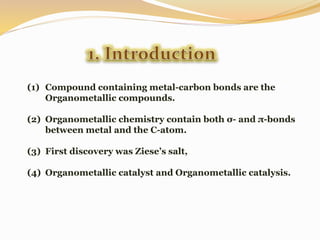
(1) Compound containing metal-carbon bonds are the
Organometallic compounds.
(2) Organometallic chemistry contain both σ- and π-bonds
between metal and the C-atom.
(3) First discovery was Ziese’s salt,
(4) Organometallic catalyst and Organometallic catalysis.
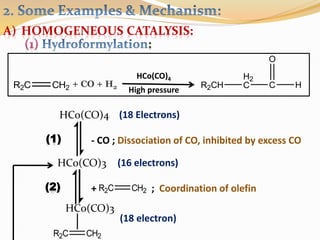
A) HOMOGENEOUS CATALYSIS:
CH2R2C + CO + H2 R2CH
H2
C C H
O
HCo(CO)4
HCo(CO)3
HCo(CO)3
R2C CH2
(1)
(2)
(18 Electrons)
- CO ; Dissociation of CO, inhibited by excess CO
(16 electrons)
+ ; Coordination of olefin
(18 electron)
R2C CH2
HCo(CO)4
High pressure
R2C
H2
C Co(CO)3
H
R2C
H2
C Co(CO)4
H
R2C
H2
C C
H
Co(CO)3
O
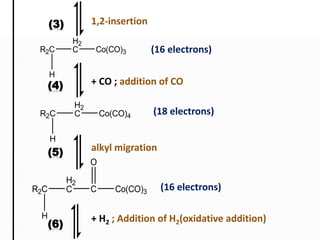
(3)
(4)
(5)
(6)
1,2-insertion
(16 electrons)
+ CO ; addition of CO
(18 electrons)
alkyl migration
(16 electrons)
+ H2 ; Addition of H2(oxidative addition)
R2C
H2
C C
H
Co(CO)3
O H
H
R2C
H2
C C
H
H
O
+ HCo(CO)3
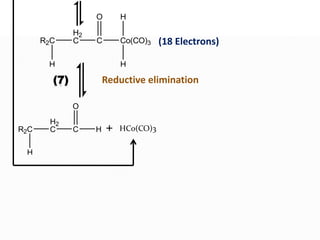
(7)
(18 Electrons)
Reductive elimination
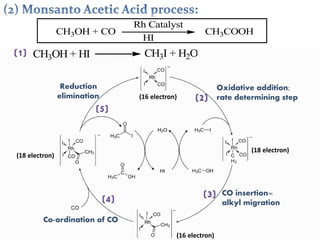
CH3OH + CO
Rh Catalyst
HI
CH3COOH
(16 electron)
(18 electron)
(2)
(3)(4)
(5)
Oxidative addition;
rate determining step
CO insertion=
alkyl migration
(16 electron)
Co-ordination of CO
Reduction
elimination
(18 electron)
(1) CH3OH + HI CH3I + H2O
H2C CH2
[PdCl4]2-
H2O
H3C C
O
H
Pd
Cl
Cl
Cl
Cl
Pd
Cl
Cl
Cl
CH2
H2C
+ Cl-
H2C CH2
Pd
H2O Cl
Cl
CH2
H2C
+ Cl-
Pd
OH2 Cl
Cl CH2CH2OH
+ H+
+ H2O
H2O:
Details: Pd
Cl OH2
Cl
HO:
H
C
H2
H
H3C C
OH
H
+ Pd[0]
+ 2Cl- + H2O
H3C C
OH
H + Pd[0] + 2Cl-
Catalyst
regenerated
by reaction
with CuCl2
H3C C
O
H + H+
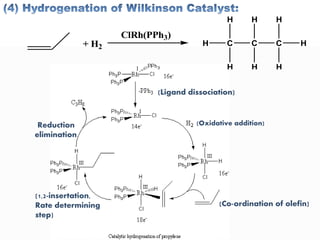
+ H2
ClRh(PPh3)
H C C C
H H
H H
H
H
H
(Oxidative addition)
(Ligand dissociation)
(Co-ordination of olefin)
(1,2-insertation,
Rate determining
step)
Reduction
elimination
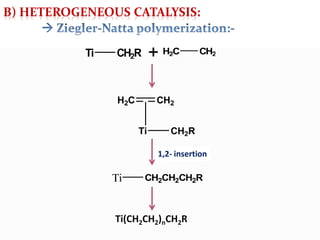
B) HETEROGENEOUS CATALYSIS:
Ti CH2R H2C CH2
H2C CH2
Ti CH2R
1,2- insertion
Ti CH2CH2CH2R
Ti(CH2CH2)nCH2R
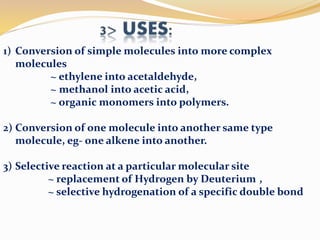
1) Conversion of simple molecules into more complex
molecules
~ ethylene into acetaldehyde,
~ methanol into acetic acid,
~ organic monomers into polymers.
2) Conversion of one molecule into another same type
molecule, eg- one alkene into another.
3) Selective reaction at a particular molecular site
~ replacement of Hydrogen by Deuterium ,
~ selective hydrogenation of a specific double bond
1) INORGANIC CHEMISTRY(Third edition)
-Gary L. Miessler & Donald A. Tarr
2) INORGANIC CHEMISTRY-Principal , Structure & Reactivity(4th Edition)
- James E. Huheey, Keiter & Keiter
3) INTERNET SOURCES
Organometallic catalysis

Organometallic catalysis

  • 1.
    Presented by: Biswajit Moran M.Sc. 4th semester Chemistry Department
  • 2.
    (1) Introduction (2) SomeExamples and Their Mechanism (3) Uses (4) References (5) Acknowledgement
  • 3.
    (1) Compound containingmetal-carbon bonds are the Organometallic compounds. (2) Organometallic chemistry contain both σ- and π-bonds between metal and the C-atom. (3) First discovery was Ziese’s salt, (4) Organometallic catalyst and Organometallic catalysis.
  • 4.
    A) HOMOGENEOUS CATALYSIS: CH2R2C+ CO + H2 R2CH H2 C C H O HCo(CO)4 HCo(CO)3 HCo(CO)3 R2C CH2 (1) (2) (18 Electrons) - CO ; Dissociation of CO, inhibited by excess CO (16 electrons) + ; Coordination of olefin (18 electron) R2C CH2 HCo(CO)4 High pressure
  • 5.
    R2C H2 C Co(CO)3 H R2C H2 C Co(CO)4 H R2C H2 CC H Co(CO)3 O (3) (4) (5) (6) 1,2-insertion (16 electrons) + CO ; addition of CO (18 electrons) alkyl migration (16 electrons) + H2 ; Addition of H2(oxidative addition)
  • 6.
    R2C H2 C C H Co(CO)3 O H H R2C H2 CC H H O + HCo(CO)3 (7) (18 Electrons) Reductive elimination
  • 7.
    CH3OH + CO RhCatalyst HI CH3COOH (16 electron) (18 electron) (2) (3)(4) (5) Oxidative addition; rate determining step CO insertion= alkyl migration (16 electron) Co-ordination of CO Reduction elimination (18 electron) (1) CH3OH + HI CH3I + H2O
  • 8.
  • 9.
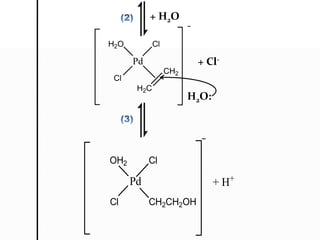
    Pd H2O Cl Cl CH2 H2C + Cl- Pd OH2Cl Cl CH2CH2OH + H+ + H2O H2O:
  • 10.
    Details: Pd Cl OH2 Cl HO: H C H2 H H3CC OH H + Pd[0] + 2Cl- + H2O H3C C OH H + Pd[0] + 2Cl- Catalyst regenerated by reaction with CuCl2 H3C C O H + H+
  • 11.
    + H2 ClRh(PPh3) H CC C H H H H H H H (Oxidative addition) (Ligand dissociation) (Co-ordination of olefin) (1,2-insertation, Rate determining step) Reduction elimination
  • 12.
    B) HETEROGENEOUS CATALYSIS: TiCH2R H2C CH2 H2C CH2 Ti CH2R 1,2- insertion Ti CH2CH2CH2R Ti(CH2CH2)nCH2R
  • 13.
    1) Conversion ofsimple molecules into more complex molecules ~ ethylene into acetaldehyde, ~ methanol into acetic acid, ~ organic monomers into polymers. 2) Conversion of one molecule into another same type molecule, eg- one alkene into another. 3) Selective reaction at a particular molecular site ~ replacement of Hydrogen by Deuterium , ~ selective hydrogenation of a specific double bond
  • 14.
    1) INORGANIC CHEMISTRY(Thirdedition) -Gary L. Miessler & Donald A. Tarr 2) INORGANIC CHEMISTRY-Principal , Structure & Reactivity(4th Edition) - James E. Huheey, Keiter & Keiter 3) INTERNET SOURCES