WELCOME
SEED CERTIFICATION,
QUALITY, PACKAGING
AND STORAGE
Submitted by - Avisha Ram Budhani
1st semester M.Sc. (Horticulture)
ASPEE College of Horticulture & Forestry
Navsari Agricultural University, Navsari
Submitted to – Dr. B.M. Tandel
Associate Professor
Department of Fruit Science
ASPEE College of Horticulture & Forestry
Navsari Agricultural University, Navsari
Definition of Seed
Seed is a basic agricultural input and it is an embryo,
embedded in the food storage tissue. Seed is also defined as a
matured ovule which consists of an embryonic plant with
storage of food and surrounded by a protective seed coat.
Structure of Seed Industry in India
Seed Sector
Seed sector in India is of two types namely formal and
informal. Informal sector is the one where farmers produce
seeds without following certification procedures and exchange
it amongst themselves. The formal type of seed sector follows
seed certification procedures and standards to produce a
particular variety of seed.
Formal Informal
Centrally planned system with
mechanized production and homogenous
in nature.
System is locally planned, unmechanized
production using local resources, no
specialization, heterogeneous in space and
time.
There exists a system of Quality Control,
use of identified and notified varieties,
certified and truthfully labelled seeds.
Traditional system of seed processing, use of
local seed types, truthfully labelled and other
unlabelled seeds.
Seed production is done by National
Government Agencies, State Government
Agencies, Government Assisted and other
cooperatives, MNCs and TNCs domestic
private sector and joint ventures
Farmer saved seeds, Farmer to Farmer
exchange, Farmers Cooperatives,
Community Groups, Non- Governmental
Organizations, Seed Growers Assocaitions.
Large quantities of seeds are marketed
through Government owned companies,
private companies, State Universities.
Small quantities of seeds are marketed
through community level. Highly localized,
use of conventional and unconventional
exchange mechanisms.
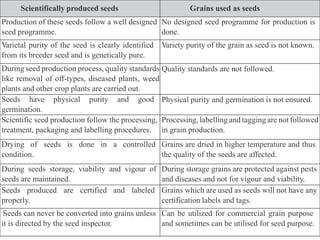
Scientifically produced seeds Grains used as seeds
Production of these seeds follow a well designed
seed programme.
No designed seed programme for production is
done.
Varietal purity of the seed is clearly identified
from its breeder seed and is genetically pure.
Variety purity of the grain as seed is not known.
During seed production process, quality standards
like removal of off-types, diseased plants, weed
plants and other crop plants are carried out.
Quality standards are not followed.
Seeds have physical purity and good
germination.
Physical purity and germination is not ensured.
Scientific seed production follow the processing,
treatment, packaging and labelling procedures.
Processing, labelling and tagging are not followed
in grain production.
Drying of seeds is done in a controlled
condition.
Grains are dried in higher temperature and thus
the quality of the seeds are affected.
During seeds storage, viability and vigour of
seeds are maintained.
During storage grains are protected against pests
and diseases and not for vigour and viability.
Seeds produced are certified and labeled
properly.
Grains which are used as seeds will not have any
certification labels and tags.
Seeds can never be converted into grains unless
it is directed by the seed inspector.
Can be utilized for commercial grain purpose
and sometimes can be utilised for seed purpose.
Classes of seed
Seed certification is a quality assurance system whereby seed
intended for marketing is subject to official control and
inspection.
Objectives of Seed Certification
The objective of seed certification is to ensure genuineness
and quality of seed to the purchaser well-organised seed
certification system helps in accomplishing the following three
primary objectives of seed programmes:
• The systematic increase of superior varieties.
• The identification of new varieties and their rapid increase
under appropriate and generally accepted names.
• Provision of a continuing supply of comparable material by
careful maintenance.
Seed Certification Agencies
Seeds Act, 1966 provides for the establishment of Seed Certification Agencies
in each State. Seed Certification Agency should function on the following broad
principles:
 Seed Certification agency should be an autonomous body.
 Seed Certification Agency should not involve itself in the production and
marketing of seeds.
 The Seed Certification Standards and procedures adapted by seed
certification agency should be uniform, throughout the country.
 Seed Certification Agency should have close linkage with the technical and
other related institutions.
 Its long-term objective should be to operate on no-profit no-loss basis.
 Adequate staff trained in seed certification should be maintained by the
Certification Agency.
 It should have provision for creating adequate facilities for ensuring timely
and through inspections.
 It should serve the interests of seed producers and farmers/users.
Indian seed programme includes the participation of Central and State
governments, Indian Council of Agricultural (ICAR), State Agricultural
Universities (SAU) system, Public sector, cooperative sector and private
sector institutions. Seed sector in India consists of two national level
corporations i.e. National Seeds Corporation (NSC) and State Farms
Corporation of India (SFCI), 15 State Seed Corporations (SSCs) and
about 100 major seed companies. For quality control and certification,
there are 22 State Seed Certification Agencies (SSCAs) and 104 state
Seed Testing Laboratories (SSTLs). The private sector has started to
play a significant role in the production and distribution of seeds.
However, the organized seed sector particularly for food crops cereals
continues to be dominated by the public sector.
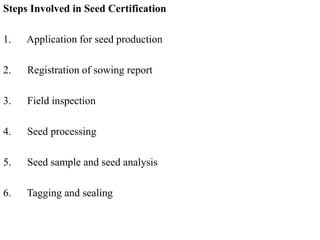
Steps Involved in Seed Certification
1. Application for seed production
2. Registration of sowing report
3. Field inspection
4. Seed processing
5. Seed sample and seed analysis
6. Tagging and sealing
1. Application for seed production
Any person who wants to take up certified seed production should
submit a sowing report in triplicate to the Assistant Director of Seed
Certification to register the crop and season with a registration fee of Rs.
25/- (Rupees twenty five only) and prescribed certification charges. The
fee is for a single crop variety for an area up to
25 acres and for a single season.
Along with this fee for seed certification the label of the seed source
should be submitted.
Seed stage Source
Foundation Stage I (F1) Breeder seed
Foundation Stage II (F2) Foundation Stage I
Certified Foundation seed-
Stage I or II
SAMPLE FORM OF SOWING REPORT
Name and address of the Producer :
Name and address of the grower :
Location of the seed farm :
a. Revenue village :
b. Block :
c. Taluk :
Crop / Variety / Acreage :
Class of seed to be produced :
Quantity of Seeds used (kg/acre) :
Source of seed :
a. Tag number :
b. Purchase Bill No. and date :
Date of sowing :
Signature of the grower :
Enclosures:
1. Tag for source of seed
2. Purchase bill of the grower
Signature of the producer
FOR OFFICE USE ONLY
Fee remitted :
Bill number and date :
Seed Certification No. :
Seed Certification Officer allotted :
Due dates for field Inspections :
Signature of Assistant Director of
Seed Certification
2. Registration of sowing report
After receiving the application of the sowing report, the Assistant Director of
Seed Certification scrutinizes and registers the seed farm and duly assigns a
Seed certification number for each sowing report.
3. Field Inspection
The objective of the field inspection is to check for the factors that may affect
the genetic purity and physical health of the seeds. Field inspection will be
conducted by the Seed Certification
Officer (SCO) to whom the specific seed farm has been allocated. The specific
date of inspection and details of the seed farm will be intimated by the Seed
Certification Officer through a copy of the sowing report sent to him. Number
of field inspections will differ from crop to crop depending upon the growth
stages of the crop. Generally field inspections would be carried out during the
following growth stages of the crop.
• Pre flowering stage
• Flowering stage
• Post flowering and Pre harvest stage
• Harvest time
4. Seed Processing
Once the seeds are harvested from the seed farm by following the
required field standards, it should be taken to the processing plant.
Processing should be done only in the approved seed processing units.
Each seed lot should accompany the processing report and each seed lot
in the unit is verified with this report. Processing includes cleaning,
drying, grading, treating and other operations to improve the seed
quality. Seed Certification Officer will inspect the processing plant to
check the possibility of mechanical mixtures. The seed lot should
correlate with the estimated yield. Seed lots should have prescribed
moisture level with proper labeling. Processed seeds should be properly
weighed, bagged, sealed and labeled. Assigning lot numbers is done at
this stage as below: E.g. Apr 13-22-10-01
It means,
APR 13 represents seed harvested in April’13.
22 – seed crop raised in Tamil Nadu State.
10 – seed processing unit number
01 – seed produce code
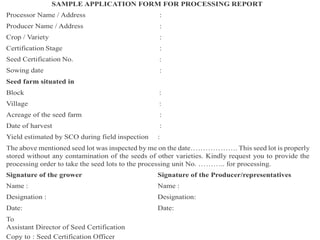
SAMPLE APPLICATION FORM FOR PROCESSING REPORT
Processor Name / Address :
Producer Name / Address :
Crop / Variety :
Certification Stage :
Seed Certification No. :
Sowing date :
Seed farm situated in
Block :
Village :
Acreage of the seed farm :
Date of harvest :
Yield estimated by SCO during field inspection :
The above mentioned seed lot was inspected by me on the date………………. This seed lot is properly
stored without any contamination of the seeds of other varieties. Kindly request you to provide the
processing order to take the seed lots to the processing unit No. ……….. for processing.
Signature of the grower Signature of the Producer/representatives
Name : Name :
Designation : Designation:
Date: Date:
To
Assistant Director of Seed Certification
Copy to : Seed Certification Officer
5. Seed sampling and analysis
Seed sample should be sent to the seed testing laboratory for analysis
through the Assistant Director of Seed Certification. The fee of Rs.30/-
(Rupees thirty only) for seed analysis should be paid during the
registration of the seed farm. To analyse the genetic purity of the seed
sample, the producer should pay a fee of Rs. 200/- (Rupees two hundred
only) to the Assistant Director of Seed Certification.
Seed lots which meet the prescribed seed standards like purity, free of
inert matter, moisture percentage and germination capacity alone will be
allotted the certification label. White colour label for foundation seeds
and blue colour label for certified seeds should be bought from the
Assistant Director of Seed Certification by paying Rs. 3 and Rs. 2
respectively.
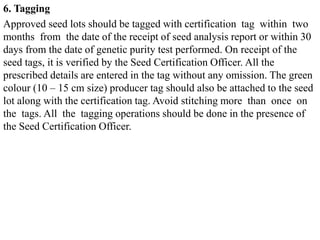
6. Tagging
Approved seed lots should be tagged with certification tag within two
months from the date of the receipt of seed analysis report or within 30
days from the date of genetic purity test performed. On receipt of the
seed tags, it is verified by the Seed Certification Officer. All the
prescribed details are entered in the tag without any omission. The green
colour (10 – 15 cm size) producer tag should also be attached to the seed
lot along with the certification tag. Avoid stitching more than once on
the tags. All the tagging operations should be done in the presence of
the Seed Certification Officer.
Characteristics of Quality seeds
• Genetic purity
• Physical purity
• Seed germination and vigour
• Seed viability
• Freedom from weeds and other crop seeds
• Seed health
• Seed moisture
• Seed size, weight and specific gravity
• Colour
Benefits of using quality seeds
1. They are genetically pure (true to type).
2. The good quality seed has high return per unit area as the genetic
potentiality of the crop can be fully exploited.
3. Less infestation of land with weed seed/other crop seeds.
4. Less disease and insect problem.
5. Minimization of seed/seedling rate i.e., fast and uniform emergence of
seedling.
6. They are vigorous, free from pests and disease.
7. They can be adopted themselves for extreme climatic condition and
cropping system of the location.
8. The quality seed respond well to the applied fertilizers and nutrients.
9. Uniform in plant population and maturity.
10. Crop raised with quality seed are aesthetically pleasing.
11. Good seed prolongs life of a variety.
12. Yield prediction is very easy.
13. Handling in post-harvest operation will be easy.
14. Preparations of finished products are also better.
15. High produce value and their marketability.
Role of improved seeds:
1. Carrier of new technology
2. Basic tool for a secure food supply
3. The principle means to obtain crop yields in less favourable
production area
4. Medium for rapid rehabilitation of agriculture after natural disasters.
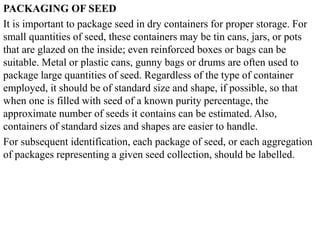
PACKAGING OF SEED
It is important to package seed in dry containers for proper storage. For
small quantities of seed, these containers may be tin cans, jars, or pots
that are glazed on the inside; even reinforced boxes or bags can be
suitable. Metal or plastic cans, gunny bags or drums are often used to
package large quantities of seed. Regardless of the type of container
employed, it should be of standard size and shape, if possible, so that
when one is filled with seed of a known purity percentage, the
approximate number of seeds it contains can be estimated. Also,
containers of standard sizes and shapes are easier to handle.
For subsequent identification, each package of seed, or each aggregation
of packages representing a given seed collection, should be labelled.
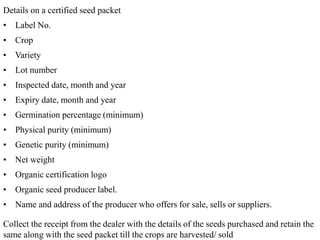
Details on a certified seed packet
• Label No.
• Crop
• Variety
• Lot number
• Inspected date, month and year
• Expiry date, month and year
• Germination percentage (minimum)
• Physical purity (minimum)
• Genetic purity (minimum)
• Net weight
• Organic certification logo
• Organic seed producer label.
• Name and address of the producer who offers for sale, sells or suppliers.
Collect the receipt from the dealer with the details of the seeds purchased and retain the
same along with the seed packet till the crops are harvested/ sold
What is seed storage?
Preservation of seed with initial quality until it is needed for planting.
Objective of seed storage
To maintain initial seed quality viz., germination, physical purity, vigour
etc., all along the storage period by providing suitable or even better
conditions.
Since the main objective of seed storage is maintenance of an acceptable
capacity for germination and emergence, it can only be accomplished by
reducing the rate of deterioration to the degree required to maintain an
acceptable level of quality for the desired period.
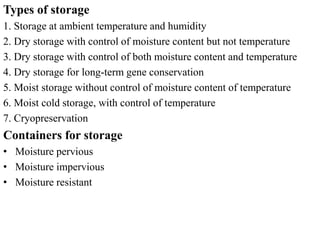
Types of storage
1. Storage at ambient temperature and humidity
2. Dry storage with control of moisture content but not temperature
3. Dry storage with control of both moisture content and temperature
4. Dry storage for long-term gene conservation
5. Moist storage without control of moisture content of temperature
6. Moist cold storage, with control of temperature
7. Cryopreservation
Containers for storage
• Moisture pervious
• Moisture impervious
• Moisture resistant
Seed certification, quality, packaging and storage

Seed certification, quality, packaging and storage

  • 1.
  • 2.
  • 3.
    Submitted by -Avisha Ram Budhani 1st semester M.Sc. (Horticulture) ASPEE College of Horticulture & Forestry Navsari Agricultural University, Navsari Submitted to – Dr. B.M. Tandel Associate Professor Department of Fruit Science ASPEE College of Horticulture & Forestry Navsari Agricultural University, Navsari
  • 4.
    Definition of Seed Seedis a basic agricultural input and it is an embryo, embedded in the food storage tissue. Seed is also defined as a matured ovule which consists of an embryonic plant with storage of food and surrounded by a protective seed coat. Structure of Seed Industry in India Seed Sector Seed sector in India is of two types namely formal and informal. Informal sector is the one where farmers produce seeds without following certification procedures and exchange it amongst themselves. The formal type of seed sector follows seed certification procedures and standards to produce a particular variety of seed.
  • 5.
    Formal Informal Centrally plannedsystem with mechanized production and homogenous in nature. System is locally planned, unmechanized production using local resources, no specialization, heterogeneous in space and time. There exists a system of Quality Control, use of identified and notified varieties, certified and truthfully labelled seeds. Traditional system of seed processing, use of local seed types, truthfully labelled and other unlabelled seeds. Seed production is done by National Government Agencies, State Government Agencies, Government Assisted and other cooperatives, MNCs and TNCs domestic private sector and joint ventures Farmer saved seeds, Farmer to Farmer exchange, Farmers Cooperatives, Community Groups, Non- Governmental Organizations, Seed Growers Assocaitions. Large quantities of seeds are marketed through Government owned companies, private companies, State Universities. Small quantities of seeds are marketed through community level. Highly localized, use of conventional and unconventional exchange mechanisms.
  • 6.
    Scientifically produced seedsGrains used as seeds Production of these seeds follow a well designed seed programme. No designed seed programme for production is done. Varietal purity of the seed is clearly identified from its breeder seed and is genetically pure. Variety purity of the grain as seed is not known. During seed production process, quality standards like removal of off-types, diseased plants, weed plants and other crop plants are carried out. Quality standards are not followed. Seeds have physical purity and good germination. Physical purity and germination is not ensured. Scientific seed production follow the processing, treatment, packaging and labelling procedures. Processing, labelling and tagging are not followed in grain production. Drying of seeds is done in a controlled condition. Grains are dried in higher temperature and thus the quality of the seeds are affected. During seeds storage, viability and vigour of seeds are maintained. During storage grains are protected against pests and diseases and not for vigour and viability. Seeds produced are certified and labeled properly. Grains which are used as seeds will not have any certification labels and tags. Seeds can never be converted into grains unless it is directed by the seed inspector. Can be utilized for commercial grain purpose and sometimes can be utilised for seed purpose.
  • 7.
  • 9.
    Seed certification isa quality assurance system whereby seed intended for marketing is subject to official control and inspection. Objectives of Seed Certification The objective of seed certification is to ensure genuineness and quality of seed to the purchaser well-organised seed certification system helps in accomplishing the following three primary objectives of seed programmes: • The systematic increase of superior varieties. • The identification of new varieties and their rapid increase under appropriate and generally accepted names. • Provision of a continuing supply of comparable material by careful maintenance.
  • 10.
    Seed Certification Agencies SeedsAct, 1966 provides for the establishment of Seed Certification Agencies in each State. Seed Certification Agency should function on the following broad principles:  Seed Certification agency should be an autonomous body.  Seed Certification Agency should not involve itself in the production and marketing of seeds.  The Seed Certification Standards and procedures adapted by seed certification agency should be uniform, throughout the country.  Seed Certification Agency should have close linkage with the technical and other related institutions.  Its long-term objective should be to operate on no-profit no-loss basis.  Adequate staff trained in seed certification should be maintained by the Certification Agency.  It should have provision for creating adequate facilities for ensuring timely and through inspections.  It should serve the interests of seed producers and farmers/users.
  • 11.
    Indian seed programmeincludes the participation of Central and State governments, Indian Council of Agricultural (ICAR), State Agricultural Universities (SAU) system, Public sector, cooperative sector and private sector institutions. Seed sector in India consists of two national level corporations i.e. National Seeds Corporation (NSC) and State Farms Corporation of India (SFCI), 15 State Seed Corporations (SSCs) and about 100 major seed companies. For quality control and certification, there are 22 State Seed Certification Agencies (SSCAs) and 104 state Seed Testing Laboratories (SSTLs). The private sector has started to play a significant role in the production and distribution of seeds. However, the organized seed sector particularly for food crops cereals continues to be dominated by the public sector.
  • 12.
    Steps Involved inSeed Certification 1. Application for seed production 2. Registration of sowing report 3. Field inspection 4. Seed processing 5. Seed sample and seed analysis 6. Tagging and sealing
  • 13.
    1. Application forseed production Any person who wants to take up certified seed production should submit a sowing report in triplicate to the Assistant Director of Seed Certification to register the crop and season with a registration fee of Rs. 25/- (Rupees twenty five only) and prescribed certification charges. The fee is for a single crop variety for an area up to 25 acres and for a single season. Along with this fee for seed certification the label of the seed source should be submitted. Seed stage Source Foundation Stage I (F1) Breeder seed Foundation Stage II (F2) Foundation Stage I Certified Foundation seed- Stage I or II
  • 14.
    SAMPLE FORM OFSOWING REPORT Name and address of the Producer : Name and address of the grower : Location of the seed farm : a. Revenue village : b. Block : c. Taluk : Crop / Variety / Acreage : Class of seed to be produced : Quantity of Seeds used (kg/acre) : Source of seed : a. Tag number : b. Purchase Bill No. and date : Date of sowing : Signature of the grower : Enclosures: 1. Tag for source of seed 2. Purchase bill of the grower Signature of the producer FOR OFFICE USE ONLY Fee remitted : Bill number and date : Seed Certification No. : Seed Certification Officer allotted : Due dates for field Inspections : Signature of Assistant Director of Seed Certification
  • 15.
    2. Registration ofsowing report After receiving the application of the sowing report, the Assistant Director of Seed Certification scrutinizes and registers the seed farm and duly assigns a Seed certification number for each sowing report. 3. Field Inspection The objective of the field inspection is to check for the factors that may affect the genetic purity and physical health of the seeds. Field inspection will be conducted by the Seed Certification Officer (SCO) to whom the specific seed farm has been allocated. The specific date of inspection and details of the seed farm will be intimated by the Seed Certification Officer through a copy of the sowing report sent to him. Number of field inspections will differ from crop to crop depending upon the growth stages of the crop. Generally field inspections would be carried out during the following growth stages of the crop. • Pre flowering stage • Flowering stage • Post flowering and Pre harvest stage • Harvest time
  • 16.
    4. Seed Processing Oncethe seeds are harvested from the seed farm by following the required field standards, it should be taken to the processing plant. Processing should be done only in the approved seed processing units. Each seed lot should accompany the processing report and each seed lot in the unit is verified with this report. Processing includes cleaning, drying, grading, treating and other operations to improve the seed quality. Seed Certification Officer will inspect the processing plant to check the possibility of mechanical mixtures. The seed lot should correlate with the estimated yield. Seed lots should have prescribed moisture level with proper labeling. Processed seeds should be properly weighed, bagged, sealed and labeled. Assigning lot numbers is done at this stage as below: E.g. Apr 13-22-10-01 It means, APR 13 represents seed harvested in April’13. 22 – seed crop raised in Tamil Nadu State. 10 – seed processing unit number 01 – seed produce code
  • 17.
    SAMPLE APPLICATION FORMFOR PROCESSING REPORT Processor Name / Address : Producer Name / Address : Crop / Variety : Certification Stage : Seed Certification No. : Sowing date : Seed farm situated in Block : Village : Acreage of the seed farm : Date of harvest : Yield estimated by SCO during field inspection : The above mentioned seed lot was inspected by me on the date………………. This seed lot is properly stored without any contamination of the seeds of other varieties. Kindly request you to provide the processing order to take the seed lots to the processing unit No. ……….. for processing. Signature of the grower Signature of the Producer/representatives Name : Name : Designation : Designation: Date: Date: To Assistant Director of Seed Certification Copy to : Seed Certification Officer
  • 18.
    5. Seed samplingand analysis Seed sample should be sent to the seed testing laboratory for analysis through the Assistant Director of Seed Certification. The fee of Rs.30/- (Rupees thirty only) for seed analysis should be paid during the registration of the seed farm. To analyse the genetic purity of the seed sample, the producer should pay a fee of Rs. 200/- (Rupees two hundred only) to the Assistant Director of Seed Certification. Seed lots which meet the prescribed seed standards like purity, free of inert matter, moisture percentage and germination capacity alone will be allotted the certification label. White colour label for foundation seeds and blue colour label for certified seeds should be bought from the Assistant Director of Seed Certification by paying Rs. 3 and Rs. 2 respectively.
  • 19.
    6. Tagging Approved seedlots should be tagged with certification tag within two months from the date of the receipt of seed analysis report or within 30 days from the date of genetic purity test performed. On receipt of the seed tags, it is verified by the Seed Certification Officer. All the prescribed details are entered in the tag without any omission. The green colour (10 – 15 cm size) producer tag should also be attached to the seed lot along with the certification tag. Avoid stitching more than once on the tags. All the tagging operations should be done in the presence of the Seed Certification Officer.
  • 20.
    Characteristics of Qualityseeds • Genetic purity • Physical purity • Seed germination and vigour • Seed viability • Freedom from weeds and other crop seeds • Seed health • Seed moisture • Seed size, weight and specific gravity • Colour
  • 21.
    Benefits of usingquality seeds 1. They are genetically pure (true to type). 2. The good quality seed has high return per unit area as the genetic potentiality of the crop can be fully exploited. 3. Less infestation of land with weed seed/other crop seeds. 4. Less disease and insect problem. 5. Minimization of seed/seedling rate i.e., fast and uniform emergence of seedling. 6. They are vigorous, free from pests and disease. 7. They can be adopted themselves for extreme climatic condition and cropping system of the location. 8. The quality seed respond well to the applied fertilizers and nutrients. 9. Uniform in plant population and maturity. 10. Crop raised with quality seed are aesthetically pleasing. 11. Good seed prolongs life of a variety. 12. Yield prediction is very easy. 13. Handling in post-harvest operation will be easy. 14. Preparations of finished products are also better. 15. High produce value and their marketability.
  • 22.
    Role of improvedseeds: 1. Carrier of new technology 2. Basic tool for a secure food supply 3. The principle means to obtain crop yields in less favourable production area 4. Medium for rapid rehabilitation of agriculture after natural disasters.
  • 23.
    PACKAGING OF SEED Itis important to package seed in dry containers for proper storage. For small quantities of seed, these containers may be tin cans, jars, or pots that are glazed on the inside; even reinforced boxes or bags can be suitable. Metal or plastic cans, gunny bags or drums are often used to package large quantities of seed. Regardless of the type of container employed, it should be of standard size and shape, if possible, so that when one is filled with seed of a known purity percentage, the approximate number of seeds it contains can be estimated. Also, containers of standard sizes and shapes are easier to handle. For subsequent identification, each package of seed, or each aggregation of packages representing a given seed collection, should be labelled.
  • 24.
    Details on acertified seed packet • Label No. • Crop • Variety • Lot number • Inspected date, month and year • Expiry date, month and year • Germination percentage (minimum) • Physical purity (minimum) • Genetic purity (minimum) • Net weight • Organic certification logo • Organic seed producer label. • Name and address of the producer who offers for sale, sells or suppliers. Collect the receipt from the dealer with the details of the seeds purchased and retain the same along with the seed packet till the crops are harvested/ sold
  • 26.
    What is seedstorage? Preservation of seed with initial quality until it is needed for planting. Objective of seed storage To maintain initial seed quality viz., germination, physical purity, vigour etc., all along the storage period by providing suitable or even better conditions. Since the main objective of seed storage is maintenance of an acceptable capacity for germination and emergence, it can only be accomplished by reducing the rate of deterioration to the degree required to maintain an acceptable level of quality for the desired period.
  • 27.
    Types of storage 1.Storage at ambient temperature and humidity 2. Dry storage with control of moisture content but not temperature 3. Dry storage with control of both moisture content and temperature 4. Dry storage for long-term gene conservation 5. Moist storage without control of moisture content of temperature 6. Moist cold storage, with control of temperature 7. Cryopreservation Containers for storage • Moisture pervious • Moisture impervious • Moisture resistant