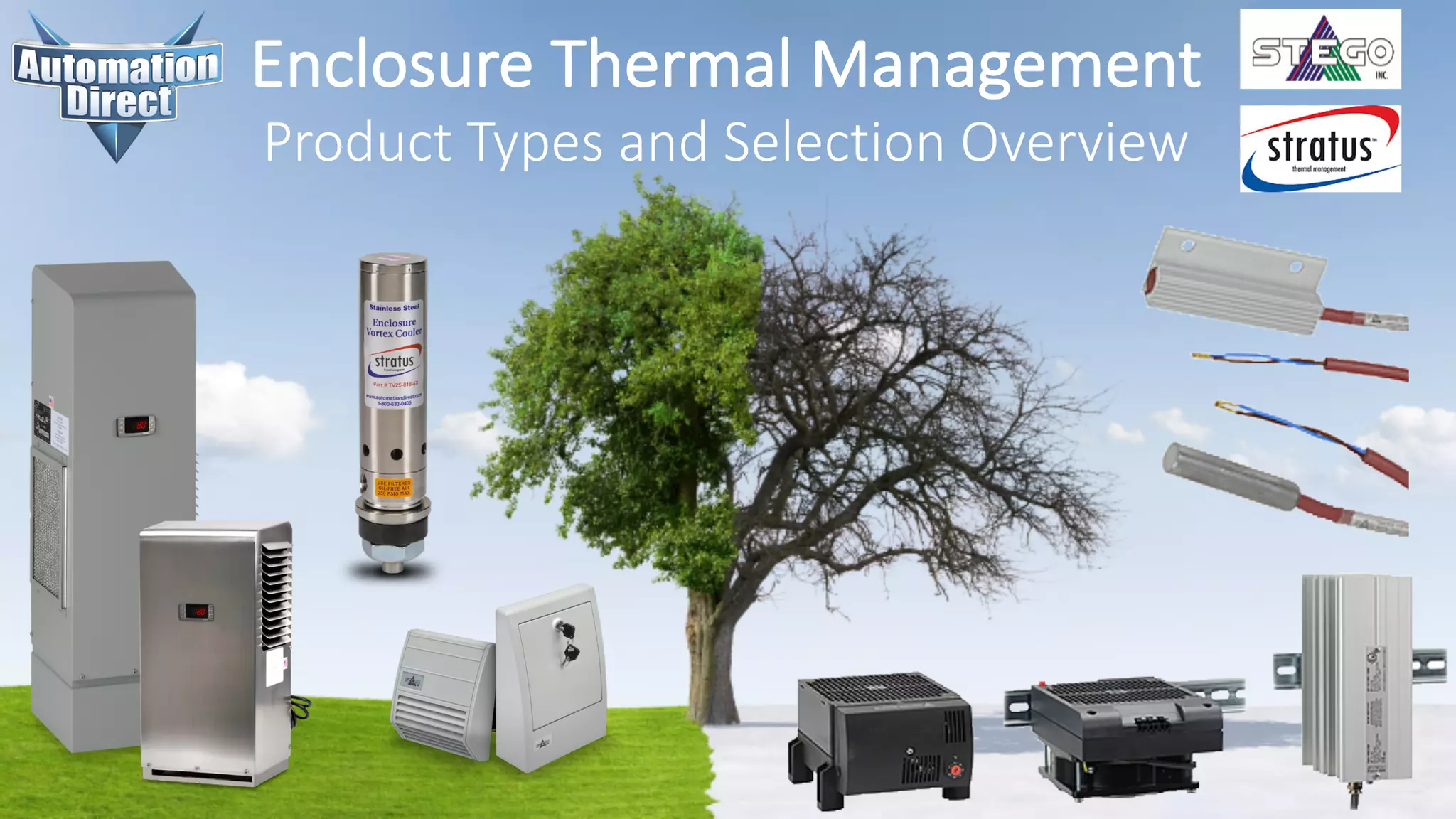
Enclosure	Thermal	Management
Product	Types	and	Selection	Overview
Reasons	to	Control	Enclosure	Climate
Industrial facilities have lots of enclosures housing
automation and electrical/electronic components, many of
which need cooling and/or heating.
When fluctuating temperatures exist, heating and cooling
are required to maintain optimal operating temperatures
that keep components from overheating or condensation
from forming.
Heat	Transfer
Controlling an enclosure’s climate is done by transferring heat into or
out of the enclosure. There are three basic heat transfer mechanisms:
1. Convection: The movement of heat through a moving fluid (a gas
or a liquid) or from a moving fluid to the surface of a solid.
2. Conduction: The flow of heat through solid material or between
two solids.
3. Radiation: The transfer of thermal energy via conversion to and
from electro-magnetic energy (light).
Convection is the primary mechanism used to control the climate inside
an enclosure because the air inside the enclosure is the most effective
means to transmit heat between the enclosure components and the
heating and/or cooling devices.
Convection
One of the factors that affects the rate of heat transfer inside an enclosure is the
movement of the air inside the enclosure. The faster the air moves inside the enclosure,
the faster the heat transfer occurs. This results in two basic types of convection:
• Natural Convection: Air expands (becomes less dense) as it warms and contracts
(more dense) when it cools. So whenever the air meets a heat source inside an
enclosure, that air expands and rises. The space that air occupied is then replaced by
cooler air, which is heated, expands, rises and gets replaced. This continuous cycle
causes air to circulate inside the enclosure.
• Forced Convection: Air movement created by an artificial means, typically a fan.
Within the context of enclosure climate control, forced convection is utilized when
higher heat transfer rates (more heating or cooling) is needed. But don’t discount the
power	of	natural	convection	– natural	convection	can	create	a	hurricane;	
there’s	no	fan	big	enough	for	that!
Reasons	for	Enclosure	Heating
• Enclosure heating is NOT for keeping internal components warm.
Electric and electronic components typically perform better at colder
temperatures.
• As temperature drops, the capacity for air to hold water vapor is
reduced, so the relative humidity of the air increases (even if the
amount of water vapor remains constant).
• Moisture and corrosion become a problem when relative air humidity is
above 65%. So the goal of enclosure heating is to keep the relative
humidity inside the enclosure below 65%.
• Temperature must be consistent to guarantee optimal operating
conditions and prevent condensation.
Enclosure	Heating	Considerations
• In some applications, an enclosure may need to be cooled during day
and heated at night.
• Heater placement is important. Ideally, optimal performance is achieved
by placing heater near the enclosure bottom to allow natural convection
to distribute the heat. Review specific heater recommendations.
• Larger enclosures often require fan heaters to distribute the heat
throughout the enclosure. Generally, heaters over 150 Watts will include
an axial fan to move the heat throughout the enclosure.
Selecting	an	Enclosure	Heater
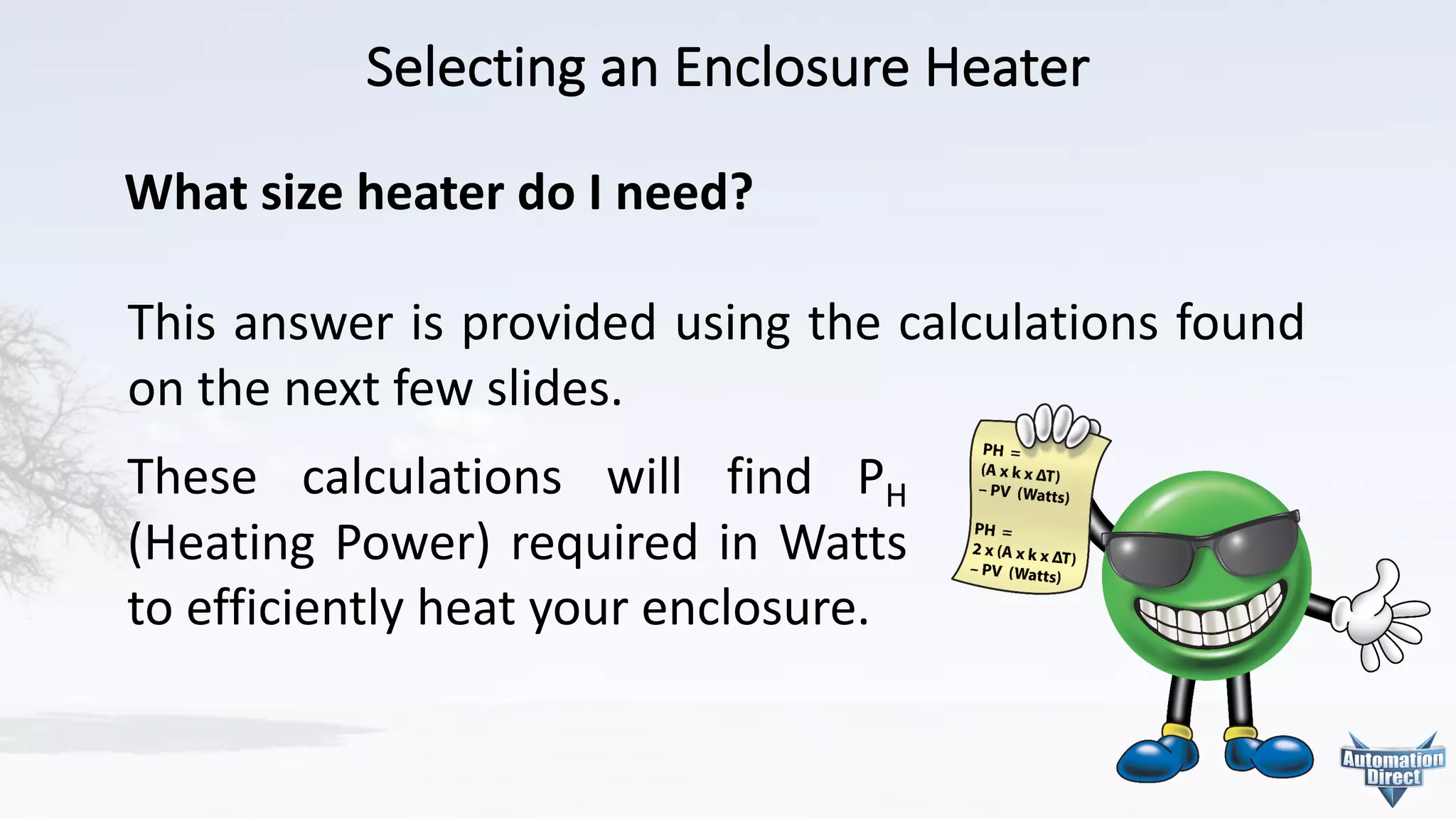
This answer is provided using the calculations found
on the next few slides.
What size heater do I need?
These calculations will find PH
(Heating Power) required in Watts
to efficiently heat your enclosure.
Selecting	an	Enclosure	Heater
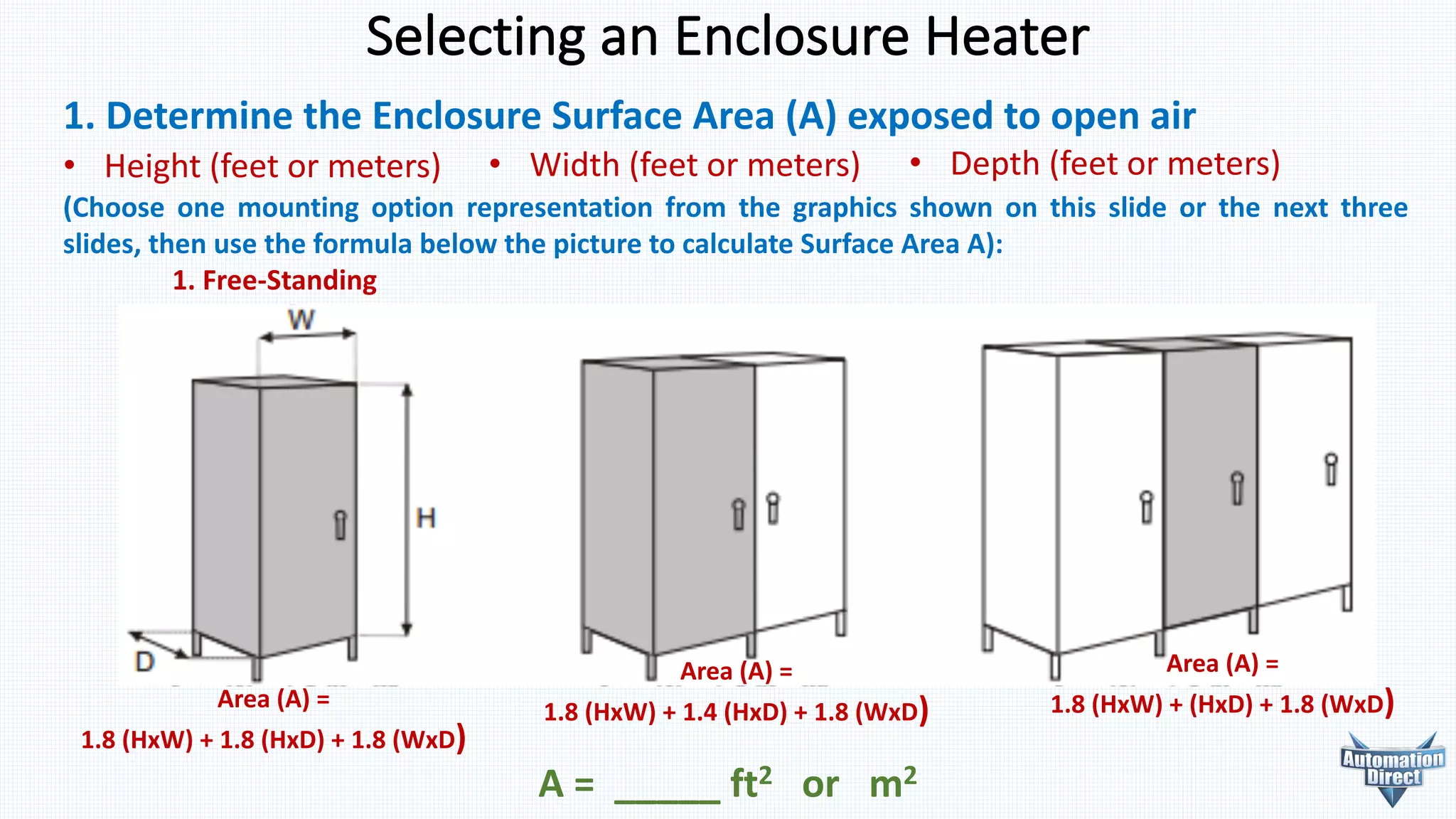
1. Determine	the	Enclosure	Surface	Area	(A)	exposed	to	open	air
• Height (feet or meters) • Width (feet or meters) • Depth (feet or meters)
(Choose one mounting option representation from the graphics shown on this slide or the next three
slides, then use the formula below the picture to calculate Surface Area A):
1. Free-Standing
A	=	 _____	ft2 or			m2
Area	(A)	=
1.8	(HxW)	+	1.8	(HxD)	+	1.8	(WxD)
Area	(A)	=
1.8	(HxW)	+	1.4	(HxD)	+	1.8	(WxD)
Area	(A)	=
1.8	(HxW)	+	(HxD)	+	1.8	(WxD)
Selecting	an	Enclosure	Heater	(continued)
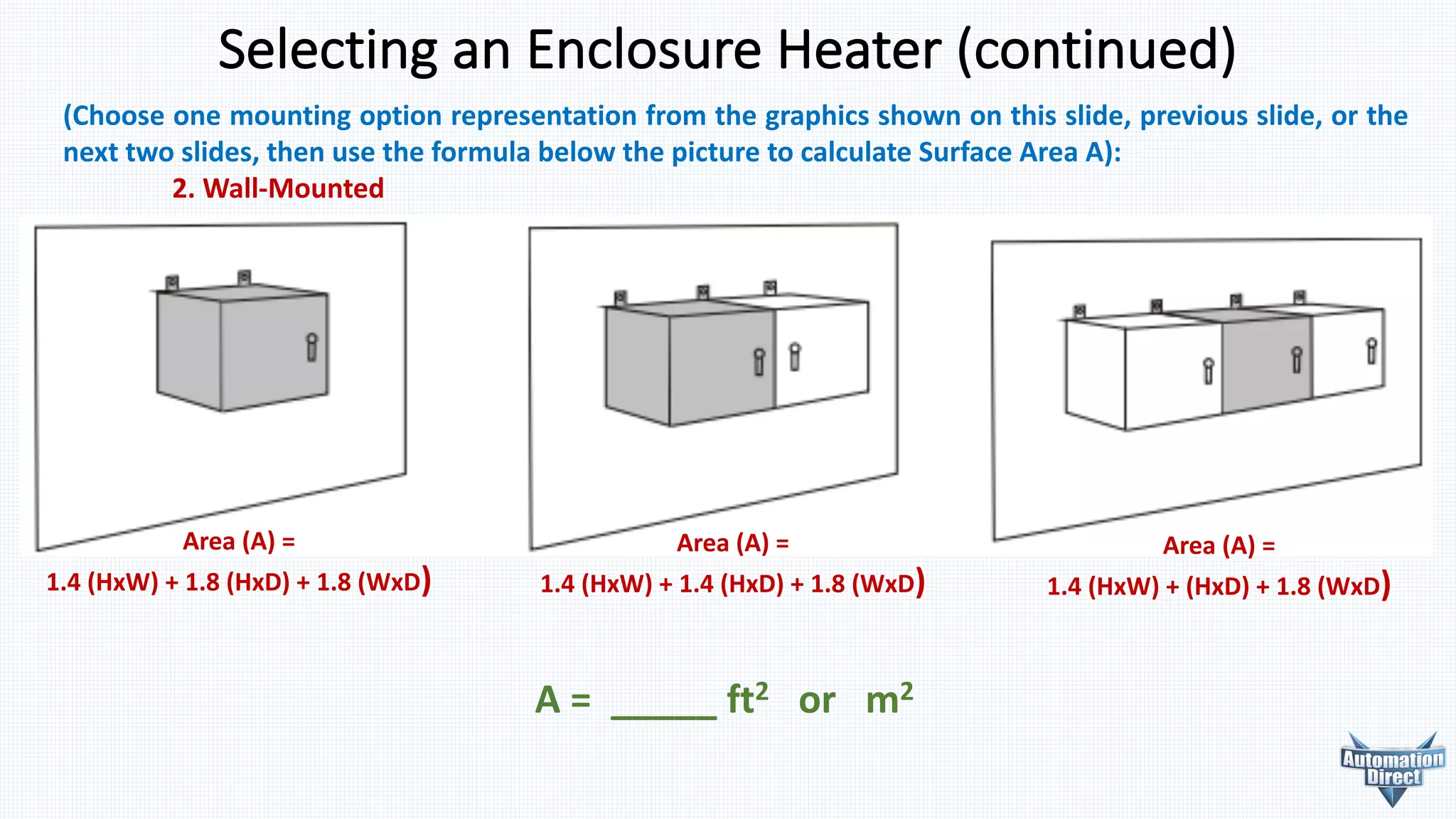
(Choose one mounting option representation from the graphics shown on this slide, previous slide, or the
next two slides, then use the formula below the picture to calculate Surface Area A):
2. Wall-Mounted
A	=	 _____	ft2 or			m2
Area	(A)	=
1.4	(HxW)	+	1.8	(HxD)	+	1.8	(WxD)
Area	(A)	=
1.4	(HxW)	+	1.4	(HxD)	+	1.8	(WxD)
Area	(A)	=
1.4	(HxW)	+	(HxD)	+	1.8	(WxD)
Selecting	an	Enclosure	Heater	(continued)
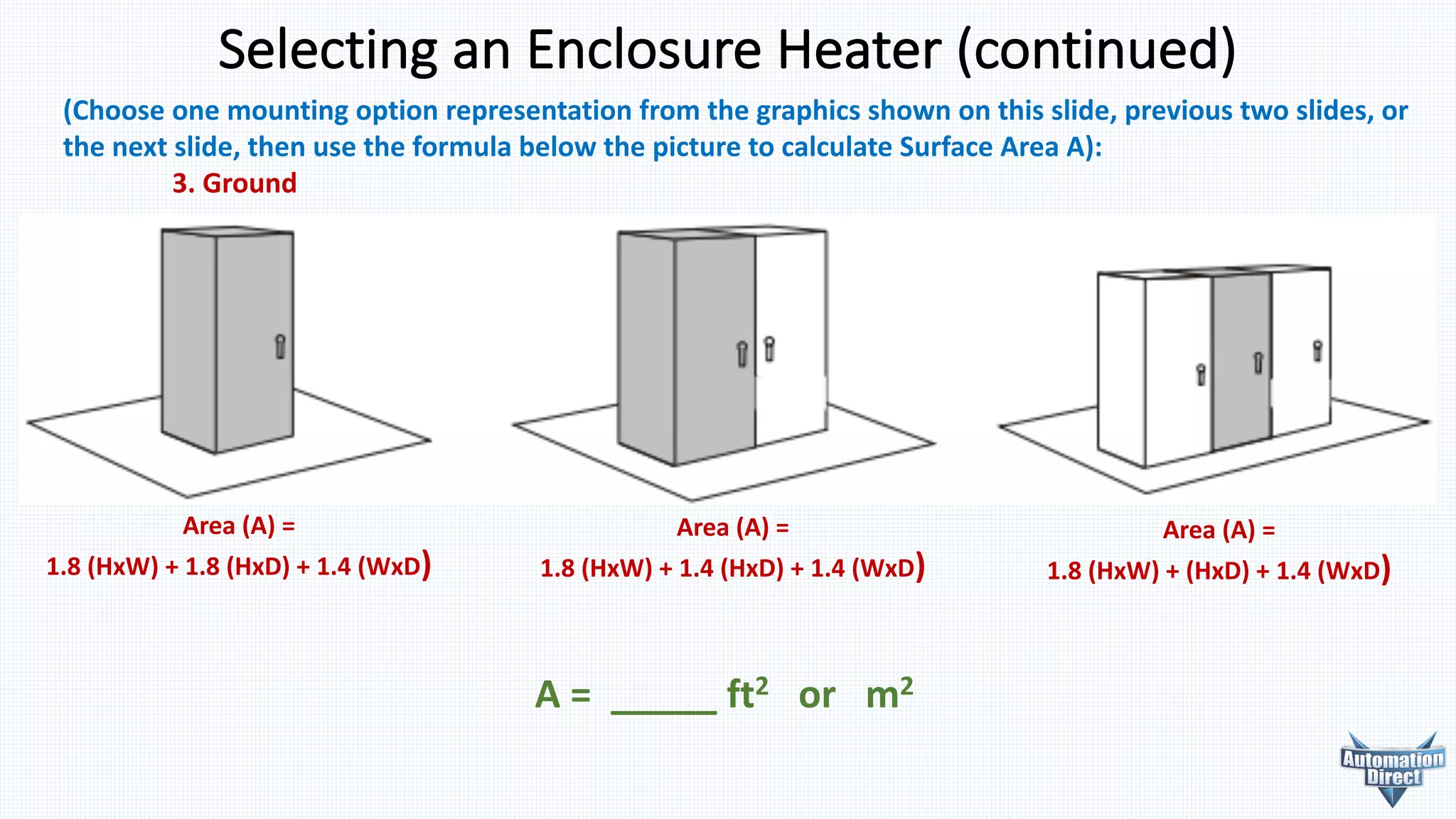
(Choose one mounting option representation from the graphics shown on this slide, previous two slides, or
the next slide, then use the formula below the picture to calculate Surface Area A):
3. Ground
A	=	 _____	ft2 or			m2
Area	(A)	=
1.8	(HxW)	+	1.8	(HxD)	+	1.4	(WxD)
Area	(A)	=
1.8	(HxW)	+	1.4	(HxD)	+	1.4	(WxD)
Area	(A)	=
1.8	(HxW)	+	(HxD)	+	1.4	(WxD)
Selecting	an	Enclosure	Heater	(continued)
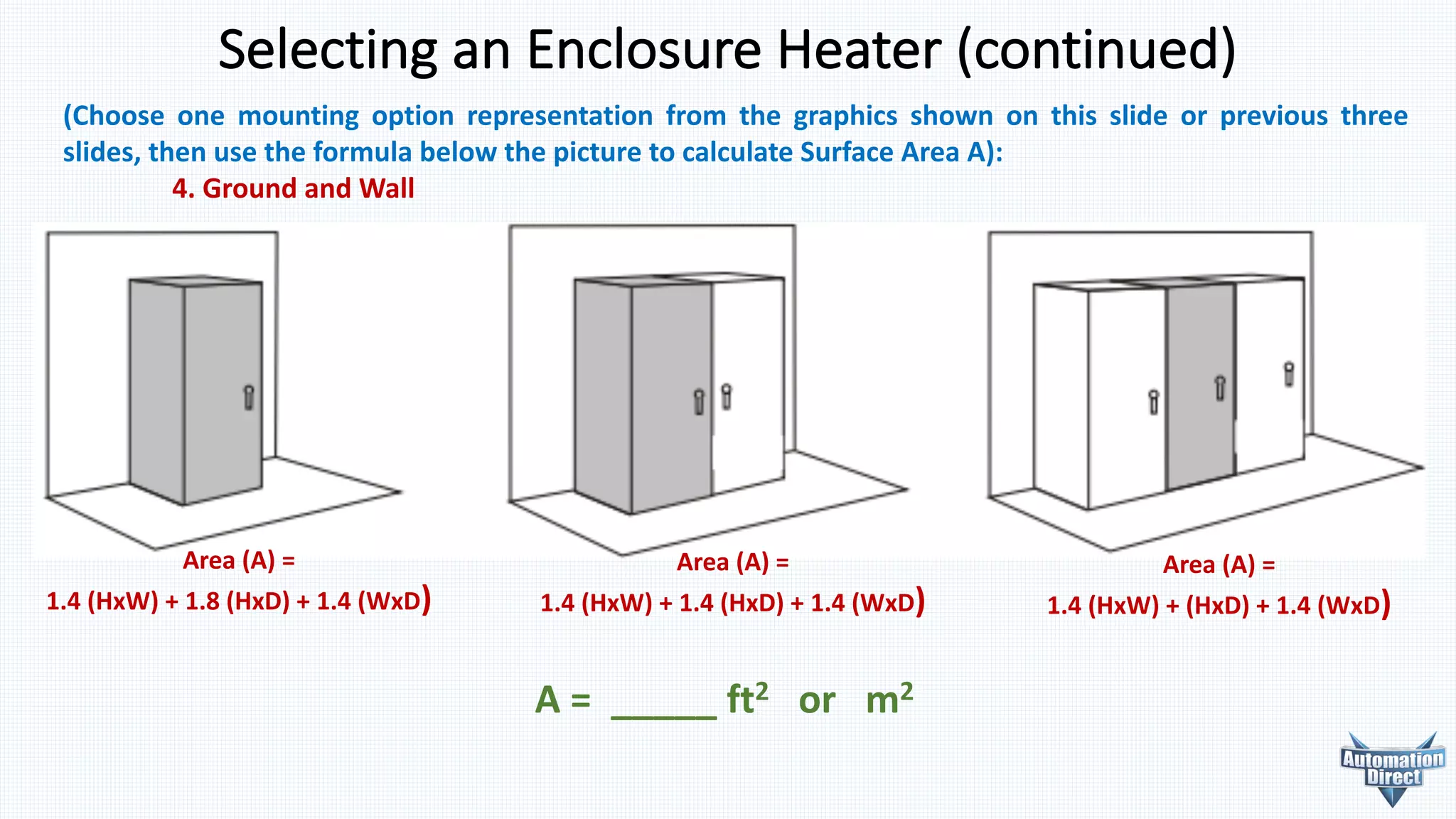
(Choose one mounting option representation from the graphics shown on this slide or previous three
slides, then use the formula below the picture to calculate Surface Area A):
4. Ground and Wall
A	=	 _____	ft2 or			m2
Area	(A)	=
1.4	(HxW)	+	1.8	(HxD)	+	1.4	(WxD)
Area	(A)	=
1.4	(HxW)	+	1.4	(HxD)	+	1.4	(WxD)
Area	(A)	=
1.4	(HxW)	+	(HxD)	+	1.4	(WxD)
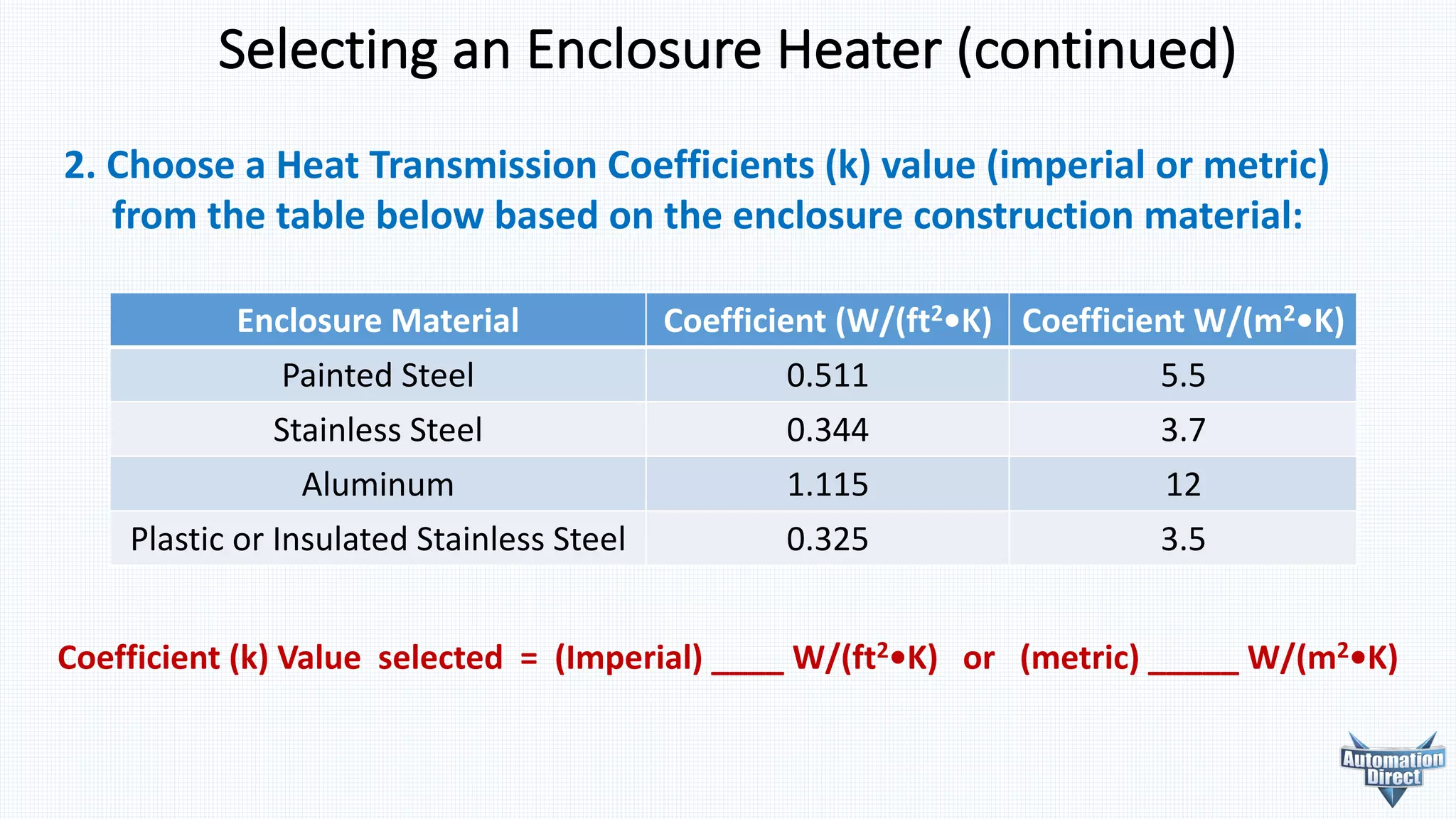
2. Choose	a	Heat	Transmission	Coefficients	(k)	value	(imperial	or	metric)
from	the	table	below	based	on	the	enclosure	construction	material:
Selecting	an	Enclosure	Heater	(continued)
Enclosure	Material Coefficient	(W/(ft2•K)	 Coefficient	W/(m2•K)
Painted	Steel 0.511 5.5
Stainless	Steel 0.344 3.7
Aluminum 1.115 12
Plastic	or	Insulated	Stainless	Steel 0.325 3.5
Coefficient	(k)	Value		selected		=		(Imperial)	____	W/(ft2•K)			or			(metric)	_____	W/(m2•K)
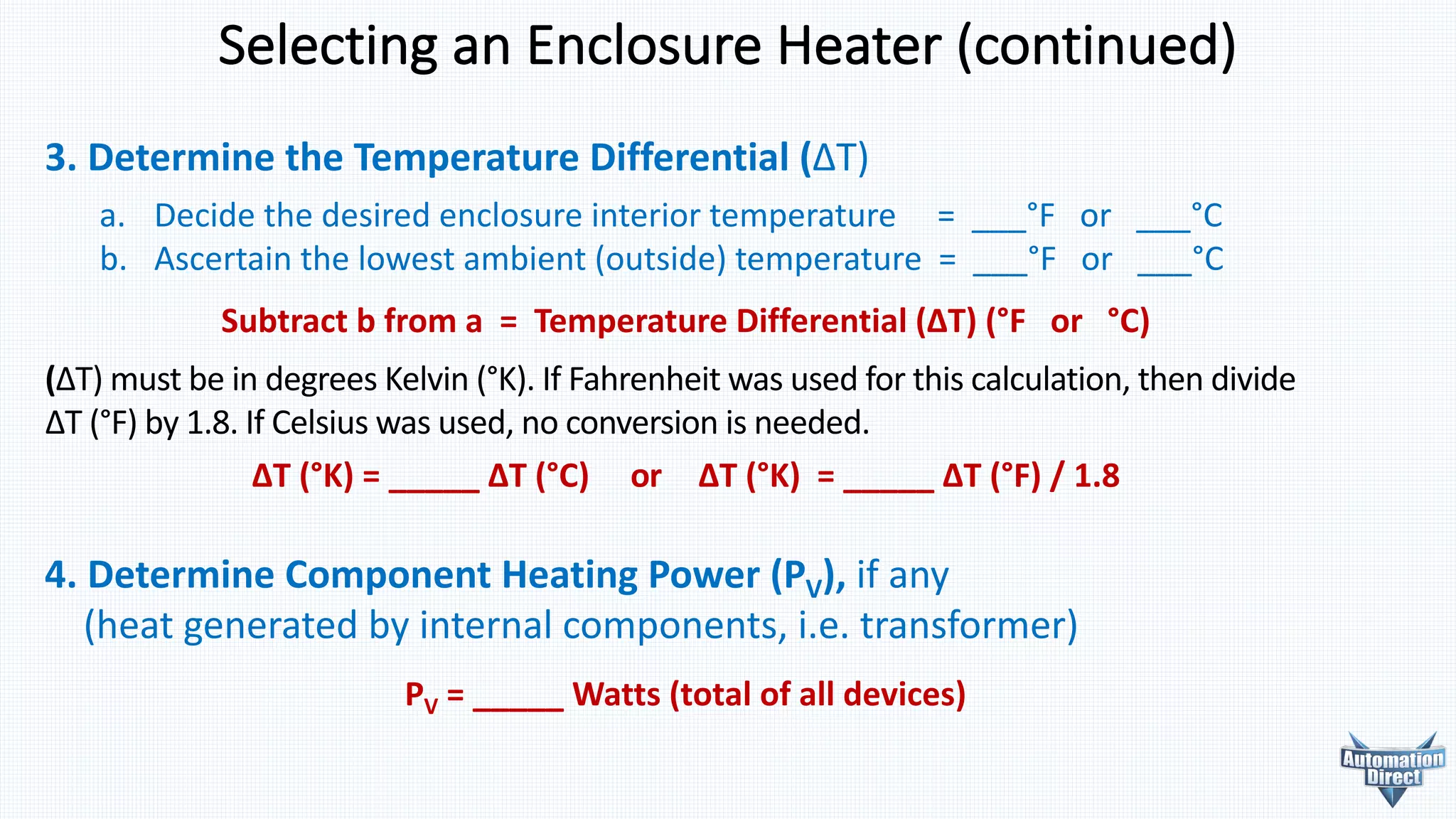
4. Determine	Component	Heating	Power	(PV),	if	any
(heat	generated	by	internal	components,	i.e.	transformer)
PV =	_____	Watts	(total	of	all	devices)
Selecting	an	Enclosure	Heater	(continued)
3. Determine	the	Temperature	Differential	(ΔT)
a. Decide the desired enclosure interior temperature = ___°F or ___°C
b. Ascertain the lowest ambient (outside) temperature = ___°F or ___°C
Subtract	b	from	a		=		Temperature	Differential	(ΔT)	(°F			or			°C)
(ΔT)	must	be	in	degrees	Kelvin	(°K).	If	Fahrenheit	was	used	for	this	calculation,	then	divide	
ΔT	(°F)	by	1.8.	If	Celsius	was	used,	no	conversion	is	needed.
ΔT	(°K)	=	_____	ΔT	(°C)					or					ΔT	(°K)	 =	_____	ΔT	(°F)	/	1.8
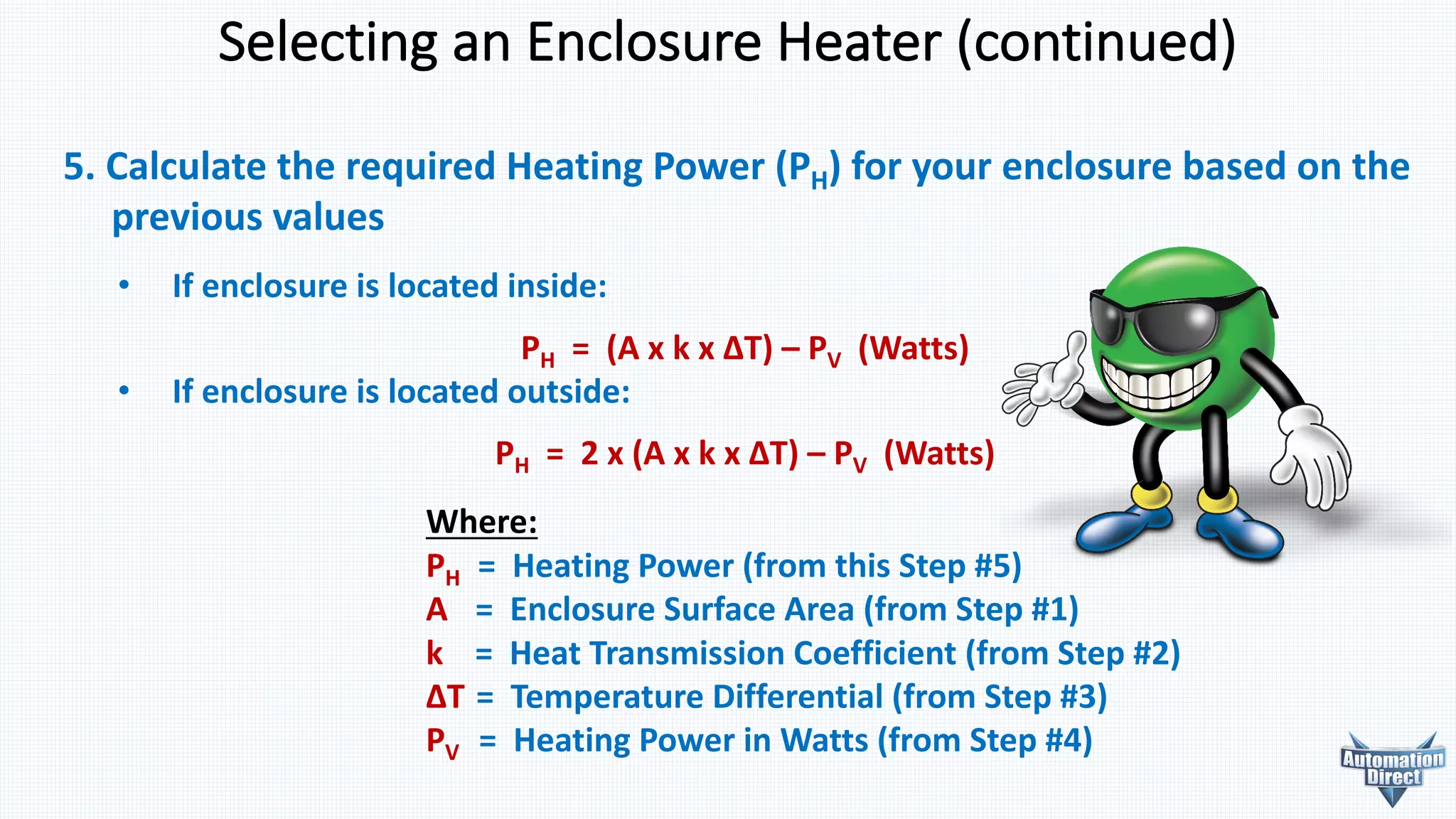
5. Calculate	the	required	Heating	Power	(PH)	for	your	enclosure	based	on	the
previous	values
• If enclosure is located inside:
PH =		(A	x	k	x	ΔT)	– PV (Watts)
• If enclosure is located outside:
PH =		2	x	(A	x	k	x	ΔT)	– PV (Watts)
Selecting	an	Enclosure	Heater	(continued)
Where:
PH =		Heating	Power	(from	this	Step	#5)
A =		Enclosure	Surface	Area	(from	Step	#1)
k =		Heat	Transmission	Coefficient	(from	Step	#2)
ΔT	=		Temperature	Differential	(from	Step	#3)
PV =		Heating	Power	in	Watts	(from	Step	#4)
Selecting	an	Enclosure	Heater	(continued)
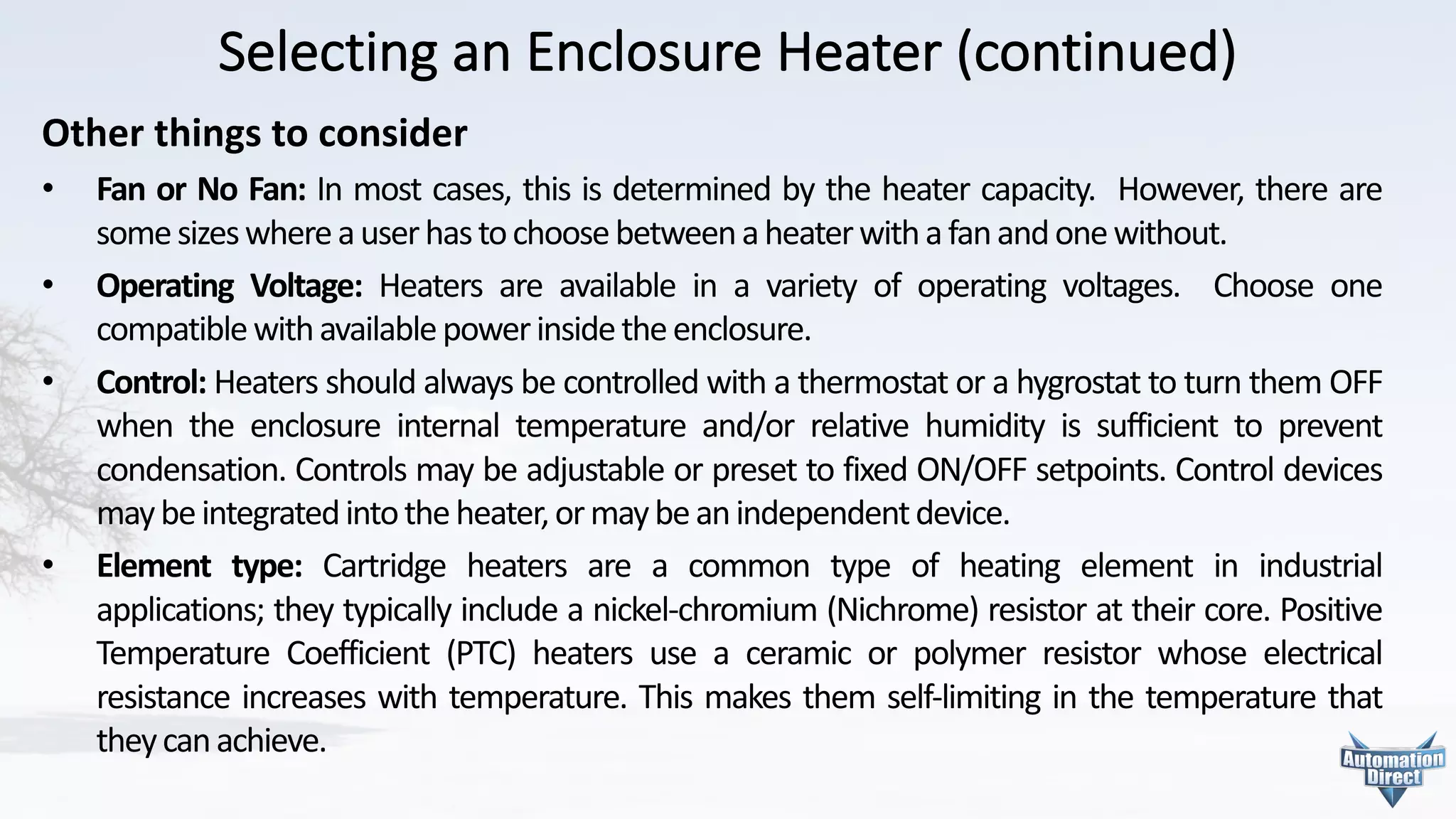
Other	things	to	consider
• Fan or No Fan: In most cases, this is determined by the heater capacity. However, there are
somesizeswhereauserhastochoosebetweenaheaterwithafanandonewithout.
• Operating Voltage: Heaters are available in a variety of operating voltages. Choose one
compatiblewithavailablepowerinsidetheenclosure.
• Control: Heaters should always be controlled with a thermostat or a hygrostat to turn them OFF
when the enclosure internal temperature and/or relative humidity is sufficient to prevent
condensation. Controls may be adjustable or preset to fixed ON/OFF setpoints. Control devices
maybeintegratedintotheheater,ormaybeanindependentdevice.
• Element type: Cartridge heaters are a common type of heating element in industrial
applications; they typically include a nickel-chromium (Nichrome) resistor at their core. Positive
Temperature Coefficient (PTC) heaters use a ceramic or polymer resistor whose electrical
resistance increases with temperature. This makes them self-limiting in the temperature that
theycanachieve.
Selecting	an	Enclosure	Heater	(continued)
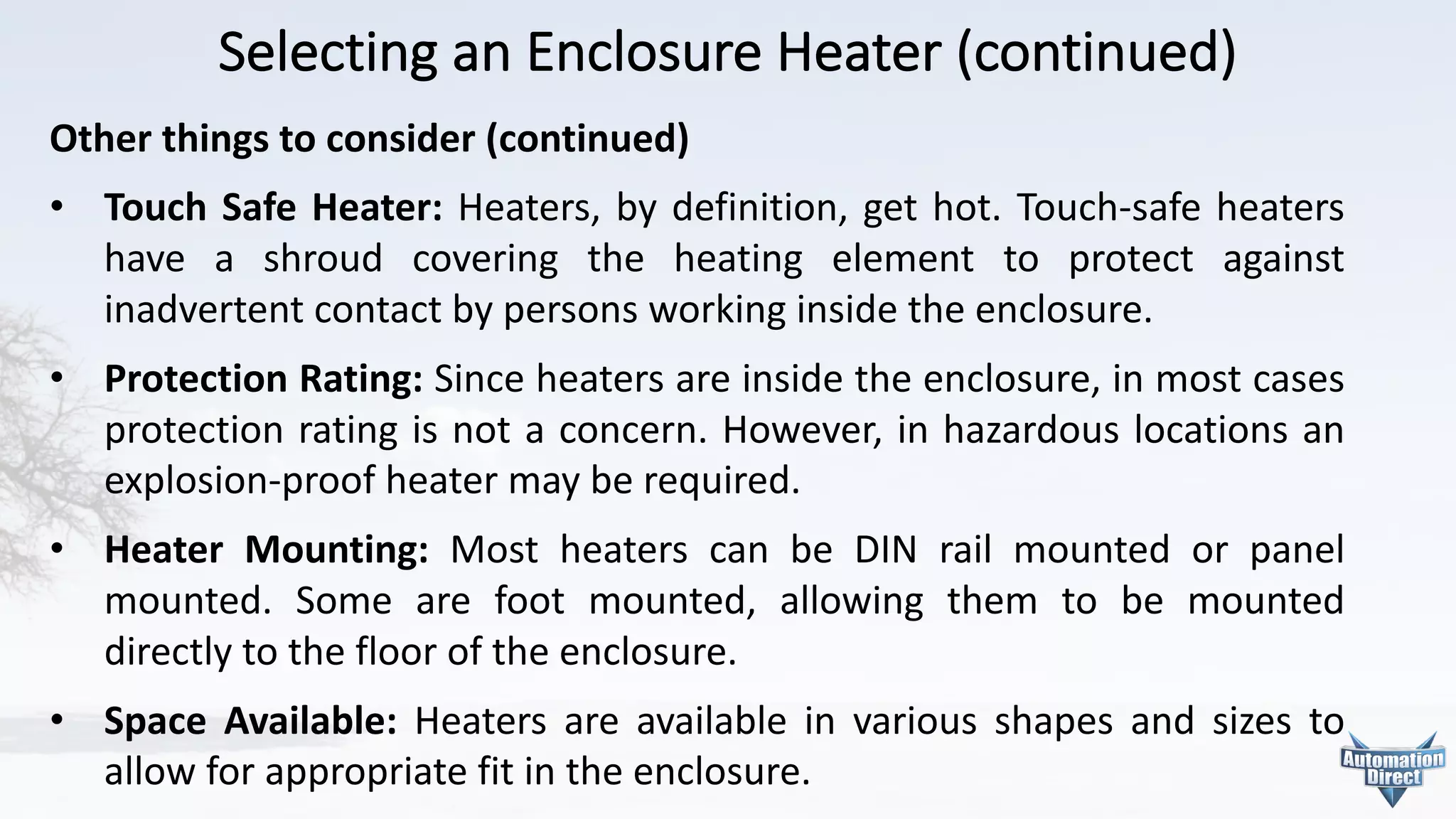
Other	things	to	consider	(continued)
• Touch Safe Heater: Heaters, by definition, get hot. Touch-safe heaters
have a shroud covering the heating element to protect against
inadvertent contact by persons working inside the enclosure.
• Protection Rating: Since heaters are inside the enclosure, in most cases
protection rating is not a concern. However, in hazardous locations an
explosion-proof heater may be required.
• Heater Mounting: Most heaters can be DIN rail mounted or panel
mounted. Some are foot mounted, allowing them to be mounted
directly to the floor of the enclosure.
• Space Available: Heaters are available in various shapes and sizes to
allow for appropriate fit in the enclosure.
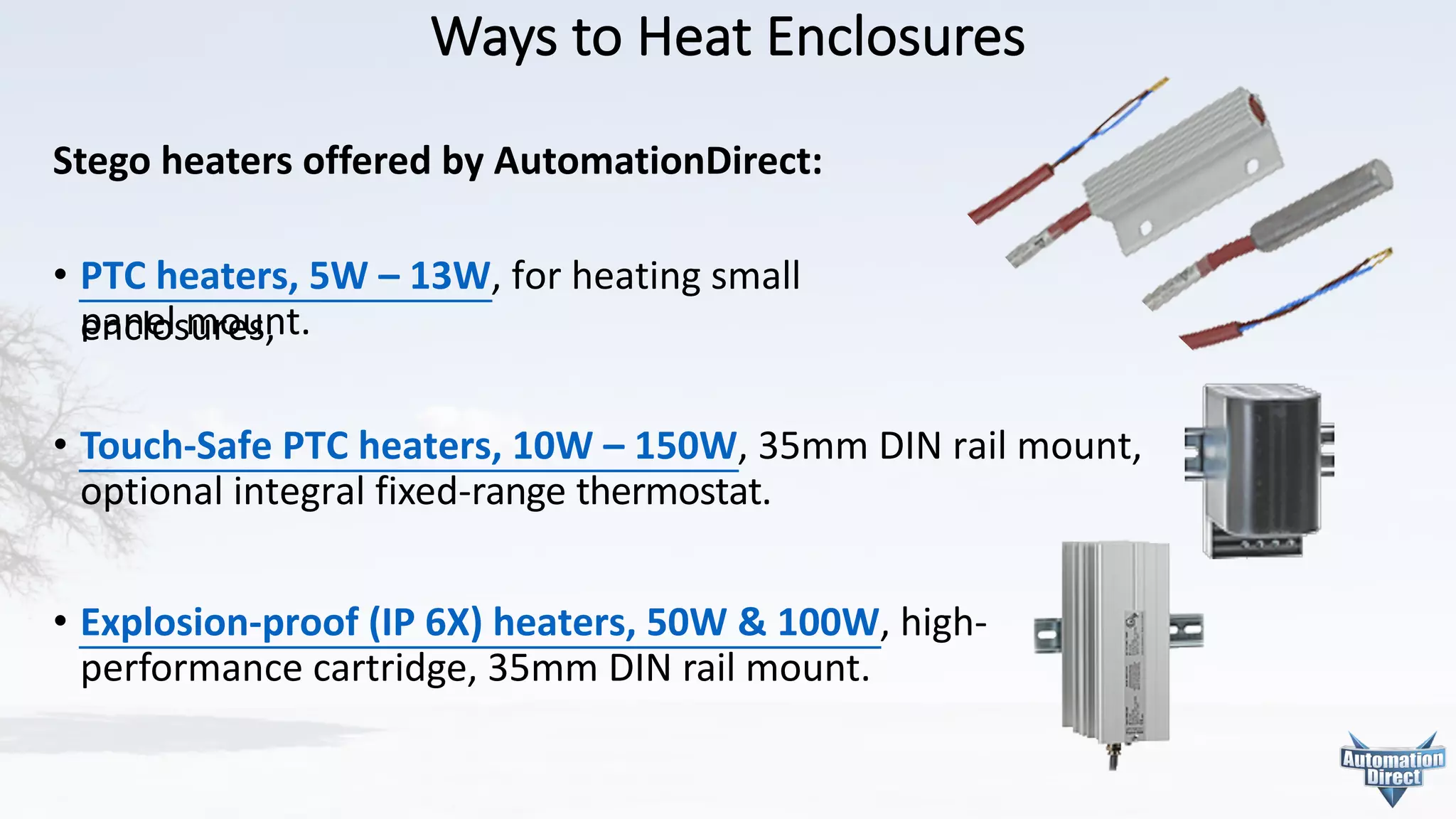
Ways	to	Heat	Enclosures
Stego heaters offered by AutomationDirect:
• PTC	heaters,	5W	– 13W, for	heating	small enclosures,
panel mount.
• Touch-Safe	PTC	heaters,	10W	– 150W,	35mm	DIN	rail	mount,
optional	integral	fixed-range	thermostat.
• Explosion-proof	(IP	6X)	heaters,	50W	&	100W,	high-	
performance	cartridge,	35mm	DIN	rail	mount.
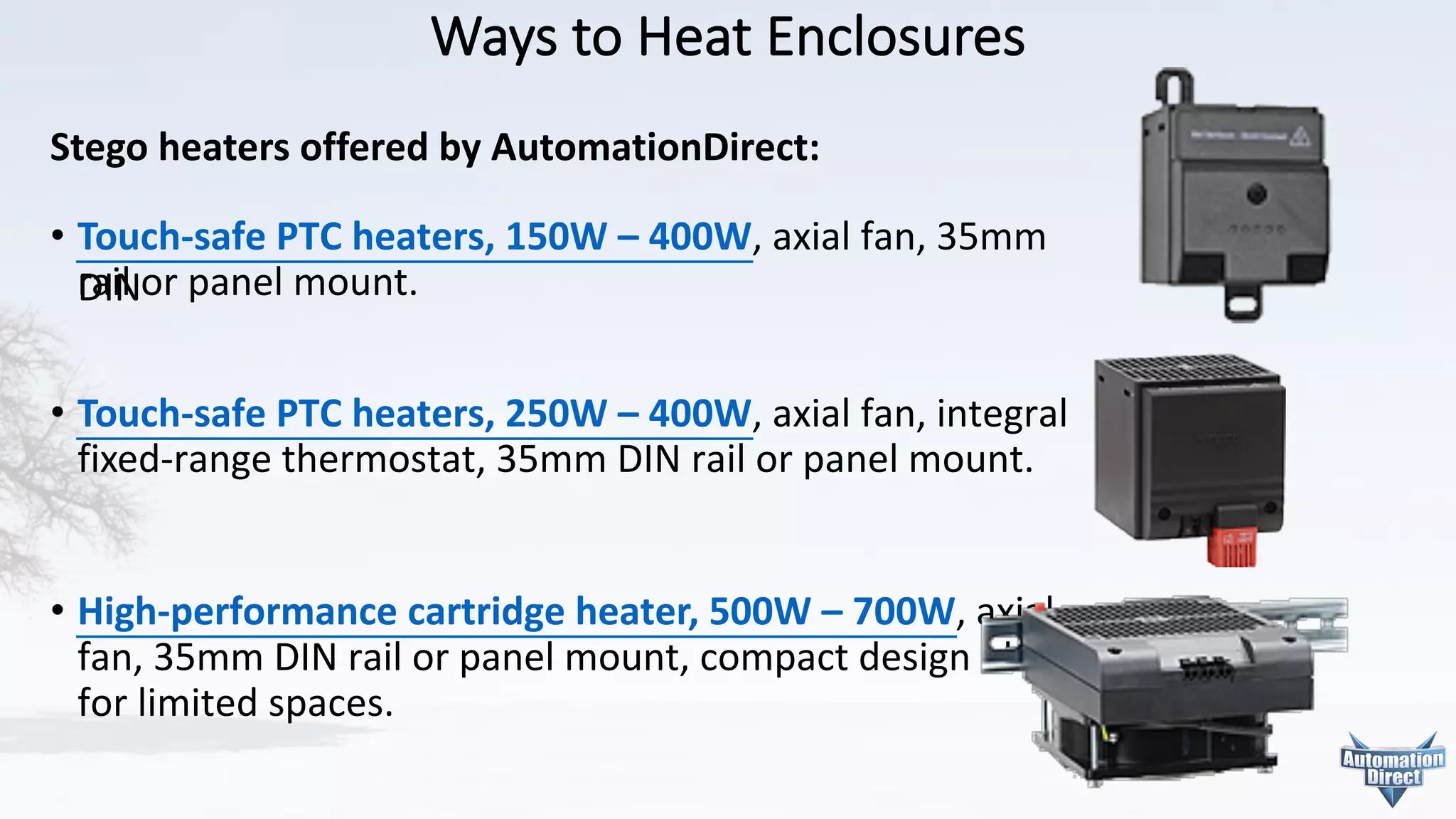
Ways	to	Heat	Enclosures
Stego heaters	offered	by	AutomationDirect:
• Touch-safe	PTC	heaters,	150W	– 400W,	axial	fan,	35mm 	
DIN or panel	mount.
• Touch-safe	PTC	heaters,	250W	– 400W,	axial	fan,	integral
fixed-range	thermostat,	35mm	DIN	rail	or	panel	mount.
• High-performance	cartridge	heater,	500W	– 700W, axial
fan,	35mm	DIN	rail	or	panel	mount,	compact design	ideal
for	limited	spaces.
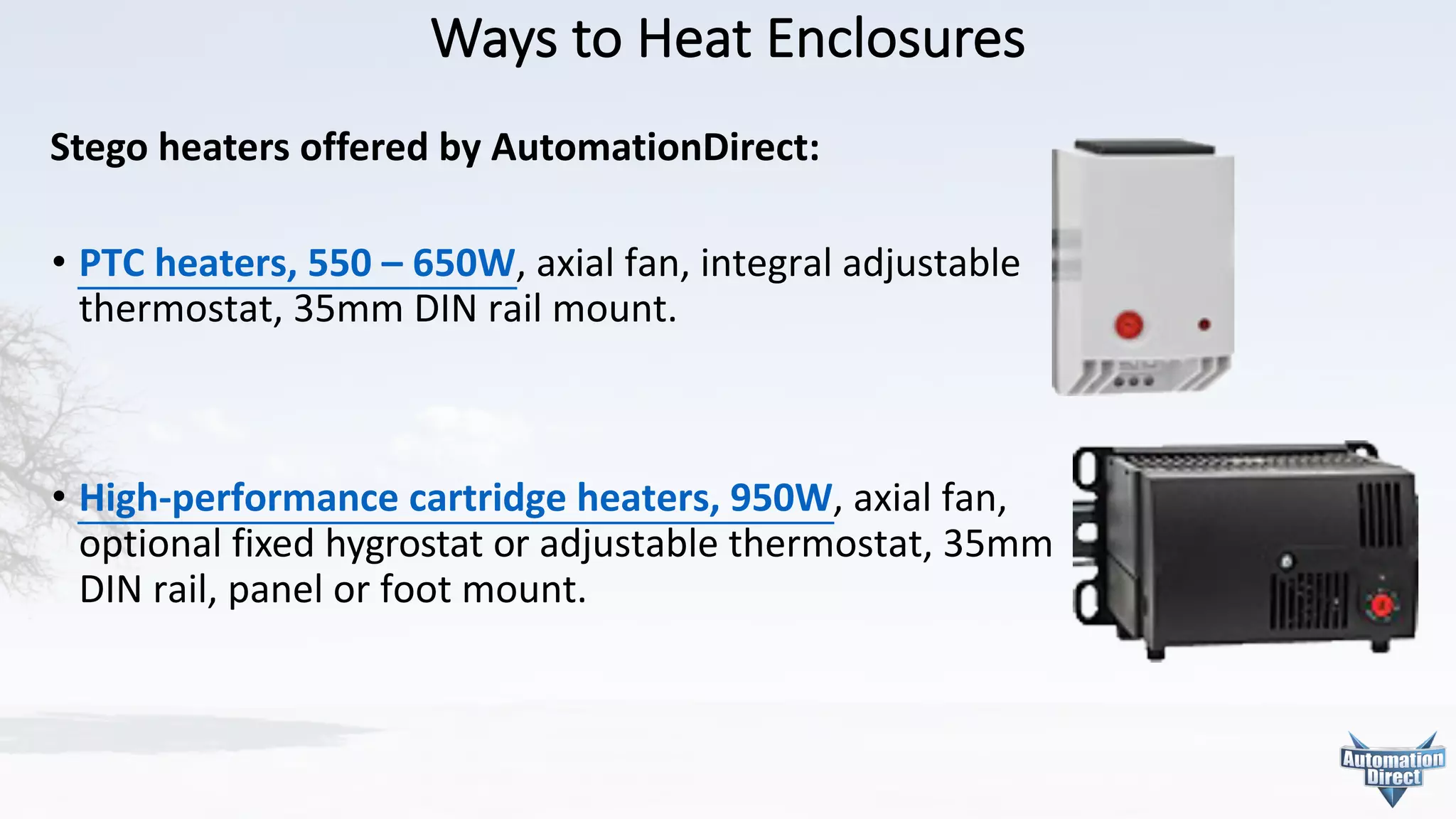
Ways	to	Heat	Enclosures
Stego heaters	offered	by	AutomationDirect:
• PTC	heaters,	550	– 650W,	axial	fan,	integral	adjustable
thermostat,	35mm	DIN	rail	mount.
• High-performance	cartridge	heaters,	950W,	axial	fan,
optional	fixed	hygrostat	or	adjustable	thermostat,	35mm
DIN	rail,	panel	or	foot	mount.
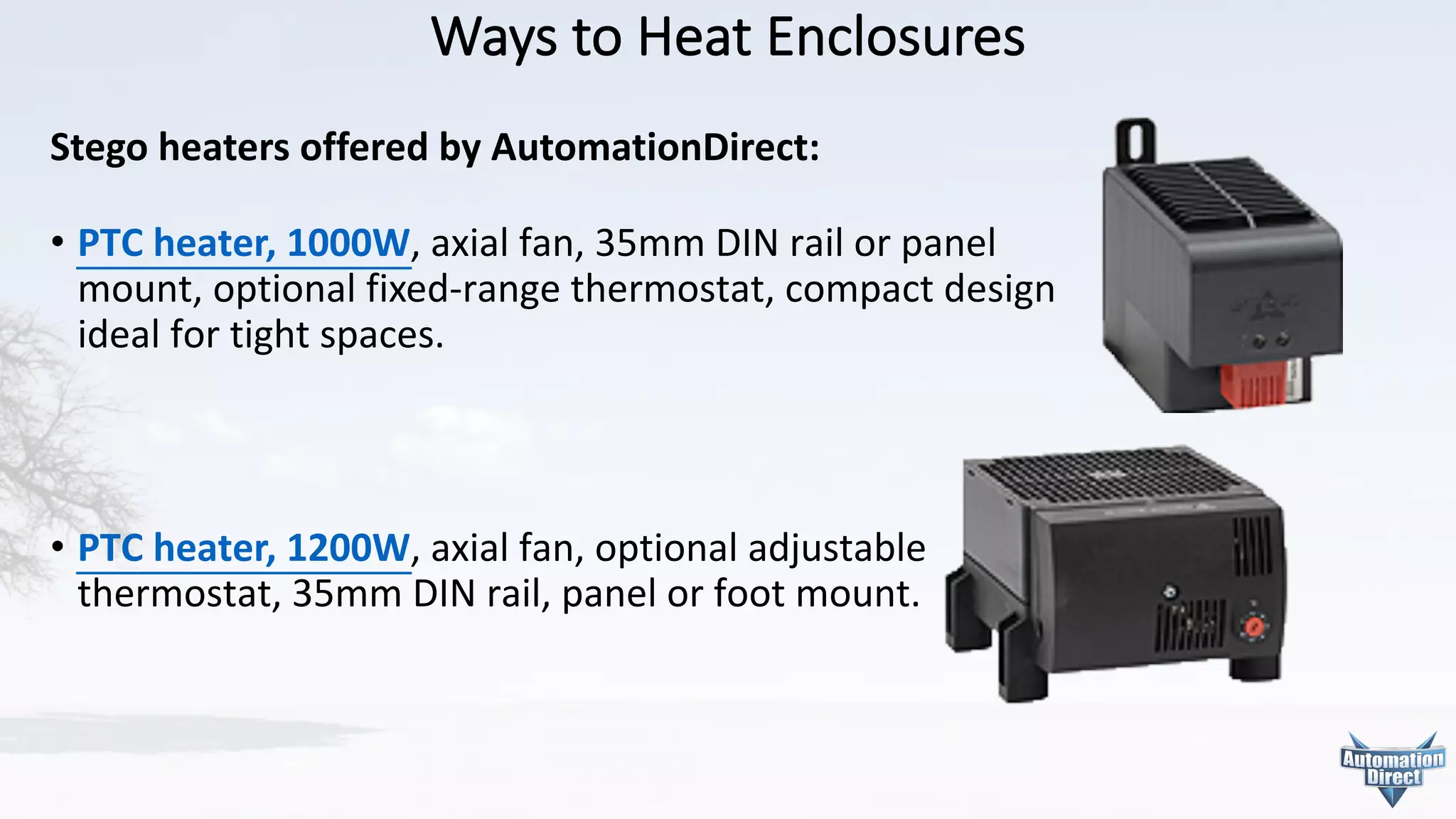
Ways	to	Heat	Enclosures
Stego heaters	offered	by	AutomationDirect:
• PTC	heater,	1000W,	axial	fan,	35mm	DIN	rail	or	panel
mount,	optional	fixed-range	thermostat,	compact	design
ideal	for	tight	spaces.
• PTC	heater,	1200W,	axial	fan,	optional	adjustable
thermostat,	35mm	DIN	rail,	panel	or	foot	mount.
Reasons	to	Control	Enclosure	Climate
Reasons for Enclosure Cooling
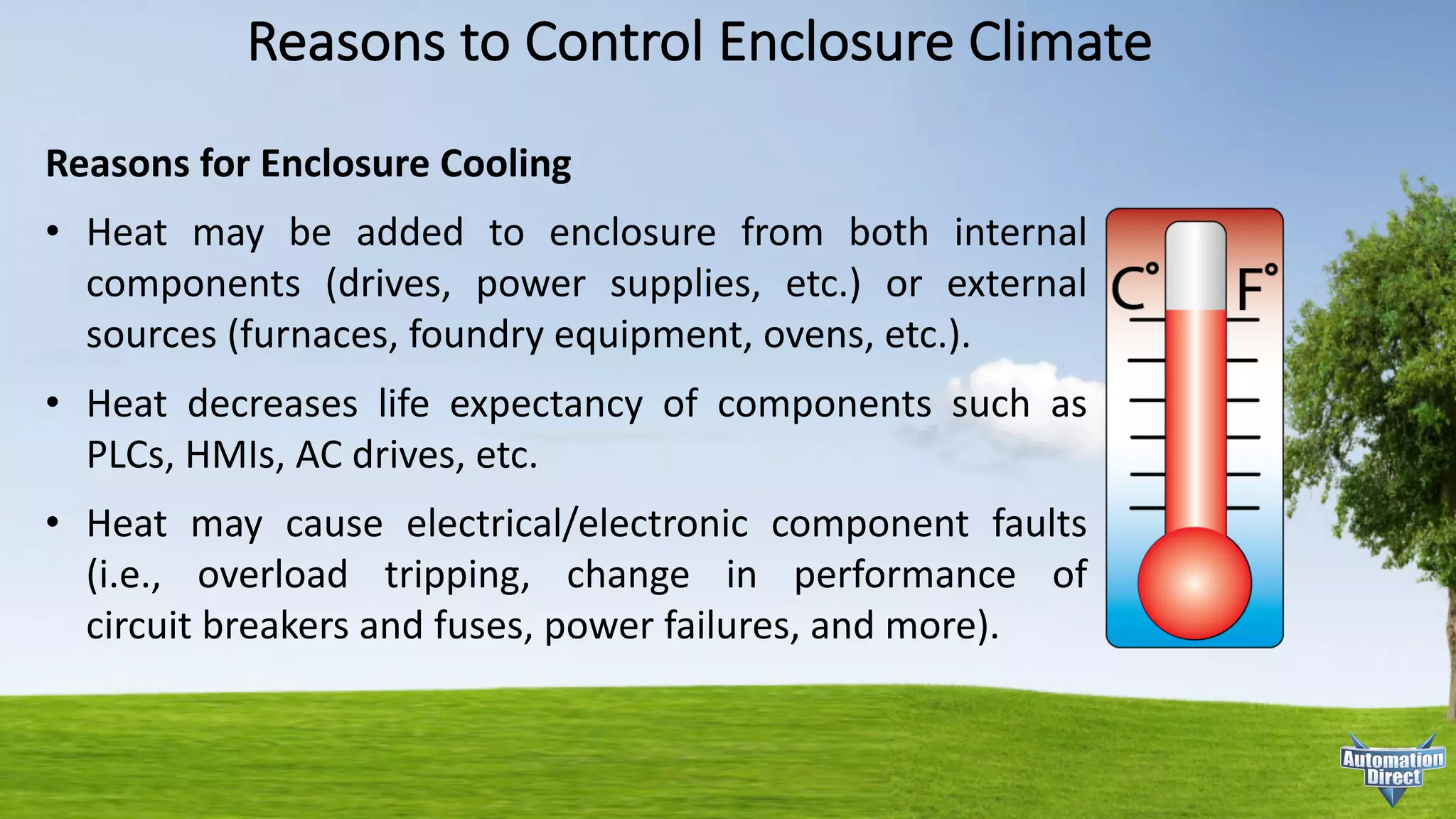
• Heat may be added to enclosure from both internal
components (drives, power supplies, etc.) or external
sources (furnaces, foundry equipment, ovens, etc.).
• Heat decreases life expectancy of components such as
PLCs, HMIs, AC drives, etc.
• Heat may cause electrical/electronic component faults
(i.e., overload tripping, change in performance of
circuit breakers and fuses, power failures, and more).
Ways	to	Keep	Enclosures	Cool
Selecting a cooling method depends on several factors:
• How much heat must be removed? The cooling capacity of the
method selected needs to be greater than the combined internal
and external heat load.
• The desired internal enclosure temperature and the ambient
temperature around the enclosure: Heat will naturally flow from
higher temperatures to lower temperatures. The higher the ambient
temperature relative to the enclosure temperature, the harder it is
to move heat from the enclosure to the atmosphere.
• The protection rating of the enclosure: Some NEMA enclosure
ratings preclude allowing outside air to enter the enclosure as part
of the cooling system, since other outside contaminants (water,
dust, oil, etc.) could enter via the same path.
Ways	to	Keep	Enclosures	Cool
How can you keep an enclosure’s interior air temperature cool?
Heat can be generated to raise the temperature of an enclosure but
cold cannot be generated. Cooling an enclosure is accomplished by
removing heat from the enclosure to the surrounding atmosphere.
There are several types of cooling methods, all of which will be
described in greater detail:
• Natural Convection: Typically for small heat loads. The ambient
temperaturemustbelowerthanthedesiredtemperatureinsideenclosure.
• Forced Convection: The ambient temperature must be lower than
the desired temperature inside the enclosure.
• Closed Loop Cooling: Used when the ambient temperature is as
high or higher than the desired internal temperature. This method
is also used for areas with harsh environments.
Natural	Convection	Cooling
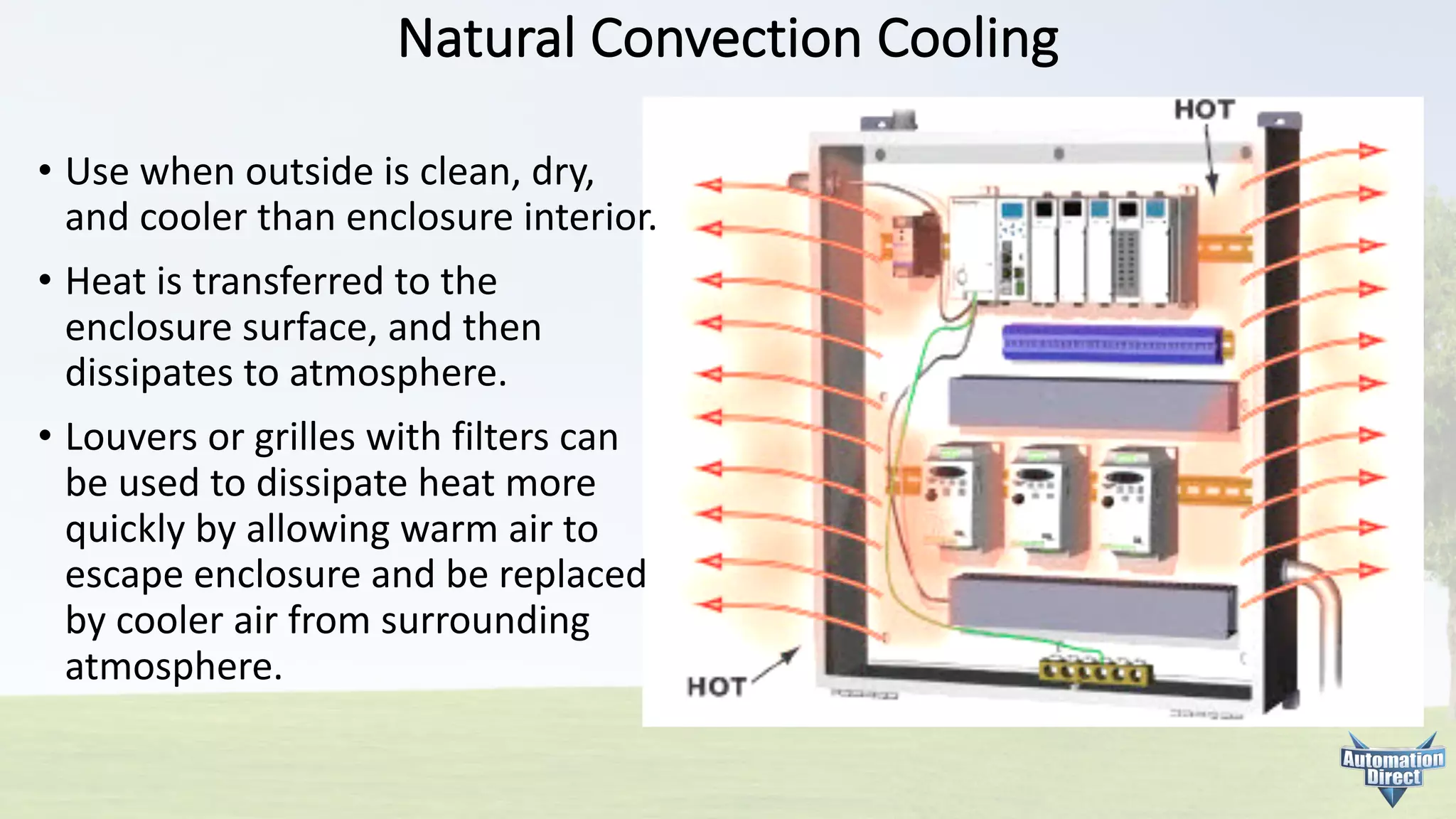
• Use	when	outside	is	clean,	dry,
and	cooler	than	enclosure interior.
• Heat	is	transferred	to	the
enclosure	surface,	and	then
dissipates	to atmosphere.
• Louvers	or	grilles	with	filters	can
be	used	to	dissipate	heat	more
quickly	by	allowing	warm	air	to
escape	enclosure	and	be	replaced
by	cooler	air	from	surrounding
atmosphere.
Natural	Convection	Cooling
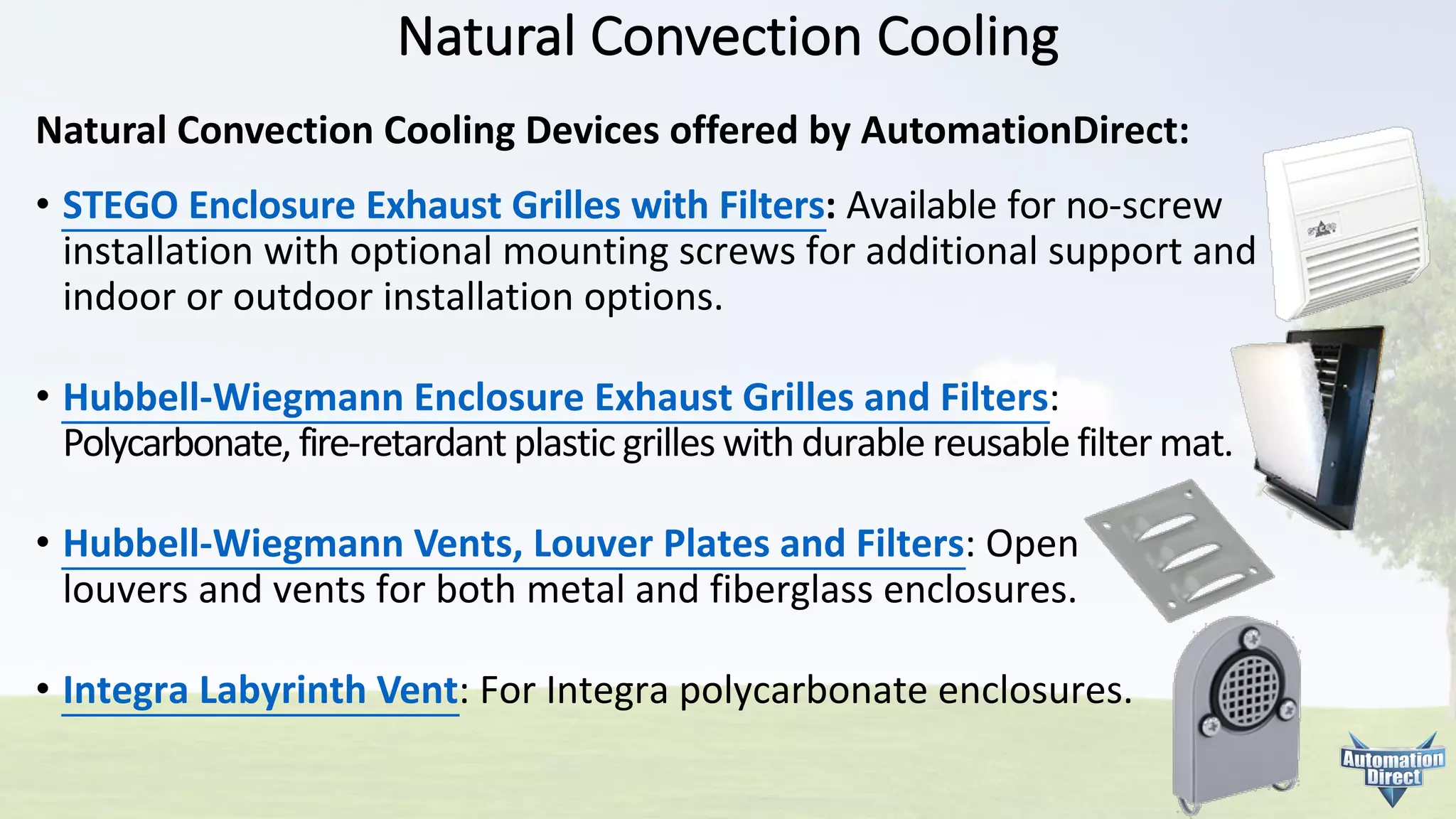
• STEGO	Enclosure	Exhaust	Grilles	with	Filters:	Available	for	no-screw
installation	with	optional	mounting	screws	for	additional	support	and
indoor	or	outdoor	installation	options.
• Hubbell-Wiegmann	Enclosure	Exhaust	Grilles	and	Filters:
Polycarbonate,	fire-retardant	plastic	grilles	with	durable	reusable	filter	mat.
• Hubbell-Wiegmann	Vents,	Louver	Plates	and	Filters:	Open
louvers	and	vents	for	both	metal	and	fiberglass	enclosures.
• Integra	Labyrinth	Vent:	For	Integra	polycarbonate	enclosures.
Natural Convection Cooling Devices offered by AutomationDirect:
Forced	Convection	Cooling
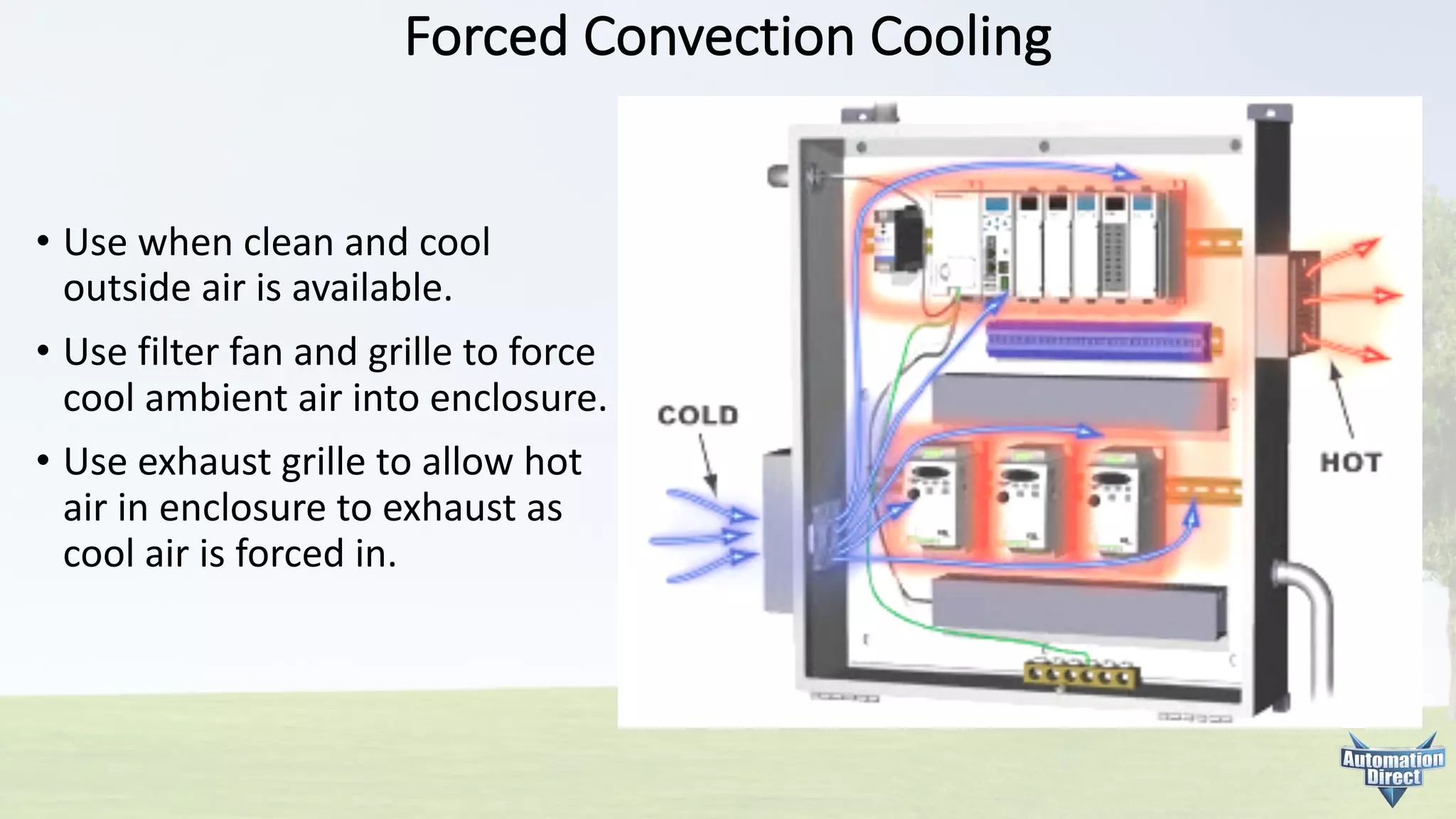
• Use	when	clean	and	cool
outside	air	is	available.
• Use	filter	fan	and	grille	to	force
cool	ambient	air	into	enclosure.
• Use	exhaust	grille	to	allow	hot
air	in	enclosure	to	exhaust	as
cool	air	is	forced	in.
Forced	Convection	Cooling
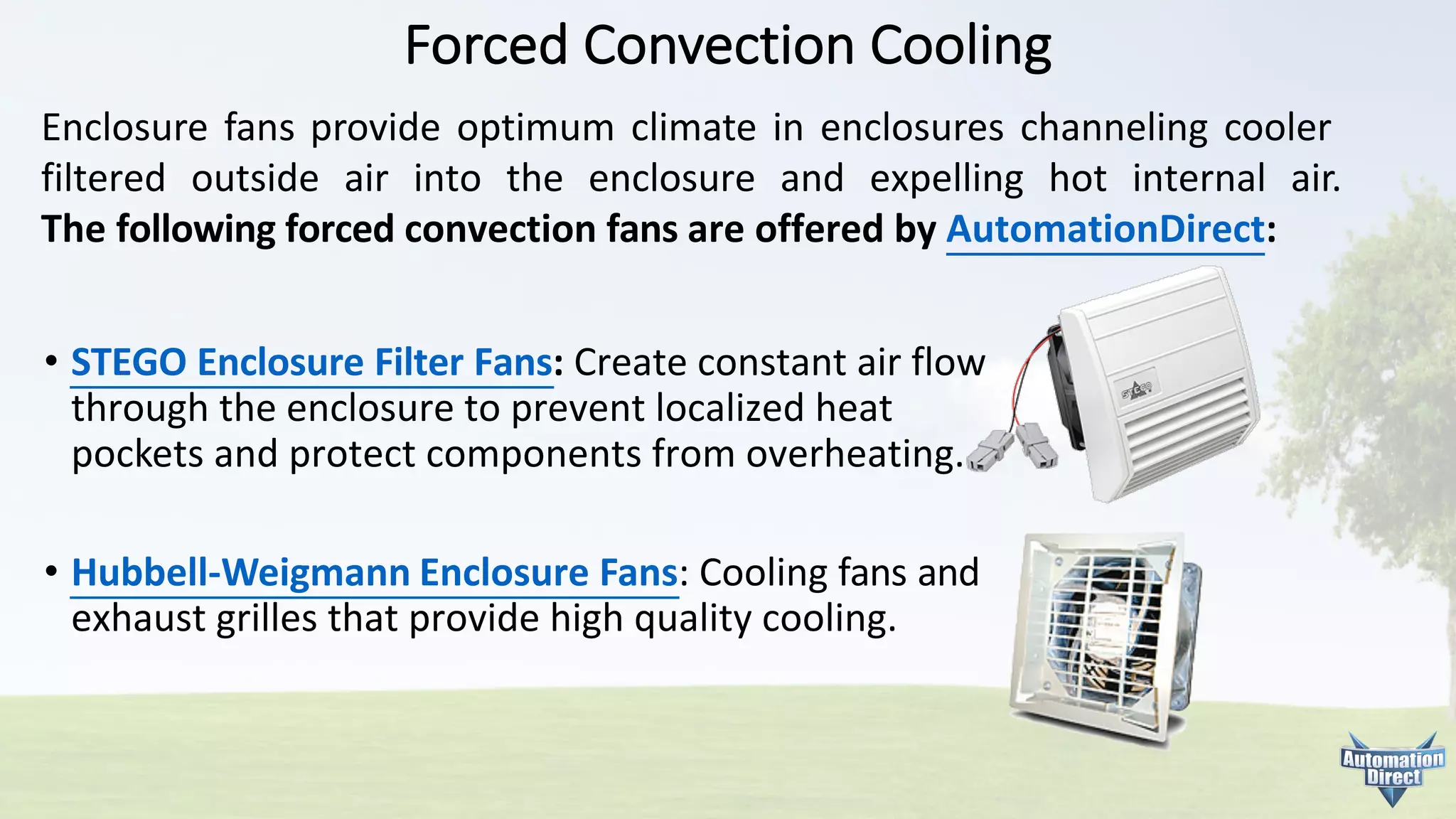
• STEGO	Enclosure	Filter	Fans:	Create	constant	air	flow
through	the	enclosure	to	prevent	localized	heat
pockets	and	protect	components	from	overheating.
• Hubbell-Weigmann Enclosure	Fans:	Cooling	fans	and
exhaust	grilles	that	provide	high	quality	cooling.
Enclosure fans provide optimum climate in enclosures channeling cooler
filtered outside air into the enclosure and expelling hot internal air.
The following forced convection fans are offered by AutomationDirect:
Forced	Convection	Cooling
Sometimes	the	enclosure	cooling	system	has	the	capacity	to	dissipate	the	total	
heat	load	in	an	enclosure,	but	if	a	high	heat	load	from	one	or	more	components	
or	a	“hot	spot”	develops	because	the	arrangement	of	the	components,	this	
restricts	air	movement	in	one	area.		These	situations	can	create	a	“bottleneck”	in	
the	flow	of	heat	from	the	enclosure	to	the	outside.
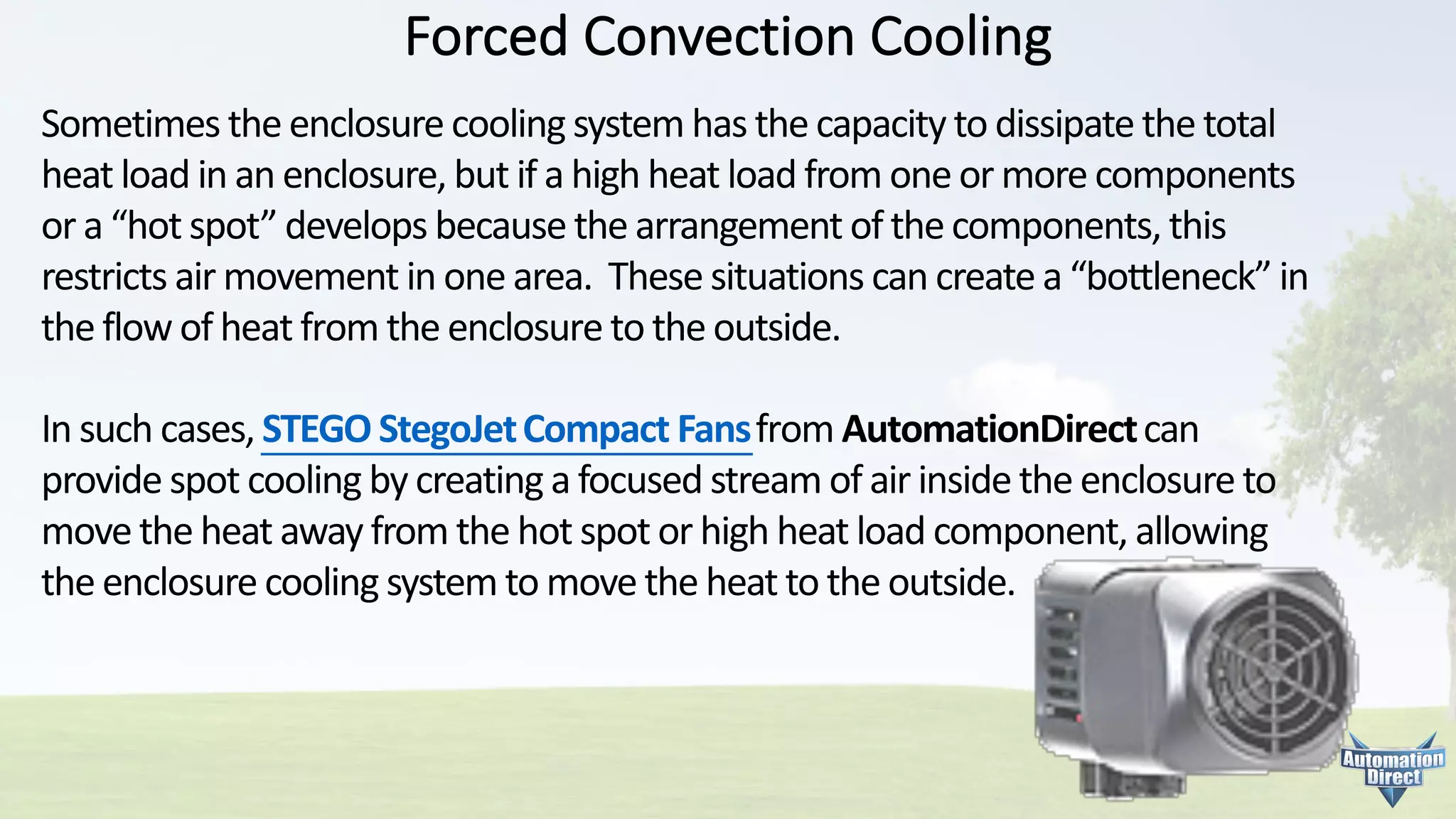
In	such	cases,	STEGO	StegoJetCompact	Fansfrom	AutomationDirectcan	
provide	spot	cooling	by	creating	a	focused	stream	of	air	inside	the	enclosure	to	
move	the	heat	away	from	the	hot	spot	or	high	heat	load	component,	allowing	
the	enclosure	cooling	system	to	move	the	heat	to	the	outside.
Closed	Loop	Cooling
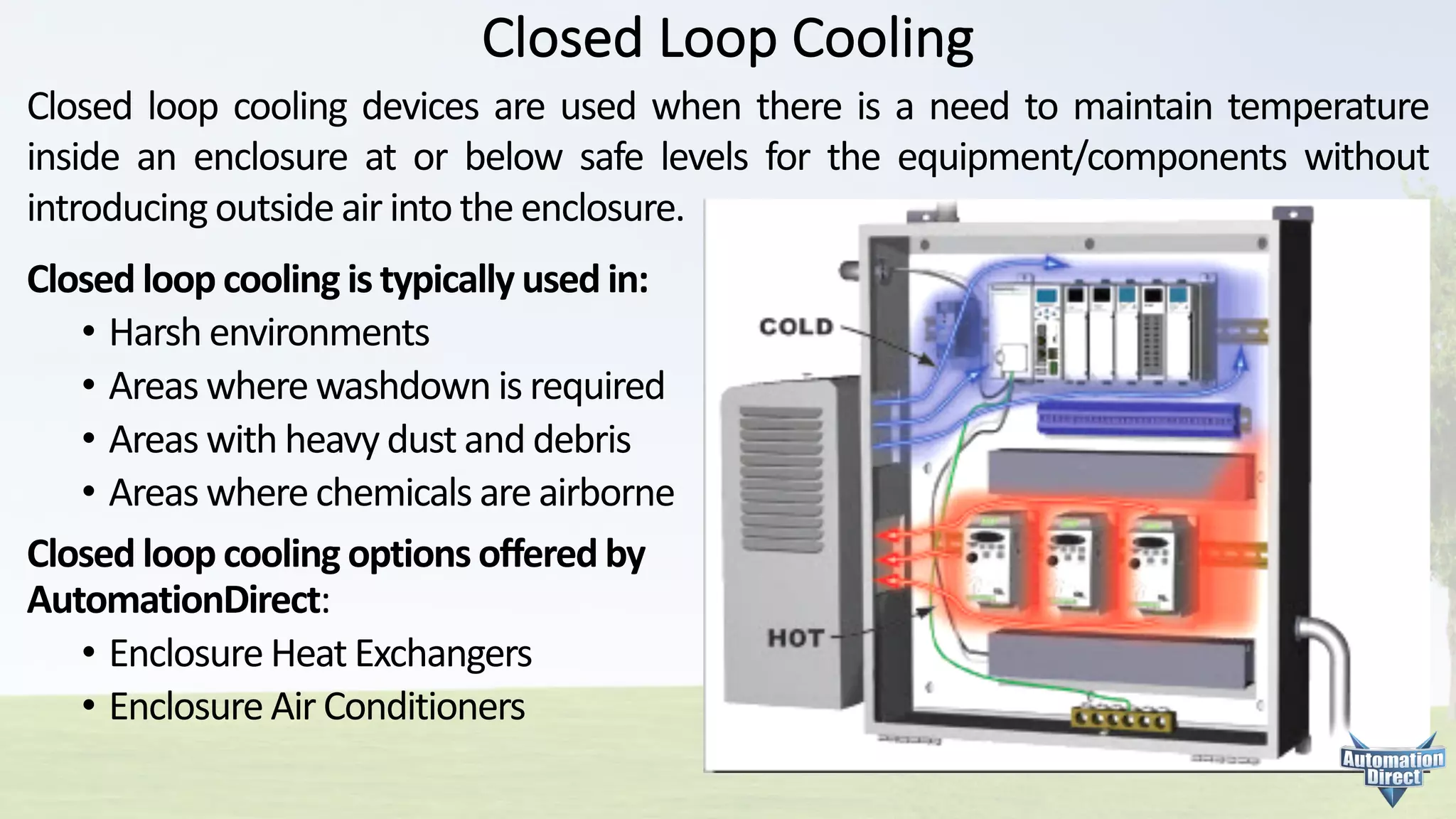
Closed loop cooling devices are used when there is a need to maintain temperature
inside an enclosure at or below safe levels for the equipment/components without
introducing outside air into the enclosure.
Closed	loop	cooling	is	typically	used	in:
• Harsh	environments
• Areas	where	washdown is	required
• Areas	with	heavy	dust	and	debris
• Areas	where	chemicals	are	airborne
Closed	loop	cooling	options	offered	by	
AutomationDirect:
• Enclosure	Heat	Exchangers
• Enclosure	Air	Conditioners
Closed	Loop	Cooling
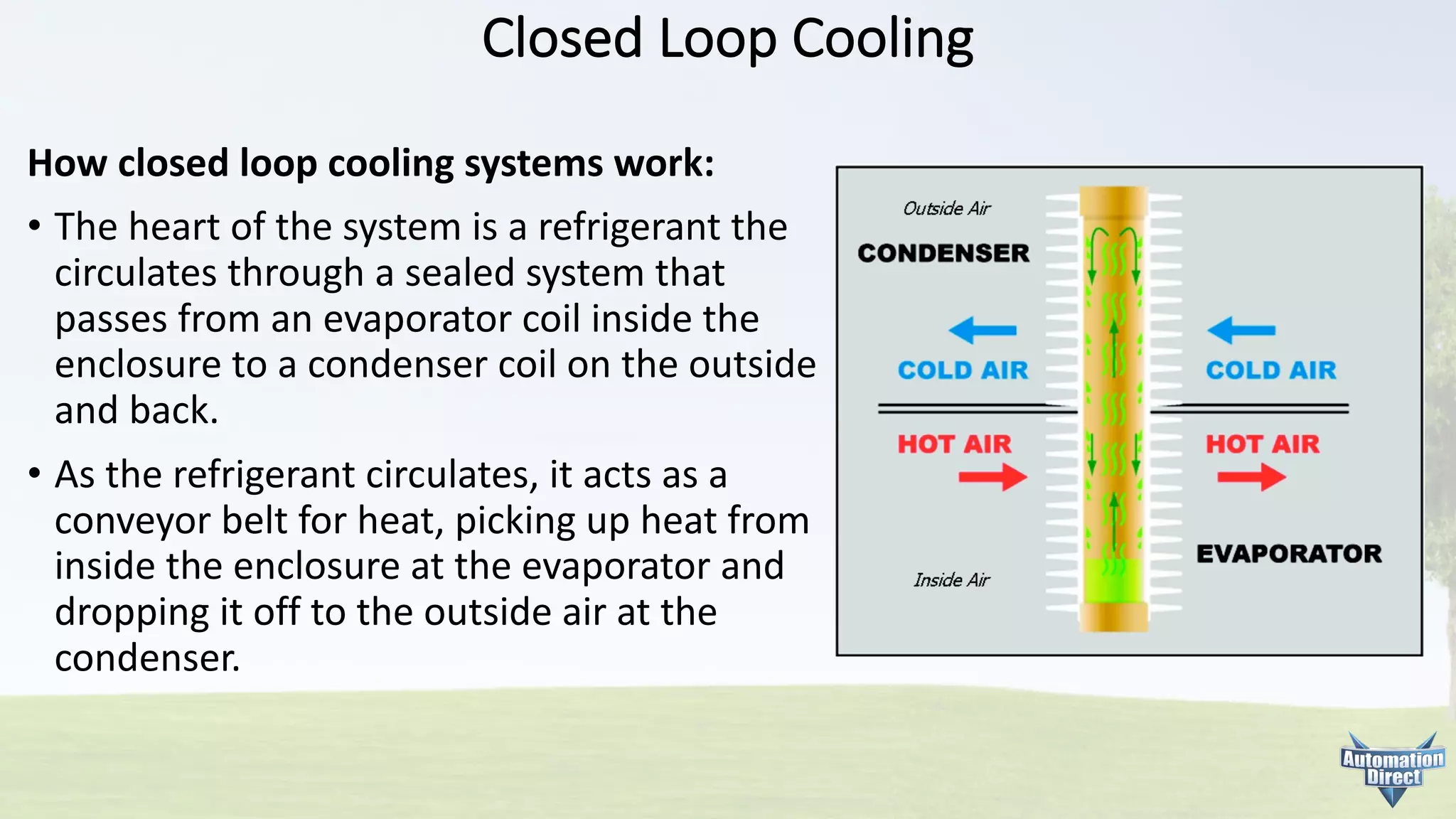
How	closed	loop	cooling	systems	work:
• The	heart	of	the	system	is	a	refrigerant	the
circulates	through	a	sealed	system	that
passes	from	an	evaporator	coil	inside	the
enclosure	to	a	condenser	coil	on	the	outside
and	back.
• As	the	refrigerant	circulates,	it	acts	as	a
conveyor	belt	for	heat,	picking	up	heat	from
inside	the	enclosure	at	the	evaporator	and
dropping	it	off	to	the	outside	air	at	the
condenser.
Closed	Loop	Cooling
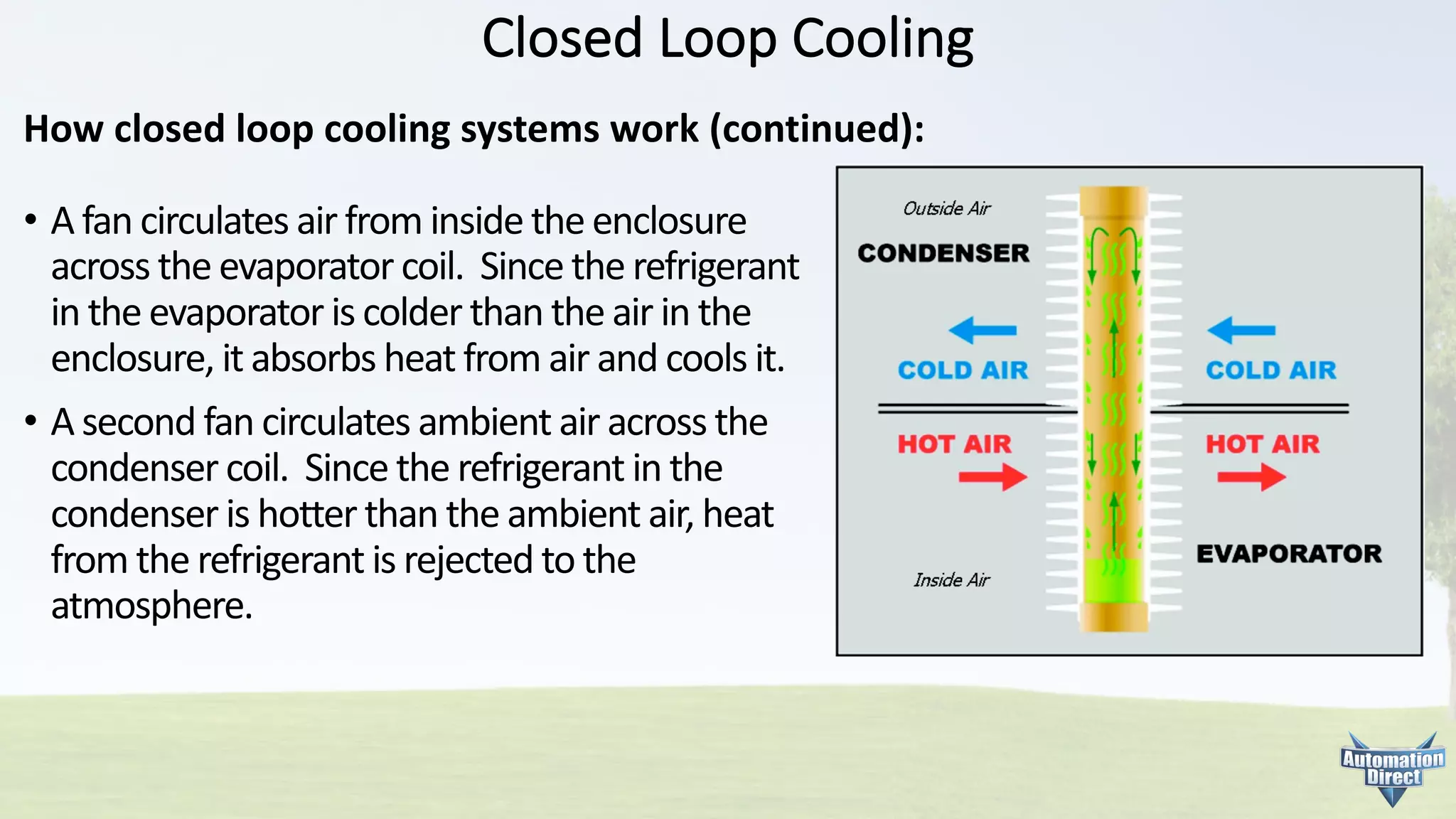
How	closed	loop	cooling	systems	work	(continued):
• A	fan	circulates	air	from	inside	the	enclosure
across	the	evaporator	coil.		Since	the	refrigerant
in	the	evaporator	is	colder	than	the	air	in	the
enclosure,	it	absorbs	heat	from	air	and	cools	it.
• A	second	fan	circulates	ambient	air	across	the
condenser	coil.		Since	the	refrigerant	in	the
condenser	is	hotter	than	the	ambient	air,	heat
from	the	refrigerant	is	rejected	to	the
atmosphere.
Closed	Loop	Cooling
Closed	loop	cooling	options	offered	by	AutomationDirect:
• Stratus	Enclosure	Air-to-Air	Heat	Exchangers
• Stratus	Enclosure	Air	Conditioners
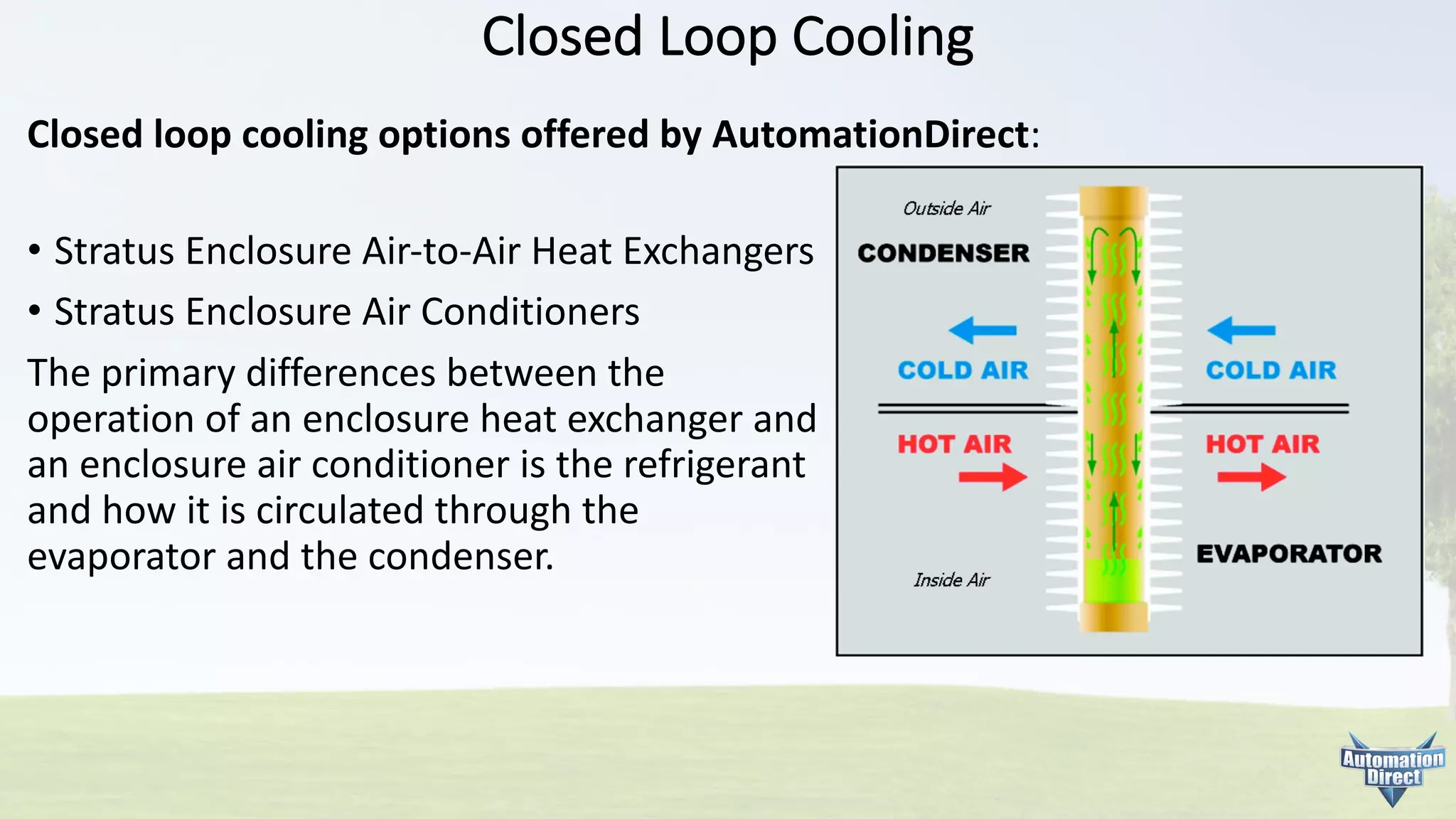
The	primary	differences	between	the	
operation	of	an	enclosure	heat	exchanger	and	
an	enclosure	air	conditioner	is	the	refrigerant	
and	how	it	is	circulated	through	the	
evaporator	and	the	condenser.
Closed	Loop	Cooling
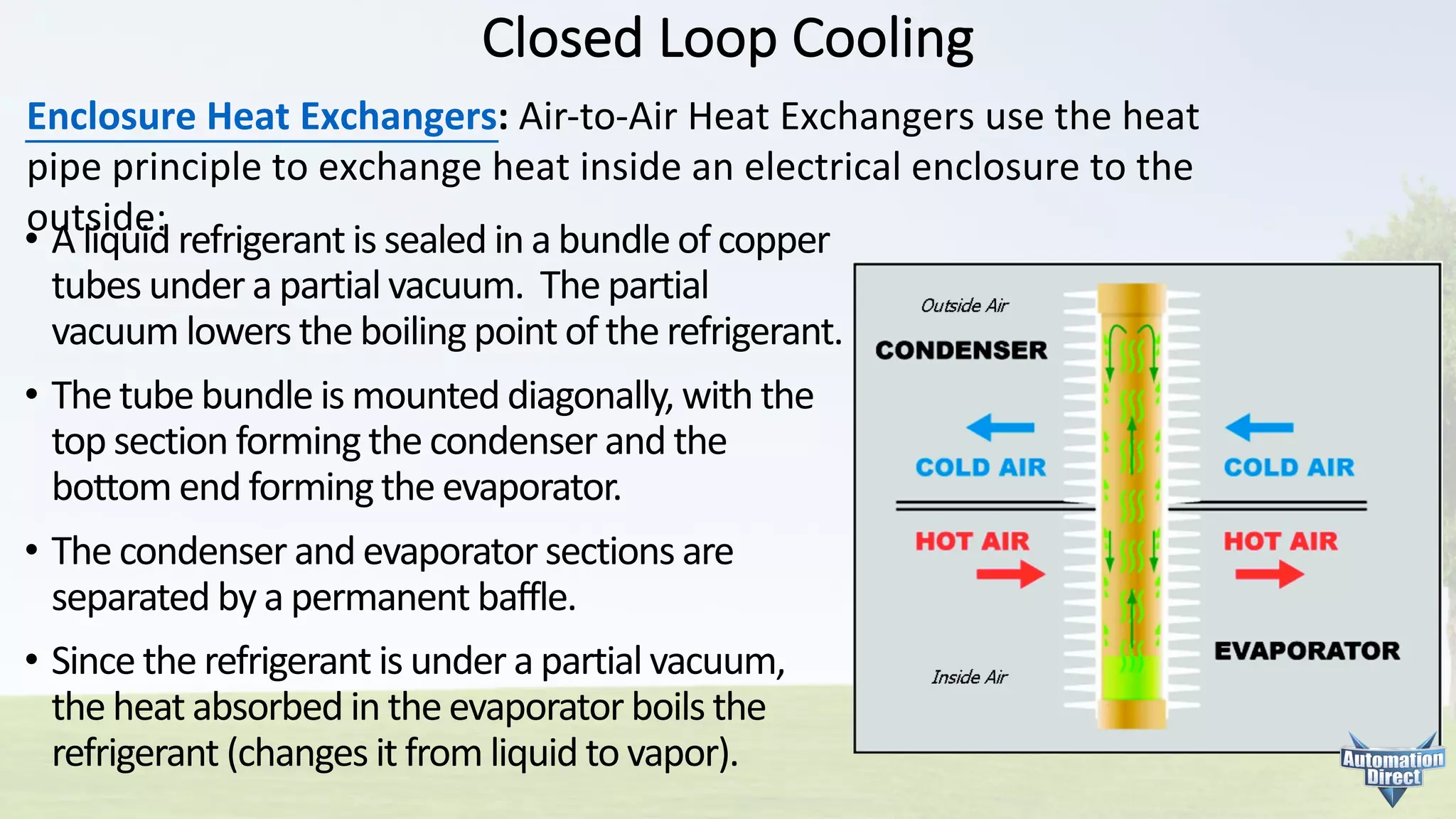
Enclosure	Heat	Exchangers: Air-to-Air	Heat	Exchangers	use	the	
heat	pipe	principle	to	exchange	heat	inside	an	electrical	enclosure	
to	the outside:	
•	 A liquid refrigerant	is	sealed	in	a	bundle	of	copper
tubes	under	a	partial	vacuum.		The	partial
vacuum	lowers	the	boiling	point	of	the	refrigerant.
• The	tube	bundle	is	mounted	diagonally,	with	the
top	section	forming	the	condenser	and	the
bottom	end	forming	the	evaporator.
• The	condenser	and	evaporator	sections	are
separated	by	a	permanent	baffle.
• Since	the	refrigerant	is	under	a	partial	vacuum,
the	heat	absorbed	in	the	evaporator	boils	the
refrigerant	(changes	it	from	liquid	to	vapor).
Closed	Loop	Cooling
Enclosure	Heat	Exchangers (continued)
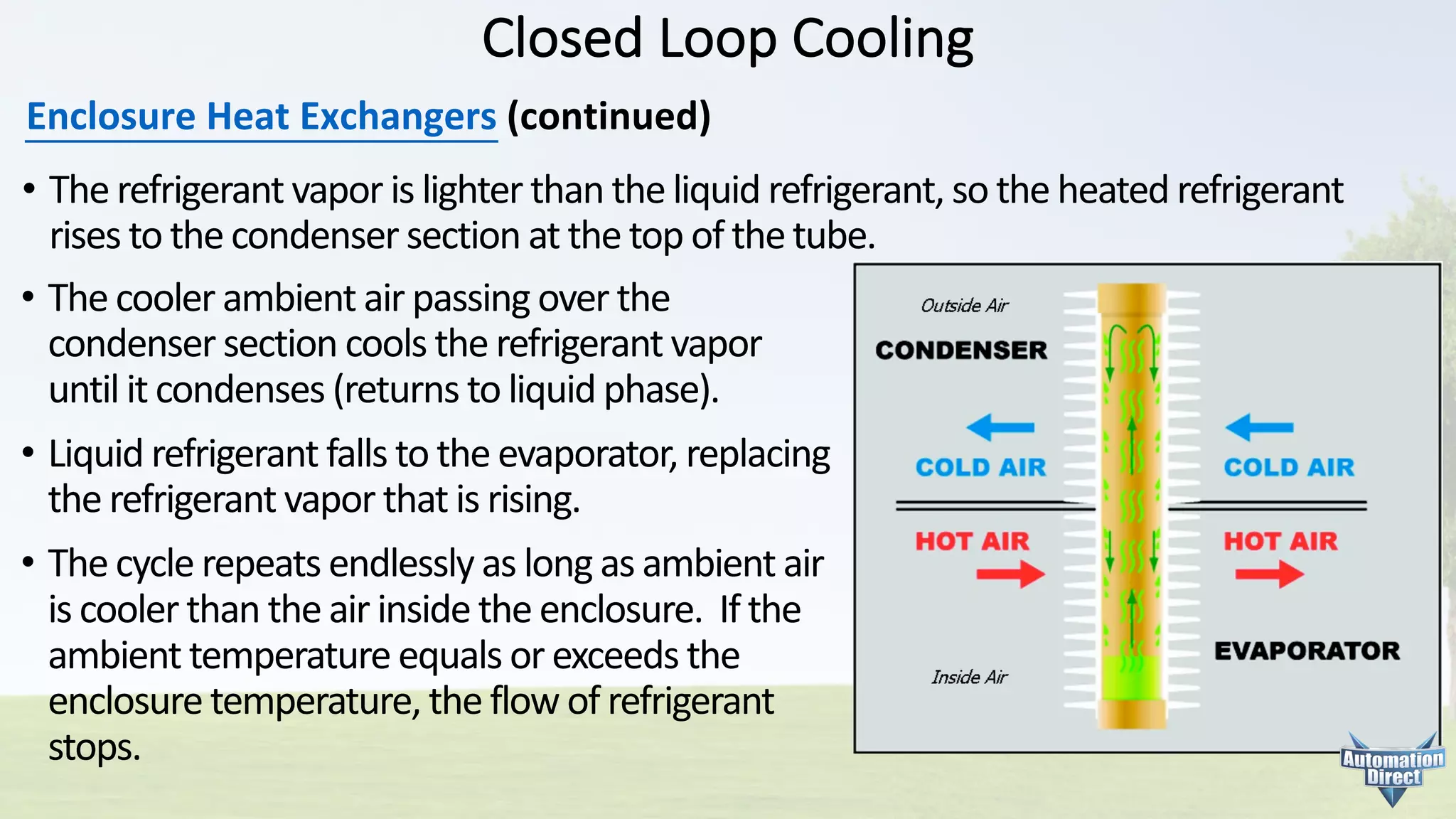
• The	refrigerant	vapor	is	lighter	than	the	liquid	refrigerant,	so	the	heated	refrigerant
rises	to	the	condenser	section	at	the	top	of	the	tube.
• The	cooler	ambient	air	passing	over	the
condenser	section	cools	the	refrigerant	vapor
until	it	condenses	(returns	to	liquid	phase).
• Liquid	refrigerant	falls	to	the	evaporator,	replacing
the	refrigerant	vapor	that	is	rising.
• The	cycle	repeats	endlessly	as	long	as	ambient	air
is	cooler	than	the	air	inside	the	enclosure.		If	the
ambient	temperature	equals	or	exceeds	the
enclosure	temperature,	the	flow	of	refrigerant
stops.
Closed	Loop	Cooling
Enclosure	Heat	Exchangers (continued)
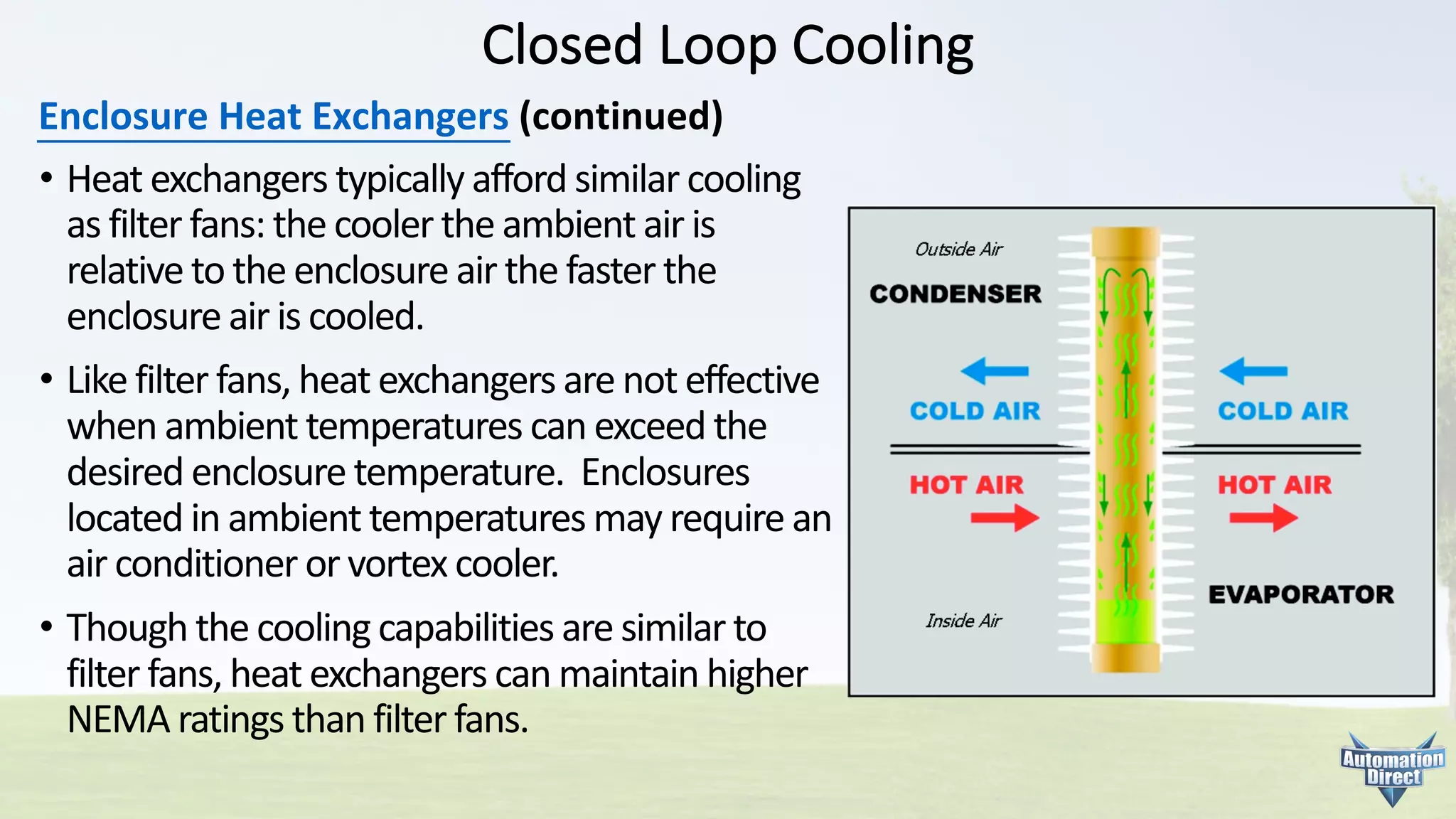
• Heat	exchangers	typically	afford	similar	cooling
as	filter	fans:	the	cooler	the	ambient	air	is
relative	to	the	enclosure	air	the	faster	the
enclosure	air	is	cooled.
• Like	filter	fans,	heat	exchangers	are	not	effective
when	ambient	temperatures	can	exceed	the
desired	enclosure	temperature.		Enclosures
located	in	ambient	temperatures	may	require	an
air	conditioner	or	vortex	cooler.
• Though	the	cooling	capabilities	are	similar	to
filter	fans,	heat	exchangers	can	maintain	higher
NEMA	ratings	than	filter	fans.
Closed	Loop	Cooling
Enclosure	Heat	Exchangers (continued)
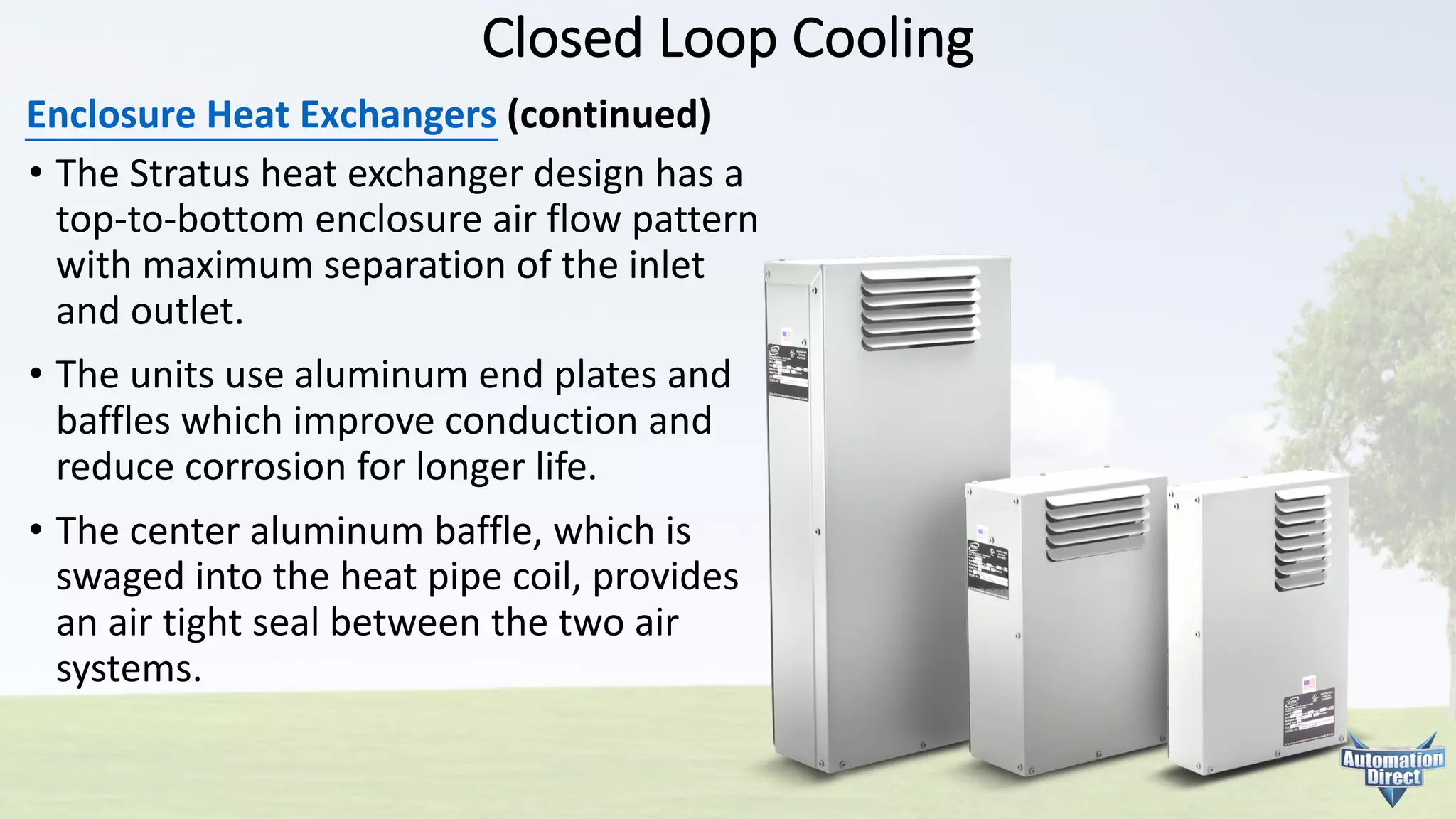
• The	Stratus	heat	exchanger	design	has	a
top-to-bottom	enclosure	air	flow	pattern
with	maximum	separation	of	the	inlet
and	outlet.
• The	units	use	aluminum	end	plates	and
baffles	which	improve	conduction	and
reduce	corrosion	for	longer	life.
• The	center	aluminum	baffle,	which	is
swaged	into	the	heat	pipe	coil,	provides
an	air	tight	seal	between	the	two	air
systems.
Closed	Loop	Cooling
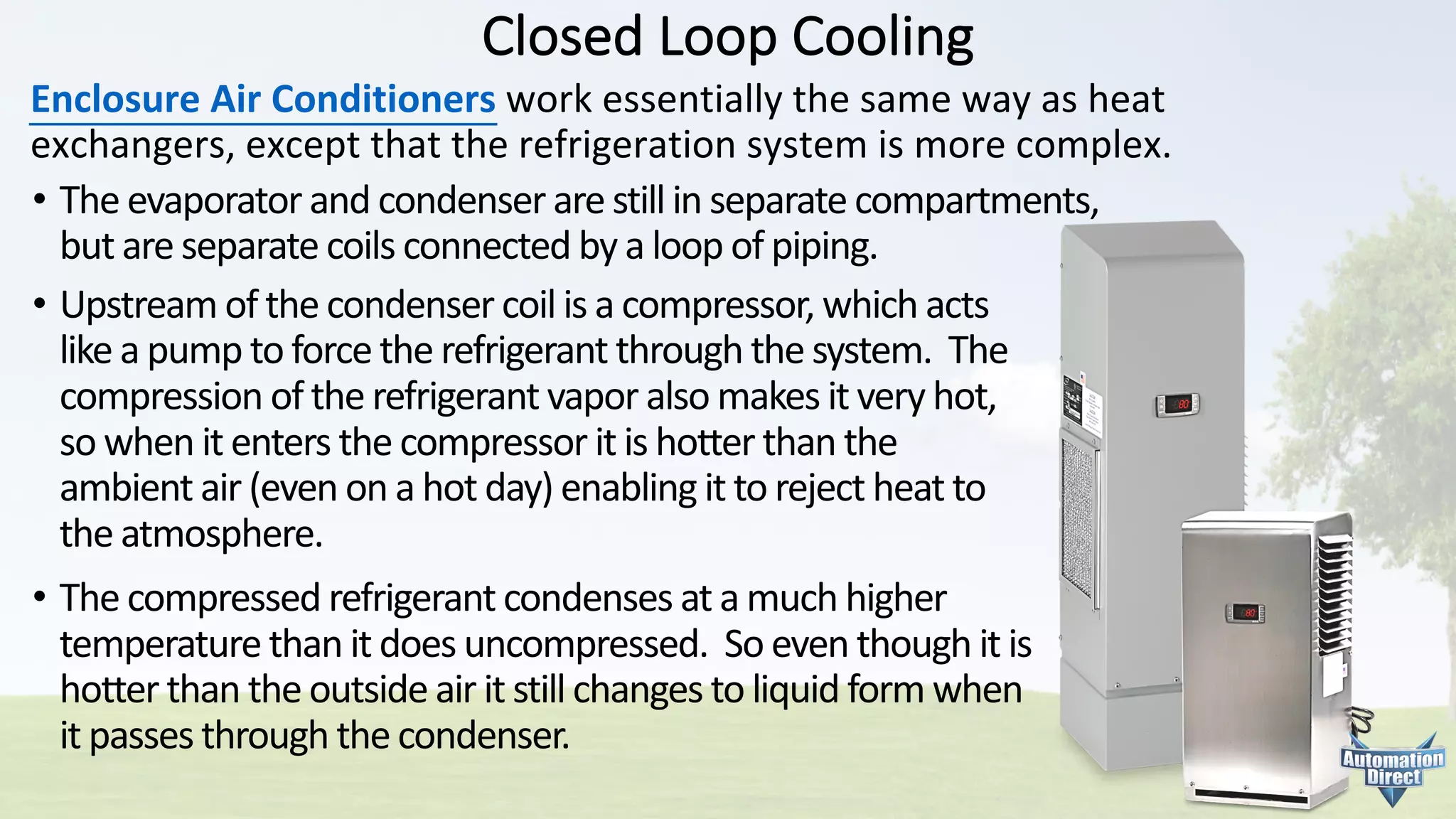
Enclosure	Air	Conditioners work	essentially	the	same	way	as	heat	
exchangers,	except	that	the	refrigeration	system	is	more	complex.
• The	evaporator	and	condenser	are	still	in	separate	compartments,
but	are	separate	coils	connected	by	a	loop	of	piping.
• Upstream	of	the	condenser	coil	is	a	compressor,	which	acts
like	a	pump	to	force	the	refrigerant	through	the	system.		The
compression	of	the	refrigerant	vapor	also	makes	it	very	hot,
so	when	it	enters	the	compressor	it	is	hotter	than	the
ambient	air	(even	on	a	hot	day)	enabling	it	to	reject	heat	to
the	atmosphere.
• The	compressed	refrigerant	condenses	at	a	much	higher
temperature	than	it	does	uncompressed.		So	even	though	it	is
hotter	than	the	outside	air	it	still	changes	to	liquid	form	when
it	passes	through	the	condenser.
Closed	Loop	Cooling
Enclosure	Air	Conditioners (continued)
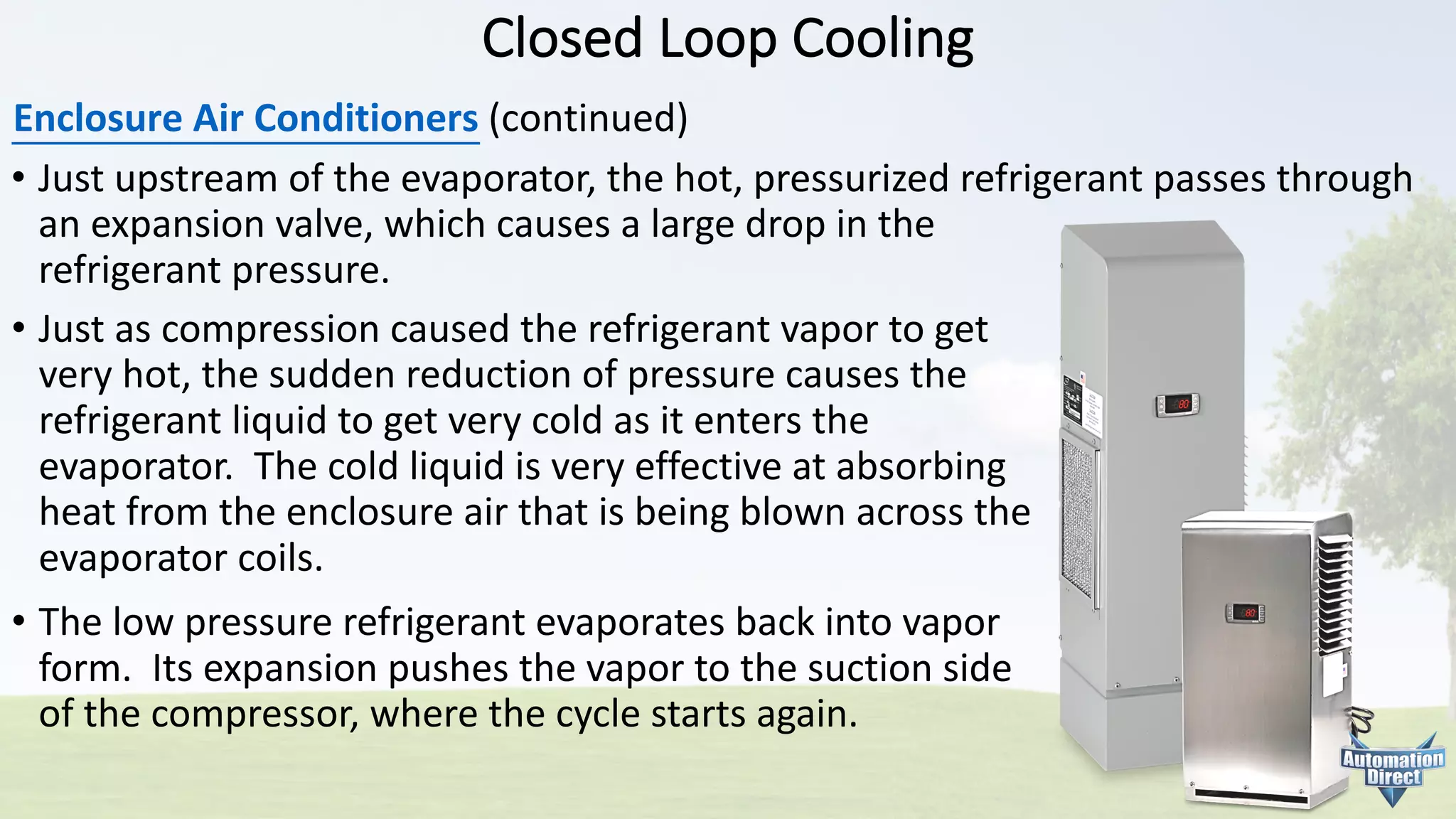
• Just	upstream	of	the	evaporator,	the	hot,	pressurized	refrigerant	passes	through
an	expansion	valve,	which	causes	a	large	drop	in	the
refrigerant	pressure.
• Just	as	compression	caused	the	refrigerant	vapor	to	get
very	hot,	the	sudden	reduction	of	pressure	causes	the
refrigerant	liquid	to	get	very	cold	as	it	enters	the
evaporator.		The	cold	liquid	is	very	effective	at	absorbing
heat	from	the	enclosure	air	that	is	being	blown	across	the
evaporator	coils.
• The	low	pressure	refrigerant	evaporates	back	into	vapor
form.		Its	expansion	pushes	the	vapor	to	the	suction	side
of	the	compressor,	where	the	cycle	starts	again.
Closed	Loop	Cooling
Enclosure	Air	Conditioners (continued)
• The	compression	and	expansion	of	the	refrigerant	(and	the
accompanying	temperature	extremes	they	produce)	means
that	an	air	conditioner	can	maintain	enclosure	temperatures
that	are	lower	than	ambient	temperatures.	This	makes	air
conditioners	useful	in	environments	that	have	high	ambient
temperatures,	where	fans	or	heat	exchangers	would	be
ineffective.
• The	effectiveness	of	the	air	conditioner	does	come	at	a
price.	The	compressor	uses	much	more	electrical	power
than	a	filter	fan	or	a	heat	exchanger.
Closed	Loop	Cooling
Enclosure	Air	Conditioners (continued)
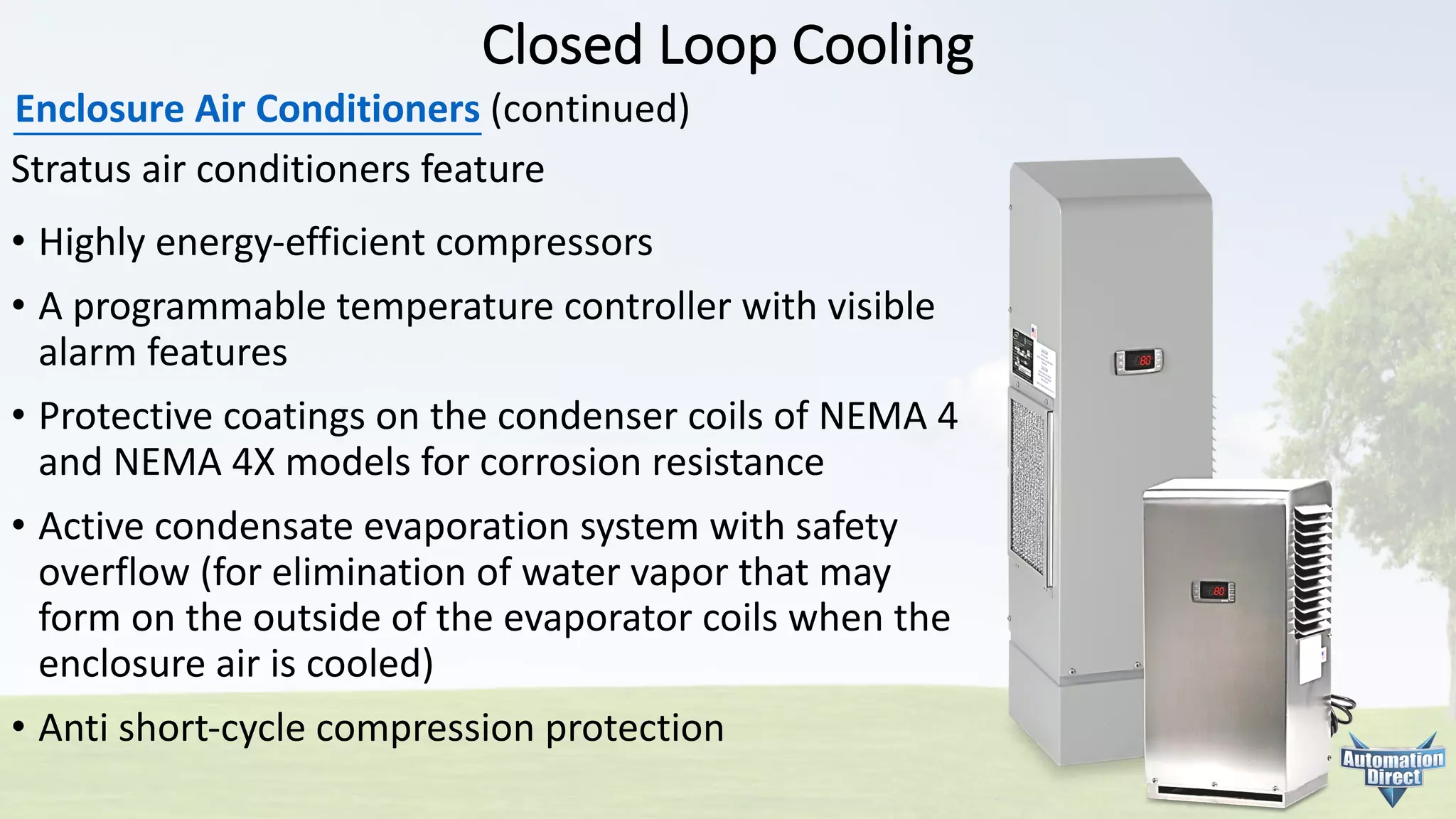
Stratus	air	conditioners	feature
• Highly	energy-efficient	compressors
• A	programmable	temperature	controller	with	visible
alarm	features
• Protective	coatings	on	the	condenser	coils	of	NEMA	4
and	NEMA	4X	models	for	corrosion	resistance
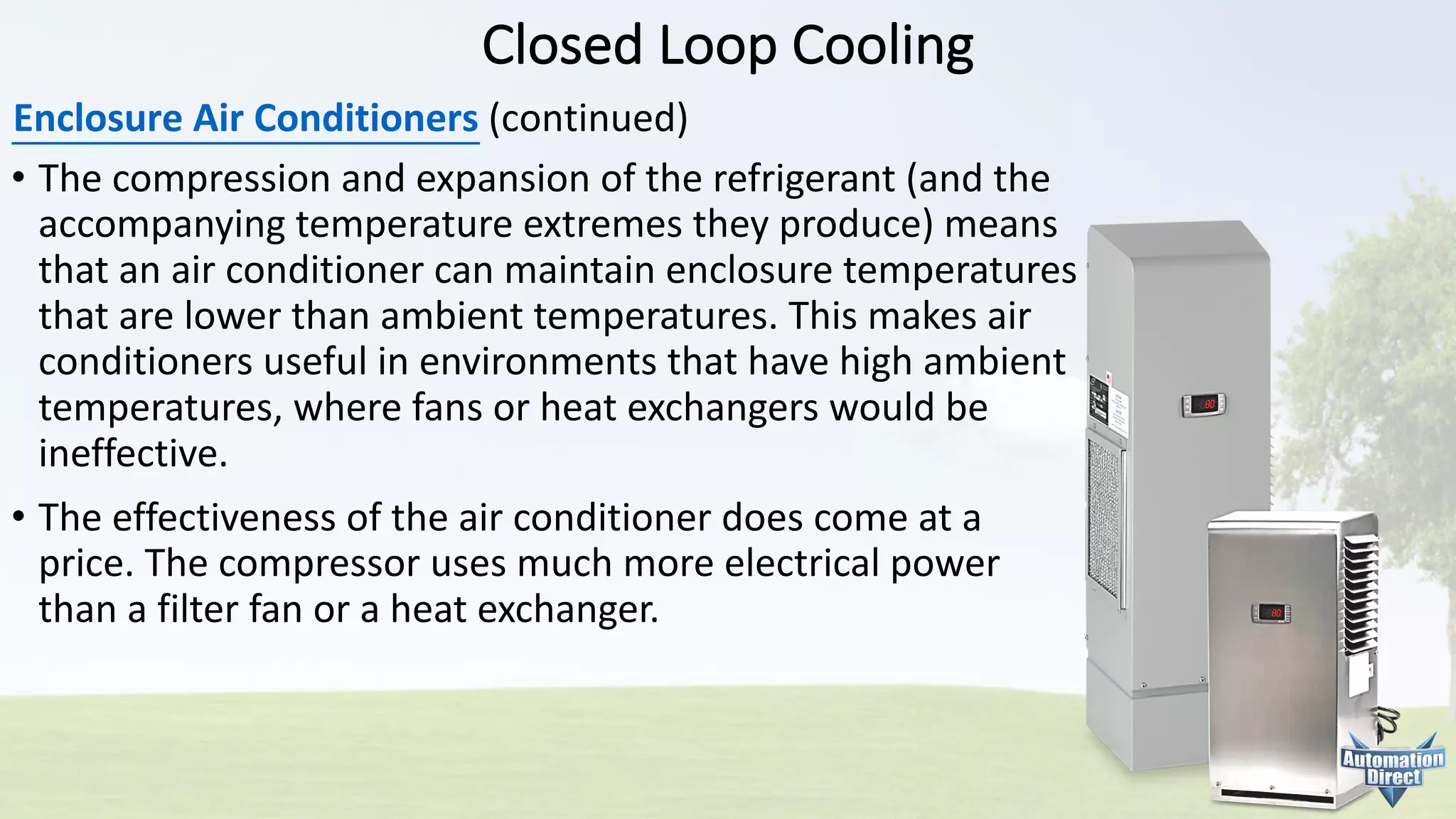
• Active	condensate	evaporation	system	with	safety
overflow	(for	elimination	of	water	vapor	that	may
form	on	the	outside	of	the	evaporator	coils	when	the
enclosure	air	is	cooled)
• Anti	short-cycle	compression	protection
Closed	Loop	Cooling
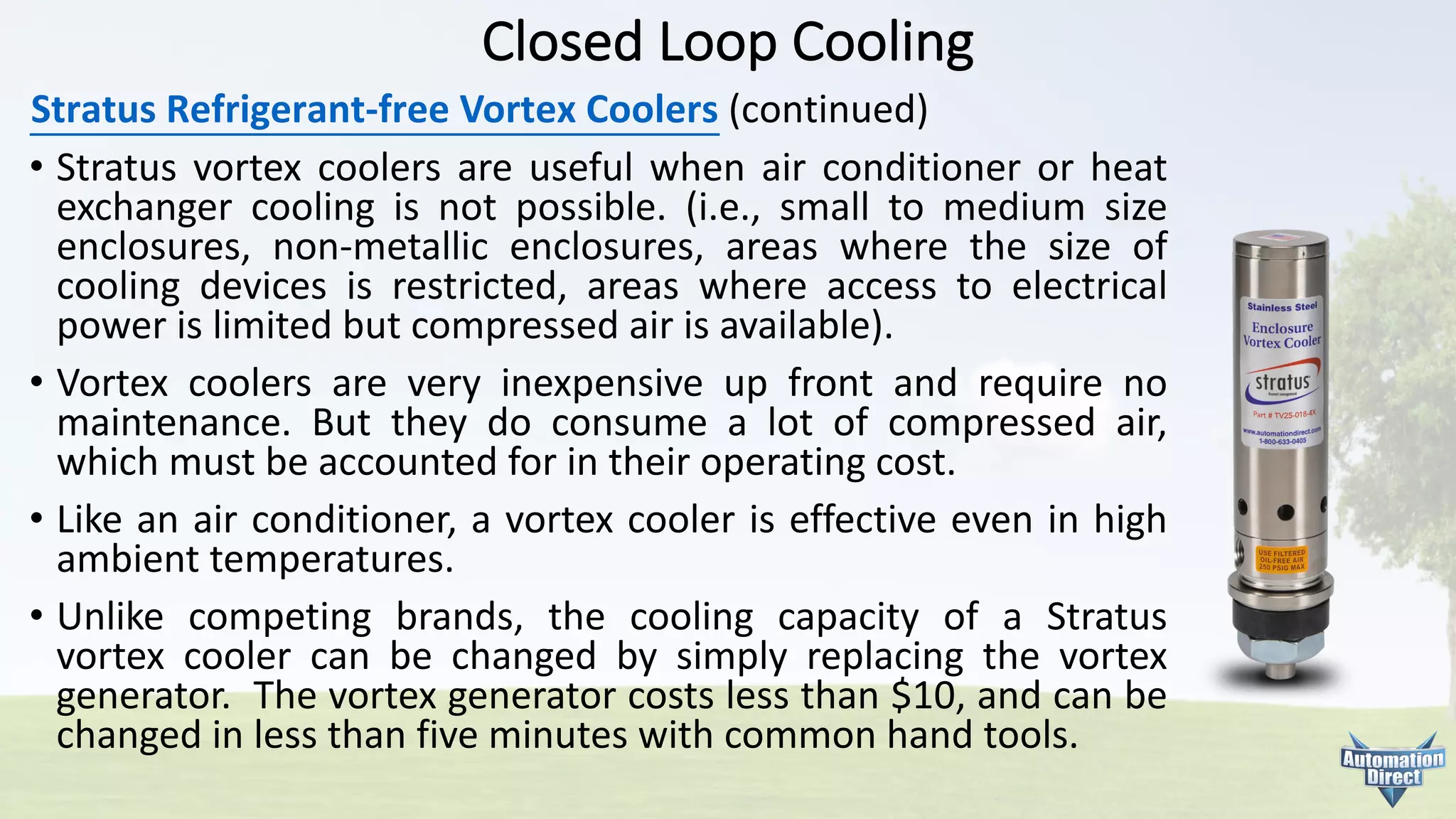
Stratus	Refrigerant-free	Vortex	Coolers
(Technically, vortex coolers aren’t closed loop, they are actually displacing hot air inside the enclosure with
cold air from the outside. However, since the cold air comes from a filtered compressed air system, they
stillmaintainhighNEMAenclosureratingslikeairconditionersandheatexchangers.)
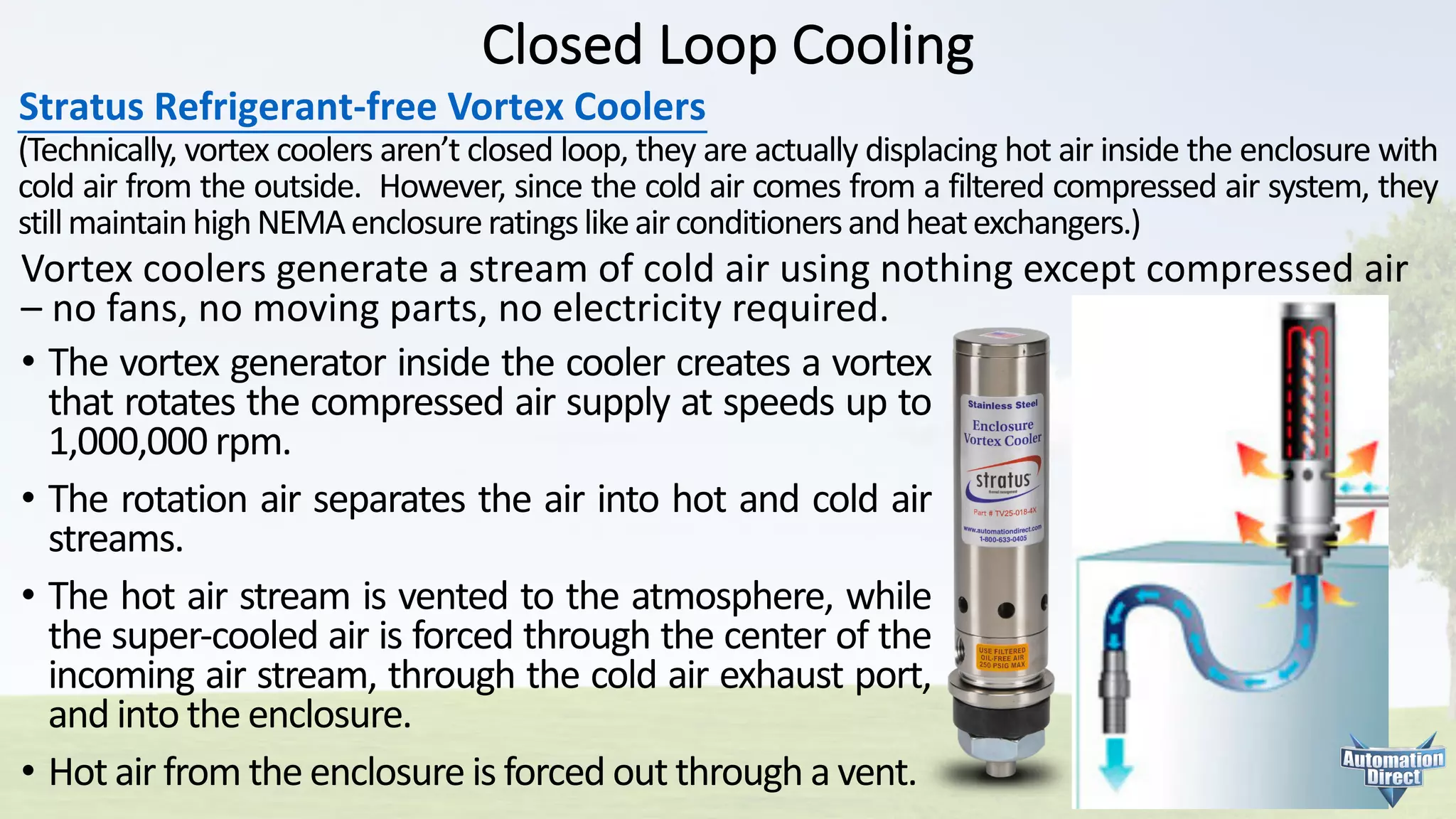
• The vortex generator inside the cooler creates a vortex
that rotates the compressed air supply at speeds up to
1,000,000 rpm.
• The rotation air separates the air into hot and cold air
streams.
• The hot air stream is vented to the atmosphere, while
the super-cooled air is forced through the center of the
incoming air stream, through the cold air exhaust port,
and into the enclosure.
• Hot air from the enclosure is forced out through a vent.
Vortex	coolers	generate	a	stream	of	cold	air	using	nothing	except	compressed	air	
– no	fans,	no	moving	parts,	no	electricity	required.
Closed	Loop	Cooling
Stratus	Refrigerant-free	Vortex	Coolers (continued)
• Stratus vortex coolers are useful when air conditioner or heat
exchanger cooling is not possible. (i.e., small to medium size
enclosures, non-metallic enclosures, areas where the size of
cooling devices is restricted, areas where access to electrical
power is limited but compressed air is available).
• Vortex coolers are very inexpensive up front and require no
maintenance. But they do consume a lot of compressed air,
which must be accounted for in their operating cost.
• Like an air conditioner, a vortex cooler is effective even in high
ambient temperatures.
• Unlike competing brands, the cooling capacity of a Stratus
vortex cooler can be changed by simply replacing the vortex
generator. The vortex generator costs less than $10, and can be
changed in less than five minutes with common hand tools.
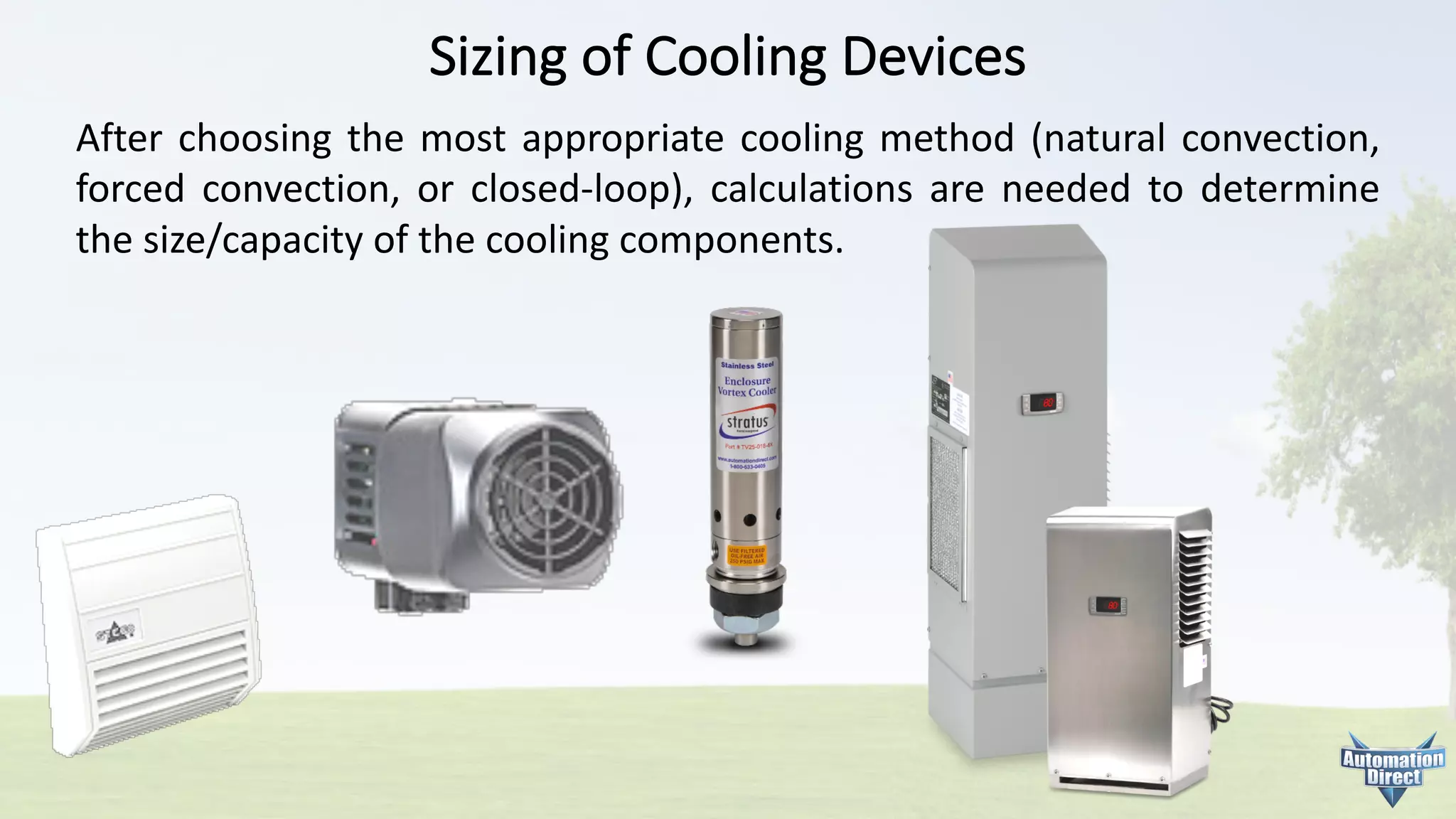
Sizing	of	Cooling	Devices
After choosing the most appropriate cooling method (natural convection,
forced convection, or closed-loop), calculations are needed to determine
the size/capacity of the cooling components.
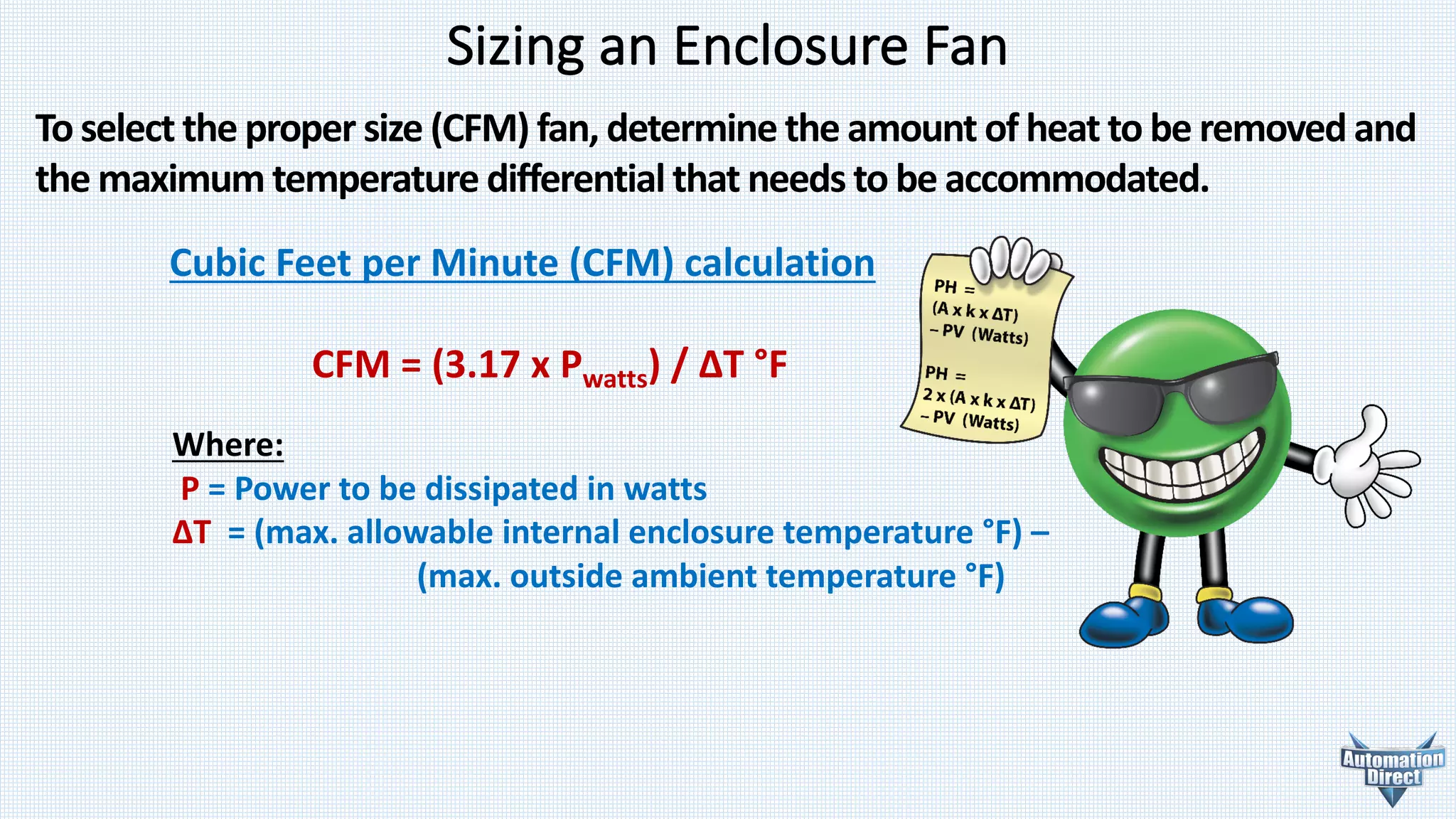
Sizing	an	Enclosure	Fan
To	select	the	proper	size	(CFM)	fan,	determine	the	amount	of	heat	to	be	removed	and	
the	maximum	temperature	differential	that	needs	to	be	accommodated.
Cubic	Feet	per	Minute	(CFM)	calculation
CFM	=	(3.17	x	Pwatts)	/	ΔT	°F
Where:
P	=	Power	to	be	dissipated	in	watts
ΔT	 =	(max.	allowable	internal	enclosure	temperature	°F)	–
(max.	outside	ambient	temperature	°F)
Fan	Sizing	Example
A NEMA 12 Hubbell Wiegmann N12302412 enclosure (30ʺ high x 24ʺ wide x
12ʺ deep) contains a GS3-2020 AC drive (20 HP 230 volt) that has a
maximum allowable operating temperature of 104°F and is located in a
warehouse with a maximum outside ambient air temperature of 95°F.
Power to be dissipated is stated in the specifications of the GS3-2020 and is
found to be 750 watts, so P = 750 watts.
ΔT	 =	104°F	(max.	operating	temperature	for	the	GS3-2020)
– 95°F	(max.	ambient	air	temperature)	=	9°F
Sizing	an	Enclosure	Fan	(continued)
CFM	=	(3.17	x	750	watts)	/	9°F	=	264
Informative video for AutomationDirect’s STEGO line of enclosure filter fans and
exhaust grilles.
Sizing	an	Enclosure	Fan
Sizing	an	Air	Conditioner	or	Vortex	Cooler
To	select	the	proper	size	unit,	consider	the	worst-case conditions,	but	do	not	oversize.	
Two	main	factors	when	choosing	for	an	indoor	uninsulated	metal NEMA	rated	enclosure:
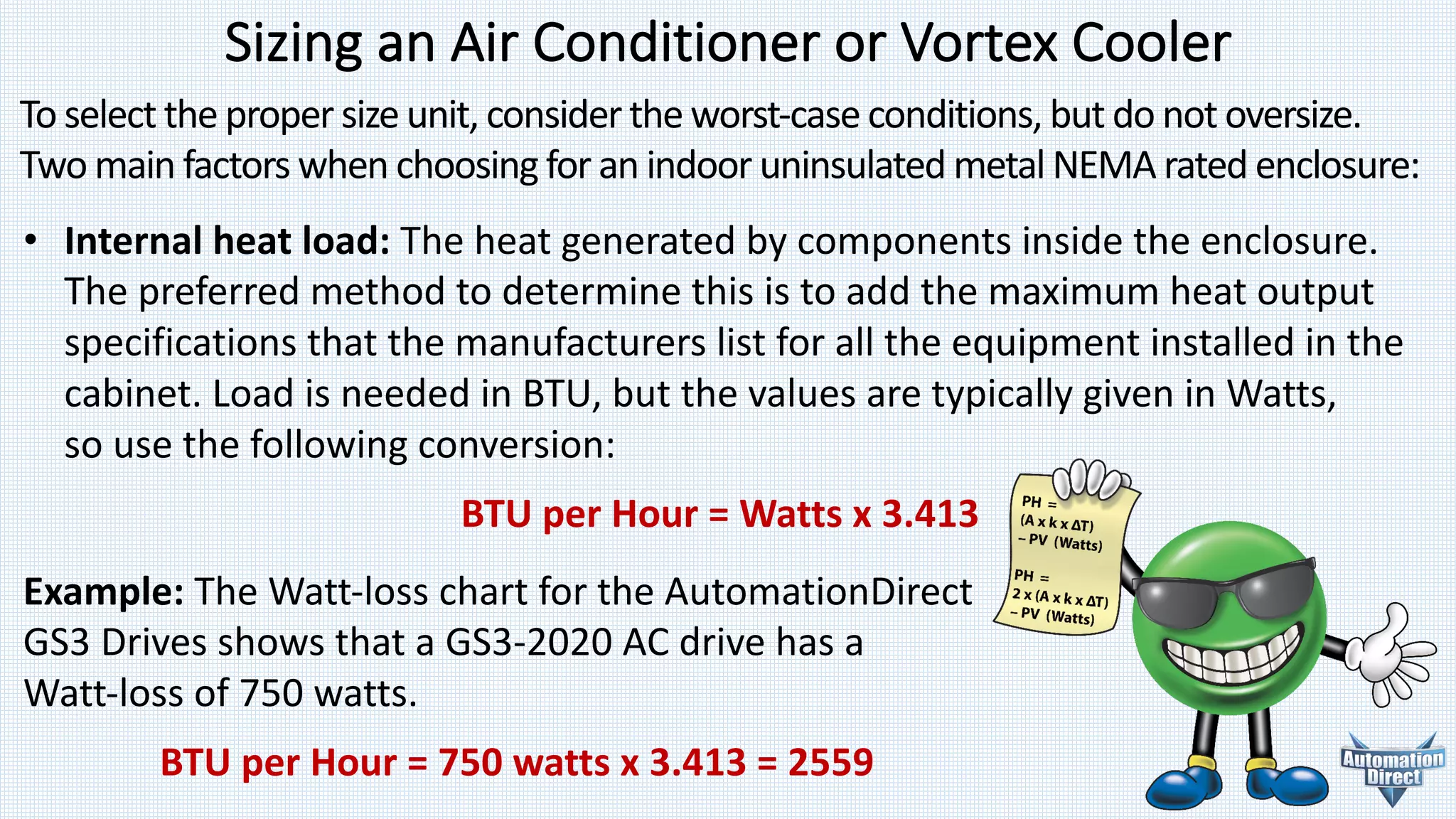
• Internal	heat	load:	The	heat	generated	by	components inside	the	enclosure.
The	preferred	method	to	determine	this	is	to	add	the	maximum	heat output
specifications	that	the	manufacturers	list	for	all	the	equipment	installed	in	the
cabinet.	Load	is	needed	in	BTU,	but	the	values	are	typically	given	in	Watts,
so use	the	following	conversion:
BTU	per	Hour	=	Watts	x	3.413
Example:	The	Watt-loss	chart	for	the	AutomationDirect
GS3	Drives	shows	that	a GS3-2020	AC	drive	has	a	
Watt-loss	of	750	watts.
BTU	per	Hour	=	750	watts	x	3.413	=	2559
Sizing	an	Air	Conditioner	(continued)
Note:	1.25	is	an	industry	standard	constant	for	metal	enclosures;	
for	plastic	enclosures	use	0.62.
• Heat	Load	Transfer: The	heat	lost	(negative	heat	load	transfer)	or gained
(positive	heat	load	transfer)	through	the	enclosure	walls with	the	surrounding
ambient	air. Calculate	using	the following	formula:
Heat	load	transfer	(BTU/H)	=	
1.25	x	surface	area	(sq.	ft.	)	x	(max.	outside	ambient	air	(°F)	–
max.	allowable	internal	enclosure	temperature	air	(°F)) Surface	Area	(sq.	ft.)	=	
2	[(H	x	W)	+	(H	x	D)	+	(W	x	D)]	/	144	sq.	inches
Cooling	capacity	(BTU/H)	=	Internal	Heat	Load	± Heat	Load	Transfer
Once	you	determine	the	Internal	Heat	Load	and	the Heat	
Load	Transfer,	you	can	choose	the	proper	size	unit	
by calculating	the	needed	cooling	capacity.
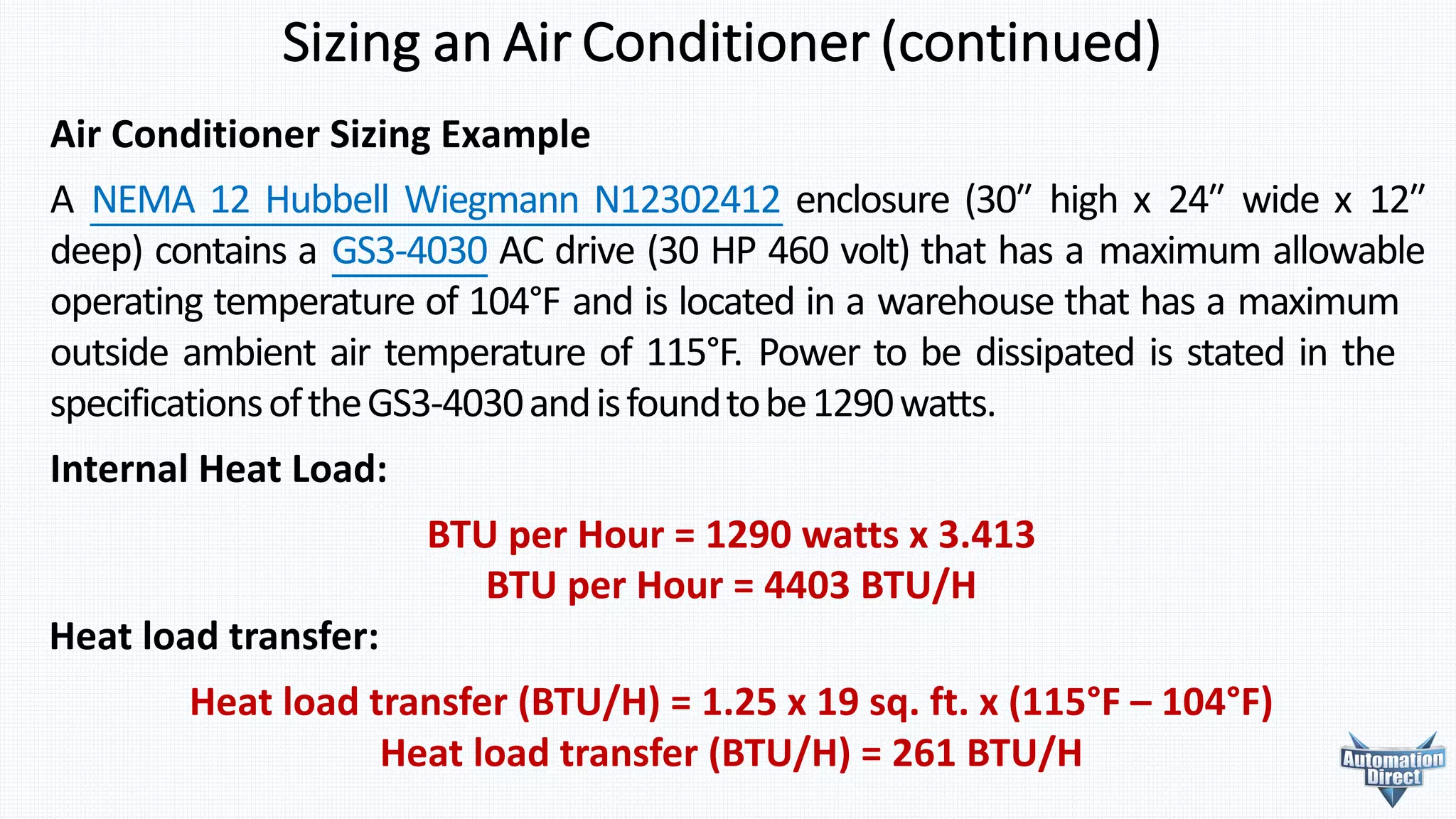
BTU	per	Hour	=	1290	watts	x	3.413
BTU	per	Hour	=	4403	BTU/H
Heat	load	transfer:
Heat	load	transfer	(BTU/H)	=	1.25	x	19	sq.	ft.	x	(115°F	– 104°F)
Heat	load	transfer	(BTU/H)	=	261	BTU/H
Sizing	an	Air	Conditioner	(continued)
Air	Conditioner	Sizing	Example
A NEMA 12 Hubbell Wiegmann N12302412 enclosure (30ʺ high x 24ʺ wide x 12ʺ
deep) contains a GS3-4030 AC drive (30 HP 460 volt) that has a maximum allowable
operating temperature of 104°F and is located in a warehouse that has a maximum
outside ambient air temperature of 115°F. Power to be dissipated is stated in the
specificationsoftheGS3-4030andisfoundtobe1290watts.
Internal	Heat	Load:
Air	Conditioner	Sizing	Example	(continued)
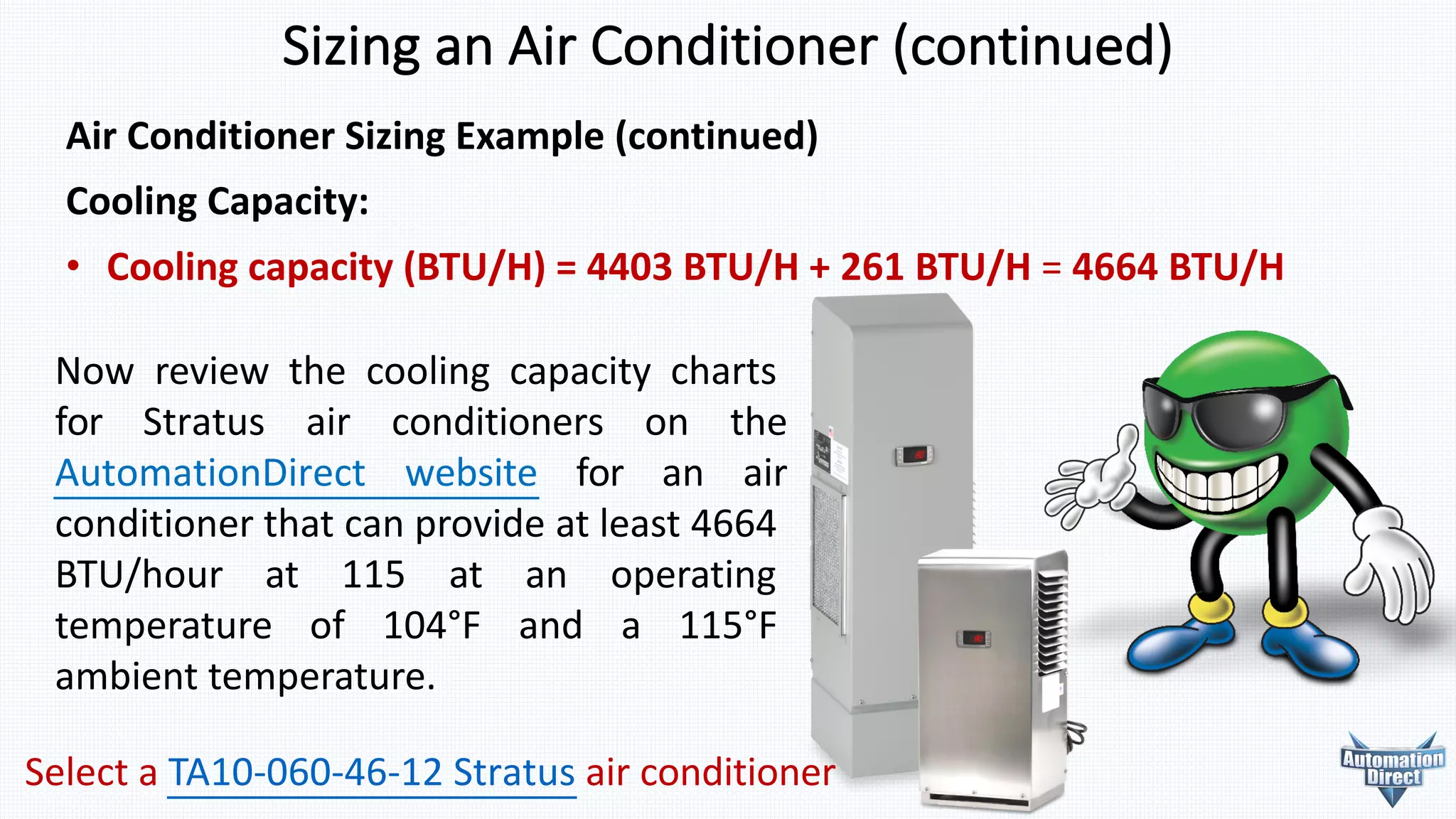
Cooling	Capacity:
• Cooling	capacity	(BTU/H)	=	4403	BTU/H	+	261	BTU/H	=	4664	BTU/H
Now review the cooling capacity charts
for Stratus air conditioners on the
AutomationDirect website for an air
conditioner that can provide at least 4664
BTU/hour at 115 at an operating
temperature of 104°F and a 115°F
ambient temperature.
Sizing	an	Air	Conditioner	(continued)
Select a TA10-060-46-12 Stratus air conditioner
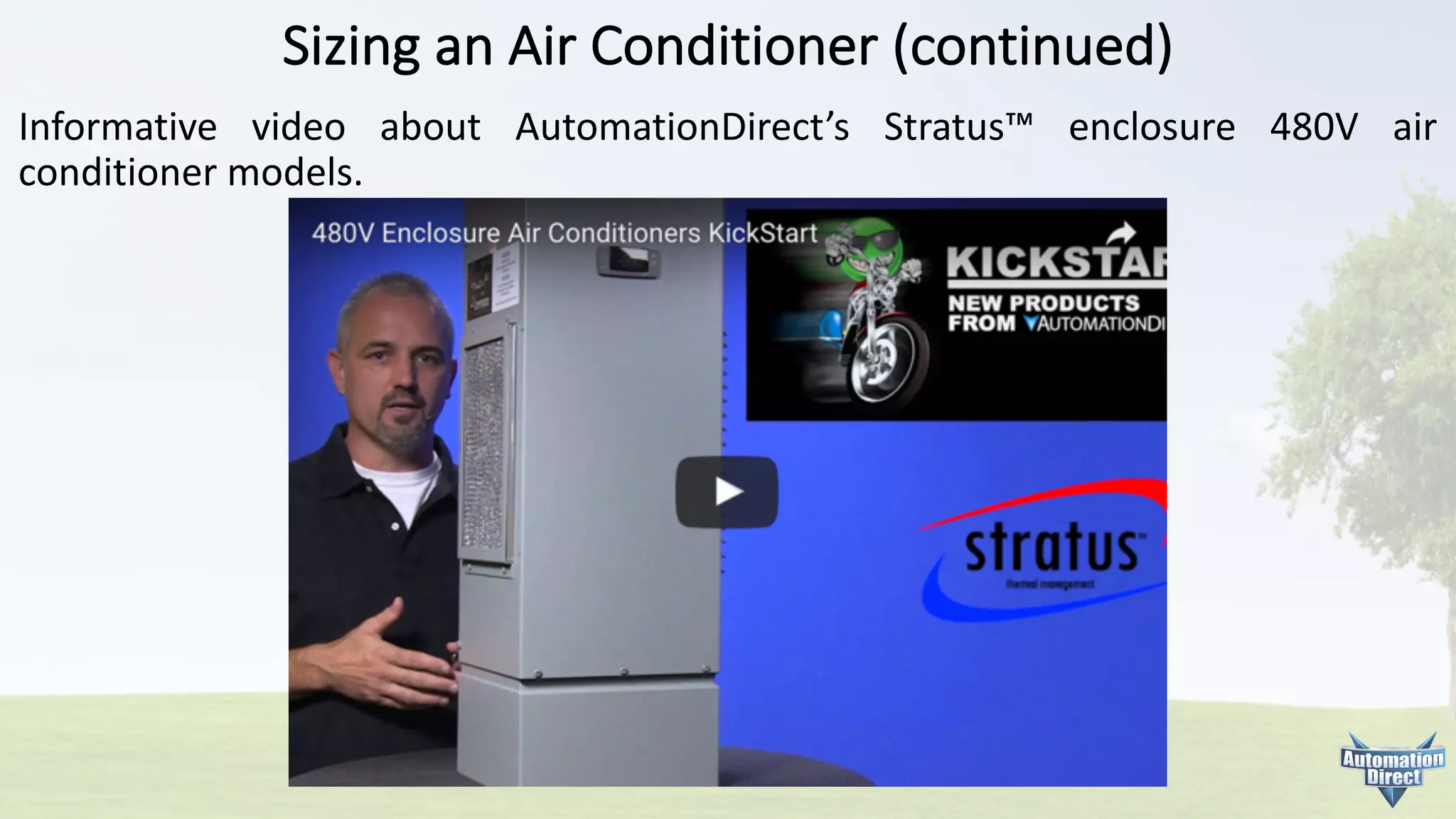
Informative video about AutomationDirect’s Stratus™ enclosure 480V air
conditioner models.
Sizing	an	Air	Conditioner	(continued)
Sizing	a	Heat	Exchanger
To select the proper size unit, consider the worst-case conditions. For a heat exchanger
to work, ambient air temperature must be lower than the desired internal enclosure
air temperature. There are three main factors in choosing a heat exchanger for an
uninsulated metal NEMA rated enclosure located indoors:
• Internal	heat	load:	The	heat	generated	by	components inside	the	enclosure.
The	preferred	method	to	determine	this	is	to	add	the	maximum	heat output
specifications	that	the	manufacturers	list	for	all	the	equipment	installed	in	the
cabinet.	This	is	typically	given	in	Watts.
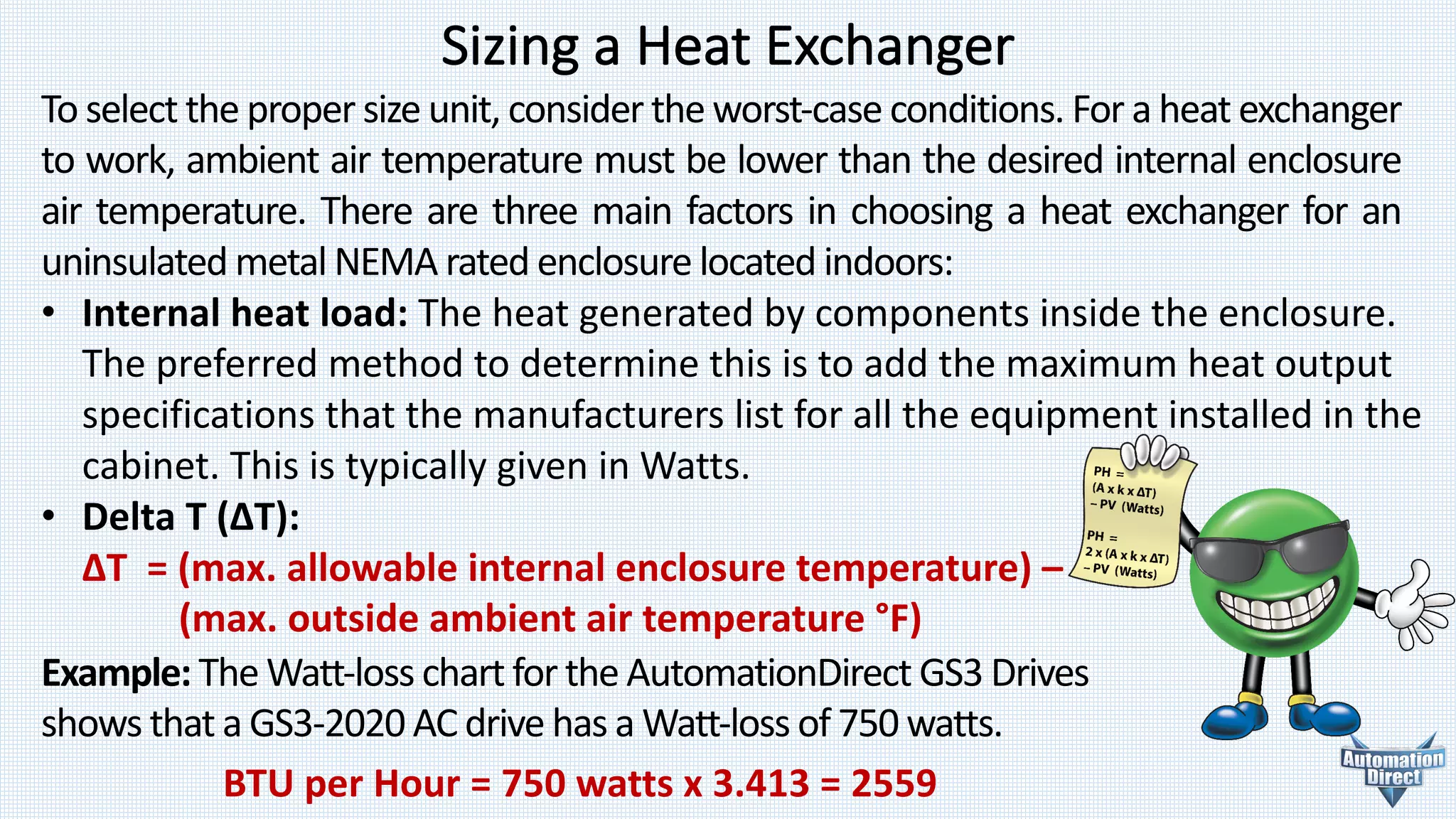
• Delta	T	(ΔT):
ΔT		=	(max.	allowable	internal	enclosure	temperature)	–
(max.	outside	ambient	air	temperature	°F)
Example:	The	Watt-loss	chart	for	the	AutomationDirect GS3	Drives	
shows	that	a GS3-2020	AC	drive	has	a	Watt-loss	of	750	watts.
BTU	per	Hour	=	750	watts	x	3.413	=	2559
Sizing	a	Heat	Exchanger	(continued)
Note:	Only	include	exposed	surfaces.
Heat	Load	Transfer	(W/°F)	=	0.22	W/°F	sq.	Ft.	x	Surface	Area
Note:	Use	0.22	Watts/°F	sq.	ft.	for	painted	stainless	and	non-
metallic	enclosures.	Use	0.10	Watts/°F	sq.	ft.	for	stainless	
steel	and	bare	aluminum	enclosures.
Once	you	determine	the	Internal	Heat	Load	and	theHeat	Load	
Transfer	and	the	Delta	T,	you	can	choose	the	proper	size	unit	
by calculating	the	needed	cooling	capacity.
• Heat	Load	Transfer: The	heat	lost	(negative	heat	load	transfer)	or gained
(positive	heat	load	transfer)	through	the	enclosure	walls with	the	surrounding
ambient	air. Calculate	using	the following	formula:
Surface	Area	(sq.	ft.)	=	 2	[(H	x	W)	+	(H	x	D)	+	(W	x	D)]	/	144	sq.	inches
Cooling	capacity	(W/°F)	=	Internal	Heat	Load	/	ΔT	 - Heat	Load	Transfer
Surface	Area	(ft.2)		=		2	[	(30	x	24)	+	(30	x	12)	+	(24	x	12)	]	/	144	sq.	inches	=	19	ft.2
Heat	load	transfer	=	0.22	x	19	ft.2		=		4.2	Watts/°F
Selecting	a	Heat	Exchanger	(continued)
Heat	Exchanger	Selection	Example
A NEMA 12 Hubbell Wiegmann N12302412 enclosure (30ʺ high x 24ʺ wide x 12ʺ
deep) contains a GS3-4010 AC drive (10 HP 460 volt) that has a maximum allowable
operating temperature of 104°F and is located in a warehouse that has a maximum
outside ambient air temperature of 90°F. Power to be dissipated is stated in the
specificationsoftheGS3-4010andisfoundtobe345Watts.
Internal	Heat	Load		=		345	Watts
Delta	T	(ΔT	)		=		104°F	– 90°F		=		14°F
Heat	load	transfer:
Heat	Exchanger	Sizing	Example	(continued)
Cooling	Capacity		=		345	Watts/°F	– 4.2	Watts/°F		=		20.4	Watts/°F
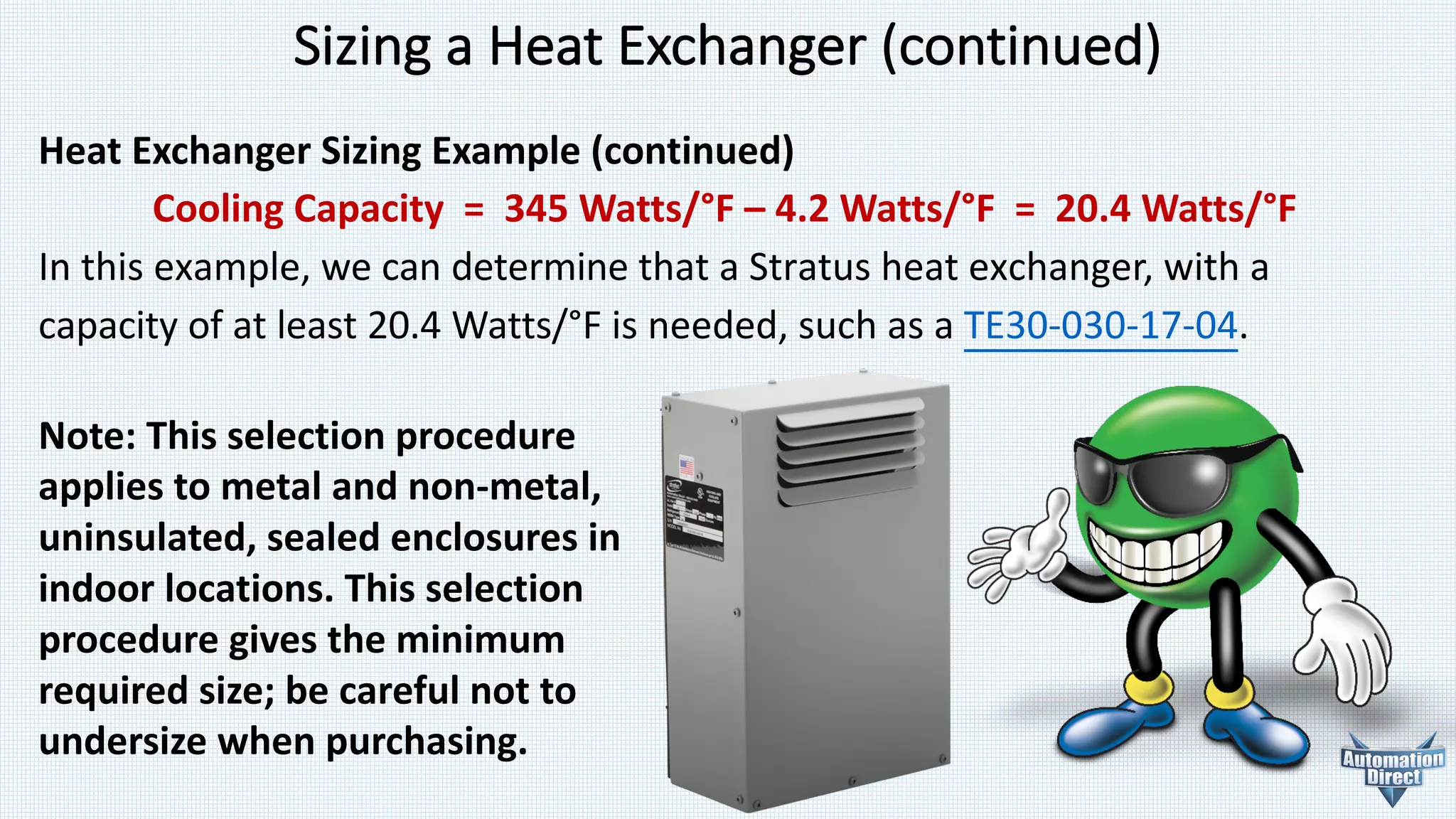
In	this	example,	we	can	determine	that	a	Stratus	heat	exchanger,	with	a	
capacity	of	at	least	20.4	Watts/°F	is	needed,	such	as	a	TE30-030-17-04.	
Sizing	a	Heat	Exchanger	(continued)
Note:	This	selection	procedure	
applies	to	metal	and	non-metal,	
uninsulated,	sealed	enclosures	in	
indoor	locations.	This	selection	
procedure	gives	the	minimum	
required	size;	be	careful	not	to	
undersize	when	purchasing.
Sizing	a	Heat	Exchanger	(continued)
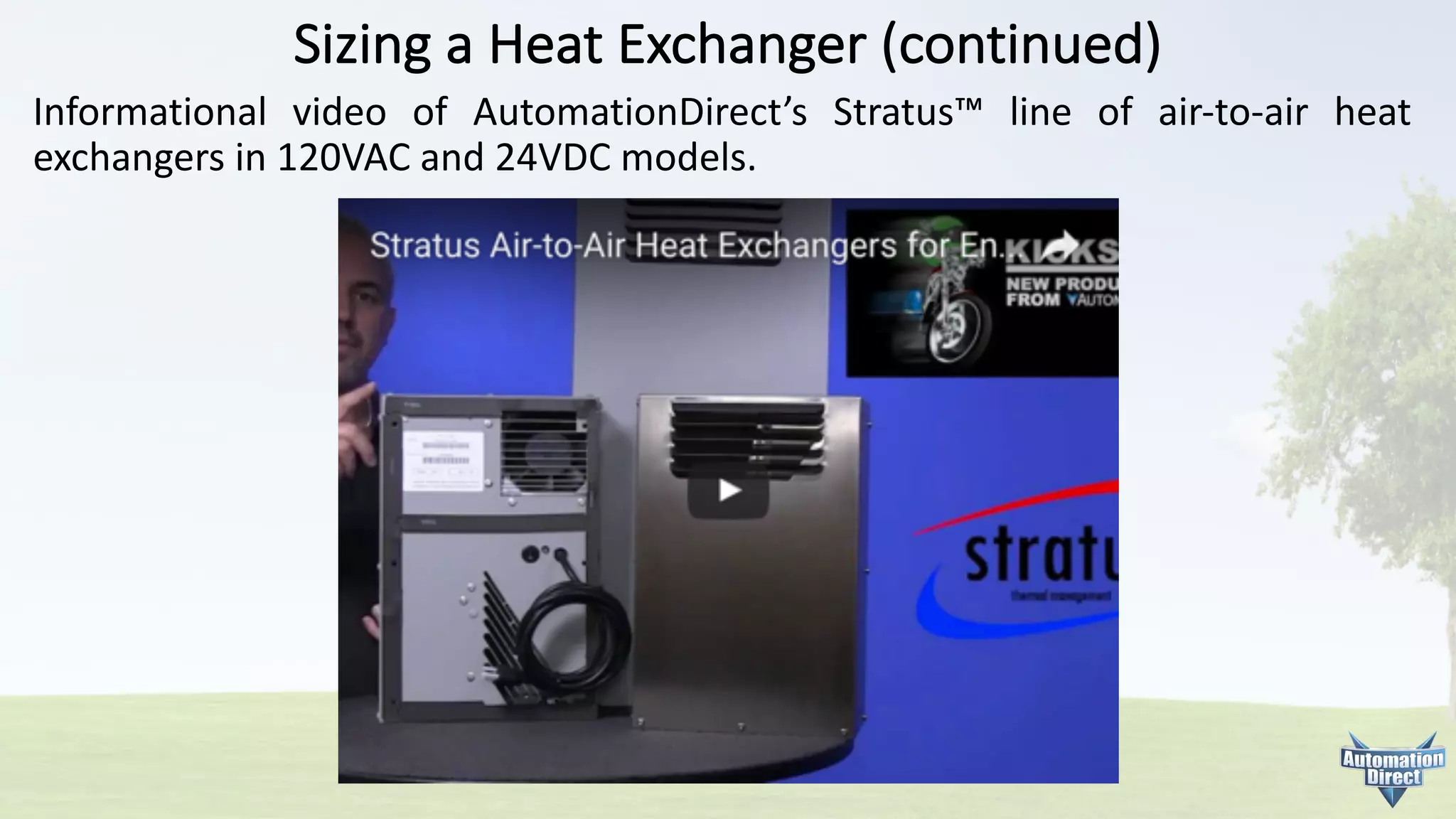
Informational video of AutomationDirect’s Stratus™ line of air-to-air heat
exchangers in 120VAC and 24VDC models.
Enclosure	Thermal	Management	Controls
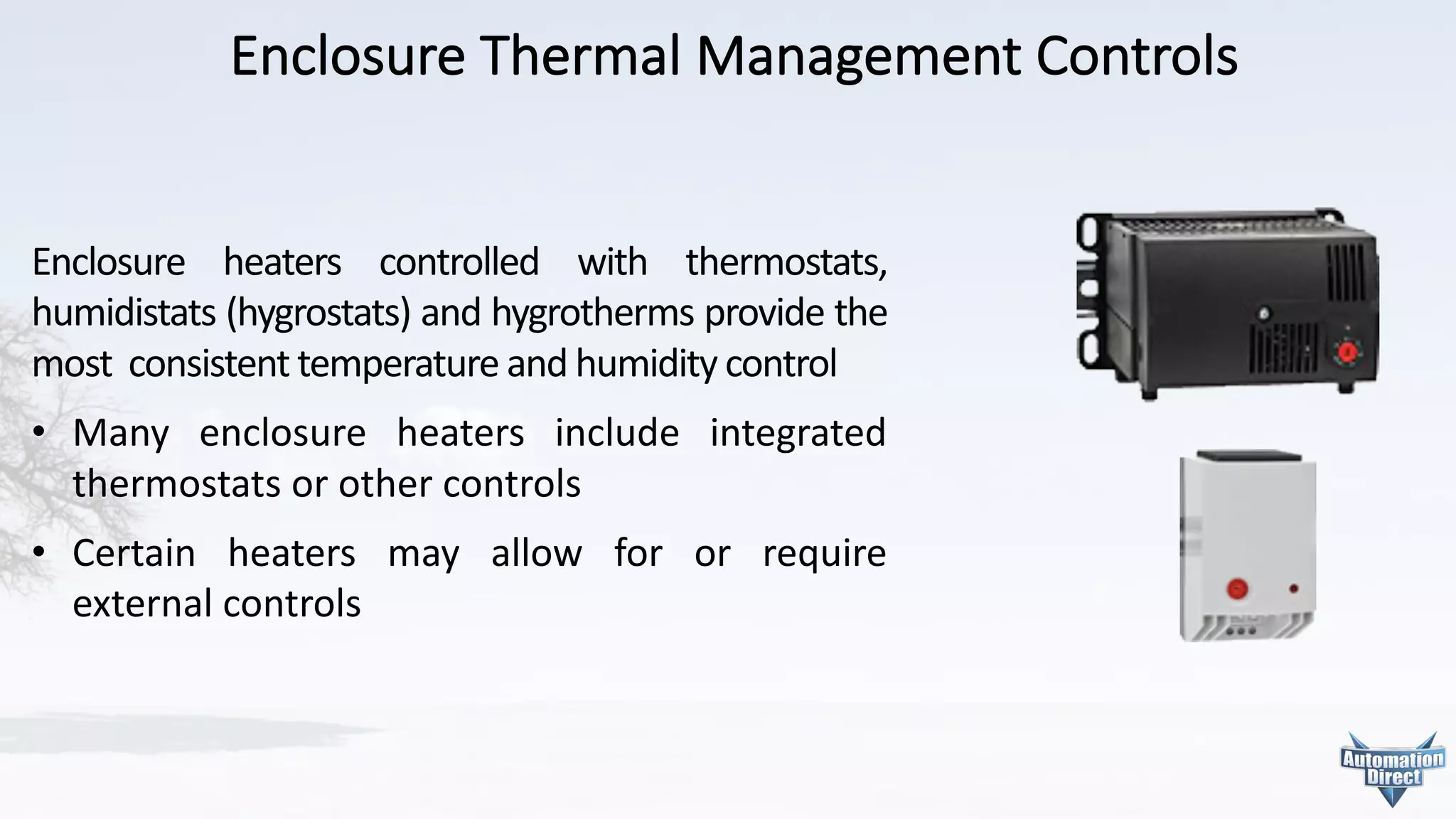
Enclosure heaters controlled with thermostats,
humidistats (hygrostats) and hygrotherms provide the
most consistent temperature and humidity control
• Many enclosure heaters include integrated
thermostats or other controls
• Certain heaters may allow for or require
external controls
Enclosure	Thermal	Management	Controls
The need for control of cooling devices depends on the type of device:
• Filter fans and Stratus heat exchangers do not require a thermostat since they
consume very little power. However if they do not need to operate
continuously, a control device will prolong the life of their filters.
• Stratus air conditioners have an integral thermostat, so an external control
device is never needed.
• Stratus vortex coolers should ALWAYS be controlled by a thermostat to
minimize compressed air consumption (and in some cases, to prevent
freezing of components inside the enclosure).
Enclosure	Thermal	Management	Controls
Climate	control	components	offered	by	AutomationDirect:
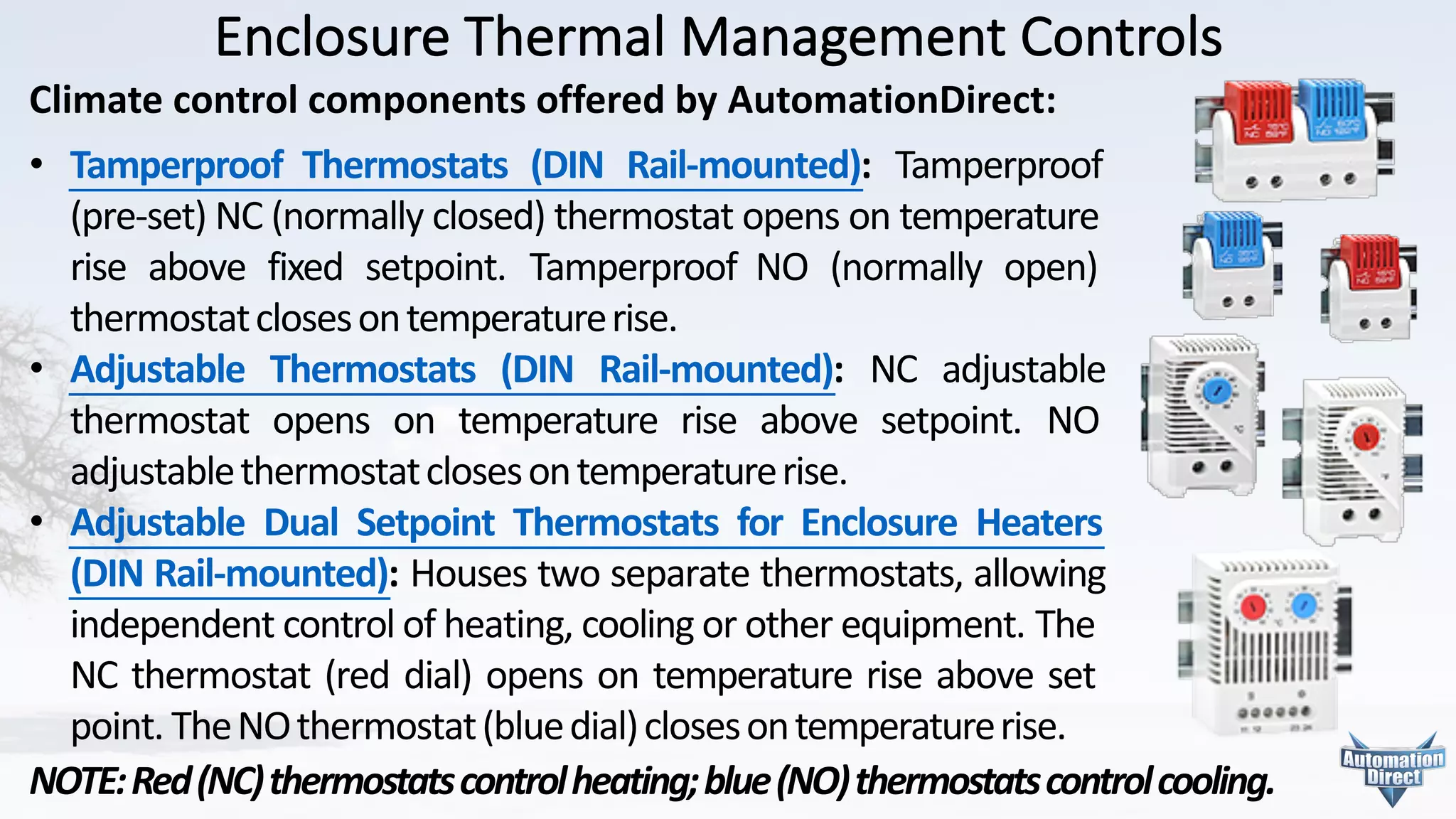
• Tamperproof Thermostats (DIN Rail-mounted): Tamperproof
(pre-set) NC (normally closed) thermostat opens on temperature
rise above fixed setpoint. Tamperproof NO (normally open)
thermostatclosesontemperaturerise.
• Adjustable Thermostats (DIN Rail-mounted): NC adjustable
thermostat opens on temperature rise above setpoint. NO
adjustablethermostatclosesontemperaturerise.
• Adjustable Dual Setpoint Thermostats for Enclosure Heaters
(DIN Rail-mounted): Houses two separate thermostats, allowing
independent control of heating, cooling or other equipment. The
NC thermostat (red dial) opens on temperature rise above set
point. TheNOthermostat(bluedial)closesontemperaturerise.	
NOTE:Red(NC)thermostatscontrolheating;blue(NO)thermostatscontrolcooling.
Enclosure	Heating	Controls
Hygrostats/Hygrotherms from	AutomationDirect:
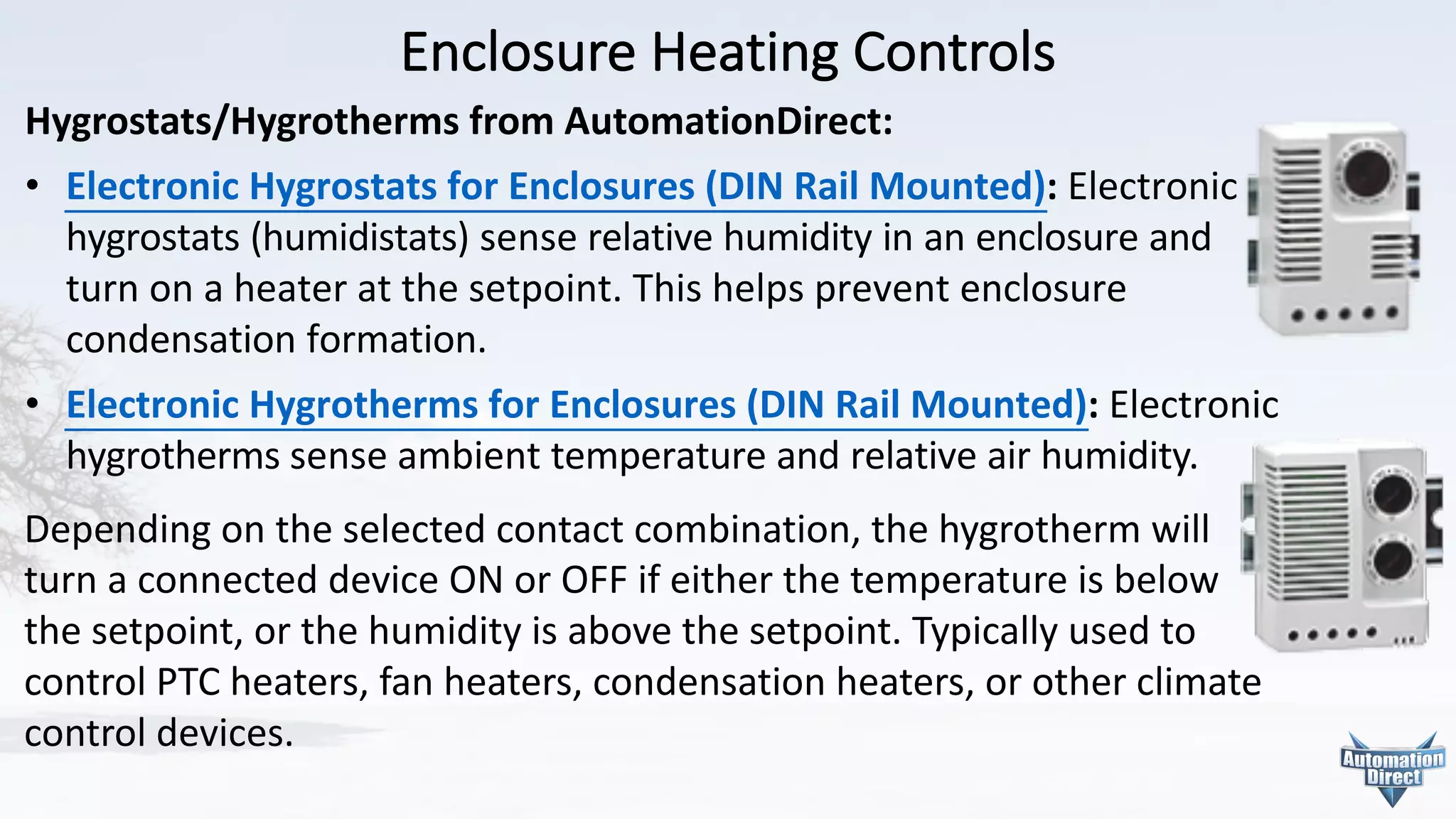
• Electronic	Hygrostats	for	Enclosures	(DIN	Rail	Mounted):	Electronic
hygrostats	(humidistats)	sense	relative	humidity	in	an	enclosure	and
turn	on	a	heater	at	the	setpoint.	This	helps	prevent	enclosure
condensation	formation.
• Electronic	Hygrotherms	for	Enclosures	(DIN	Rail	Mounted):	Electronic
hygrotherms sense	ambient	temperature	and	relative	air	humidity.	
Depending	on	the	selected	contact	combination,	the	hygrotherm will	
turn	a	connected	device	ON	or	OFF	if	either	the	temperature	is	below	
the	setpoint,	or	the	humidity	is	above	the	setpoint.	Typically	used	to	
control	PTC	heaters,	fan	heaters,	condensation	heaters,	or	other	climate	
control	devices.
Enclosure	Thermal	Management	Controls
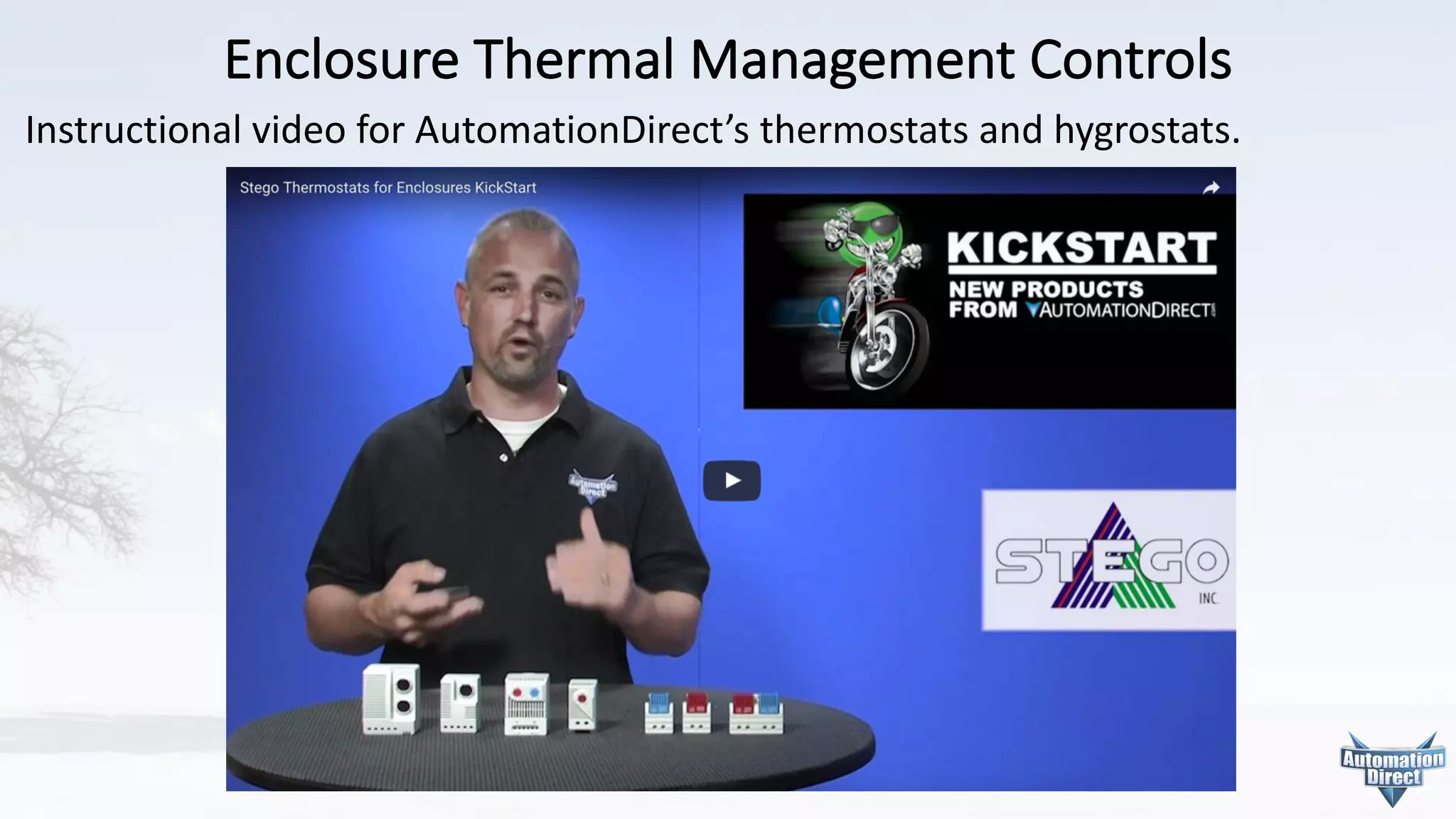
Instructional	video	for	AutomationDirect’s thermostats	and	hygrostats.
Weather keeping	your	enclosure	cool,	or	safe	and	dry,	we	have	
the	climate	control	solution	at	prices	that	won’t	make	you	sweat!

Enclosure Thermal Management: Product Types and Selection Overview