T R A N S P O R A T I O N
M A N A G E M E N T S Y S T E M
TRANSPORTATION
MANAGEMENT SYSTEM
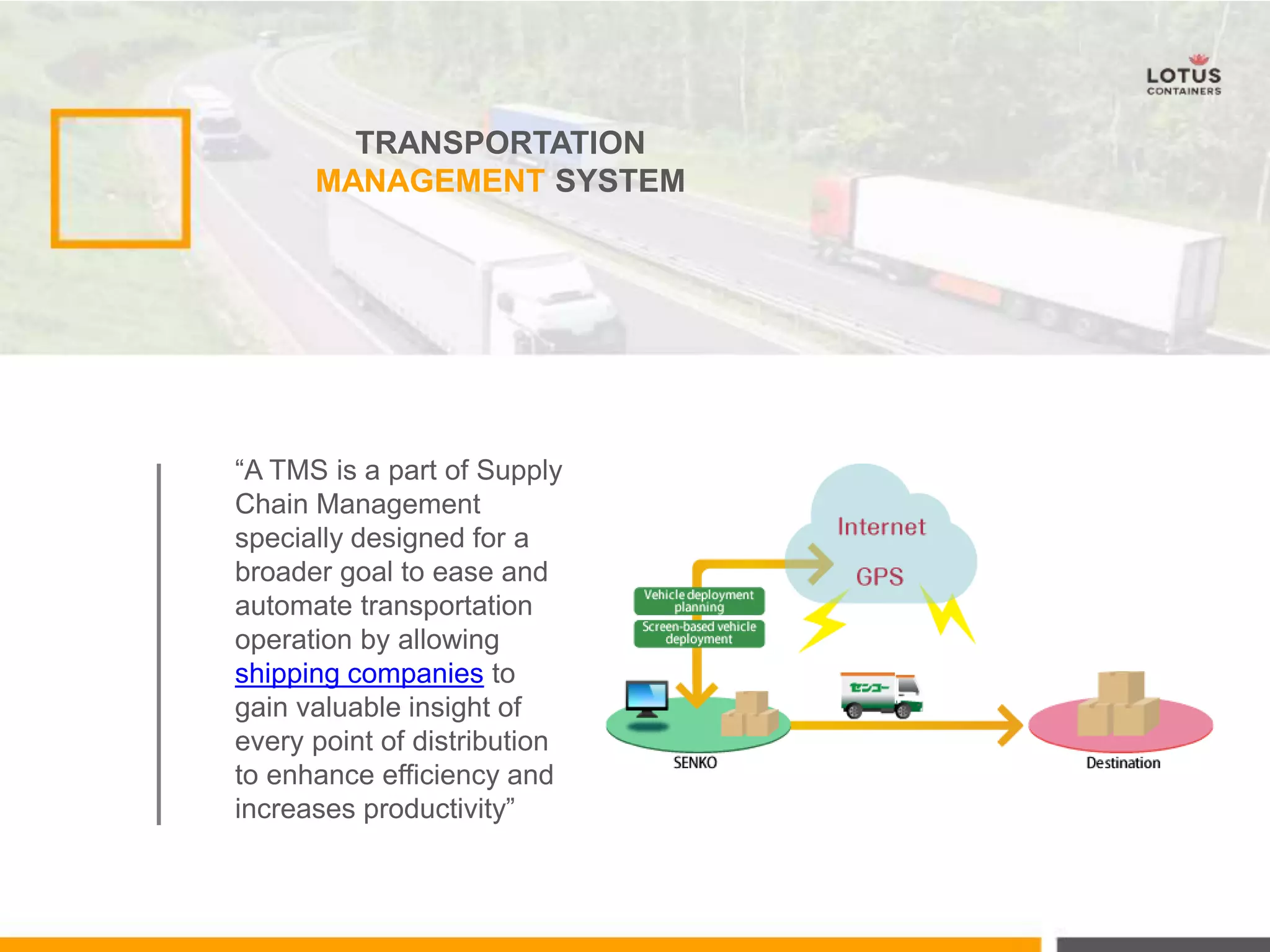
“A TMS is a part of Supply
Chain Management
specially designed for a
broader goal to ease and
automate transportation
operation by allowing
shipping companies to
gain valuable insight of
every point of distribution
to enhance efficiency and
increases productivity”
CHALLENGES In logistics, a freight
forwarding company faces
various challenges
• LENGTHY OPERATIONS
• IMPROPER ROUTE PLANNING
• LACK OF DELIVERY PROOF
• LACK OF OPERATIONAL VISIBILITY
• HIGH COST AND COMPLEXITY
• NO UPDATION
• MULTIPLE CONTRACT MANAGEMENT
• NO CONTROL ON REVENUE LEAKAGE
• STATUTORY DOCUMENTATION
• MANAGING MULTIPLE STAKEHOLDERS
• INEFFICIENT ACCOUNTING
• NO CENTRALIZED CONTROL
EVOLUTION OF TMS
Up until 2010, transportation of
cargoes or shipping containers were
managed manually that was marked
with inconsistency in delivery dates,
shipment records, tracking routes,
etc
But with increasing automated
production process, where demand
for “Just In Time” has been set as
standard services by end-users.
Freight shipping companies have
also experienced the same up rise
aided with advanced TMS.
HOW IT SIMPLIFY
YOUR TRANSPORTATION?
Increase Supply Chain
Transparency
Track Freight
Business Insight
Reduces freight expenses
Increase customer Services
Improved Warehouse Efficiency
Better Communication
INCREASE SUPPLY CHAIN
EFFICIENCY
Timely availability of products acts
as one of the important factors
that determine business growth.
Well equipped technical
competencies and cloud
computing services of TMS helps
a business to increase its
productivity by allowing full
visibility of shipment
TRANSPARENCY
The in-built technology
doesn’t only let you track
your shipment but it also
provides you complete detail
at every step of intermodal
transportation
Getting real-time information
helps to track shipment
between the route and take
preventive measures
addressing unanticipated
events if occur any.
TRACK FREIGHT
Real-time tracking of
shipment from the port
of origin to the port of
destination allows
shippers & carriers to
plan further business
activities accordingly.
It accounts for great
benefit as it helps to
reduce potential cost
caused by any of the
reasons like- delay
delivery or missing
consignment.
BUSINESS INSIGHT
It counts into a deep benefit
as TMS enables a user to get
the full insight of the overall
supply chain, be it pre-
analysis of cost, getting online
quotations, freight shipping
containers for sale, online
invoices, tracking locations or
optimized and planned the
movement of product. Getting
information in hand builds up
customer trustworthiness
towards the shipping
company. This further helps to
build a long and strong
relationship with customers.
REDUCES FREIGHT
EXPENSES
TMS was designed keeping
in mind to benefit both
shippers and carriers as well.
A TMS acts as an expert in
providing valuable
information and suggestions
on how to reduce freight
expenses by analytics and
optimization. With its
machine learning technology,
it makes early predictions
pertaining to any rise in
freight charges.
INCREASE
CUSTOMER SERVICE
With the ability to monitor
on-time performance, a
TMS provides increased
customer services
enabling them to access
shipment and freight
information anytime
through the application. It
bridges the gap between
supply management and
inventory management
system. It consolidates all
customer orders to find
the best available carrier
place and shipping
containers rates at a
minimal price.
IMPROVED WAREHOUSE
EFFICIENCY
A well-organized warehouse
becomes an important part of
the constant flow of freight
container inventory. A TMS
paired with Warehouse
Management System (WMS)
displays full and final records of
orders and track both in transit
and when they arrive. It informs
the inventory manager before
about products going out of
stock, missing invoices, and
knows well about each product
placement. It is known to
outperform humans in most
areas of warehousing.
BETTER
COMMUNICATION
With its advanced and
optimized features, a
TMS plays a great role
in linking shippers to
freight forwarding
companies and also
customers and vice-
versa that allows a
smooth flow of
communication
reducing inefficiency.
WHO CAN USE THE TMS?
The TMS software is primarily used by the business entities
involved in freight transportation services. There is no such
limitation to its user, thus any one being the part of supply chain
avail its benefit.
 3PL and 4PL companies and Logistics Service Providers
 Manufacturers
 Distributors
 Retail businesses
 Ecommerce companies
From truckload carriers, freight brokers, LTL careers, to 3PL
companies, the digitally connected supply chain provides
shippers a more effective tool to navigate the mobility, IoT, cloud
world that benefits everyone involved in the supply chain by
offering both cloud-based and desktop TMS software.
CERTAIN ‘MUST HAVES ‘ FOR SUCCESSFUL
TMS IMPLEMENTATION
Geoff Milsom, Senior Director at enVista suggests “A
successful TMS implementation actually begins before a
solution is even selected.”
Before you implement a TMS
• Match your objectives with prospective vendors.
• Get the right contractor involved, including people involved in
manufacturing, warehousing, distribution, procurement, and
finance.
• Apart from software-as-a-service (SaaS) applications, one must
involve IT too.
With well equipped TMS
software, LOTUS Containers
has been acing the race for
more than a decade in
providing fast, flexible, reliable
and cost-efficient containers
and shipping services to its
customers worldwide.

Transportation management system PPT

  • 1.
    T R AN S P O R A T I O N M A N A G E M E N T S Y S T E M
  • 2.
    TRANSPORTATION MANAGEMENT SYSTEM “A TMSis a part of Supply Chain Management specially designed for a broader goal to ease and automate transportation operation by allowing shipping companies to gain valuable insight of every point of distribution to enhance efficiency and increases productivity”
  • 3.
    CHALLENGES In logistics,a freight forwarding company faces various challenges • LENGTHY OPERATIONS • IMPROPER ROUTE PLANNING • LACK OF DELIVERY PROOF • LACK OF OPERATIONAL VISIBILITY • HIGH COST AND COMPLEXITY • NO UPDATION • MULTIPLE CONTRACT MANAGEMENT • NO CONTROL ON REVENUE LEAKAGE • STATUTORY DOCUMENTATION • MANAGING MULTIPLE STAKEHOLDERS • INEFFICIENT ACCOUNTING • NO CENTRALIZED CONTROL
  • 4.
    EVOLUTION OF TMS Upuntil 2010, transportation of cargoes or shipping containers were managed manually that was marked with inconsistency in delivery dates, shipment records, tracking routes, etc But with increasing automated production process, where demand for “Just In Time” has been set as standard services by end-users. Freight shipping companies have also experienced the same up rise aided with advanced TMS.
  • 5.
    HOW IT SIMPLIFY YOURTRANSPORTATION? Increase Supply Chain Transparency Track Freight Business Insight Reduces freight expenses Increase customer Services Improved Warehouse Efficiency Better Communication
  • 6.
    INCREASE SUPPLY CHAIN EFFICIENCY Timelyavailability of products acts as one of the important factors that determine business growth. Well equipped technical competencies and cloud computing services of TMS helps a business to increase its productivity by allowing full visibility of shipment
  • 7.
    TRANSPARENCY The in-built technology doesn’tonly let you track your shipment but it also provides you complete detail at every step of intermodal transportation Getting real-time information helps to track shipment between the route and take preventive measures addressing unanticipated events if occur any.
  • 8.
    TRACK FREIGHT Real-time trackingof shipment from the port of origin to the port of destination allows shippers & carriers to plan further business activities accordingly. It accounts for great benefit as it helps to reduce potential cost caused by any of the reasons like- delay delivery or missing consignment.
  • 9.
    BUSINESS INSIGHT It countsinto a deep benefit as TMS enables a user to get the full insight of the overall supply chain, be it pre- analysis of cost, getting online quotations, freight shipping containers for sale, online invoices, tracking locations or optimized and planned the movement of product. Getting information in hand builds up customer trustworthiness towards the shipping company. This further helps to build a long and strong relationship with customers.
  • 10.
    REDUCES FREIGHT EXPENSES TMS wasdesigned keeping in mind to benefit both shippers and carriers as well. A TMS acts as an expert in providing valuable information and suggestions on how to reduce freight expenses by analytics and optimization. With its machine learning technology, it makes early predictions pertaining to any rise in freight charges.
  • 11.
    INCREASE CUSTOMER SERVICE With theability to monitor on-time performance, a TMS provides increased customer services enabling them to access shipment and freight information anytime through the application. It bridges the gap between supply management and inventory management system. It consolidates all customer orders to find the best available carrier place and shipping containers rates at a minimal price.
  • 12.
    IMPROVED WAREHOUSE EFFICIENCY A well-organizedwarehouse becomes an important part of the constant flow of freight container inventory. A TMS paired with Warehouse Management System (WMS) displays full and final records of orders and track both in transit and when they arrive. It informs the inventory manager before about products going out of stock, missing invoices, and knows well about each product placement. It is known to outperform humans in most areas of warehousing.
  • 13.
    BETTER COMMUNICATION With its advancedand optimized features, a TMS plays a great role in linking shippers to freight forwarding companies and also customers and vice- versa that allows a smooth flow of communication reducing inefficiency.
  • 14.
    WHO CAN USETHE TMS? The TMS software is primarily used by the business entities involved in freight transportation services. There is no such limitation to its user, thus any one being the part of supply chain avail its benefit.  3PL and 4PL companies and Logistics Service Providers  Manufacturers  Distributors  Retail businesses  Ecommerce companies From truckload carriers, freight brokers, LTL careers, to 3PL companies, the digitally connected supply chain provides shippers a more effective tool to navigate the mobility, IoT, cloud world that benefits everyone involved in the supply chain by offering both cloud-based and desktop TMS software.
  • 15.
    CERTAIN ‘MUST HAVES‘ FOR SUCCESSFUL TMS IMPLEMENTATION Geoff Milsom, Senior Director at enVista suggests “A successful TMS implementation actually begins before a solution is even selected.” Before you implement a TMS • Match your objectives with prospective vendors. • Get the right contractor involved, including people involved in manufacturing, warehousing, distribution, procurement, and finance. • Apart from software-as-a-service (SaaS) applications, one must involve IT too.
  • 16.
    With well equippedTMS software, LOTUS Containers has been acing the race for more than a decade in providing fast, flexible, reliable and cost-efficient containers and shipping services to its customers worldwide.