

Presented by:-
Arshman Saleem
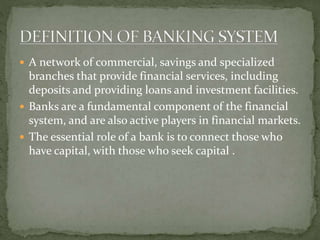
 Today’s commercial world is built around money.
 Bank facilitate financial transactions & hence are an
integral part of commercial world.
 Banking is essentially a business model.
 The bulk transactions of a Banking business model are
the daily combination of savings and recurring account
transactions.
 A network of commercial, savings and specialized
branches that provide financial services, including
deposits and providing loans and investment facilities.
 Banks are a fundamental component of the financial
system, and are also active players in financial markets.
 The essential role of a bank is to connect those who
have capital, with those who seek capital .
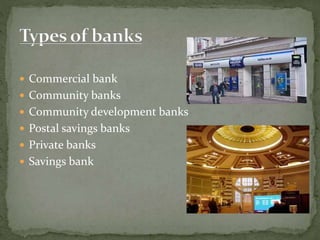
 Commercial bank
 Community banks
 Community development banks
 Postal savings banks
 Private banks
 Savings bank
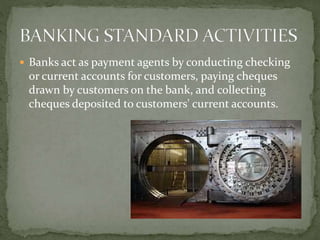
 Banks act as payment agents by conducting checking
or current accounts for customers, paying cheques
drawn by customers on the bank, and collecting
cheques deposited to customers' current accounts.
 Banks offer many different channels to access their
banking and other services:
 ATM
 Mail
 Mobile banking
 Online banking
 Video banking
 Telephone banking
 issue of banknotes
 processing of payments by way of telegraphic transfer,
EFTPOS, internet banking or other means
 issuing bank drafts and bank cheques
 accepting money on term deposit
 safekeeping of documents and other items in safe
deposit boxes
 currency exchange
 acting as a 'financial supermarket' for the sale
 A bank can generate revenue in a variety of different
ways including interest, transaction fees and financial
advice.
 The bank profits from the differential between the
level of interest it pays for deposits and other sources
of funds, and the level of interest it charges in its
lending activities.
 Fees and financial advice constitute a more stable
revenue stream and banks have therefore placed more
emphasis on these revenue lines to smooth their
financial performance.
 Some of the main risks faced by banks include:
 Credit risk
 Liquidity risk
 Market risk
 Operational risk
 The capital requirement is a bank regulation, which
sets a framework on how banks and depository
institutions must handle their capital.
 The economic functions of banks include:
 Issue of money
 Netting and settlement of payments
 Credit intermediation
 Credit quality improvement
 Maturity transformation
 The requirements for the issue of a bank license vary
between jurisdictions but typically include:
 Minimum capital
 Minimum capital ratio
 'Fit and Proper' requirements for the bank's
controllers, owners, directors, or senior officers
 Approval of the bank's business plan as being
sufficiently prudent and plausible.
 Bank statements are accounting records produced by
banks under the various accounting standards of the
world.
 there are two kinds of accounts: debit and credit.
 Credit accounts are Revenue, Equity and Liabilities.
 Debit Accounts are Assets and Expenses.
 The advantages are as follows:
 More Locations.
 Discounts.
 Personal Service Sacrificed.
 More Product Offerings.
 Credit Tough to Find.
 The disadvantages are as follows:
 Loan Approvals
 Rigid Standards
 Security
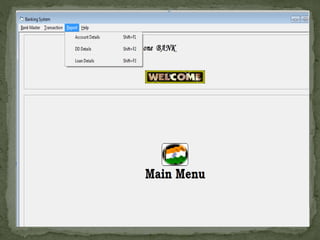
 This project deals with the computerized processing of
Banking System.
 The front end tool used in the development of the project
is Visual Basics 6.0.
 The back end tool is the more efficient MS SQL.
 The project exhibits the relational database concepts
connecting various relations in an intricate fashion.
 The backend maintains records of the Accounts Details.
 The system has been developed in such a way that it allows
for further enhancements at any time in the future.
 The main objectives of this project are:
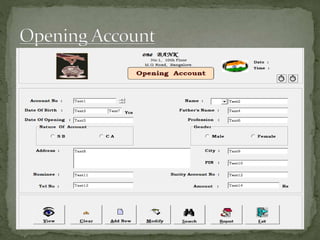
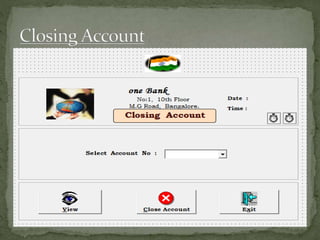
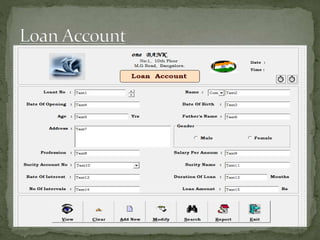
 Opening and Closing Accounts.
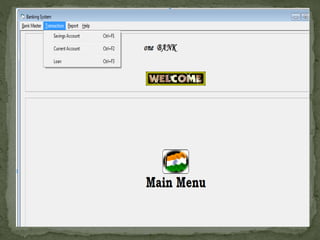
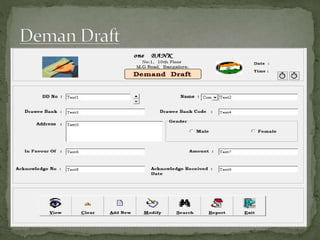
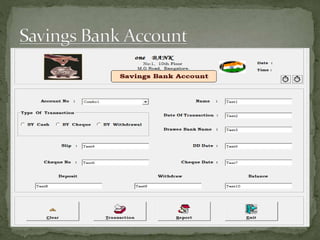
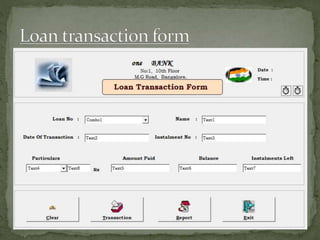
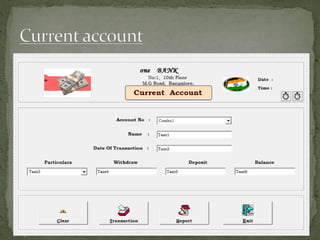
 Processing Transactions.
 Generating an Updated Report.
 The objective & goals of the proposed system are:-
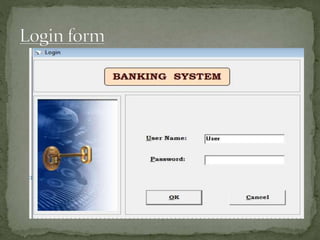
 To allow only authorized user to access various
functions and processed available in the system.
 Locate any A/C wanted by the user.
 Reduced clerical work as most of the work done by
computer.
 Provide greater speed & reduced time consumption.
 To increase the number of A/C and customer.
 The software will be user friendly so that even a
beginner can operate the package and thus maintain
the status of A/C and balance status easily.
 The first software project management activity is the
determination of software scope.
 Scope is defined by answering the following question.
 INFORMATION OBJECTIVES
 FUNCTION AND PERFORMANCE
 Any information can be easily searched.
 All records of A/c`s and customer are stored in
separate file
 Particular A/c information can be modified
 A particular customer record can be modified for one
or more fields like customer name, address by
providing A/c number.
 The proposed system is more efficient, fast, reliable,
user friendly.
 Over and above the proposed system does not have any
possibility of data loss during processing.
 Increased operational efficiency, profitability &
productivity.
 Superior customer service.
 Multi-channel, real-time transaction processing.
 Better cross-selling ability.
 Improved management and accountability.
 Minimal transaction costs.
 Improved financial analyses capabilities.
 This package provides an easy and efficient method to
interact with the users.
 The package has all the features specified in the
original problem definition.
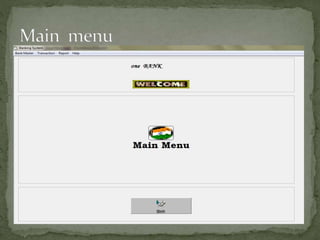
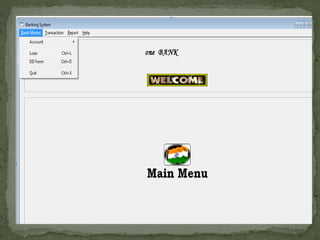
 Special attention has been provided to the interface,
dialogue boxes outcall these make it comfortable to
use.
 The package is designed so as to be flexible and easily
modifiable or extendable.
The future will be not be more of
the same…
… we need to be ready..

Bank System

  • 1.
  • 2.
     Today’s commercialworld is built around money.  Bank facilitate financial transactions & hence are an integral part of commercial world.  Banking is essentially a business model.  The bulk transactions of a Banking business model are the daily combination of savings and recurring account transactions.
  • 3.
     A networkof commercial, savings and specialized branches that provide financial services, including deposits and providing loans and investment facilities.  Banks are a fundamental component of the financial system, and are also active players in financial markets.  The essential role of a bank is to connect those who have capital, with those who seek capital .
  • 4.
     Commercial bank Community banks  Community development banks  Postal savings banks  Private banks  Savings bank
  • 5.
     Banks actas payment agents by conducting checking or current accounts for customers, paying cheques drawn by customers on the bank, and collecting cheques deposited to customers' current accounts.
  • 6.
     Banks offermany different channels to access their banking and other services:  ATM  Mail  Mobile banking  Online banking  Video banking  Telephone banking
  • 7.
     issue ofbanknotes  processing of payments by way of telegraphic transfer, EFTPOS, internet banking or other means  issuing bank drafts and bank cheques  accepting money on term deposit  safekeeping of documents and other items in safe deposit boxes  currency exchange  acting as a 'financial supermarket' for the sale
  • 8.
     A bankcan generate revenue in a variety of different ways including interest, transaction fees and financial advice.  The bank profits from the differential between the level of interest it pays for deposits and other sources of funds, and the level of interest it charges in its lending activities.  Fees and financial advice constitute a more stable revenue stream and banks have therefore placed more emphasis on these revenue lines to smooth their financial performance.
  • 9.
     Some ofthe main risks faced by banks include:  Credit risk  Liquidity risk  Market risk  Operational risk  The capital requirement is a bank regulation, which sets a framework on how banks and depository institutions must handle their capital.
  • 10.
     The economicfunctions of banks include:  Issue of money  Netting and settlement of payments  Credit intermediation  Credit quality improvement  Maturity transformation
  • 11.
     The requirementsfor the issue of a bank license vary between jurisdictions but typically include:  Minimum capital  Minimum capital ratio  'Fit and Proper' requirements for the bank's controllers, owners, directors, or senior officers  Approval of the bank's business plan as being sufficiently prudent and plausible.
  • 12.
     Bank statementsare accounting records produced by banks under the various accounting standards of the world.  there are two kinds of accounts: debit and credit.  Credit accounts are Revenue, Equity and Liabilities.  Debit Accounts are Assets and Expenses.
  • 13.
     The advantagesare as follows:  More Locations.  Discounts.  Personal Service Sacrificed.  More Product Offerings.  Credit Tough to Find.
  • 14.
     The disadvantagesare as follows:  Loan Approvals  Rigid Standards  Security
  • 16.
     This projectdeals with the computerized processing of Banking System.  The front end tool used in the development of the project is Visual Basics 6.0.  The back end tool is the more efficient MS SQL.  The project exhibits the relational database concepts connecting various relations in an intricate fashion.  The backend maintains records of the Accounts Details.  The system has been developed in such a way that it allows for further enhancements at any time in the future.
  • 17.
     The mainobjectives of this project are:  Opening and Closing Accounts.  Processing Transactions.  Generating an Updated Report.
  • 18.
     The objective& goals of the proposed system are:-  To allow only authorized user to access various functions and processed available in the system.  Locate any A/C wanted by the user.  Reduced clerical work as most of the work done by computer.  Provide greater speed & reduced time consumption.  To increase the number of A/C and customer.  The software will be user friendly so that even a beginner can operate the package and thus maintain the status of A/C and balance status easily.
  • 19.
     The firstsoftware project management activity is the determination of software scope.  Scope is defined by answering the following question.  INFORMATION OBJECTIVES  FUNCTION AND PERFORMANCE
  • 20.
     Any informationcan be easily searched.  All records of A/c`s and customer are stored in separate file  Particular A/c information can be modified  A particular customer record can be modified for one or more fields like customer name, address by providing A/c number.  The proposed system is more efficient, fast, reliable, user friendly.  Over and above the proposed system does not have any possibility of data loss during processing.
  • 38.
     Increased operationalefficiency, profitability & productivity.  Superior customer service.  Multi-channel, real-time transaction processing.  Better cross-selling ability.  Improved management and accountability.  Minimal transaction costs.  Improved financial analyses capabilities.
  • 39.
     This packageprovides an easy and efficient method to interact with the users.  The package has all the features specified in the original problem definition.  Special attention has been provided to the interface, dialogue boxes outcall these make it comfortable to use.  The package is designed so as to be flexible and easily modifiable or extendable.
  • 40.
    The future willbe not be more of the same… … we need to be ready..