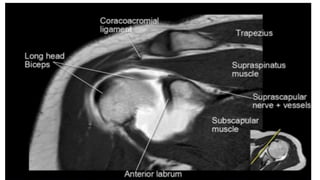
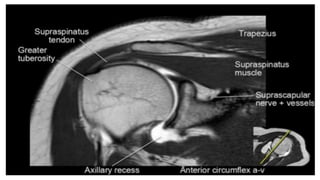
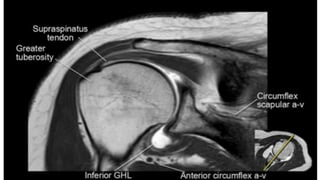
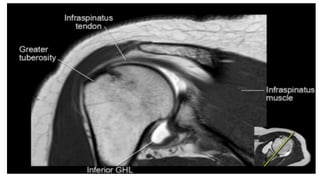
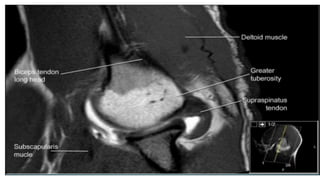
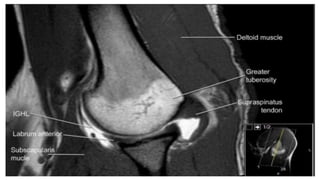
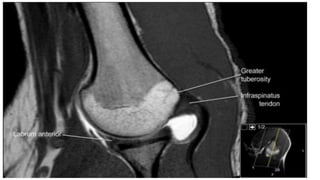
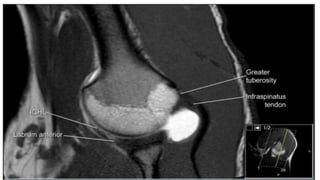
How to read a shoulder MRI
Dr ARJUN
T1- weighted image:
Fats and bone marrow produce high signal (white); ligaments, cartilage,
fluid produce low signal (black)
T2- weighted image:
Ligaments, cartilage and fluid produce high signal (white); bone marrow
produces a low signal (black).
PLANES
Coronal oblique:
slices parallel to the tendon of the supraspinatus muscle,
going from posterior to the anterior shoulder.
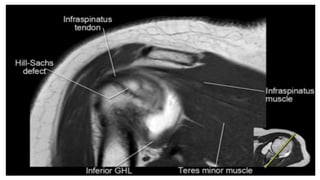
Sagittal oblique:
slices perpendicular to the supraspinatus muscle, going
from head of humerus to the scapula.
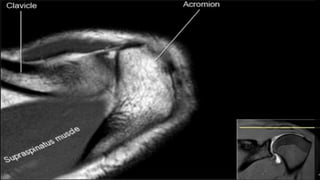
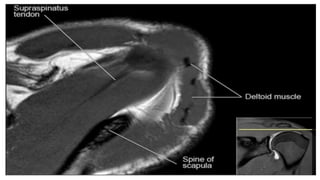
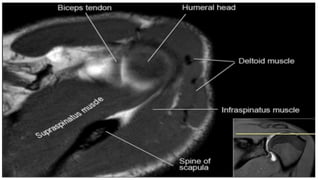
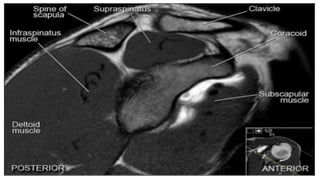
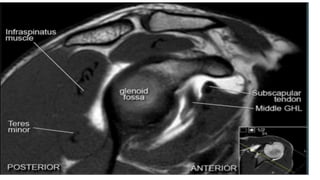
Axial plane:
makes cross-sections of the shoulder from top to bottom.
• All tendons: low SI on all MRI sequences
Axial
Coronal plane
Sagittal plane
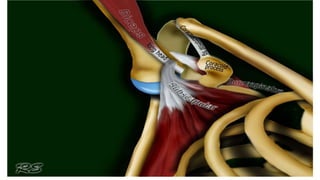
ABER VIEW
abduction external rotation
(ABER) view
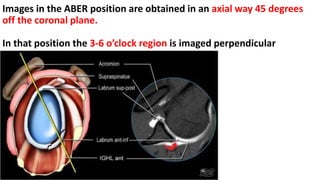
Images in the ABER position are obtained in an axial way 45 degrees
off the coronal plane.
In that position the 3-6 o’clock region is imaged perpendicular
Labral tears (ABER) view
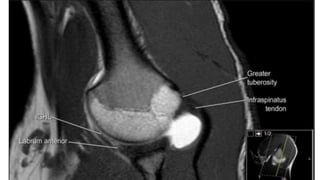
excellent for assessing the anteroinferior labrum at the 3-6
o’clock position, where most labral tears are located.
In the aber position
inferior glenohumeral ligament is stretched
Tension on the anteroinferior labrum
Intra-articular contrast to get between the labral tear and the glenoid
•ABER view :useful for both partial- and full-thickness tears of
the rotator cuff.
ABER POSITION :releases tension on the cuff relative to the
normal coronal view obtained with the arm in adduction.
As a result, subtle articular-sided partial thickness tears will not
lie apposed to the adjacent intact fibers of the remaining
rotator cuff nor be effaced against the humeral head, and
•intra-articular contrast can enhance visualization of the tear
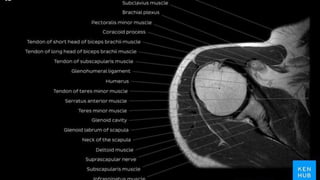
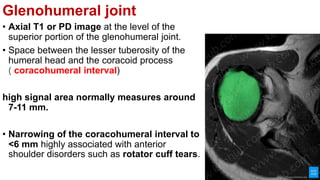
Glenohumeral joint
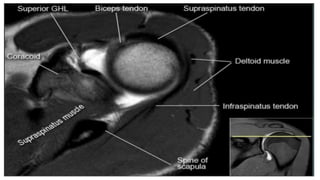
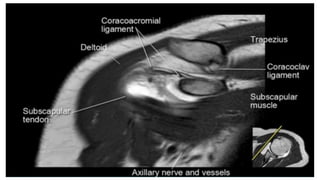
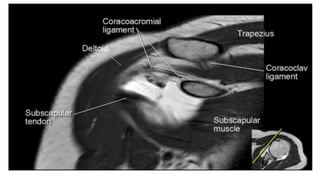
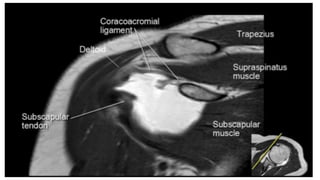
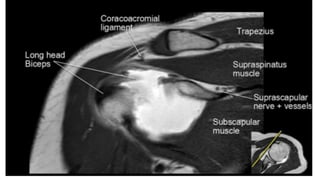
• Axial T1 or PD image at the level of the
superior portion of the glenohumeral joint.
• Space between the lesser tuberosity of the
humeral head and the coracoid process
( coracohumeral interval)
high signal area normally measures around
7-11 mm.
• Narrowing of the coracohumeral interval to
<6 mm highly associated with anterior
shoulder disorders such as rotator cuff tears.
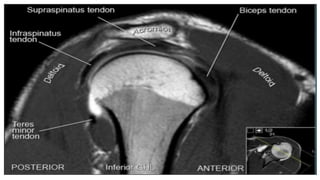
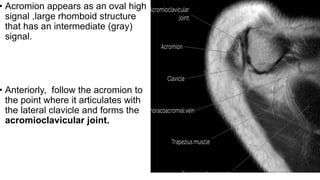
• Acromion appears as an oval high
signal ,large rhomboid structure
that has an intermediate (gray)
signal.
• Anteriorly, follow the acromion to
the point where it articulates with
the lateral clavicle and forms the
acromioclavicular joint.
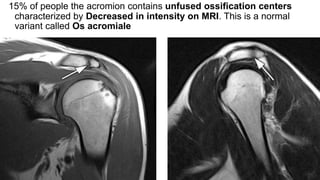
15% of people the acromion contains unfused ossification centers
characterized by Decreased in intensity on MRI. This is a normal
variant called Os acromiale
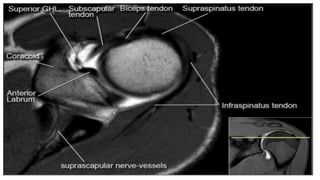
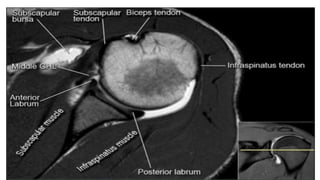
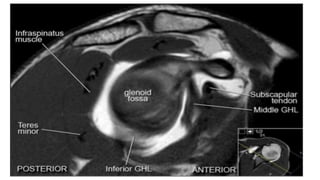
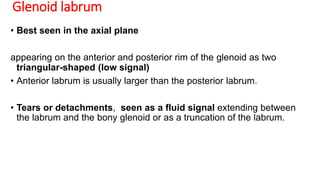
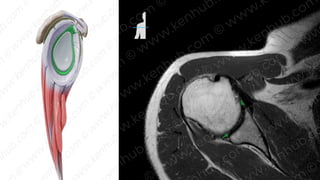
Glenoid labrum
• Best seen in the axial plane
appearing on the anterior and posterior rim of the glenoid as two
triangular-shaped (low signal)
• Anterior labrum is usually larger than the posterior labrum.
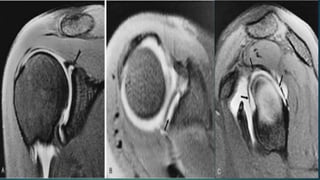
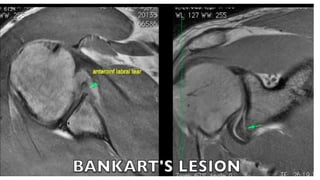
• Tears or detachments, seen as a fluid signal extending between
the labrum and the bony glenoid or as a truncation of the labrum.
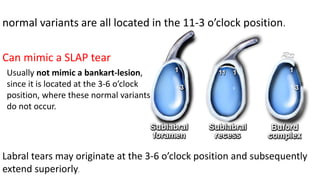
normal variants are all located in the 11-3 o’clock position.
Can mimic a SLAP tear
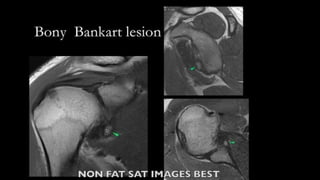
Usually not mimic a bankart-lesion,
since it is located at the 3-6 o’clock
position, where these normal variants
do not occur.
Labral tears may originate at the 3-6 o’clock position and subsequently
extend superiorly.
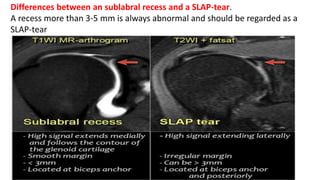
Differences between an sublabral recess and a SLAP-tear.
A recess more than 3-5 mm is always abnormal and should be regarded as a
SLAP-tear
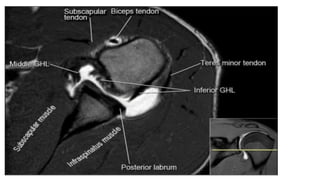
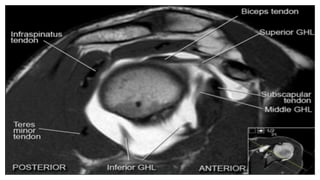
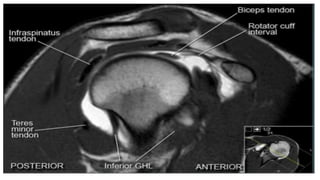
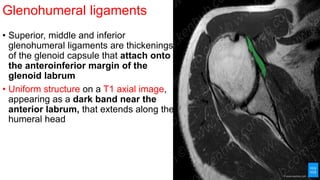
Glenohumeral ligaments
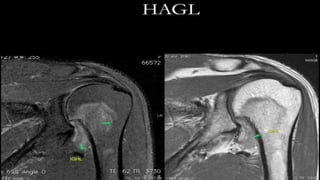
• Superior, middle and inferior
glenohumeral ligaments are thickenings
of the glenoid capsule that attach onto
the anteroinferior margin of the
glenoid labrum
• Uniform structure on a T1 axial image,
appearing as a dark band near the
anterior labrum, that extends along the
humeral head
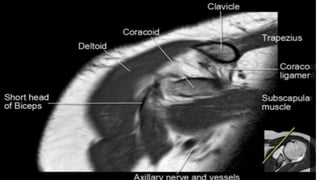
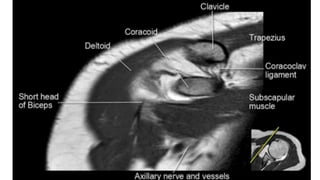
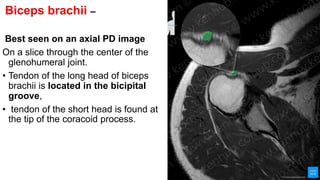
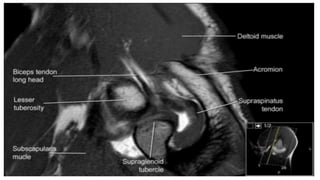
Biceps brachii –
Best seen on an axial PD image
On a slice through the center of the
glenohumeral joint.
• Tendon of the long head of biceps
brachii is located in the bicipital
groove,
• tendon of the short head is found at
the tip of the coracoid process.
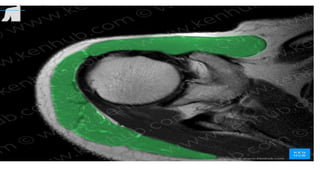
Deltoid
ROTATOR CUFF TEAR
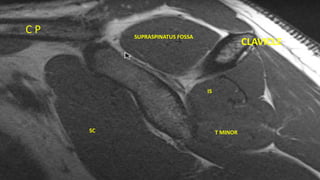
C P
CLAVICLE
SUPRASPINATUS FOSSA
IS
T MINOR
SC
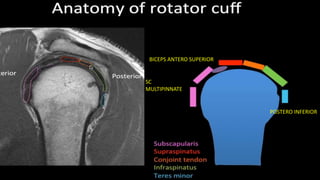
SC
MULTIPINNATE
BICEPS ANTERO SUPERIOR
POSTERO INFERIOR
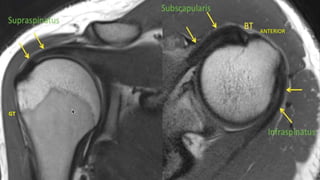
GT
ANTERIOR
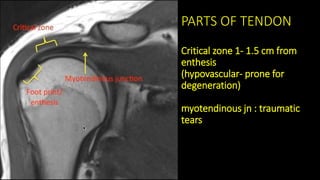
PARTS OF TENDON
Critical zone 1- 1.5 cm from
enthesis
(hypovascular- prone for
degeneration)
myotendinous jn : traumatic
tears
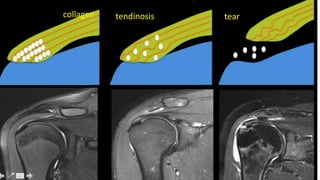
collagen tendinosis tear
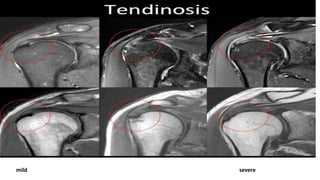
mild severe
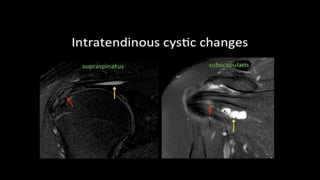
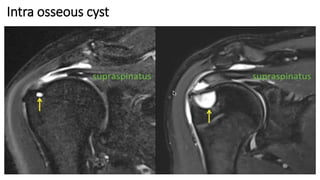
Intra osseous cyst
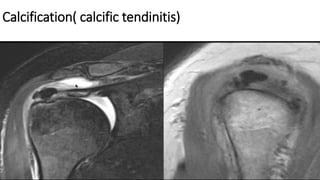
Calcification( calcific tendinitis)
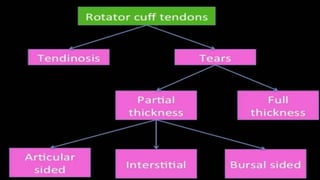
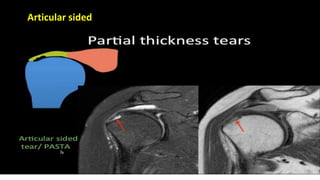
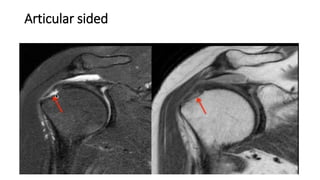
Articular sided
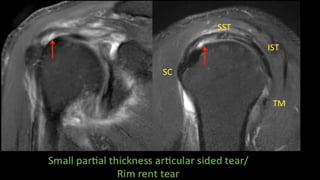
Articular sided
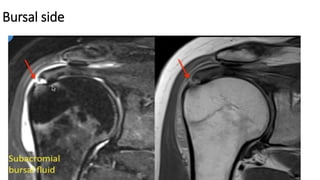
Bursal side
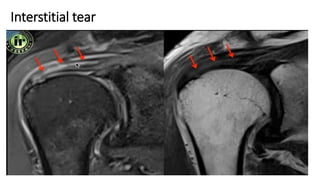
Interstitial tear
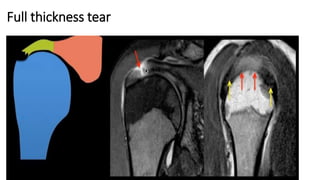
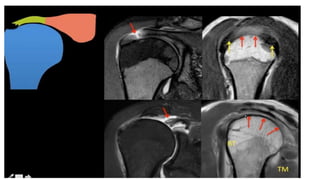
Full-thickness tear:
• high SI on T2WI
• Direct signs
• Tendon discontinuity
• Fluid signal in tendon gap
• Retraction of musculotendinous junction
• Associated findings
• Subacromial/ subdeltoid bursal fluid
• Muscle atrophy
Full thickness tear
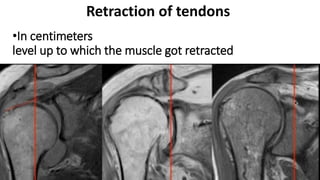
•In centimeters
level up to which the muscle got retracted
Retraction of tendons
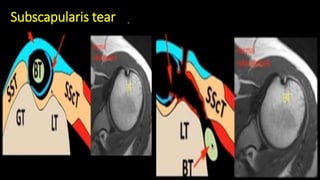
Subscapularis tear
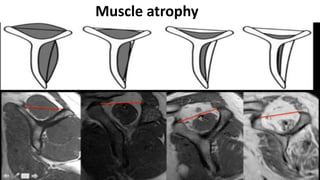
Muscle atrophy
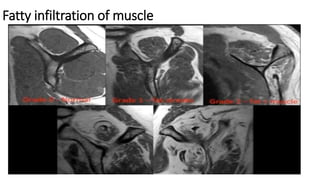
Fatty infiltration of muscle
Glenoid
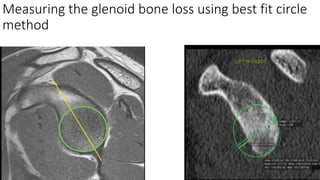
Measuring the glenoid bone loss using best fit circle
method
• thankyou

HOW TO READ SHOULDER MRI

  • 1.
    How to reada shoulder MRI Dr ARJUN
  • 2.
    T1- weighted image: Fatsand bone marrow produce high signal (white); ligaments, cartilage, fluid produce low signal (black) T2- weighted image: Ligaments, cartilage and fluid produce high signal (white); bone marrow produces a low signal (black).
  • 3.
    PLANES Coronal oblique: slices parallelto the tendon of the supraspinatus muscle, going from posterior to the anterior shoulder. Sagittal oblique: slices perpendicular to the supraspinatus muscle, going from head of humerus to the scapula. Axial plane: makes cross-sections of the shoulder from top to bottom.
  • 4.
    • All tendons:low SI on all MRI sequences
  • 5.
  • 14.
  • 26.
  • 33.
    ABER VIEW abduction externalrotation (ABER) view
  • 35.
    Images in theABER position are obtained in an axial way 45 degrees off the coronal plane. In that position the 3-6 o’clock region is imaged perpendicular
  • 36.
    Labral tears (ABER)view excellent for assessing the anteroinferior labrum at the 3-6 o’clock position, where most labral tears are located. In the aber position inferior glenohumeral ligament is stretched Tension on the anteroinferior labrum Intra-articular contrast to get between the labral tear and the glenoid
  • 38.
    •ABER view :usefulfor both partial- and full-thickness tears of the rotator cuff. ABER POSITION :releases tension on the cuff relative to the normal coronal view obtained with the arm in adduction. As a result, subtle articular-sided partial thickness tears will not lie apposed to the adjacent intact fibers of the remaining rotator cuff nor be effaced against the humeral head, and •intra-articular contrast can enhance visualization of the tear
  • 44.
    Glenohumeral joint • AxialT1 or PD image at the level of the superior portion of the glenohumeral joint. • Space between the lesser tuberosity of the humeral head and the coracoid process ( coracohumeral interval) high signal area normally measures around 7-11 mm. • Narrowing of the coracohumeral interval to <6 mm highly associated with anterior shoulder disorders such as rotator cuff tears.
  • 45.
    • Acromion appearsas an oval high signal ,large rhomboid structure that has an intermediate (gray) signal. • Anteriorly, follow the acromion to the point where it articulates with the lateral clavicle and forms the acromioclavicular joint.
  • 46.
    15% of peoplethe acromion contains unfused ossification centers characterized by Decreased in intensity on MRI. This is a normal variant called Os acromiale
  • 47.
    Glenoid labrum • Bestseen in the axial plane appearing on the anterior and posterior rim of the glenoid as two triangular-shaped (low signal) • Anterior labrum is usually larger than the posterior labrum. • Tears or detachments, seen as a fluid signal extending between the labrum and the bony glenoid or as a truncation of the labrum.
  • 49.
    normal variants areall located in the 11-3 o’clock position. Can mimic a SLAP tear Usually not mimic a bankart-lesion, since it is located at the 3-6 o’clock position, where these normal variants do not occur. Labral tears may originate at the 3-6 o’clock position and subsequently extend superiorly.
  • 51.
    Differences between ansublabral recess and a SLAP-tear. A recess more than 3-5 mm is always abnormal and should be regarded as a SLAP-tear
  • 52.
    Glenohumeral ligaments • Superior,middle and inferior glenohumeral ligaments are thickenings of the glenoid capsule that attach onto the anteroinferior margin of the glenoid labrum • Uniform structure on a T1 axial image, appearing as a dark band near the anterior labrum, that extends along the humeral head
  • 53.
    Biceps brachii – Bestseen on an axial PD image On a slice through the center of the glenohumeral joint. • Tendon of the long head of biceps brachii is located in the bicipital groove, • tendon of the short head is found at the tip of the coracoid process.
  • 54.
  • 55.
  • 56.
  • 57.
  • 58.
  • 59.
    PARTS OF TENDON Criticalzone 1- 1.5 cm from enthesis (hypovascular- prone for degeneration) myotendinous jn : traumatic tears
  • 60.
  • 62.
  • 64.
  • 65.
  • 66.
  • 67.
  • 68.
  • 69.
  • 71.
    Full-thickness tear: • highSI on T2WI • Direct signs • Tendon discontinuity • Fluid signal in tendon gap • Retraction of musculotendinous junction • Associated findings • Subacromial/ subdeltoid bursal fluid • Muscle atrophy
  • 72.
  • 74.
    •In centimeters level upto which the muscle got retracted Retraction of tendons
  • 75.
  • 76.
  • 77.
  • 78.
  • 83.
    Measuring the glenoidbone loss using best fit circle method
  • 86.