Lecturer of radiodiagnosis
S H O U LD E R JO IN T
     D IS E AS E S
1 - Rotator cuff disease
2 – Instability and Labral lesions,
3- Biceps disorders,
4-Truma
5-Tumors
6-Arthritis.
7-Refered pain as radiculopathy, and thoracic outlet syndrome.
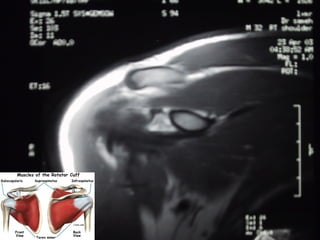
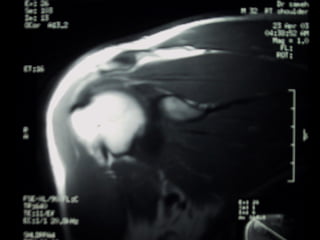
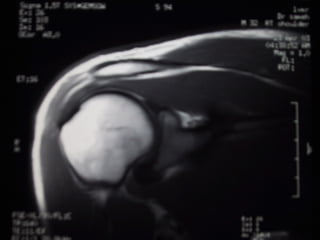
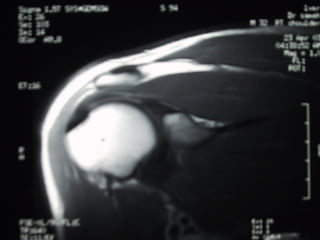
Rotator cuff disease
Tendinosis
        The earliest stage of rotator cuff tendon pathology. The term
tendinosis and not tendinitis is probably appropriate to describe such a
cuff.

Partial-thickness tear
       shows no communication between the glenohumeral joint and
subacromial bursa.
Bursal side tear
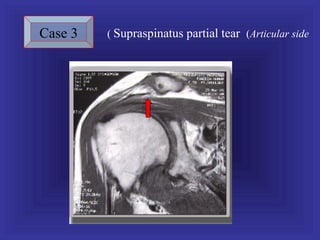
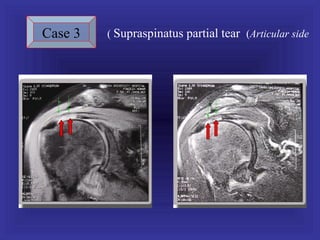
Articular side tear
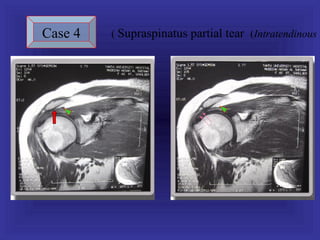
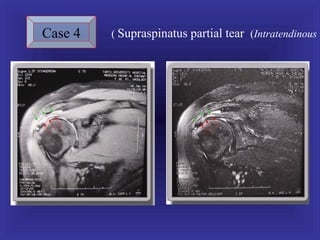
Intratendinous tear
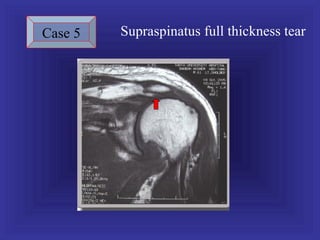
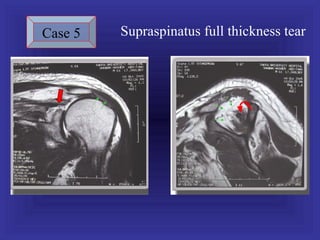
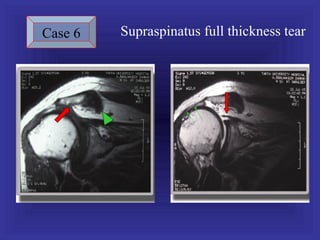
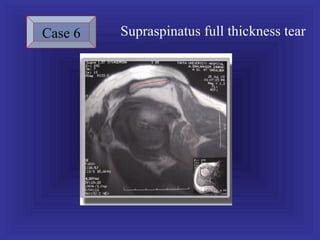
Full-thickness tear
         It is a discontinuity in the tendon that extends from the
articular surface to the bursal surface.
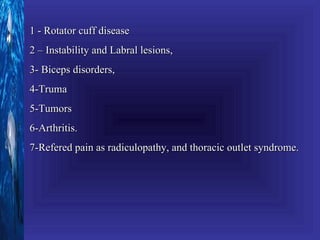
Rotator cuff disease
Causes
         1 – Impingement syndrome


     2 – Degenerative


     3 - Traumatic
Shoulder instability

        shoulder instability is slipping of the humeral head out
of the glenoid socket during activities causing symptoms. It is
referred to a spectrum of disorders that includes dislocation,
subluxation and laxity.
        Instability is classified according to
 temporal relationship of antecedent trauma (acute first-time
 versus recurrent)
 degree (subluxation versus dislocation)
 direction, either unidirectional (anteroinferior or posterior) or
 multidirectional.
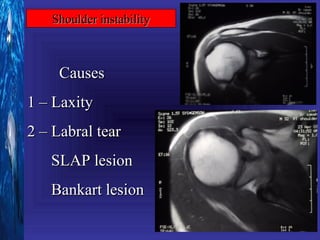
Shoulder instability


     Causes
1 – Laxity
2 – Labral tear
   SLAP lesion
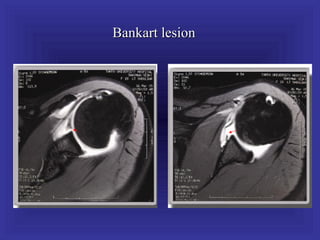
   Bankart lesion
MR imaging
Pulse sequences
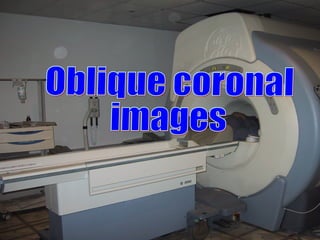
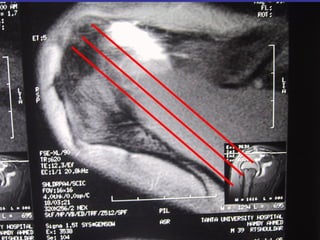
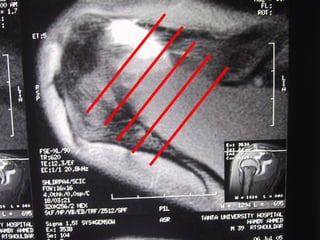
       MR images obtained included axial , oblique coronal
and oblique sagittal planes with different pulse sequences as
following:

Oblique Coronal T1 weighted images
Oblique Coronal T2 weighted images
Oblique Coronal T2 weighted fat suppressed images
Oblique Coronal Proton Density (PD) weighted images
Oblique Sagittal T1 weighted images
Axial Gradient weighted images
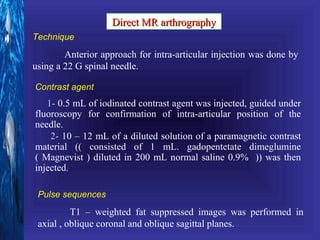
Direct MR arthrography
Technique
        Anterior approach for intra-articular injection was done by
using a 22 G spinal needle.

Contrast agent
   1- 0.5 mL of iodinated contrast agent was injected, guided under
fluoroscopy for confirmation of intra-articular position of the
needle.
    2- 10 – 12 mL of a diluted solution of a paramagnetic contrast
material (( consisted of 1 mL. gadopentetate dimeglumine
( Magnevist ) diluted in 200 mL normal saline 0.9% )) was then
injected.

 Pulse sequences
          T1 – weighted fat suppressed images was performed in
 axial , oblique coronal and oblique sagittal planes.
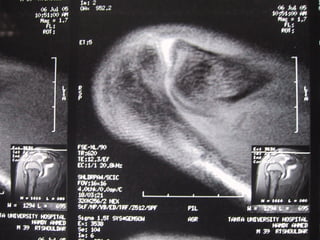
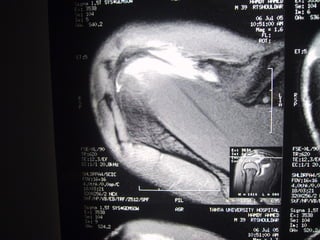
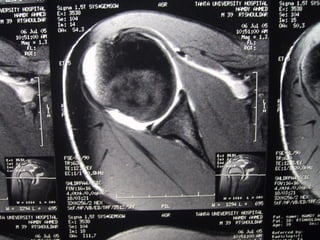
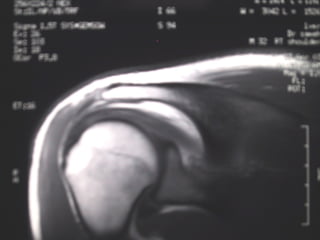
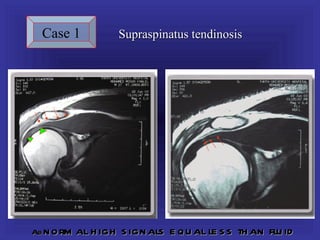
Case 1           Supraspinatus tendinosis


Ab norm   al h igh s ignals e qu al le s s th an flu id
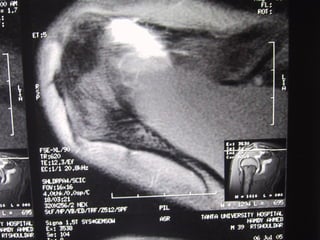
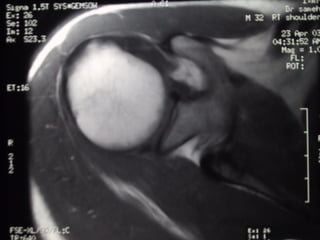
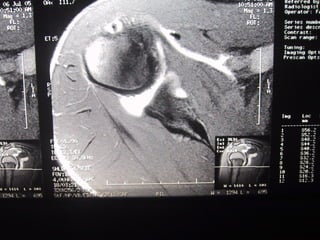
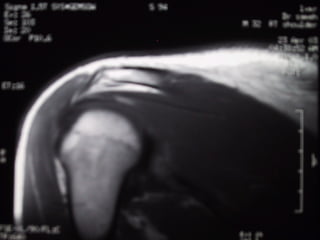
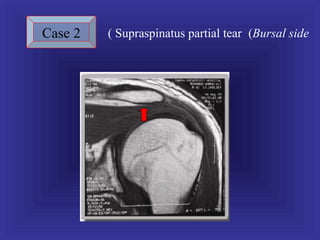
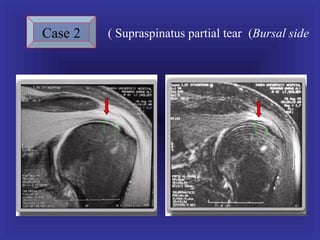
Case 2   ( Supraspinatus partial tear (Bursal side
Case 3   ( Supraspinatus partial tear (Articular side
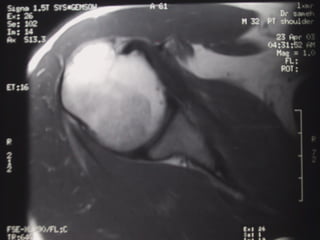
Case 4   ( Supraspinatus partial tear (Intratendinous
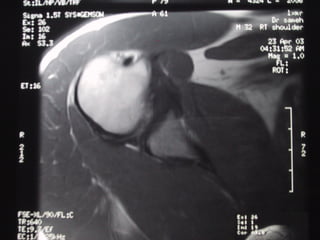
Case 5   Supraspinatus full thickness tear
Case 6   Supraspinatus full thickness tear
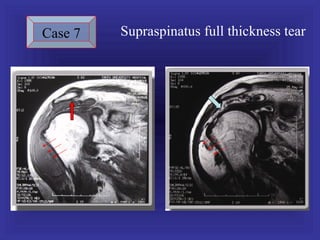
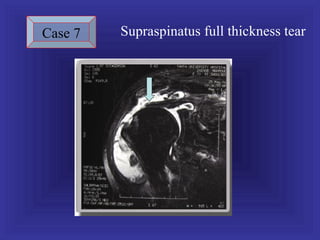
Case 7   Supraspinatus full thickness tear
ROLE OF MRI IN THE
DIAGNOSIS OF GLENOID
    LABRAL TEARS
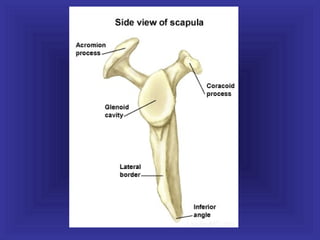
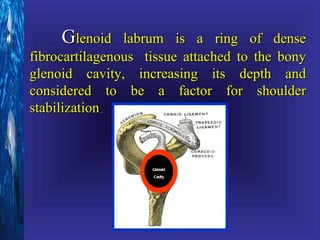
Glenoid    labrum is a ring of dense
fibrocartilagenous tissue attached to the bony
glenoid cavity, increasing its depth and
considered to be a factor for shoulder
stabilization.


                    Glenoid
                    Cavity
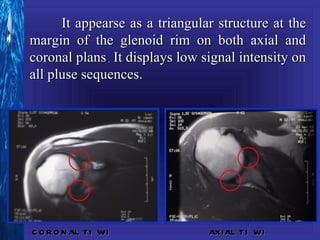
It appearse as a triangular structure at the
margin of the glenoid rim on both axial and
coronal plans. It displays low signal intensity on
all pluse sequences.


C O R O N AL T1 WI              AX IAL T1 WI
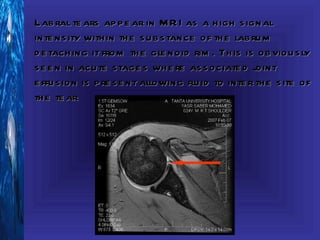
Lab ral te ars ap p e ar in M R I as a h igh s ignal
inte ns ity with in th e s u b s tance of th e lab ru m
d e tach ing it from th e gle noid rim . Th is is ob viou s ly
s e e n in acu te s tage s wh e re as s ociate d j   oint
e ffu s ion is p re s e nt allowing flu id to inte r th e s ite of
th e te ar
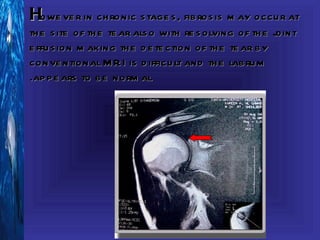
Howe ve r in ch ronic s tage s , fib ros is m ay occu r at
th e s ite of th e te ar als o with re s olving of th e joint
e ffu s ion m aking th e d e te ction of th e te ar b y
conve ntional M R I is d ifficu lt and th e lab ru m
.ap p e ars to b e norm al
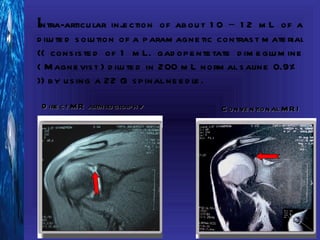
So in th is s itu ation d ire ct M R arth rograp h y
is ind icate d
Intra-articu lar inje ction of ab ou t 1 0 – 1 2 m L of a
d ilu te d s olu tion of a p aram agne tic contras t m ate rial
(( cons is te d of 1 m L. gad op e nte tate d im e glu m ine
( M agne vis t ) d ilu te d in 200 m L norm al s aline 0.9%
)) b y u s ing a 22 G s p inal ne e d le .

 D ire ct M R arth rograp h y              C onve ntional M R I
Two mechanisms of truma
 are encountered in the
   glenoid labral tears
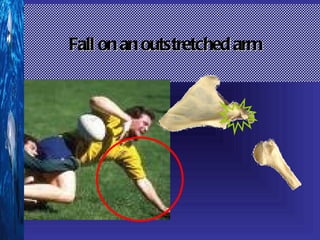
Fall on an outstretched arm
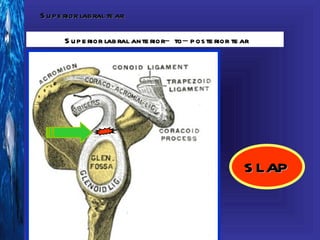
S u p e rior lab ral te ar

       S u p e rior lab ral ante rior– to – p os te rior te ar


                                                            S LAP
F ou r m ain typ e s of S LAP LE S IO N S


                      Type I
Ju s t fraying or irre gu larity of th e lab ru m
is d e m ons trate d . Th is typ e of le s ion is
qu ite com m on in e ld e rly p e rs ons and
m ay re p re s e nt a d e ge ne rative te ar of
th e lab ru m . Th is typ e rare ly cau s e s
s ym p tom s and d o not re qu ire s u rgical
re p air.
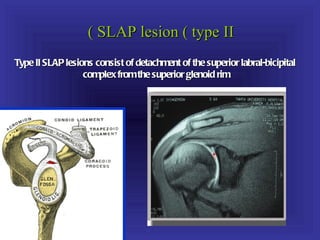
( SLAP lesion ( type II
Type II SLAP lesions consist of detachment of the superior labral-bicipital
                  complex from the superior glenoid rim
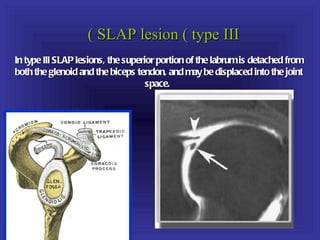
( SLAP lesion ( type III
In type III SLAP lesions, the superior portion of the labrum is detached from
both the glenoid and the biceps tendon, and may be displaced into the joint
                                    space.
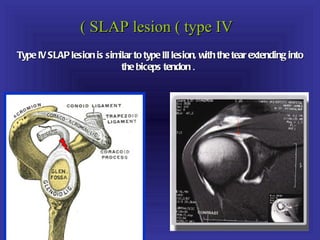
( SLAP lesion ( type IV
Type IV SLAP lesion is similar to type III lesion, with the tear extending into
                           the biceps tendon .
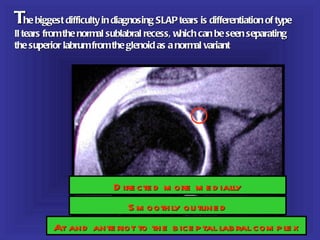
The biggest difficulty in diagnosing SLAP tears is differentiation of type
II tears from the normal sublabral recess, which can be seen separating
the superior labrum from the glenoid as a normal variant


                          D ire cte d m ore m e d ially
                              S m ooth ly ou tline d
          At and ante riot to th e b ice p tal lab ral com p le x
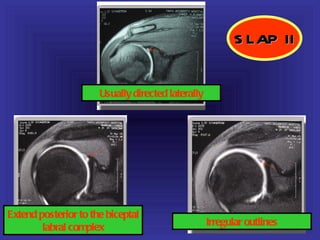
S LAP II


                      Usually directed laterally


Extend posterior to the biceptal
        labral complex                             Irregular outlines
SHOULDER DISLOCATION
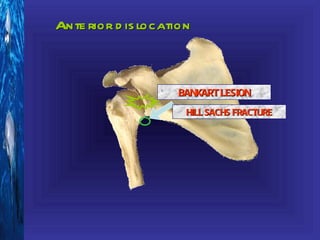
Ante rior d is location


                    BANKART LESION
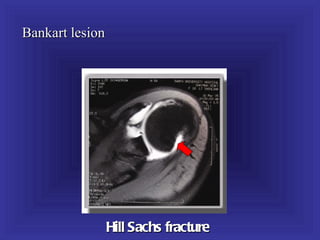
                      HILL SACHS FRACTURE
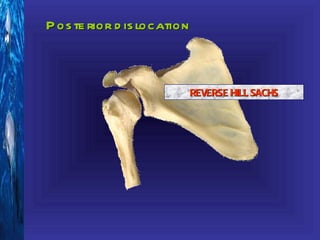
P os te rior d is location


                             REVERSE HILL SACHS
Bankart lesion
Bankart lesion


                 Hill Sachs fracture
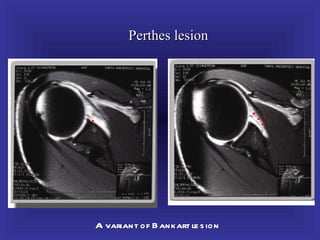
Perthes lesion


A variant of Bankart le s ion
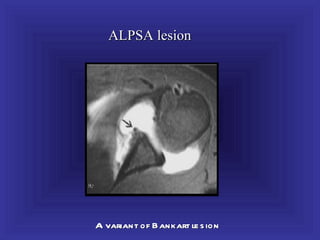
ALPSA lesion


A variant of Bankart le s ion
 MRI is an accurate modality in detection of
glenoid labral tear specially in acute stages
 Direct MR arthrography may be needed for
detection of labral tear in chronic stages,
however it converts the modality from non
invasive to an invasive method.
Have A Nice Day

Full shoulder

  • 2.
  • 35.
    S H OU LD E R JO IN T D IS E AS E S
  • 36.
    1 - Rotatorcuff disease 2 – Instability and Labral lesions, 3- Biceps disorders, 4-Truma 5-Tumors 6-Arthritis. 7-Refered pain as radiculopathy, and thoracic outlet syndrome.
  • 37.
    Rotator cuff disease Tendinosis The earliest stage of rotator cuff tendon pathology. The term tendinosis and not tendinitis is probably appropriate to describe such a cuff. Partial-thickness tear shows no communication between the glenohumeral joint and subacromial bursa. Bursal side tear Articular side tear Intratendinous tear Full-thickness tear It is a discontinuity in the tendon that extends from the articular surface to the bursal surface.
  • 38.
    Rotator cuff disease Causes 1 – Impingement syndrome 2 – Degenerative 3 - Traumatic
  • 39.
    Shoulder instability shoulder instability is slipping of the humeral head out of the glenoid socket during activities causing symptoms. It is referred to a spectrum of disorders that includes dislocation, subluxation and laxity. Instability is classified according to temporal relationship of antecedent trauma (acute first-time versus recurrent) degree (subluxation versus dislocation) direction, either unidirectional (anteroinferior or posterior) or multidirectional.
  • 40.
    Shoulder instability Causes 1 – Laxity 2 – Labral tear SLAP lesion Bankart lesion
  • 41.
    MR imaging Pulse sequences MR images obtained included axial , oblique coronal and oblique sagittal planes with different pulse sequences as following: Oblique Coronal T1 weighted images Oblique Coronal T2 weighted images Oblique Coronal T2 weighted fat suppressed images Oblique Coronal Proton Density (PD) weighted images Oblique Sagittal T1 weighted images Axial Gradient weighted images
  • 42.
    Direct MR arthrography Technique Anterior approach for intra-articular injection was done by using a 22 G spinal needle. Contrast agent 1- 0.5 mL of iodinated contrast agent was injected, guided under fluoroscopy for confirmation of intra-articular position of the needle. 2- 10 – 12 mL of a diluted solution of a paramagnetic contrast material (( consisted of 1 mL. gadopentetate dimeglumine ( Magnevist ) diluted in 200 mL normal saline 0.9% )) was then injected. Pulse sequences T1 – weighted fat suppressed images was performed in axial , oblique coronal and oblique sagittal planes.
  • 43.
    Case 1 Supraspinatus tendinosis Ab norm al h igh s ignals e qu al le s s th an flu id
  • 44.
    Case 2 ( Supraspinatus partial tear (Bursal side
  • 45.
    Case 2 ( Supraspinatus partial tear (Bursal side
  • 46.
    Case 3 ( Supraspinatus partial tear (Articular side
  • 47.
    Case 3 ( Supraspinatus partial tear (Articular side
  • 48.
    Case 4 ( Supraspinatus partial tear (Intratendinous
  • 49.
    Case 4 ( Supraspinatus partial tear (Intratendinous
  • 50.
    Case 5 Supraspinatus full thickness tear
  • 51.
    Case 5 Supraspinatus full thickness tear
  • 52.
    Case 6 Supraspinatus full thickness tear
  • 53.
    Case 6 Supraspinatus full thickness tear
  • 54.
    Case 7 Supraspinatus full thickness tear
  • 55.
    Case 7 Supraspinatus full thickness tear
  • 56.
    ROLE OF MRIIN THE DIAGNOSIS OF GLENOID LABRAL TEARS
  • 57.
    Glenoid labrum is a ring of dense fibrocartilagenous tissue attached to the bony glenoid cavity, increasing its depth and considered to be a factor for shoulder stabilization. Glenoid Cavity
  • 58.
    It appearse asa triangular structure at the margin of the glenoid rim on both axial and coronal plans. It displays low signal intensity on all pluse sequences. C O R O N AL T1 WI AX IAL T1 WI
  • 59.
    Lab ral tears ap p e ar in M R I as a h igh s ignal inte ns ity with in th e s u b s tance of th e lab ru m d e tach ing it from th e gle noid rim . Th is is ob viou s ly s e e n in acu te s tage s wh e re as s ociate d j oint e ffu s ion is p re s e nt allowing flu id to inte r th e s ite of th e te ar
  • 60.
    Howe ve rin ch ronic s tage s , fib ros is m ay occu r at th e s ite of th e te ar als o with re s olving of th e joint e ffu s ion m aking th e d e te ction of th e te ar b y conve ntional M R I is d ifficu lt and th e lab ru m .ap p e ars to b e norm al
  • 61.
    So in this s itu ation d ire ct M R arth rograp h y is ind icate d
  • 62.
    Intra-articu lar injection of ab ou t 1 0 – 1 2 m L of a d ilu te d s olu tion of a p aram agne tic contras t m ate rial (( cons is te d of 1 m L. gad op e nte tate d im e glu m ine ( M agne vis t ) d ilu te d in 200 m L norm al s aline 0.9% )) b y u s ing a 22 G s p inal ne e d le . D ire ct M R arth rograp h y C onve ntional M R I
  • 63.
    Two mechanisms oftruma are encountered in the glenoid labral tears
  • 64.
    Fall on anoutstretched arm
  • 65.
    S u pe rior lab ral te ar S u p e rior lab ral ante rior– to – p os te rior te ar S LAP
  • 66.
    F ou rm ain typ e s of S LAP LE S IO N S Type I Ju s t fraying or irre gu larity of th e lab ru m is d e m ons trate d . Th is typ e of le s ion is qu ite com m on in e ld e rly p e rs ons and m ay re p re s e nt a d e ge ne rative te ar of th e lab ru m . Th is typ e rare ly cau s e s s ym p tom s and d o not re qu ire s u rgical re p air.
  • 67.
    ( SLAP lesion( type II Type II SLAP lesions consist of detachment of the superior labral-bicipital complex from the superior glenoid rim
  • 68.
    ( SLAP lesion( type III In type III SLAP lesions, the superior portion of the labrum is detached from both the glenoid and the biceps tendon, and may be displaced into the joint space.
  • 69.
    ( SLAP lesion( type IV Type IV SLAP lesion is similar to type III lesion, with the tear extending into the biceps tendon .
  • 70.
    The biggest difficultyin diagnosing SLAP tears is differentiation of type II tears from the normal sublabral recess, which can be seen separating the superior labrum from the glenoid as a normal variant D ire cte d m ore m e d ially S m ooth ly ou tline d At and ante riot to th e b ice p tal lab ral com p le x
  • 71.
    S LAP II Usually directed laterally Extend posterior to the biceptal labral complex Irregular outlines
  • 72.
  • 73.
    Ante rior dis location BANKART LESION HILL SACHS FRACTURE
  • 74.
    P os terior d is location REVERSE HILL SACHS
  • 75.
  • 76.
    Bankart lesion Hill Sachs fracture
  • 77.
    Perthes lesion A variantof Bankart le s ion
  • 78.
    ALPSA lesion A variantof Bankart le s ion
  • 79.
     MRI isan accurate modality in detection of glenoid labral tear specially in acute stages  Direct MR arthrography may be needed for detection of labral tear in chronic stages, however it converts the modality from non invasive to an invasive method.
  • 80.