BUILDING CONSTRUCTION

1
Types of Building Construction
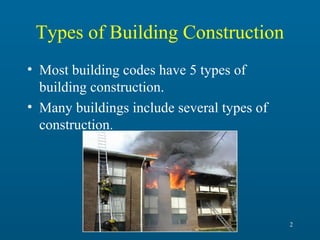
• Most building codes have 5 types of
building construction.
• Many buildings include several types of
construction.

2
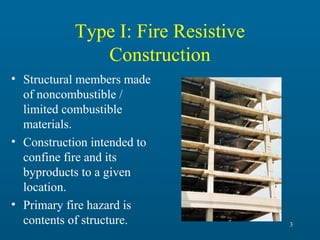
Type I: Fire Resistive
Construction
• Structural members made
of noncombustible /
limited combustible
materials.
• Construction intended to
confine fire and its
byproducts to a given
location.
• Primary fire hazard is
contents of structure.

3
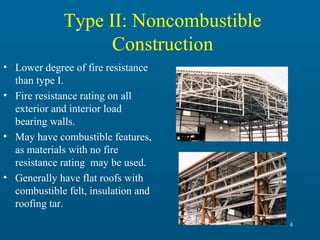
Type II: Noncombustible
Construction
• Lower degree of fire resistance
than type I.
• Fire resistance rating on all
exterior and interior load
bearing walls.
• May have combustible features,
as materials with no fire
resistance rating may be used.
• Generally have flat roofs with
combustible felt, insulation and
roofing tar.
4
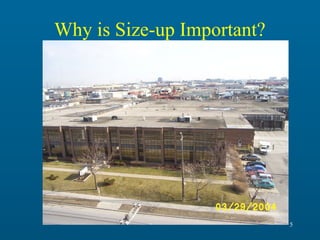
Why is Size-up Important?

5
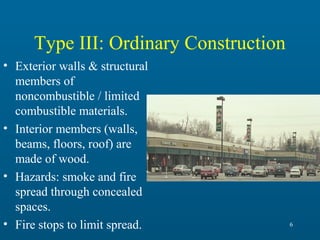
Type III: Ordinary Construction
• Exterior walls & structural
members of
noncombustible / limited
combustible materials.
• Interior members (walls,
beams, floors, roof) are
made of wood.
• Hazards: smoke and fire
spread through concealed
spaces.
• Fire stops to limit spread.

6
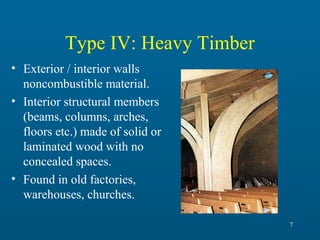
Type IV: Heavy Timber
• Exterior / interior walls
noncombustible material.
• Interior structural members
(beams, columns, arches,
floors etc.) made of solid or
laminated wood with no
concealed spaces.
• Found in old factories,
warehouses, churches.
7
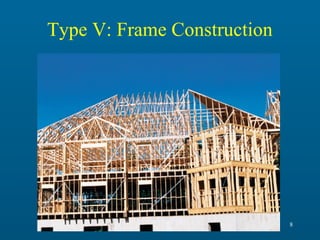
Type V: Frame Construction

8
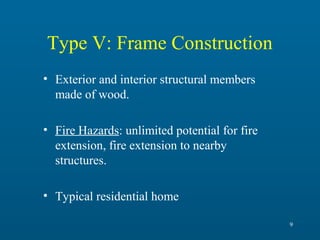
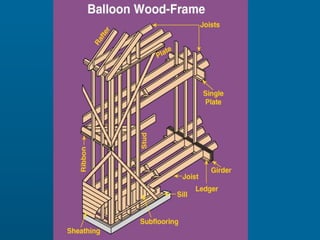
Type V: Frame Construction
• Exterior and interior structural members
made of wood.
• Fire Hazards: unlimited potential for fire
extension, fire extension to nearby
structures.
• Typical residential home
9
10
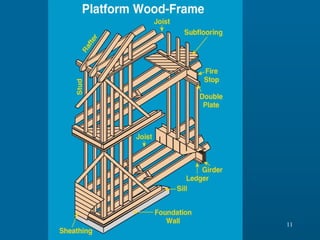
Platform Frame

11
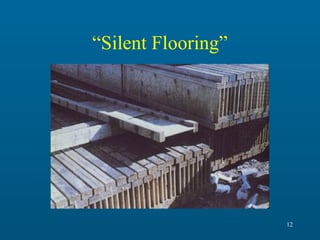
“Silent Flooring”

12
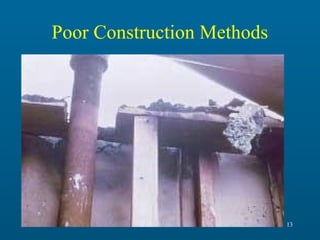
Poor Construction Methods

13
Fire Effects on Common
Construction Materials – Wood
• May be used in load bearing and non-load bearing
walls.
• Reaction of wood to fire conditions is based on the
size of the wood and its moisture content.
• Water does not have a negative effect on wood’s
structural strength.
• Plywood, particle board, paneling may be highly
combustible, produce toxic gases and rapidly
deteriorate under fire conditions.
14
Fire Effects on Common
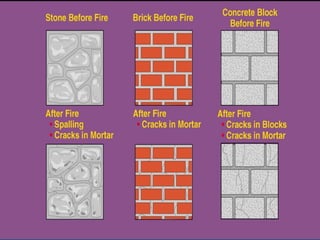
Construction Materials Masonry
Brick, concrete, and stonework.

•
• Commonly used for firewalls to separate connected
structures and prevent fire spread.
• May be used as load bearing or veneer.
• Minimally affected by fire & high temperatures.
• Mortar joints between bricks, blocks may
deteriorate. (mortar mix is weakest part of wall)
• Rapid cooling of masonry by water may cause
cracking or spalling.
15
16
Fire Effects on Common
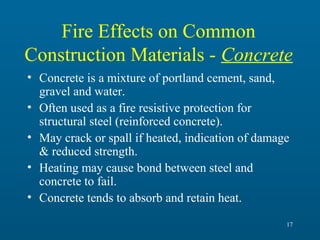
Construction Materials - Concrete
• Concrete is a mixture of portland cement, sand,
gravel and water.
• Often used as a fire resistive protection for
structural steel (reinforced concrete).
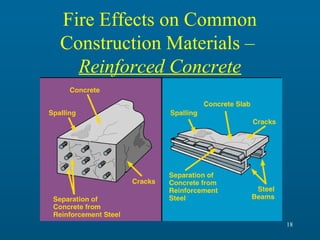
• May crack or spall if heated, indication of damage
& reduced strength.
• Heating may cause bond between steel and
concrete to fail.
• Concrete tends to absorb and retain heat.
17
Fire Effects on Common
Construction Materials –
Reinforced Concrete

18
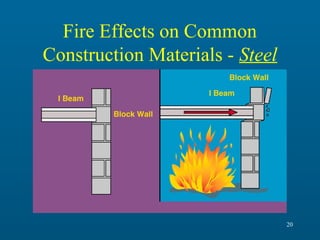
Fire Effects on Common
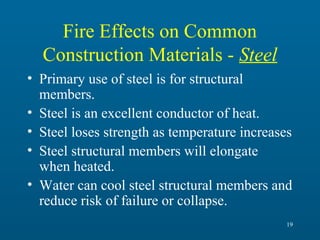
Construction Materials - Steel
• Primary use of steel is for structural
members.
• Steel is an excellent conductor of heat.
• Steel loses strength as temperature increases
• Steel structural members will elongate
when heated.
• Water can cool steel structural members and
reduce risk of failure or collapse.
19
Fire Effects on Common
Construction Materials - Steel

20
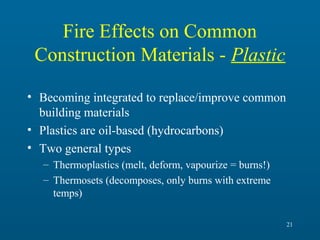
Fire Effects on Common
Construction Materials - Plastic
• Becoming integrated to replace/improve common
building materials
• Plastics are oil-based (hydrocarbons)
• Two general types
– Thermoplastics (melt, deform, vapourize = burns!)
– Thermosets (decomposes, only burns with extreme
temps)
21
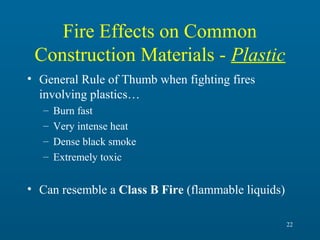
Fire Effects on Common
Construction Materials - Plastic
• General Rule of Thumb when fighting fires
involving plastics…
–
–
–
–

Burn fast
Very intense heat
Dense black smoke
Extremely toxic

• Can resemble a Class B Fire (flammable liquids)
22
23
BREAK TIME

24
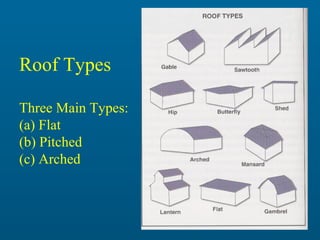
Roof Types
Three Main Types:
(a) Flat
(b) Pitched
(c) Arched

25
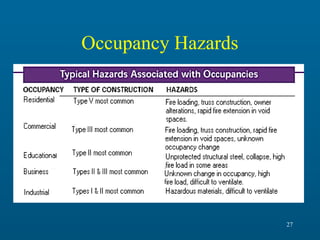
Occupancy Versus Type of
Construction
• Occupancy creates the fire load.
• Building codes specify building type based
on occupancy classification.
• Fire code determines fire protection based
on building and occupancy use.
• Occupancies are residential, commercial,
business, industrial and educational.
• Each type has a number of hazards.
26
Occupancy Hazards

27
Building Uses
• Ontario Fire Code and Ontario Building Code
separate buildings in groups A-F, as related to
their major use (or major occupancy)
• With each type of building comes various
requirements/restrictions on building construction
• Private dwelling residences are exempt (with some
exceptions)
28
Building Uses
• A – Assembly
– Theatres, libraries, schools, large bars, pubs and restaurants

• B – Institutional (compelled to sleep over)
– Jails, hospitals, orphanages, nursing homes

• C – Residential
– Apartment buildings (common area) , group homes, houses, motels

• D – Business and Personal Services
– Banks, barber shops, offices (medico legal), laundromat

• E – Mercantile
– Markets, stores, shops, supermarkets, restaurants, bars and pubs

• F – Industrial
– Flammable liquid plant, television studio, freight depot

29
Firefighter Hazards:
Structure Fires
• Change in occupancy creating an unusually heavy
fire load.
• Dangerous stockpiling and excessive stock
creating access problems.
• Unknown design errors, renovations, contractor
short cuts.
• Arsonists traps or tampering with fire protection
systems.
• Occupancy may not be what it appears.
(drug lab, boarding house, group home, etc.)
30
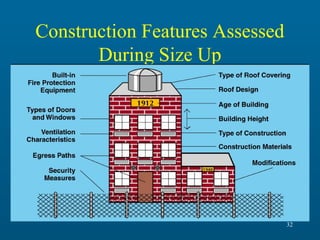
Construction Features Assessed
During Size Up

What constructions features are
important during size-up?

31
Construction Features Assessed
During Size Up

32
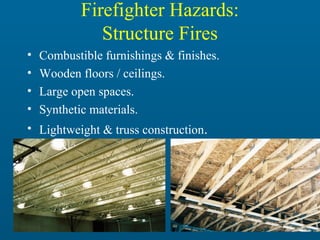
Firefighter Hazards:
Structure Fires
•
•
•
•

Combustible furnishings & finishes.
Wooden floors / ceilings.
Large open spaces.
Synthetic materials.

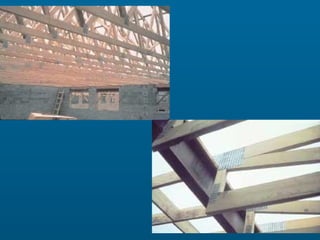
• Lightweight & truss construction.

33
Lightweight Wood or Steel Truss
Construction

=
Very Dangerous Firefighting
Conditions

34
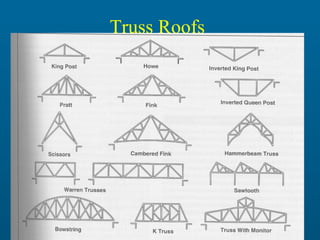
Truss Roofs

35
36
37
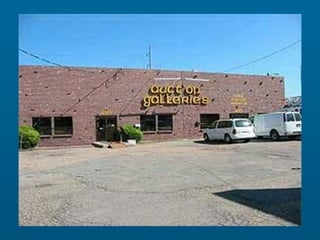
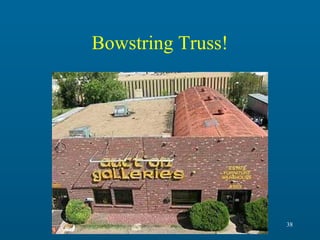
Bowstring Truss!

38
Beware of the Truss!

39
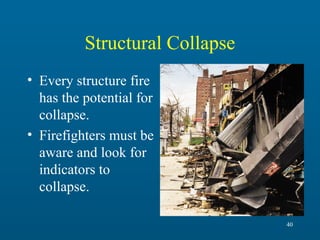
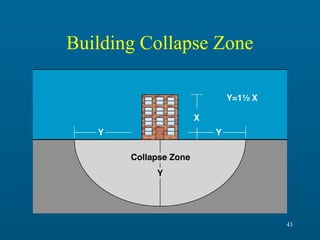
Structural Collapse
• Every structure fire
has the potential for
collapse.
• Firefighters must be
aware and look for
indicators to
collapse.
40
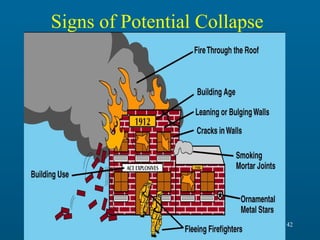
Signs of Potential Collapse
• Prolonged exposure.(time)
• Distorted structural members.
• Fire on floors below heavy
machinery and heavy loads.

41
Signs of Potential Collapse

42
Building Collapse Zone

43
44
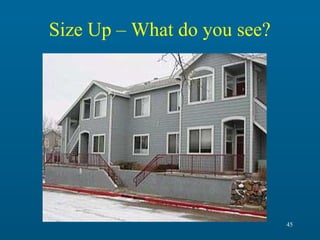
Size Up – What do you see?

45
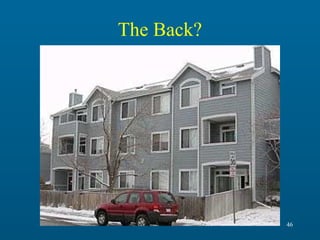
The Back?

46
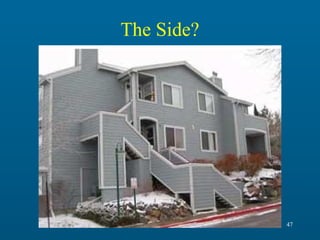
The Side?

47

Building construction

  • 1.
  • 2.
    Types of BuildingConstruction • Most building codes have 5 types of building construction. • Many buildings include several types of construction. 2
  • 3.
    Type I: FireResistive Construction • Structural members made of noncombustible / limited combustible materials. • Construction intended to confine fire and its byproducts to a given location. • Primary fire hazard is contents of structure. 3
  • 4.
    Type II: Noncombustible Construction •Lower degree of fire resistance than type I. • Fire resistance rating on all exterior and interior load bearing walls. • May have combustible features, as materials with no fire resistance rating may be used. • Generally have flat roofs with combustible felt, insulation and roofing tar. 4
  • 5.
    Why is Size-upImportant? 5
  • 6.
    Type III: OrdinaryConstruction • Exterior walls & structural members of noncombustible / limited combustible materials. • Interior members (walls, beams, floors, roof) are made of wood. • Hazards: smoke and fire spread through concealed spaces. • Fire stops to limit spread. 6
  • 7.
    Type IV: HeavyTimber • Exterior / interior walls noncombustible material. • Interior structural members (beams, columns, arches, floors etc.) made of solid or laminated wood with no concealed spaces. • Found in old factories, warehouses, churches. 7
  • 8.
    Type V: FrameConstruction 8
  • 9.
    Type V: FrameConstruction • Exterior and interior structural members made of wood. • Fire Hazards: unlimited potential for fire extension, fire extension to nearby structures. • Typical residential home 9
  • 10.
  • 11.
  • 12.
  • 13.
  • 14.
    Fire Effects onCommon Construction Materials – Wood • May be used in load bearing and non-load bearing walls. • Reaction of wood to fire conditions is based on the size of the wood and its moisture content. • Water does not have a negative effect on wood’s structural strength. • Plywood, particle board, paneling may be highly combustible, produce toxic gases and rapidly deteriorate under fire conditions. 14
  • 15.
    Fire Effects onCommon Construction Materials Masonry Brick, concrete, and stonework. • • Commonly used for firewalls to separate connected structures and prevent fire spread. • May be used as load bearing or veneer. • Minimally affected by fire & high temperatures. • Mortar joints between bricks, blocks may deteriorate. (mortar mix is weakest part of wall) • Rapid cooling of masonry by water may cause cracking or spalling. 15
  • 16.
  • 17.
    Fire Effects onCommon Construction Materials - Concrete • Concrete is a mixture of portland cement, sand, gravel and water. • Often used as a fire resistive protection for structural steel (reinforced concrete). • May crack or spall if heated, indication of damage & reduced strength. • Heating may cause bond between steel and concrete to fail. • Concrete tends to absorb and retain heat. 17
  • 18.
    Fire Effects onCommon Construction Materials – Reinforced Concrete 18
  • 19.
    Fire Effects onCommon Construction Materials - Steel • Primary use of steel is for structural members. • Steel is an excellent conductor of heat. • Steel loses strength as temperature increases • Steel structural members will elongate when heated. • Water can cool steel structural members and reduce risk of failure or collapse. 19
  • 20.
    Fire Effects onCommon Construction Materials - Steel 20
  • 21.
    Fire Effects onCommon Construction Materials - Plastic • Becoming integrated to replace/improve common building materials • Plastics are oil-based (hydrocarbons) • Two general types – Thermoplastics (melt, deform, vapourize = burns!) – Thermosets (decomposes, only burns with extreme temps) 21
  • 22.
    Fire Effects onCommon Construction Materials - Plastic • General Rule of Thumb when fighting fires involving plastics… – – – – Burn fast Very intense heat Dense black smoke Extremely toxic • Can resemble a Class B Fire (flammable liquids) 22
  • 23.
  • 24.
  • 25.
    Roof Types Three MainTypes: (a) Flat (b) Pitched (c) Arched 25
  • 26.
    Occupancy Versus Typeof Construction • Occupancy creates the fire load. • Building codes specify building type based on occupancy classification. • Fire code determines fire protection based on building and occupancy use. • Occupancies are residential, commercial, business, industrial and educational. • Each type has a number of hazards. 26
  • 27.
  • 28.
    Building Uses • OntarioFire Code and Ontario Building Code separate buildings in groups A-F, as related to their major use (or major occupancy) • With each type of building comes various requirements/restrictions on building construction • Private dwelling residences are exempt (with some exceptions) 28
  • 29.
    Building Uses • A– Assembly – Theatres, libraries, schools, large bars, pubs and restaurants • B – Institutional (compelled to sleep over) – Jails, hospitals, orphanages, nursing homes • C – Residential – Apartment buildings (common area) , group homes, houses, motels • D – Business and Personal Services – Banks, barber shops, offices (medico legal), laundromat • E – Mercantile – Markets, stores, shops, supermarkets, restaurants, bars and pubs • F – Industrial – Flammable liquid plant, television studio, freight depot 29
  • 30.
    Firefighter Hazards: Structure Fires •Change in occupancy creating an unusually heavy fire load. • Dangerous stockpiling and excessive stock creating access problems. • Unknown design errors, renovations, contractor short cuts. • Arsonists traps or tampering with fire protection systems. • Occupancy may not be what it appears. (drug lab, boarding house, group home, etc.) 30
  • 31.
    Construction Features Assessed DuringSize Up What constructions features are important during size-up? 31
  • 32.
  • 33.
    Firefighter Hazards: Structure Fires • • • • Combustiblefurnishings & finishes. Wooden floors / ceilings. Large open spaces. Synthetic materials. • Lightweight & truss construction. 33
  • 34.
    Lightweight Wood orSteel Truss Construction = Very Dangerous Firefighting Conditions 34
  • 35.
  • 36.
  • 37.
  • 38.
  • 39.
    Beware of theTruss! 39
  • 40.
    Structural Collapse • Everystructure fire has the potential for collapse. • Firefighters must be aware and look for indicators to collapse. 40
  • 41.
    Signs of PotentialCollapse • Prolonged exposure.(time) • Distorted structural members. • Fire on floors below heavy machinery and heavy loads. 41
  • 42.
    Signs of PotentialCollapse 42
  • 43.
  • 44.
  • 45.
    Size Up –What do you see? 45
  • 46.
  • 47.

Editor's Notes

  • #10 MOST COMMONLY DEALT WITH CONSTRUCTION TYPE.
  • #31 ALL OF THESE TYPES OF CONDITIONS WILL CONTRIBUTE TO FIRE SPREAD.