Solar radiation spectrum
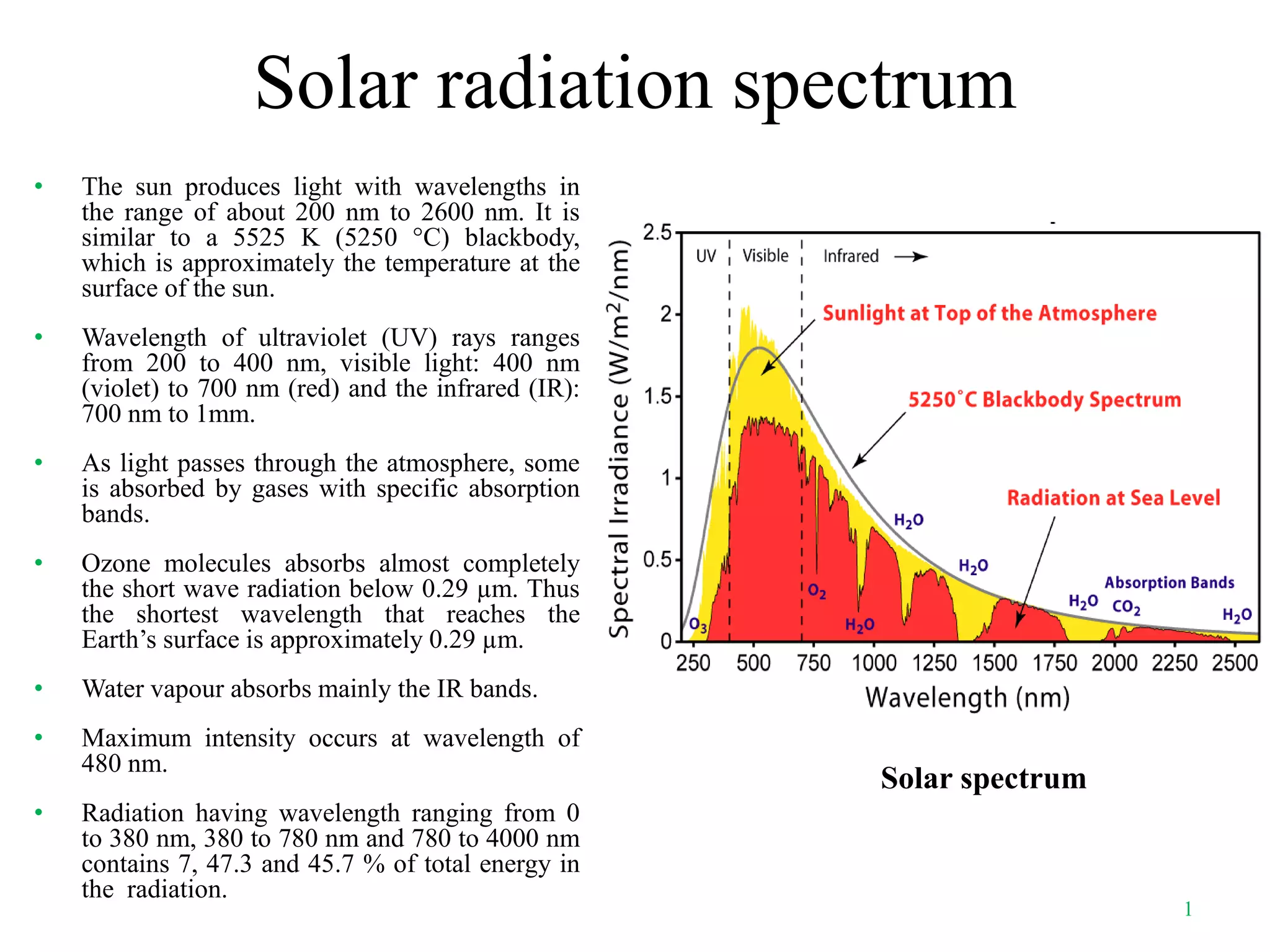
• The sun produces light with wavelengths in
the range of about 200 nm to 2600 nm. It is
similar to a 5525 K (5250 °C) blackbody,
which is approximately the temperature at the
surface of the sun.
• Wavelength of ultraviolet (UV) rays ranges
from 200 to 400 nm, visible light: 400 nm
(violet) to 700 nm (red) and the infrared (IR):
700 nm to 1mm.
• As light passes through the atmosphere, some
is absorbed by gases with specific absorption
bands.
• Ozone molecules absorbs almost completely
the short wave radiation below 0.29 µm. Thus
the shortest wavelength that reaches the
Earth’s surface is approximately 0.29 µm.
• Water vapour absorbs mainly the IR bands.
• Maximum intensity occurs at wavelength of
480 nm.
• Radiation having wavelength ranging from 0
to 380 nm, 380 to 780 nm and 780 to 4000 nm
contains 7, 47.3 and 45.7 % of total energy in
the radiation.
Solar spectrum
1

Solar Radiation Spectrum.pptx

  • 1.
    Solar radiation spectrum •The sun produces light with wavelengths in the range of about 200 nm to 2600 nm. It is similar to a 5525 K (5250 °C) blackbody, which is approximately the temperature at the surface of the sun. • Wavelength of ultraviolet (UV) rays ranges from 200 to 400 nm, visible light: 400 nm (violet) to 700 nm (red) and the infrared (IR): 700 nm to 1mm. • As light passes through the atmosphere, some is absorbed by gases with specific absorption bands. • Ozone molecules absorbs almost completely the short wave radiation below 0.29 µm. Thus the shortest wavelength that reaches the Earth’s surface is approximately 0.29 µm. • Water vapour absorbs mainly the IR bands. • Maximum intensity occurs at wavelength of 480 nm. • Radiation having wavelength ranging from 0 to 380 nm, 380 to 780 nm and 780 to 4000 nm contains 7, 47.3 and 45.7 % of total energy in the radiation. Solar spectrum 1