Six Dimension
of 21st century
learning
design
ZWANE ENTONETIA ANIKIE
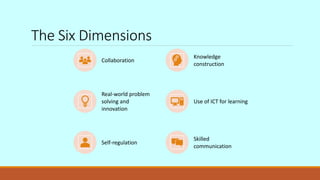
The Six Dimensions
Collaboration
Knowledge
construction
Real-world problem
solving and
innovation
Use of ICT for learning
Self-regulation
Skilled
communication
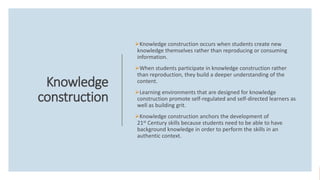
Knowledge
construction
Knowledge construction occurs when students create new
knowledge themselves rather than reproducing or consuming
information.
When students participate in knowledge construction rather
than reproduction, they build a deeper understanding of the
content.
Learning environments that are designed for knowledge
construction promote self-regulated and self-directed learners as
well as building grit.
Knowledge construction anchors the development of
21st Century skills because students need to be able to have
background knowledge in order to perform the skills in an
authentic context.
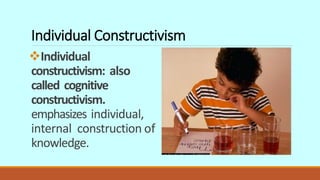
Individual Constructivism
Individual
constructivism: also
called cognitive
constructivism.
emphasizes individual,
internal construction of
knowledge.
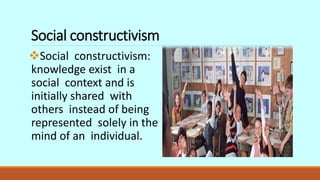
Social constructivism
Social constructivism:
knowledge exist in a
social context and is
initially shared with
others instead of being
represented solely in the
mind of an individual.
Collaboration
Collaboration
is a process through which people who see different aspects of
a problem can constructively explore their differences and
search for solutions that go beyond their own limited vision of
what is possible.
Real-world
problem
solving and
innovation
Real world problem-solving and innovation are skills that are
integral to living and working in the 21st century.
Educators can provide young people with opportunities to
engage in real world problems and to apply their solutions or
ideas in practice
Teachers for example, can familiarise learners with the use of
Microsoft word to write formal letters, Curriculum Vitae which
will help learners to write perfect CVs and formal letters when
applying for a job in future.
Use of ICT for
learning
Information and Communication Technology (ICT) in
education is the mode of education that use information and
communications technology to support, enhance, and optimize
the delivery of information.
Teachers can make use of computers to prepare lessons and
use ICT tools for data management such as Microsoft Access to
save space and time.
Teachers can familiarise learners with ICT for learning by using
online assessment tools to prepare for assessments.
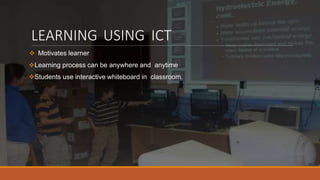
LEARNING USING ICT
 Motivates learner
Learning process can be anywhere and anytime
Students use interactive whiteboard in classroom.
Self-
regulation
Self-regulation is the ability to understand and
manage your behavior and your reactions to
feelings and things happening around you.
It includes being able to: regulate reactions to
strong emotions like frustration, excitement,
anger and embarrassment.
Skilled
communication
Teachers need to be professional at all times and give learners
proper feedback using professional communication skills.
Indirectly so learners will also learn how to communicate well
with their teachers and their peers.
Self-regulation
and Skilled
communication
in Education
Self Regulation
 Mediate, scaffolding and make your lesson to be interesting
to promote self
regulated learning amongst learners and deep learning
Skilled Communication
 Make use of professional communication skills.
 Give proper feedback to learners.
 Be professional at all times.
 Be open to learning as a teacher to face different
shortcomings in the classroom.
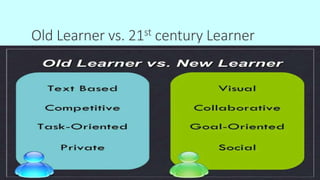
Old Learner vs. 21st century Learner
Thank You
Work cited
 Haasis, K. (2013) TCI lab creative collaboration 130904. Available from Slideshare at
https://www.slideshare.net/klaushaasis/tci-lab-creative-collaboration-130904 (Accessed 18 August 2021).
Nat, C. (2013) Constructivism: Knowledge Construction / Concept Learning. Available from SlideShare at
https://www.slideshare.net/laralundang/constructivism-knowledge-construction-concept-learning (Accessed 18 August 2021).
 Deshmukh, S. (2013) Impact of ict in education. Available from SlideShare at https://www.slideshare.net/sanika1130/impact-
of-ict-in-education (Accessed 20 august 2021).
Mdlazi, A. (2015) Six dimensions of 21st century. Available from SlideShare at https://www.slideshare.net/Andile1980/six-
dimensions-of-21st-century (Accessed 20 August 2021).
Budhrani, K. (2009) E-Learning: 21st Century Perspectives on Teaching, Learning, and Technology. Available from SlideShare
at https://www.slideshare.net/kiranb/elearning-21st-century-perspectives-on-teaching-learning-and-technology (Accessed 23
August 2021).
Lee, M. (2018) How community collaboration can foster innovation. Available from Website at
https://www.ey.com/en_gl/wealth-asset-management/how-community-collaboration-can-foster-innovation (Accessed 25 August
2021)

Six Dimensions

  • 1.
    Six Dimension of 21stcentury learning design ZWANE ENTONETIA ANIKIE
  • 2.
    The Six Dimensions Collaboration Knowledge construction Real-worldproblem solving and innovation Use of ICT for learning Self-regulation Skilled communication
  • 3.
    Knowledge construction Knowledge construction occurswhen students create new knowledge themselves rather than reproducing or consuming information. When students participate in knowledge construction rather than reproduction, they build a deeper understanding of the content. Learning environments that are designed for knowledge construction promote self-regulated and self-directed learners as well as building grit. Knowledge construction anchors the development of 21st Century skills because students need to be able to have background knowledge in order to perform the skills in an authentic context.
  • 4.
    Individual Constructivism Individual constructivism: also calledcognitive constructivism. emphasizes individual, internal construction of knowledge.
  • 5.
    Social constructivism Social constructivism: knowledgeexist in a social context and is initially shared with others instead of being represented solely in the mind of an individual.
  • 6.
  • 7.
    Collaboration is a processthrough which people who see different aspects of a problem can constructively explore their differences and search for solutions that go beyond their own limited vision of what is possible.
  • 8.
    Real-world problem solving and innovation Real worldproblem-solving and innovation are skills that are integral to living and working in the 21st century. Educators can provide young people with opportunities to engage in real world problems and to apply their solutions or ideas in practice Teachers for example, can familiarise learners with the use of Microsoft word to write formal letters, Curriculum Vitae which will help learners to write perfect CVs and formal letters when applying for a job in future.
  • 9.
    Use of ICTfor learning Information and Communication Technology (ICT) in education is the mode of education that use information and communications technology to support, enhance, and optimize the delivery of information. Teachers can make use of computers to prepare lessons and use ICT tools for data management such as Microsoft Access to save space and time. Teachers can familiarise learners with ICT for learning by using online assessment tools to prepare for assessments.
  • 10.
    LEARNING USING ICT Motivates learner Learning process can be anywhere and anytime Students use interactive whiteboard in classroom.
  • 11.
    Self- regulation Self-regulation is theability to understand and manage your behavior and your reactions to feelings and things happening around you. It includes being able to: regulate reactions to strong emotions like frustration, excitement, anger and embarrassment.
  • 12.
    Skilled communication Teachers need tobe professional at all times and give learners proper feedback using professional communication skills. Indirectly so learners will also learn how to communicate well with their teachers and their peers.
  • 13.
    Self-regulation and Skilled communication in Education SelfRegulation  Mediate, scaffolding and make your lesson to be interesting to promote self regulated learning amongst learners and deep learning Skilled Communication  Make use of professional communication skills.  Give proper feedback to learners.  Be professional at all times.  Be open to learning as a teacher to face different shortcomings in the classroom.
  • 14.
    Old Learner vs.21st century Learner
  • 15.
  • 16.
    Work cited  Haasis,K. (2013) TCI lab creative collaboration 130904. Available from Slideshare at https://www.slideshare.net/klaushaasis/tci-lab-creative-collaboration-130904 (Accessed 18 August 2021). Nat, C. (2013) Constructivism: Knowledge Construction / Concept Learning. Available from SlideShare at https://www.slideshare.net/laralundang/constructivism-knowledge-construction-concept-learning (Accessed 18 August 2021).  Deshmukh, S. (2013) Impact of ict in education. Available from SlideShare at https://www.slideshare.net/sanika1130/impact- of-ict-in-education (Accessed 20 august 2021). Mdlazi, A. (2015) Six dimensions of 21st century. Available from SlideShare at https://www.slideshare.net/Andile1980/six- dimensions-of-21st-century (Accessed 20 August 2021). Budhrani, K. (2009) E-Learning: 21st Century Perspectives on Teaching, Learning, and Technology. Available from SlideShare at https://www.slideshare.net/kiranb/elearning-21st-century-perspectives-on-teaching-learning-and-technology (Accessed 23 August 2021). Lee, M. (2018) How community collaboration can foster innovation. Available from Website at https://www.ey.com/en_gl/wealth-asset-management/how-community-collaboration-can-foster-innovation (Accessed 25 August 2021)

Editor's Notes

  • #5 Nat, C. (2013) Constructivism: Knowledge Construction / Concept Learning. Available from Slideshare at https://www.slideshare.net/laralundang/constructivism-knowledge-construction-concept-learning (Accessed 18 August 2021).
  • #6 Nat, C. (2013) Constructivism: Knowledge Construction / Concept Learning. Available from Slideshare at https://www.slideshare.net/laralundang/constructivism-knowledge-construction-concept-learning (Accessed 18 August 2021).
  • #7 Lee, M. (2018) How community collaboration can foster innovation. Available from Website at https://www.ey.com/en_gl/wealth-asset-management/how-community-collaboration-can-foster-innovation (Accessed 25 August 2021)
  • #8  Haasis, K. (2013) TCI lab creative collaboration 130904. Available from Slideshare at https://www.slideshare.net/klaushaasis/tci-lab-creative-collaboration-130904 (Accessed 18 August 2021).
  • #11 Deshmukh, S. (2013) Impact of ict in education. Available from SlideShare at https://www.slideshare.net/sanika1130/impact-of-ict-in-education (Accessed 20 august 2021).
  • #14 Mdlazi, A. (2015) Six dimensions of 21st century. Available from SlideShare at https://www.slideshare.net/Andile1980/six-dimensions-of-21st-century (Accessed 20 August 2021).
  • #15 Budhrani, K. (2009) E-Learning: 21st Century Perspectives on Teaching, Learning, and Technology. Available from SlideShare at https://www.slideshare.net/kiranb/elearning-21st-century-perspectives-on-teaching-learning-and-technology (Accessed 23 August 2021).