PENGERTIAN BUAH
Sri Trisnowati
Pengertian dan Definisi
A. Pomology
• Ilmu dan teknologi tentang budidaya tanaman buah disebut
sebagai pomologi (pomology).
Dalam< http://en.wikipedia.org/wiki/Pomology> pengertian
pomologi adalah sebagai berikut :
• Pomology (from Latin pomum (fruit) + -logy) is a branch of
botany that studies and cultivates pome fruit, particularly
from the genera Malus, Prunus and Pyrus belonging to the
Rosaceae. The term is sometimes applied more broadly, to the
cultivation of any type of fruit. In the latter case, the
denomination fruticulture—introduced from romance
languages (from Latin fructus and cultura) —is also used.
• Pomological research is mainly focused on the development,
cultivation and physiological studies of stone fruit trees. The
goals of fruit tree improvement include enhancement of fruit
quality, regulation of production periods, and reduction of
production cost.
Dalam <http://www.wisegeek.com/what-is-
pomology.htm> pengertian pomologi diterangkan
sebagai berikut :
Pomology is a branch of horticulture which
focuses on the cultivation, production, harvest, and
storage of fruit, especially tree fruits. Fruit orchards
can be found all over the world, and tree fruits are a
major industry in many countries, making pomology
especially vital. Pomologists can work in the industry,
or for research facilities at universities and other
organizations.
The word “pomology” comes from the Latin
word for “apple,” but pomology is about a lot
more than just apples. Any number of fruit
trees can be included in a survey of pomology,
like apricots, pears, plums, peaches, cherries,
nectarines, and avocados. Pomologists also
research tree nuts like almonds, walnuts, and
pecans, among others.
One of the most critical aspects of
pomology is the development of new fruit
cultivars. A pomologist can cross-breed various
fruit cultivars for specifically desired traits, such
as flavor, hardiness, or disease-resistance.
Pomology has contributed a number of exotic
and interesting fruit cultivars to the world, such
as the pluot, a cross between a plum and an
apricot. If a pomologist can breed a distinctive
and entirely new cultivar, he or she stands to
profit significantly from the resulting patents.
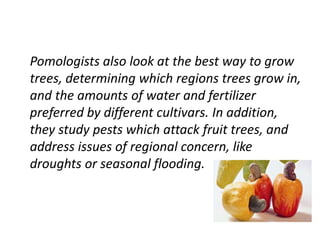
Pomologists also look at the best way to grow
trees, determining which regions trees grow in,
and the amounts of water and fertilizer
preferred by different cultivars. In addition,
they study pests which attack fruit trees, and
address issues of regional concern, like
droughts or seasonal flooding.
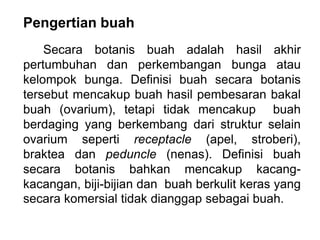
Pengertian buah
Secara botanis buah adalah hasil akhir
pertumbuhan dan perkembangan bunga atau
kelompok bunga. Definisi buah secara botanis
tersebut mencakup buah hasil pembesaran bakal
buah (ovarium), tetapi tidak mencakup buah
berdaging yang berkembang dari struktur selain
ovarium seperti receptacle (apel, stroberi),
braktea dan peduncle (nenas). Definisi buah
secara botanis bahkan mencakup kacang-
kacangan, biji-bijian dan buah berkulit keras yang
secara komersial tidak dianggap sebagai buah.
Dalam The Shorter Oxford English
Dictionary diterangkan bahwa buah adalah hasil
tanaman yang dapat dimakan, terdiri atas biji dan
pelindungnya, terutama bila pelindung tersebut
berdaging (pulpy) dan berair(juicy). Definisi buah
menurut konsumen adalah hasil tanaman yang
beraroma, rasanya manis alami atau dibuat manis
sebelum dimakan dan dimanfaatkan terutama
sebagai makanan penyegar. Definisi menurut
konsumen ini lebih sesuai untuk digunakan secara
umum.
Derivasi buah, struktur asal buah atau dari
jaringan mana buah dibentuk.
Beberapa pengertian tentang buah juga
ditampilkan dalam berbagai tulisan.
Dalam< http://id.wikipedia.org/wiki/Buah>
buah didefinisikan sebagai organ pada tumbuhan
berbunga yang merupakan perkembangan
lanjutan bakal buah (ovarium). Buah biasanya
membungkus dan melindungi biji. Aneka rupa dan
bentuk buah tidak terlepas kaitannya dengan
fungsi utama buah, yakni sebagai pemencar biji.
Pengertian buah dalam lingkup hortikultura tidak
terbatas pada yang terbentuk dari bakal buah,
melainkan dapat pula berasal dari perkembangan
organ yang lain.
Oxford advanced Learner’s dictionary (1995)
memberikan pengertian buah sebagai :
• The part of a plant that contains seeds and flesh and
can be eaten as food.
• Botany : a part of a plant or tree formed after the
flowers have died and in which seeds formed.
Tulisan lain mengatakan : In broad terms, a fruit is a
structure of a plant that contains its seed/seeds.The term
has different meanings dependent on context. In non-
technical usage, such as food preparation, fruit normally
means the fleshy seed-associated structures of certain
plants that are sweet and edible in the raw state, such as
apples, oranges, grapes, strawberries, and bananas.
Seed-associated structures that do not fit these informal
criteria are usually called by other names, such as
vegetables, pods, nut, ears and cones.
In biology (botany), a "fruit" is a part of a flowering
plant that derives from specific tissues of the flower,
mainly one or more ovaries. Taken strictly, this definition
excludes many structures that are "fruits" in the common
sense of the term, such as fleshy fruit-like growths that
develop from other plant tissues close to the fruit
(accessory fruit, or more rarely false fruit or pseudocarp),
such as cashew fruits. Often the botanical fruit is only part
of the common fruit, or is merely adjacent to it. On the
other hand, the botanical sense includes many structures
that are not commonly called "fruits", such as bean pods,
corn kernels, wheat grains, tomatoes, and many more.
Beberapa komoditas yang secara
botanis didefinisikan sebagai buah, secara
umum digolongkan di dalam sayuran
(tomat, terung cabai, paria, gambas)
karena pada umumnya tidak manis atau
tidak dibuat menjadi manis, dimasak dan
dimanfaatkan sebagai pelengkap makanan
pokok, daging atau ikan.
Euler diagram representing the relationship between
(culinary) vegetables and botanical fruits. Some
vegetables, such as tomatoes, fall into both categories.
Many fruits that, in a botanical sense, are true fruits are
actually treated as vegetables in cooking and food
preparation, because they are not particularly sweet.
These culinary vegetables include cucurbits (e.g., squash,
pumpkin, and cucumber), tomatoes, peas, beans, corn,
eggplant, and sweet pepper.
Diagram Euler
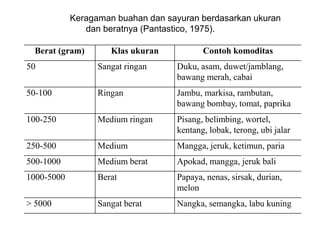
Keragaman buah
Pada umumnya buahan tropis
mempunyai ukuran yang sangat beragam,
dari buah yang berukuran kecil dan ringan
kecil sampai buah yang sangat besar dan
berat. Bila dibandingkan antara buah yang
paling kecil dengan buah yang paling
besar, maka perbandingannya dapat
mencapai 1:1000, sedang buahan sub
tropis variasinya lebih kecil (1:10).
Berat (gram) Klas ukuran Contoh komoditas
50 Sangat ringan Duku, asam, duwet/jamblang,
bawang merah, cabai
50-100 Ringan Jambu, markisa, rambutan,
bawang bombay, tomat, paprika
100-250 Medium ringan Pisang, belimbing, wortel,
kentang, lobak, terong, ubi jalar
250-500 Medium Mangga, jeruk, ketimun, paria
500-1000 Medium berat Apokad, mangga, jeruk bali
1000-5000 Berat Papaya, nenas, sirsak, durian,
melon
> 5000 Sangat berat Nangka, semangka, labu kuning
Keragaman buahan dan sayuran berdasarkan ukuran
dan beratnya (Pantastico, 1975).
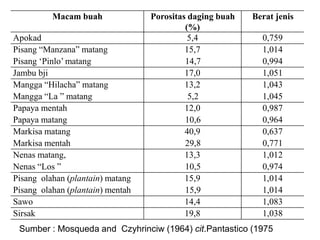
Porositas
Sayuran daun pada umumnya lebih
porous daripada buah atau umbi karena di
dalam daun terdapat jaringan palisade dan
jaringan mesofil yang susunannya renggang.
Porositas dan berat jenis beberapa buahan
tropis dicontohkan oleh Mosqueda and
Czyhrinciw (1964) cit.Pantastico (1975)
Macam buah Porositas daging buah
(%)
Berat jenis
Apokad 5,4 0,759
Pisang “Manzana” matang 15,7 1,014
Pisang ‘Pinlo’ matang 14,7 0,994
Jambu bji 17,0 1,051
Mangga “Hilacha” matang 13,2 1,043
Mangga “La ” matang 5,2 1,045
Papaya mentah 12,0 0,987
Papaya matang 10,6 0,964
Markisa matang 40,9 0,637
Markisa mentah 29,8 0,771
Nenas matang, 13,3 1,012
Nenas “Los ” 10,5 0,974
Pisang olahan (plantain) matang 15,9 1,014
Pisang olahan (plantain) mentah 15,9 1,014
Sawo 14,4 1,083
Sirsak 19,8 1,038
Sumber : Mosqueda and Czyhrinciw (1964) cit.Pantastico (1975
Sumber Informasi dan Referensi
1. Anonim.< http://en.wikipedia.org/wiki/Pomology>
2.Anonim.<http://www.wisegeek.com/what-is-
pomology.htm>
3. Anonim. < http://id.wikipedia.org/wiki/Buah>
4. Oxford advanced Learner’s dictionary (1995)
5. Pantastico, Er. B. (ed). 1975. Postharvest Physiology,
Handling and Utilization of Tropical and Subtropical Fruits
and Vegetables. AVI.
6. Wills, R. H. H., T. H. Lu, D. Graham, W. B. Mc. Glasson
and E. G. Hall. 1981. Postharvest. Granada.

Pengertian buah (3)

  • 1.
  • 2.
    Pengertian dan Definisi A.Pomology • Ilmu dan teknologi tentang budidaya tanaman buah disebut sebagai pomologi (pomology). Dalam< http://en.wikipedia.org/wiki/Pomology> pengertian pomologi adalah sebagai berikut : • Pomology (from Latin pomum (fruit) + -logy) is a branch of botany that studies and cultivates pome fruit, particularly from the genera Malus, Prunus and Pyrus belonging to the Rosaceae. The term is sometimes applied more broadly, to the cultivation of any type of fruit. In the latter case, the denomination fruticulture—introduced from romance languages (from Latin fructus and cultura) —is also used. • Pomological research is mainly focused on the development, cultivation and physiological studies of stone fruit trees. The goals of fruit tree improvement include enhancement of fruit quality, regulation of production periods, and reduction of production cost.
  • 3.
    Dalam <http://www.wisegeek.com/what-is- pomology.htm> pengertianpomologi diterangkan sebagai berikut : Pomology is a branch of horticulture which focuses on the cultivation, production, harvest, and storage of fruit, especially tree fruits. Fruit orchards can be found all over the world, and tree fruits are a major industry in many countries, making pomology especially vital. Pomologists can work in the industry, or for research facilities at universities and other organizations.
  • 4.
    The word “pomology”comes from the Latin word for “apple,” but pomology is about a lot more than just apples. Any number of fruit trees can be included in a survey of pomology, like apricots, pears, plums, peaches, cherries, nectarines, and avocados. Pomologists also research tree nuts like almonds, walnuts, and pecans, among others.
  • 5.
    One of themost critical aspects of pomology is the development of new fruit cultivars. A pomologist can cross-breed various fruit cultivars for specifically desired traits, such as flavor, hardiness, or disease-resistance. Pomology has contributed a number of exotic and interesting fruit cultivars to the world, such as the pluot, a cross between a plum and an apricot. If a pomologist can breed a distinctive and entirely new cultivar, he or she stands to profit significantly from the resulting patents.
  • 6.
    Pomologists also lookat the best way to grow trees, determining which regions trees grow in, and the amounts of water and fertilizer preferred by different cultivars. In addition, they study pests which attack fruit trees, and address issues of regional concern, like droughts or seasonal flooding.
  • 7.
    Pengertian buah Secara botanisbuah adalah hasil akhir pertumbuhan dan perkembangan bunga atau kelompok bunga. Definisi buah secara botanis tersebut mencakup buah hasil pembesaran bakal buah (ovarium), tetapi tidak mencakup buah berdaging yang berkembang dari struktur selain ovarium seperti receptacle (apel, stroberi), braktea dan peduncle (nenas). Definisi buah secara botanis bahkan mencakup kacang- kacangan, biji-bijian dan buah berkulit keras yang secara komersial tidak dianggap sebagai buah.
  • 8.
    Dalam The ShorterOxford English Dictionary diterangkan bahwa buah adalah hasil tanaman yang dapat dimakan, terdiri atas biji dan pelindungnya, terutama bila pelindung tersebut berdaging (pulpy) dan berair(juicy). Definisi buah menurut konsumen adalah hasil tanaman yang beraroma, rasanya manis alami atau dibuat manis sebelum dimakan dan dimanfaatkan terutama sebagai makanan penyegar. Definisi menurut konsumen ini lebih sesuai untuk digunakan secara umum.
  • 9.
    Derivasi buah, strukturasal buah atau dari jaringan mana buah dibentuk.
  • 10.
    Beberapa pengertian tentangbuah juga ditampilkan dalam berbagai tulisan. Dalam< http://id.wikipedia.org/wiki/Buah> buah didefinisikan sebagai organ pada tumbuhan berbunga yang merupakan perkembangan lanjutan bakal buah (ovarium). Buah biasanya membungkus dan melindungi biji. Aneka rupa dan bentuk buah tidak terlepas kaitannya dengan fungsi utama buah, yakni sebagai pemencar biji. Pengertian buah dalam lingkup hortikultura tidak terbatas pada yang terbentuk dari bakal buah, melainkan dapat pula berasal dari perkembangan organ yang lain.
  • 11.
    Oxford advanced Learner’sdictionary (1995) memberikan pengertian buah sebagai : • The part of a plant that contains seeds and flesh and can be eaten as food. • Botany : a part of a plant or tree formed after the flowers have died and in which seeds formed. Tulisan lain mengatakan : In broad terms, a fruit is a structure of a plant that contains its seed/seeds.The term has different meanings dependent on context. In non- technical usage, such as food preparation, fruit normally means the fleshy seed-associated structures of certain plants that are sweet and edible in the raw state, such as apples, oranges, grapes, strawberries, and bananas. Seed-associated structures that do not fit these informal criteria are usually called by other names, such as vegetables, pods, nut, ears and cones.
  • 12.
    In biology (botany),a "fruit" is a part of a flowering plant that derives from specific tissues of the flower, mainly one or more ovaries. Taken strictly, this definition excludes many structures that are "fruits" in the common sense of the term, such as fleshy fruit-like growths that develop from other plant tissues close to the fruit (accessory fruit, or more rarely false fruit or pseudocarp), such as cashew fruits. Often the botanical fruit is only part of the common fruit, or is merely adjacent to it. On the other hand, the botanical sense includes many structures that are not commonly called "fruits", such as bean pods, corn kernels, wheat grains, tomatoes, and many more.
  • 13.
    Beberapa komoditas yangsecara botanis didefinisikan sebagai buah, secara umum digolongkan di dalam sayuran (tomat, terung cabai, paria, gambas) karena pada umumnya tidak manis atau tidak dibuat menjadi manis, dimasak dan dimanfaatkan sebagai pelengkap makanan pokok, daging atau ikan.
  • 14.
    Euler diagram representingthe relationship between (culinary) vegetables and botanical fruits. Some vegetables, such as tomatoes, fall into both categories. Many fruits that, in a botanical sense, are true fruits are actually treated as vegetables in cooking and food preparation, because they are not particularly sweet. These culinary vegetables include cucurbits (e.g., squash, pumpkin, and cucumber), tomatoes, peas, beans, corn, eggplant, and sweet pepper. Diagram Euler
  • 15.
    Keragaman buah Pada umumnyabuahan tropis mempunyai ukuran yang sangat beragam, dari buah yang berukuran kecil dan ringan kecil sampai buah yang sangat besar dan berat. Bila dibandingkan antara buah yang paling kecil dengan buah yang paling besar, maka perbandingannya dapat mencapai 1:1000, sedang buahan sub tropis variasinya lebih kecil (1:10).
  • 16.
    Berat (gram) Klasukuran Contoh komoditas 50 Sangat ringan Duku, asam, duwet/jamblang, bawang merah, cabai 50-100 Ringan Jambu, markisa, rambutan, bawang bombay, tomat, paprika 100-250 Medium ringan Pisang, belimbing, wortel, kentang, lobak, terong, ubi jalar 250-500 Medium Mangga, jeruk, ketimun, paria 500-1000 Medium berat Apokad, mangga, jeruk bali 1000-5000 Berat Papaya, nenas, sirsak, durian, melon > 5000 Sangat berat Nangka, semangka, labu kuning Keragaman buahan dan sayuran berdasarkan ukuran dan beratnya (Pantastico, 1975).
  • 17.
    Porositas Sayuran daun padaumumnya lebih porous daripada buah atau umbi karena di dalam daun terdapat jaringan palisade dan jaringan mesofil yang susunannya renggang. Porositas dan berat jenis beberapa buahan tropis dicontohkan oleh Mosqueda and Czyhrinciw (1964) cit.Pantastico (1975)
  • 18.
    Macam buah Porositasdaging buah (%) Berat jenis Apokad 5,4 0,759 Pisang “Manzana” matang 15,7 1,014 Pisang ‘Pinlo’ matang 14,7 0,994 Jambu bji 17,0 1,051 Mangga “Hilacha” matang 13,2 1,043 Mangga “La ” matang 5,2 1,045 Papaya mentah 12,0 0,987 Papaya matang 10,6 0,964 Markisa matang 40,9 0,637 Markisa mentah 29,8 0,771 Nenas matang, 13,3 1,012 Nenas “Los ” 10,5 0,974 Pisang olahan (plantain) matang 15,9 1,014 Pisang olahan (plantain) mentah 15,9 1,014 Sawo 14,4 1,083 Sirsak 19,8 1,038 Sumber : Mosqueda and Czyhrinciw (1964) cit.Pantastico (1975
  • 19.
    Sumber Informasi danReferensi 1. Anonim.< http://en.wikipedia.org/wiki/Pomology> 2.Anonim.<http://www.wisegeek.com/what-is- pomology.htm> 3. Anonim. < http://id.wikipedia.org/wiki/Buah> 4. Oxford advanced Learner’s dictionary (1995) 5. Pantastico, Er. B. (ed). 1975. Postharvest Physiology, Handling and Utilization of Tropical and Subtropical Fruits and Vegetables. AVI. 6. Wills, R. H. H., T. H. Lu, D. Graham, W. B. Mc. Glasson and E. G. Hall. 1981. Postharvest. Granada.