-D R A M R U T A U N A W A N E
( G E N E R A L S U R G E R Y )
Suture materials
Definition
 Suture material – Artificial fibers used to hold
traumatized tissue together till natural scarring and
healing takes place
Goals of Suturing
 Apposition of wound edges
 To provide adequate tensile strength
 Maintain hemostasis
 Aid in wound healing
 Prevent wound infection
 Reduce scarring and achieve asthetically appropriate
wounds
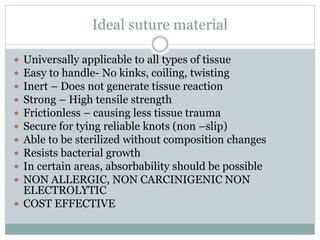
Ideal suture material
 Universally applicable to all types of tissue
 Easy to handle- No kinks, coiling, twisting
 Inert – Does not generate tissue reaction
 Strong – High tensile strength
 Frictionless – causing less tissue trauma
 Secure for tying reliable knots (non –slip)
 Able to be sterilized without composition changes
 Resists bacterial growth
 In certain areas, absorbability should be possible
 NON ALLERGIC, NON CARCINIGENIC NON
ELECTROLYTIC
 COST EFFECTIVE
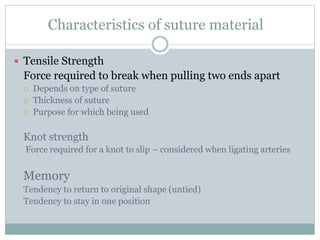
Characteristics of suture material
 Tensile Strength
Force required to break when pulling two ends apart
 Depends on type of suture
 Thickness of suture
 Purpose for which being used
Knot strength
Force required for a knot to slip – considered when ligating arteries
Memory
Tendency to return to original shape (untied)
Tendency to stay in one position
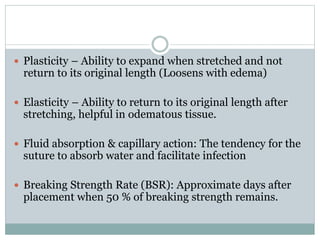
 Plasticity – Ability to expand when stretched and not
return to its original length (Loosens with edema)
 Elasticity – Ability to return to its original length after
stretching, helpful in odematous tissue.
 Fluid absorption & capillary action: The tendency for the
suture to absorb water and facilitate infection
 Breaking Strength Rate (BSR): Approximate days after
placement when 50 % of breaking strength remains.
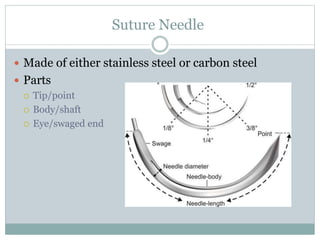
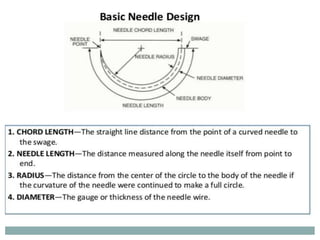
Suture Needle
 Made of either stainless steel or carbon steel
 Parts
 Tip/point
 Body/shaft
 Eye/swaged end
Needle Properties
 Sharp enough to penetrate tissue with minima
resistance
 Rigid enough to resist bending or breaking
 Sterile and corrosion resistant to prevent infections
 Stays stable in the grasp of needle holder
 Ductility – Needle’s resistance to breaking under a
given amount of bending
Technical specifications
 Needle Length
6mm, 8mm, 12mm, 18mm, 22mm, 30mm, 35mm,
40mm, 50mm
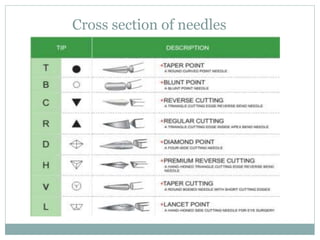
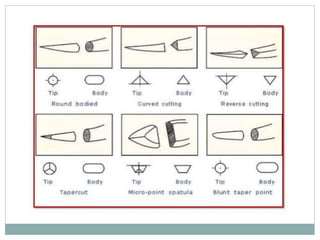
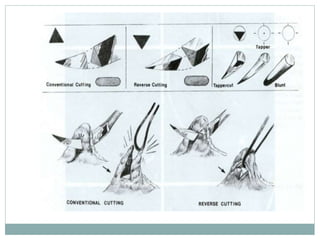
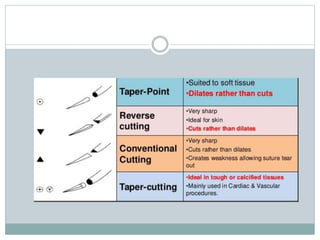
• Cross Section- round, cutting, reverse cutting,
tapercut, micro-point spatula curved
 Needle Curvature
 Straight, ½ circle, ½ circle double, 1/4th circle, 1/4th circle
double, 3/8th circle, 3/8th circle double, 5/8th circle, loop round
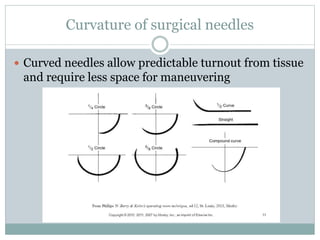
Curvature of surgical needles
 Curved needles allow predictable turnout from tissue
and require less space for maneuvering
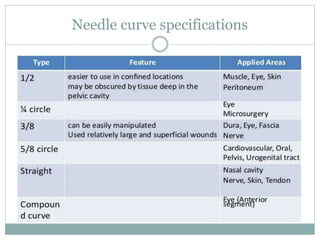
Needle curve specifications
Cross section of needles
Eye (Swage)
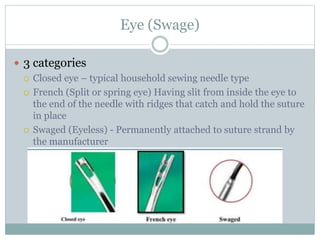
 3 categories
 Closed eye – typical household sewing needle type
 French (Split or spring eye) Having slit from inside the eye to
the end of the needle with ridges that catch and hold the suture
in place
 Swaged (Eyeless) - Permanently attached to suture strand by
the manufacturer
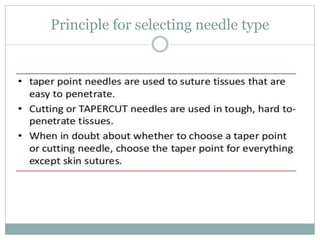
Principle for selecting needle type
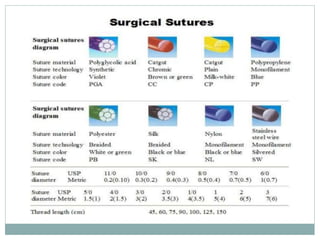
Classification of Suture Materials
 According to
absorbability
 Absorbable
 Non absorbable
According to
material
 Natural
 Synthetic
According to
structure
Monofilament
Polyfilament/
braided
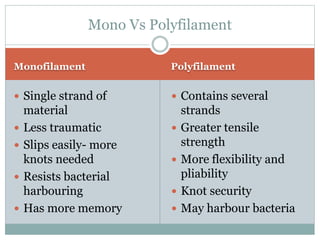
Monofilament Polyfilament
 Single strand of
material
 Less traumatic
 Slips easily- more
knots needed
 Resists bacterial
harbouring
 Has more memory
 Contains several
strands
 Greater tensile
strength
 More flexibility and
pliability
 Knot security
 May harbour bacteria
Mono Vs Polyfilament
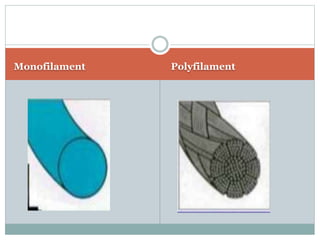
Monofilament Polyfilament
Question to ask when you see suture material --
 Is it natural or synthetic?
 Is it absorbable or non absorbable ?
 Is it mono filament or polyfilament ?
Absorbable Sutures
Natural
Monofilament
Plain
Gut
Synthetic
Monofilament
PDS
(Polydiaxone
suture)
Chromic
Gut
Braided
Monocryl
Vicryl
(polygalactin
suture)
Natural and absorbable sutures elicit more inflammatory reaction than non
absorbable and synthetic sutures
 Absorbable sutures are broken down by
 Proteolysis (Eg Catgut)
 Hydrolysis ( Ex Vicryl, Dexon)
Catgut
 Absorbable, Natural, Monofilament
 Made from submucosa of sheep intestinal tissue
(collagen)
 Plain catgut is destroyed in about a week
 Chromic acid delays hydrolysis and keeps it in tissue
longer (2-3weeks)
 High tissue reactivity
 Uses – Tubal ligation, episiotomy suturing, oral mucosa
suturing
VICRYL (polygalactin, braided)
Absorbable, synthetic, braided
Low elasticity
Tensile strength – 65% @ 14 days
- 40% @ 21 days
- 10 % @ 35 days
Absorption complete by 70 days
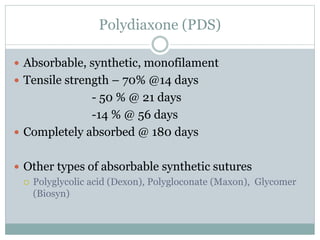
Polydiaxone (PDS)
 Absorbable, synthetic, monofilament
 Tensile strength – 70% @14 days
- 50 % @ 21 days
-14 % @ 56 days
 Completely absorbed @ 180 days
 Other types of absorbable synthetic sutures
 Polyglycolic acid (Dexon), Polygloconate (Maxon), Glycomer
(Biosyn)
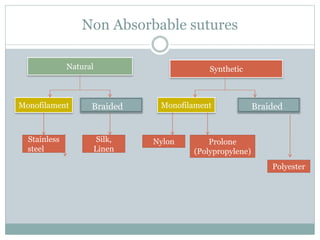
Non Absorbable sutures
Natural Synthetic
Monofilament Braided Monofilament Braided
Stainless
steel
Silk,
Linen
Nylon Prolone
(Polypropylene)
Polyester
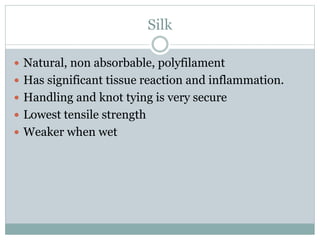
Silk
 Natural, non absorbable, polyfilament
 Has significant tissue reaction and inflammation.
 Handling and knot tying is very secure
 Lowest tensile strength
 Weaker when wet
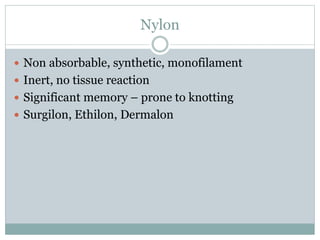
Nylon
 Non absorbable, synthetic, monofilament
 Inert, no tissue reaction
 Significant memory – prone to knotting
 Surgilon, Ethilon, Dermalon
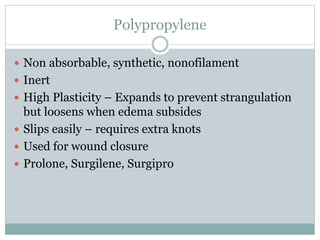
Polypropylene
 Non absorbable, synthetic, nonofilament
 Inert
 High Plasticity – Expands to prevent strangulation
but loosens when edema subsides
 Slips easily – requires extra knots
 Used for wound closure
 Prolone, Surgilene, Surgipro
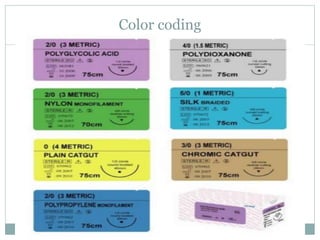
Color coding

Suture materials

  • 1.
    -D R AM R U T A U N A W A N E ( G E N E R A L S U R G E R Y ) Suture materials
  • 2.
    Definition  Suture material– Artificial fibers used to hold traumatized tissue together till natural scarring and healing takes place
  • 3.
    Goals of Suturing Apposition of wound edges  To provide adequate tensile strength  Maintain hemostasis  Aid in wound healing  Prevent wound infection  Reduce scarring and achieve asthetically appropriate wounds
  • 4.
    Ideal suture material Universally applicable to all types of tissue  Easy to handle- No kinks, coiling, twisting  Inert – Does not generate tissue reaction  Strong – High tensile strength  Frictionless – causing less tissue trauma  Secure for tying reliable knots (non –slip)  Able to be sterilized without composition changes  Resists bacterial growth  In certain areas, absorbability should be possible  NON ALLERGIC, NON CARCINIGENIC NON ELECTROLYTIC  COST EFFECTIVE
  • 5.
    Characteristics of suturematerial  Tensile Strength Force required to break when pulling two ends apart  Depends on type of suture  Thickness of suture  Purpose for which being used Knot strength Force required for a knot to slip – considered when ligating arteries Memory Tendency to return to original shape (untied) Tendency to stay in one position
  • 6.
     Plasticity –Ability to expand when stretched and not return to its original length (Loosens with edema)  Elasticity – Ability to return to its original length after stretching, helpful in odematous tissue.  Fluid absorption & capillary action: The tendency for the suture to absorb water and facilitate infection  Breaking Strength Rate (BSR): Approximate days after placement when 50 % of breaking strength remains.
  • 7.
    Suture Needle  Madeof either stainless steel or carbon steel  Parts  Tip/point  Body/shaft  Eye/swaged end
  • 8.
    Needle Properties  Sharpenough to penetrate tissue with minima resistance  Rigid enough to resist bending or breaking  Sterile and corrosion resistant to prevent infections  Stays stable in the grasp of needle holder  Ductility – Needle’s resistance to breaking under a given amount of bending
  • 10.
    Technical specifications  NeedleLength 6mm, 8mm, 12mm, 18mm, 22mm, 30mm, 35mm, 40mm, 50mm • Cross Section- round, cutting, reverse cutting, tapercut, micro-point spatula curved  Needle Curvature  Straight, ½ circle, ½ circle double, 1/4th circle, 1/4th circle double, 3/8th circle, 3/8th circle double, 5/8th circle, loop round
  • 11.
    Curvature of surgicalneedles  Curved needles allow predictable turnout from tissue and require less space for maneuvering
  • 12.
  • 13.
  • 17.
    Eye (Swage)  3categories  Closed eye – typical household sewing needle type  French (Split or spring eye) Having slit from inside the eye to the end of the needle with ridges that catch and hold the suture in place  Swaged (Eyeless) - Permanently attached to suture strand by the manufacturer
  • 18.
  • 19.
    Classification of SutureMaterials  According to absorbability  Absorbable  Non absorbable According to material  Natural  Synthetic According to structure Monofilament Polyfilament/ braided
  • 20.
    Monofilament Polyfilament  Singlestrand of material  Less traumatic  Slips easily- more knots needed  Resists bacterial harbouring  Has more memory  Contains several strands  Greater tensile strength  More flexibility and pliability  Knot security  May harbour bacteria Mono Vs Polyfilament
  • 21.
  • 22.
    Question to askwhen you see suture material --  Is it natural or synthetic?  Is it absorbable or non absorbable ?  Is it mono filament or polyfilament ?
  • 23.
  • 24.
     Absorbable suturesare broken down by  Proteolysis (Eg Catgut)  Hydrolysis ( Ex Vicryl, Dexon)
  • 25.
    Catgut  Absorbable, Natural,Monofilament  Made from submucosa of sheep intestinal tissue (collagen)  Plain catgut is destroyed in about a week  Chromic acid delays hydrolysis and keeps it in tissue longer (2-3weeks)  High tissue reactivity  Uses – Tubal ligation, episiotomy suturing, oral mucosa suturing
  • 26.
    VICRYL (polygalactin, braided) Absorbable,synthetic, braided Low elasticity Tensile strength – 65% @ 14 days - 40% @ 21 days - 10 % @ 35 days Absorption complete by 70 days
  • 27.
    Polydiaxone (PDS)  Absorbable,synthetic, monofilament  Tensile strength – 70% @14 days - 50 % @ 21 days -14 % @ 56 days  Completely absorbed @ 180 days  Other types of absorbable synthetic sutures  Polyglycolic acid (Dexon), Polygloconate (Maxon), Glycomer (Biosyn)
  • 28.
    Non Absorbable sutures NaturalSynthetic Monofilament Braided Monofilament Braided Stainless steel Silk, Linen Nylon Prolone (Polypropylene) Polyester
  • 29.
    Silk  Natural, nonabsorbable, polyfilament  Has significant tissue reaction and inflammation.  Handling and knot tying is very secure  Lowest tensile strength  Weaker when wet
  • 30.
    Nylon  Non absorbable,synthetic, monofilament  Inert, no tissue reaction  Significant memory – prone to knotting  Surgilon, Ethilon, Dermalon
  • 31.
    Polypropylene  Non absorbable,synthetic, nonofilament  Inert  High Plasticity – Expands to prevent strangulation but loosens when edema subsides  Slips easily – requires extra knots  Used for wound closure  Prolone, Surgilene, Surgipro
  • 37.