Ammar Alkhaldi
Real Reliability
15 March 2016
PART 1: why you shall not use MTBF!!!
How to Measure Reliability
Measurement can help us to answer the followings
question:
Are we doing good or bad ?
Is our performance increasing or decreasing ?
Which unit is performing better ? (Benchmarking)
What/How to improve ?
“You can’t improve what you can’t measure”
Why are we measuring things ?
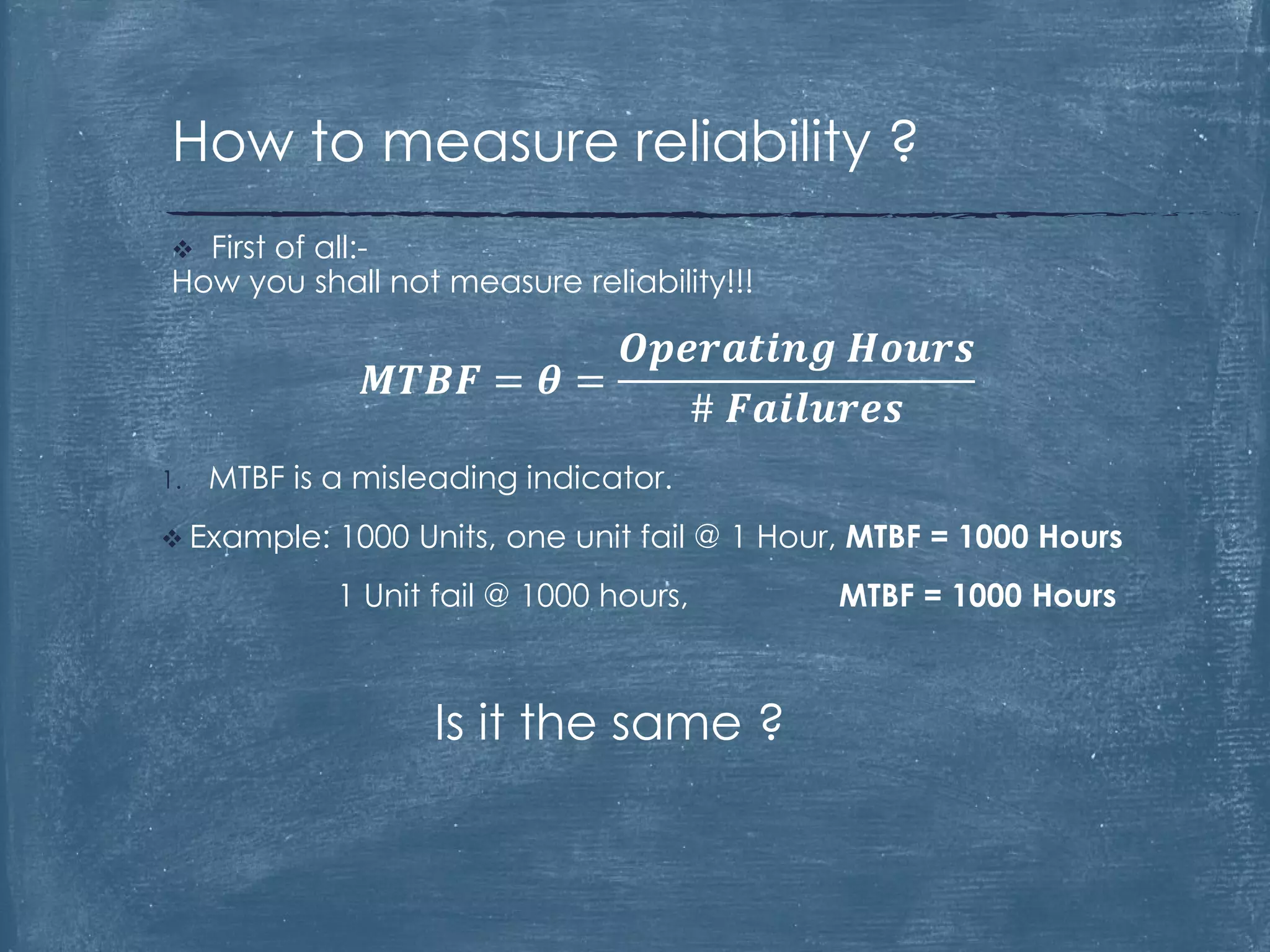
1. MTBF is a misleading indicator.
 Example: 1000 Units, one unit fail @ 1 Hour, MTBF = 1000 Hours
1 Unit fail @ 1000 hours, MTBF = 1000 Hours
Is it the same ?
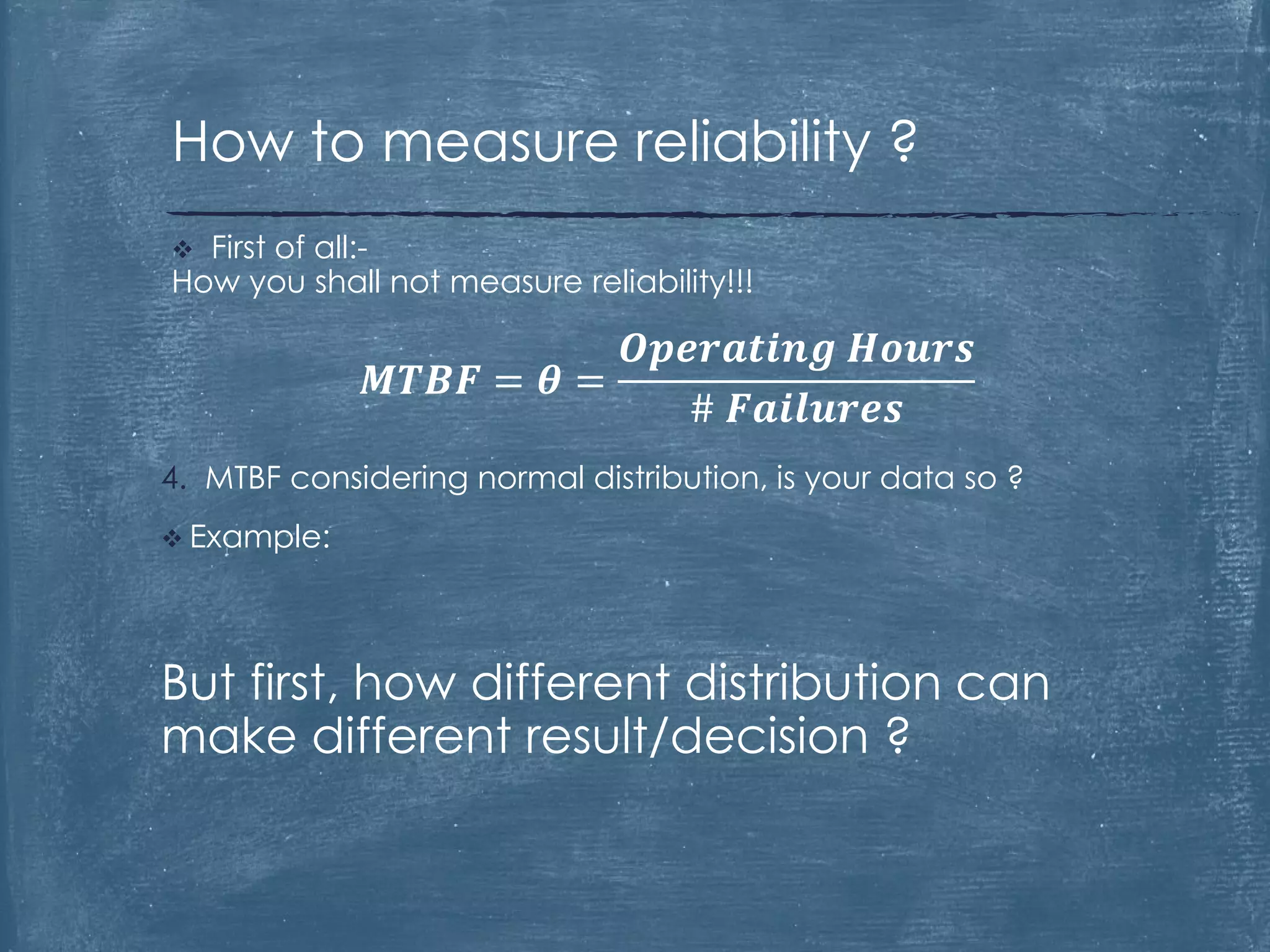
 First of all:-
How you shall not measure reliability!!!
𝑴𝑻𝑩𝑭 = 𝜽 =
𝑶𝒑𝒆𝒓𝒂𝒕𝒊𝒏𝒈 𝑯𝒐𝒖𝒓𝒔
# 𝑭𝒂𝒊𝒍𝒖𝒓𝒆𝒔
How to measure reliability ?
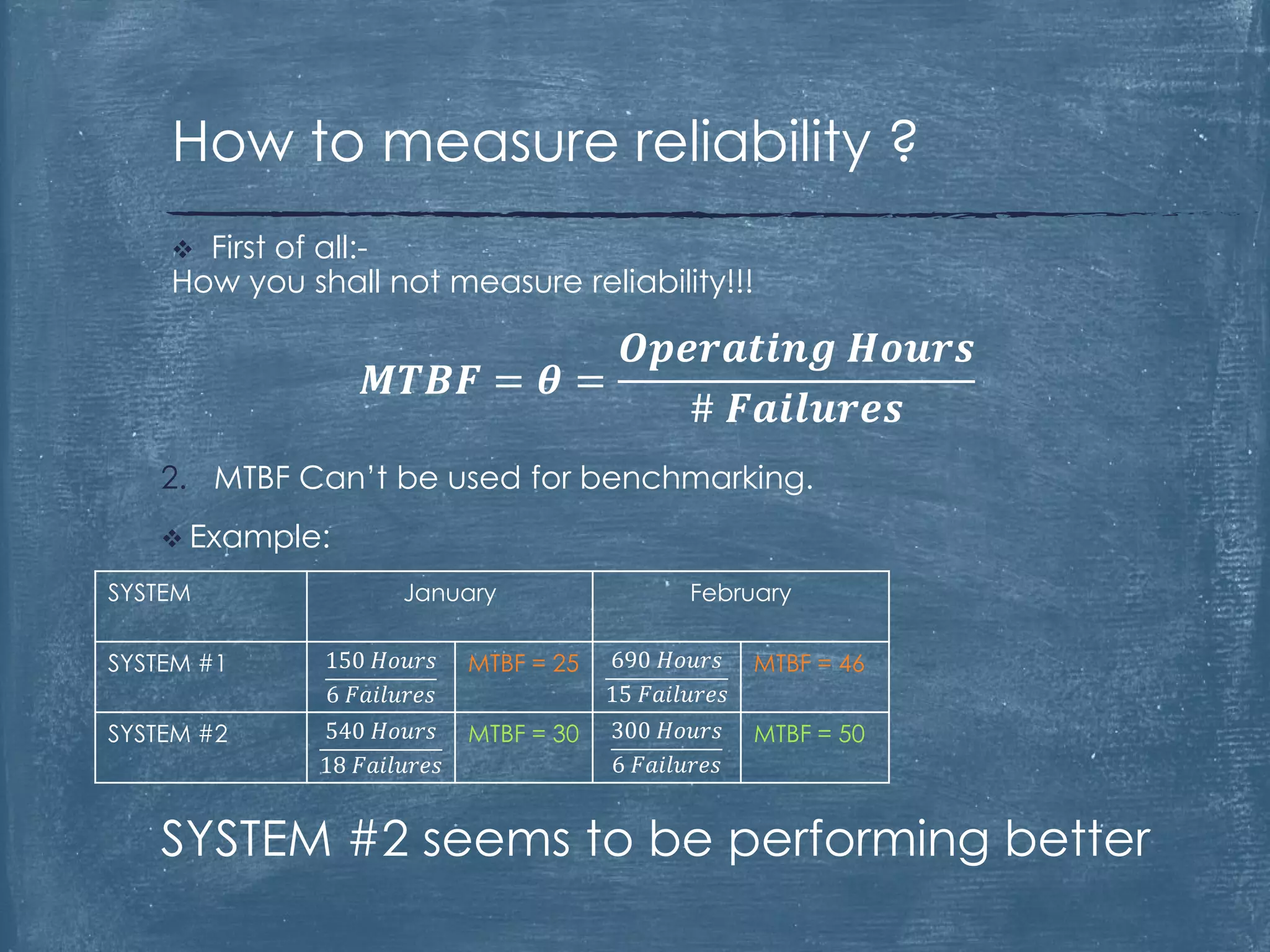
2. MTBF Can’t be used for benchmarking.
 Example:
SYSTEM #2 seems to be performing better
 First of all:-
How you shall not measure reliability!!!
𝑴𝑻𝑩𝑭 = 𝜽 =
𝑶𝒑𝒆𝒓𝒂𝒕𝒊𝒏𝒈 𝑯𝒐𝒖𝒓𝒔
# 𝑭𝒂𝒊𝒍𝒖𝒓𝒆𝒔
How to measure reliability ?
SYSTEM January February
SYSTEM #1 150 𝐻𝑜𝑢𝑟𝑠
6 𝐹𝑎𝑖𝑙𝑢𝑟𝑒𝑠
MTBF = 25 690 𝐻𝑜𝑢𝑟𝑠
15 𝐹𝑎𝑖𝑙𝑢𝑟𝑒𝑠
MTBF = 46
SYSTEM #2 540 𝐻𝑜𝑢𝑟𝑠
18 𝐹𝑎𝑖𝑙𝑢𝑟𝑒𝑠
MTBF = 30 300 𝐻𝑜𝑢𝑟𝑠
6 𝐹𝑎𝑖𝑙𝑢𝑟𝑒𝑠
MTBF = 50
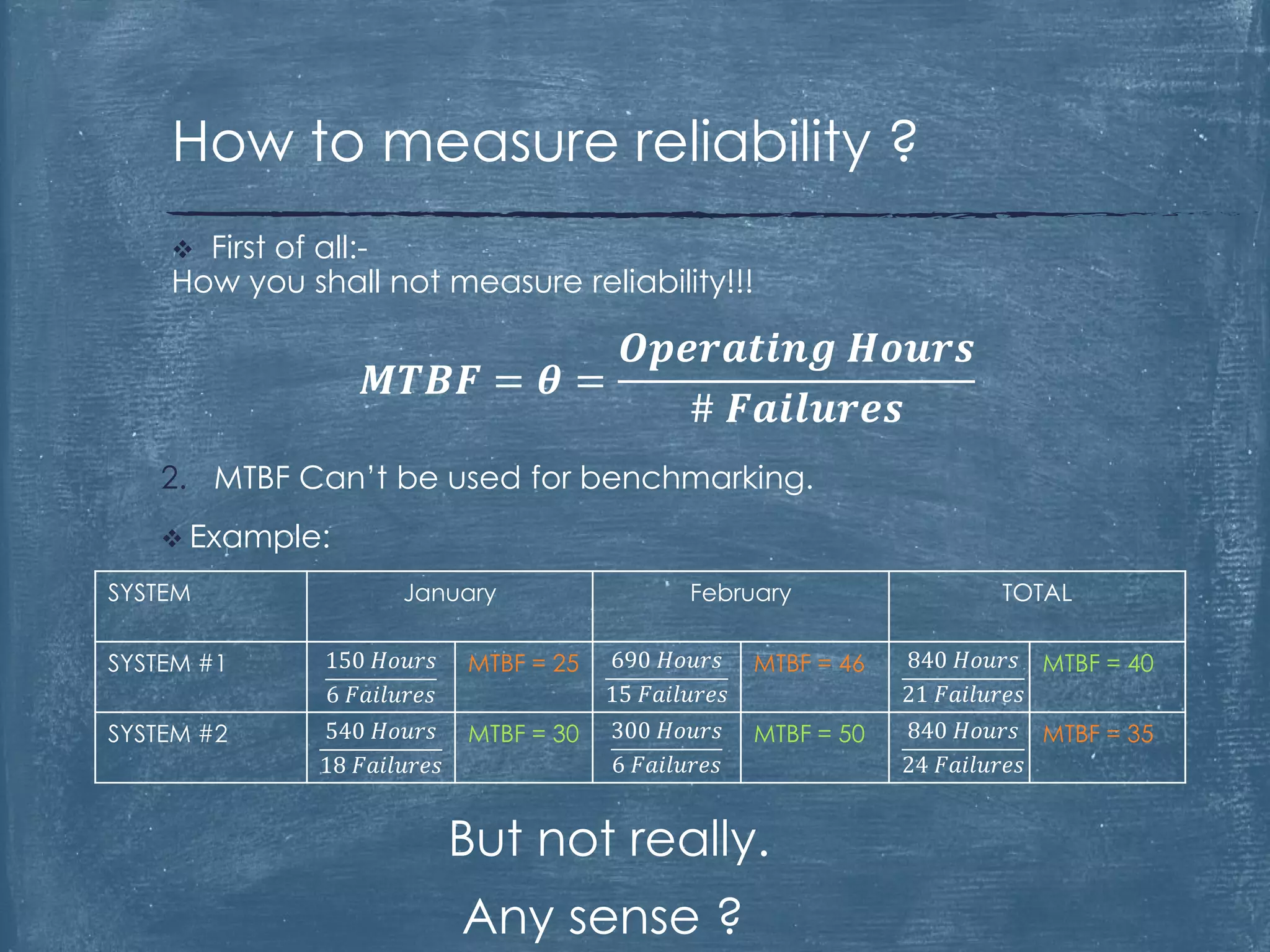
2. MTBF Can’t be used for benchmarking.
 Example:
But not really.
Any sense ?
 First of all:-
How you shall not measure reliability!!!
𝑴𝑻𝑩𝑭 = 𝜽 =
𝑶𝒑𝒆𝒓𝒂𝒕𝒊𝒏𝒈 𝑯𝒐𝒖𝒓𝒔
# 𝑭𝒂𝒊𝒍𝒖𝒓𝒆𝒔
How to measure reliability ?
SYSTEM January February TOTAL
SYSTEM #1 150 𝐻𝑜𝑢𝑟𝑠
6 𝐹𝑎𝑖𝑙𝑢𝑟𝑒𝑠
MTBF = 25 690 𝐻𝑜𝑢𝑟𝑠
15 𝐹𝑎𝑖𝑙𝑢𝑟𝑒𝑠
MTBF = 46 840 𝐻𝑜𝑢𝑟𝑠
21 𝐹𝑎𝑖𝑙𝑢𝑟𝑒𝑠
MTBF = 40
SYSTEM #2 540 𝐻𝑜𝑢𝑟𝑠
18 𝐹𝑎𝑖𝑙𝑢𝑟𝑒𝑠
MTBF = 30 300 𝐻𝑜𝑢𝑟𝑠
6 𝐹𝑎𝑖𝑙𝑢𝑟𝑒𝑠
MTBF = 50 840 𝐻𝑜𝑢𝑟𝑠
24 𝐹𝑎𝑖𝑙𝑢𝑟𝑒𝑠
MTBF = 35
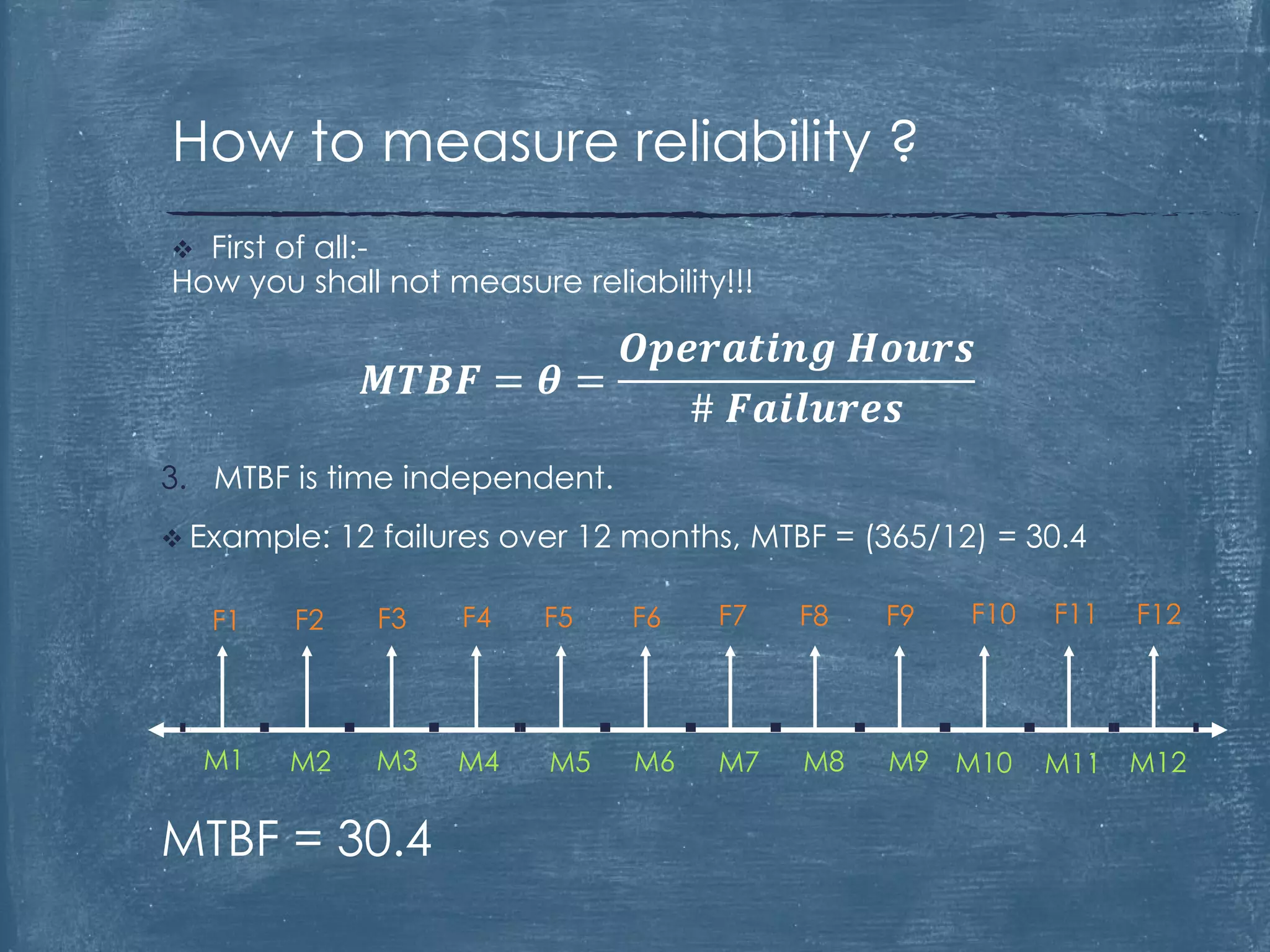
3. MTBF is time independent.
 Example: 12 failures over 12 months, MTBF = (365/12) = 30.4
MTBF = 30.4
 First of all:-
How you shall not measure reliability!!!
𝑴𝑻𝑩𝑭 = 𝜽 =
𝑶𝒑𝒆𝒓𝒂𝒕𝒊𝒏𝒈 𝑯𝒐𝒖𝒓𝒔
# 𝑭𝒂𝒊𝒍𝒖𝒓𝒆𝒔
How to measure reliability ?
M1 M2 M3 M4 M5 M6 M7 M8 M9 M10 M11 M12
F1 F2 F3 F4 F5 F7F6 F8 F9 F10 F11 F12
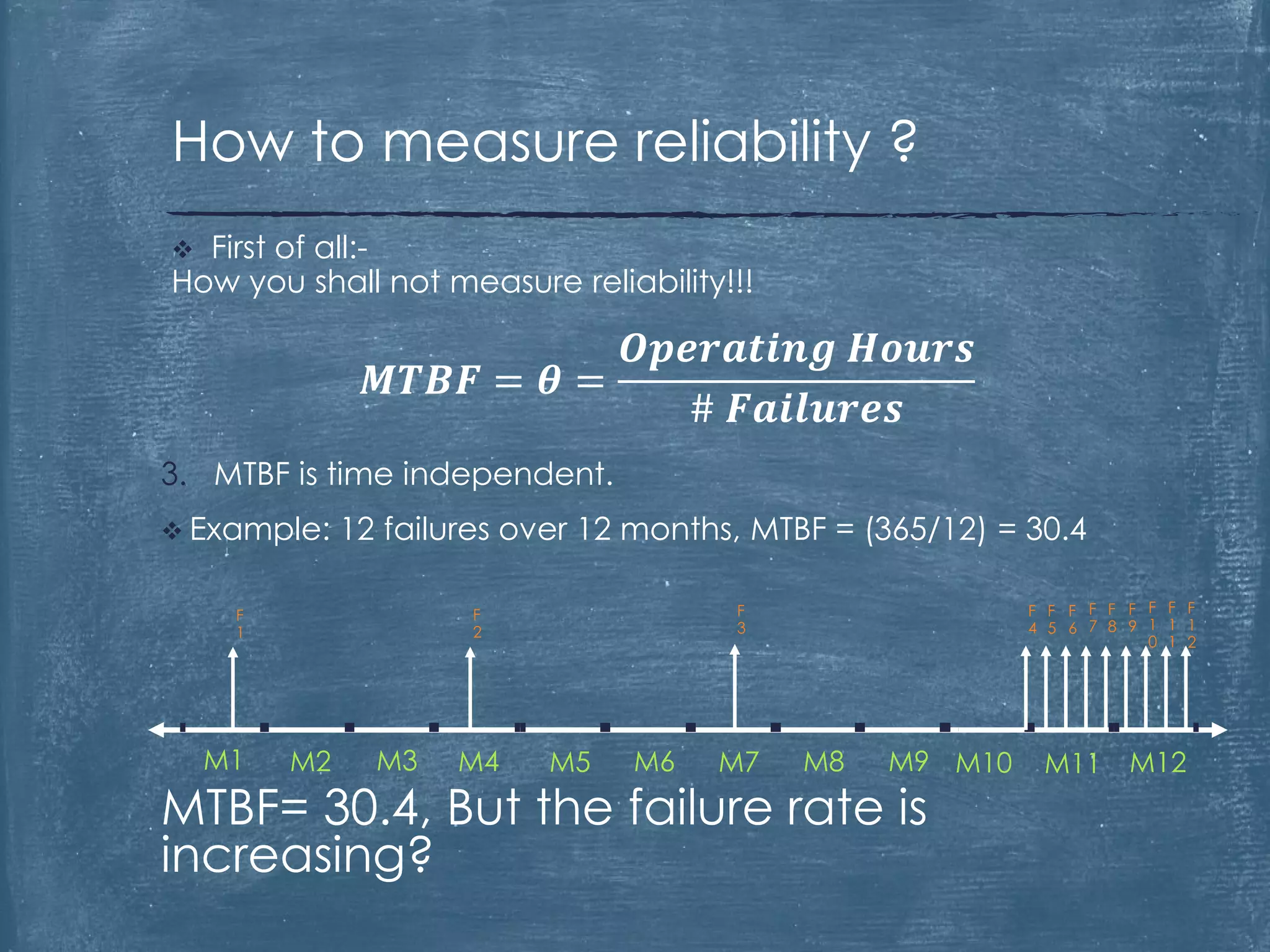
3. MTBF is time independent.
 Example: 12 failures over 12 months, MTBF = (365/12) = 30.4
MTBF= 30.4, But the failure rate is
increasing?
 First of all:-
How you shall not measure reliability!!!
𝑴𝑻𝑩𝑭 = 𝜽 =
𝑶𝒑𝒆𝒓𝒂𝒕𝒊𝒏𝒈 𝑯𝒐𝒖𝒓𝒔
# 𝑭𝒂𝒊𝒍𝒖𝒓𝒆𝒔
How to measure reliability ?
M1 M2 M3 M4 M5 M6 M7 M8 M9 M10 M11 M12
F
1
F
2
F
3
F
4
F
5
F
7
F
6
F
8
F
9
F
1
0
F
1
1
F
1
2
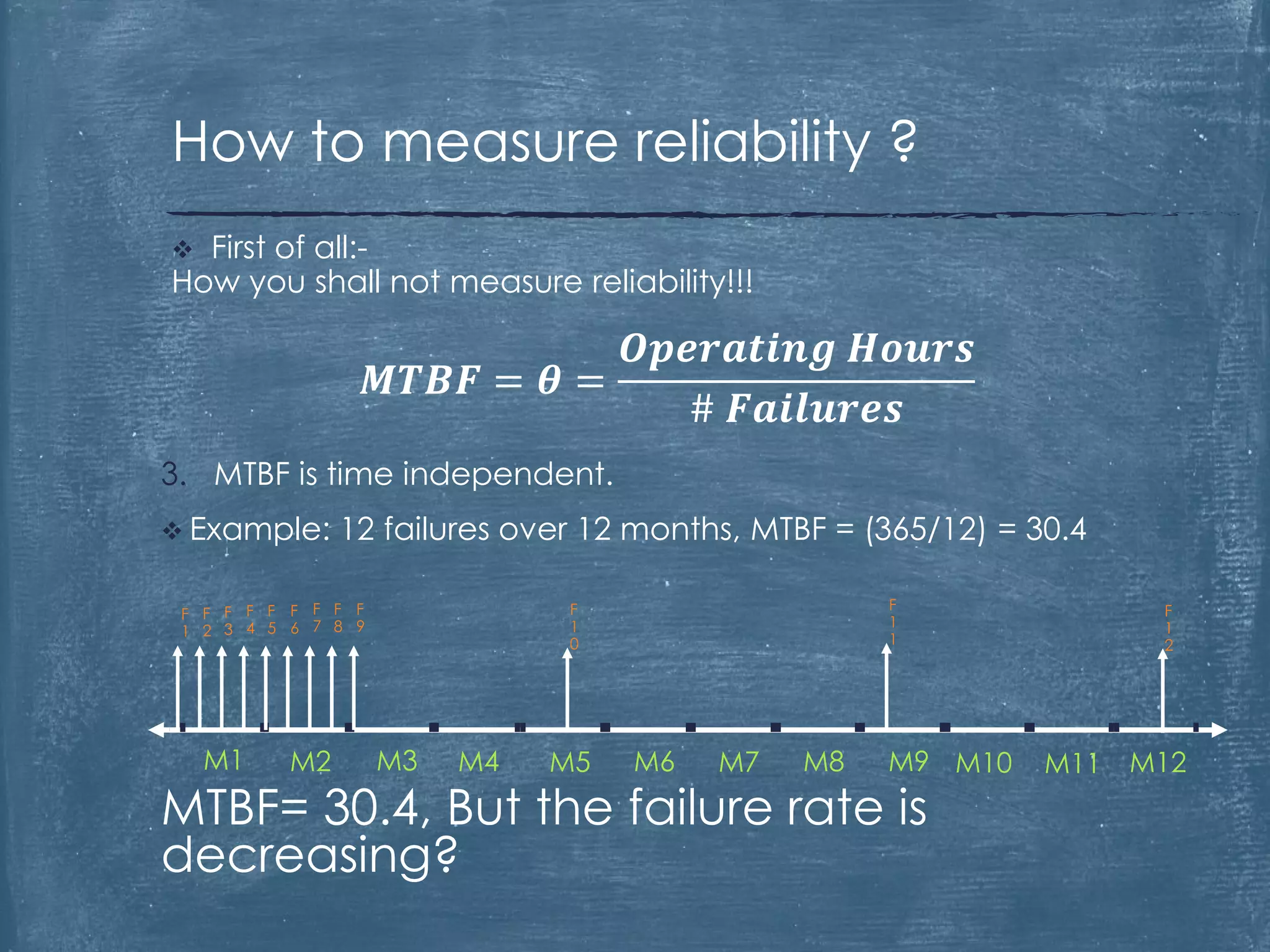
3. MTBF is time independent.
 Example: 12 failures over 12 months, MTBF = (365/12) = 30.4
MTBF= 30.4, But the failure rate is
decreasing?
 First of all:-
How you shall not measure reliability!!!
𝑴𝑻𝑩𝑭 = 𝜽 =
𝑶𝒑𝒆𝒓𝒂𝒕𝒊𝒏𝒈 𝑯𝒐𝒖𝒓𝒔
# 𝑭𝒂𝒊𝒍𝒖𝒓𝒆𝒔
How to measure reliability ?
M1 M2 M3 M4 M5 M6 M7 M8 M9 M10 M11 M12
F
1
F
2
F
3
F
4
F
5
F
7
F
6
F
8
F
9
F
1
0
F
1
1
F
1
2
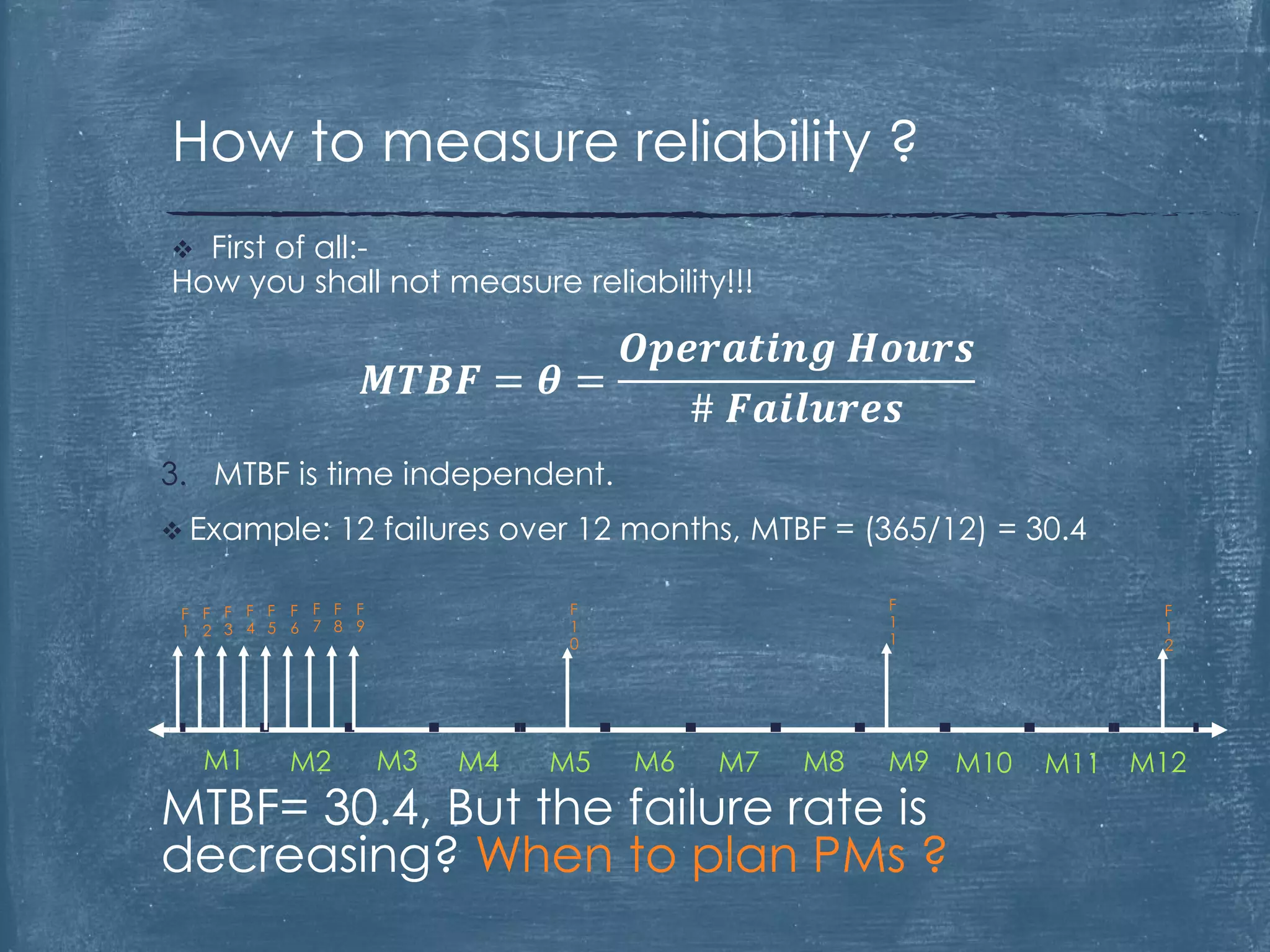
3. MTBF is time independent.
 Example: 12 failures over 12 months, MTBF = (365/12) = 30.4
MTBF= 30.4, But the failure rate is
decreasing? When to plan PMs ?
 First of all:-
How you shall not measure reliability!!!
𝑴𝑻𝑩𝑭 = 𝜽 =
𝑶𝒑𝒆𝒓𝒂𝒕𝒊𝒏𝒈 𝑯𝒐𝒖𝒓𝒔
# 𝑭𝒂𝒊𝒍𝒖𝒓𝒆𝒔
How to measure reliability ?
M1 M2 M3 M4 M5 M6 M7 M8 M9 M10 M11 M12
F
1
F
2
F
3
F
4
F
5
F
7
F
6
F
8
F
9
F
1
0
F
1
1
F
1
2
4. MTBF considering normal distribution, is your data so ?
 Example:
But first, how different distribution can
make different result/decision ?
 First of all:-
How you shall not measure reliability!!!
𝑴𝑻𝑩𝑭 = 𝜽 =
𝑶𝒑𝒆𝒓𝒂𝒕𝒊𝒏𝒈 𝑯𝒐𝒖𝒓𝒔
# 𝑭𝒂𝒊𝒍𝒖𝒓𝒆𝒔
How to measure reliability ?
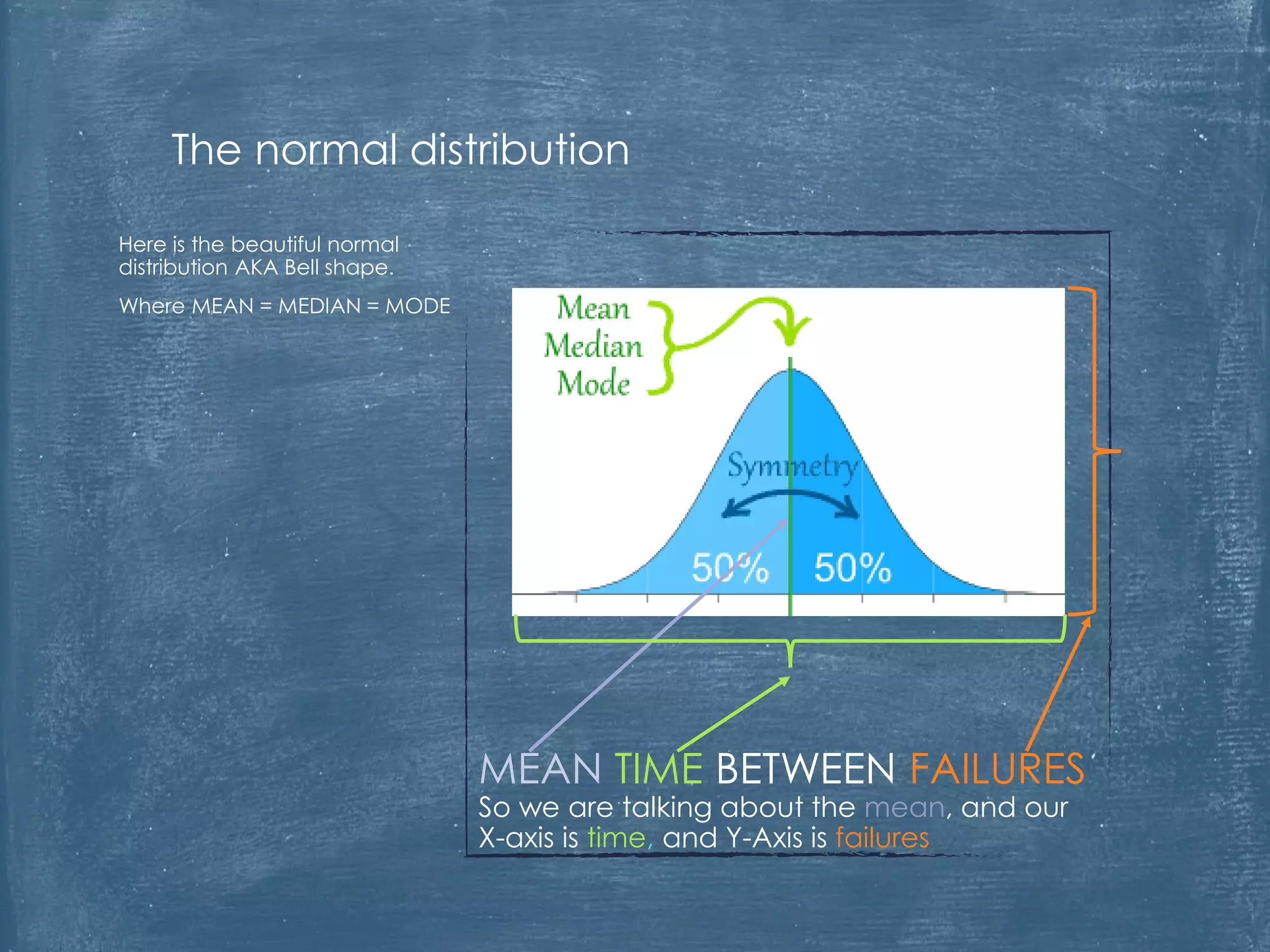
Here is the beautiful normal
distribution AKA Bell shape.
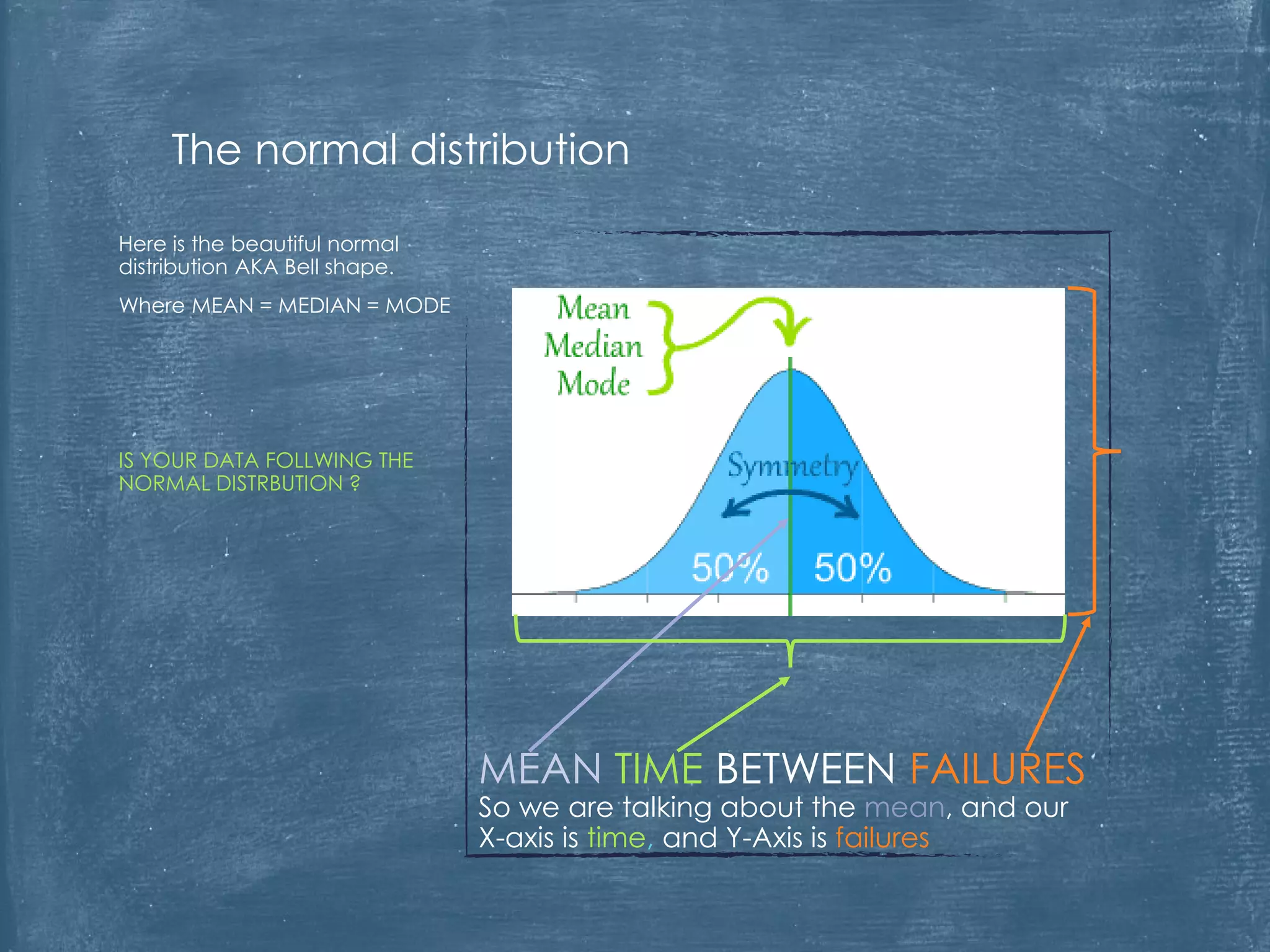
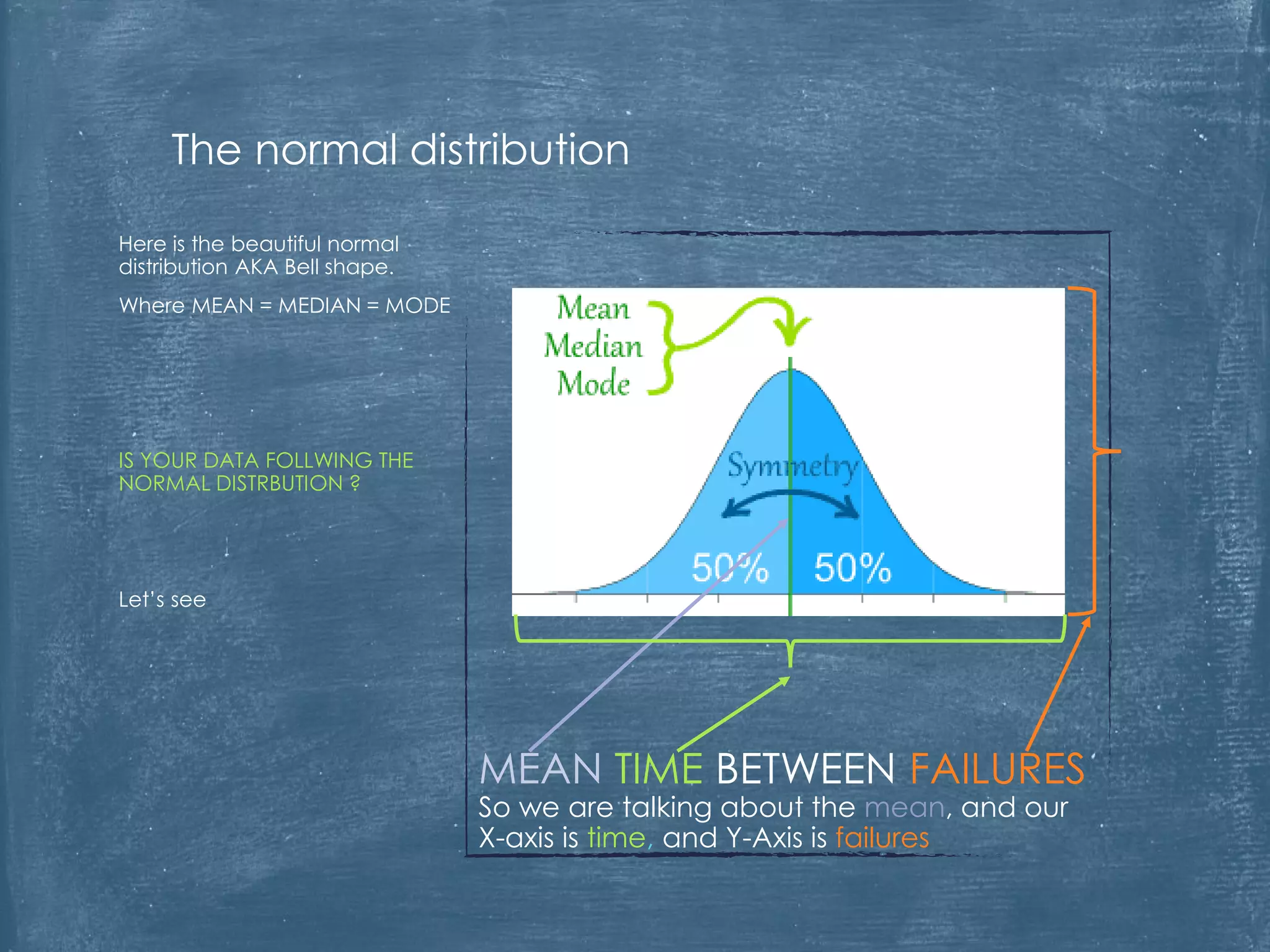
Where MEAN = MEDIAN = MODE
The normal distribution
MEAN TIME BETWEEN FAILURES
So we are talking about the mean, and our
X-axis is time, and Y-Axis is failures
Here is the beautiful normal
distribution AKA Bell shape.
Where MEAN = MEDIAN = MODE
IS YOUR DATA FOLLWING THE
NORMAL DISTRBUTION ?
The normal distribution
MEAN TIME BETWEEN FAILURES
So we are talking about the mean, and our
X-axis is time, and Y-Axis is failures
Here is the beautiful normal
distribution AKA Bell shape.
Where MEAN = MEDIAN = MODE
IS YOUR DATA FOLLWING THE
NORMAL DISTRBUTION ?
Let’s see
The normal distribution
MEAN TIME BETWEEN FAILURES
So we are talking about the mean, and our
X-axis is time, and Y-Axis is failures
Let’s say we are studding
the failure of lightbulb,
we have a group of 100
bulb, and we are running
in the constant failure
rate part of the bath
curve (Phase 2)
The normal distribution
Let’s say we are studding
the failure of lightbulb,
we have a group of 100
bulb, and we are running
in the constant failure
rate part of the bath
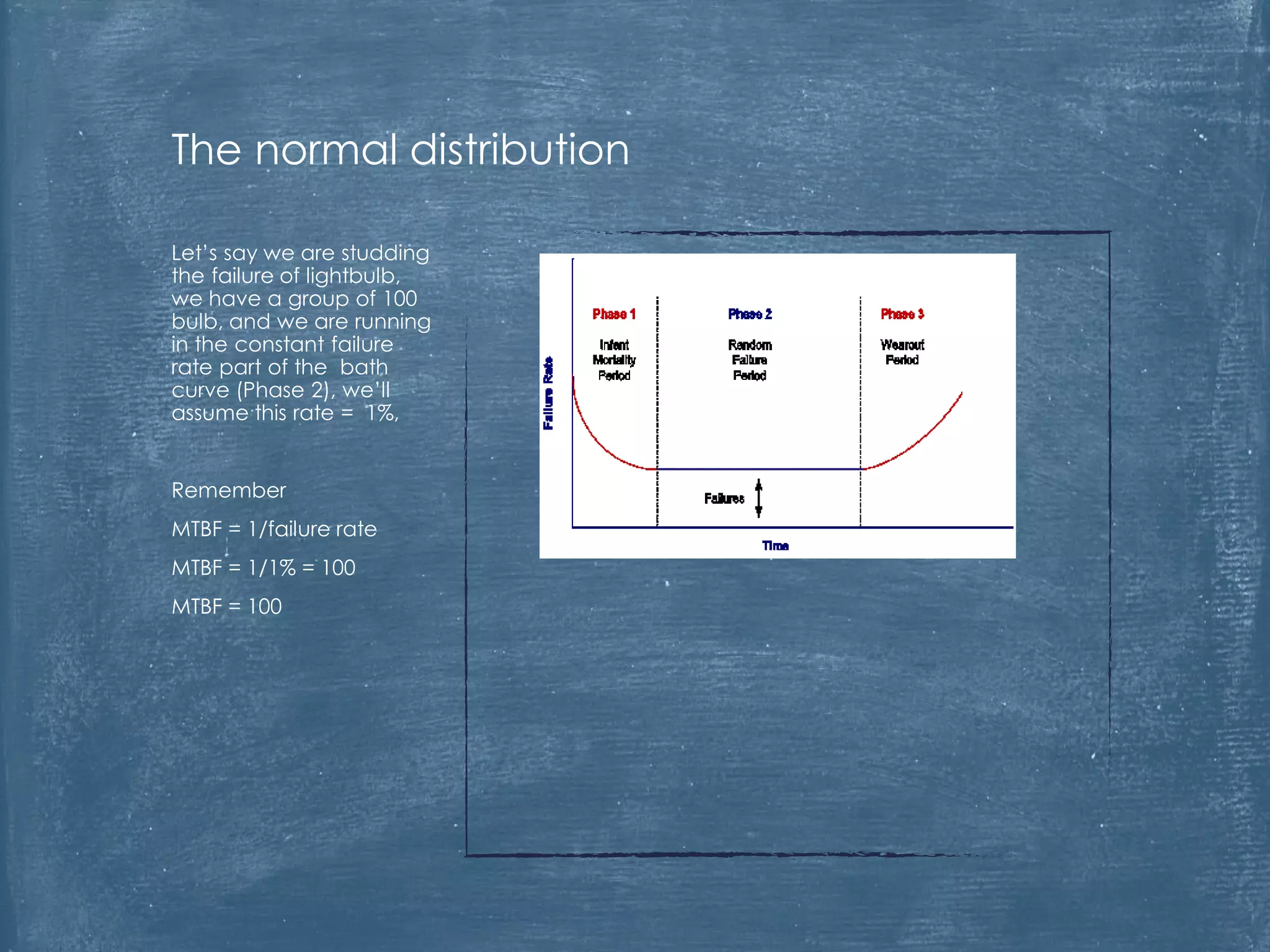
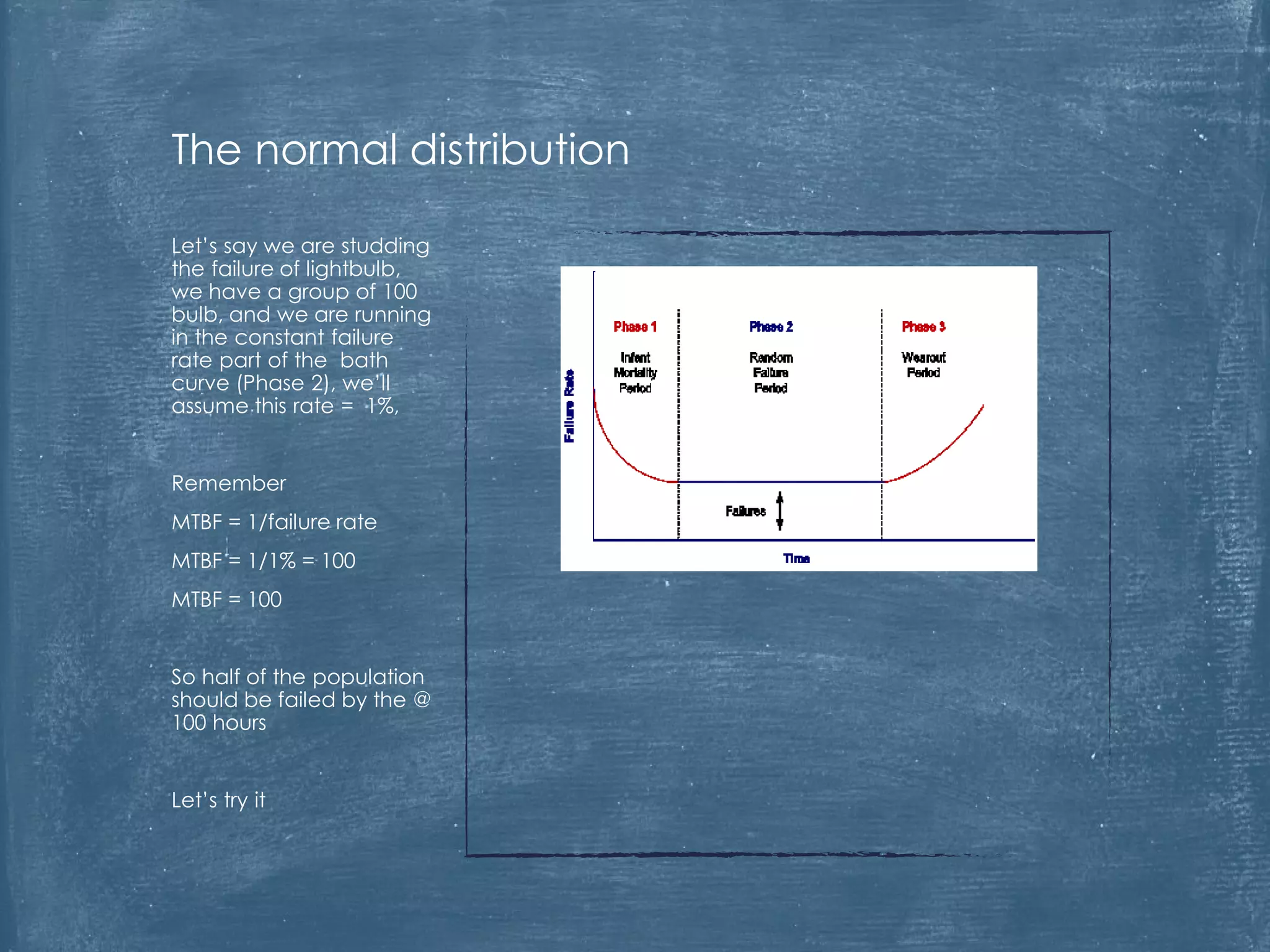
curve (Phase 2), we’ll
assume this rate = 1%,
Remember
MTBF = 1/failure rate
MTBF = 1/1% = 100
MTBF = 100
The normal distribution
Let’s say we are studding
the failure of lightbulb,
we have a group of 100
bulb, and we are running
in the constant failure
rate part of the bath
curve (Phase 2), we’ll
assume this rate = 1%,
Remember
MTBF = 1/failure rate
MTBF = 1/1% = 100
MTBF = 100
So half of the population
should be failed by the @
100 hours
Let’s try it
The normal distribution
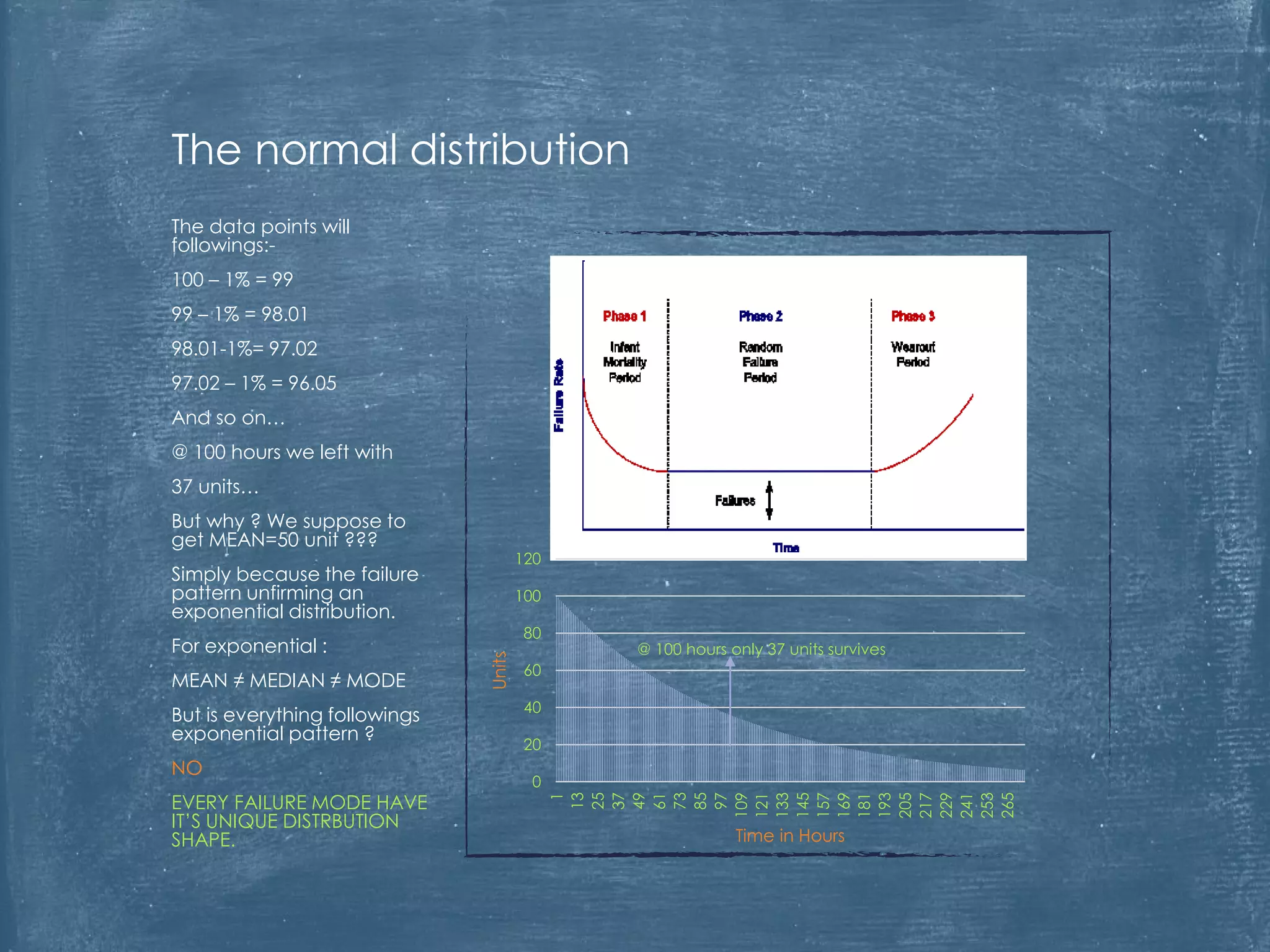
The data points will
followings:-
100 – 1% = 99
99 – 1% = 98.01
98.01-1%= 97.02
97.02 – 1% = 96.05
And so on…
@ 100 hours we left with
37 units…
But why ? We suppose to
get MEAN=50 unit ???
Simply because the failure
pattern unfirming an
exponential distribution.
For exponential :
MEAN ≠ MEDIAN ≠ MODE
But is everything followings
exponential pattern ?
NO
EVERY FAILURE MODE HAVE
IT’S UNIQUE DISTRBUTION
SHAPE.
The normal distribution
0
20
40
60
80
100
120 1
13
25
37
49
61
73
85
97
109
121
133
145
157
169
181
193
205
217
229
241
253
265
Units
Time in Hours
@ 100 hours only 37 units survives
If you think MTBF is not the wright way
to measure reliability then stay toned
for the upcoming post.
Salam
Ammar Alkhaldi, CSSBB
So how to measure reliability then ?

How to measure reliability

  • 1.
    Ammar Alkhaldi Real Reliability 15March 2016 PART 1: why you shall not use MTBF!!! How to Measure Reliability
  • 2.
    Measurement can helpus to answer the followings question: Are we doing good or bad ? Is our performance increasing or decreasing ? Which unit is performing better ? (Benchmarking) What/How to improve ? “You can’t improve what you can’t measure” Why are we measuring things ?
  • 3.
    1. MTBF isa misleading indicator.  Example: 1000 Units, one unit fail @ 1 Hour, MTBF = 1000 Hours 1 Unit fail @ 1000 hours, MTBF = 1000 Hours Is it the same ?  First of all:- How you shall not measure reliability!!! 𝑴𝑻𝑩𝑭 = 𝜽 = 𝑶𝒑𝒆𝒓𝒂𝒕𝒊𝒏𝒈 𝑯𝒐𝒖𝒓𝒔 # 𝑭𝒂𝒊𝒍𝒖𝒓𝒆𝒔 How to measure reliability ?
  • 4.
    2. MTBF Can’tbe used for benchmarking.  Example: SYSTEM #2 seems to be performing better  First of all:- How you shall not measure reliability!!! 𝑴𝑻𝑩𝑭 = 𝜽 = 𝑶𝒑𝒆𝒓𝒂𝒕𝒊𝒏𝒈 𝑯𝒐𝒖𝒓𝒔 # 𝑭𝒂𝒊𝒍𝒖𝒓𝒆𝒔 How to measure reliability ? SYSTEM January February SYSTEM #1 150 𝐻𝑜𝑢𝑟𝑠 6 𝐹𝑎𝑖𝑙𝑢𝑟𝑒𝑠 MTBF = 25 690 𝐻𝑜𝑢𝑟𝑠 15 𝐹𝑎𝑖𝑙𝑢𝑟𝑒𝑠 MTBF = 46 SYSTEM #2 540 𝐻𝑜𝑢𝑟𝑠 18 𝐹𝑎𝑖𝑙𝑢𝑟𝑒𝑠 MTBF = 30 300 𝐻𝑜𝑢𝑟𝑠 6 𝐹𝑎𝑖𝑙𝑢𝑟𝑒𝑠 MTBF = 50
  • 5.
    2. MTBF Can’tbe used for benchmarking.  Example: But not really. Any sense ?  First of all:- How you shall not measure reliability!!! 𝑴𝑻𝑩𝑭 = 𝜽 = 𝑶𝒑𝒆𝒓𝒂𝒕𝒊𝒏𝒈 𝑯𝒐𝒖𝒓𝒔 # 𝑭𝒂𝒊𝒍𝒖𝒓𝒆𝒔 How to measure reliability ? SYSTEM January February TOTAL SYSTEM #1 150 𝐻𝑜𝑢𝑟𝑠 6 𝐹𝑎𝑖𝑙𝑢𝑟𝑒𝑠 MTBF = 25 690 𝐻𝑜𝑢𝑟𝑠 15 𝐹𝑎𝑖𝑙𝑢𝑟𝑒𝑠 MTBF = 46 840 𝐻𝑜𝑢𝑟𝑠 21 𝐹𝑎𝑖𝑙𝑢𝑟𝑒𝑠 MTBF = 40 SYSTEM #2 540 𝐻𝑜𝑢𝑟𝑠 18 𝐹𝑎𝑖𝑙𝑢𝑟𝑒𝑠 MTBF = 30 300 𝐻𝑜𝑢𝑟𝑠 6 𝐹𝑎𝑖𝑙𝑢𝑟𝑒𝑠 MTBF = 50 840 𝐻𝑜𝑢𝑟𝑠 24 𝐹𝑎𝑖𝑙𝑢𝑟𝑒𝑠 MTBF = 35
  • 6.
    3. MTBF istime independent.  Example: 12 failures over 12 months, MTBF = (365/12) = 30.4 MTBF = 30.4  First of all:- How you shall not measure reliability!!! 𝑴𝑻𝑩𝑭 = 𝜽 = 𝑶𝒑𝒆𝒓𝒂𝒕𝒊𝒏𝒈 𝑯𝒐𝒖𝒓𝒔 # 𝑭𝒂𝒊𝒍𝒖𝒓𝒆𝒔 How to measure reliability ? M1 M2 M3 M4 M5 M6 M7 M8 M9 M10 M11 M12 F1 F2 F3 F4 F5 F7F6 F8 F9 F10 F11 F12
  • 7.
    3. MTBF istime independent.  Example: 12 failures over 12 months, MTBF = (365/12) = 30.4 MTBF= 30.4, But the failure rate is increasing?  First of all:- How you shall not measure reliability!!! 𝑴𝑻𝑩𝑭 = 𝜽 = 𝑶𝒑𝒆𝒓𝒂𝒕𝒊𝒏𝒈 𝑯𝒐𝒖𝒓𝒔 # 𝑭𝒂𝒊𝒍𝒖𝒓𝒆𝒔 How to measure reliability ? M1 M2 M3 M4 M5 M6 M7 M8 M9 M10 M11 M12 F 1 F 2 F 3 F 4 F 5 F 7 F 6 F 8 F 9 F 1 0 F 1 1 F 1 2
  • 8.
    3. MTBF istime independent.  Example: 12 failures over 12 months, MTBF = (365/12) = 30.4 MTBF= 30.4, But the failure rate is decreasing?  First of all:- How you shall not measure reliability!!! 𝑴𝑻𝑩𝑭 = 𝜽 = 𝑶𝒑𝒆𝒓𝒂𝒕𝒊𝒏𝒈 𝑯𝒐𝒖𝒓𝒔 # 𝑭𝒂𝒊𝒍𝒖𝒓𝒆𝒔 How to measure reliability ? M1 M2 M3 M4 M5 M6 M7 M8 M9 M10 M11 M12 F 1 F 2 F 3 F 4 F 5 F 7 F 6 F 8 F 9 F 1 0 F 1 1 F 1 2
  • 9.
    3. MTBF istime independent.  Example: 12 failures over 12 months, MTBF = (365/12) = 30.4 MTBF= 30.4, But the failure rate is decreasing? When to plan PMs ?  First of all:- How you shall not measure reliability!!! 𝑴𝑻𝑩𝑭 = 𝜽 = 𝑶𝒑𝒆𝒓𝒂𝒕𝒊𝒏𝒈 𝑯𝒐𝒖𝒓𝒔 # 𝑭𝒂𝒊𝒍𝒖𝒓𝒆𝒔 How to measure reliability ? M1 M2 M3 M4 M5 M6 M7 M8 M9 M10 M11 M12 F 1 F 2 F 3 F 4 F 5 F 7 F 6 F 8 F 9 F 1 0 F 1 1 F 1 2
  • 10.
    4. MTBF consideringnormal distribution, is your data so ?  Example: But first, how different distribution can make different result/decision ?  First of all:- How you shall not measure reliability!!! 𝑴𝑻𝑩𝑭 = 𝜽 = 𝑶𝒑𝒆𝒓𝒂𝒕𝒊𝒏𝒈 𝑯𝒐𝒖𝒓𝒔 # 𝑭𝒂𝒊𝒍𝒖𝒓𝒆𝒔 How to measure reliability ?
  • 11.
    Here is thebeautiful normal distribution AKA Bell shape. Where MEAN = MEDIAN = MODE The normal distribution MEAN TIME BETWEEN FAILURES So we are talking about the mean, and our X-axis is time, and Y-Axis is failures
  • 12.
    Here is thebeautiful normal distribution AKA Bell shape. Where MEAN = MEDIAN = MODE IS YOUR DATA FOLLWING THE NORMAL DISTRBUTION ? The normal distribution MEAN TIME BETWEEN FAILURES So we are talking about the mean, and our X-axis is time, and Y-Axis is failures
  • 13.
    Here is thebeautiful normal distribution AKA Bell shape. Where MEAN = MEDIAN = MODE IS YOUR DATA FOLLWING THE NORMAL DISTRBUTION ? Let’s see The normal distribution MEAN TIME BETWEEN FAILURES So we are talking about the mean, and our X-axis is time, and Y-Axis is failures
  • 14.
    Let’s say weare studding the failure of lightbulb, we have a group of 100 bulb, and we are running in the constant failure rate part of the bath curve (Phase 2) The normal distribution
  • 15.
    Let’s say weare studding the failure of lightbulb, we have a group of 100 bulb, and we are running in the constant failure rate part of the bath curve (Phase 2), we’ll assume this rate = 1%, Remember MTBF = 1/failure rate MTBF = 1/1% = 100 MTBF = 100 The normal distribution
  • 16.
    Let’s say weare studding the failure of lightbulb, we have a group of 100 bulb, and we are running in the constant failure rate part of the bath curve (Phase 2), we’ll assume this rate = 1%, Remember MTBF = 1/failure rate MTBF = 1/1% = 100 MTBF = 100 So half of the population should be failed by the @ 100 hours Let’s try it The normal distribution
  • 17.
    The data pointswill followings:- 100 – 1% = 99 99 – 1% = 98.01 98.01-1%= 97.02 97.02 – 1% = 96.05 And so on… @ 100 hours we left with 37 units… But why ? We suppose to get MEAN=50 unit ??? Simply because the failure pattern unfirming an exponential distribution. For exponential : MEAN ≠ MEDIAN ≠ MODE But is everything followings exponential pattern ? NO EVERY FAILURE MODE HAVE IT’S UNIQUE DISTRBUTION SHAPE. The normal distribution 0 20 40 60 80 100 120 1 13 25 37 49 61 73 85 97 109 121 133 145 157 169 181 193 205 217 229 241 253 265 Units Time in Hours @ 100 hours only 37 units survives
  • 18.
    If you thinkMTBF is not the wright way to measure reliability then stay toned for the upcoming post. Salam Ammar Alkhaldi, CSSBB So how to measure reliability then ?