Warning- Graphic Photos
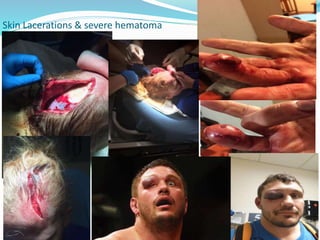
Skin Lacerations & severe hematoma
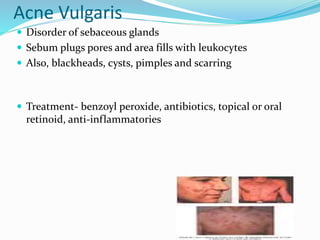
Acne Vulgaris
 Disorder of sebaceous glands
 Sebum plugs pores and area fills with leukocytes
 Also, blackheads, cysts, pimples and scarring
 Treatment- benzoyl peroxide, antibiotics, topical or oral
retinoid, anti-inflammatories
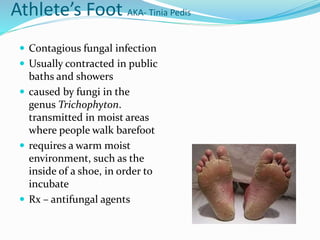
Athlete’s Foot AKA- Tinia Pedis
 Contagious fungal infection
 Usually contracted in public
baths and showers
 caused by fungi in the
genus Trichophyton.
transmitted in moist areas
where people walk barefoot
 requires a warm moist
environment, such as the
inside of a shoe, in order to
incubate
 Rx – antifungal agents
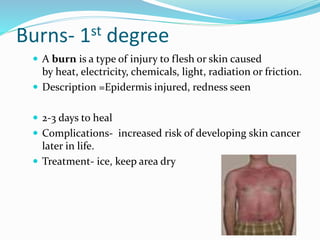
Burns- 1st degree
 A burn is a type of injury to flesh or skin caused
by heat, electricity, chemicals, light, radiation or friction.
 Description =Epidermis injured, redness seen
 2-3 days to heal
 Complications- increased risk of developing skin cancer
later in life.
 Treatment- ice, keep area dry
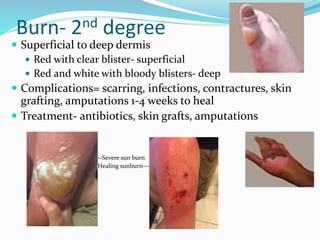
Burn- 2nd degree
 Superficial to deep dermis
 Red with clear blister- superficial
 Red and white with bloody blisters- deep
 Complications= scarring, infections, contractures, skin
grafting, amputations 1-4 weeks to heal
 Treatment- antibiotics, skin grafts, amputations
• --Severe sun burn
• Healing sunburn---
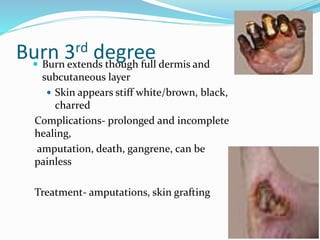
Burn 3rd degree Burn extends though full dermis and
subcutaneous layer
 Skin appears stiff white/brown, black,
charred
Complications- prolonged and incomplete
healing,
amputation, death, gangrene, can be
painless
Treatment- amputations, skin grafting
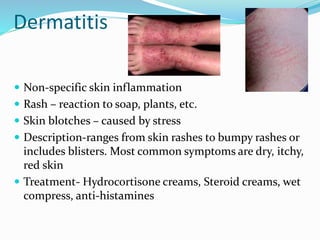
Dermatitis
 Non-specific skin inflammation
 Rash – reaction to soap, plants, etc.
 Skin blotches – caused by stress
 Description-ranges from skin rashes to bumpy rashes or
includes blisters. Most common symptoms are dry, itchy,
red skin
 Treatment- Hydrocortisone creams, Steroid creams, wet
compress, anti-histamines
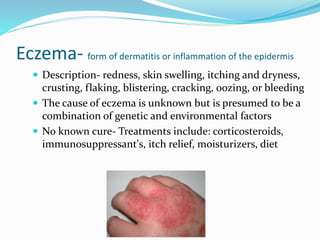
Eczema- form of dermatitis or inflammation of the epidermis
 Description- redness, skin swelling, itching and dryness,
crusting, flaking, blistering, cracking, oozing, or bleeding
 The cause of eczema is unknown but is presumed to be a
combination of genetic and environmental factors
 No known cure- Treatments include: corticosteroids,
immunosuppressant's, itch relief, moisturizers, diet
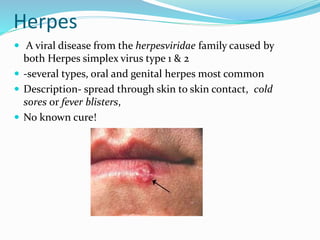
Herpes
 A viral disease from the herpesviridae family caused by
both Herpes simplex virus type 1 & 2
 -several types, oral and genital herpes most common
 Description- spread through skin to skin contact, cold
sores or fever blisters,
 No known cure!
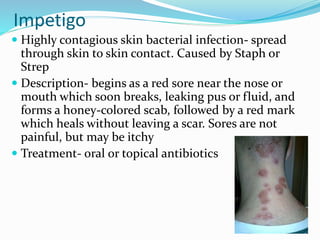
Impetigo
 Highly contagious skin bacterial infection- spread
through skin to skin contact. Caused by Staph or
Strep
 Description- begins as a red sore near the nose or
mouth which soon breaks, leaking pus or fluid, and
forms a honey-colored scab, followed by a red mark
which heals without leaving a scar. Sores are not
painful, but may be itchy
 Treatment- oral or topical antibiotics
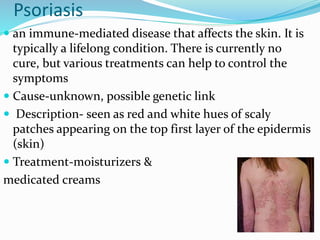
Psoriasis
 an immune-mediated disease that affects the skin. It is
typically a lifelong condition. There is currently no
cure, but various treatments can help to control the
symptoms
 Cause-unknown, possible genetic link
 Description- seen as red and white hues of scaly
patches appearing on the top first layer of the epidermis
(skin)
 Treatment-moisturizers &
medicated creams
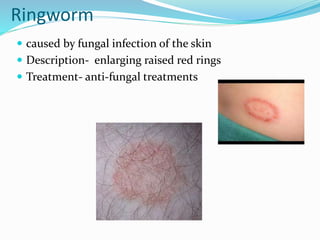
Ringworm
 caused by fungal infection of the skin
 Description- enlarging raised red rings
 Treatment- anti-fungal treatments
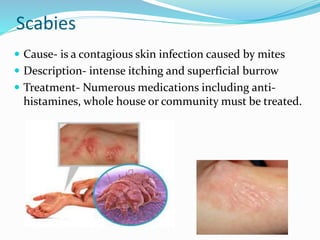
Scabies
 Cause- is a contagious skin infection caused by mites
 Description- intense itching and superficial burrow
 Treatment- Numerous medications including anti-
histamines, whole house or community must be treated.
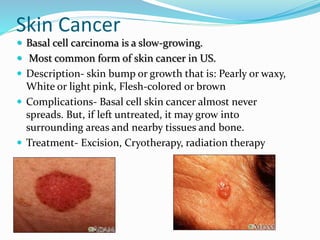
Skin Cancer
 Basal cell carcinoma is a slow-growing.
 Most common form of skin cancer in US.
 Description- skin bump or growth that is: Pearly or waxy,
White or light pink, Flesh-colored or brown
 Complications- Basal cell skin cancer almost never
spreads. But, if left untreated, it may grow into
surrounding areas and nearby tissues and bone.
 Treatment- Excision, Cryotherapy, radiation therapy
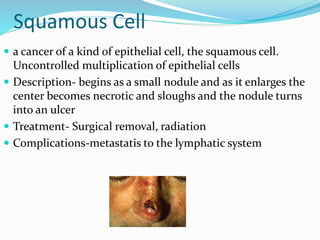
Squamous Cell
 a cancer of a kind of epithelial cell, the squamous cell.
Uncontrolled multiplication of epithelial cells
 Description- begins as a small nodule and as it enlarges the
center becomes necrotic and sloughs and the nodule turns
into an ulcer
 Treatment- Surgical removal, radiation
 Complications-metastatis to the lymphatic system
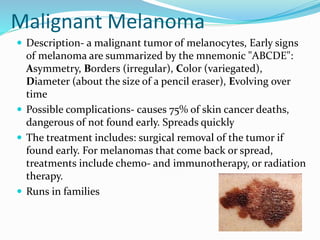
Malignant Melanoma
 Description- a malignant tumor of melanocytes, Early signs
of melanoma are summarized by the mnemonic "ABCDE":
Asymmetry, Borders (irregular), Color (variegated),
Diameter (about the size of a pencil eraser), Evolving over
time
 Possible complications- causes 75% of skin cancer deaths,
dangerous of not found early. Spreads quickly
 The treatment includes: surgical removal of the tumor if
found early. For melanomas that come back or spread,
treatments include chemo- and immunotherapy, or radiation
therapy.
 Runs in families
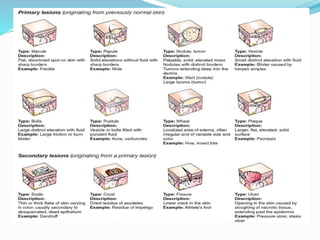
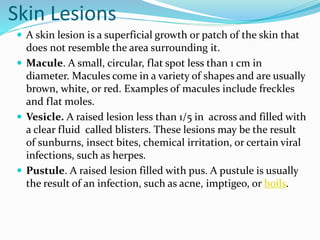
Skin Lesions
 A skin lesion is a superficial growth or patch of the skin that
does not resemble the area surrounding it.
 Macule. A small, circular, flat spot less than 1 cm in
diameter. Macules come in a variety of shapes and are usually
brown, white, or red. Examples of macules include freckles
and flat moles.
 Vesicle. A raised lesion less than 1/5 in across and filled with
a clear fluid called blisters. These lesions may be the result
of sunburns, insect bites, chemical irritation, or certain viral
infections, such as herpes.
 Pustule. A raised lesion filled with pus. A pustule is usually
the result of an infection, such as acne, imptigeo, or boils.
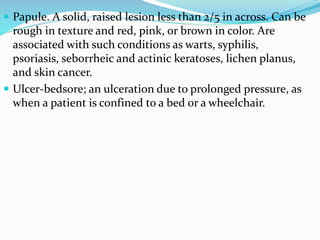
 Papule. A solid, raised lesion less than 2/5 in across. Can be
rough in texture and red, pink, or brown in color. Are
associated with such conditions as warts, syphilis,
psoriasis, seborrheic and actinic keratoses, lichen planus,
and skin cancer.
 Ulcer-bedsore; an ulceration due to prolonged pressure, as
when a patient is confined to a bed or a wheelchair.
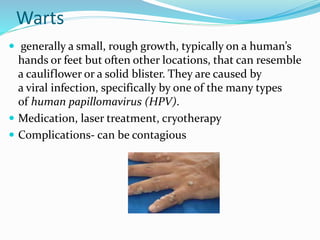
Warts
 generally a small, rough growth, typically on a human’s
hands or feet but often other locations, that can resemble
a cauliflower or a solid blister. They are caused by
a viral infection, specifically by one of the many types
of human papillomavirus (HPV).
 Medication, laser treatment, cryotherapy
 Complications- can be contagious
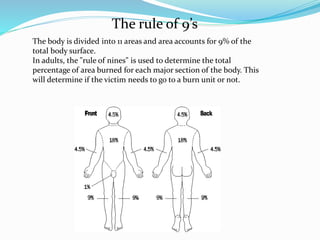
The rule of 9’s
The body is divided into 11 areas and area accounts for 9% of the
total body surface.
In adults, the "rule of nines" is used to determine the total
percentage of area burned for each major section of the body. This
will determine if the victim needs to go to a burn unit or not.

Integumentary disorders

  • 2.
  • 3.
    Skin Lacerations &severe hematoma
  • 4.
    Acne Vulgaris  Disorderof sebaceous glands  Sebum plugs pores and area fills with leukocytes  Also, blackheads, cysts, pimples and scarring  Treatment- benzoyl peroxide, antibiotics, topical or oral retinoid, anti-inflammatories
  • 5.
    Athlete’s Foot AKA-Tinia Pedis  Contagious fungal infection  Usually contracted in public baths and showers  caused by fungi in the genus Trichophyton. transmitted in moist areas where people walk barefoot  requires a warm moist environment, such as the inside of a shoe, in order to incubate  Rx – antifungal agents
  • 6.
    Burns- 1st degree A burn is a type of injury to flesh or skin caused by heat, electricity, chemicals, light, radiation or friction.  Description =Epidermis injured, redness seen  2-3 days to heal  Complications- increased risk of developing skin cancer later in life.  Treatment- ice, keep area dry
  • 7.
    Burn- 2nd degree Superficial to deep dermis  Red with clear blister- superficial  Red and white with bloody blisters- deep  Complications= scarring, infections, contractures, skin grafting, amputations 1-4 weeks to heal  Treatment- antibiotics, skin grafts, amputations • --Severe sun burn • Healing sunburn---
  • 8.
    Burn 3rd degreeBurn extends though full dermis and subcutaneous layer  Skin appears stiff white/brown, black, charred Complications- prolonged and incomplete healing, amputation, death, gangrene, can be painless Treatment- amputations, skin grafting
  • 9.
    Dermatitis  Non-specific skininflammation  Rash – reaction to soap, plants, etc.  Skin blotches – caused by stress  Description-ranges from skin rashes to bumpy rashes or includes blisters. Most common symptoms are dry, itchy, red skin  Treatment- Hydrocortisone creams, Steroid creams, wet compress, anti-histamines
  • 10.
    Eczema- form ofdermatitis or inflammation of the epidermis  Description- redness, skin swelling, itching and dryness, crusting, flaking, blistering, cracking, oozing, or bleeding  The cause of eczema is unknown but is presumed to be a combination of genetic and environmental factors  No known cure- Treatments include: corticosteroids, immunosuppressant's, itch relief, moisturizers, diet
  • 11.
    Herpes  A viraldisease from the herpesviridae family caused by both Herpes simplex virus type 1 & 2  -several types, oral and genital herpes most common  Description- spread through skin to skin contact, cold sores or fever blisters,  No known cure!
  • 12.
    Impetigo  Highly contagiousskin bacterial infection- spread through skin to skin contact. Caused by Staph or Strep  Description- begins as a red sore near the nose or mouth which soon breaks, leaking pus or fluid, and forms a honey-colored scab, followed by a red mark which heals without leaving a scar. Sores are not painful, but may be itchy  Treatment- oral or topical antibiotics
  • 13.
    Psoriasis  an immune-mediateddisease that affects the skin. It is typically a lifelong condition. There is currently no cure, but various treatments can help to control the symptoms  Cause-unknown, possible genetic link  Description- seen as red and white hues of scaly patches appearing on the top first layer of the epidermis (skin)  Treatment-moisturizers & medicated creams
  • 14.
    Ringworm  caused byfungal infection of the skin  Description- enlarging raised red rings  Treatment- anti-fungal treatments
  • 15.
    Scabies  Cause- isa contagious skin infection caused by mites  Description- intense itching and superficial burrow  Treatment- Numerous medications including anti- histamines, whole house or community must be treated.
  • 16.
    Skin Cancer  Basalcell carcinoma is a slow-growing.  Most common form of skin cancer in US.  Description- skin bump or growth that is: Pearly or waxy, White or light pink, Flesh-colored or brown  Complications- Basal cell skin cancer almost never spreads. But, if left untreated, it may grow into surrounding areas and nearby tissues and bone.  Treatment- Excision, Cryotherapy, radiation therapy
  • 17.
    Squamous Cell  acancer of a kind of epithelial cell, the squamous cell. Uncontrolled multiplication of epithelial cells  Description- begins as a small nodule and as it enlarges the center becomes necrotic and sloughs and the nodule turns into an ulcer  Treatment- Surgical removal, radiation  Complications-metastatis to the lymphatic system
  • 18.
    Malignant Melanoma  Description-a malignant tumor of melanocytes, Early signs of melanoma are summarized by the mnemonic "ABCDE": Asymmetry, Borders (irregular), Color (variegated), Diameter (about the size of a pencil eraser), Evolving over time  Possible complications- causes 75% of skin cancer deaths, dangerous of not found early. Spreads quickly  The treatment includes: surgical removal of the tumor if found early. For melanomas that come back or spread, treatments include chemo- and immunotherapy, or radiation therapy.  Runs in families
  • 20.
    Skin Lesions  Askin lesion is a superficial growth or patch of the skin that does not resemble the area surrounding it.  Macule. A small, circular, flat spot less than 1 cm in diameter. Macules come in a variety of shapes and are usually brown, white, or red. Examples of macules include freckles and flat moles.  Vesicle. A raised lesion less than 1/5 in across and filled with a clear fluid called blisters. These lesions may be the result of sunburns, insect bites, chemical irritation, or certain viral infections, such as herpes.  Pustule. A raised lesion filled with pus. A pustule is usually the result of an infection, such as acne, imptigeo, or boils.
  • 21.
     Papule. Asolid, raised lesion less than 2/5 in across. Can be rough in texture and red, pink, or brown in color. Are associated with such conditions as warts, syphilis, psoriasis, seborrheic and actinic keratoses, lichen planus, and skin cancer.  Ulcer-bedsore; an ulceration due to prolonged pressure, as when a patient is confined to a bed or a wheelchair.
  • 22.
    Warts  generally asmall, rough growth, typically on a human’s hands or feet but often other locations, that can resemble a cauliflower or a solid blister. They are caused by a viral infection, specifically by one of the many types of human papillomavirus (HPV).  Medication, laser treatment, cryotherapy  Complications- can be contagious
  • 23.
    The rule of9’s The body is divided into 11 areas and area accounts for 9% of the total body surface. In adults, the "rule of nines" is used to determine the total percentage of area burned for each major section of the body. This will determine if the victim needs to go to a burn unit or not.