Alireza Akhavanpour
Tensorflow & Keras callbacks
TensorFlow Callbacks (Part I)
Alireza Akhavanpour
Akhavanpour.ir
CLASS.VISION
https://github.com/Alireza-Akhavan/tf2-tutorial
Alireza Akhavanpour
Tensorflow & Keras callbacks
What is Callback?
 Callbacks: utilities called at certain points during model training.
https://www.tensorflow.org/api_docs/python/tf/keras/callbacks
Alireza Akhavanpour
Tensorflow & Keras callbacks
What is Callback?
 Callbacks: utilities called at certain points during model training.
https://www.tensorflow.org/api_docs/python/tf/keras/callbacks
 set of methods called at various stages of training, testing, and
predicting
o batch/epoch
o start and ends
 useful to get a view on internal states and statistics of the model
during training.
 You can pass a list of callbacks to any of these methods:
o tf.keras.Model.fit()
o tf.keras.Model.evaluate()
o tf.keras.Model.predict().
Alireza Akhavanpour
Tensorflow & Keras callbacks
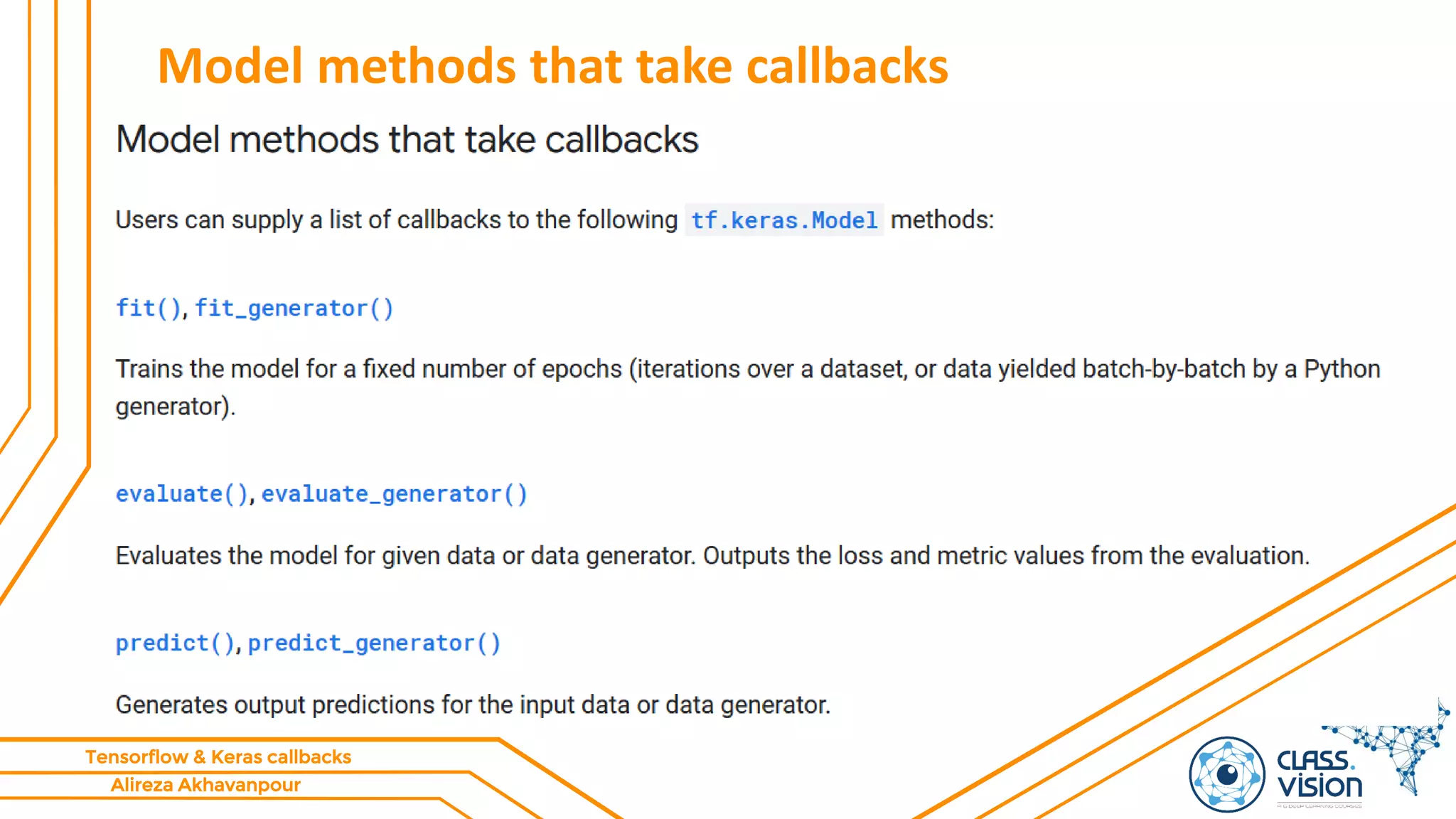
Model methods that take callbacks
Alireza Akhavanpour
Tensorflow & Keras callbacks
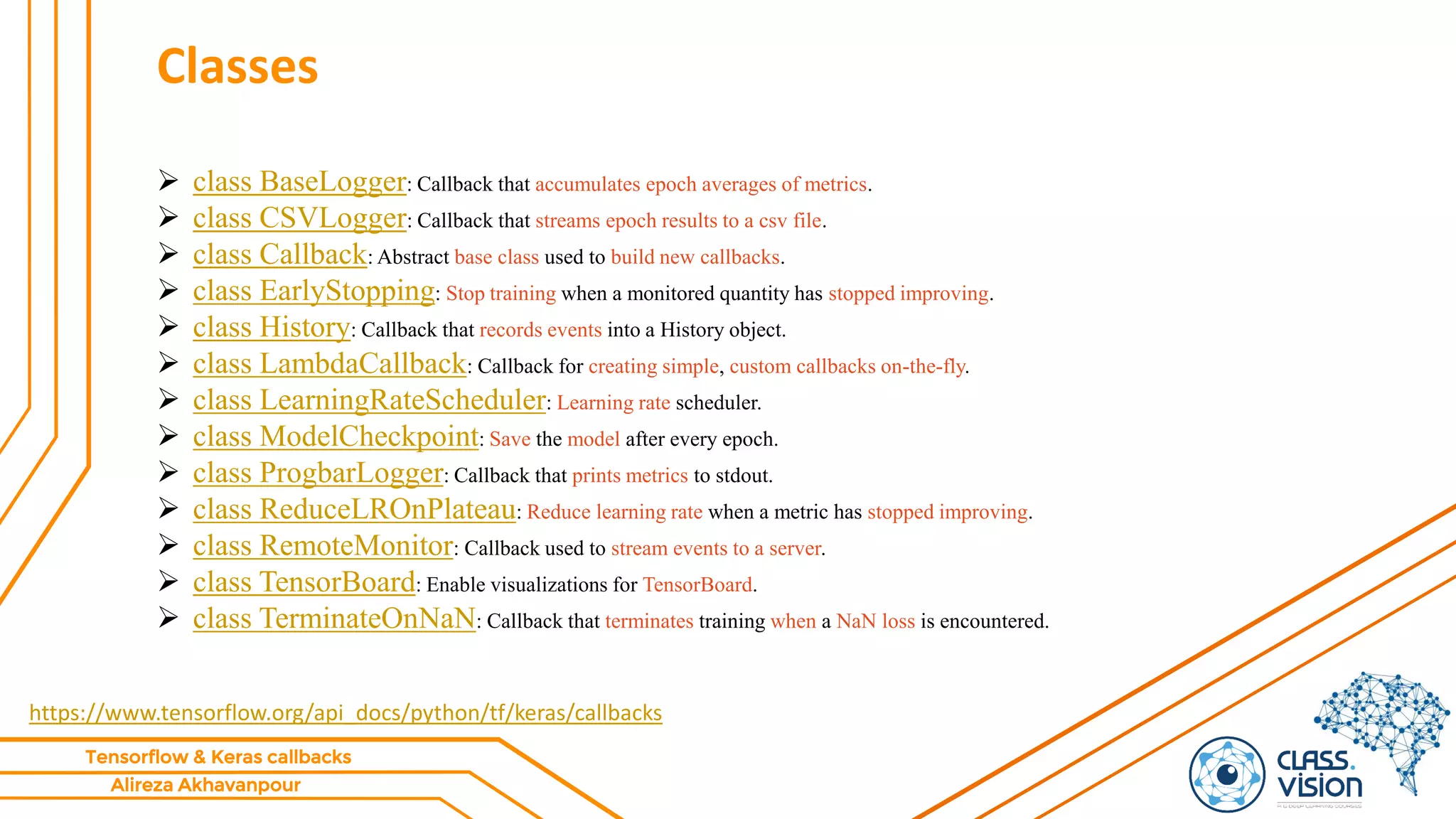
Classes
 class BaseLogger: Callback that accumulates epoch averages of metrics.
 class CSVLogger: Callback that streams epoch results to a csv file.
 class Callback: Abstract base class used to build new callbacks.
 class EarlyStopping: Stop training when a monitored quantity has stopped improving.
 class History: Callback that records events into a History object.
 class LambdaCallback: Callback for creating simple, custom callbacks on-the-fly.
 class LearningRateScheduler: Learning rate scheduler.
 class ModelCheckpoint: Save the model after every epoch.
 class ProgbarLogger: Callback that prints metrics to stdout.
 class ReduceLROnPlateau: Reduce learning rate when a metric has stopped improving.
 class RemoteMonitor: Callback used to stream events to a server.
 class TensorBoard: Enable visualizations for TensorBoard.
 class TerminateOnNaN: Callback that terminates training when a NaN loss is encountered.
https://www.tensorflow.org/api_docs/python/tf/keras/callbacks
Alireza Akhavanpour
Tensorflow & Keras callbacks
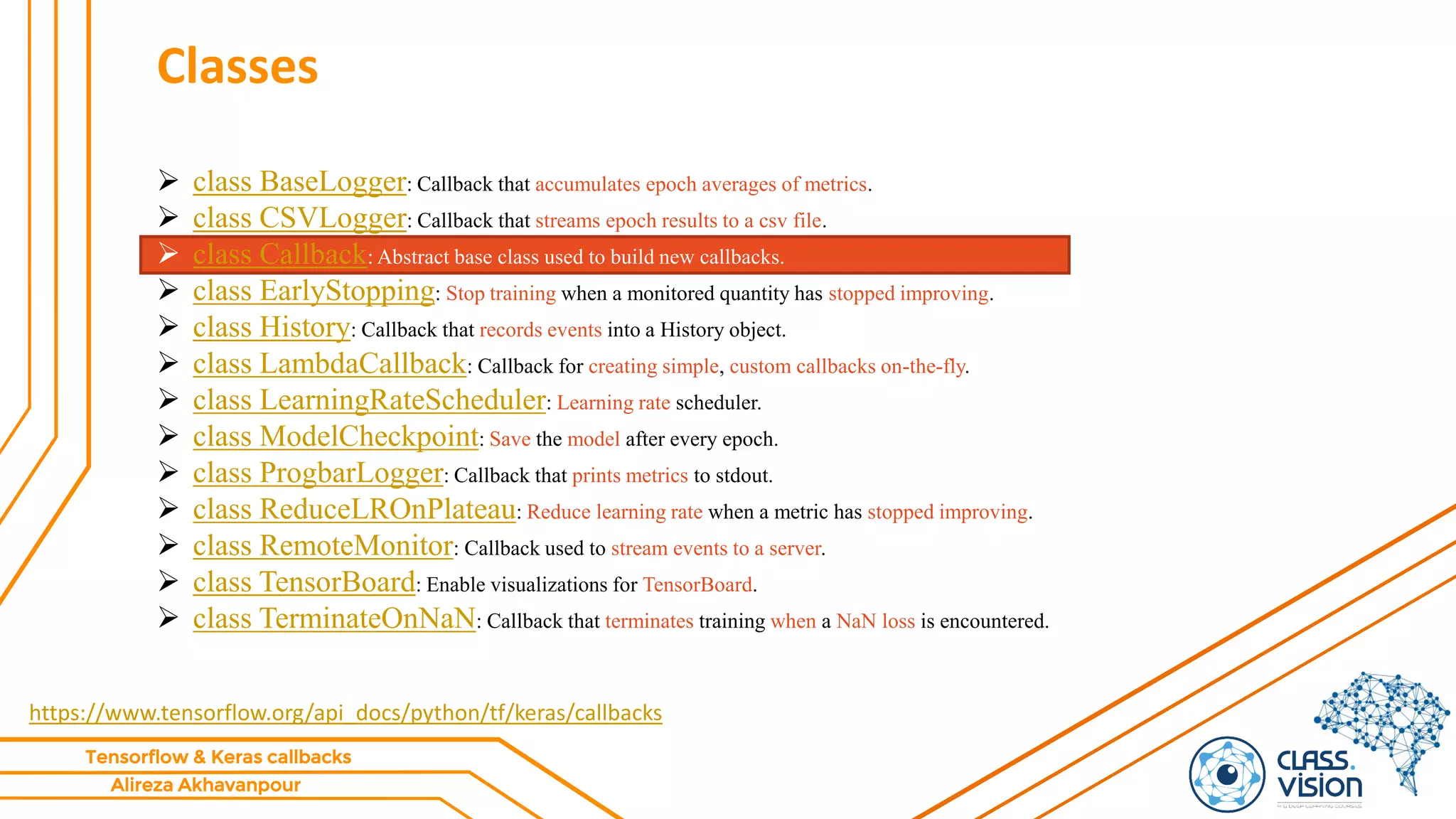
Classes
 class BaseLogger: Callback that accumulates epoch averages of metrics.
 class CSVLogger: Callback that streams epoch results to a csv file.
 class Callback: Abstract base class used to build new callbacks.
 class EarlyStopping: Stop training when a monitored quantity has stopped improving.
 class History: Callback that records events into a History object.
 class LambdaCallback: Callback for creating simple, custom callbacks on-the-fly.
 class LearningRateScheduler: Learning rate scheduler.
 class ModelCheckpoint: Save the model after every epoch.
 class ProgbarLogger: Callback that prints metrics to stdout.
 class ReduceLROnPlateau: Reduce learning rate when a metric has stopped improving.
 class RemoteMonitor: Callback used to stream events to a server.
 class TensorBoard: Enable visualizations for TensorBoard.
 class TerminateOnNaN: Callback that terminates training when a NaN loss is encountered.
https://www.tensorflow.org/api_docs/python/tf/keras/callbacks
Alireza Akhavanpour
Tensorflow & Keras callbacks
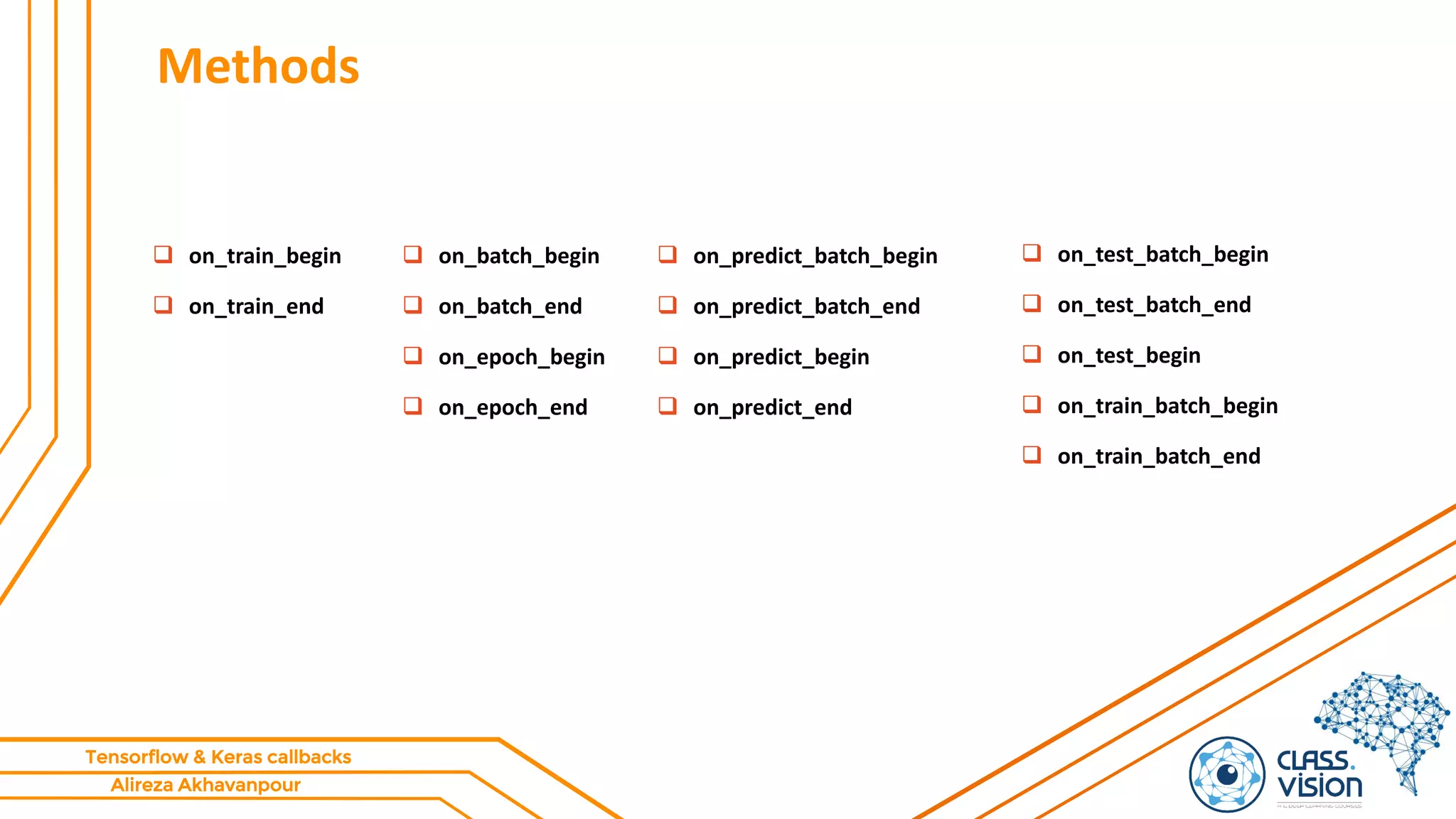
Methods
 on_batch_begin
 on_batch_end
 on_epoch_begin
 on_epoch_end
 on_predict_batch_begin
 on_predict_batch_end
 on_predict_begin
 on_predict_end
 on_test_batch_begin
 on_test_batch_end
 on_test_begin
 on_train_batch_begin
 on_train_batch_end
 on_train_begin
 on_train_end
Alireza Akhavanpour
Tensorflow & Keras callbacks
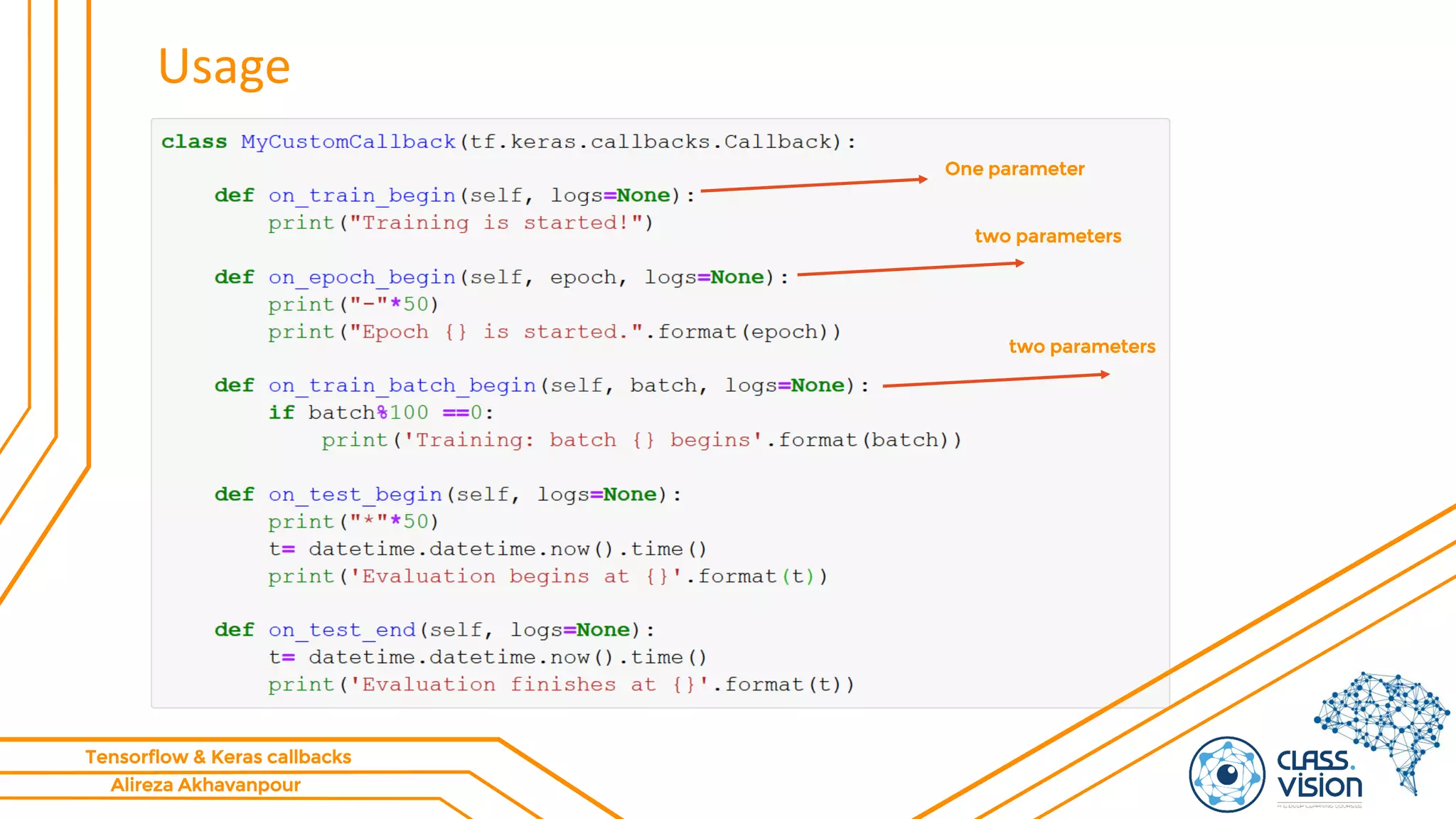
Usage
One parameter
two parameters
two parameters
Alireza Akhavanpour
Tensorflow & Keras callbacks
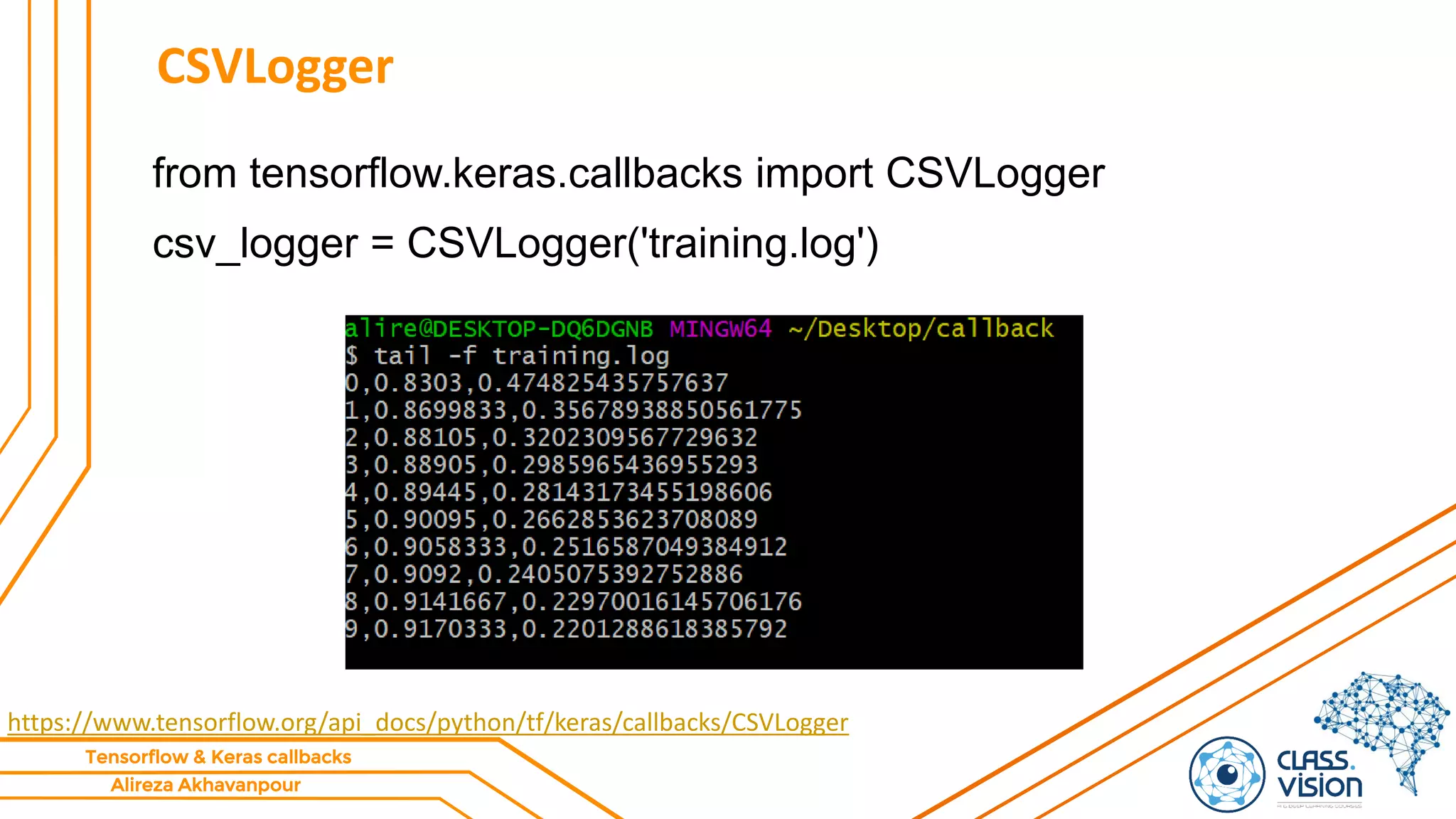
CSVLogger
from tensorflow.keras.callbacks import CSVLogger
csv_logger = CSVLogger('training.log')
https://www.tensorflow.org/api_docs/python/tf/keras/callbacks/CSVLogger
Alireza Akhavanpour
Tensorflow & Keras callbacks
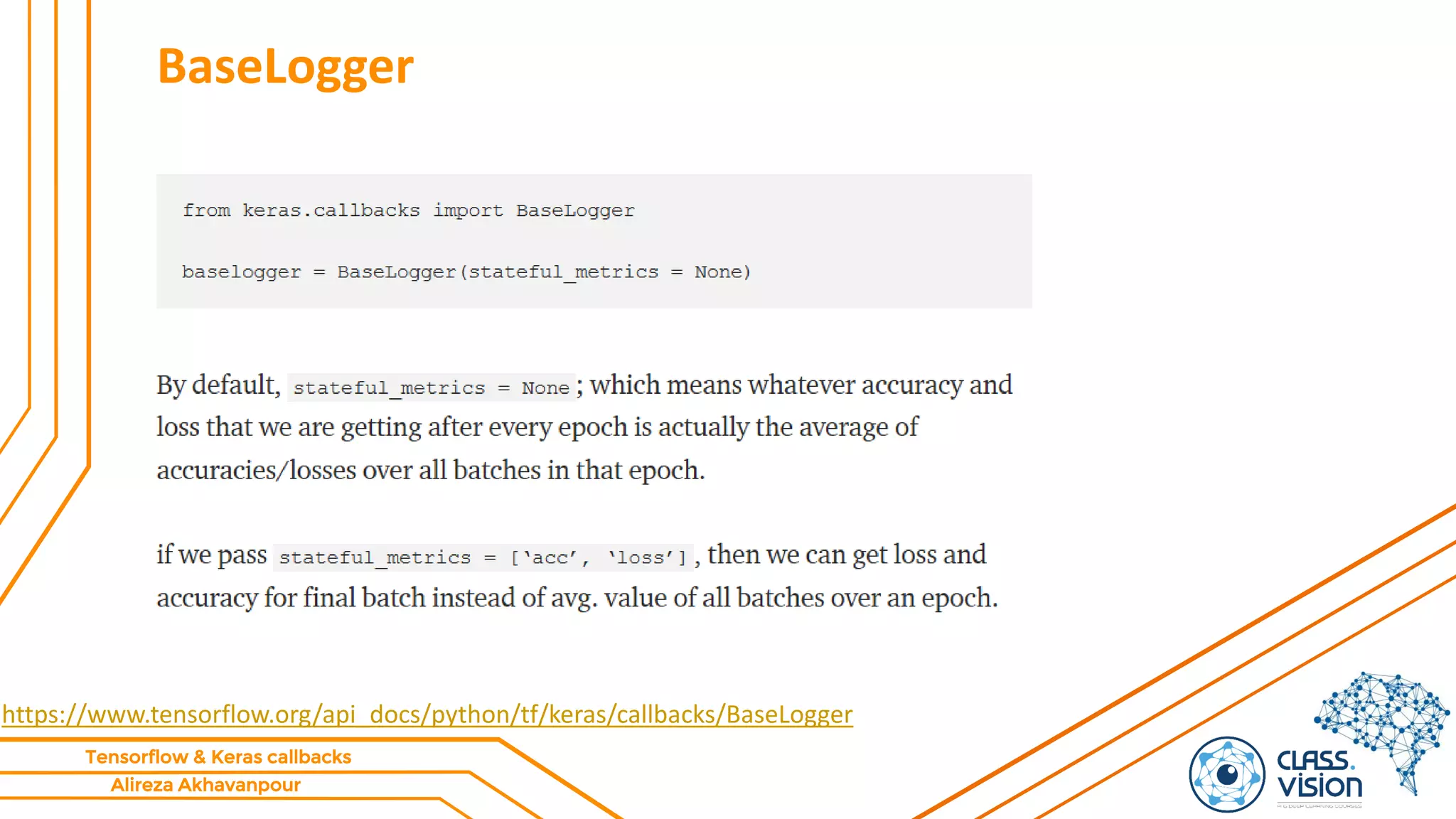
BaseLogger
https://www.tensorflow.org/api_docs/python/tf/keras/callbacks/BaseLogger
Alireza Akhavanpour
Tensorflow & Keras callbacks
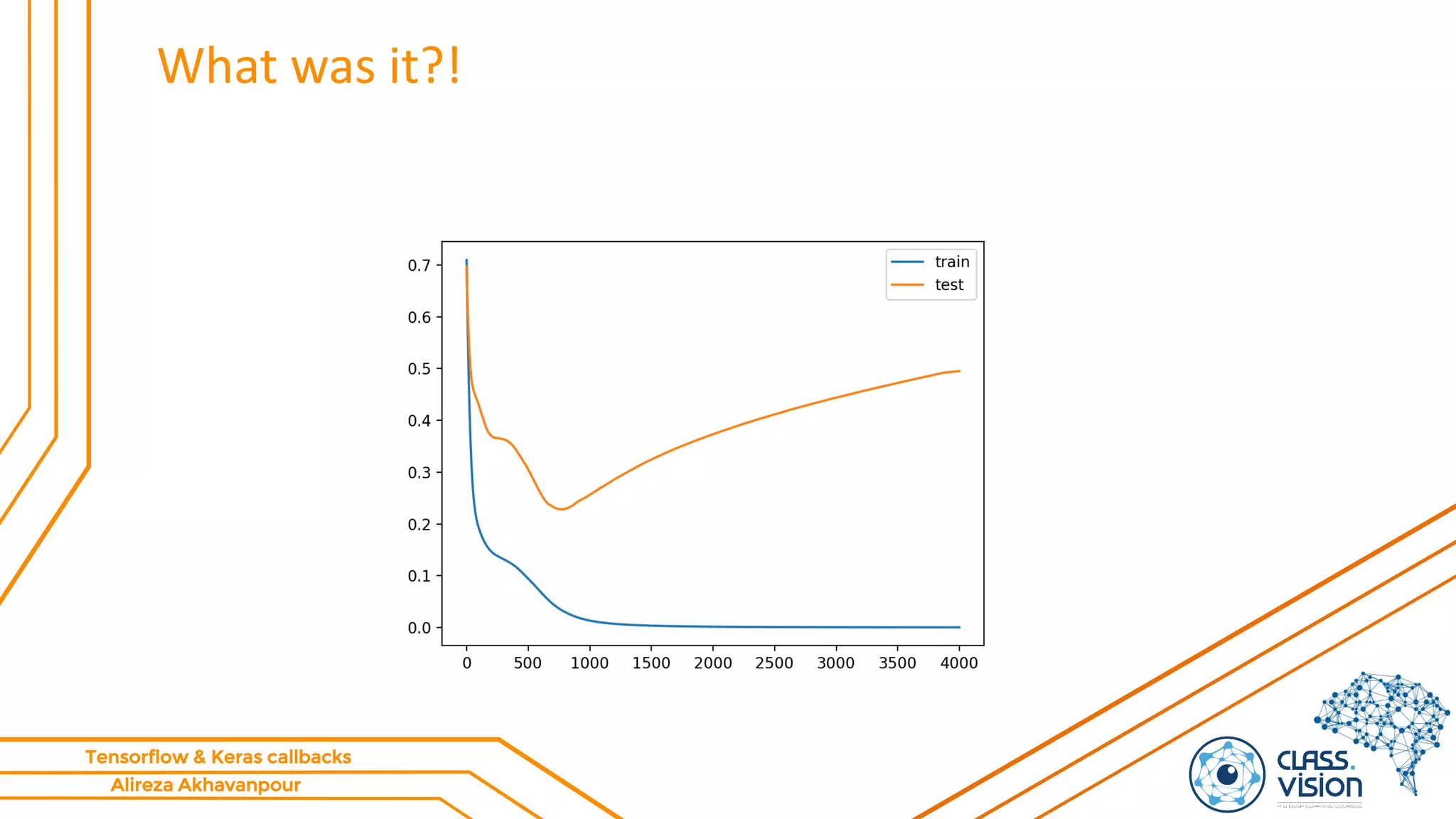
What was it?!
Alireza Akhavanpour
Tensorflow & Keras callbacks
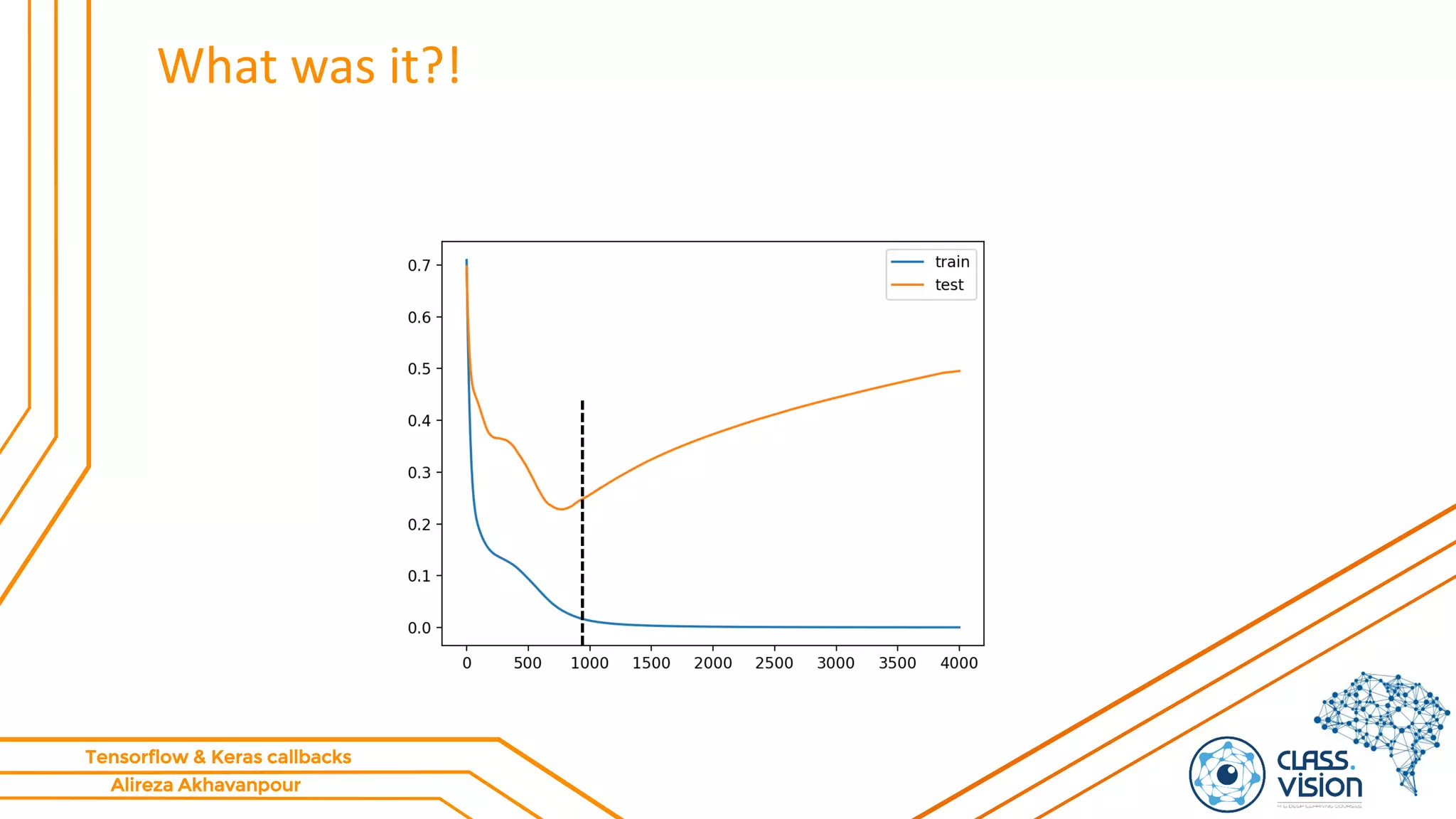
What was it?!
Alireza Akhavanpour
Tensorflow & Keras callbacks
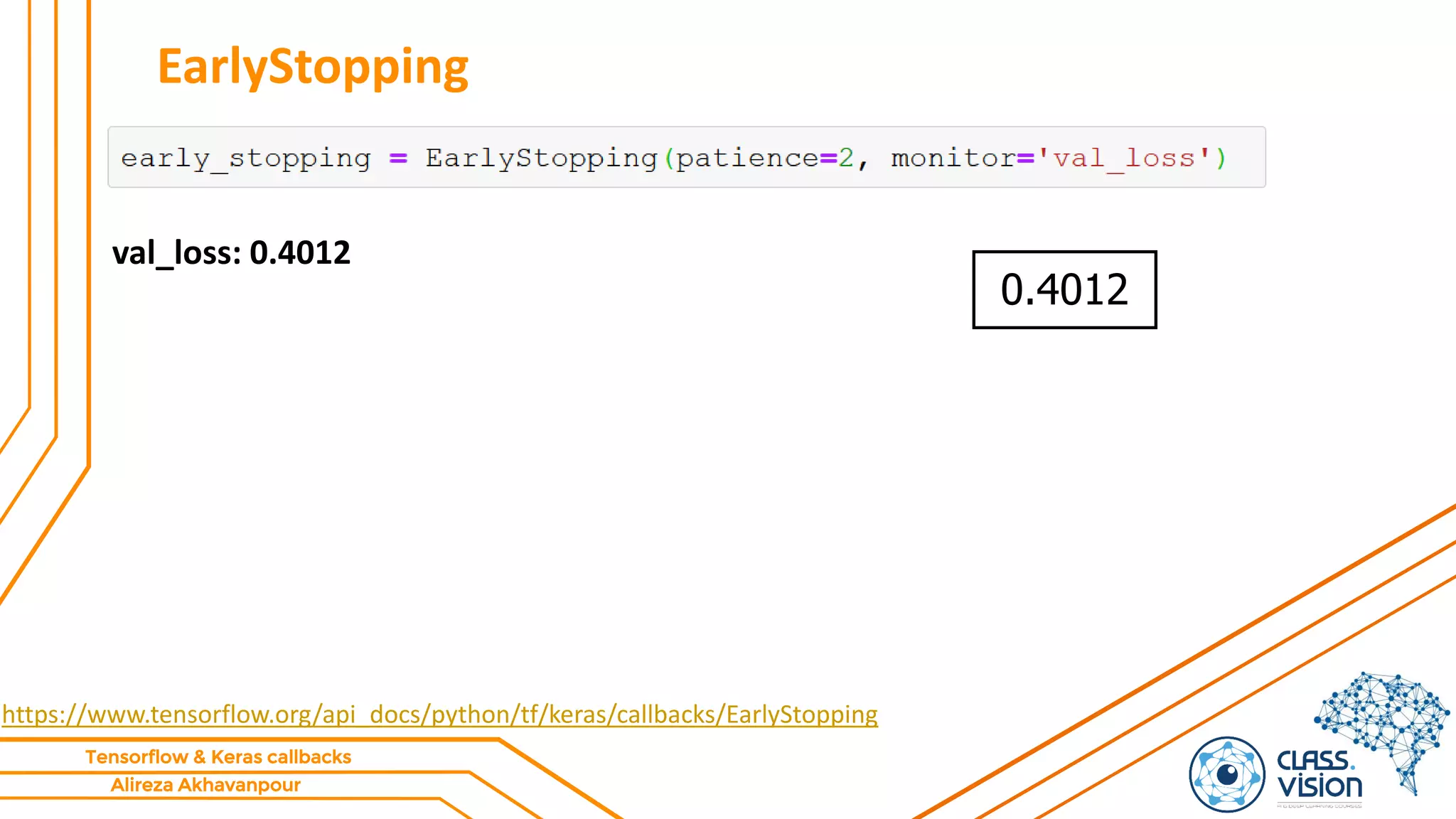
EarlyStopping
https://www.tensorflow.org/api_docs/python/tf/keras/callbacks/EarlyStopping
val_loss: 0.4012
0.4012
Alireza Akhavanpour
Tensorflow & Keras callbacks
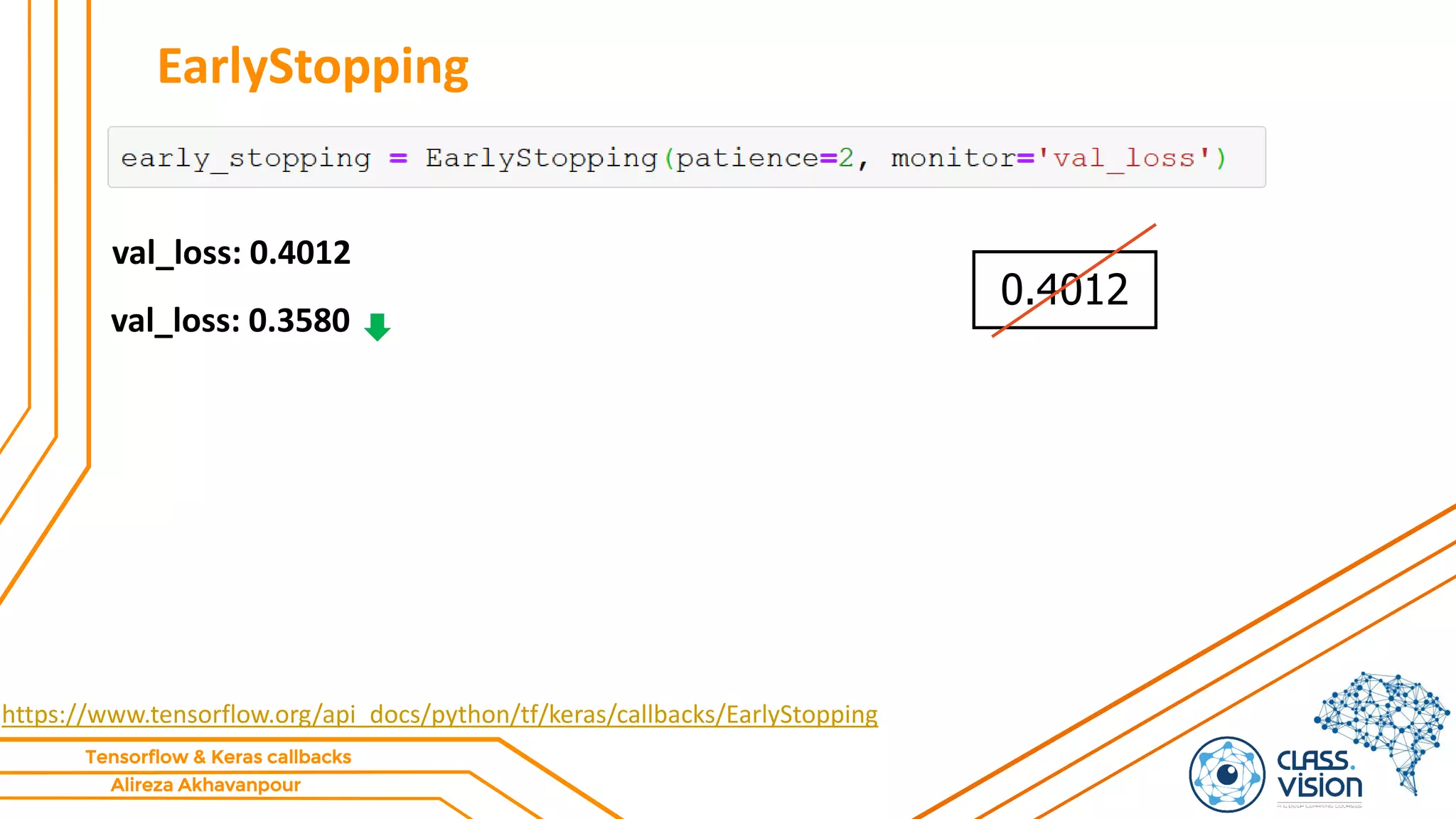
EarlyStopping
https://www.tensorflow.org/api_docs/python/tf/keras/callbacks/EarlyStopping
val_loss: 0.4012
0.4012
val_loss: 0.3580
Alireza Akhavanpour
Tensorflow & Keras callbacks
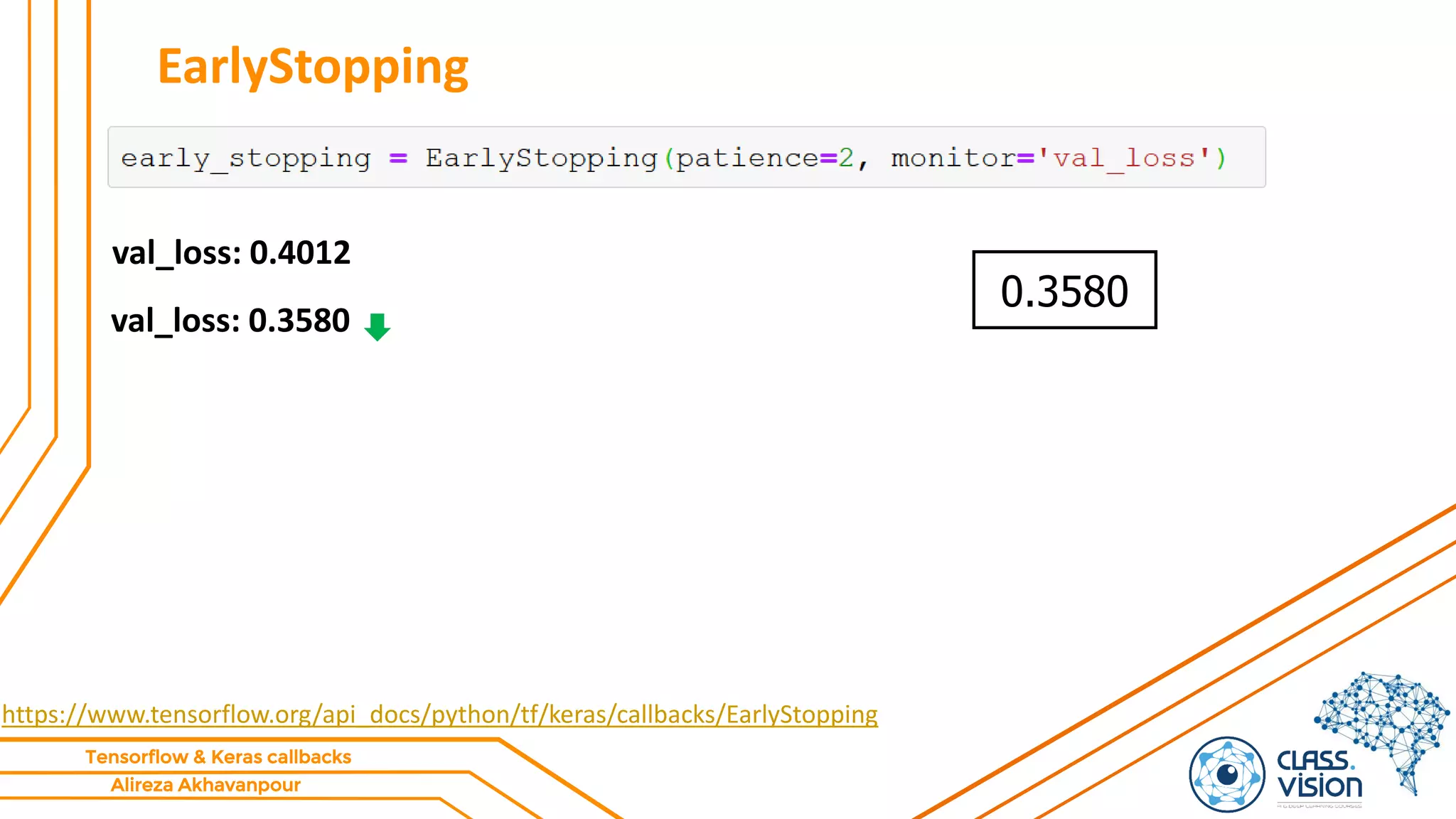
EarlyStopping
https://www.tensorflow.org/api_docs/python/tf/keras/callbacks/EarlyStopping
val_loss: 0.4012
val_loss: 0.3580
0.3580
Alireza Akhavanpour
Tensorflow & Keras callbacks
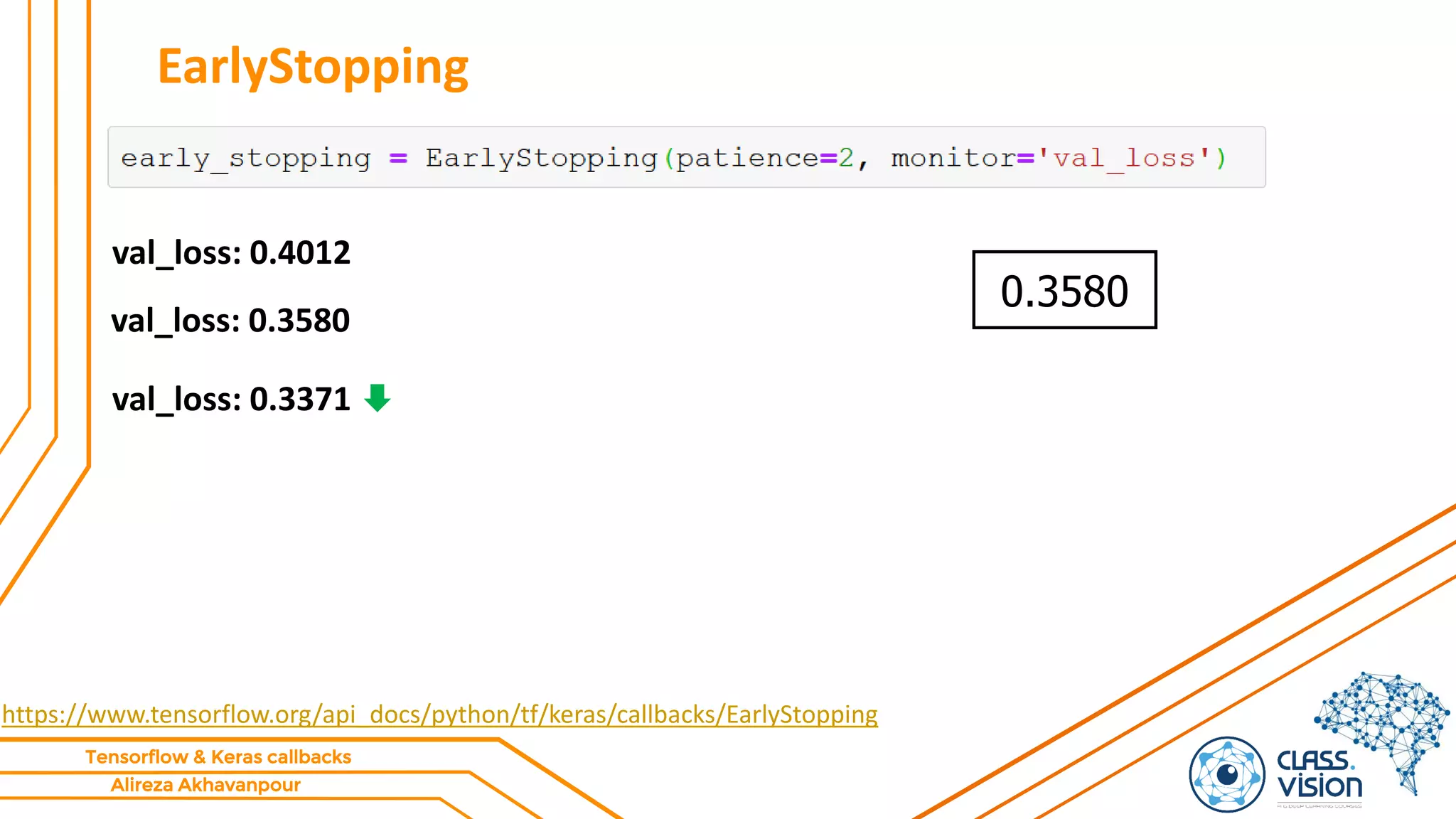
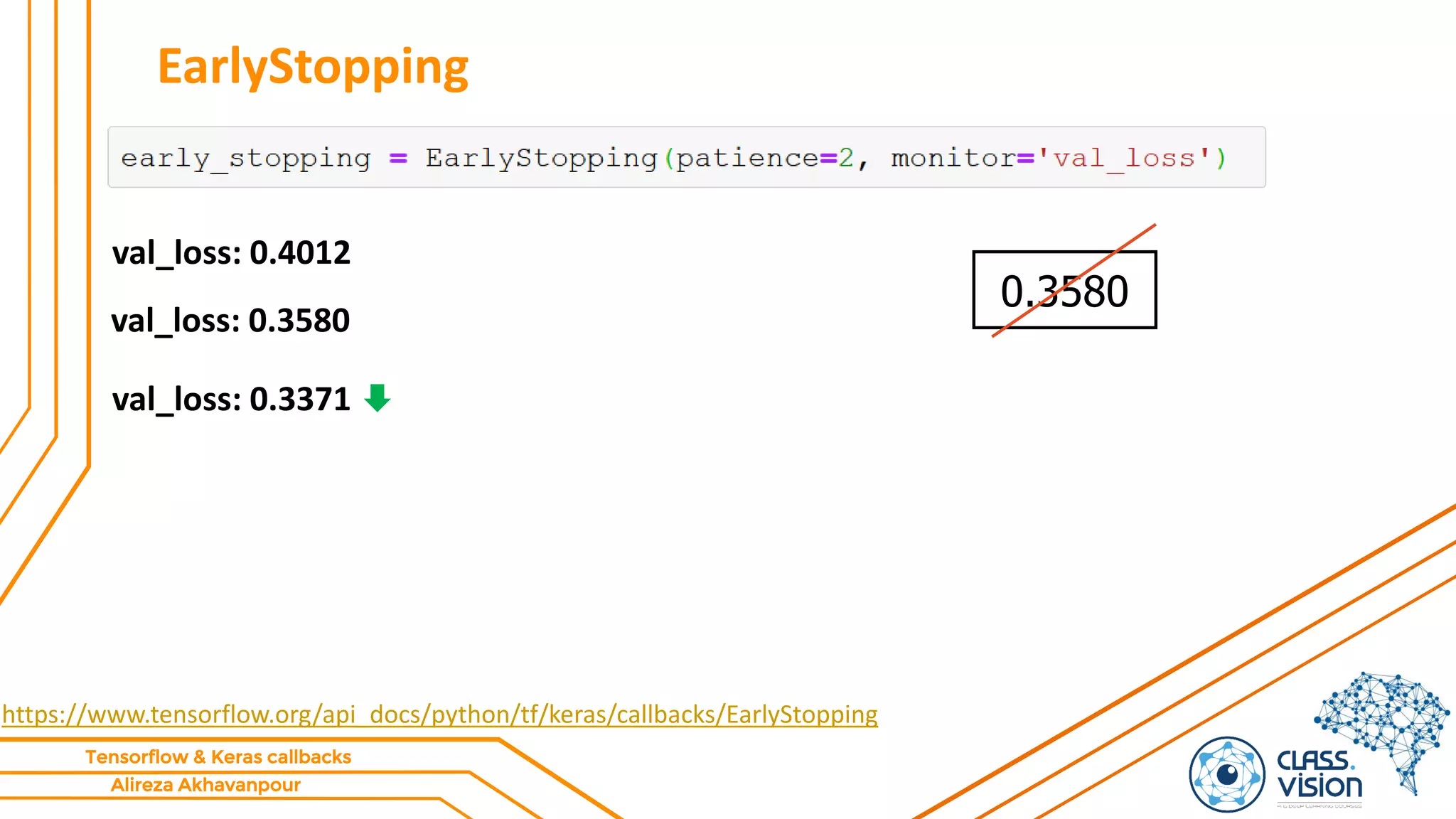
EarlyStopping
https://www.tensorflow.org/api_docs/python/tf/keras/callbacks/EarlyStopping
val_loss: 0.4012
val_loss: 0.3580
0.3580
val_loss: 0.3371
Alireza Akhavanpour
Tensorflow & Keras callbacks
EarlyStopping
https://www.tensorflow.org/api_docs/python/tf/keras/callbacks/EarlyStopping
val_loss: 0.4012
val_loss: 0.3580
0.3580
val_loss: 0.3371
Alireza Akhavanpour
Tensorflow & Keras callbacks
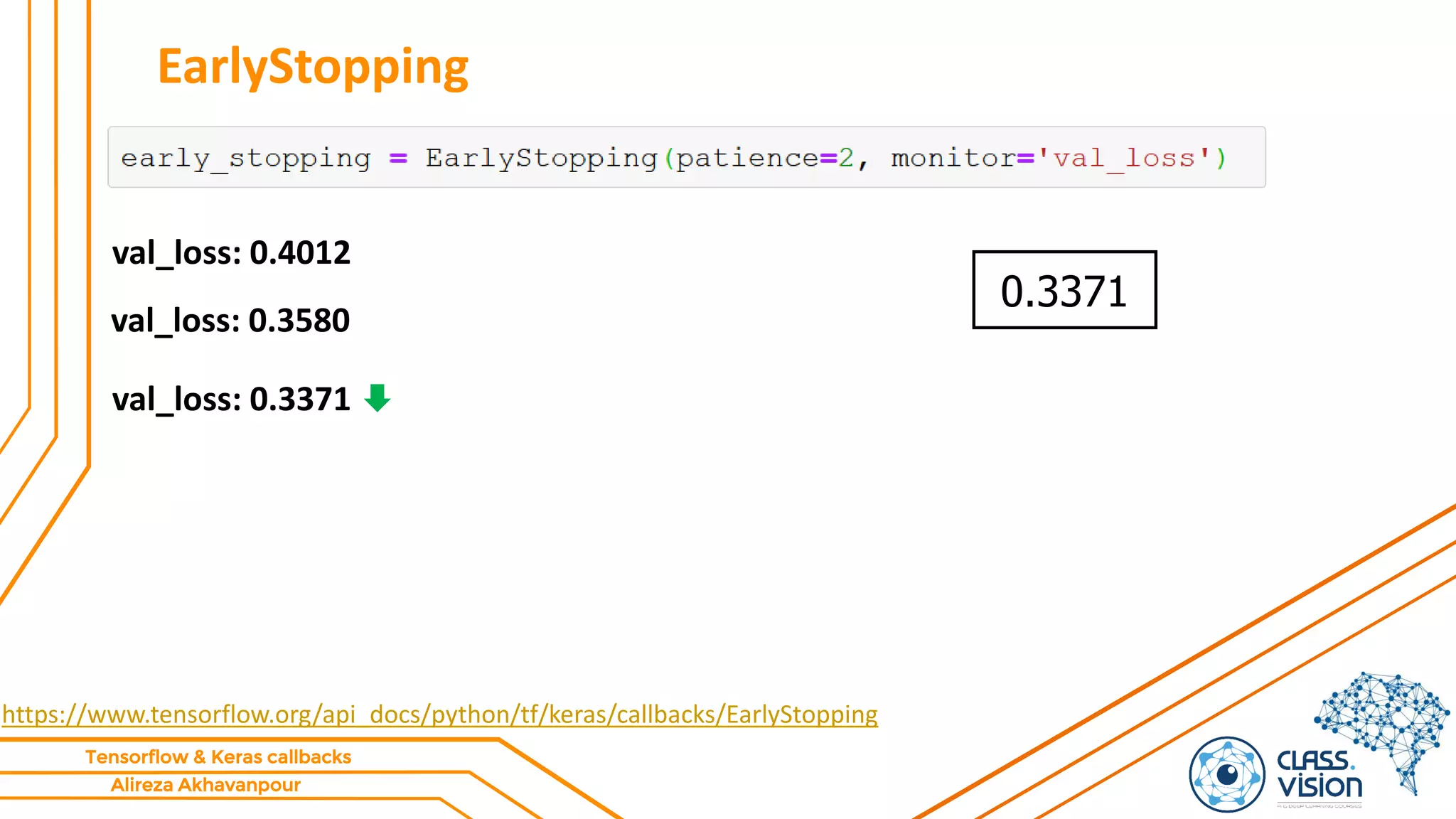
EarlyStopping
https://www.tensorflow.org/api_docs/python/tf/keras/callbacks/EarlyStopping
val_loss: 0.4012
val_loss: 0.3580
0.3371
val_loss: 0.3371
Alireza Akhavanpour
Tensorflow & Keras callbacks
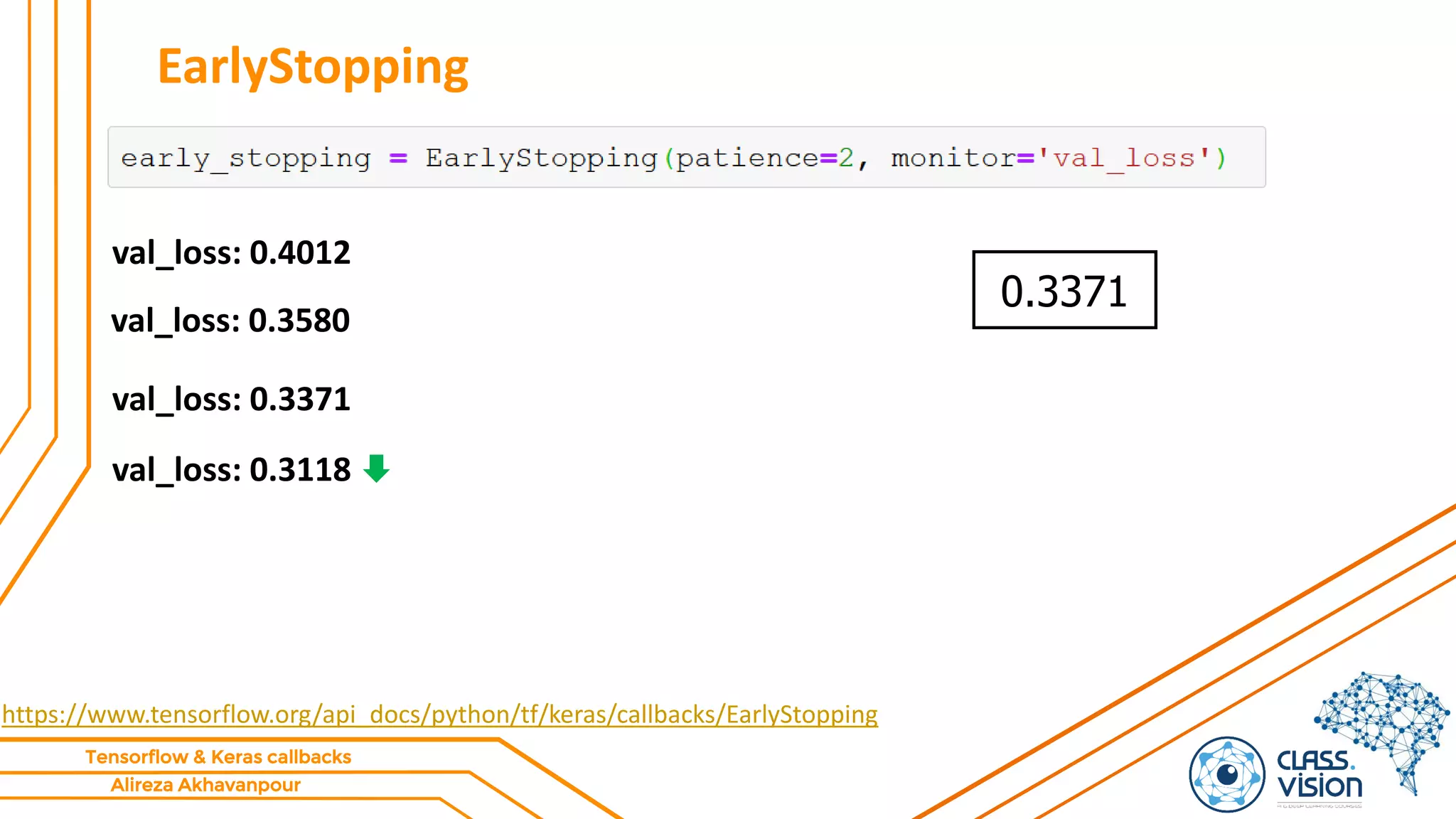
EarlyStopping
https://www.tensorflow.org/api_docs/python/tf/keras/callbacks/EarlyStopping
val_loss: 0.4012
val_loss: 0.3580
0.3371
val_loss: 0.3371
val_loss: 0.3118
Alireza Akhavanpour
Tensorflow & Keras callbacks
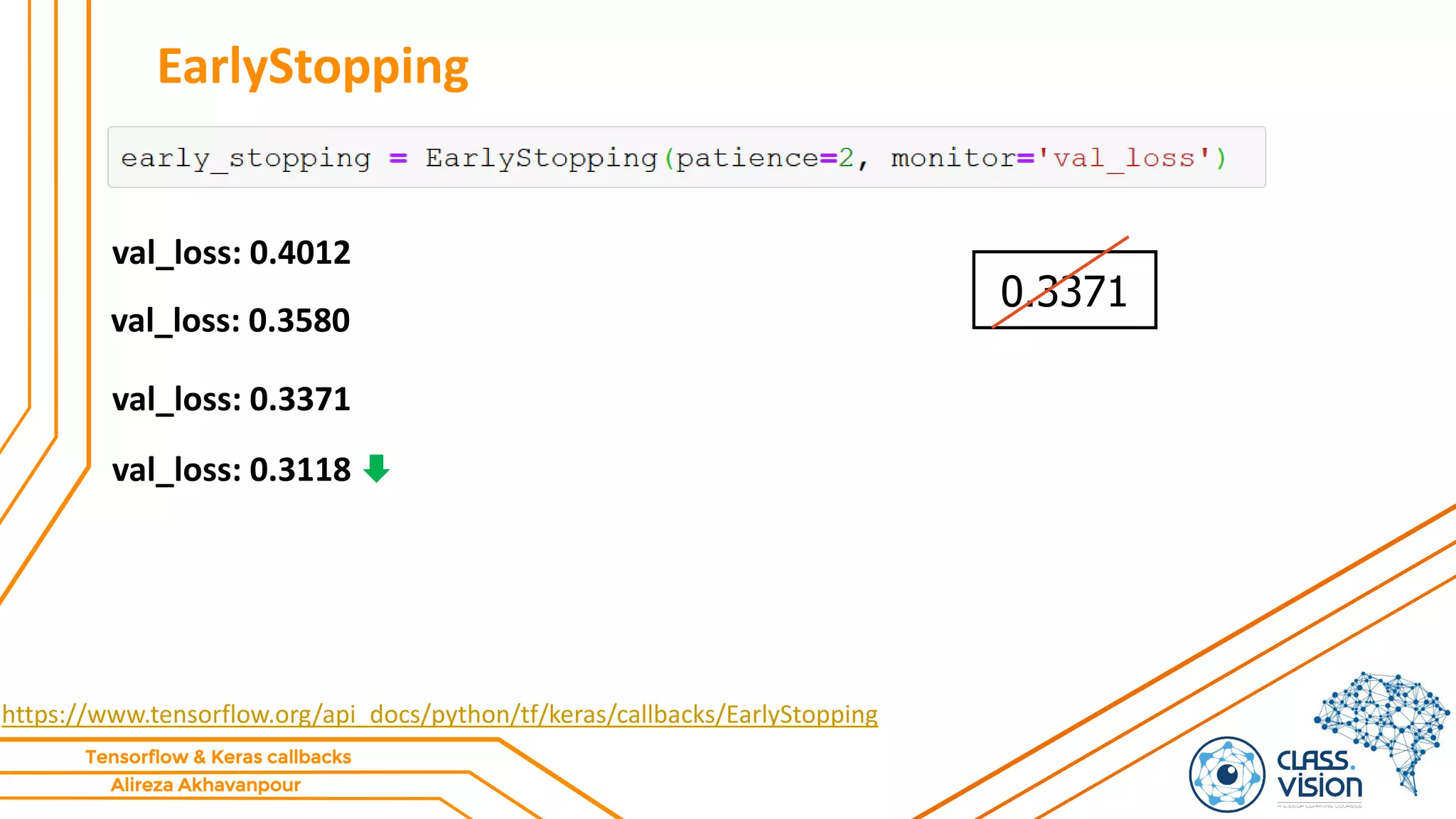
EarlyStopping
https://www.tensorflow.org/api_docs/python/tf/keras/callbacks/EarlyStopping
val_loss: 0.4012
val_loss: 0.3580
0.3371
val_loss: 0.3371
val_loss: 0.3118
Alireza Akhavanpour
Tensorflow & Keras callbacks
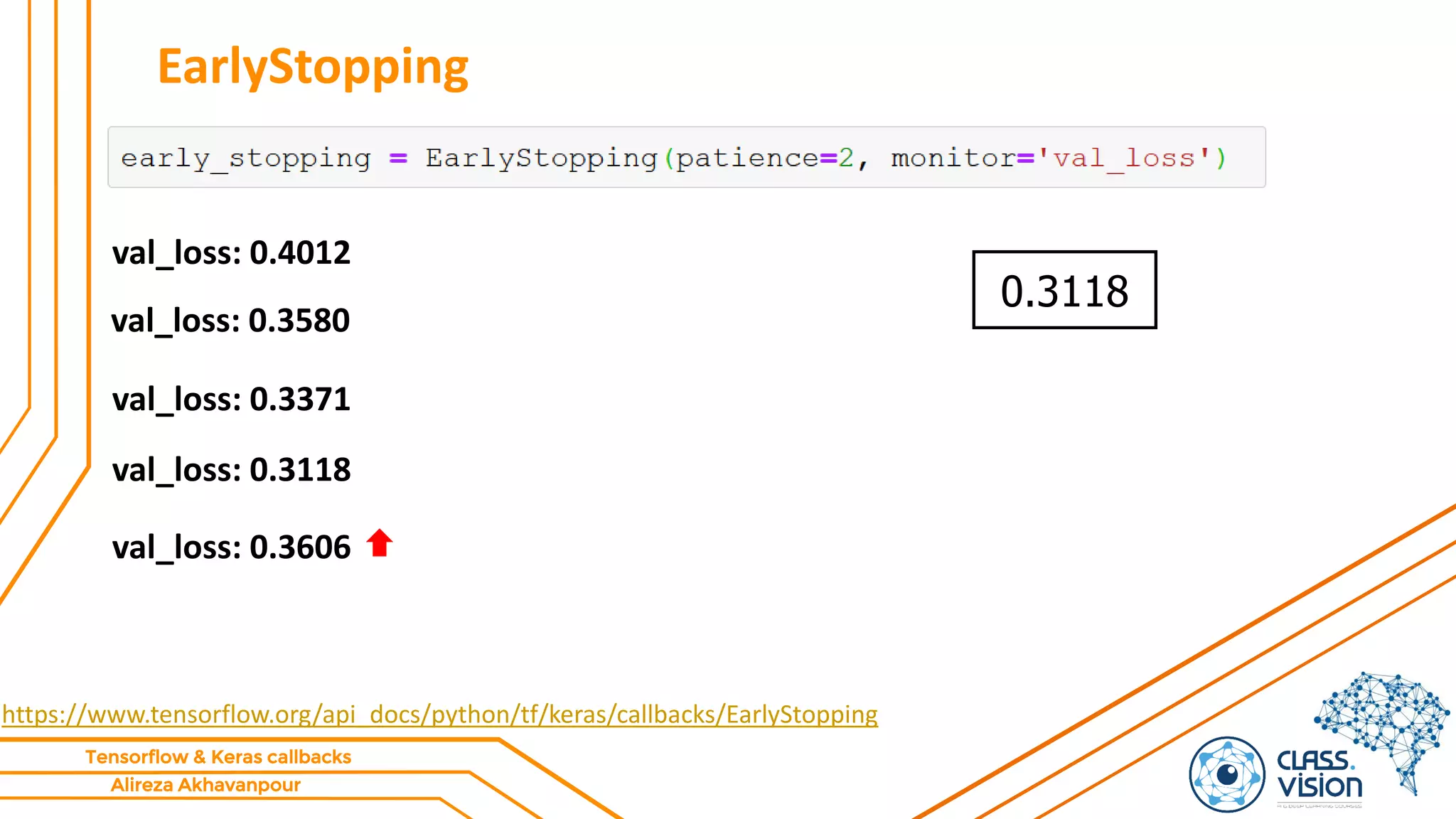
EarlyStopping
https://www.tensorflow.org/api_docs/python/tf/keras/callbacks/EarlyStopping
val_loss: 0.4012
val_loss: 0.3580
0.3118
val_loss: 0.3371
val_loss: 0.3118
val_loss: 0.3606
Alireza Akhavanpour
Tensorflow & Keras callbacks
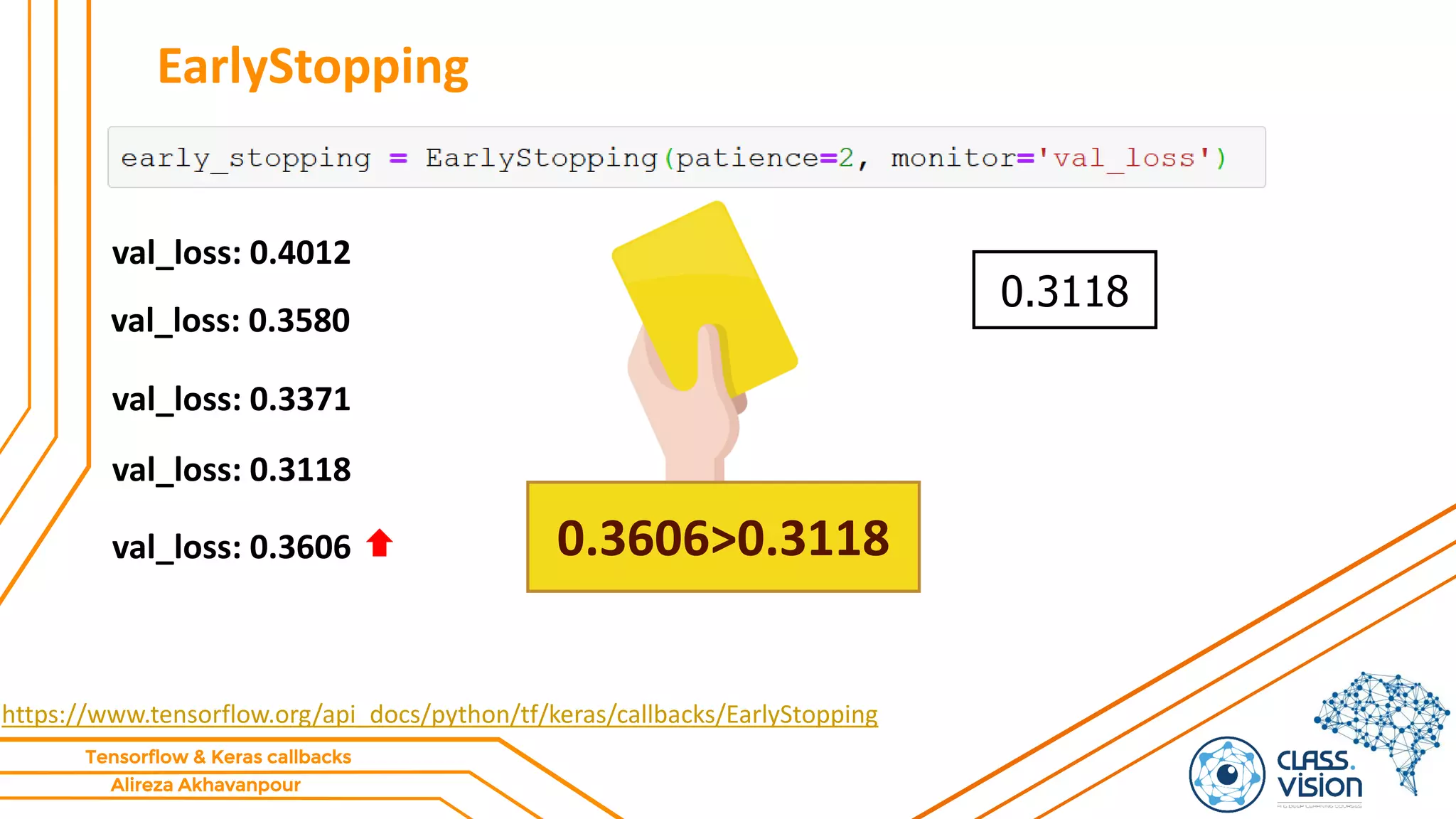
EarlyStopping
https://www.tensorflow.org/api_docs/python/tf/keras/callbacks/EarlyStopping
val_loss: 0.4012
val_loss: 0.3580
0.3118
val_loss: 0.3371
val_loss: 0.3118
val_loss: 0.3606 0.3606>0.3118
Alireza Akhavanpour
Tensorflow & Keras callbacks
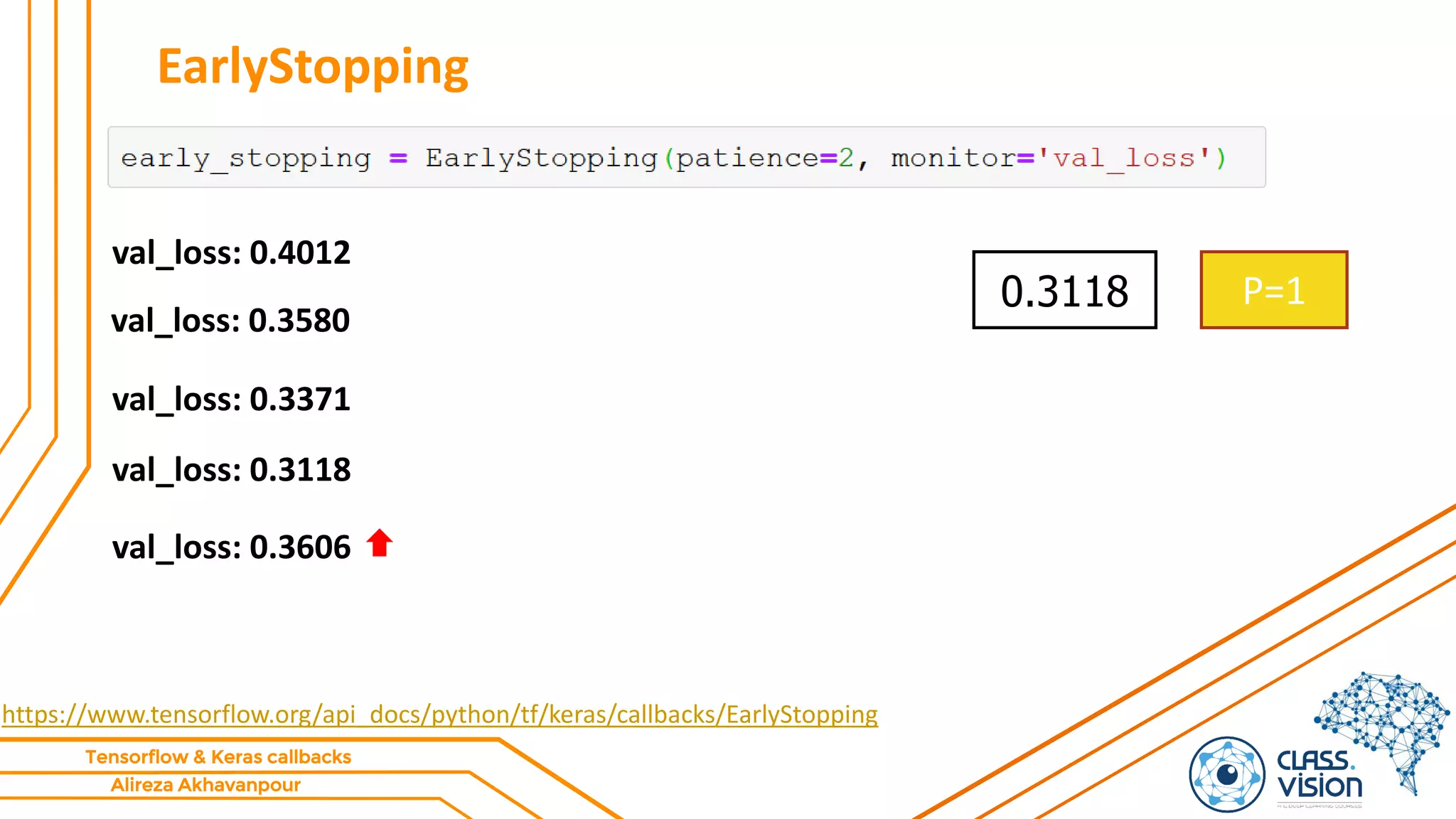
EarlyStopping
https://www.tensorflow.org/api_docs/python/tf/keras/callbacks/EarlyStopping
val_loss: 0.4012
val_loss: 0.3580
0.3118
val_loss: 0.3371
val_loss: 0.3118
val_loss: 0.3606
P=1
Alireza Akhavanpour
Tensorflow & Keras callbacks
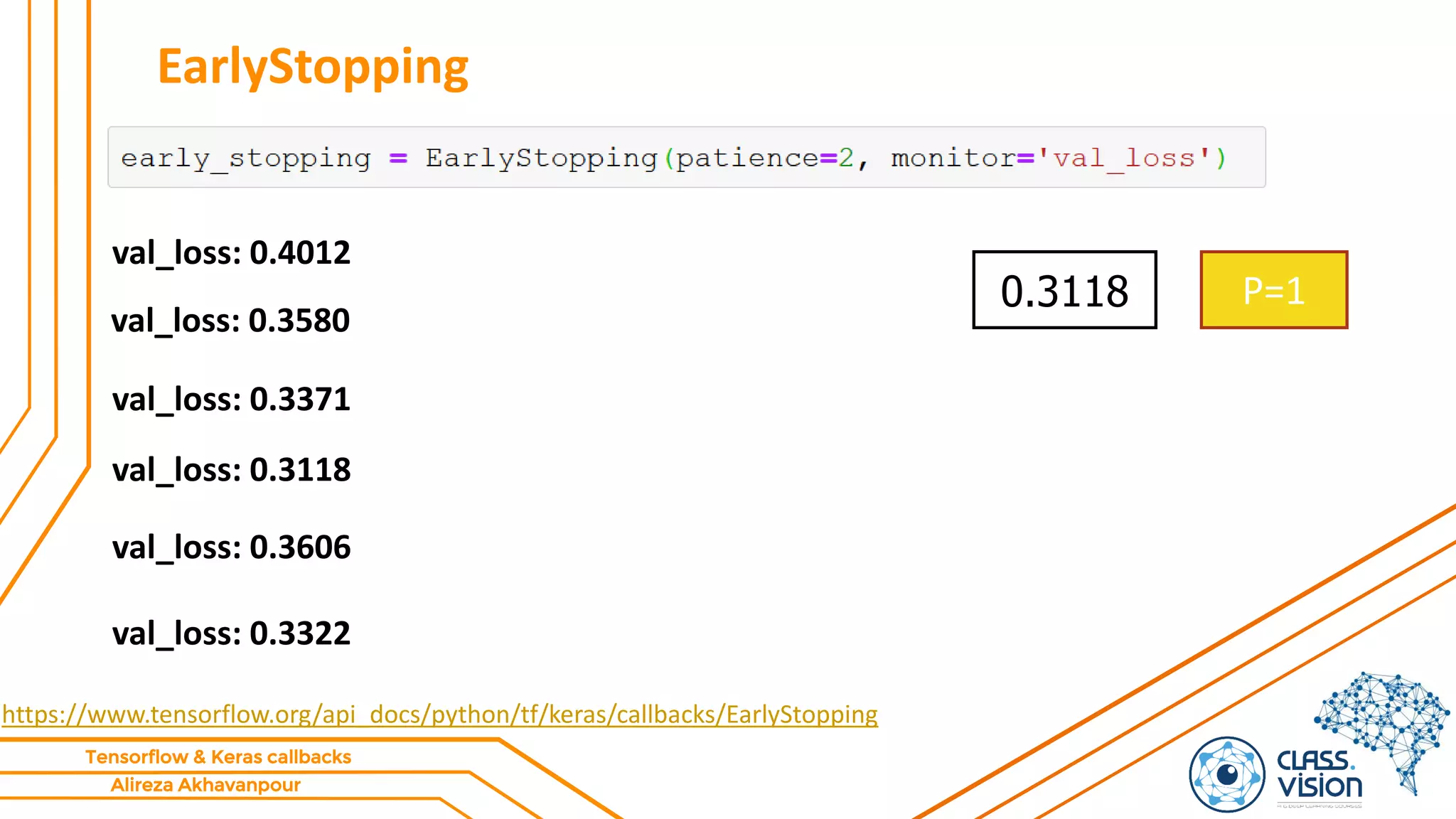
EarlyStopping
https://www.tensorflow.org/api_docs/python/tf/keras/callbacks/EarlyStopping
val_loss: 0.4012
val_loss: 0.3580
0.3118
val_loss: 0.3371
val_loss: 0.3118
val_loss: 0.3606
val_loss: 0.3322
P=1
Alireza Akhavanpour
Tensorflow & Keras callbacks
EarlyStopping
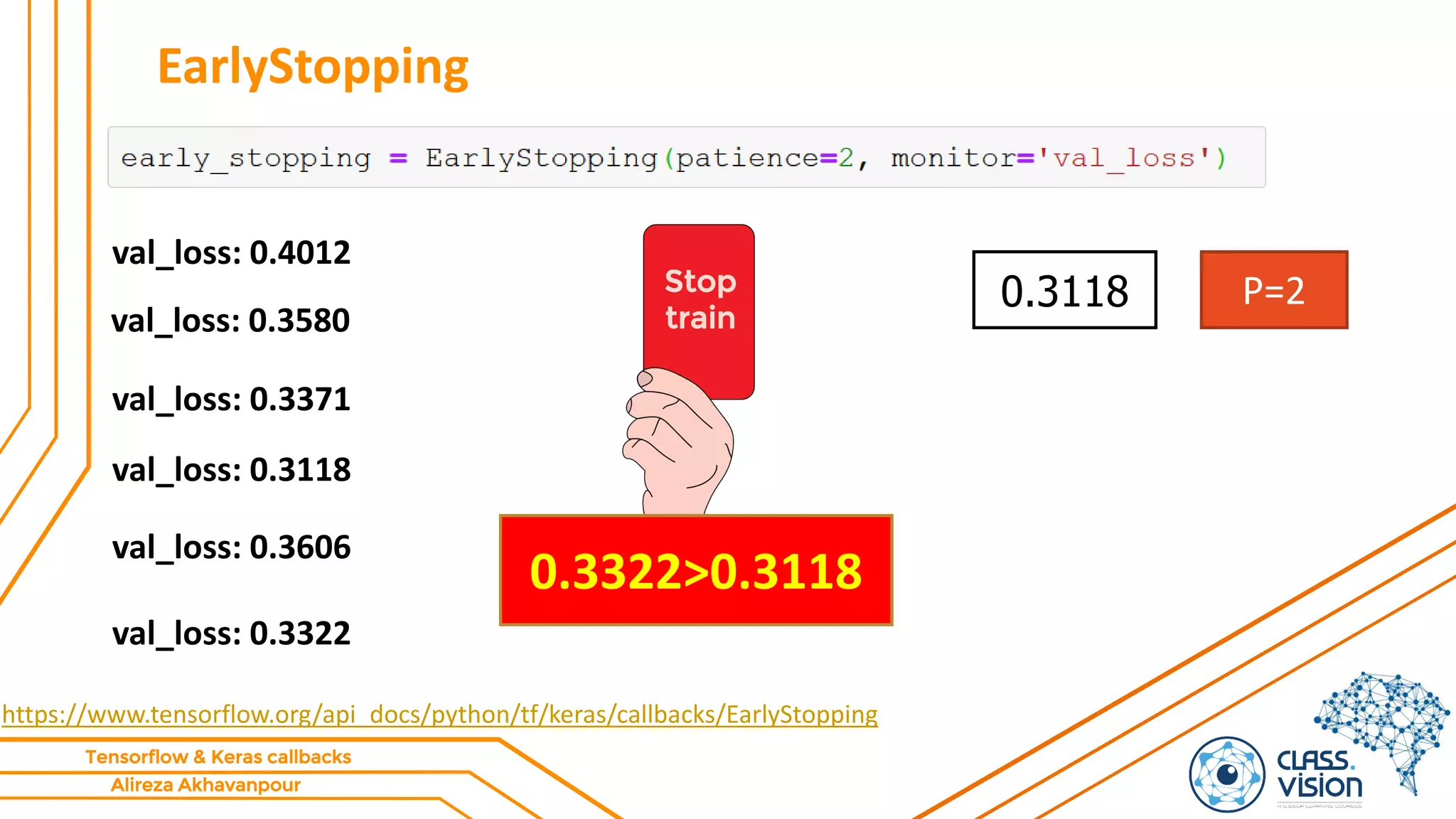
https://www.tensorflow.org/api_docs/python/tf/keras/callbacks/EarlyStopping
val_loss: 0.4012
val_loss: 0.3580
0.3118
val_loss: 0.3371
val_loss: 0.3118
val_loss: 0.3606
P=2
val_loss: 0.3322
0.3322>0.3118
Stop
train
Alireza Akhavanpour
Tensorflow & Keras callbacks
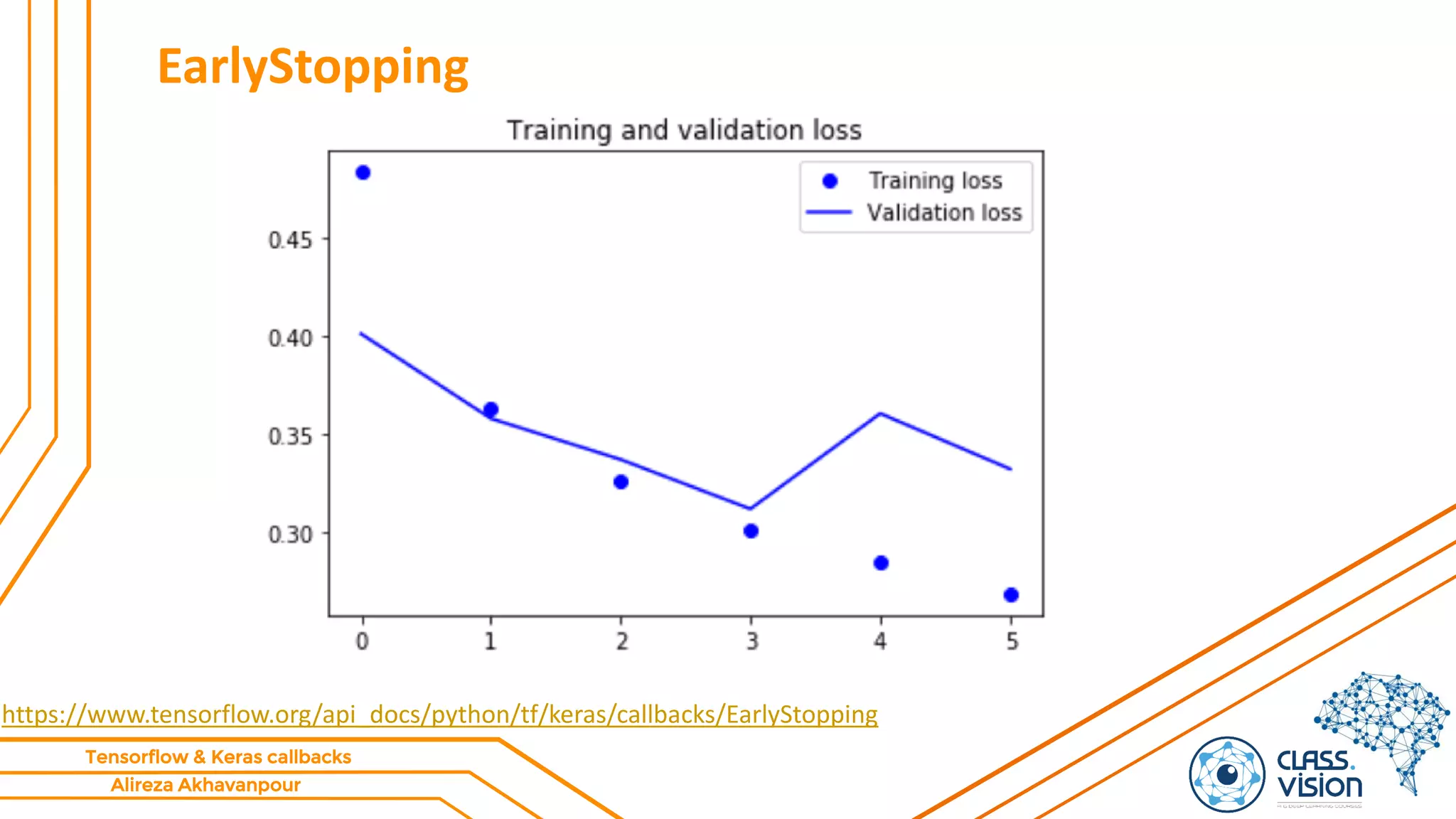
EarlyStopping
https://www.tensorflow.org/api_docs/python/tf/keras/callbacks/EarlyStopping
Alireza Akhavanpour
Tensorflow & Keras callbacks
EarlyStopping – Quiz 1 …
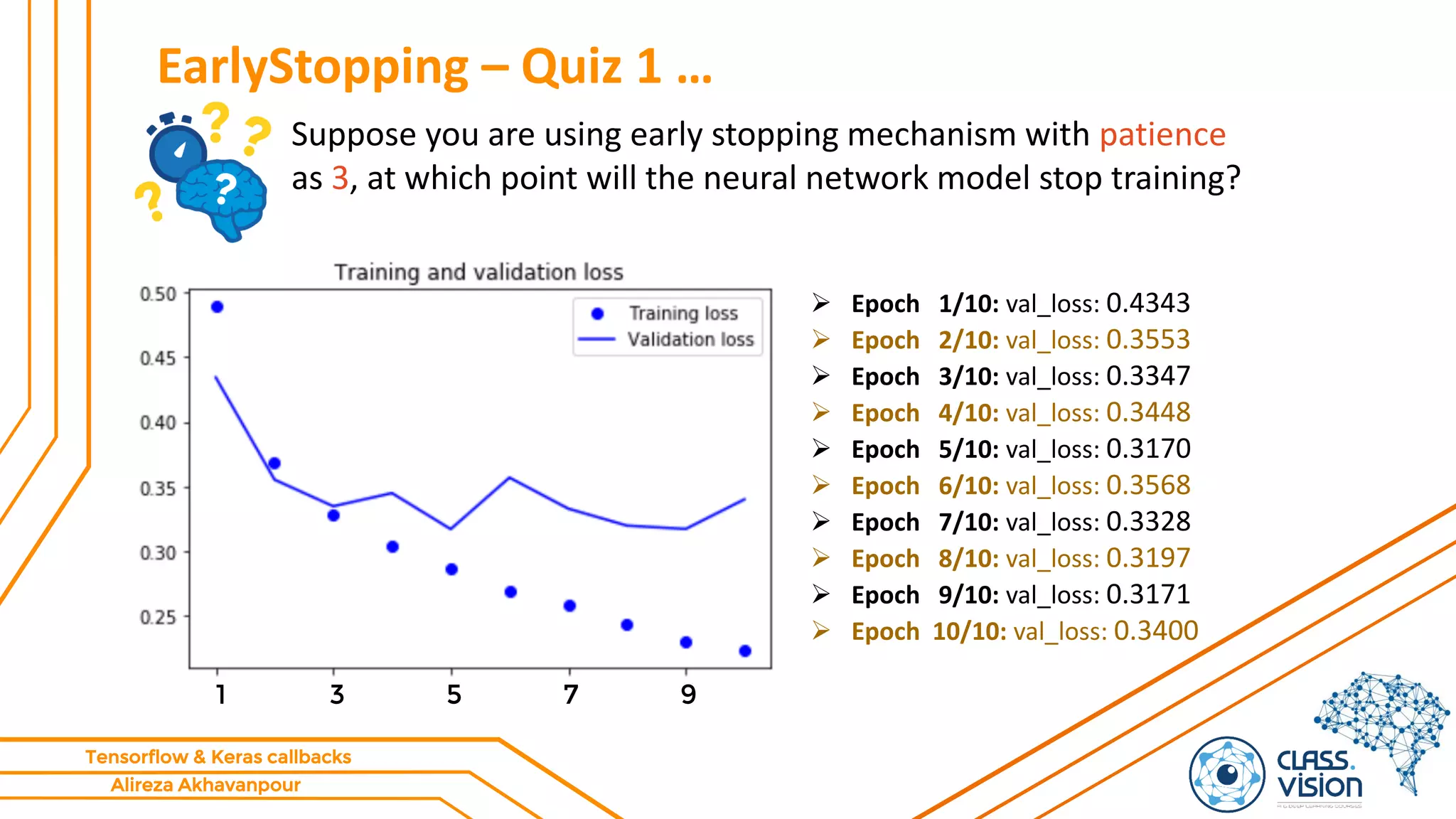
 Epoch 1/10: val_loss: 0.4343
 Epoch 2/10: val_loss: 0.3553
 Epoch 3/10: val_loss: 0.3347
 Epoch 4/10: val_loss: 0.3448
 Epoch 5/10: val_loss: 0.3170
 Epoch 6/10: val_loss: 0.3568
 Epoch 7/10: val_loss: 0.3328
 Epoch 8/10: val_loss: 0.3197
 Epoch 9/10: val_loss: 0.3171
 Epoch 10/10: val_loss: 0.3400
1 3 5 7 9
Suppose you are using early stopping mechanism with patience
as 3, at which point will the neural network model stop training?
Alireza Akhavanpour
Tensorflow & Keras callbacks
EarlyStopping – Quiz2 …
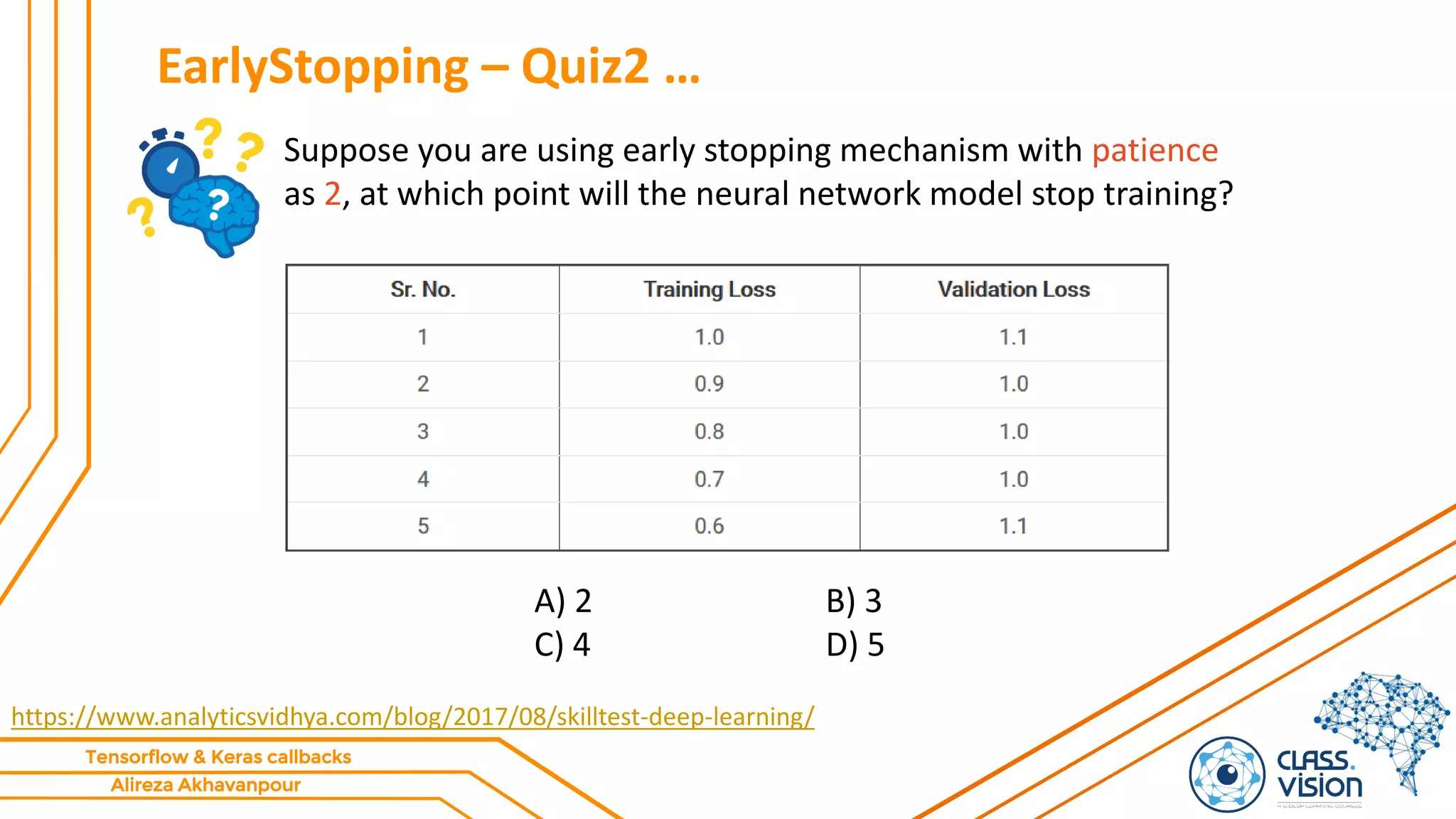
Suppose you are using early stopping mechanism with patience
as 2, at which point will the neural network model stop training?
A) 2 B) 3
C) 4 D) 5
https://www.analyticsvidhya.com/blog/2017/08/skilltest-deep-learning/
Alireza Akhavanpour
Tensorflow & Keras callbacks
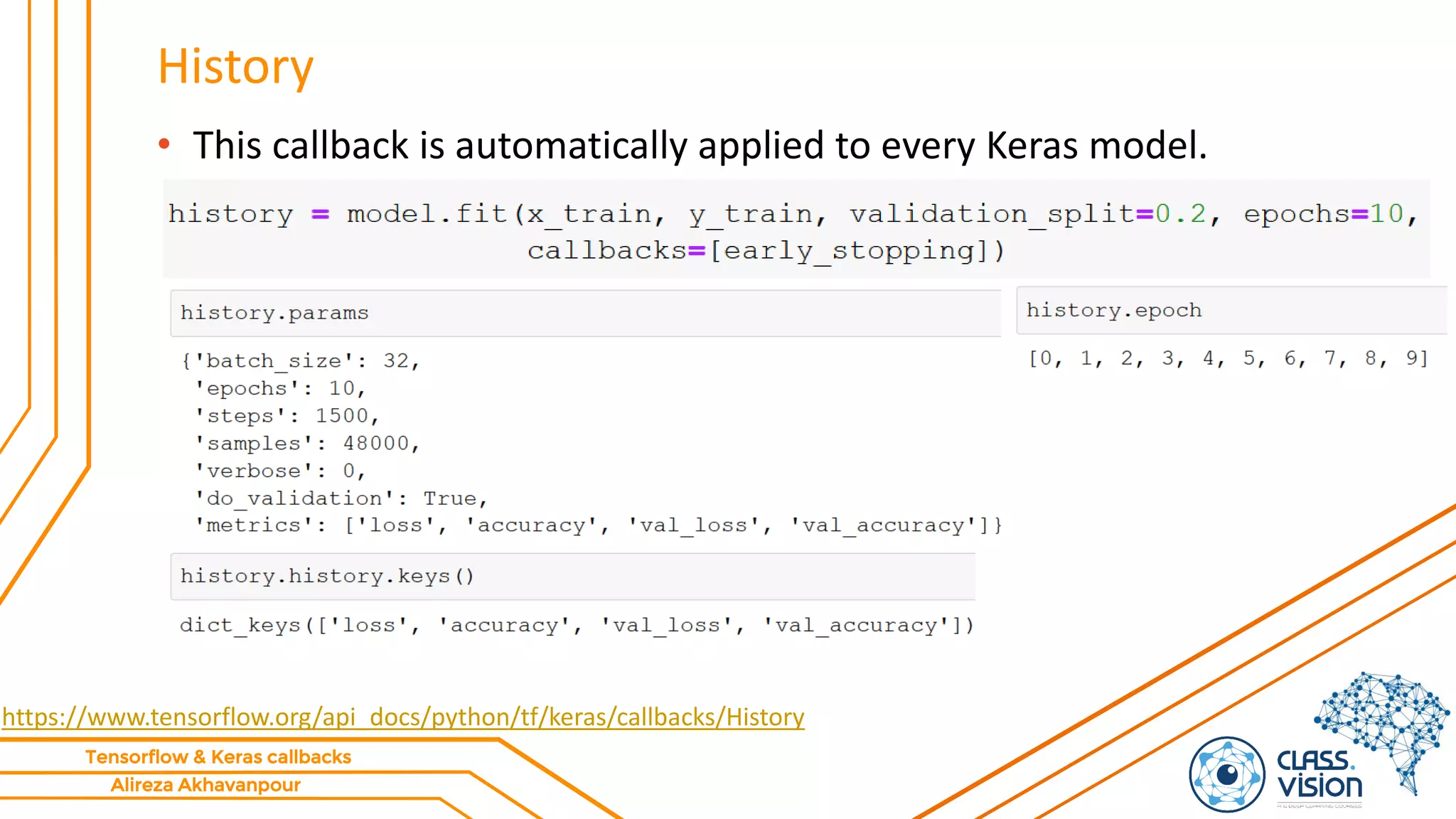
History
• This callback is automatically applied to every Keras model.
https://www.tensorflow.org/api_docs/python/tf/keras/callbacks/History
Alireza Akhavanpour
Tensorflow & Keras callbacks
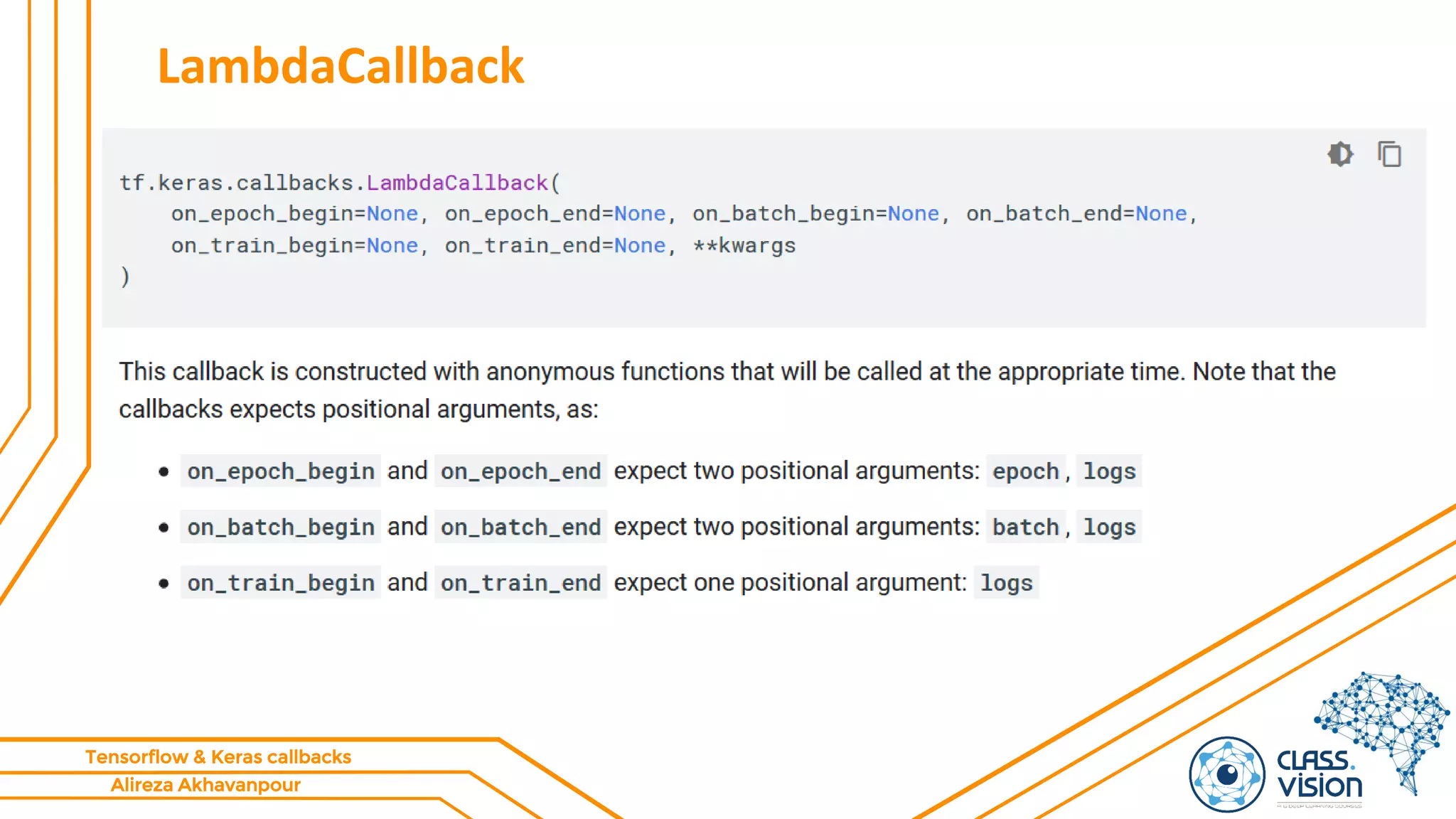
LambdaCallback
Alireza Akhavanpour
Tensorflow & Keras callbacks
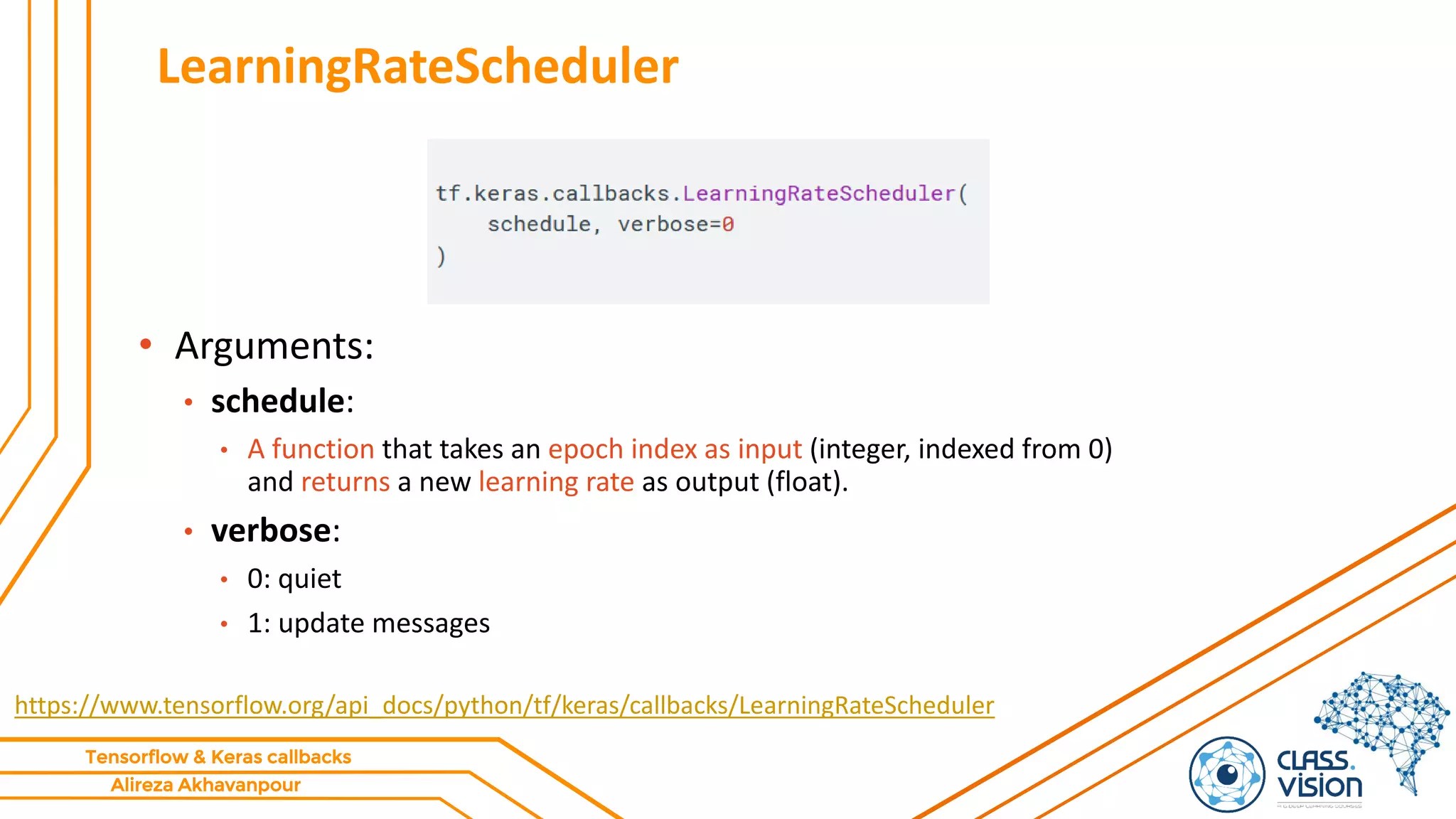
LearningRateScheduler
https://www.tensorflow.org/api_docs/python/tf/keras/callbacks/LearningRateScheduler
• Arguments:
• schedule:
• A function that takes an epoch index as input (integer, indexed from 0)
and returns a new learning rate as output (float).
• verbose:
• 0: quiet
• 1: update messages
Alireza Akhavanpour
Tensorflow & Keras callbacks
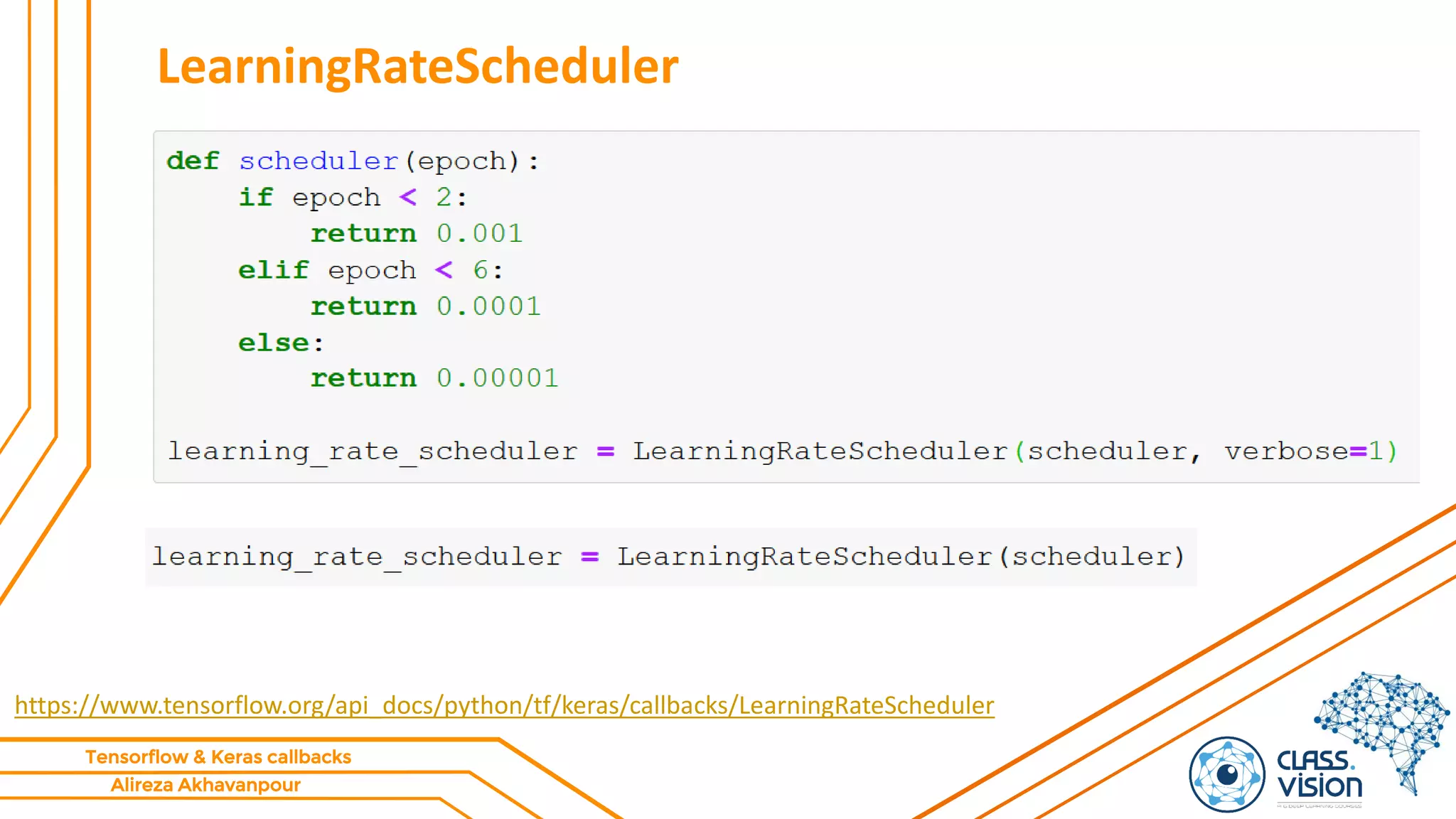
LearningRateScheduler
https://www.tensorflow.org/api_docs/python/tf/keras/callbacks/LearningRateScheduler
Alireza Akhavanpour
Tensorflow & Keras callbacks
ModelCheckpoint
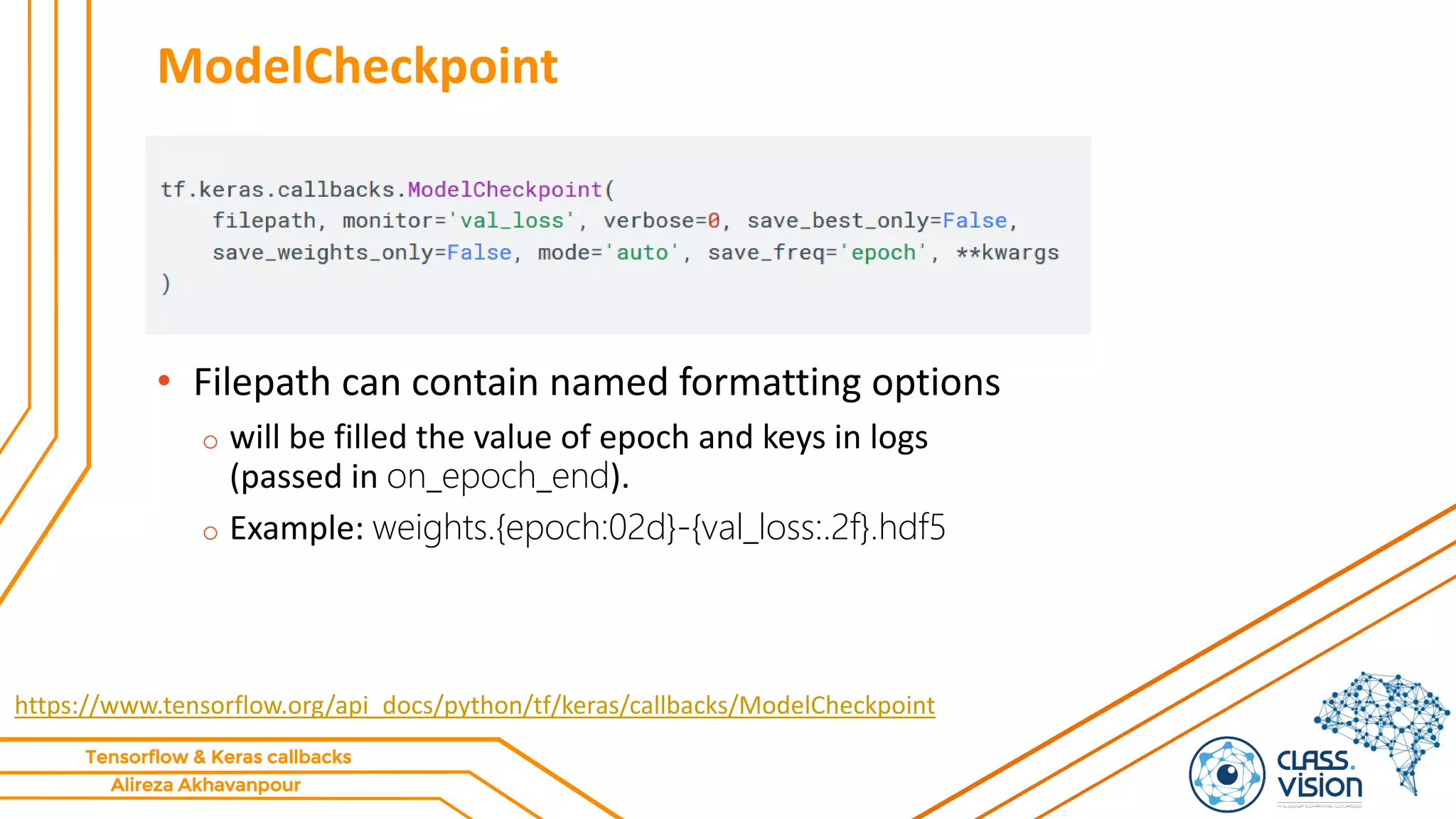
• Filepath can contain named formatting options
o will be filled the value of epoch and keys in logs
(passed in on_epoch_end).
o Example: weights.{epoch:02d}-{val_loss:.2f}.hdf5
https://www.tensorflow.org/api_docs/python/tf/keras/callbacks/ModelCheckpoint
Alireza Akhavanpour
Tensorflow & Keras callbacks
ModelCheckpoint
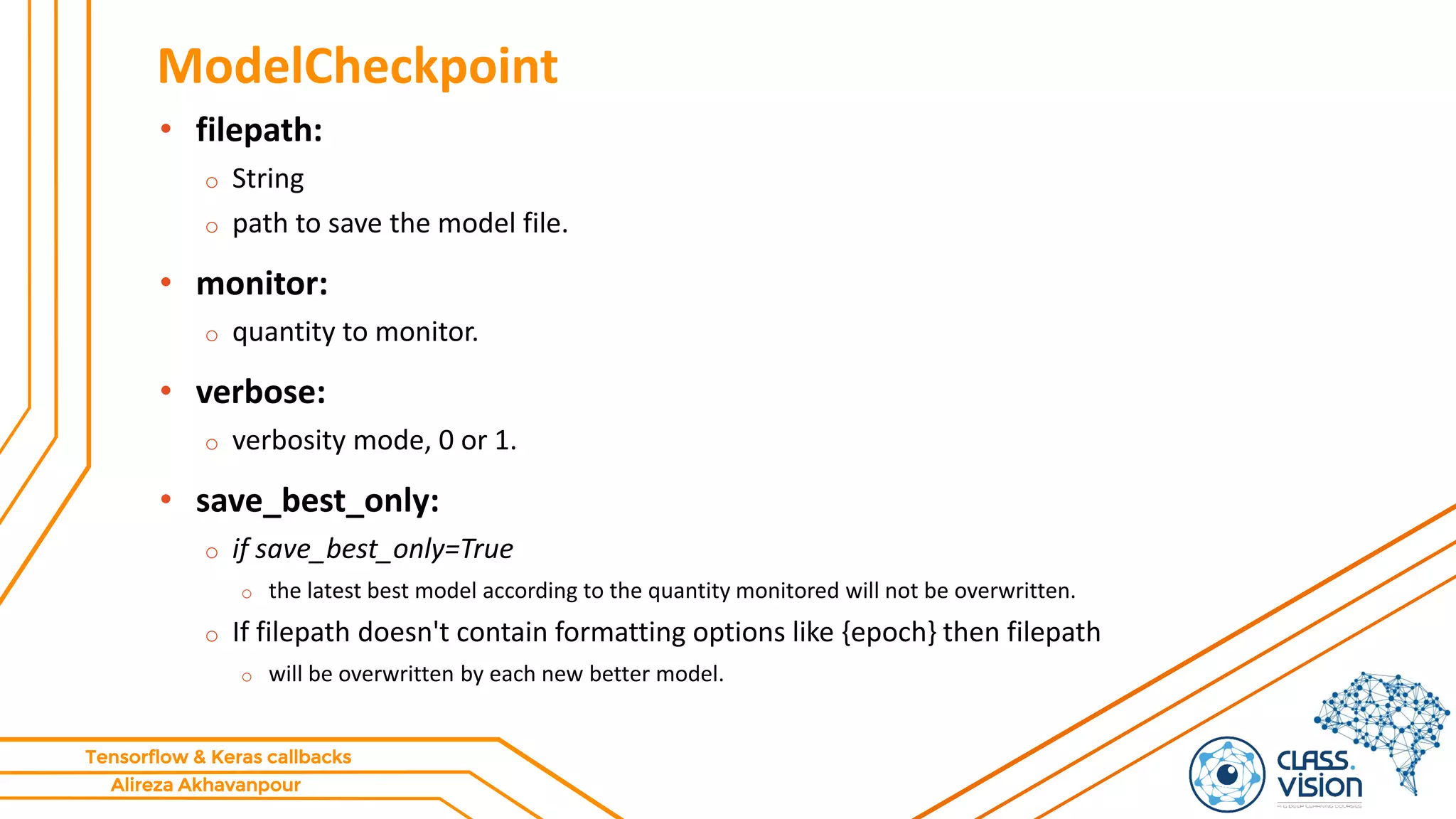
• filepath:
o String
o path to save the model file.
• monitor:
o quantity to monitor.
• verbose:
o verbosity mode, 0 or 1.
• save_best_only:
o if save_best_only=True
o the latest best model according to the quantity monitored will not be overwritten.
o If filepath doesn't contain formatting options like {epoch} then filepath
o will be overwritten by each new better model.
Alireza Akhavanpour
Tensorflow & Keras callbacks
ModelCheckpoint
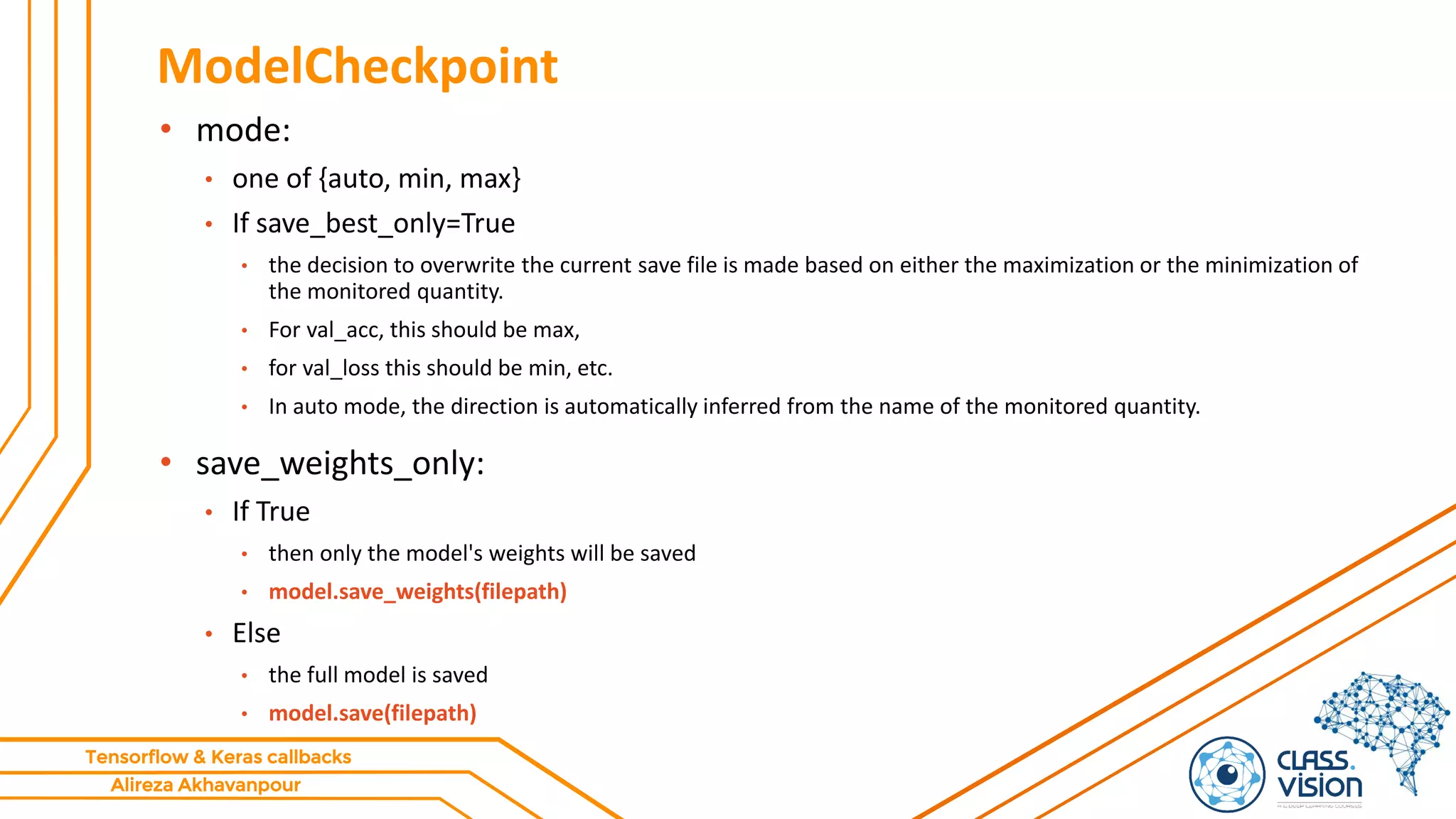
• mode:
• one of {auto, min, max}
• If save_best_only=True
• the decision to overwrite the current save file is made based on either the maximization or the minimization of
the monitored quantity.
• For val_acc, this should be max,
• for val_loss this should be min, etc.
• In auto mode, the direction is automatically inferred from the name of the monitored quantity.
• save_weights_only:
• If True
• then only the model's weights will be saved
• model.save_weights(filepath)
• Else
• the full model is saved
• model.save(filepath)
Alireza Akhavanpour
Tensorflow & Keras callbacks
ModelCheckpoint
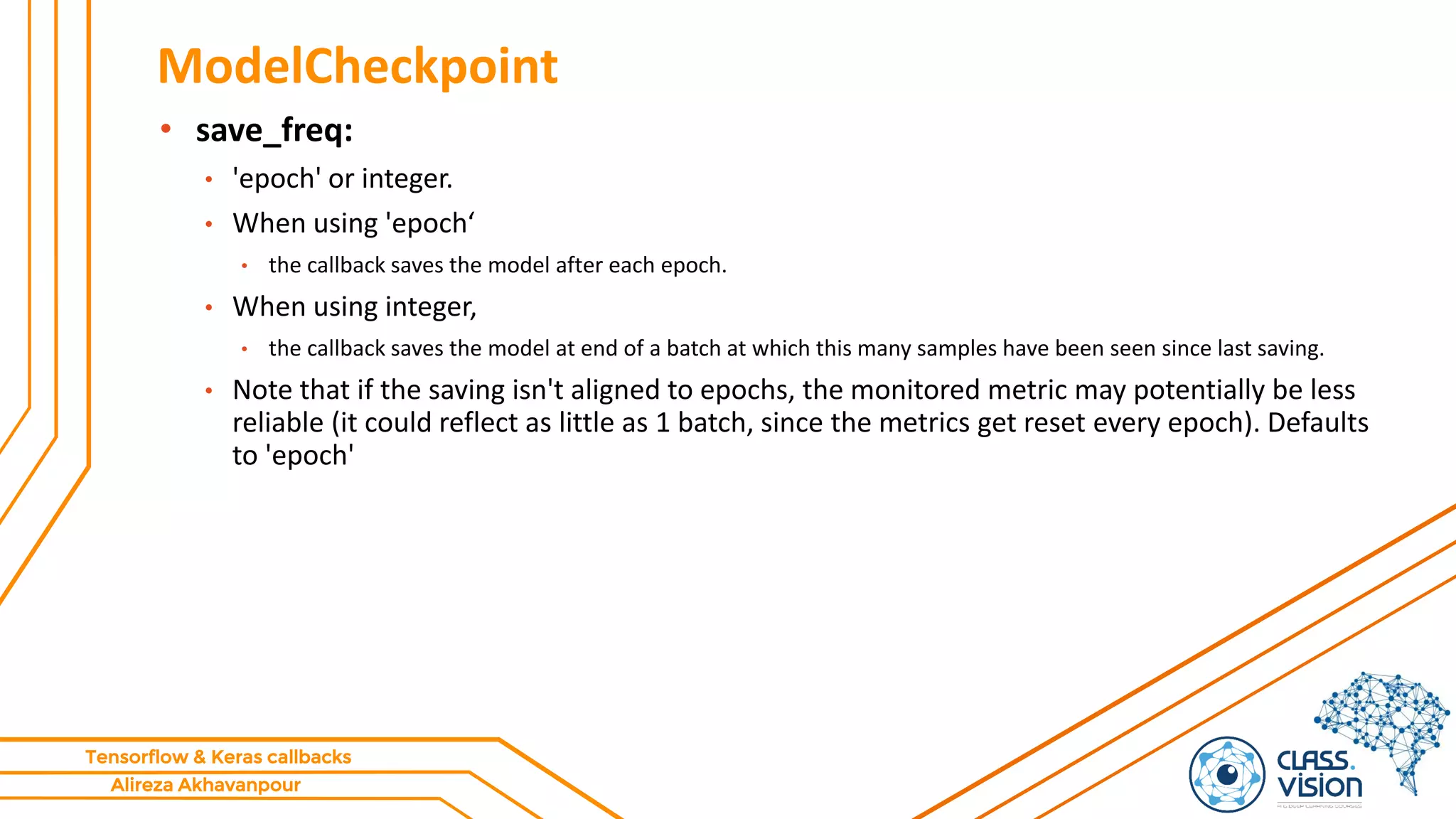
• save_freq:
• 'epoch' or integer.
• When using 'epoch‘
• the callback saves the model after each epoch.
• When using integer,
• the callback saves the model at end of a batch at which this many samples have been seen since last saving.
• Note that if the saving isn't aligned to epochs, the monitored metric may potentially be less
reliable (it could reflect as little as 1 batch, since the metrics get reset every epoch). Defaults
to 'epoch'
Alireza Akhavanpour
Tensorflow & Keras callbacks
ModelCheckpoint
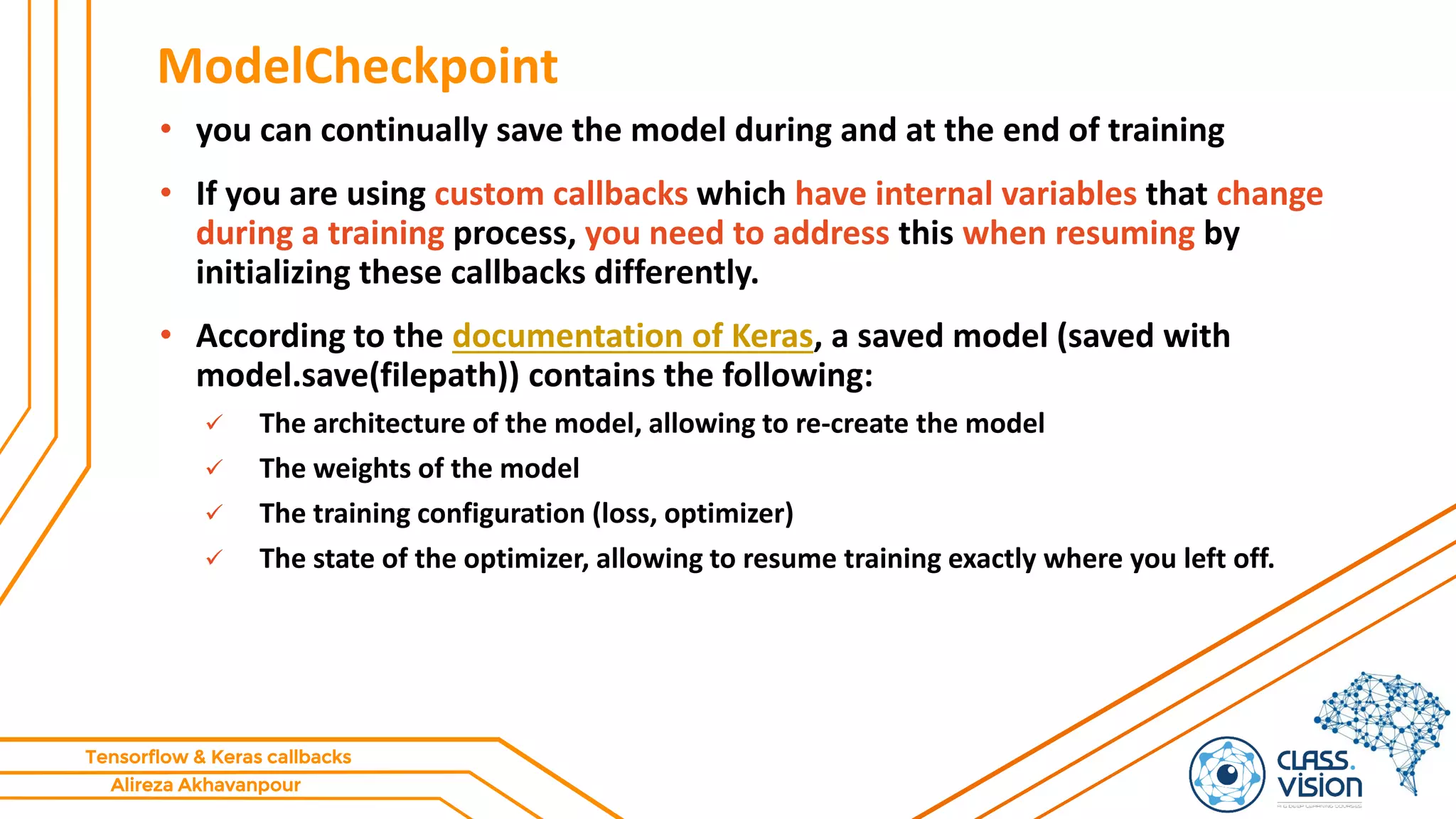
• you can continually save the model during and at the end of training
• If you are using custom callbacks which have internal variables that change
during a training process, you need to address this when resuming by
initializing these callbacks differently.
• According to the documentation of Keras, a saved model (saved with
model.save(filepath)) contains the following:
 The architecture of the model, allowing to re-create the model
 The weights of the model
 The training configuration (loss, optimizer)
 The state of the optimizer, allowing to resume training exactly where you left off.
Alireza Akhavanpour
Tensorflow & Keras callbacks
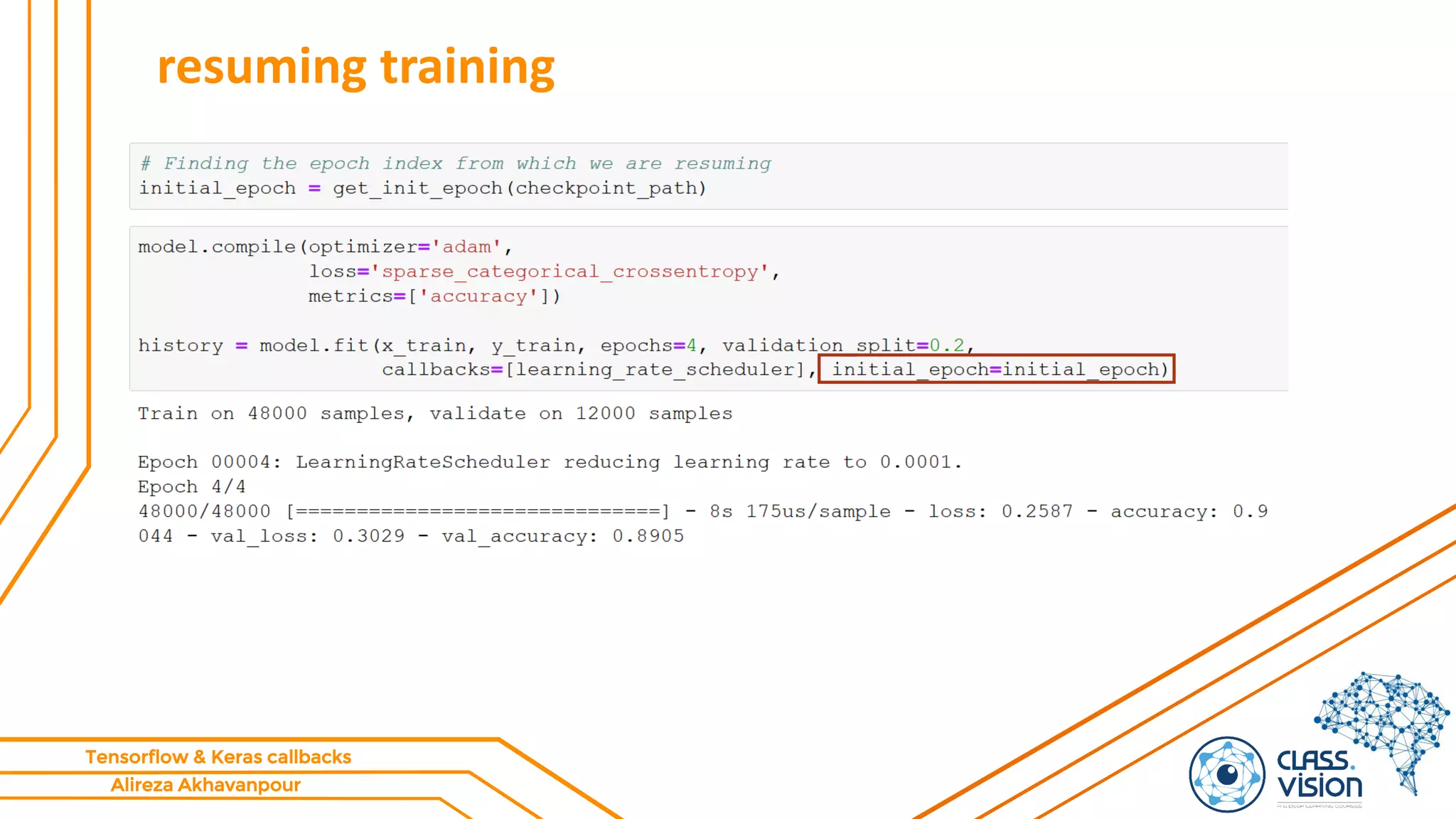
resuming training
Alireza Akhavanpour
Tensorflow & Keras callbacks
Saving custom objects
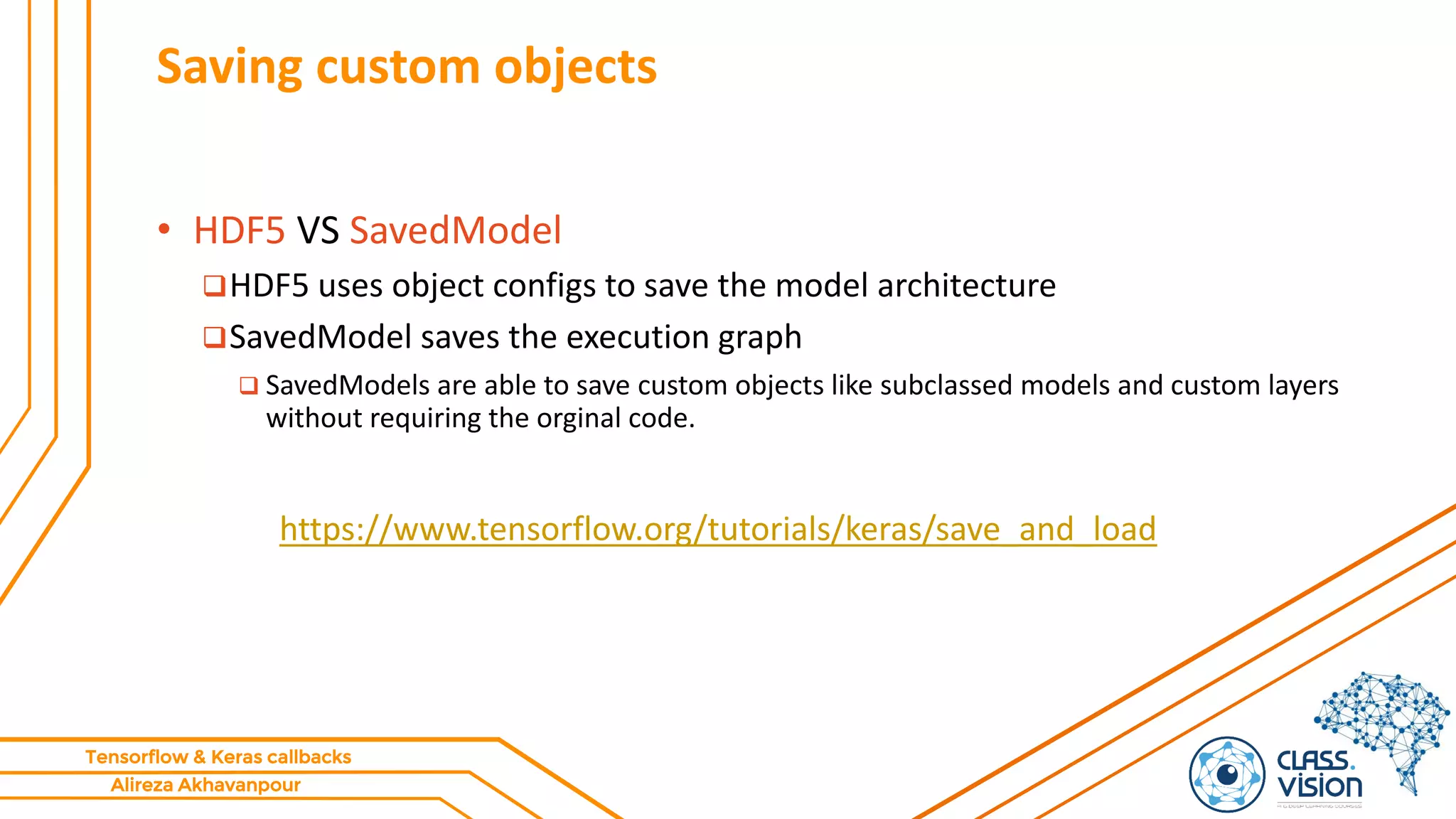
• HDF5 VS SavedModel
HDF5 uses object configs to save the model architecture
SavedModel saves the execution graph
 SavedModels are able to save custom objects like subclassed models and custom layers
without requiring the orginal code.
https://www.tensorflow.org/tutorials/keras/save_and_load
Alireza Akhavanpour
Tensorflow & Keras callbacks
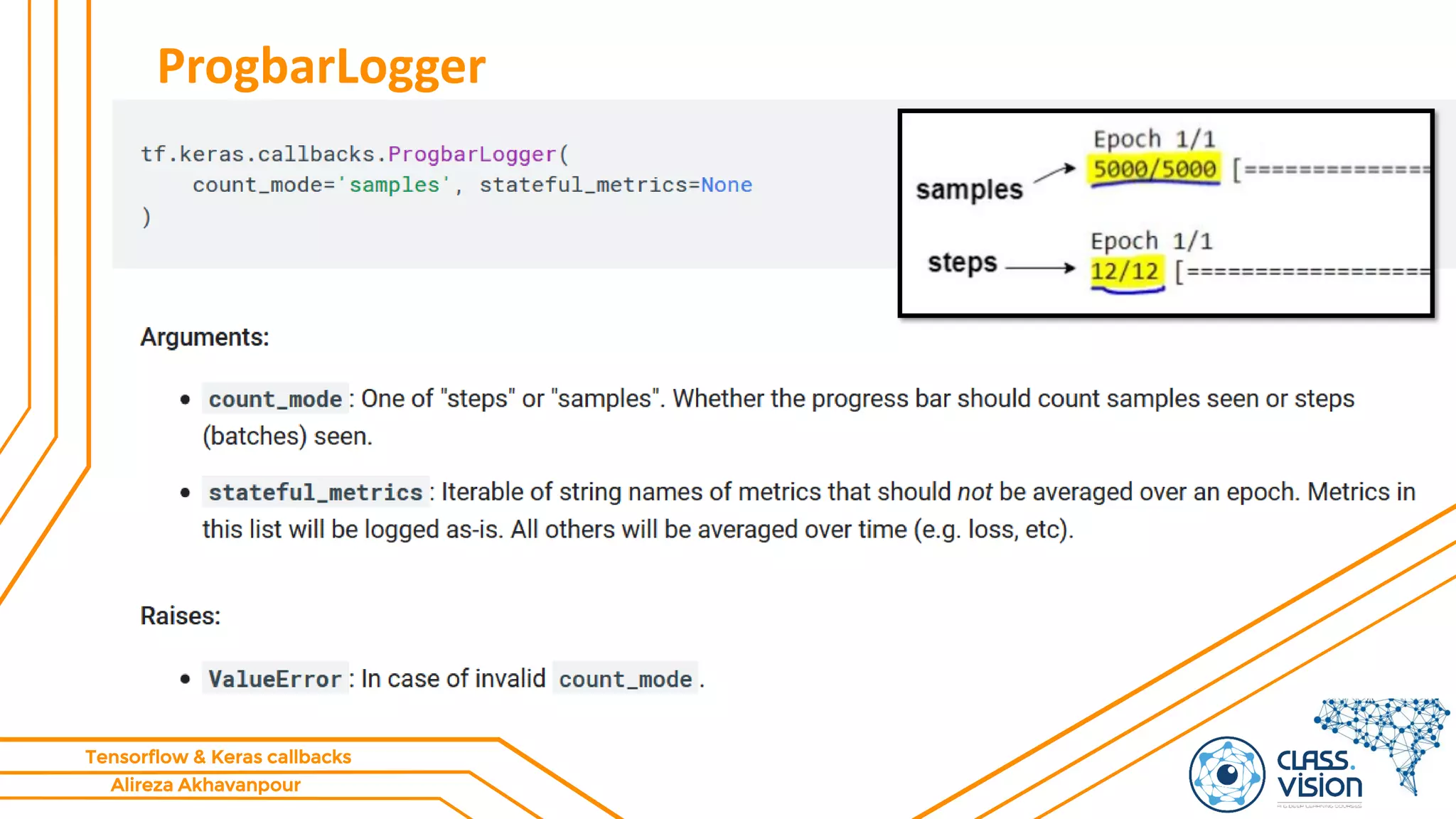
ProgbarLogger
Alireza Akhavanpour
Tensorflow & Keras callbacks
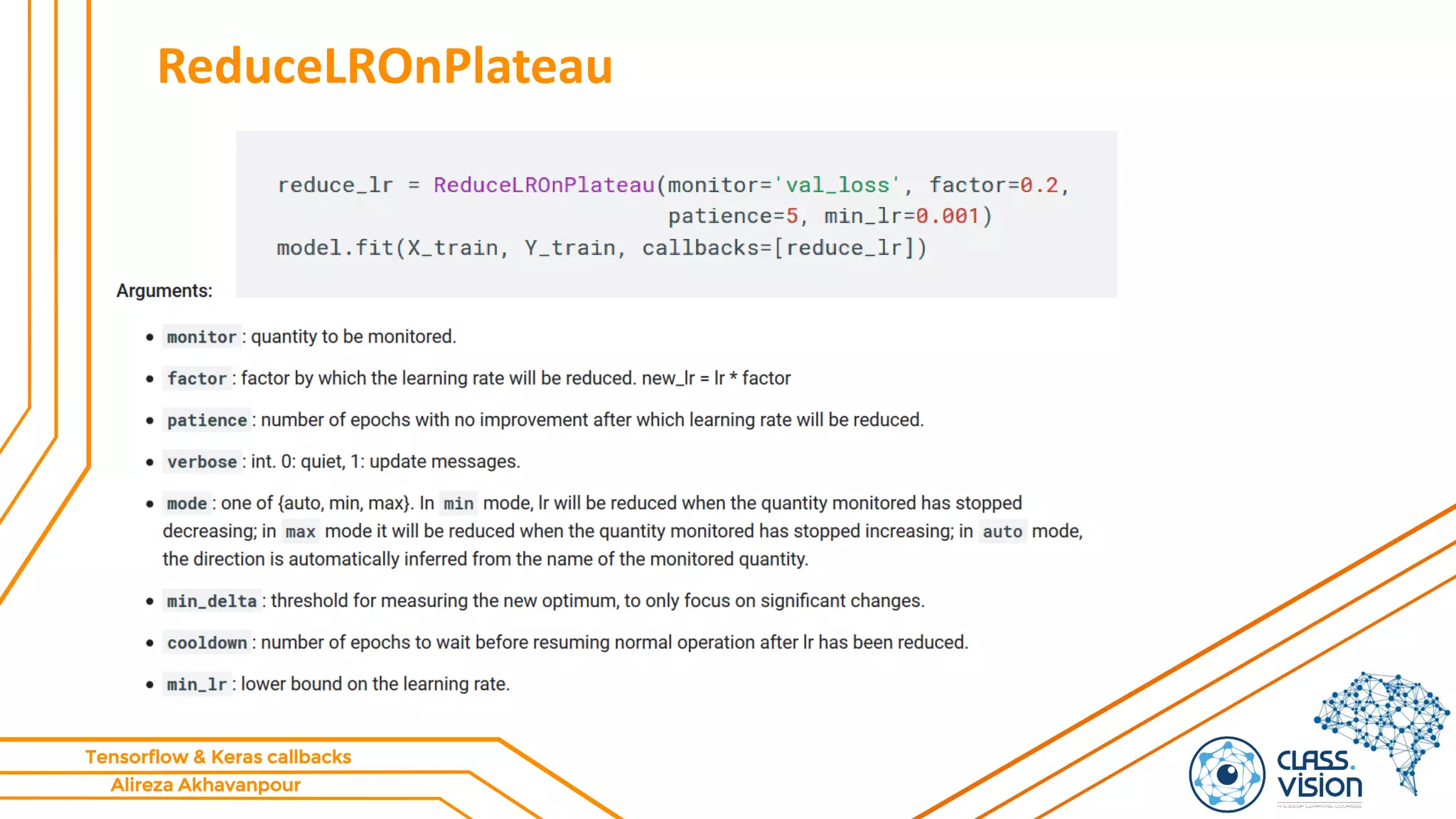
ReduceLROnPlateau
Alireza Akhavanpour
Tensorflow & Keras callbacks
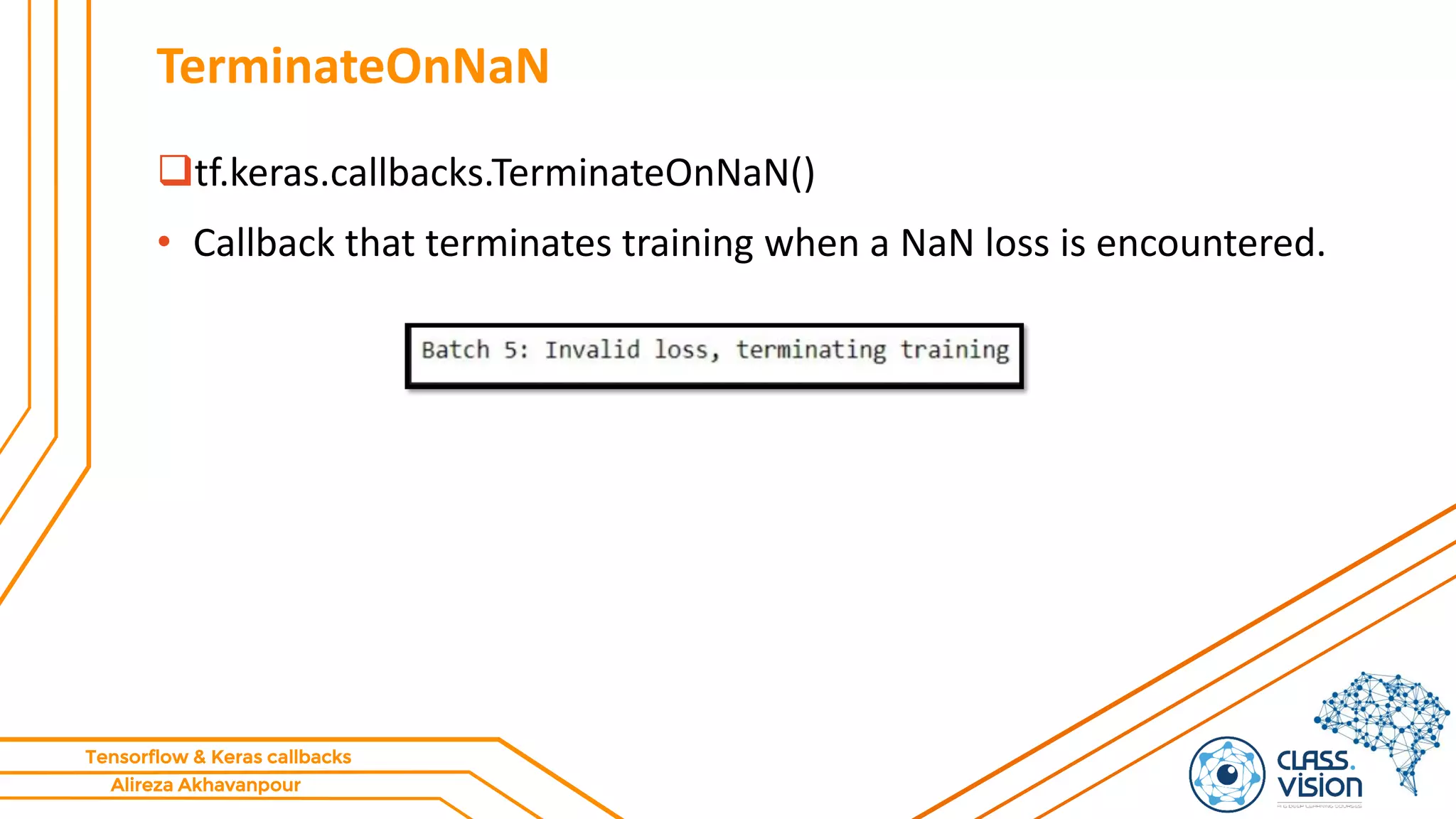
TerminateOnNaN
tf.keras.callbacks.TerminateOnNaN()
• Callback that terminates training when a NaN loss is encountered.
Alireza Akhavanpour
Tensorflow & Keras callbacks
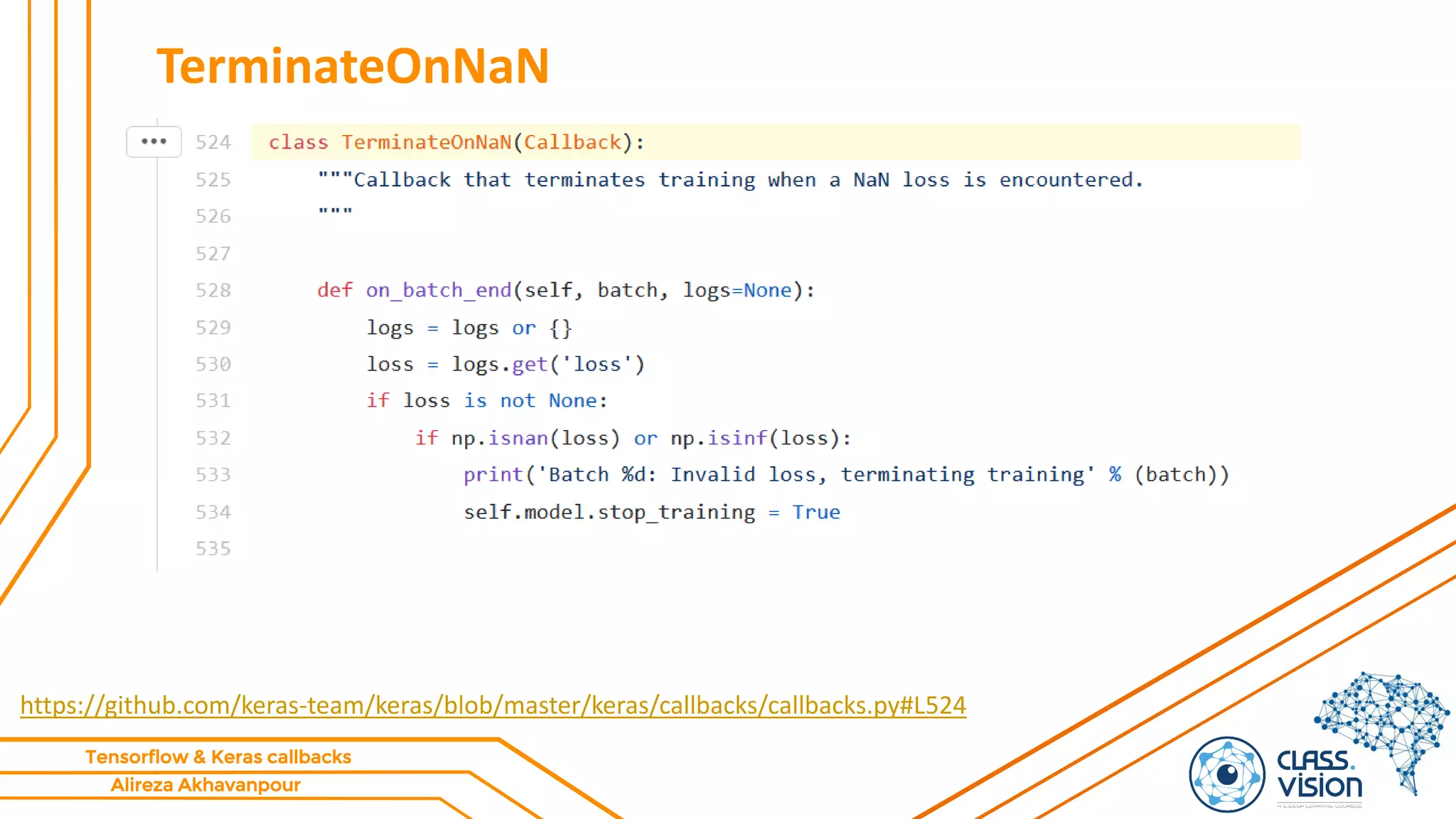
TerminateOnNaN
https://github.com/keras-team/keras/blob/master/keras/callbacks/callbacks.py#L524
Alireza Akhavanpour
Tensorflow & Keras callbacks
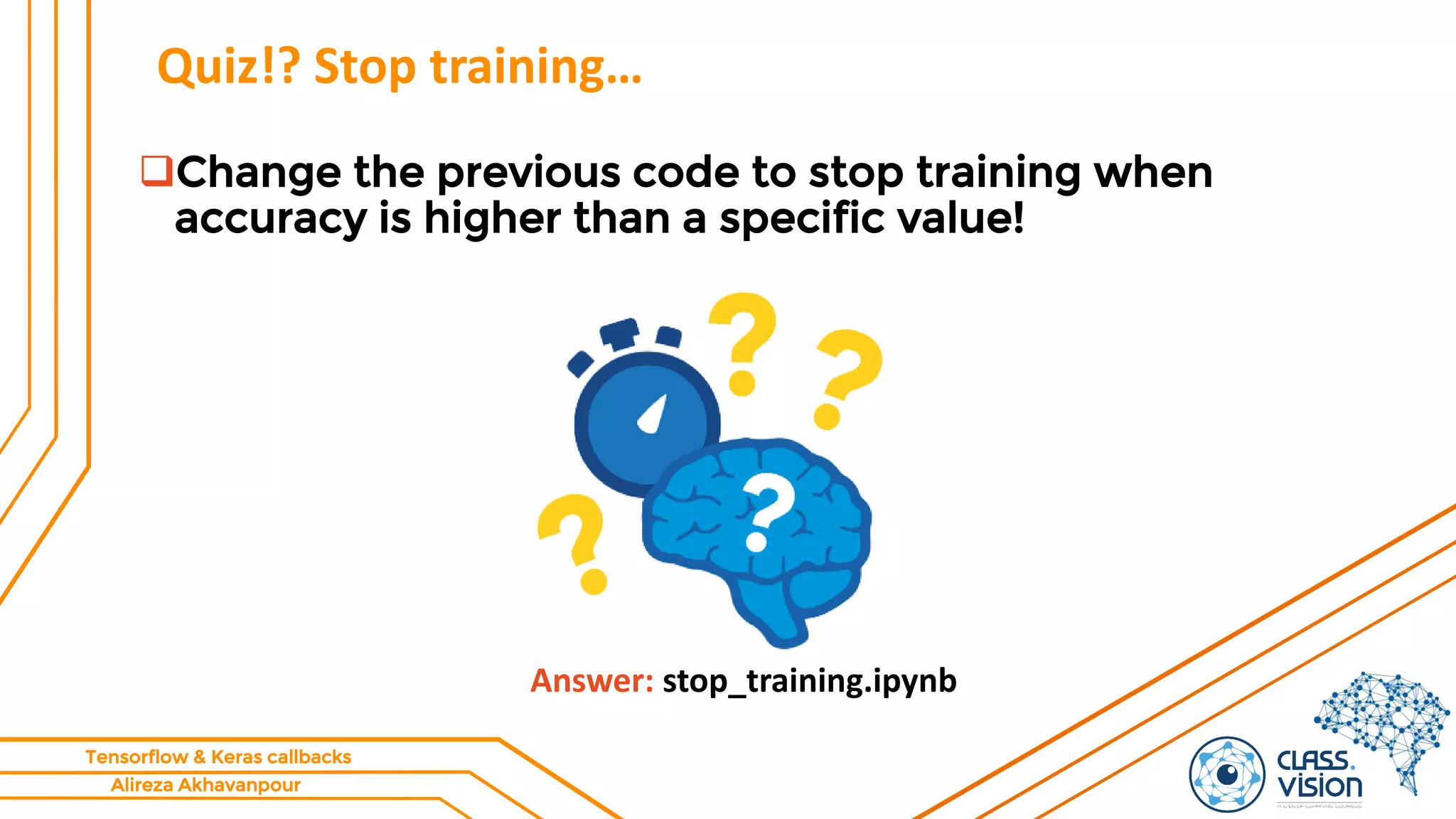
Quiz!? Stop training…
Change the previous code to stop training when
accuracy is higher than a specific value!
Answer: stop_training.ipynb
Alireza Akhavanpour
Tensorflow & Keras callbacks
‫کنید‬ ‫دنبال‬ ‫را‬ ‫ما‬...
https://t.me/cvision
https://www.aparat.com/cvision
https://www.linkedin.com/company/class-vision/
http://class.vision
http://github.com/alireza-akhavan/
Alireza Akhavanpour
Tensorflow & Keras callbacks
Sources
o https://www.tensorflow.org/guide/keras/custom_callback
o https://www.tensorflow.org/api_docs/python/tf/keras/callbacks/CSVLogger
o https://www.tensorflow.org/api_docs/python/tf/keras/callbacks/BaseLogger
o https://www.tensorflow.org/api_docs/python/tf/keras/callbacks/EarlyStopping
o https://www.tensorflow.org/api_docs/python/tf/keras/callbacks/History
o https://www.tensorflow.org/api_docs/python/tf/keras/callbacks/LearningRateScheduler
o https://www.tensorflow.org/api_docs/python/tf/keras/callbacks/ModelCheckpoint
o https://www.tensorflow.org/tutorials/keras/save_and_load
o https://www.coursera.org/lecture/introduction-tensorflow/using-callbacks-to-control-training-AIkt8
o https://medium.com/analytics-vidhya/groom-your-model-using-keras-callbacks-e97b4fa1b21c
o https://medium.com/analytics-vidhya/tensorflow-2-0-save-and-restore-models-4708ed3f0d8
o https://towardsdatascience.com/resuming-a-training-process-with-keras-3e93152ee11a
o https://www.tensorflow.org/tutorials/keras/save_and_load

Callbacks part1

  • 1.
    Alireza Akhavanpour Tensorflow &Keras callbacks TensorFlow Callbacks (Part I) Alireza Akhavanpour Akhavanpour.ir CLASS.VISION https://github.com/Alireza-Akhavan/tf2-tutorial
  • 2.
    Alireza Akhavanpour Tensorflow &Keras callbacks What is Callback?  Callbacks: utilities called at certain points during model training. https://www.tensorflow.org/api_docs/python/tf/keras/callbacks
  • 3.
    Alireza Akhavanpour Tensorflow &Keras callbacks What is Callback?  Callbacks: utilities called at certain points during model training. https://www.tensorflow.org/api_docs/python/tf/keras/callbacks  set of methods called at various stages of training, testing, and predicting o batch/epoch o start and ends  useful to get a view on internal states and statistics of the model during training.  You can pass a list of callbacks to any of these methods: o tf.keras.Model.fit() o tf.keras.Model.evaluate() o tf.keras.Model.predict().
  • 4.
    Alireza Akhavanpour Tensorflow &Keras callbacks Model methods that take callbacks
  • 5.
    Alireza Akhavanpour Tensorflow &Keras callbacks Classes  class BaseLogger: Callback that accumulates epoch averages of metrics.  class CSVLogger: Callback that streams epoch results to a csv file.  class Callback: Abstract base class used to build new callbacks.  class EarlyStopping: Stop training when a monitored quantity has stopped improving.  class History: Callback that records events into a History object.  class LambdaCallback: Callback for creating simple, custom callbacks on-the-fly.  class LearningRateScheduler: Learning rate scheduler.  class ModelCheckpoint: Save the model after every epoch.  class ProgbarLogger: Callback that prints metrics to stdout.  class ReduceLROnPlateau: Reduce learning rate when a metric has stopped improving.  class RemoteMonitor: Callback used to stream events to a server.  class TensorBoard: Enable visualizations for TensorBoard.  class TerminateOnNaN: Callback that terminates training when a NaN loss is encountered. https://www.tensorflow.org/api_docs/python/tf/keras/callbacks
  • 6.
    Alireza Akhavanpour Tensorflow &Keras callbacks Classes  class BaseLogger: Callback that accumulates epoch averages of metrics.  class CSVLogger: Callback that streams epoch results to a csv file.  class Callback: Abstract base class used to build new callbacks.  class EarlyStopping: Stop training when a monitored quantity has stopped improving.  class History: Callback that records events into a History object.  class LambdaCallback: Callback for creating simple, custom callbacks on-the-fly.  class LearningRateScheduler: Learning rate scheduler.  class ModelCheckpoint: Save the model after every epoch.  class ProgbarLogger: Callback that prints metrics to stdout.  class ReduceLROnPlateau: Reduce learning rate when a metric has stopped improving.  class RemoteMonitor: Callback used to stream events to a server.  class TensorBoard: Enable visualizations for TensorBoard.  class TerminateOnNaN: Callback that terminates training when a NaN loss is encountered. https://www.tensorflow.org/api_docs/python/tf/keras/callbacks
  • 7.
    Alireza Akhavanpour Tensorflow &Keras callbacks Methods  on_batch_begin  on_batch_end  on_epoch_begin  on_epoch_end  on_predict_batch_begin  on_predict_batch_end  on_predict_begin  on_predict_end  on_test_batch_begin  on_test_batch_end  on_test_begin  on_train_batch_begin  on_train_batch_end  on_train_begin  on_train_end
  • 8.
    Alireza Akhavanpour Tensorflow &Keras callbacks Usage One parameter two parameters two parameters
  • 9.
    Alireza Akhavanpour Tensorflow &Keras callbacks CSVLogger from tensorflow.keras.callbacks import CSVLogger csv_logger = CSVLogger('training.log') https://www.tensorflow.org/api_docs/python/tf/keras/callbacks/CSVLogger
  • 10.
    Alireza Akhavanpour Tensorflow &Keras callbacks BaseLogger https://www.tensorflow.org/api_docs/python/tf/keras/callbacks/BaseLogger
  • 11.
    Alireza Akhavanpour Tensorflow &Keras callbacks What was it?!
  • 12.
    Alireza Akhavanpour Tensorflow &Keras callbacks What was it?!
  • 13.
    Alireza Akhavanpour Tensorflow &Keras callbacks EarlyStopping https://www.tensorflow.org/api_docs/python/tf/keras/callbacks/EarlyStopping val_loss: 0.4012 0.4012
  • 14.
    Alireza Akhavanpour Tensorflow &Keras callbacks EarlyStopping https://www.tensorflow.org/api_docs/python/tf/keras/callbacks/EarlyStopping val_loss: 0.4012 0.4012 val_loss: 0.3580
  • 15.
    Alireza Akhavanpour Tensorflow &Keras callbacks EarlyStopping https://www.tensorflow.org/api_docs/python/tf/keras/callbacks/EarlyStopping val_loss: 0.4012 val_loss: 0.3580 0.3580
  • 16.
    Alireza Akhavanpour Tensorflow &Keras callbacks EarlyStopping https://www.tensorflow.org/api_docs/python/tf/keras/callbacks/EarlyStopping val_loss: 0.4012 val_loss: 0.3580 0.3580 val_loss: 0.3371
  • 17.
    Alireza Akhavanpour Tensorflow &Keras callbacks EarlyStopping https://www.tensorflow.org/api_docs/python/tf/keras/callbacks/EarlyStopping val_loss: 0.4012 val_loss: 0.3580 0.3580 val_loss: 0.3371
  • 18.
    Alireza Akhavanpour Tensorflow &Keras callbacks EarlyStopping https://www.tensorflow.org/api_docs/python/tf/keras/callbacks/EarlyStopping val_loss: 0.4012 val_loss: 0.3580 0.3371 val_loss: 0.3371
  • 19.
    Alireza Akhavanpour Tensorflow &Keras callbacks EarlyStopping https://www.tensorflow.org/api_docs/python/tf/keras/callbacks/EarlyStopping val_loss: 0.4012 val_loss: 0.3580 0.3371 val_loss: 0.3371 val_loss: 0.3118
  • 20.
    Alireza Akhavanpour Tensorflow &Keras callbacks EarlyStopping https://www.tensorflow.org/api_docs/python/tf/keras/callbacks/EarlyStopping val_loss: 0.4012 val_loss: 0.3580 0.3371 val_loss: 0.3371 val_loss: 0.3118
  • 21.
    Alireza Akhavanpour Tensorflow &Keras callbacks EarlyStopping https://www.tensorflow.org/api_docs/python/tf/keras/callbacks/EarlyStopping val_loss: 0.4012 val_loss: 0.3580 0.3118 val_loss: 0.3371 val_loss: 0.3118 val_loss: 0.3606
  • 22.
    Alireza Akhavanpour Tensorflow &Keras callbacks EarlyStopping https://www.tensorflow.org/api_docs/python/tf/keras/callbacks/EarlyStopping val_loss: 0.4012 val_loss: 0.3580 0.3118 val_loss: 0.3371 val_loss: 0.3118 val_loss: 0.3606 0.3606>0.3118
  • 23.
    Alireza Akhavanpour Tensorflow &Keras callbacks EarlyStopping https://www.tensorflow.org/api_docs/python/tf/keras/callbacks/EarlyStopping val_loss: 0.4012 val_loss: 0.3580 0.3118 val_loss: 0.3371 val_loss: 0.3118 val_loss: 0.3606 P=1
  • 24.
    Alireza Akhavanpour Tensorflow &Keras callbacks EarlyStopping https://www.tensorflow.org/api_docs/python/tf/keras/callbacks/EarlyStopping val_loss: 0.4012 val_loss: 0.3580 0.3118 val_loss: 0.3371 val_loss: 0.3118 val_loss: 0.3606 val_loss: 0.3322 P=1
  • 25.
    Alireza Akhavanpour Tensorflow &Keras callbacks EarlyStopping https://www.tensorflow.org/api_docs/python/tf/keras/callbacks/EarlyStopping val_loss: 0.4012 val_loss: 0.3580 0.3118 val_loss: 0.3371 val_loss: 0.3118 val_loss: 0.3606 P=2 val_loss: 0.3322 0.3322>0.3118 Stop train
  • 26.
    Alireza Akhavanpour Tensorflow &Keras callbacks EarlyStopping https://www.tensorflow.org/api_docs/python/tf/keras/callbacks/EarlyStopping
  • 27.
    Alireza Akhavanpour Tensorflow &Keras callbacks EarlyStopping – Quiz 1 …  Epoch 1/10: val_loss: 0.4343  Epoch 2/10: val_loss: 0.3553  Epoch 3/10: val_loss: 0.3347  Epoch 4/10: val_loss: 0.3448  Epoch 5/10: val_loss: 0.3170  Epoch 6/10: val_loss: 0.3568  Epoch 7/10: val_loss: 0.3328  Epoch 8/10: val_loss: 0.3197  Epoch 9/10: val_loss: 0.3171  Epoch 10/10: val_loss: 0.3400 1 3 5 7 9 Suppose you are using early stopping mechanism with patience as 3, at which point will the neural network model stop training?
  • 28.
    Alireza Akhavanpour Tensorflow &Keras callbacks EarlyStopping – Quiz2 … Suppose you are using early stopping mechanism with patience as 2, at which point will the neural network model stop training? A) 2 B) 3 C) 4 D) 5 https://www.analyticsvidhya.com/blog/2017/08/skilltest-deep-learning/
  • 29.
    Alireza Akhavanpour Tensorflow &Keras callbacks History • This callback is automatically applied to every Keras model. https://www.tensorflow.org/api_docs/python/tf/keras/callbacks/History
  • 30.
    Alireza Akhavanpour Tensorflow &Keras callbacks LambdaCallback
  • 31.
    Alireza Akhavanpour Tensorflow &Keras callbacks LearningRateScheduler https://www.tensorflow.org/api_docs/python/tf/keras/callbacks/LearningRateScheduler • Arguments: • schedule: • A function that takes an epoch index as input (integer, indexed from 0) and returns a new learning rate as output (float). • verbose: • 0: quiet • 1: update messages
  • 32.
    Alireza Akhavanpour Tensorflow &Keras callbacks LearningRateScheduler https://www.tensorflow.org/api_docs/python/tf/keras/callbacks/LearningRateScheduler
  • 33.
    Alireza Akhavanpour Tensorflow &Keras callbacks ModelCheckpoint • Filepath can contain named formatting options o will be filled the value of epoch and keys in logs (passed in on_epoch_end). o Example: weights.{epoch:02d}-{val_loss:.2f}.hdf5 https://www.tensorflow.org/api_docs/python/tf/keras/callbacks/ModelCheckpoint
  • 34.
    Alireza Akhavanpour Tensorflow &Keras callbacks ModelCheckpoint • filepath: o String o path to save the model file. • monitor: o quantity to monitor. • verbose: o verbosity mode, 0 or 1. • save_best_only: o if save_best_only=True o the latest best model according to the quantity monitored will not be overwritten. o If filepath doesn't contain formatting options like {epoch} then filepath o will be overwritten by each new better model.
  • 35.
    Alireza Akhavanpour Tensorflow &Keras callbacks ModelCheckpoint • mode: • one of {auto, min, max} • If save_best_only=True • the decision to overwrite the current save file is made based on either the maximization or the minimization of the monitored quantity. • For val_acc, this should be max, • for val_loss this should be min, etc. • In auto mode, the direction is automatically inferred from the name of the monitored quantity. • save_weights_only: • If True • then only the model's weights will be saved • model.save_weights(filepath) • Else • the full model is saved • model.save(filepath)
  • 36.
    Alireza Akhavanpour Tensorflow &Keras callbacks ModelCheckpoint • save_freq: • 'epoch' or integer. • When using 'epoch‘ • the callback saves the model after each epoch. • When using integer, • the callback saves the model at end of a batch at which this many samples have been seen since last saving. • Note that if the saving isn't aligned to epochs, the monitored metric may potentially be less reliable (it could reflect as little as 1 batch, since the metrics get reset every epoch). Defaults to 'epoch'
  • 37.
    Alireza Akhavanpour Tensorflow &Keras callbacks ModelCheckpoint • you can continually save the model during and at the end of training • If you are using custom callbacks which have internal variables that change during a training process, you need to address this when resuming by initializing these callbacks differently. • According to the documentation of Keras, a saved model (saved with model.save(filepath)) contains the following:  The architecture of the model, allowing to re-create the model  The weights of the model  The training configuration (loss, optimizer)  The state of the optimizer, allowing to resume training exactly where you left off.
  • 38.
    Alireza Akhavanpour Tensorflow &Keras callbacks resuming training
  • 39.
    Alireza Akhavanpour Tensorflow &Keras callbacks Saving custom objects • HDF5 VS SavedModel HDF5 uses object configs to save the model architecture SavedModel saves the execution graph  SavedModels are able to save custom objects like subclassed models and custom layers without requiring the orginal code. https://www.tensorflow.org/tutorials/keras/save_and_load
  • 40.
    Alireza Akhavanpour Tensorflow &Keras callbacks ProgbarLogger
  • 41.
    Alireza Akhavanpour Tensorflow &Keras callbacks ReduceLROnPlateau
  • 42.
    Alireza Akhavanpour Tensorflow &Keras callbacks TerminateOnNaN tf.keras.callbacks.TerminateOnNaN() • Callback that terminates training when a NaN loss is encountered.
  • 43.
    Alireza Akhavanpour Tensorflow &Keras callbacks TerminateOnNaN https://github.com/keras-team/keras/blob/master/keras/callbacks/callbacks.py#L524
  • 44.
    Alireza Akhavanpour Tensorflow &Keras callbacks Quiz!? Stop training… Change the previous code to stop training when accuracy is higher than a specific value! Answer: stop_training.ipynb
  • 45.
    Alireza Akhavanpour Tensorflow &Keras callbacks ‫کنید‬ ‫دنبال‬ ‫را‬ ‫ما‬... https://t.me/cvision https://www.aparat.com/cvision https://www.linkedin.com/company/class-vision/ http://class.vision http://github.com/alireza-akhavan/
  • 46.
    Alireza Akhavanpour Tensorflow &Keras callbacks Sources o https://www.tensorflow.org/guide/keras/custom_callback o https://www.tensorflow.org/api_docs/python/tf/keras/callbacks/CSVLogger o https://www.tensorflow.org/api_docs/python/tf/keras/callbacks/BaseLogger o https://www.tensorflow.org/api_docs/python/tf/keras/callbacks/EarlyStopping o https://www.tensorflow.org/api_docs/python/tf/keras/callbacks/History o https://www.tensorflow.org/api_docs/python/tf/keras/callbacks/LearningRateScheduler o https://www.tensorflow.org/api_docs/python/tf/keras/callbacks/ModelCheckpoint o https://www.tensorflow.org/tutorials/keras/save_and_load o https://www.coursera.org/lecture/introduction-tensorflow/using-callbacks-to-control-training-AIkt8 o https://medium.com/analytics-vidhya/groom-your-model-using-keras-callbacks-e97b4fa1b21c o https://medium.com/analytics-vidhya/tensorflow-2-0-save-and-restore-models-4708ed3f0d8 o https://towardsdatascience.com/resuming-a-training-process-with-keras-3e93152ee11a o https://www.tensorflow.org/tutorials/keras/save_and_load