















Introduction to Object
Oriented Programming
with PHP
Object Oriented ConceptObject Oriented Concept
 Classes, which are the "blueprints" for an object and are the
actual code that defines the properties and methods.
 Objects, which are running instances of a class and contain
all the internal data and state information needed for your
application to function.
 Encapsulation, which is the capability of an object to protect
access to its internal data
 Inheritance, which is the ability to define a class of one kind
as being a sub-type of a different kind of class (much the
same way a square is a kind of rectangle).
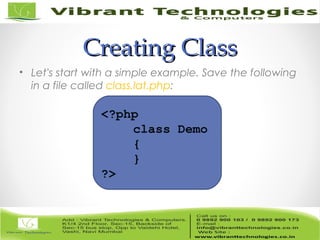
Creating ClassCreating Class
• Let's start with a simple example. Save the following
in a file called class.lat.php:
<?php
class Demo
{
}
?>
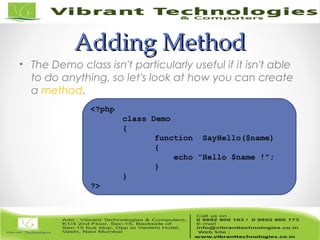
Adding MethodAdding Method
• The Demo class isn't particularly useful if it isn't able
to do anything, so let's look at how you can create
a method.
<?php
class Demo
{
function SayHello($name)
{
echo “Hello $name !”;
}
}
?>
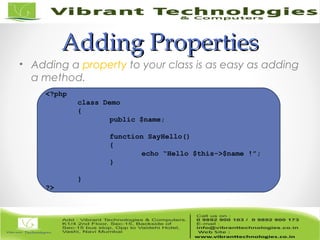
Adding PropertiesAdding Properties
• Adding a property to your class is as easy as adding
a method.
<?php
class Demo
{
public $name;
function SayHello()
{
echo “Hello $this->$name !”;
}
}
?>
Object InstantiationObject Instantiation
• You can instantiate an object of type Demo like
this:
<?php
require_once('class.lat.php');
$objDemo = new Demo();
$objDemo->name = “Bayu”;
$objDemo->SayHallo();
?>
Protecting Access toProtecting Access to
Member VariablesMember Variables (1)(1) There are three different levels of visibility that a member variable or method
can have :
 Public
▪ members are accessible to any and all code
 Private
▪ members are only accessible to the class itself
 Protected
▪ members are available to the class itself, and to classes that inherit
from it
Public is the default visibility level for any member variables or functions
that do not explicitly set one, but it is good practice to always explicitly state
the visibility of all the members of the class.
Public is the default visibility level for any member variables or functions
that do not explicitly set one, but it is good practice to always explicitly state
the visibility of all the members of the class.
Protecting Access toProtecting Access to
Member VariablesMember Variables (2)(2)
• Try to change access level of property named
“name” to private of previous code.
• What the possible solution of this problem?
• Make the getter and setter function...
Always use get and set functions for your properties. Changes to business logic
and data validation requirements in the future will be much easier to
implement.
Always use get and set functions for your properties. Changes to business logic
and data validation requirements in the future will be much easier to
implement.
Class ConstantsClass Constants
 It is possible to define constant values on a per-
class basis remaining the same and
unchangeable.
 Constants differ from normal variables in that you
don't use the $ symbol to declare or use them
 The value must be a constant expression, not (for
example) a variable, a property, a result of a
mathematical operation, or a function call
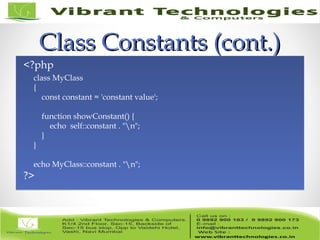
Class Constants (cont.)Class Constants (cont.)
<?php
class MyClass
{
    const constant = 'constant value';
    function showConstant() {
        echo  self::constant . "n";
    }
}
echo MyClass::constant . "n";
?>
<?php
class MyClass
{
    const constant = 'constant value';
    function showConstant() {
        echo  self::constant . "n";
    }
}
echo MyClass::constant . "n";
?>
Static KeywordStatic Keyword
• Declaring class properties or methods as static
makes them accessible without needing an
instantiation of the class.
• A property declared as static can not be accessed
with an instantiated class object
ContructorContructor
• Constructor is the method that will be implemented when object has
been initiated
• Commonly, constructor is used to initialize the object
• Use function __construct to create constructor in PHP
<?php
class Demo
{
function __construct
{
}
}
?>
DestructorDestructor
• Destructor, is method that will be run when object is
ended
<?php
class Demo
{
function __destruct
{
}
}
?>
InheritanceInheritance
• There are many benefits of inheritance with PHP, the
most common is simplifying and reducing instances of
redundant code.
Inheritance (2)Inheritance (2)
class hewan
{
protected $jml_kaki;
protected $warna_kulit;
function __construct()
{
}
function berpindah()
{
echo "Saya berpindah";
}
function makan()
{
echo "Saya makan";
}
}
class hewan
{
protected $jml_kaki;
protected $warna_kulit;
function __construct()
{
}
function berpindah()
{
echo "Saya berpindah";
}
function makan()
{
echo "Saya makan";
}
}
Inherintace (3)Inherintace (3)
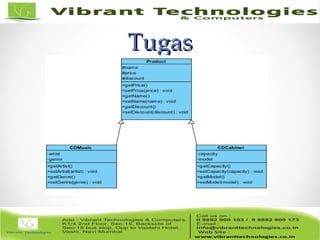
TugasTugas
Tugas (cont.)Tugas (cont.)
 Class product :
 name
 price
 discount
 Class CDMusic :
 artist
 Genre
 Class CDRack
 capacity
 model
Tugas (cont.)Tugas (cont.)
 CDMusic
 Menuruni name, price dan discount dari Product
 Price = price + 10%
 Ada penambahan 5% pada discount
 CDRack
 Menuruni name, price dan discount dari Product
 Price = price + 15%
 Tidak ada penambahan discount
 Buatlah code dalam PHP, serta simulasi untuk kasus
tersebut!
ThankThank You !!!You !!!
For More Information click below link:
Follow Us on:
http://vibranttechnologies.co.in/php-classes-in-
mumbai.html

PHP - Introduction to Object Oriented Programming with PHP

  • 2.
    Introduction to Object OrientedProgramming with PHP
  • 3.
    Object Oriented ConceptObjectOriented Concept  Classes, which are the "blueprints" for an object and are the actual code that defines the properties and methods.  Objects, which are running instances of a class and contain all the internal data and state information needed for your application to function.  Encapsulation, which is the capability of an object to protect access to its internal data  Inheritance, which is the ability to define a class of one kind as being a sub-type of a different kind of class (much the same way a square is a kind of rectangle).
  • 4.
    Creating ClassCreating Class •Let's start with a simple example. Save the following in a file called class.lat.php: <?php class Demo { } ?>
  • 5.
    Adding MethodAdding Method •The Demo class isn't particularly useful if it isn't able to do anything, so let's look at how you can create a method. <?php class Demo { function SayHello($name) { echo “Hello $name !”; } } ?>
  • 6.
    Adding PropertiesAdding Properties •Adding a property to your class is as easy as adding a method. <?php class Demo { public $name; function SayHello() { echo “Hello $this->$name !”; } } ?>
  • 7.
    Object InstantiationObject Instantiation •You can instantiate an object of type Demo like this: <?php require_once('class.lat.php'); $objDemo = new Demo(); $objDemo->name = “Bayu”; $objDemo->SayHallo(); ?>
  • 8.
    Protecting Access toProtectingAccess to Member VariablesMember Variables (1)(1) There are three different levels of visibility that a member variable or method can have :  Public ▪ members are accessible to any and all code  Private ▪ members are only accessible to the class itself  Protected ▪ members are available to the class itself, and to classes that inherit from it Public is the default visibility level for any member variables or functions that do not explicitly set one, but it is good practice to always explicitly state the visibility of all the members of the class. Public is the default visibility level for any member variables or functions that do not explicitly set one, but it is good practice to always explicitly state the visibility of all the members of the class.
  • 9.
    Protecting Access toProtectingAccess to Member VariablesMember Variables (2)(2) • Try to change access level of property named “name” to private of previous code. • What the possible solution of this problem? • Make the getter and setter function... Always use get and set functions for your properties. Changes to business logic and data validation requirements in the future will be much easier to implement. Always use get and set functions for your properties. Changes to business logic and data validation requirements in the future will be much easier to implement.
  • 10.
    Class ConstantsClass Constants It is possible to define constant values on a per- class basis remaining the same and unchangeable.  Constants differ from normal variables in that you don't use the $ symbol to declare or use them  The value must be a constant expression, not (for example) a variable, a property, a result of a mathematical operation, or a function call
  • 11.
    Class Constants (cont.)ClassConstants (cont.) <?php class MyClass {     const constant = 'constant value';     function showConstant() {         echo  self::constant . "n";     } } echo MyClass::constant . "n"; ?> <?php class MyClass {     const constant = 'constant value';     function showConstant() {         echo  self::constant . "n";     } } echo MyClass::constant . "n"; ?>
  • 12.
    Static KeywordStatic Keyword •Declaring class properties or methods as static makes them accessible without needing an instantiation of the class. • A property declared as static can not be accessed with an instantiated class object
  • 14.
    ContructorContructor • Constructor isthe method that will be implemented when object has been initiated • Commonly, constructor is used to initialize the object • Use function __construct to create constructor in PHP <?php class Demo { function __construct { } } ?>
  • 15.
    DestructorDestructor • Destructor, ismethod that will be run when object is ended <?php class Demo { function __destruct { } } ?>
  • 16.
    InheritanceInheritance • There aremany benefits of inheritance with PHP, the most common is simplifying and reducing instances of redundant code.
  • 17.
    Inheritance (2)Inheritance (2) classhewan { protected $jml_kaki; protected $warna_kulit; function __construct() { } function berpindah() { echo "Saya berpindah"; } function makan() { echo "Saya makan"; } } class hewan { protected $jml_kaki; protected $warna_kulit; function __construct() { } function berpindah() { echo "Saya berpindah"; } function makan() { echo "Saya makan"; } }
  • 18.
  • 19.
  • 20.
    Tugas (cont.)Tugas (cont.) Class product :  name  price  discount  Class CDMusic :  artist  Genre  Class CDRack  capacity  model
  • 21.
    Tugas (cont.)Tugas (cont.) CDMusic  Menuruni name, price dan discount dari Product  Price = price + 10%  Ada penambahan 5% pada discount  CDRack  Menuruni name, price dan discount dari Product  Price = price + 15%  Tidak ada penambahan discount  Buatlah code dalam PHP, serta simulasi untuk kasus tersebut!
  • 22.
    ThankThank You !!!You!!! For More Information click below link: Follow Us on: http://vibranttechnologies.co.in/php-classes-in- mumbai.html