 Definition
 History of Ribozyme discovery
 Characteristics of Ribozyme
 Structure and mechanism of Ribozyme
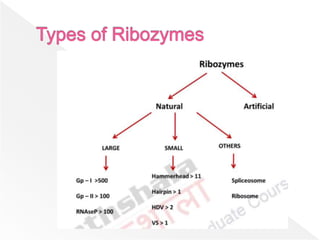
 Types of Ribozymes
 Applications
 Ribozymes (ribonucleic acid enzymes)
are RNA molecules that are capable of catalyzing
specific biochemical reactions, similar to the action of
protein enzymes.
 Discovery revealed that RNA contributed to the ‘RNA
world hypothesis’
 major role
a. Hydrolysis of phosphodiester bonds
b. Formation of bonds
c. Catalyze amino transferase activity of the
ribosome
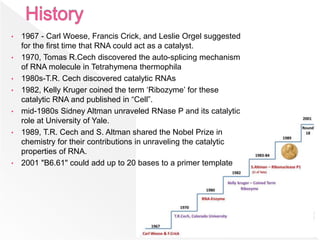
• 1967 - Carl Woese, Francis Crick, and Leslie Orgel suggested
for the first time that RNA could act as a catalyst.
• 1970, Tomas R.Cech discovered the auto-splicing mechanism
of RNA molecule in Tetrahymena thermophila
• 1980s-T.R. Cech discovered catalytic RNAs
• 1982, Kelly Kruger coined the term ‘Ribozyme’ for these
catalytic RNA and published in “Cell”.
• mid-1980s Sidney Altman unraveled RNase P and its catalytic
role at University of Yale.
• 1989, T.R. Cech and S. Altman shared the Nobel Prize in
chemistry for their contributions in unraveling the catalytic
properties of RNA.
• 2001 "B6.61" could add up to 20 bases to a primer template
 Contrary to central dogma
 associated with metal ions
 Uses RNA as its substrate
 cleave other RNA molecules which
contained the NUX pattern of nucleotides
 Present in every living organism
 follows Michael-Menten kinetics
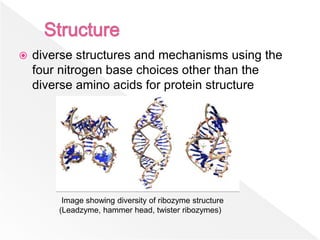
 diverse structures and mechanisms using the
four nitrogen base choices other than the
diverse amino acids for protein structure
Image showing diversity of ribozyme structure
(Leadzyme, hammer head, twister ribozymes)
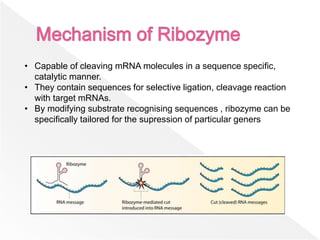
• Capable of cleaving mRNA molecules in a sequence specific,
catalytic manner.
• They contain sequences for selective ligation, cleavage reaction
with target mRNAs.
• By modifying substrate recognising sequences , ribozyme can be
specifically tailored for the supression of particular geners
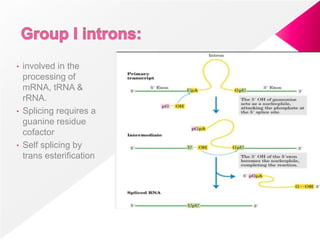
• involved in the
processing of
mRNA, tRNA &
rRNA.
• Splicing requires a
guanine residue
cofactor
• Self splicing by
trans esterification
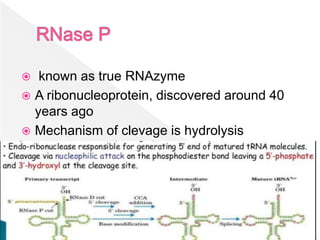
 known as true RNAzyme
 A ribonucleoprotein, discovered around 40
years ago
 Mechanism of clevage is hydrolysis
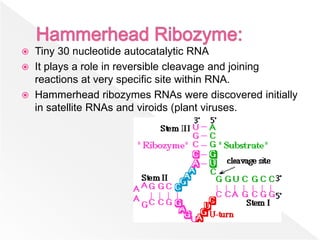
 Tiny 30 nucleotide autocatalytic RNA
 It plays a role in reversible cleavage and joining
reactions at very specific site within RNA.
 Hammerhead ribozymes RNAs were discovered initially
in satellite RNAs and viroids (plant viruses.
 hepatitis delta virus (HDV) ribozyme
 85 nucleotide long, non coding
 plays role in viral replication. It is the only known
ribozyme required for the viability of a human
pathogen.
 VS or Varkud satellite ribozyme is the largest
known natural nucleolytic RNA
 satellite RNA is found in mitochondria of some
fungal strains like Neurospora
 small ribozymes found
in RNA satellites of
plant viruses.
 It assists in the
cleavage & ligation of
products of replication
to form circular and
linear satellite RNAs.
 Leadzyme- natural counterparts are in 5SrRNA.
 Ligase ribozyme- catalyse the assembly of RNA
fragments to form its polymer
 Allosteric ribozyme- act as molecular switches
 regulatory segment of a messenger RNA molecule that
binds a small molecule, resulting in a change in
production of the proteins encoded by the mRNA
 e-pathsala
 https://www.annualreviews.org/doi/full/10.1146/annurev.biophys.30.
1.457
 Slideshare.net
 https://www.news-medical.net/life-sciences/What-are-
Ribozymes.aspx
Thank you

ribozyme-210812091643 (1).pdf

  • 2.
     Definition  Historyof Ribozyme discovery  Characteristics of Ribozyme  Structure and mechanism of Ribozyme  Types of Ribozymes  Applications
  • 3.
     Ribozymes (ribonucleicacid enzymes) are RNA molecules that are capable of catalyzing specific biochemical reactions, similar to the action of protein enzymes.  Discovery revealed that RNA contributed to the ‘RNA world hypothesis’  major role a. Hydrolysis of phosphodiester bonds b. Formation of bonds c. Catalyze amino transferase activity of the ribosome
  • 4.
    • 1967 -Carl Woese, Francis Crick, and Leslie Orgel suggested for the first time that RNA could act as a catalyst. • 1970, Tomas R.Cech discovered the auto-splicing mechanism of RNA molecule in Tetrahymena thermophila • 1980s-T.R. Cech discovered catalytic RNAs • 1982, Kelly Kruger coined the term ‘Ribozyme’ for these catalytic RNA and published in “Cell”. • mid-1980s Sidney Altman unraveled RNase P and its catalytic role at University of Yale. • 1989, T.R. Cech and S. Altman shared the Nobel Prize in chemistry for their contributions in unraveling the catalytic properties of RNA. • 2001 "B6.61" could add up to 20 bases to a primer template
  • 5.
     Contrary tocentral dogma  associated with metal ions  Uses RNA as its substrate  cleave other RNA molecules which contained the NUX pattern of nucleotides  Present in every living organism  follows Michael-Menten kinetics
  • 6.
     diverse structuresand mechanisms using the four nitrogen base choices other than the diverse amino acids for protein structure Image showing diversity of ribozyme structure (Leadzyme, hammer head, twister ribozymes)
  • 7.
    • Capable ofcleaving mRNA molecules in a sequence specific, catalytic manner. • They contain sequences for selective ligation, cleavage reaction with target mRNAs. • By modifying substrate recognising sequences , ribozyme can be specifically tailored for the supression of particular geners
  • 9.
    • involved inthe processing of mRNA, tRNA & rRNA. • Splicing requires a guanine residue cofactor • Self splicing by trans esterification
  • 11.
     known astrue RNAzyme  A ribonucleoprotein, discovered around 40 years ago  Mechanism of clevage is hydrolysis
  • 12.
     Tiny 30nucleotide autocatalytic RNA  It plays a role in reversible cleavage and joining reactions at very specific site within RNA.  Hammerhead ribozymes RNAs were discovered initially in satellite RNAs and viroids (plant viruses.
  • 13.
     hepatitis deltavirus (HDV) ribozyme  85 nucleotide long, non coding  plays role in viral replication. It is the only known ribozyme required for the viability of a human pathogen.  VS or Varkud satellite ribozyme is the largest known natural nucleolytic RNA  satellite RNA is found in mitochondria of some fungal strains like Neurospora
  • 14.
     small ribozymesfound in RNA satellites of plant viruses.  It assists in the cleavage & ligation of products of replication to form circular and linear satellite RNAs.
  • 16.
     Leadzyme- naturalcounterparts are in 5SrRNA.  Ligase ribozyme- catalyse the assembly of RNA fragments to form its polymer  Allosteric ribozyme- act as molecular switches  regulatory segment of a messenger RNA molecule that binds a small molecule, resulting in a change in production of the proteins encoded by the mRNA
  • 18.
     e-pathsala  https://www.annualreviews.org/doi/full/10.1146/annurev.biophys.30. 1.457 Slideshare.net  https://www.news-medical.net/life-sciences/What-are- Ribozymes.aspx Thank you