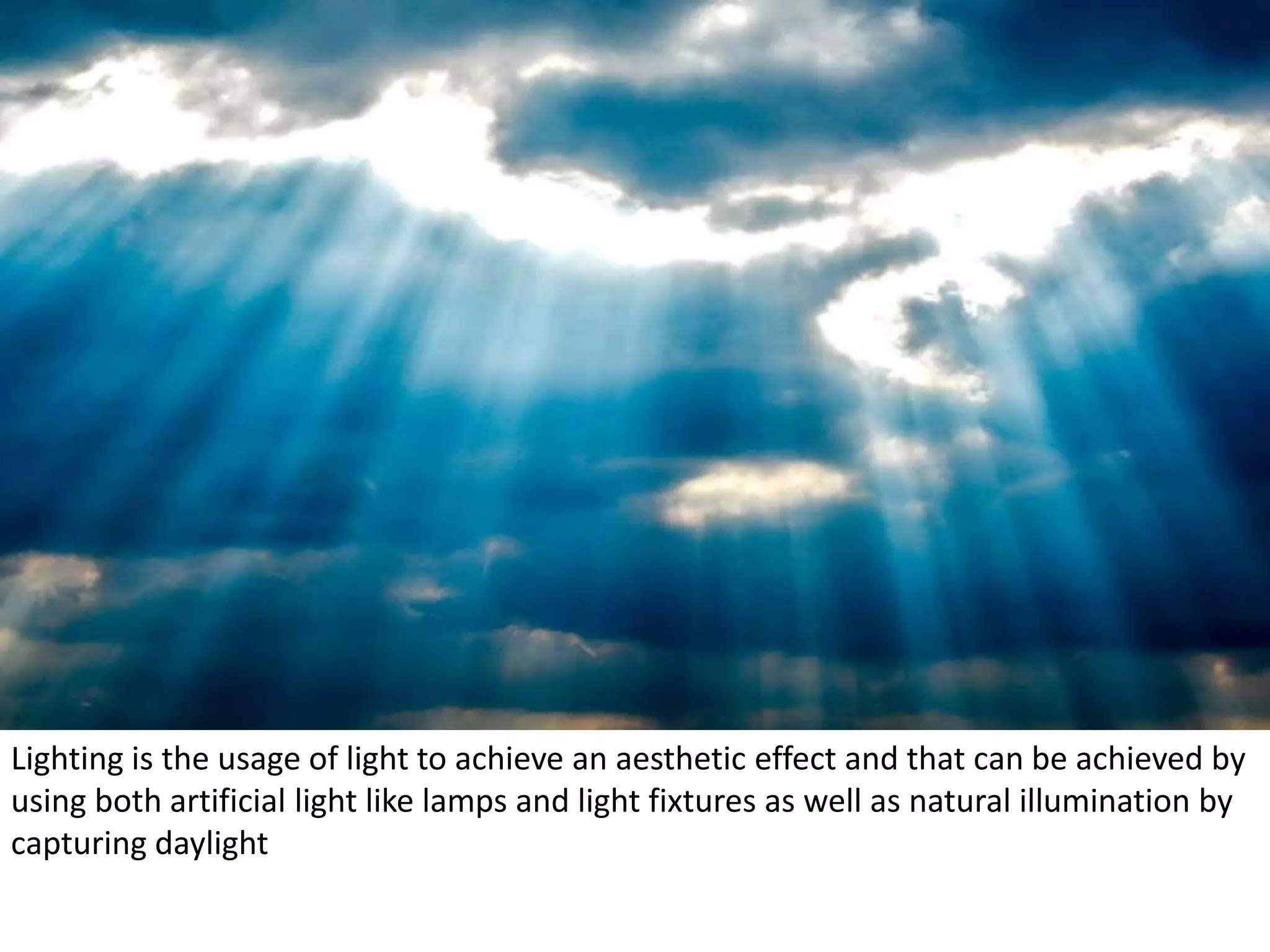
Lighting is the usage of light to achieve an aesthetic effect and that can be achieved by
using both artificial light like lamps and light fixtures as well as natural illumination by
capturing daylight
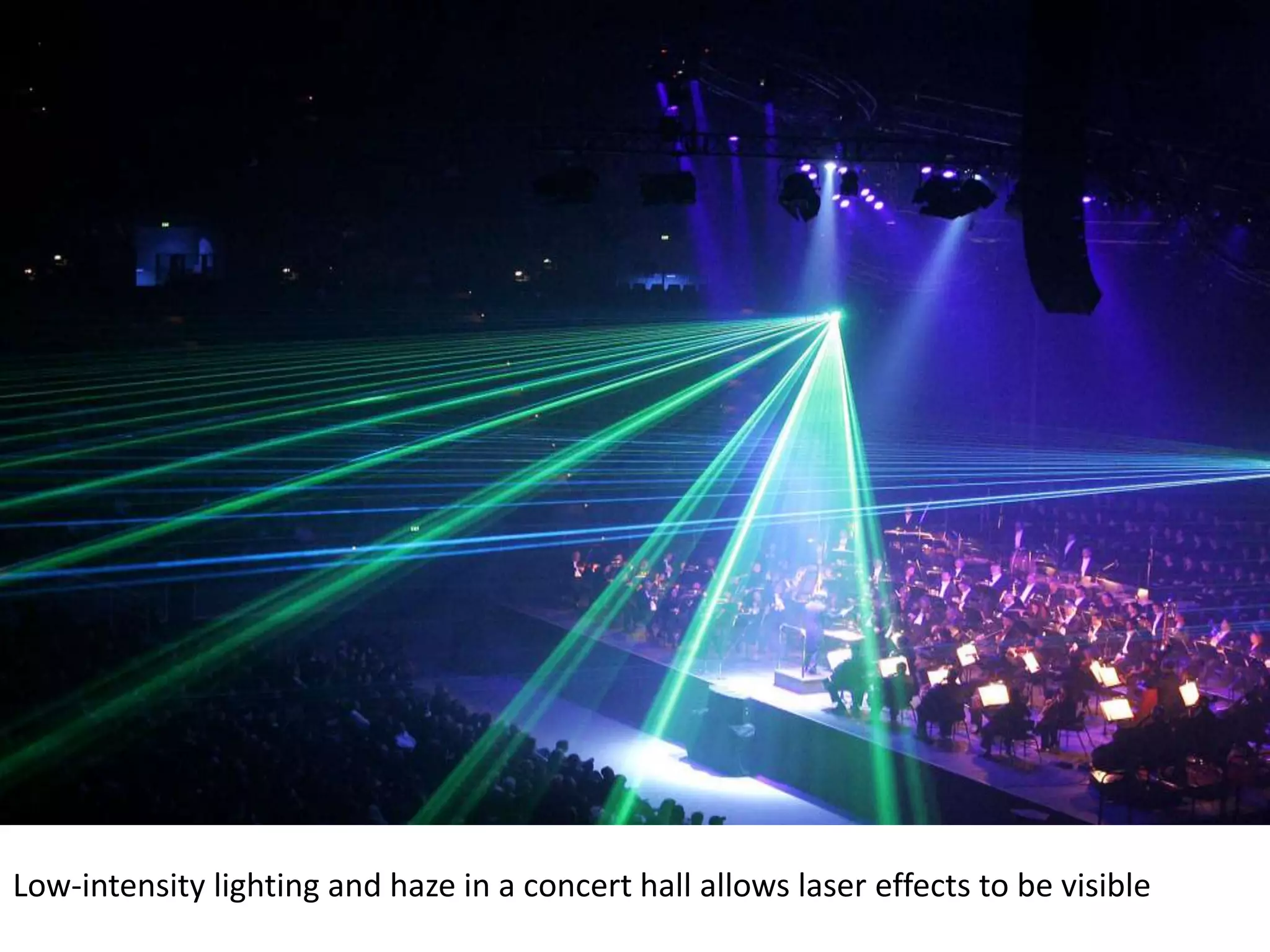
Low-intensity lighting and haze in a concert hall allows laser effects to be visible
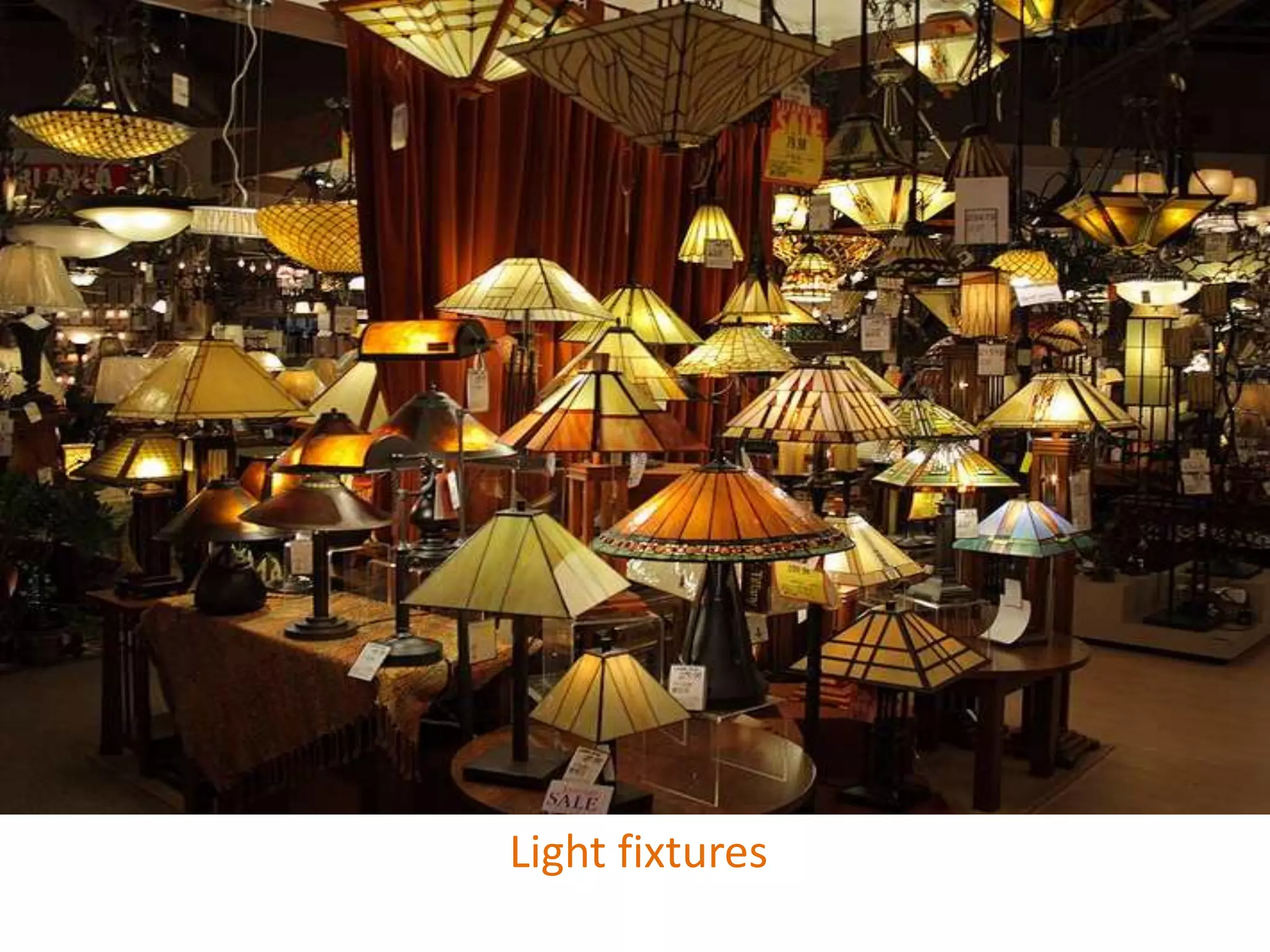
Light fixtures
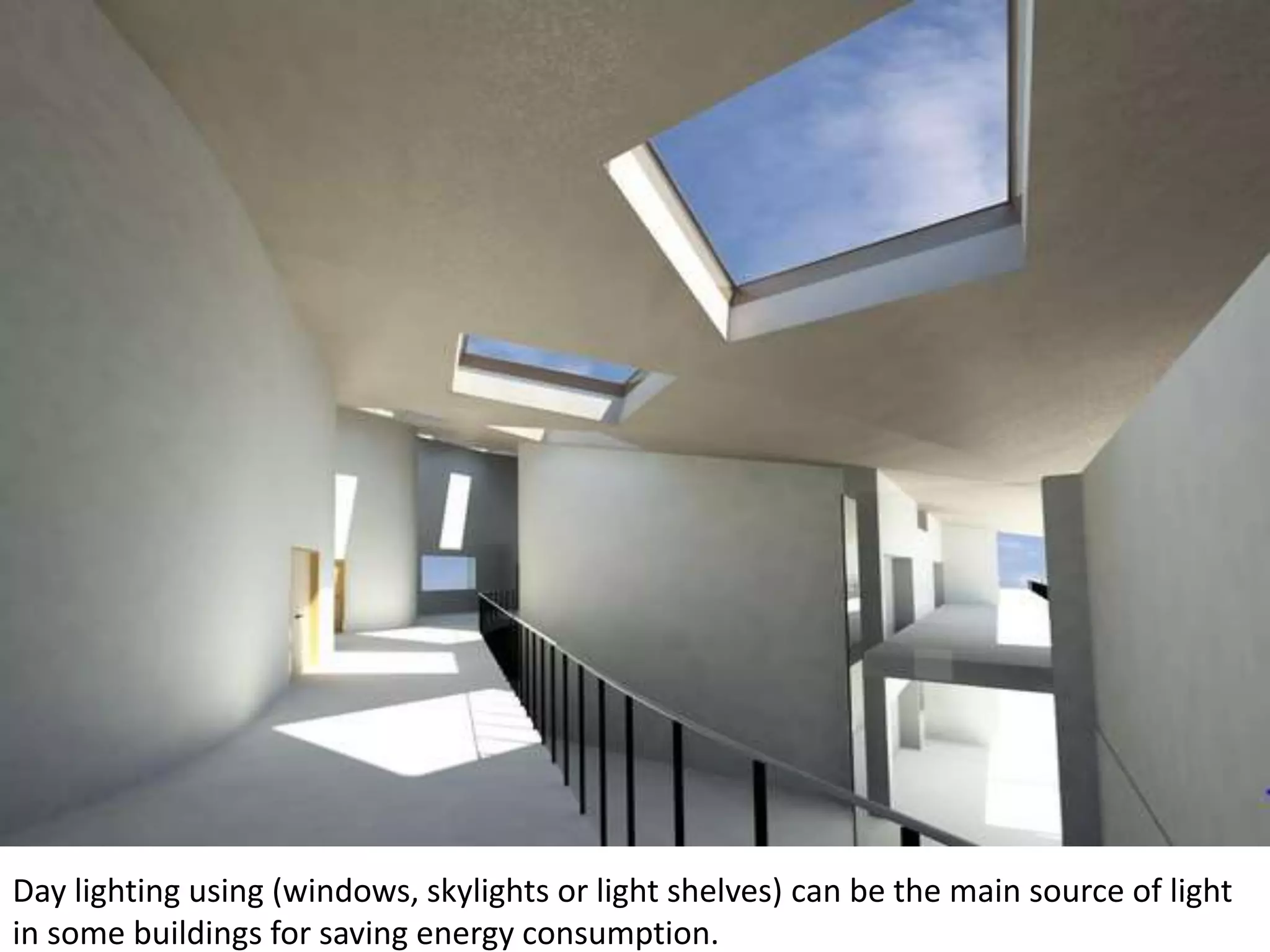
Day lighting using (windows, skylights or light shelves) can be the main source of light
in some buildings for saving energy consumption.
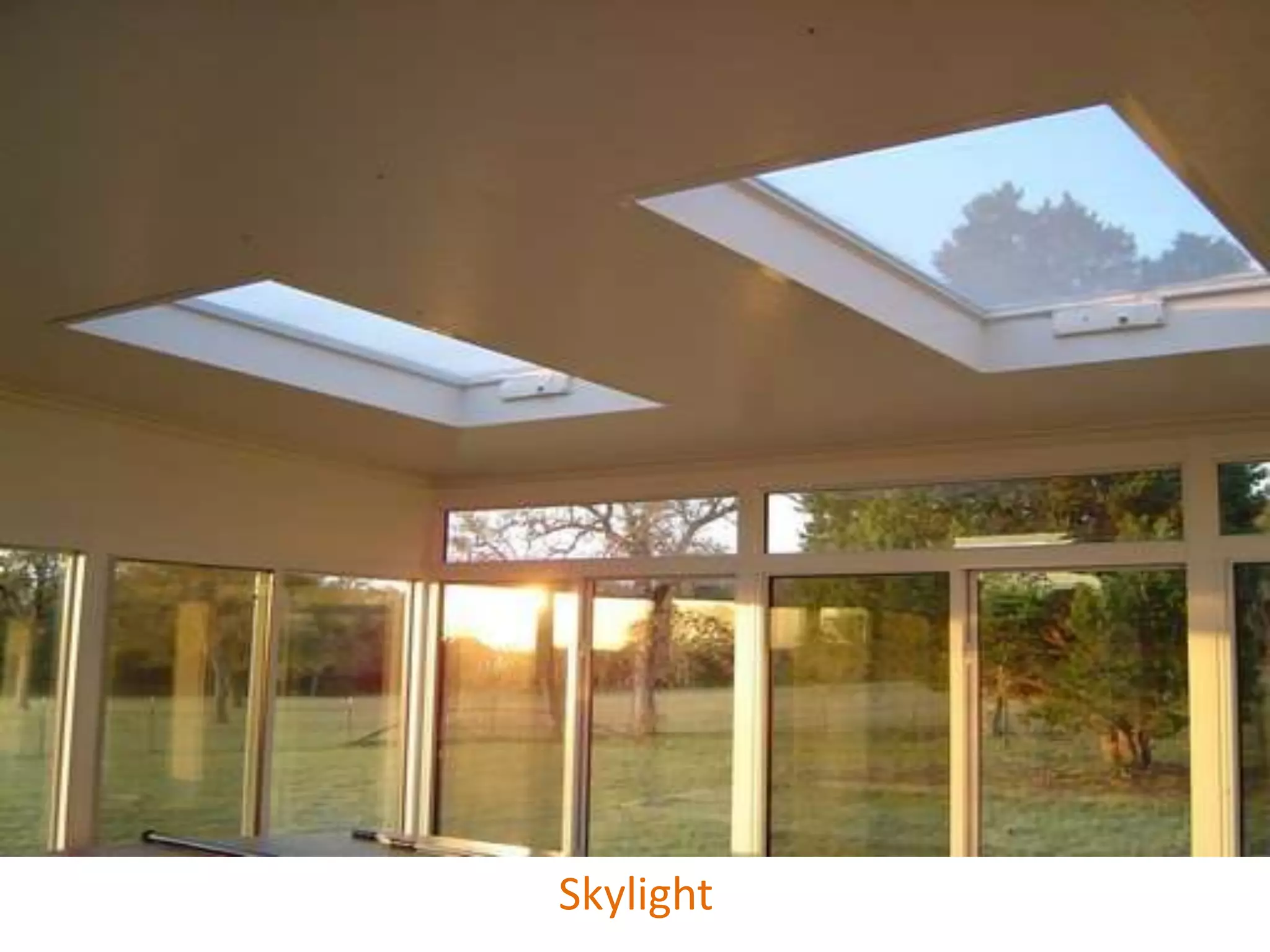
Skylight
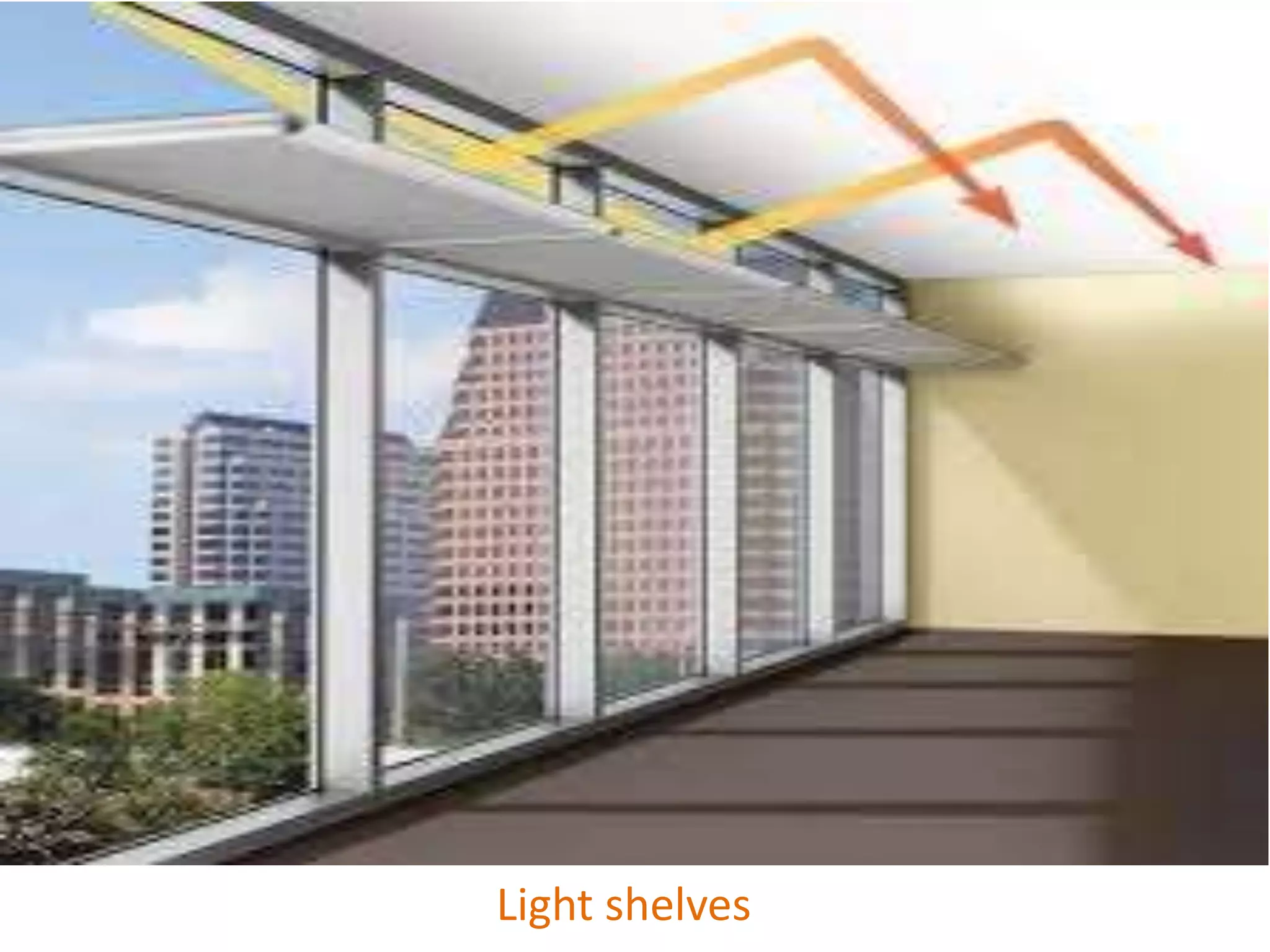
Light shelves
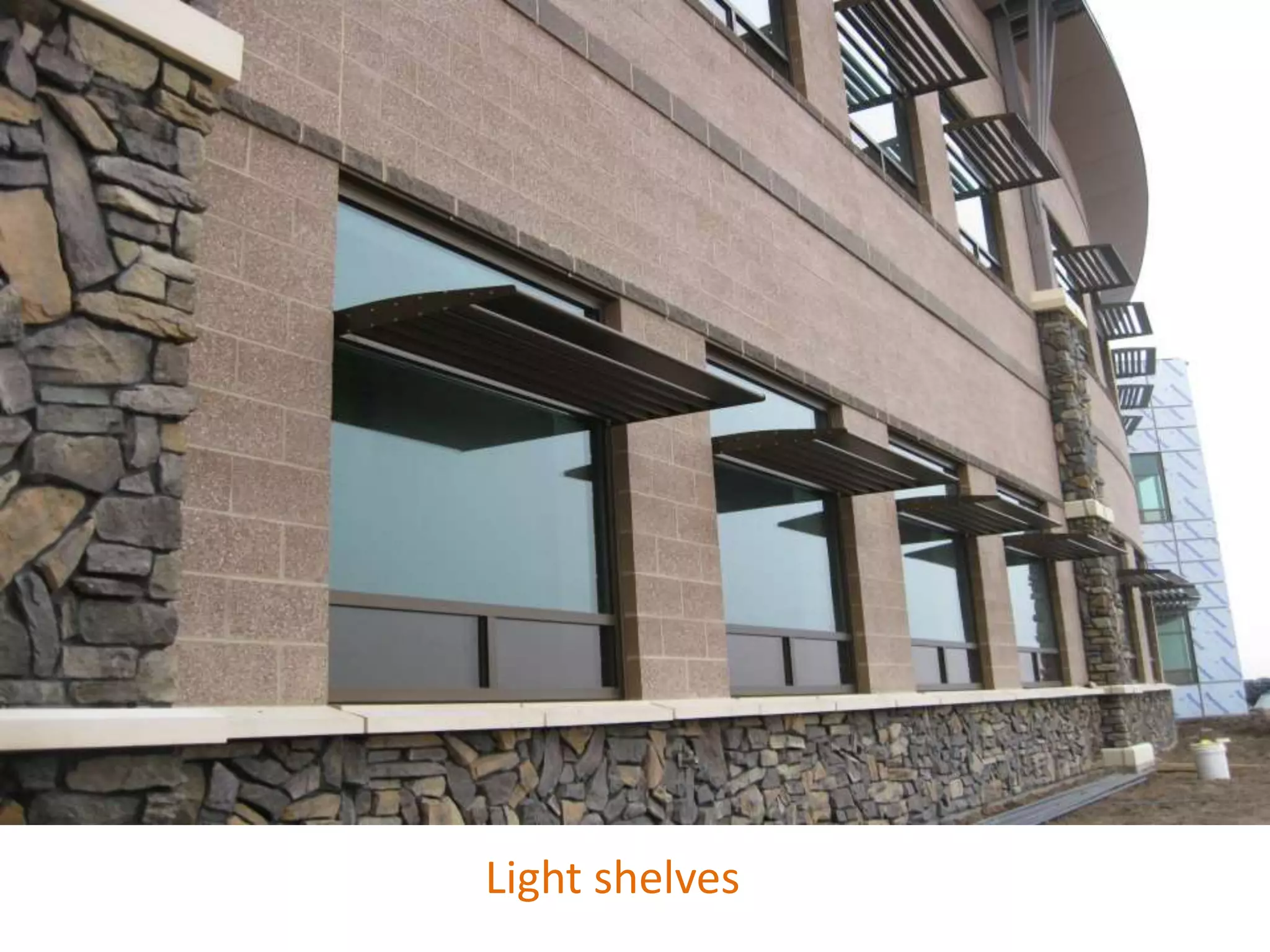
Light shelves
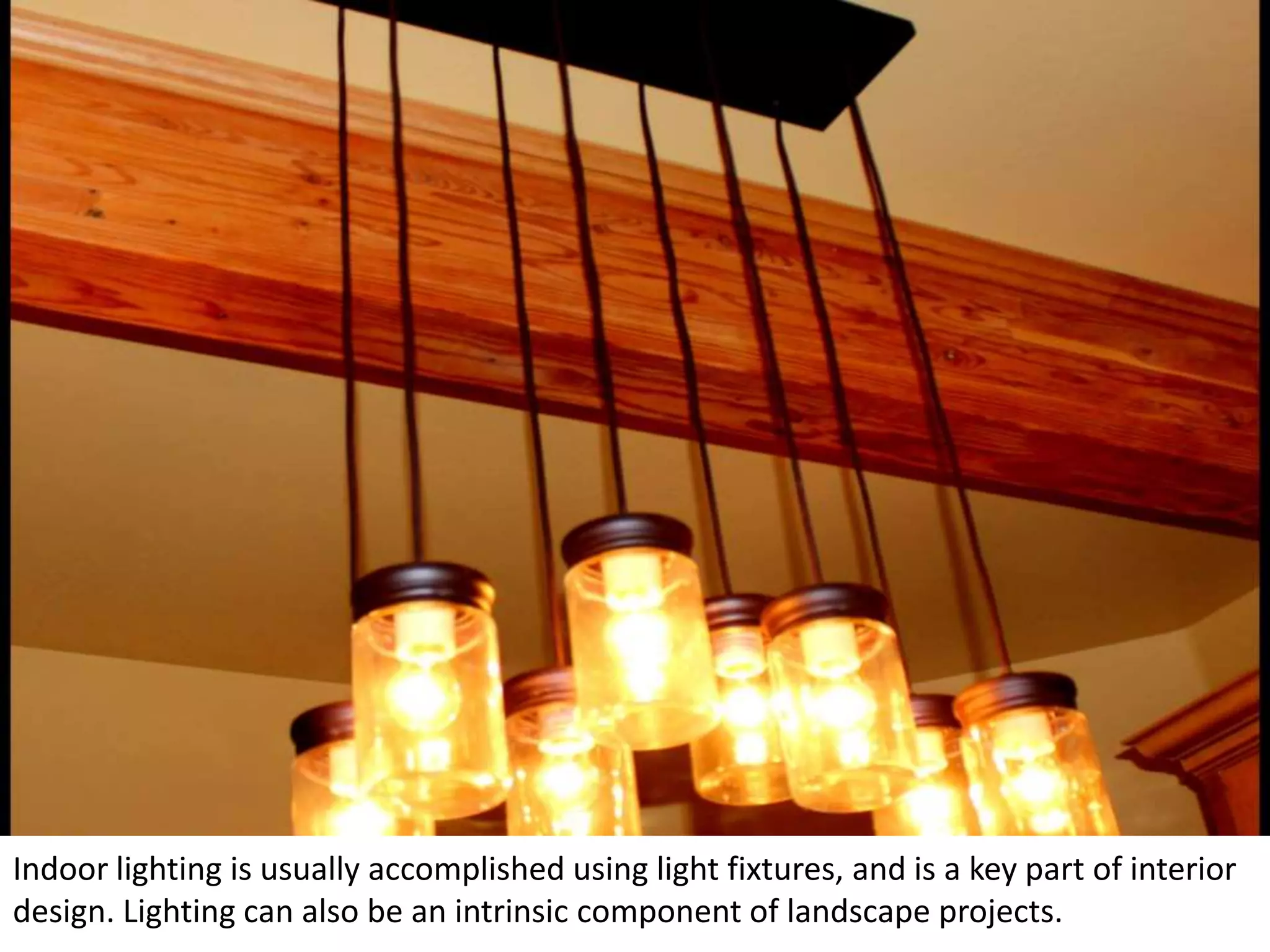
Indoor lighting is usually accomplished using light fixtures, and is a key part of interior
design. Lighting can also be an intrinsic component of landscape projects.
Light fixtures
Lighting fixtures come in a wide variety of styles for various functions. The most
important functions are as a holder for the light source, to provide directed light and
to avoid visual glare. Some are very plain and functional, while some are pieces of art
in themselves. Nearly any material can be used, so long as it can tolerate the excess
heat and is in keeping with safety codes.
Color temperature for white light sources also affects their use for certain applications.
The color temperature of a white light source is the temperature in Kelvin of a
theoretical black body emitter that most closely matches the spectral characteristics of
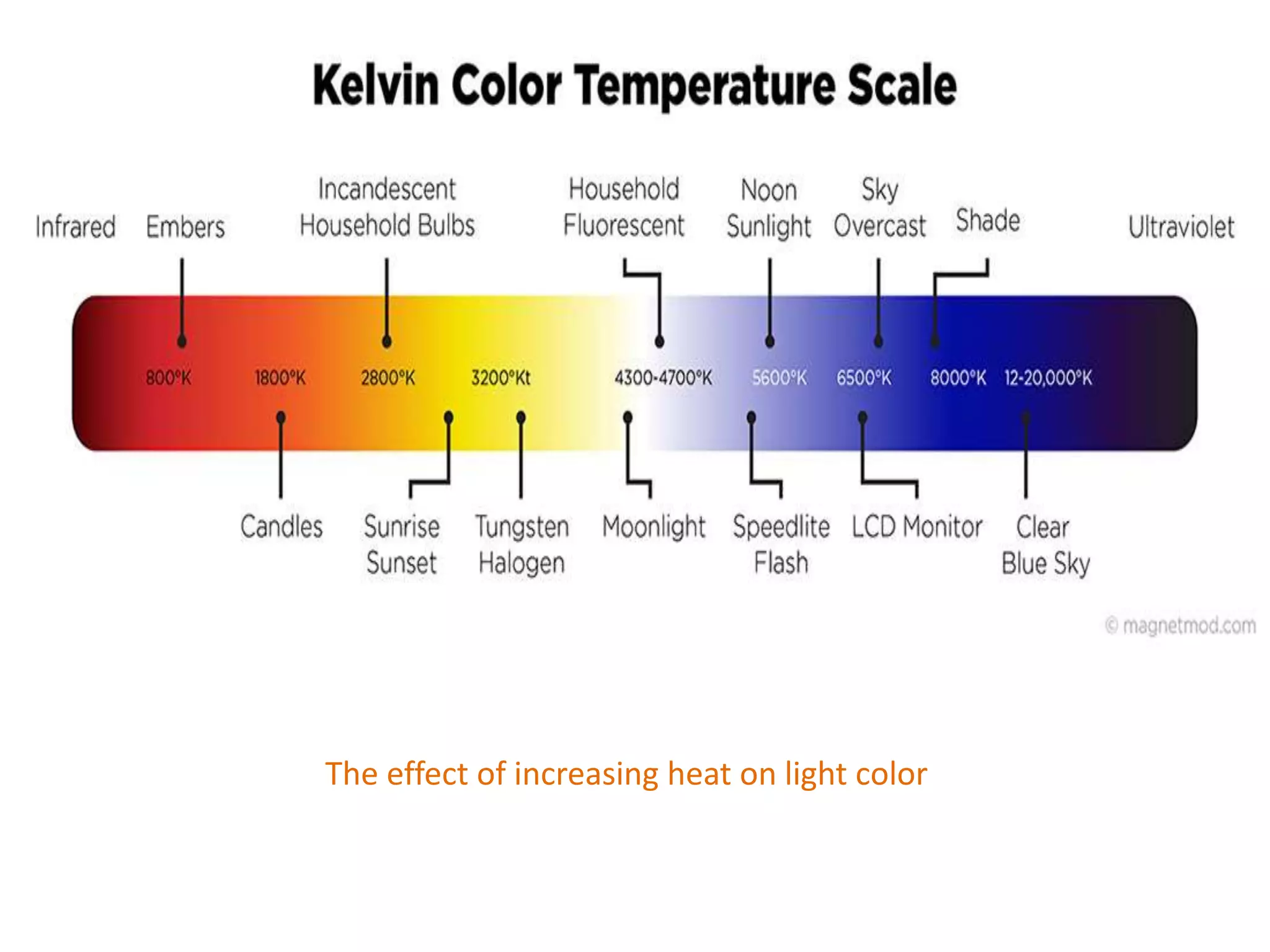
the lamp. An incandescent bulb has a color temperature around 2800 to 3000 Kelvin;
daylight is around 6400 Kelvin. Lower color temperature lamps have relatively more
energy in the yellow and red part of the visible spectrum, while high color
temperatures correspond to lamps with more of a blue-white appearance. For critical
inspection or color matching tasks, or for retail displays of food and clothing, the color
temperature of the lamps will be selected for the best overall lighting effect.
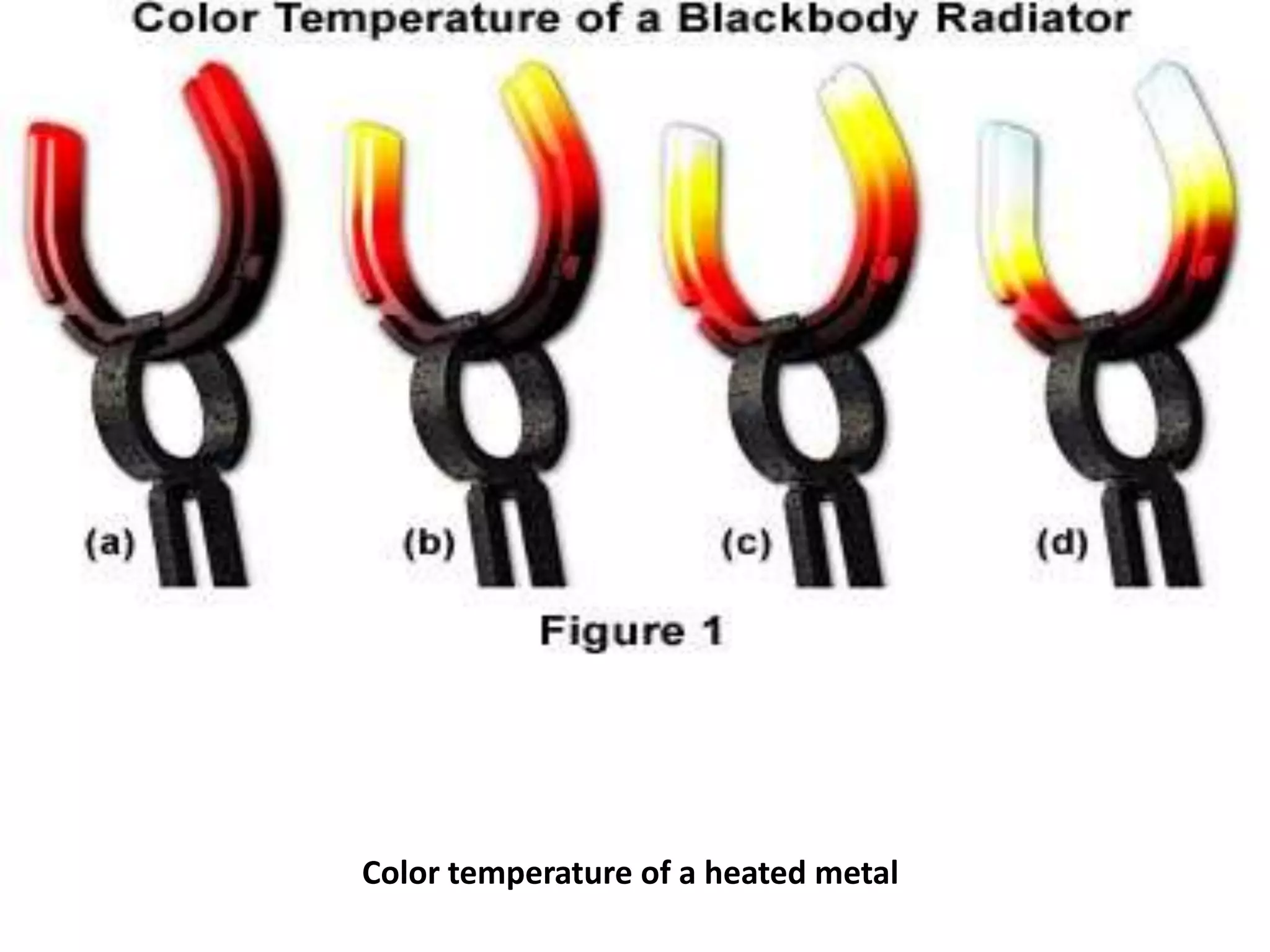
Color temperature of a heated metal
The effect of increasing heat on light color
Types of lighting
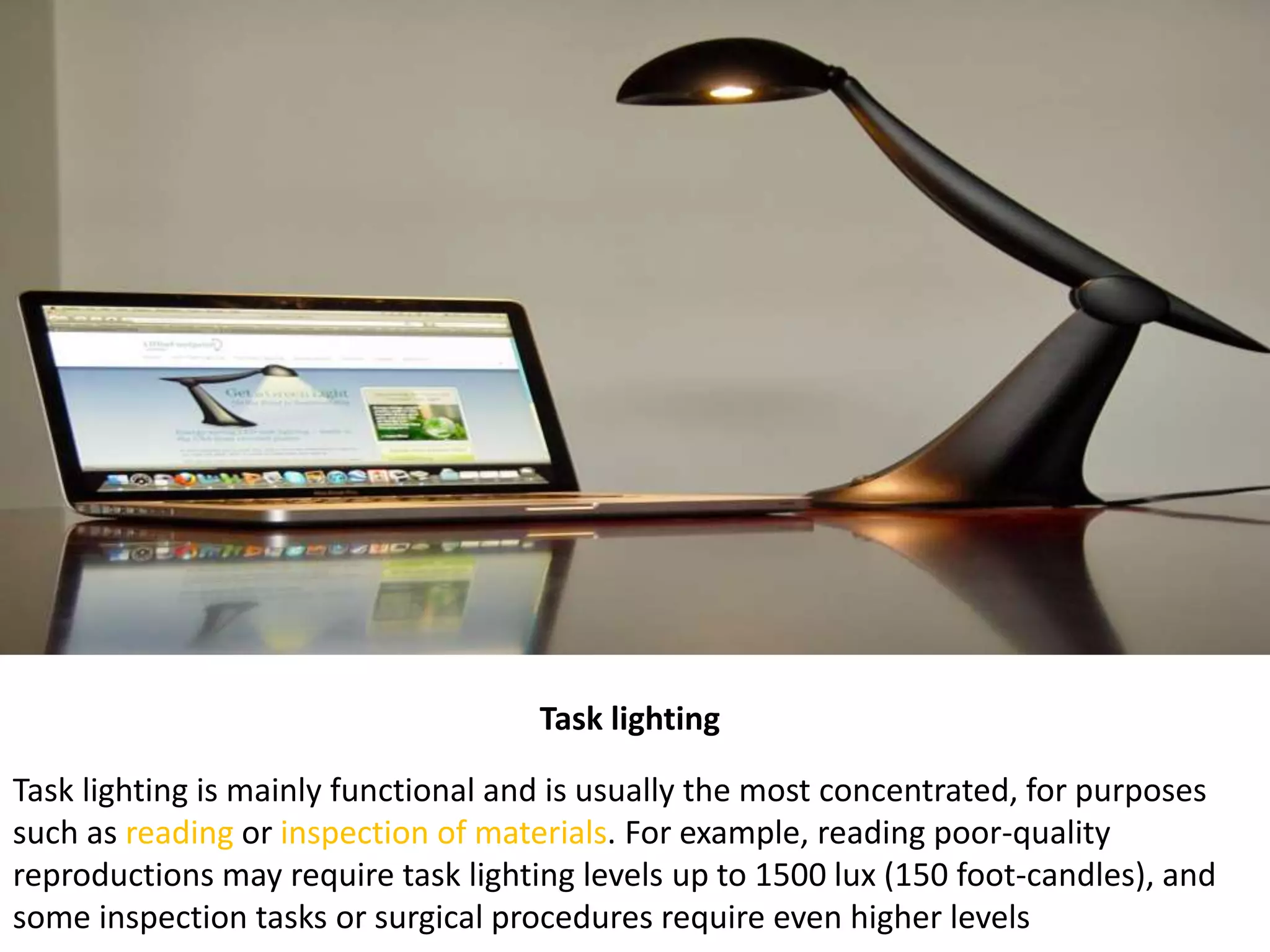
Task lighting
Task lighting is mainly functional and is usually the most concentrated, for purposes
such as reading or inspection of materials. For example, reading poor-quality
reproductions may require task lighting levels up to 1500 lux (150 foot-candles), and
some inspection tasks or surgical procedures require even higher levels
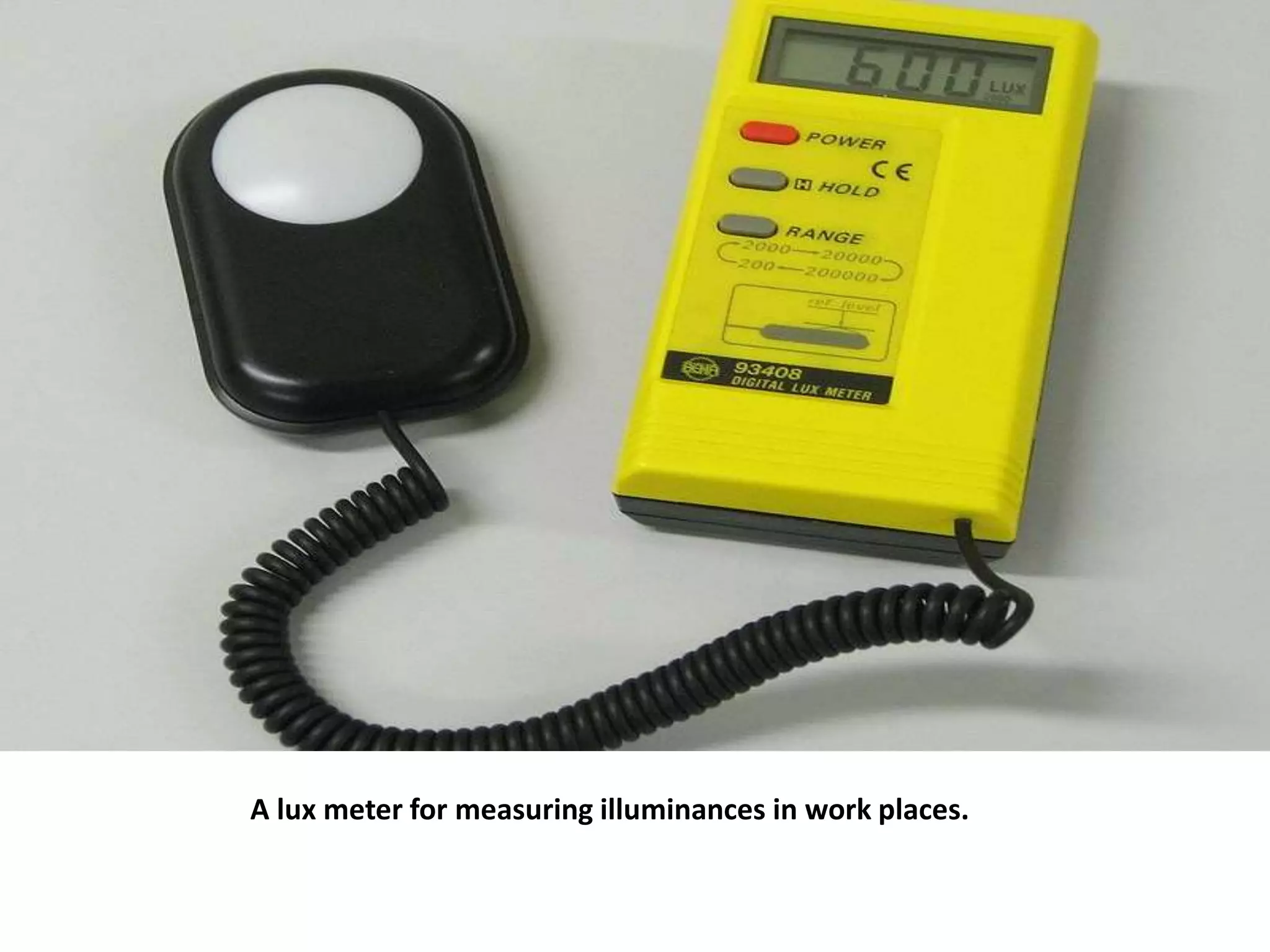
A lux meter for measuring illuminances in work places.
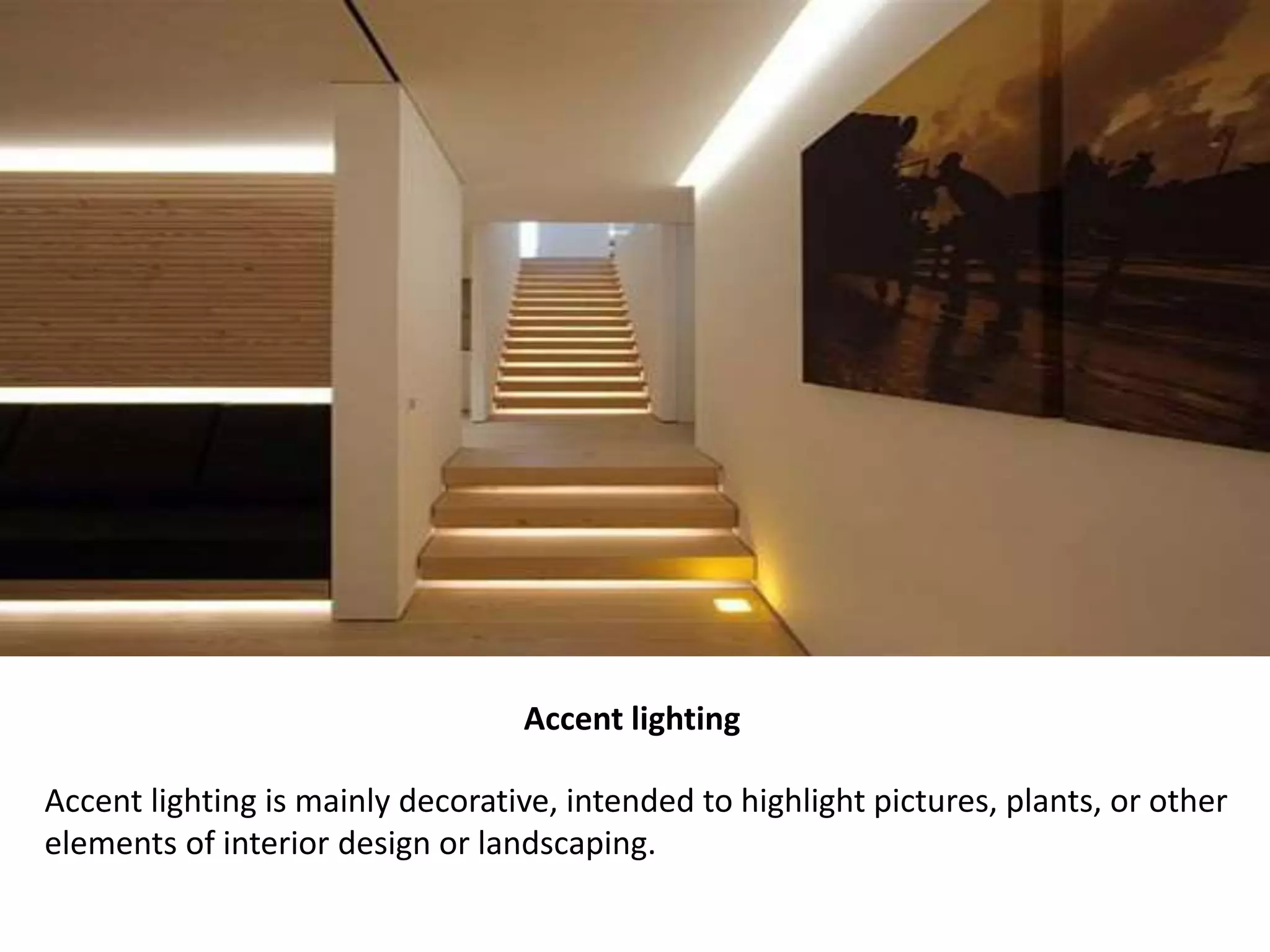
Accent lighting
Accent lighting is mainly decorative, intended to highlight pictures, plants, or other
elements of interior design or landscaping.
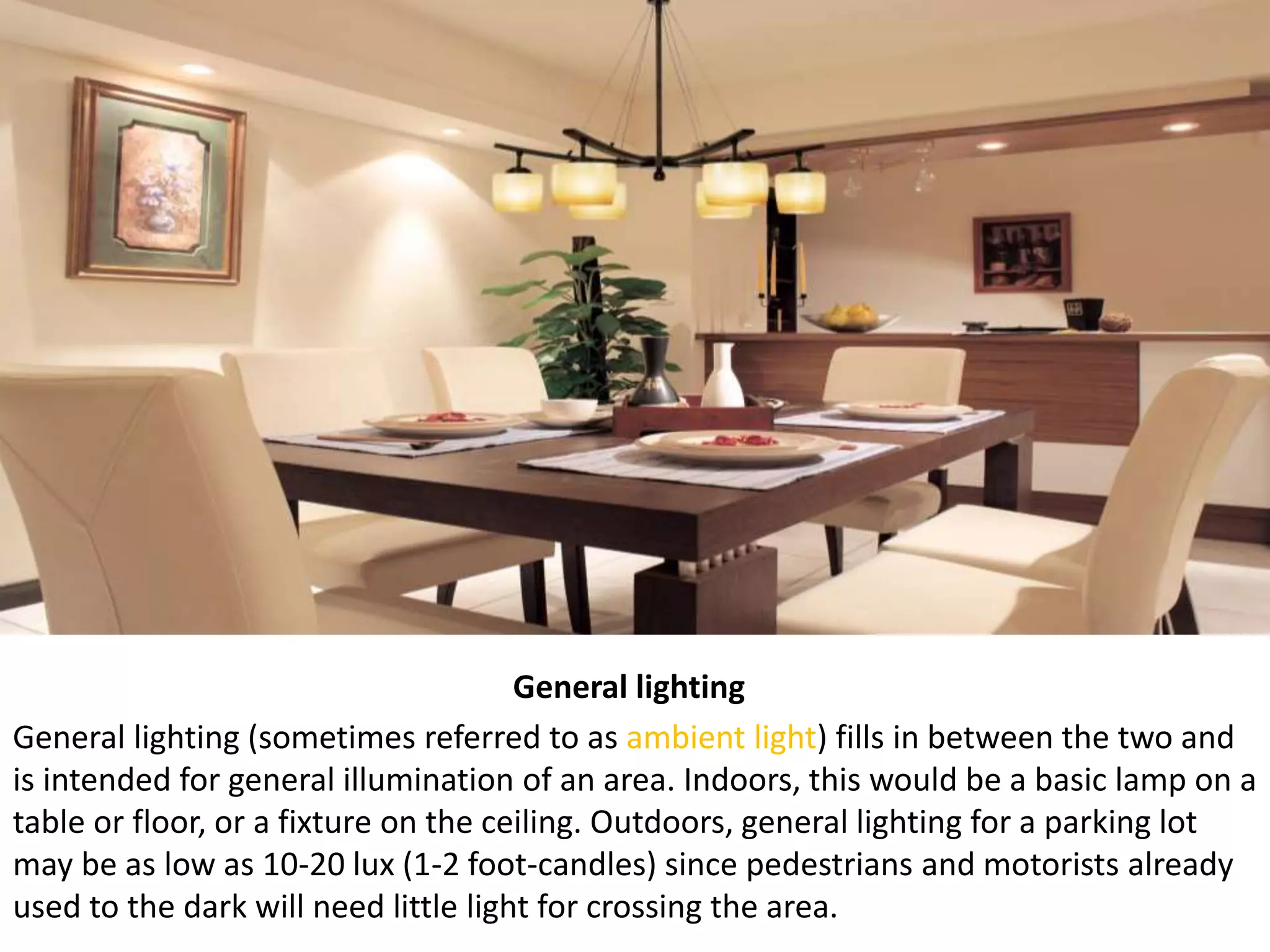
General lighting
General lighting (sometimes referred to as ambient light) fills in between the two and
is intended for general illumination of an area. Indoors, this would be a basic lamp on a
table or floor, or a fixture on the ceiling. Outdoors, general lighting for a parking lot
may be as low as 10-20 lux (1-2 foot-candles) since pedestrians and motorists already
used to the dark will need little light for crossing the area.
Methods of lighting
• Down lighting
• Up lighting
• Front lighting
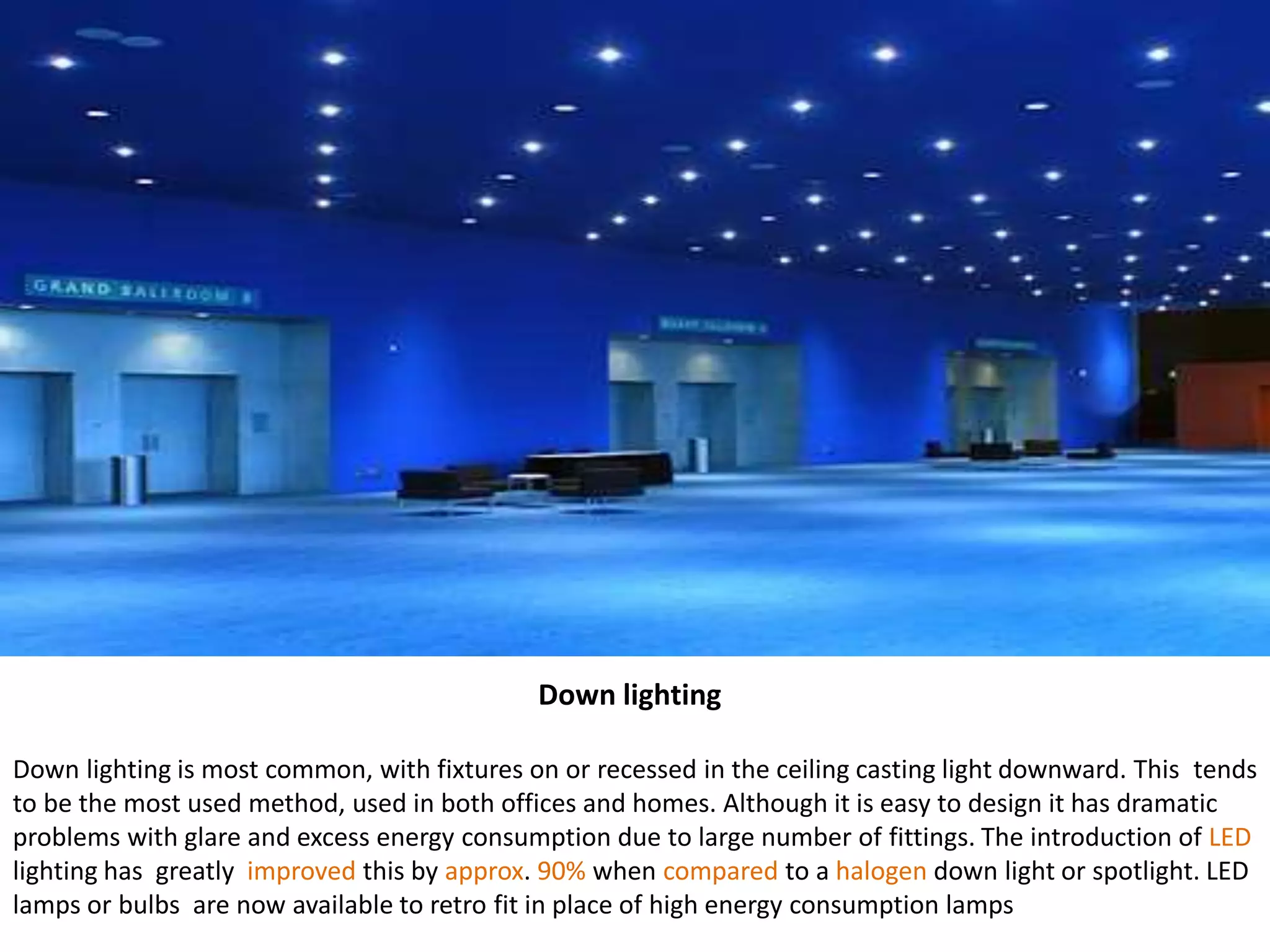
Down lighting
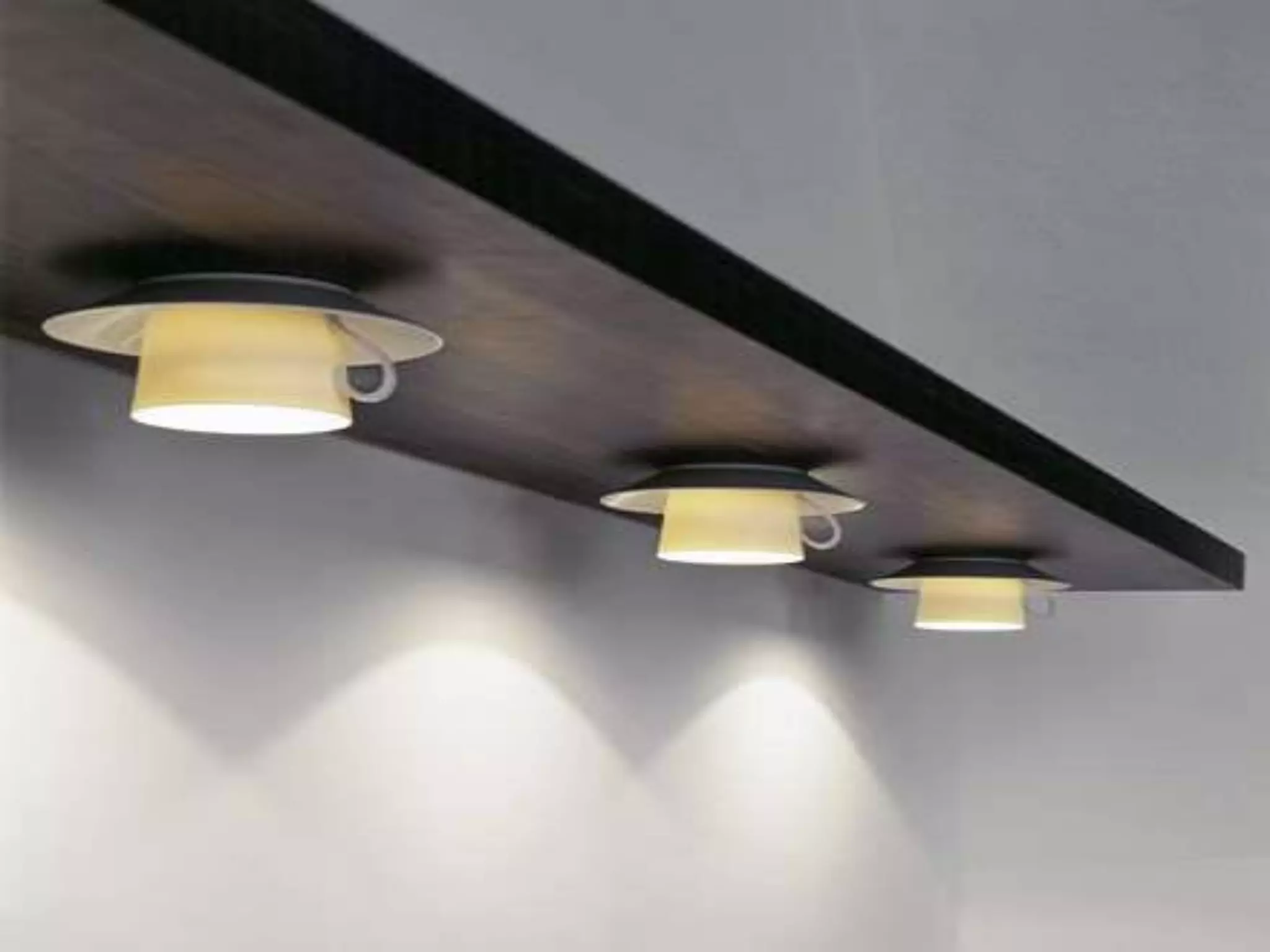
Down lighting is most common, with fixtures on or recessed in the ceiling casting light downward. This tends
to be the most used method, used in both offices and homes. Although it is easy to design it has dramatic
problems with glare and excess energy consumption due to large number of fittings. The introduction of LED
lighting has greatly improved this by approx. 90% when compared to a halogen down light or spotlight. LED
lamps or bulbs are now available to retro fit in place of high energy consumption lamps
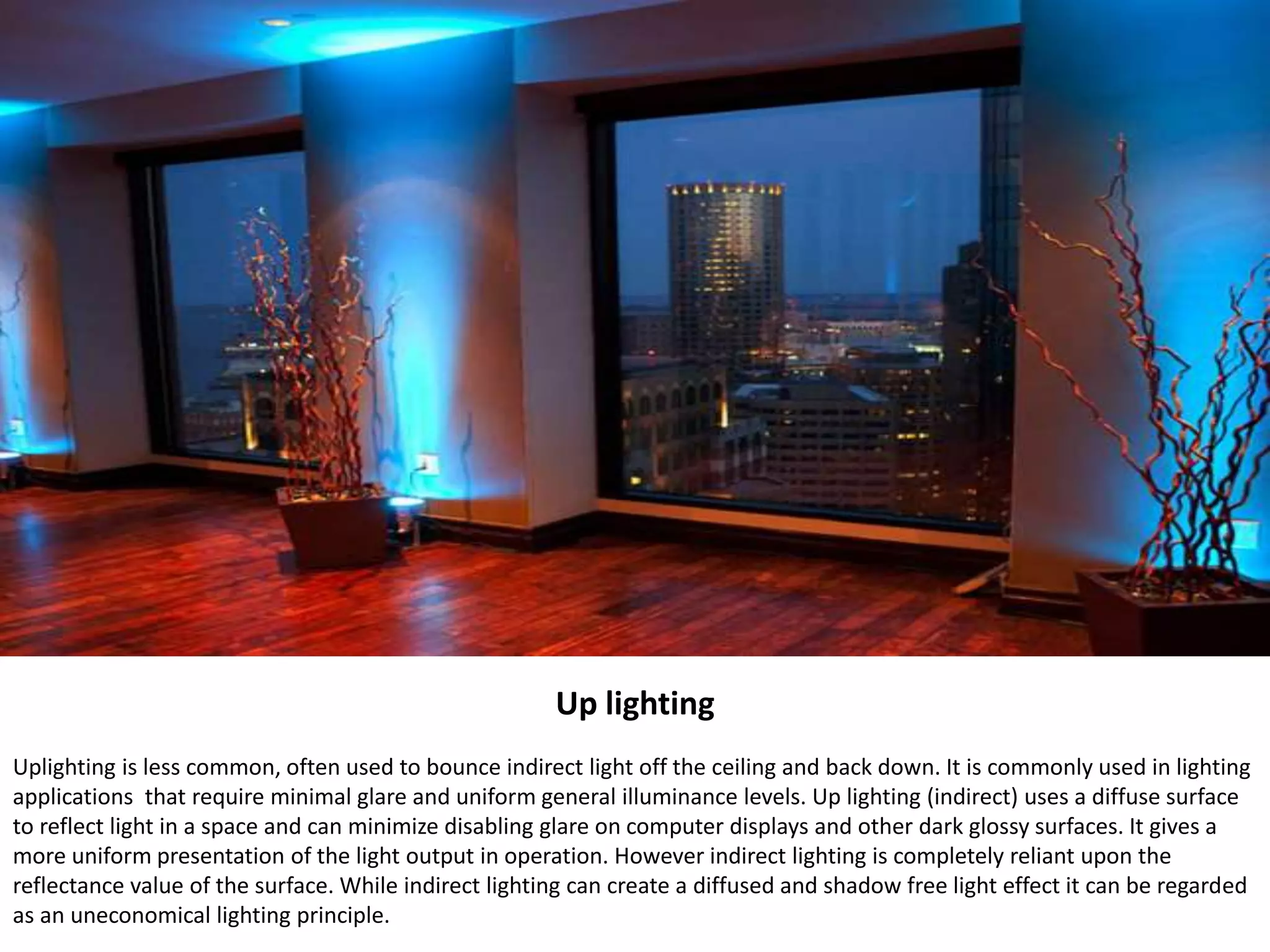
Up lighting
Uplighting is less common, often used to bounce indirect light off the ceiling and back down. It is commonly used in lighting
applications that require minimal glare and uniform general illuminance levels. Up lighting (indirect) uses a diffuse surface
to reflect light in a space and can minimize disabling glare on computer displays and other dark glossy surfaces. It gives a
more uniform presentation of the light output in operation. However indirect lighting is completely reliant upon the
reflectance value of the surface. While indirect lighting can create a diffused and shadow free light effect it can be regarded
as an uneconomical lighting principle.
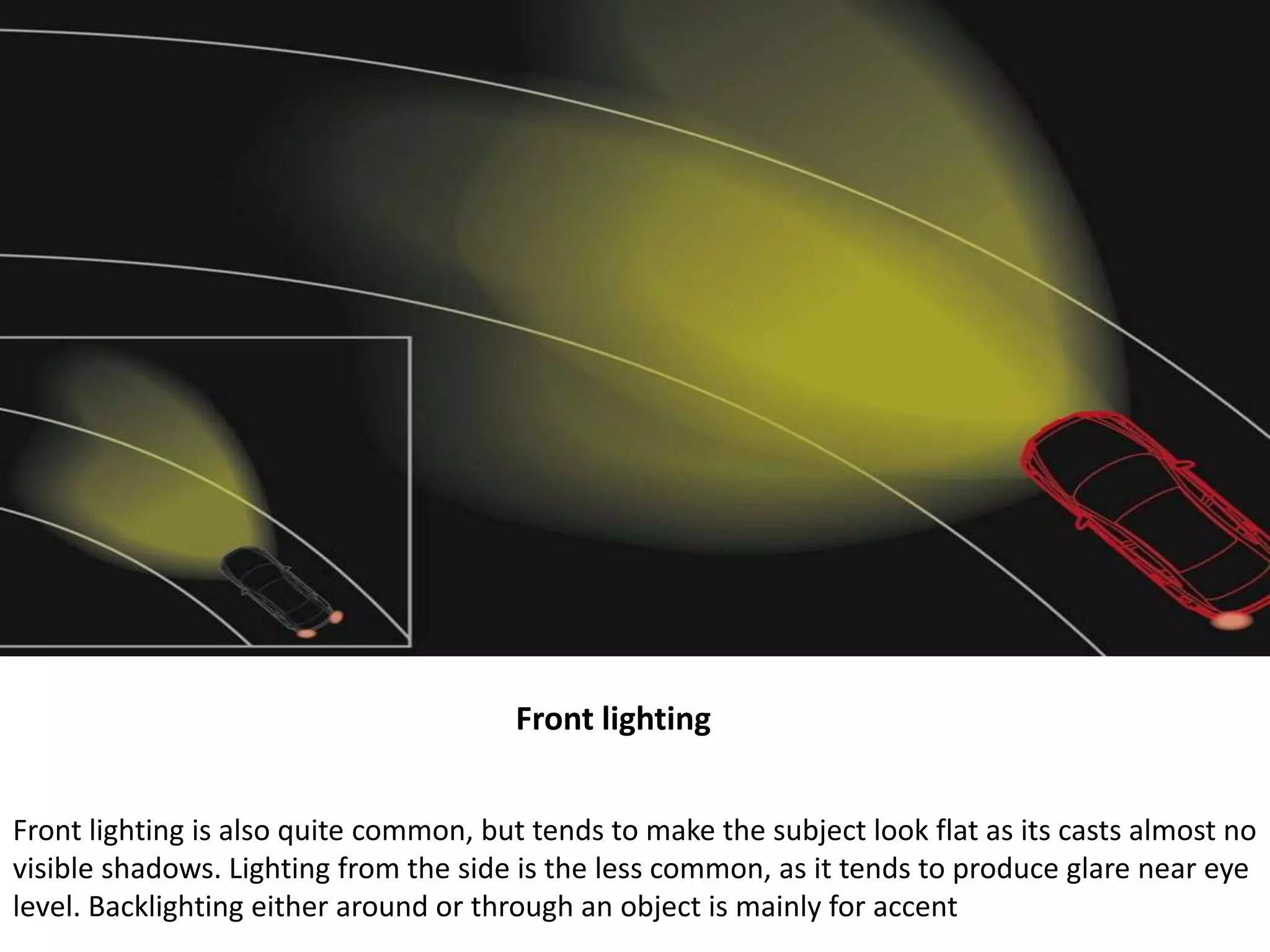
Front lighting
Front lighting is also quite common, but tends to make the subject look flat as its casts almost no
visible shadows. Lighting from the side is the less common, as it tends to produce glare near eye
level. Backlighting either around or through an object is mainly for accent
Architectural lighting design
Architectural lighting design is a field within architecture, interior design and electrical
engineering that is concerned with the design of lighting systems, including natural
light, electric light, or both, to serve human needs.
The design process takes account of:
• the kind of human activity for which lighting is to be provided.
• the amount of light required.
• the color of the light as it may affect the views of particular objects and the
environment as a whole.
• the distribution of light within the space to be lighted, whether indoor or outdoor.
• the effect of the lightened system itself on the user.
Lighting tips for each room
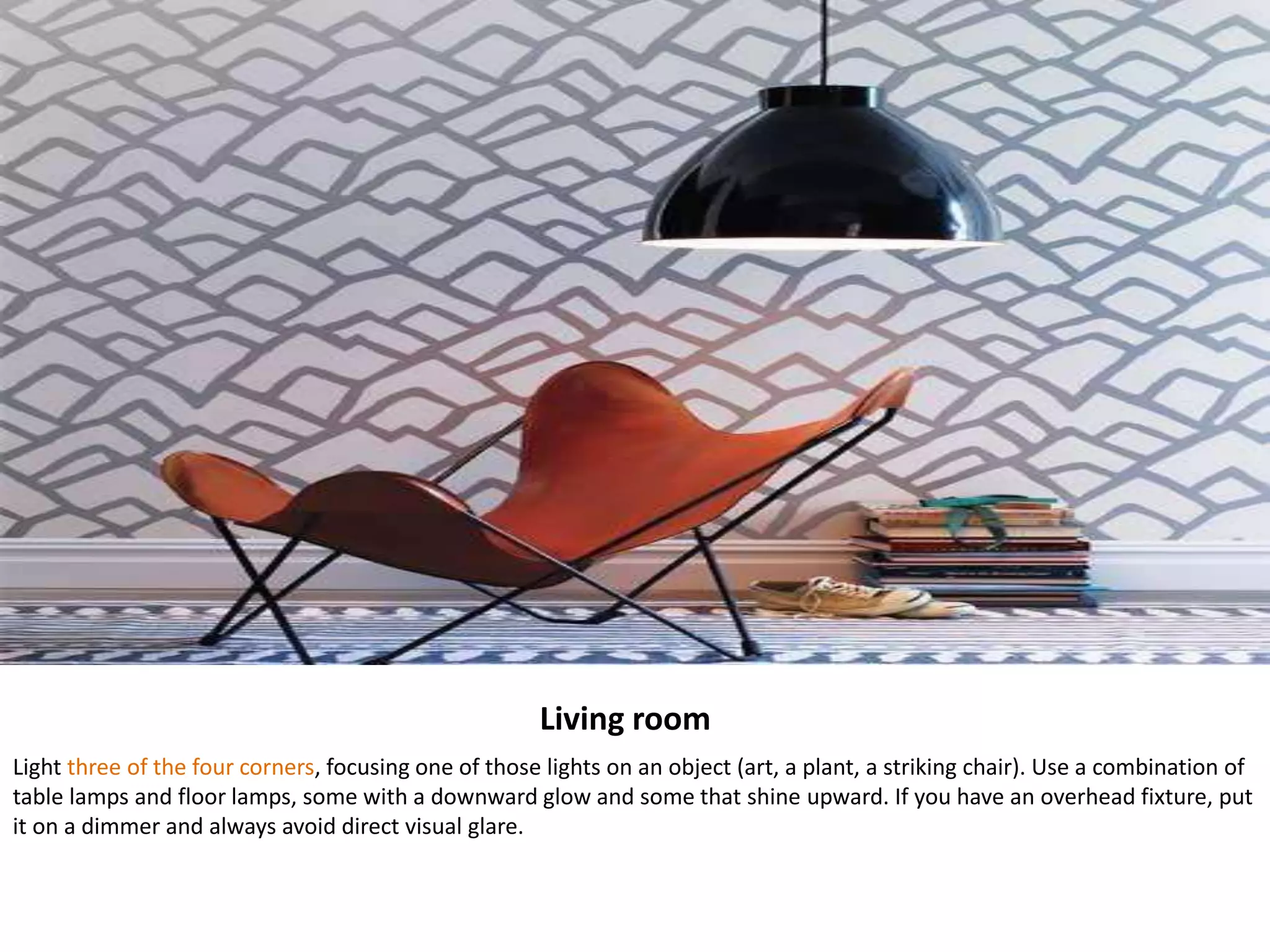
Living room
Light three of the four corners, focusing one of those lights on an object (art, a plant, a striking chair). Use a combination of
table lamps and floor lamps, some with a downward glow and some that shine upward. If you have an overhead fixture, put
it on a dimmer and always avoid direct visual glare.
Dining room
Make the table the brightest spot in the room. Use a chandelier or a pendant above the table,
limiting the total wattage to 100. Elsewhere in the room, indirect lighting is best—it’s relaxing
and flattering. Give the space a subtle glow with a pair of small table lamps on a sideboard or
matching sconces on the wall above. Battery-powered votives inside a glass-front china cabinet
can be a nice touch.
Kitchen
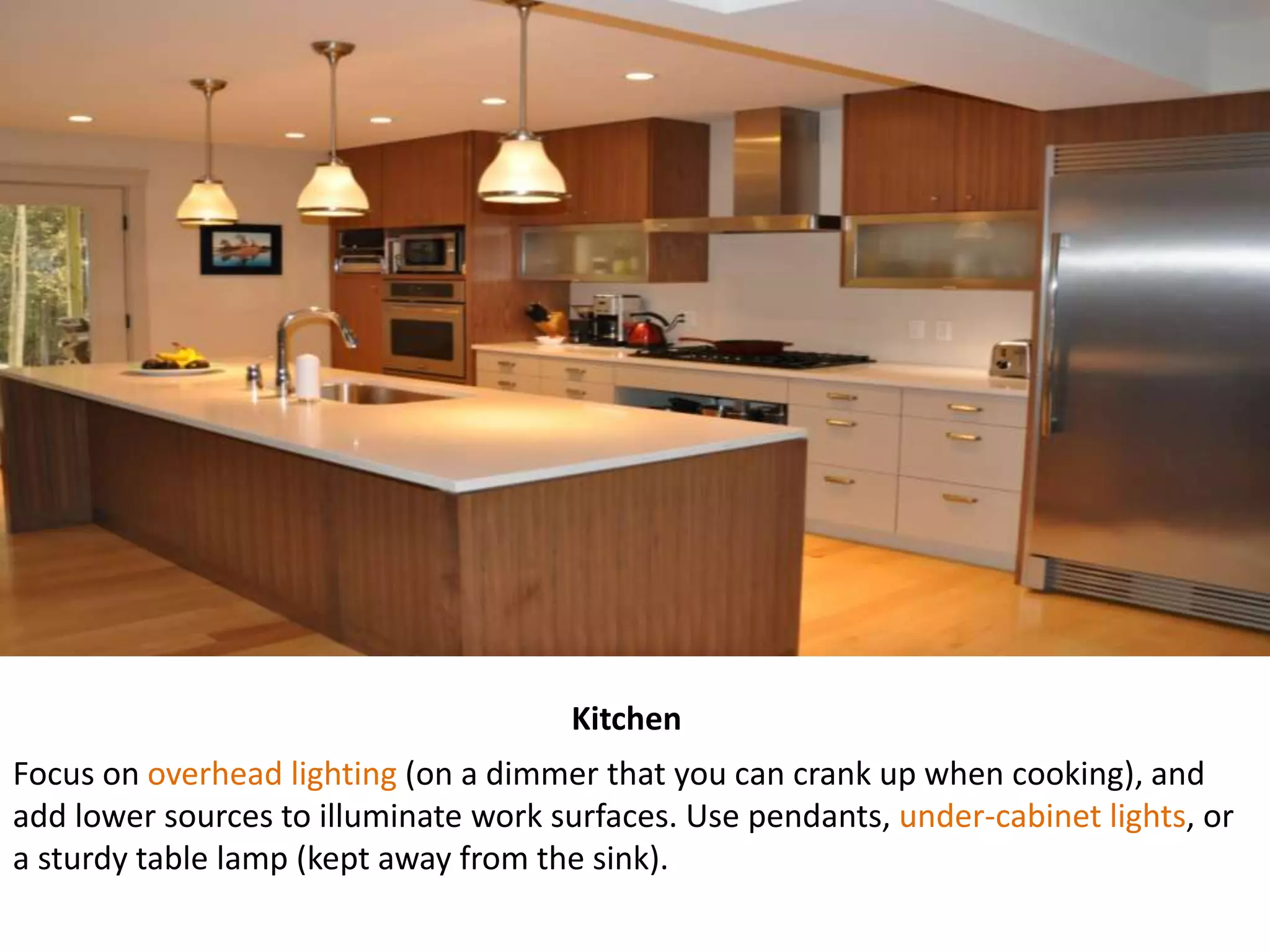
Focus on overhead lighting (on a dimmer that you can crank up when cooking), and
add lower sources to illuminate work surfaces. Use pendants, under-cabinet lights, or
a sturdy table lamp (kept away from the sink).
Bedroom
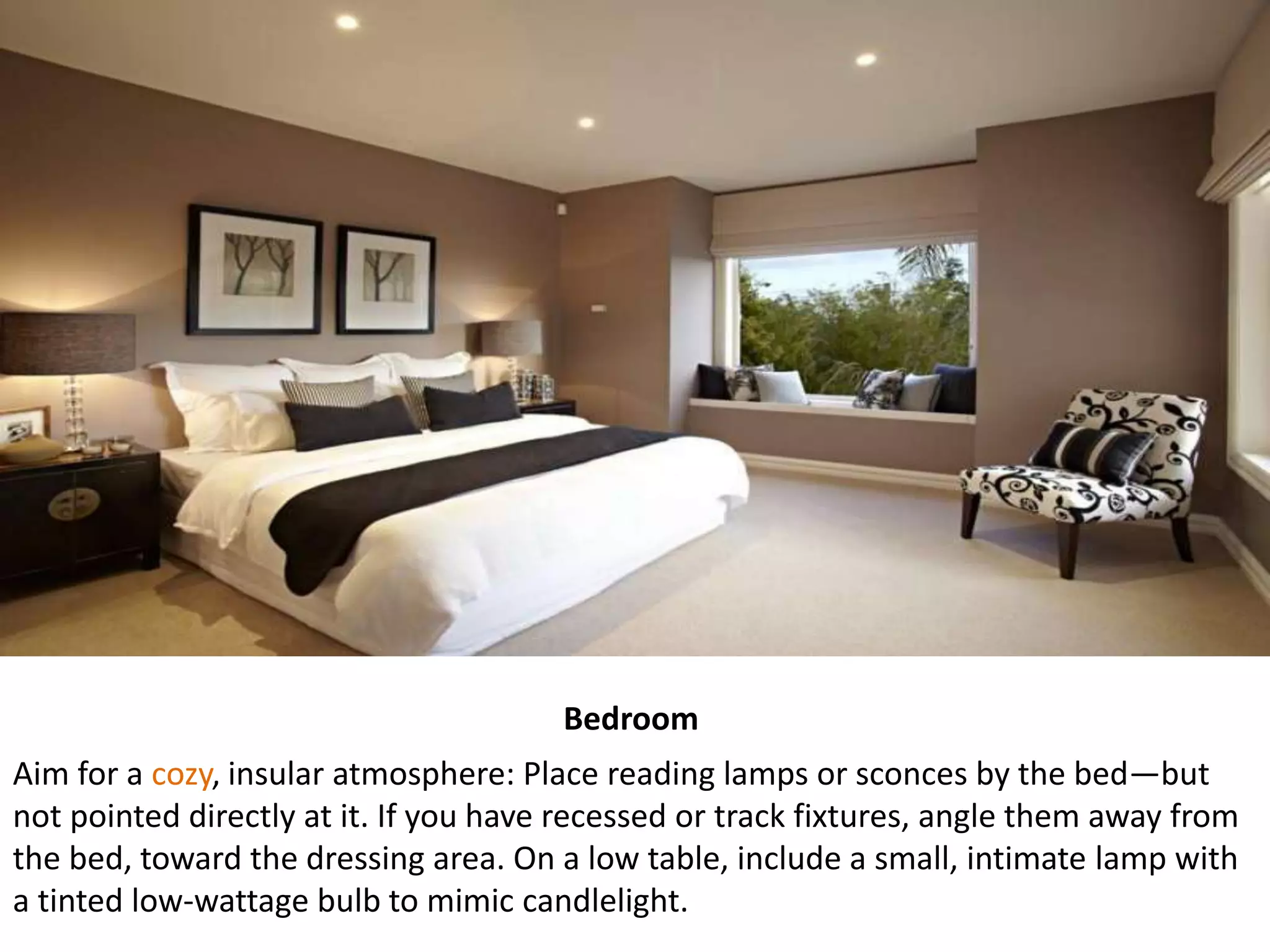
Aim for a cozy, insular atmosphere: Place reading lamps or sconces by the bed—but
not pointed directly at it. If you have recessed or track fixtures, angle them away from
the bed, toward the dressing area. On a low table, include a small, intimate lamp with
a tinted low-wattage bulb to mimic candlelight.
Bathroom
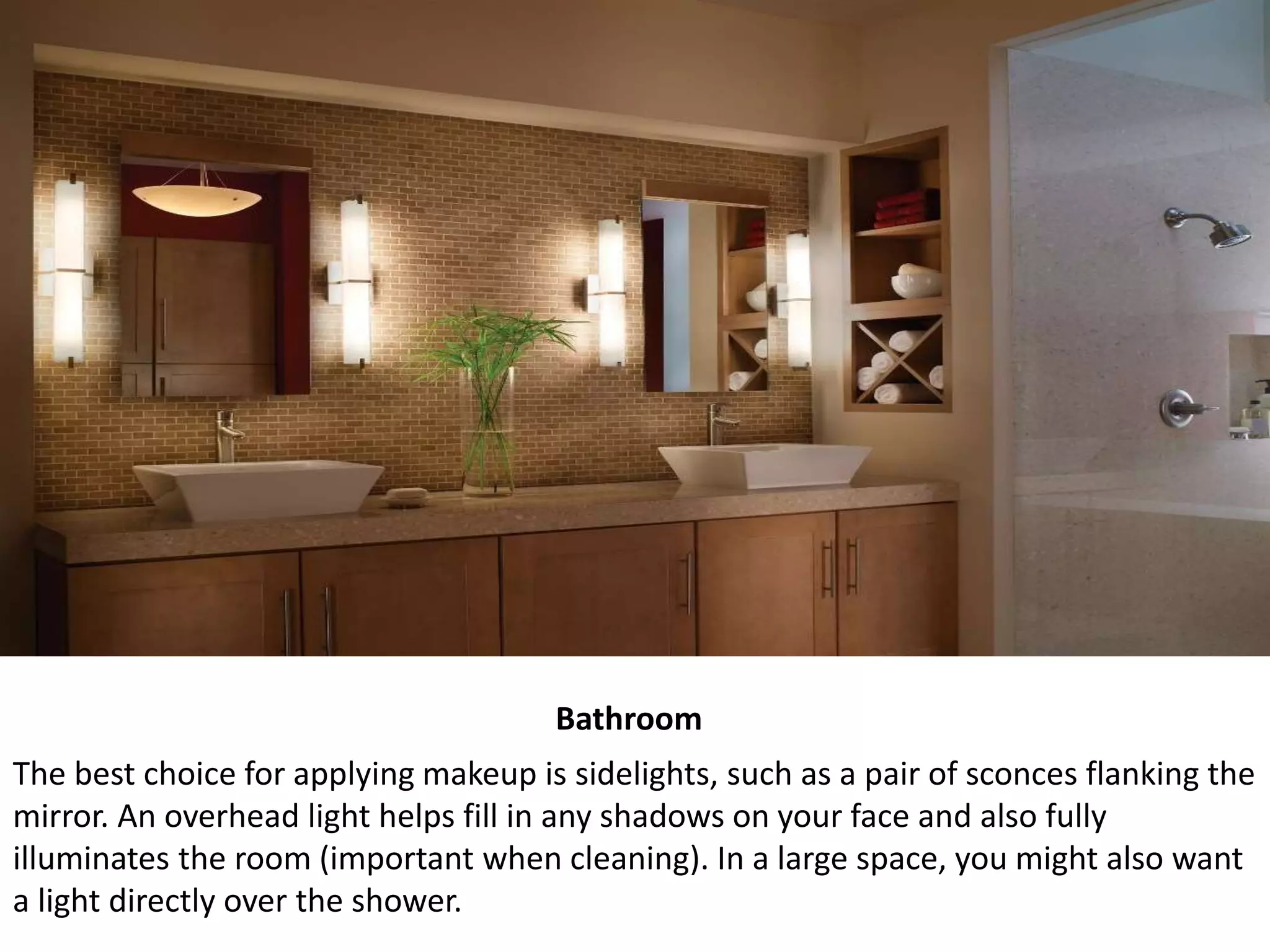
The best choice for applying makeup is sidelights, such as a pair of sconces flanking the
mirror. An overhead light helps fill in any shadows on your face and also fully
illuminates the room (important when cleaning). In a large space, you might also want
a light directly over the shower.
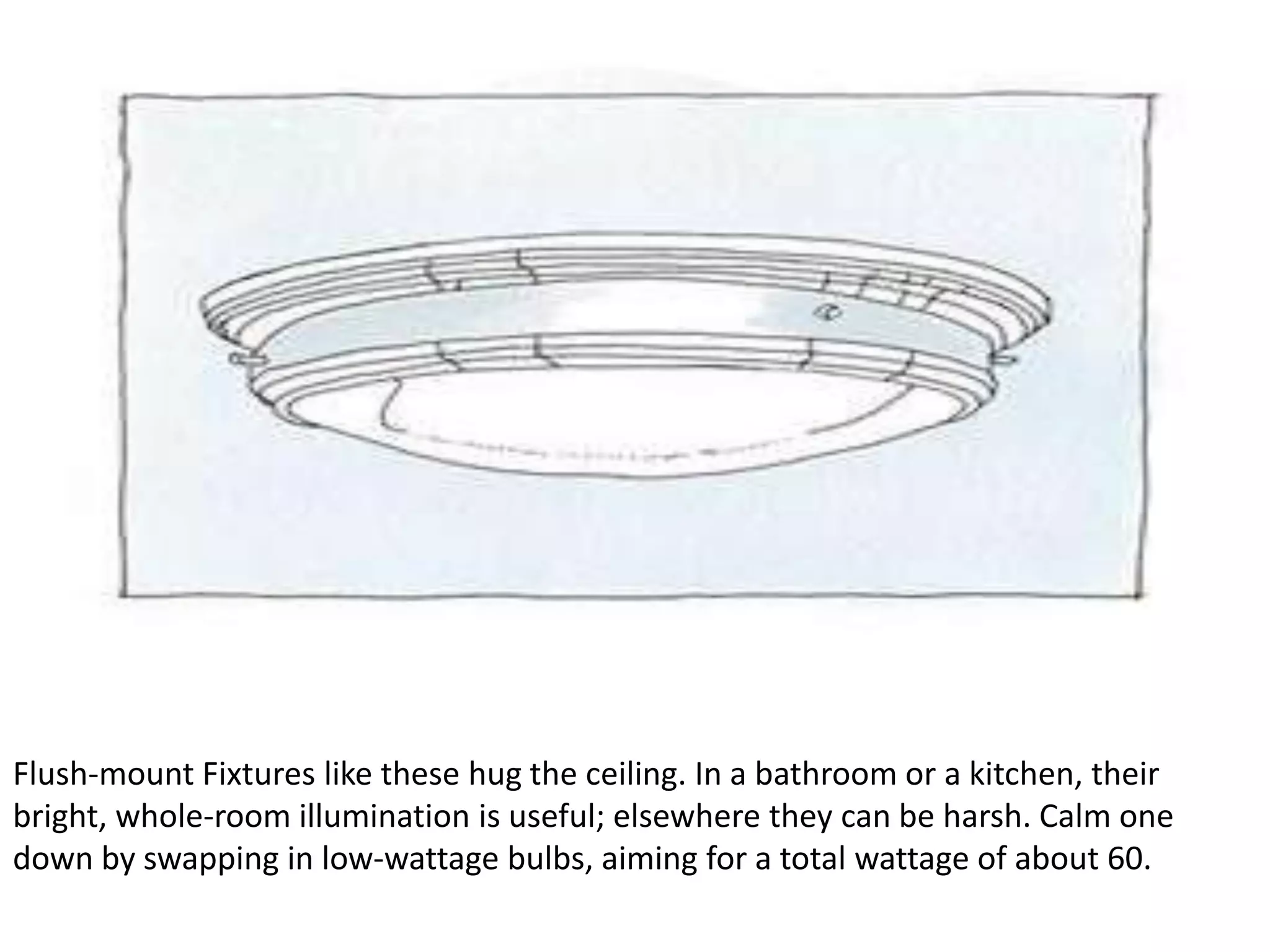
Flush-mount Fixtures like these hug the ceiling. In a bathroom or a kitchen, their
bright, whole-room illumination is useful; elsewhere they can be harsh. Calm one
down by swapping in low-wattage bulbs, aiming for a total wattage of about 60.
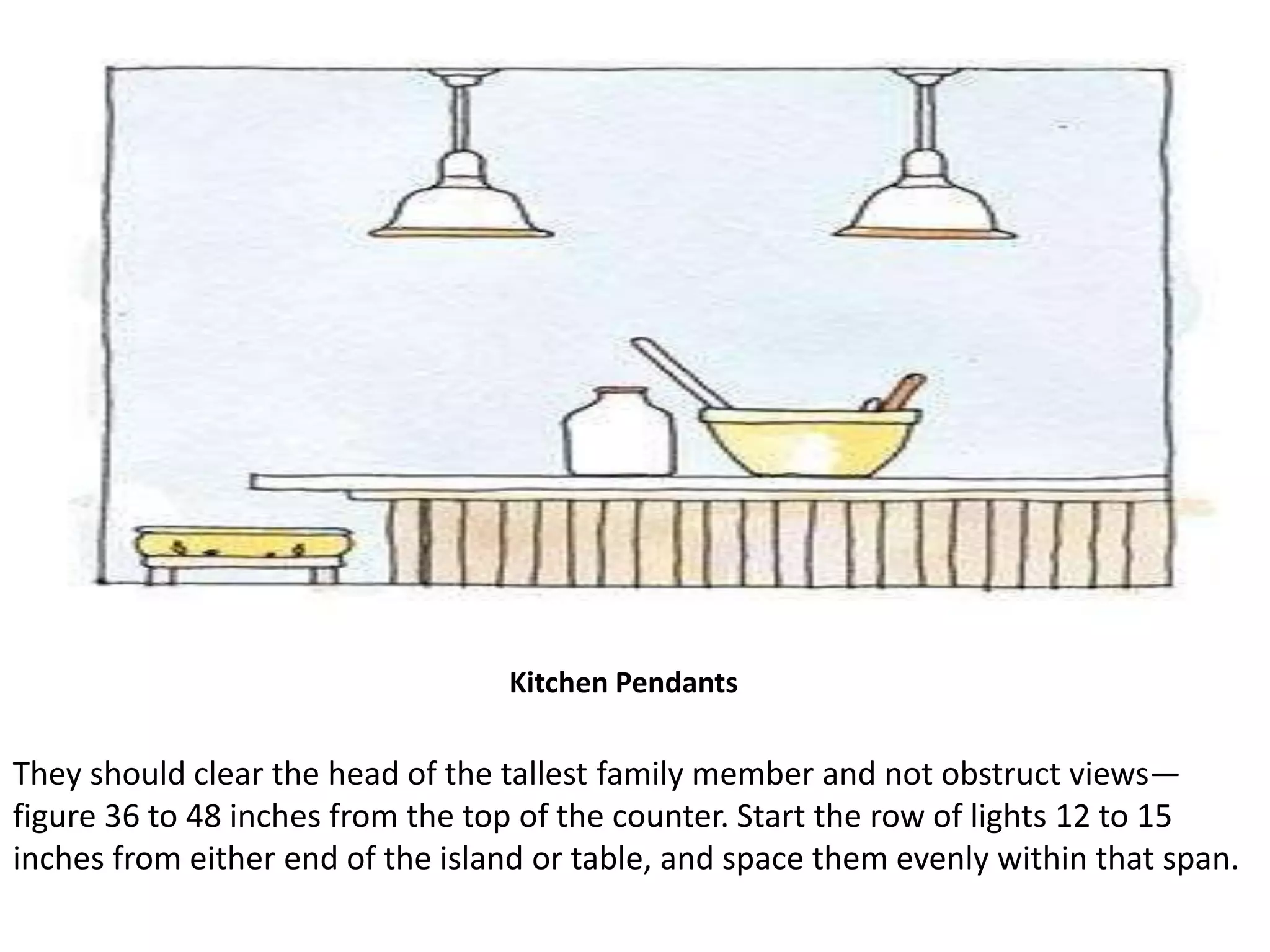
Kitchen Pendants
They should clear the head of the tallest family member and not obstruct views—
figure 36 to 48 inches from the top of the counter. Start the row of lights 12 to 15
inches from either end of the island or table, and space them evenly within that span.
Go for a fixture one-half to three-quarters the width of the table; anything larger will
cast shadows on faces. Hang the light 36 to 48 inches above the table. Choose the
lower number for more intimacy, the higher one if you want to stand when toasting.
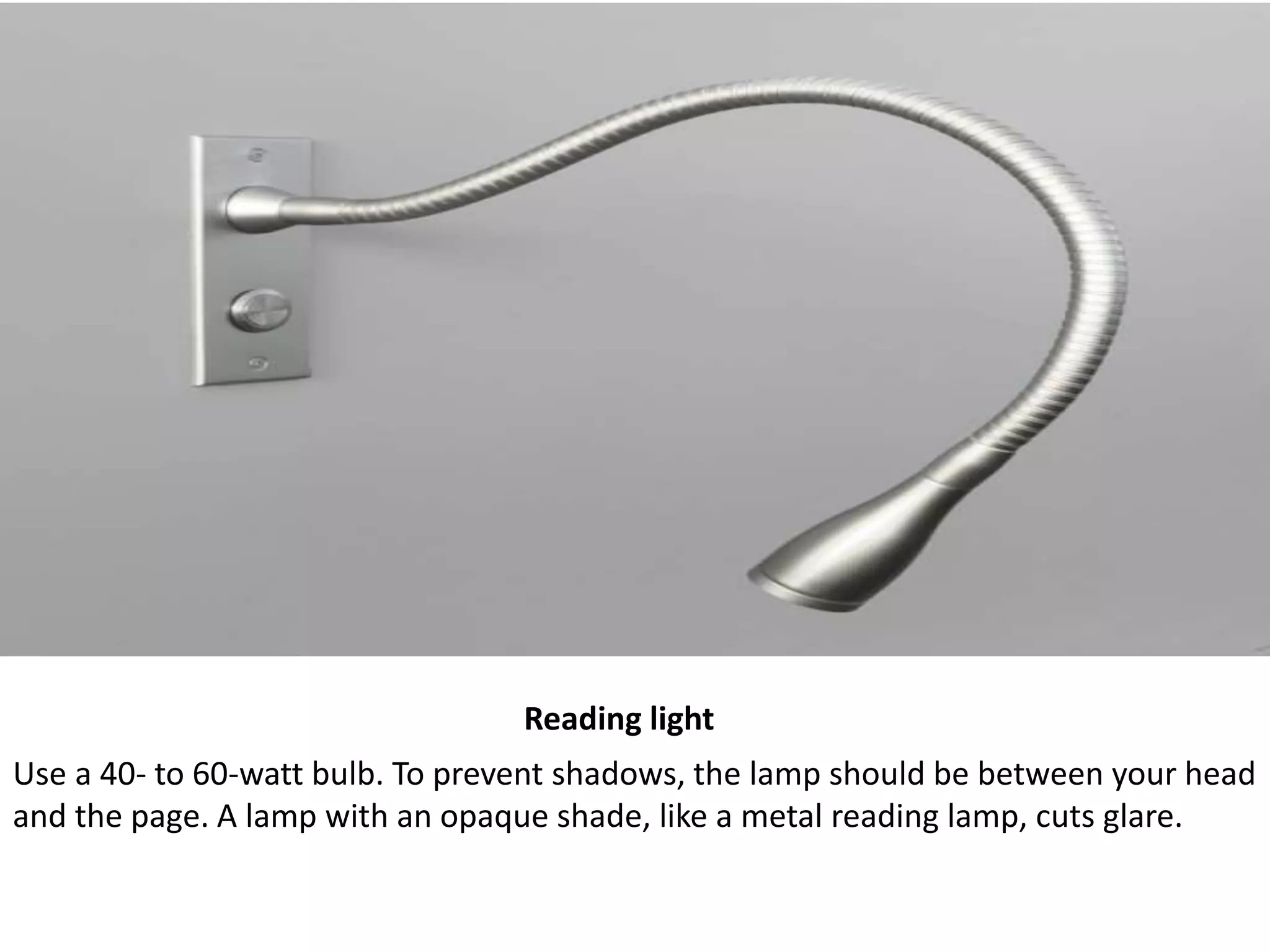
Reading light
Use a 40- to 60-watt bulb. To prevent shadows, the lamp should be between your head
and the page. A lamp with an opaque shade, like a metal reading lamp, cuts glare.
1: Silver Bowl
A metallic finish on the top half of the bulb softens the light. A great solution for overheads with exposed bulbs, especially if there isn’t a dimmer. (Halco clear silver-bowl
globe, $3, 1000bulbs.com.)
2: Soft Pink
Emits a gorgeous, rosy glow. Perfect for mood lighting in the living room, the dining room, or a bedroom. Once you switch, you’ll never go back. (Sylvania soft pink bulbs,
$5.50 for two, hardwarestore.com.)
3: Round Candelabra
Try these in a modern chandelier. Or, for a surprise, swap them in for the flame-shaped bulbs in a traditional chandelier. (GE crystal-clear globe lightbulbs, $3, amazon.com.)
4: Edison
Inspired by Thomas Edison’s original design, it has a visible filament and a rustic glow. Pricey and low-wattage, it’s worthwhile only in lamps where the bulb is exposed.
(Triple-loop bulb, $25, rejuvenation.com.)

Introduction to Lighting

  • 1.
    Lighting is theusage of light to achieve an aesthetic effect and that can be achieved by using both artificial light like lamps and light fixtures as well as natural illumination by capturing daylight
  • 2.
    Low-intensity lighting andhaze in a concert hall allows laser effects to be visible
  • 3.
  • 5.
    Day lighting using(windows, skylights or light shelves) can be the main source of light in some buildings for saving energy consumption.
  • 6.
  • 7.
  • 8.
  • 9.
    Indoor lighting isusually accomplished using light fixtures, and is a key part of interior design. Lighting can also be an intrinsic component of landscape projects.
  • 10.
    Light fixtures Lighting fixturescome in a wide variety of styles for various functions. The most important functions are as a holder for the light source, to provide directed light and to avoid visual glare. Some are very plain and functional, while some are pieces of art in themselves. Nearly any material can be used, so long as it can tolerate the excess heat and is in keeping with safety codes. Color temperature for white light sources also affects their use for certain applications. The color temperature of a white light source is the temperature in Kelvin of a theoretical black body emitter that most closely matches the spectral characteristics of the lamp. An incandescent bulb has a color temperature around 2800 to 3000 Kelvin; daylight is around 6400 Kelvin. Lower color temperature lamps have relatively more energy in the yellow and red part of the visible spectrum, while high color temperatures correspond to lamps with more of a blue-white appearance. For critical inspection or color matching tasks, or for retail displays of food and clothing, the color temperature of the lamps will be selected for the best overall lighting effect.
  • 11.
    Color temperature ofa heated metal
  • 12.
    The effect ofincreasing heat on light color
  • 13.
  • 14.
    Task lighting Task lightingis mainly functional and is usually the most concentrated, for purposes such as reading or inspection of materials. For example, reading poor-quality reproductions may require task lighting levels up to 1500 lux (150 foot-candles), and some inspection tasks or surgical procedures require even higher levels
  • 15.
    A lux meterfor measuring illuminances in work places.
  • 16.
    Accent lighting Accent lightingis mainly decorative, intended to highlight pictures, plants, or other elements of interior design or landscaping.
  • 17.
    General lighting General lighting(sometimes referred to as ambient light) fills in between the two and is intended for general illumination of an area. Indoors, this would be a basic lamp on a table or floor, or a fixture on the ceiling. Outdoors, general lighting for a parking lot may be as low as 10-20 lux (1-2 foot-candles) since pedestrians and motorists already used to the dark will need little light for crossing the area.
  • 18.
    Methods of lighting •Down lighting • Up lighting • Front lighting
  • 19.
    Down lighting Down lightingis most common, with fixtures on or recessed in the ceiling casting light downward. This tends to be the most used method, used in both offices and homes. Although it is easy to design it has dramatic problems with glare and excess energy consumption due to large number of fittings. The introduction of LED lighting has greatly improved this by approx. 90% when compared to a halogen down light or spotlight. LED lamps or bulbs are now available to retro fit in place of high energy consumption lamps
  • 20.
    Up lighting Uplighting isless common, often used to bounce indirect light off the ceiling and back down. It is commonly used in lighting applications that require minimal glare and uniform general illuminance levels. Up lighting (indirect) uses a diffuse surface to reflect light in a space and can minimize disabling glare on computer displays and other dark glossy surfaces. It gives a more uniform presentation of the light output in operation. However indirect lighting is completely reliant upon the reflectance value of the surface. While indirect lighting can create a diffused and shadow free light effect it can be regarded as an uneconomical lighting principle.
  • 21.
    Front lighting Front lightingis also quite common, but tends to make the subject look flat as its casts almost no visible shadows. Lighting from the side is the less common, as it tends to produce glare near eye level. Backlighting either around or through an object is mainly for accent
  • 22.
    Architectural lighting design Architecturallighting design is a field within architecture, interior design and electrical engineering that is concerned with the design of lighting systems, including natural light, electric light, or both, to serve human needs. The design process takes account of: • the kind of human activity for which lighting is to be provided. • the amount of light required. • the color of the light as it may affect the views of particular objects and the environment as a whole. • the distribution of light within the space to be lighted, whether indoor or outdoor. • the effect of the lightened system itself on the user.
  • 23.
  • 24.
    Living room Light threeof the four corners, focusing one of those lights on an object (art, a plant, a striking chair). Use a combination of table lamps and floor lamps, some with a downward glow and some that shine upward. If you have an overhead fixture, put it on a dimmer and always avoid direct visual glare.
  • 25.
    Dining room Make thetable the brightest spot in the room. Use a chandelier or a pendant above the table, limiting the total wattage to 100. Elsewhere in the room, indirect lighting is best—it’s relaxing and flattering. Give the space a subtle glow with a pair of small table lamps on a sideboard or matching sconces on the wall above. Battery-powered votives inside a glass-front china cabinet can be a nice touch.
  • 26.
    Kitchen Focus on overheadlighting (on a dimmer that you can crank up when cooking), and add lower sources to illuminate work surfaces. Use pendants, under-cabinet lights, or a sturdy table lamp (kept away from the sink).
  • 27.
    Bedroom Aim for acozy, insular atmosphere: Place reading lamps or sconces by the bed—but not pointed directly at it. If you have recessed or track fixtures, angle them away from the bed, toward the dressing area. On a low table, include a small, intimate lamp with a tinted low-wattage bulb to mimic candlelight.
  • 28.
    Bathroom The best choicefor applying makeup is sidelights, such as a pair of sconces flanking the mirror. An overhead light helps fill in any shadows on your face and also fully illuminates the room (important when cleaning). In a large space, you might also want a light directly over the shower.
  • 29.
    Flush-mount Fixtures likethese hug the ceiling. In a bathroom or a kitchen, their bright, whole-room illumination is useful; elsewhere they can be harsh. Calm one down by swapping in low-wattage bulbs, aiming for a total wattage of about 60.
  • 30.
    Kitchen Pendants They shouldclear the head of the tallest family member and not obstruct views— figure 36 to 48 inches from the top of the counter. Start the row of lights 12 to 15 inches from either end of the island or table, and space them evenly within that span.
  • 31.
    Go for afixture one-half to three-quarters the width of the table; anything larger will cast shadows on faces. Hang the light 36 to 48 inches above the table. Choose the lower number for more intimacy, the higher one if you want to stand when toasting.
  • 32.
    Reading light Use a40- to 60-watt bulb. To prevent shadows, the lamp should be between your head and the page. A lamp with an opaque shade, like a metal reading lamp, cuts glare.
  • 33.
    1: Silver Bowl Ametallic finish on the top half of the bulb softens the light. A great solution for overheads with exposed bulbs, especially if there isn’t a dimmer. (Halco clear silver-bowl globe, $3, 1000bulbs.com.) 2: Soft Pink Emits a gorgeous, rosy glow. Perfect for mood lighting in the living room, the dining room, or a bedroom. Once you switch, you’ll never go back. (Sylvania soft pink bulbs, $5.50 for two, hardwarestore.com.) 3: Round Candelabra Try these in a modern chandelier. Or, for a surprise, swap them in for the flame-shaped bulbs in a traditional chandelier. (GE crystal-clear globe lightbulbs, $3, amazon.com.) 4: Edison Inspired by Thomas Edison’s original design, it has a visible filament and a rustic glow. Pricey and low-wattage, it’s worthwhile only in lamps where the bulb is exposed. (Triple-loop bulb, $25, rejuvenation.com.)