The art and technique of arranging type to make
written language readable and appealing
It involves selecting typefaces, point size, line length, line
spacing (leading), letter spacing (tracking), and adjusting
the space between pairs (kerning)
Typeface vs. Font
Typeface
A set of typographical symbols and
characters. It’s the letters, numbers and
other characters that let us put words on
paper and on screen.
Typeface is a family of fonts
( eg Helvetica Regular, Helvetica Bold,
Helvetica Italic, Helvetica Black)
Font
A complete character set within a typeface,
often a particular size and style.
A font is one weight or style within a
typeface family.
(e.g. Helvetica Regular)
Font and Typeface are not interchangeable
Serif and San Serif
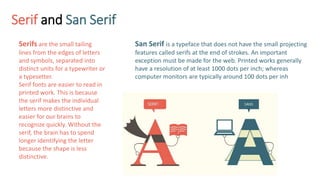
Serifs are the small tailing
lines from the edges of letters
and symbols, separated into
distinct units for a typewriter or
a typesetter.
Serif fonts are easier to read in
printed work. This is because
the serif makes the individual
letters more distinctive and
easier for our brains to
recognize quickly. Without the
serif, the brain has to spend
longer identifying the letter
because the shape is less
distinctive.
San Serif is a typeface that does not have the small projecting
features called serifs at the end of strokes. An important
exception must be made for the web. Printed works generally
have a resolution of at least 1000 dots per inch; whereas
computer monitors are typically around 100 dots per inh
SERIF
Old style/ Humanist: Times New Roman, Garamond
Transitional: Baskerville
Modern: Bodoni
Slab Serif: Rockwell
SAN SERIF
Grotesque: Franklin Gothic
Transitional/ Neo Grotesque: Helvetia
Humanist: Tahoma, Gill Sans
Geometric: Futura
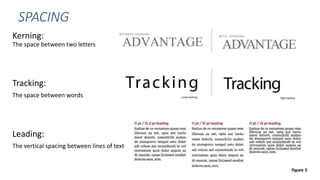
SPACING
Kerning:
The space between two letters
Tracking:
The space between words
Leading:
The vertical spacing between lines of text

Topography

  • 1.
    The art andtechnique of arranging type to make written language readable and appealing It involves selecting typefaces, point size, line length, line spacing (leading), letter spacing (tracking), and adjusting the space between pairs (kerning)
  • 2.
    Typeface vs. Font Typeface Aset of typographical symbols and characters. It’s the letters, numbers and other characters that let us put words on paper and on screen. Typeface is a family of fonts ( eg Helvetica Regular, Helvetica Bold, Helvetica Italic, Helvetica Black) Font A complete character set within a typeface, often a particular size and style. A font is one weight or style within a typeface family. (e.g. Helvetica Regular) Font and Typeface are not interchangeable
  • 3.
    Serif and SanSerif Serifs are the small tailing lines from the edges of letters and symbols, separated into distinct units for a typewriter or a typesetter. Serif fonts are easier to read in printed work. This is because the serif makes the individual letters more distinctive and easier for our brains to recognize quickly. Without the serif, the brain has to spend longer identifying the letter because the shape is less distinctive. San Serif is a typeface that does not have the small projecting features called serifs at the end of strokes. An important exception must be made for the web. Printed works generally have a resolution of at least 1000 dots per inch; whereas computer monitors are typically around 100 dots per inh
  • 4.
    SERIF Old style/ Humanist:Times New Roman, Garamond Transitional: Baskerville Modern: Bodoni Slab Serif: Rockwell SAN SERIF Grotesque: Franklin Gothic Transitional/ Neo Grotesque: Helvetia Humanist: Tahoma, Gill Sans Geometric: Futura
  • 5.
    SPACING Kerning: The space betweentwo letters Tracking: The space between words Leading: The vertical spacing between lines of text