By: Abdulrazak Zakieh
1Transform and Conquer
• Understand the concept of transform and conquer
• List the applications of presorting
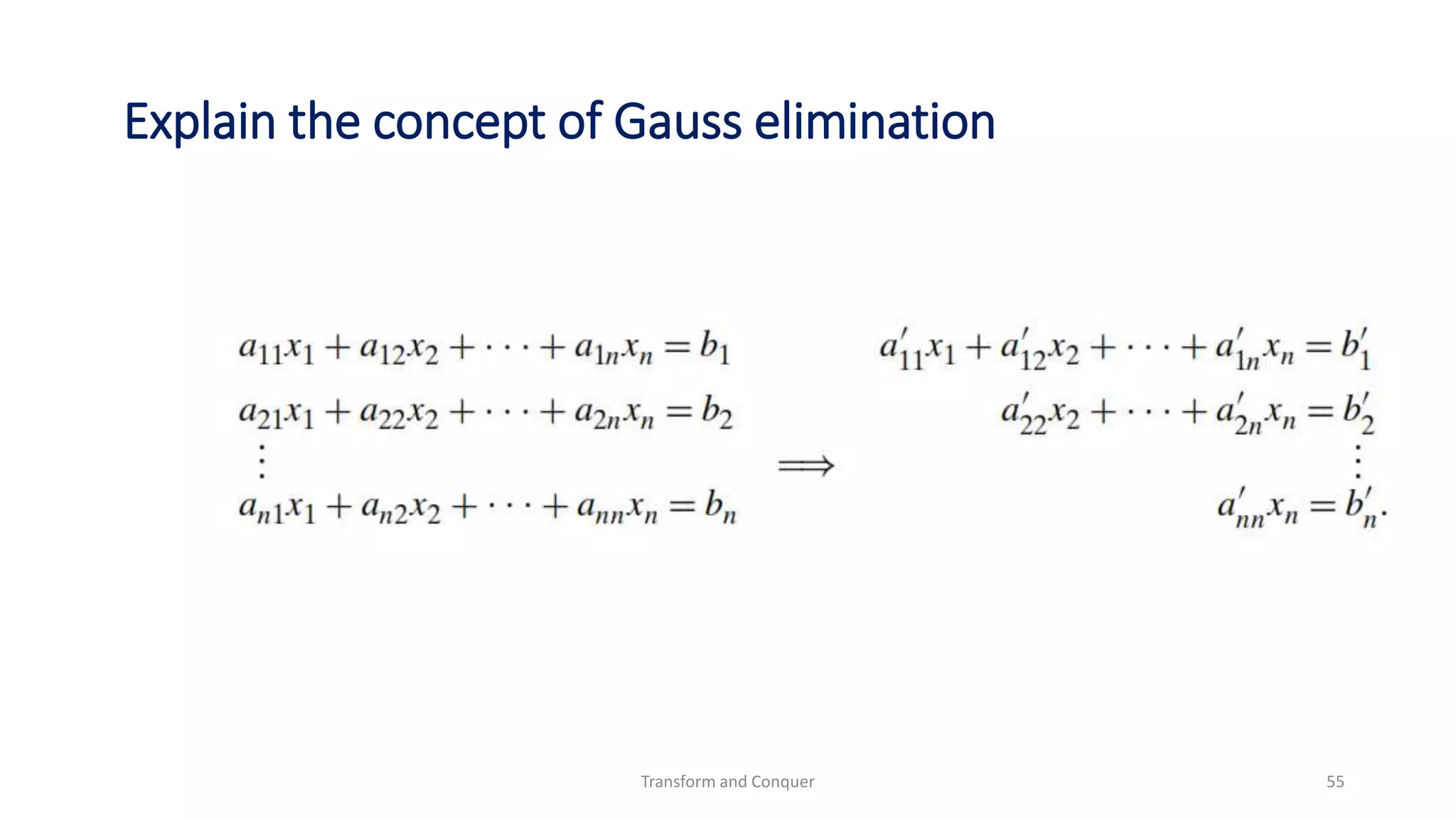
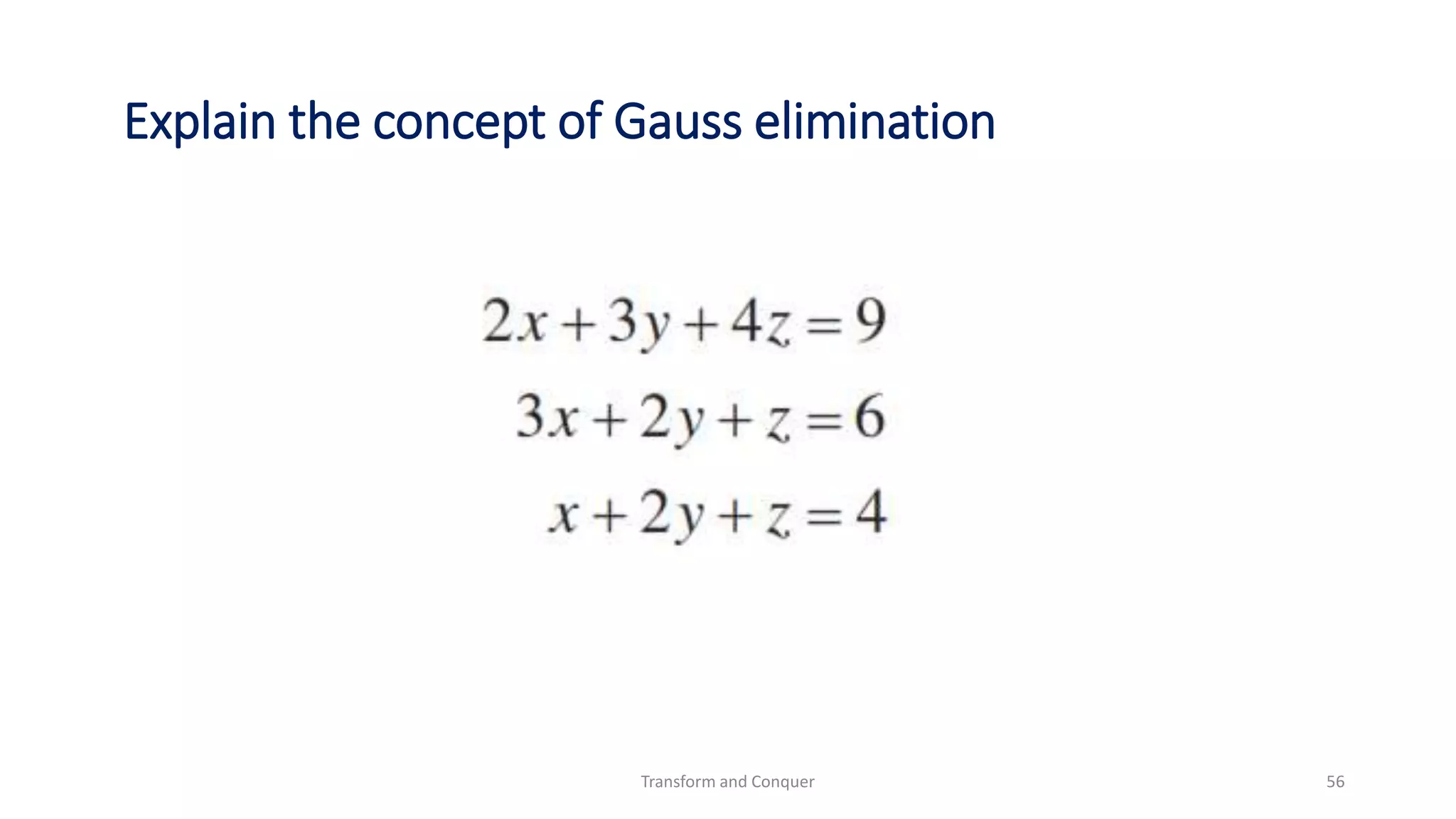
• Explain the concept of Gauss elimination
• Use Horner’s rule for evaluating polynomials
• Find the lowest common multiple of two numbers
2Transform and Conquer
• Understand the concept of transform and conquer
• List the applications of presorting
• Explain the concept of Gauss elimination
• Use Horner’s rule for evaluating polynomials
• Find the lowest common multiple of two numbers
3Transform and Conquer
Understand the concept of transform and conquer
4Transform and Conquer
Understand the concept of transform and conquer
5Transform and Conquer
Understand the concept of transform and conquer
6
Minimize Complication
Transform and Conquer
Understand the concept of transform and conquer
7
•Instance Simplification
•Change Representation
•Problem Reduction
Transform and Conquer
• Understand the concept of transform and conquer
• List the applications of presorting
• Explain the concept of Gauss elimination
• Use Horner’s rule for evaluating polynomials
• Find the lowest common multiple of two numbers
8Transform and Conquer
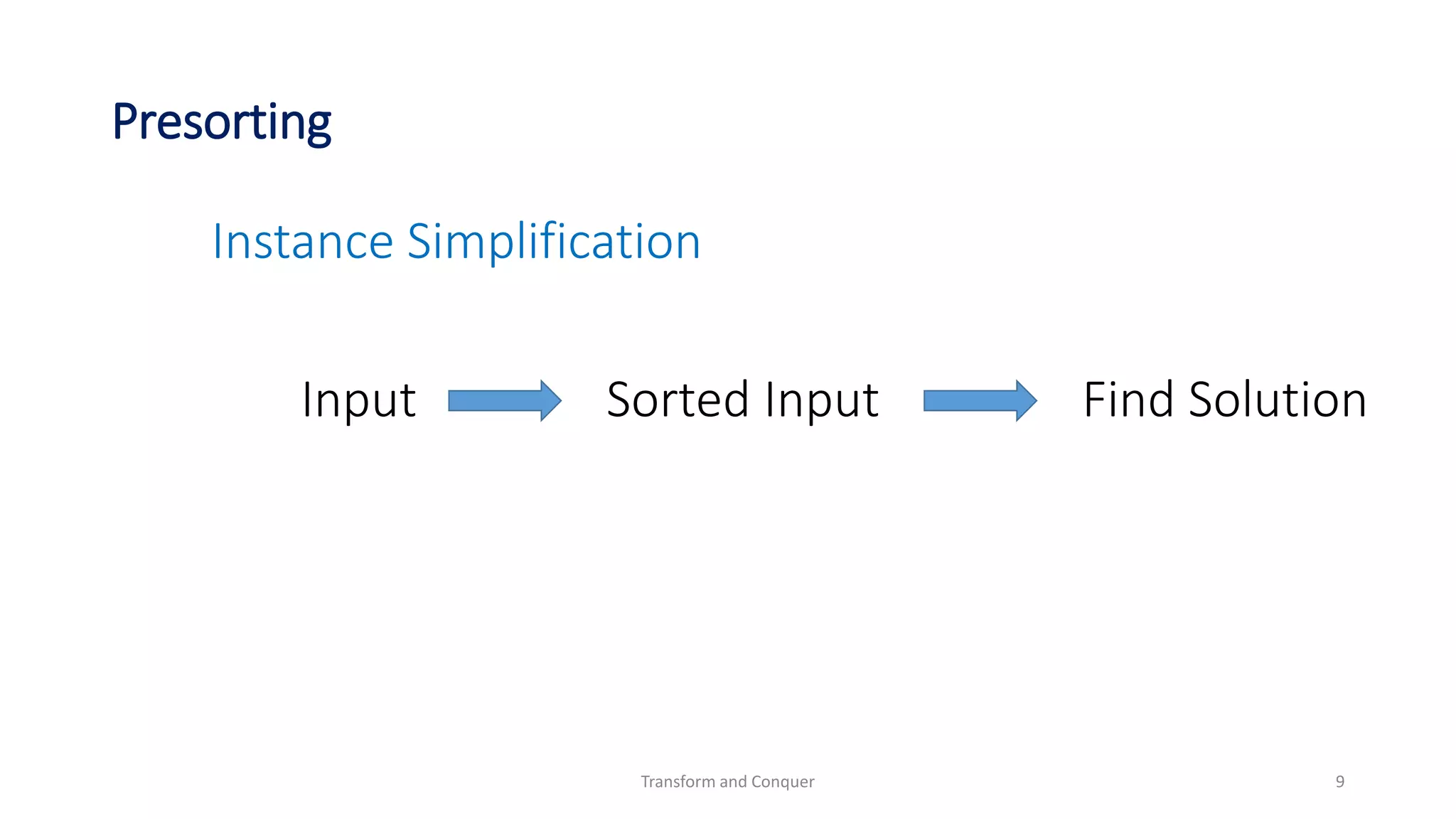
9
Presorting
Instance Simplification
Input Sorted Input Find Solution
Transform and Conquer
10
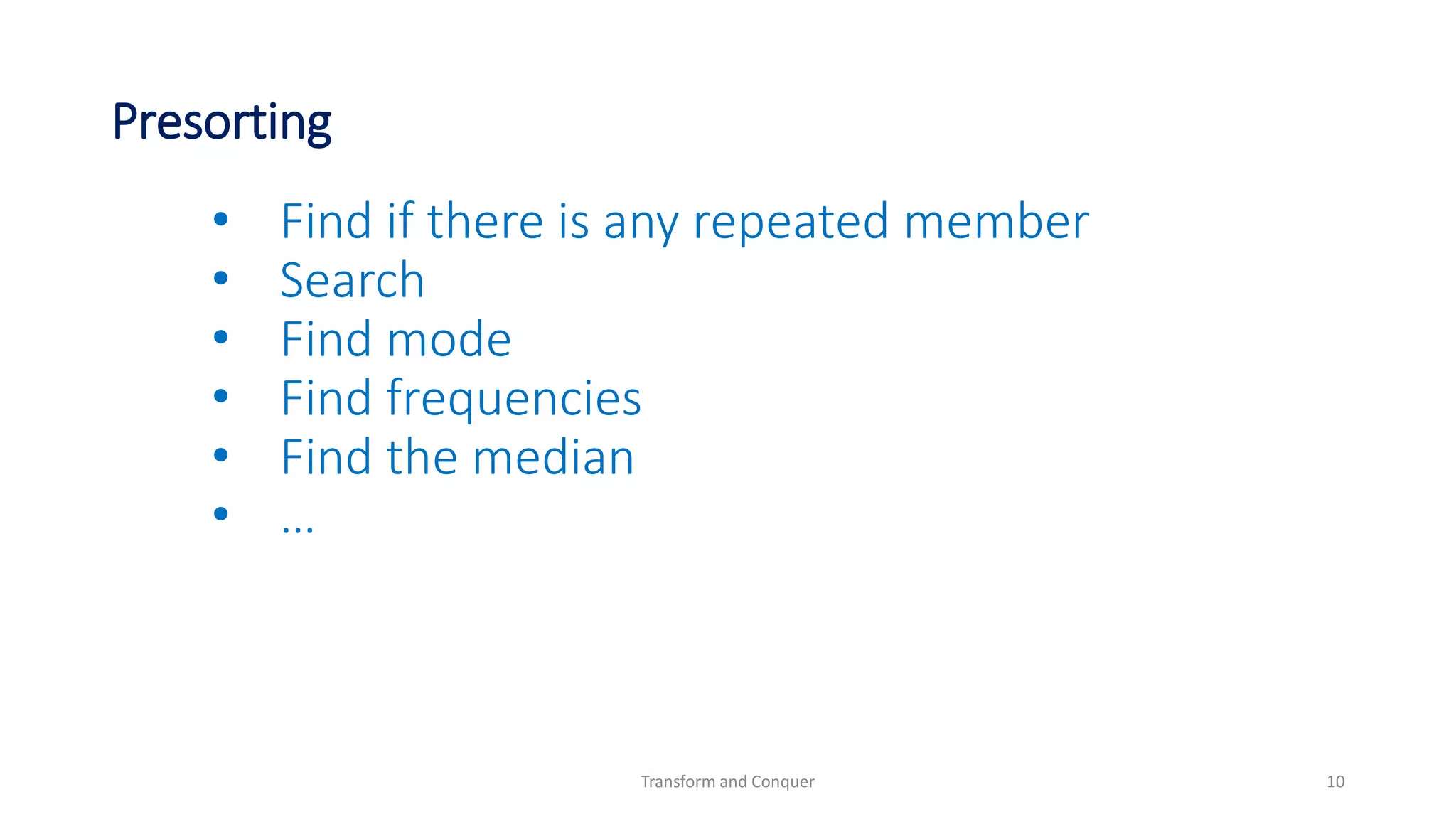
Presorting
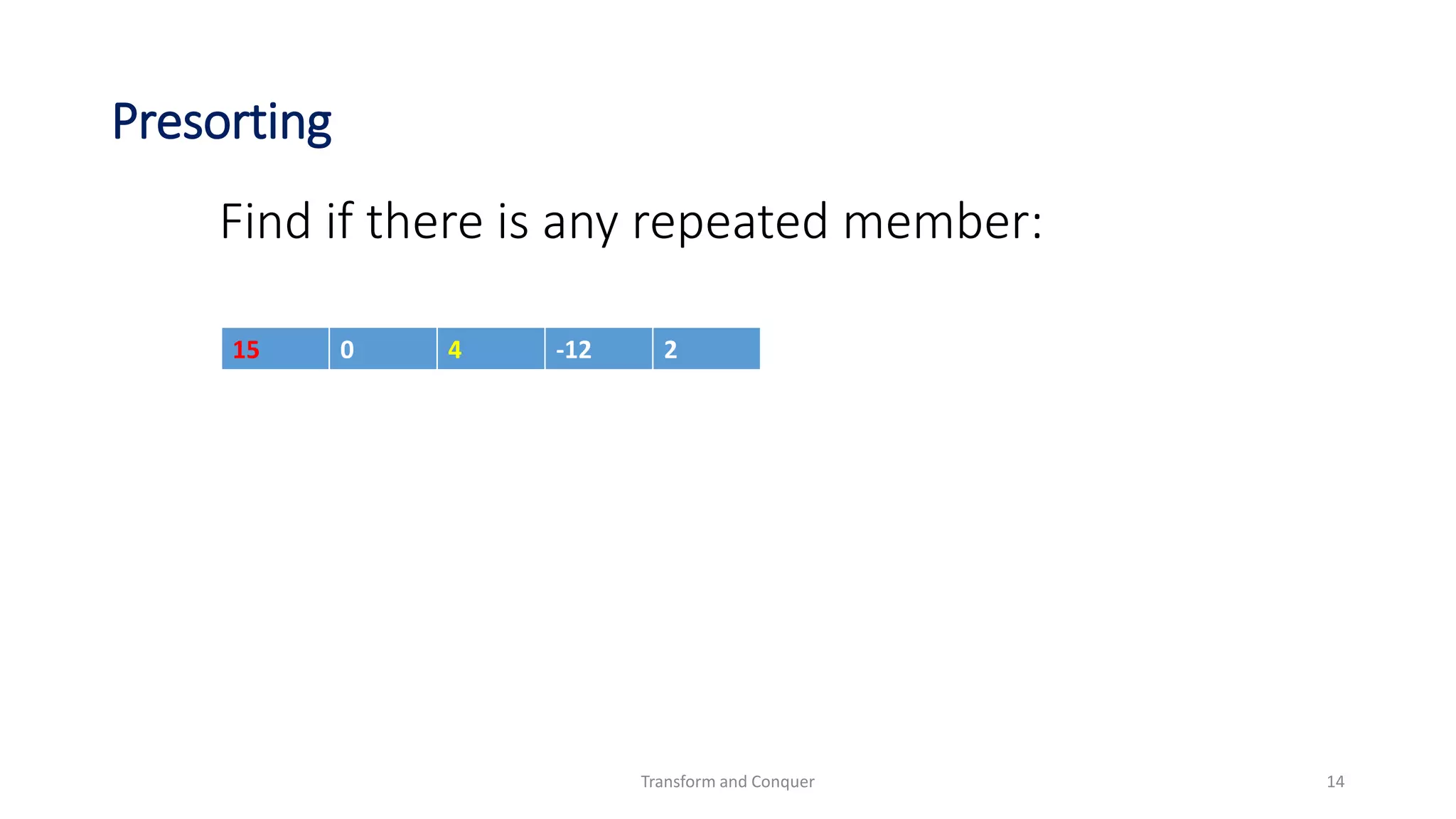
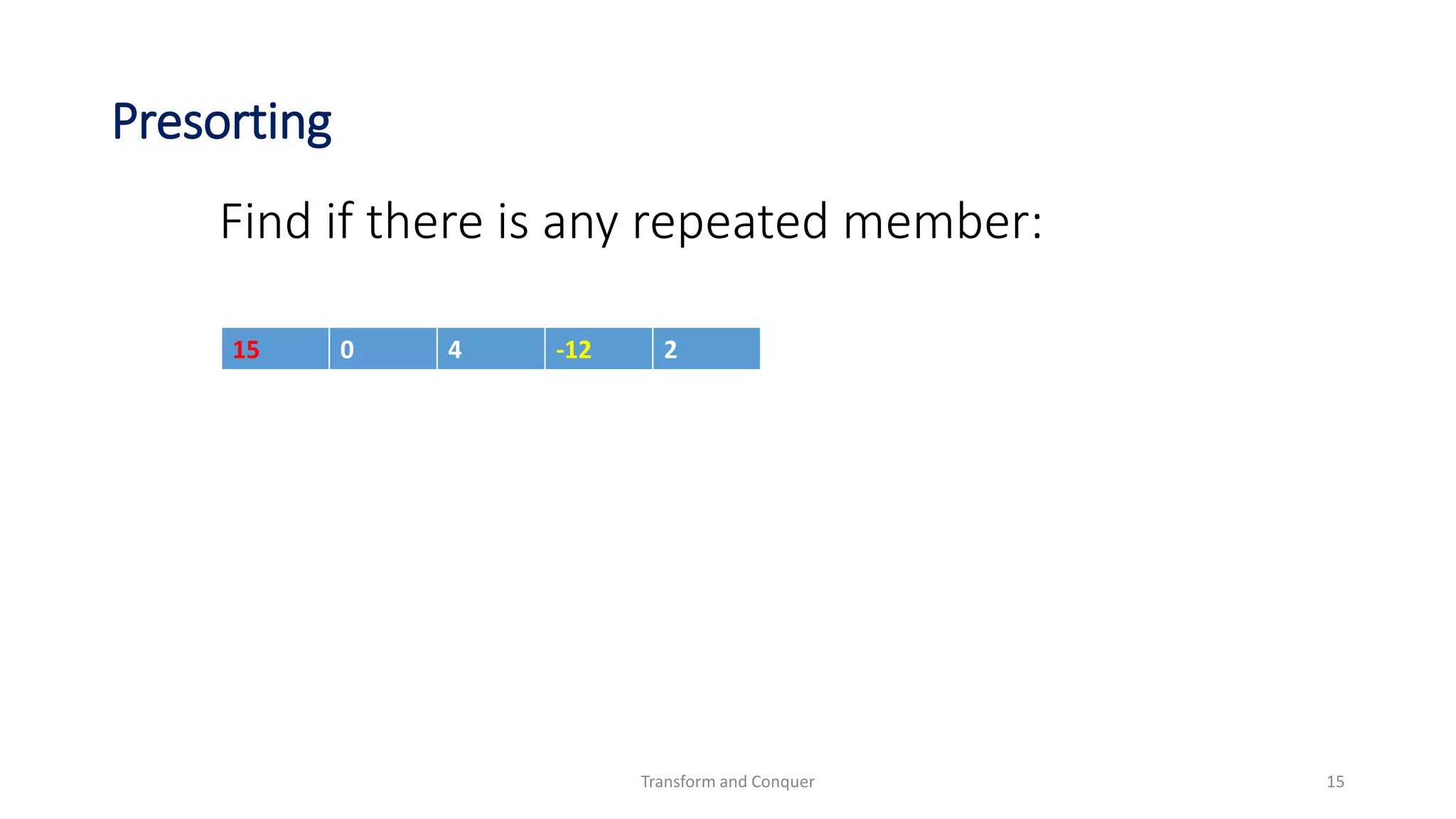
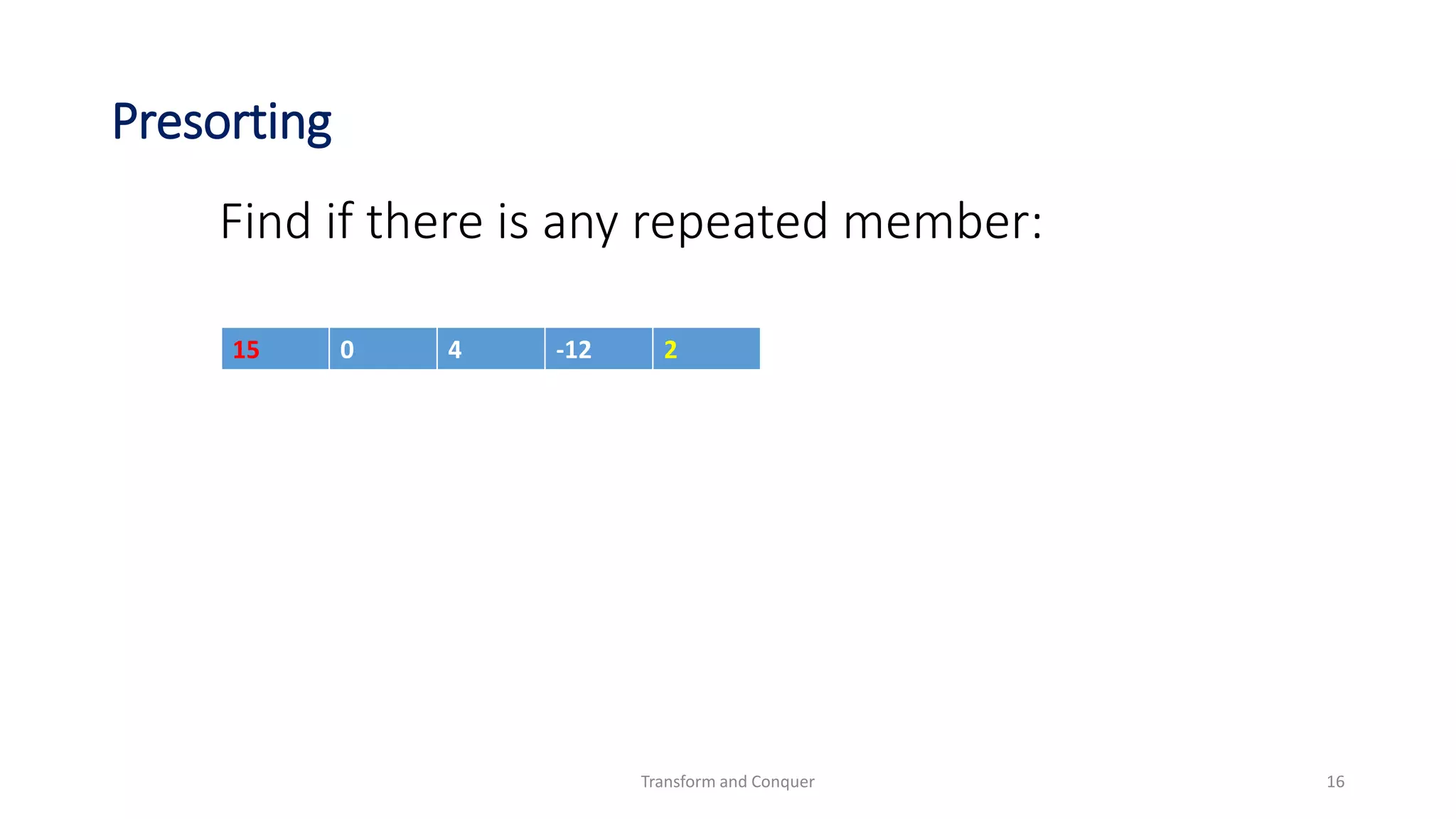
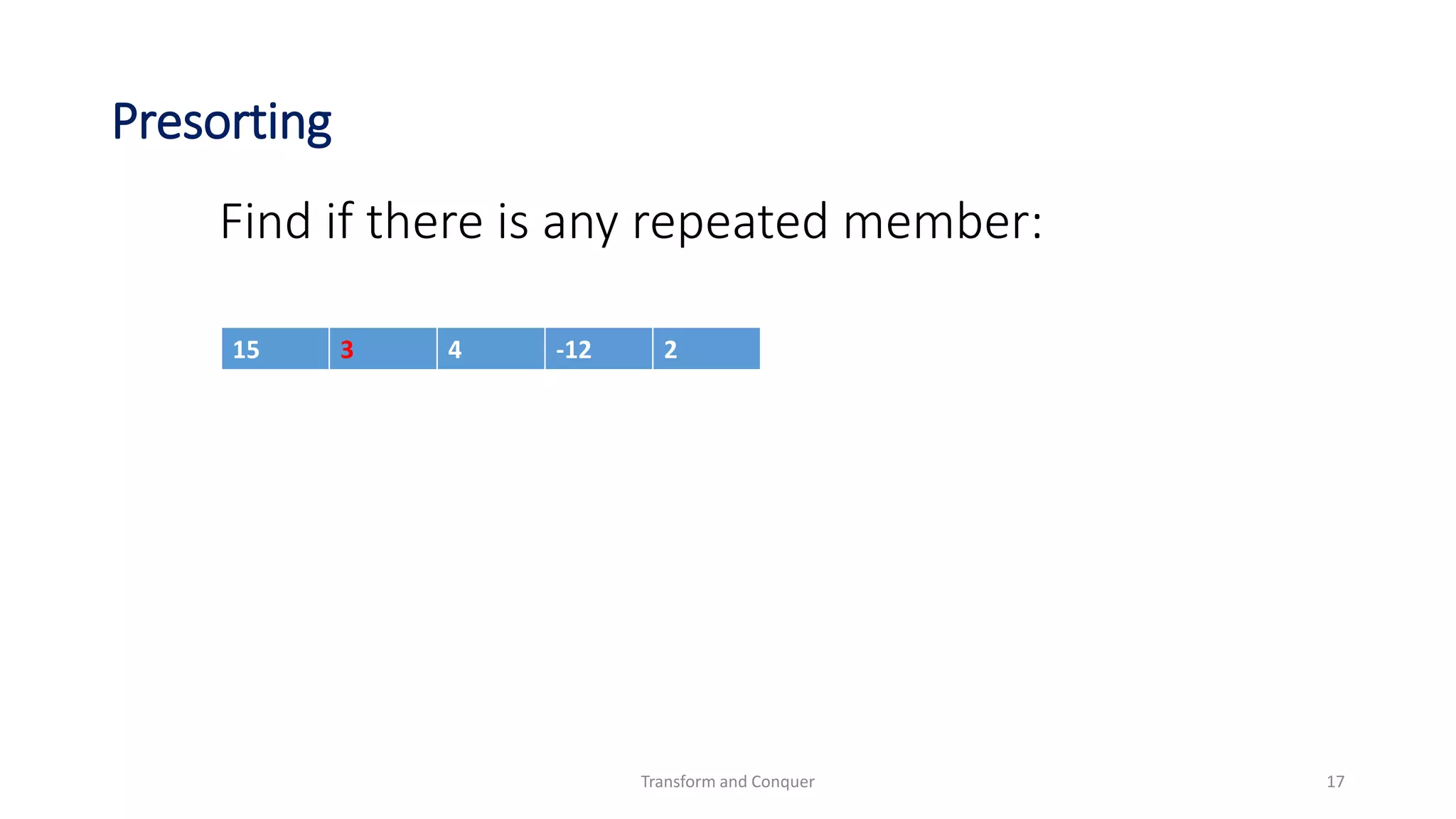
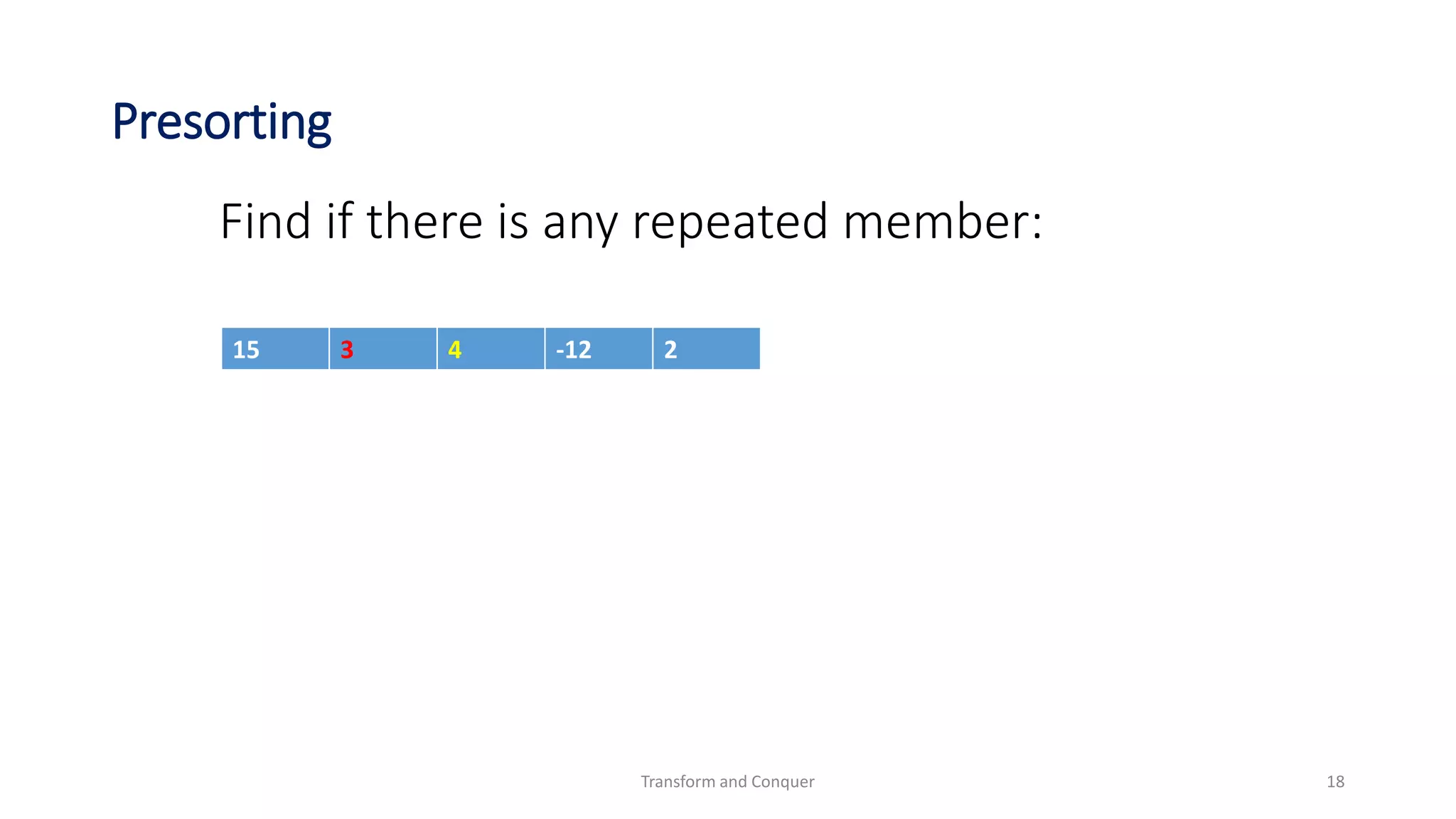
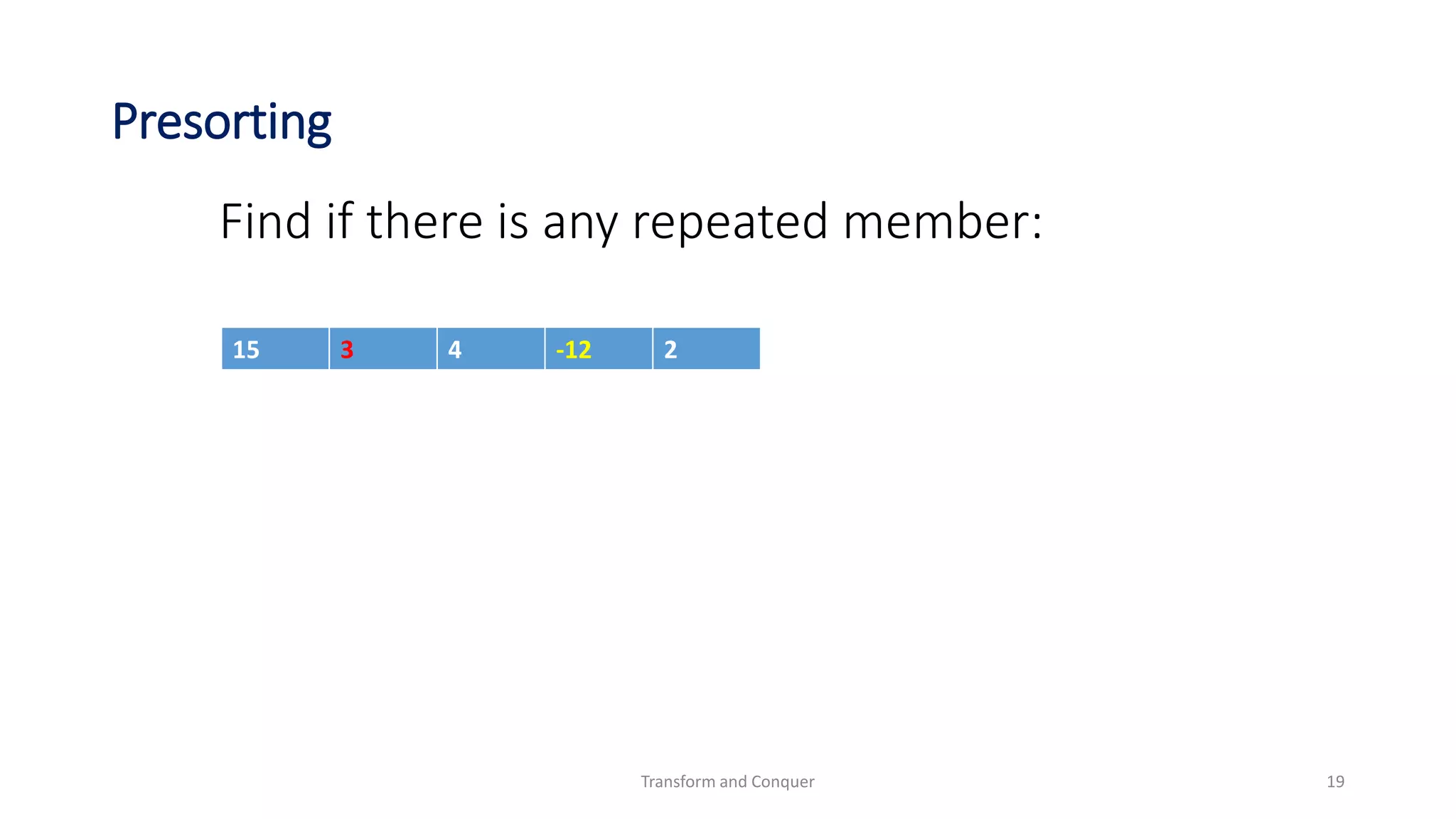
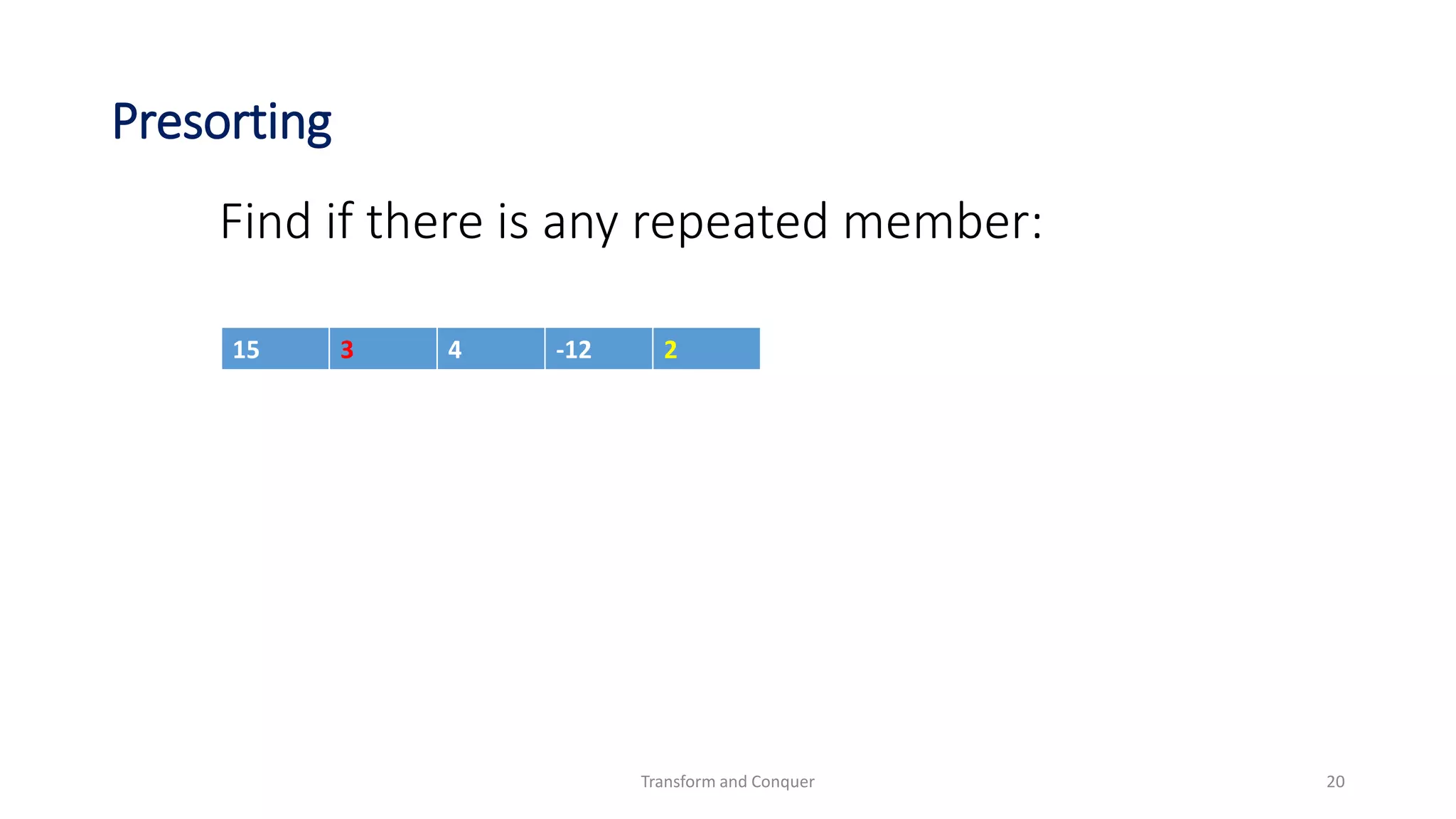
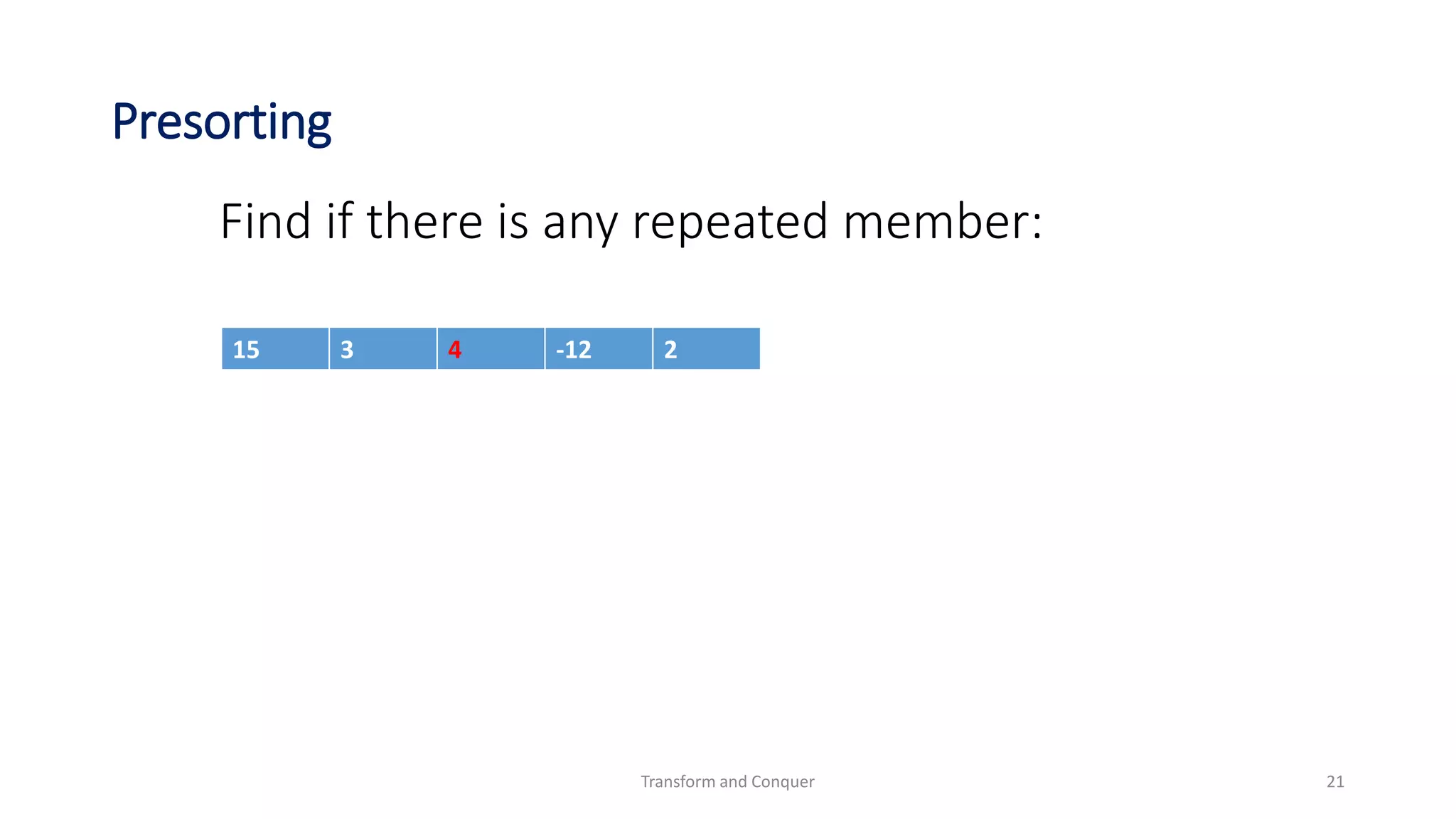
• Find if there is any repeated member
• Search
• Find mode
• Find frequencies
• Find the median
• …
Transform and Conquer
Presorting
11
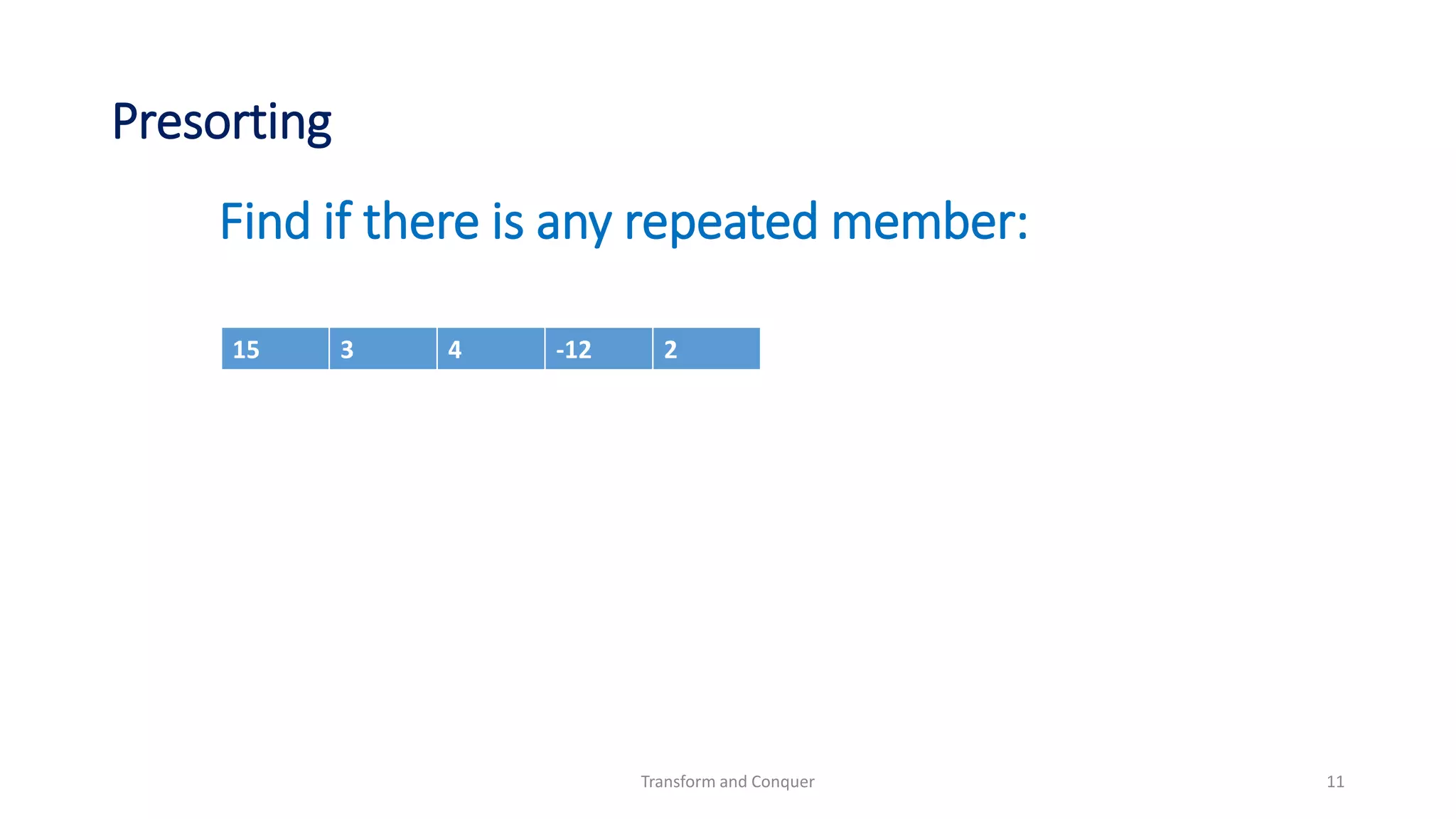
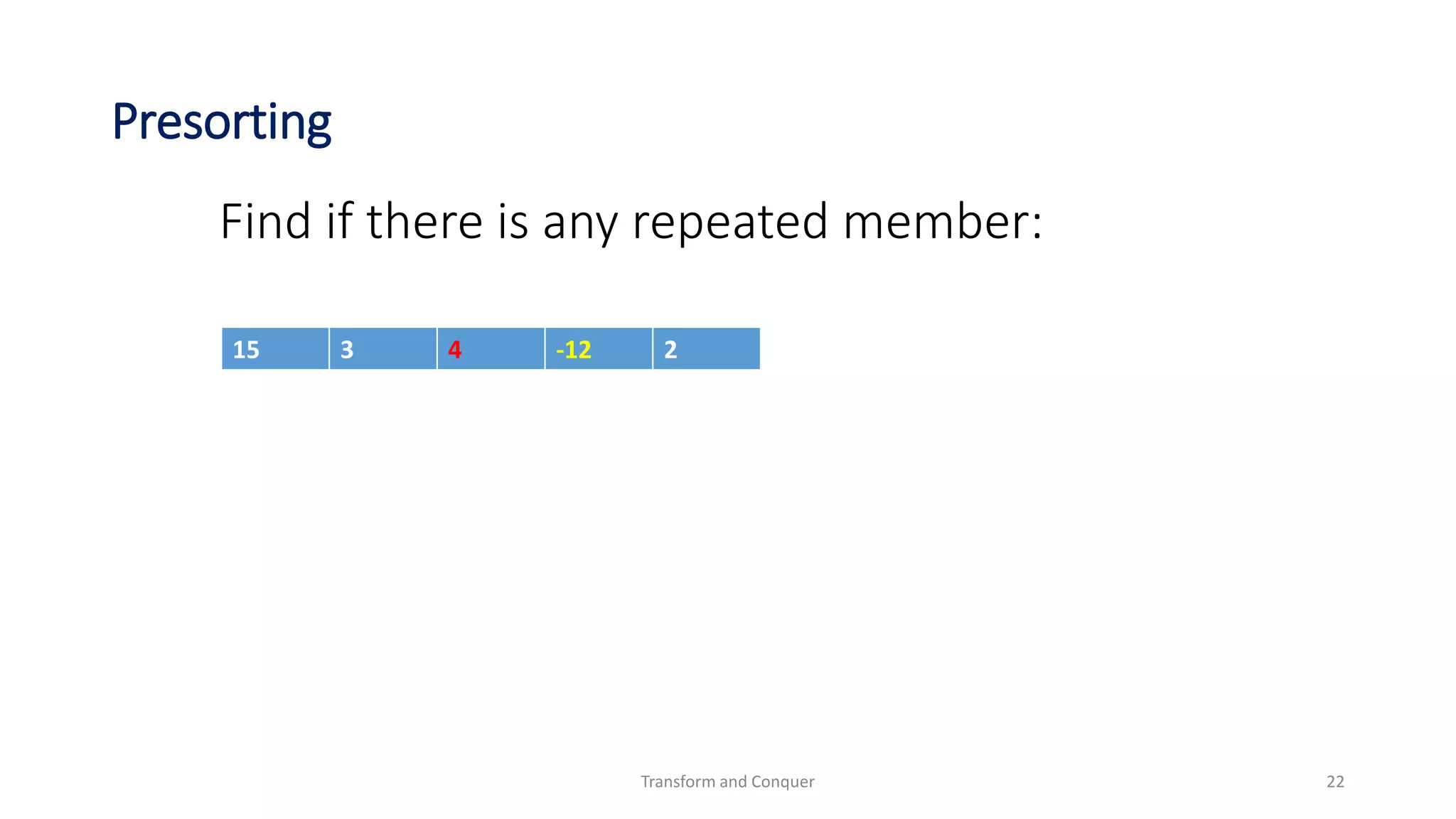
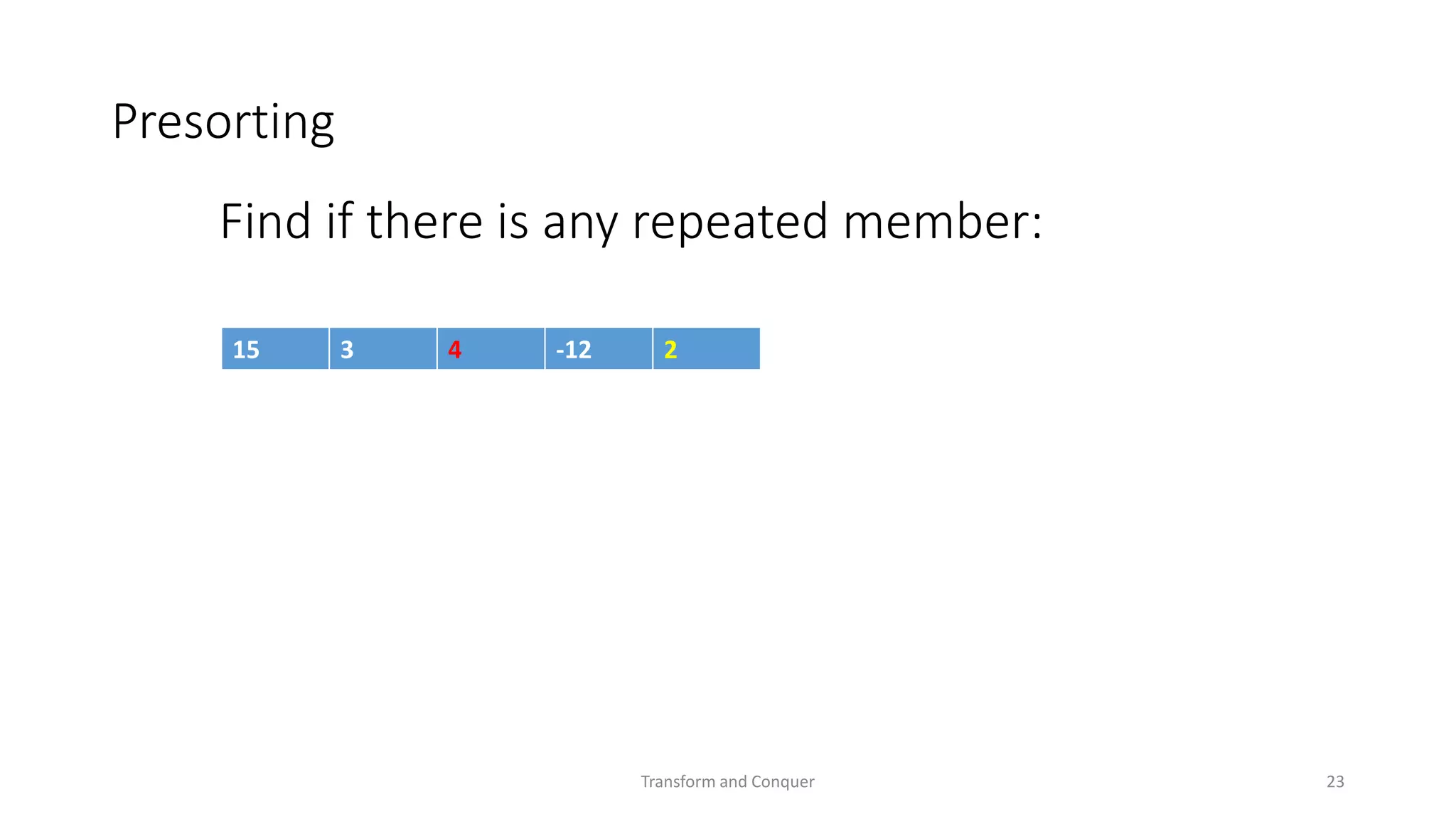
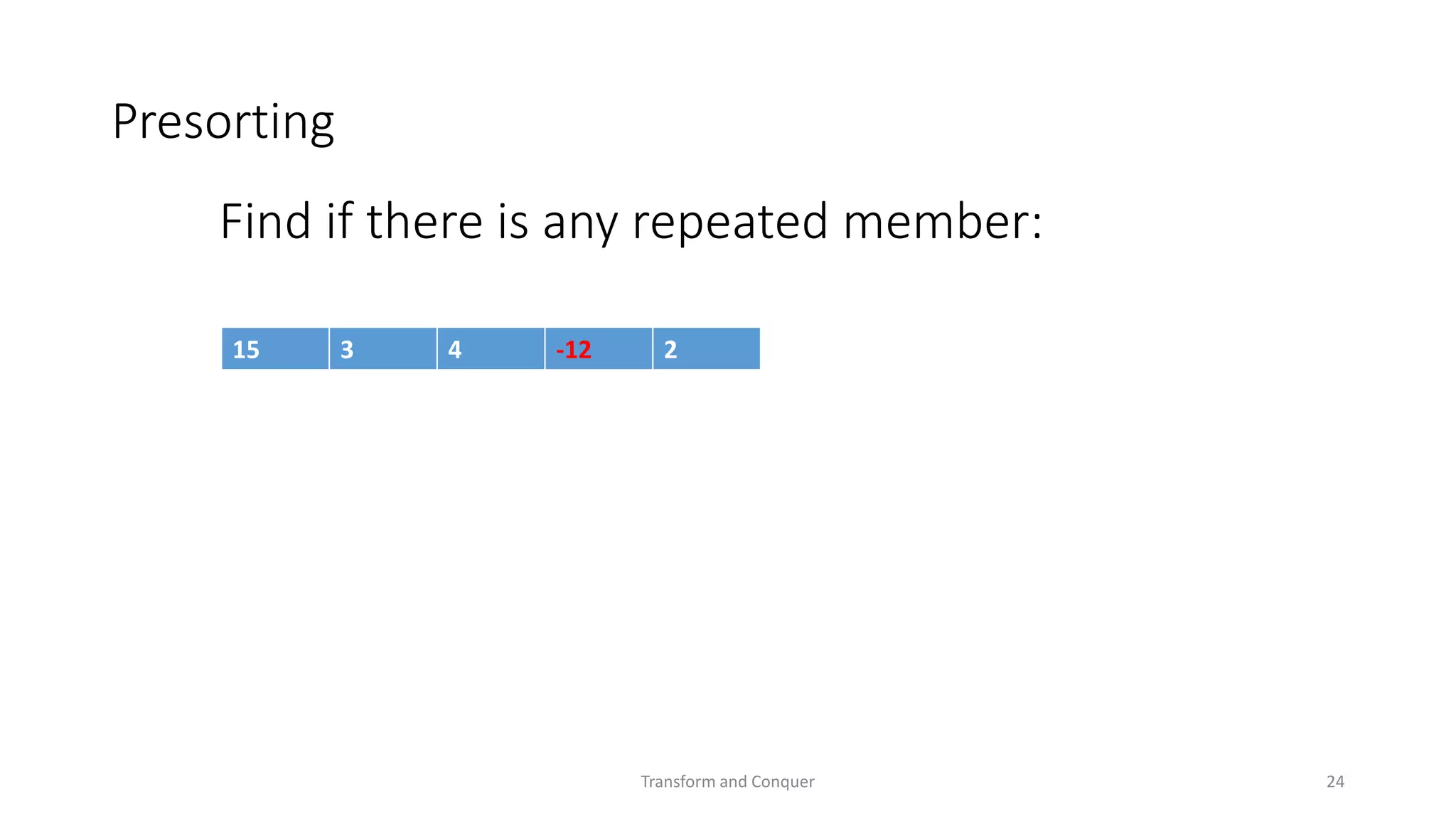
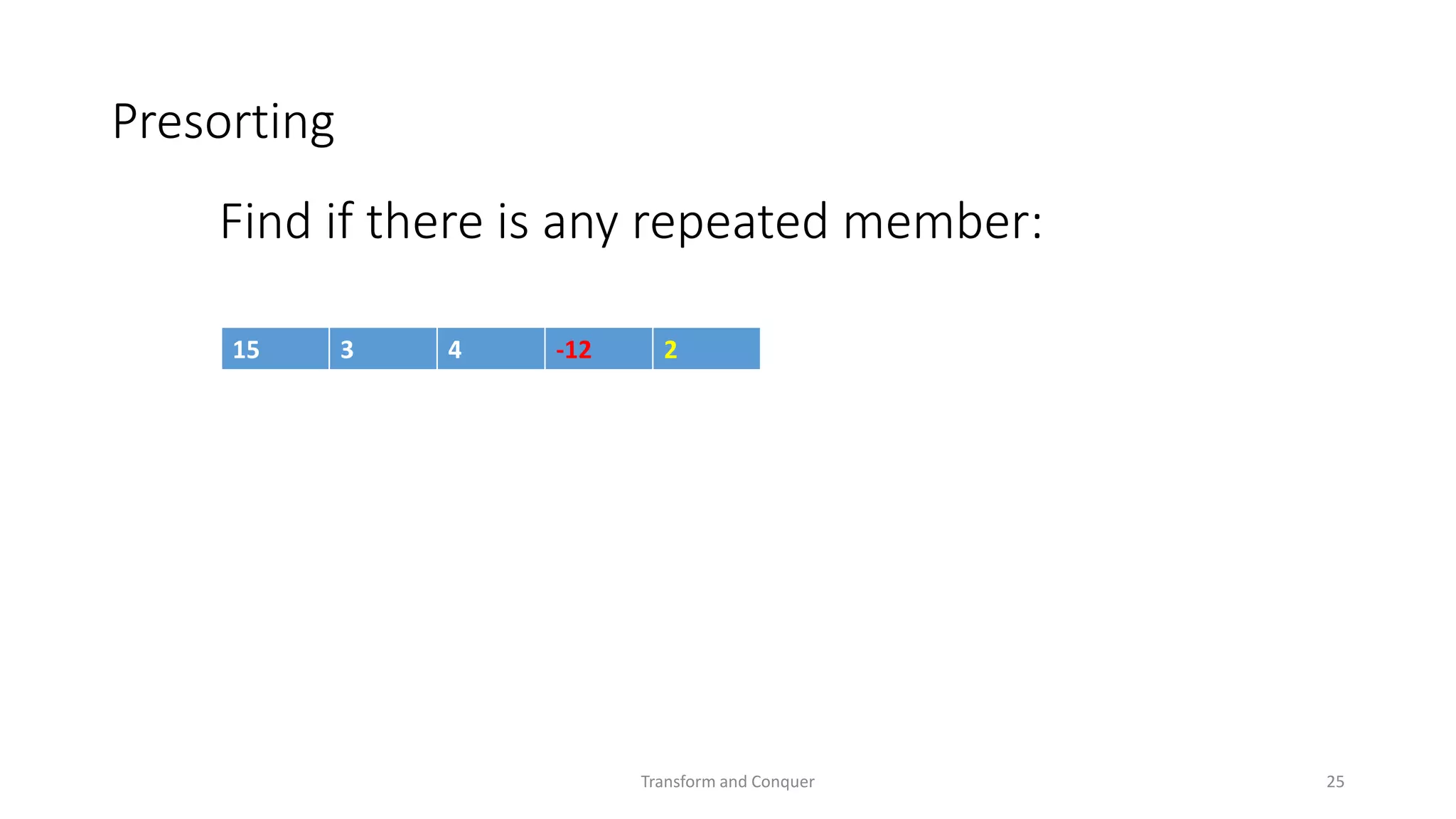
15 3 4 -12 2
Find if there is any repeated member:
Transform and Conquer
Presorting
12
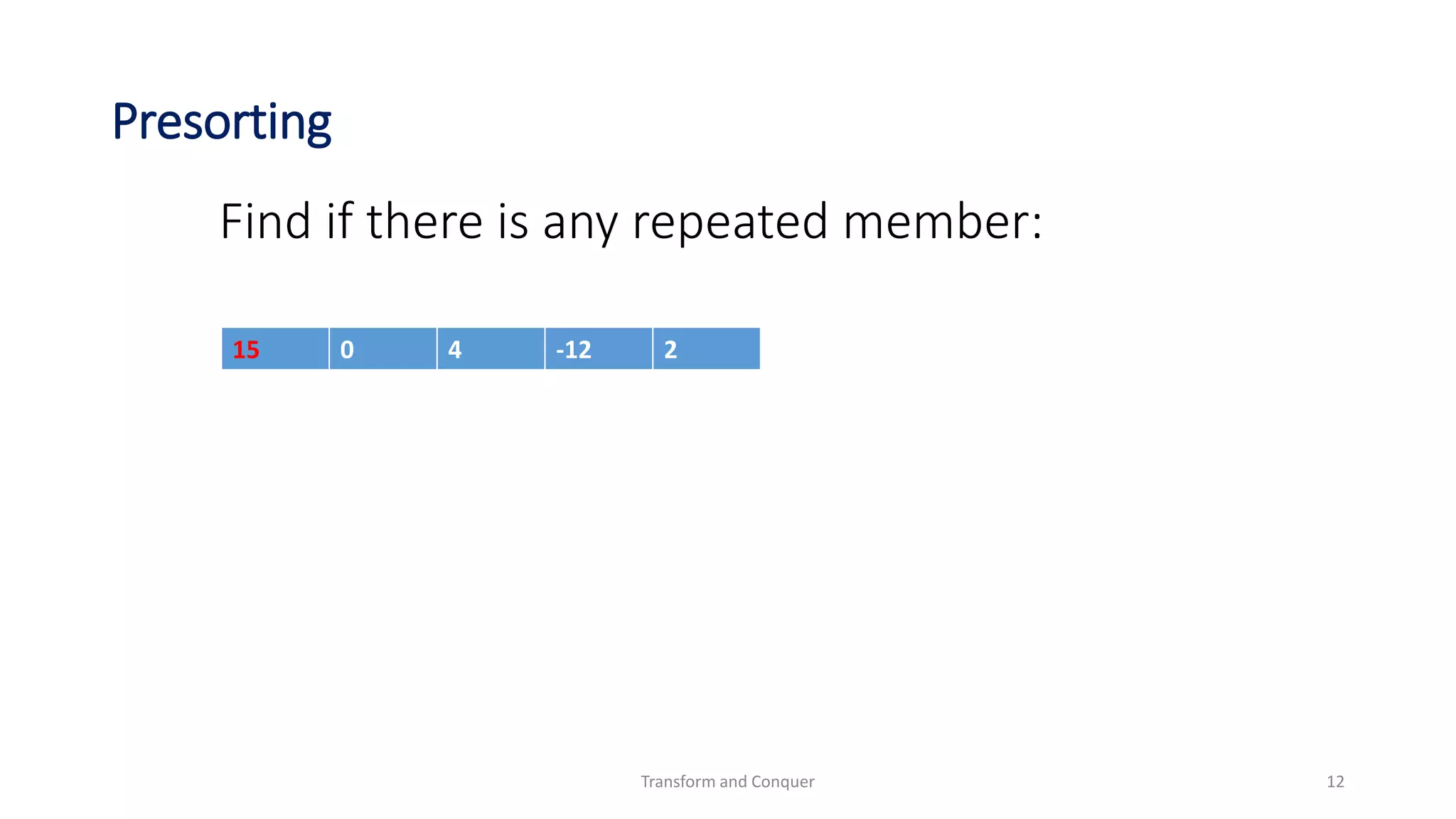
15 0 4 -12 2
Find if there is any repeated member:
Transform and Conquer
Presorting
13
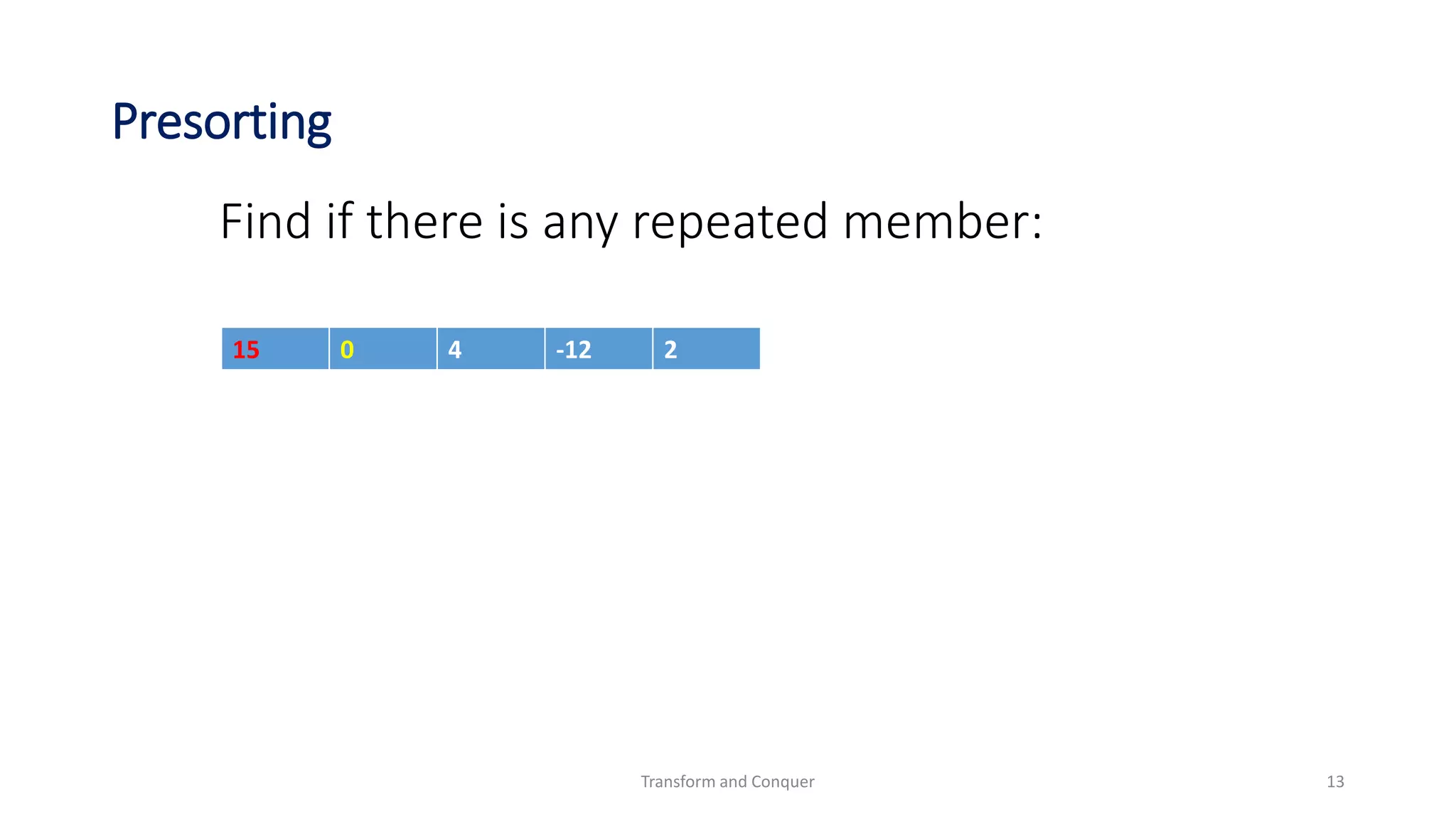
15 0 4 -12 2
Find if there is any repeated member:
Transform and Conquer
Presorting
14
15 0 4 -12 2
Find if there is any repeated member:
Transform and Conquer
Presorting
15
15 0 4 -12 2
Find if there is any repeated member:
Transform and Conquer
Presorting
16
15 0 4 -12 2
Find if there is any repeated member:
Transform and Conquer
Presorting
17
15 3 4 -12 2
Find if there is any repeated member:
Transform and Conquer
Presorting
18
15 3 4 -12 2
Find if there is any repeated member:
Transform and Conquer
Presorting
19
15 3 4 -12 2
Find if there is any repeated member:
Transform and Conquer
Presorting
20
15 3 4 -12 2
Find if there is any repeated member:
Transform and Conquer
Presorting
21
15 3 4 -12 2
Find if there is any repeated member:
Transform and Conquer
Presorting
22
15 3 4 -12 2
Find if there is any repeated member:
Transform and Conquer
Presorting
23
15 3 4 -12 2
Find if there is any repeated member:
Transform and Conquer
Presorting
24
15 3 4 -12 2
Find if there is any repeated member:
Transform and Conquer
Presorting
25
15 3 4 -12 2
Find if there is any repeated member:
Transform and Conquer
Presorting
26
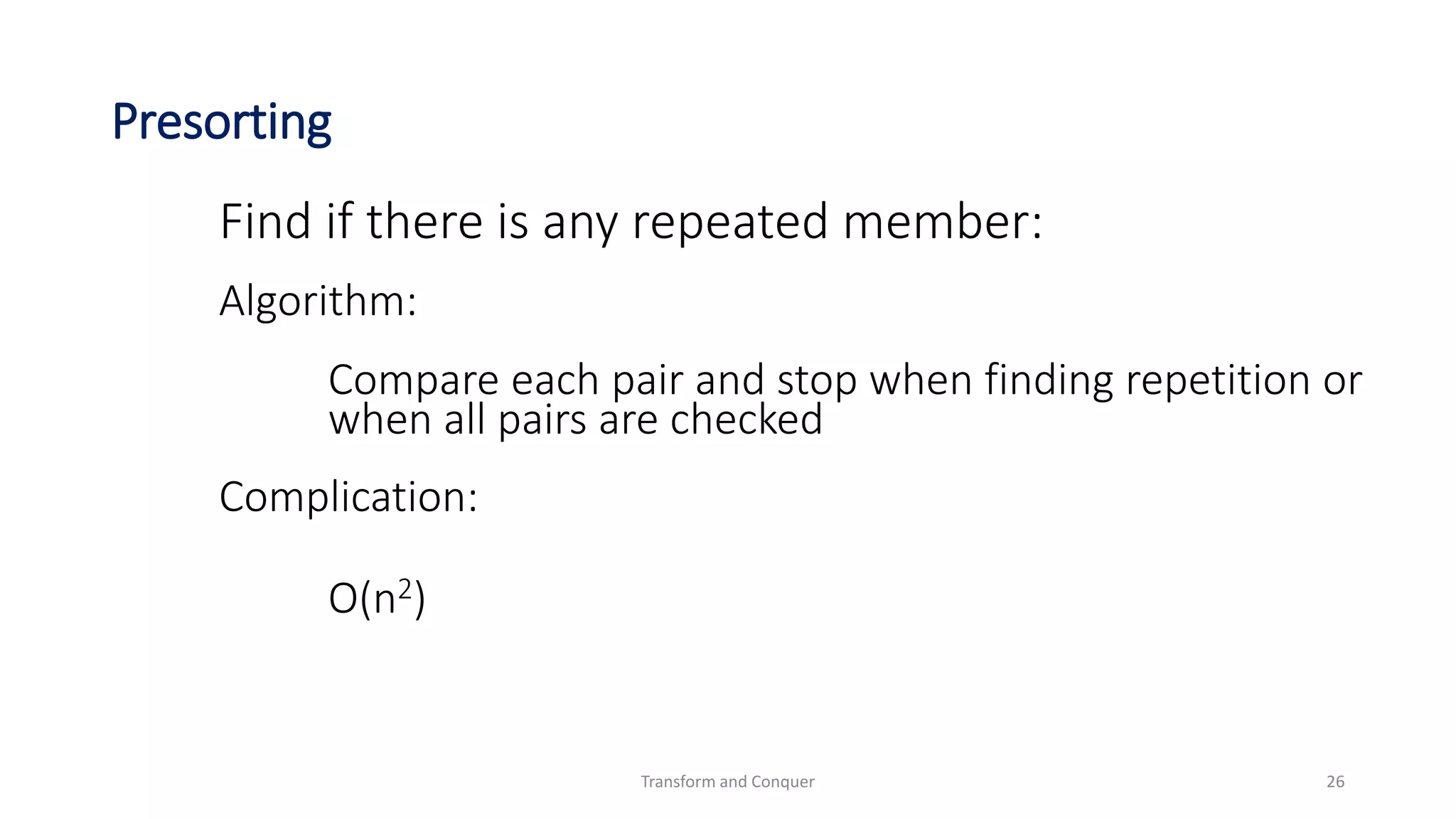
Find if there is any repeated member:
Algorithm:
Compare each pair and stop when finding repetition or
when all pairs are checked
Complication:
O(n2)
Transform and Conquer
Presorting
27
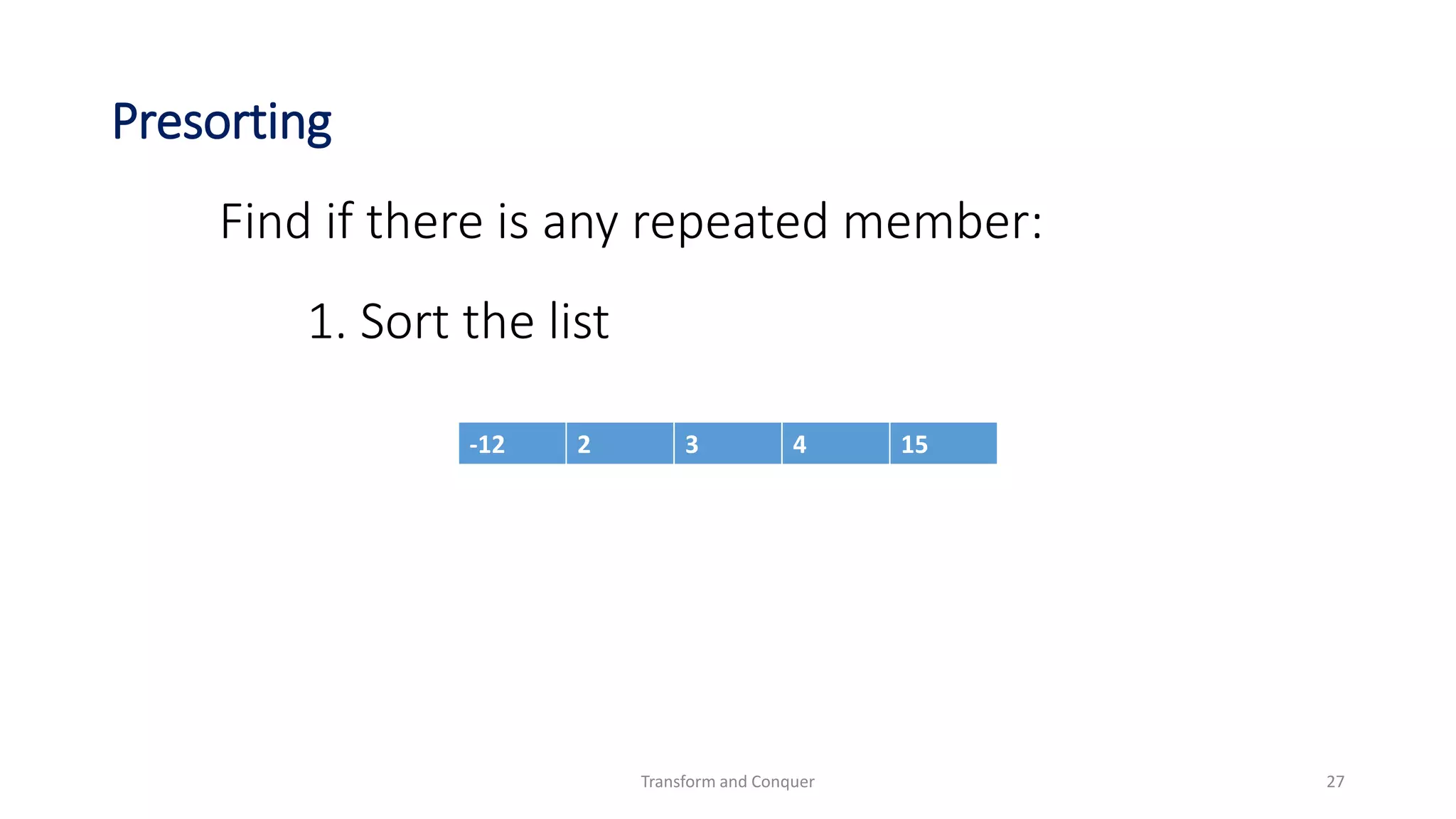
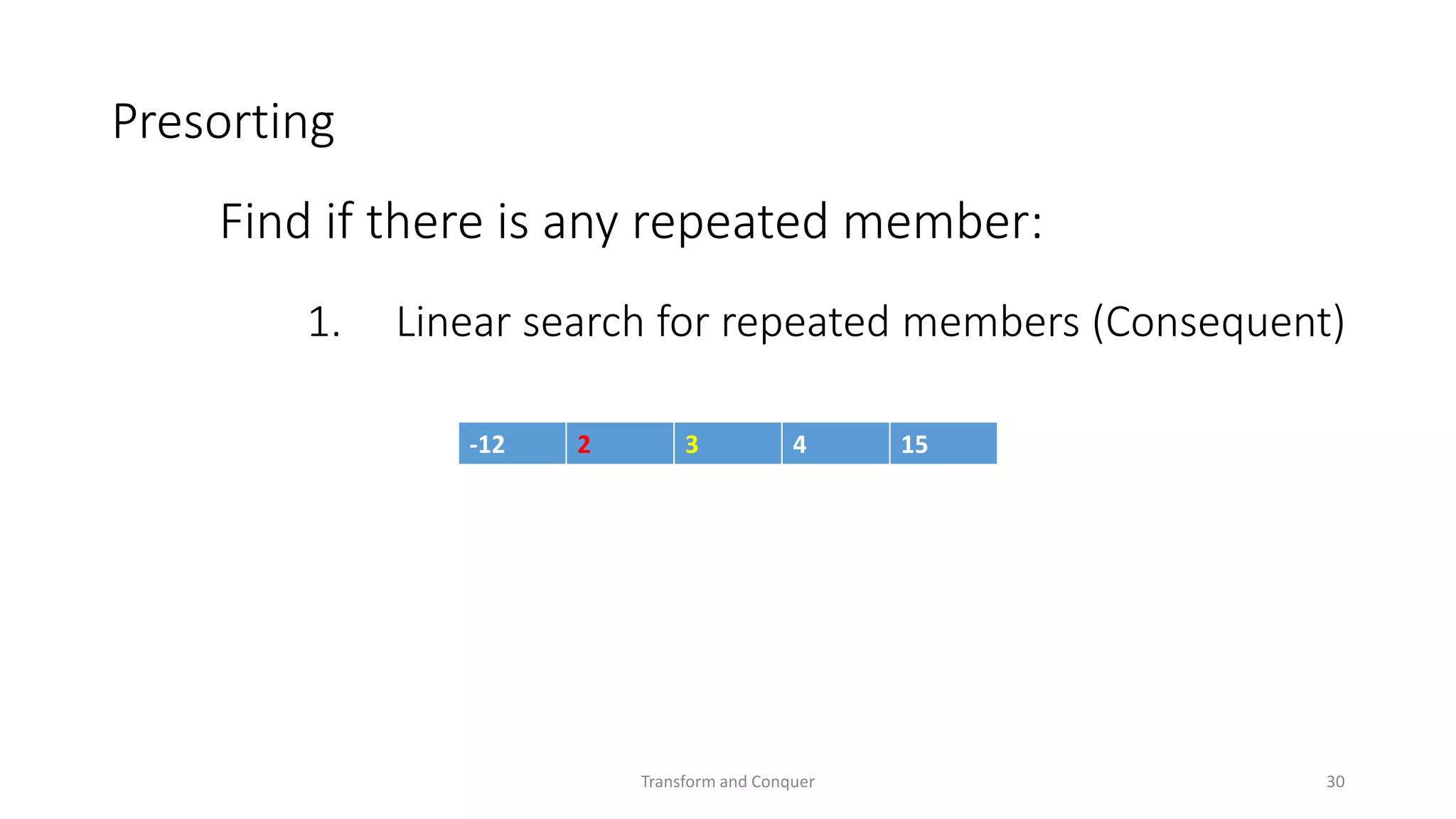
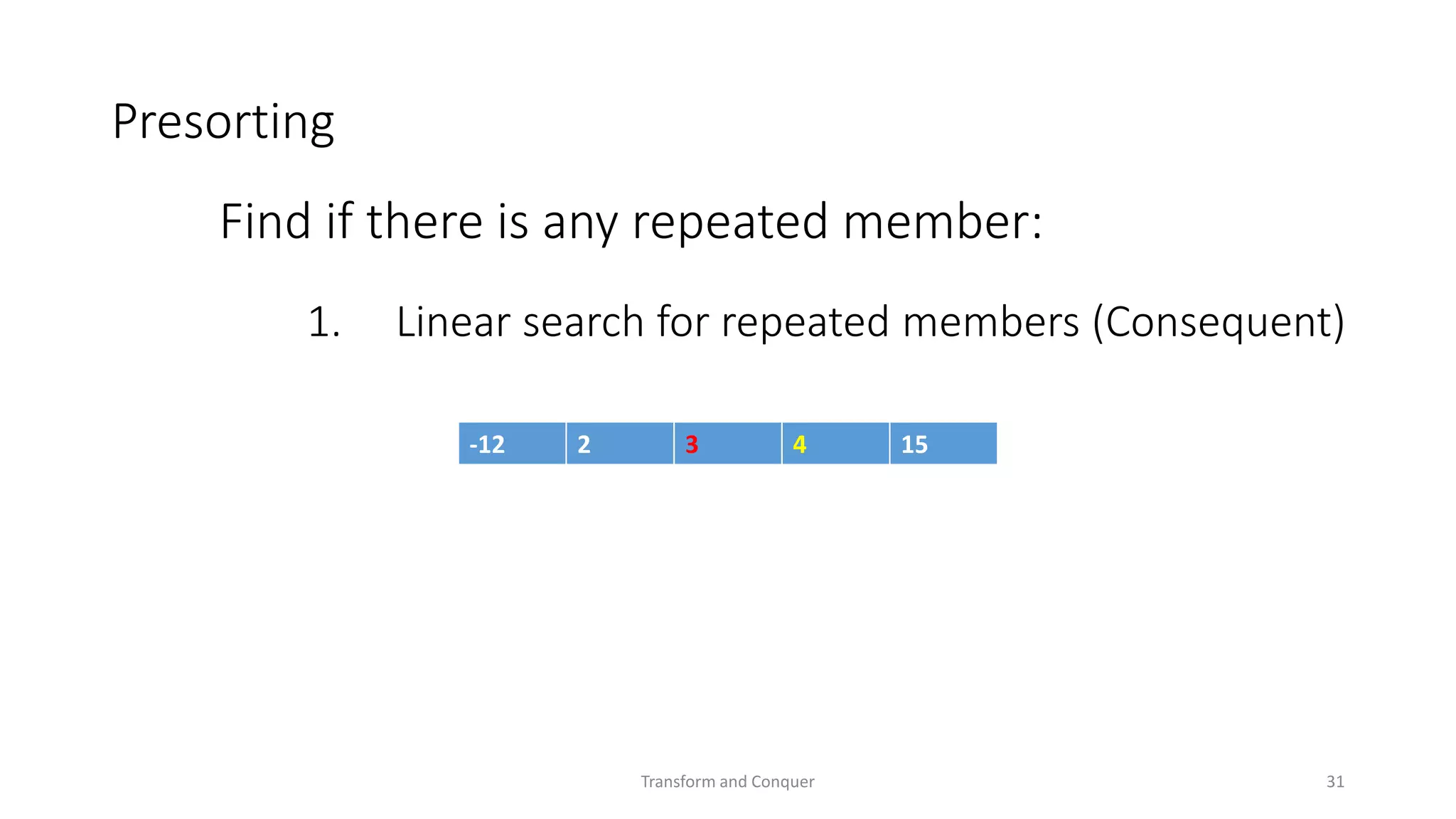
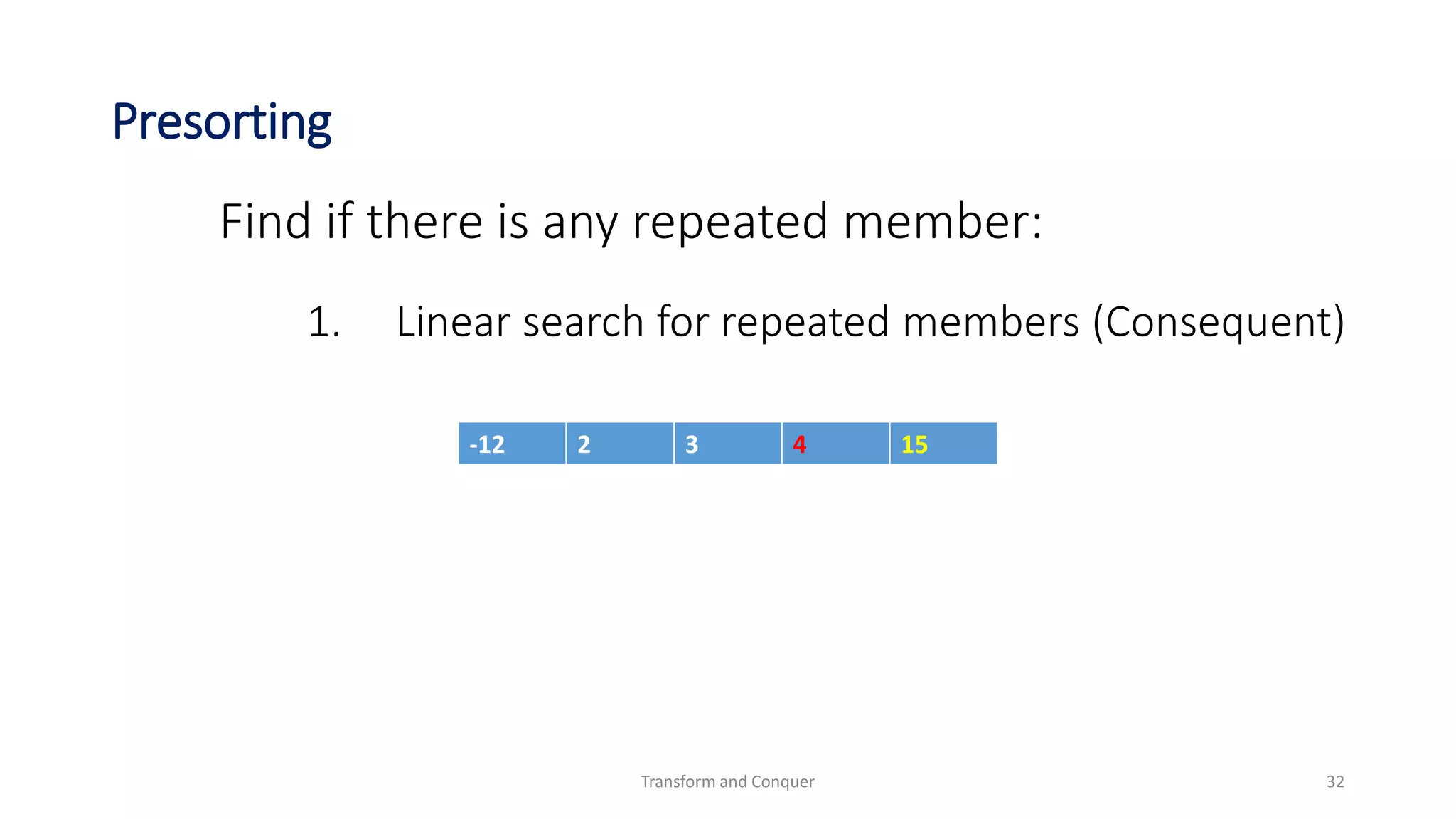
-12 2 3 4 15
Find if there is any repeated member:
1. Sort the list
Transform and Conquer
Presorting
28
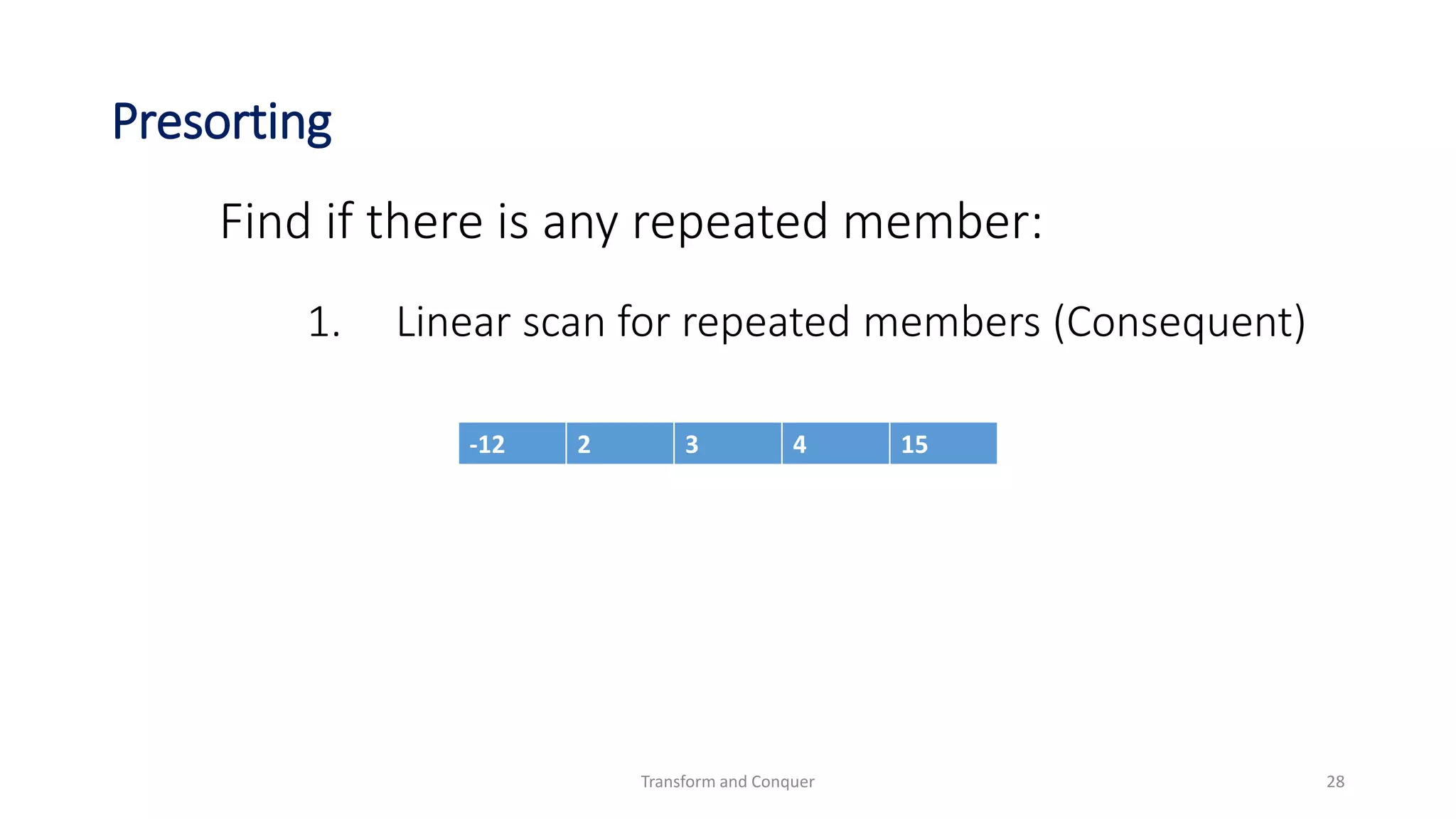
-12 2 3 4 15
Find if there is any repeated member:
1. Linear scan for repeated members (Consequent)
Transform and Conquer
Presorting
29
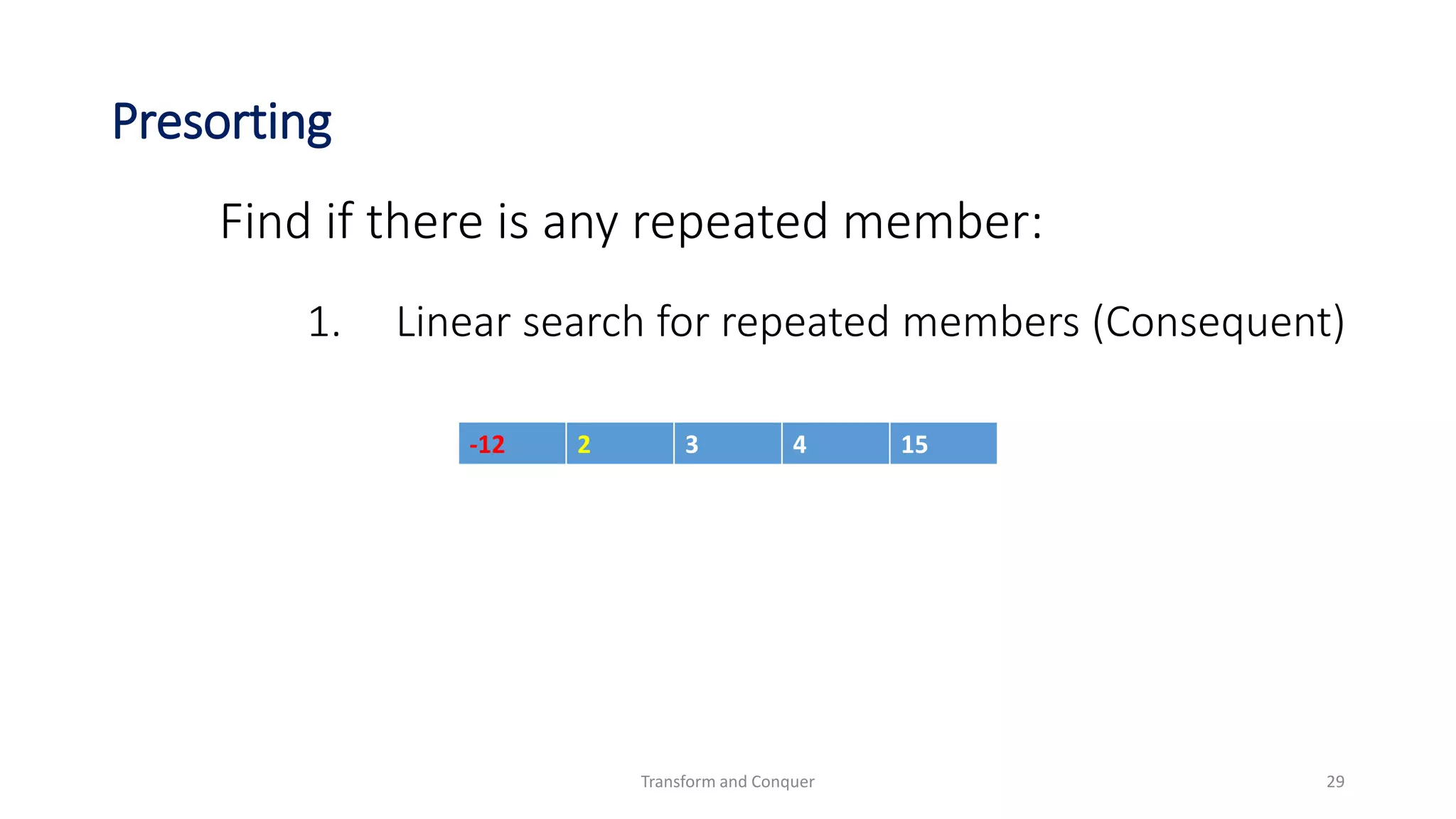
-12 2 3 4 15
Find if there is any repeated member:
1. Linear search for repeated members (Consequent)
Transform and Conquer
Presorting
30
-12 2 3 4 15
Find if there is any repeated member:
1. Linear search for repeated members (Consequent)
Transform and Conquer
Presorting
31
-12 2 3 4 15
Find if there is any repeated member:
1. Linear search for repeated members (Consequent)
Transform and Conquer
Presorting
32
-12 2 3 4 15
Find if there is any repeated member:
1. Linear search for repeated members (Consequent)
Transform and Conquer
Presorting
33
Find if there is any repeated member:
Algorithm:
1. Sort the list
2. For i = 0 to n – 2:
2.1 if a[i] = a[i + 1] then return false
3. return true
Complication:
T(n) = Tsort(n) + Tscan(n)
Transform and Conquer
Presorting
34
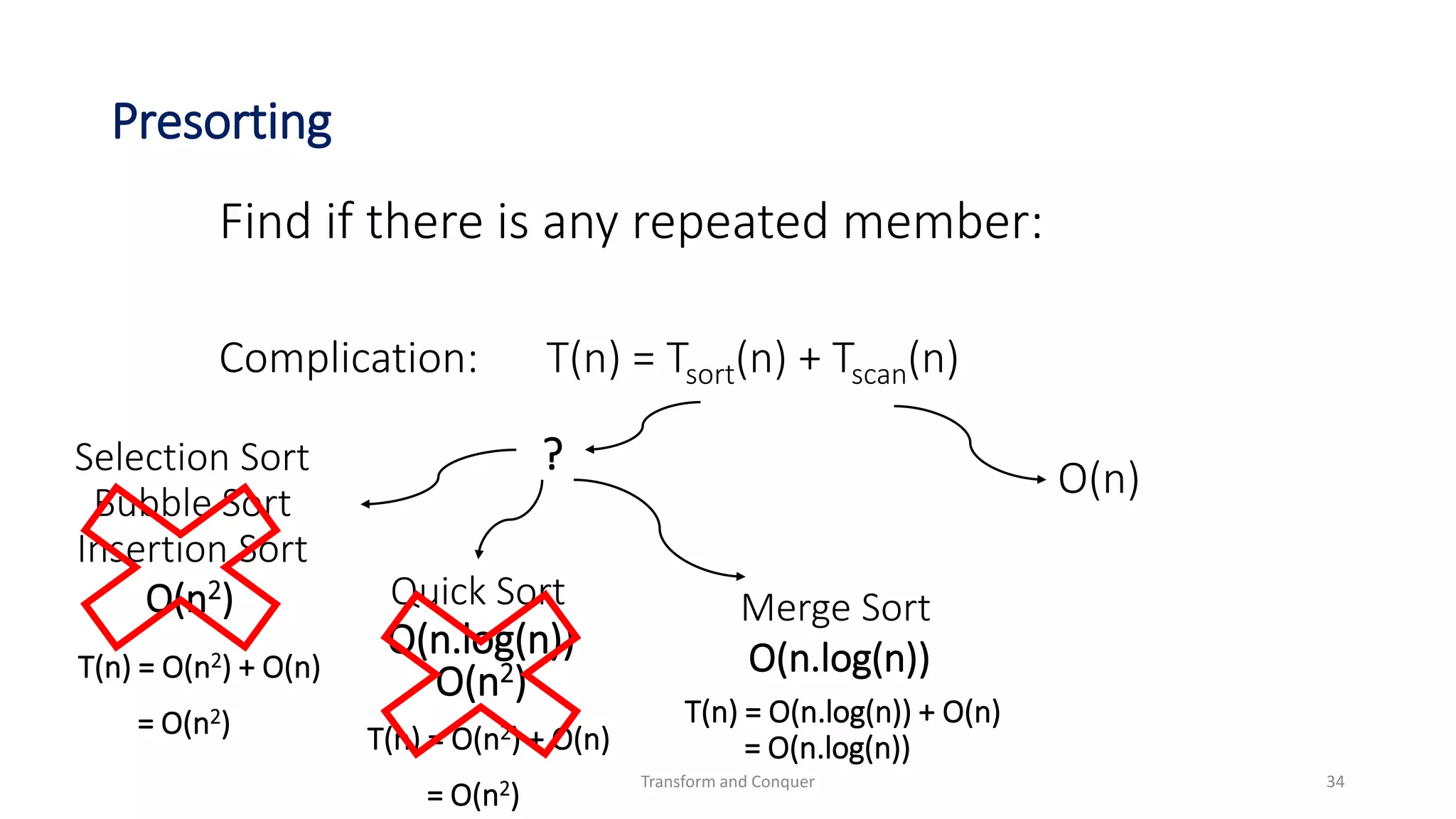
Find if there is any repeated member:
Complication: T(n) = Tsort(n) + Tscan(n)
O(n)
?Selection Sort
Bubble Sort
Insertion Sort
O(n2) Merge Sort
O(n.log(n))
Quick Sort
O(n.log(n))
O(n2)T(n) = O(n2) + O(n)
= O(n2) T(n) = O(n.log(n)) + O(n)
= O(n.log(n))T(n) = O(n2) + O(n)
= O(n2)
Transform and Conquer
Presorting
35
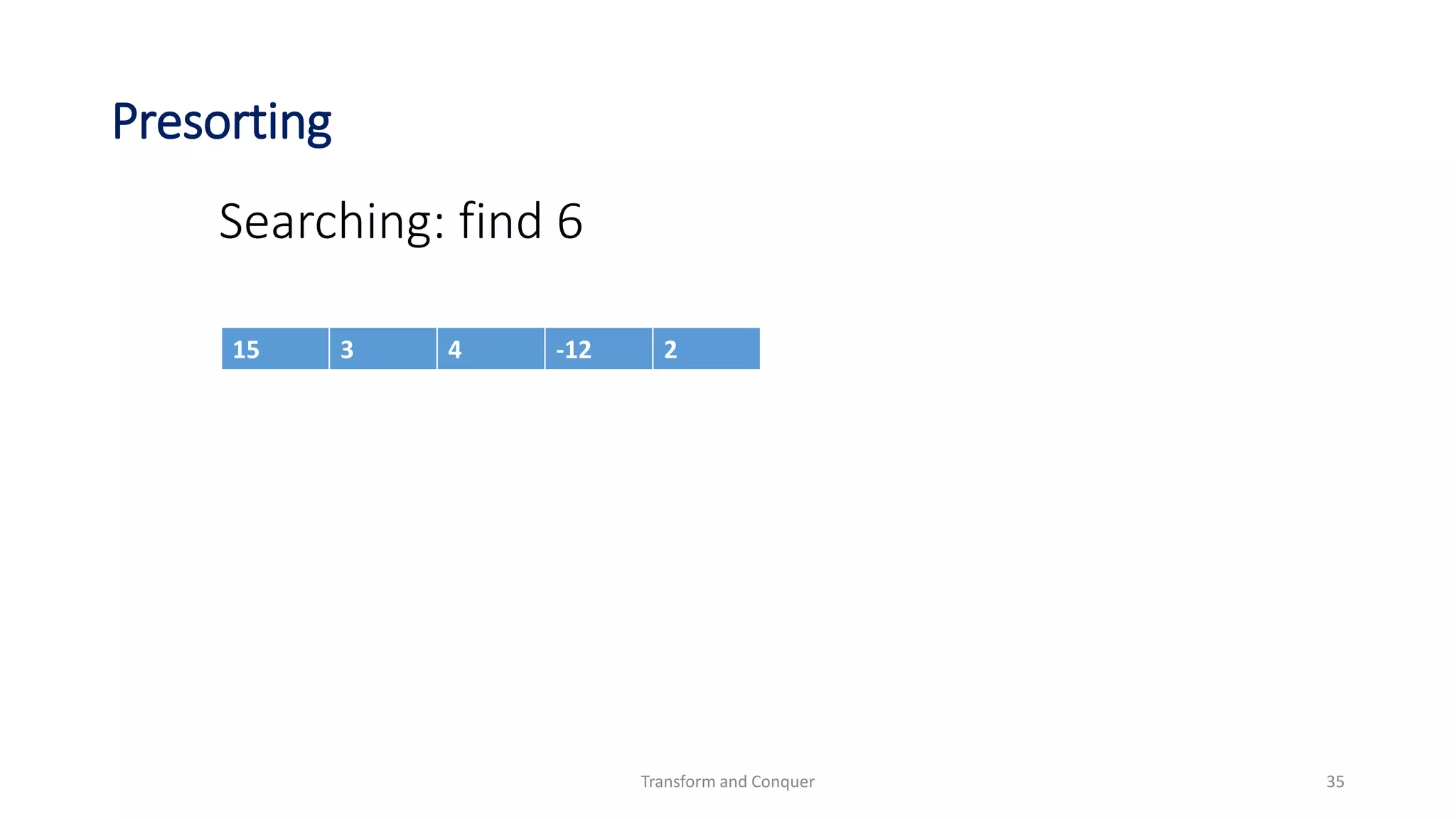
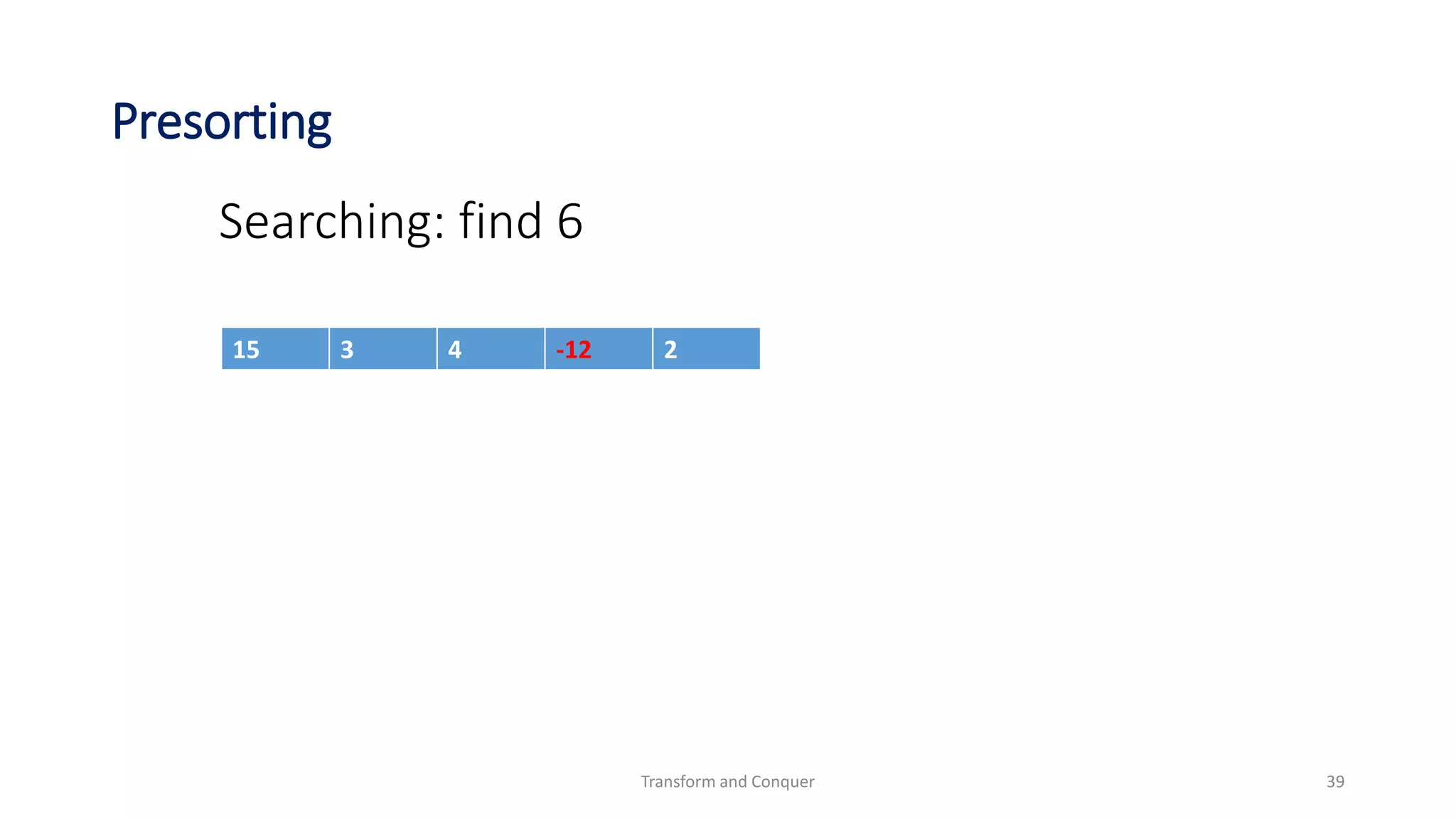
15 3 4 -12 2
Searching: find 6
Transform and Conquer
Presorting
36
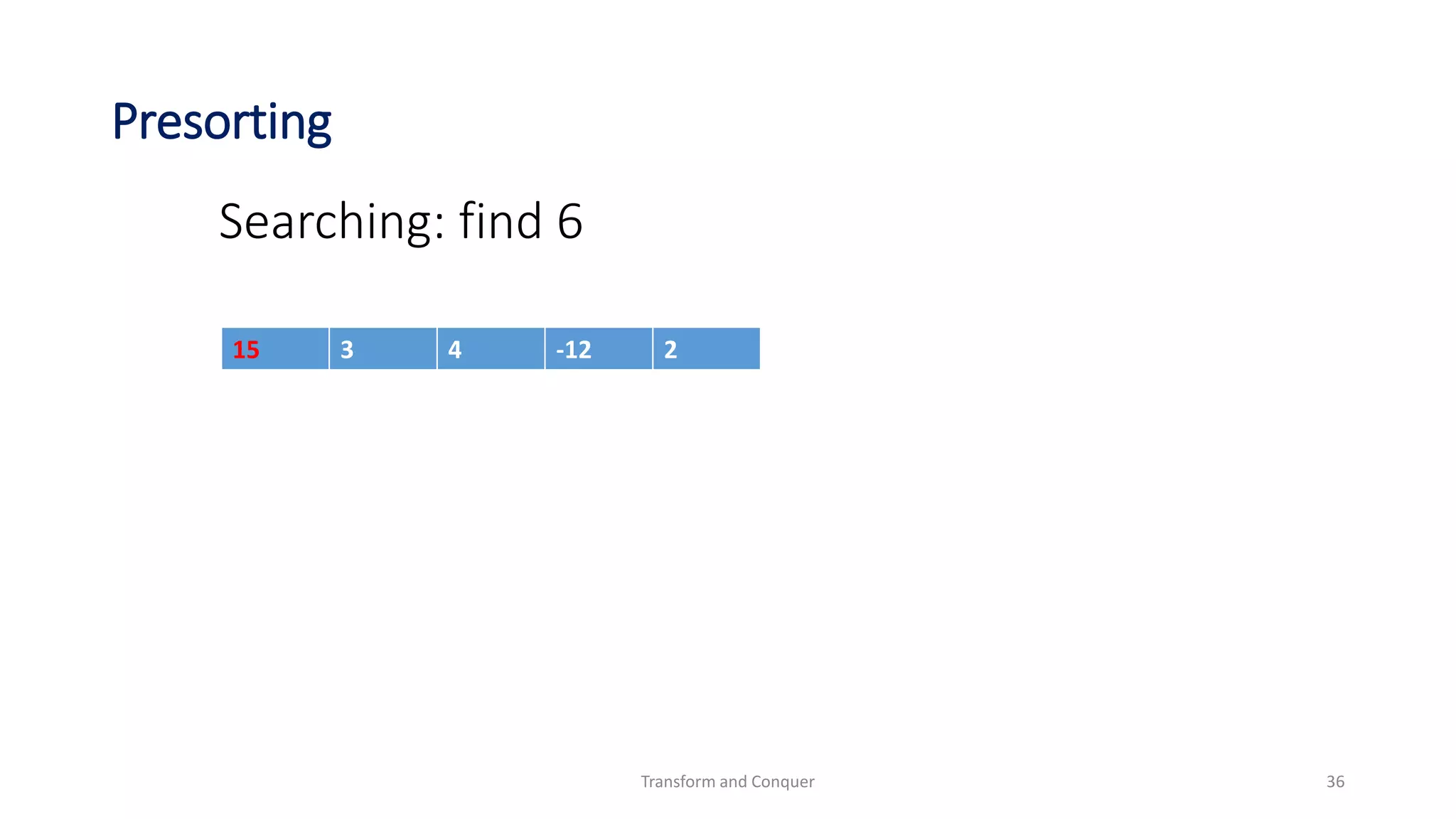
15 3 4 -12 2
Searching: find 6
Transform and Conquer
Presorting
37
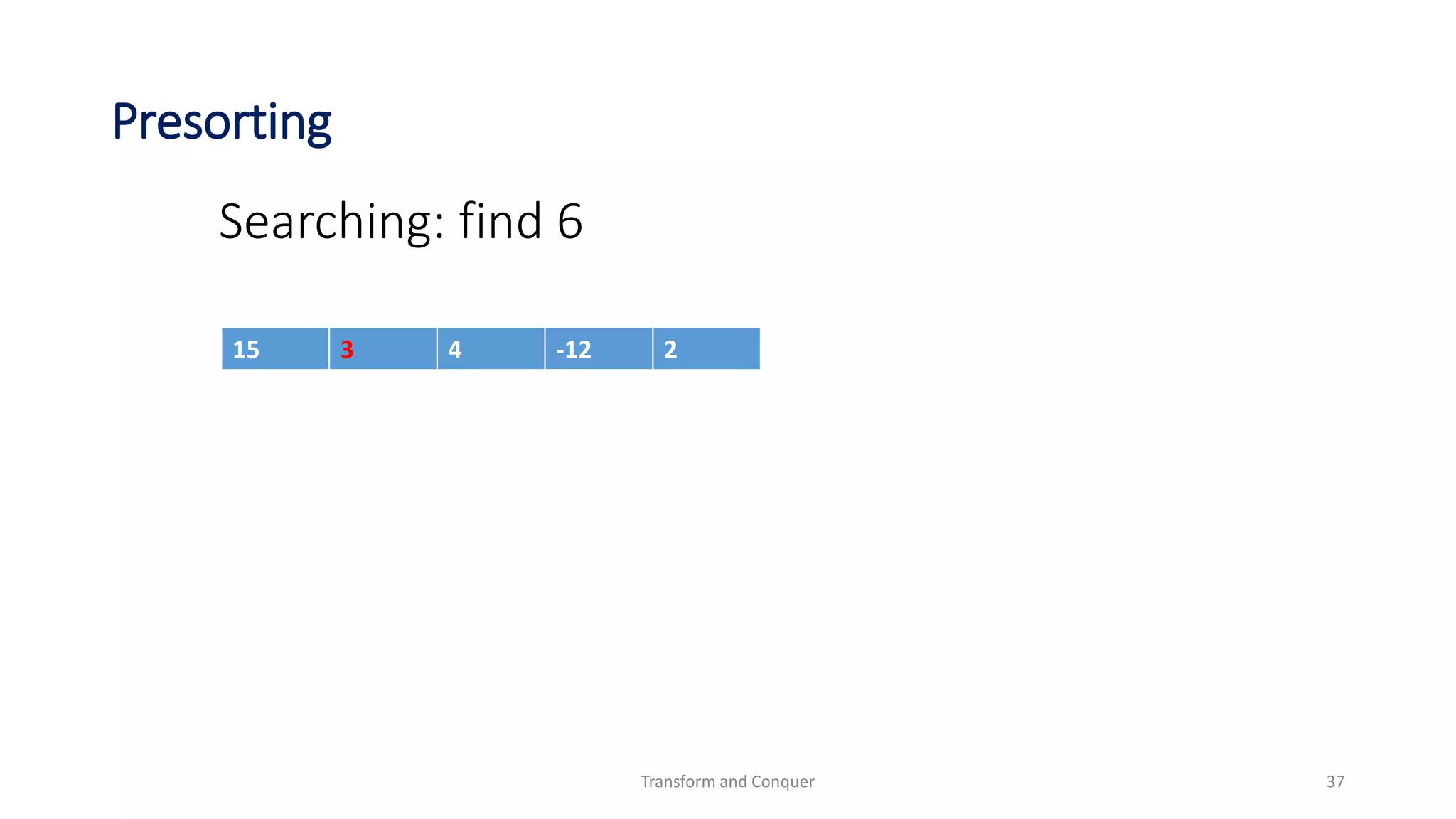
15 3 4 -12 2
Searching: find 6
Transform and Conquer
Presorting
38
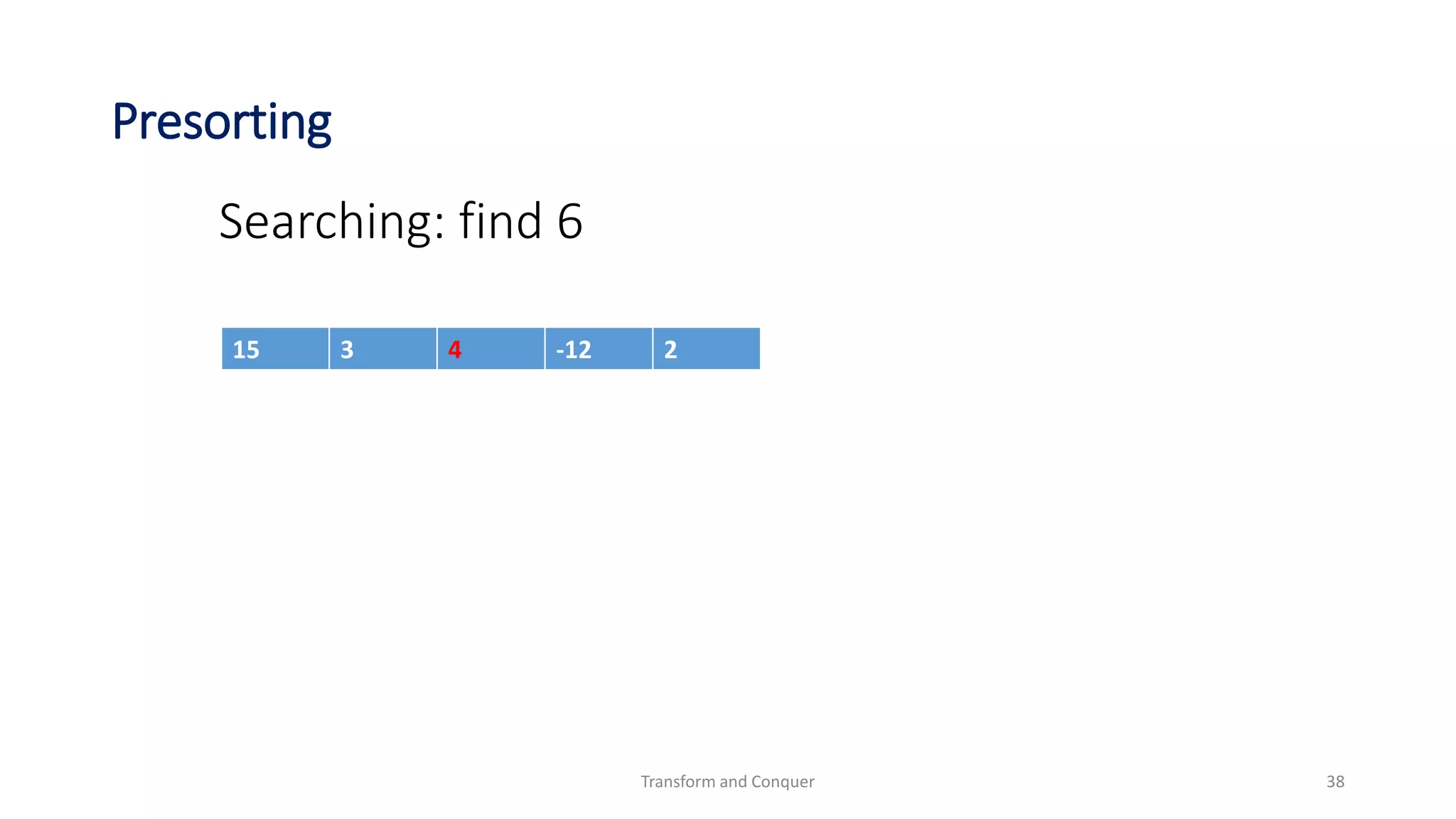
15 3 4 -12 2
Searching: find 6
Transform and Conquer
Presorting
39
15 3 4 -12 2
Searching: find 6
Transform and Conquer
Presorting
40
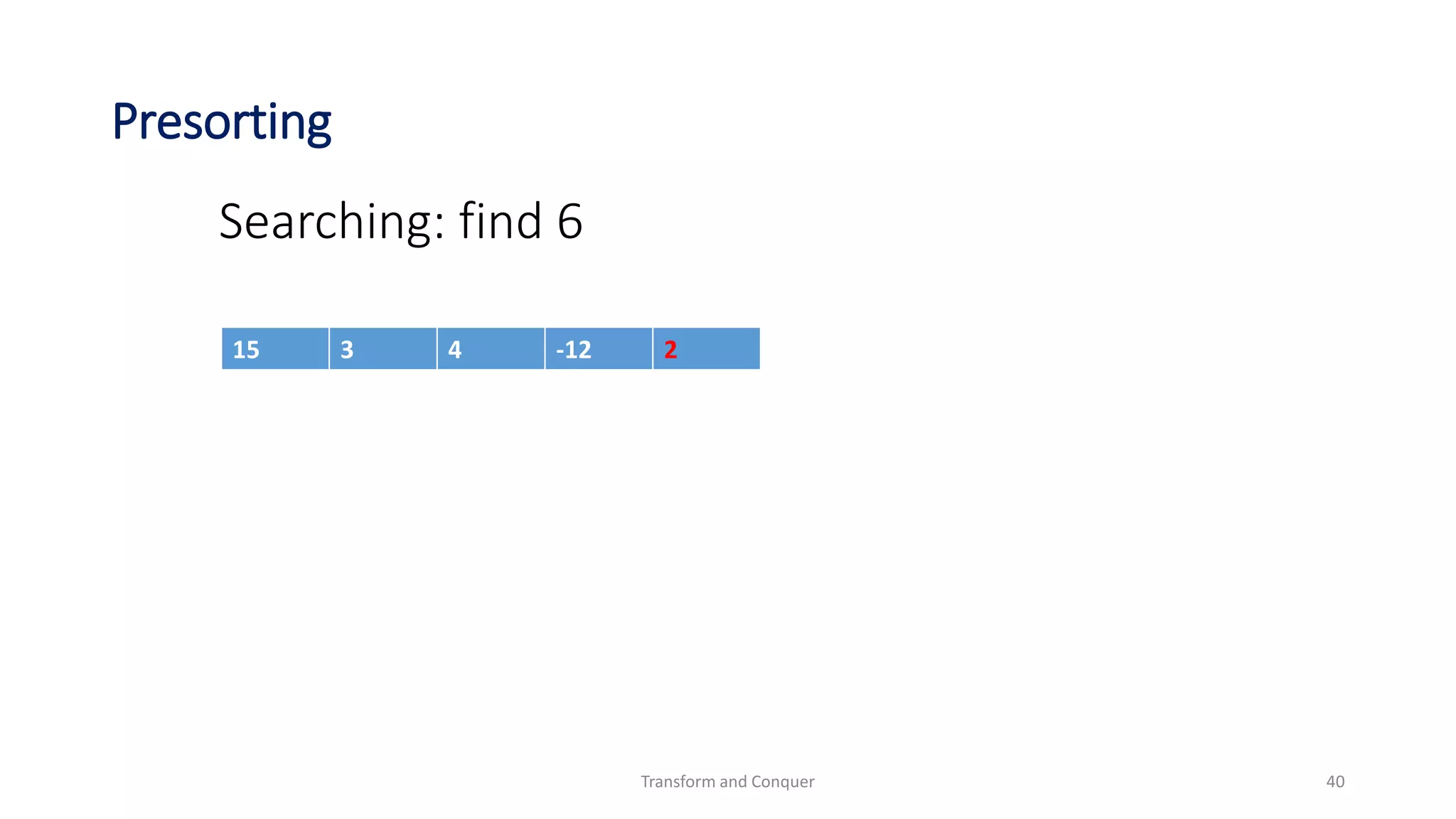
15 3 4 -12 2
Searching: find 6
Transform and Conquer
Presorting
41
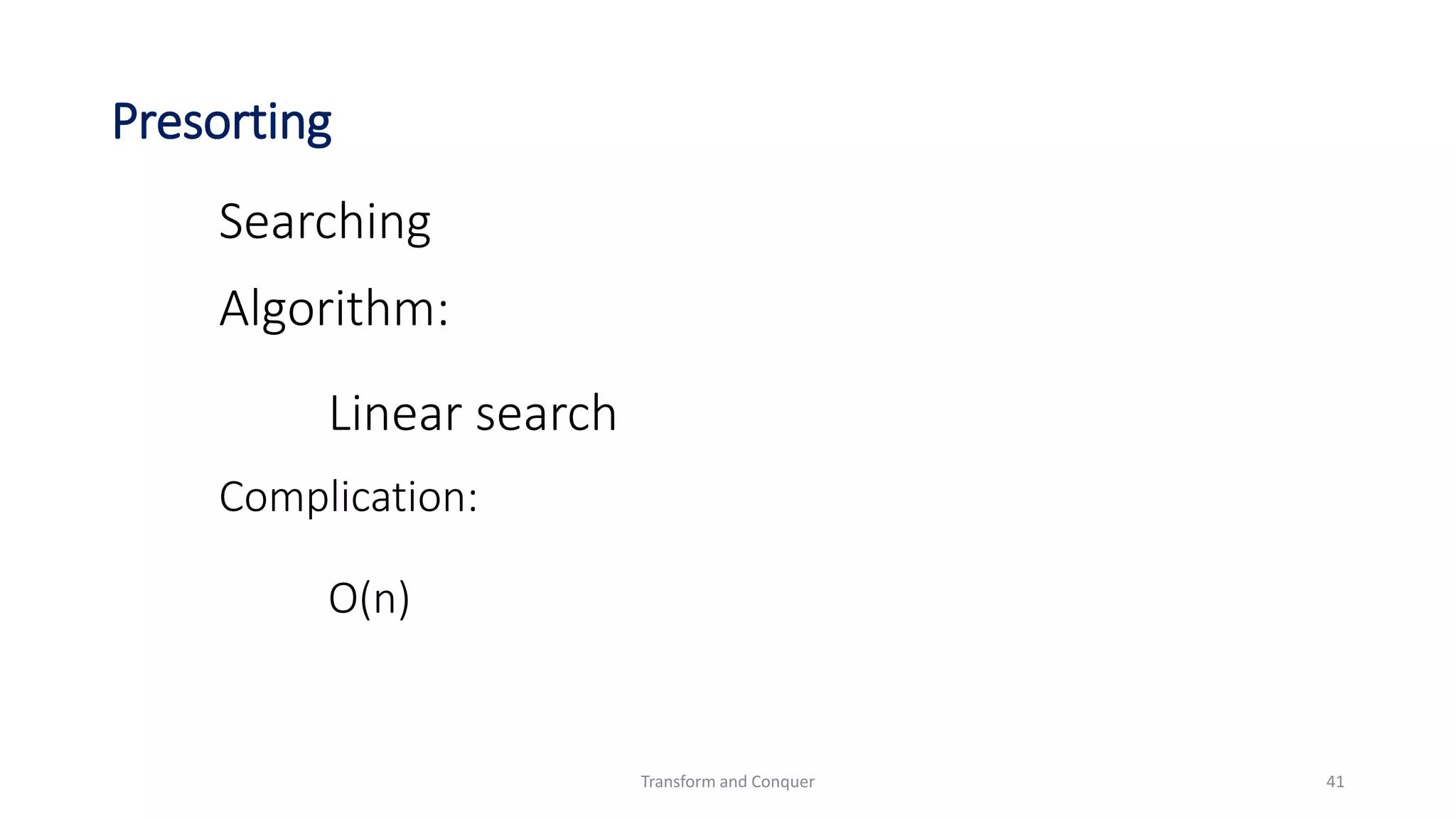
Searching
Algorithm:
Linear search
Complication:
O(n)
Transform and Conquer
Presorting
42
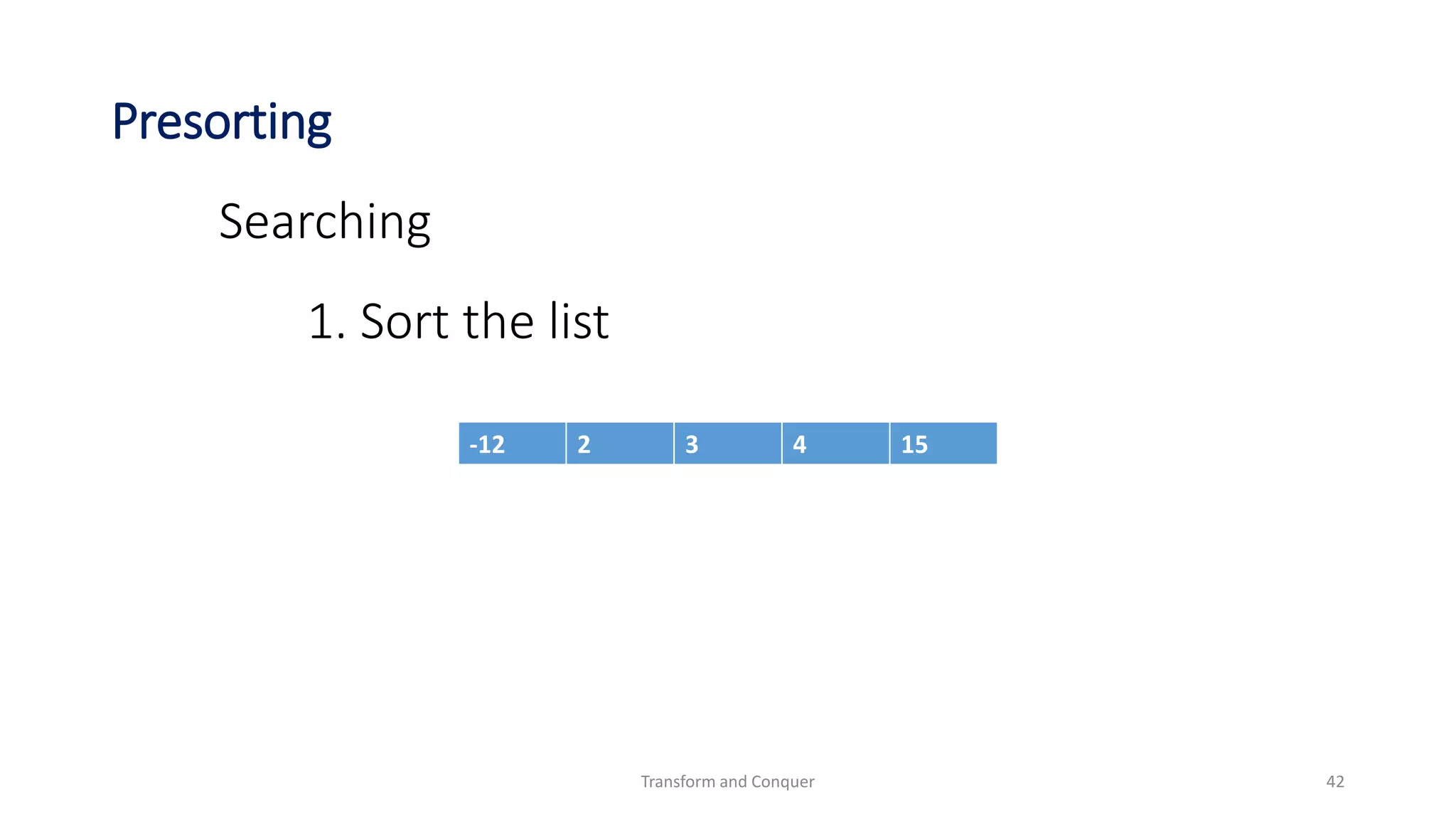
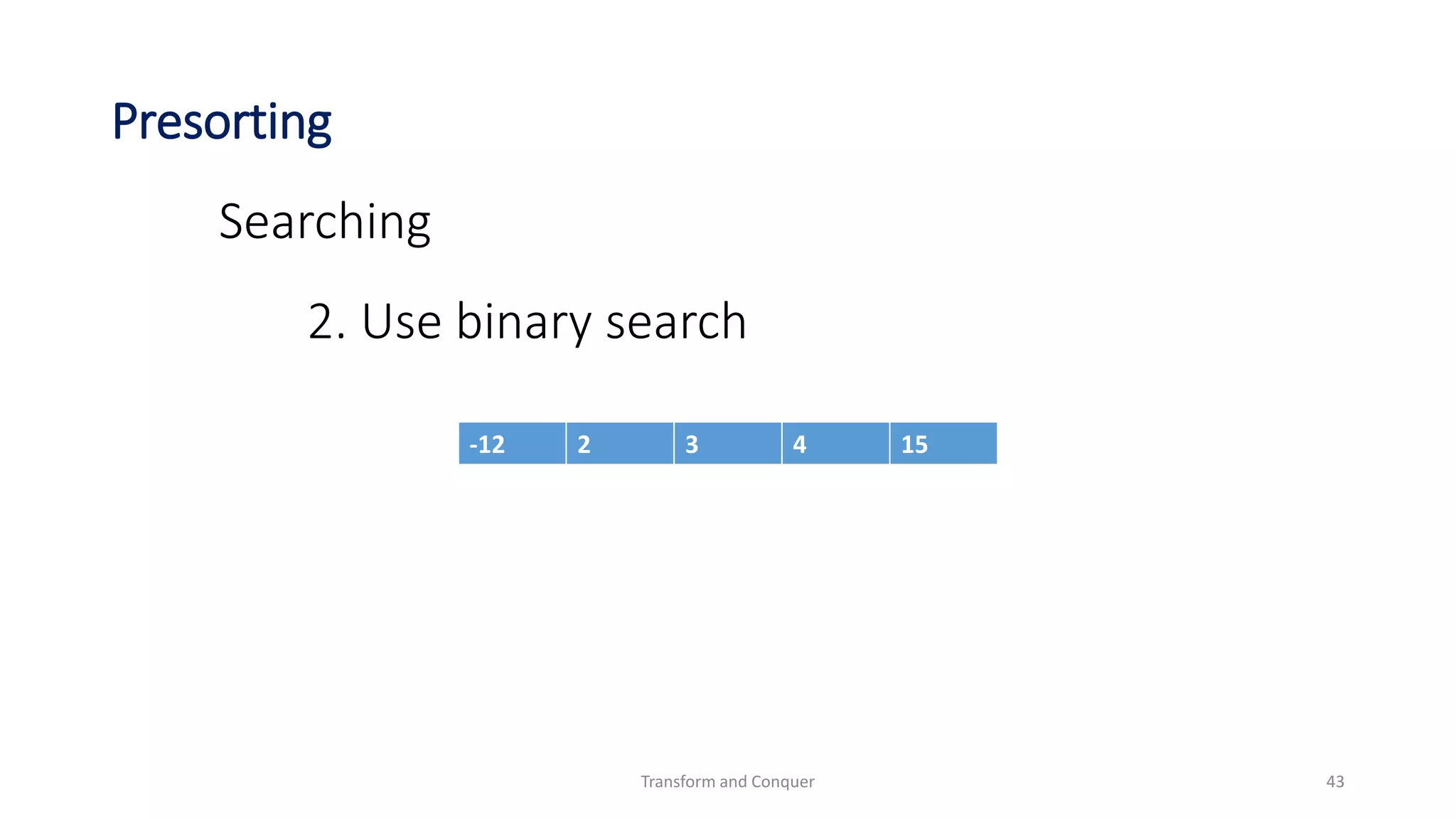
-12 2 3 4 15
Searching
1. Sort the list
Transform and Conquer
Presorting
43
-12 2 3 4 15
Searching
2. Use binary search
Transform and Conquer
Presorting
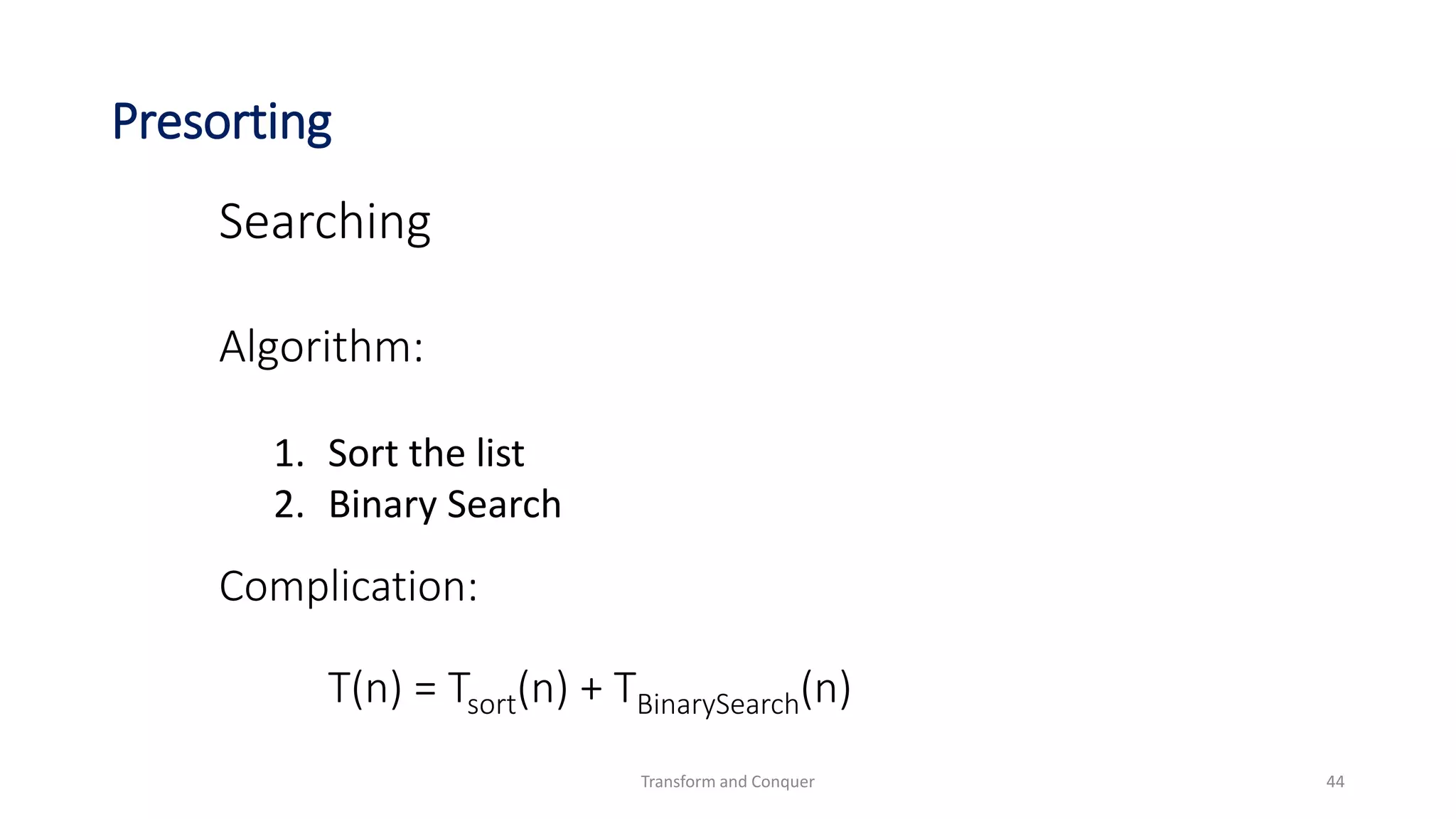
44
Searching
Algorithm:
1. Sort the list
2. Binary Search
Complication:
T(n) = Tsort(n) + TBinarySearch(n)
Transform and Conquer
Presorting
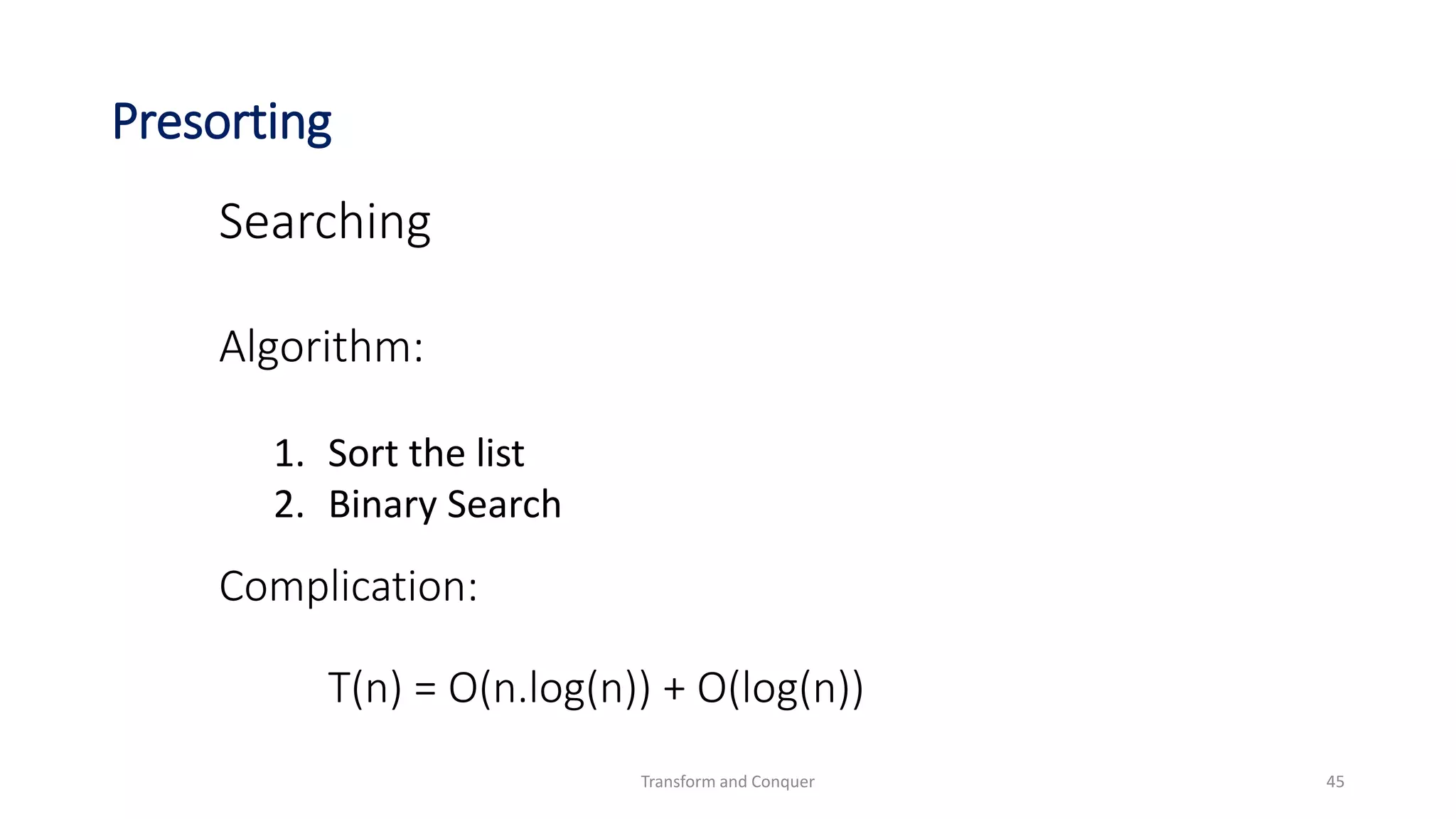
45
Searching
Algorithm:
1. Sort the list
2. Binary Search
Complication:
T(n) = O(n.log(n)) + O(log(n))
Transform and Conquer
Presorting
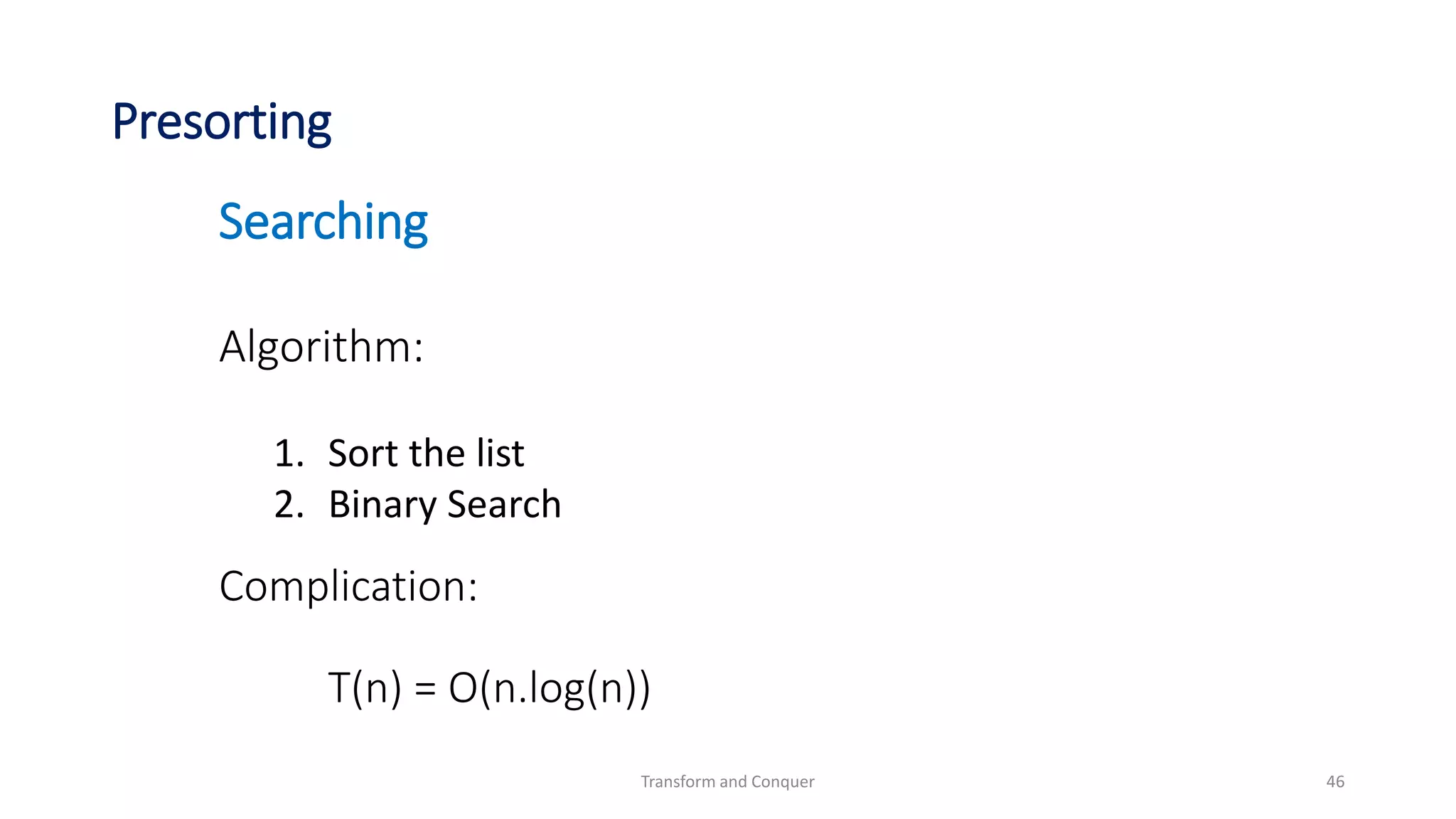
46
Searching
Algorithm:
1. Sort the list
2. Binary Search
Complication:
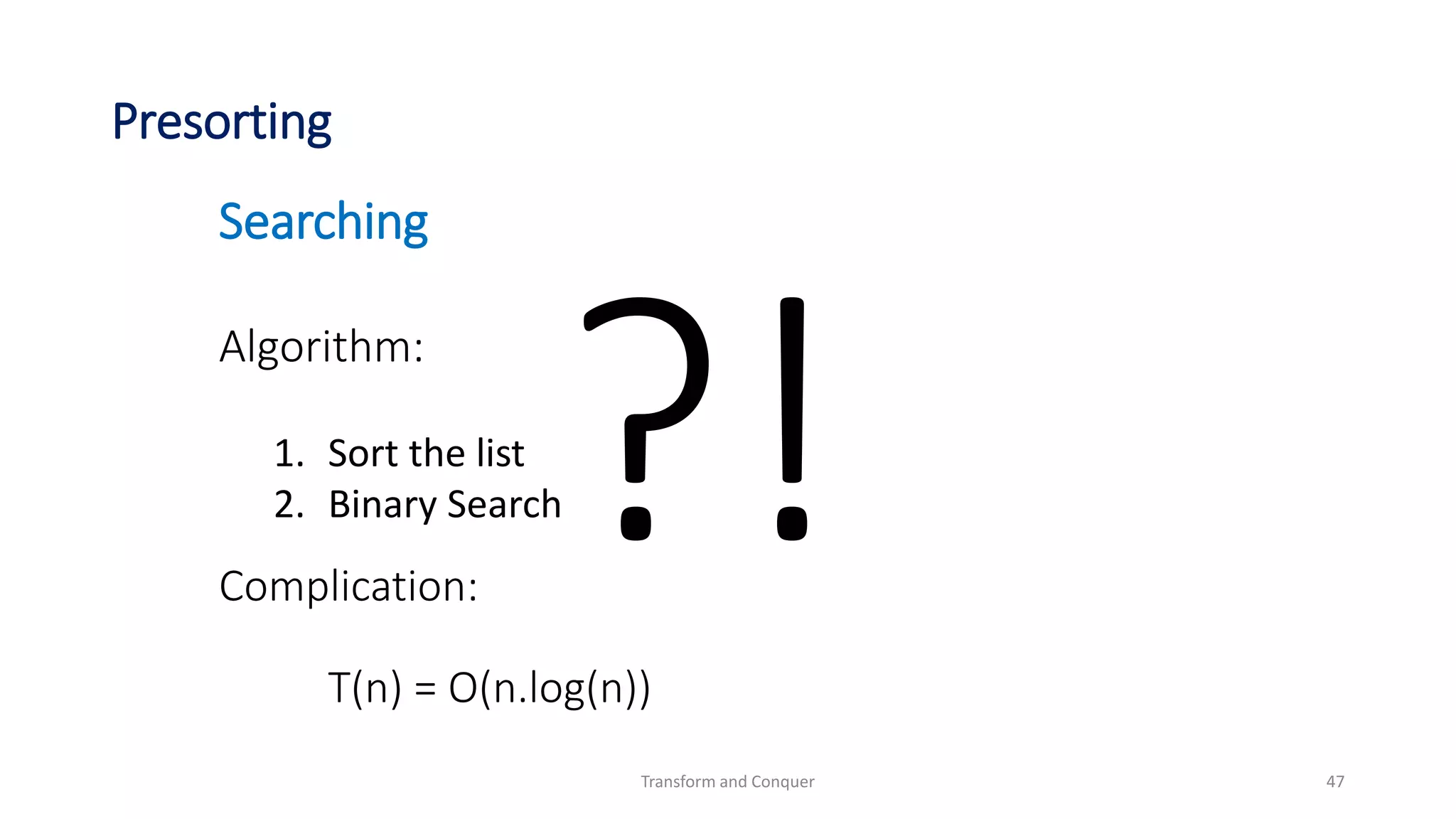
T(n) = O(n.log(n))
Transform and Conquer
Presorting
47
Searching
Algorithm:
1. Sort the list
2. Binary Search
Complication:
T(n) = O(n.log(n))
Transform and Conquer
Presorting
48
Searching
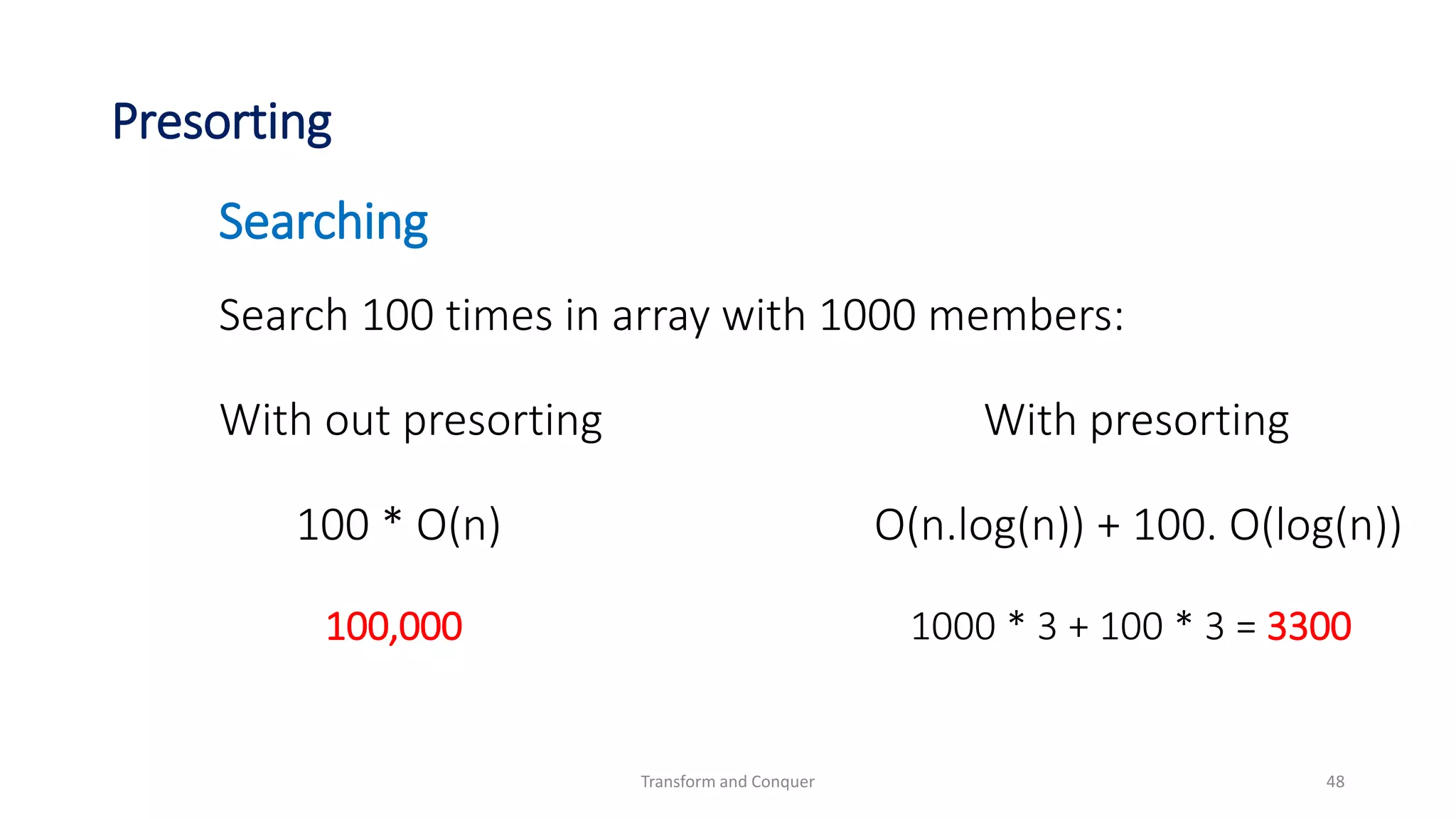
Search 100 times in array with 1000 members:
With out presorting With presorting
100 * O(n) O(n.log(n)) + 100. O(log(n))
100,000 1000 * 3 + 100 * 3 = 3300
Transform and Conquer
• Understand the concept of transform and conquer
• List the applications of presorting
• Explain the concept of Gauss elimination
• Use Horner’s rule for evaluating polynomials
• Find the lowest common multiple of two numbers
49Transform and Conquer
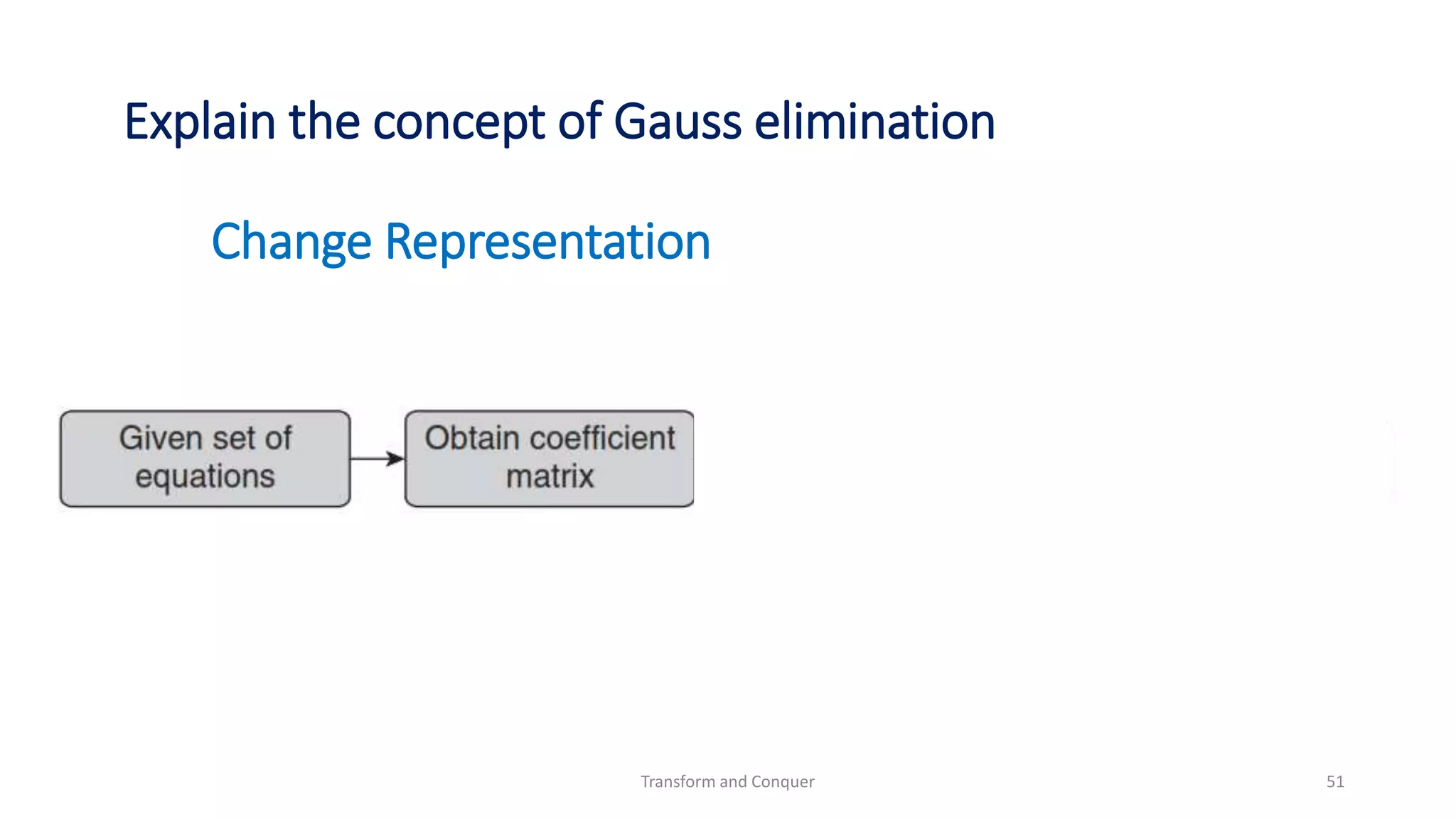
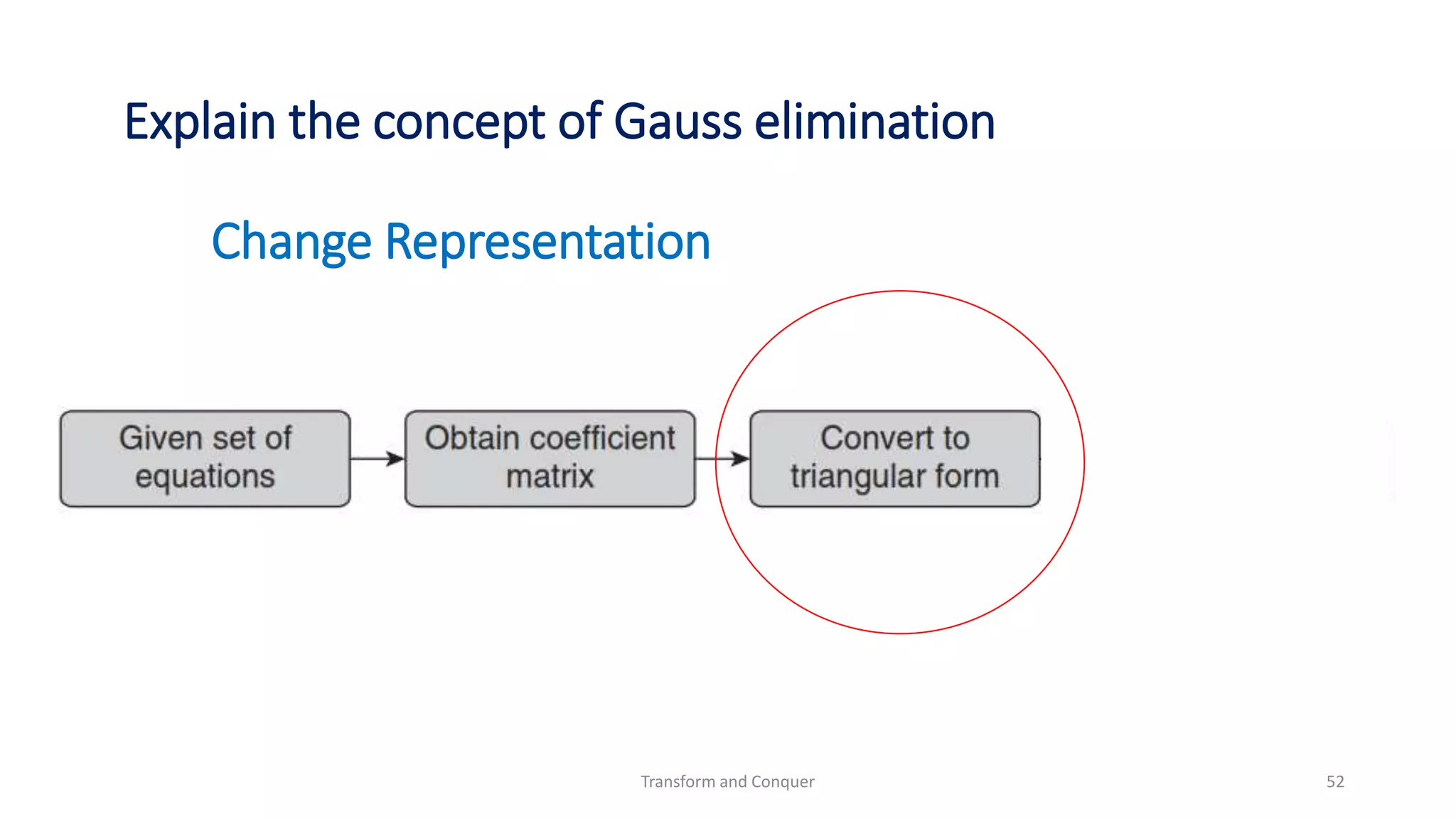
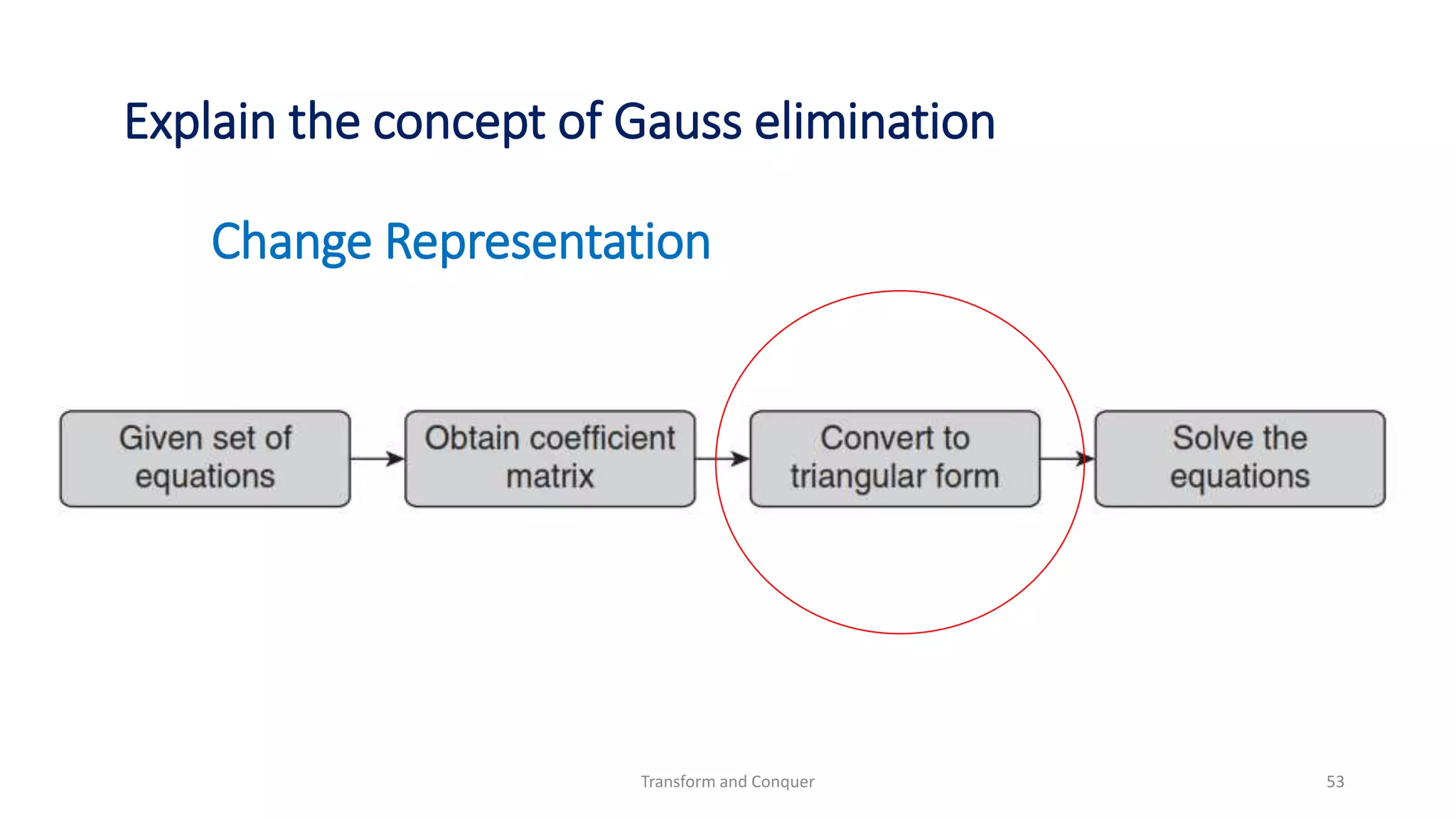
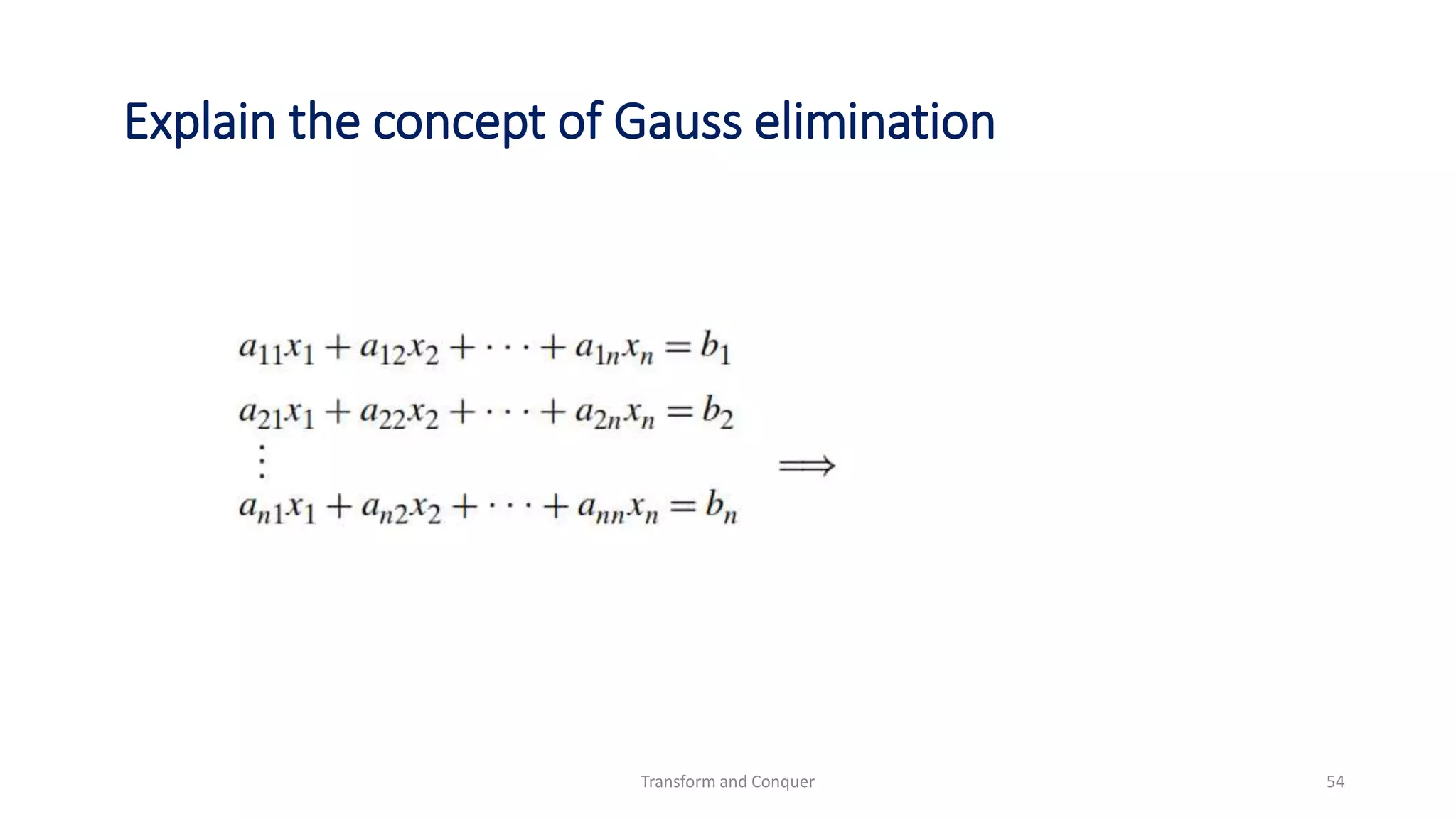
Explain the concept of Gauss elimination
50
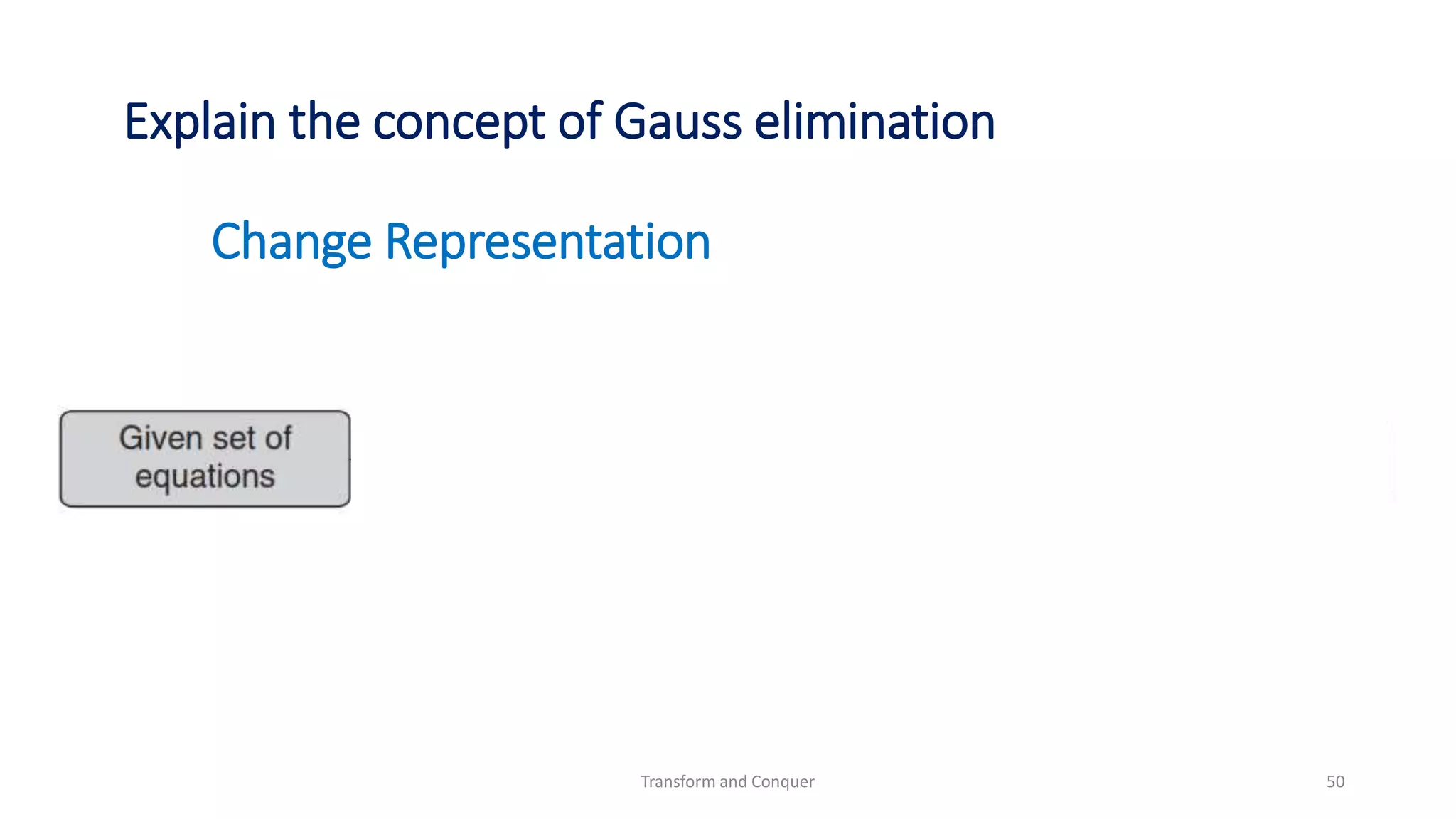
Change Representation
Transform and Conquer
Explain the concept of Gauss elimination
51
Change Representation
Transform and Conquer
Explain the concept of Gauss elimination
52
Change Representation
Transform and Conquer
Explain the concept of Gauss elimination
53
Change Representation
Transform and Conquer
Explain the concept of Gauss elimination
54Transform and Conquer
Explain the concept of Gauss elimination
55Transform and Conquer
Explain the concept of Gauss elimination
56Transform and Conquer
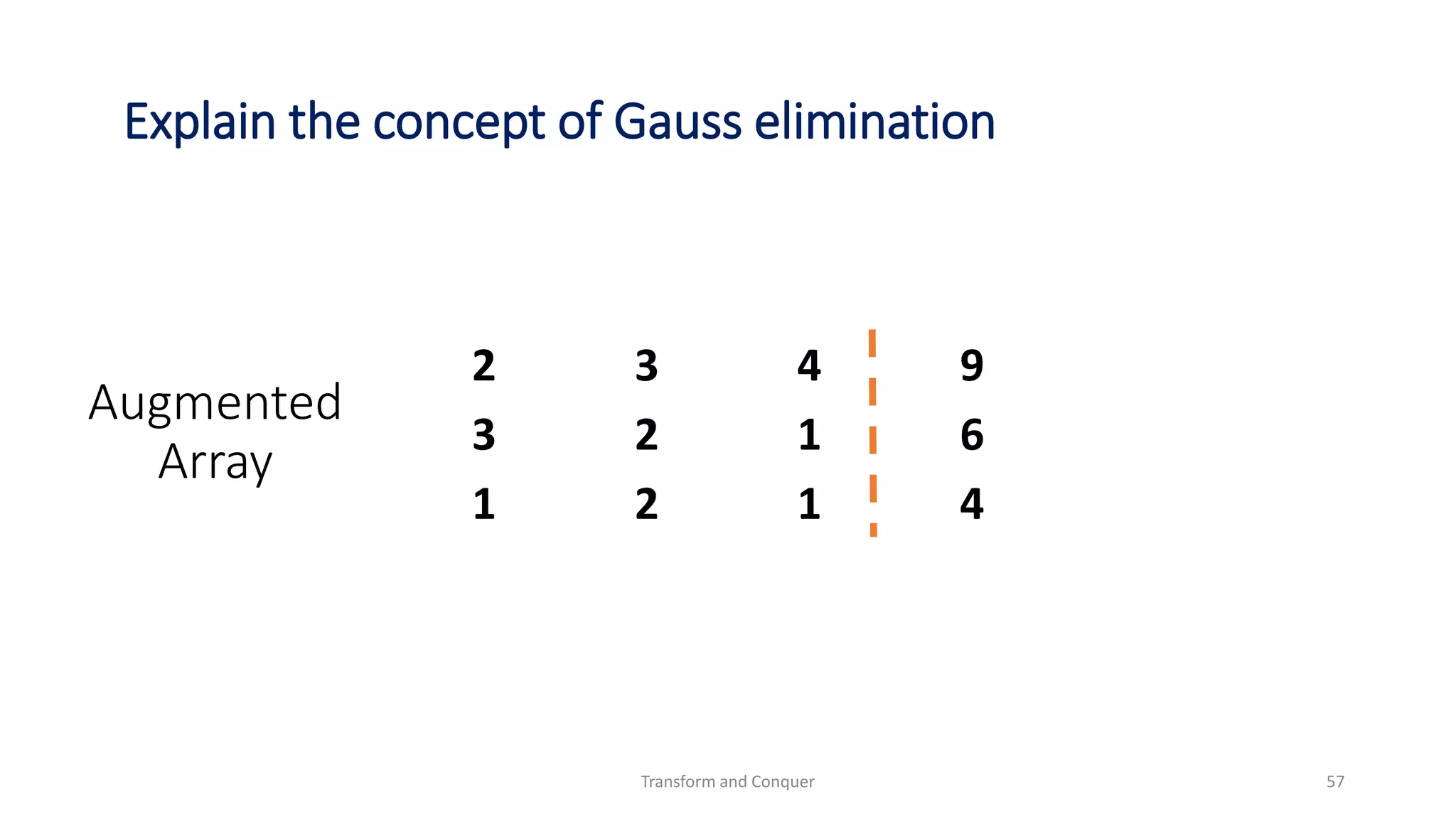
Explain the concept of Gauss elimination
57
Augmented
Array
2 3 4 9
3 2 1 6
1 2 1 4
Transform and Conquer
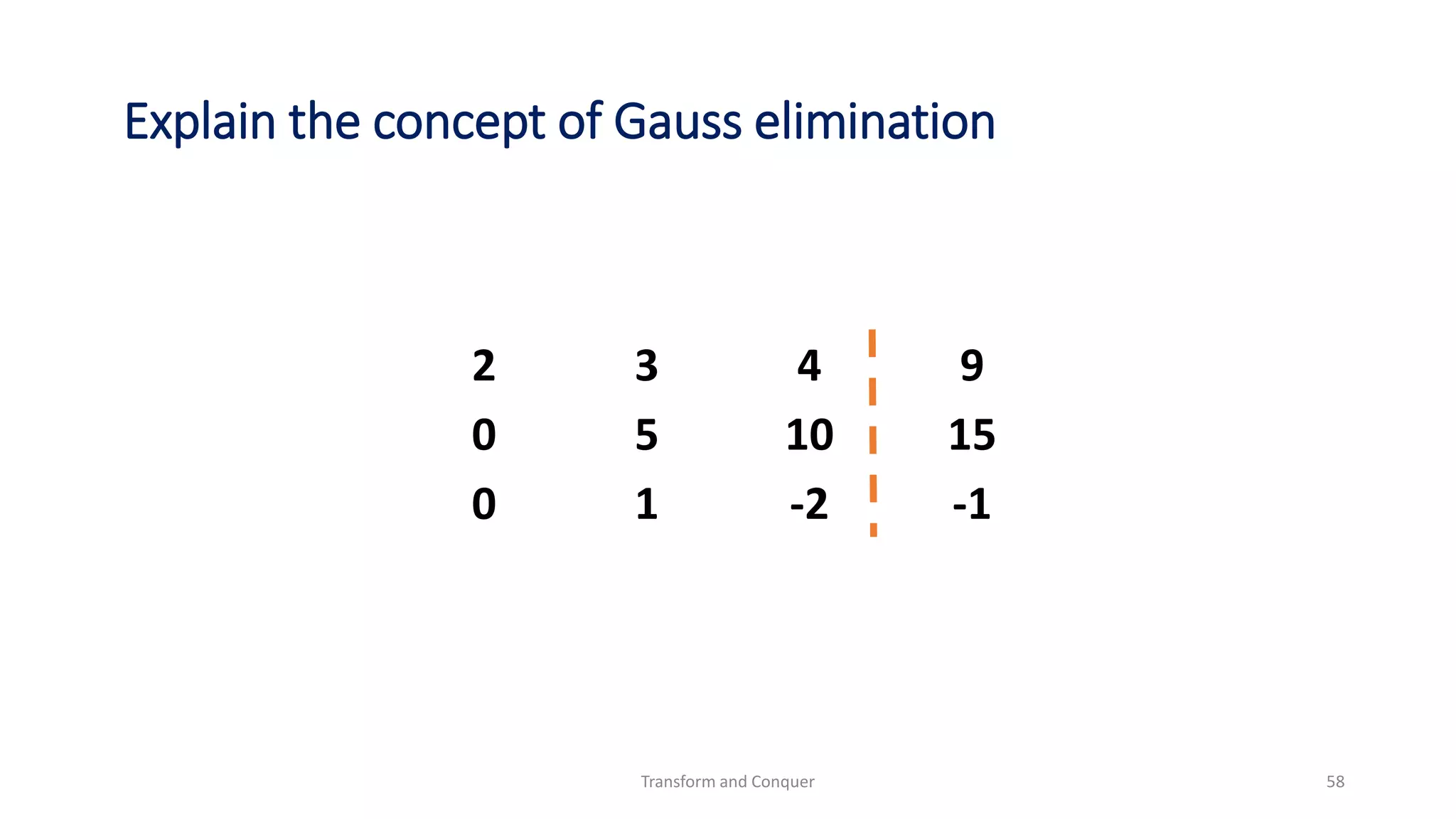
Explain the concept of Gauss elimination
58
2 3 4 9
0 5 10 15
0 1 -2 -1
Transform and Conquer
Explain the concept of Gauss elimination
59
2 3 4 9
0 5 10 15
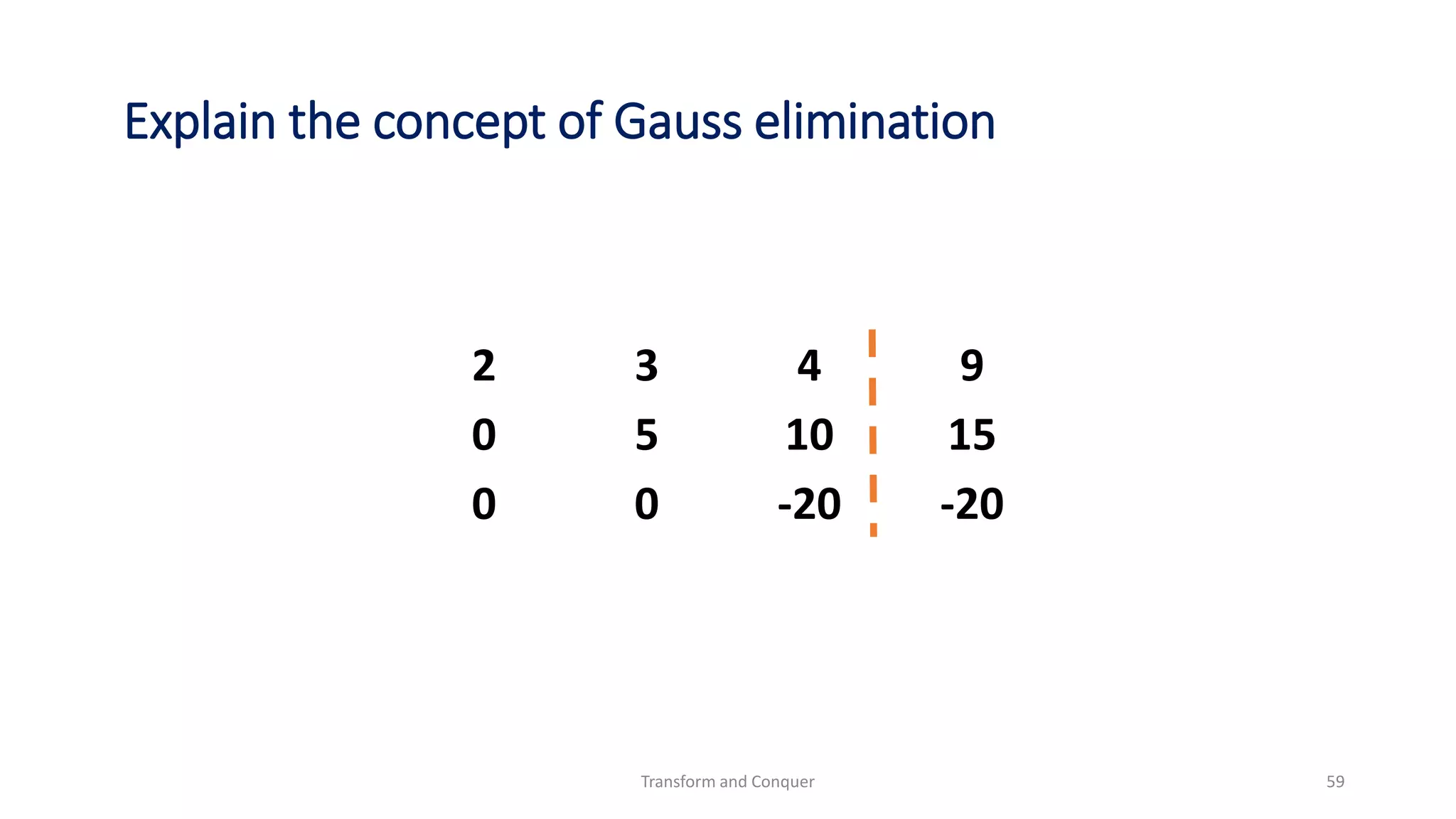
0 0 -20 -20
Transform and Conquer
Explain the concept of Gauss elimination
60
2 3 4 9
0 5 10 15
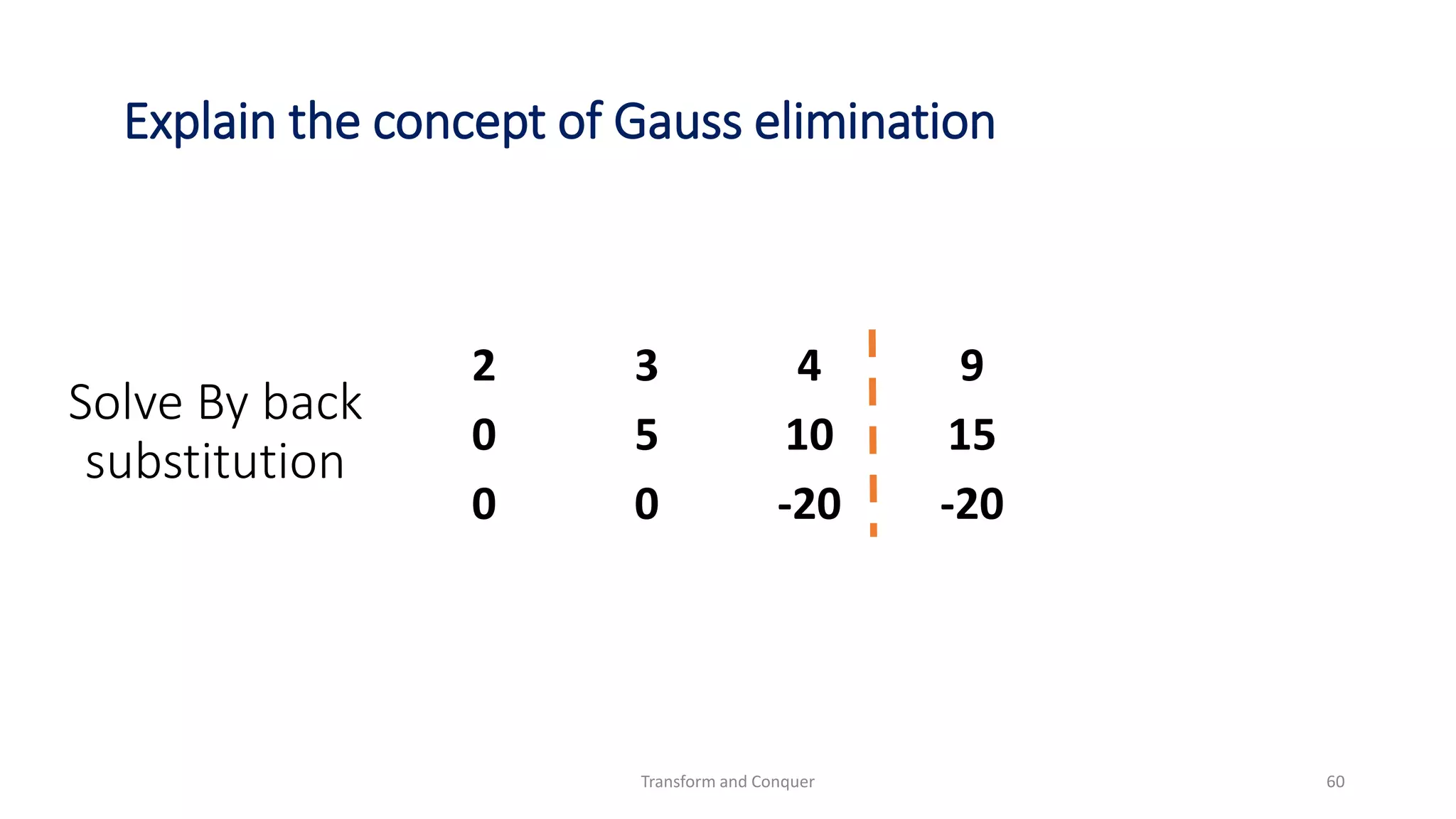
0 0 -20 -20
Solve By back
substitution
Transform and Conquer
Explain the concept of Gauss elimination
61
2 3 4 9
0 5 10 15
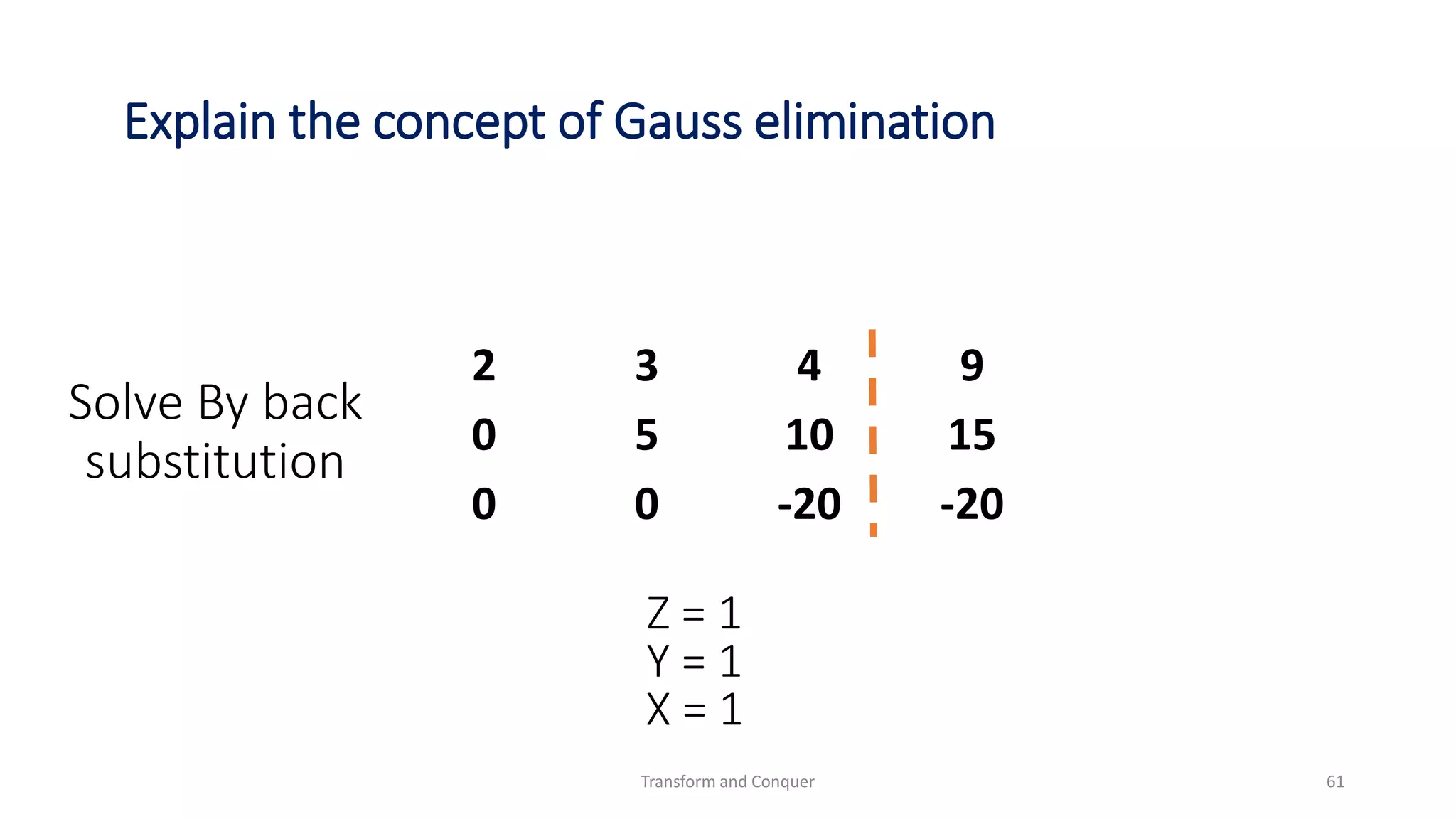
0 0 -20 -20
Solve By back
substitution
Z = 1
Y = 1
X = 1
Transform and Conquer
Gauss elimination
62
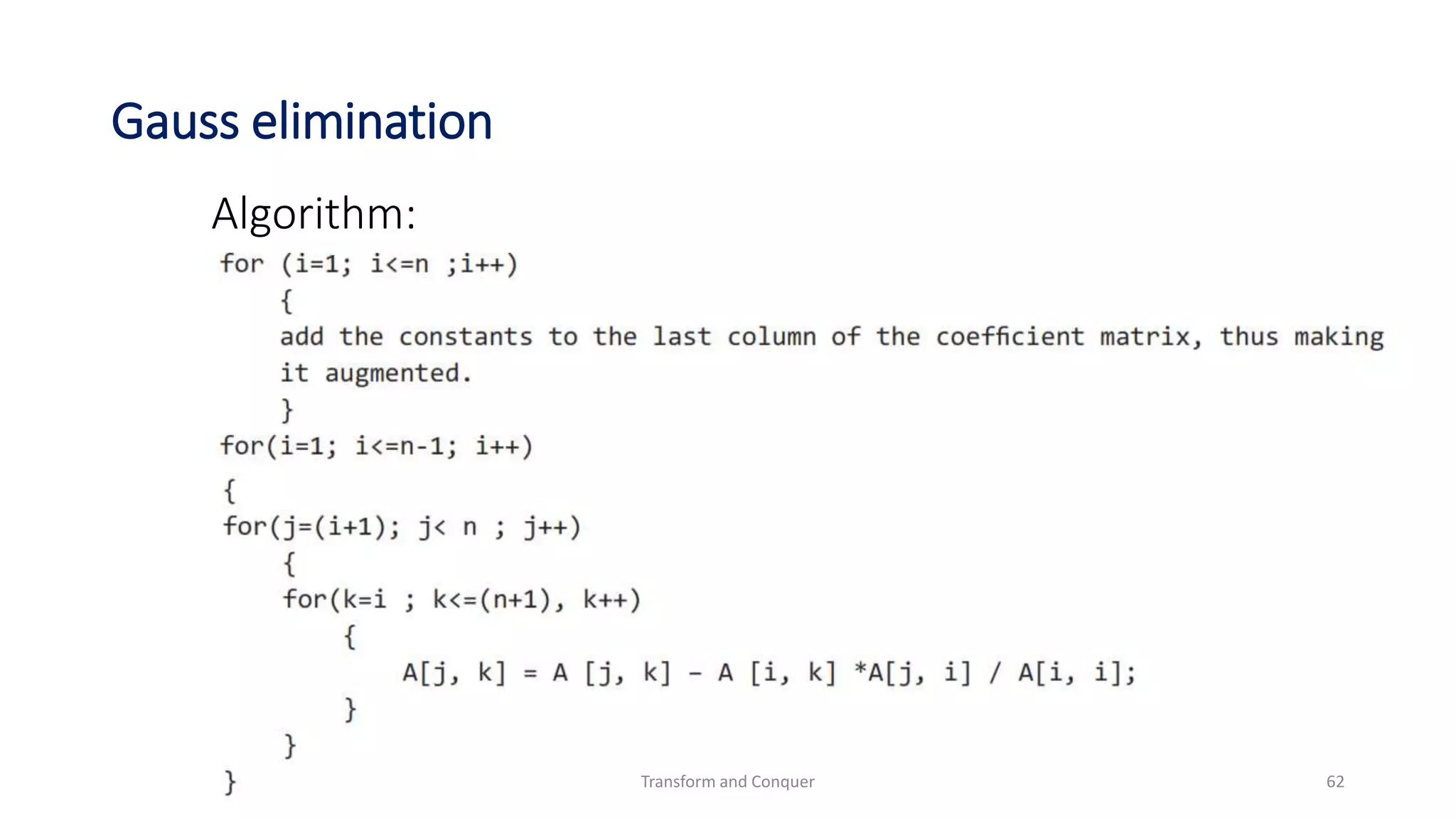
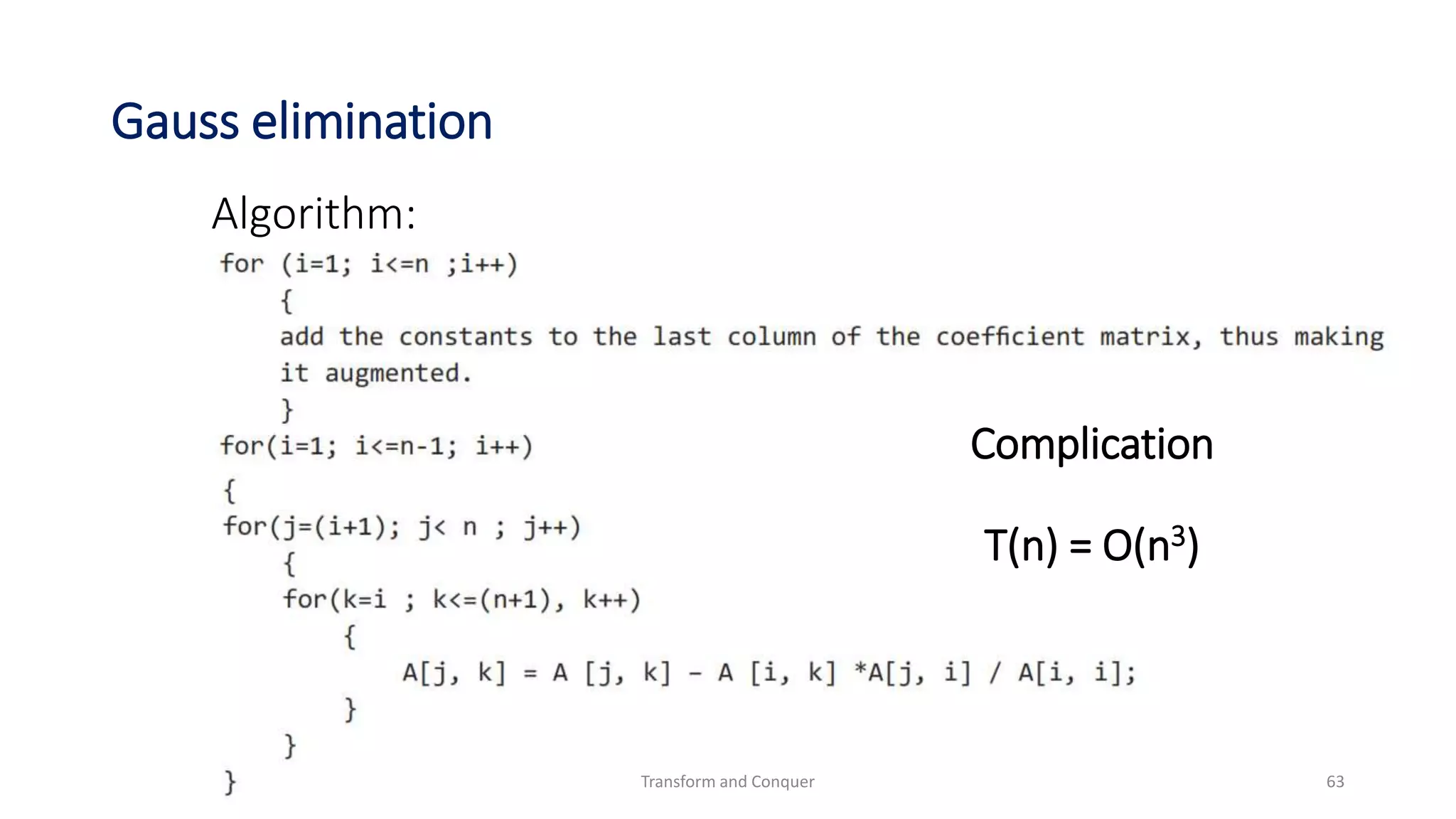
Algorithm:
Transform and Conquer
Gauss elimination
63
Algorithm:
Complication
T(n) = O(n3)
Transform and Conquer
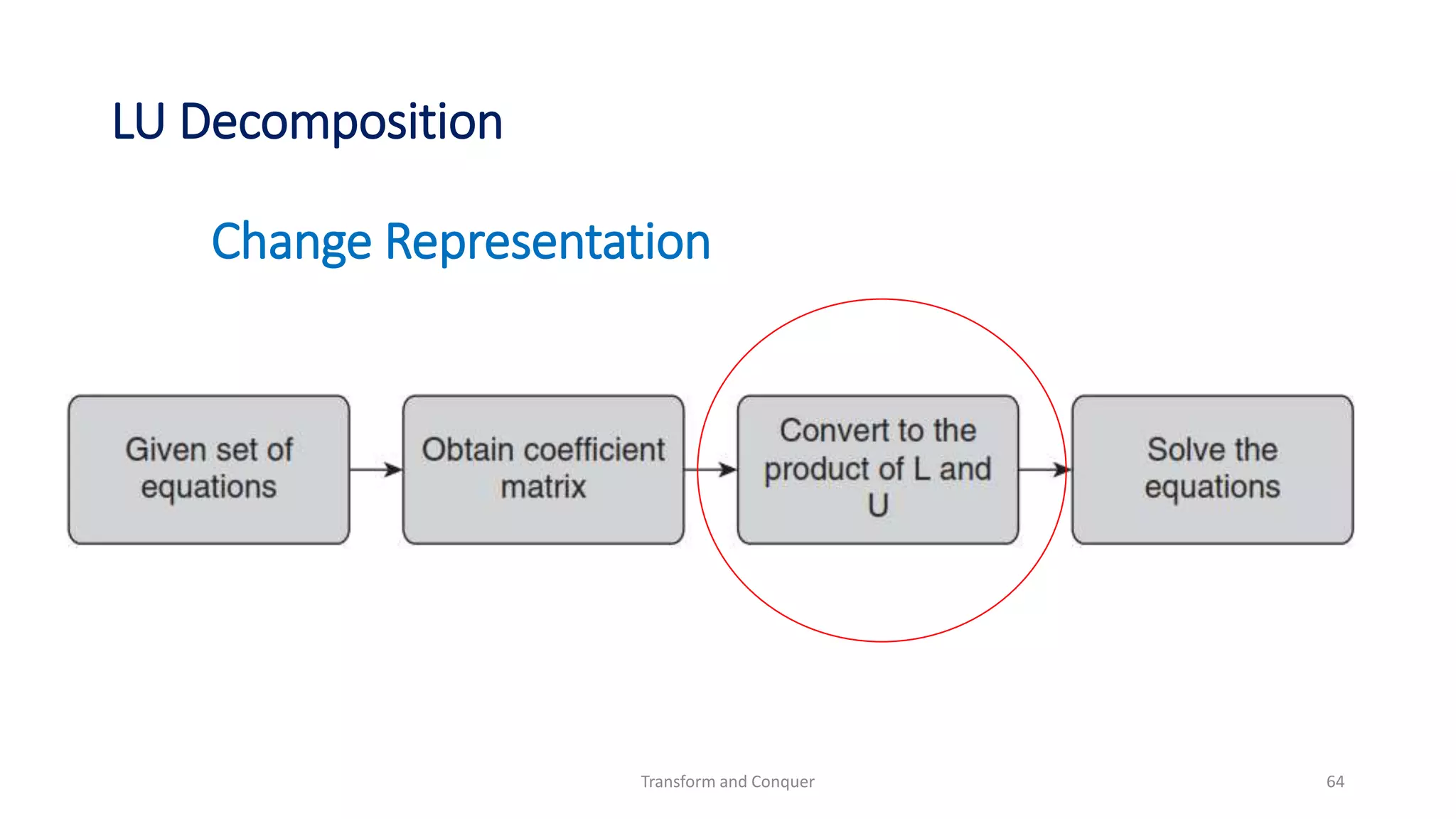
LU Decomposition
64
Change Representation
Transform and Conquer
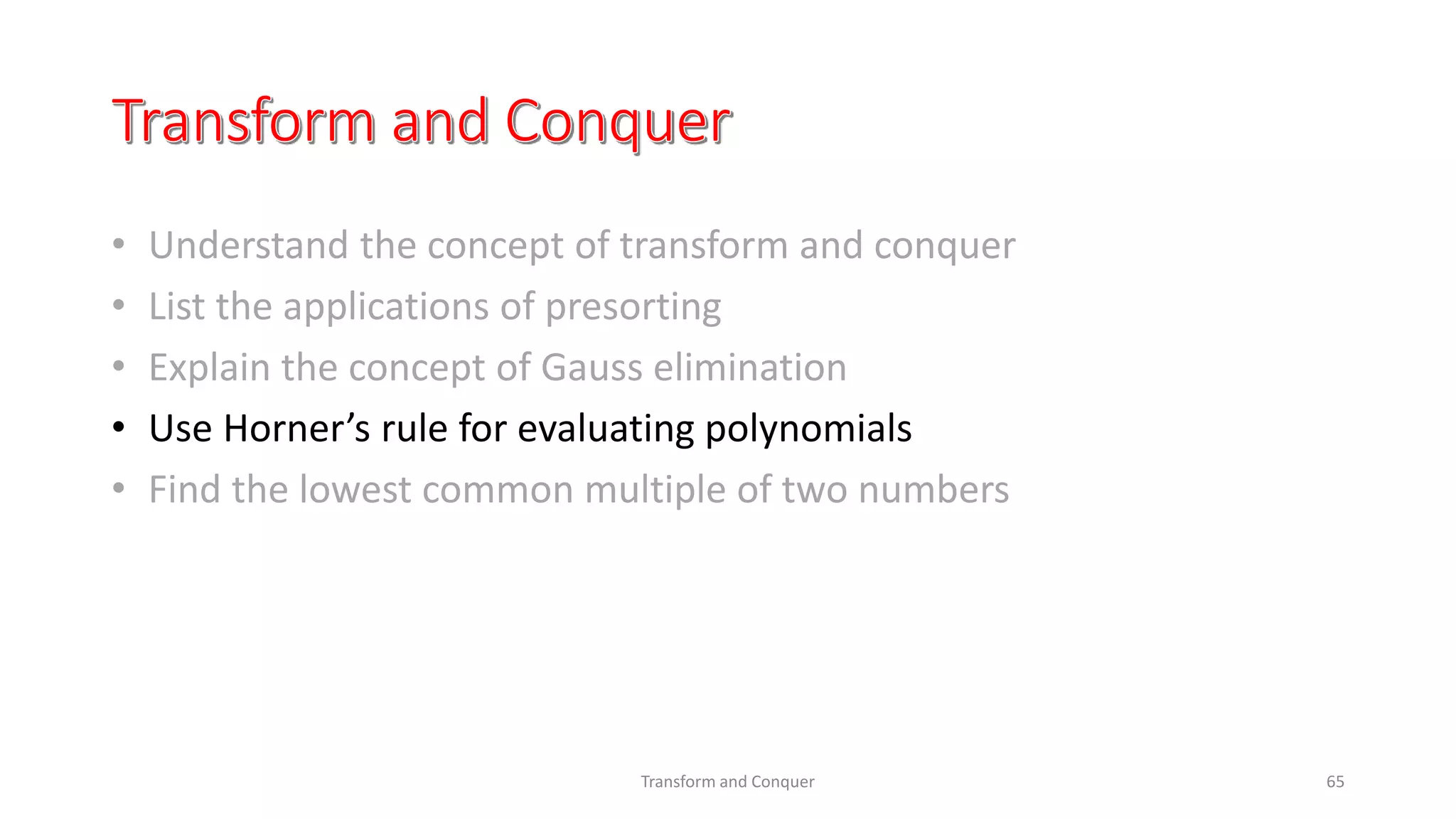
• Understand the concept of transform and conquer
• List the applications of presorting
• Explain the concept of Gauss elimination
• Use Horner’s rule for evaluating polynomials
• Find the lowest common multiple of two numbers
65Transform and Conquer
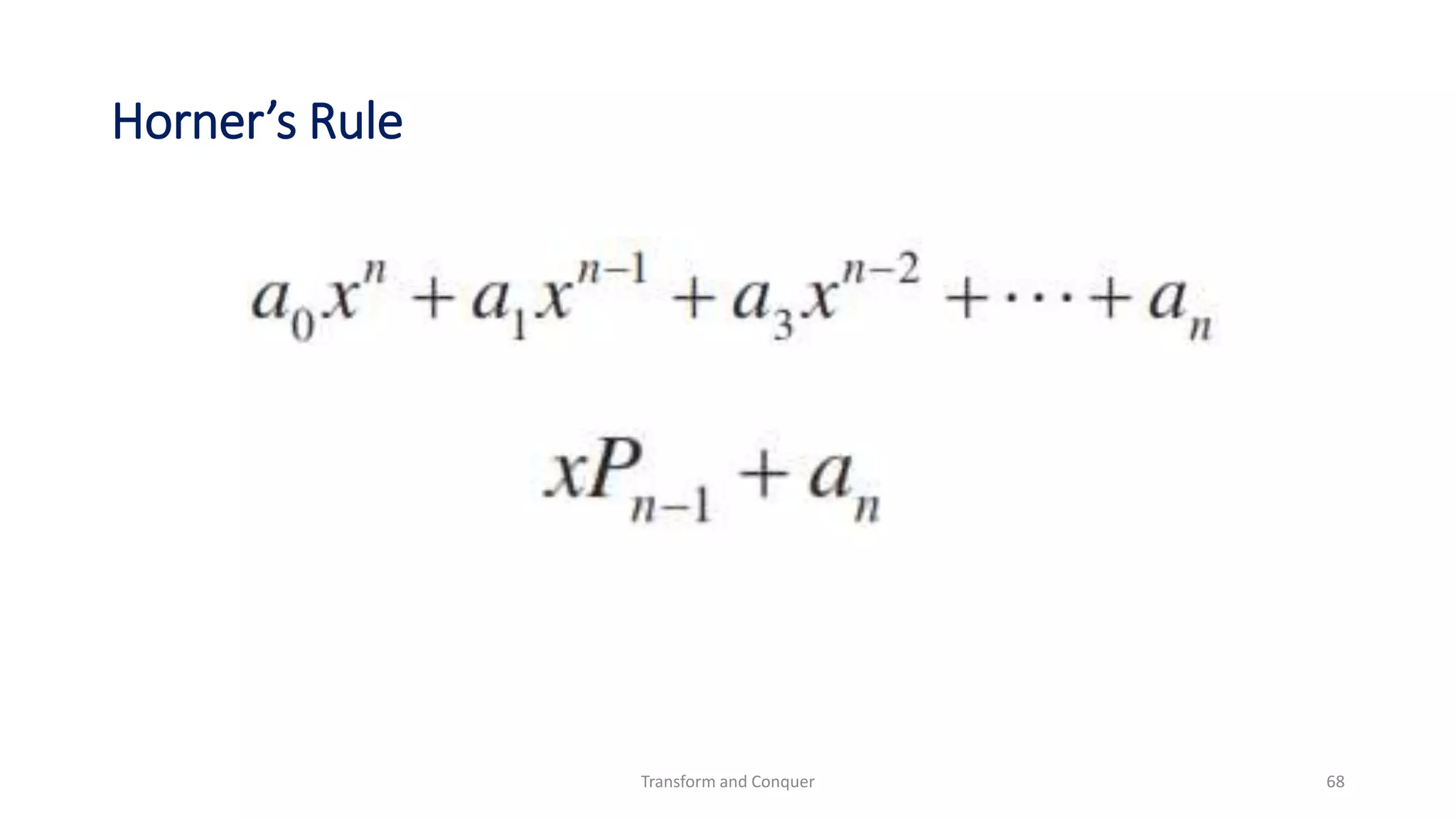
Horner’s Rule
66
Used for Evaluating Polynomials.
Change Representation
Transform and Conquer
Horner’s Rule
67
Multiply by coefficients
Complication:
O(n2)
Transform and Conquer
Horner’s Rule
68Transform and Conquer
Horner’s Rule
69Transform and Conquer
70
Algorithm:
Complication: T(n) = O(n)
0
i+1
i + 1
i < n
Horner’s Rule
Transform and Conquer
• Understand the concept of transform and conquer
• List the applications of presorting
• Explain the concept of Gauss elimination
• Use Horner’s rule for evaluating polynomials
• Find the lowest common multiple of two numbers
71Transform and Conquer
LCM(m,n)
72Transform and Conquer
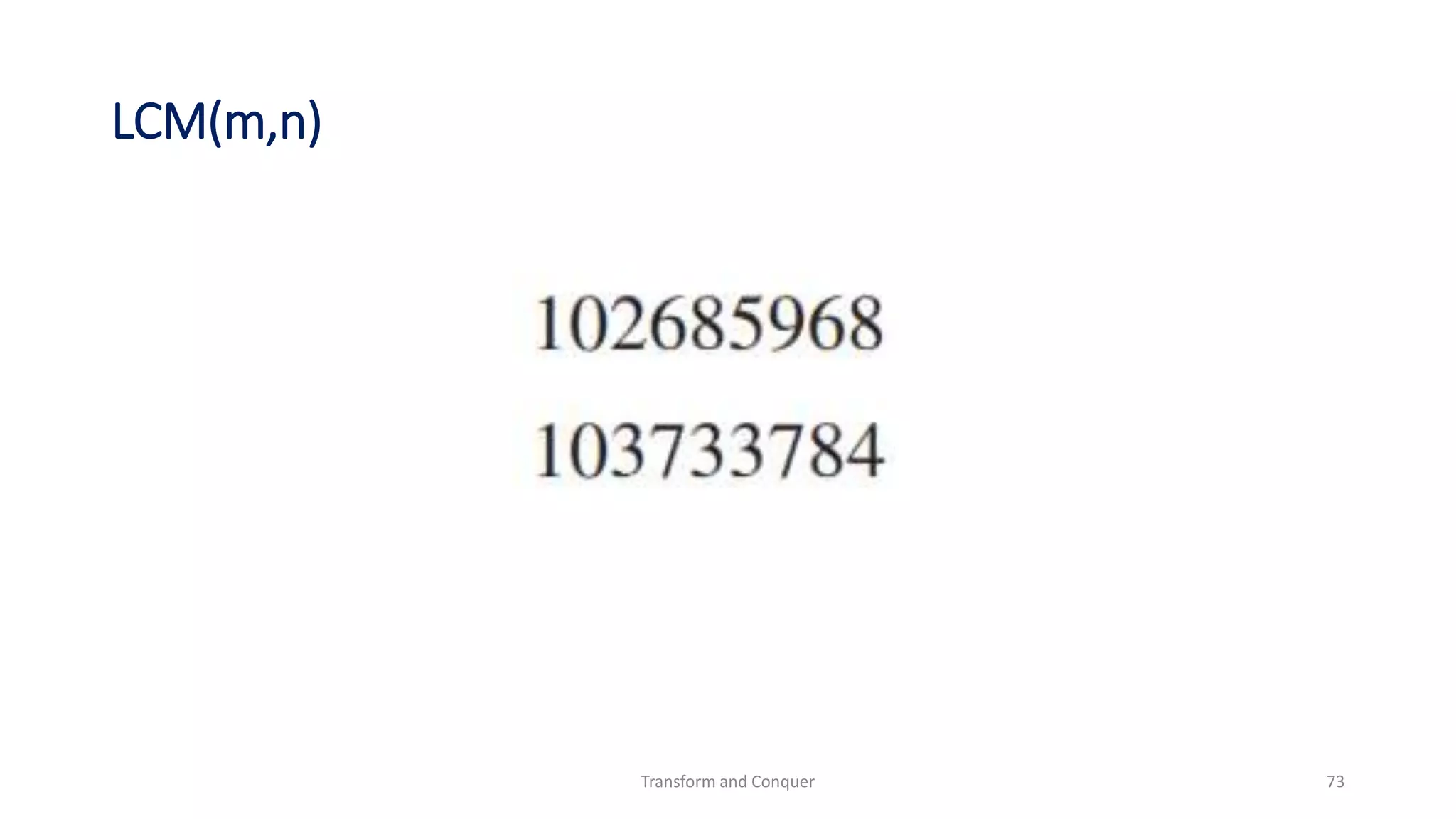
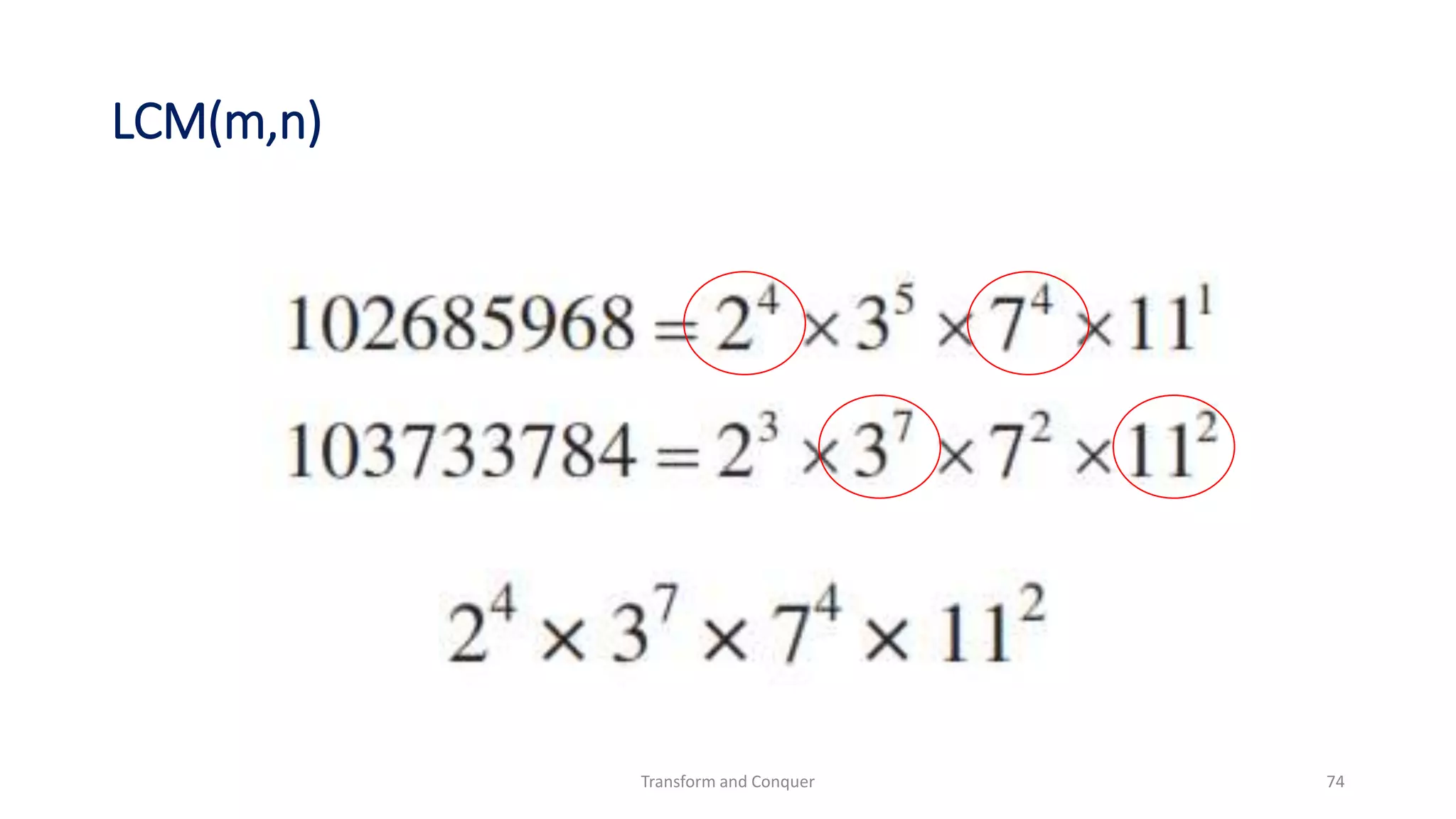
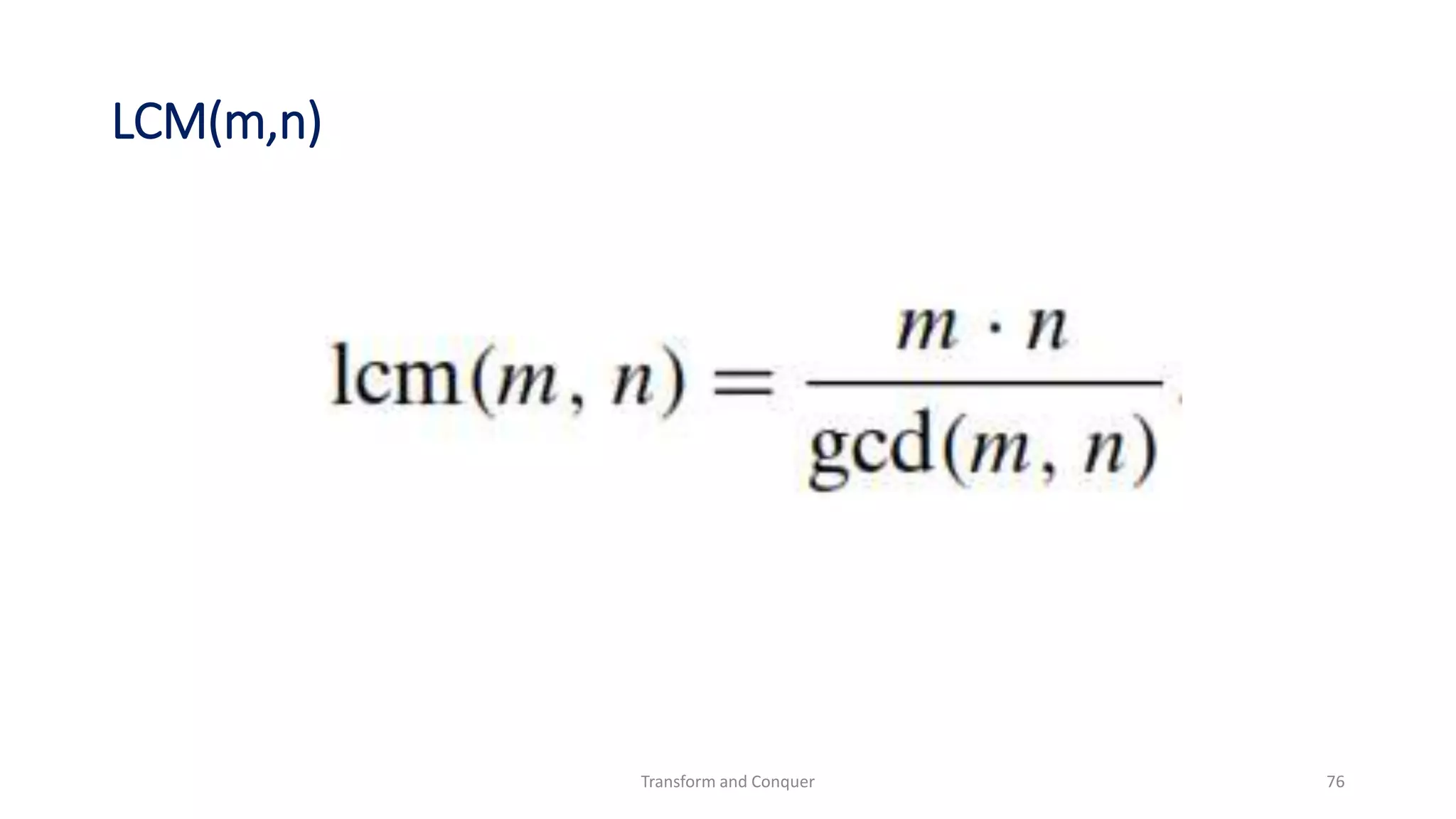
The smallest integer that is divisible by both m and n
LCM(m,n)
73Transform and Conquer
LCM(m,n)
74Transform and Conquer
LCM(m,n)
75Transform and Conquer
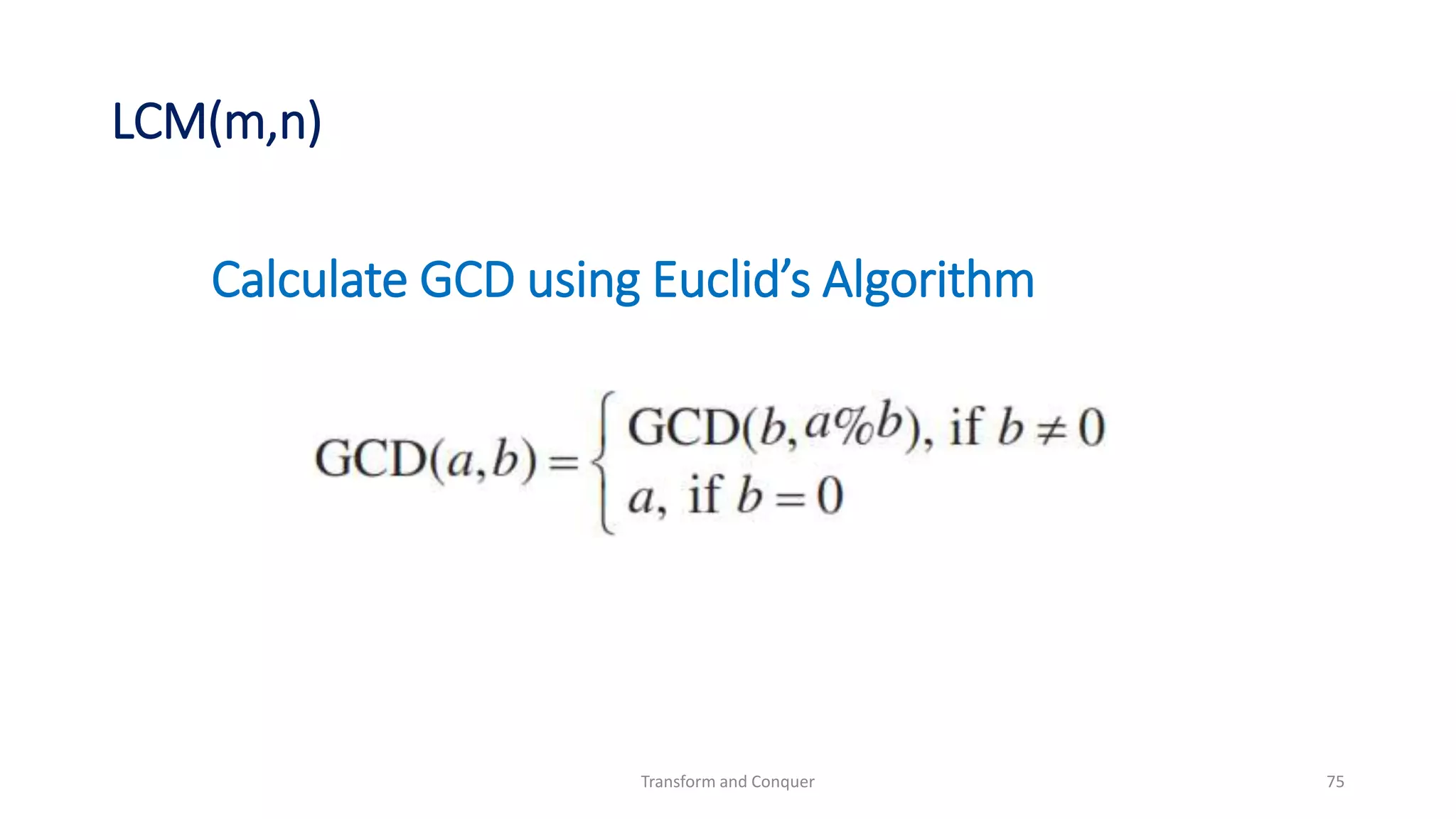
Calculate GCD using Euclid’s Algorithm
LCM(m,n)
76Transform and Conquer
LCM(m,n)
77Transform and Conquer
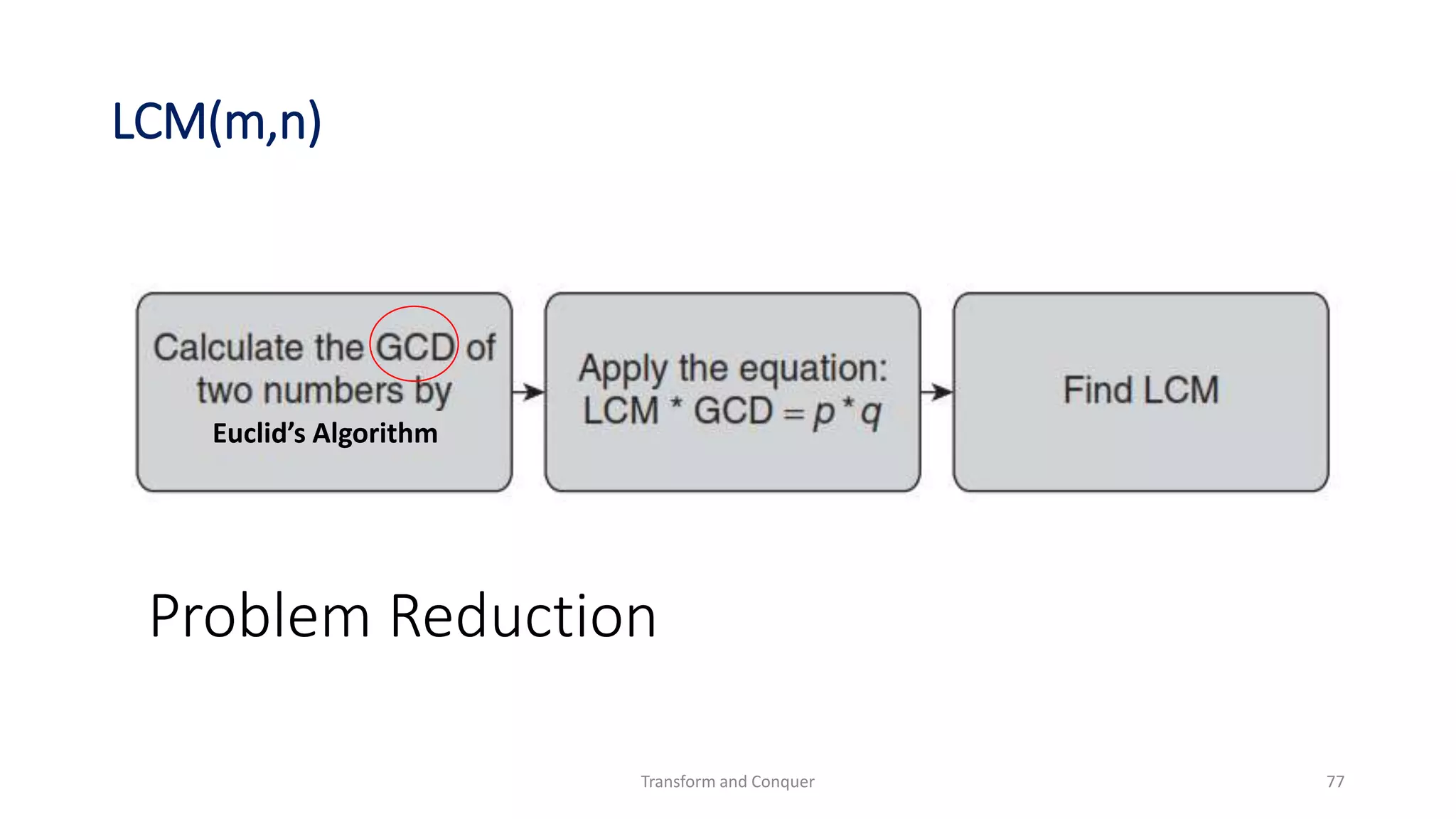
Euclid’s Algorithm
Problem Reduction
Resources
78Transform and Conquer
Algorithms_design and analysis [Harsh Bhasin] chapter 15.
Levitin A.-Introduction to the design and analysis of
algorithms-AW (2011) [Anany Levitin] chapter 6.
Transform and Conquer 79
Thanks for your listening

Advanced Algorithms: Transform and conquer

Editor's Notes

  • #75 24 = 2.2.2.3, 60 = 2.2.3.5, lcm = 120