architecture, the machine & the worker
CITY PHOTOGRAPHYCITY PHOTOGRAPHY
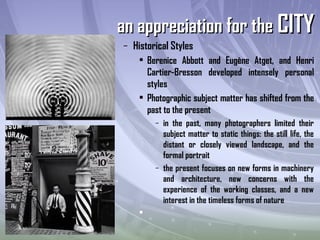
– Historical Styles
• Berenice Abbott and Eugène Atget, and Henri
Cartier-Bresson developed intensely personal
styles
• Photographic subject matter has shifted from the
past to the present
– in the past, many photographers limited their
subject matter to static things: the still life, the
distant or closely viewed landscape, and the
formal portrait
– the present focuses on new forms in machinery
and architecture, new concerns with the
experience of the working classes, and a new
interest in the timeless forms of nature
•
an appreciation for thean appreciation for the CITYCITY
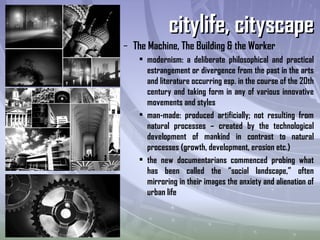
– The Machine, The Building & the Worker
• modernism: a deliberate philosophical and practical
estrangement or divergence from the past in the arts
and literature occurring esp. in the course of the 20th
century and taking form in any of various innovative
movements and styles
• man-made: produced artificially; not resulting from
natural processes – created by the technological
development of mankind in contrast to natural
processes (growth, development, erosion etc.)
• the new documentarians commenced probing what
has been called the “social landscape,” often
mirroring in their images the anxiety and alienation of
urban life
citylife, cityscapecitylife, cityscape
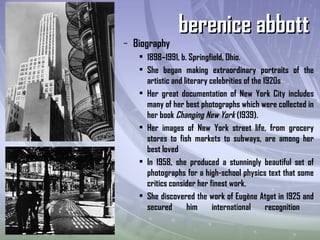
– Biography
• 1898–1991, b. Springfield, Ohio.
• She began making extraordinary portraits of the
artistic and literary celebrities of the 1920s
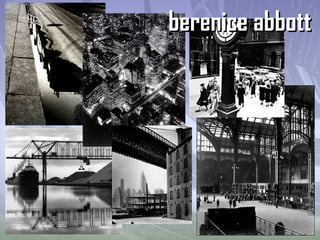
• Her great documentation of New York City includes
many of her best photographs which were collected in
her book Changing New York (1939).
• Her images of New York street life, from grocery
stores to fish markets to subways, are among her
best loved
• In 1958, she produced a stunningly beautiful set of
photographs for a high-school physics text that some
critics consider her finest work.
• She discovered the work of Eugène Atget in 1925 and
secured him international recognition
berenice abbottberenice abbott
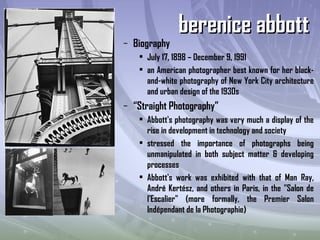
– Biography
• July 17, 1898 – December 9, 1991
• an American photographer best known for her black-
and-white photography of New York City architecture
and urban design of the 1930s
– “Straight Photography”
• Abbott's photography was very much a display of the
rise in development in technology and society
• stressed the importance of photographs being
unmanipulated in both subject matter & developing
processes
• Abbott's work was exhibited with that of Man Ray,
André Kertész, and others in Paris, in the "Salon de
l'Escalier" (more formally, the Premier Salon
Indépendant de la Photographie)
berenice abbottberenice abbott
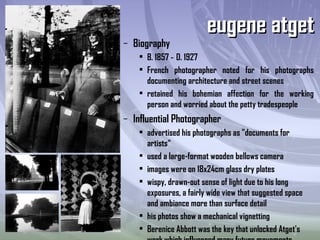
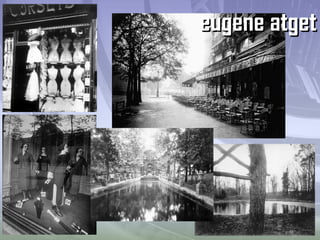
– Biography
• B. 1857 D. 1927‑
• French photographer noted for his photographs
documenting architecture and street scenes
• retained his bohemian affection for the working
person and worried about the petty tradespeople
– Influential Photographer
• advertised his photographs as "documents for
artists“
• used a large-format wooden bellows camera
• images were on 18x24cm glass dry plates
• wispy, drawn-out sense of light due to his long
exposures, a fairly wide view that suggested space
and ambiance more than surface detail
• his photos show a mechanical vignetting
• Berenice Abbott was the key that unlocked Atget's
eugene atgeteugene atget
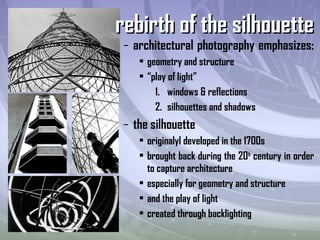
– architectural photography emphasizes:
• geometry and structure
• “play of light”
1. windows & reflections
2. silhouettes and shadows
– the silhouette
• originalyl developed in the 1700s
• brought back during the 20th
century in order
to capture architecture
• especially for geometry and structure
• and the play of light
• created through backlighting
rebirth of the silhouetterebirth of the silhouette
– Biography
• B. 1709- D. 1767
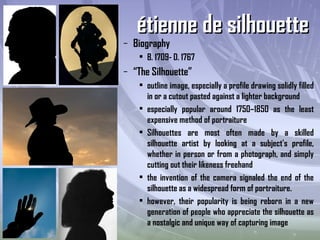
– “The Silhouette”
• outline image, especially a profile drawing solidly filled
in or a cutout pasted against a lighter background
• especially popular around 1750–1850 as the least
expensive method of portraiture
• Silhouettes are most often made by a skilled
silhouette artist by looking at a subject's profile,
whether in person or from a photograph, and simply
cutting out their likeness freehand
• the invention of the camera signaled the end of the
silhouette as a widespread form of portraiture.
• however, their popularity is being reborn in a new
generation of people who appreciate the silhouette as
a nostalgic and unique way of capturing image
étienne de silhouetteétienne de silhouette
silhouettessilhouettes
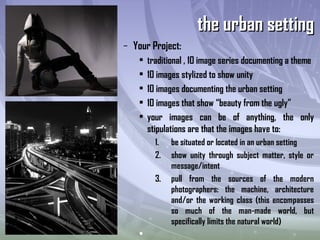
– Your Project:
• traditional , 10 image series documenting a theme
• 10 images stylized to show unity
• 10 images documenting the urban setting
• 10 images that show “beauty from the ugly”
• your images can be of anything, the only
stipulations are that the images have to:
1. be situated or located in an urban setting
2. show unity through subject matter, style or
message/intent
3. pull from the sources of the modern
photographers: the machine, architecture
and/or the working class (this encompasses
so much of the man-made world, but
specifically limits the natural world)
•
the urban settingthe urban setting

Urban Setting - Architecture

  • 1.
    architecture, the machine& the worker CITY PHOTOGRAPHYCITY PHOTOGRAPHY
  • 2.
    – Historical Styles •Berenice Abbott and Eugène Atget, and Henri Cartier-Bresson developed intensely personal styles • Photographic subject matter has shifted from the past to the present – in the past, many photographers limited their subject matter to static things: the still life, the distant or closely viewed landscape, and the formal portrait – the present focuses on new forms in machinery and architecture, new concerns with the experience of the working classes, and a new interest in the timeless forms of nature • an appreciation for thean appreciation for the CITYCITY
  • 3.
    – The Machine,The Building & the Worker • modernism: a deliberate philosophical and practical estrangement or divergence from the past in the arts and literature occurring esp. in the course of the 20th century and taking form in any of various innovative movements and styles • man-made: produced artificially; not resulting from natural processes – created by the technological development of mankind in contrast to natural processes (growth, development, erosion etc.) • the new documentarians commenced probing what has been called the “social landscape,” often mirroring in their images the anxiety and alienation of urban life citylife, cityscapecitylife, cityscape
  • 4.
    – Biography • 1898–1991,b. Springfield, Ohio. • She began making extraordinary portraits of the artistic and literary celebrities of the 1920s • Her great documentation of New York City includes many of her best photographs which were collected in her book Changing New York (1939). • Her images of New York street life, from grocery stores to fish markets to subways, are among her best loved • In 1958, she produced a stunningly beautiful set of photographs for a high-school physics text that some critics consider her finest work. • She discovered the work of Eugène Atget in 1925 and secured him international recognition berenice abbottberenice abbott
  • 5.
    – Biography • July17, 1898 – December 9, 1991 • an American photographer best known for her black- and-white photography of New York City architecture and urban design of the 1930s – “Straight Photography” • Abbott's photography was very much a display of the rise in development in technology and society • stressed the importance of photographs being unmanipulated in both subject matter & developing processes • Abbott's work was exhibited with that of Man Ray, André Kertész, and others in Paris, in the "Salon de l'Escalier" (more formally, the Premier Salon Indépendant de la Photographie) berenice abbottberenice abbott
  • 6.
  • 7.
    – Biography • B.1857 D. 1927‑ • French photographer noted for his photographs documenting architecture and street scenes • retained his bohemian affection for the working person and worried about the petty tradespeople – Influential Photographer • advertised his photographs as "documents for artists“ • used a large-format wooden bellows camera • images were on 18x24cm glass dry plates • wispy, drawn-out sense of light due to his long exposures, a fairly wide view that suggested space and ambiance more than surface detail • his photos show a mechanical vignetting • Berenice Abbott was the key that unlocked Atget's eugene atgeteugene atget
  • 8.
  • 9.
    – architectural photographyemphasizes: • geometry and structure • “play of light” 1. windows & reflections 2. silhouettes and shadows – the silhouette • originalyl developed in the 1700s • brought back during the 20th century in order to capture architecture • especially for geometry and structure • and the play of light • created through backlighting rebirth of the silhouetterebirth of the silhouette
  • 10.
    – Biography • B.1709- D. 1767 – “The Silhouette” • outline image, especially a profile drawing solidly filled in or a cutout pasted against a lighter background • especially popular around 1750–1850 as the least expensive method of portraiture • Silhouettes are most often made by a skilled silhouette artist by looking at a subject's profile, whether in person or from a photograph, and simply cutting out their likeness freehand • the invention of the camera signaled the end of the silhouette as a widespread form of portraiture. • however, their popularity is being reborn in a new generation of people who appreciate the silhouette as a nostalgic and unique way of capturing image étienne de silhouetteétienne de silhouette
  • 11.
  • 12.
    – Your Project: •traditional , 10 image series documenting a theme • 10 images stylized to show unity • 10 images documenting the urban setting • 10 images that show “beauty from the ugly” • your images can be of anything, the only stipulations are that the images have to: 1. be situated or located in an urban setting 2. show unity through subject matter, style or message/intent 3. pull from the sources of the modern photographers: the machine, architecture and/or the working class (this encompasses so much of the man-made world, but specifically limits the natural world) • the urban settingthe urban setting