PHYLUM CNIDARIABY: ANDREW QUINTOIS
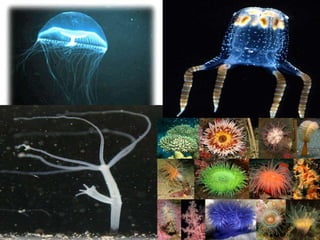
FOUR DIVISIONS OF CNIDARIANS1. SCYTHOZOA (jellyfish)2. CUBOZOA (square shaped jellyfish)3. HYDROZOA ( hydras)4. ANTHOZOA ( corals & sea anemones)
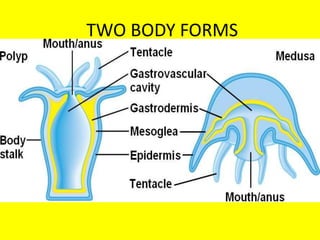
 TWO BODY FORMS
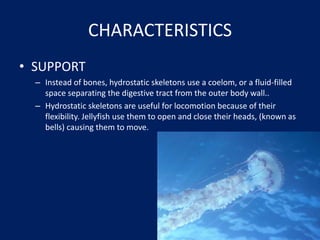
CHARACTERISTICSSUPPORTInstead of bones, hydrostatic skeletons use a coelom, or a fluid-filled space separating the digestive tract from the outer body wall..Hydrostatic skeletons are useful for locomotion because of their flexibility. Jellyfish use them to open and close their heads, (known as bells) causing them to move.
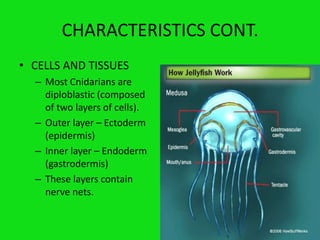
CHARACTERISTICS CONT.CELLS AND TISSUESMost Cnidarians are diploblastic (composed of two layers of cells).Outer layer – Ectoderm (epidermis)Inner layer – Endoderm (gastrodermis)These layers contain nerve nets.
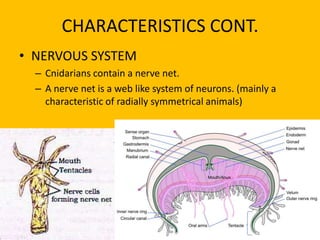
CHARACTERISTICS CONT.NERVOUS SYSTEMCnidarians contain a nerve net.A nerve net is a web like system of neurons. (mainly a characteristic of radially symmetrical animals)
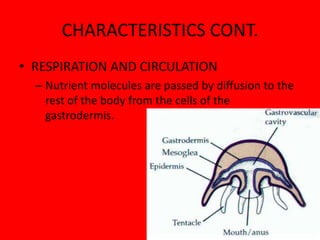
CHARACTERISTICS CONT.RESPIRATION AND CIRCULATIONNutrient molecules are passed by diffusion to the rest of the body from the cells of the gastrodermis.
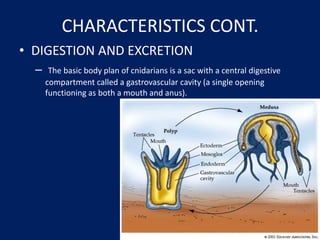
CHARACTERISTICS CONT.DIGESTION AND EXCRETIONThe basic body plan of cnidarians is a sac with a central digestive compartment called a gastrovascular cavity (a single opening functioning as both a mouth and anus).
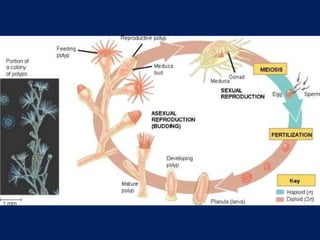
CHARACTERISTICS CONT.REPRODUCTIONCnidarians can reproduce both sexually and Asexually.Asexual reproduction is seen in polyps, while sexual reproduction is seen in medusas.
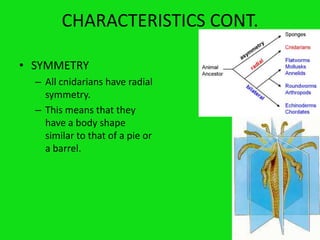
CHARACTERISTICS CONT.SYMMETRYAll cnidarians have radial symmetry.This means that they have a body shape similar to that of a pie or a barrel.
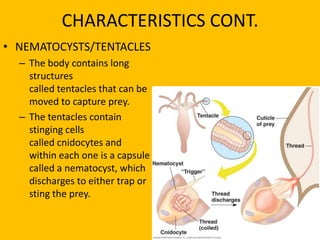
CHARACTERISTICS CONT.NEMATOCYSTS/TENTACLESThe body contains long structures called tentacles that can be moved to capture prey.The tentacles contain stinging cells called cnidocytes and within each one is a capsule called a nematocyst, which discharges to either trap or sting the prey.
LINKShttp://www.youtube.com/watch?v=6zJiBc_N1ZkNematocysts Firinghttp://www.youtube.com/watch?v=-Tp38DUjUnM&NR=1How Jellyfish stinghttp://www.youtube.com/watch?v=Kukv0AtIVdU&feature=relatedHydra

Phylum cnidaria