What is a Metazoan?
In other words what are the inherent
Characteristics of the animal body plan that are different
from that of a colonial heterotrophic protists?
What are some characteristics of sponges that help us
place them directly in the metazoan
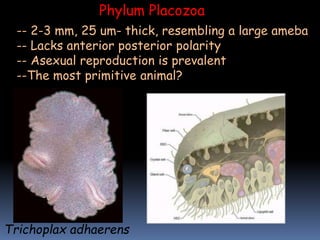
Phylum Placozoa
-- 2-3 mm, 25 um- thick, resembling a large ameba
-- Lacks anterior posterior polarity
-- Asexual reproduction is prevalent
--The most primitive animal?
Trichoplax adhaerens
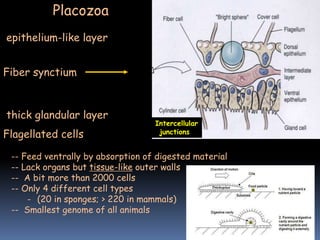
Phylum Placozoa Dorsal
Fiber synctium
cilium
epithelium-like layer
thick glandular layer
Flagellated cells
-- Feed ventrally by absorption of digested material
-- Lack organs but tissue-like outer walls
-- A bit more than 2000 cells
-- Only 4 different cell types
- (20 in sponges; > 220 in mammals)
-- Smallest genome of all animals
Intercellular
junctions
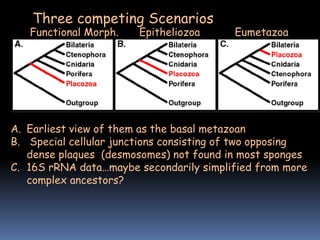
Three competing Scenarios
A. Earliest view of them as the basal metazoan
B. Special cellular junctions consisting of two opposing
dense plaques (desmosomes) not found in most sponges
C. 16S rRNA data…maybe secondarily simplified from more
complex ancestors?
Epitheliozoa Eumetazoa
Functional Morph.
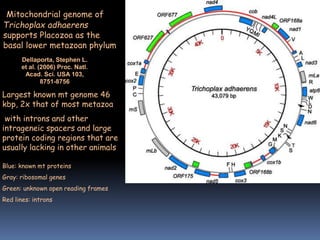
Mitochondrial genome of
Trichoplax adhaerens
supports Placozoa as the
basal lower metazoan phylum
Dellaporta, Stephen L.
et al. (2006) Proc. Natl.
Acad. Sci. USA 103,
8751-8756
Largest known mt genome 46
kbp, 2x that of most metazoa
with introns and other
intrageneic spacers and large
protein coding regions that are
usually lacking in other animals
Blue: known mt proteins
Gray: ribosomal genes
Green: unknown open reading frames
Red lines: introns
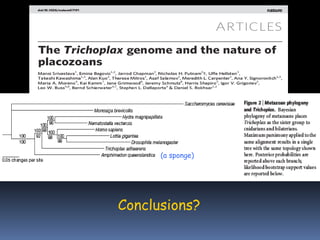
Conclusions?
(a sponge)
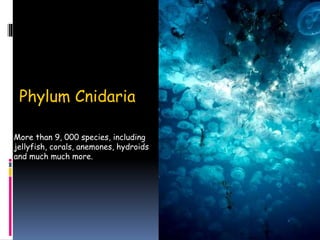
More than 9, 000 species, including
jellyfish, corals, anemones, hydroids
and much much more.
Phylum Cnidaria
Themes
 General characteristics of Cnidaria
 Why are they successful?
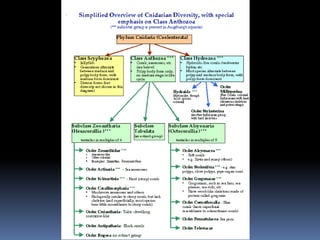
 Cnidaria Diversity and Taxonomy
 Classes, SubClasses of Anthozoans
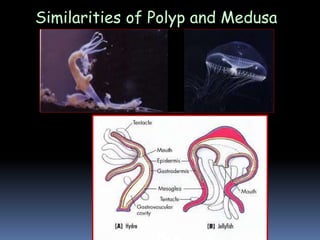
 Similarity of Polyp and Medusa
 The Cnidaria Body Plan
 Class Scyphozoa, the jellyfish
 Complexity, Sensory & Nervous System
What Characteristics Account for
the Great Success of Cnidarians?
1. Two distinct adult forms
2. Diphasic life cycle in some species
3. Ability to proliferate by cloning
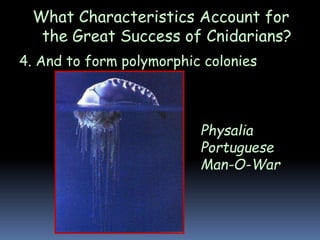
4. And to form polymorphic colonies
5. Formidable prey capture device
6. Low Energy Demands
What Characteristics Account for
the Great Success of Cnidarians?
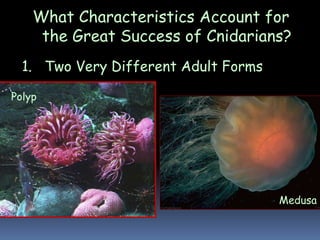
1. Two Very Different Adult Forms
Polyp
Medusa
What Characteristics Account for
the Great Success of Cnidarians?
2. Dimorphic Life Cycle in Many Species
Life cycle
Of the
Hydroid
Obelia
What Characteristics Account for
the Great Success of Cnidarians?
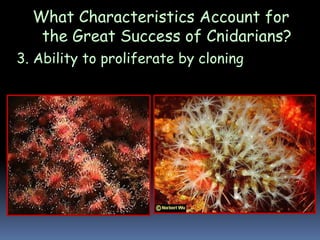
3. Ability to proliferate by cloning
What Characteristics Account for
the Great Success of Cnidarians?
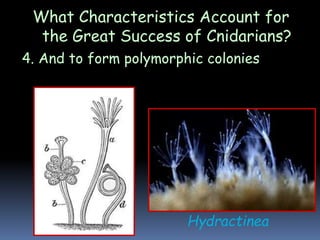
4. And to form polymorphic colonies
Hydractinea
What Characteristics Account for
the Great Success of Cnidarians?
4. And to form polymorphic colonies
Physalia
Portuguese
Man-O-War
What Characteristics Account for
the Great Success of Cnidarians?
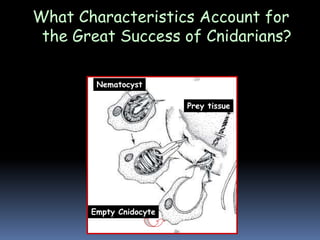
5. Formidable prey-capture device
Nematocyst
Prey tissue
Empty Cnidocyte
What Characteristics Account for
the Great Success of Cnidarians?
5. Formidable prey-capture device
What Characteristics Account for
the Great Success of Cnidarians?
6. Low Energy Demands
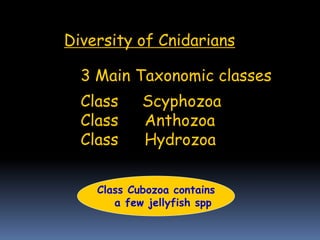
Diversity of Cnidarians
3 Main Taxonomic classes
Class Scyphozoa
Class Anthozoa
Class Hydrozoa
Class Cubozoa contains
a few jellyfish spp
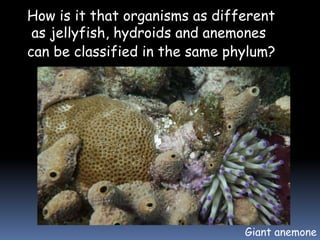
How is it that organisms as different
as jellyfish, hydroids and anemones
can be classified in the same phylum?
Giant anemone
Similarities of Polyp and Medusa
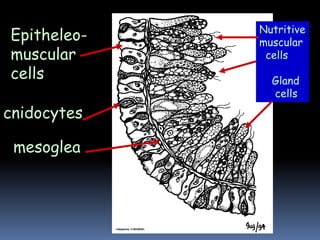
cnidocytes
Epitheleo-
muscular
cells
mesoglea
Nutritive
muscular
cells
Gland
cells
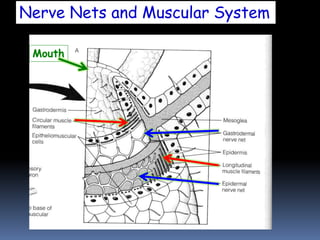
Nerve Nets and Muscular System
Mouth
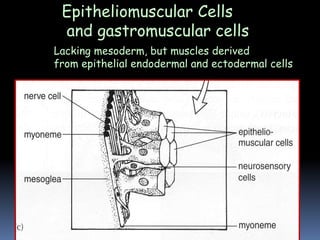
Epitheliomuscular Cells
and gastromuscular cells
Lacking mesoderm, but muscles derived
from epithelial endodermal and ectodermal cells
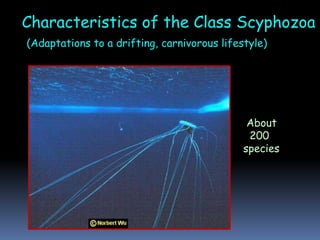
Characteristics of the Class Scyphozoa
(Adaptations to a drifting, carnivorous lifestyle)
About
200
species
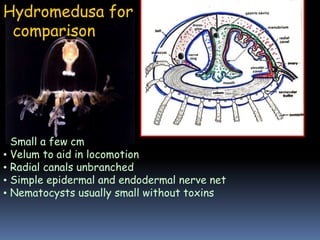
• Small a few cm
• Velum to aid in locomotion
• Radial canals unbranched
• Simple epidermal and endodermal nerve net
• Nematocysts usually small without toxins
Hydromedusa for
comparison
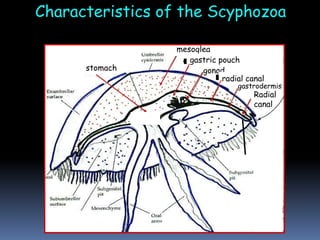
Characteristics of the Scyphozoa
mouth
stomach
mesoglea
gastric pouch
gonad
radial canal
gastrodermis
Radial
canal
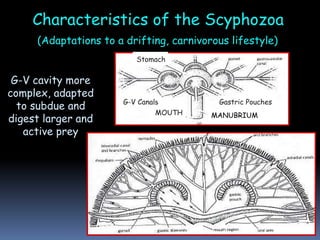
Characteristics of the Scyphozoa
(Adaptations to a drifting, carnivorous lifestyle)
G-V cavity more
complex, adapted
to subdue and
digest larger and
active prey
MOUTH MANUBRIUM
Stomach
G-V Canals
Stomach
Gastric Pouches
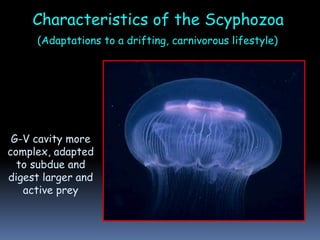
Characteristics of the Scyphozoa
(Adaptations to a drifting, carnivorous lifestyle)
G-V cavity more
complex, adapted
to subdue and
digest larger and
active prey
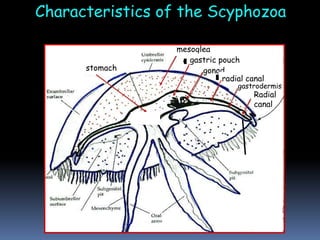
Characteristics of the Scyphozoa
mouth
stomach
mesoglea
gastric pouch
gonad
radial canal
gastrodermis
Radial
canal
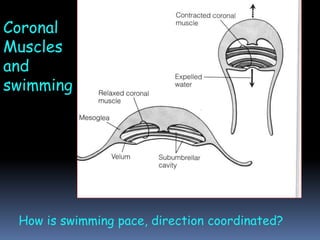
How is swimming pace, direction coordinated?
Coronal
Muscles
and
swimming
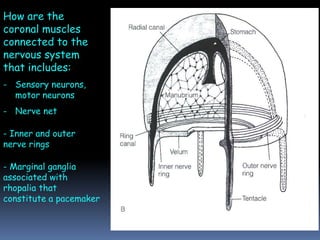
How are the
coronal muscles
connected to the
nervous system
that includes:
- Sensory neurons,
motor neurons
- Nerve net
- Inner and outer
nerve rings
- Marginal ganglia
associated with
rhopalia that
constitute a pacemaker
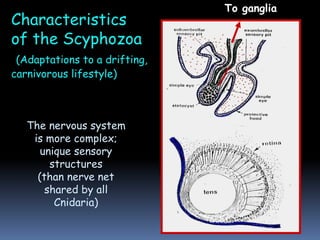
Characteristics
of the Scyphozoa
(Adaptations to a drifting,
carnivorous lifestyle)
The nervous system
is more complex;
unique sensory
structures
(than nerve net
shared by all
Cnidaria)
To ganglia
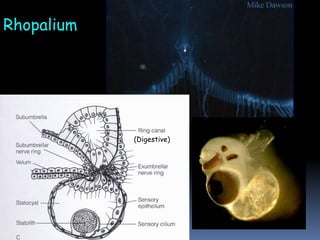
Rhopalium
(Digestive)
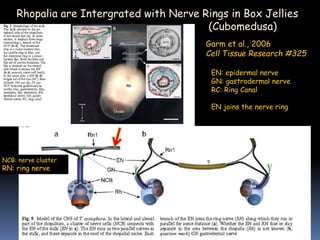
Garm et al., 2006
Cell Tissue Research #325
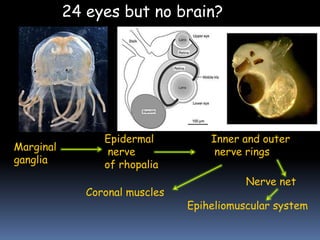
Rhopalia are Intergrated with Nerve Rings in Box Jellies
(Cubomedusa)
EN: epidermal nerve
GN: gastrodermal nerve
RC: Ring Canal
EN joins the nerve ring
NCB: nerve cluster
RN: ring nerve
24 eyes but no brain?
Marginal
ganglia
Inner and outer
nerve rings
Coronal muscles
Nerve net
Epiheliomuscular system
Epidermal
nerve
of rhopalia
When did a Centralized Nervous System Evolve?
“Conventional” view
Marlow et al., 2009, Developmental Neurobiology
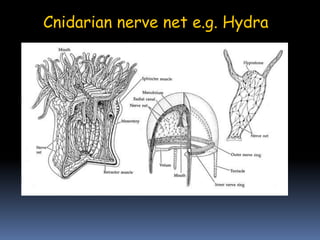
Cnidarian nerve net e.g. Hydra
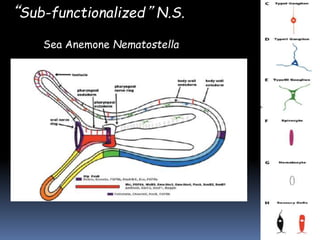
“Sub-functionalized” N.S.
Sea Anemone Nematostella
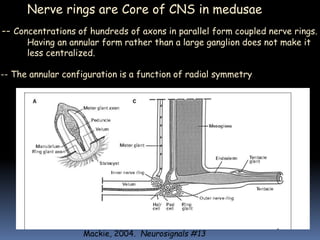
Mackie, 2004. Neurosignals #13
Nerve rings are Core of CNS in medusae
-- Concentrations of hundreds of axons in parallel form coupled nerve rings.
Having an annular form rather than a large ganglion does not make it
less centralized.
-- The annular configuration is a function of radial symmetry

Cnidaria1.ppt

  • 1.
    What is aMetazoan? In other words what are the inherent Characteristics of the animal body plan that are different from that of a colonial heterotrophic protists? What are some characteristics of sponges that help us place them directly in the metazoan
  • 2.
    Phylum Placozoa -- 2-3mm, 25 um- thick, resembling a large ameba -- Lacks anterior posterior polarity -- Asexual reproduction is prevalent --The most primitive animal? Trichoplax adhaerens
  • 3.
    Phylum Placozoa Dorsal Fibersynctium cilium epithelium-like layer thick glandular layer Flagellated cells -- Feed ventrally by absorption of digested material -- Lack organs but tissue-like outer walls -- A bit more than 2000 cells -- Only 4 different cell types - (20 in sponges; > 220 in mammals) -- Smallest genome of all animals Intercellular junctions
  • 4.
    Three competing Scenarios A.Earliest view of them as the basal metazoan B. Special cellular junctions consisting of two opposing dense plaques (desmosomes) not found in most sponges C. 16S rRNA data…maybe secondarily simplified from more complex ancestors? Epitheliozoa Eumetazoa Functional Morph.
  • 5.
    Mitochondrial genome of Trichoplaxadhaerens supports Placozoa as the basal lower metazoan phylum Dellaporta, Stephen L. et al. (2006) Proc. Natl. Acad. Sci. USA 103, 8751-8756 Largest known mt genome 46 kbp, 2x that of most metazoa with introns and other intrageneic spacers and large protein coding regions that are usually lacking in other animals Blue: known mt proteins Gray: ribosomal genes Green: unknown open reading frames Red lines: introns
  • 6.
  • 7.
    More than 9,000 species, including jellyfish, corals, anemones, hydroids and much much more. Phylum Cnidaria
  • 8.
    Themes  General characteristicsof Cnidaria  Why are they successful?  Cnidaria Diversity and Taxonomy  Classes, SubClasses of Anthozoans  Similarity of Polyp and Medusa  The Cnidaria Body Plan  Class Scyphozoa, the jellyfish  Complexity, Sensory & Nervous System
  • 9.
    What Characteristics Accountfor the Great Success of Cnidarians? 1. Two distinct adult forms 2. Diphasic life cycle in some species 3. Ability to proliferate by cloning 4. And to form polymorphic colonies 5. Formidable prey capture device 6. Low Energy Demands
  • 10.
    What Characteristics Accountfor the Great Success of Cnidarians? 1. Two Very Different Adult Forms Polyp Medusa
  • 11.
    What Characteristics Accountfor the Great Success of Cnidarians? 2. Dimorphic Life Cycle in Many Species Life cycle Of the Hydroid Obelia
  • 12.
    What Characteristics Accountfor the Great Success of Cnidarians? 3. Ability to proliferate by cloning
  • 13.
    What Characteristics Accountfor the Great Success of Cnidarians? 4. And to form polymorphic colonies Hydractinea
  • 14.
    What Characteristics Accountfor the Great Success of Cnidarians? 4. And to form polymorphic colonies Physalia Portuguese Man-O-War
  • 15.
    What Characteristics Accountfor the Great Success of Cnidarians? 5. Formidable prey-capture device Nematocyst Prey tissue Empty Cnidocyte
  • 16.
    What Characteristics Accountfor the Great Success of Cnidarians? 5. Formidable prey-capture device
  • 17.
    What Characteristics Accountfor the Great Success of Cnidarians? 6. Low Energy Demands
  • 18.
    Diversity of Cnidarians 3Main Taxonomic classes Class Scyphozoa Class Anthozoa Class Hydrozoa Class Cubozoa contains a few jellyfish spp
  • 20.
    How is itthat organisms as different as jellyfish, hydroids and anemones can be classified in the same phylum? Giant anemone
  • 21.
  • 22.
  • 23.
    Nerve Nets andMuscular System Mouth
  • 24.
    Epitheliomuscular Cells and gastromuscularcells Lacking mesoderm, but muscles derived from epithelial endodermal and ectodermal cells
  • 25.
    Characteristics of theClass Scyphozoa (Adaptations to a drifting, carnivorous lifestyle) About 200 species
  • 26.
    • Small afew cm • Velum to aid in locomotion • Radial canals unbranched • Simple epidermal and endodermal nerve net • Nematocysts usually small without toxins Hydromedusa for comparison
  • 27.
    Characteristics of theScyphozoa mouth stomach mesoglea gastric pouch gonad radial canal gastrodermis Radial canal
  • 28.
    Characteristics of theScyphozoa (Adaptations to a drifting, carnivorous lifestyle) G-V cavity more complex, adapted to subdue and digest larger and active prey MOUTH MANUBRIUM Stomach G-V Canals Stomach Gastric Pouches
  • 29.
    Characteristics of theScyphozoa (Adaptations to a drifting, carnivorous lifestyle) G-V cavity more complex, adapted to subdue and digest larger and active prey
  • 30.
    Characteristics of theScyphozoa mouth stomach mesoglea gastric pouch gonad radial canal gastrodermis Radial canal
  • 31.
    How is swimmingpace, direction coordinated? Coronal Muscles and swimming
  • 32.
    How are the coronalmuscles connected to the nervous system that includes: - Sensory neurons, motor neurons - Nerve net - Inner and outer nerve rings - Marginal ganglia associated with rhopalia that constitute a pacemaker
  • 33.
    Characteristics of the Scyphozoa (Adaptationsto a drifting, carnivorous lifestyle) The nervous system is more complex; unique sensory structures (than nerve net shared by all Cnidaria) To ganglia
  • 34.
  • 35.
    Garm et al.,2006 Cell Tissue Research #325 Rhopalia are Intergrated with Nerve Rings in Box Jellies (Cubomedusa) EN: epidermal nerve GN: gastrodermal nerve RC: Ring Canal EN joins the nerve ring NCB: nerve cluster RN: ring nerve
  • 36.
    24 eyes butno brain? Marginal ganglia Inner and outer nerve rings Coronal muscles Nerve net Epiheliomuscular system Epidermal nerve of rhopalia
  • 37.
    When did aCentralized Nervous System Evolve? “Conventional” view Marlow et al., 2009, Developmental Neurobiology
  • 38.
  • 39.
  • 40.
    Mackie, 2004. Neurosignals#13 Nerve rings are Core of CNS in medusae -- Concentrations of hundreds of axons in parallel form coupled nerve rings. Having an annular form rather than a large ganglion does not make it less centralized. -- The annular configuration is a function of radial symmetry