GROUP
PRESENTATION
Our Team
AHMAD AIMAN
MARFUATUL NAFISA
AMAR AL HAKIM
Objective
Objective 1: What is Evolutionary
Prototyping
Objective 2: How To Implement
in E-Commerce Clothing Store
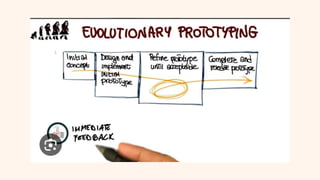
• software development approach where an initial, basic
version of the system is quickly built. This prototype is
refined and improved through multiple iterations based on
feedback from users and stakeholders. It allows for
flexibility in accommodating changing requirements and
ensures continuous user involvement throughout the
development process
What is Evolutionary
Prototyping?
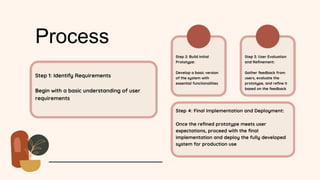
Process
Step 1: Identify Requirements
Begin with a basic understanding of user
requirements
Step 2: Build Initial
Prototype:
Develop a basic version
of the system with
essential functionalities
Step 3: User Evaluation
and Refinement:
Gather feedback from
users, evaluate the
prototype, and refine it
based on the feedback
Step 4: Final Implementation and Deployment:
Once the refined prototype meets user
expectations, proceed with the final
implementation and deploy the fully developed
system for production use
Advantage &
Disadvantage
Advantage Disadvantage
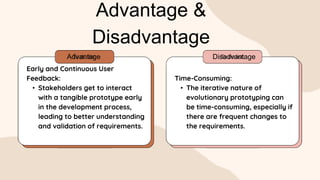
Time-Consuming:
• The iterative nature of
evolutionary prototyping can
be time-consuming, especially if
there are frequent changes to
the requirements.
Early and Continuous User
Feedback:
• Stakeholders get to interact
with a tangible prototype early
in the development process,
leading to better understanding
and validation of requirements.
Advantage &
Disadvantage
Advantage Disadvantage
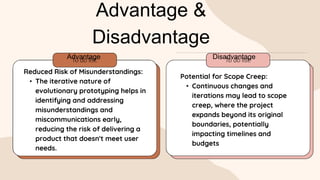
Potential for Scope Creep:
• Continuous changes and
iterations may lead to scope
creep, where the project
expands beyond its original
boundaries, potentially
impacting timelines and
budgets
Reduced Risk of Misunderstandings:
• The iterative nature of
evolutionary prototyping helps in
identifying and addressing
misunderstandings and
miscommunications early,
reducing the risk of delivering a
product that doesn't meet user
needs.
Advantage &
Disadvantage
Advantage Disadvantage
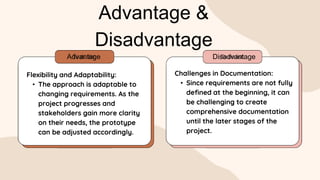
Flexibility and Adaptability:
• The approach is adaptable to
changing requirements. As the
project progresses and
stakeholders gain more clarity
on their needs, the prototype
can be adjusted accordingly.
Challenges in Documentation:
• Since requirements are not fully
defined at the beginning, it can
be challenging to create
comprehensive documentation
until the later stages of the
project.
Advantage &
Disadvantage
Advantage Disadvantage
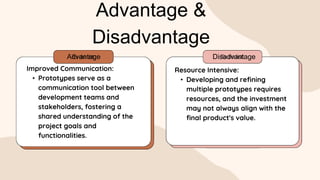
Improved Communication:
• Prototypes serve as a
communication tool between
development teams and
stakeholders, fostering a
shared understanding of the
project goals and
functionalities.
Resource Intensive:
• Developing and refining
multiple prototypes requires
resources, and the investment
may not always align with the
final product's value.
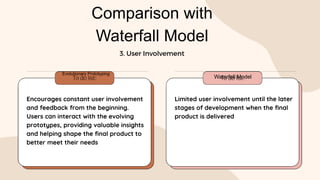
Comparison with
Waterfall Model
Evolutionary Prototyping
Waterfall Model
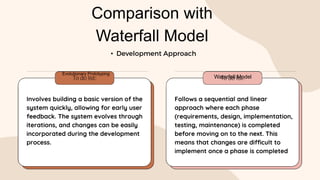
Involves building a basic version of the
system quickly, allowing for early user
feedback. The system evolves through
iterations, and changes can be easily
incorporated during the development
process.
Follows a sequential and linear
approach where each phase
(requirements, design, implementation,
testing, maintenance) is completed
before moving on to the next. This
means that changes are difficult to
implement once a phase is completed
• Development Approach
Comparison with
Waterfall Model
Evolutionary Prototyping
Waterfall Model
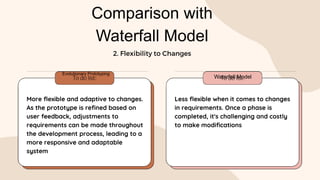
More flexible and adaptive to changes.
As the prototype is refined based on
user feedback, adjustments to
requirements can be made throughout
the development process, leading to a
more responsive and adaptable
system
Less flexible when it comes to changes
in requirements. Once a phase is
completed, it's challenging and costly
to make modifications
2. Flexibility to Changes
Comparison with
Waterfall Model
Evolutionary Prototyping
Waterfall Model
Encourages constant user involvement
and feedback from the beginning.
Users can interact with the evolving
prototypes, providing valuable insights
and helping shape the final product to
better meet their needs
Limited user involvement until the later
stages of development when the final
product is delivered
3. User Involvement
Topic 1 What is Evolutionary Prototyping.pptx

Topic 1 What is Evolutionary Prototyping.pptx

  • 1.
  • 2.
    Our Team AHMAD AIMAN MARFUATULNAFISA AMAR AL HAKIM
  • 3.
    Objective Objective 1: Whatis Evolutionary Prototyping Objective 2: How To Implement in E-Commerce Clothing Store
  • 4.
    • software developmentapproach where an initial, basic version of the system is quickly built. This prototype is refined and improved through multiple iterations based on feedback from users and stakeholders. It allows for flexibility in accommodating changing requirements and ensures continuous user involvement throughout the development process What is Evolutionary Prototyping?
  • 5.
    Process Step 1: IdentifyRequirements Begin with a basic understanding of user requirements Step 2: Build Initial Prototype: Develop a basic version of the system with essential functionalities Step 3: User Evaluation and Refinement: Gather feedback from users, evaluate the prototype, and refine it based on the feedback Step 4: Final Implementation and Deployment: Once the refined prototype meets user expectations, proceed with the final implementation and deploy the fully developed system for production use
  • 7.
    Advantage & Disadvantage Advantage Disadvantage Time-Consuming: •The iterative nature of evolutionary prototyping can be time-consuming, especially if there are frequent changes to the requirements. Early and Continuous User Feedback: • Stakeholders get to interact with a tangible prototype early in the development process, leading to better understanding and validation of requirements.
  • 8.
    Advantage & Disadvantage Advantage Disadvantage Potentialfor Scope Creep: • Continuous changes and iterations may lead to scope creep, where the project expands beyond its original boundaries, potentially impacting timelines and budgets Reduced Risk of Misunderstandings: • The iterative nature of evolutionary prototyping helps in identifying and addressing misunderstandings and miscommunications early, reducing the risk of delivering a product that doesn't meet user needs.
  • 9.
    Advantage & Disadvantage Advantage Disadvantage Flexibilityand Adaptability: • The approach is adaptable to changing requirements. As the project progresses and stakeholders gain more clarity on their needs, the prototype can be adjusted accordingly. Challenges in Documentation: • Since requirements are not fully defined at the beginning, it can be challenging to create comprehensive documentation until the later stages of the project.
  • 10.
    Advantage & Disadvantage Advantage Disadvantage ImprovedCommunication: • Prototypes serve as a communication tool between development teams and stakeholders, fostering a shared understanding of the project goals and functionalities. Resource Intensive: • Developing and refining multiple prototypes requires resources, and the investment may not always align with the final product's value.
  • 11.
    Comparison with Waterfall Model EvolutionaryPrototyping Waterfall Model Involves building a basic version of the system quickly, allowing for early user feedback. The system evolves through iterations, and changes can be easily incorporated during the development process. Follows a sequential and linear approach where each phase (requirements, design, implementation, testing, maintenance) is completed before moving on to the next. This means that changes are difficult to implement once a phase is completed • Development Approach
  • 12.
    Comparison with Waterfall Model EvolutionaryPrototyping Waterfall Model More flexible and adaptive to changes. As the prototype is refined based on user feedback, adjustments to requirements can be made throughout the development process, leading to a more responsive and adaptable system Less flexible when it comes to changes in requirements. Once a phase is completed, it's challenging and costly to make modifications 2. Flexibility to Changes
  • 13.
    Comparison with Waterfall Model EvolutionaryPrototyping Waterfall Model Encourages constant user involvement and feedback from the beginning. Users can interact with the evolving prototypes, providing valuable insights and helping shape the final product to better meet their needs Limited user involvement until the later stages of development when the final product is delivered 3. User Involvement