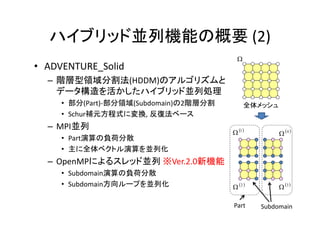
Schur補元方程式への変換
1
2
3
4
bAx
B
N
I
1
I
B
N
I
1
I
i
B
i
BB
Ti
B
TN
IB
TN
B
T1
IB
T1
B
N
B
N
IB
N
II
1
B
1
IB
1
II
b
b
b
x
x
x
RARARAR
RAA0
RA0A
1
2
3
4
N,...,1i,inxRAbAx
onbAAbRxRAAAAR
ii
B
i
B
i
IB
i
I
1i
II
i
I
N
1i
N
1i
ii
I
1i
II
Ti
IB
i
B
Ti
BB
N
1i
i
B
i
IB
1i
II
Ti
IB
i
BB
Ti
B
解くべき線形方程式
領域分割情報で並び替え
(I) 独立計算可能な部分
(B) 袖領域
式を分割
反復法で解く
8.
反復法における行列ベクトル積のOpenMP並列化
n
k
nn
niTi
B
n
j
n
j
niTi
IB
ni
B
i
BB
ni
ni1i
II
ni
ni
B
i
IB
ni
k
qqq
forend
qRqq
tApRAq
sAt
pRAs
Nto1ifor
n
k
nn
n
kk
n
k
n
k
k
k
qqq
forend
forend
]j[p]j][i[A]i[q]i[q
nto1jfor
nto1ifor
bAx の場合
DDMの場合
行方向ループをOpenMP並列化
MPI_Send/Recvで袖領域交換
領域方向ループをOpenMP並列化
MPI_Send/Recvで袖領域交換
(1) 疎行列ベクトル積
(2) 前進・後退代入
(3) 疎行列ベクトル積
(4) ベクトル和
(1) 疎行列ベクトル積
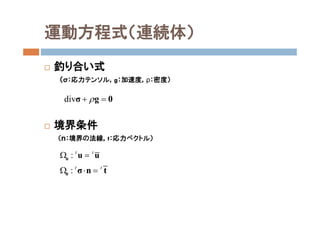
運動方程式(体積力)
釣り合い式の の項
→積分すると等価節点力になるのでに含まれる
自重(重力加速度は時間により変化しない)
地震力(時間により変化する.地動により全節点に同じ加速度
がかかる)
( 地盤からの相対変位)
ADVENTUE_Solidでは履歴依存体積力機能は実装されていない
→
境界条件として履歴依存節点強制{加速度|(速度)|変位}を入力
(加速度を入力する場合には,基線補正が必要)
g
t t t t
g
t t t t
g
u
u
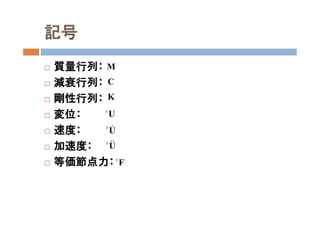
M u 1 C u K u 0
M u C u K u M 1
t
F
t
u
線形ソルバー
係数行列は以下のeffective stiffnessmatrixとなる.
コースグリッド問題は, (基本解(剛体モー
ド)により張られる空間)を用いて作っているため,
数学的背景は曖昧である.しかし,多くの場合,
静解析よりも収束性は良い.
2
1
t t
M C K
KerK
22.
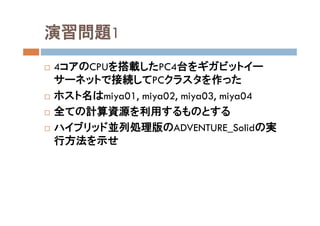
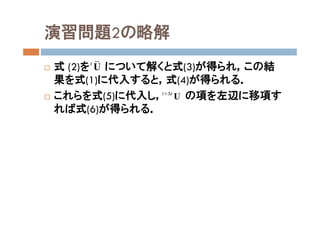
演習問題2
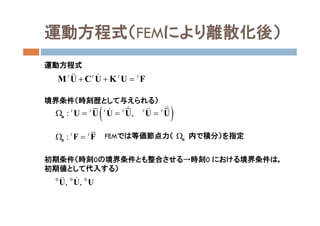
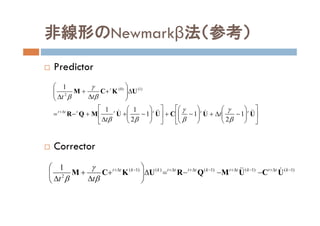
以下の式(1), (2)より,式(3),(4)を導け.式(3), (4)を運動方程式(5)に代入し,式(6)を導け
(1)
(2)
(3)
(4)
(5)
(6)
ttttttt
UUUU 1
2 1
2
t t t t t t t
t t
U U U U U
UUUCUUUMR
UKCM
tttttttt
tt
t
ttt
tt
1
2
11
2
111
1
2
2
t t t t
M U C U K U F
UUUUU ttttttt
ttt
1
2
1111
22
UUUUU ttttttt
t
tt
2
11
ADVENTURE_IO(2)
入出力データの多層モデル
DDM layer Subdomaininformation, Control data etc.
Second FEM layer Node Element Displacement, Stress,
Boundary Conditions, etc.
First FEM Layer FEGA
Large-scale data handling
layer
Document
File I/O, Memory I/O
Hardware layer Disk, Memory
40.
ADVENTURE_IO(3) FEGA
(Finite ElementGeneric Attributes):FEMの入出力データを一般化
Type “All” or not Element or Node Constant or
Variable
1 All Element Constant
2 All Element Variable
3 All Node Constant
4 All Node Variable
5 Element Constant
6 Element Variable
7 Node Constant
8 Node Variable
9 Void (= AllElementConstant or AllNodeConstant)
FEGA形式にしておけば,AdvMetisで領域分割できる
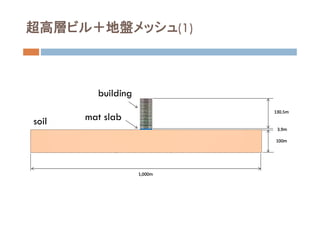
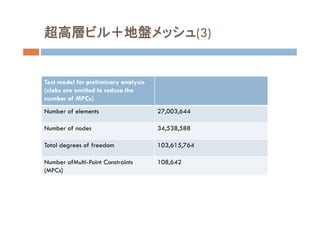
超高層ビル+地盤メッシュ(3)
Test model forpreliminary analysis
(slabs are omitted to reduce the
number of MPCs)
Number of elements 27,003,644
Number of nodes 34,538,588
Total degrees of freedom 103,615,764
Number ofMulti-Point Constraints
(MPCs)
108,642
52.
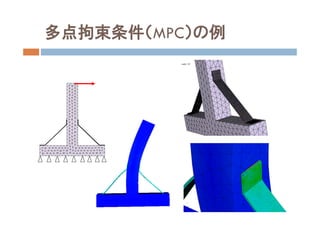
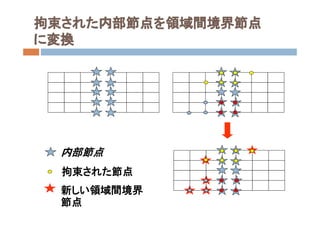
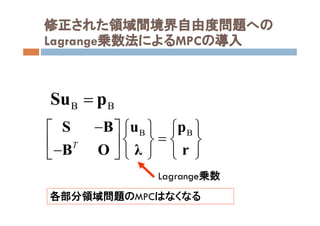
大規模なMPC
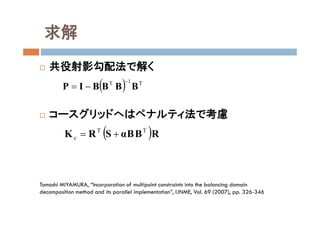
T1T
BBBBIP
Projection
Solved by sparse direct solver, MUMPS
Problem size: 0.1-4 M DOFs (too large problem for the
direct solver)
MPCs are divided into
independent groups
has block structure
can be computed
independently in each
group
1T
B B
T
B B
53.
性能評価
Linear dynamicanalysis
Fujitsu FX10 at the University of Tokyo
16 cores / nodes
Number
of
nodes
Number of
subdomains
Preparation 1st time step CG iter. / step 650 time steps
16 96,000 346 s 433 ~ 866 s 100 ~200 steps 7.3 days
32 96,000 204 s 177 ~ 354 s 100 ~200 steps 2.9 days
64 96,000 163 s 131 ~ 262 s 100 ~200 steps 2.2 days
64 96,000 Nonlinear 700 ~ 1400 s 11 days
128 96,000 164 s 117 ~ 234 s 100 ~200 steps 1.9 days
256 92,160 156 s 117 ~ 234 s 100 ~200 steps 1.9 days
参考文献
全般
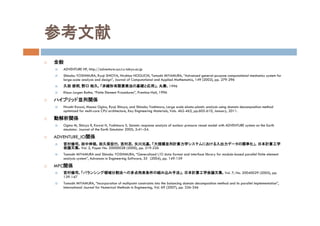
ADVENTUREHP, http://adventure.sys.t.u-tokyo.ac.jp
Shinobu YOSHIMURA, Ryuji SHIOYA, Hirohisa NOGUCHI, Tomoshi MIYAMURA, “Advanced general-purpose computational mechanics system for
large-scale analysis and design”, Journal of Computational and Applied Mathematics, 149 (2002), pp. 279-296
久田 俊明, 野口 裕久,「非線形有限要素法の基礎と応用」,丸善,1996
Klaus-Jurgen Bathe, “Finite Element Procedures”, Prentice-Hall, 1996
ハイブリッド並列関係
Hiroshi Kawai, Masao Ogino, Ryuji Shioya, and Shinobu Yoshimura, Large scale elasto-plastic analysis using domain decomposition method
optimized for multi-core CPU architecture, Key Engineering Materials, Vols. 462-463, pp.605-610, January, 2011.
動解析関係
Ogino M, Shioya R, Kawai H, Yoshimura S. Seismic response analysis of nuclear pressure vessel model with ADVENTURE system on the Earth
simulator. Journal of the Earth Simulator 2005; 2:41–54.
ADVENTURE_IO関係
宮村倫司,田中伸哉,田久保宏行,吉村忍,矢川元基,「大規模並列計算力学システムにおける入出力データの標準化」,日本計算工学
会論文集,Vol. 2, Paper No. 20000028 (2000), pp. 219-226
Tomoshi MIYAMURA and Shinobu YOSHIMURA, “Generalized I/O data format and interface library for module-based parallel finite element
analysis system”, Advances in Engineering Software, 35 (2004), pp. 149-159
MPC関係
宮村倫司,「バランシング領域分割法への多点拘束条件の組み込み手法」,日本計算工学会論文集,Vol. 7, No. 20040029 (2005), pp.
139-147
Tomoshi MIYAMURA, “Incorporation of multipoint constraints into the balancing domain decomposition method and its parallel implementation”,
International Journal for Numerical Methods in Engineering, Vol. 69 (2007), pp. 326-346




![反復法における行列ベクトル積のOpenMP並列化
n
k
nn
niTi
B
n
j
n
j
niTi
IB
ni
B
i
BB
ni
ni1i
II
ni
ni
B
i
IB
ni
k
qqq
forend
qRqq
tApRAq
sAt
pRAs
Nto1ifor
n
k
nn
n
kk
n
k
n
k
k
k
qqq
forend
forend
]j[p]j][i[A]i[q]i[q
nto1jfor
nto1ifor
bAx の場合
DDMの場合
行方向ループをOpenMP並列化
MPI_Send/Recvで袖領域交換
領域方向ループをOpenMP並列化
MPI_Send/Recvで袖領域交換
(1) 疎行列ベクトル積
(2) 前進・後退代入
(3) 疎行列ベクトル積
(4) ベクトル和
(1) 疎行列ベクトル積](https://image.slidesharecdn.com/miyamuraadventureseminar08final-180316024121/85/ADVENTURE_Solid-Ver-2-0-8-320.jpg)

![bddソルバの数値実験
# Sdm. Ver.1.21 Ver.2.0
64 MPI 64 MPI 32 MPI x 2 OMP 16 MPI x 4 OMP 8 MPI x 8 OMP 4 MPI x 16 OMP
256 13.2 12.3 11.7 12.4 12.0 11.9
1,024 8.6 9.7 9.1 7.8 7.9 8.1
2,048 21.4 20.4 19.5 13.6 11.7 11.3
• 静弾性解析, 約100万自由度モデル
• 計算機環境
– Fujitsu PRIMEHPC FX10 (SPARC64 IXfx 16コア) x 4ノード
• 実行コマンド例
> setenv OMP_NUM_THREADS 4
> mpiexec ‐f machines ‐n 3 advsolid‐p_omp ‐solver bdd data
Ver.1.21とVer.2.0による経過時間[s]の比較](https://image.slidesharecdn.com/miyamuraadventureseminar08final-180316024121/85/ADVENTURE_Solid-Ver-2-0-12-320.jpg)
















![ADVENTURE_BCtool Ver.2.の概要と実際[デモ]](https://cdn.slidesharecdn.com/ss_thumbnails/bctoolver2-6asdelivered-180316024120-thumbnail.jpg?width=640&height=640&fit=bounds)


