
Relative and
Attributable Risks
BY
DR MUHAMMAD TAUSEEF JAVED
CONSULTANT MINISTRY OF HEALTH
MAKKAH KSA
&
IPH LAHORE
Absolute Risk
• Involves people who contract
disease due to an exposure
• Doesn’t consider those who are sick
but haven’t been exposed
Calculating Excess Risk
Relative Risk
Definition:
A measure of the strength of
association based on prospective
studies (cohort studies).
Determining Relative Risk
Interpreting Relative Risk
Relative Risk Calculations
Relative Risk Calculations (cont.)
Relative Risk in
Case-Control Studies
• Can’t derive incidence from case-
control studies
Begin with diseased people (cases) and
non-diseased people (controls)
• Therefore, can’t calculate relative
risk directly
• But, we can use another method
called an odds ratio
Odds Ratio in
Prospective (Cohort) Studies
Odds Ratio in
Case-Control Studies
Odds Ratio in
Case-Control Studies (cont.)
When is the Odds Ratio a Good
Estimate of Relative Risk?
• When cases are representative of
diseased population
• When controls are representative of
population without disease
• When the disease being studied
occurs at low frequency
REMEMBER !!!
• An odds ratio is a useful measure of
association
• In a cohort study, the relative risk
can be calculated directly
• In a case-control study the relative
risk cannot be calculated directly, so
an odds ratio is used instead
Attributable Risk
Definition:
The amount of disease that can be
attributed to a certain exposure.
Concept of Attributable Risk
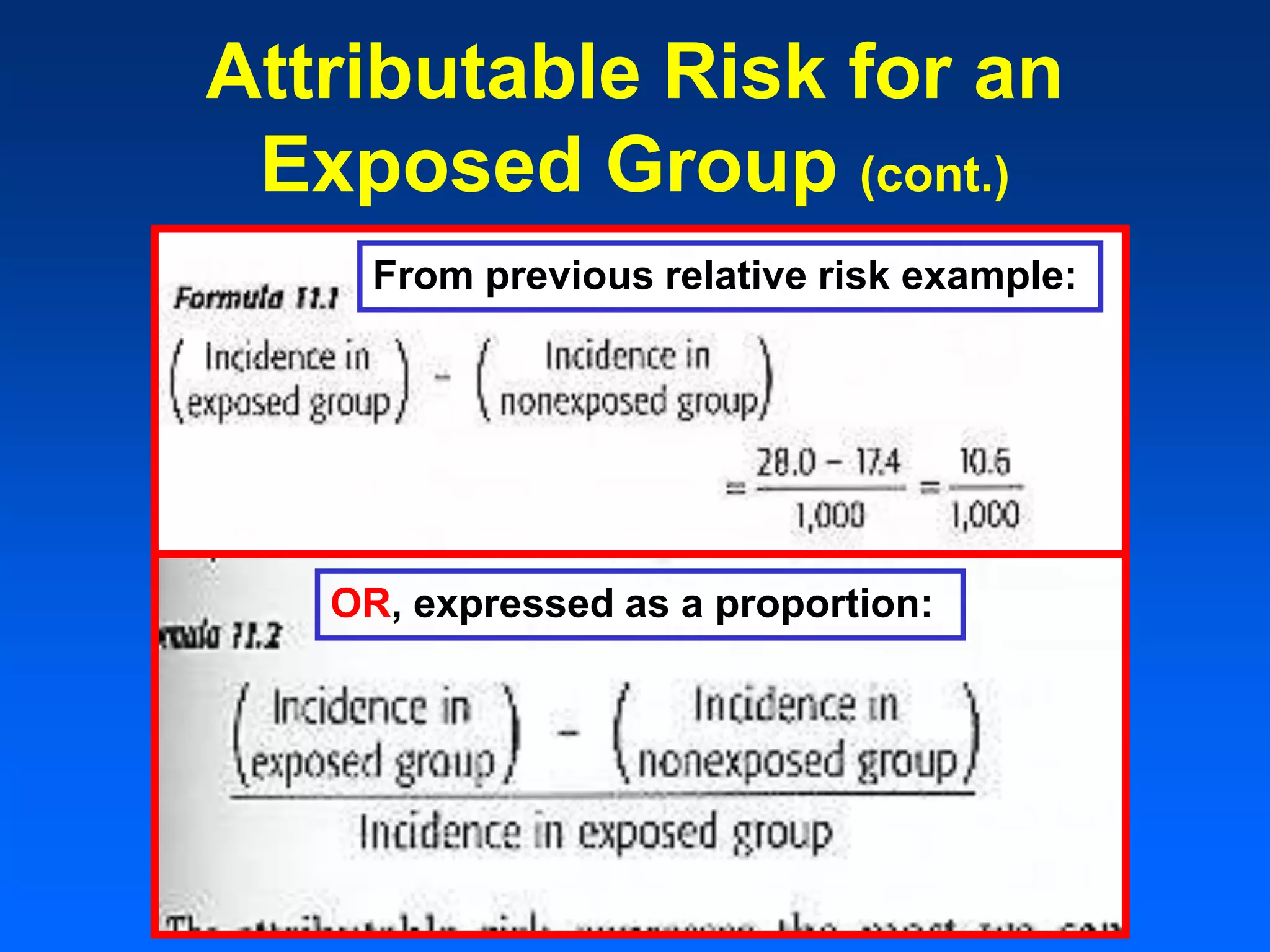
Attributable Risk for an
Exposed Group
OR, expressed as a proportion:
Attributable Risk for an
Exposed Group (cont.)
From previous relative risk example:
Calculation for Proportional
Incidence in Total Population
First calculate A-R for
group from
Formulas 11.1 & 11.2
(previous slide),
then use Formula 11.3
For proportion of the
incidence in the
total population, use
Formula 11.4
Calculations for
Attributable Risks (cont.)
Summary
• Relative risk and odds ratio are important as
measures of the strength of association
Important for deriving causal inference
• Attributable risk is a measure of how much
disease risk is attributed to a certain exposure
Useful in determining how much disease can
be prevented
• Therefore:
Relative risk is valuable in etiologic studies
of disease
Attributable risk is useful for Public Health
guidelines and planning

Relative and Atribute Risk