Dr. Belkacem Mouhouche – Samsung Electronics
Chief Standards Engineer
Technical Manager of 5G projects: 5G-Xcast and 5G-Tours
Recent advances in Broadcasting standards and
research
2
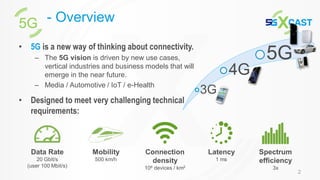
• 5G is a new way of thinking about connectivity.
- Overview5G
Data Rate
20 Gbit/s
(user 100 Mbit/s)
Mobility
500 km/h
Latency
1 ms
Connection
density
106 devices / km2
Spectrum
efficiency
3x
– The 5G vision is driven by new use cases,
vertical industries and business models that will
emerge in the near future.
– Media / Automotive / IoT / e-Health
• Designed to meet very challenging technical
requirements:
3G
4G
5G
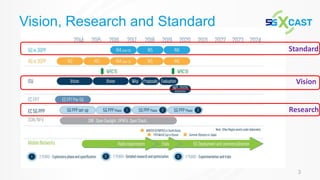
Vision, Research and Standard
3
Standard
Research
Vision
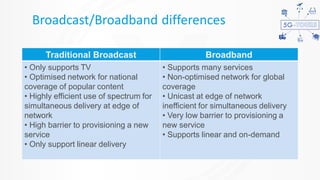
Broadcast/Broadband differences
Traditional Broadcast Broadband
• Only supports TV
• Optimised network for national
coverage of popular content
• Highly efficient use of spectrum for
simultaneous delivery at edge of
network
• High barrier to provisioning a new
service
• Only support linear delivery
• Supports many services
• Non-optimised network for global
coverage
• Unicast at edge of network
inefficient for simultaneous delivery
• Very low barrier to provisioning a
new service
• Supports linear and on-demand
5
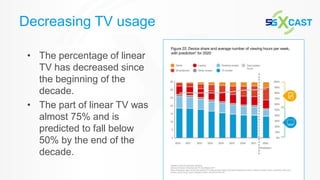
Decreasing TV usage
• The percentage of linear
TV has decreased since
the beginning of the
decade.
• The part of linear TV was
almost 75% and is
predicted to fall below
50% by the end of the
decade.
6
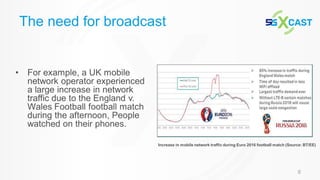
The need for broadcast
• For example, a UK mobile
network operator experienced
a large increase in network
traffic due to the England v.
Wales Football football match
during the afternoon, People
watched on their phones.
Increase in mobile network traffic during Euro 2016 football match (Source: BT/EE)
7
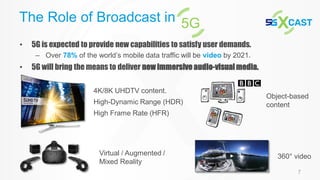
• 5G is expected to provide new capabilities to satisfy user demands.
– Over 78% of the world’s mobile data traffic will be video by 2021.
• 5G will bring the means to deliver new immersive audio-visualmedia.
The Role of Broadcast in 5G
4K/8K UHDTV content.
High-Dynamic Range (HDR)
High Frame Rate (HFR)
Object-based
content
Virtual / Augmented /
Mixed Reality
360° video
8
• Innovative 5G use cases require broadcast transmissions!
• Big potential in convergence of fixed and mobile broadband networks for large-
scale media delivery.
• Point to multipoint as a delivery optimization tool, rather than a service.
• Broadcasters interest in 3GPP technologies has increased recently.
– 4G LTE Rel-14 has incorporated many requirements, but suffers from the eMBMS legacy.
The Role of Broadcast in 5G
Broadcast allows an infinite number of users to receive the same
content at the same time, using just a fixed number of resources.
9
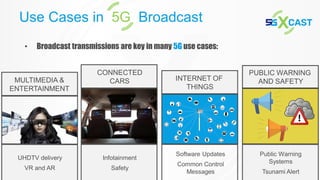
• Broadcast transmissions are key in many 5G use cases:
Use Cases in 5G Broadcast
CONNECTED
CARS
PUBLIC WARNING
AND SAFETY
Infotainment
Safety
Software Updates
Common Control
Messages
Public Warning
Systems
Tsunami Alert
MULTIMEDIA &
ENTERTAINMENT
UHDTV delivery
VR and AR
INTERNET OF
THINGS
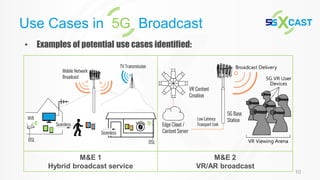
M&E 1
Hybrid broadcast service
M&E 2
VR/AR broadcast
10
• Examples of potential use cases identified:
Use Cases in 5G Broadcast
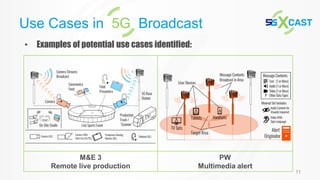
M&E 3
Remote live production
PW
Multimedia alert
11
• Examples of potential use cases identified:
Use Cases in 5G Broadcast
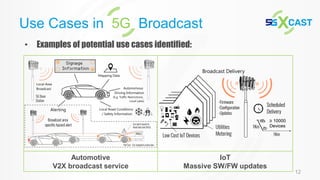
Automotive
V2X broadcast service
IoT
Massive SW/FW updates
12
• Examples of potential use cases identified:
Use Cases in 5G Broadcast
13
3GPP Terminology:
Terrestrial Broadcast and Mixed Mode
Source: Qualcomm, “Accelerating the mobile ecosystem expansion in the 5G era with
LTE-Advanced Pro” May 2018
14
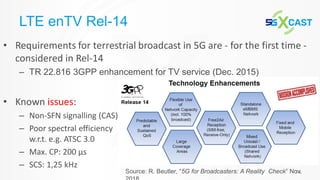
• Requirements for terrestrial broadcast in 5G are - for the first time -
considered in Rel-14
– TR 22.816 3GPP enhancement for TV service (Dec. 2015)
• Known issues:
– Non-SFN signalling (CAS)
– Poor spectral efficiency
w.r.t. e.g. ATSC 3.0
– Max. CP: 200 µs
– SCS: 1,25 kHz
LTE enTV Rel-14
Source: R. Beutler, “5G for Broadcasters: A Reality Check” Nov.
15
Terrestrial Broadcast and Mixed Mode
in 3GPP Rel-16 at RAN#80
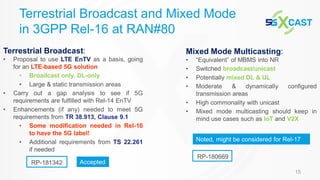
Terrestrial Broadcast:
• Proposal to use LTE EnTV as a basis, going
for an LTE-based 5G solution
• Broadcast only, DL-only
• Large & static transmission areas
• Carry out a gap analysis to see if 5G
requirements are fulfilled with Rel-14 EnTV
• Enhancements (if any) needed to meet 5G
requirements from TR 38.913, Clause 9.1
• Some modification needed in Rel-16
to have the 5G label!
• Additional requirements from TS 22.261
if needed
Mixed Mode Multicasting:
• “Equivalent” of MBMS into NR
• Switched broadcast/unicast
• Potentially mixed DL & UL
• Moderate & dynamically configured
transmission areas
• High commonality with unicast
• Mixed mode multicasting should keep in
mind use cases such as IoT and V2X
Noted, might be considered for Rel-17
AcceptedRP-181342
RP-180669
16
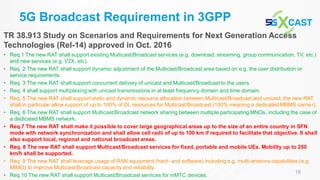
• Req.1 The new RAT shall support existing Multicast/Broadcast services (e.g. download, streaming, group communication, TV, etc.)
and new services (e.g. V2X, etc).
• Req. 2 The new RAT shall support dynamic adjustment of the Multicast/Broadcast area based on e.g. the user distribution or
service requirements.
• Req. 3 The new RAT shall support concurrent delivery of unicast and Multicast/Broadcast to the users.
• Req. 4 shall support multiplexing with unicast transmissions in at least frequency domain and time domain.
• Req. 5 The new RAT shall support static and dynamic resource allocation between Multicast/Broadcast and unicast; the new RAT
shall in particular allow support of up to 100% of DL resources for Multicast/Broadcast (100% meaning a dedicated MBMS carrier).
• Req. 6 The new RAT shall support Multicast/Broadcast network sharing between multiple participating MNOs, including the case of
a dedicated MBMS network.
• Req.7 The new RAT shall make it possible to cover large geographical areas up to the size of an entire country in SFN
mode with network synchronization and shall allow cell radii of up to 100 km if required to facilitate that objective. It shall
also support local, regional and national broadcast areas.
• Req. 8 The new RAT shall support Multicast/Broadcast services for fixed, portable and mobile UEs. Mobility up to 250
km/h shall be supported.
• Req. 9 The new RAT shall leverage usage of RAN equipment (hard- and software) including e.g. multi-antenna capabilities (e.g.
MIMO) to improve Multicast/Broadcast capacity and reliability.
• Req.10 The new RAT shall support Multicast/Broadcast services for mMTC devices.
5G Broadcast Requirement in 3GPP
TR 38.913 Study on Scenarios and Requirements for Next Generation Access
Technologies (Rel-14) approved in Oct. 2016
17
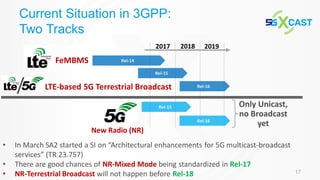
Current Situation in 3GPP:
Two Tracks
• In March SA2 started a SI on “Architectural enhancements for 5G multicast-broadcast
services” (TR 23.757)
• There are good chances of NR-Mixed Mode being standardized in Rel-17
• NR-Terrestrial Broadcast will not happen before Rel-18
2017
Rel-14
Rel-15
FeMBMS
2018 2019
Rel-16LTE-based 5G Terrestrial Broadcast
Rel-15
Rel-16
Only Unicast,
no Broadcast
yet
/
New Radio (NR)
18
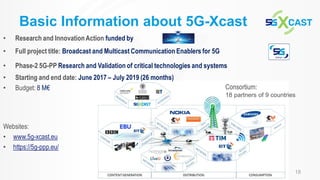
Basic Information about 5G-Xcast
• Research and InnovationAction funded by
• Full project title: Broadcast and Multicast Communication Enablers for 5G
• Phase-2 5G-PP Research and Validation of critical technologies and systems
• Starting and end date: June 2017 – July 2019 (26 months)
• Budget: 8 M€
Websites:
• www.5g-xcast.eu
• https://5g-ppp.eu/
Consortium:
18 partners of 9 countries
19
Scope
CONTENT
FRAMEWORK
Network-agnostic. Combines unicast, multicast, broadcast
and caching for dynamic network resource optimization.
PROOF OF
CONCEPT
• Object-based broadcasting
• Hybrid broadcast service
• Public warning
TEST-BED
x3
• Surrey, UK
• Munich, Germany
• Turku, Finland
x3
DEMO
20
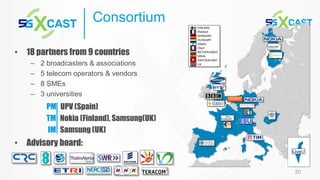
• 18 partners from 9 countries
– 2 broadcasters & associations
– 5 telecom operators & vendors
– 8 SMEs
– 3 universities
PM UPV (Spain)
TM Nokia (Finland), Samsung(UK)
IM Samsung (UK)
• Advisory board:
Consortium
21
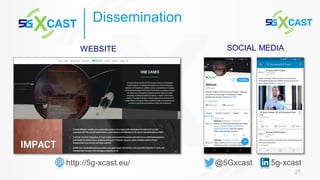
Dissemination
WEBSITE SOCIAL MEDIA
@5Gxcasthttp://5g-xcast.eu/ 5g-xcast
Convergence Vision
Converged architecture
over:
• fixed broadband,
• mobile broadband
• and terrestrial
broadcast
That allows a seamless,
uninterrupted service to
users
22
23
5G-Xcast Technical Solution Design in 3 phases
5G Multicast/Broadcast
24
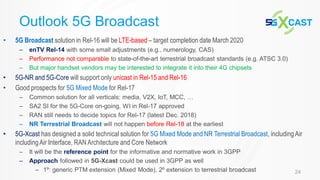
• 5G Broadcast solution in Rel-16 will be LTE-based – target completion date March 2020
– enTV Rel-14 with some small adjustments (e.g., numerology, CAS)
– Performance not comparable to state-of-the-art terrestrial broadcast standards (e.g. ATSC 3.0)
– But major handset vendors may be interested to integrate it into their 4G chipsets
• 5G-NR and 5G-Core will support only unicast in Rel-15 and Rel-16
• Good prospects for 5G Mixed Mode for Rel-17
– Common solution for all verticals: media, V2X, IoT, MCC, …
– SA2 SI for the 5G-Core on-going, WI in Rel-17 approved
– RAN still needs to decide topics for Rel-17 (latest Dec. 2018)
– NR Terrestrial Broadcast will not happen before Rel-18 at the earliest
• 5G-Xcast has designed a solid technical solution for 5G Mixed Mode and NR Terrestrial Broadcast, includingAir
includingAir Interface, RAN Architecture and Core Network
– It will be the reference point for the informative and normative work in 3GPP
– Approach followed in 5G-Xcast could be used in 3GPP as well
– 1º: generic PTM extension (Mixed Mode), 2º extension to terrestrial broadcast
Outlook 5G Broadcast
25
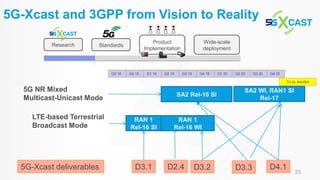
5G-Xcast and 3GPP from Vision to Reality
RAN 1
Rel-16 SI
SA2 Rel-16 SI
Q3 18 Q4 18 Q1 19 Q2 19 Q3 19 Q4 19 Q1 20 Q2 20 Q3 20 Q4 20
RAN 1
Rel-16 WI
D3.1 D4.15G-Xcast deliverables D3.2 D3.3
LTE-based Terrestrial
Broadcast Mode
5G NR Mixed
Multicast-Unicast Mode
Research Standards
Product
Implementation
Wide-scale
deployment
SA2 WI, RAN1 SI
Rel-17
To be decided
D2.4
26
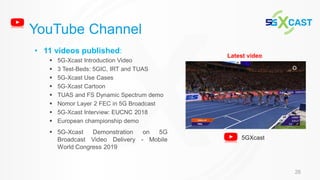
• 11 videos published:
 5G-Xcast Introduction Video
 3 Test-Beds: 5GIC, IRT and TUAS
 5G-Xcast Use Cases
 5G-Xcast Cartoon
 TUAS and FS Dynamic Spectrum demo
 Nomor Layer 2 FEC in 5G Broadcast
 5G-Xcast Interview: EUCNC 2018
 European championship demo
 5G-Xcast Demonstration on 5G
Broadcast Video Delivery - Mobile
World Congress 2019
YouTube Channel
5GXcast
Latest video
27
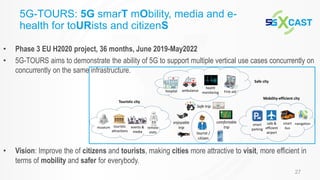
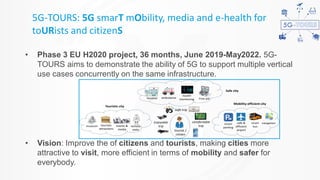
• Phase 3 EU H2020 project, 36 months, June 2019-May2022
• 5G-TOURS aims to demonstrate the ability of 5G to support multiple vertical use cases concurrently on
concurrently on the same infrastructure.
• Vision: Improve the of citizens and tourists, making cities more attractive to visit, more efficient in
terms of mobility and safer for everybody.
5G-TOURS: 5G smarT mObility, media and e-
health for toURists and citizenS
museum touristic
attractions
remote
visits
events &
media tourist /
citizen
Touristic city
Safe city
Mobility-efficient city
hospital ambulance First-aid
health
monitoring
Safe trip
enjoyable
trip
comfortable
trip
safe &
efficient
airport
smart
parking
smart
bus
navigation
5G-TOURS: 5G smarT mObility, media and e-health for
toURists and citizenS
• Phase 3 EU H2020 project, 36 months, June 2019-May2022. 5G-
TOURS aims to demonstrate the ability of 5G to support multiple vertical
use cases concurrently on the same infrastructure.
• Vision: Improve the of citizens and tourists, making cities more
attractive to visit, more efficient in terms of mobility and safer for
everybody.
museum touristic
attractions
remote
visits
events &
media tourist /
citizen
Touristic city
Safe city
Mobility-efficient city
hospital ambulance First-aid
health
monitoring
Safe trip
enjoyable
trip
comfortable
trip
safe &
efficient
airport
smart
parking
smart
bus
navigation
5G-TOURS Consortium Partners
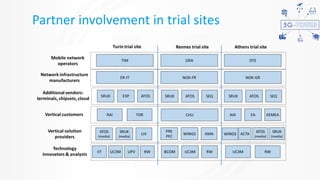
Partner involvement in trial sites

Recent advances in Broadcasting standards and research

  • 1.
    Dr. Belkacem Mouhouche– Samsung Electronics Chief Standards Engineer Technical Manager of 5G projects: 5G-Xcast and 5G-Tours Recent advances in Broadcasting standards and research
  • 2.
    2 • 5G isa new way of thinking about connectivity. - Overview5G Data Rate 20 Gbit/s (user 100 Mbit/s) Mobility 500 km/h Latency 1 ms Connection density 106 devices / km2 Spectrum efficiency 3x – The 5G vision is driven by new use cases, vertical industries and business models that will emerge in the near future. – Media / Automotive / IoT / e-Health • Designed to meet very challenging technical requirements: 3G 4G 5G
  • 3.
    Vision, Research andStandard 3 Standard Research Vision
  • 4.
    Broadcast/Broadband differences Traditional BroadcastBroadband • Only supports TV • Optimised network for national coverage of popular content • Highly efficient use of spectrum for simultaneous delivery at edge of network • High barrier to provisioning a new service • Only support linear delivery • Supports many services • Non-optimised network for global coverage • Unicast at edge of network inefficient for simultaneous delivery • Very low barrier to provisioning a new service • Supports linear and on-demand
  • 5.
    5 Decreasing TV usage •The percentage of linear TV has decreased since the beginning of the decade. • The part of linear TV was almost 75% and is predicted to fall below 50% by the end of the decade.
  • 6.
    6 The need forbroadcast • For example, a UK mobile network operator experienced a large increase in network traffic due to the England v. Wales Football football match during the afternoon, People watched on their phones. Increase in mobile network traffic during Euro 2016 football match (Source: BT/EE)
  • 7.
    7 • 5G isexpected to provide new capabilities to satisfy user demands. – Over 78% of the world’s mobile data traffic will be video by 2021. • 5G will bring the means to deliver new immersive audio-visualmedia. The Role of Broadcast in 5G 4K/8K UHDTV content. High-Dynamic Range (HDR) High Frame Rate (HFR) Object-based content Virtual / Augmented / Mixed Reality 360° video
  • 8.
    8 • Innovative 5Guse cases require broadcast transmissions! • Big potential in convergence of fixed and mobile broadband networks for large- scale media delivery. • Point to multipoint as a delivery optimization tool, rather than a service. • Broadcasters interest in 3GPP technologies has increased recently. – 4G LTE Rel-14 has incorporated many requirements, but suffers from the eMBMS legacy. The Role of Broadcast in 5G Broadcast allows an infinite number of users to receive the same content at the same time, using just a fixed number of resources.
  • 9.
    9 • Broadcast transmissionsare key in many 5G use cases: Use Cases in 5G Broadcast CONNECTED CARS PUBLIC WARNING AND SAFETY Infotainment Safety Software Updates Common Control Messages Public Warning Systems Tsunami Alert MULTIMEDIA & ENTERTAINMENT UHDTV delivery VR and AR INTERNET OF THINGS
  • 10.
    M&E 1 Hybrid broadcastservice M&E 2 VR/AR broadcast 10 • Examples of potential use cases identified: Use Cases in 5G Broadcast
  • 11.
    M&E 3 Remote liveproduction PW Multimedia alert 11 • Examples of potential use cases identified: Use Cases in 5G Broadcast
  • 12.
    Automotive V2X broadcast service IoT MassiveSW/FW updates 12 • Examples of potential use cases identified: Use Cases in 5G Broadcast
  • 13.
    13 3GPP Terminology: Terrestrial Broadcastand Mixed Mode Source: Qualcomm, “Accelerating the mobile ecosystem expansion in the 5G era with LTE-Advanced Pro” May 2018
  • 14.
    14 • Requirements forterrestrial broadcast in 5G are - for the first time - considered in Rel-14 – TR 22.816 3GPP enhancement for TV service (Dec. 2015) • Known issues: – Non-SFN signalling (CAS) – Poor spectral efficiency w.r.t. e.g. ATSC 3.0 – Max. CP: 200 µs – SCS: 1,25 kHz LTE enTV Rel-14 Source: R. Beutler, “5G for Broadcasters: A Reality Check” Nov.
  • 15.
    15 Terrestrial Broadcast andMixed Mode in 3GPP Rel-16 at RAN#80 Terrestrial Broadcast: • Proposal to use LTE EnTV as a basis, going for an LTE-based 5G solution • Broadcast only, DL-only • Large & static transmission areas • Carry out a gap analysis to see if 5G requirements are fulfilled with Rel-14 EnTV • Enhancements (if any) needed to meet 5G requirements from TR 38.913, Clause 9.1 • Some modification needed in Rel-16 to have the 5G label! • Additional requirements from TS 22.261 if needed Mixed Mode Multicasting: • “Equivalent” of MBMS into NR • Switched broadcast/unicast • Potentially mixed DL & UL • Moderate & dynamically configured transmission areas • High commonality with unicast • Mixed mode multicasting should keep in mind use cases such as IoT and V2X Noted, might be considered for Rel-17 AcceptedRP-181342 RP-180669
  • 16.
    16 • Req.1 Thenew RAT shall support existing Multicast/Broadcast services (e.g. download, streaming, group communication, TV, etc.) and new services (e.g. V2X, etc). • Req. 2 The new RAT shall support dynamic adjustment of the Multicast/Broadcast area based on e.g. the user distribution or service requirements. • Req. 3 The new RAT shall support concurrent delivery of unicast and Multicast/Broadcast to the users. • Req. 4 shall support multiplexing with unicast transmissions in at least frequency domain and time domain. • Req. 5 The new RAT shall support static and dynamic resource allocation between Multicast/Broadcast and unicast; the new RAT shall in particular allow support of up to 100% of DL resources for Multicast/Broadcast (100% meaning a dedicated MBMS carrier). • Req. 6 The new RAT shall support Multicast/Broadcast network sharing between multiple participating MNOs, including the case of a dedicated MBMS network. • Req.7 The new RAT shall make it possible to cover large geographical areas up to the size of an entire country in SFN mode with network synchronization and shall allow cell radii of up to 100 km if required to facilitate that objective. It shall also support local, regional and national broadcast areas. • Req. 8 The new RAT shall support Multicast/Broadcast services for fixed, portable and mobile UEs. Mobility up to 250 km/h shall be supported. • Req. 9 The new RAT shall leverage usage of RAN equipment (hard- and software) including e.g. multi-antenna capabilities (e.g. MIMO) to improve Multicast/Broadcast capacity and reliability. • Req.10 The new RAT shall support Multicast/Broadcast services for mMTC devices. 5G Broadcast Requirement in 3GPP TR 38.913 Study on Scenarios and Requirements for Next Generation Access Technologies (Rel-14) approved in Oct. 2016
  • 17.
    17 Current Situation in3GPP: Two Tracks • In March SA2 started a SI on “Architectural enhancements for 5G multicast-broadcast services” (TR 23.757) • There are good chances of NR-Mixed Mode being standardized in Rel-17 • NR-Terrestrial Broadcast will not happen before Rel-18 2017 Rel-14 Rel-15 FeMBMS 2018 2019 Rel-16LTE-based 5G Terrestrial Broadcast Rel-15 Rel-16 Only Unicast, no Broadcast yet / New Radio (NR)
  • 18.
    18 Basic Information about5G-Xcast • Research and InnovationAction funded by • Full project title: Broadcast and Multicast Communication Enablers for 5G • Phase-2 5G-PP Research and Validation of critical technologies and systems • Starting and end date: June 2017 – July 2019 (26 months) • Budget: 8 M€ Websites: • www.5g-xcast.eu • https://5g-ppp.eu/ Consortium: 18 partners of 9 countries
  • 19.
    19 Scope CONTENT FRAMEWORK Network-agnostic. Combines unicast,multicast, broadcast and caching for dynamic network resource optimization. PROOF OF CONCEPT • Object-based broadcasting • Hybrid broadcast service • Public warning TEST-BED x3 • Surrey, UK • Munich, Germany • Turku, Finland x3 DEMO
  • 20.
    20 • 18 partnersfrom 9 countries – 2 broadcasters & associations – 5 telecom operators & vendors – 8 SMEs – 3 universities PM UPV (Spain) TM Nokia (Finland), Samsung(UK) IM Samsung (UK) • Advisory board: Consortium
  • 21.
  • 22.
    Convergence Vision Converged architecture over: •fixed broadband, • mobile broadband • and terrestrial broadcast That allows a seamless, uninterrupted service to users 22
  • 23.
    23 5G-Xcast Technical SolutionDesign in 3 phases 5G Multicast/Broadcast
  • 24.
    24 • 5G Broadcastsolution in Rel-16 will be LTE-based – target completion date March 2020 – enTV Rel-14 with some small adjustments (e.g., numerology, CAS) – Performance not comparable to state-of-the-art terrestrial broadcast standards (e.g. ATSC 3.0) – But major handset vendors may be interested to integrate it into their 4G chipsets • 5G-NR and 5G-Core will support only unicast in Rel-15 and Rel-16 • Good prospects for 5G Mixed Mode for Rel-17 – Common solution for all verticals: media, V2X, IoT, MCC, … – SA2 SI for the 5G-Core on-going, WI in Rel-17 approved – RAN still needs to decide topics for Rel-17 (latest Dec. 2018) – NR Terrestrial Broadcast will not happen before Rel-18 at the earliest • 5G-Xcast has designed a solid technical solution for 5G Mixed Mode and NR Terrestrial Broadcast, includingAir includingAir Interface, RAN Architecture and Core Network – It will be the reference point for the informative and normative work in 3GPP – Approach followed in 5G-Xcast could be used in 3GPP as well – 1º: generic PTM extension (Mixed Mode), 2º extension to terrestrial broadcast Outlook 5G Broadcast
  • 25.
    25 5G-Xcast and 3GPPfrom Vision to Reality RAN 1 Rel-16 SI SA2 Rel-16 SI Q3 18 Q4 18 Q1 19 Q2 19 Q3 19 Q4 19 Q1 20 Q2 20 Q3 20 Q4 20 RAN 1 Rel-16 WI D3.1 D4.15G-Xcast deliverables D3.2 D3.3 LTE-based Terrestrial Broadcast Mode 5G NR Mixed Multicast-Unicast Mode Research Standards Product Implementation Wide-scale deployment SA2 WI, RAN1 SI Rel-17 To be decided D2.4
  • 26.
    26 • 11 videospublished:  5G-Xcast Introduction Video  3 Test-Beds: 5GIC, IRT and TUAS  5G-Xcast Use Cases  5G-Xcast Cartoon  TUAS and FS Dynamic Spectrum demo  Nomor Layer 2 FEC in 5G Broadcast  5G-Xcast Interview: EUCNC 2018  European championship demo  5G-Xcast Demonstration on 5G Broadcast Video Delivery - Mobile World Congress 2019 YouTube Channel 5GXcast Latest video
  • 27.
    27 • Phase 3EU H2020 project, 36 months, June 2019-May2022 • 5G-TOURS aims to demonstrate the ability of 5G to support multiple vertical use cases concurrently on concurrently on the same infrastructure. • Vision: Improve the of citizens and tourists, making cities more attractive to visit, more efficient in terms of mobility and safer for everybody. 5G-TOURS: 5G smarT mObility, media and e- health for toURists and citizenS museum touristic attractions remote visits events & media tourist / citizen Touristic city Safe city Mobility-efficient city hospital ambulance First-aid health monitoring Safe trip enjoyable trip comfortable trip safe & efficient airport smart parking smart bus navigation
  • 28.
    5G-TOURS: 5G smarTmObility, media and e-health for toURists and citizenS • Phase 3 EU H2020 project, 36 months, June 2019-May2022. 5G- TOURS aims to demonstrate the ability of 5G to support multiple vertical use cases concurrently on the same infrastructure. • Vision: Improve the of citizens and tourists, making cities more attractive to visit, more efficient in terms of mobility and safer for everybody. museum touristic attractions remote visits events & media tourist / citizen Touristic city Safe city Mobility-efficient city hospital ambulance First-aid health monitoring Safe trip enjoyable trip comfortable trip safe & efficient airport smart parking smart bus navigation
  • 29.
  • 30.