
Understanding Depth of
          Field
0 When done well, a photograph that has good control
  over the depth of field can add dramatically to the
  impact of the picture.
0 When we are talking about depth of field, what we are
  referring to is a shot were the main subject of the
  picture is in sharp focus but other elements in the
  picture are blurred or out of focus.
Understanding Depth of Field
  What do we mean by controlling
       depth of field (DoF)
0 Two key terms to learn here are focal plane which is the
  area of the image that we want to have in sharp focus and
  bokeh which is the out of focus sections.
0 This is the effect where the subject is in sharp focus but the
  rest of the image is slightly out of focus.
0 The effect is referred to as bokeh. The more bokeh, the more
  dramatic the blurring effect.
Understanding Depth of Field
  Understanding Aperture
0 If you have a fully automatic point and shoot then you
  will not be able to achieve the effect you want.
0 Being able to control the depth of field is not very easy
  on lower end cameras as you need to be able to shoot
  in either an aperture priority mode or in a full manual
  mode.
Understanding Aperture
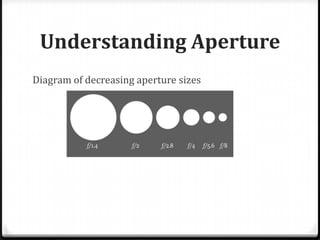
Diagram of decreasing aperture sizes
Understanding Aperture
0 The aperture setting is the size of the opening that is
  used to let light into the camera and onto the sensor.
0 The size of the opening is measured is F-stops.
0 The confusing part is that the larger the aperture
  setting, the smaller the hole that will be used to take
  the picture
Understanding Aperture
0 The reason why lenses with a very large aperture (smaller
  f-stop number) are more expensive is because the lenses
  require more engineering and typically use better and
  more complicated lens elements.
0 The other side effect of getting a lens with a small f-stop
  number is that the smaller the f-stop, the more light will
  come in per image thus allowing you to shoot in lower light
  conditions.
0 A lens with a f/1.8 can shoot well exposed pictures in a
  situation that is much darker than an f/4.0 lens could shoot
  in.
Why Control DoF?
0 The simple answer is mood.
0 Quite often, the background of an image may be
  distracting from the subject matter, think of a bride
  standing in front of a wall of flowers.
0 In this case, the bride is obviously the main subject
  and anything else may distract from the subject, by
  blurring out the flowers behind the bride, you can
  retain some of the color and texture without the
  detail, adding a much more dramatic feel to the image.
Choosing Lenses
0 When choosing a new lens, once you decide once you decide the
  focal range you are looking for, then you go for the lens with the
  largest aperture (again, lowest number) that you can afford.
0 A common misconception with new photographers is that a lens
  labeled with a single aperture will only do that aperture.
0 The labeling denotes the maximum aperture at the listed focal
  length, So if you have a 70-300 f/4.0 – f/5,6, then your maximum
  aperture at 70mm will be f/4.0 but will shrink to f/5.6 at 300mm
0 Whereas a 70-200 f/2.8 can maintain f/2.8 throughout the entire
  focal range but can also go to the minimum aperture of you
  camera (often f/22 or lower),
Now that you have these basics
 down, you should be able to tell
  that the faster (smaller f-stop
number) the better able the lens is
to shoot in darker conditions and
 when used at the lens’ maximum
 aperture, the more pronounced
     the bokeh effect will be
Source:
http://cameradojo.com/201
 1/06/09/understanding-
       depth-of-field/

Basic photography depth of field

  • 2.
    Understanding Depth of Field 0 When done well, a photograph that has good control over the depth of field can add dramatically to the impact of the picture. 0 When we are talking about depth of field, what we are referring to is a shot were the main subject of the picture is in sharp focus but other elements in the picture are blurred or out of focus.
  • 3.
    Understanding Depth ofField What do we mean by controlling depth of field (DoF) 0 Two key terms to learn here are focal plane which is the area of the image that we want to have in sharp focus and bokeh which is the out of focus sections. 0 This is the effect where the subject is in sharp focus but the rest of the image is slightly out of focus. 0 The effect is referred to as bokeh. The more bokeh, the more dramatic the blurring effect.
  • 4.
    Understanding Depth ofField Understanding Aperture 0 If you have a fully automatic point and shoot then you will not be able to achieve the effect you want. 0 Being able to control the depth of field is not very easy on lower end cameras as you need to be able to shoot in either an aperture priority mode or in a full manual mode.
  • 5.
    Understanding Aperture Diagram ofdecreasing aperture sizes
  • 6.
    Understanding Aperture 0 Theaperture setting is the size of the opening that is used to let light into the camera and onto the sensor. 0 The size of the opening is measured is F-stops. 0 The confusing part is that the larger the aperture setting, the smaller the hole that will be used to take the picture
  • 7.
    Understanding Aperture 0 Thereason why lenses with a very large aperture (smaller f-stop number) are more expensive is because the lenses require more engineering and typically use better and more complicated lens elements. 0 The other side effect of getting a lens with a small f-stop number is that the smaller the f-stop, the more light will come in per image thus allowing you to shoot in lower light conditions. 0 A lens with a f/1.8 can shoot well exposed pictures in a situation that is much darker than an f/4.0 lens could shoot in.
  • 8.
    Why Control DoF? 0The simple answer is mood. 0 Quite often, the background of an image may be distracting from the subject matter, think of a bride standing in front of a wall of flowers. 0 In this case, the bride is obviously the main subject and anything else may distract from the subject, by blurring out the flowers behind the bride, you can retain some of the color and texture without the detail, adding a much more dramatic feel to the image.
  • 9.
    Choosing Lenses 0 Whenchoosing a new lens, once you decide once you decide the focal range you are looking for, then you go for the lens with the largest aperture (again, lowest number) that you can afford. 0 A common misconception with new photographers is that a lens labeled with a single aperture will only do that aperture. 0 The labeling denotes the maximum aperture at the listed focal length, So if you have a 70-300 f/4.0 – f/5,6, then your maximum aperture at 70mm will be f/4.0 but will shrink to f/5.6 at 300mm 0 Whereas a 70-200 f/2.8 can maintain f/2.8 throughout the entire focal range but can also go to the minimum aperture of you camera (often f/22 or lower),
  • 10.
    Now that youhave these basics down, you should be able to tell that the faster (smaller f-stop number) the better able the lens is to shoot in darker conditions and when used at the lens’ maximum aperture, the more pronounced the bokeh effect will be
  • 11.