Question
Discuss
1. Epistasis.
2. The types of epistasis and their statistical inferences
Amos Kenyi Dickson
Bugema university
• Introduction
• Definition
• Kinds of Epistasis
(і) Dominant Epistasis.
(ii) Recessive epistasis
(iii) Duplicate Recessive Genes
(iv) Duplicate Dominant Genes
(v) Duplicate Genes with Cumulative Effect
(vi) Dominant Recessive Interaction
• References
introduction
Epistasis is a Greek word that means standing
over .Bateson used it to describe the masking
effect in 1909.
An interaction between a pair of loci in which the
phenotype effect of one locus depends on the
genotype at the second locus.
Genes whose phenotypes are ;
 Expressed epistatic.
 Altered or suppressed hypostatic.
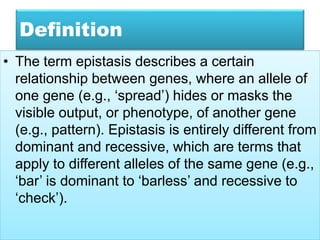
Definition
• The term epistasis describes a certain
relationship between genes, where an allele of
one gene (e.g., ‘spread’) hides or masks the
visible output, or phenotype, of another gene
(e.g., pattern). Epistasis is entirely different from
dominant and recessive, which are terms that
apply to different alleles of the same gene (e.g.,
‘bar’ is dominant to ‘barless’ and recessive to
‘check’).
• Epistasis is the phenomenon of the effect of
one gene (locus) being dependent on the
presence of one or more 'modifier genes', the
genetic background.
• Epistasis occurrs when one allele of a gene
masks the expression of alleles of another
gene.
The masking of the phenotypic effect of alleles
at one gene by alleles of another gene. A gene
is said to be epistatic when its presence
suppresses the effect of a gene at another
locus. Epistatic genes are sometimes called
inhibiting genes because of their effect on
(suppressed) other genes which are described
as hypostatic.
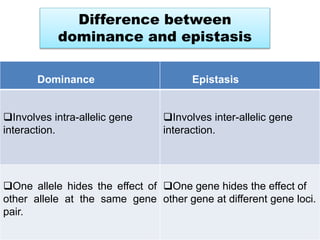
Difference between
dominance and epistasis
Dominance Epistasis
Involves intra-allelic gene
interaction.
Involves inter-allelic gene
interaction.
One allele hides the effect of
other allele at the same gene
pair.
One gene hides the effect of
other gene at different gene loci.
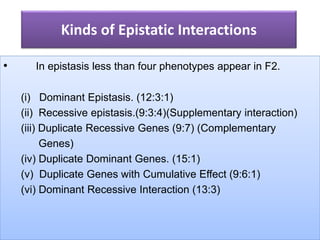
Kinds of Epistatic Interactions
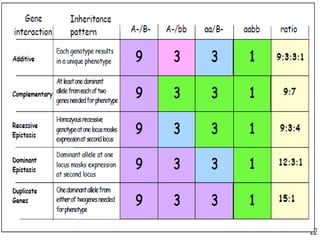
• In epistasis less than four phenotypes appear in F2.
(і) Dominant Epistasis. (12:3:1)
(ii) Recessive epistasis.(9:3:4)(Supplementary interaction)
(iii) Duplicate Recessive Genes (9:7) (Complementary
Genes)
(iv) Duplicate Dominant Genes. (15:1)
(v) Duplicate Genes with Cumulative Effect (9:6:1)
(vi) Dominant Recessive Interaction (13:3)
1. Dominant Epistasis.
(12:3:1)
• When a dominant allele at one locus can mask
the expression of both alleles (dominant and
recessive) at another locus, it is known as
dominant epistasis. In other words, the
expression of one dominant or recessive allele
is masked by another dominant gene. This is
also referred to as simple epistasis.
• This type of dominant epistasis modifies the
classical ratio of 9:3:3:1 into 12:3:1
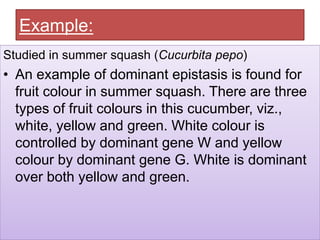
Example:
Studied in summer squash (Cucurbita pepo)
• An example of dominant epistasis is found for
fruit colour in summer squash. There are three
types of fruit colours in this cucumber, viz.,
white, yellow and green. White colour is
controlled by dominant gene W and yellow
colour by dominant gene G. White is dominant
over both yellow and green.
The green fruits are produced in recessive
condition (wwgg). A cross between plants
having white and yellow fruits produced F1
with white fruits. Inter-mating of F1 plants
produced plants with white, yellow and
green coloured fruits in F2 in 12 : 3 : 1 ratio
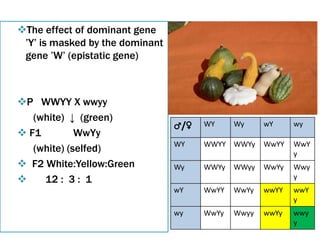
The effect of dominant gene
’Y’ is masked by the dominant
gene ’W’ (epistatic gene)
P WWYY X wwyy
(white) ↓ (green)
 F1 WwYy
(white) (selfed)
 F2 White:Yellow:Green
 12 : 3 : 1
♂/♀ WY Wy wY wy
WY WWYY WWYy WwYY WwY
y
Wy WWYy WWyy WwYy Wwy
y
wY WwYY WwYy wwYY wwY
y
wy WwYy Wwyy wwYy wwy
y
2. Recessive epistasis. (9:3:4)
(Supplementary interaction)
• When recessive alleles at one locus mask the
expression of both (dominant and recessive)
alleles at another locus, it is known as
recessive epistasis. This type of gene
interaction is also known as supplementary
epistasis.
• In horses, brown coat color (B) is dominant over tan
(b).
• However, how that gene is expressed in the
phenotype is dependent on a second gene that
controls the deposition of pigment in hair.
• The dominant gene (C) codes for the presence of
pigment in hair, whereas the recessive gene (c) codes
for the absence of pigment.
3. Duplicate Recessive Genes (9:7)
(Complementary Genes)
• When recessive alleles at either of the two
loci can mask the expression of dominant
alleles at the two loci.
• If both gene loci have homozygous
recessive alleles and both of them
produce identical phenotype the F2
ratio 9:3:3:1 would be 9:7
Example
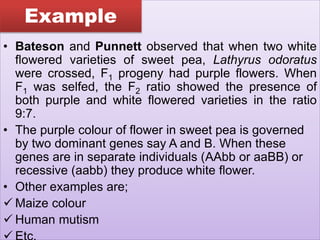
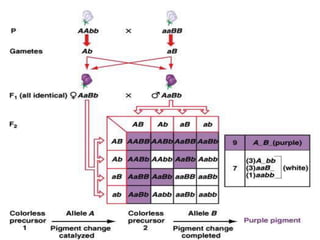
• Bateson and Punnett observed that when two white
flowered varieties of sweet pea, Lathyrus odoratus
were crossed, F1 progeny had purple flowers. When
F1 was selfed, the F2 ratio showed the presence of
both purple and white flowered varieties in the ratio
9:7.
• The purple colour of flower in sweet pea is governed
by two dominant genes say A and B. When these
genes are in separate individuals (AAbb or aaBB) or
recessive (aabb) they produce white flower.
• Other examples are;
 Maize colour
 Human mutism
Example
• In this case dominant alleles on both locus
are required hence wherever A and B both
are present they result into purple effect
masking the white.
• This is because A and B alleles modified the
colorless precursor by showing their effects
4. Duplicate Dominant
Genes. (15:1)
• When a dominant allele at either of two loci can mask
the expression of recessive alleles at the two loci, it is
also called duplicate gene action.
• If a dominant allele of both gene loci produces the
same phenotype without cumulative effect, i.e.,
independently the ratio will be 15:1.
• The duplicate genes are also called pseudoalleles
Example
• A good example of duplicate dominant epistasis is
awn character in rice. Development of awn in rice
is controlled by two dominant duplicate genes (A
and B).
• Presence of any of these two alleles can produce
awn. The awnless condition develops only when
both these genes are in homozygous recessive
state (aabb). A cross between awned and awnless
strains produced awned plants in F1. Inter-mating
of F1 plants produced awned and awnless plants in
15 : 1 ratio in F2 generation
The allele A is epistatic to B/b alleles and all plants
having allele A will develop awn. Another dominant allele
B is epistatic to alleles A/a. Individuals with this allele
also will develop awn character. Hence in F2, plants with
A-B-(9/16), A-bb-(3/16) and aaB-(3/16) genotypes will
develop awn.
The awnless condition will develop only in double
recessive (aabb) genotype (1/16). In this way only
two classes of plants are developed and the
normal dihybrid segregation ratio 9 : 3 : 3 : 1 is
modified to 15 : 1 ratio in F2. Similar gene action
is found for nodulation in peanut and non-floating
character in rice.
5. Duplicate Genes with
Cumulative Effect.
(9:6:1)
• Both the dominant non allelic alleles, when present together,
give a new phenotype, but when allowed to express
independently, they give their own phenotypic expression
separately.
• In the absence of any dominant allele, the recessive allele is
expressed.
• Such gene interaction is known as polymeric gene interaction.
The joint effect of two alleles appears to be additive or
cumulative, but each of the two genes show complete
dominance, hence they cannot be considered as additive
genes.
Example
• A well-known example of polymeric gene interaction is
fruit shape in summer squash. There are three types
of fruit shape in this plant, viz., disc, spherical and
long. The disc shape is controlled by two dominant
genes (A and B), the spherical shape is produced by
either dominant allele (A or B) and long shaped fruits
develop in double recessive (aabb) plants.
A cross between disc shape (AABB)
and long shape (aabb) strains
produced disc shape fruits in F1. Inter-
mating of F1 plants produced plants
with disc, spherical and long shape
fruits in 9 : 6 : 1 ratio in F2
Here plants with A—B—(9/16) genotypes
produce disc shape fruits, those with A-bb-
(3/16) and aaB-(3/16) genotypes produce
spherical fruits, and plants with aabb (1/16)
genotype produce long fruits. Thus in F2,
normal dihybrid segregation ratio 9:3:3: 1 is
modified to 9 : 6 : 1 ratio. Similar gene
action is also found in barley for awn length.
6. Dominant Recessive
Interaction (13:3)
• In this type of epistasis, a dominant allele at
one locus can mask the expression of both
(dominant and recessive) alleles at second
locus. This is also known as inhibitory gene
interaction. An example of this type of gene
interaction is found for anthocyanin
pigmentation in rice.
Example
• The green colour of plants is governed by the
gene I which is dominant over purple colour.
The purple colour is controlled by a dominant
gene P. When a cross was made between
green (IIpp) and purple (iiPP) colour plants, the
F1 was green. Inter-mating of F1 plants
produced green and purple plants in 13 : 3 ratio
in F2. This can be explained as follows.
Here the allele I isepistatic to alleles P
and p. Hence in F2, plants with I-P-
(9/16), I-pp (3/16) and iipp (1/16)
genotypes will be green because I will
mask the effect of P or p. Plants with
iiP-(3/16) will be purple, because I is
absent.
In this way the normal dihybrid
segregation ratio 9 : 3 : 3 : 1 is modified
to 13 : 3 ratio. Similar gene interaction
is found for grain colour in maize,
plumage colour in poultry and certain
characters in other crop species.
References:
• Hartl,D.L., & Jones,W.E., (1998) “Genetics Principles and
Analysis” ed: 4th Jones and Bartlett Publishers
International London,UK, pp: 19,20,61-63
• Miko, I., (2008) Epistasis: Gene interaction and phenotype
effects. Nature Education 1(1)
• Richards,J.E. & Hawley, R. S., (2010) “ The human genome”
ed: 3rd Academic Press, pp: 31
• Verma,P.S., & Agarwal,V.K., (2004) “Cell biology, Genetics,
Molecular Biology, Evolution and Ecology” ed: 24th S.Chand
and Company Ltd,Ram Nagar, New Delhi. Pp: 45-56
• http://www.biologydiscussion.com/genetics/gene-
interactions/top-6-types-of-epistasis-gene-interaction/37818
• http://www.yourarticlelibrary.com/biology/6-most-
important-kinds-of-epistasis-biology/6436/

Epistasis

  • 1.
    Question Discuss 1. Epistasis. 2. Thetypes of epistasis and their statistical inferences Amos Kenyi Dickson Bugema university
  • 2.
    • Introduction • Definition •Kinds of Epistasis (і) Dominant Epistasis. (ii) Recessive epistasis (iii) Duplicate Recessive Genes (iv) Duplicate Dominant Genes (v) Duplicate Genes with Cumulative Effect (vi) Dominant Recessive Interaction • References
  • 3.
    introduction Epistasis is aGreek word that means standing over .Bateson used it to describe the masking effect in 1909. An interaction between a pair of loci in which the phenotype effect of one locus depends on the genotype at the second locus. Genes whose phenotypes are ;  Expressed epistatic.  Altered or suppressed hypostatic.
  • 4.
    Definition • The termepistasis describes a certain relationship between genes, where an allele of one gene (e.g., ‘spread’) hides or masks the visible output, or phenotype, of another gene (e.g., pattern). Epistasis is entirely different from dominant and recessive, which are terms that apply to different alleles of the same gene (e.g., ‘bar’ is dominant to ‘barless’ and recessive to ‘check’).
  • 5.
    • Epistasis isthe phenomenon of the effect of one gene (locus) being dependent on the presence of one or more 'modifier genes', the genetic background. • Epistasis occurrs when one allele of a gene masks the expression of alleles of another gene.
  • 6.
    The masking ofthe phenotypic effect of alleles at one gene by alleles of another gene. A gene is said to be epistatic when its presence suppresses the effect of a gene at another locus. Epistatic genes are sometimes called inhibiting genes because of their effect on (suppressed) other genes which are described as hypostatic.
  • 7.
    Difference between dominance andepistasis Dominance Epistasis Involves intra-allelic gene interaction. Involves inter-allelic gene interaction. One allele hides the effect of other allele at the same gene pair. One gene hides the effect of other gene at different gene loci.
  • 8.
    Kinds of EpistaticInteractions • In epistasis less than four phenotypes appear in F2. (і) Dominant Epistasis. (12:3:1) (ii) Recessive epistasis.(9:3:4)(Supplementary interaction) (iii) Duplicate Recessive Genes (9:7) (Complementary Genes) (iv) Duplicate Dominant Genes. (15:1) (v) Duplicate Genes with Cumulative Effect (9:6:1) (vi) Dominant Recessive Interaction (13:3)
  • 9.
    1. Dominant Epistasis. (12:3:1) •When a dominant allele at one locus can mask the expression of both alleles (dominant and recessive) at another locus, it is known as dominant epistasis. In other words, the expression of one dominant or recessive allele is masked by another dominant gene. This is also referred to as simple epistasis. • This type of dominant epistasis modifies the classical ratio of 9:3:3:1 into 12:3:1
  • 10.
    Example: Studied in summersquash (Cucurbita pepo) • An example of dominant epistasis is found for fruit colour in summer squash. There are three types of fruit colours in this cucumber, viz., white, yellow and green. White colour is controlled by dominant gene W and yellow colour by dominant gene G. White is dominant over both yellow and green.
  • 11.
    The green fruitsare produced in recessive condition (wwgg). A cross between plants having white and yellow fruits produced F1 with white fruits. Inter-mating of F1 plants produced plants with white, yellow and green coloured fruits in F2 in 12 : 3 : 1 ratio
  • 13.
    The effect ofdominant gene ’Y’ is masked by the dominant gene ’W’ (epistatic gene) P WWYY X wwyy (white) ↓ (green)  F1 WwYy (white) (selfed)  F2 White:Yellow:Green  12 : 3 : 1 ♂/♀ WY Wy wY wy WY WWYY WWYy WwYY WwY y Wy WWYy WWyy WwYy Wwy y wY WwYY WwYy wwYY wwY y wy WwYy Wwyy wwYy wwy y
  • 14.
    2. Recessive epistasis.(9:3:4) (Supplementary interaction) • When recessive alleles at one locus mask the expression of both (dominant and recessive) alleles at another locus, it is known as recessive epistasis. This type of gene interaction is also known as supplementary epistasis.
  • 15.
    • In horses,brown coat color (B) is dominant over tan (b). • However, how that gene is expressed in the phenotype is dependent on a second gene that controls the deposition of pigment in hair. • The dominant gene (C) codes for the presence of pigment in hair, whereas the recessive gene (c) codes for the absence of pigment.
  • 17.
    3. Duplicate RecessiveGenes (9:7) (Complementary Genes) • When recessive alleles at either of the two loci can mask the expression of dominant alleles at the two loci. • If both gene loci have homozygous recessive alleles and both of them produce identical phenotype the F2 ratio 9:3:3:1 would be 9:7
  • 18.
    Example • Bateson andPunnett observed that when two white flowered varieties of sweet pea, Lathyrus odoratus were crossed, F1 progeny had purple flowers. When F1 was selfed, the F2 ratio showed the presence of both purple and white flowered varieties in the ratio 9:7. • The purple colour of flower in sweet pea is governed by two dominant genes say A and B. When these genes are in separate individuals (AAbb or aaBB) or recessive (aabb) they produce white flower. • Other examples are;  Maize colour  Human mutism Example
  • 22.
    • In thiscase dominant alleles on both locus are required hence wherever A and B both are present they result into purple effect masking the white. • This is because A and B alleles modified the colorless precursor by showing their effects
  • 23.
    4. Duplicate Dominant Genes.(15:1) • When a dominant allele at either of two loci can mask the expression of recessive alleles at the two loci, it is also called duplicate gene action. • If a dominant allele of both gene loci produces the same phenotype without cumulative effect, i.e., independently the ratio will be 15:1. • The duplicate genes are also called pseudoalleles
  • 24.
    Example • A goodexample of duplicate dominant epistasis is awn character in rice. Development of awn in rice is controlled by two dominant duplicate genes (A and B). • Presence of any of these two alleles can produce awn. The awnless condition develops only when both these genes are in homozygous recessive state (aabb). A cross between awned and awnless strains produced awned plants in F1. Inter-mating of F1 plants produced awned and awnless plants in 15 : 1 ratio in F2 generation
  • 26.
    The allele Ais epistatic to B/b alleles and all plants having allele A will develop awn. Another dominant allele B is epistatic to alleles A/a. Individuals with this allele also will develop awn character. Hence in F2, plants with A-B-(9/16), A-bb-(3/16) and aaB-(3/16) genotypes will develop awn.
  • 27.
    The awnless conditionwill develop only in double recessive (aabb) genotype (1/16). In this way only two classes of plants are developed and the normal dihybrid segregation ratio 9 : 3 : 3 : 1 is modified to 15 : 1 ratio in F2. Similar gene action is found for nodulation in peanut and non-floating character in rice.
  • 28.
    5. Duplicate Geneswith Cumulative Effect. (9:6:1) • Both the dominant non allelic alleles, when present together, give a new phenotype, but when allowed to express independently, they give their own phenotypic expression separately. • In the absence of any dominant allele, the recessive allele is expressed. • Such gene interaction is known as polymeric gene interaction. The joint effect of two alleles appears to be additive or cumulative, but each of the two genes show complete dominance, hence they cannot be considered as additive genes.
  • 29.
    Example • A well-knownexample of polymeric gene interaction is fruit shape in summer squash. There are three types of fruit shape in this plant, viz., disc, spherical and long. The disc shape is controlled by two dominant genes (A and B), the spherical shape is produced by either dominant allele (A or B) and long shaped fruits develop in double recessive (aabb) plants.
  • 30.
    A cross betweendisc shape (AABB) and long shape (aabb) strains produced disc shape fruits in F1. Inter- mating of F1 plants produced plants with disc, spherical and long shape fruits in 9 : 6 : 1 ratio in F2
  • 33.
    Here plants withA—B—(9/16) genotypes produce disc shape fruits, those with A-bb- (3/16) and aaB-(3/16) genotypes produce spherical fruits, and plants with aabb (1/16) genotype produce long fruits. Thus in F2, normal dihybrid segregation ratio 9:3:3: 1 is modified to 9 : 6 : 1 ratio. Similar gene action is also found in barley for awn length.
  • 34.
    6. Dominant Recessive Interaction(13:3) • In this type of epistasis, a dominant allele at one locus can mask the expression of both (dominant and recessive) alleles at second locus. This is also known as inhibitory gene interaction. An example of this type of gene interaction is found for anthocyanin pigmentation in rice.
  • 35.
    Example • The greencolour of plants is governed by the gene I which is dominant over purple colour. The purple colour is controlled by a dominant gene P. When a cross was made between green (IIpp) and purple (iiPP) colour plants, the F1 was green. Inter-mating of F1 plants produced green and purple plants in 13 : 3 ratio in F2. This can be explained as follows.
  • 37.
    Here the alleleI isepistatic to alleles P and p. Hence in F2, plants with I-P- (9/16), I-pp (3/16) and iipp (1/16) genotypes will be green because I will mask the effect of P or p. Plants with iiP-(3/16) will be purple, because I is absent.
  • 38.
    In this waythe normal dihybrid segregation ratio 9 : 3 : 3 : 1 is modified to 13 : 3 ratio. Similar gene interaction is found for grain colour in maize, plumage colour in poultry and certain characters in other crop species.
  • 40.
    References: • Hartl,D.L., &Jones,W.E., (1998) “Genetics Principles and Analysis” ed: 4th Jones and Bartlett Publishers International London,UK, pp: 19,20,61-63 • Miko, I., (2008) Epistasis: Gene interaction and phenotype effects. Nature Education 1(1) • Richards,J.E. & Hawley, R. S., (2010) “ The human genome” ed: 3rd Academic Press, pp: 31 • Verma,P.S., & Agarwal,V.K., (2004) “Cell biology, Genetics, Molecular Biology, Evolution and Ecology” ed: 24th S.Chand and Company Ltd,Ram Nagar, New Delhi. Pp: 45-56 • http://www.biologydiscussion.com/genetics/gene- interactions/top-6-types-of-epistasis-gene-interaction/37818 • http://www.yourarticlelibrary.com/biology/6-most- important-kinds-of-epistasis-biology/6436/