Sorting Knowledge out of the Virtual
World
Researcher´s Point of View
Anita Rubin
Finland Futures Research Centre, University of Turku
www.tse.fi/tutu
2
Rob Gonsalves
New Moon Eclipsed
3
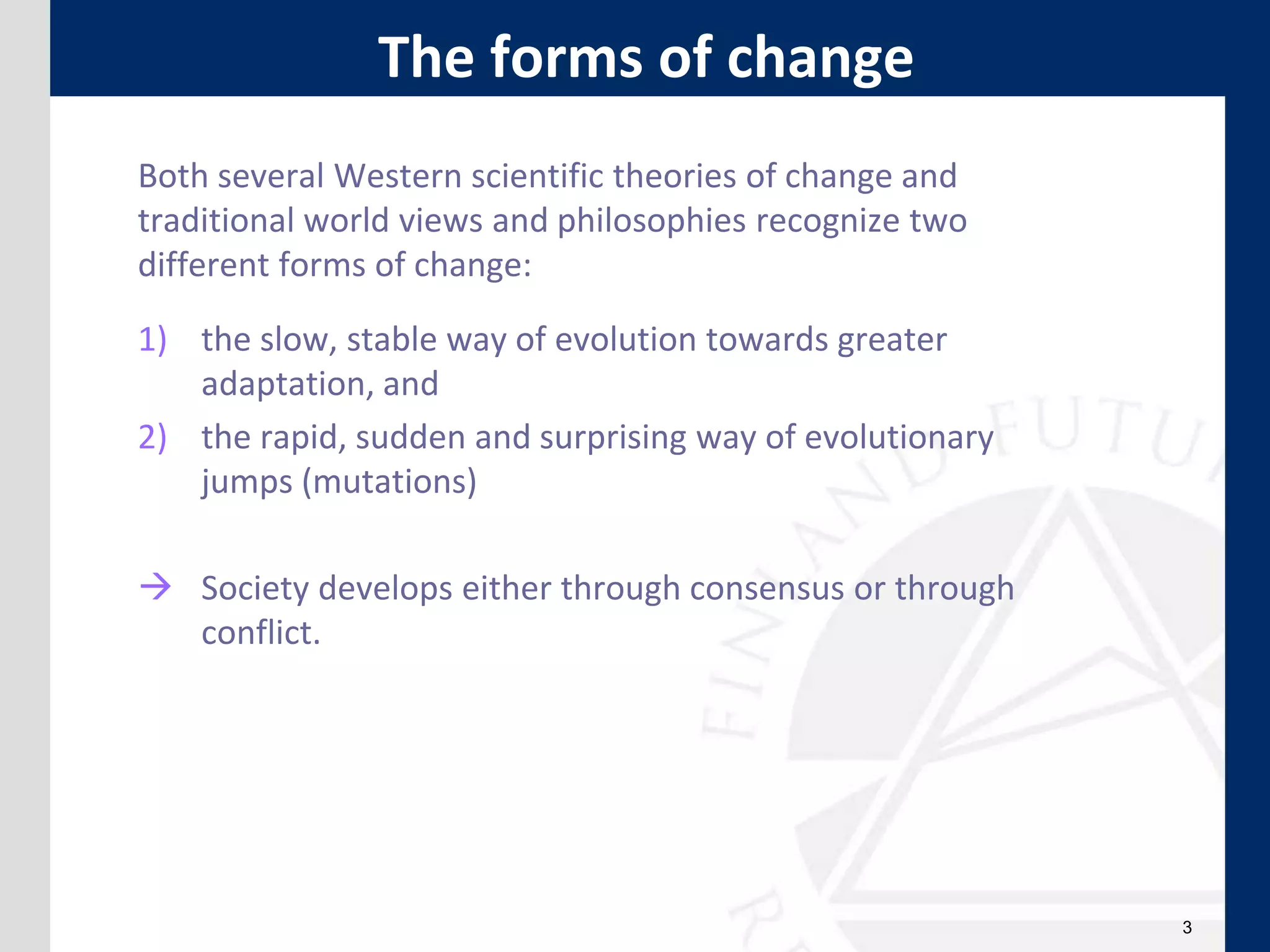
Both several Western scientific theories of change and
traditional world views and philosophies recognize two
different forms of change:
1) the slow, stable way of evolution towards greater
adaptation, and
2) the rapid, sudden and surprising way of evolutionary
jumps (mutations)
 Society develops either through consensus or through
conflict.
The forms of change
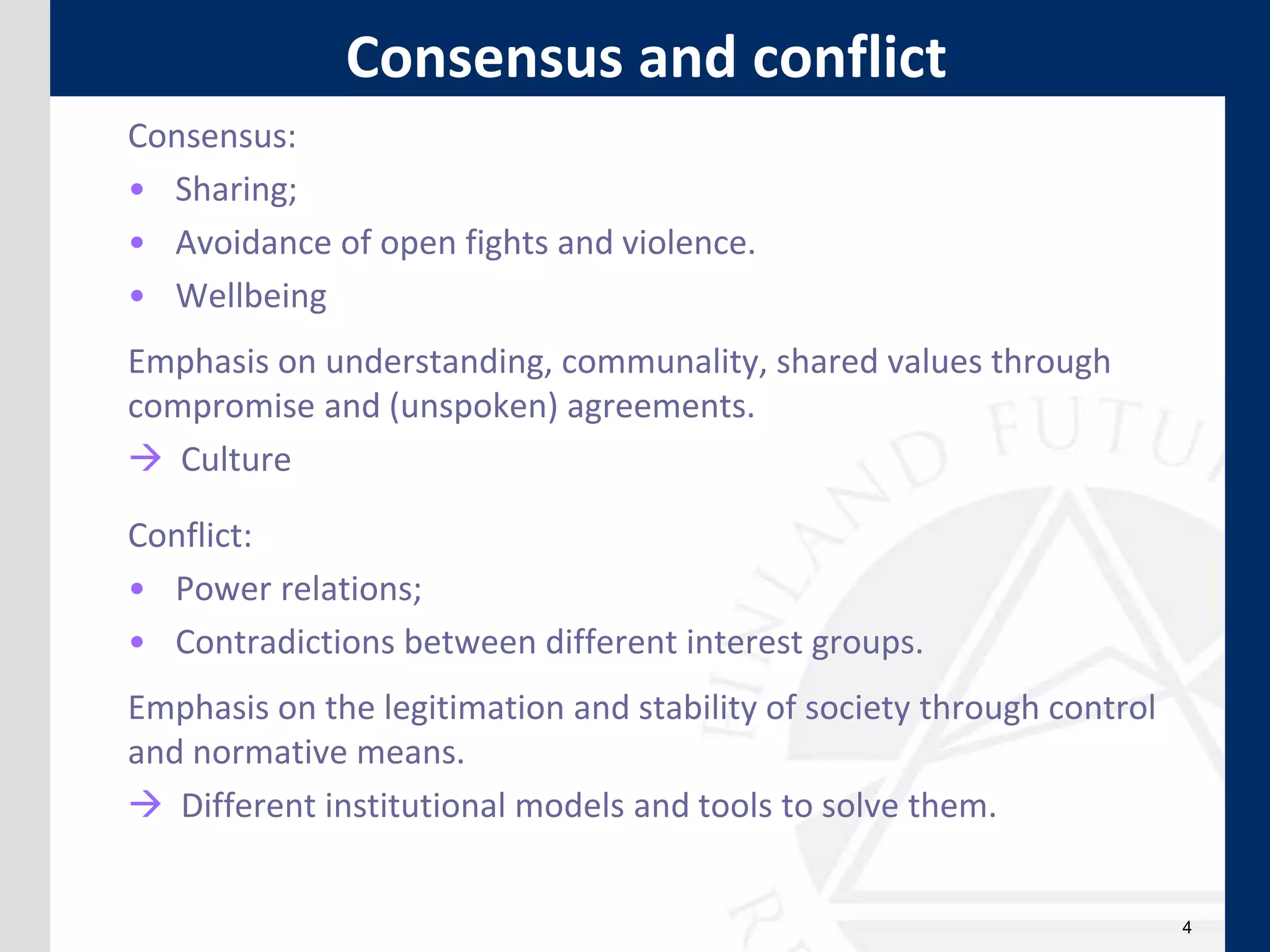
Consensus:
• Sharing;
• Avoidance of open fights and violence.
• Wellbeing
Emphasis on understanding, communality, shared values through
compromise and (unspoken) agreements.
 Culture
Conflict:
• Power relations;
• Contradictions between different interest groups.
Emphasis on the legitimation and stability of society through control
and normative means.
 Different institutional models and tools to solve them.
4
Consensus and conflict
5
Consensus and conflict in Futures Studies
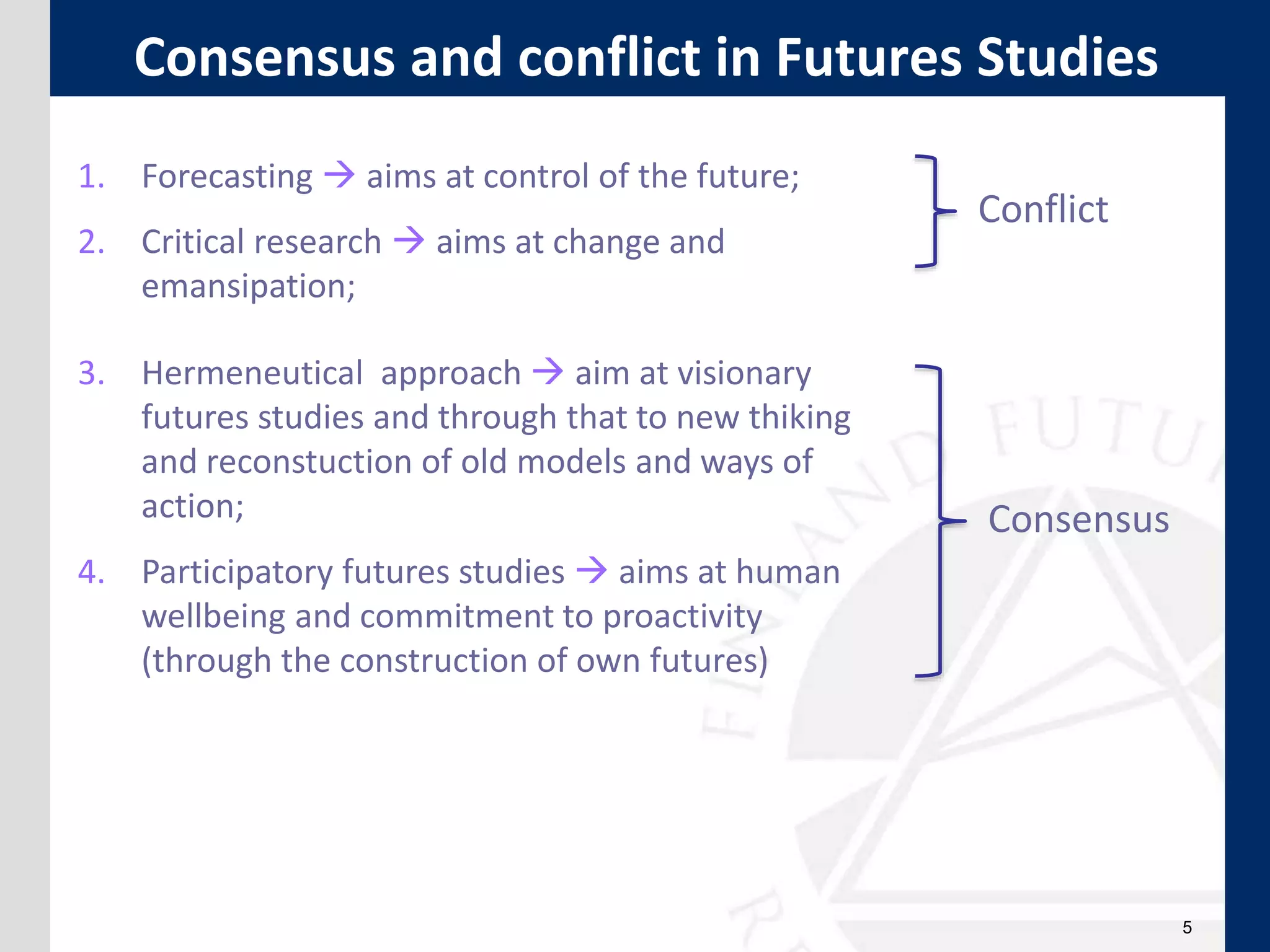
1. Forecasting  aims at control of the future;
2. Critical research  aims at change and
emansipation;
3. Hermeneutical approach  aim at visionary
futures studies and through that to new thiking
and reconstuction of old models and ways of
action;
4. Participatory futures studies  aims at human
wellbeing and commitment to proactivity
(through the construction of own futures)
Conflict
Consensus
29.1.2015 6
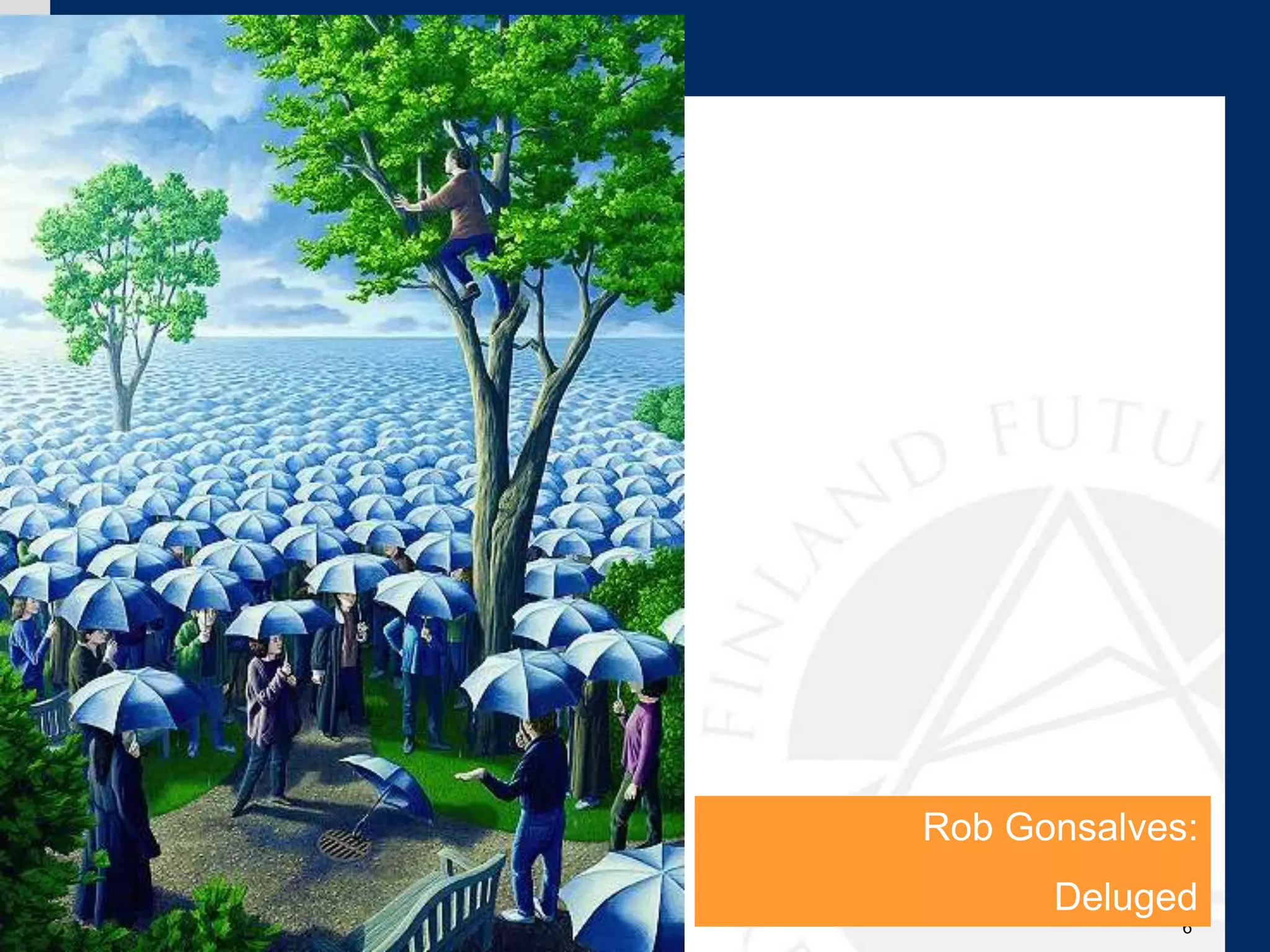
Rob Gonsalves:
Deluged
7
1. Empirical tradition: forecasting, scenario working, foresight, trend
analysis, etc. Emphasis on what we think about the future; many
possible futures.
2. Cultural tradition: participatory methods, futures workshops etc.
Emphasis on who makes the future; alternative futures and
proactivity.
3. Critical tradition (eg. CLA): social construction, emphasis on why
we think of the future the way we do; language, worldviews,
values, myths, etc.
4. Intergral tradition: concerned both on the ”inside” (individual)
and ”outside” (collective, social) domains: 1) the self and
consicousness, 2) cultural world views, 3) biology (behaviour,
brains, organisms), and 4) social, technological, geo-political
environment, evolution of social systems.
Four traditions in futures inquiry
8
Integral futures studies
Incorporation of different scientific paradigms (scientific thinking based
on physical-material understanding of reality) to other ways of knowing
(eg. intuitive knowing, sprituality, subjective experience, art, etc.)
 Sees reality as manifold, multi-level, subjective and constantly
changing
 Recognized cultural interdependence;
 Is highly systemic in its basci understanding of the world and its
phenomena.
From participatory paradigm: proactivity
From hermeneutical paradigm: humane point of view, need to
understand
From constructivism: authenticity, enthusiasm
From critical paradigm: need to change
…/…
9
• What we see as happening in the world is in large part conditioned
on what is going on in our own minds.
• We cannot understand images of the future if we know nothing of
the structure and functioning of consciousness.
• Therefore futures inquiry is, by its very nature, a broadly inter-,
trans-, multi-, meta-, counter-, and even anti-disciplinary activity.
• The viewpoint is dependent on actor’s perceptions and perceptions
are dependent on his/her consciousness, values, abiloity to see,
choose what he/she sees, understand and, finally, choose the way
of action.
Integral futures studies
 is a meta-paradigmatic point of view
 is composed of a plurality of perpectives, and
 recognizes multiple ways of knowing (epistemological pluralism)
…/…
10
11
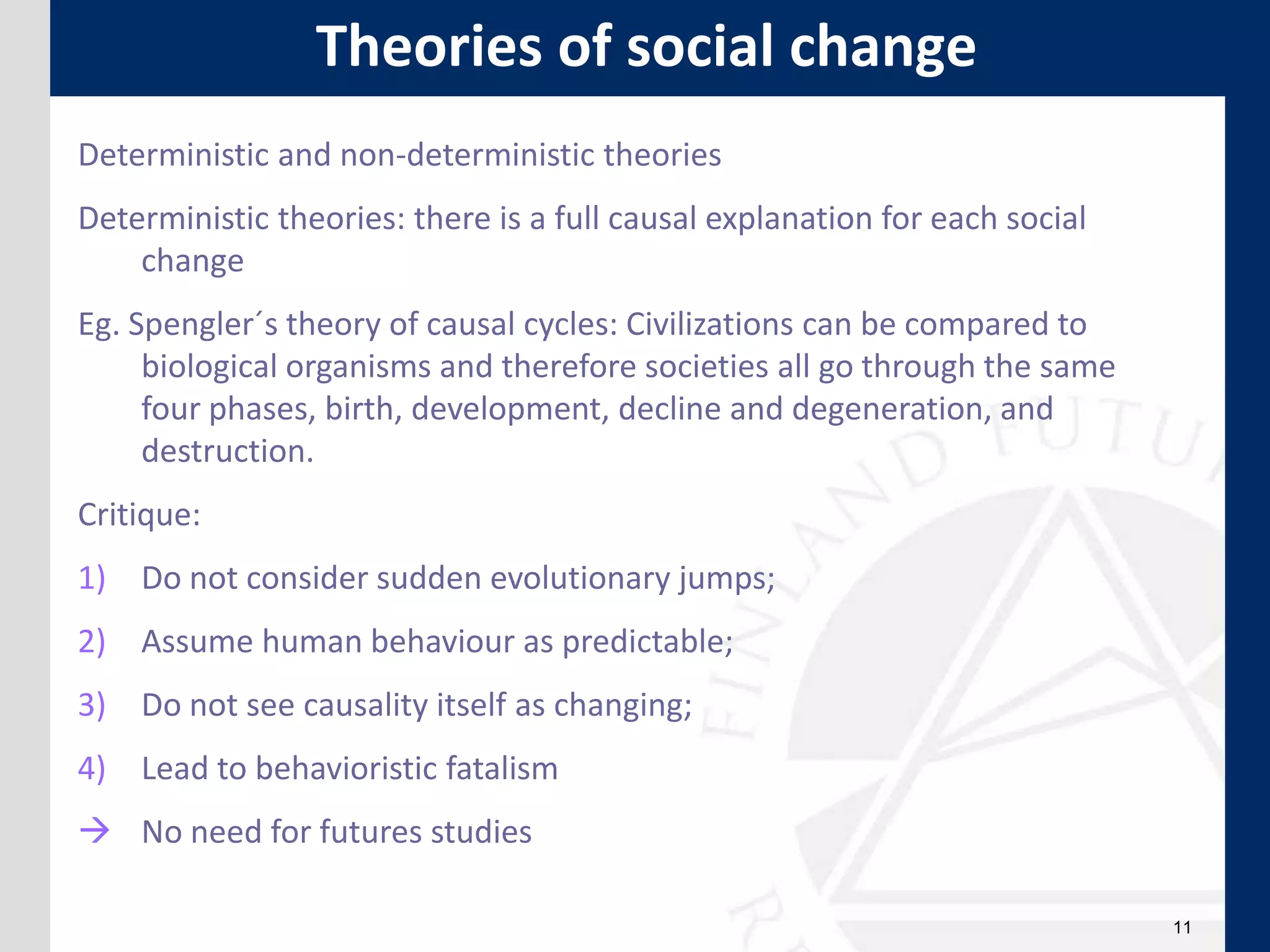
Theories of social change
Deterministic and non-deterministic theories
Deterministic theories: there is a full causal explanation for each social
change
Eg. Spengler´s theory of causal cycles: Civilizations can be compared to
biological organisms and therefore societies all go through the same
four phases, birth, development, decline and degeneration, and
destruction.
Critique:
1) Do not consider sudden evolutionary jumps;
2) Assume human behaviour as predictable;
3) Do not see causality itself as changing;
4) Lead to behavioristic fatalism
 No need for futures studies
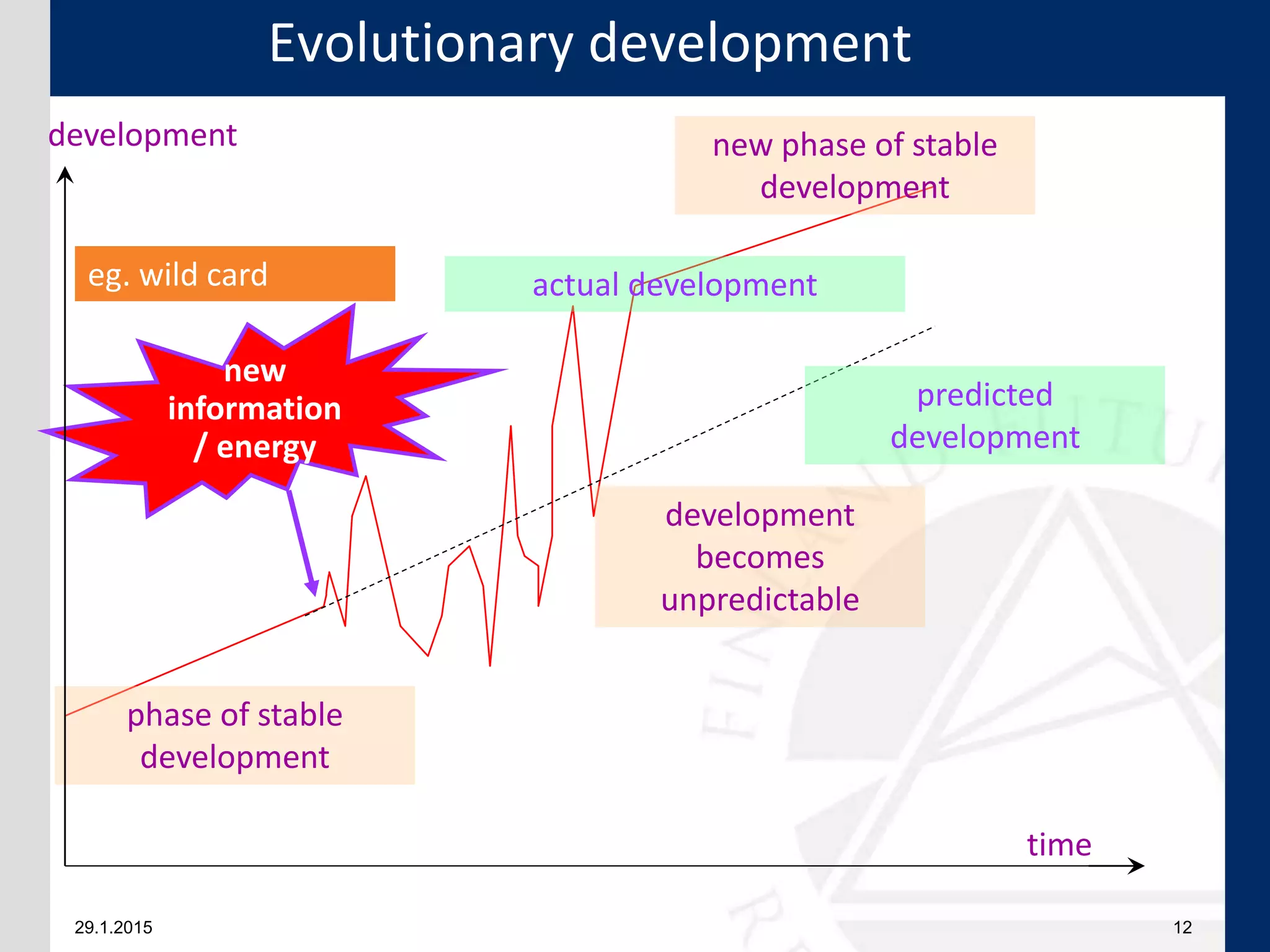
29.1.2015 12
time
Evolutionary development
phase of stable
development
new
information
/ energy
new phase of stable
development
development
becomes
unpredictable
predicted
development
actual developmenteg. wild card
development
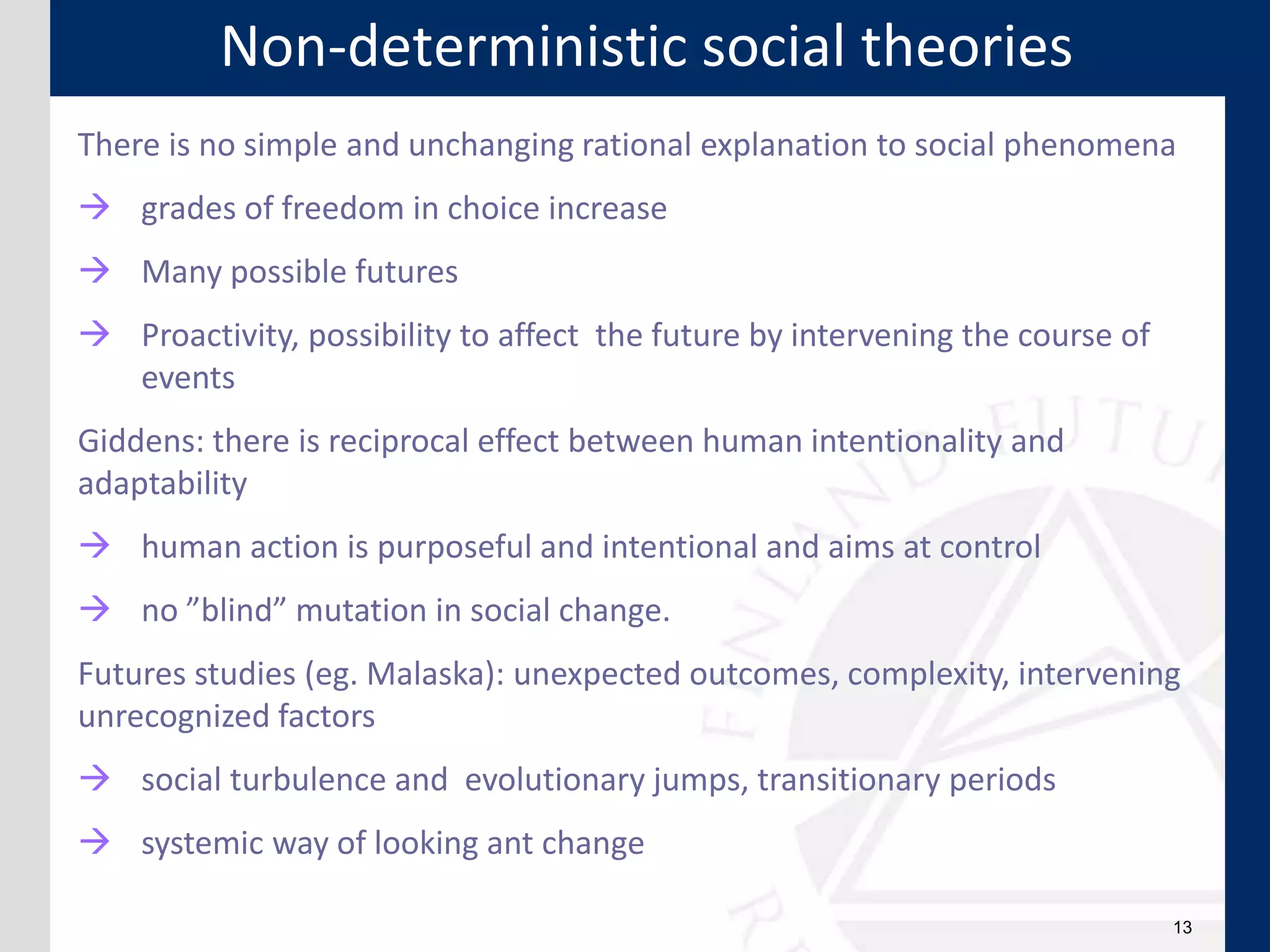
13
There is no simple and unchanging rational explanation to social phenomena
 grades of freedom in choice increase
 Many possible futures
 Proactivity, possibility to affect the future by intervening the course of
events
Giddens: there is reciprocal effect between human intentionality and
adaptability
 human action is purposeful and intentional and aims at control
 no ”blind” mutation in social change.
Futures studies (eg. Malaska): unexpected outcomes, complexity, intervening
unrecognized factors
 social turbulence and evolutionary jumps, transitionary periods
 systemic way of looking ant change
Non-deterministic social theories
29.1.2015 14
• People aim at rational behaviour (= rationally-oriented action
towards one or several goals).
• However, what is regarded as rational is culture-specific and
becomes re-defined by the needs and conditions given by culture.
 There is a constant, systemic interaction guiding cultural
development: individuals search rational explanation to their
behaviour from their society and culture, while their choices and
decisions then reinforce and also gradually change the culture.
The dialogue of rationality and culture
29.1.2015 15
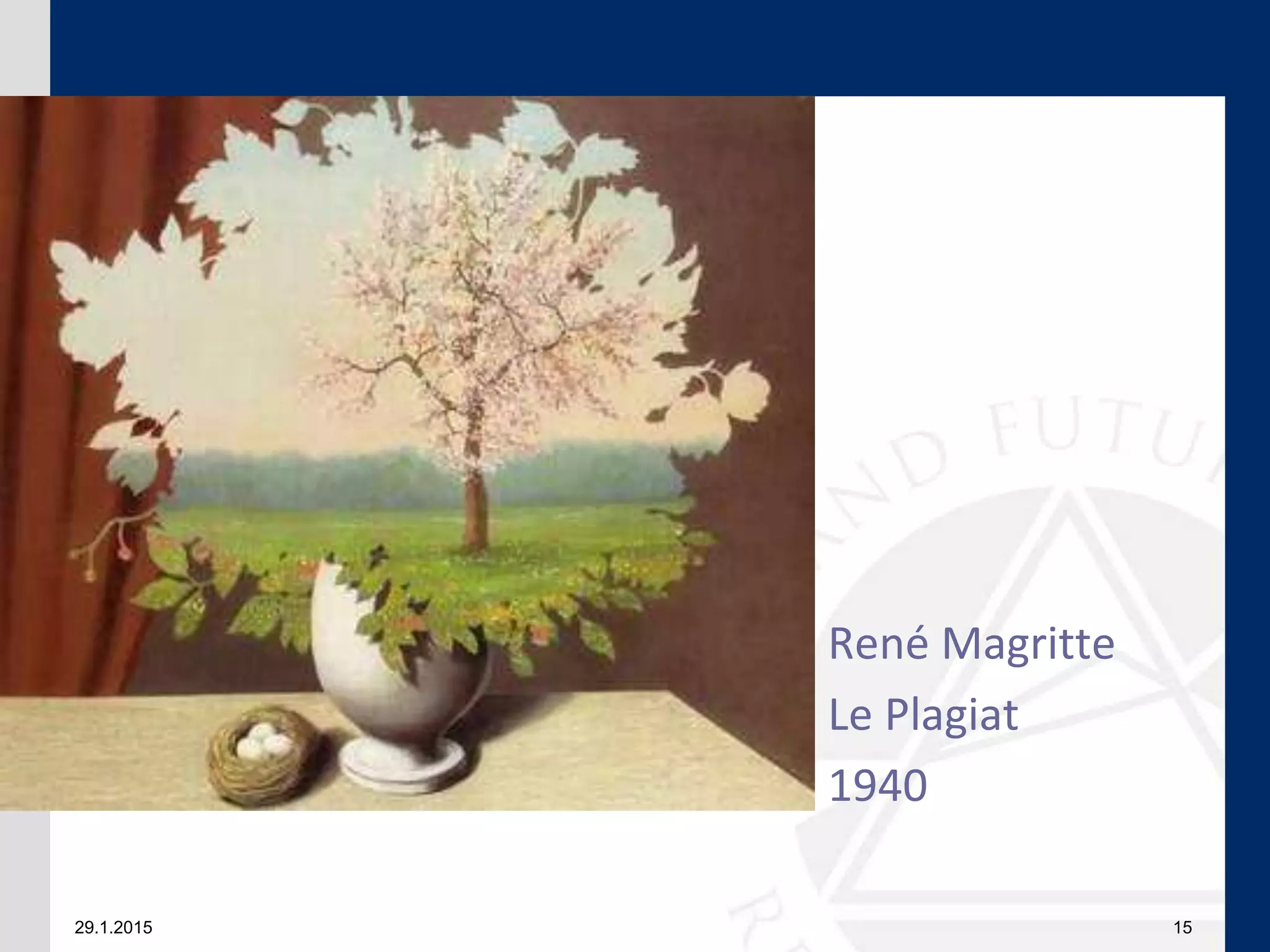
René Magritte
Le Plagiat
1940
29.1.2015 16
“Change is the other name of time.” (Aristotle)
As a phenomenon, contemporary change
• cannot be analyzed as following a fixed, unidirectional path;
• cannot be explained by a mere reference to social, political,
economic or even natural laws or some inner logic, and
• can only be explained by reference to systemic processes with a
number of controversies, non-linear development, antagonisms
which may en up as unintended and non-foreseeable consequences.
The changing nature of change
17
The world in which we live is charged with meanings which are partly
conscious, partly unconcious.
We understand it with the help of symbols (eg. language) with which we
create models of it (representations).
We can act in it with the help of culturally-herited tools and models.
 Ability to understand ourseles as a part of the world and act in it in a
logical and rational way.
 Everyday understanding of what the world is all about.
But what happens when the world changes and our everyday
understanding can no more comprehend it and our logic does not tell
about it in a coherent way?
Changing everyday reality
18
Rob Gonsalves:
Tributaries
29.1.2015 19
• Human choice derives from both the knowledge base and from
the value base – from instrumental and intrinsic values.
 Values play a role first in the selection of the idealised outcome,
and then the selection of the means to achieve that goal.
• However, we are in trouble every time when we face a situation
where routine methods and the traditional way of conduct do not
work (= bring about the expected outcome) anymore.
 The social endorsement on which we could lean for so long and
thus know that our choices and decisions were acceptable and
good, is not self-evident anymore. Instead, there are various
different social groups, cultures, ways of actions, traditions,
practices etc. which we have to take into consideration, evaluate
and perhaps choose from.
Decision-making in changing social reality
29.1.2015 20
Technologies do not take a linear path from theory to application to
introduction in society, because they are influenced by social choices at
every point.
Consequently, technologies bear the imprint of the social processes that
have brought them forth.
 a spiral-shape effect: social factors shape technology
 the properties and effects of technology can in large be seen as social
properties and social effects.
 when we talk about “information society”, we cannot separate
neither information nor the means of its transmission from that
society where information is being used and utilised. In the end they
are the same.
In the form of technology, change
21
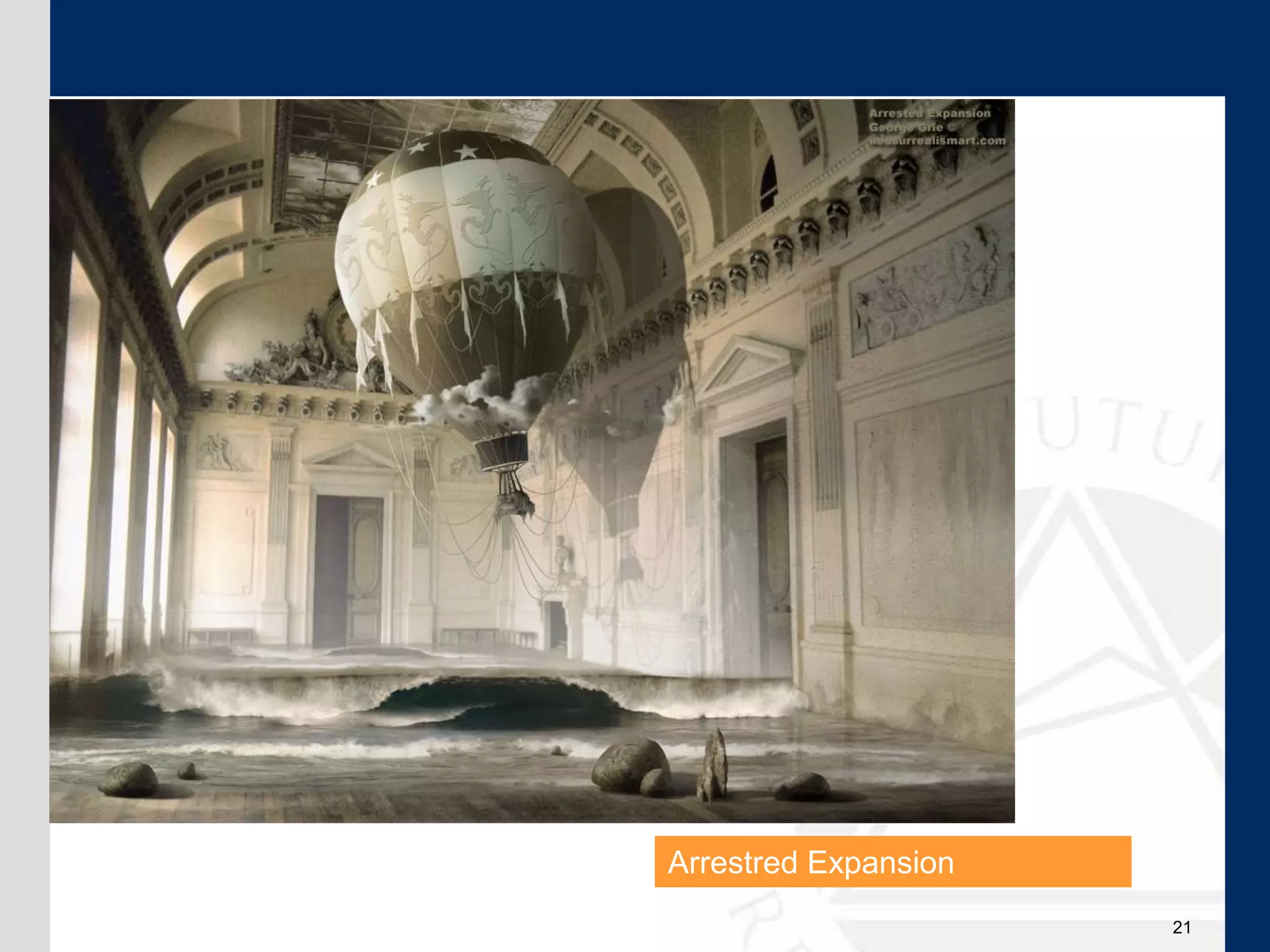
Arrestred Expansion
29.1.2015 22
Communication is just one of the aspects in the experience of meaning:
 Differentiation,
 emergence of lines and borders,
 the formation of reality through that,
 immediate experience and feedback.
When more and more information is received on a real-time basis, the
understanding the logic of cause and effect tends to blur.
 new situations
 new challenges
 need for the creation of new tools, means, and even language and
concepts for coping, empowerment, creativity, and active
participation
…/…
Challenges
29.1.2015 23
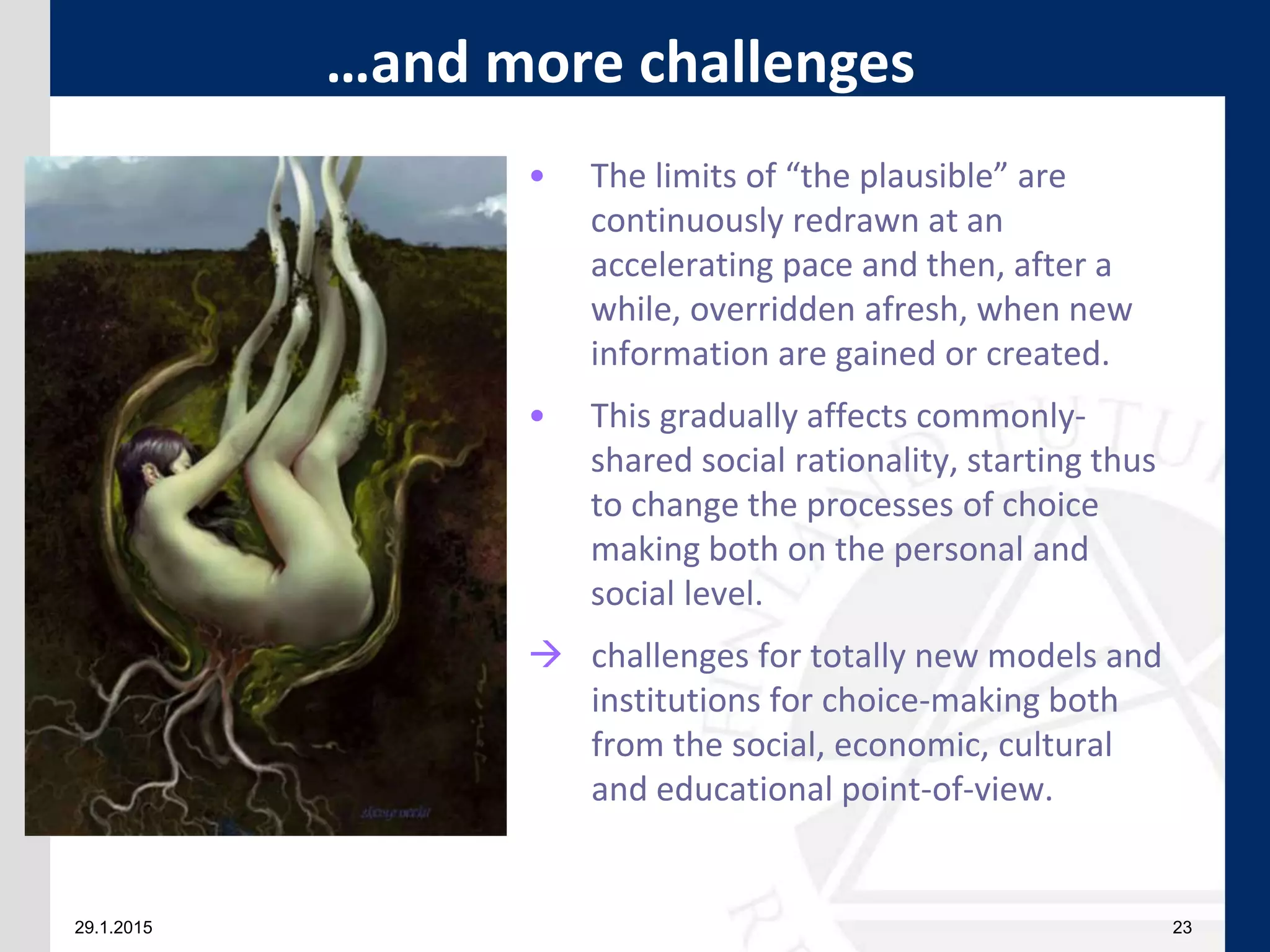
• The limits of “the plausible” are
continuously redrawn at an
accelerating pace and then, after a
while, overridden afresh, when new
information are gained or created.
• This gradually affects commonly-
shared social rationality, starting thus
to change the processes of choice
making both on the personal and
social level.
 challenges for totally new models and
institutions for choice-making both
from the social, economic, cultural
and educational point-of-view.
…and more challenges
29.1.2015 24
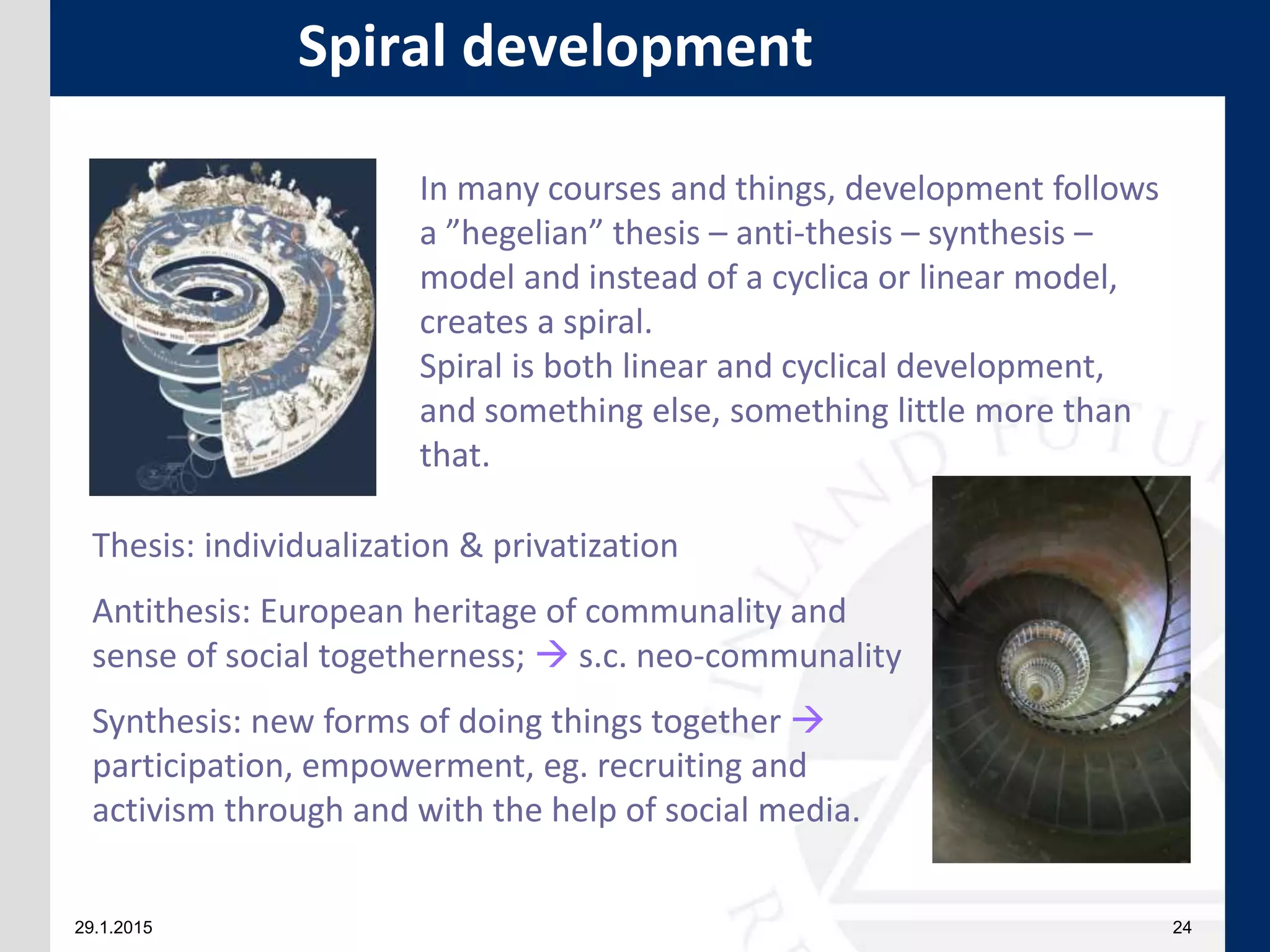
Spiral development
In many courses and things, development follows
a ”hegelian” thesis – anti-thesis – synthesis –
model and instead of a cyclica or linear model,
creates a spiral.
Spiral is both linear and cyclical development,
and something else, something little more than
that.
Thesis: individualization & privatization
Antithesis: European heritage of communality and
sense of social togetherness;  s.c. neo-communality
Synthesis: new forms of doing things together 
participation, empowerment, eg. recruiting and
activism through and with the help of social media.
29.1.2015 25
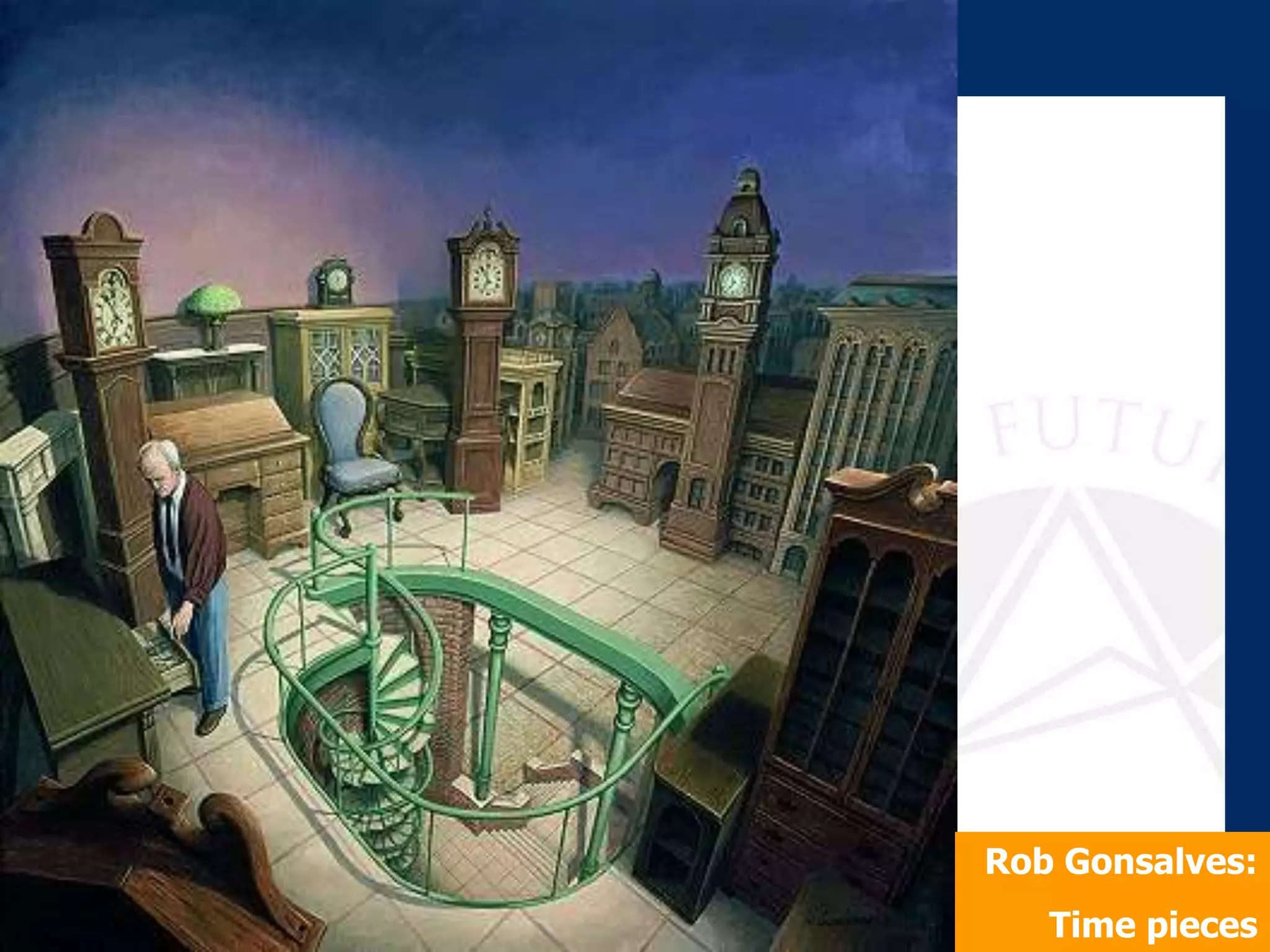
Rob Gonsalves:
Time pieces
29.1.2015 26
When more and more information is available on a real-time basis, the
understanding of the logic of cause and effect tends to blur.
 rapid and unexpected movements in the global
market economy;
 constant new innovations in information
technology;
 the growth of information on an exponential
speed.
Need for the creation of new tools, means, and even language and
concepts for coping, empowerment, creativity, and active participation.
Need for new tools…
29.1.2015 27
• The limits of “the plausible” are continuously redrawn at an accelerating
pace and then, after a while, overridden afresh, when new information
are gained or created.
• This gradually affects socially-shared rationality, starting thus to change
the processes of choice making both on the personal and social level.
Need for totally new models and institutions for choice-making both from
the social, economic, cultural and educational point-of-view.
the culture of self-actualisation
…and new institutions
29.1.2015 28
Where industrial society emphasises ”the middle of the road” thinking
and aims at balance, convergence and stability, ubiquous society tears
apart, divides, exacerbates, emphasizes diversity and develops through
controversy
 Social, cultural and technological schizophrenia
1. New sense of community which is highly sensitive – emotionality of
culture;
2. common emotions through the media/social media create an
iterative phenomenon (actor’s experience and feeling strengthen
just because he/she knows that there are thousands of others
feeling the same at the very same moment.)
From industrial to ubiquous society
29
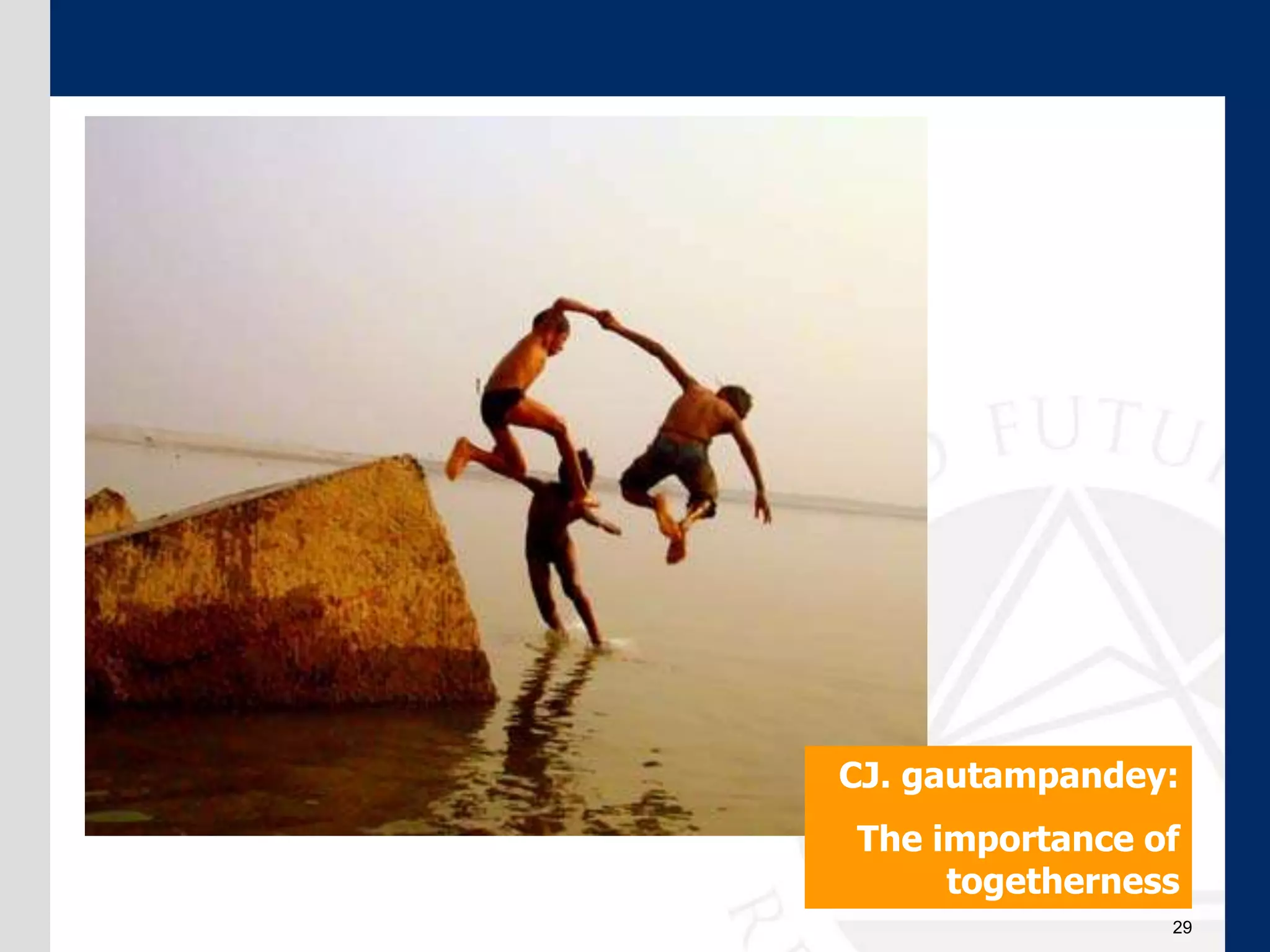
CJ. gautampandey:
The importance of
togetherness
30
Discontent on the already existing is the starting point, nature and
grounds of development. On the other hand, the urge for security
creates a need to keep things as they are, unchanged.
 Human need to develop vs. resistance to change
The revolution of humanhood: very soon we´ll be able to charge our
minds and consciousnesses to machines/computers/net
 eternal life, or
 ultra intelligent conscious / self-conscious machine which destroys
the humankind?
 What does it actually mean to be conscious? Thinking is more than
the ability to be logical, to combine things and to make
conclusions: it is also the ability to feel and connect emotions to
decision-making.
New challenges to consciousness
31
More and more often the Internet and social
media also enable shared experience which is
multiversal and real-time by nature (eg. the
earthquake in Haiti, the tsunami, 9-11, Princess
Diana’s funeral, etc.)
 awareness of millions of people simultaneously sharing the same
experience;
 The first steps of true shared consciousness?
 The evolution of consciousness
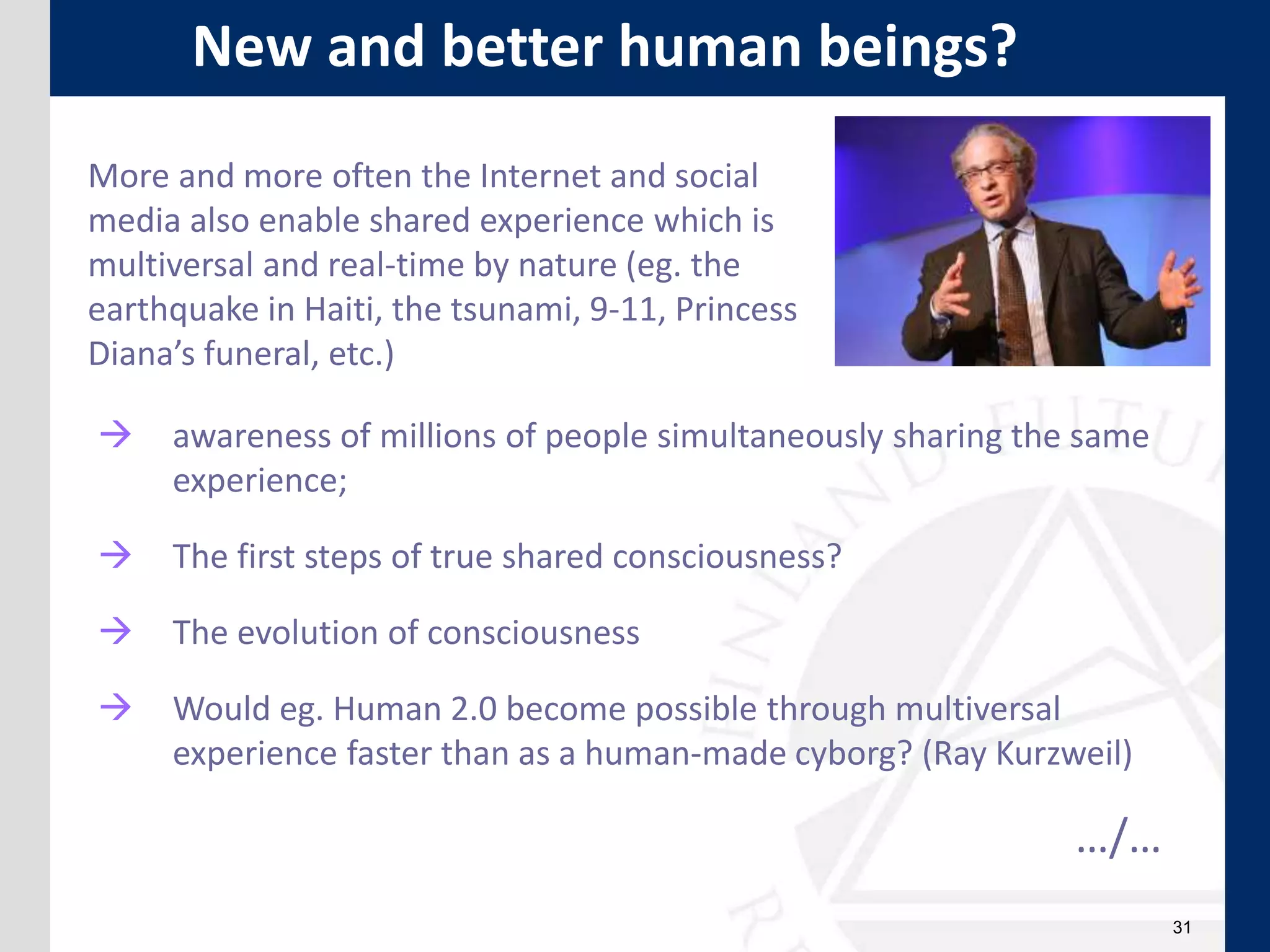
 Would eg. Human 2.0 become possible through multiversal
experience faster than as a human-made cyborg? (Ray Kurzweil)
…/…
New and better human beings?
32
Global, local, glocal / indepenence of time and place
 discourse of overcoming time
 The facilitation of everyday life by developing technology 
more machines  more time to – what?
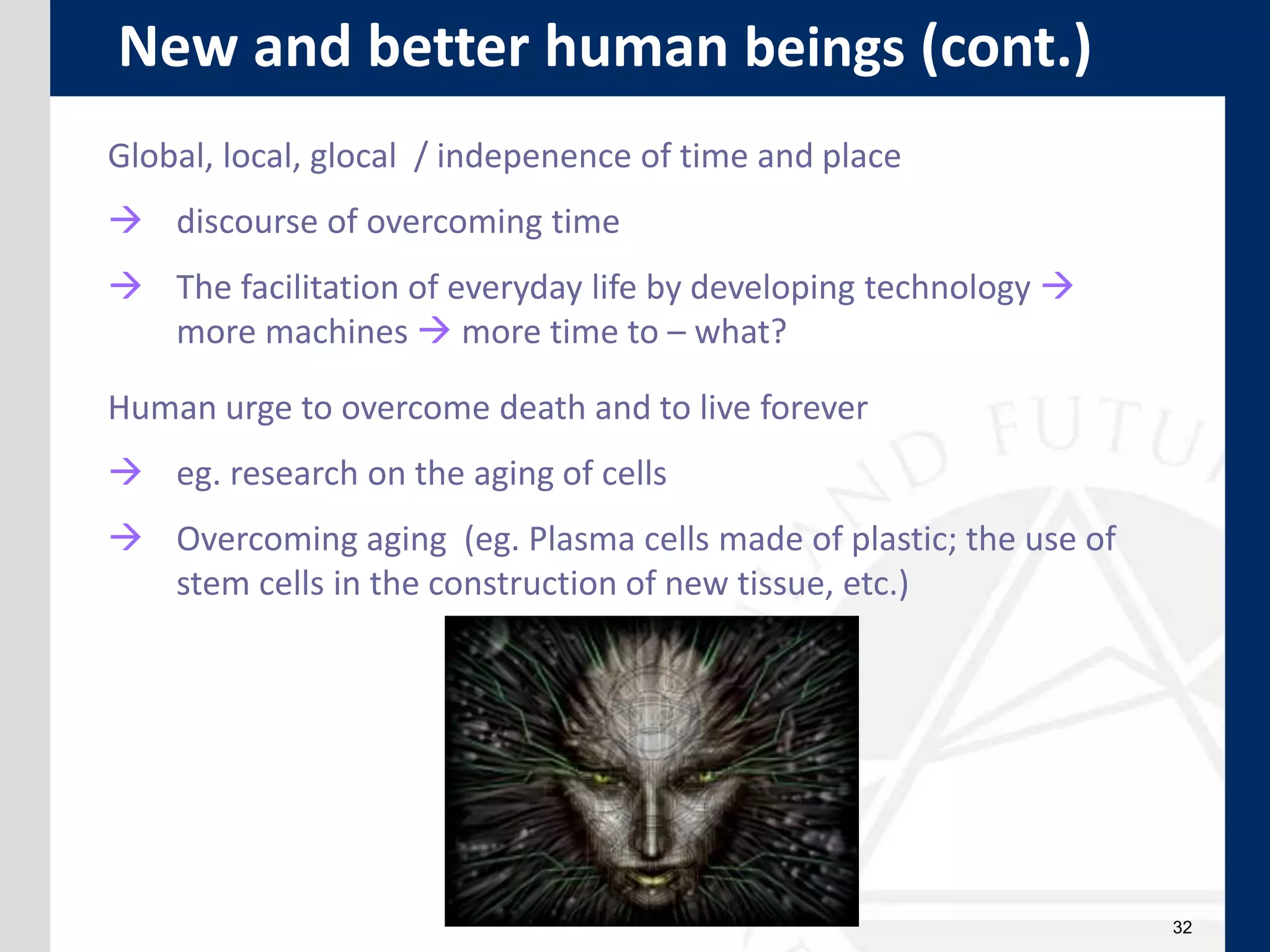
Human urge to overcome death and to live forever
 eg. research on the aging of cells
 Overcoming aging (eg. Plasma cells made of plastic; the use of
stem cells in the construction of new tissue, etc.)
New and better human beings (cont.)
33
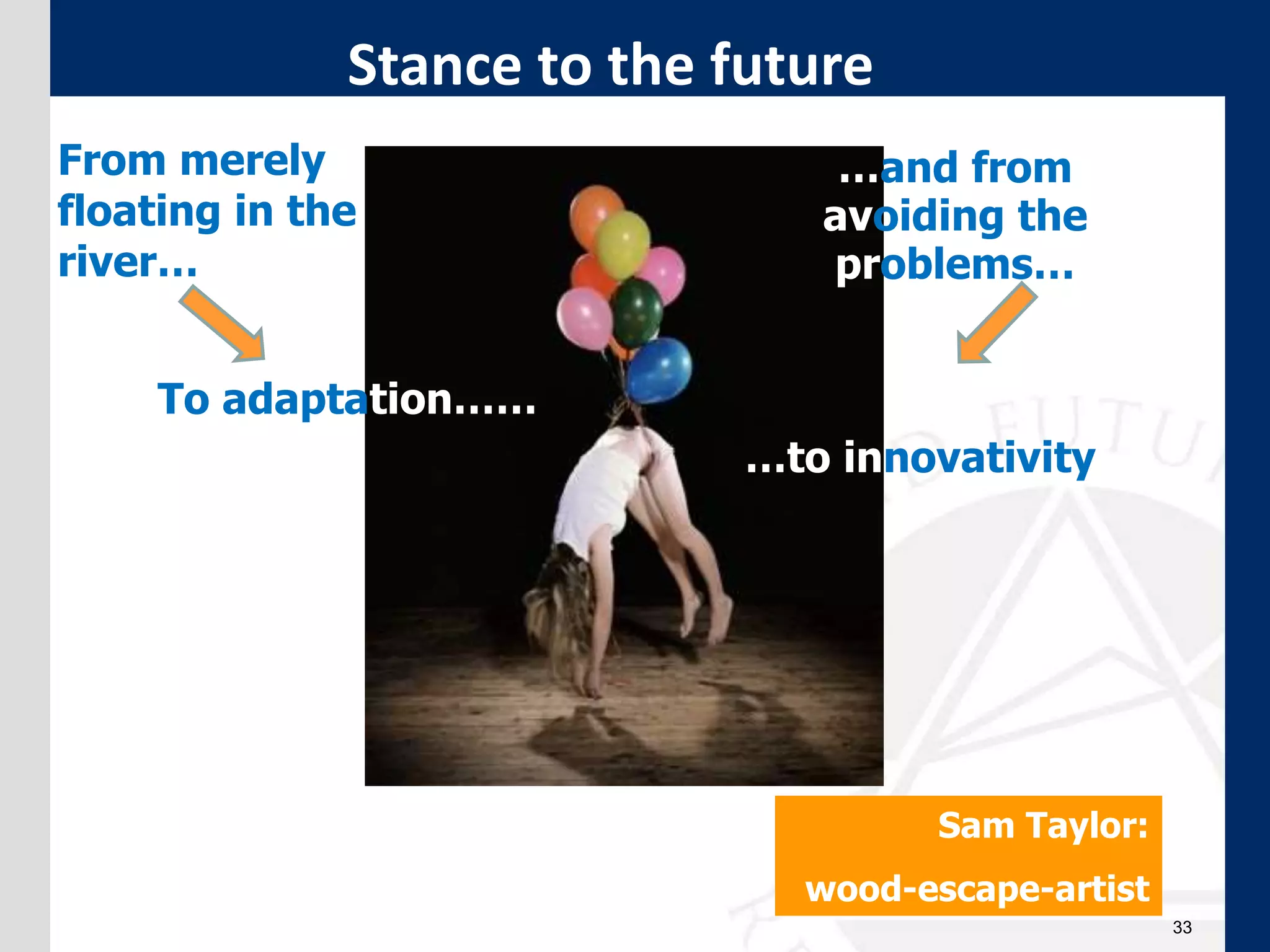
Stance to the future
From merely
floating in the
river…
To adaptation……
…and from
avoiding the
problems…
…to innovativity
Sam Taylor:
wood-escape-artist
34
What a futurist mostly needs is
1. Ability to find the correct source of information;
2. Ability to critically combine information coming from very
different channels into a logic and meaningful whole (from the
points of view of good and reliable science, human
empowerment and participation);
3. Ability to combine this information and utilize it in concrete
actions and choices.
– in futures studies, we speak about proactivity.
And the most important:
29.1.2015 35
Thank you for travelling
with us and welcome
onboard again!

Sorting knowledge out

  • 1.
    Sorting Knowledge outof the Virtual World Researcher´s Point of View Anita Rubin Finland Futures Research Centre, University of Turku www.tse.fi/tutu
  • 2.
  • 3.
    3 Both several Westernscientific theories of change and traditional world views and philosophies recognize two different forms of change: 1) the slow, stable way of evolution towards greater adaptation, and 2) the rapid, sudden and surprising way of evolutionary jumps (mutations)  Society develops either through consensus or through conflict. The forms of change
  • 4.
    Consensus: • Sharing; • Avoidanceof open fights and violence. • Wellbeing Emphasis on understanding, communality, shared values through compromise and (unspoken) agreements.  Culture Conflict: • Power relations; • Contradictions between different interest groups. Emphasis on the legitimation and stability of society through control and normative means.  Different institutional models and tools to solve them. 4 Consensus and conflict
  • 5.
    5 Consensus and conflictin Futures Studies 1. Forecasting  aims at control of the future; 2. Critical research  aims at change and emansipation; 3. Hermeneutical approach  aim at visionary futures studies and through that to new thiking and reconstuction of old models and ways of action; 4. Participatory futures studies  aims at human wellbeing and commitment to proactivity (through the construction of own futures) Conflict Consensus
  • 6.
  • 7.
    7 1. Empirical tradition:forecasting, scenario working, foresight, trend analysis, etc. Emphasis on what we think about the future; many possible futures. 2. Cultural tradition: participatory methods, futures workshops etc. Emphasis on who makes the future; alternative futures and proactivity. 3. Critical tradition (eg. CLA): social construction, emphasis on why we think of the future the way we do; language, worldviews, values, myths, etc. 4. Intergral tradition: concerned both on the ”inside” (individual) and ”outside” (collective, social) domains: 1) the self and consicousness, 2) cultural world views, 3) biology (behaviour, brains, organisms), and 4) social, technological, geo-political environment, evolution of social systems. Four traditions in futures inquiry
  • 8.
    8 Integral futures studies Incorporationof different scientific paradigms (scientific thinking based on physical-material understanding of reality) to other ways of knowing (eg. intuitive knowing, sprituality, subjective experience, art, etc.)  Sees reality as manifold, multi-level, subjective and constantly changing  Recognized cultural interdependence;  Is highly systemic in its basci understanding of the world and its phenomena. From participatory paradigm: proactivity From hermeneutical paradigm: humane point of view, need to understand From constructivism: authenticity, enthusiasm From critical paradigm: need to change …/…
  • 9.
    9 • What wesee as happening in the world is in large part conditioned on what is going on in our own minds. • We cannot understand images of the future if we know nothing of the structure and functioning of consciousness. • Therefore futures inquiry is, by its very nature, a broadly inter-, trans-, multi-, meta-, counter-, and even anti-disciplinary activity. • The viewpoint is dependent on actor’s perceptions and perceptions are dependent on his/her consciousness, values, abiloity to see, choose what he/she sees, understand and, finally, choose the way of action. Integral futures studies  is a meta-paradigmatic point of view  is composed of a plurality of perpectives, and  recognizes multiple ways of knowing (epistemological pluralism) …/…
  • 10.
  • 11.
    11 Theories of socialchange Deterministic and non-deterministic theories Deterministic theories: there is a full causal explanation for each social change Eg. Spengler´s theory of causal cycles: Civilizations can be compared to biological organisms and therefore societies all go through the same four phases, birth, development, decline and degeneration, and destruction. Critique: 1) Do not consider sudden evolutionary jumps; 2) Assume human behaviour as predictable; 3) Do not see causality itself as changing; 4) Lead to behavioristic fatalism  No need for futures studies
  • 12.
    29.1.2015 12 time Evolutionary development phaseof stable development new information / energy new phase of stable development development becomes unpredictable predicted development actual developmenteg. wild card development
  • 13.
    13 There is nosimple and unchanging rational explanation to social phenomena  grades of freedom in choice increase  Many possible futures  Proactivity, possibility to affect the future by intervening the course of events Giddens: there is reciprocal effect between human intentionality and adaptability  human action is purposeful and intentional and aims at control  no ”blind” mutation in social change. Futures studies (eg. Malaska): unexpected outcomes, complexity, intervening unrecognized factors  social turbulence and evolutionary jumps, transitionary periods  systemic way of looking ant change Non-deterministic social theories
  • 14.
    29.1.2015 14 • Peopleaim at rational behaviour (= rationally-oriented action towards one or several goals). • However, what is regarded as rational is culture-specific and becomes re-defined by the needs and conditions given by culture.  There is a constant, systemic interaction guiding cultural development: individuals search rational explanation to their behaviour from their society and culture, while their choices and decisions then reinforce and also gradually change the culture. The dialogue of rationality and culture
  • 15.
  • 16.
    29.1.2015 16 “Change isthe other name of time.” (Aristotle) As a phenomenon, contemporary change • cannot be analyzed as following a fixed, unidirectional path; • cannot be explained by a mere reference to social, political, economic or even natural laws or some inner logic, and • can only be explained by reference to systemic processes with a number of controversies, non-linear development, antagonisms which may en up as unintended and non-foreseeable consequences. The changing nature of change
  • 17.
    17 The world inwhich we live is charged with meanings which are partly conscious, partly unconcious. We understand it with the help of symbols (eg. language) with which we create models of it (representations). We can act in it with the help of culturally-herited tools and models.  Ability to understand ourseles as a part of the world and act in it in a logical and rational way.  Everyday understanding of what the world is all about. But what happens when the world changes and our everyday understanding can no more comprehend it and our logic does not tell about it in a coherent way? Changing everyday reality
  • 18.
  • 19.
    29.1.2015 19 • Humanchoice derives from both the knowledge base and from the value base – from instrumental and intrinsic values.  Values play a role first in the selection of the idealised outcome, and then the selection of the means to achieve that goal. • However, we are in trouble every time when we face a situation where routine methods and the traditional way of conduct do not work (= bring about the expected outcome) anymore.  The social endorsement on which we could lean for so long and thus know that our choices and decisions were acceptable and good, is not self-evident anymore. Instead, there are various different social groups, cultures, ways of actions, traditions, practices etc. which we have to take into consideration, evaluate and perhaps choose from. Decision-making in changing social reality
  • 20.
    29.1.2015 20 Technologies donot take a linear path from theory to application to introduction in society, because they are influenced by social choices at every point. Consequently, technologies bear the imprint of the social processes that have brought them forth.  a spiral-shape effect: social factors shape technology  the properties and effects of technology can in large be seen as social properties and social effects.  when we talk about “information society”, we cannot separate neither information nor the means of its transmission from that society where information is being used and utilised. In the end they are the same. In the form of technology, change
  • 21.
  • 22.
    29.1.2015 22 Communication isjust one of the aspects in the experience of meaning:  Differentiation,  emergence of lines and borders,  the formation of reality through that,  immediate experience and feedback. When more and more information is received on a real-time basis, the understanding the logic of cause and effect tends to blur.  new situations  new challenges  need for the creation of new tools, means, and even language and concepts for coping, empowerment, creativity, and active participation …/… Challenges
  • 23.
    29.1.2015 23 • Thelimits of “the plausible” are continuously redrawn at an accelerating pace and then, after a while, overridden afresh, when new information are gained or created. • This gradually affects commonly- shared social rationality, starting thus to change the processes of choice making both on the personal and social level.  challenges for totally new models and institutions for choice-making both from the social, economic, cultural and educational point-of-view. …and more challenges
  • 24.
    29.1.2015 24 Spiral development Inmany courses and things, development follows a ”hegelian” thesis – anti-thesis – synthesis – model and instead of a cyclica or linear model, creates a spiral. Spiral is both linear and cyclical development, and something else, something little more than that. Thesis: individualization & privatization Antithesis: European heritage of communality and sense of social togetherness;  s.c. neo-communality Synthesis: new forms of doing things together  participation, empowerment, eg. recruiting and activism through and with the help of social media.
  • 25.
  • 26.
    29.1.2015 26 When moreand more information is available on a real-time basis, the understanding of the logic of cause and effect tends to blur.  rapid and unexpected movements in the global market economy;  constant new innovations in information technology;  the growth of information on an exponential speed. Need for the creation of new tools, means, and even language and concepts for coping, empowerment, creativity, and active participation. Need for new tools…
  • 27.
    29.1.2015 27 • Thelimits of “the plausible” are continuously redrawn at an accelerating pace and then, after a while, overridden afresh, when new information are gained or created. • This gradually affects socially-shared rationality, starting thus to change the processes of choice making both on the personal and social level. Need for totally new models and institutions for choice-making both from the social, economic, cultural and educational point-of-view. the culture of self-actualisation …and new institutions
  • 28.
    29.1.2015 28 Where industrialsociety emphasises ”the middle of the road” thinking and aims at balance, convergence and stability, ubiquous society tears apart, divides, exacerbates, emphasizes diversity and develops through controversy  Social, cultural and technological schizophrenia 1. New sense of community which is highly sensitive – emotionality of culture; 2. common emotions through the media/social media create an iterative phenomenon (actor’s experience and feeling strengthen just because he/she knows that there are thousands of others feeling the same at the very same moment.) From industrial to ubiquous society
  • 29.
  • 30.
    30 Discontent on thealready existing is the starting point, nature and grounds of development. On the other hand, the urge for security creates a need to keep things as they are, unchanged.  Human need to develop vs. resistance to change The revolution of humanhood: very soon we´ll be able to charge our minds and consciousnesses to machines/computers/net  eternal life, or  ultra intelligent conscious / self-conscious machine which destroys the humankind?  What does it actually mean to be conscious? Thinking is more than the ability to be logical, to combine things and to make conclusions: it is also the ability to feel and connect emotions to decision-making. New challenges to consciousness
  • 31.
    31 More and moreoften the Internet and social media also enable shared experience which is multiversal and real-time by nature (eg. the earthquake in Haiti, the tsunami, 9-11, Princess Diana’s funeral, etc.)  awareness of millions of people simultaneously sharing the same experience;  The first steps of true shared consciousness?  The evolution of consciousness  Would eg. Human 2.0 become possible through multiversal experience faster than as a human-made cyborg? (Ray Kurzweil) …/… New and better human beings?
  • 32.
    32 Global, local, glocal/ indepenence of time and place  discourse of overcoming time  The facilitation of everyday life by developing technology  more machines  more time to – what? Human urge to overcome death and to live forever  eg. research on the aging of cells  Overcoming aging (eg. Plasma cells made of plastic; the use of stem cells in the construction of new tissue, etc.) New and better human beings (cont.)
  • 33.
    33 Stance to thefuture From merely floating in the river… To adaptation…… …and from avoiding the problems… …to innovativity Sam Taylor: wood-escape-artist
  • 34.
    34 What a futuristmostly needs is 1. Ability to find the correct source of information; 2. Ability to critically combine information coming from very different channels into a logic and meaningful whole (from the points of view of good and reliable science, human empowerment and participation); 3. Ability to combine this information and utilize it in concrete actions and choices. – in futures studies, we speak about proactivity. And the most important:
  • 35.
    29.1.2015 35 Thank youfor travelling with us and welcome onboard again!