York Teachmeet
“Breaking the Sound
Barrier”
June 7th 2017
Listening – the Cinderella skill?
• Importance for acquisition
• One-way versus two-way listening
• Process versus product
• We get better at what we practice
• Role of phonology and phonics
Bottom-up and top-down listening skills
•Top-down – using background knowledge,
context , rules of conversation
•Bottom-up – decoding the message bit-by-
bit
How do we listen?
John Field model
1. Decoding – matching acoustic sensations to sounds and syllables of
the language
2. Lexical search – dividing connected speech into words and matching
these with your lexicon
3. Parsing – imposing a grammatical pattern on words
4. Meaning construction – enriching bare meaning of utterance
5. Discourse construction – linking information to what went before
Problem with comprehension model?
Danger of assuming listening skills will develop without specific
attention to bottom-up decoding skills
Role of phonics
Phonics: a method for teaching reading and writing of a language by
developing learners' phonemic awareness—the ability to hear, identify,
and manipulate phonemes—in order to teach the correspondence
between these sounds and the spelling patterns (graphemes) that
represent them.
Teaching Schools Council Report (2017)
“There is significant evidence, including from the most effective
practitioners, that direct and systematic teaching of phonics in the new
language is a more reliable method for assuring accurate pronunciation
and spelling. However, this is still relatively rare practice in classrooms.”
“The aim should be that a pupil can pronounce most words accurately
from the written form, including those not yet explicitly taught; and
that they can produce a potentially accurate spelling of new words.”
https://www.tscouncil.org.uk/wp-content/uploads/2016/12/MFL-
Pedagogy-Review-Report-2.pdf (p.12)
Phonics ideas (1)
• Rachel Hawkes rachelhawkes.com
“What I mean by phonics is teaching the key sounds of the
foreign language (‘key’ being those sounds that are written the
same but pronounced differently in English) and fixing them in
long-term memory by embedding them in words, often nouns but
not always.”
Phonics ideas (2)
Word mind-reading
• After presenting one or more phonemes and doing much
receptive work write a number of words (10-12?) containing that
the phoneme(s) on the board.
• Play “hide the flashcard”. Write one of the words on a mini-
board and ask pupils to guess the hidden word. This generates
many repetitions, while giving you plenty of chances to give
feedback.
• You can use chunks rather than isolated words.
Phonics ideas (3)
Faulty echo
• Write a sentence on the board containing one or
more phonemes you have practised recently.
Then, repeat the sentence twice, once correctly
and the second time making one or more
mistakes. Reward the person or team (if you split
the class into groups) who spot the mistake(s) by
uttering the sentence correctly.
Phonics ideas (4)
Track the sound
1. Read a text and tell students to clap, put their hand up or
stand every time they hear a specific sound.
2. Read a text and tell them to note down every word they hear
containing the target sound (it doesn’t matter if the spelling is
incorrect).
3. Tell students at the start of the lesson you will reward any
instance of them spotting the target sounds in your input, at
any point in the lesson.
Phonics ideas (5)
Say the next word or sound (aural gap-fill)
• For near beginners or low intermediates. Simply read aloud a text you
have been working on. When you pause, either at the end of a word,
or in the middle of one, students have to call out or whisper the next
word or sound.
Make sure you pause before the target sound(s) or a word containing
the target sound(s).
Pupils like short-term memory tasks.
Issues with teaching phonics/phonology
• Get it right from the start
• Get students enjoying playing with sounds
• Insist on accuracy – be rigorous
• Show written word
• Do it in short bursts regularly
• Danger of neglecting communication – focus on form rather than
meaning
• Remember intonation – useful for identifying gaps between words
• Not a panacea!
“Comprehension approach” and
interpersonal (two-way) listening
Developing intermediate listening (1)
Importance of teacher voice – listening is social
“Detect my lies”
Give a simple account about yourself or, for example, what you did during
the last weekend or a recent holiday.
Choose your topic depending on what theme, grammar or vocabulary you’ve
recently covered.
Talk for about two minutes and ask the class to detect five lies within your
account. Make these quite subtle inaccuracies or blindingly obvious
inventions, depending on your class.
Use as many verbal cues as possible to help students understand, e.g.
repetition, rewording and hesitation. Try it!
Developing intermediate listening (2)
Developing intermediate listening (3)
What can I take on holiday?
• Tell students they’re going on a holiday and have to work out what they
can or can’t take with them. Only you know the criterion that an object
must meet for the student to be able to take it. The students must work
out the criterion.
• Give students one example of an object which can be taken, enclosed in a
model TL statement, e.g. I’m going to Barcelona, and I’m going to bring [a
swimsuit]. Write the model statement on the board, then turn it into a
question and reflect it back to the class: What are you going to bring to
Barcelona?
Developing intermediate listening (4)
Would I lie?
Students work out which 3 of 6 statements are not true by asking you questions. Prepare 6
statements about yourself, three true and three false, and write them on the board. For example:
 My brother has twin sons.
 I have three cats.
 If I’d been a boy, I would’ve been called George.
 My family was brought up in Spain.
 My favourite movie is The Sound of Music.
 My father was an extra in Star Wars.
Tell them there are 3 false statements and they have to find them by asking you questions, listening
to your answers and watching your reaction. You can embroider your answers as much as possible,
giving the right number of hints depending on how fast you think your class is.
Interpersonal listening
Question type Example
True/false
statement.
Tom is a cat. True or false?
Yes/no question
through intonation.
Tom’s a cat?
Yes/no question. Is Tom a cat?
Either/or question. Is Tom a cat or a dog?
Multiple-choice
question.
Is Tom a dog, cat, elephant or
crocodile?
Question word
question.
What is Tom?
Listening via question-answer
Peppa Pig est le personnage principal de la série. C’est une cochonne.
Elle habite une petite maison avec son frère Georges et ses parents.
C’est la fille de la famille. Elle a beaucoup d’amis. Elle porte une robe
rouge et des chaussures noires. Elle a sept ans. Elle adore sauter dasn
des flaques d’eau.
Papa Pig est le père de Peppa. Il est content et il aime jouer avec peppa
et Georges. Il adore les cookies et le gateau au chocolat. Il aime danser
et jouer de l’accordéon, mais il n’aime pas l’exercice physique. Il
travaille dans un bureau.
Physical listening
•Simon Says (not just parts of body)
•Alouette
•Describe and do
•Mute customer
Developing advanced listening
• Lecture format to develop listening and cultural knowledge (AO4)
• General knowledge quizzes
• Inviting a native speaker (or other native speaker!)
• Lyricstraining.com
• Independent listening tasks – various sources
• Ilini.com (French)
• News in Slow French/German/Spanish
• See links at frenchteacher.net for more French
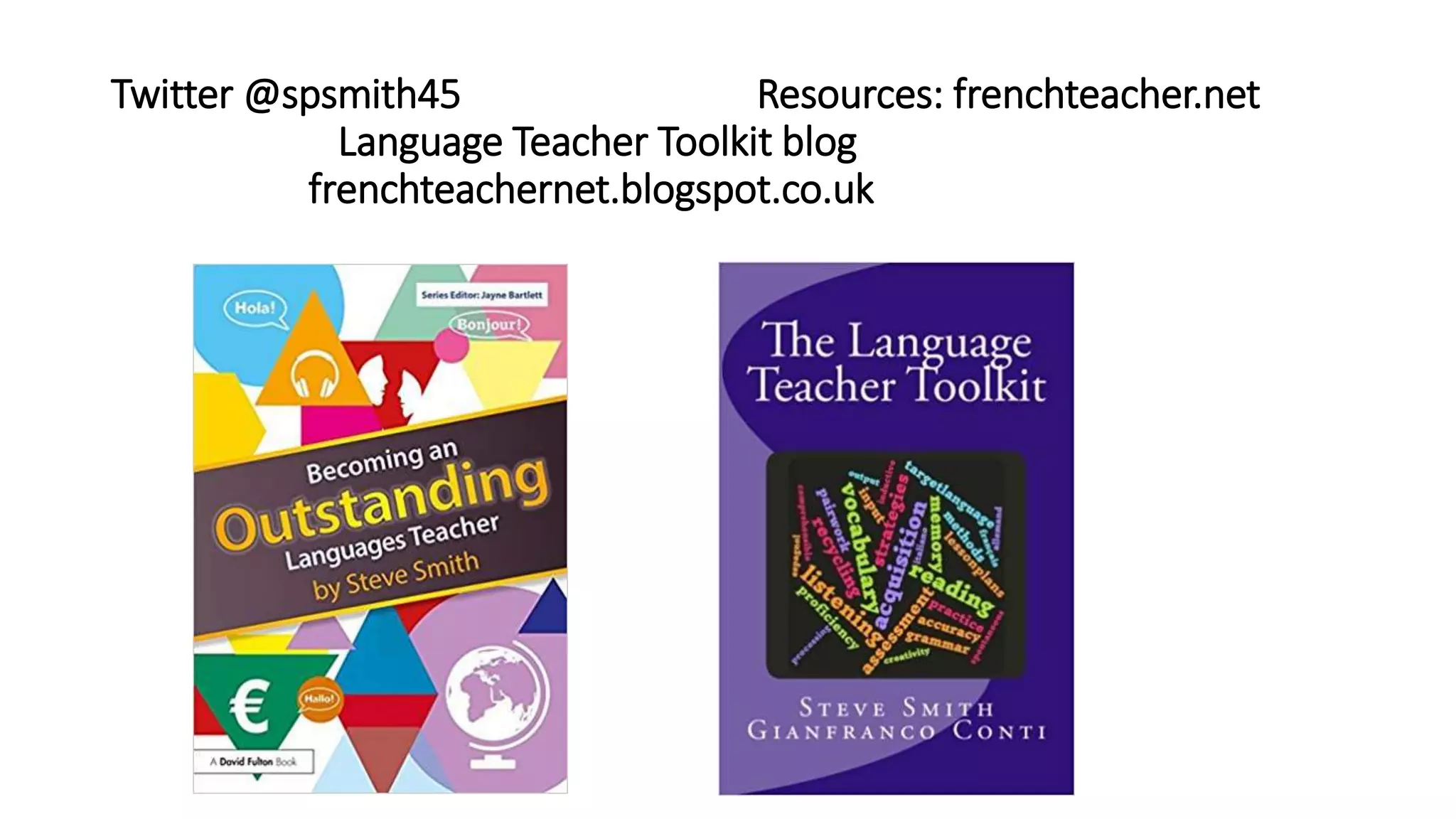
Twitter @spsmith45 Resources: frenchteacher.net
Language Teacher Toolkit blog
frenchteachernet.blogspot.co.uk

Listening power point York Teachmeet

  • 1.
    York Teachmeet “Breaking theSound Barrier” June 7th 2017
  • 2.
    Listening – theCinderella skill? • Importance for acquisition • One-way versus two-way listening • Process versus product • We get better at what we practice • Role of phonology and phonics
  • 3.
    Bottom-up and top-downlistening skills •Top-down – using background knowledge, context , rules of conversation •Bottom-up – decoding the message bit-by- bit
  • 4.
    How do welisten? John Field model 1. Decoding – matching acoustic sensations to sounds and syllables of the language 2. Lexical search – dividing connected speech into words and matching these with your lexicon 3. Parsing – imposing a grammatical pattern on words 4. Meaning construction – enriching bare meaning of utterance 5. Discourse construction – linking information to what went before
  • 5.
    Problem with comprehensionmodel? Danger of assuming listening skills will develop without specific attention to bottom-up decoding skills Role of phonics Phonics: a method for teaching reading and writing of a language by developing learners' phonemic awareness—the ability to hear, identify, and manipulate phonemes—in order to teach the correspondence between these sounds and the spelling patterns (graphemes) that represent them.
  • 6.
    Teaching Schools CouncilReport (2017) “There is significant evidence, including from the most effective practitioners, that direct and systematic teaching of phonics in the new language is a more reliable method for assuring accurate pronunciation and spelling. However, this is still relatively rare practice in classrooms.” “The aim should be that a pupil can pronounce most words accurately from the written form, including those not yet explicitly taught; and that they can produce a potentially accurate spelling of new words.” https://www.tscouncil.org.uk/wp-content/uploads/2016/12/MFL- Pedagogy-Review-Report-2.pdf (p.12)
  • 7.
    Phonics ideas (1) •Rachel Hawkes rachelhawkes.com “What I mean by phonics is teaching the key sounds of the foreign language (‘key’ being those sounds that are written the same but pronounced differently in English) and fixing them in long-term memory by embedding them in words, often nouns but not always.”
  • 8.
    Phonics ideas (2) Wordmind-reading • After presenting one or more phonemes and doing much receptive work write a number of words (10-12?) containing that the phoneme(s) on the board. • Play “hide the flashcard”. Write one of the words on a mini- board and ask pupils to guess the hidden word. This generates many repetitions, while giving you plenty of chances to give feedback. • You can use chunks rather than isolated words.
  • 9.
    Phonics ideas (3) Faultyecho • Write a sentence on the board containing one or more phonemes you have practised recently. Then, repeat the sentence twice, once correctly and the second time making one or more mistakes. Reward the person or team (if you split the class into groups) who spot the mistake(s) by uttering the sentence correctly.
  • 10.
    Phonics ideas (4) Trackthe sound 1. Read a text and tell students to clap, put their hand up or stand every time they hear a specific sound. 2. Read a text and tell them to note down every word they hear containing the target sound (it doesn’t matter if the spelling is incorrect). 3. Tell students at the start of the lesson you will reward any instance of them spotting the target sounds in your input, at any point in the lesson.
  • 11.
    Phonics ideas (5) Saythe next word or sound (aural gap-fill) • For near beginners or low intermediates. Simply read aloud a text you have been working on. When you pause, either at the end of a word, or in the middle of one, students have to call out or whisper the next word or sound. Make sure you pause before the target sound(s) or a word containing the target sound(s). Pupils like short-term memory tasks.
  • 12.
    Issues with teachingphonics/phonology • Get it right from the start • Get students enjoying playing with sounds • Insist on accuracy – be rigorous • Show written word • Do it in short bursts regularly • Danger of neglecting communication – focus on form rather than meaning • Remember intonation – useful for identifying gaps between words • Not a panacea!
  • 13.
  • 14.
    Developing intermediate listening(1) Importance of teacher voice – listening is social “Detect my lies” Give a simple account about yourself or, for example, what you did during the last weekend or a recent holiday. Choose your topic depending on what theme, grammar or vocabulary you’ve recently covered. Talk for about two minutes and ask the class to detect five lies within your account. Make these quite subtle inaccuracies or blindingly obvious inventions, depending on your class. Use as many verbal cues as possible to help students understand, e.g. repetition, rewording and hesitation. Try it!
  • 15.
  • 16.
    Developing intermediate listening(3) What can I take on holiday? • Tell students they’re going on a holiday and have to work out what they can or can’t take with them. Only you know the criterion that an object must meet for the student to be able to take it. The students must work out the criterion. • Give students one example of an object which can be taken, enclosed in a model TL statement, e.g. I’m going to Barcelona, and I’m going to bring [a swimsuit]. Write the model statement on the board, then turn it into a question and reflect it back to the class: What are you going to bring to Barcelona?
  • 17.
    Developing intermediate listening(4) Would I lie? Students work out which 3 of 6 statements are not true by asking you questions. Prepare 6 statements about yourself, three true and three false, and write them on the board. For example:  My brother has twin sons.  I have three cats.  If I’d been a boy, I would’ve been called George.  My family was brought up in Spain.  My favourite movie is The Sound of Music.  My father was an extra in Star Wars. Tell them there are 3 false statements and they have to find them by asking you questions, listening to your answers and watching your reaction. You can embroider your answers as much as possible, giving the right number of hints depending on how fast you think your class is.
  • 18.
    Interpersonal listening Question typeExample True/false statement. Tom is a cat. True or false? Yes/no question through intonation. Tom’s a cat? Yes/no question. Is Tom a cat? Either/or question. Is Tom a cat or a dog? Multiple-choice question. Is Tom a dog, cat, elephant or crocodile? Question word question. What is Tom?
  • 19.
    Listening via question-answer PeppaPig est le personnage principal de la série. C’est une cochonne. Elle habite une petite maison avec son frère Georges et ses parents. C’est la fille de la famille. Elle a beaucoup d’amis. Elle porte une robe rouge et des chaussures noires. Elle a sept ans. Elle adore sauter dasn des flaques d’eau. Papa Pig est le père de Peppa. Il est content et il aime jouer avec peppa et Georges. Il adore les cookies et le gateau au chocolat. Il aime danser et jouer de l’accordéon, mais il n’aime pas l’exercice physique. Il travaille dans un bureau.
  • 20.
    Physical listening •Simon Says(not just parts of body) •Alouette •Describe and do •Mute customer
  • 21.
    Developing advanced listening •Lecture format to develop listening and cultural knowledge (AO4) • General knowledge quizzes • Inviting a native speaker (or other native speaker!) • Lyricstraining.com • Independent listening tasks – various sources • Ilini.com (French) • News in Slow French/German/Spanish • See links at frenchteacher.net for more French
  • 22.
    Twitter @spsmith45 Resources:frenchteacher.net Language Teacher Toolkit blog frenchteachernet.blogspot.co.uk