Introduction to Wireless Sensor Networks
1
Introduction to
Wireless Sensor Networks
Mr. Lokesh M. Giripunje
DYPIEMR
UNIT 1
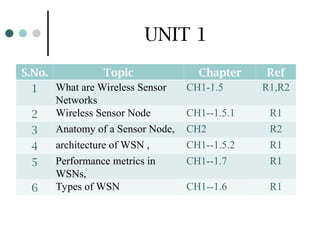
S.No. Topic Chapter Ref
1 What are Wireless Sensor
Networks
CH1-1.5 R1,R2
2 Wireless Sensor Node CH1--1.5.1 R1
3 Anatomy of a Sensor Node, CH2 R2
4 architecture of WSN , CH1--1.5.2 R1
5 Performance metrics in
WSNs,
CH1--1.7 R1
6 Types of WSN CH1--1.6 R1
Introduction to Wireless Sensor Networks
3
Introduction
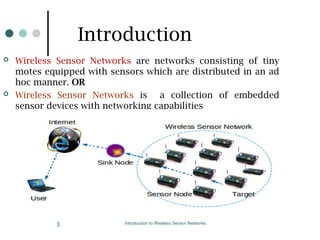
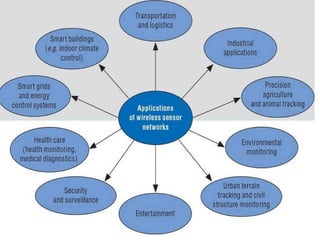
 Wireless Sensor Networks are networks consisting of tiny
motes equipped with sensors which are distributed in an ad
hoc manner. OR
 Wireless Sensor Networks is a collection of embedded
sensor devices with networking capabilities
Introduction to Wireless Sensor Networks
4
Introduction
 These sensors work with each other to
sense some physical phenomenon and then
the information gathered is processed to
get relevant results.
 Wireless sensor networks consists of
protocols and algorithms with self-
organizing capabilities.
Introduction to Wireless Sensor Networks
5
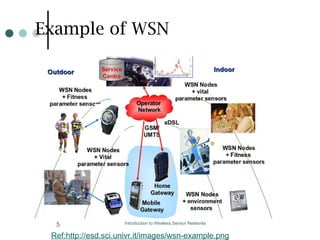
Example of WSN
Ref:http://esd.sci.univr.it/images/wsn-example.png
Introduction to Wireless Sensor Networks
6
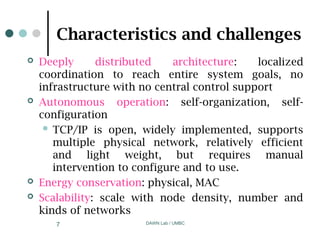
Characteristics and challenges
 Deeply distributed architecture: localized
coordination to reach entire system goals, no
infrastructure with no central control support
 Autonomous operation: self-organization, self-
configuration
 TCP/IP is open, widely implemented, supports
multiple physical network, relatively efficient
and light weight, but requires manual
intervention to configure and to use.
 Energy conservation: physical, MAC
 Scalability: scale with node density, number and
kinds of networks
DAWN Lab / UMBC
7
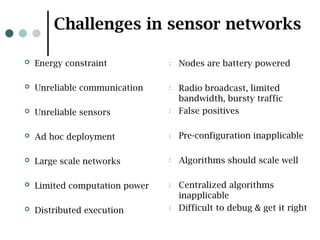
Challenges in sensor networks
 Energy constraint
 Unreliable communication
 Unreliable sensors
 Ad hoc deployment
 Large scale networks
 Limited computation power
 Distributed execution
: Nodes are battery powered
: Radio broadcast, limited
bandwidth, bursty traffic
: False positives
: Pre-configuration inapplicable
: Algorithms should scale well
: Centralized algorithms
inapplicable
: Difficult to debug & get it right
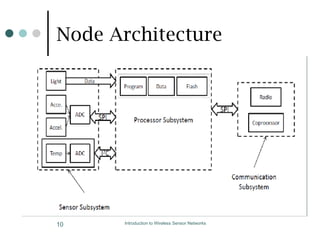
Node Architecture
 Wireless sensor nodes are the essential
building blocks in a wireless sensor
network
 The node consists of sensing, processing,
communication, and power subsystems
Introduction to Wireless Sensor Networks
9
Node Architecture
Introduction to Wireless Sensor Networks
10
Contd…
 The Sensing Subsystem
 Sensors
 Analog-to-Digital Converter
 The Processor Subsystem
 Architectural Overview
 Microcontroller
 Digital Signal Processor
 Application-specific Integrated Circuit
 Field Programmable Gate Array
 Communication Interfaces
 Serial Peripheral Interface
 Inter-Integrated Circuit
Introduction to Wireless Sensor Networks
11
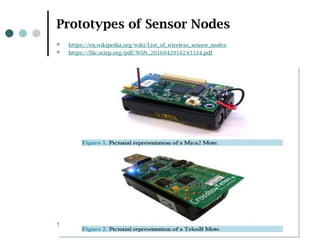
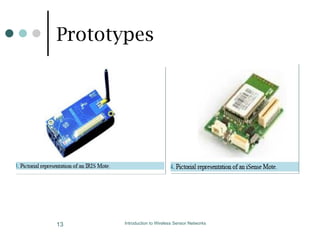
Prototypes of Sensor Nodes
 https://en.wikipedia.org/wiki/List_of_wireless_sensor_nodes
 https://file.scirp.org/pdf/WSN_2016042016243334.pdf
Introduction to Wireless Sensor Networks
12
Prototypes
Introduction to Wireless Sensor Networks
13
TELOSB MOTE
Introduction to Wireless Sensor Networks
14
Ref:http://www.eecs.berkeley.edu/~culler/eecs194/labs/lab1/telosb.JPG
Operating Systems
 TINYOS
 Contiki
 eRTOS
 MuCOS-2
 https://en.wikipedia.org/wiki/
List_of_wireless_sensor_nodes
Introduction to Wireless Sensor Networks
15
TinyOS
 most popular operating system for WSN
 developed by UC Berkeley
 features a component-based architecture
 software is written in modular pieces called
components
 Each component denotes the interfaces that it
provides
 An interface declares a set of functions called
commands that the interface provider
implements and another set of functions called
events that the interface user should be ready
to handle
Performance Metrics
 Network lifetime: It is measure of energy efficiency, as
sensor nodes are battery operated, WSNs protocols must be
energy efficient to maximize system lifetime.
 Energy consumption. : It is the sum of used energy by all
WSN nodes.
 Latency: It is the end-to-end delay that implies the average
time between sending a packet from the source, and the time
for successfully receiving the message at the destination.
 Accuracy : It is the freedom from mistake or error,
correctness, conformity to truth, exactness
 Fault-tolerance : Sensors may fail due to surrounding
physical conditions or when their energy runs out.
Introduction to Wireless Sensor Networks
17
Performance Metrics
 Scalability : As a prime factor, it is WSN
adaptability to increased workload
 Network throughput : It is a common metric
for all networks. The end-to-end throughput
measures the number of packets per second
received at the destination.
Introduction to Wireless Sensor Networks
18
Types of WSN
 1.6.1 Terrestrial WSNs
 These types of networks consist of hundreds or
thousands of wireless sensor nodes. These nodes
can be deployed in an unstructured or a structured
manner. The nodes are distributed randomly in an
unstructured mode, but they are kept within the
target area.
 As these are the ‘terrestrial’ sensor networks
therefore they are above ground and solar cells can
be used to power up these networks. The energy
can be conserved by minimizing delays and by
using operations of low duty cycles etc.
Introduction to Wireless Sensor Networks
19
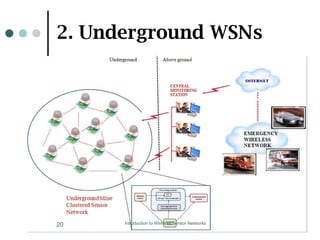
2. Underground WSNs
Introduction to Wireless Sensor Networks
20
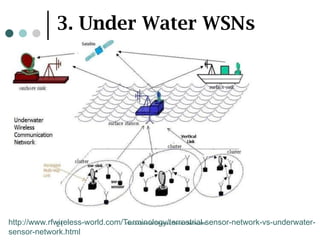
3. Under Water WSNs
Introduction to Wireless Sensor Networks
21
http://www.rfwireless-world.com/Terminology/terrestrial-sensor-network-vs-underwater-
sensor-network.html
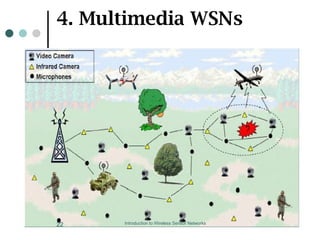
4. Multimedia WSNs
Introduction to Wireless Sensor Networks
22
5. Mobile WSNs
 The mobile wireless sensor networks are
much more versatile than the static
sensor networks. The advantages of
MWSN over the static wireless sensor
networks include better and improved
coverage, better energy efficiency,
superior channel capacity, and so on.
Introduction to Wireless Sensor Networks
23
Useful links
 http://vlab.amrita.edu/index.php?
sub=78&brch=256
 https://www3.nd.edu/~cpoellab/
teaching/cse40815
Introduction to Wireless Sensor Networks
25
References
1. Eschenauer, L., and V. Gligor, “A Key-Management Scheme for Distributed Sensor
Networks,” Proceedings of ACM Conference on Computer and Communications
Security (ACM CCS), Washington DC, pp. 41-47, 2002
2. http://www.xbow.com/products/Product_pdf_files/Wireless_pdf/
MICA2_Datasheet.pdf
3. http://www.ece.osu.edu/~bibyk/ee582/telosMote.pdf
4. http://en.wikipedia.org/wiki/Wireless_Sensor_Networks
5. http://arri.uta.edu/acs/networks/WirelessSensorNetChap04.pdf
6. http://www.eecs.harvard.edu/~mdw/course/cs263/papers/jhill-thesis.pdf
7. http://www.polastre.com/papers/polastre-thesis-final.pdf
8. www.cse.fau.edu/~jie/teaching/fall_2004_files/sensorslides1.ppt
9. http://web2.uwindsor.ca/courses/cs/aggarwal/cs60520/SeminarMaterial/WSN-
future.ppt
10. http://web.cecs.pdx.edu/~nbulusu/talks/grace-hopper.ppt
11. http://galaxy.cs.lamar.edu/~bsun/wsn/wsn.html
12. www.dsc.ufcg.edu.br/~maspohn/katia/introduction.ppt
13. http://computer.howstuffworks.com/mote1.htm
Introduction to Wireless Sensor Networks
26
THANK YOU
Introduction to Wireless Sensor Networks
27
www.cse.fau.edu/~jie/teaching/fall_2004_files/sensorslides1.ppt
http://web2.uwindsor.ca/courses/cs/aggarwal/cs60520/SeminarMaterial/WSN-future.ppt
http://web.cecs.pdx.edu/~nbulusu/talks/grace-hopper.ppt
http://galaxy.cs.lamar.edu/~bsun/wsn/wsn.html
www.dsc.ufcg.edu.br/~maspohn/katia/introduction.ppt
http://computer.howstuffworks.com/mote1.htm
http://www.polastre.com/papers/polastre-thesis-final.pdf
References
Comparison with Ad Hoc
Wireless Networks
 The number of nodes in sensor network can be
several orders of magnitude large than the
number of nodes in an ad hoc network.
 Sensor nodes are more easy to failure and
energy drain, and their battery sources are
usually not replaceable or rechargeable.
 Sensor nodes may not have unique global
identifiers (ID), so unique addressing is not
always feasible in sensor networks.
Comparison with Ad Hoc
Wireless Networks
 Sensor networks are data-centric, the queries in
sensor networks are addressed to nodes which
have data satisfying some conditions. Ad Hoc
networks are address-centric, with queries
addressed to particular nodes specified by their
unique address.
 Data fusion/aggregation: the sensor nodes
aggregate the local information before relaying.
The goals are reduce bandwidth consumption,
media access delay, and power consumption for
communication.
Comparison with ad hoc
networks
Wireless sensor networks mainly use
broadcast communication while ad hoc
networks use point-to-point communication.
Unlike ad hoc networks wireless sensor
networks are limited by sensors limited
power, energy and computational capability.
Sensor nodes may not have global ID because
of the large amount of overhead and large
number of sensors.
Introduction to Wireless Sensor Networks
30
Introduction to Wireless Sensor Networks
31

Wireless senson Network WSN Chapter-1.ppt

  • 1.
    Introduction to WirelessSensor Networks 1 Introduction to Wireless Sensor Networks Mr. Lokesh M. Giripunje DYPIEMR
  • 2.
    UNIT 1 S.No. TopicChapter Ref 1 What are Wireless Sensor Networks CH1-1.5 R1,R2 2 Wireless Sensor Node CH1--1.5.1 R1 3 Anatomy of a Sensor Node, CH2 R2 4 architecture of WSN , CH1--1.5.2 R1 5 Performance metrics in WSNs, CH1--1.7 R1 6 Types of WSN CH1--1.6 R1
  • 3.
    Introduction to WirelessSensor Networks 3 Introduction  Wireless Sensor Networks are networks consisting of tiny motes equipped with sensors which are distributed in an ad hoc manner. OR  Wireless Sensor Networks is a collection of embedded sensor devices with networking capabilities
  • 4.
    Introduction to WirelessSensor Networks 4 Introduction  These sensors work with each other to sense some physical phenomenon and then the information gathered is processed to get relevant results.  Wireless sensor networks consists of protocols and algorithms with self- organizing capabilities.
  • 5.
    Introduction to WirelessSensor Networks 5 Example of WSN Ref:http://esd.sci.univr.it/images/wsn-example.png
  • 6.
    Introduction to WirelessSensor Networks 6
  • 7.
    Characteristics and challenges Deeply distributed architecture: localized coordination to reach entire system goals, no infrastructure with no central control support  Autonomous operation: self-organization, self- configuration  TCP/IP is open, widely implemented, supports multiple physical network, relatively efficient and light weight, but requires manual intervention to configure and to use.  Energy conservation: physical, MAC  Scalability: scale with node density, number and kinds of networks DAWN Lab / UMBC 7
  • 8.
    Challenges in sensornetworks  Energy constraint  Unreliable communication  Unreliable sensors  Ad hoc deployment  Large scale networks  Limited computation power  Distributed execution : Nodes are battery powered : Radio broadcast, limited bandwidth, bursty traffic : False positives : Pre-configuration inapplicable : Algorithms should scale well : Centralized algorithms inapplicable : Difficult to debug & get it right
  • 9.
    Node Architecture  Wirelesssensor nodes are the essential building blocks in a wireless sensor network  The node consists of sensing, processing, communication, and power subsystems Introduction to Wireless Sensor Networks 9
  • 10.
    Node Architecture Introduction toWireless Sensor Networks 10
  • 11.
    Contd…  The SensingSubsystem  Sensors  Analog-to-Digital Converter  The Processor Subsystem  Architectural Overview  Microcontroller  Digital Signal Processor  Application-specific Integrated Circuit  Field Programmable Gate Array  Communication Interfaces  Serial Peripheral Interface  Inter-Integrated Circuit Introduction to Wireless Sensor Networks 11
  • 12.
    Prototypes of SensorNodes  https://en.wikipedia.org/wiki/List_of_wireless_sensor_nodes  https://file.scirp.org/pdf/WSN_2016042016243334.pdf Introduction to Wireless Sensor Networks 12
  • 13.
  • 14.
    TELOSB MOTE Introduction toWireless Sensor Networks 14 Ref:http://www.eecs.berkeley.edu/~culler/eecs194/labs/lab1/telosb.JPG
  • 15.
    Operating Systems  TINYOS Contiki  eRTOS  MuCOS-2  https://en.wikipedia.org/wiki/ List_of_wireless_sensor_nodes Introduction to Wireless Sensor Networks 15
  • 16.
    TinyOS  most popularoperating system for WSN  developed by UC Berkeley  features a component-based architecture  software is written in modular pieces called components  Each component denotes the interfaces that it provides  An interface declares a set of functions called commands that the interface provider implements and another set of functions called events that the interface user should be ready to handle
  • 17.
    Performance Metrics  Networklifetime: It is measure of energy efficiency, as sensor nodes are battery operated, WSNs protocols must be energy efficient to maximize system lifetime.  Energy consumption. : It is the sum of used energy by all WSN nodes.  Latency: It is the end-to-end delay that implies the average time between sending a packet from the source, and the time for successfully receiving the message at the destination.  Accuracy : It is the freedom from mistake or error, correctness, conformity to truth, exactness  Fault-tolerance : Sensors may fail due to surrounding physical conditions or when their energy runs out. Introduction to Wireless Sensor Networks 17
  • 18.
    Performance Metrics  Scalability: As a prime factor, it is WSN adaptability to increased workload  Network throughput : It is a common metric for all networks. The end-to-end throughput measures the number of packets per second received at the destination. Introduction to Wireless Sensor Networks 18
  • 19.
    Types of WSN 1.6.1 Terrestrial WSNs  These types of networks consist of hundreds or thousands of wireless sensor nodes. These nodes can be deployed in an unstructured or a structured manner. The nodes are distributed randomly in an unstructured mode, but they are kept within the target area.  As these are the ‘terrestrial’ sensor networks therefore they are above ground and solar cells can be used to power up these networks. The energy can be conserved by minimizing delays and by using operations of low duty cycles etc. Introduction to Wireless Sensor Networks 19
  • 20.
    2. Underground WSNs Introductionto Wireless Sensor Networks 20
  • 21.
    3. Under WaterWSNs Introduction to Wireless Sensor Networks 21 http://www.rfwireless-world.com/Terminology/terrestrial-sensor-network-vs-underwater- sensor-network.html
  • 22.
    4. Multimedia WSNs Introductionto Wireless Sensor Networks 22
  • 23.
    5. Mobile WSNs The mobile wireless sensor networks are much more versatile than the static sensor networks. The advantages of MWSN over the static wireless sensor networks include better and improved coverage, better energy efficiency, superior channel capacity, and so on. Introduction to Wireless Sensor Networks 23
  • 24.
    Useful links  http://vlab.amrita.edu/index.php? sub=78&brch=256 https://www3.nd.edu/~cpoellab/ teaching/cse40815
  • 25.
    Introduction to WirelessSensor Networks 25 References 1. Eschenauer, L., and V. Gligor, “A Key-Management Scheme for Distributed Sensor Networks,” Proceedings of ACM Conference on Computer and Communications Security (ACM CCS), Washington DC, pp. 41-47, 2002 2. http://www.xbow.com/products/Product_pdf_files/Wireless_pdf/ MICA2_Datasheet.pdf 3. http://www.ece.osu.edu/~bibyk/ee582/telosMote.pdf 4. http://en.wikipedia.org/wiki/Wireless_Sensor_Networks 5. http://arri.uta.edu/acs/networks/WirelessSensorNetChap04.pdf 6. http://www.eecs.harvard.edu/~mdw/course/cs263/papers/jhill-thesis.pdf 7. http://www.polastre.com/papers/polastre-thesis-final.pdf 8. www.cse.fau.edu/~jie/teaching/fall_2004_files/sensorslides1.ppt 9. http://web2.uwindsor.ca/courses/cs/aggarwal/cs60520/SeminarMaterial/WSN- future.ppt 10. http://web.cecs.pdx.edu/~nbulusu/talks/grace-hopper.ppt 11. http://galaxy.cs.lamar.edu/~bsun/wsn/wsn.html 12. www.dsc.ufcg.edu.br/~maspohn/katia/introduction.ppt 13. http://computer.howstuffworks.com/mote1.htm
  • 26.
    Introduction to WirelessSensor Networks 26 THANK YOU
  • 27.
    Introduction to WirelessSensor Networks 27 www.cse.fau.edu/~jie/teaching/fall_2004_files/sensorslides1.ppt http://web2.uwindsor.ca/courses/cs/aggarwal/cs60520/SeminarMaterial/WSN-future.ppt http://web.cecs.pdx.edu/~nbulusu/talks/grace-hopper.ppt http://galaxy.cs.lamar.edu/~bsun/wsn/wsn.html www.dsc.ufcg.edu.br/~maspohn/katia/introduction.ppt http://computer.howstuffworks.com/mote1.htm http://www.polastre.com/papers/polastre-thesis-final.pdf References
  • 28.
    Comparison with AdHoc Wireless Networks  The number of nodes in sensor network can be several orders of magnitude large than the number of nodes in an ad hoc network.  Sensor nodes are more easy to failure and energy drain, and their battery sources are usually not replaceable or rechargeable.  Sensor nodes may not have unique global identifiers (ID), so unique addressing is not always feasible in sensor networks.
  • 29.
    Comparison with AdHoc Wireless Networks  Sensor networks are data-centric, the queries in sensor networks are addressed to nodes which have data satisfying some conditions. Ad Hoc networks are address-centric, with queries addressed to particular nodes specified by their unique address.  Data fusion/aggregation: the sensor nodes aggregate the local information before relaying. The goals are reduce bandwidth consumption, media access delay, and power consumption for communication.
  • 30.
    Comparison with adhoc networks Wireless sensor networks mainly use broadcast communication while ad hoc networks use point-to-point communication. Unlike ad hoc networks wireless sensor networks are limited by sensors limited power, energy and computational capability. Sensor nodes may not have global ID because of the large amount of overhead and large number of sensors. Introduction to Wireless Sensor Networks 30
  • 31.
    Introduction to WirelessSensor Networks 31

Editor's Notes

  • #10 https://file.scirp.org/pdf/WSN_2016042016243334.pdf
  • #15 file:///C:/Users/Admin/Downloads/sensors-11-05900.pdf
  • #17 System lifetime can be measured by generic parameters such as the time until half of the nodes die, or by application directed metrics, such as when the network stops providing the application with the desired information about the environment, it is also calculated as the time until message loss rate exceeds a given threshold.
  • #20 The underground wireless sensor networks are more expensive than the terrestrial WSNs in terms of deployment, maintenance, and equipment cost considerations and careful planning. The WSNs networks consist of a number of sensor nodes that are hidden in the ground to monitor underground conditions. To relay information from the sensor nodes to the base station, additional sink nodes are located above the ground. he underground wireless sensor networks deployed into the ground are difficult to recharge. The sensor battery nodes equipped with a limited battery power are difficult to recharge. In addition to this, the underground environment makes wireless communication a challenge due to high level of attenuation and signal loss.
  • #21 The underwater sensor networks are designed to operate under water. Water is used as communication channel for communication. A typical underwater sensor network composed of transmitter and receiver part. It uses electromagnetic radio waves, optical waves and acoustic waves for communication. EM waves propagate at longer distances through conductive sea water at very low frequencies (i.e. 30 to 300Hz). This needs large antenna and high power for transmission. Hence it is not ideal for underwater communication.  In contrast to EM waves, optical waves do not suffer from very high attenuation. However optical communication under water suffers from scattering loss. Moreover it needs high precision narrower laser beams for carrying the information. Hence optical waves are suitable for short range communication in underwater environment.  Due to limitations of EM waves and Optical waves acoustic waves are used for communication in underwater sensor based networks.  Difference between Terrestrial sensor network and underwater sensor network Following are the differences between the two communication technologies: • Size and Cost: In Terrestrial network air is the communication medium, in underwater network water is the communication medium.  • terrestrial sensor nodes are inexpensive due to smaller size, underwater sensors are expensive devices. This is due to the fact that underwater transceiver hardware need to protected from extreme underwater environment and hence are costly.  • Deployment: Terrestrial sensor networks are densely deployed, while for underwater case deployment is more sparse due to cost and challenges involved.  • Power:The power required in acoustic underwater communication is higher compare to terrestrial communication due to greater distance and more complex signal processing needed at the receiver. Better signal processing is required under water due to complex channel conditions. In underwater networks more energy consumption is needed and hence battery capacity requirement is higher.  • Memory: Terrestrial sensor nodes have very limited storage capacity. Underwater sensor nodes require more data catching due to intermittent channel requirement.
  • #22 Muttimedia wireless sensor networks have been proposed to enable tracking and monitoring of events in the form of multimedia, such as imaging, video, and audio. These networks consist of low-cost sensor nodes equipped with micrpphones and cameras.