


Budgets
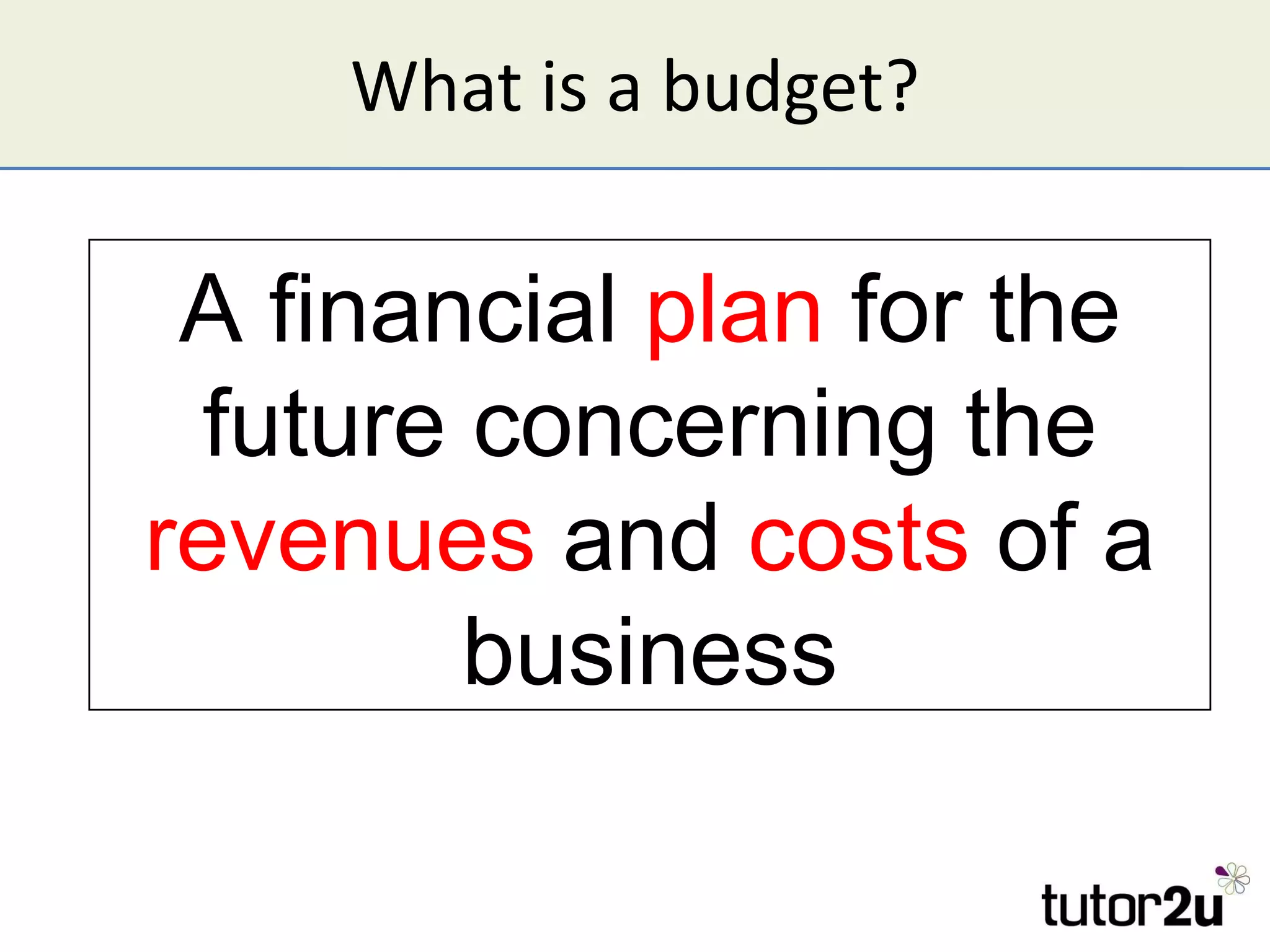
What is a budget? A financial  plan  for the future concerning the  revenues  and  costs  of a business
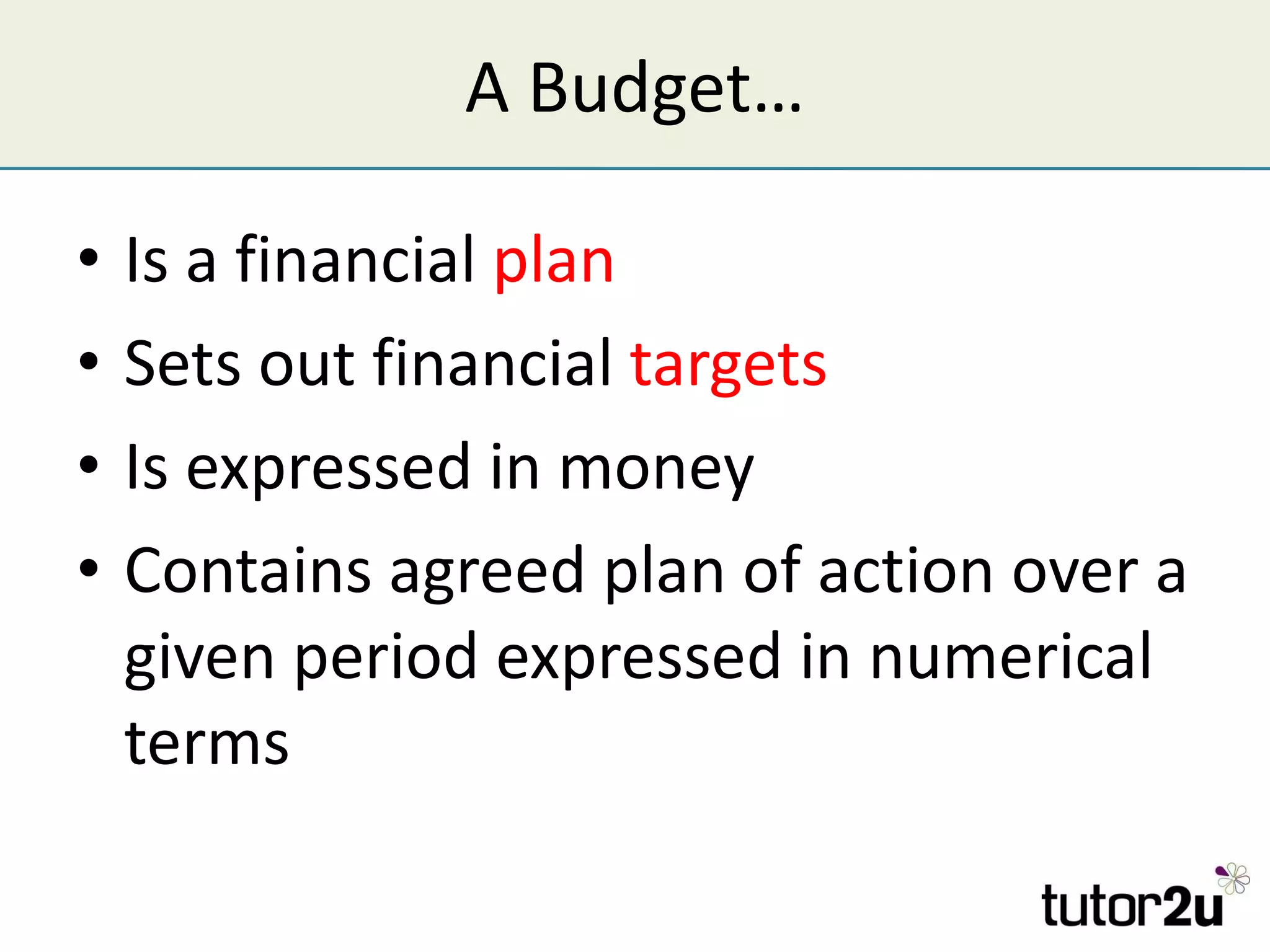
A Budget… Is a financial  plan Sets out financial  targets Is expressed in money Contains agreed plan of action over a given period expressed in numerical terms
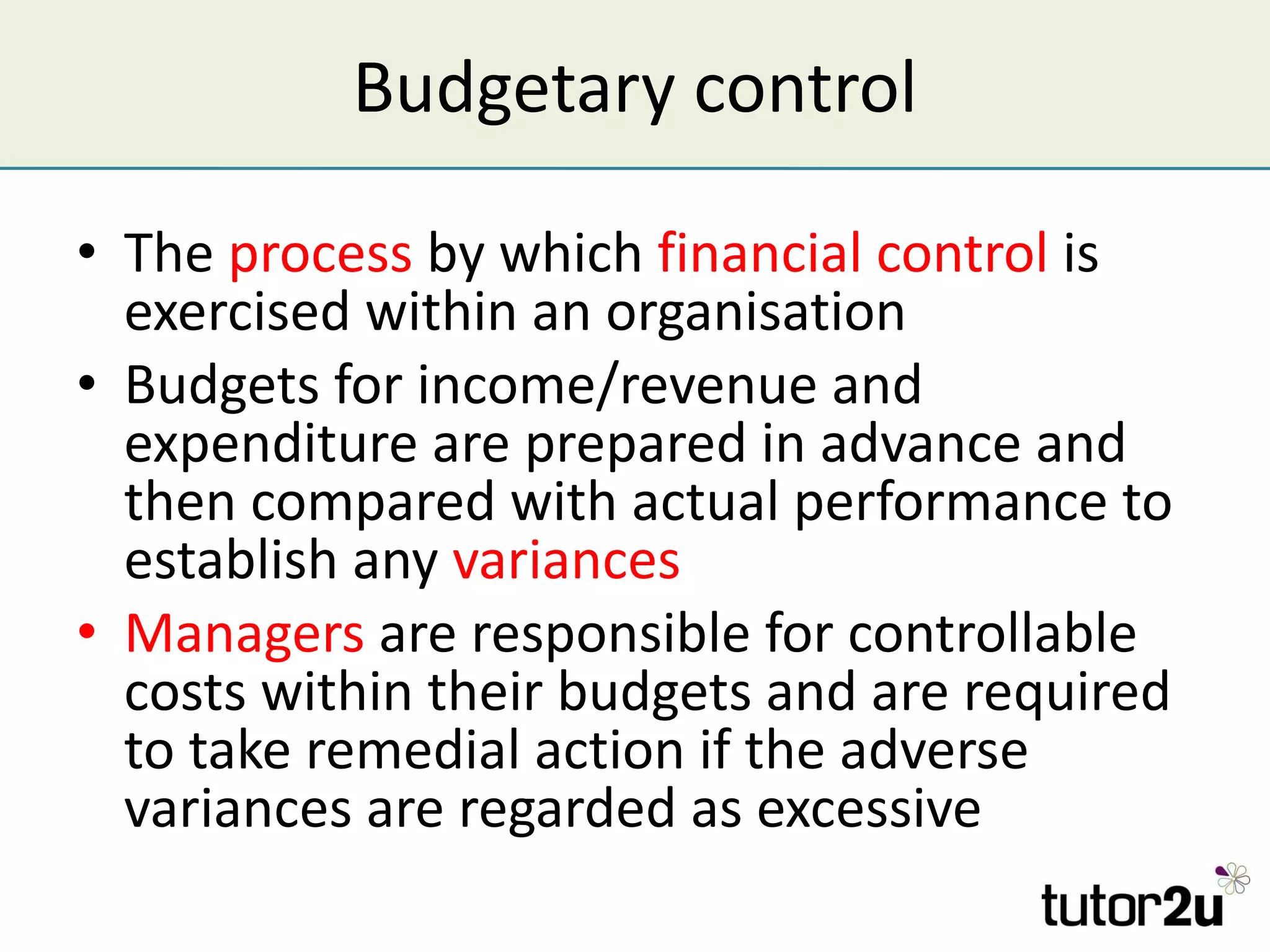
Budgetary control The  process  by which  financial control  is exercised within an organisation Budgets for income/revenue and expenditure are prepared in advance and then compared with actual performance to establish any  variances Managers  are responsible for controllable costs within their budgets and are required to take remedial action if the adverse variances are regarded as excessive
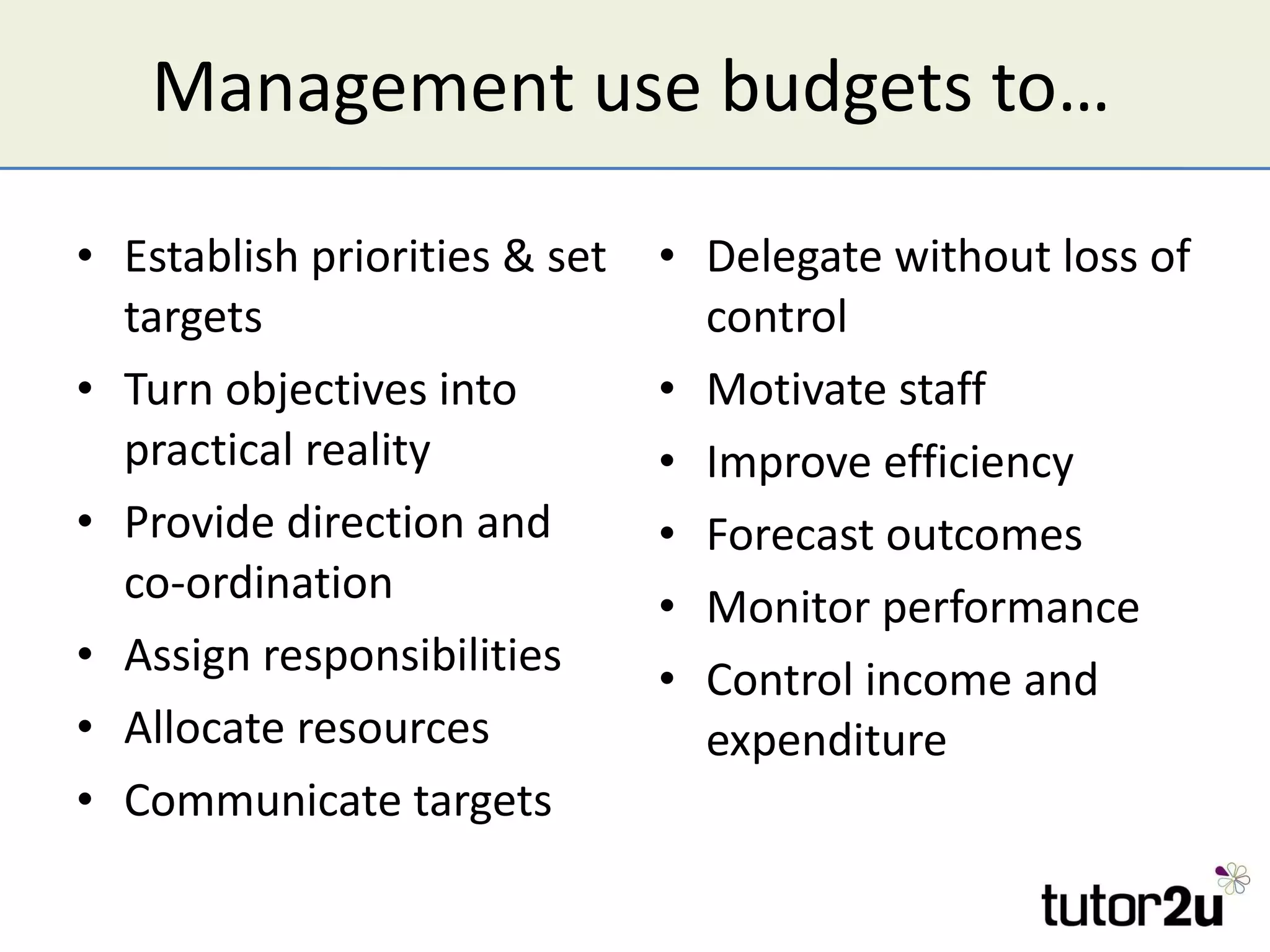
Management use budgets to… Establish priorities & set targets Turn objectives into practical reality Provide direction and co-ordination Assign responsibilities Allocate resources Communicate targets Delegate without loss of control Motivate staff Improve efficiency Forecast outcomes Monitor performance Control income and expenditure
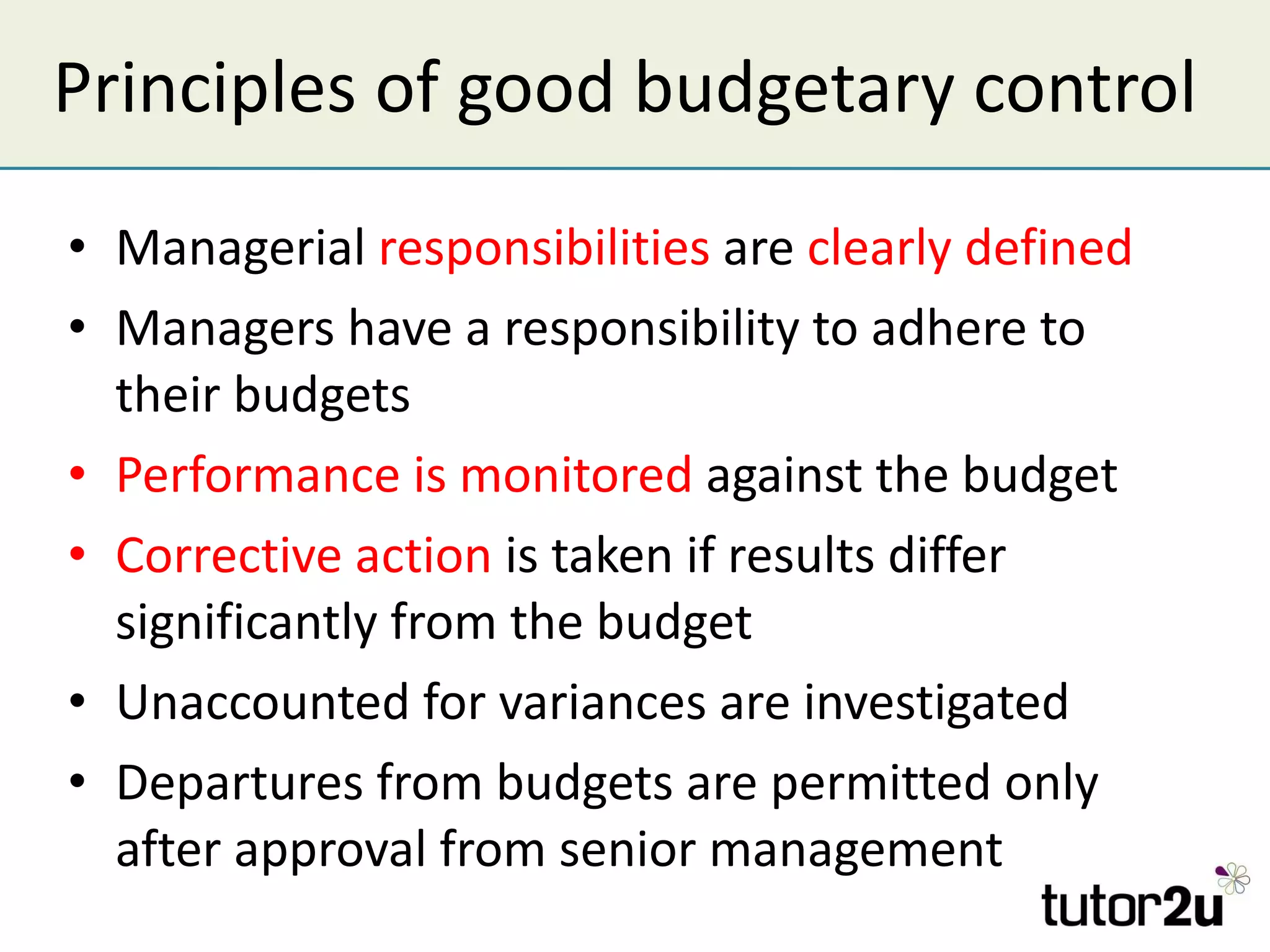
Principles of good budgetary control Managerial  responsibilities  are  clearly defined Managers have a responsibility to adhere to their budgets Performance is monitored  against the budget Corrective action  is taken if results differ significantly from the budget Unaccounted for variances are investigated Departures from budgets are permitted only after approval from senior management
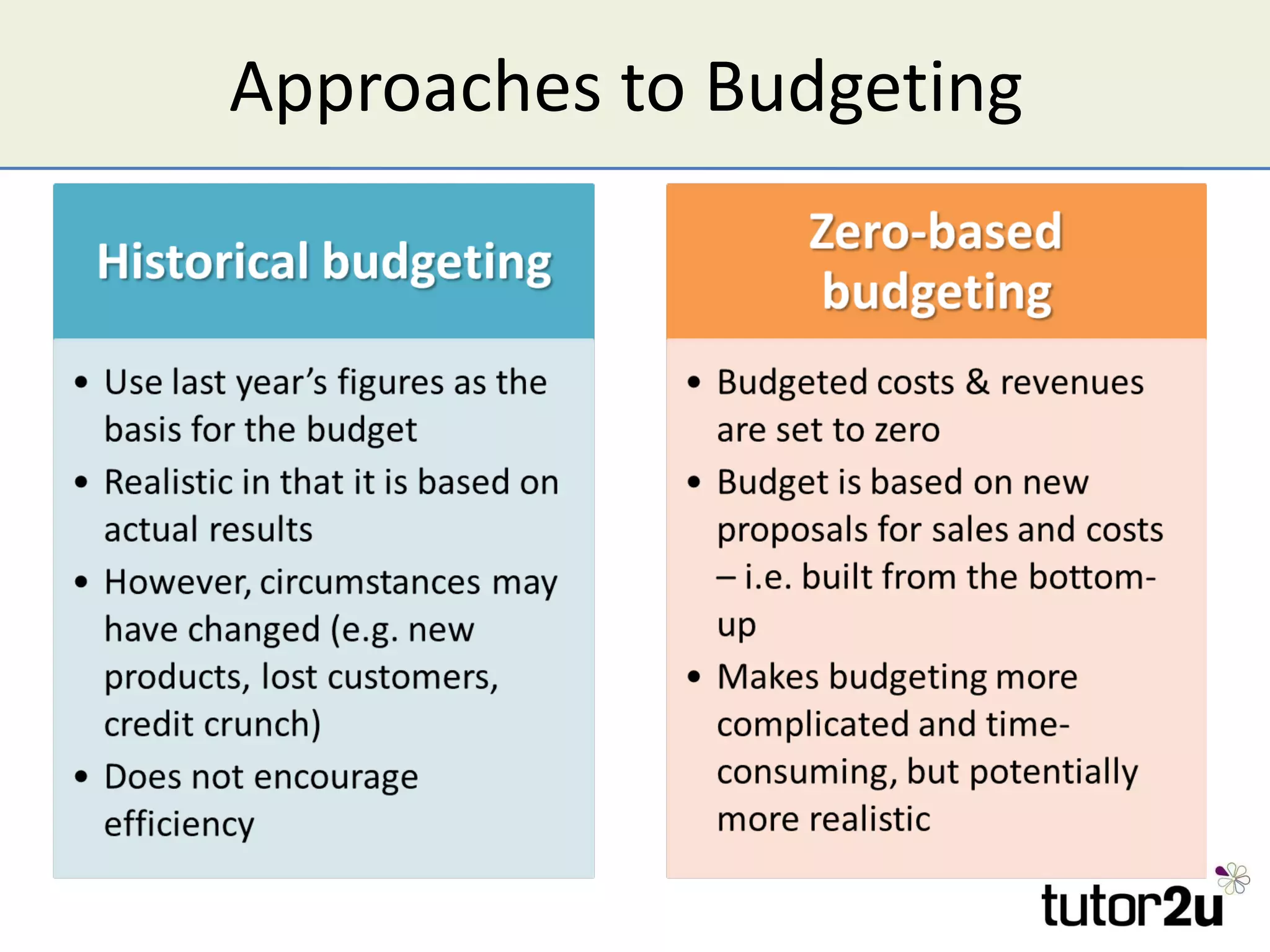
Approaches to Budgeting
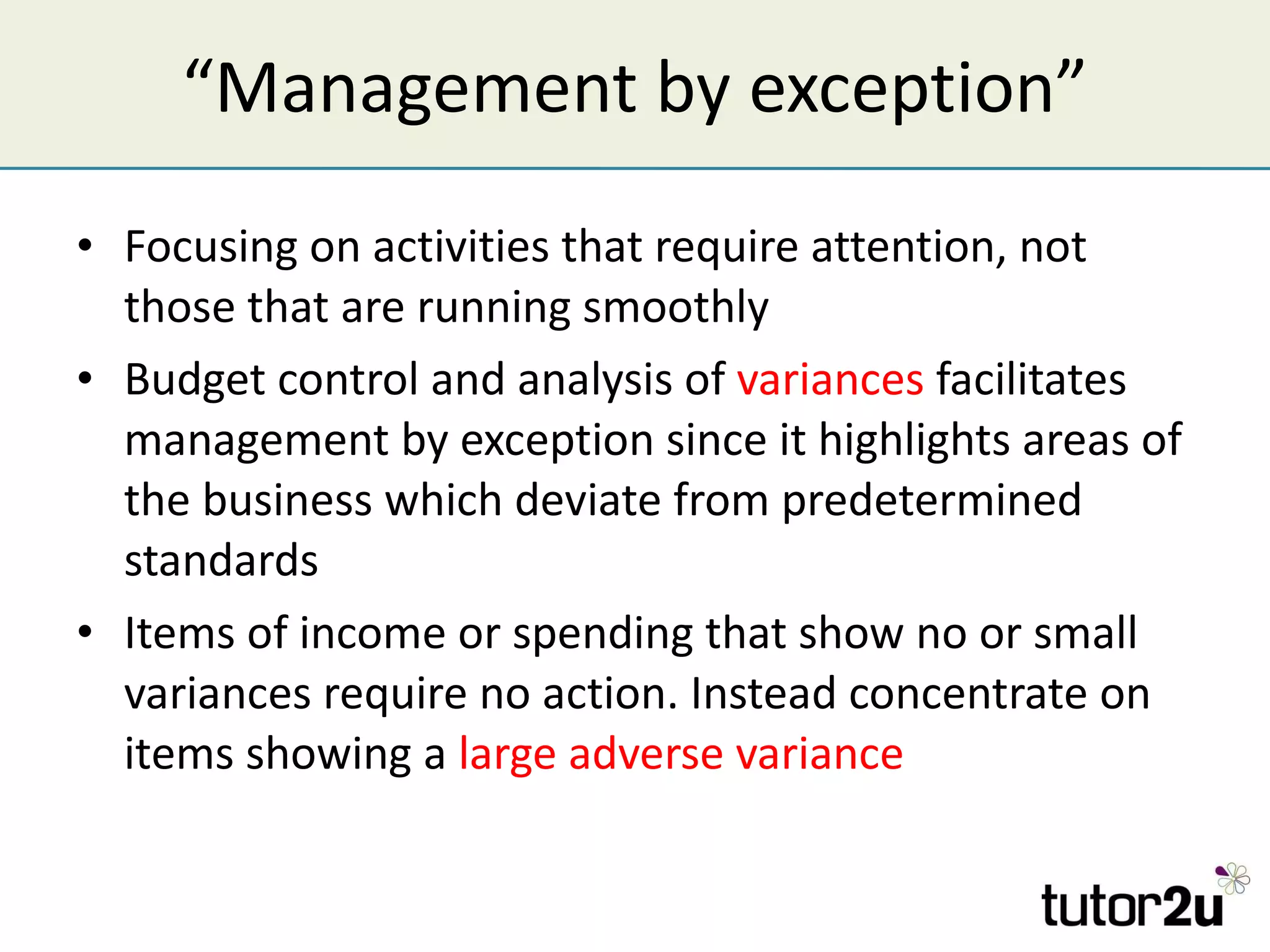
“ Management by exception” Focusing on activities that require attention, not those that are running smoothly Budget control and analysis of  variances  facilitates management by exception since it highlights areas of the business which deviate from predetermined standards Items of income or spending that show no or small variances require no action. Instead concentrate on items showing a  large adverse variance
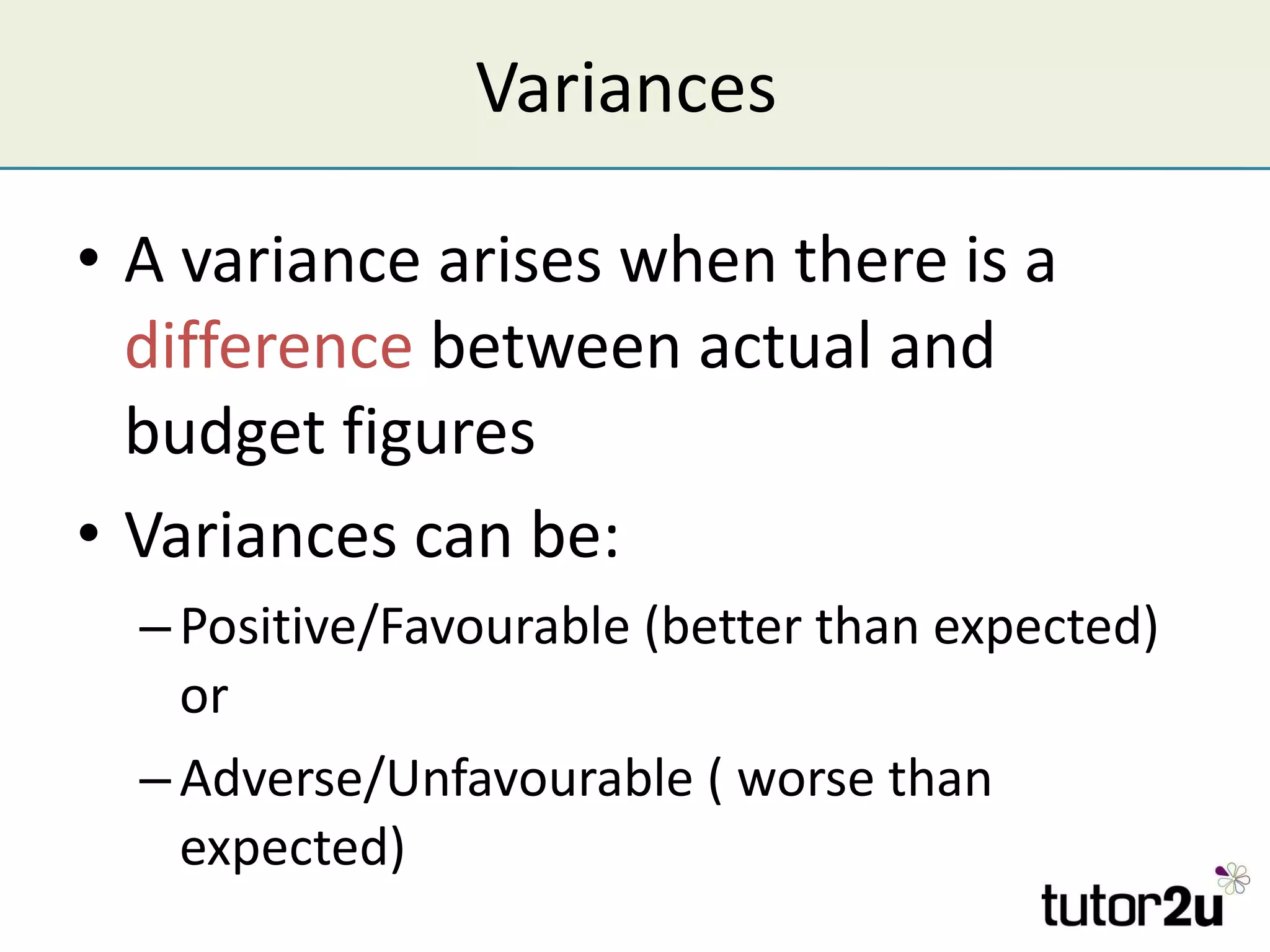
Variances  A variance arises when there is a  difference  between actual and budget figures Variances can be: Positive/Favourable (better than expected) or Adverse/Unfavourable ( worse than expected)
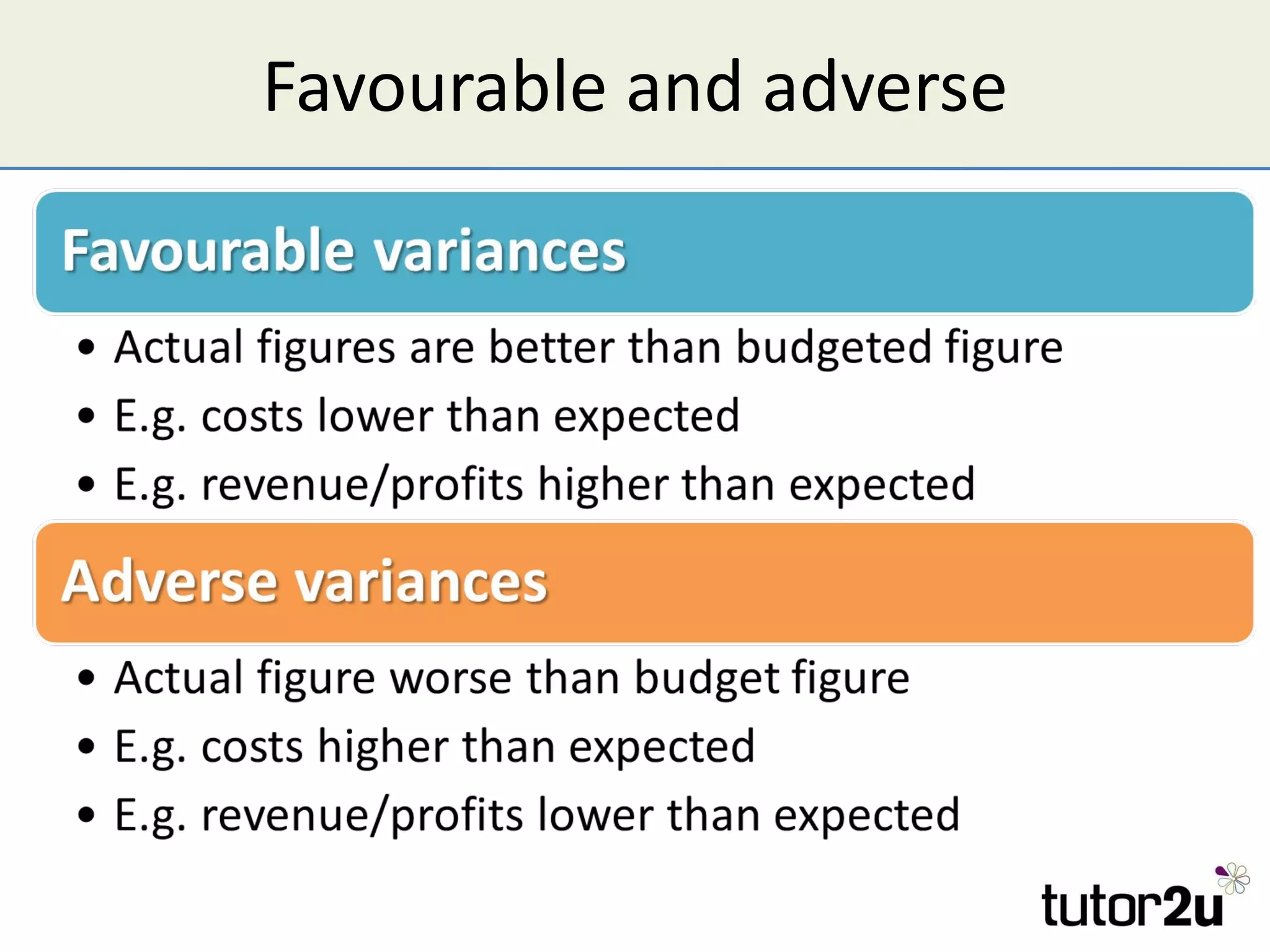
Favourable and adverse
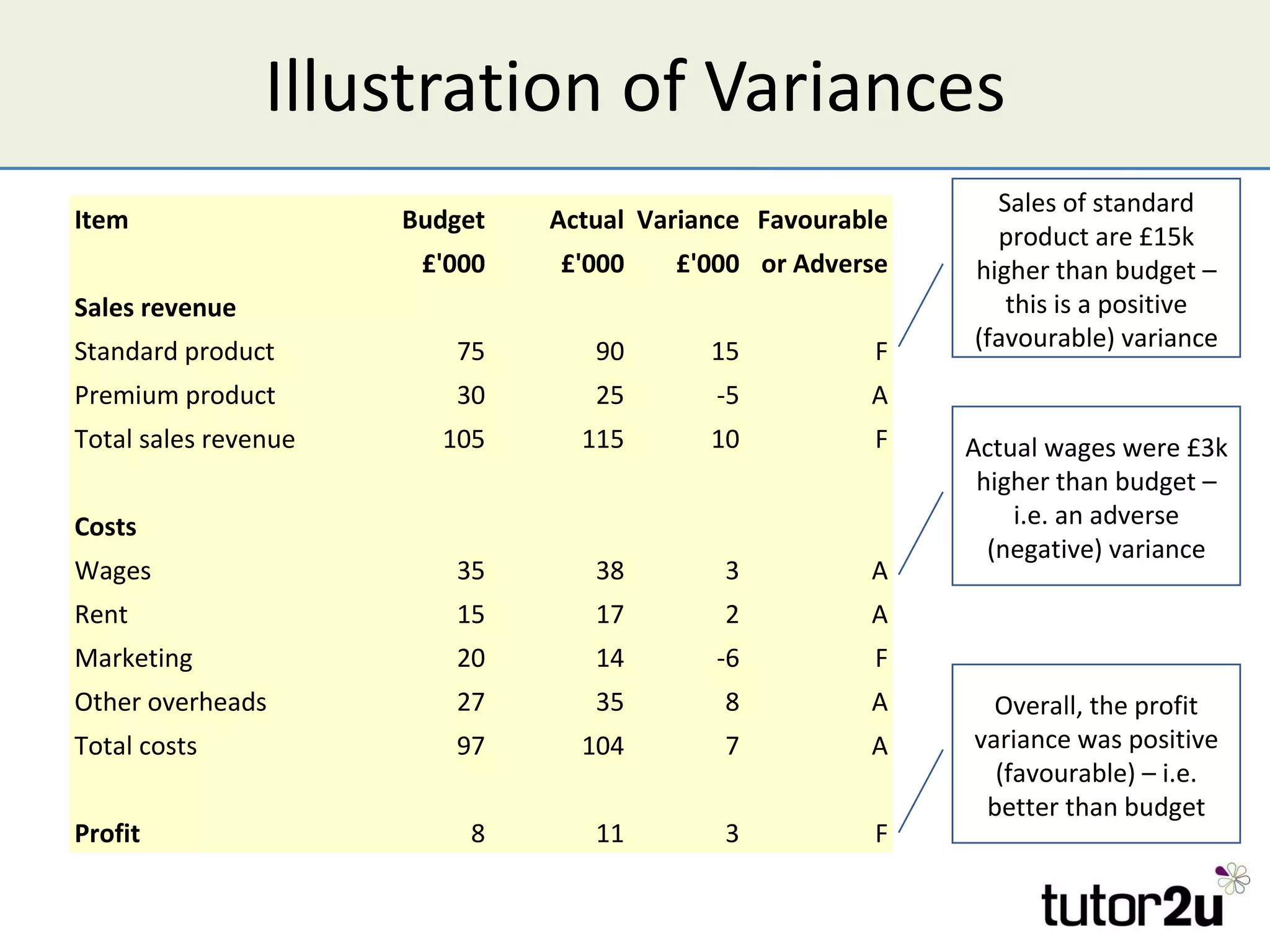
Illustration of Variances Sales of standard product are £15k higher than budget – this is a positive (favourable) variance Actual wages were £3k higher than budget – i.e. an adverse (negative) variance Overall, the profit variance was positive (favourable) – i.e. better than budget Item Budget Actual Variance Favourable £'000 £'000 £'000 or Adverse Sales revenue Standard product 75 90 15 F Premium product 30 25 -5 A Total sales revenue 105 115 10 F Costs Wages 35 38 3 A Rent 15 17 2 A Marketing 20 14 -6 F Other overheads 27 35 8 A Total costs 97 104 7 A Profit 8 11 3 F
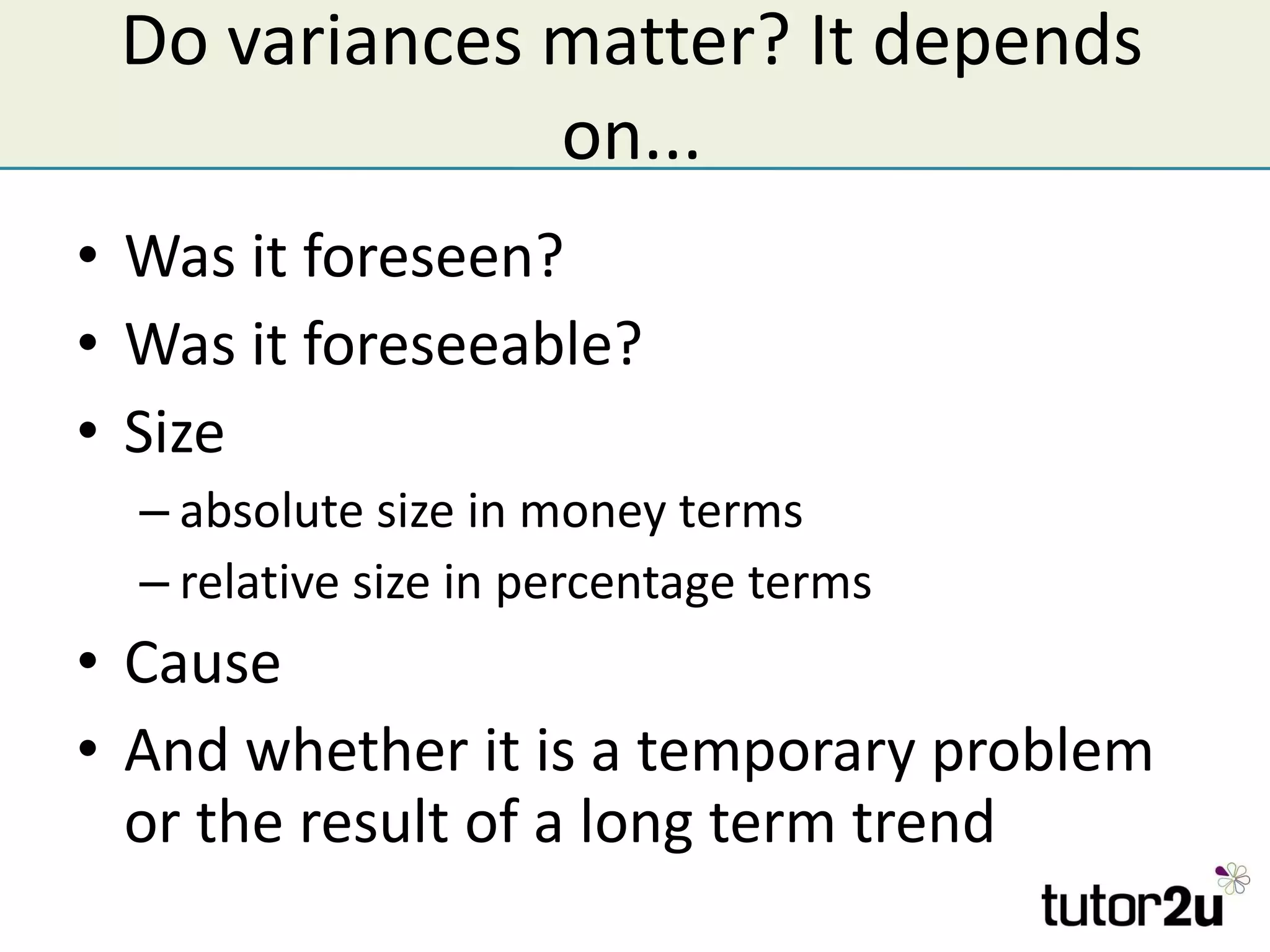
Do variances matter? It depends on... Was it foreseen? Was it foreseeable? Size absolute size in money terms relative size in percentage terms Cause And whether it is a temporary problem or the result of a long term trend
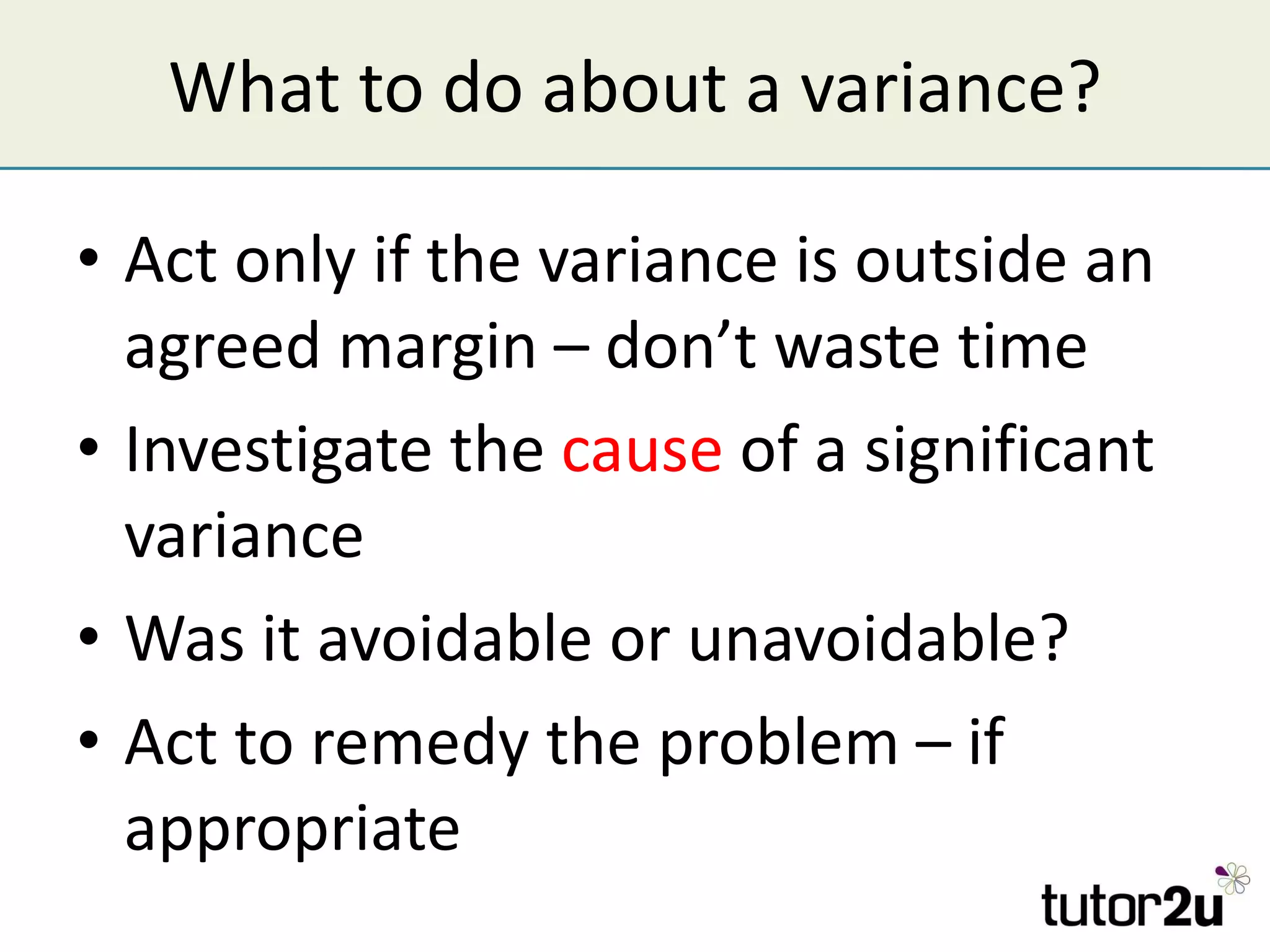
What to do about a variance? Act only if the variance is outside an agreed margin – don’t waste time Investigate the  cause  of a significant variance Was it avoidable or unavoidable? Act to remedy the problem – if appropriate
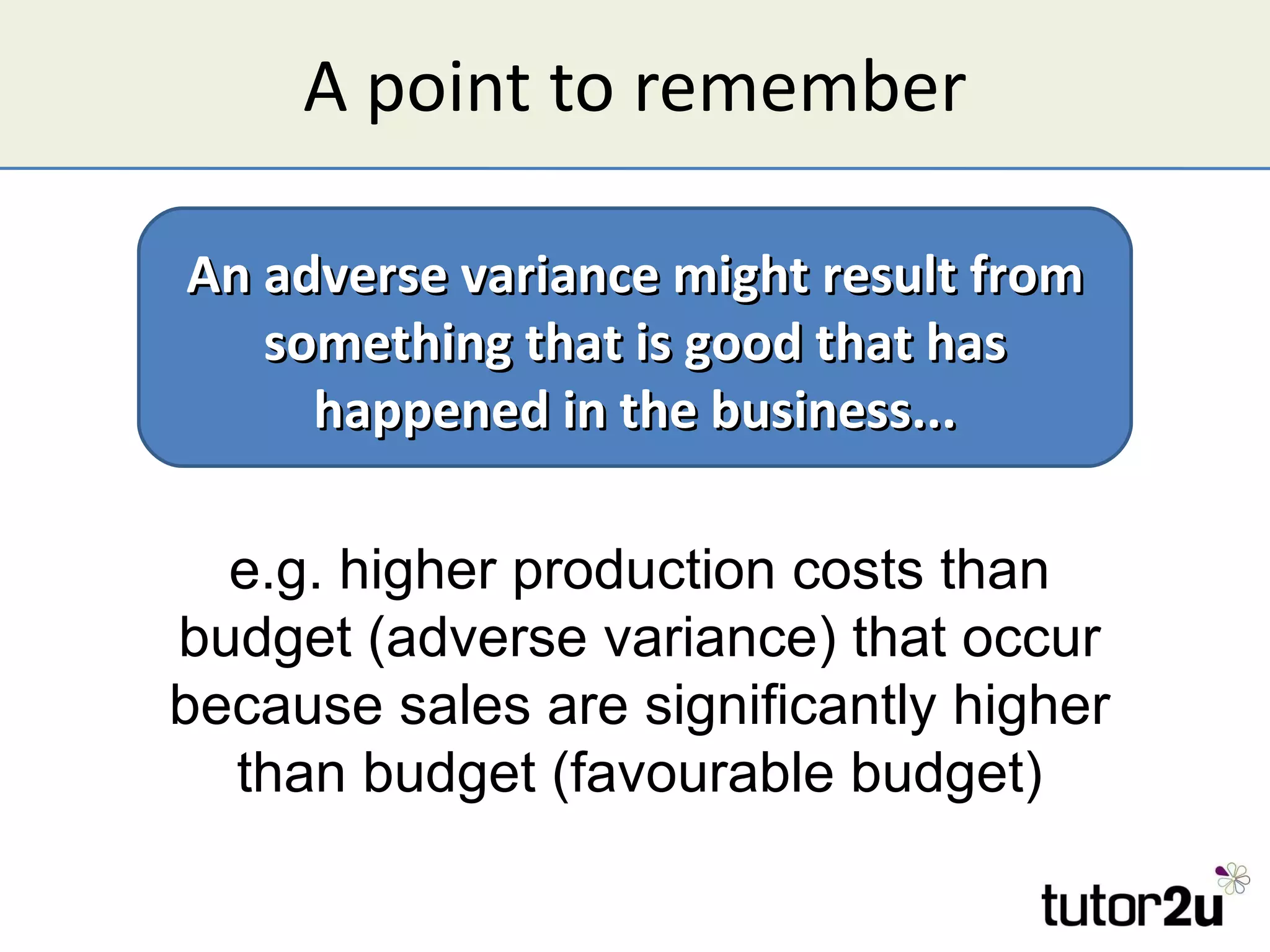
A point to remember An adverse variance might result from something that is good that has happened in the business... e.g. higher production costs than budget (adverse variance) that occur because sales are significantly higher than budget (favourable budget)
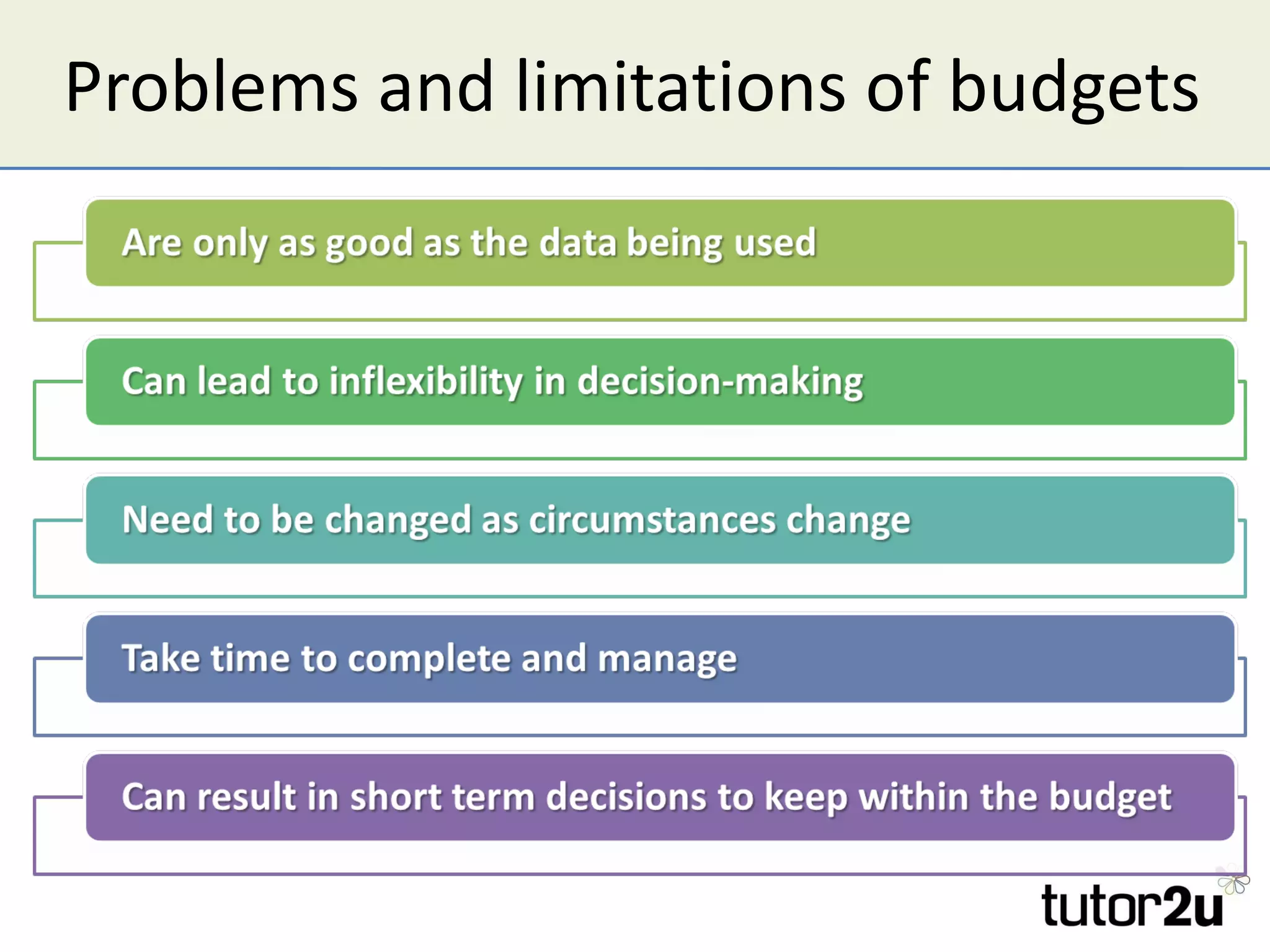
Problems and limitations of budgets
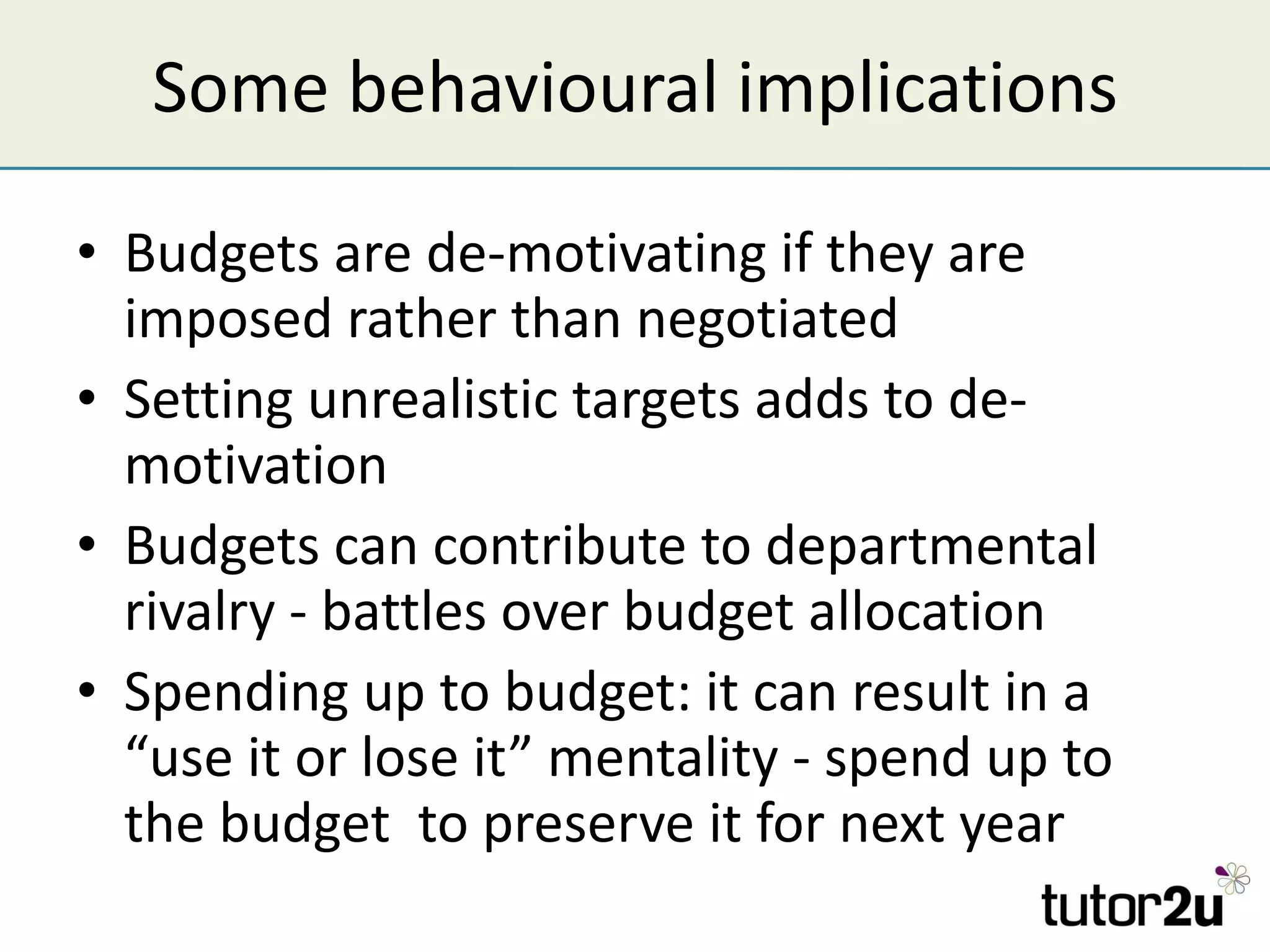
Some behavioural implications Budgets are de-motivating if they are imposed rather than negotiated Setting unrealistic targets adds to de-motivation Budgets can contribute to departmental rivalry - battles over budget allocation Spending up to budget: it can result in a “use it or lose it” mentality - spend up to the budget  to preserve it for next year
Test Your Understanding http://www.tutor2u.net/business/quiz/usingbudgets/quiz.html
Keep up-to-date with business stories, resources, quizzes and worksheets for your business course.  Click the logo!
Follow tutor2u on Twitter tutor2u tutor2u_econ
Become a fan of tutor2u on Facebook! tutor2u on Facebook

Budgets

  • 1.
  • 2.
    What is abudget? A financial plan for the future concerning the revenues and costs of a business
  • 3.
    A Budget… Isa financial plan Sets out financial targets Is expressed in money Contains agreed plan of action over a given period expressed in numerical terms
  • 4.
    Budgetary control The process by which financial control is exercised within an organisation Budgets for income/revenue and expenditure are prepared in advance and then compared with actual performance to establish any variances Managers are responsible for controllable costs within their budgets and are required to take remedial action if the adverse variances are regarded as excessive
  • 5.
    Management use budgetsto… Establish priorities & set targets Turn objectives into practical reality Provide direction and co-ordination Assign responsibilities Allocate resources Communicate targets Delegate without loss of control Motivate staff Improve efficiency Forecast outcomes Monitor performance Control income and expenditure
  • 6.
    Principles of goodbudgetary control Managerial responsibilities are clearly defined Managers have a responsibility to adhere to their budgets Performance is monitored against the budget Corrective action is taken if results differ significantly from the budget Unaccounted for variances are investigated Departures from budgets are permitted only after approval from senior management
  • 7.
  • 8.
    “ Management byexception” Focusing on activities that require attention, not those that are running smoothly Budget control and analysis of variances facilitates management by exception since it highlights areas of the business which deviate from predetermined standards Items of income or spending that show no or small variances require no action. Instead concentrate on items showing a large adverse variance
  • 9.
    Variances Avariance arises when there is a difference between actual and budget figures Variances can be: Positive/Favourable (better than expected) or Adverse/Unfavourable ( worse than expected)
  • 10.
  • 11.
    Illustration of VariancesSales of standard product are £15k higher than budget – this is a positive (favourable) variance Actual wages were £3k higher than budget – i.e. an adverse (negative) variance Overall, the profit variance was positive (favourable) – i.e. better than budget Item Budget Actual Variance Favourable £'000 £'000 £'000 or Adverse Sales revenue Standard product 75 90 15 F Premium product 30 25 -5 A Total sales revenue 105 115 10 F Costs Wages 35 38 3 A Rent 15 17 2 A Marketing 20 14 -6 F Other overheads 27 35 8 A Total costs 97 104 7 A Profit 8 11 3 F
  • 12.
    Do variances matter?It depends on... Was it foreseen? Was it foreseeable? Size absolute size in money terms relative size in percentage terms Cause And whether it is a temporary problem or the result of a long term trend
  • 13.
    What to doabout a variance? Act only if the variance is outside an agreed margin – don’t waste time Investigate the cause of a significant variance Was it avoidable or unavoidable? Act to remedy the problem – if appropriate
  • 14.
    A point toremember An adverse variance might result from something that is good that has happened in the business... e.g. higher production costs than budget (adverse variance) that occur because sales are significantly higher than budget (favourable budget)
  • 15.
  • 16.
    Some behavioural implicationsBudgets are de-motivating if they are imposed rather than negotiated Setting unrealistic targets adds to de-motivation Budgets can contribute to departmental rivalry - battles over budget allocation Spending up to budget: it can result in a “use it or lose it” mentality - spend up to the budget to preserve it for next year
  • 17.
    Test Your Understandinghttp://www.tutor2u.net/business/quiz/usingbudgets/quiz.html
  • 18.
    Keep up-to-date withbusiness stories, resources, quizzes and worksheets for your business course. Click the logo!
  • 19.
    Follow tutor2u onTwitter tutor2u tutor2u_econ
  • 20.
    Become a fanof tutor2u on Facebook! tutor2u on Facebook