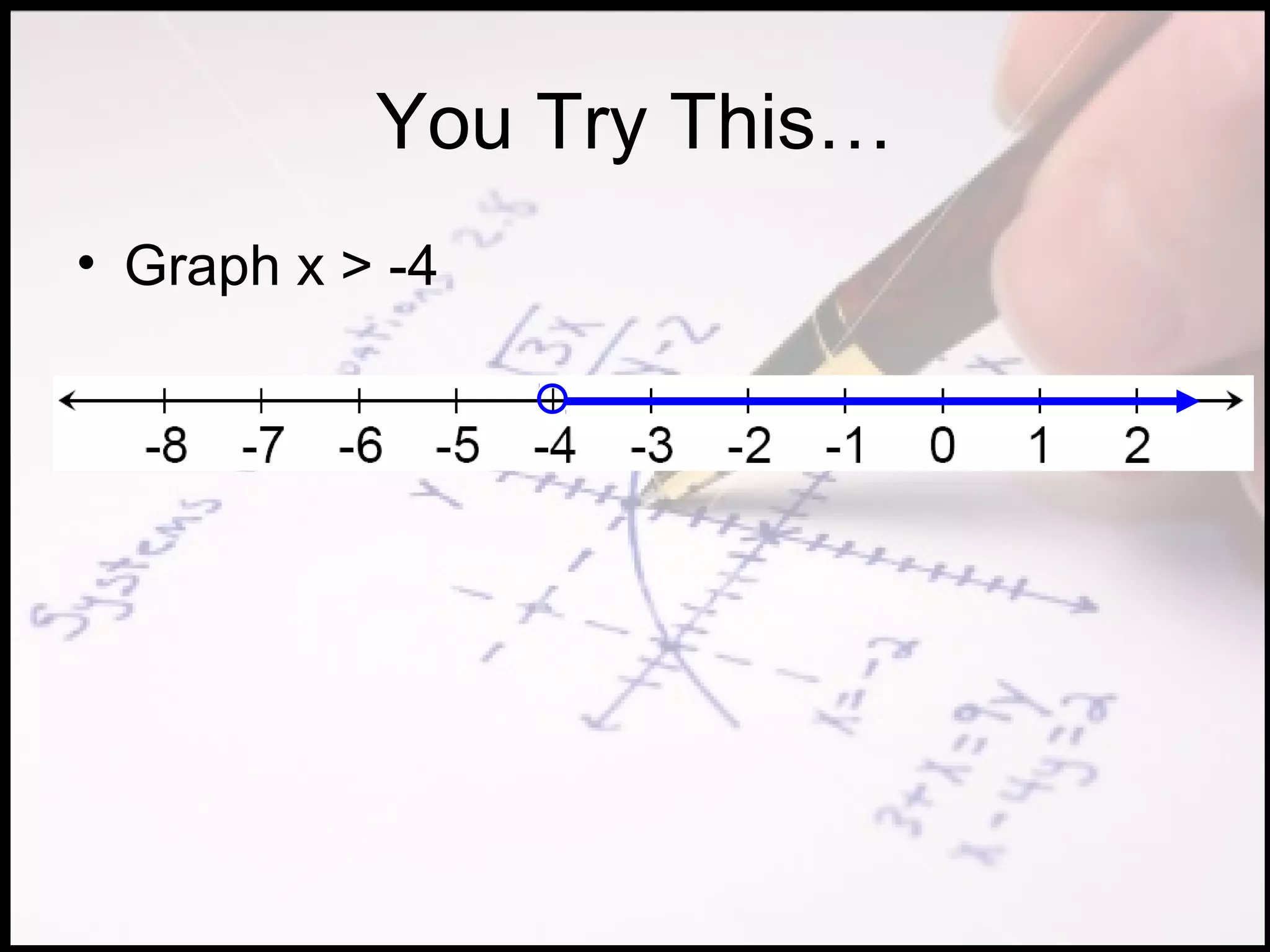
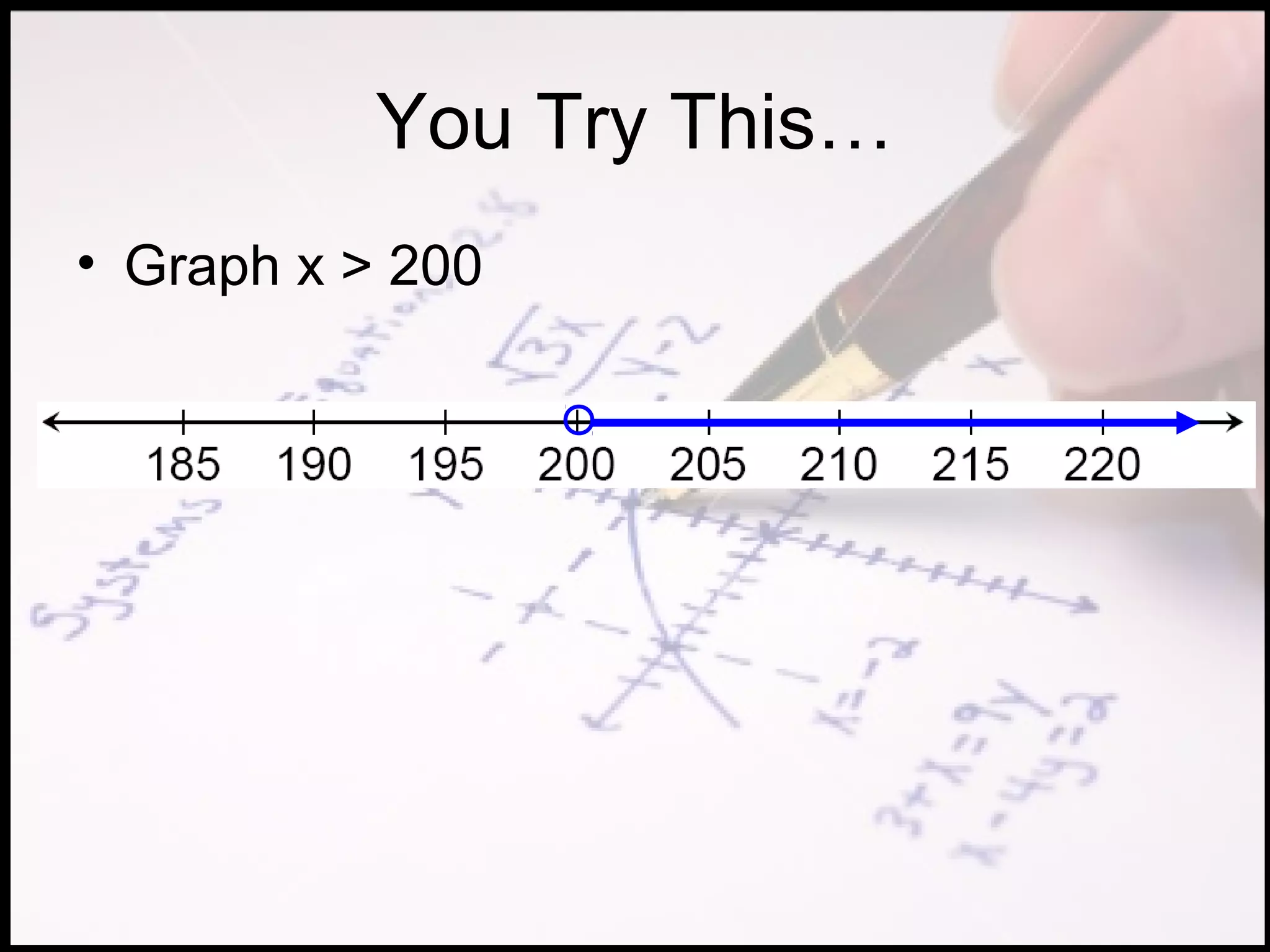
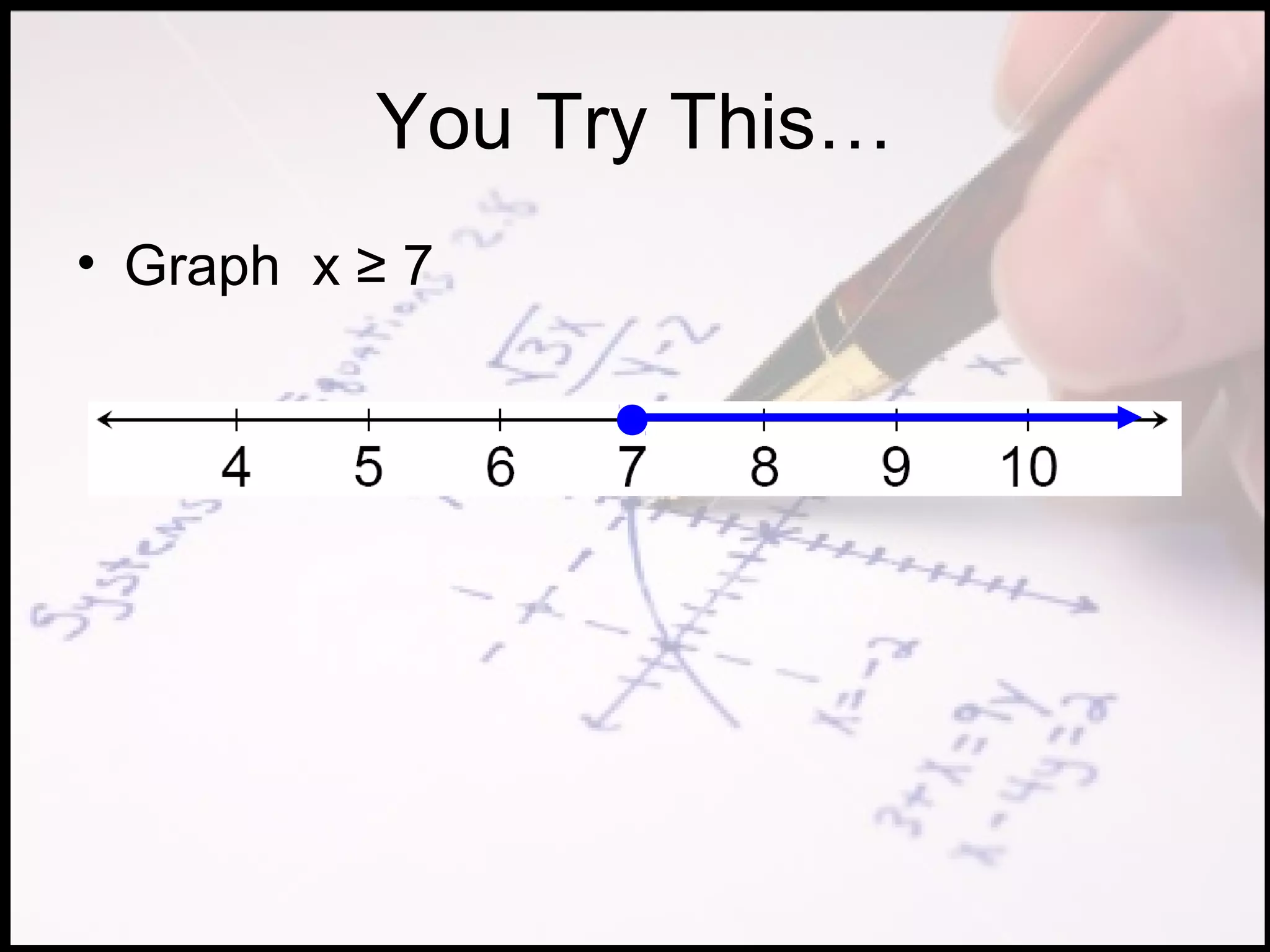
Here are the steps to solve each inequality and graph the solution:
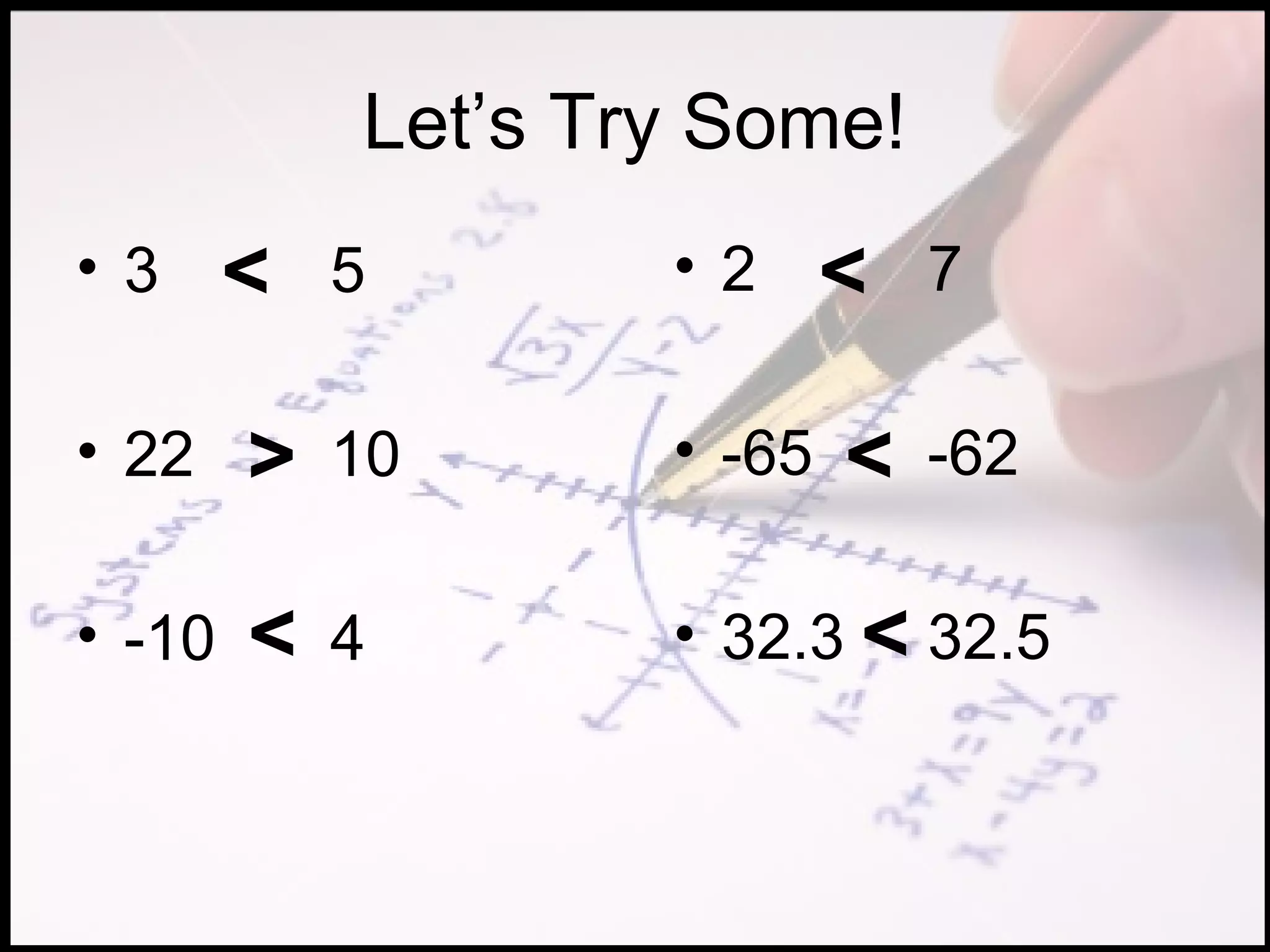
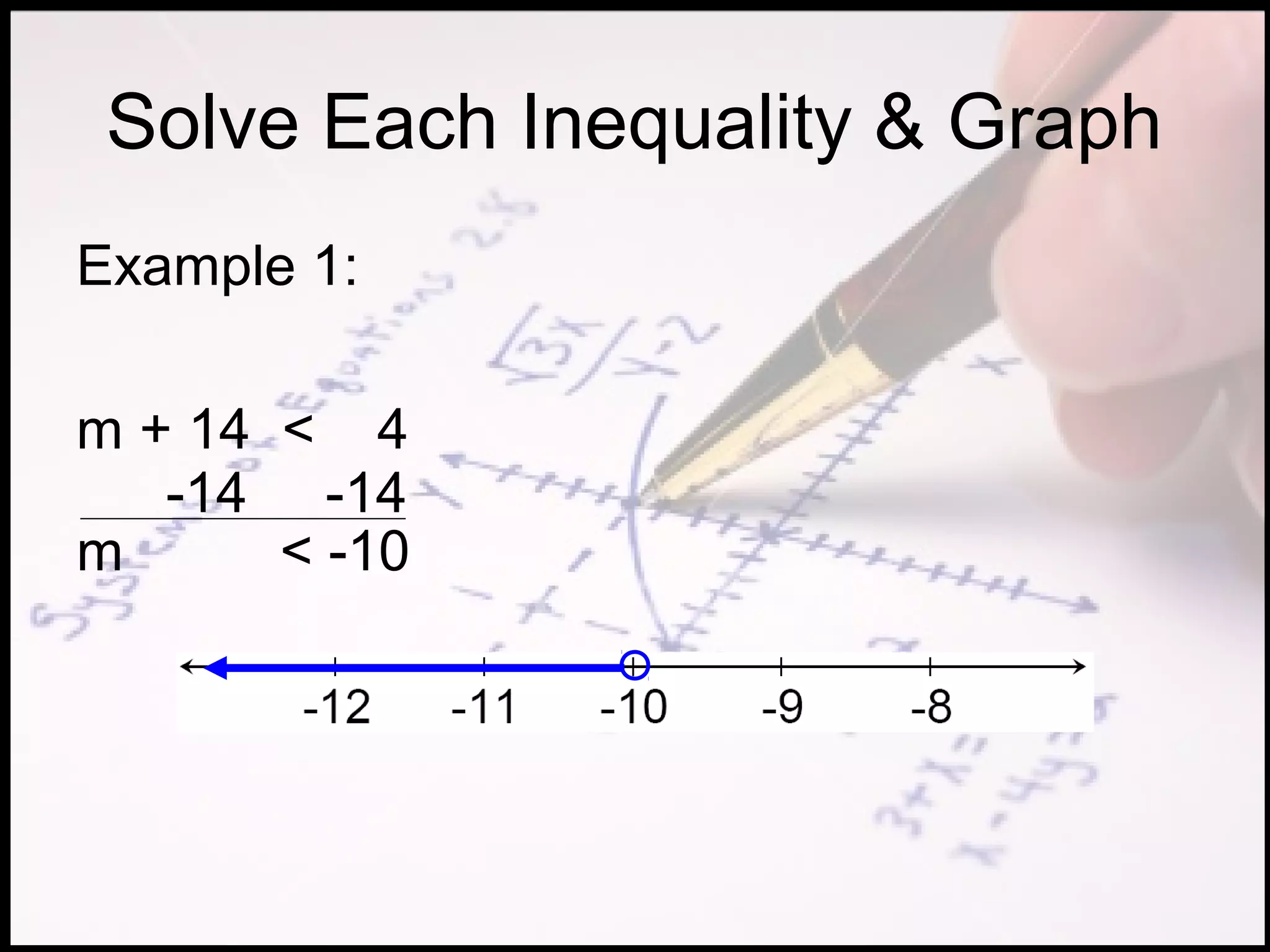
1) m + 14 < 4
-14 -14
m < -10
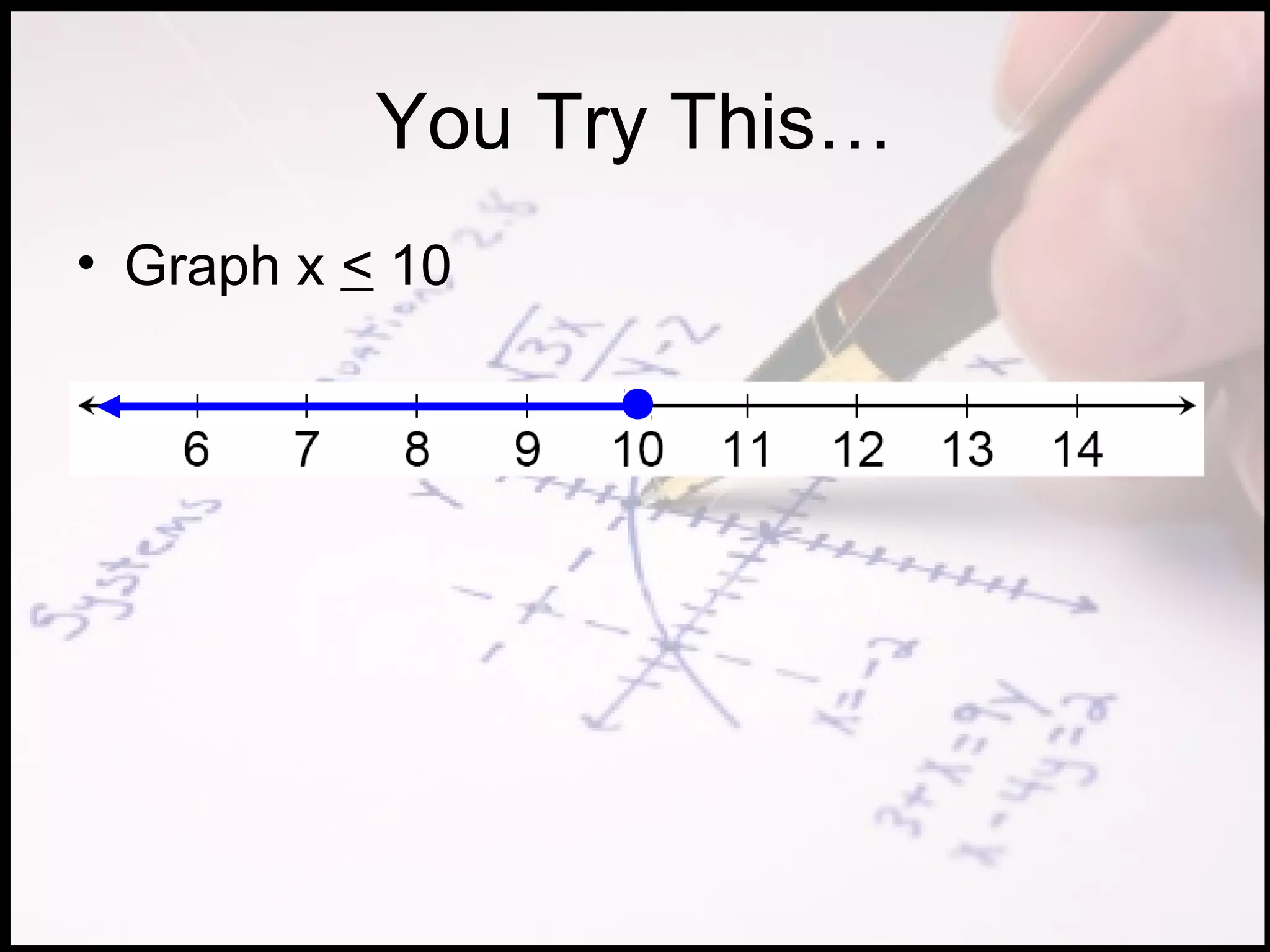
Graph: m < -10
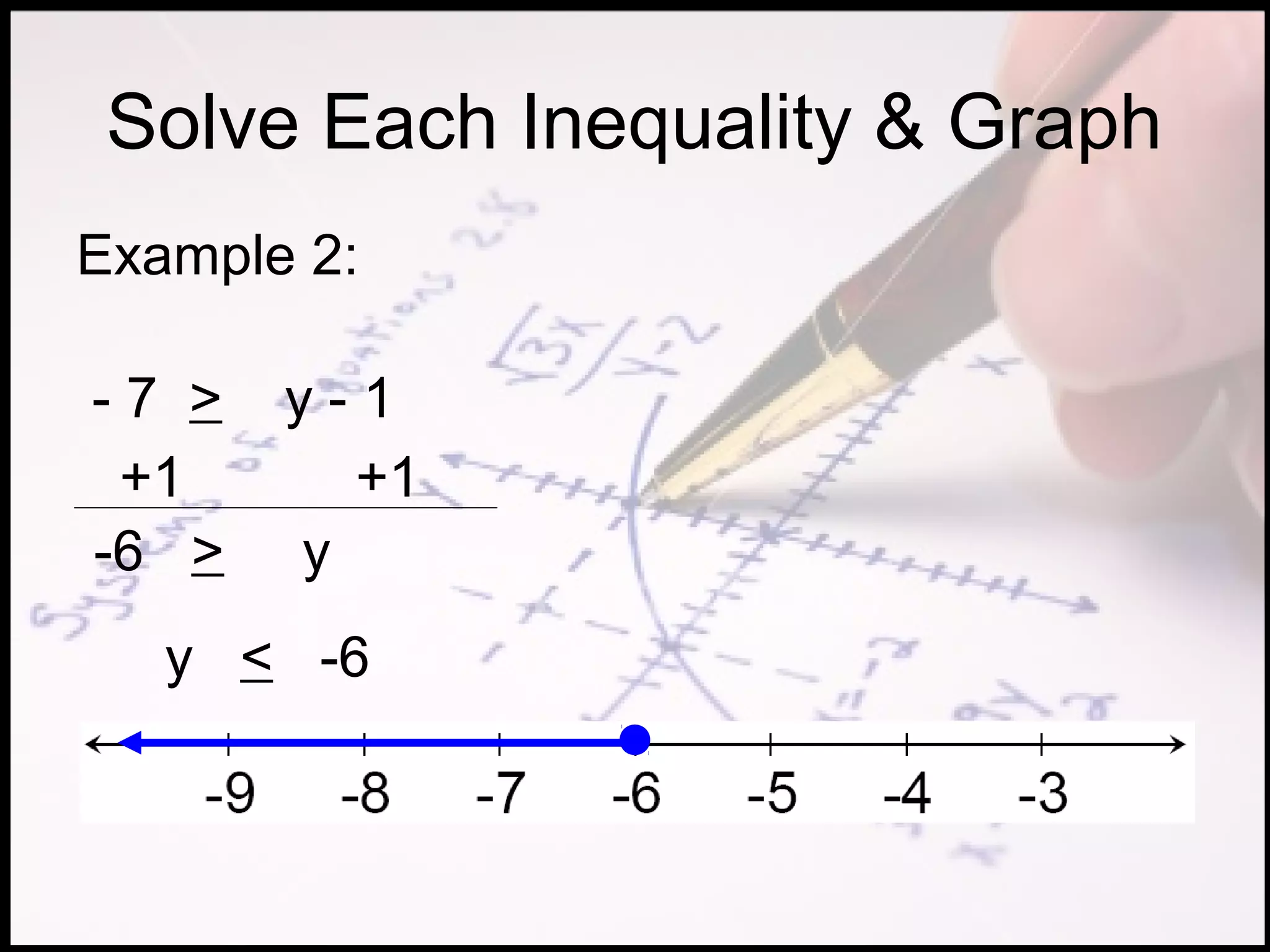
2) -7 > y-1
+1 +1
-6 > y
y < -6
Graph: y < -6
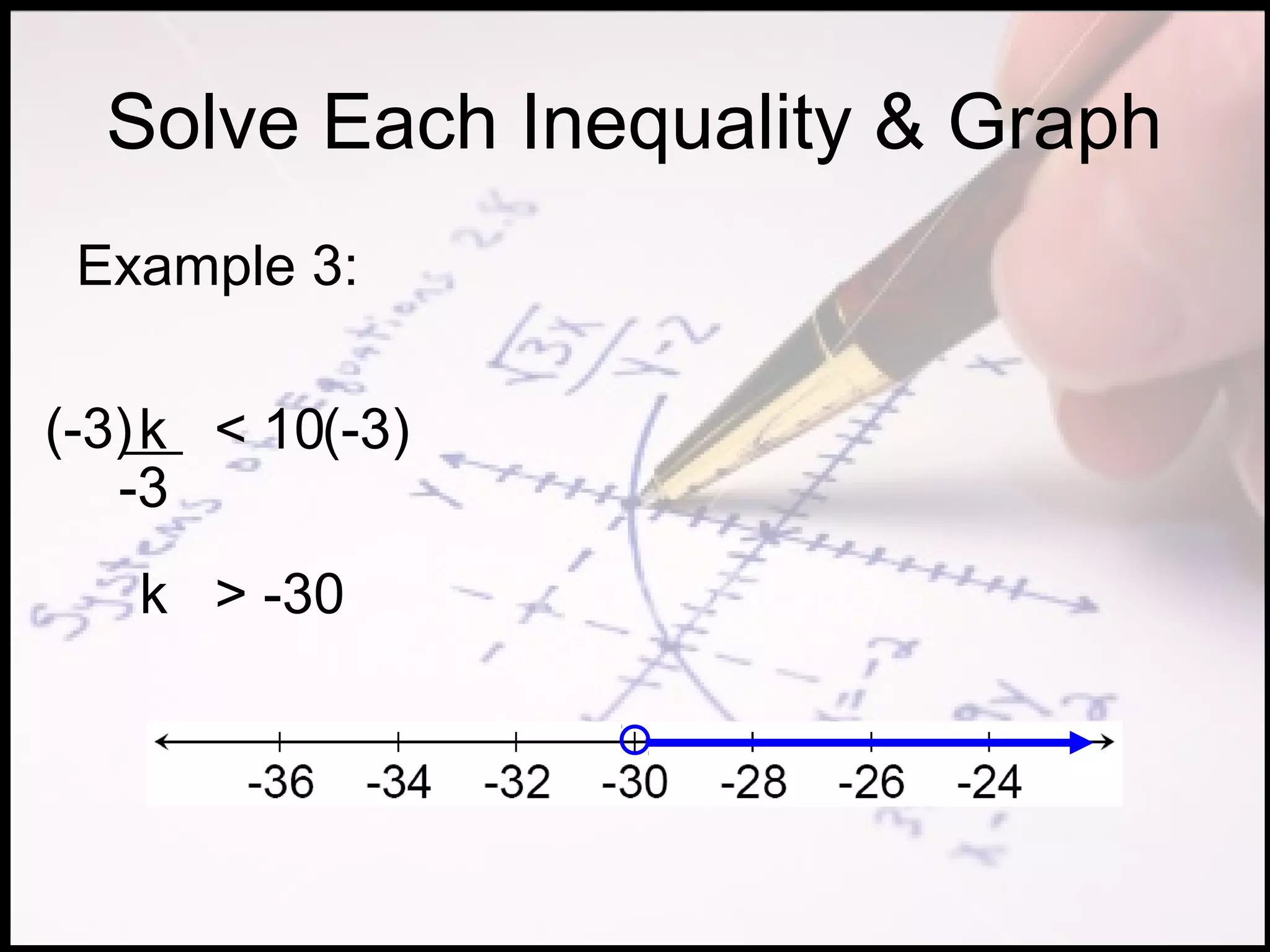
3) (-3)k < 10(-3)
-3
k > -30
Graph: k > -30
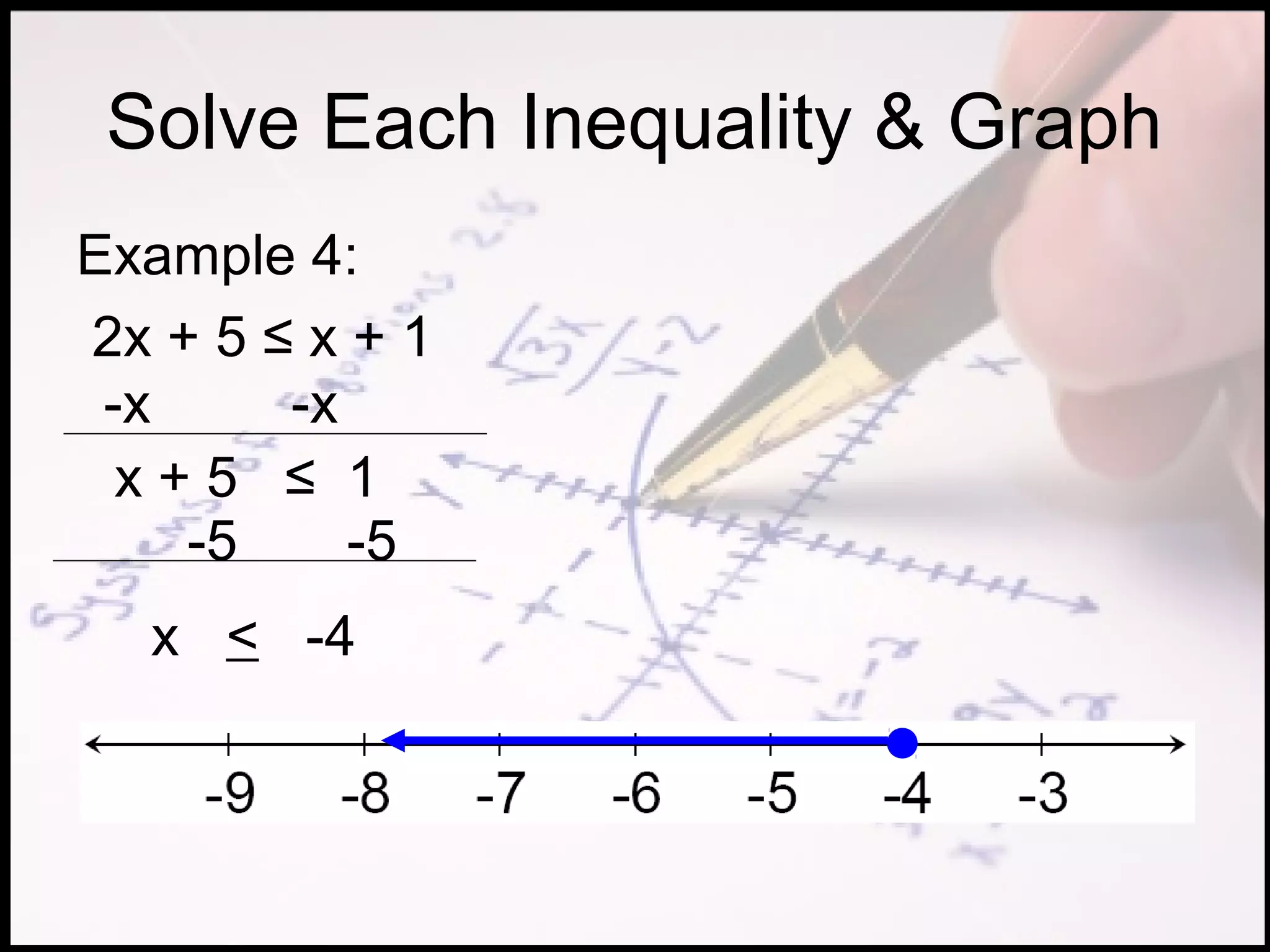
4) 2x + 5 ≤ x + 1
-x -x
x + 5 ≤ 1
-5 -5
x ≤ -4
Graph: x ≤ -4
In this document
Powered by AI
Overview of inequalities and the difference between equations and inequalities.
Introduction to inequality signs and their usage in mathematical statements.
Examples and exercises on interpreting and graphing inequalities. Exercises for graphing various inequalities, enhancing understanding.
Formulating inequalities based on defined conditions in word problems.
Applying inequalities to a practical shopping scenario involving limits on spending.
Illustration of maintaining logical consistency in solving inequalities and key rules.
Step-by-step examples for solving inequalities and graphing results.
Equal or Unequal?
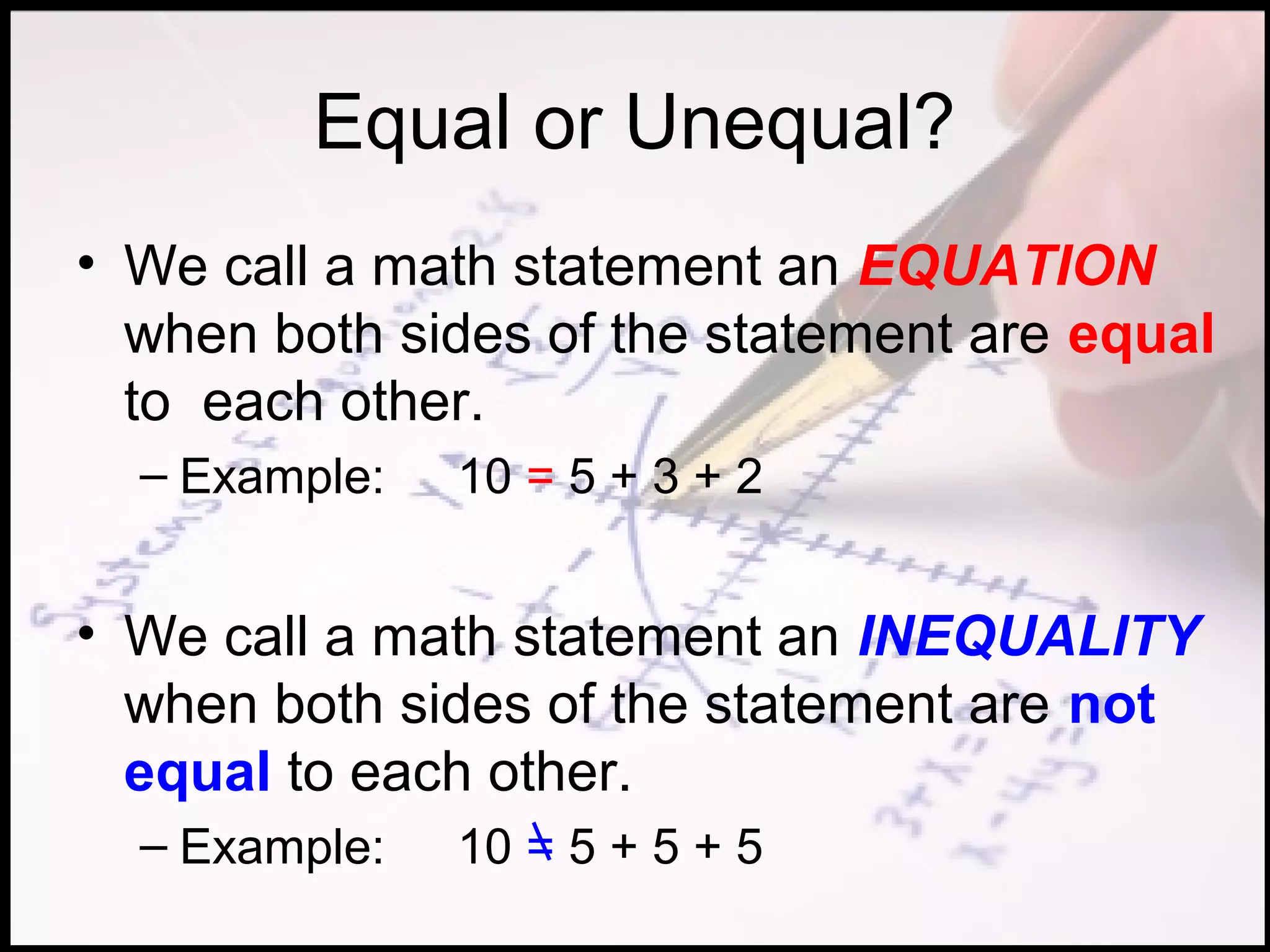
•We call a math statement an EQUATION
when both sides of the statement are equal
to each other.
– Example: 10 = 5 + 3 + 2
• We call a math statement an INEQUALITY
when both sides of the statement are not
equal to each other.
– Example: 10 = 5 + 5 + 5
3.
Inequality Signs
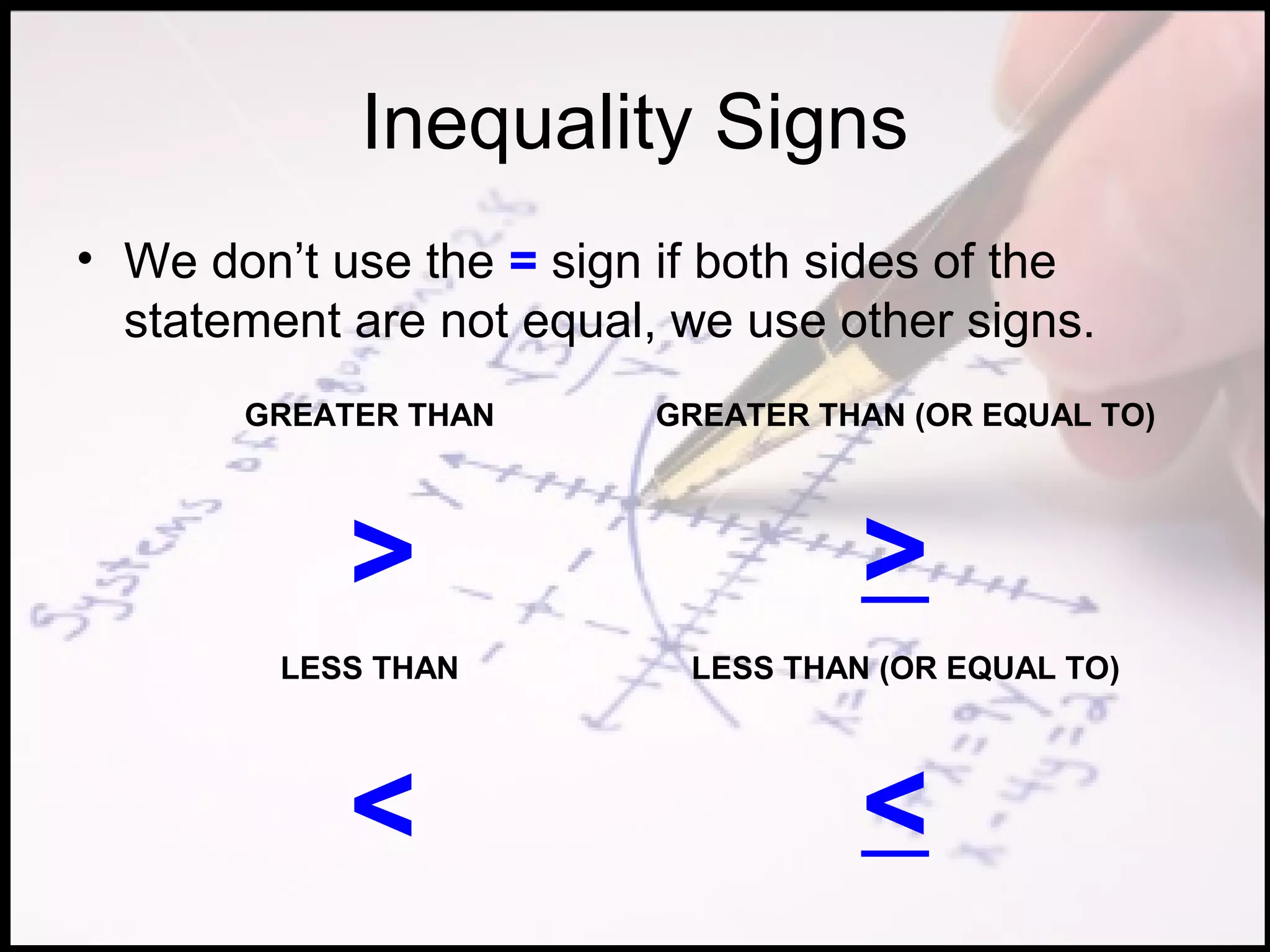
• Wedon’t use the = sign if both sides of the
statement are not equal, we use other signs.
GREATER THAN GREATER THAN (OR EQUAL TO)
> >
LESS THAN LESS THAN (OR EQUAL TO)
< <
4.
DON’T FORGET THIS!!!
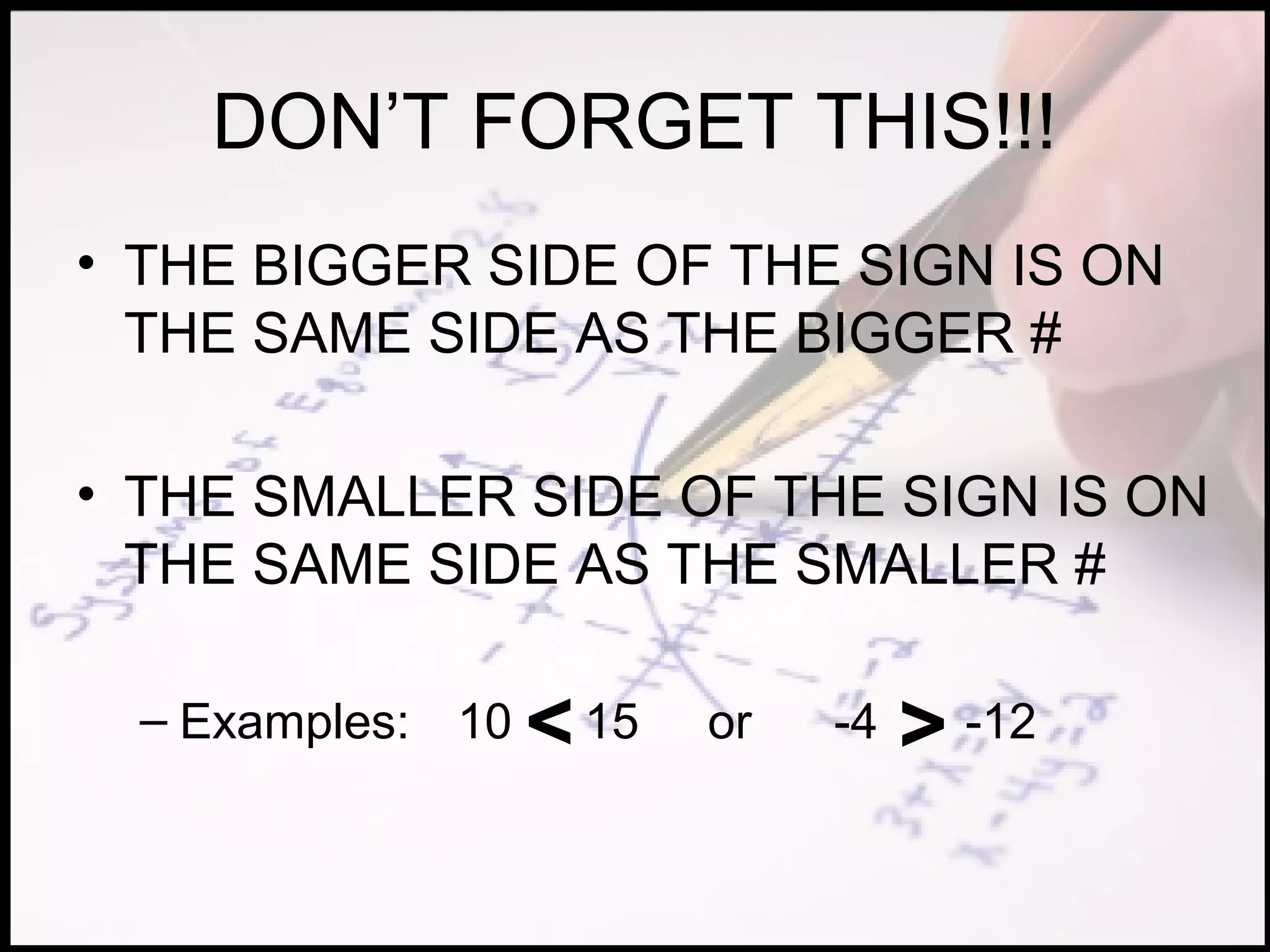
•THE BIGGER SIDE OF THE SIGN IS ON
THE SAME SIDE AS THE BIGGER #
• THE SMALLER SIDE OF THE SIGN IS ON
THE SAME SIDE AS THE SMALLER #
– Examples: 10 < 15 or -4 > -12
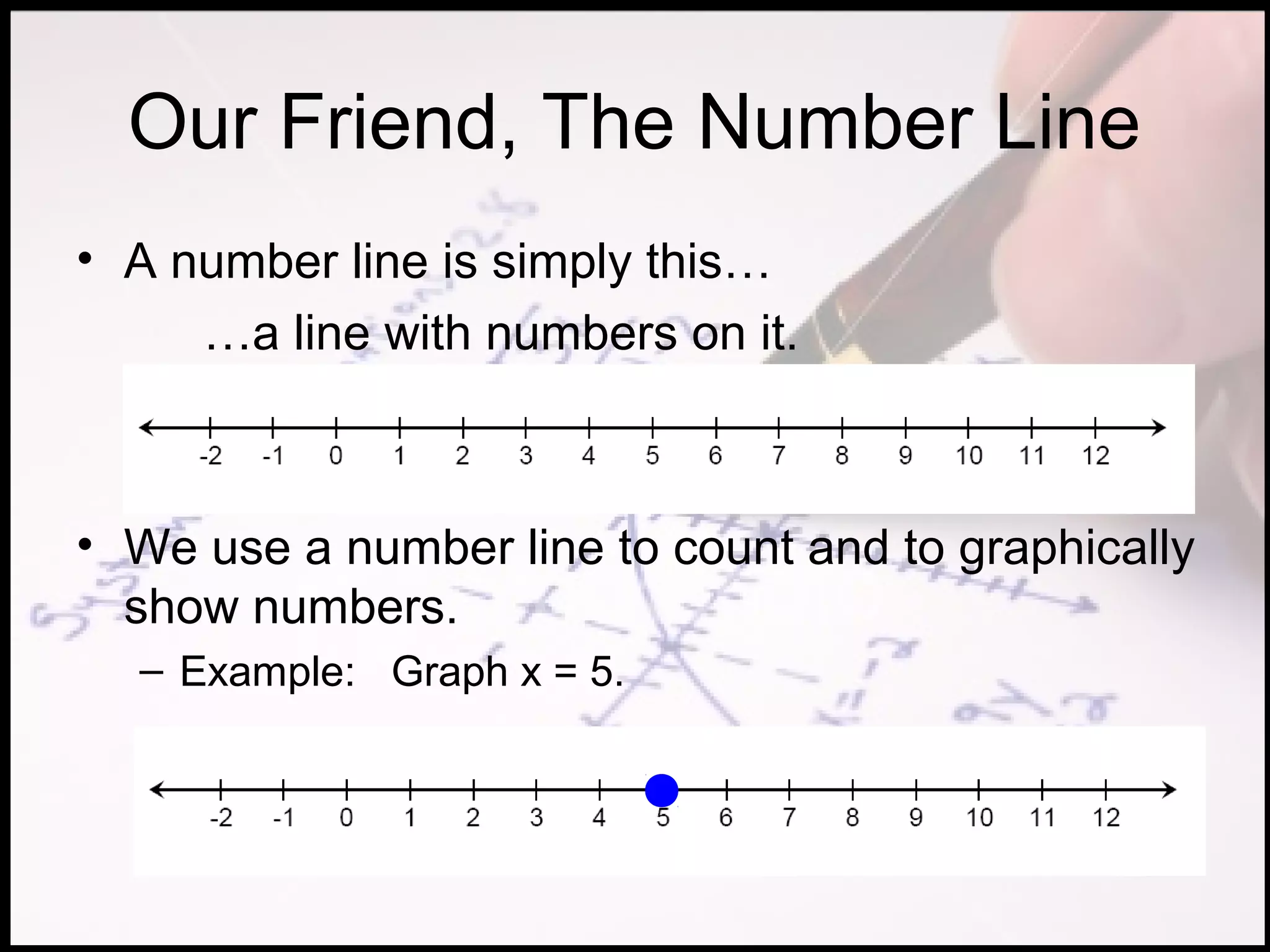
Our Friend, TheNumber Line
• A number line is simply this…
…a line with numbers on it.
• We use a number line to count and to graphically
show numbers.
– Example: Graph x = 5.
7.
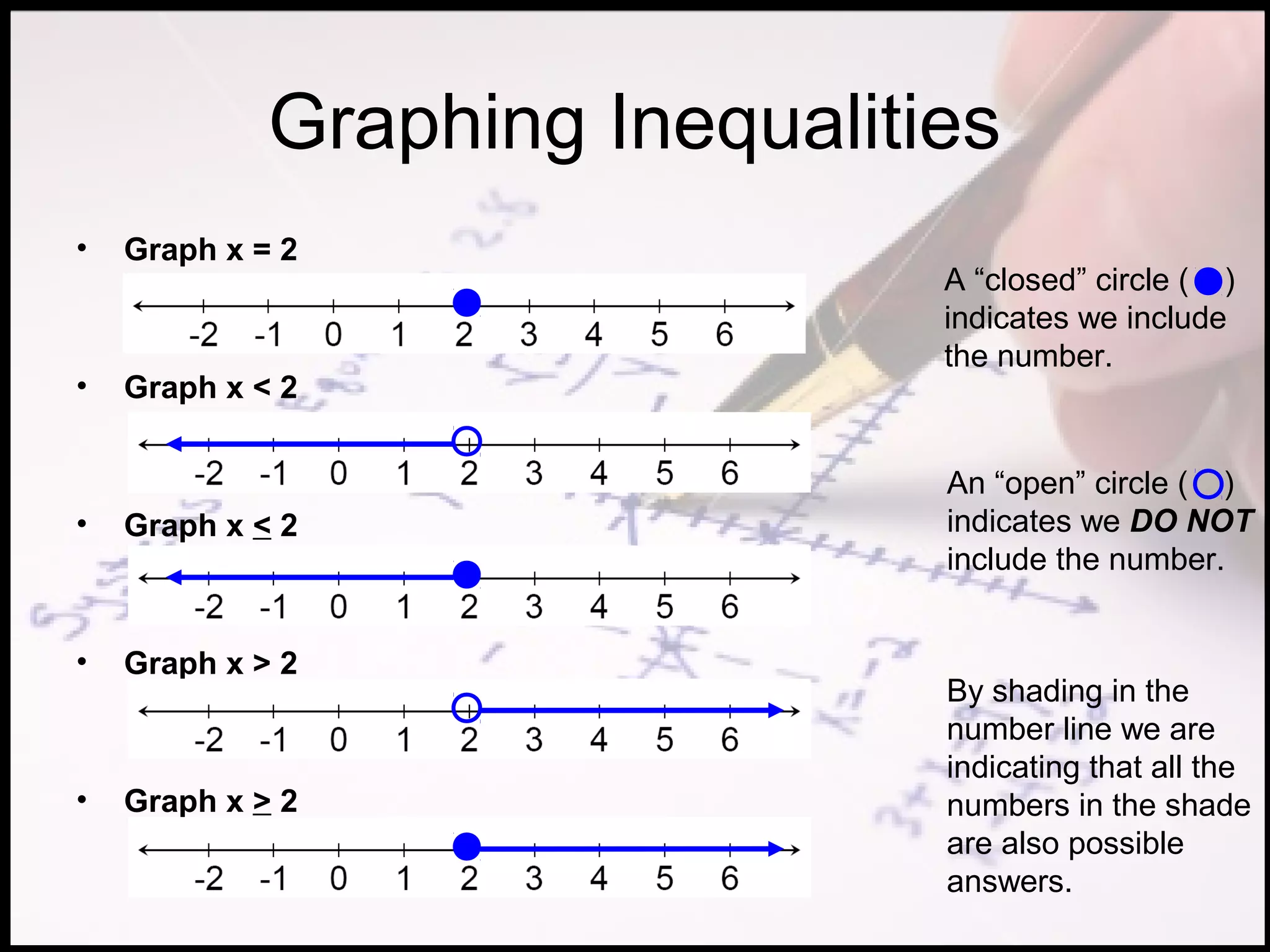
Graphing Inequalities
• Graph x = 2
A “closed” circle ( )
indicates we include
the number.
• Graph x < 2
An “open” circle ( )
• Graph x < 2 indicates we DO NOT
include the number.
• Graph x > 2
By shading in the
number line we are
indicating that all the
• Graph x > 2 numbers in the shade
are also possible
answers.
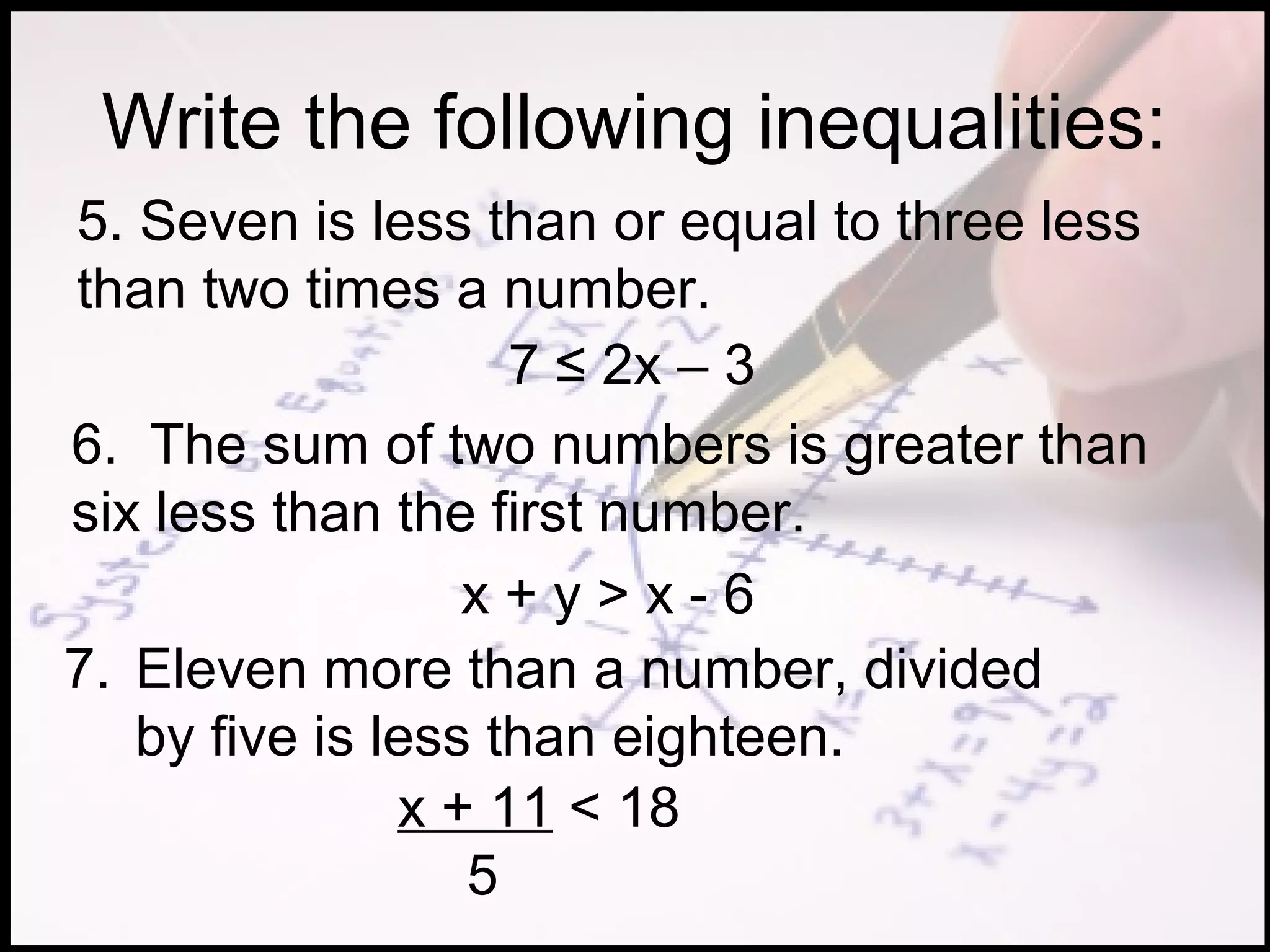
Write the followinginequalities:
5. Seven is less than or equal to three less
than two times a number.
7 ≤ 2x – 3
6. The sum of two numbers is greater than
six less than the first number.
x+y>x-6
7. Eleven more than a number, divided
by five is less than eighteen.
x + 11 < 18
5
13.
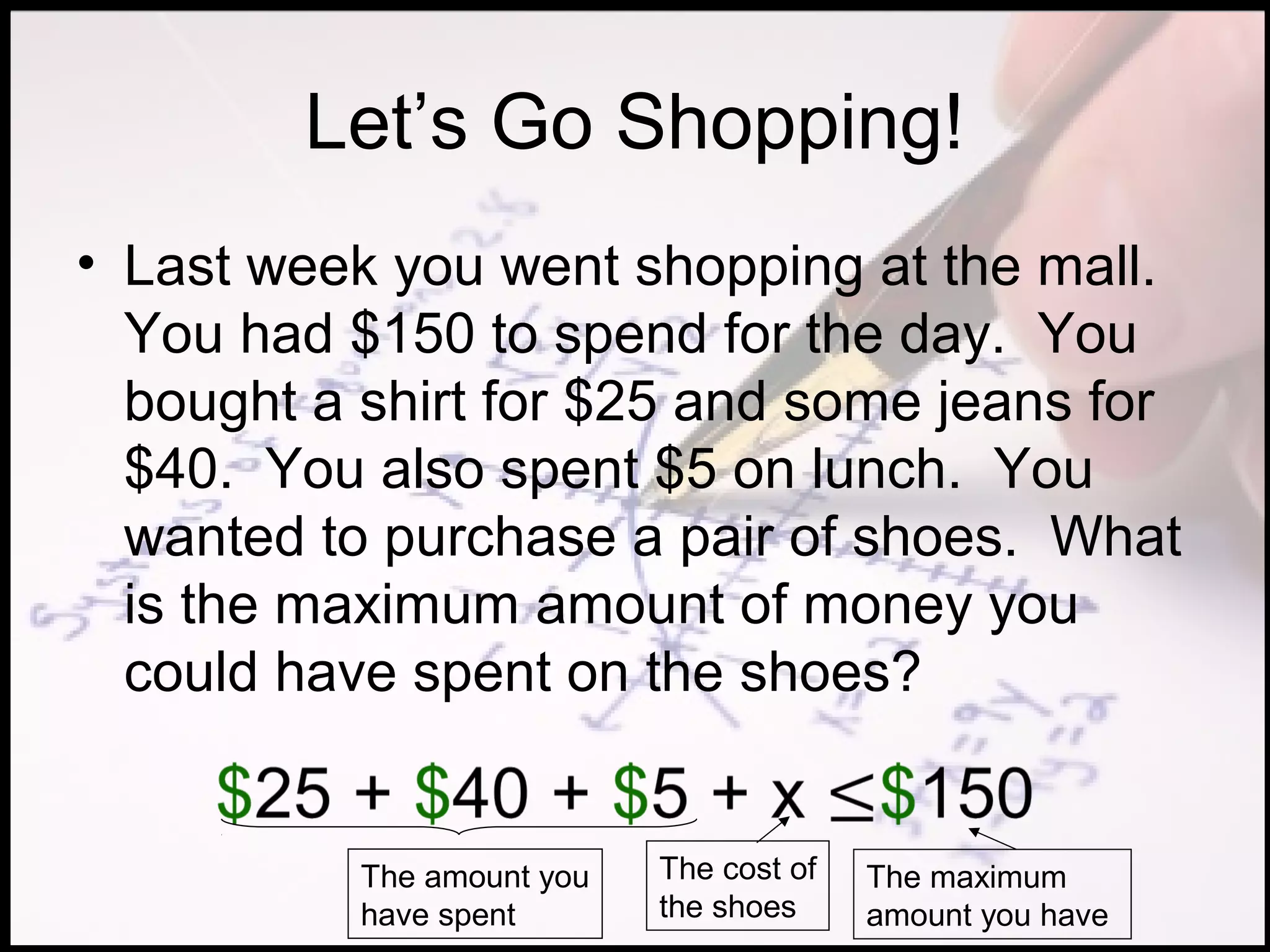
Let’s Go Shopping!
•Last week you went shopping at the mall.
You had $150 to spend for the day. You
bought a shirt for $25 and some jeans for
$40. You also spent $5 on lunch. You
wanted to purchase a pair of shoes. What
is the maximum amount of money you
could have spent on the shoes?
The amount you The cost of The maximum
have spent the shoes amount you have
14.
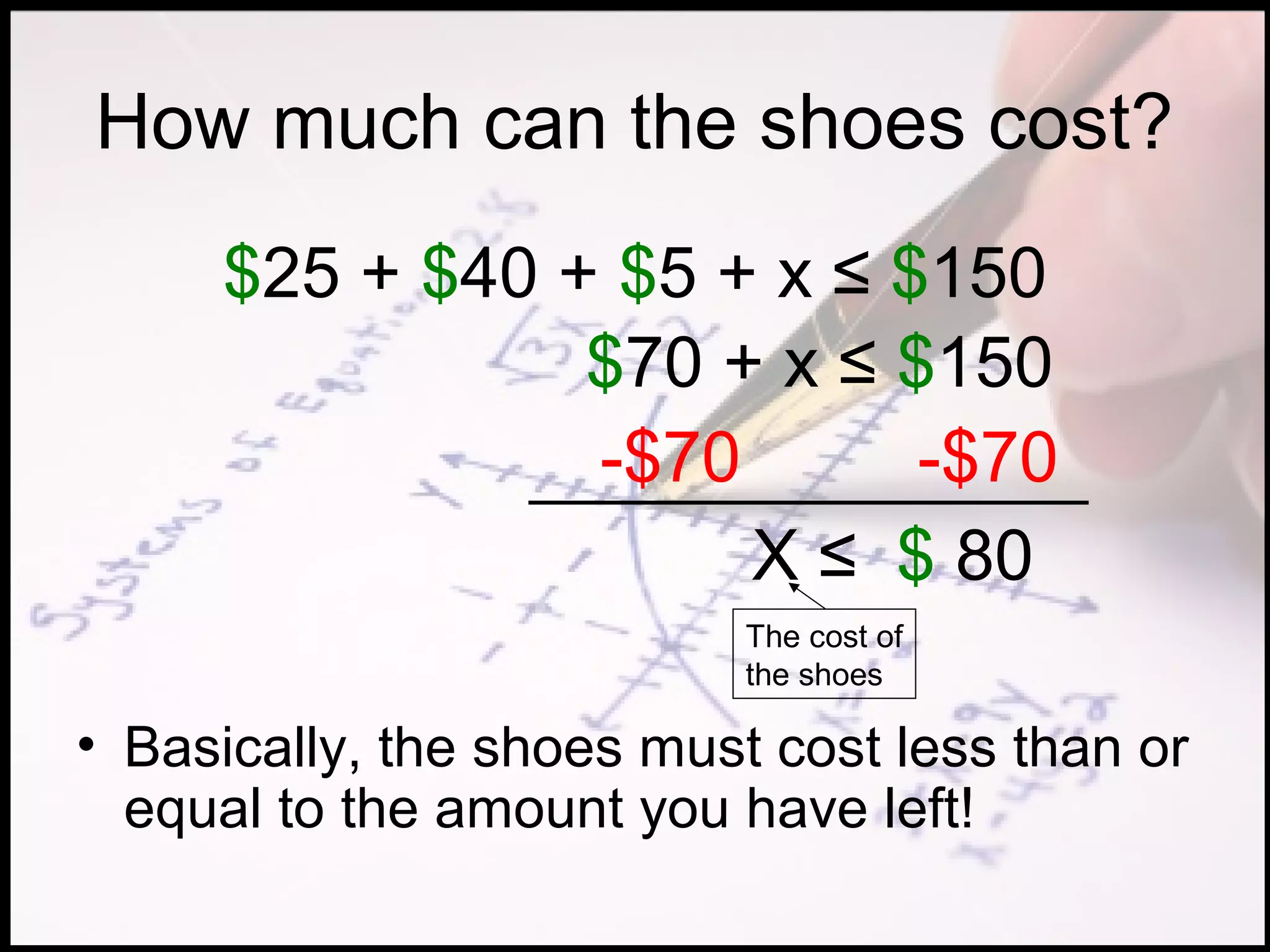
How much canthe shoes cost?
$25 + $40 + $5 + x ≤ $150
$70 + x ≤ $150
-$70 -$70
X ≤ $ 80
The cost of
the shoes
• Basically, the shoes must cost less than or
equal to the amount you have left!
15.
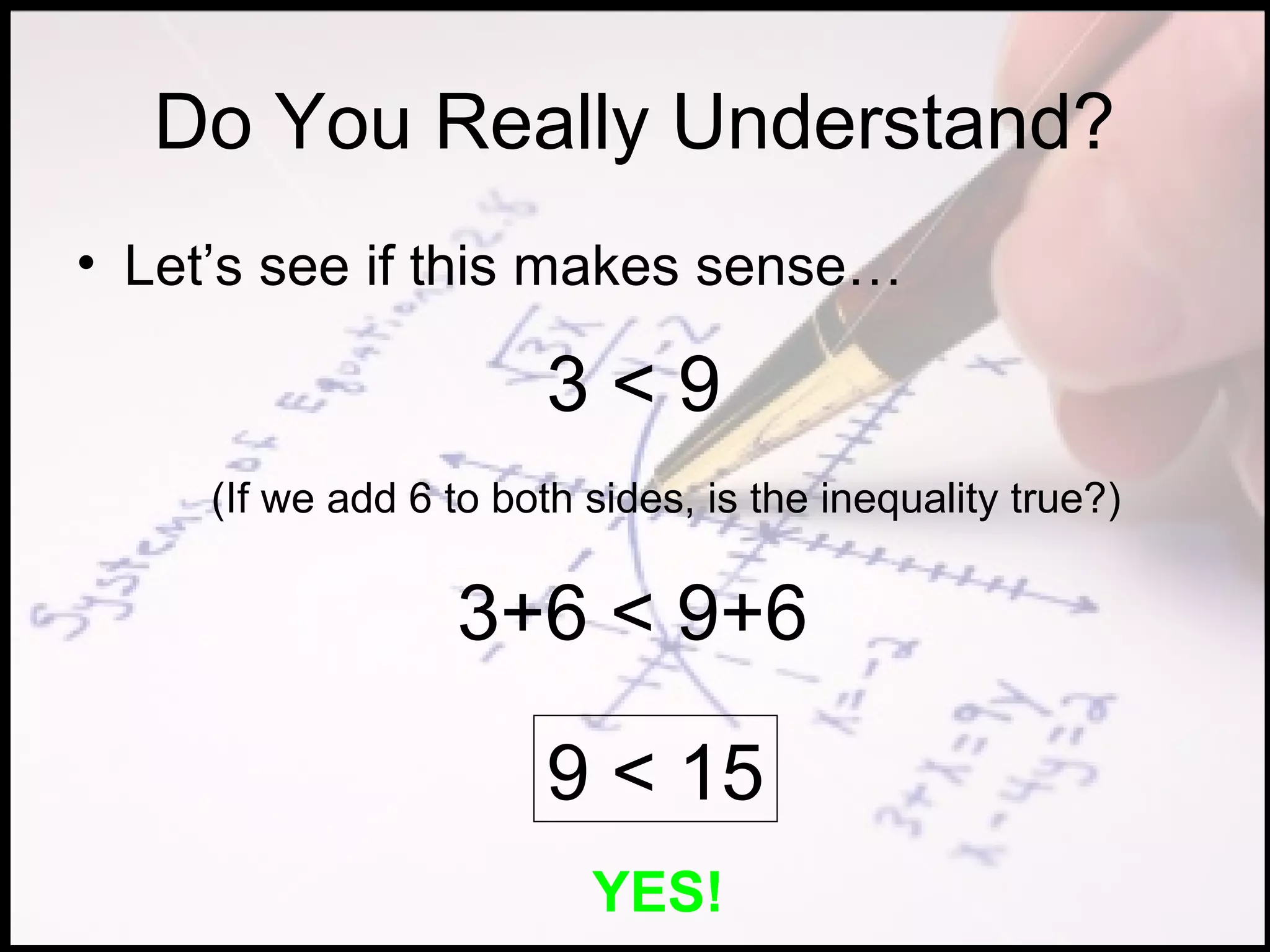
Do You ReallyUnderstand?
• Let’s see if this makes sense…
3<9
(If we add 6 to both sides, is the inequality true?)
3+6 < 9+6
9 < 15
YES!
16.
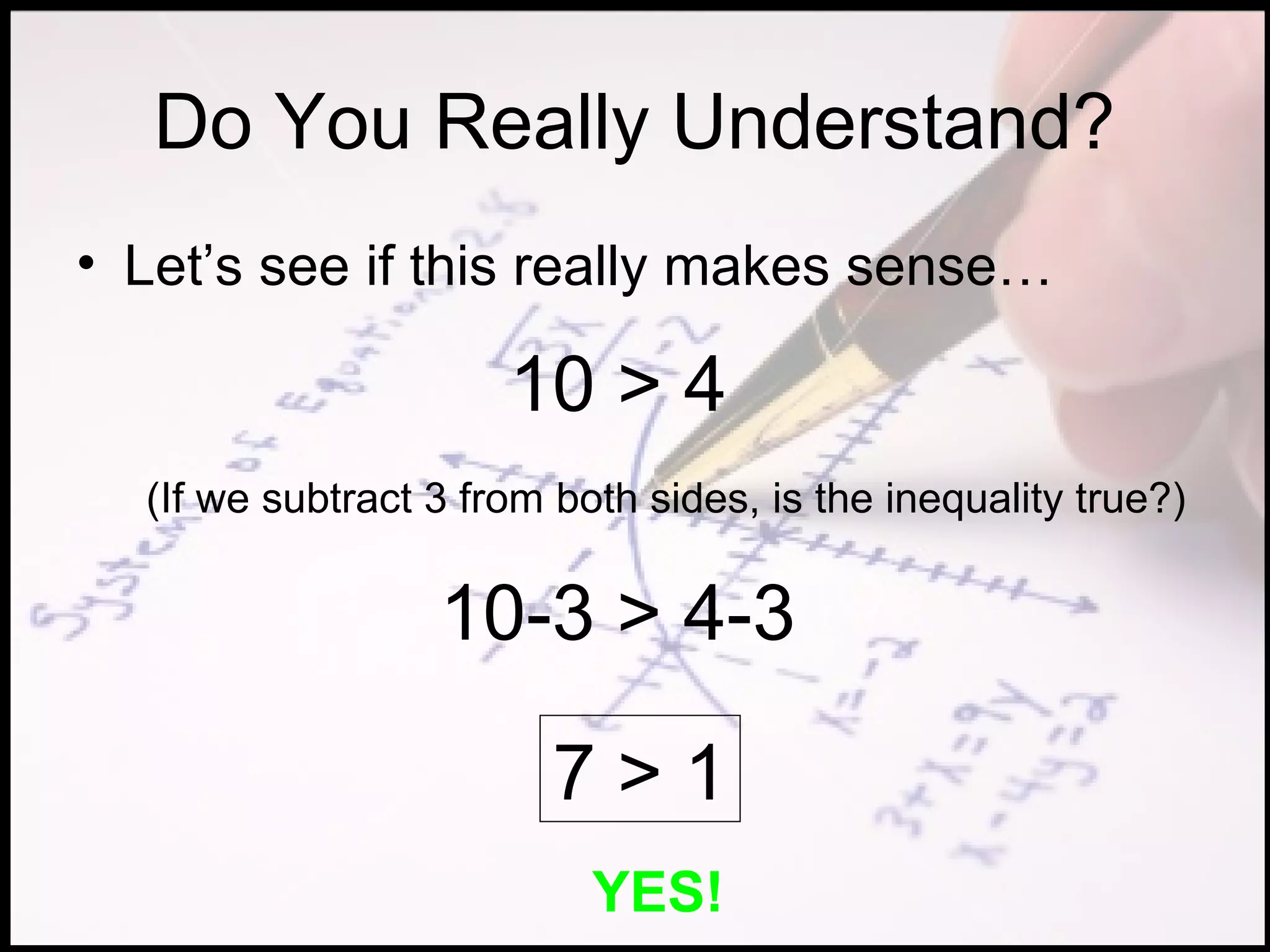
Do You ReallyUnderstand?
• Let’s see if this really makes sense…
10 > 4
(If we subtract 3 from both sides, is the inequality true?)
10-3 > 4-3
7>1
YES!
17.
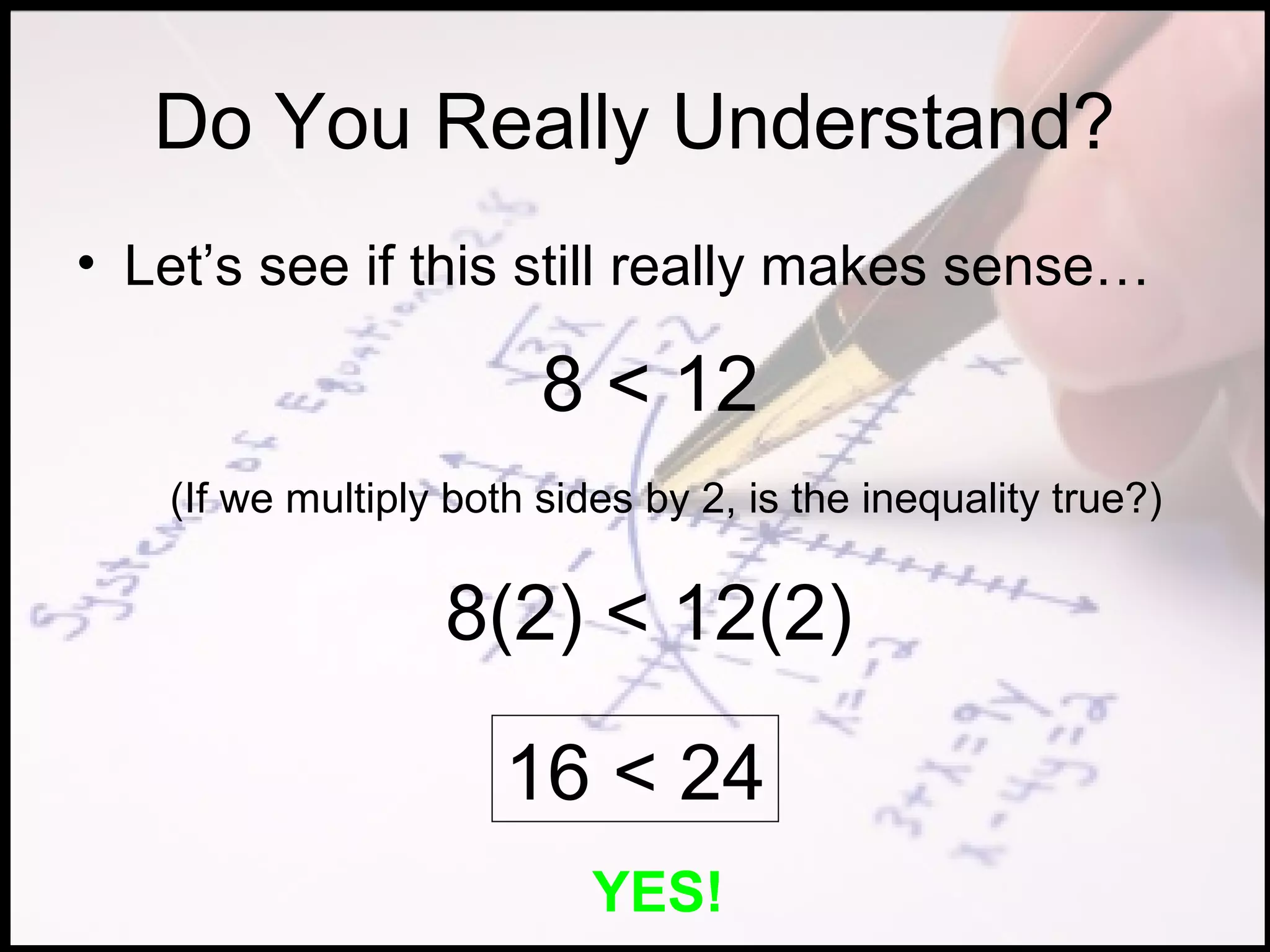
Do You ReallyUnderstand?
• Let’s see if this still really makes sense…
8 < 12
(If we multiply both sides by 2, is the inequality true?)
8(2) < 12(2)
16 < 24
YES!
18.
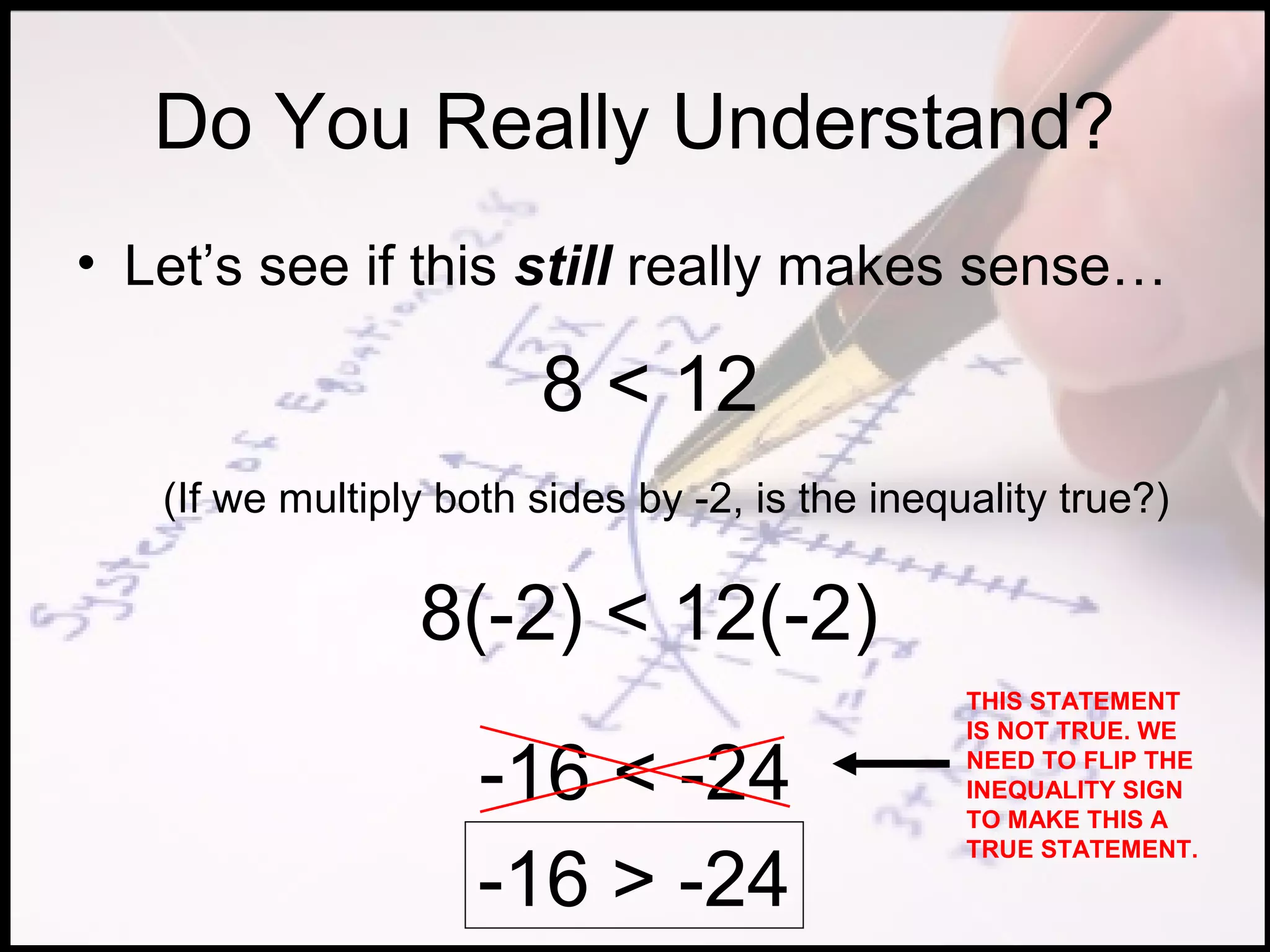
Do You ReallyUnderstand?
• Let’s see if this still really makes sense…
8 < 12
(If we multiply both sides by -2, is the inequality true?)
8(-2) < 12(-2)
THIS STATEMENT
IS NOT TRUE. WE
-16 < -24 NEED TO FLIP THE
INEQUALITY SIGN
TO MAKE THIS A
TRUE STATEMENT.
-16 > -24
19.
Solving Inequalities
• Soapparently there are a few basic rules
we have to follow when solving
inequalities.
• If you break these rules you will answer
the question incorrectly!
• DON’T BREAK THE RULZ!
20.
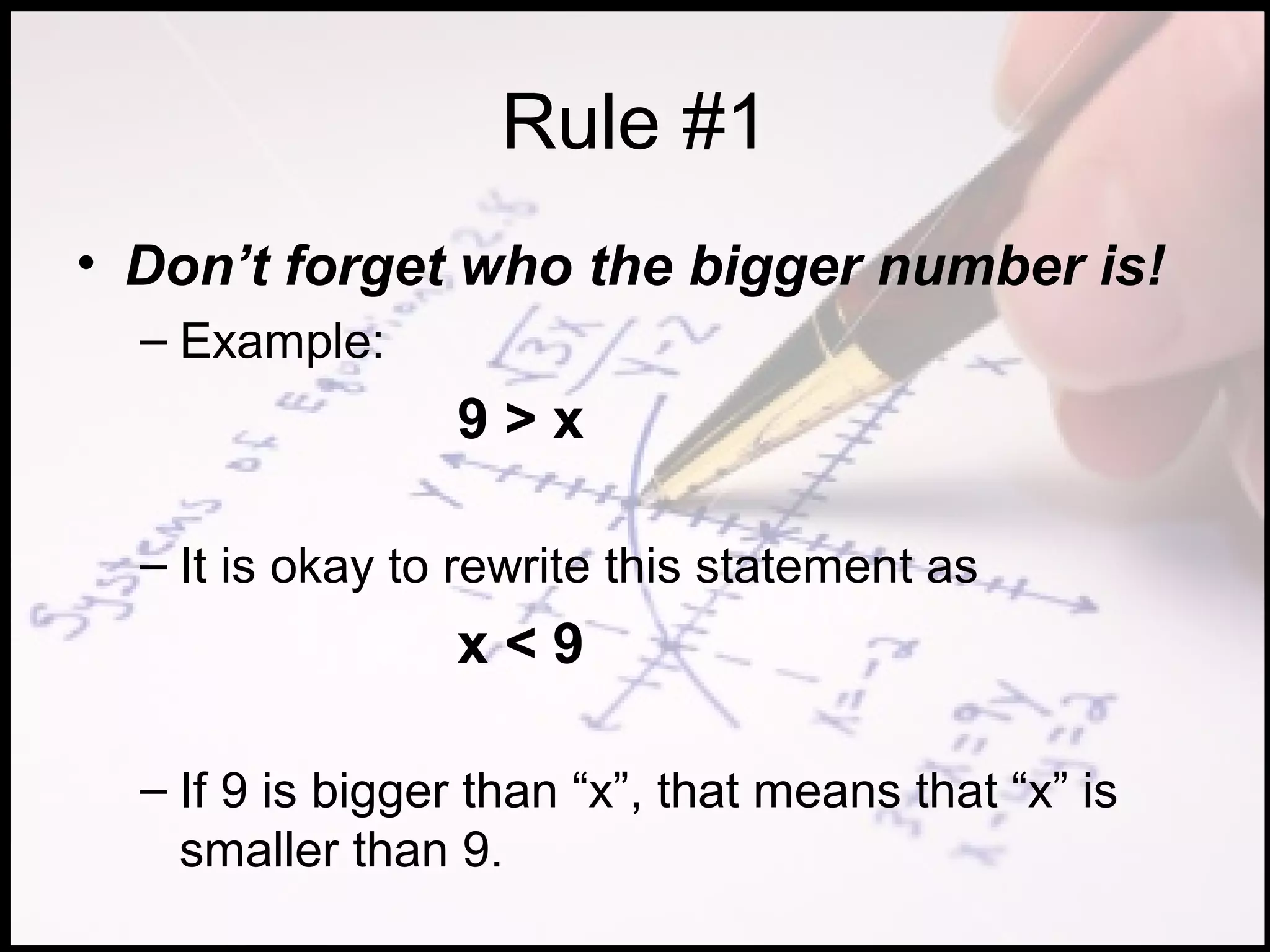
Rule #1
• Don’tforget who the bigger number is!
– Example:
9>x
– It is okay to rewrite this statement as
x<9
– If 9 is bigger than “x”, that means that “x” is
smaller than 9.
21.
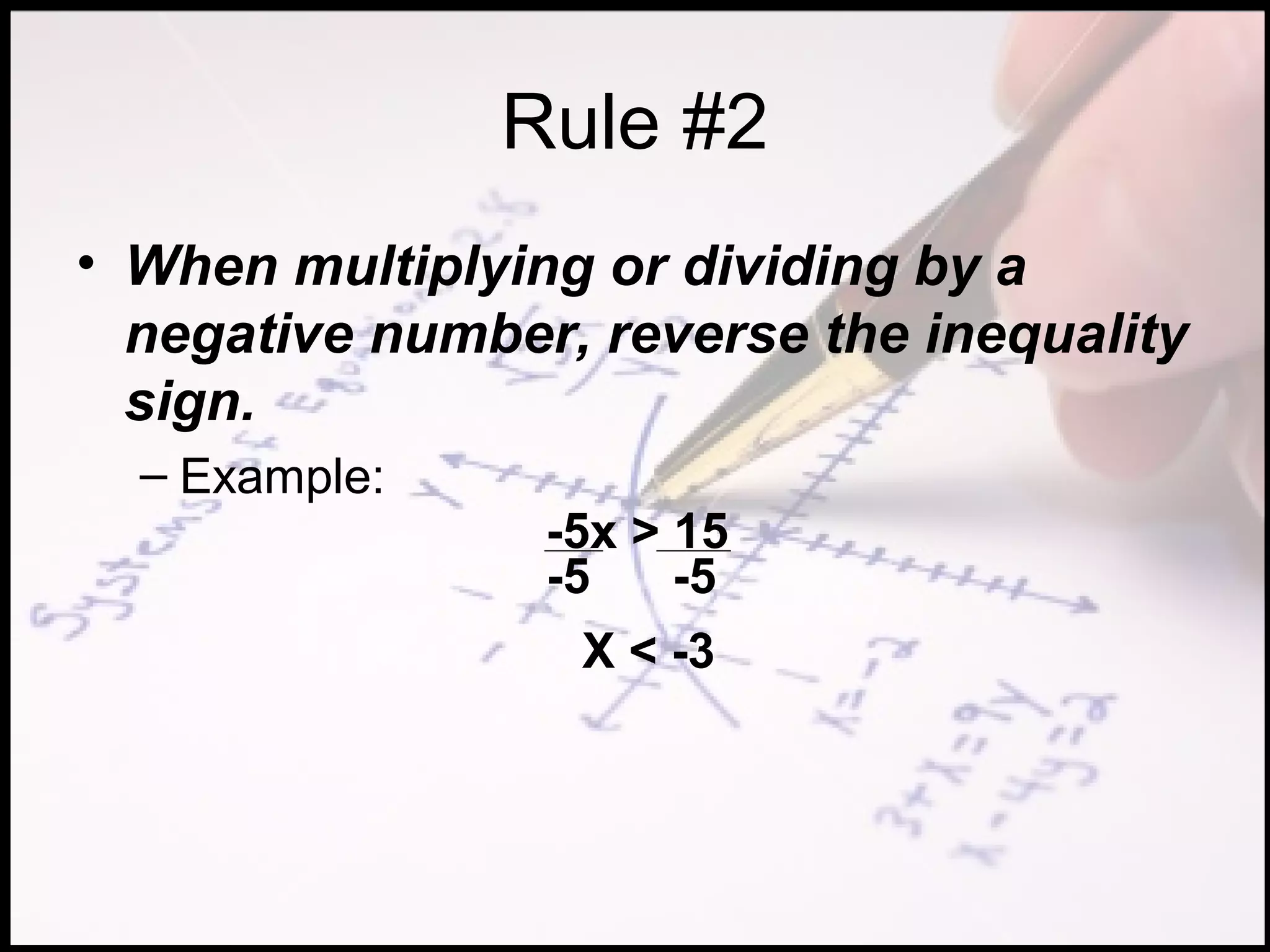
Rule #2
• Whenmultiplying or dividing by a
negative number, reverse the inequality
sign.
– Example:
-5x > 15
-5 -5
X < -3