Lecture 7: Definite Clause Grammars

Loading...

Flash Player 9 (or above) is needed to view presentations.
We have detected that you do not have it on your computer. To install it, go here.

0 comments

Post a comment

    Post a comment
    Embed Video
    Edit your comment Cancel

    Favorites, Groups & Events

    Lecture 7: Definite Clause Grammars - Presentation Transcript

    1. Lecture 7: Definite Clause Grammars •  Theory – Introduce context free grammars and some related concepts © Patrick Blackburn, Johan Bos & Kristina Striegnitz – Introduce definite clause grammars, the Prolog way of working with context free grammars (and other grammars too) •  Exercises – Exercises of LPN: 7.1, 7.2, 7.3 – Practical work
    2. Context free grammars •  Prolog offers a special notation for defining grammars, namely DCGs or definite clause grammars © Patrick Blackburn, Johan Bos & Kristina Striegnitz •  So what is a grammar? •  We will answer this question by discussing context free grammars •  CFGs are a very powerful mechanism, and can handle most syntactic aspects of natural languages (such as English or Italian)
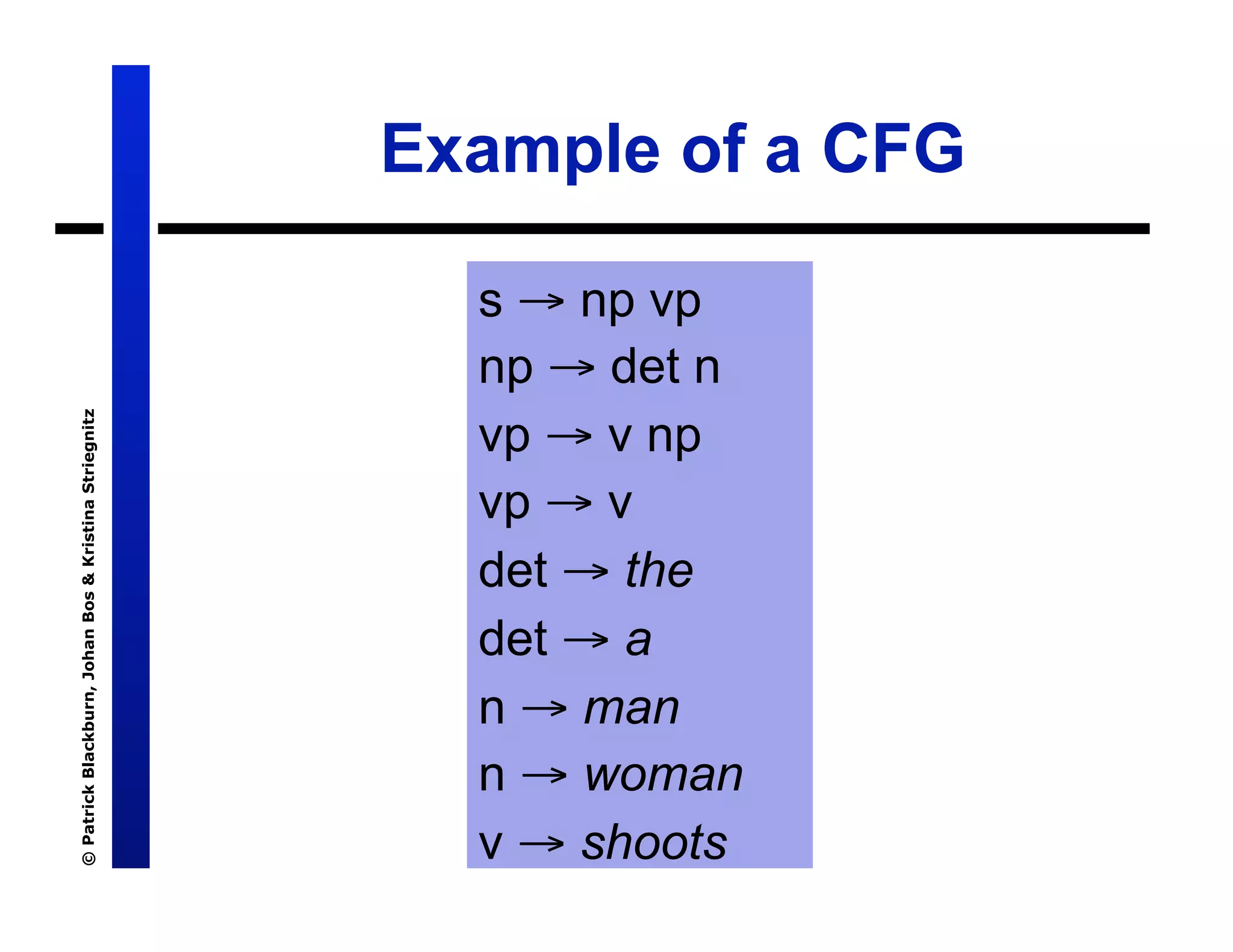
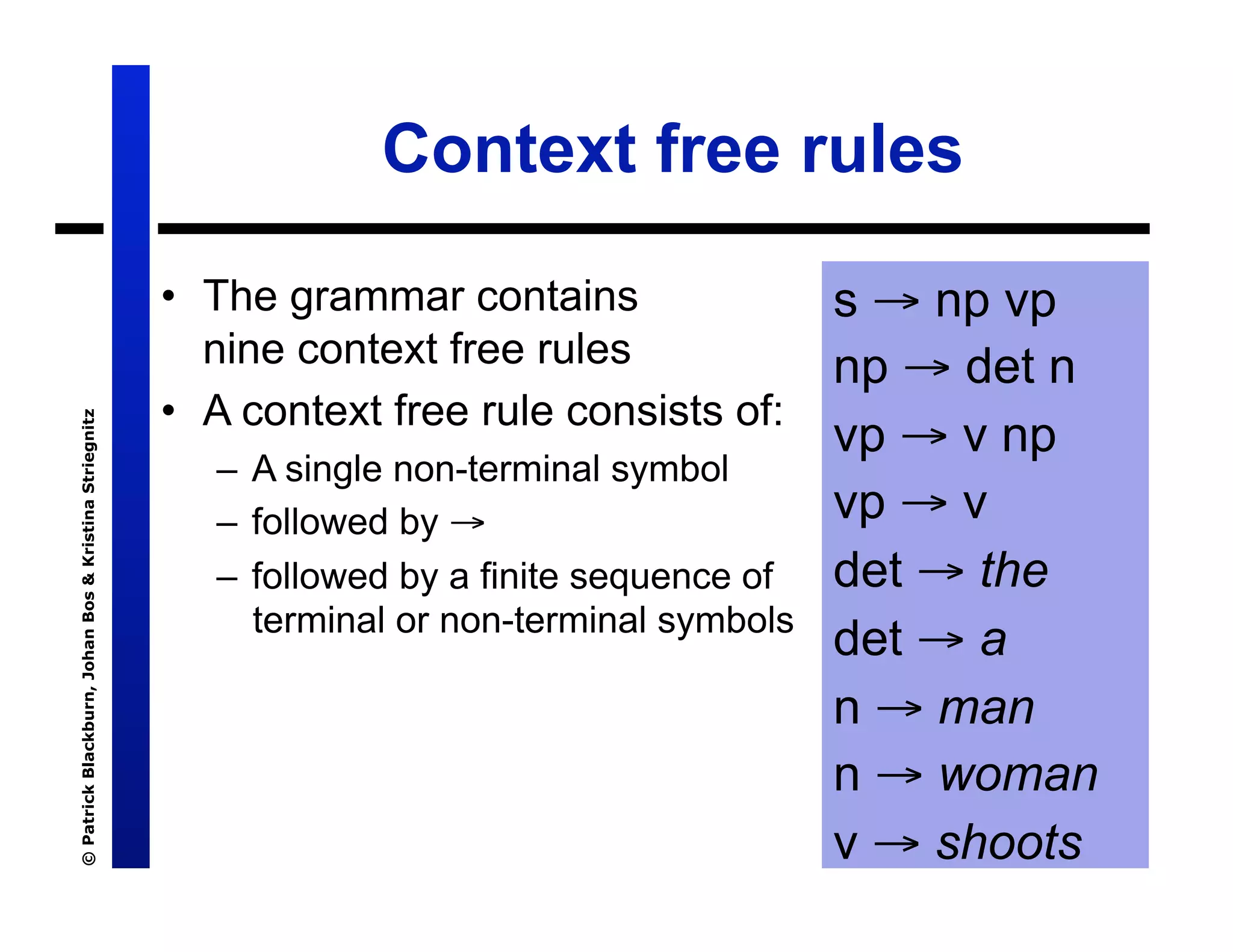
    3. Example of a CFG s → np vp np → det n vp → v np © Patrick Blackburn, Johan Bos & Kristina Striegnitz vp → v det → the det → a n → man n → woman v → shoots
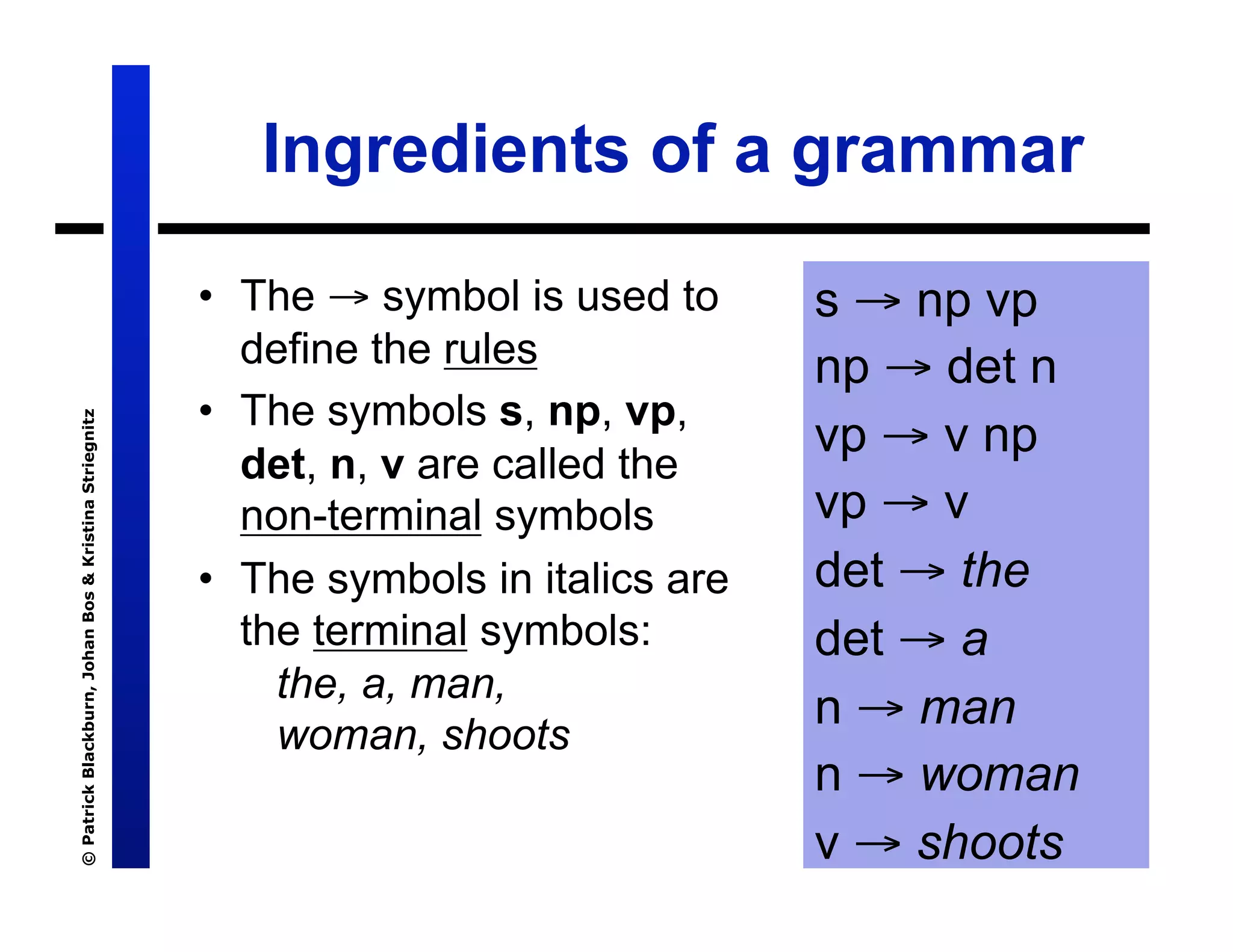
    4. Ingredients of a grammar •  The → symbol is used to s → np vp define the rules np → det n •  The symbols s, np, vp, vp → v np © Patrick Blackburn, Johan Bos & Kristina Striegnitz det, n, v are called the vp → v non-terminal symbols det → the •  The symbols in italics are the terminal symbols: det → a the, a, man, n → man woman, shoots n → woman v → shoots
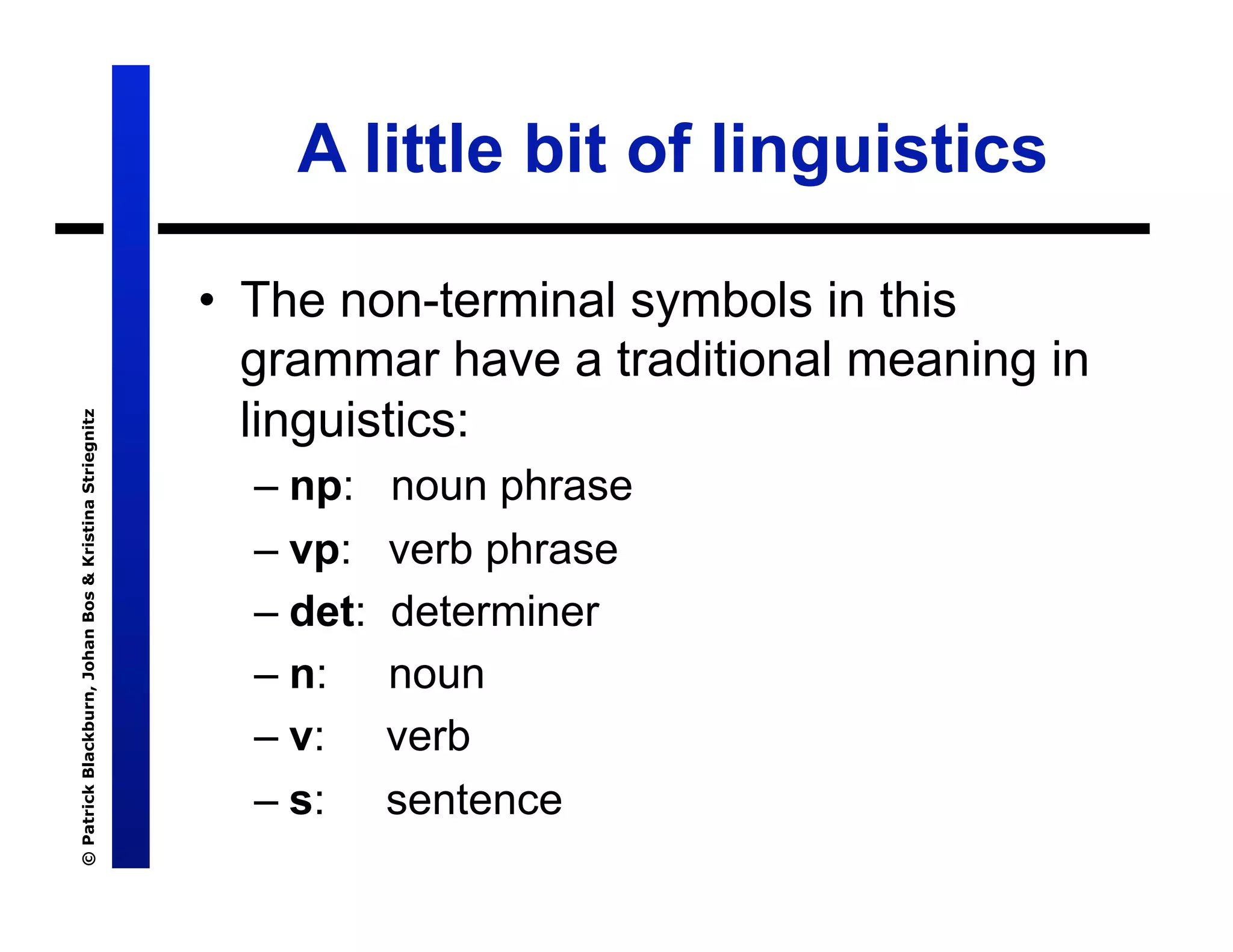
    5. A little bit of linguistics •  The non-terminal symbols in this grammar have a traditional meaning in linguistics: © Patrick Blackburn, Johan Bos & Kristina Striegnitz – np: noun phrase – vp: verb phrase – det: determiner – n: noun – v: verb – s: sentence
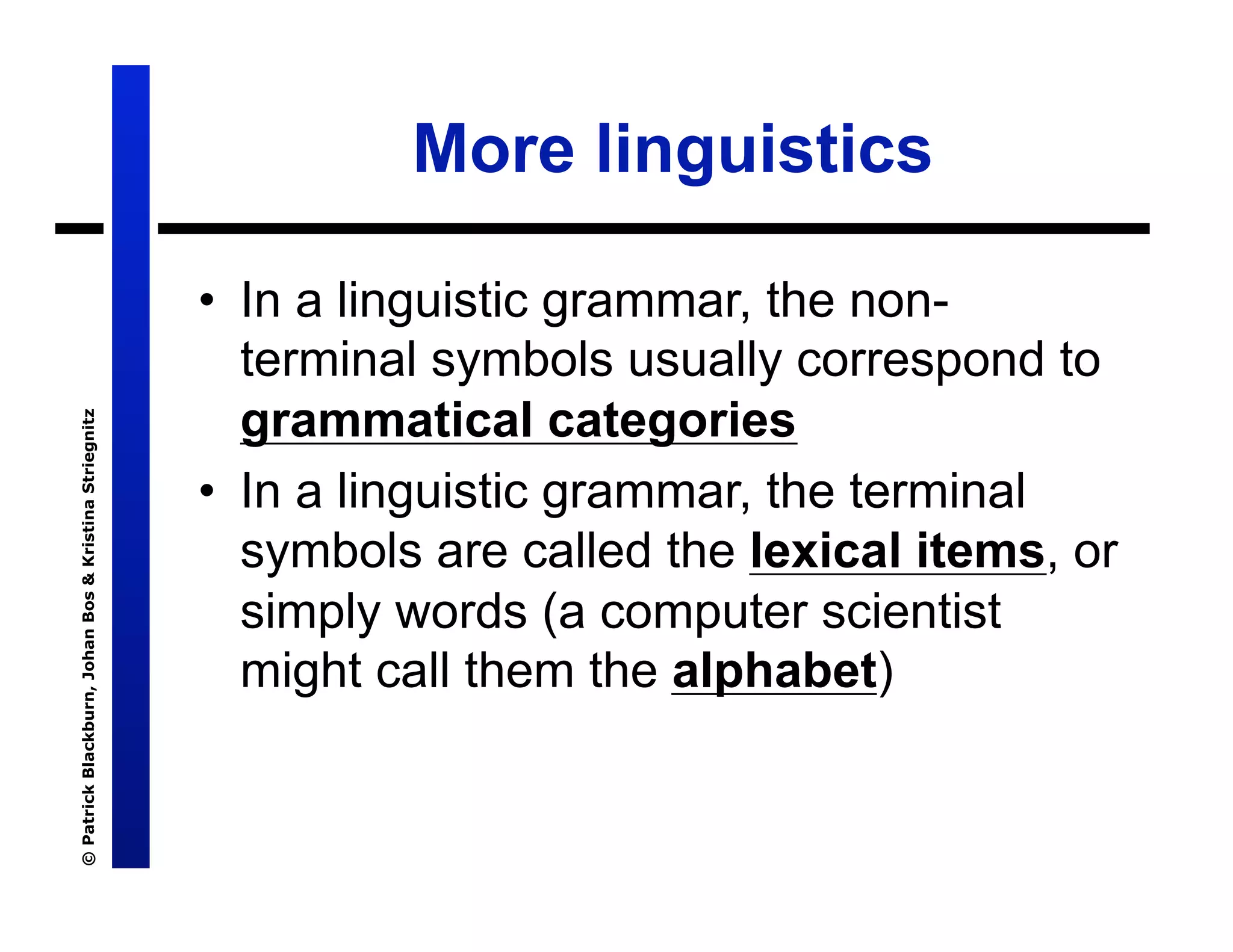
    6. More linguistics •  In a linguistic grammar, the non- terminal symbols usually correspond to grammatical categories © Patrick Blackburn, Johan Bos & Kristina Striegnitz •  In a linguistic grammar, the terminal symbols are called the lexical items, or simply words (a computer scientist might call them the alphabet)
    7. Context free rules •  The grammar contains s → np vp nine context free rules np → det n •  A context free rule consists of: vp → v np © Patrick Blackburn, Johan Bos & Kristina Striegnitz –  A single non-terminal symbol vp → v –  followed by → det → the –  followed by a finite sequence of terminal or non-terminal symbols det → a n → man n → woman v → shoots
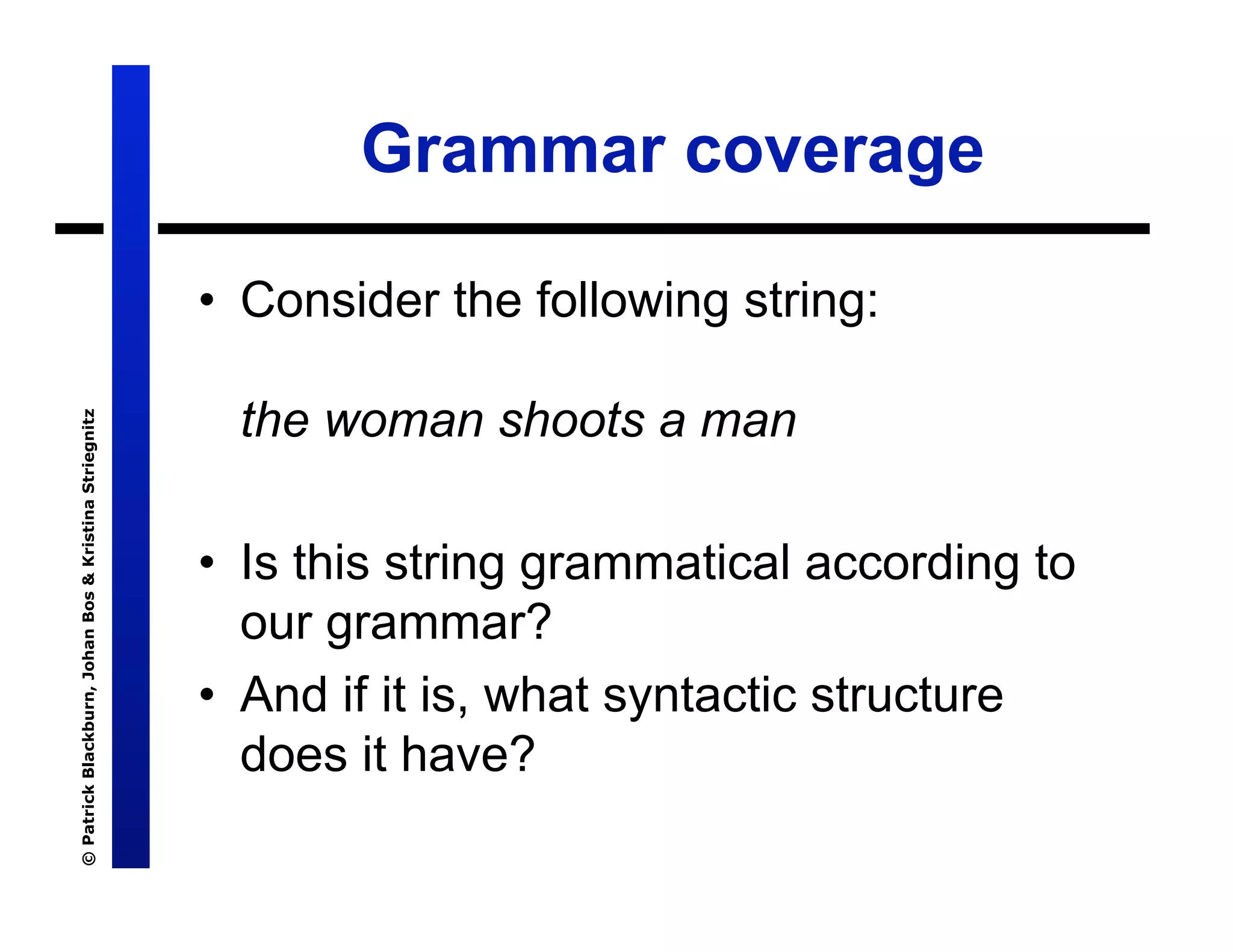
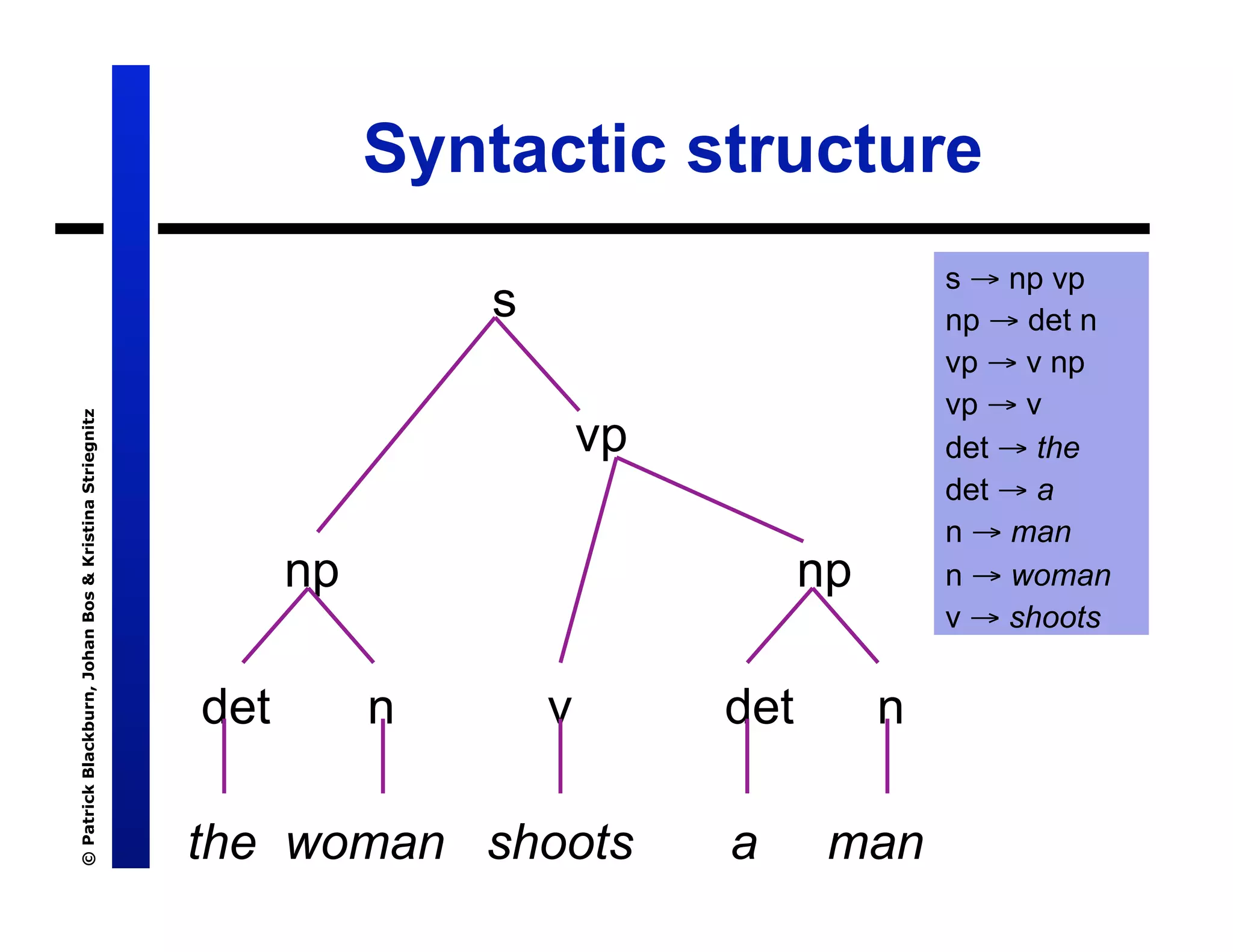
    8. Grammar coverage •  Consider the following string: the woman shoots a man © Patrick Blackburn, Johan Bos & Kristina Striegnitz •  Is this string grammatical according to our grammar? •  And if it is, what syntactic structure does it have?
    9. Syntactic structure s → np vp s np → det n vp → v np vp → v vp © Patrick Blackburn, Johan Bos & Kristina Striegnitz det → the det → a n → man np np n → woman v → shoots det n v det n the woman shoots a man
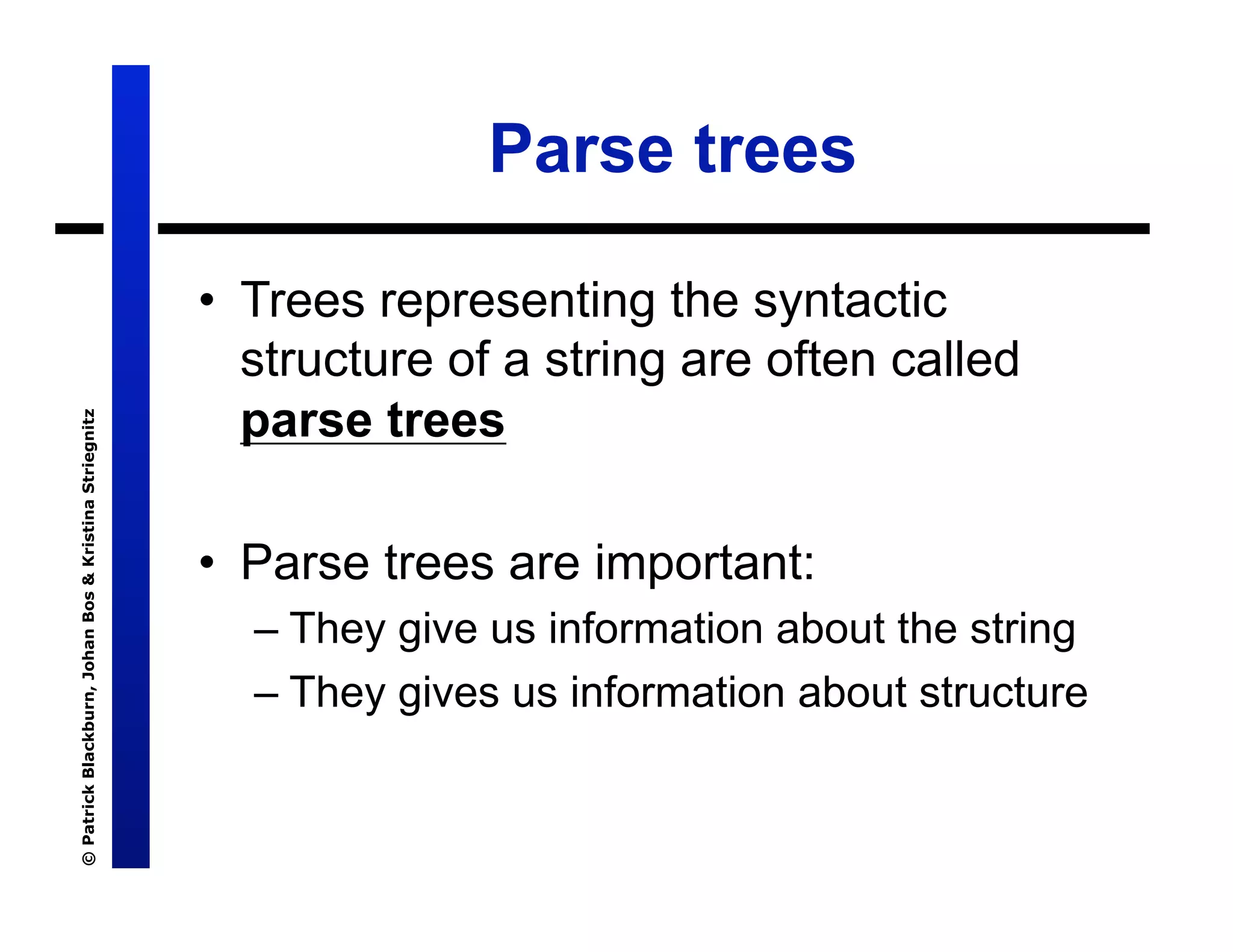
    10. Parse trees •  Trees representing the syntactic structure of a string are often called parse trees © Patrick Blackburn, Johan Bos & Kristina Striegnitz •  Parse trees are important: – They give us information about the string – They gives us information about structure
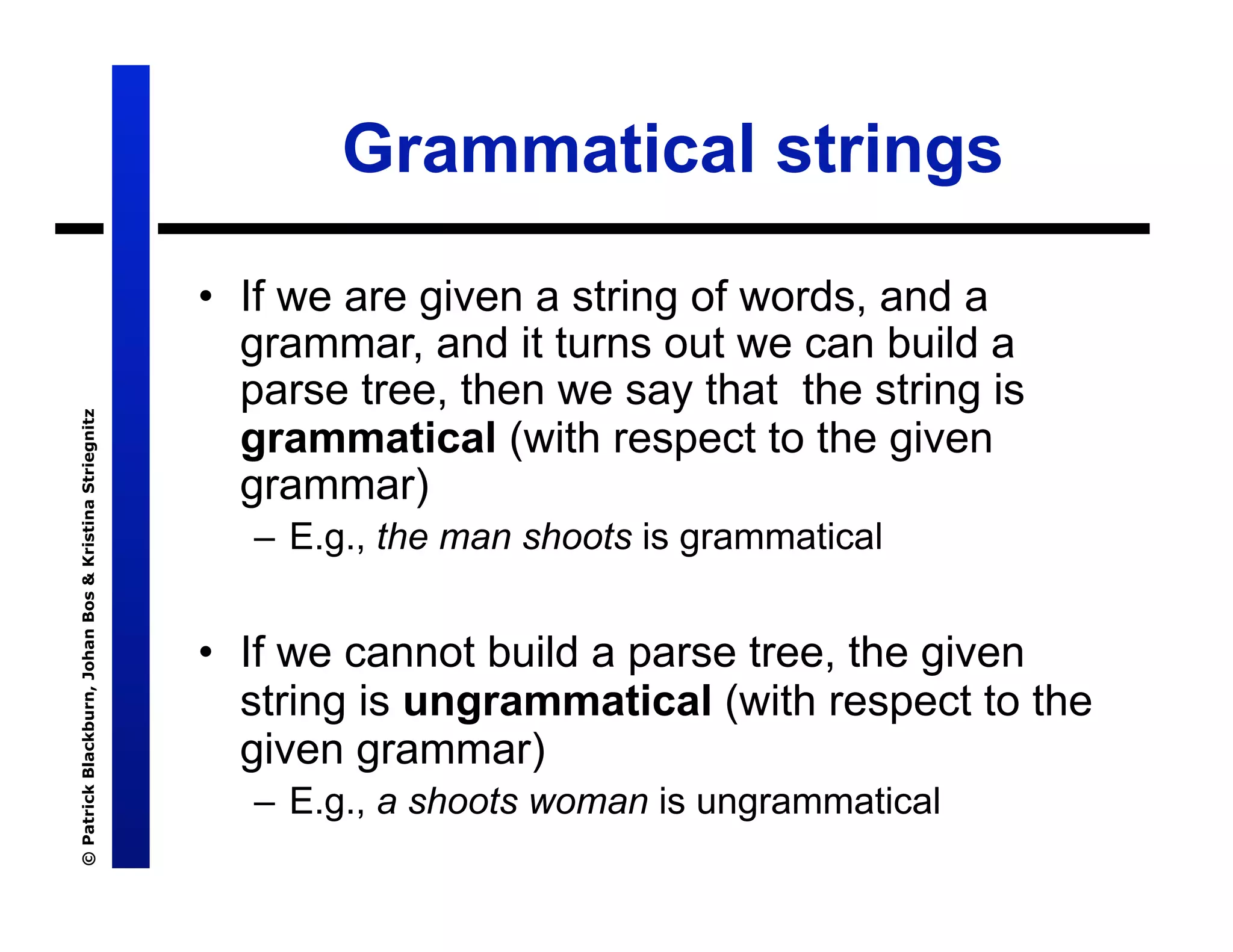
    11. Grammatical strings •  If we are given a string of words, and a grammar, and it turns out we can build a parse tree, then we say that the string is © Patrick Blackburn, Johan Bos & Kristina Striegnitz grammatical (with respect to the given grammar) –  E.g., the man shoots is grammatical •  If we cannot build a parse tree, the given string is ungrammatical (with respect to the given grammar) –  E.g., a shoots woman is ungrammatical
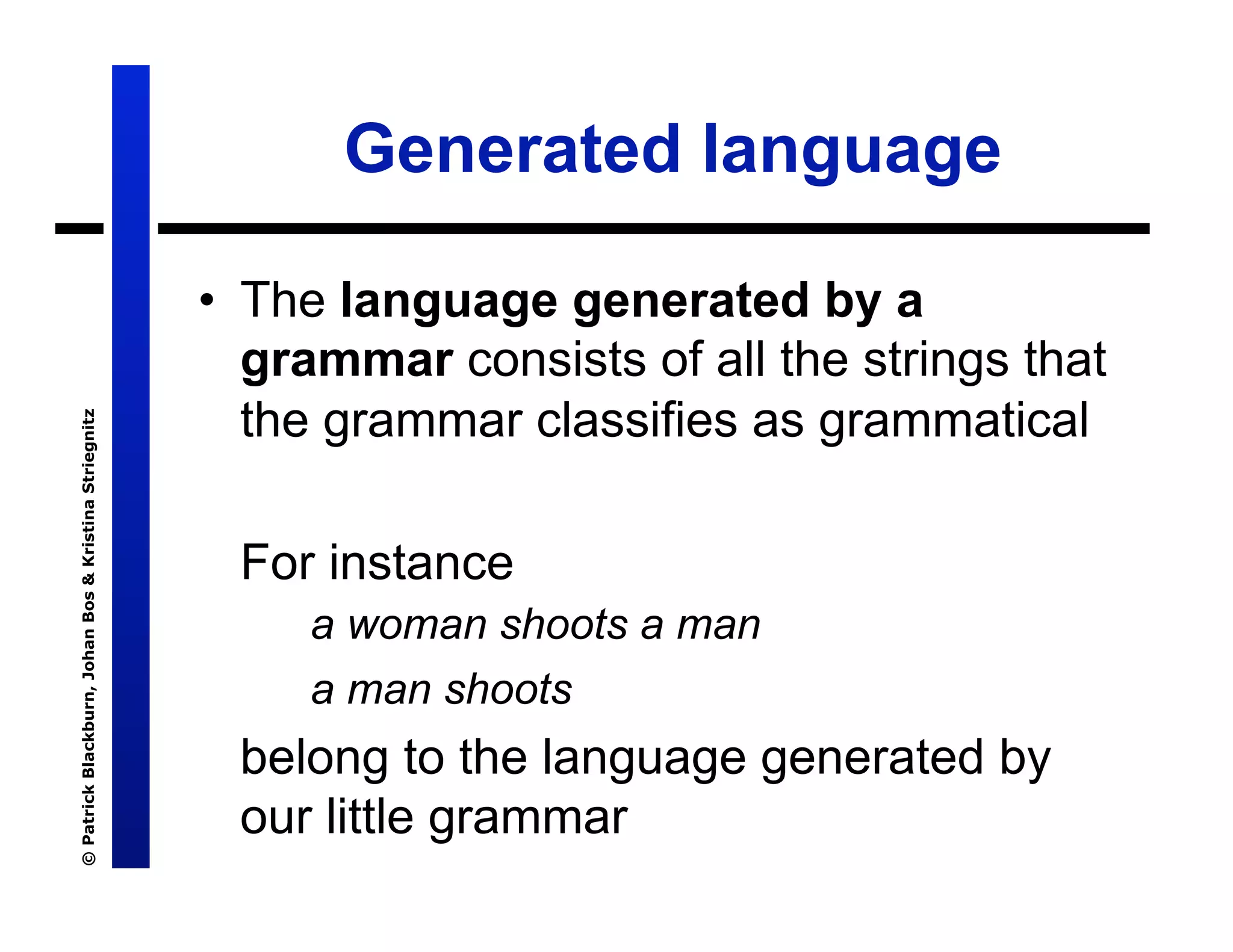
    12. Generated language •  The language generated by a grammar consists of all the strings that the grammar classifies as grammatical © Patrick Blackburn, Johan Bos & Kristina Striegnitz For instance a woman shoots a man a man shoots belong to the language generated by our little grammar
    13. Recogniser •  A context free recogniser is a program which correctly tells us whether or not a string belongs to the language © Patrick Blackburn, Johan Bos & Kristina Striegnitz generated by a context free grammar •  To put it another way, a recogniser is a program that correctly classifies strings as grammatical or ungrammatical
    14. Information about structure •  But both in linguistics and computer science, we are not merely interested in whether a string is grammatical or not © Patrick Blackburn, Johan Bos & Kristina Striegnitz •  We also want to know why it is grammatical: we want to know what its structure is •  The parse tree gives us this structure
    15. Parser •  A context free parser correctly decides whether a string belongs to the language generated by a context free © Patrick Blackburn, Johan Bos & Kristina Striegnitz grammar •  And it also tells us what its structure is •  To sum up: – A recogniser just says yes or no – A parser also gives us a parse tree
    16. Context free language •  We know what a context free grammar is, but what is a context free language? •  Simply: a context free language is a © Patrick Blackburn, Johan Bos & Kristina Striegnitz language that can be generated by a context free grammar •  Some human languages are context free, some others are not –  English and Italian are probably context free –  Dutch and Swiss-German are not context free
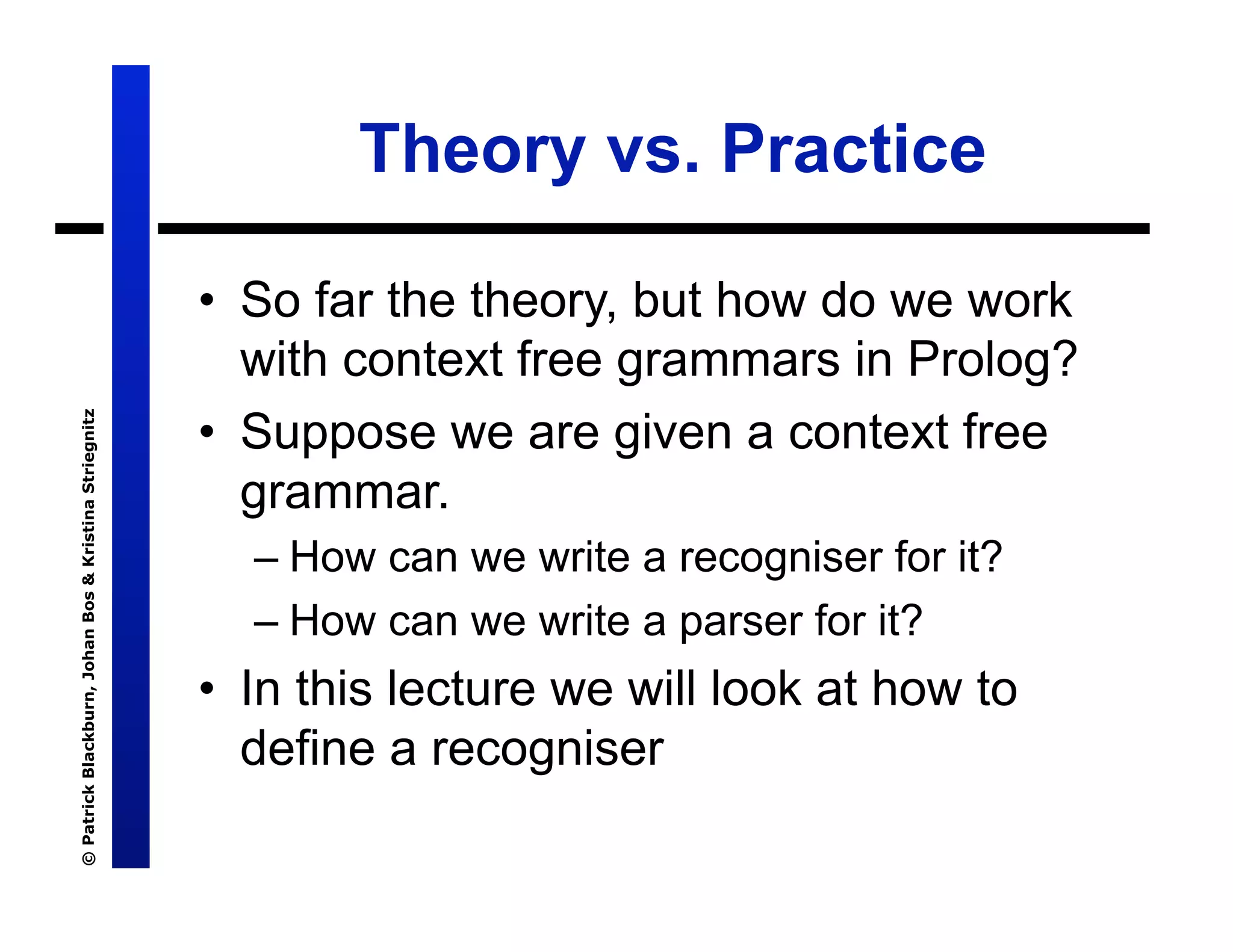
    17. Theory vs. Practice •  So far the theory, but how do we work with context free grammars in Prolog? •  Suppose we are given a context free © Patrick Blackburn, Johan Bos & Kristina Striegnitz grammar. – How can we write a recogniser for it? – How can we write a parser for it? •  In this lecture we will look at how to define a recogniser
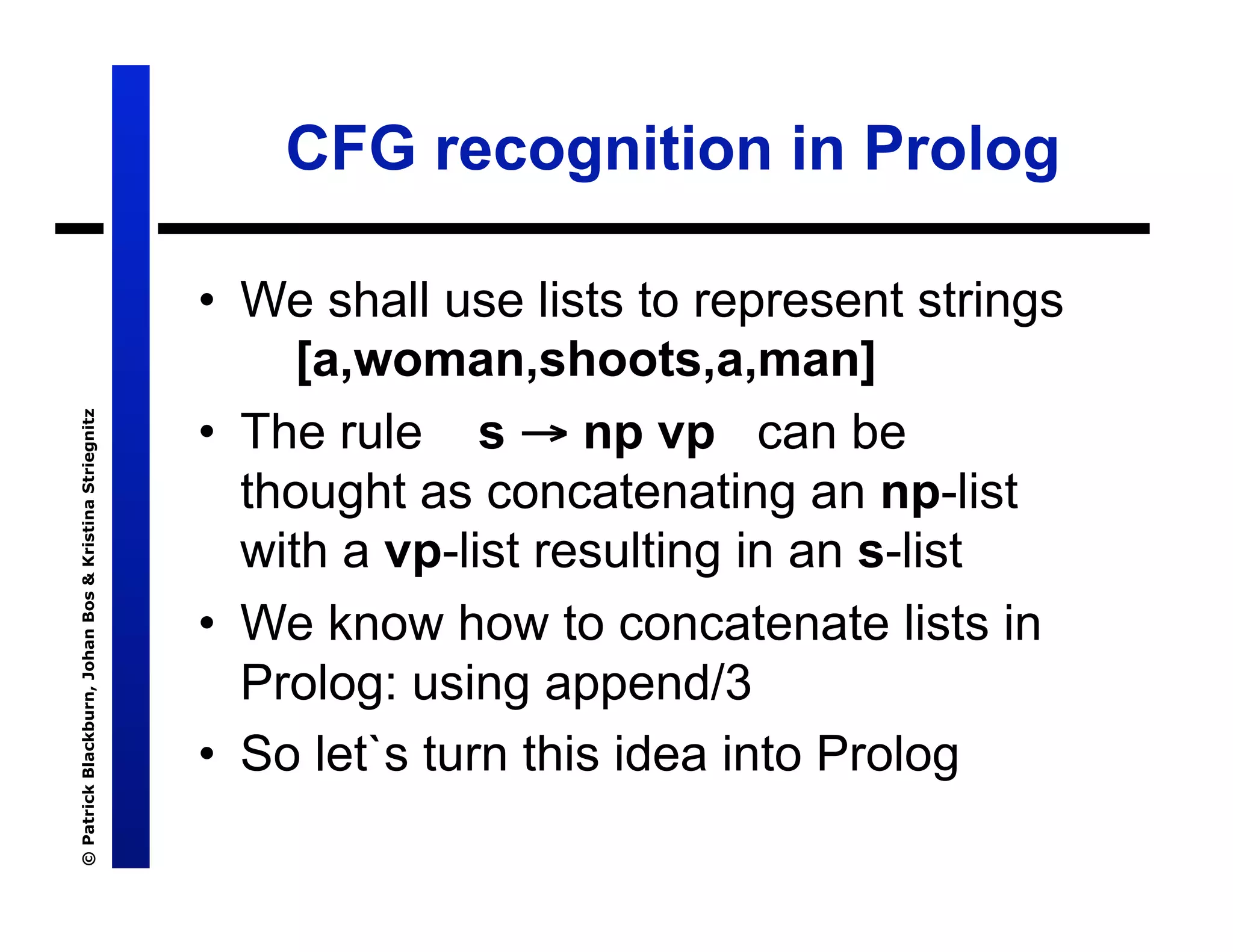
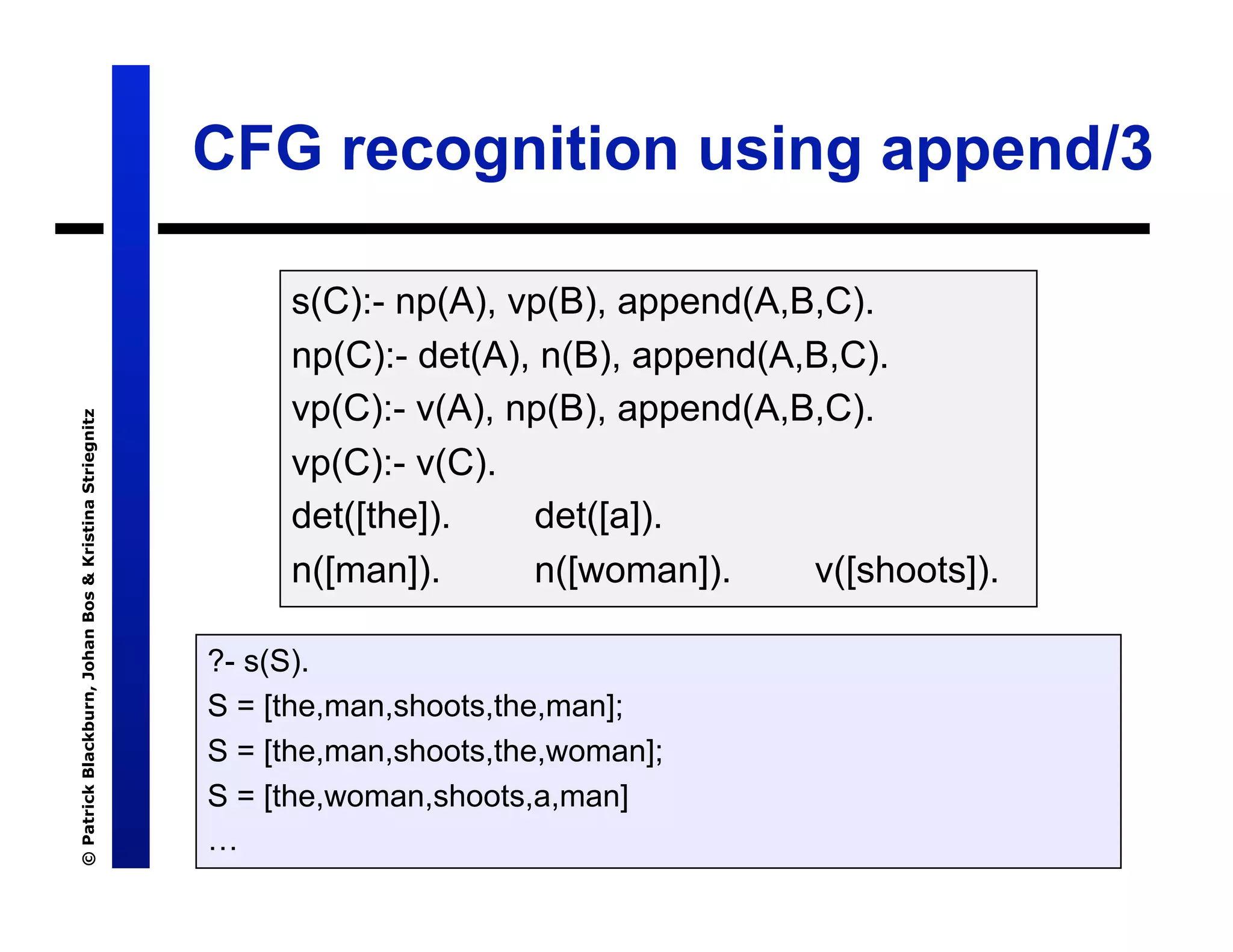
    18. CFG recognition in Prolog •  We shall use lists to represent strings [a,woman,shoots,a,man] •  The rule s → np vp can be © Patrick Blackburn, Johan Bos & Kristina Striegnitz thought as concatenating an np-list with a vp-list resulting in an s-list •  We know how to concatenate lists in Prolog: using append/3 •  So let`s turn this idea into Prolog
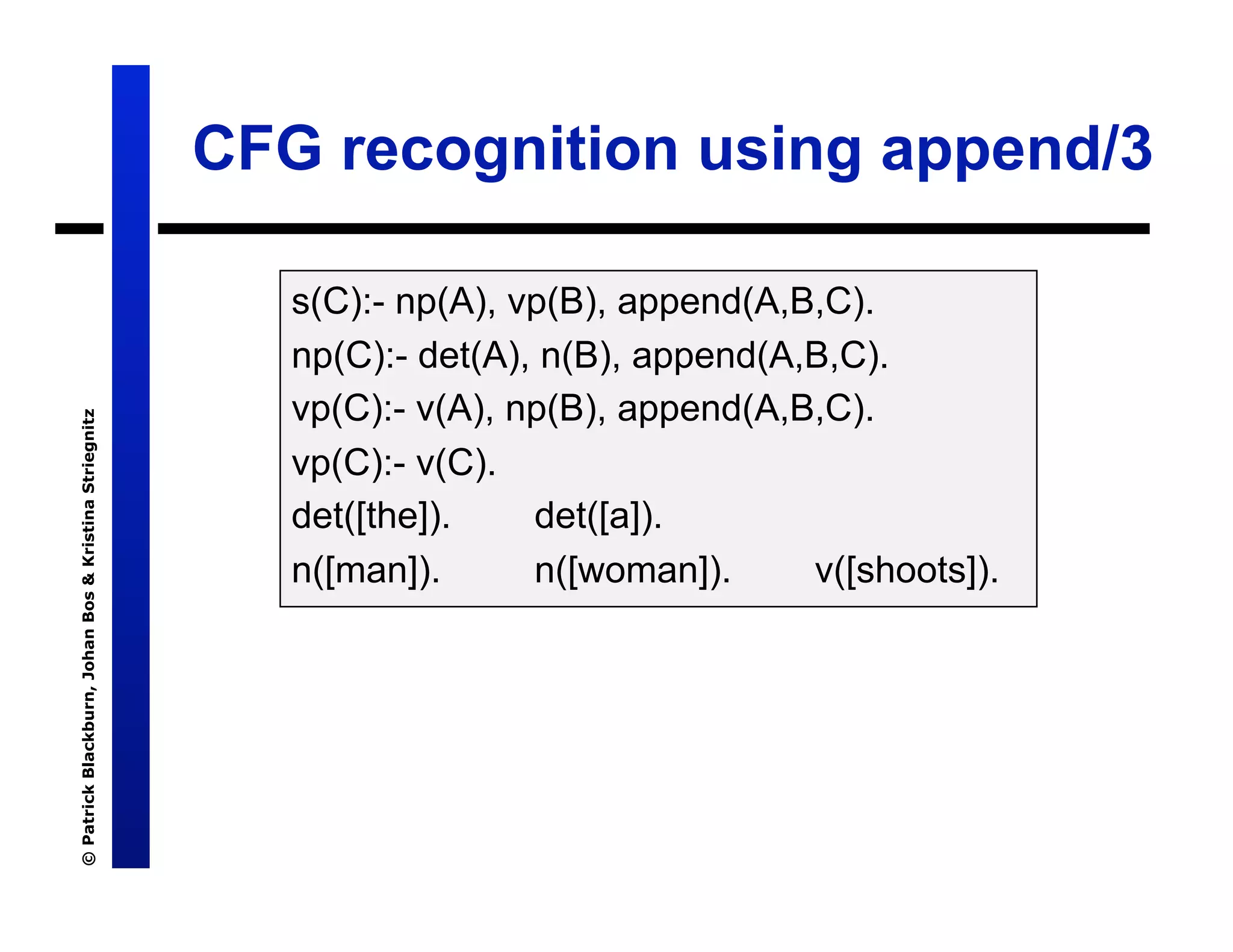
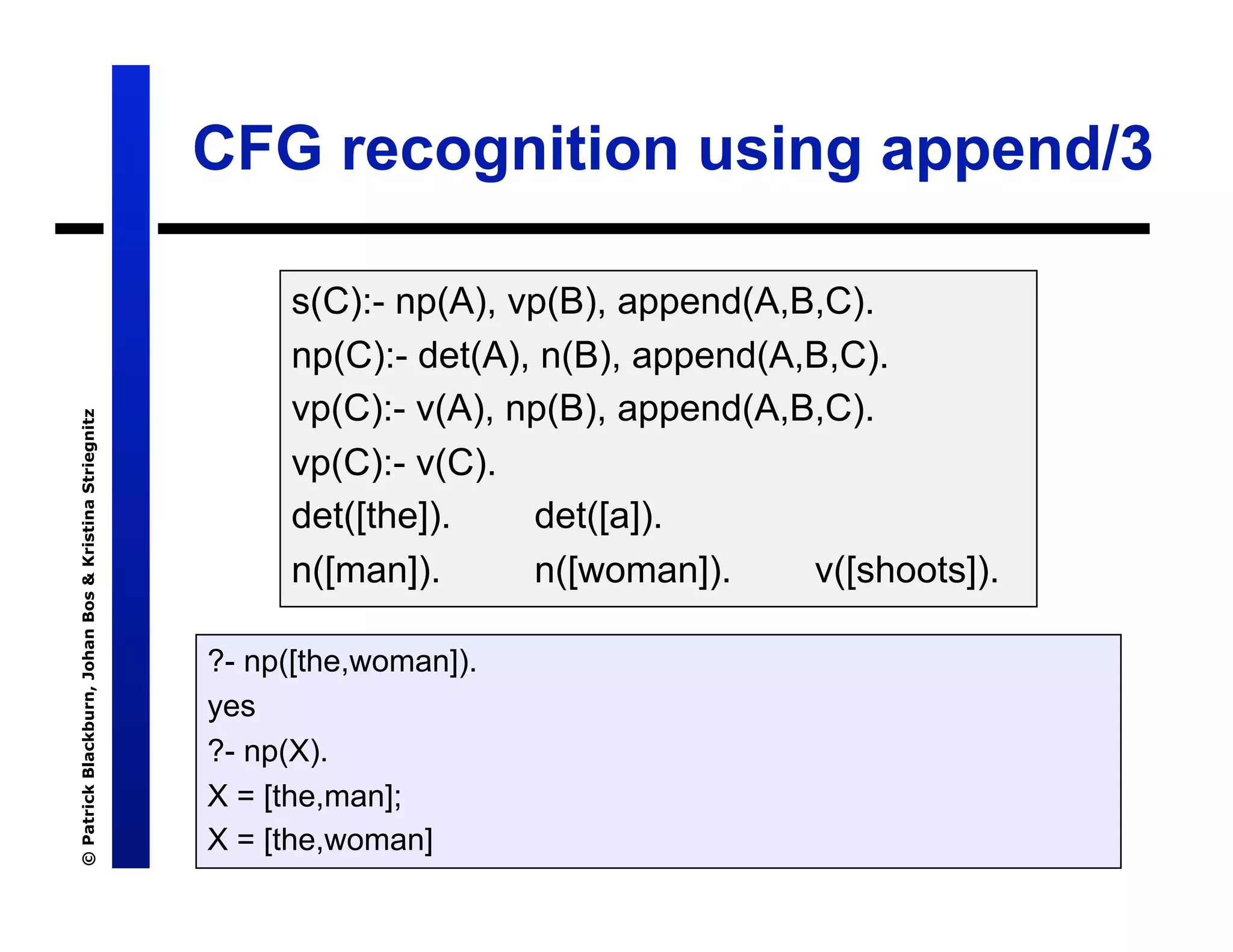
    19. CFG recognition using append/3 s(C):- np(A), vp(B), append(A,B,C). np(C):- det(A), n(B), append(A,B,C). vp(C):- v(A), np(B), append(A,B,C). © Patrick Blackburn, Johan Bos & Kristina Striegnitz vp(C):- v(C). det([the]). det([a]). n([man]). n([woman]). v([shoots]).
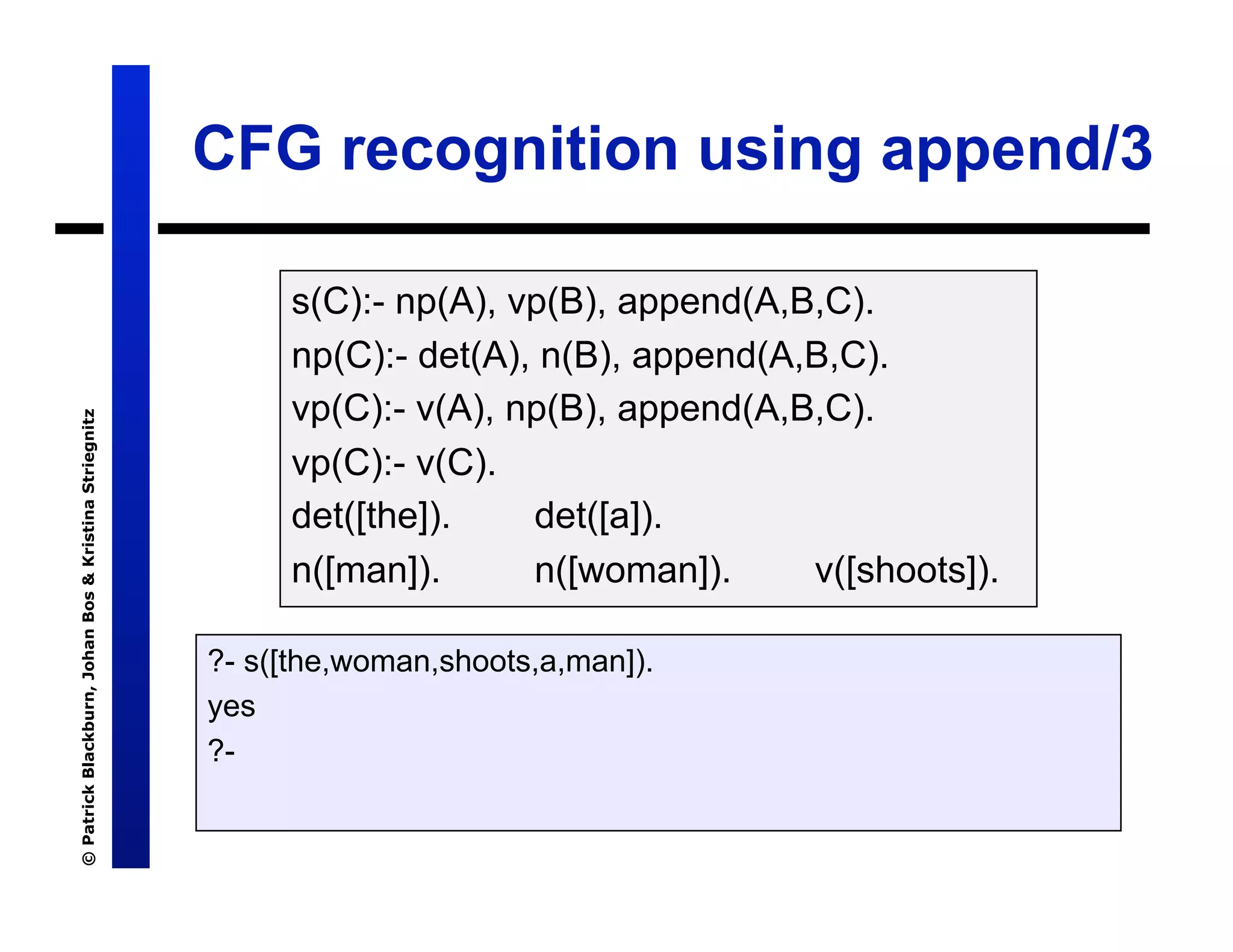
    20. CFG recognition using append/3 s(C):- np(A), vp(B), append(A,B,C). np(C):- det(A), n(B), append(A,B,C). vp(C):- v(A), np(B), append(A,B,C). © Patrick Blackburn, Johan Bos & Kristina Striegnitz vp(C):- v(C). det([the]). det([a]). n([man]). n([woman]). v([shoots]). ?- s([the,woman,shoots,a,man]). yes ?-
    21. CFG recognition using append/3 s(C):- np(A), vp(B), append(A,B,C). np(C):- det(A), n(B), append(A,B,C). vp(C):- v(A), np(B), append(A,B,C). © Patrick Blackburn, Johan Bos & Kristina Striegnitz vp(C):- v(C). det([the]). det([a]). n([man]). n([woman]). v([shoots]). ?- s(S). S = [the,man,shoots,the,man]; S = [the,man,shoots,the,woman]; S = [the,woman,shoots,a,man] …
    22. CFG recognition using append/3 s(C):- np(A), vp(B), append(A,B,C). np(C):- det(A), n(B), append(A,B,C). vp(C):- v(A), np(B), append(A,B,C). © Patrick Blackburn, Johan Bos & Kristina Striegnitz vp(C):- v(C). det([the]). det([a]). n([man]). n([woman]). v([shoots]). ?- np([the,woman]). yes ?- np(X). X = [the,man]; X = [the,woman]
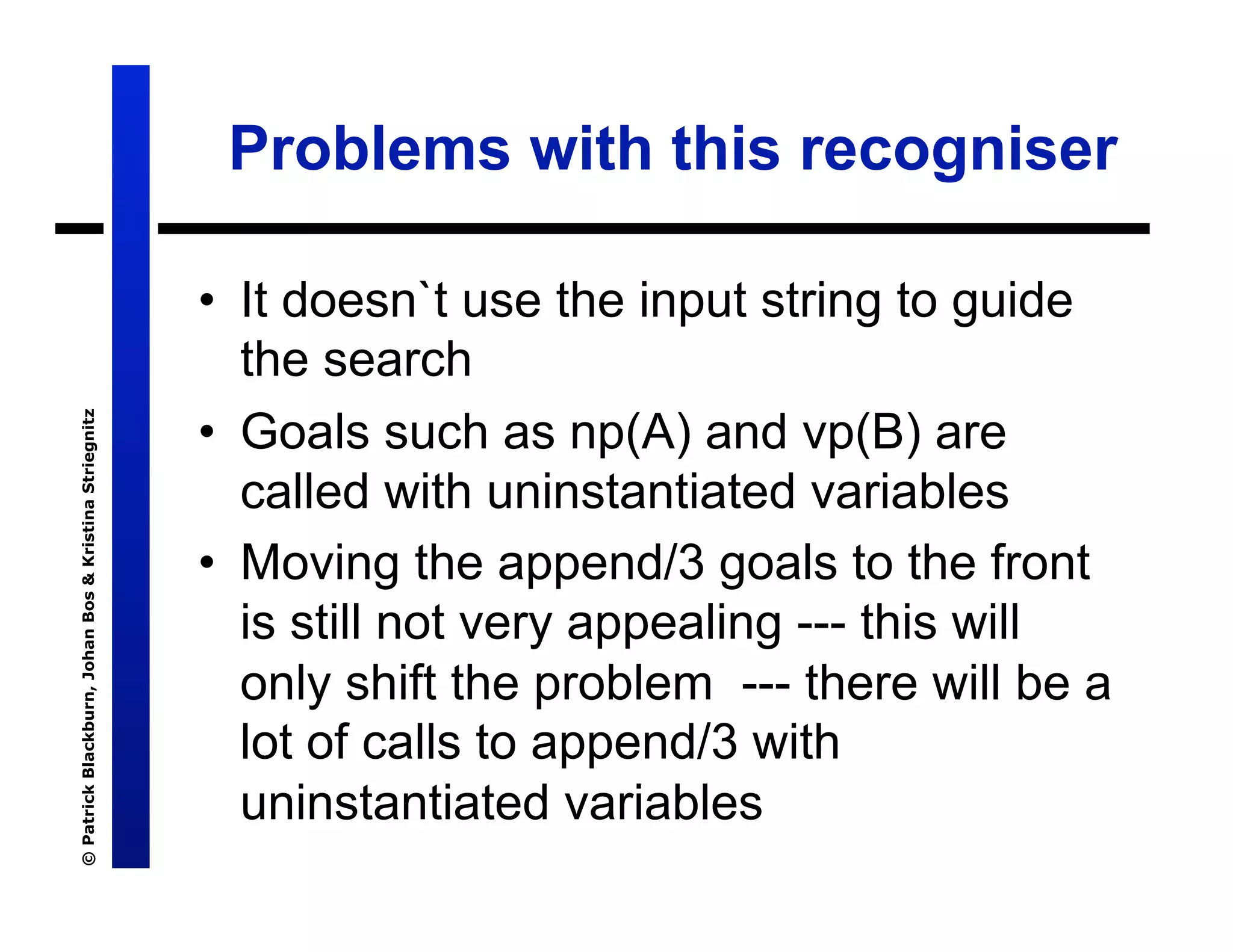
    23. Problems with this recogniser •  It doesn`t use the input string to guide the search •  Goals such as np(A) and vp(B) are © Patrick Blackburn, Johan Bos & Kristina Striegnitz called with uninstantiated variables •  Moving the append/3 goals to the front is still not very appealing --- this will only shift the problem --- there will be a lot of calls to append/3 with uninstantiated variables
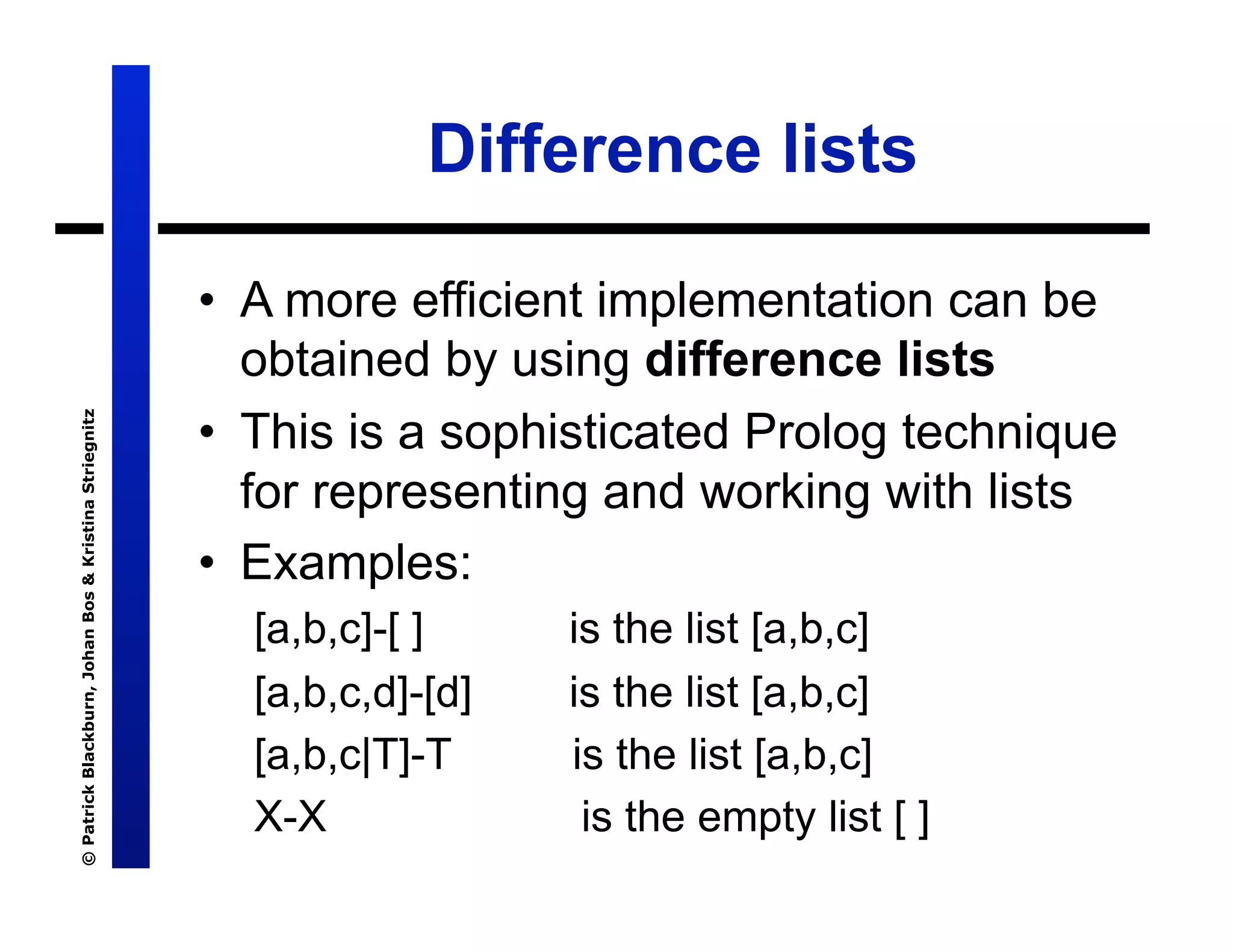
    24. Difference lists •  A more efficient implementation can be obtained by using difference lists •  This is a sophisticated Prolog technique © Patrick Blackburn, Johan Bos & Kristina Striegnitz for representing and working with lists •  Examples: [a,b,c]-[ ] is the list [a,b,c] [a,b,c,d]-[d] is the list [a,b,c] [a,b,c|T]-T is the list [a,b,c] X-X is the empty list [ ]
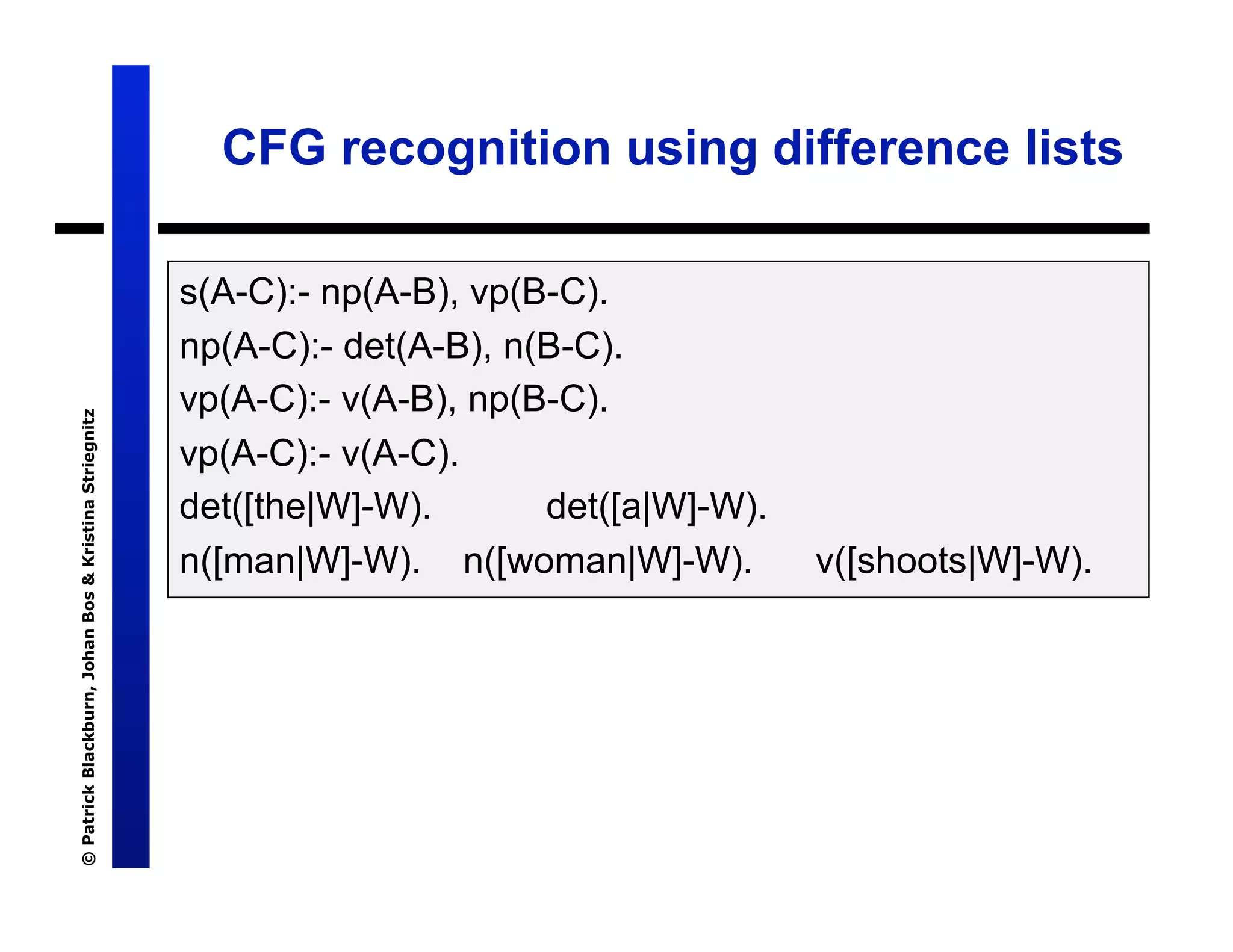
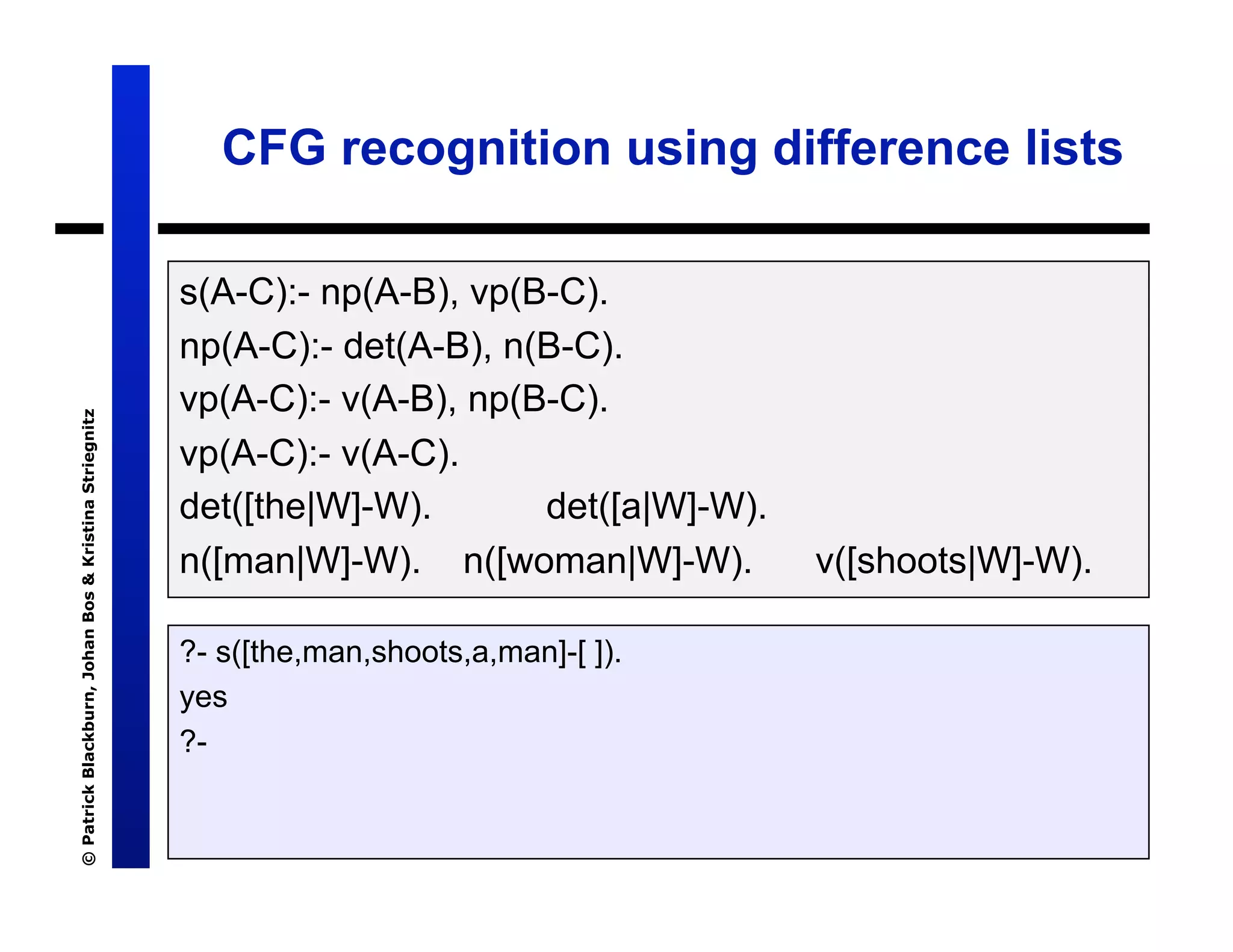
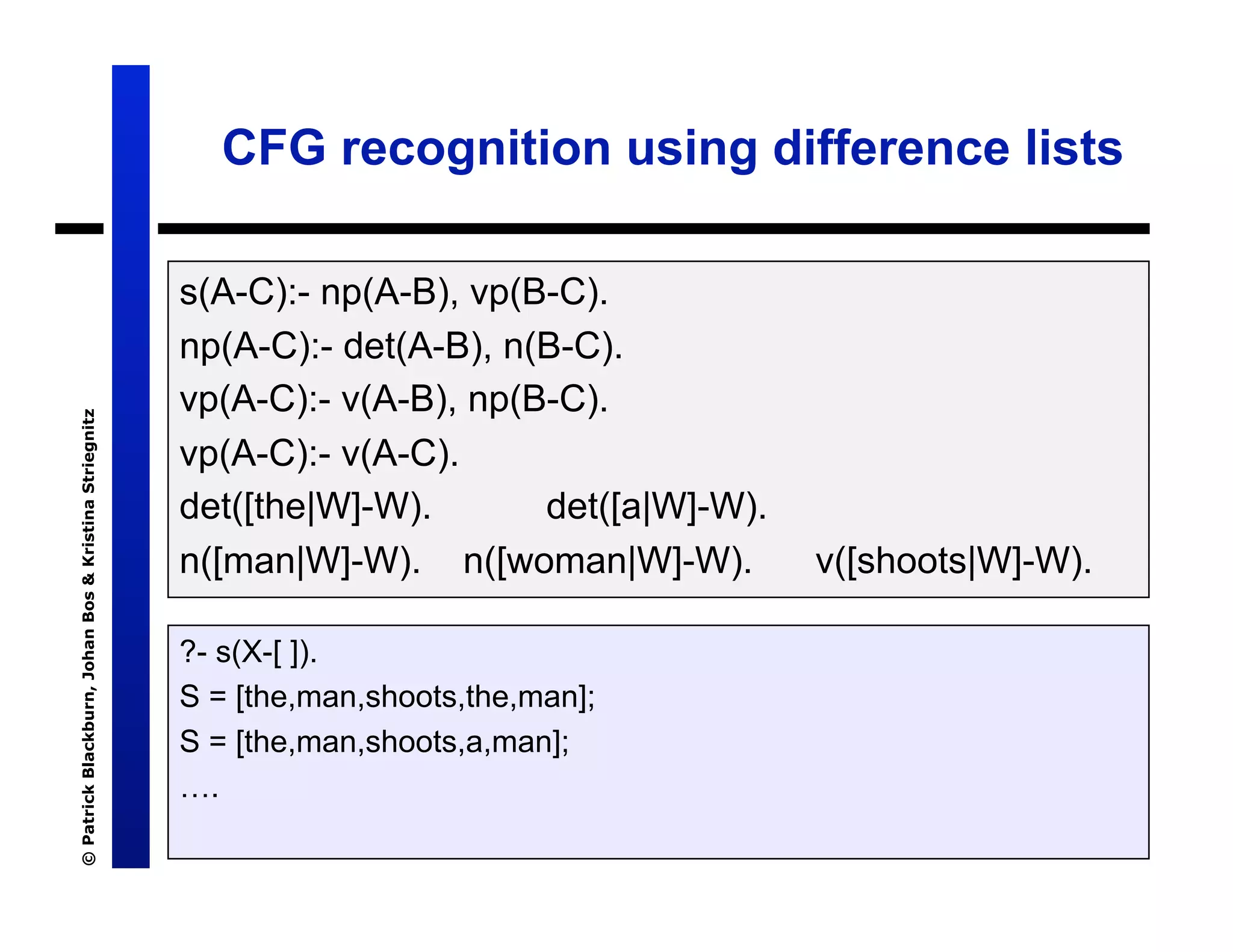
    25. CFG recognition using difference lists s(A-C):- np(A-B), vp(B-C). np(A-C):- det(A-B), n(B-C). vp(A-C):- v(A-B), np(B-C). © Patrick Blackburn, Johan Bos & Kristina Striegnitz vp(A-C):- v(A-C). det([the|W]-W). det([a|W]-W). n([man|W]-W). n([woman|W]-W). v([shoots|W]-W).
    26. CFG recognition using difference lists s(A-C):- np(A-B), vp(B-C). np(A-C):- det(A-B), n(B-C). vp(A-C):- v(A-B), np(B-C). © Patrick Blackburn, Johan Bos & Kristina Striegnitz vp(A-C):- v(A-C). det([the|W]-W). det([a|W]-W). n([man|W]-W). n([woman|W]-W). v([shoots|W]-W). ?- s([the,man,shoots,a,man]-[ ]). yes ?-
    27. CFG recognition using difference lists s(A-C):- np(A-B), vp(B-C). np(A-C):- det(A-B), n(B-C). vp(A-C):- v(A-B), np(B-C). © Patrick Blackburn, Johan Bos & Kristina Striegnitz vp(A-C):- v(A-C). det([the|W]-W). det([a|W]-W). n([man|W]-W). n([woman|W]-W). v([shoots|W]-W). ?- s(X-[ ]). S = [the,man,shoots,the,man]; S = [the,man,shoots,a,man]; ….
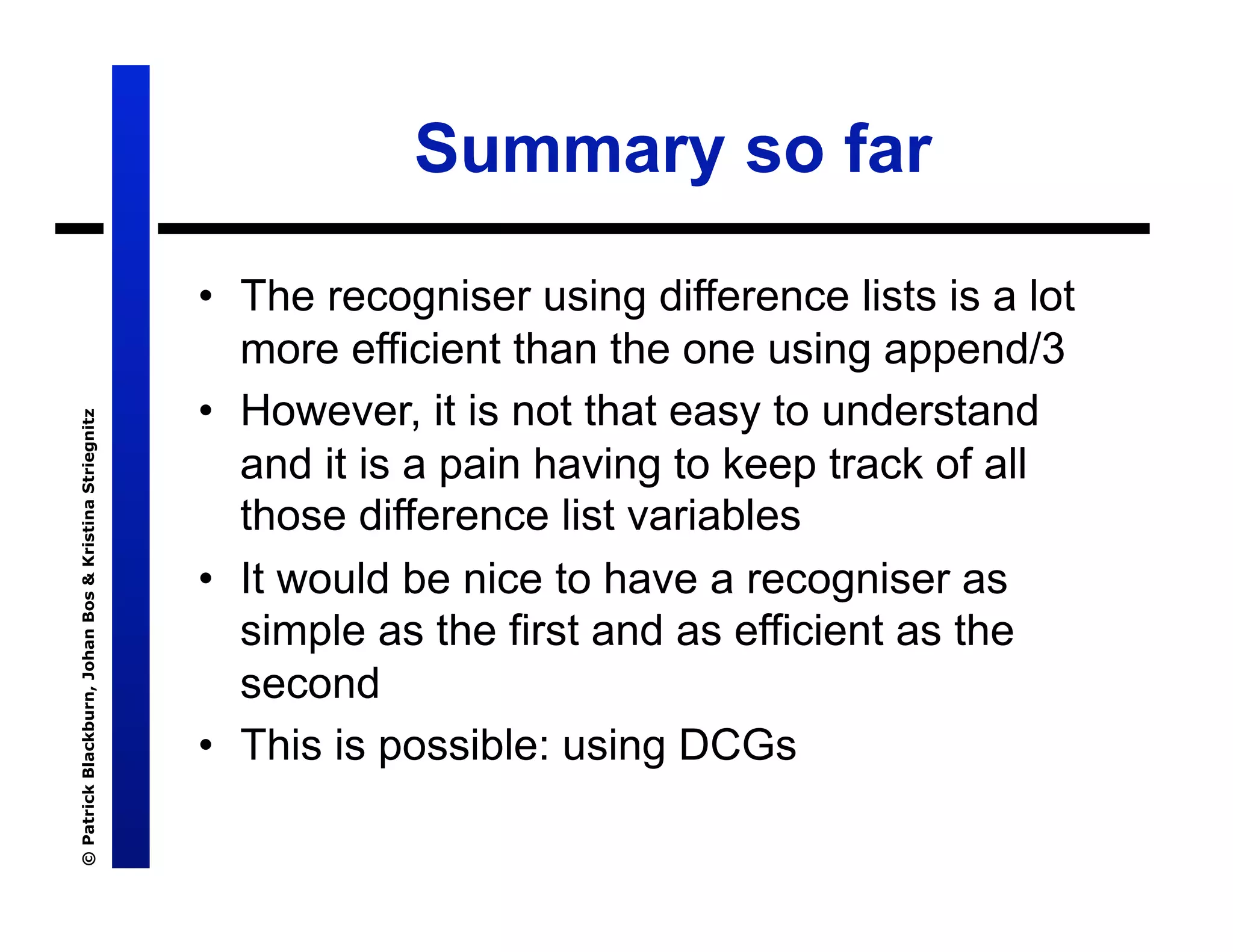
    28. Summary so far •  The recogniser using difference lists is a lot more efficient than the one using append/3 •  However, it is not that easy to understand © Patrick Blackburn, Johan Bos & Kristina Striegnitz and it is a pain having to keep track of all those difference list variables •  It would be nice to have a recogniser as simple as the first and as efficient as the second •  This is possible: using DCGs
    29. Definite Clause Grammars •  What are DCGs? •  Quite simply, a nice notation for writing grammars that hides the underlying © Patrick Blackburn, Johan Bos & Kristina Striegnitz difference list variables •  Let us look at three examples
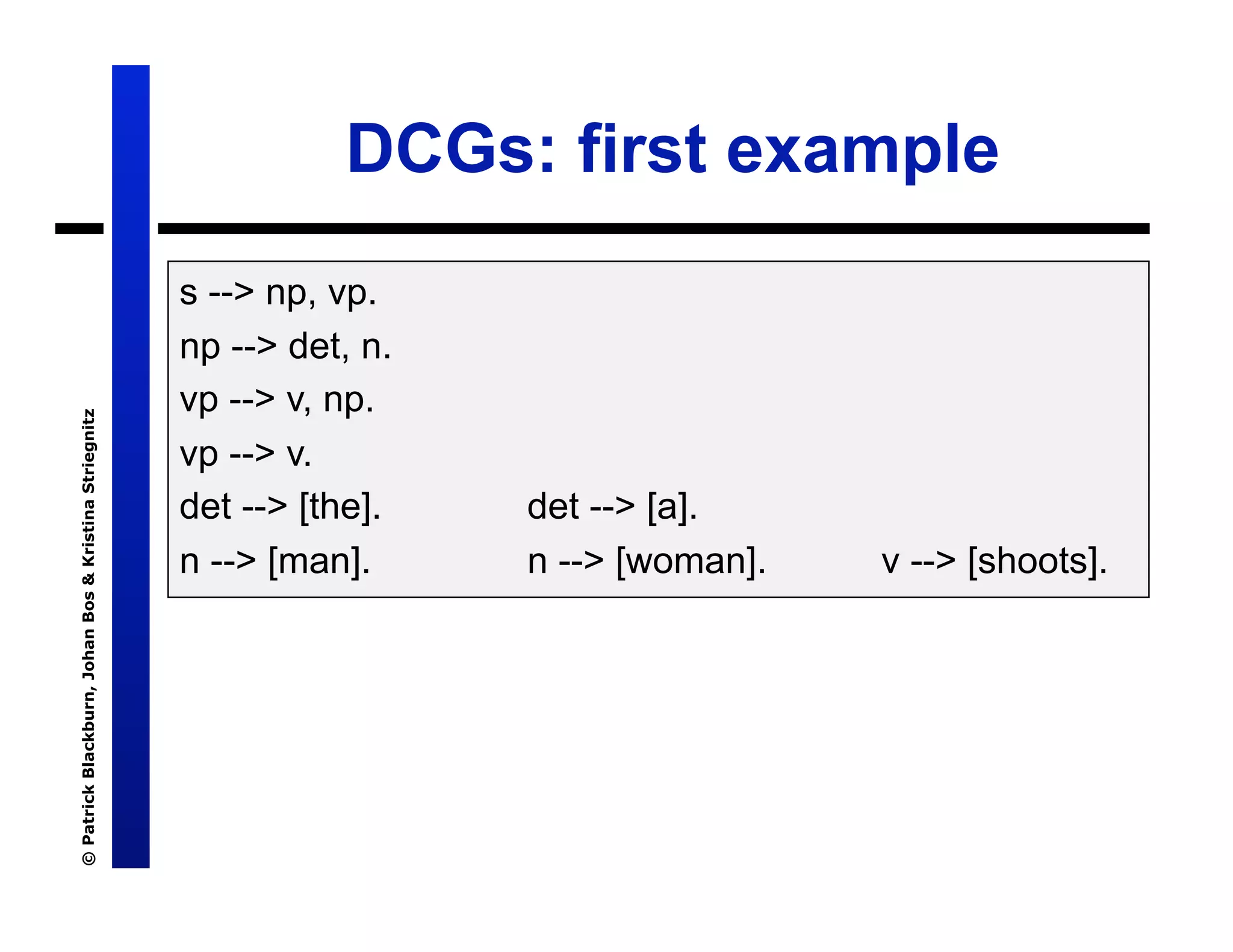
    30. DCGs: first example s --> np, vp. np --> det, n. vp --> v, np. © Patrick Blackburn, Johan Bos & Kristina Striegnitz vp --> v. det --> [the]. det --> [a]. n --> [man]. n --> [woman]. v --> [shoots].
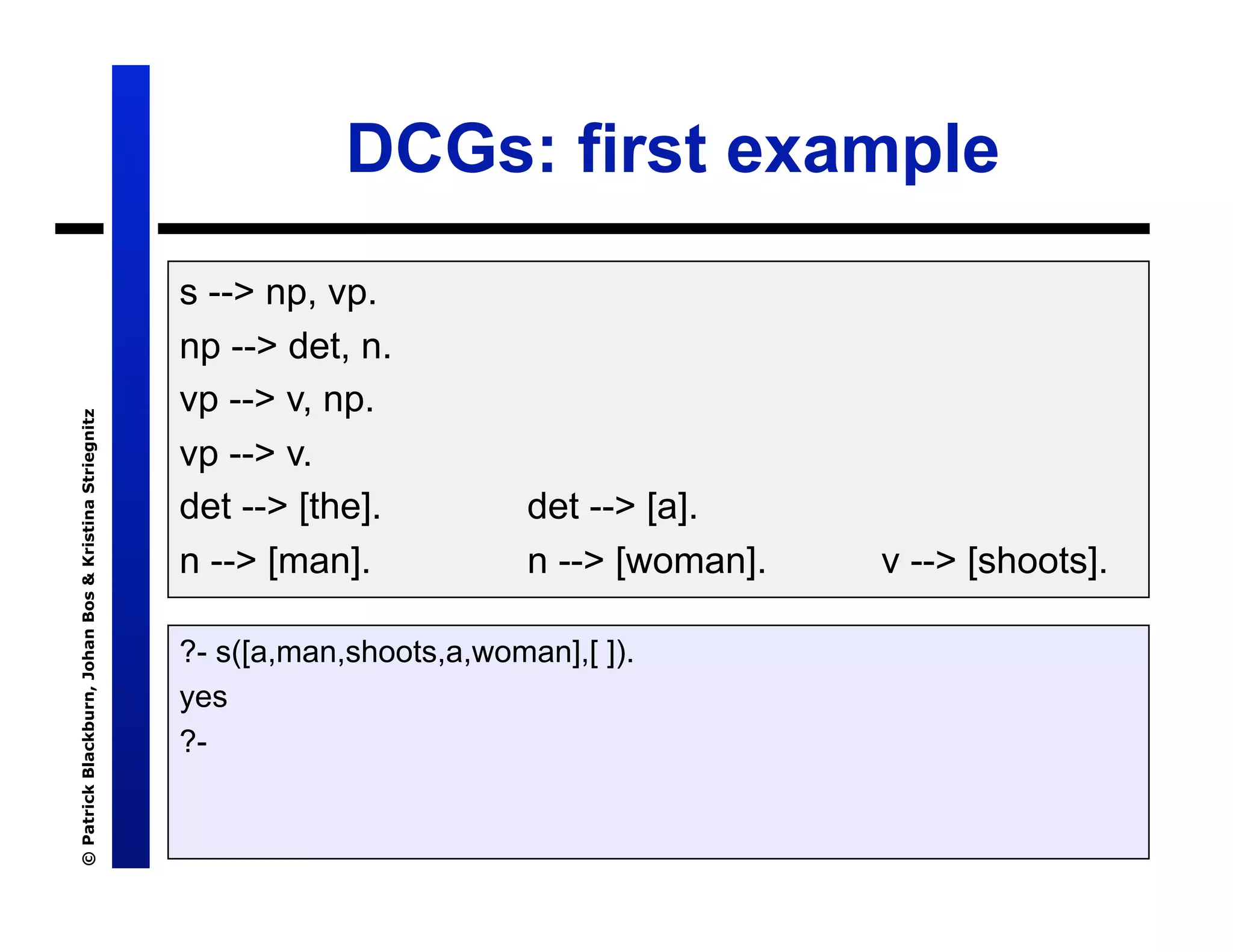
    31. DCGs: first example s --> np, vp. np --> det, n. vp --> v, np. © Patrick Blackburn, Johan Bos & Kristina Striegnitz vp --> v. det --> [the]. det --> [a]. n --> [man]. n --> [woman]. v --> [shoots]. ?- s([a,man,shoots,a,woman],[ ]). yes ?-
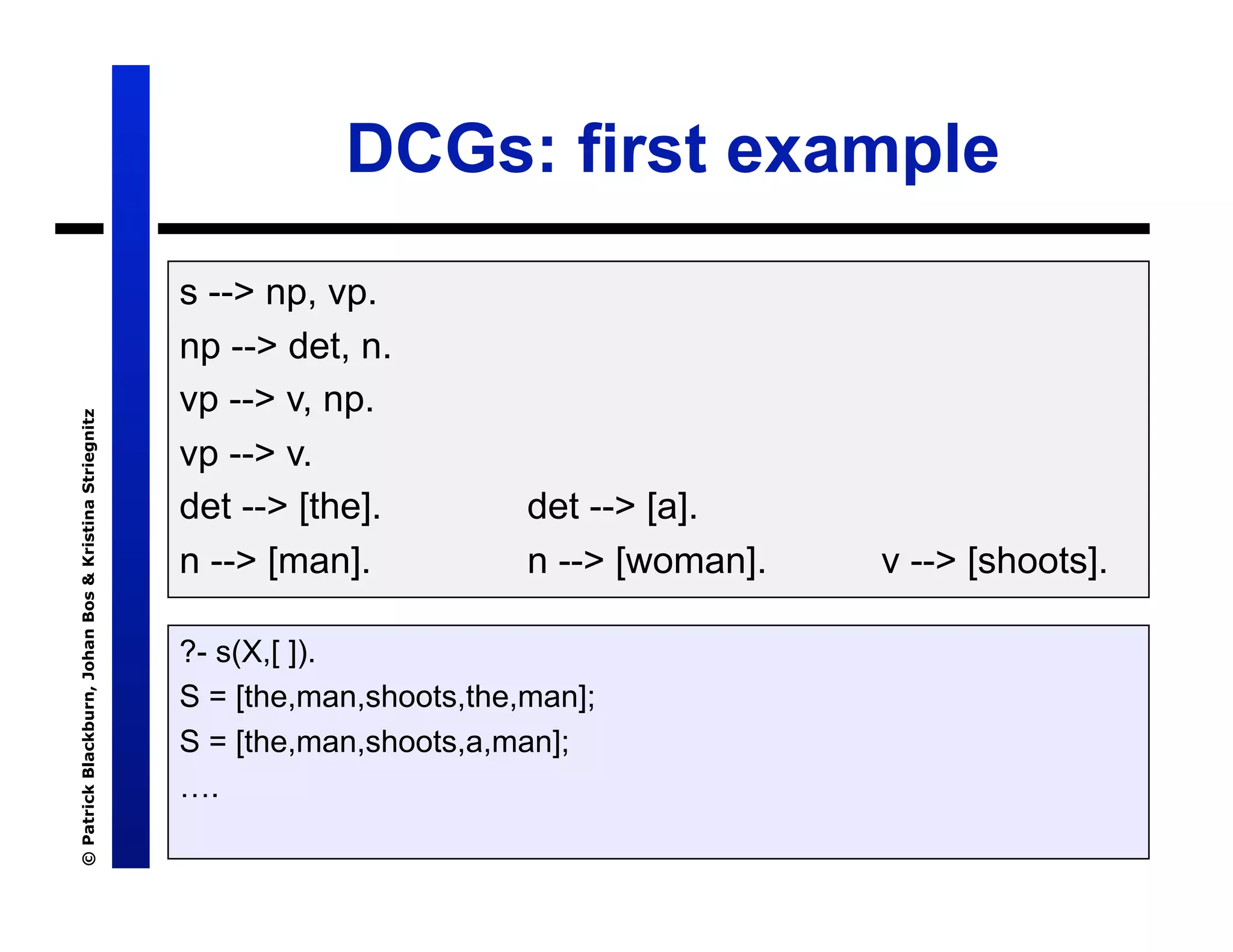
    32. DCGs: first example s --> np, vp. np --> det, n. vp --> v, np. © Patrick Blackburn, Johan Bos & Kristina Striegnitz vp --> v. det --> [the]. det --> [a]. n --> [man]. n --> [woman]. v --> [shoots]. ?- s(X,[ ]). S = [the,man,shoots,the,man]; S = [the,man,shoots,a,man]; ….
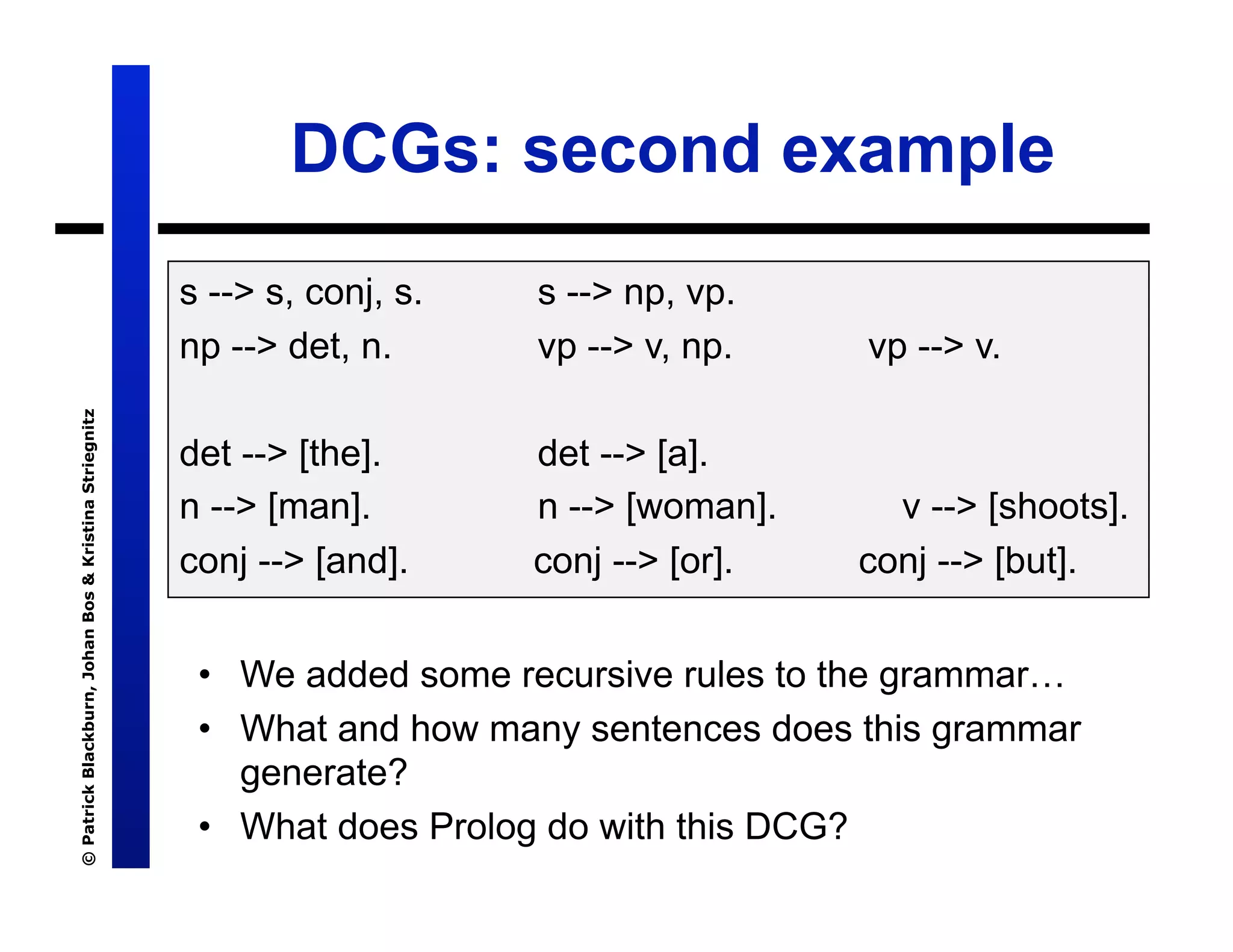
    33. DCGs: second example s --> s, conj, s. s --> np, vp. np --> det, n. vp --> v, np. vp --> v. © Patrick Blackburn, Johan Bos & Kristina Striegnitz det --> [the]. det --> [a]. n --> [man]. n --> [woman]. v --> [shoots]. conj --> [and]. conj --> [or]. conj --> [but]. •  We added some recursive rules to the grammar… •  What and how many sentences does this grammar generate? •  What does Prolog do with this DCG?
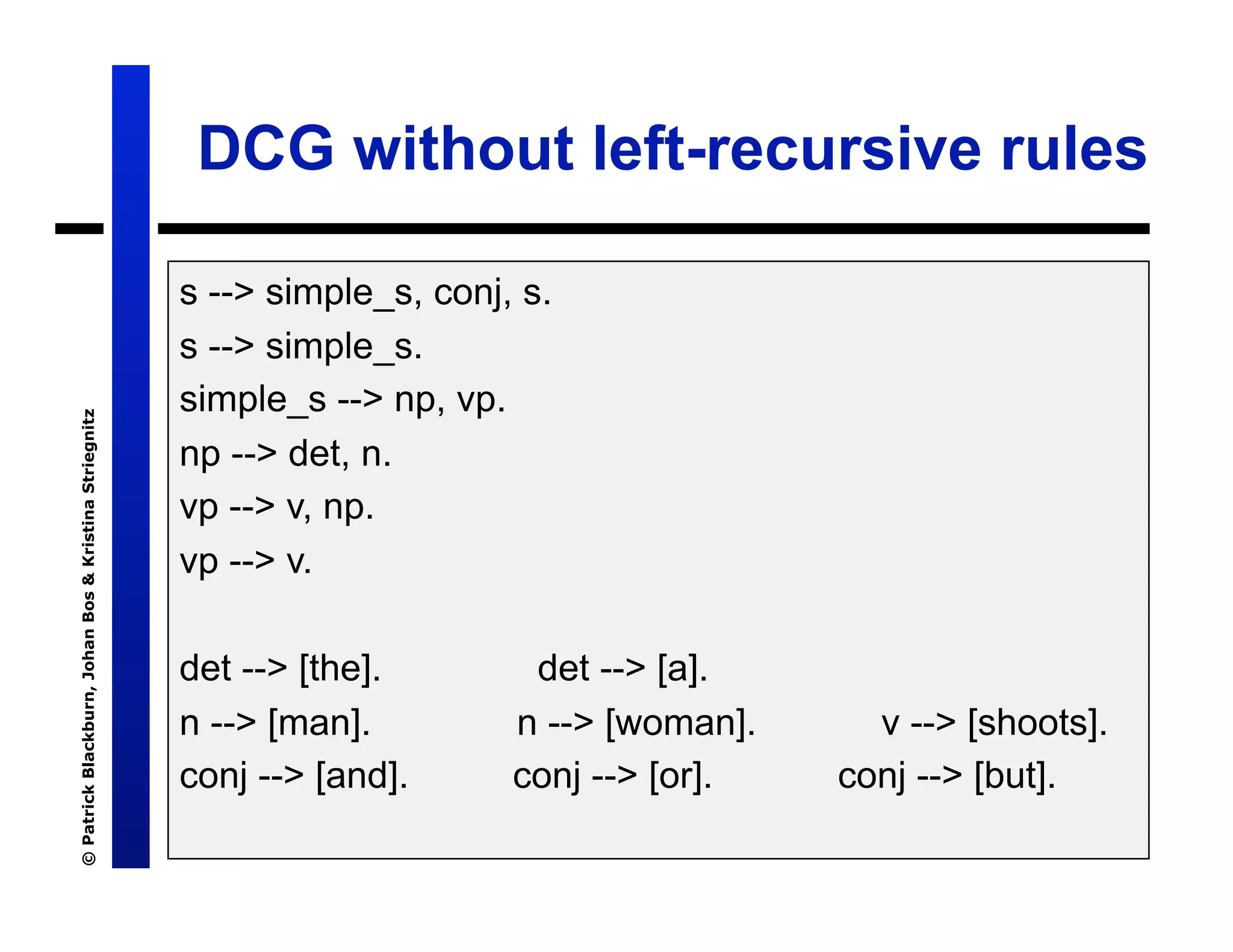
    34. DCG without left-recursive rules s --> simple_s, conj, s. s --> simple_s. simple_s --> np, vp. © Patrick Blackburn, Johan Bos & Kristina Striegnitz np --> det, n. vp --> v, np. vp --> v. det --> [the]. det --> [a]. n --> [man]. n --> [woman]. v --> [shoots]. conj --> [and]. conj --> [or]. conj --> [but].
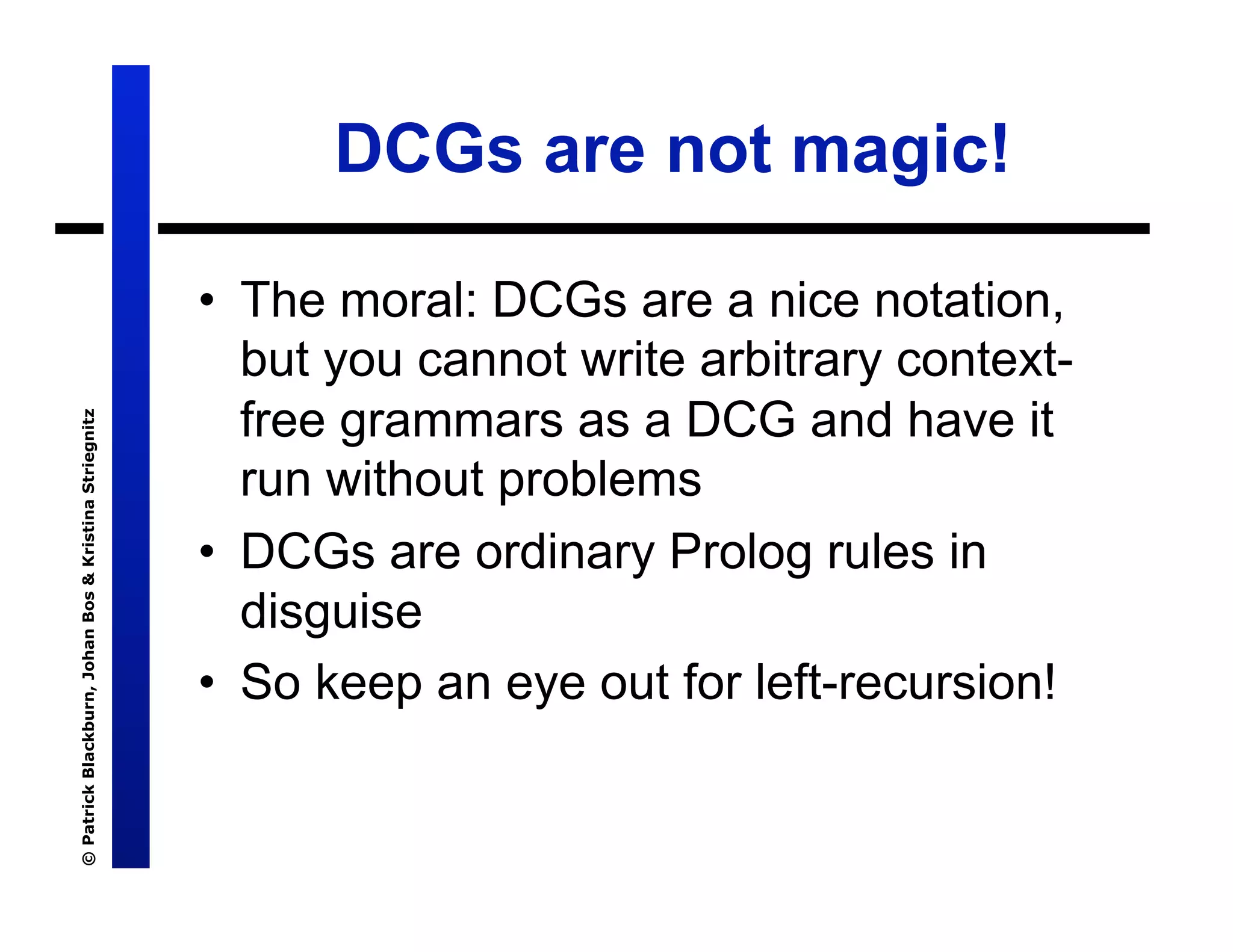
    35. DCGs are not magic! •  The moral: DCGs are a nice notation, but you cannot write arbitrary context- free grammars as a DCG and have it © Patrick Blackburn, Johan Bos & Kristina Striegnitz run without problems •  DCGs are ordinary Prolog rules in disguise •  So keep an eye out for left-recursion!
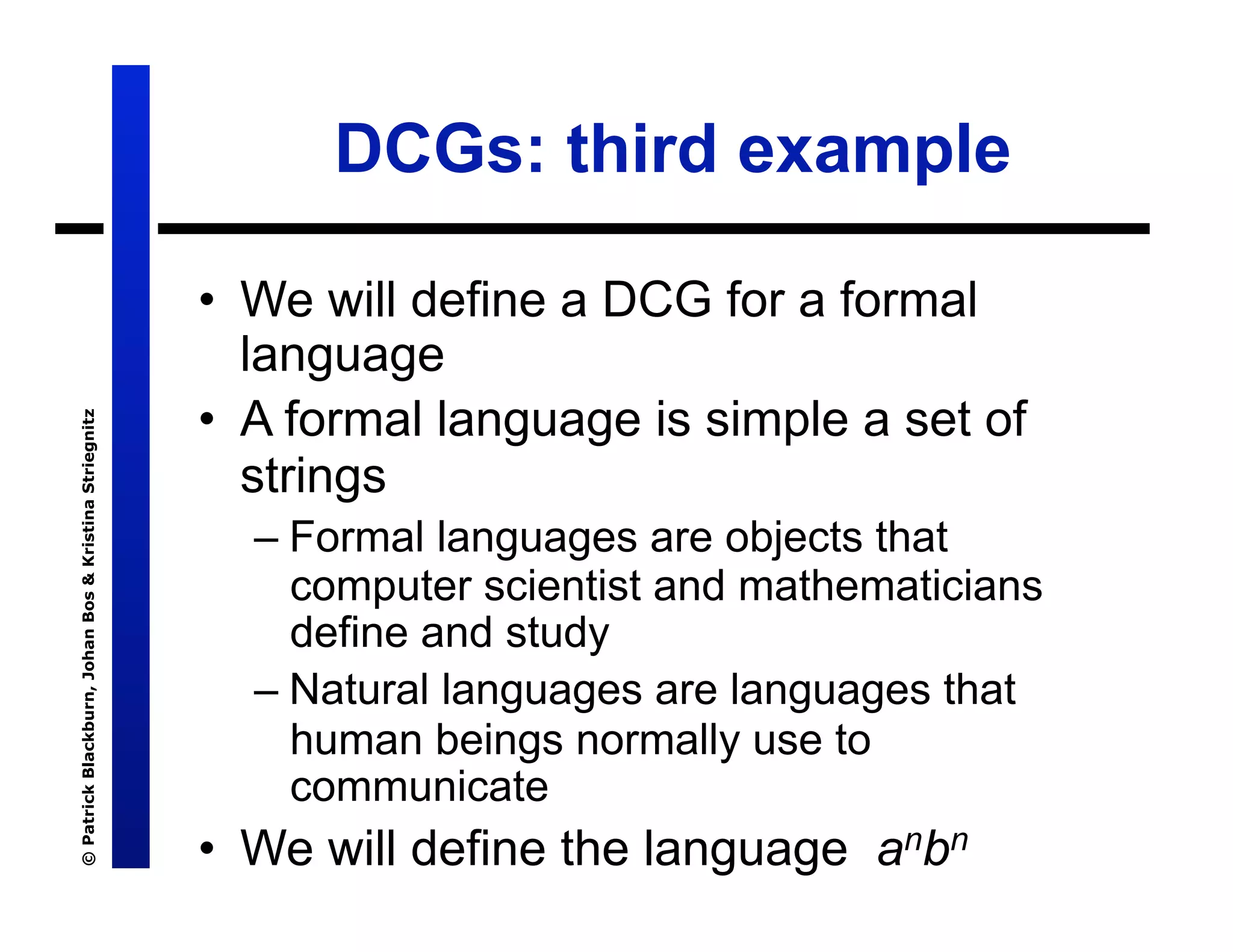
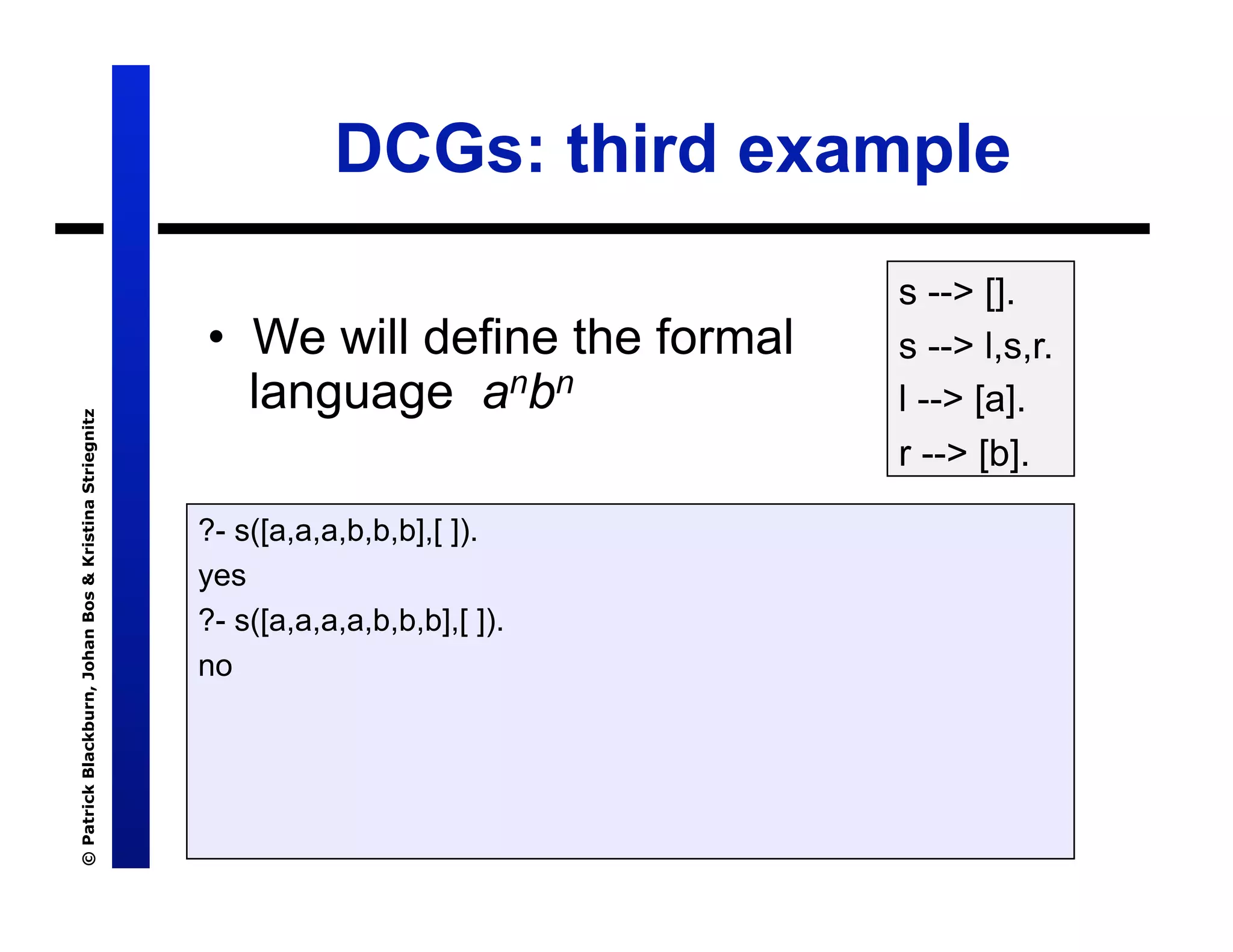
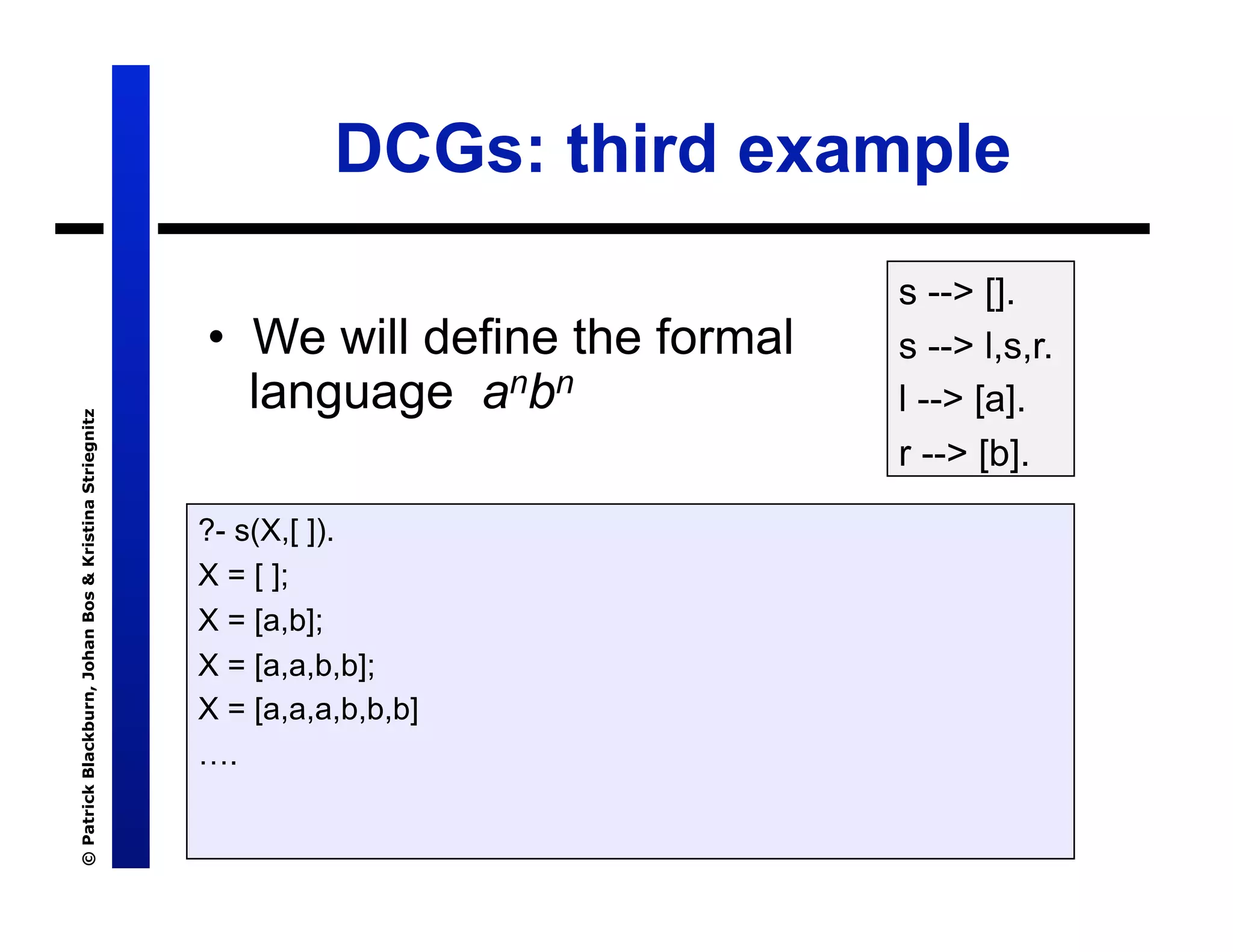
    36. DCGs: third example •  We will define a DCG for a formal language •  A formal language is simple a set of © Patrick Blackburn, Johan Bos & Kristina Striegnitz strings – Formal languages are objects that computer scientist and mathematicians define and study – Natural languages are languages that human beings normally use to communicate •  We will define the language anbn
    37. DCGs: third example s --> []. •  We will define the formal s --> l,s,r. language anbn l --> [a]. © Patrick Blackburn, Johan Bos & Kristina Striegnitz r --> [b]. ?- s([a,a,a,b,b,b],[ ]). yes ?- s([a,a,a,a,b,b,b],[ ]). no
    38. DCGs: third example s --> []. •  We will define the formal s --> l,s,r. language anbn l --> [a]. © Patrick Blackburn, Johan Bos & Kristina Striegnitz r --> [b]. ?- s(X,[ ]). X = [ ]; X = [a,b]; X = [a,a,b,b]; X = [a,a,a,b,b,b] ….
    39. © Patrick Blackburn, Johan Bos & Kristina Striegnitz •  LPN 7.3 •  LPN 7.2 •  LPN 7.1 Exercises
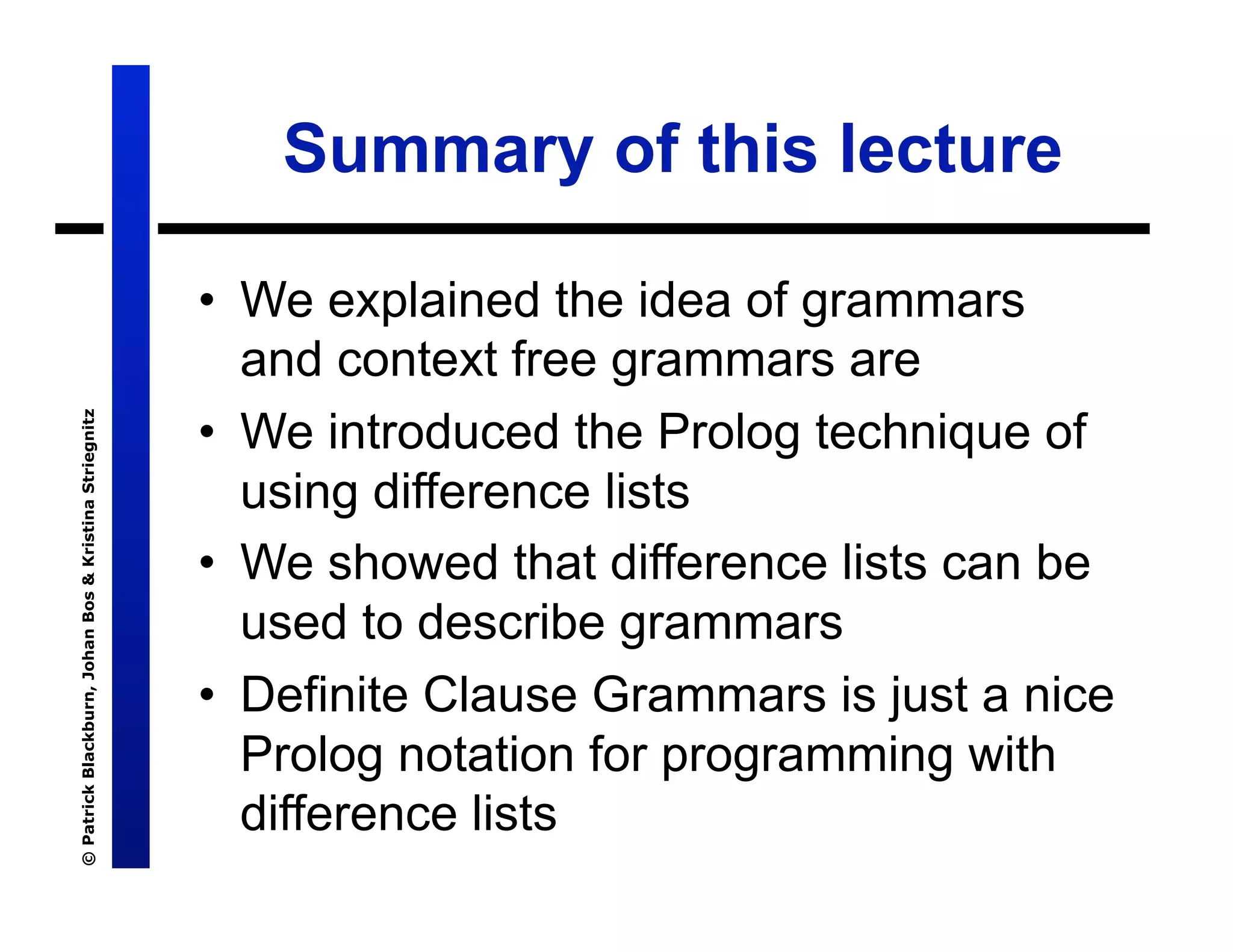
    40. Summary of this lecture •  We explained the idea of grammars and context free grammars are •  We introduced the Prolog technique of © Patrick Blackburn, Johan Bos & Kristina Striegnitz using difference lists •  We showed that difference lists can be used to describe grammars •  Definite Clause Grammars is just a nice Prolog notation for programming with difference lists
    41. Next lecture •  More Definite Clause Grammars – Examine two important capabilities offered by DCG notation © Patrick Blackburn, Johan Bos & Kristina Striegnitz •  Extra arguments •  Extra tests – Discuss the status and limitations of definite clause grammars
    SlideShare Zeitgeist 2009

    + timmenziestimmenzies Nominate

    custom

    652 views, 0 favs, 0 embeds more stats

    © Patrick Blackburn, Johan Bos & Kristina Striegni more

    More info about this document

    © All Rights Reserved

    Go to text version

    • Total Views 652
      • 652 on SlideShare
      • 0 from embeds
    • Comments 0
    • Favorites 0
    • Downloads 9
    Most viewed embeds

    more

    All embeds

    less

    Flagged as inappropriate Flag as inappropriate
    Flag as inappropriate

    Select your reason for flagging this presentation as inappropriate. If needed, use the feedback form to let us know more details.

    Cancel
    File a copyright complaint
    Having problems? Go to our helpdesk?

    Categories