
Light beyond Vision:Day and Night in Building Scienceand ChronobiologyLight beyond Vision:Day and Night in Building Scienceand ChronobiologyProf. Jean-Louis Scartezzini, Dr. Mirjam MünchSolar Energy and Building Physics LaboratoryEcole Polytechnique Fédérale de Lausanne (EPFL), Lausanne (Switzerland)
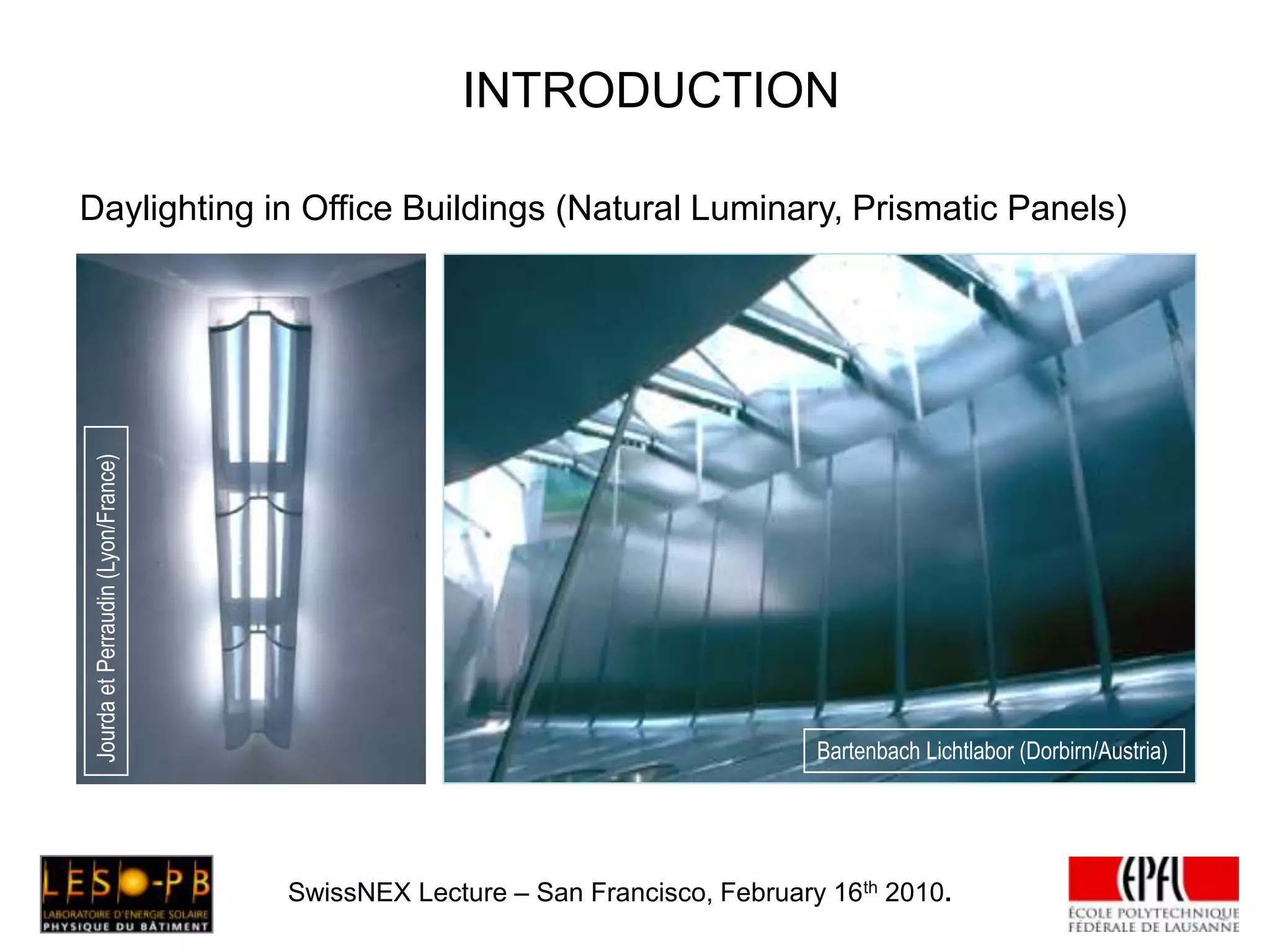
INTRODUCTIONDaylighting in Office Buildings (Natural Luminary, Prismatic Panels)Jourda et Perraudin (Lyon/France)Bartenbach Lichtlabor (Dorbirn/Austria)
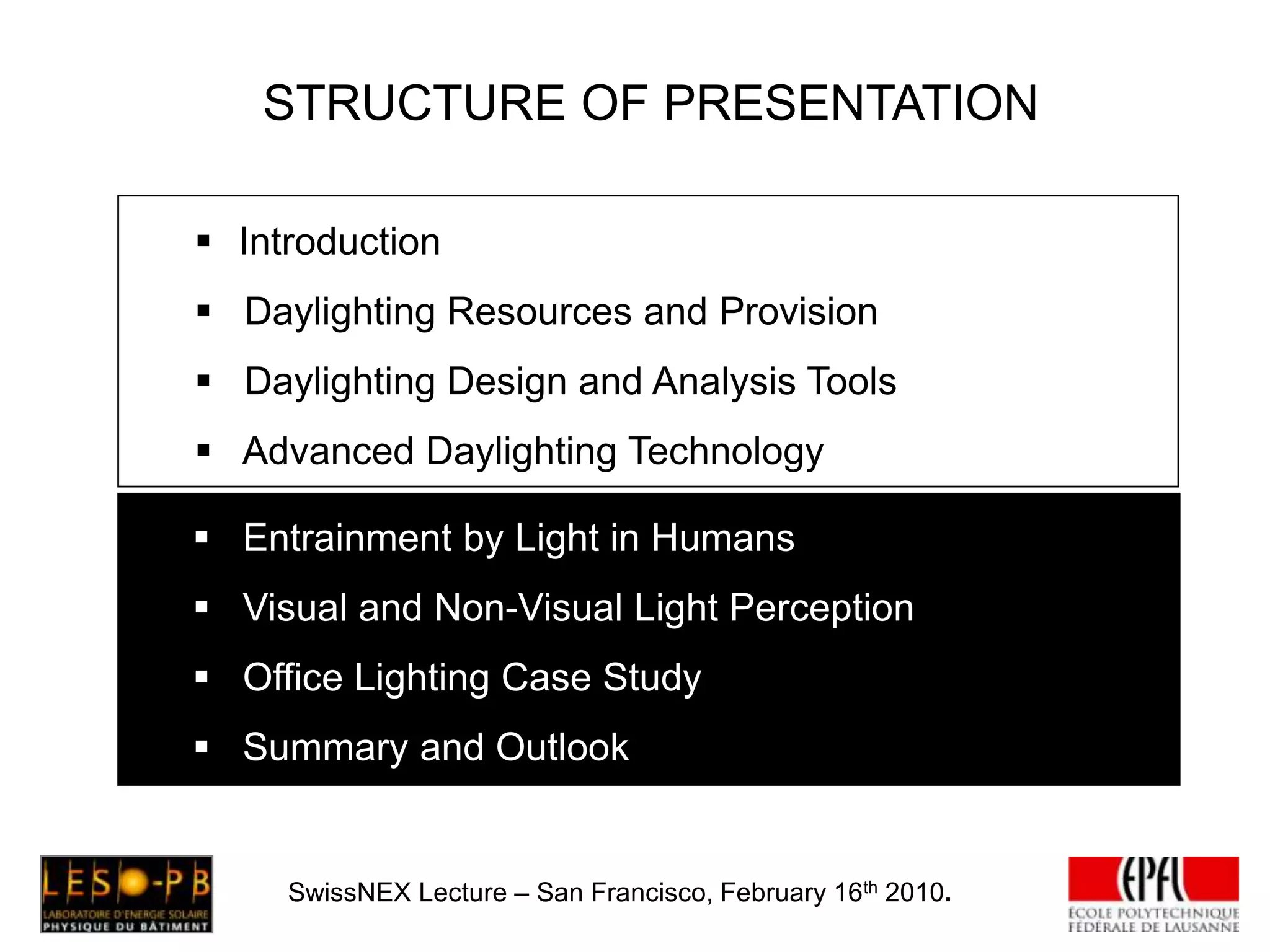
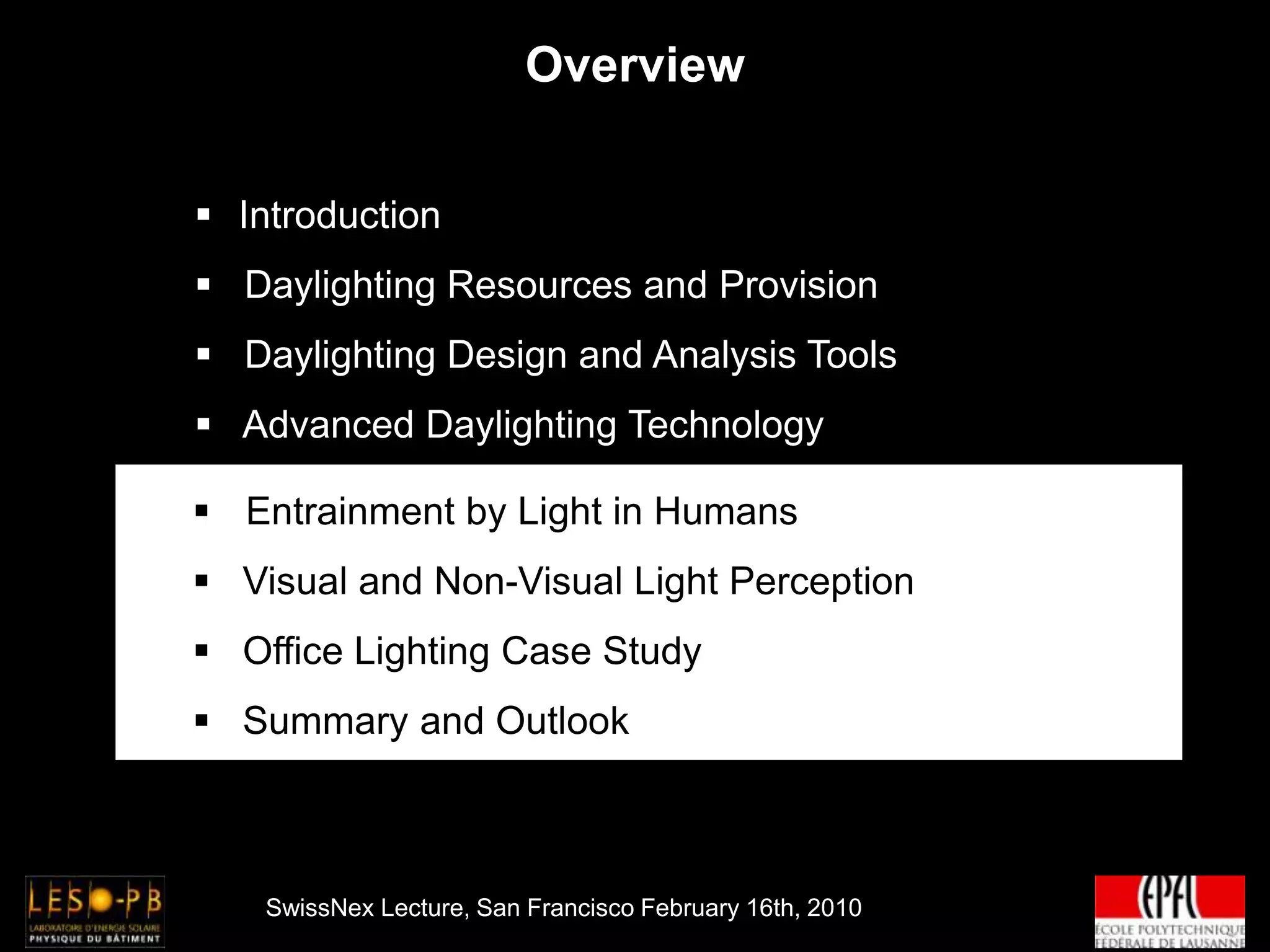
STRUCTURE OF PRESENTATIONIntroduction
   Daylighting Resources and Provision
   Daylighting Design and Analysis Tools
   Advanced Daylighting Technology
Entrainment by Light in Humans
   Visual and Non-Visual Light Perception
   Office Lighting Case Study
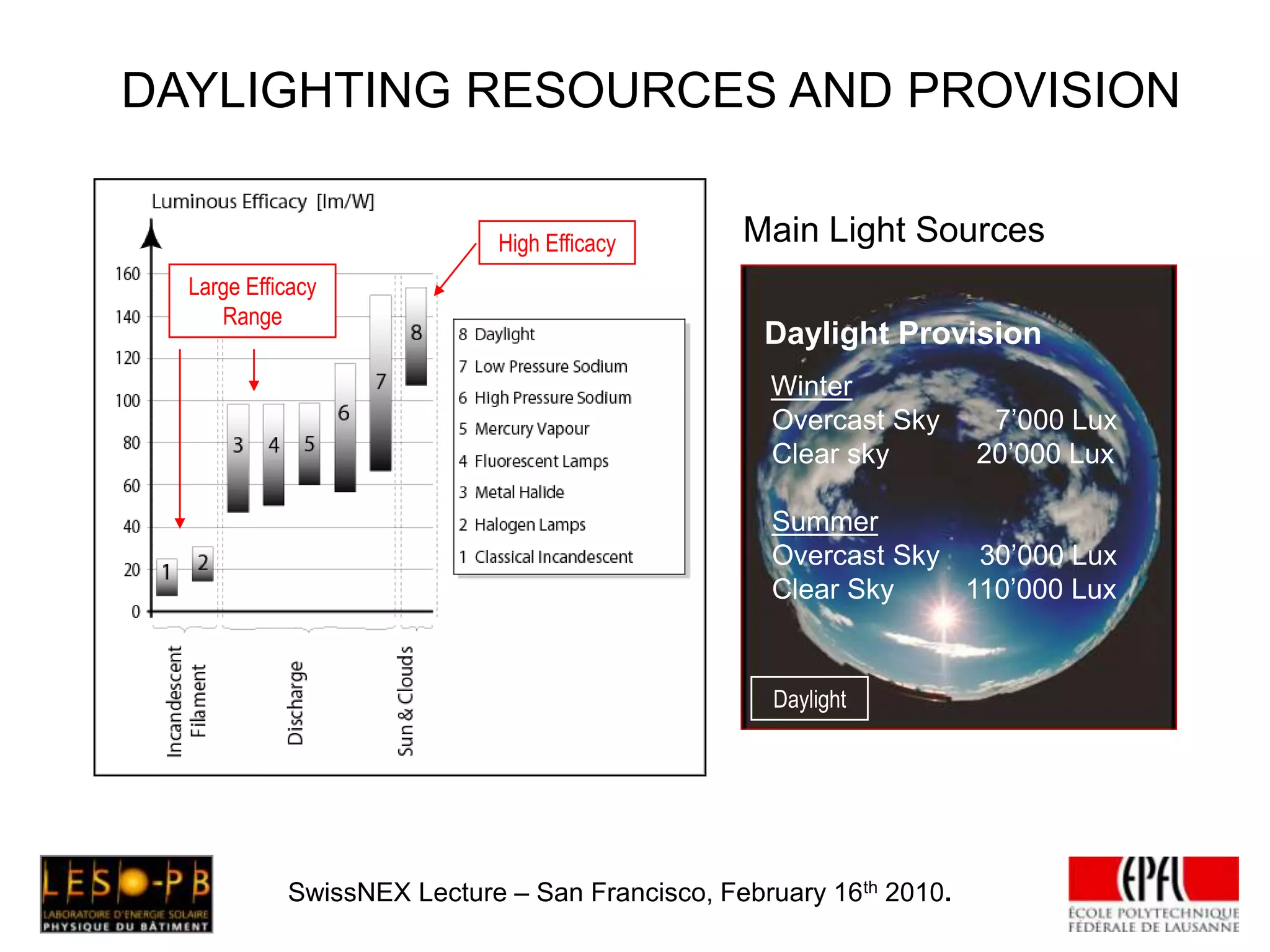
   Summary and OutlookHigh EfficacyLarge Efficacy RangeDAYLIGHTING RESOURCES AND PROVISIONMain Light SourcesDaylight ProvisionWinter Overcast Sky       7’000 Lux Clear sky           20’000 LuxSummer Overcast Sky     30’000 Lux Clear Sky         110’000 LuxElectricLightDaylight
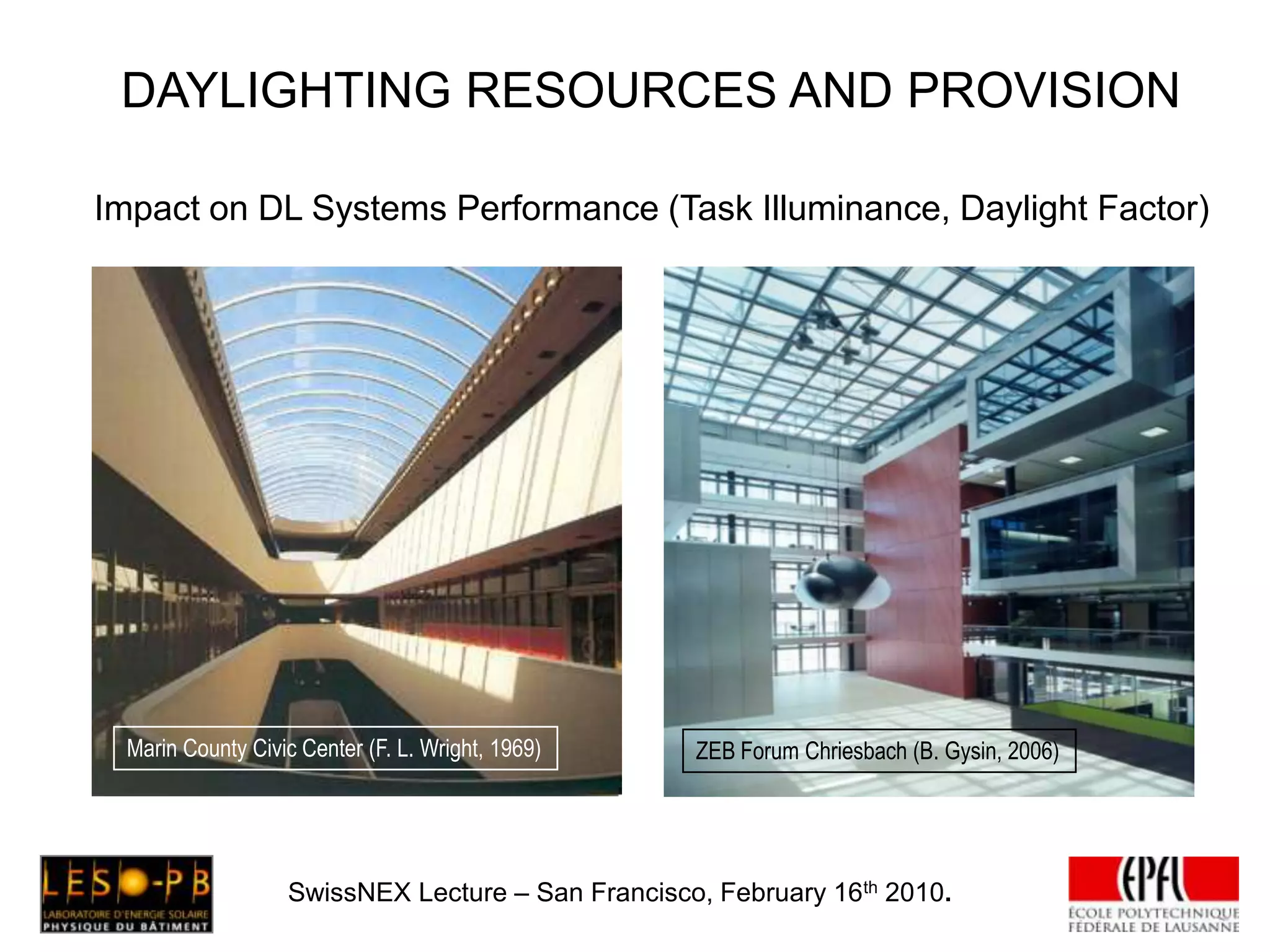
DAYLIGHTING RESOURCES AND PROVISIONImpact on DL Systems Performance (Task Illuminance, Daylight Factor)Marin County Civic Center (F. L. Wright, 1969)ZEB Forum Chriesbach (B. Gysin, 2006)
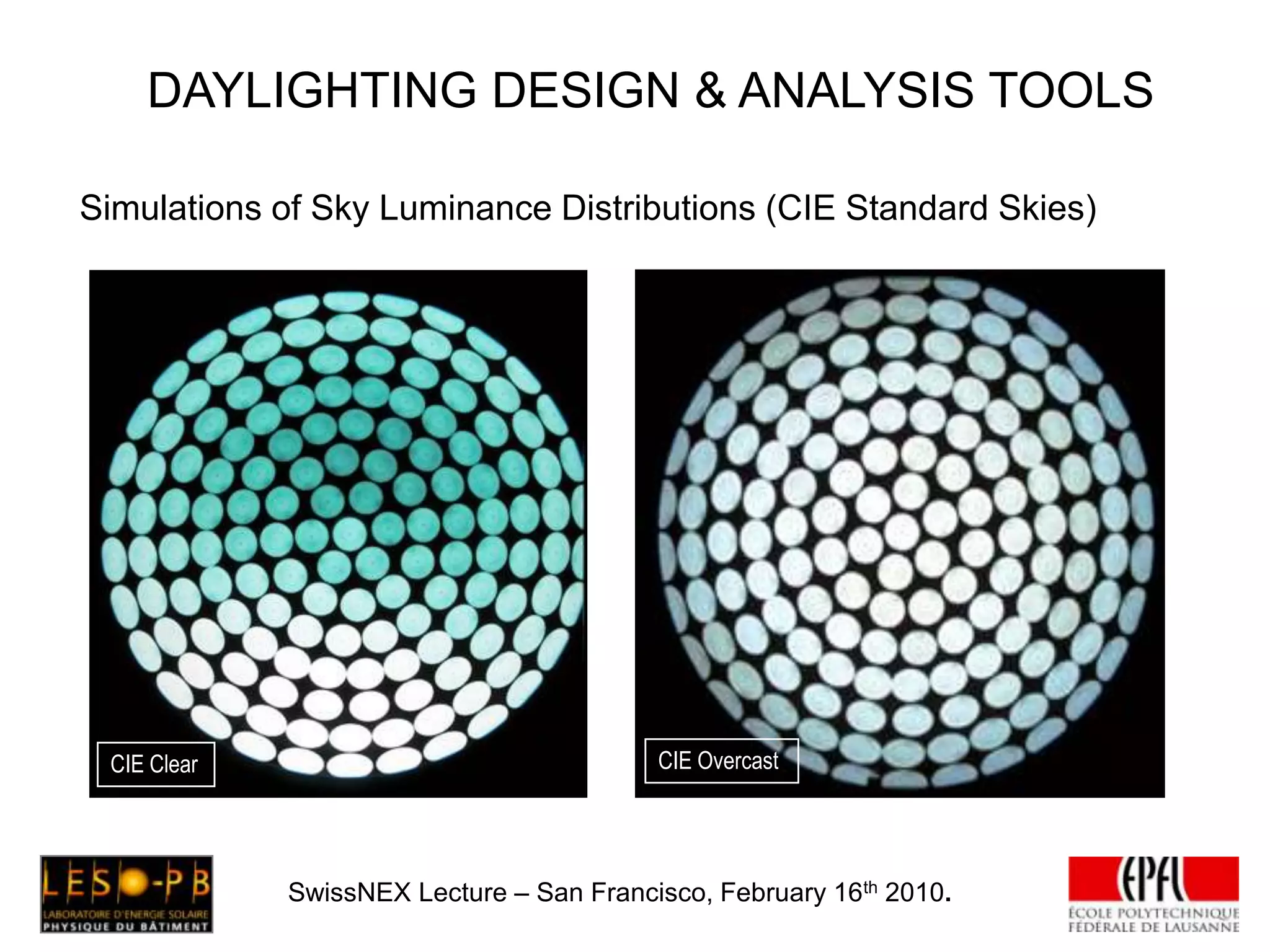
CIE OvercastCIE ClearDAYLIGHTING DESIGN & ANALYSIS TOOLSSimulations of Sky Luminance Distributions (CIE Standard Skies)Isotropic
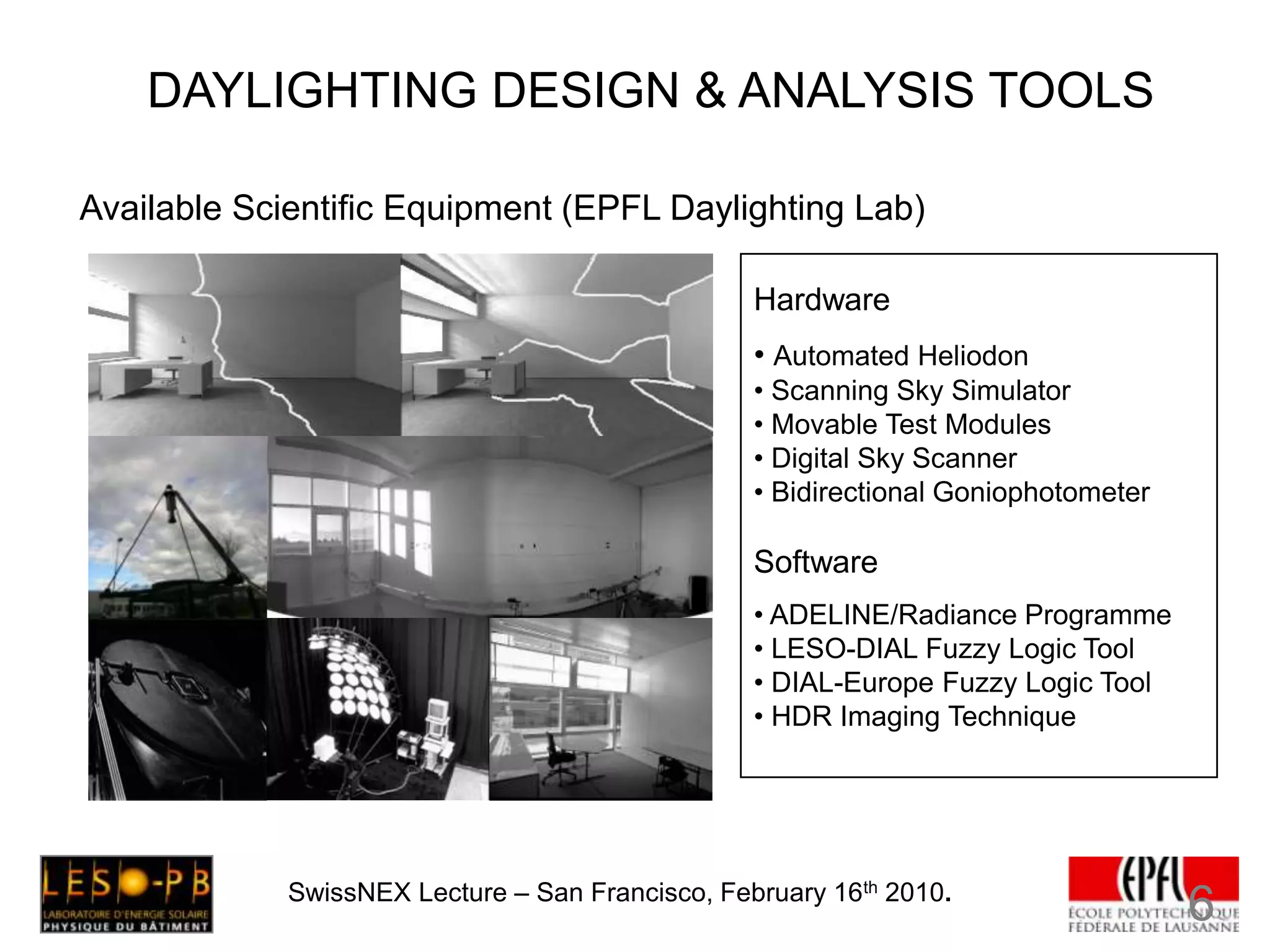
DAYLIGHTING DESIGN & ANALYSIS TOOLSAvailable Scientific Equipment (EPFL Daylighting Lab)HardwareAutomated Heliodon
 Scanning Sky Simulator
 Movable Test Modules
 Digital Sky Scanner
 Bidirectional GoniophotometerSoftware ADELINE/Radiance Programme
 LESO-DIAL Fuzzy Logic Tool
 DIAL-Europe Fuzzy Logic Tool
 HDR Imaging Technique6
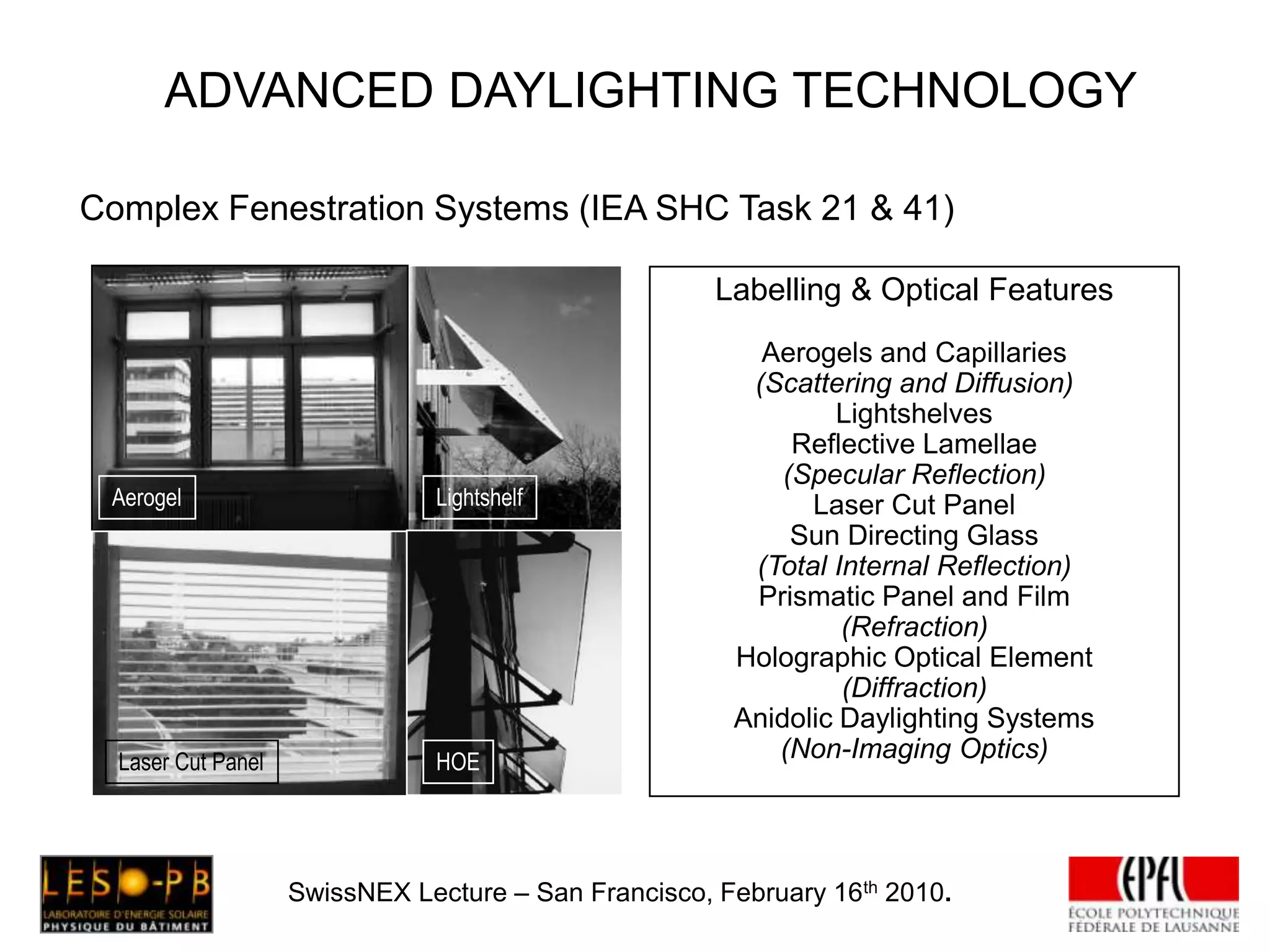
ADVANCED DAYLIGHTING TECHNOLOGYComplex Fenestration Systems (IEA SHC Task 21 & 41)Labelling & Optical FeaturesAerogels and Capillaries(Scattering and Diffusion)LightshelvesReflective Lamellae(Specular Reflection)Laser Cut PanelSun Directing Glass(Total Internal Reflection)Prismatic Panel and Film(Refraction)Holographic Optical Element(Diffraction)Anidolic Daylighting Systems(Non-Imaging Optics)AerogelLightshelfHOELaser Cut Panel
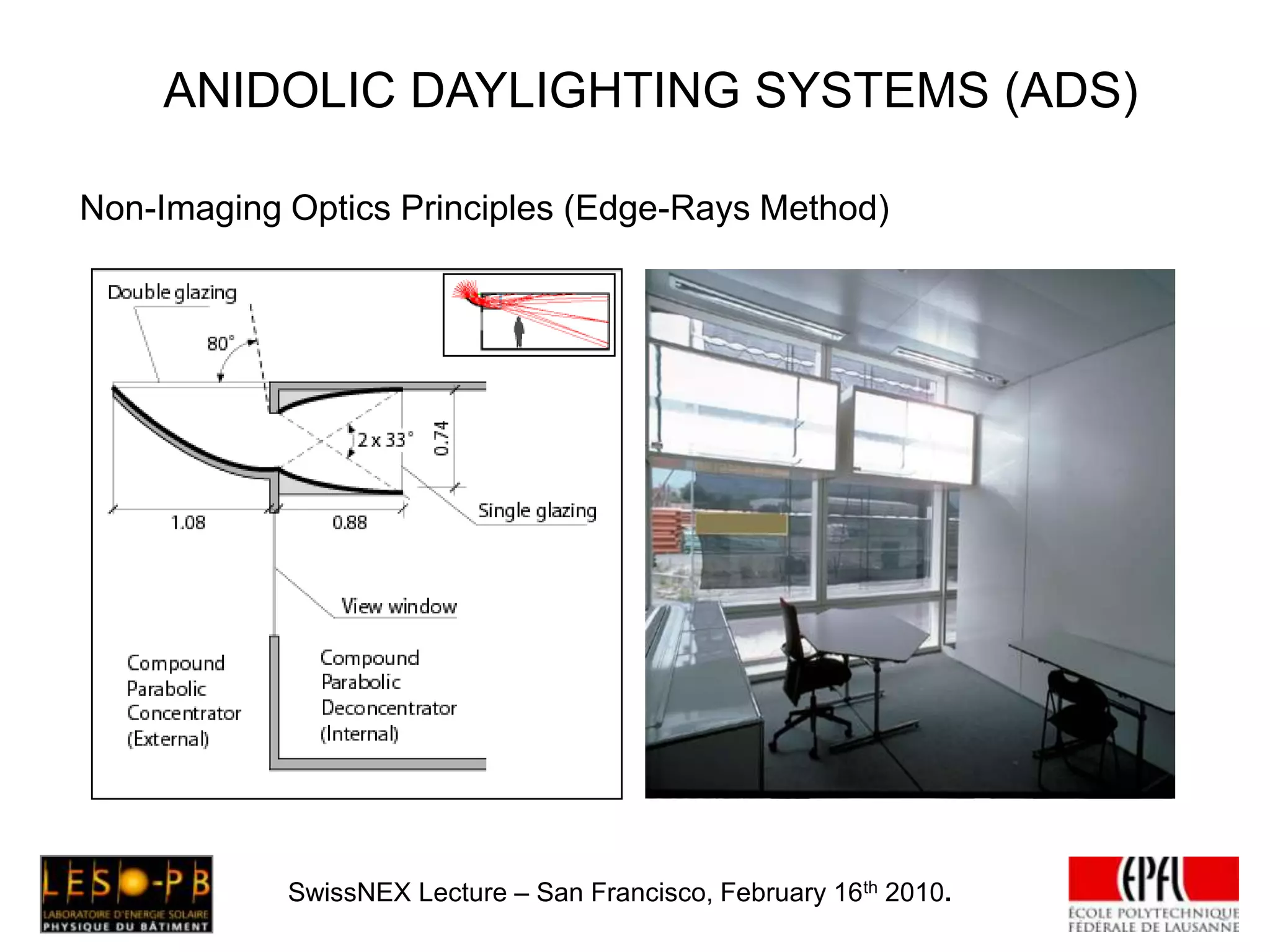
ANIDOLIC DAYLIGHTING SYSTEMS (ADS)Non-Imaging Optics Principles (Edge-Rays Method)
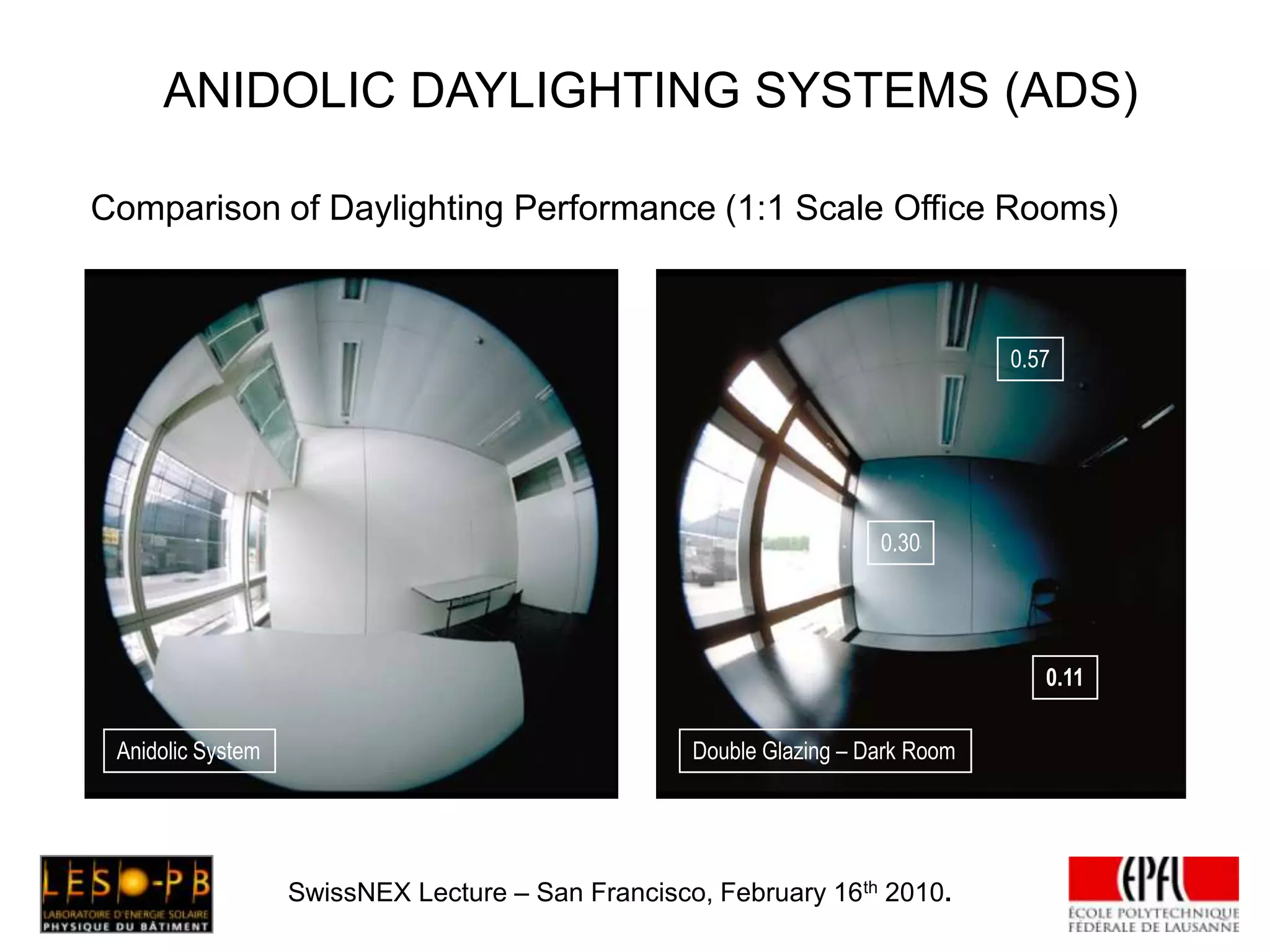
0.750.750.16Reflection FactorsANIDOLIC DAYLIGHTING SYSTEMS (ADS)Comparison of Daylighting Performance (1:1 Scale Office Rooms)0.570.300.11Double Glazing – Dark RoomAnidolic SystemDouble Glazing – Light Room
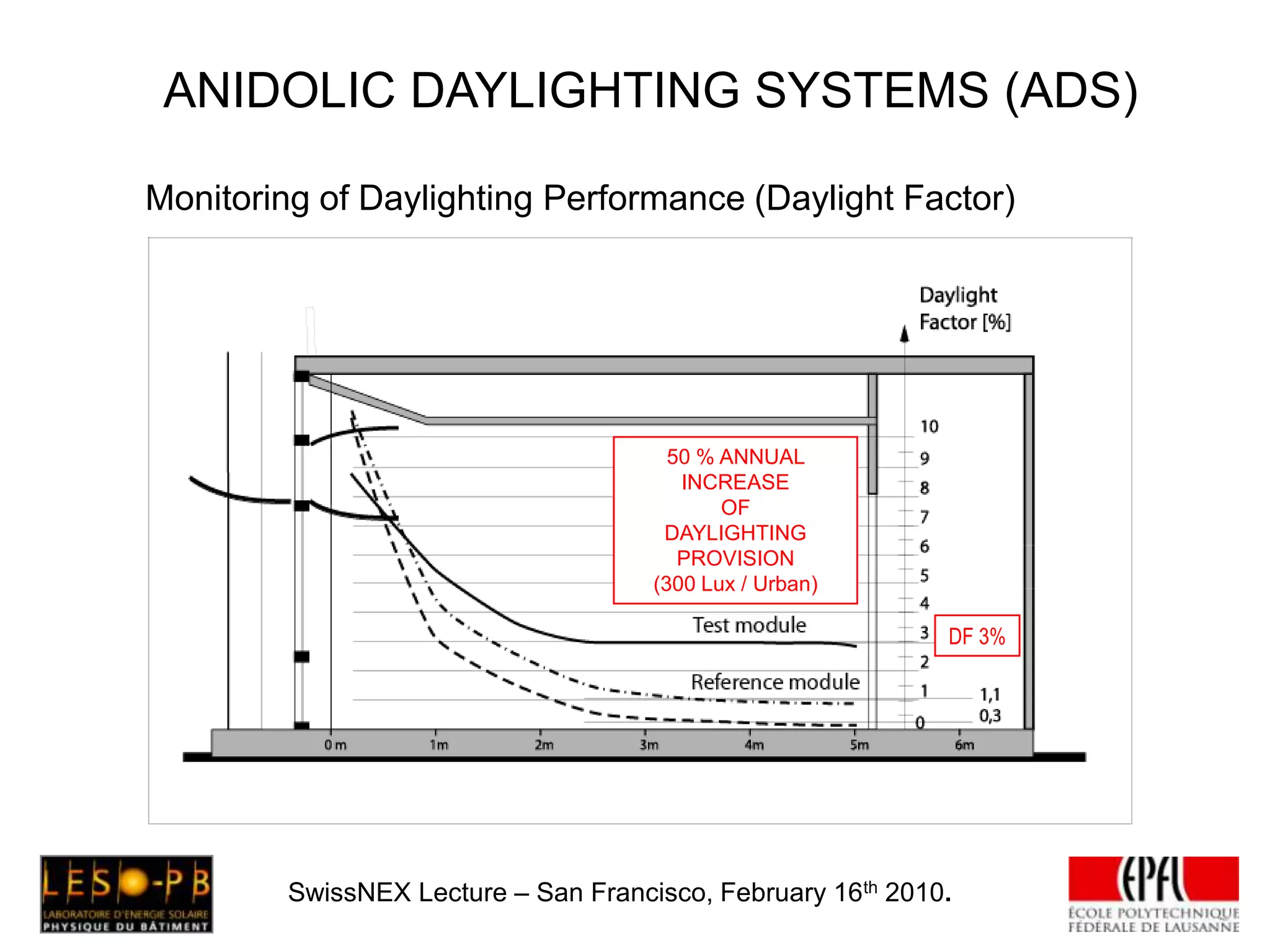
ANIDOLIC DAYLIGHTING SYSTEMS (ADS)Monitoring of Daylighting Performance (Daylight Factor)50 % ANNUAL INCREASEOF DAYLIGHTING PROVISION(300 Lux / Urban)DF 3%
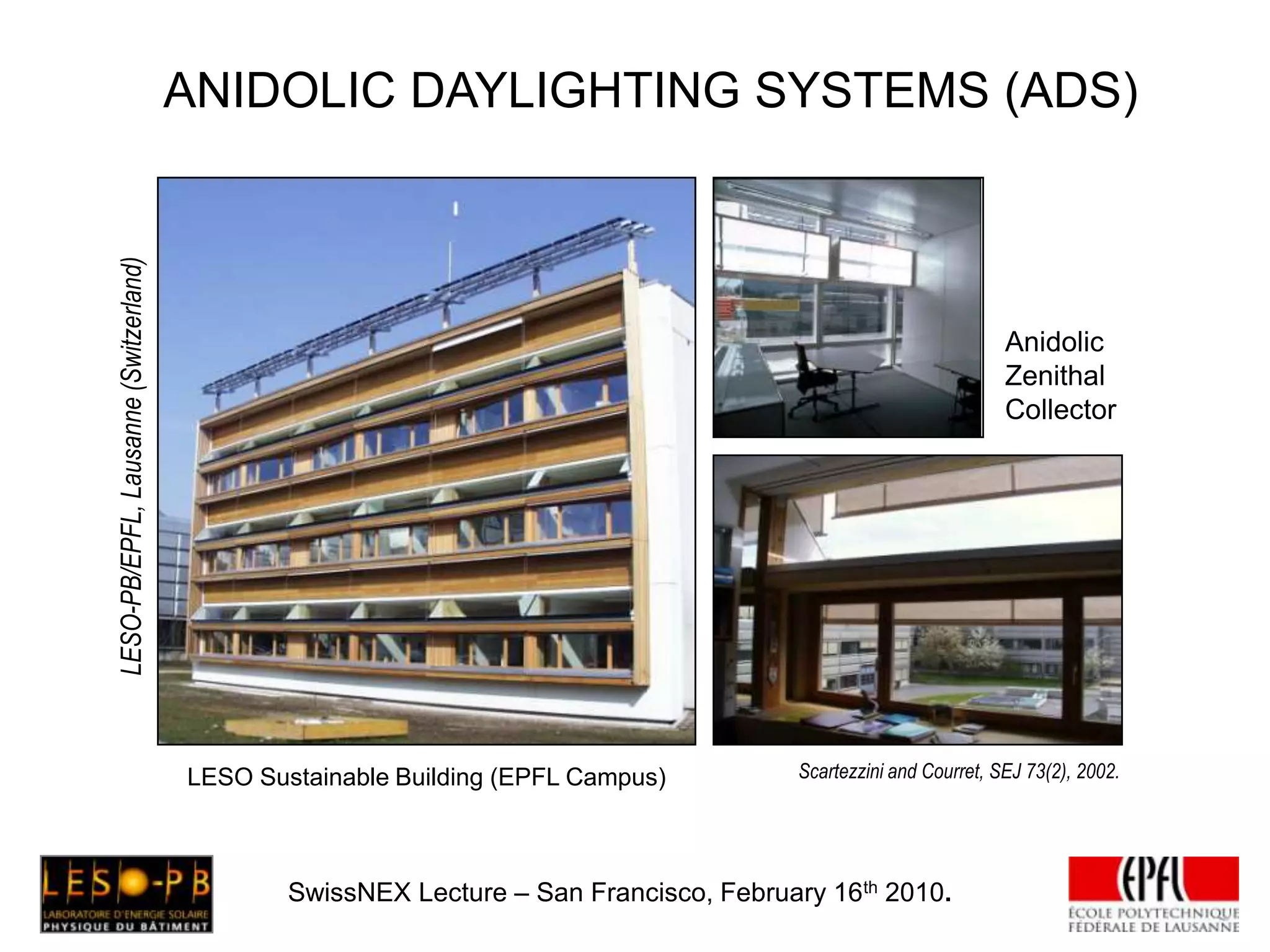
ANIDOLIC DAYLIGHTING SYSTEMS (ADS)AnidolicZenithalCollector LESO-PB/EPFL, Lausanne (Switzerland) Scartezzini and Courret, SEJ 73(2), 2002.LESO Sustainable Building (EPFL Campus)
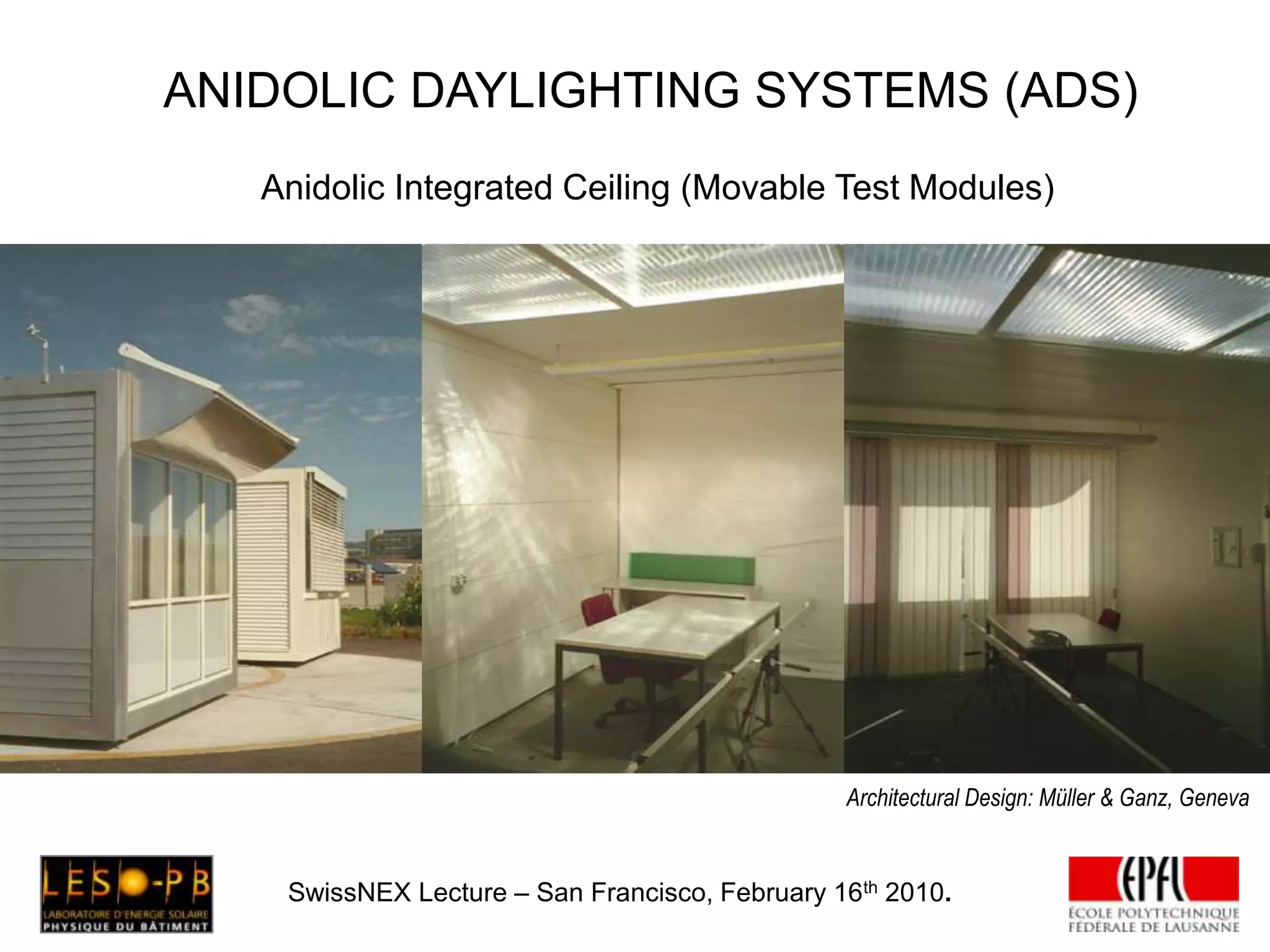
ANIDOLIC DAYLIGHTING SYSTEMS (ADS)Anidolic Integrated Ceiling (Movable Test Modules)Architectural Design: Müller & Ganz, Geneva
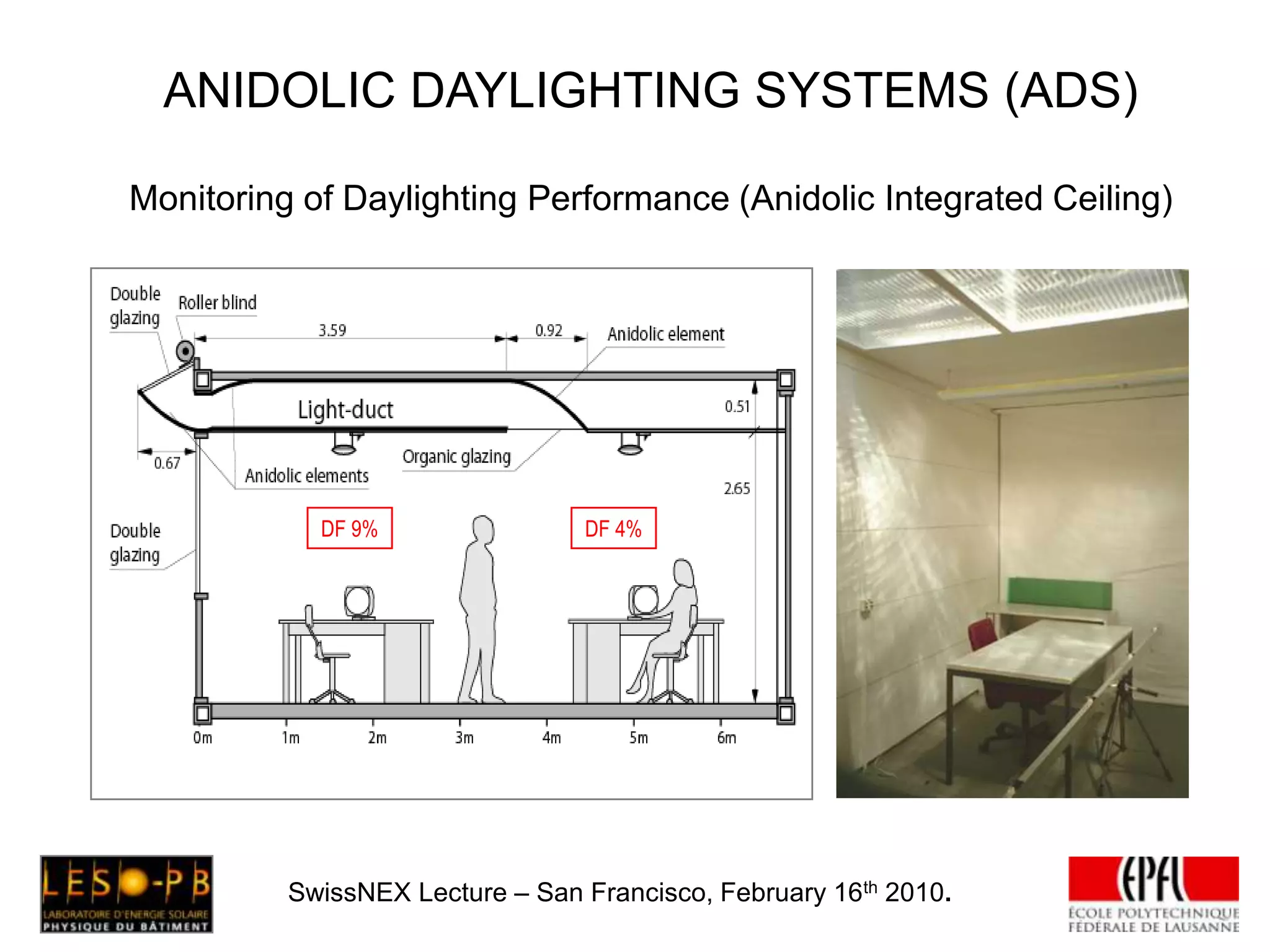
ANIDOLIC DAYLIGHTING SYSTEMS (ADS)Monitoring of Daylighting Performance (Anidolic Integrated Ceiling)DF 9%DF 4%
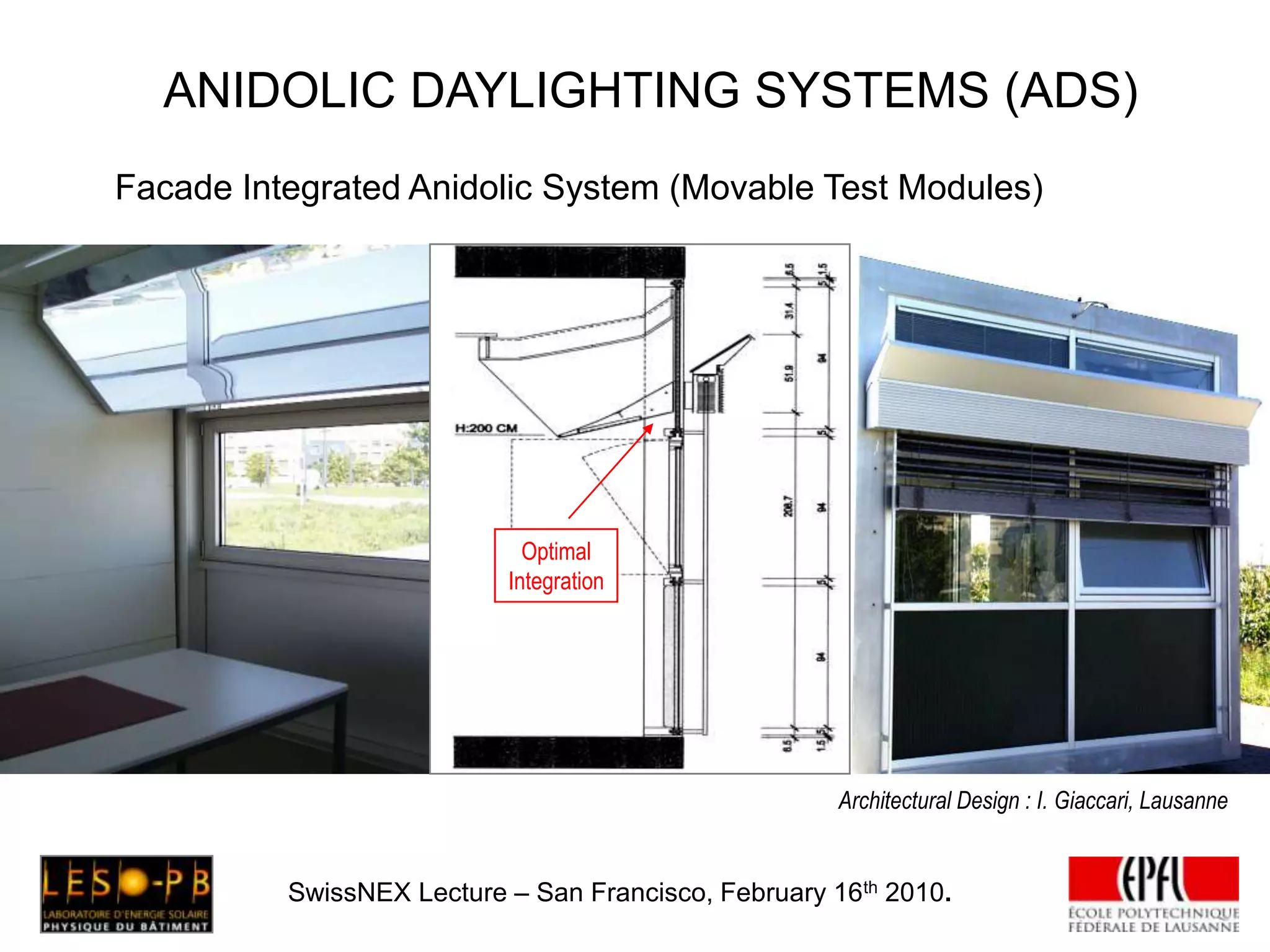
OptimalIntegrationANIDOLIC DAYLIGHTING SYSTEMS (ADS)Facade Integrated Anidolic System (Movable Test Modules)Architectural Design : I. Giaccari, Lausanne
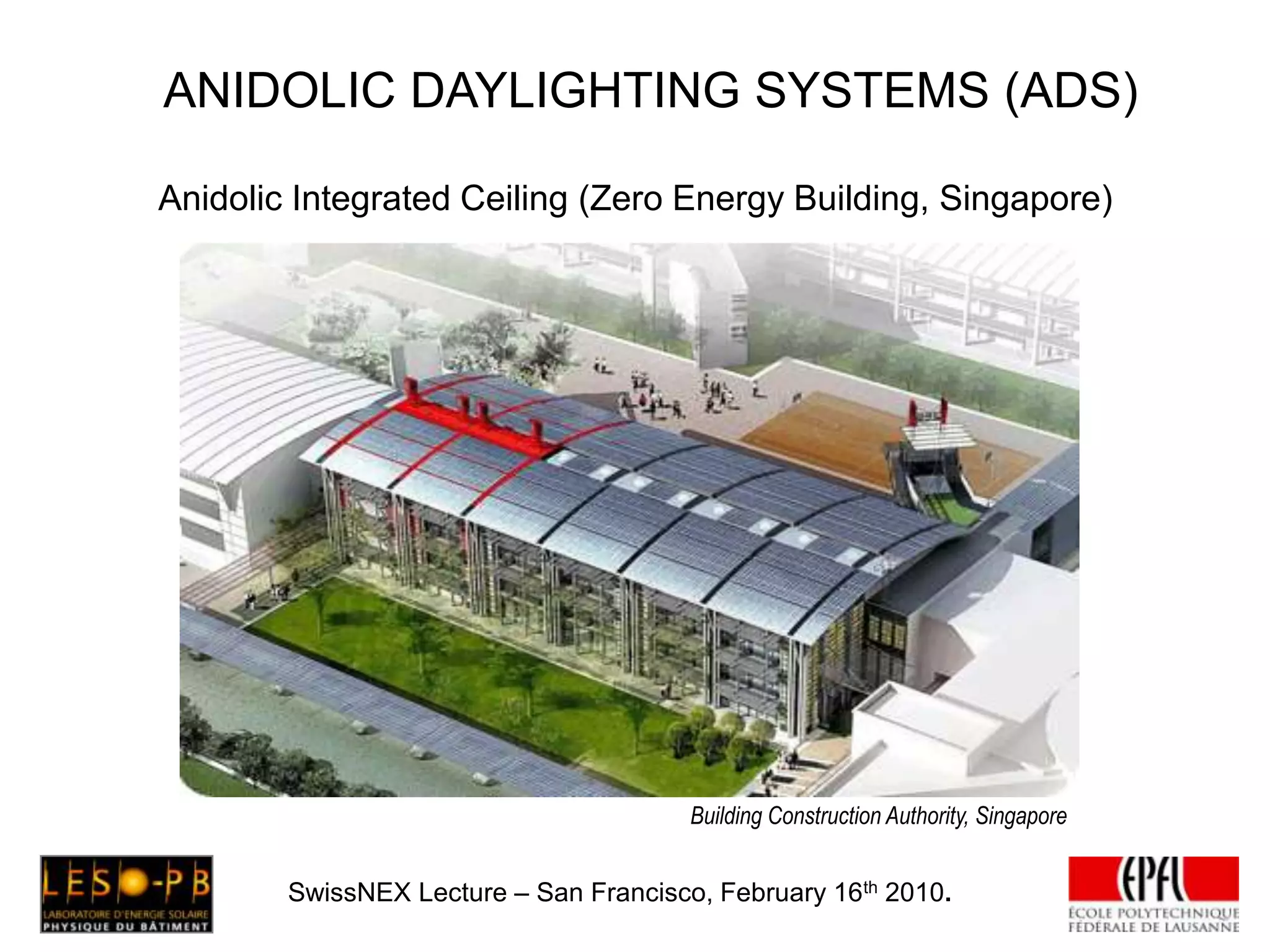
ANIDOLIC DAYLIGHTING SYSTEMS (ADS)Anidolic Integrated Ceiling (Zero Energy Building, Singapore)Building Construction Authority, Singapore
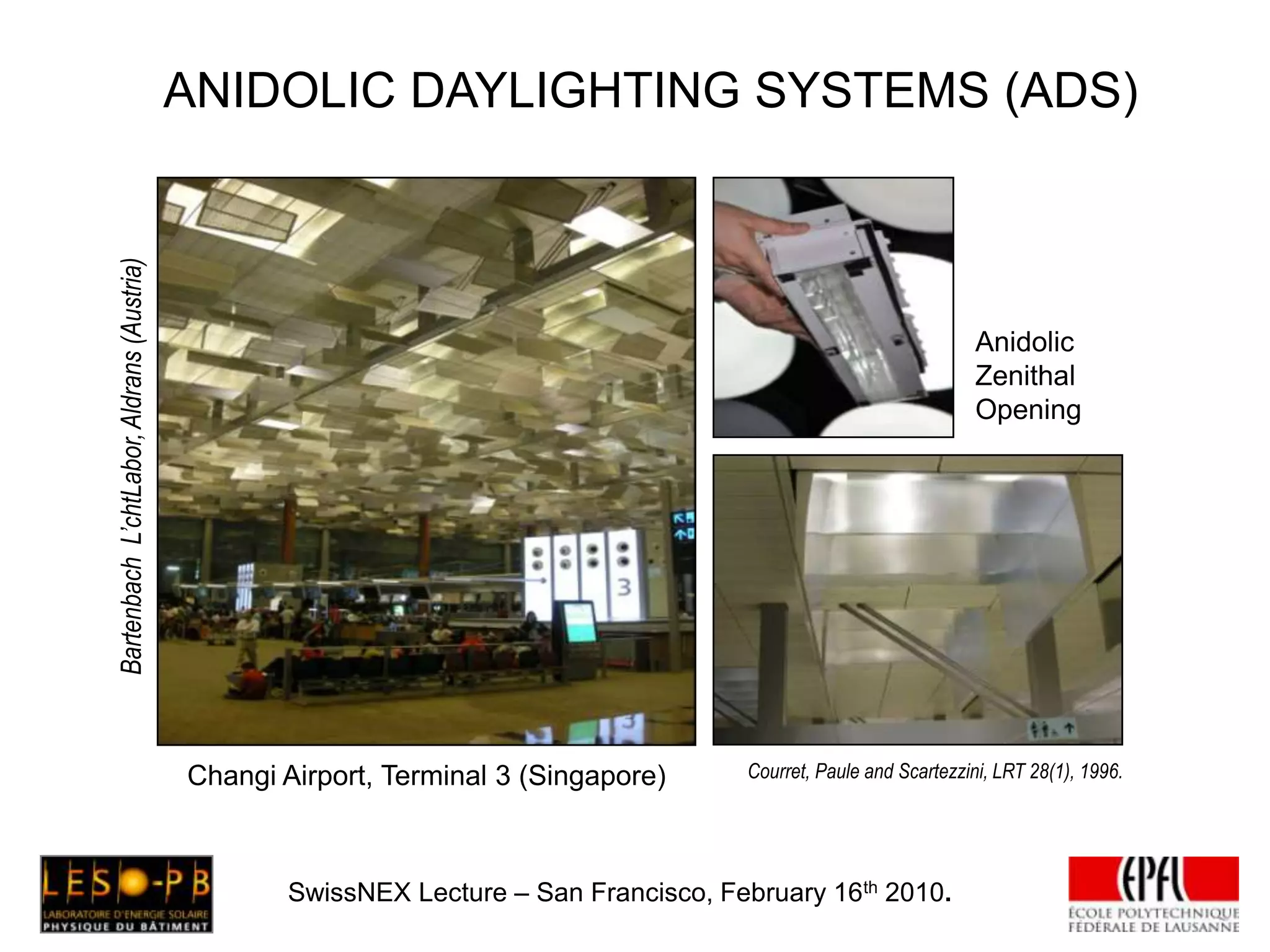
ANIDOLIC DAYLIGHTING SYSTEMS (ADS)AnidolicZenithalOpeningBartenbach  L’chtLabor, Aldrans (Austria) Courret, Paule and Scartezzini, LRT 28(1), 1996.Changi Airport, Terminal 3 (Singapore)
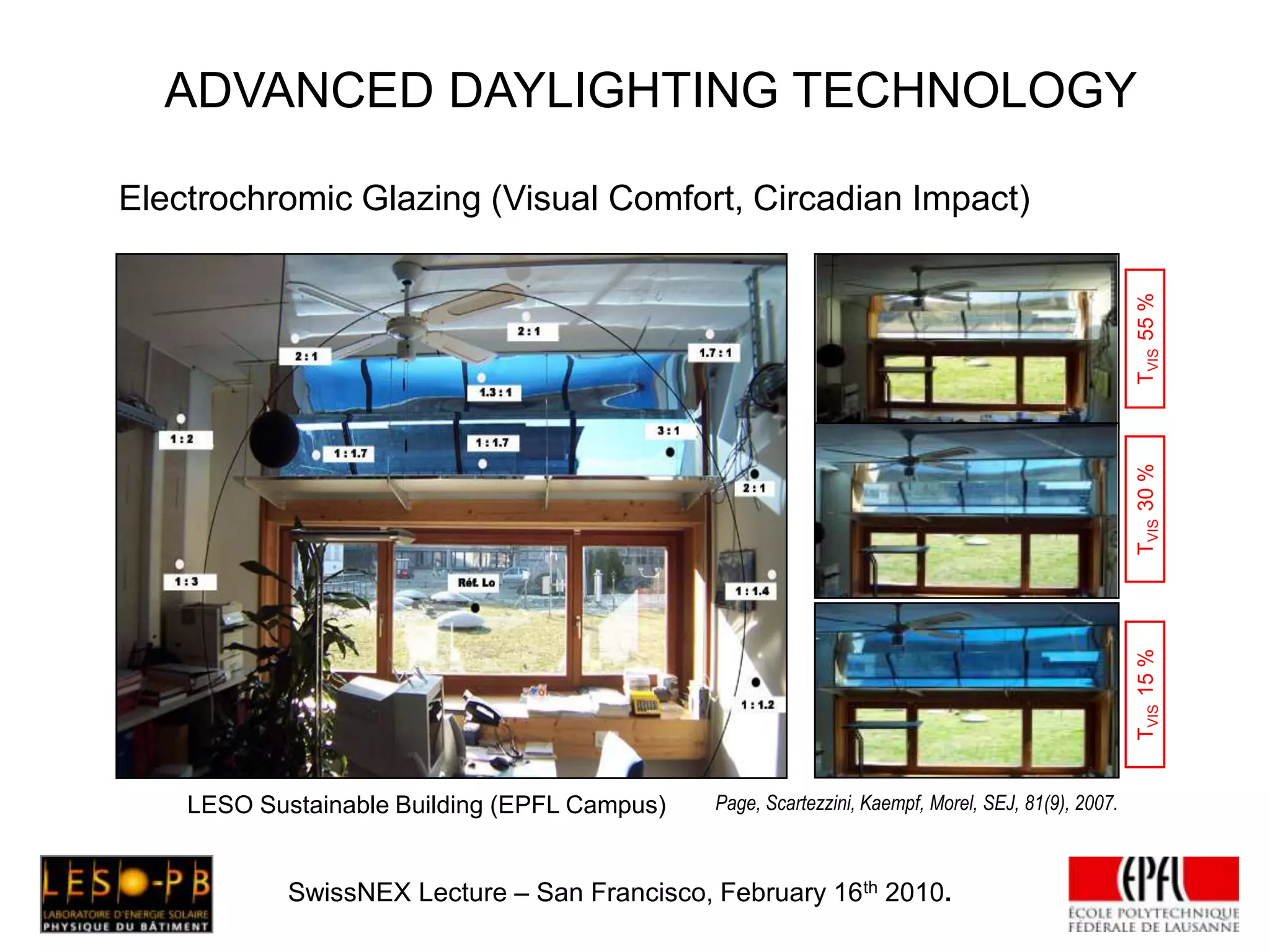
ADVANCED DAYLIGHTING TECHNOLOGYElectrochromic Glazing (Visual Comfort, Circadian Impact)TVIS  55 %TVIS  30 %TVIS  15 %Page, Scartezzini, Kaempf, Morel, SEJ, 81(9), 2007.LESO Sustainable Building (EPFL Campus)
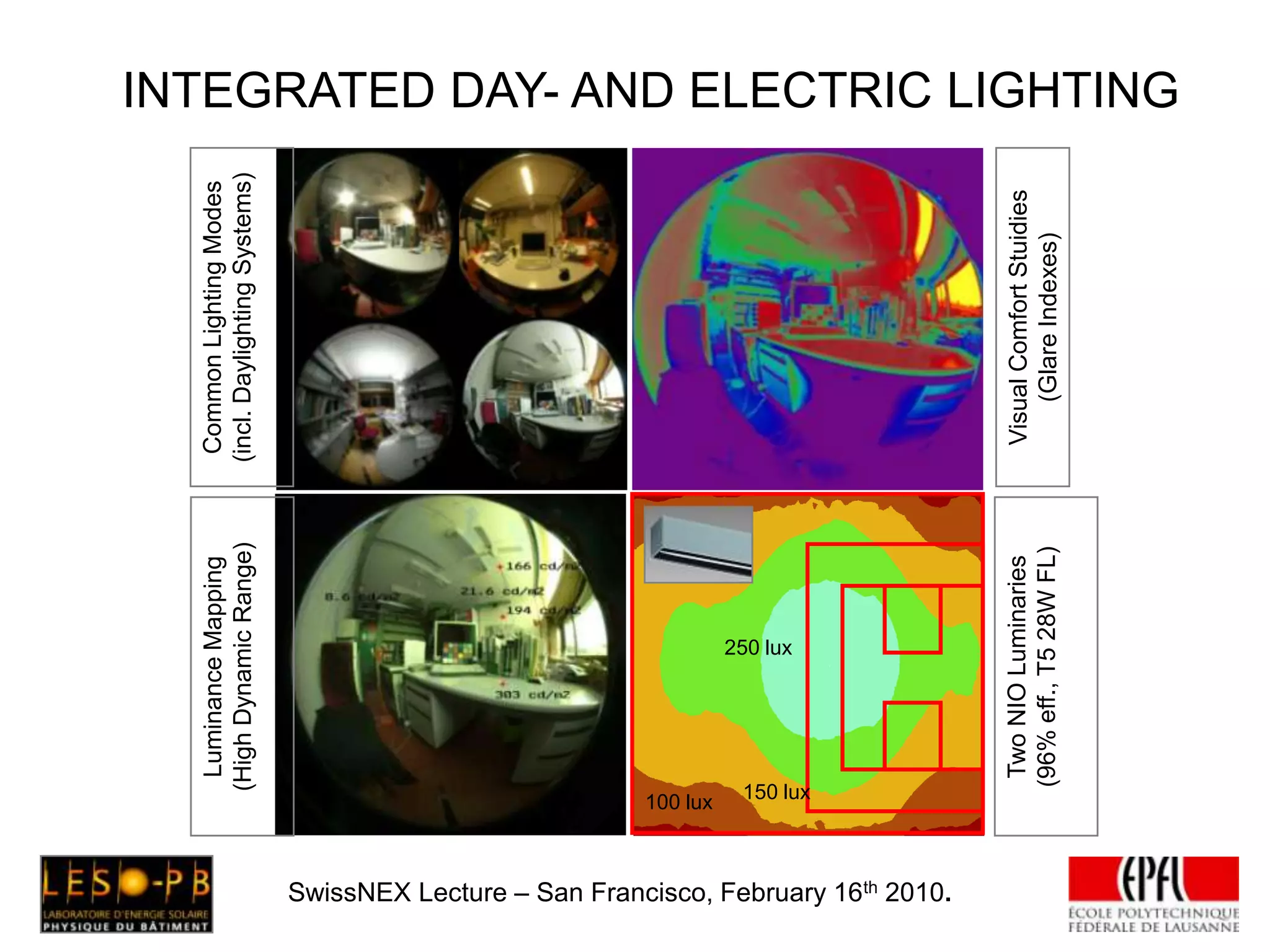
250 lux150 lux100 luxINTEGRATED DAY- AND ELECTRIC LIGHTINGCommon Lighting Modes (incl. Daylighting Systems)Visual Comfort Stuidies      (Glare Indexes)Two NIO Luminaries  (96% eff., T5 28W FL)Luminance Mapping        (High Dynamic Range)
SwissNex Lecture, San Francisco February 16th, 2010OverviewIntroduction
   Daylighting Resources and Provision
   Daylighting Design and Analysis Tools
   Advanced Daylighting Technology

Light Beyond Vision

  • 1.
    Light beyond Vision:Dayand Night in Building Scienceand ChronobiologyLight beyond Vision:Day and Night in Building Scienceand ChronobiologyProf. Jean-Louis Scartezzini, Dr. Mirjam MünchSolar Energy and Building Physics LaboratoryEcole Polytechnique Fédérale de Lausanne (EPFL), Lausanne (Switzerland)
  • 2.
    INTRODUCTIONDaylighting in OfficeBuildings (Natural Luminary, Prismatic Panels)Jourda et Perraudin (Lyon/France)Bartenbach Lichtlabor (Dorbirn/Austria)
  • 3.
  • 4.
    Daylighting Resources and Provision
  • 5.
    Daylighting Design and Analysis Tools
  • 6.
    Advanced Daylighting Technology
  • 7.
  • 8.
    Visual and Non-Visual Light Perception
  • 9.
    Office Lighting Case Study
  • 10.
    Summary and OutlookHigh EfficacyLarge Efficacy RangeDAYLIGHTING RESOURCES AND PROVISIONMain Light SourcesDaylight ProvisionWinter Overcast Sky 7’000 Lux Clear sky 20’000 LuxSummer Overcast Sky 30’000 Lux Clear Sky 110’000 LuxElectricLightDaylight
  • 11.
    DAYLIGHTING RESOURCES ANDPROVISIONImpact on DL Systems Performance (Task Illuminance, Daylight Factor)Marin County Civic Center (F. L. Wright, 1969)ZEB Forum Chriesbach (B. Gysin, 2006)
  • 12.
    CIE OvercastCIE ClearDAYLIGHTINGDESIGN & ANALYSIS TOOLSSimulations of Sky Luminance Distributions (CIE Standard Skies)Isotropic
  • 13.
    DAYLIGHTING DESIGN &ANALYSIS TOOLSAvailable Scientific Equipment (EPFL Daylighting Lab)HardwareAutomated Heliodon
  • 14.
    Scanning SkySimulator
  • 15.
  • 16.
  • 17.
    Bidirectional GoniophotometerSoftwareADELINE/Radiance Programme
  • 18.
  • 19.
  • 20.
    HDR ImagingTechnique6
  • 21.
    ADVANCED DAYLIGHTING TECHNOLOGYComplexFenestration Systems (IEA SHC Task 21 & 41)Labelling & Optical FeaturesAerogels and Capillaries(Scattering and Diffusion)LightshelvesReflective Lamellae(Specular Reflection)Laser Cut PanelSun Directing Glass(Total Internal Reflection)Prismatic Panel and Film(Refraction)Holographic Optical Element(Diffraction)Anidolic Daylighting Systems(Non-Imaging Optics)AerogelLightshelfHOELaser Cut Panel
  • 22.
    ANIDOLIC DAYLIGHTING SYSTEMS(ADS)Non-Imaging Optics Principles (Edge-Rays Method)
  • 23.
    0.750.750.16Reflection FactorsANIDOLIC DAYLIGHTINGSYSTEMS (ADS)Comparison of Daylighting Performance (1:1 Scale Office Rooms)0.570.300.11Double Glazing – Dark RoomAnidolic SystemDouble Glazing – Light Room
  • 24.
    ANIDOLIC DAYLIGHTING SYSTEMS(ADS)Monitoring of Daylighting Performance (Daylight Factor)50 % ANNUAL INCREASEOF DAYLIGHTING PROVISION(300 Lux / Urban)DF 3%
  • 25.
    ANIDOLIC DAYLIGHTING SYSTEMS(ADS)AnidolicZenithalCollector LESO-PB/EPFL, Lausanne (Switzerland) Scartezzini and Courret, SEJ 73(2), 2002.LESO Sustainable Building (EPFL Campus)
  • 26.
    ANIDOLIC DAYLIGHTING SYSTEMS(ADS)Anidolic Integrated Ceiling (Movable Test Modules)Architectural Design: Müller & Ganz, Geneva
  • 27.
    ANIDOLIC DAYLIGHTING SYSTEMS(ADS)Monitoring of Daylighting Performance (Anidolic Integrated Ceiling)DF 9%DF 4%
  • 28.
    OptimalIntegrationANIDOLIC DAYLIGHTING SYSTEMS(ADS)Facade Integrated Anidolic System (Movable Test Modules)Architectural Design : I. Giaccari, Lausanne
  • 29.
    ANIDOLIC DAYLIGHTING SYSTEMS(ADS)Anidolic Integrated Ceiling (Zero Energy Building, Singapore)Building Construction Authority, Singapore
  • 30.
    ANIDOLIC DAYLIGHTING SYSTEMS(ADS)AnidolicZenithalOpeningBartenbach L’chtLabor, Aldrans (Austria) Courret, Paule and Scartezzini, LRT 28(1), 1996.Changi Airport, Terminal 3 (Singapore)
  • 31.
    ADVANCED DAYLIGHTING TECHNOLOGYElectrochromicGlazing (Visual Comfort, Circadian Impact)TVIS 55 %TVIS 30 %TVIS 15 %Page, Scartezzini, Kaempf, Morel, SEJ, 81(9), 2007.LESO Sustainable Building (EPFL Campus)
  • 32.
    250 lux150 lux100luxINTEGRATED DAY- AND ELECTRIC LIGHTINGCommon Lighting Modes (incl. Daylighting Systems)Visual Comfort Stuidies (Glare Indexes)Two NIO Luminaries (96% eff., T5 28W FL)Luminance Mapping (High Dynamic Range)
  • 34.
    SwissNex Lecture, SanFrancisco February 16th, 2010OverviewIntroduction
  • 35.
    Daylighting Resources and Provision
  • 36.
    Daylighting Design and Analysis Tools
  • 37.
    Advanced Daylighting Technology
  • 38.
  • 39.
    Visual and Non-VisualLight Perception
  • 40.
    Office Lighting Case Study
  • 41.
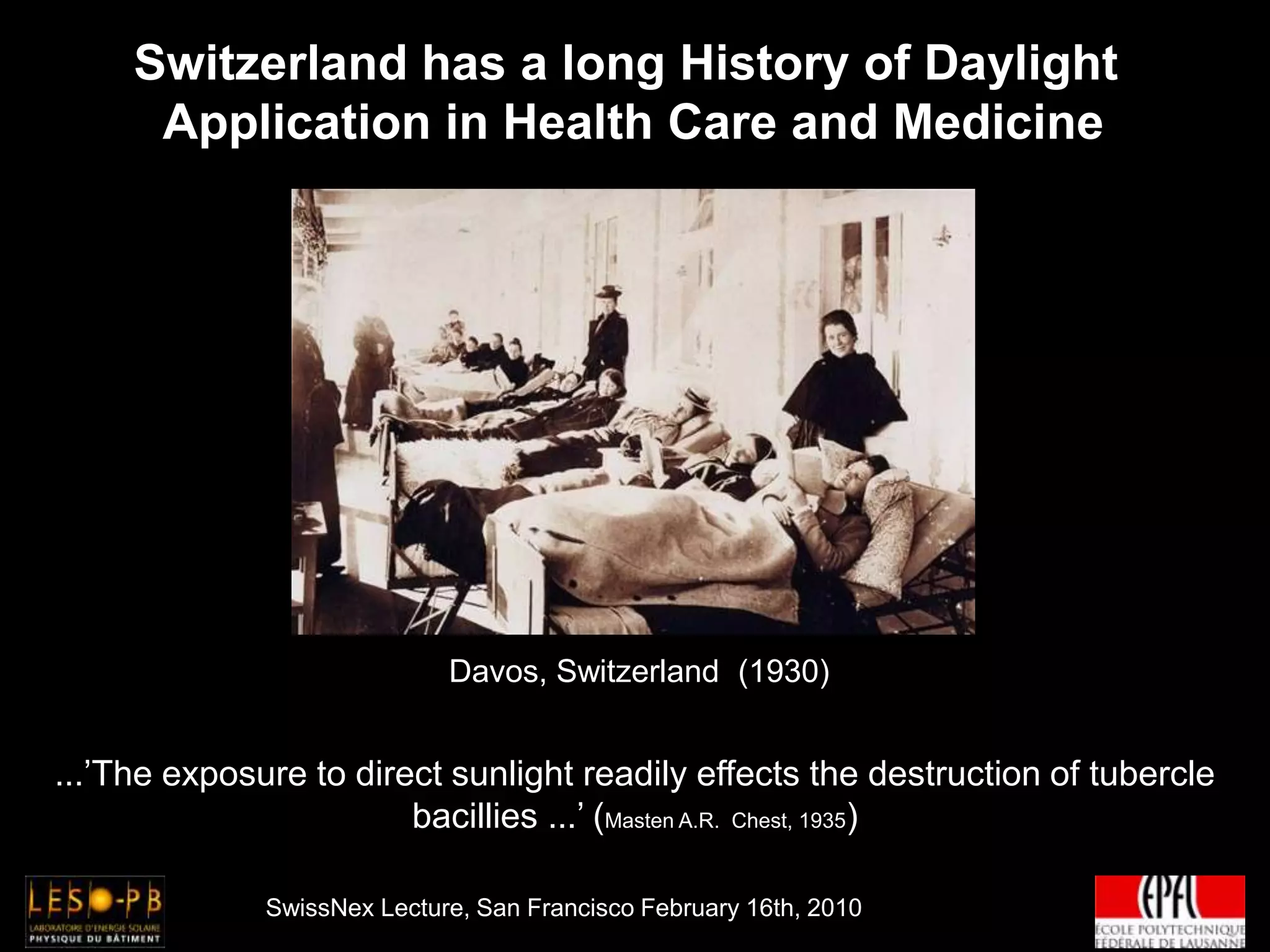
    Summary and OutlookSwissNex Lecture, San Francisco February 16th, 2010Switzerland has a long History of Daylight Application in Health Care and MedicineDavos, Switzerland (1930)...’The exposure to direct sunlight readily effects the destruction of tubercle bacillies ...’ (Masten A.R. Chest, 1935)
  • 42.
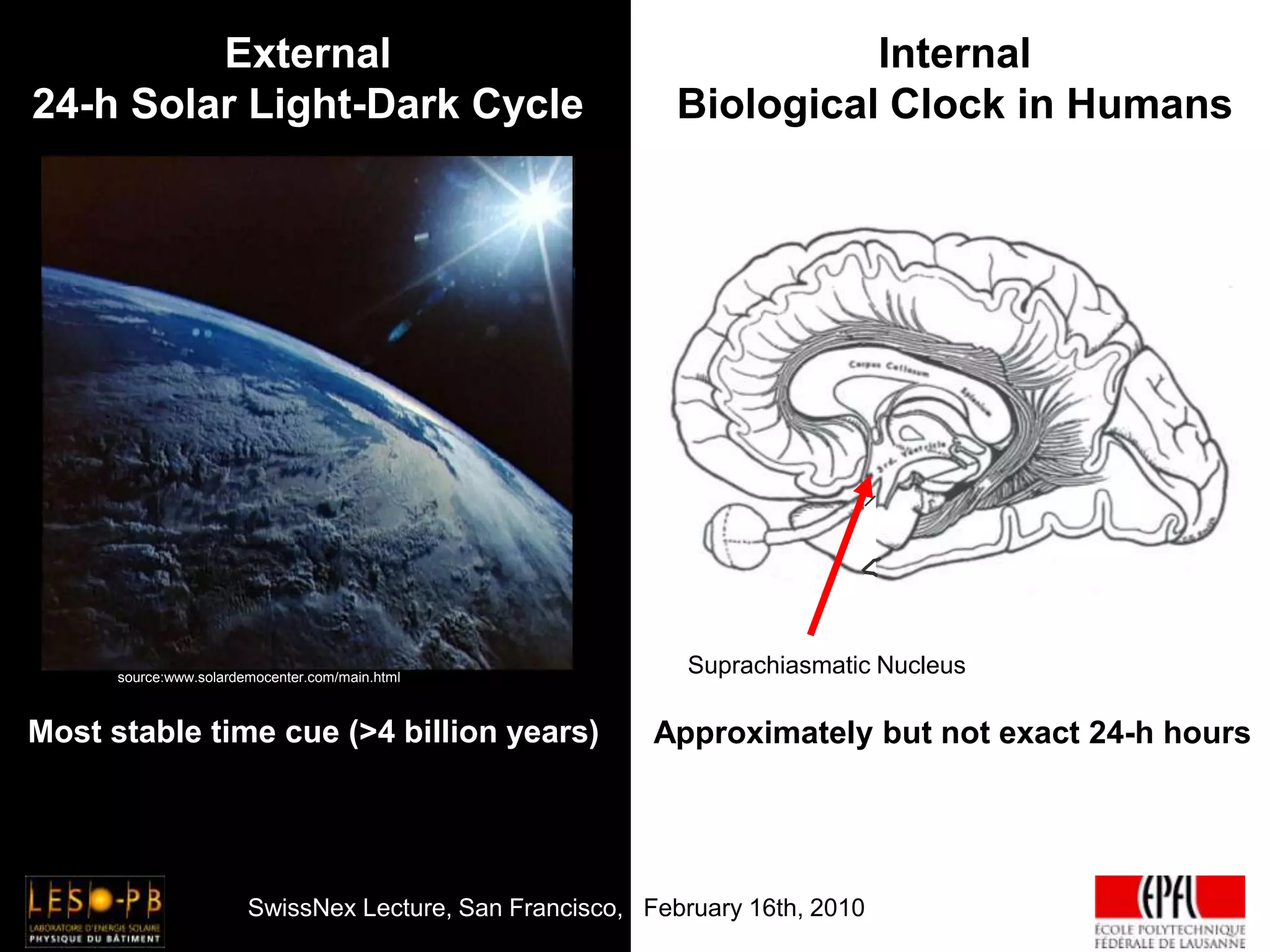
    InternalBiological Clock inHumansSuprachiasmatic NucleusApproximately but not exact 24-h hoursExternal24-h Solar Light-Dark Cyclesource:www.solardemocenter.com/main.htmlMost stable time cue (>4 billion years)SwissNex Lecture, San Francisco, February 16th, 2010
  • 43.
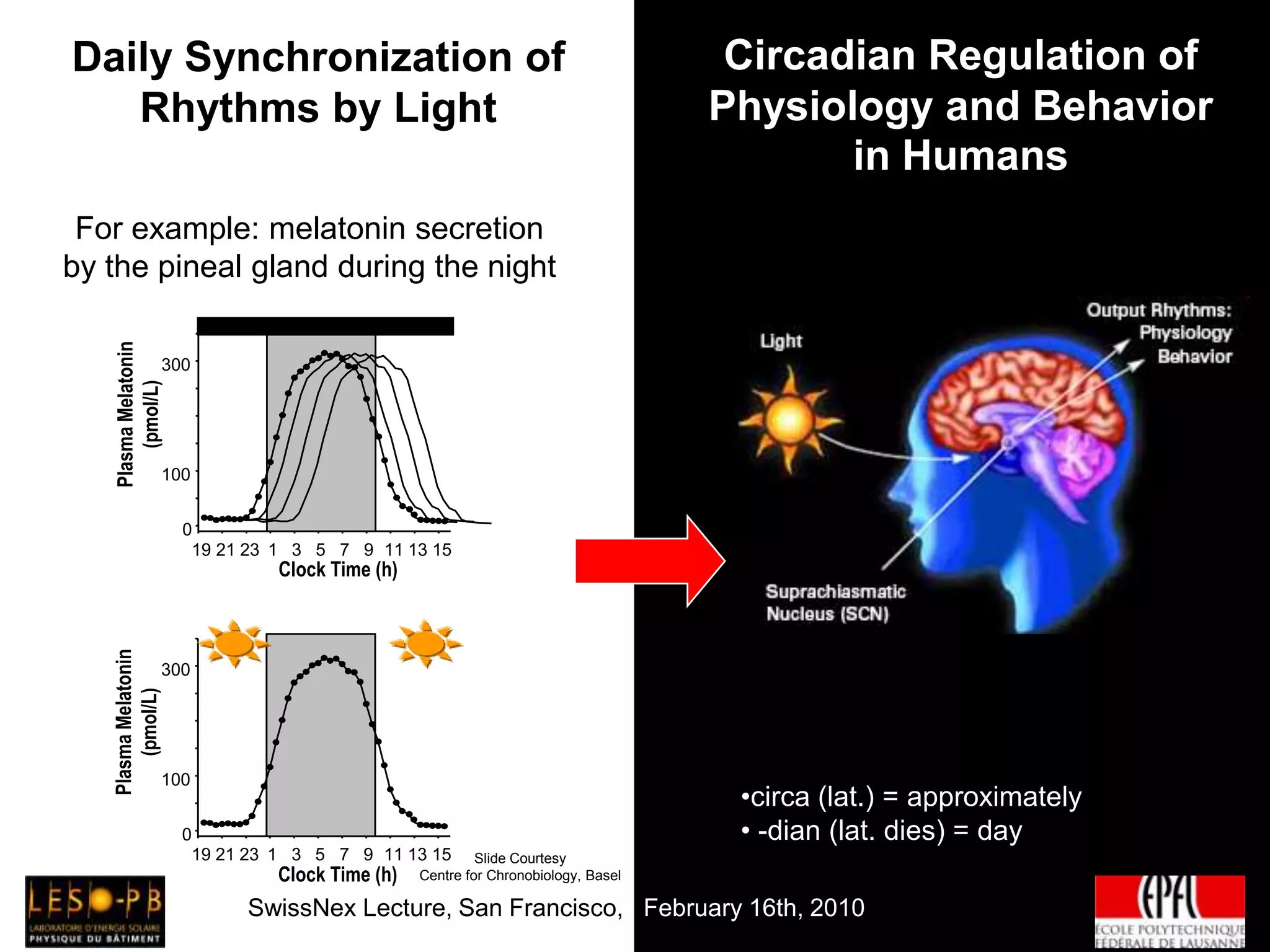
    Circadian Regulation ofPhysiology and Behavior in Humans300300Plasma Melatonin (pmol/L)Plasma Melatonin (pmol/L)100100001921231357911131519212313579111315Clock Time (h)Clock Time (h)circa (lat.) = approximately
  • 44.
    -dian (lat.dies) = dayDaily Synchronization of Rhythms by LightFor example: melatonin secretionby the pineal gland during the nightSlide CourtesyCentre for Chronobiology, BaselSwissNex Lecture, San Francisco,February 16th, 2010
  • 45.
    Visual system: rods& conesNon-visual system: retinalganglion cellscircadian rhythms
  • 46.
  • 47.
  • 48.
  • 49.
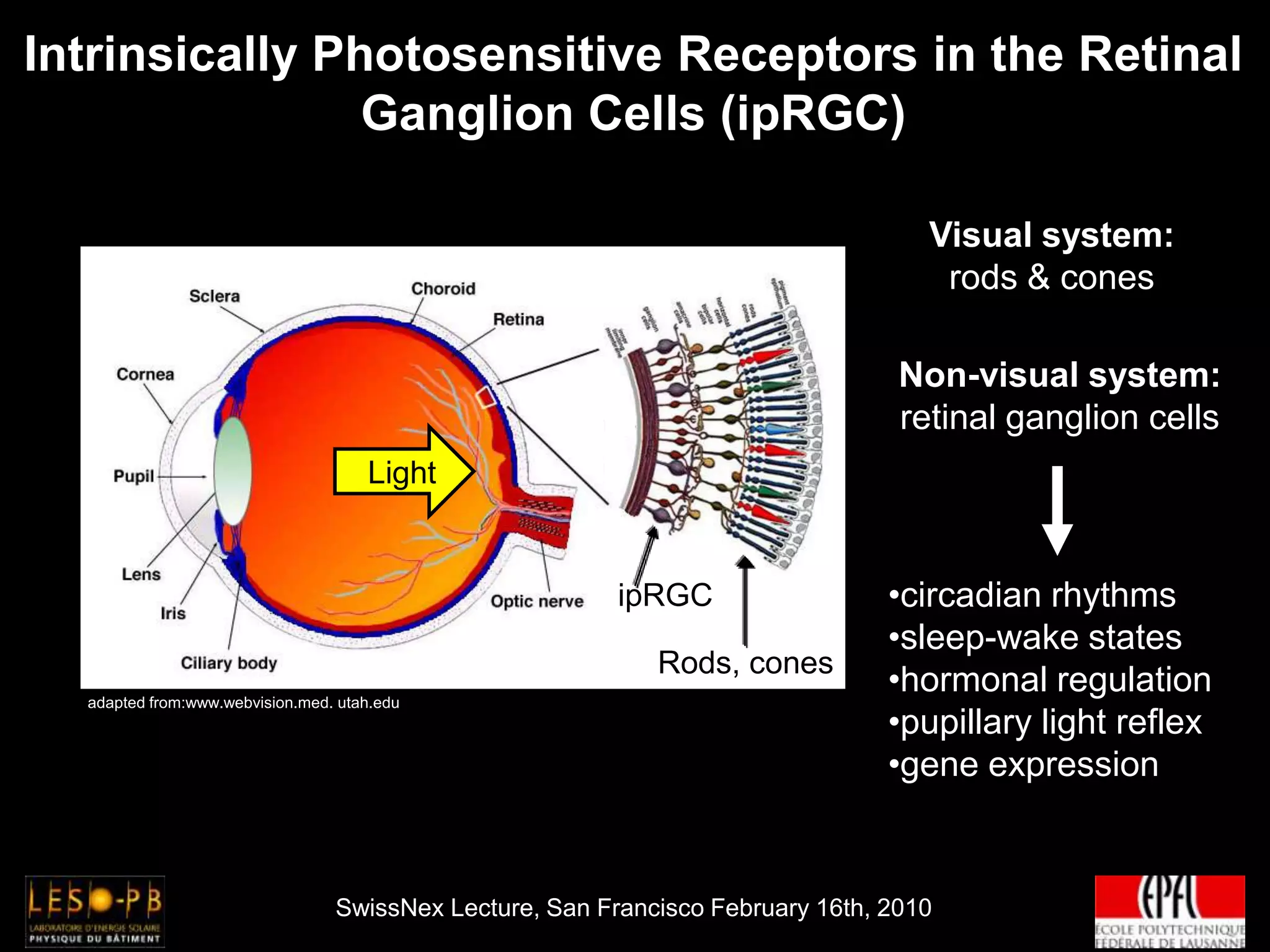
    gene expressionSwissNex Lecture,San Francisco February 16th, 2010Intrinsically Photosensitive Receptors in the Retinal Ganglion Cells (ipRGC)LightipRGCRods, conesadapted from:www.webvision.med. utah.edu
  • 50.
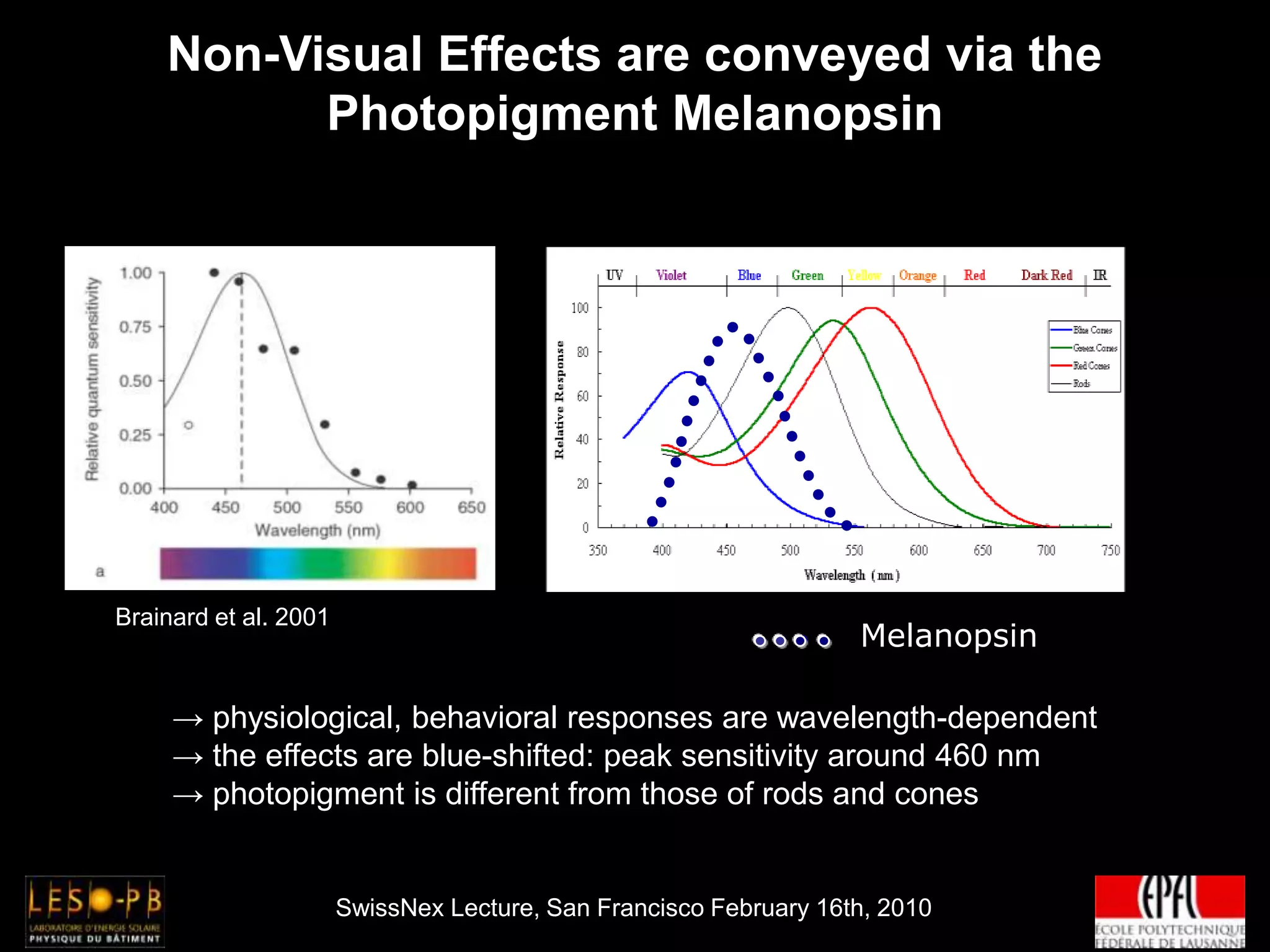
    MelanopsinSwissNex Lecture, SanFrancisco February 16th, 2010Non-Visual Effects are conveyed via the Photopigment MelanopsinBrainard et al. 2001->physiological, behavioral responses are wavelength-dependent-> the effects are blue-shifted: peak sensitivity around 460 nm-> photopigment is different from those of rods and cones
  • 51.
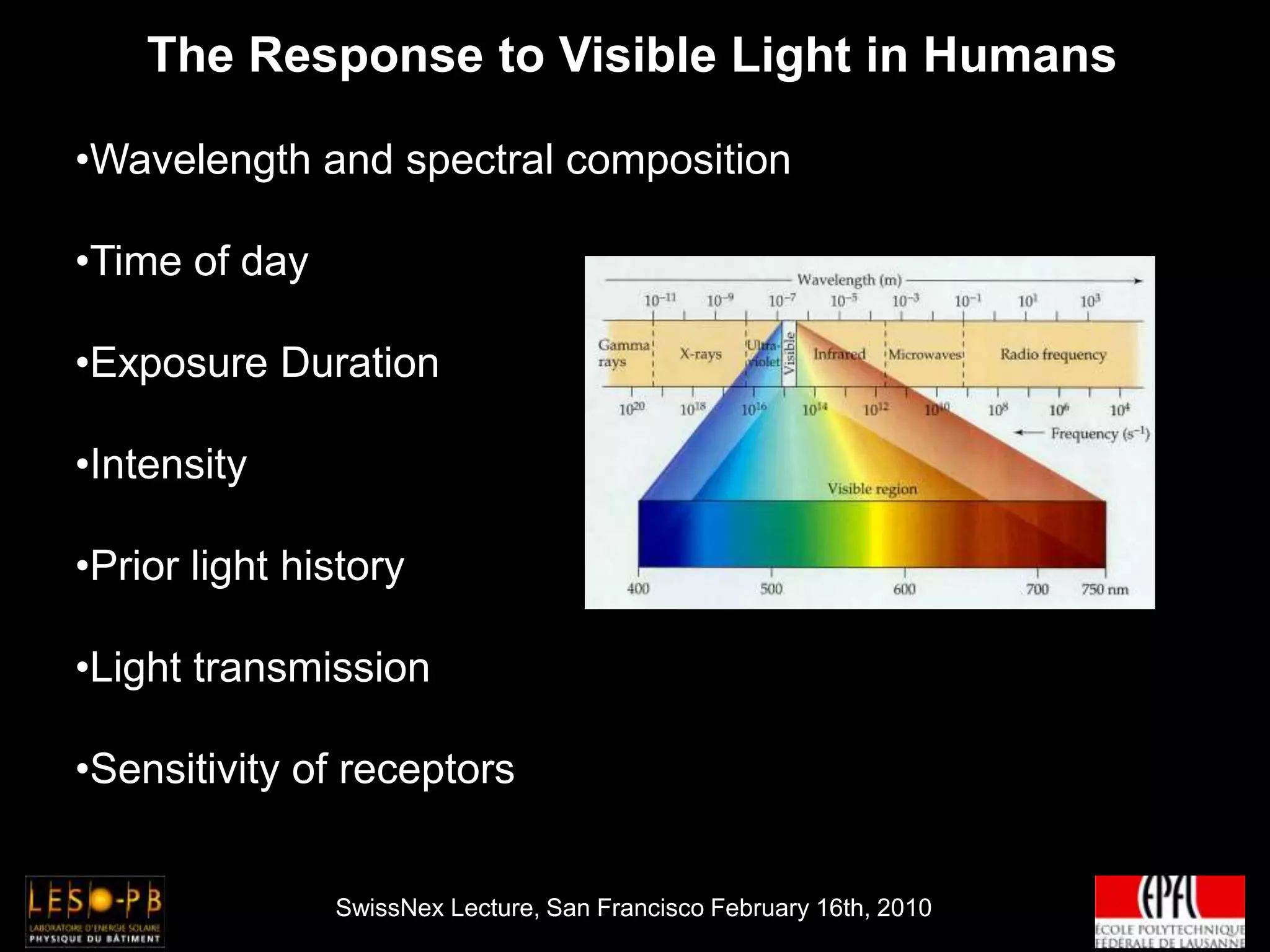
    SwissNex Lecture, SanFrancisco February 16th, 2010The Response to Visible Light in HumansTWavelength and spectral composition
  • 52.
  • 53.
  • 54.
  • 55.
  • 56.
  • 57.
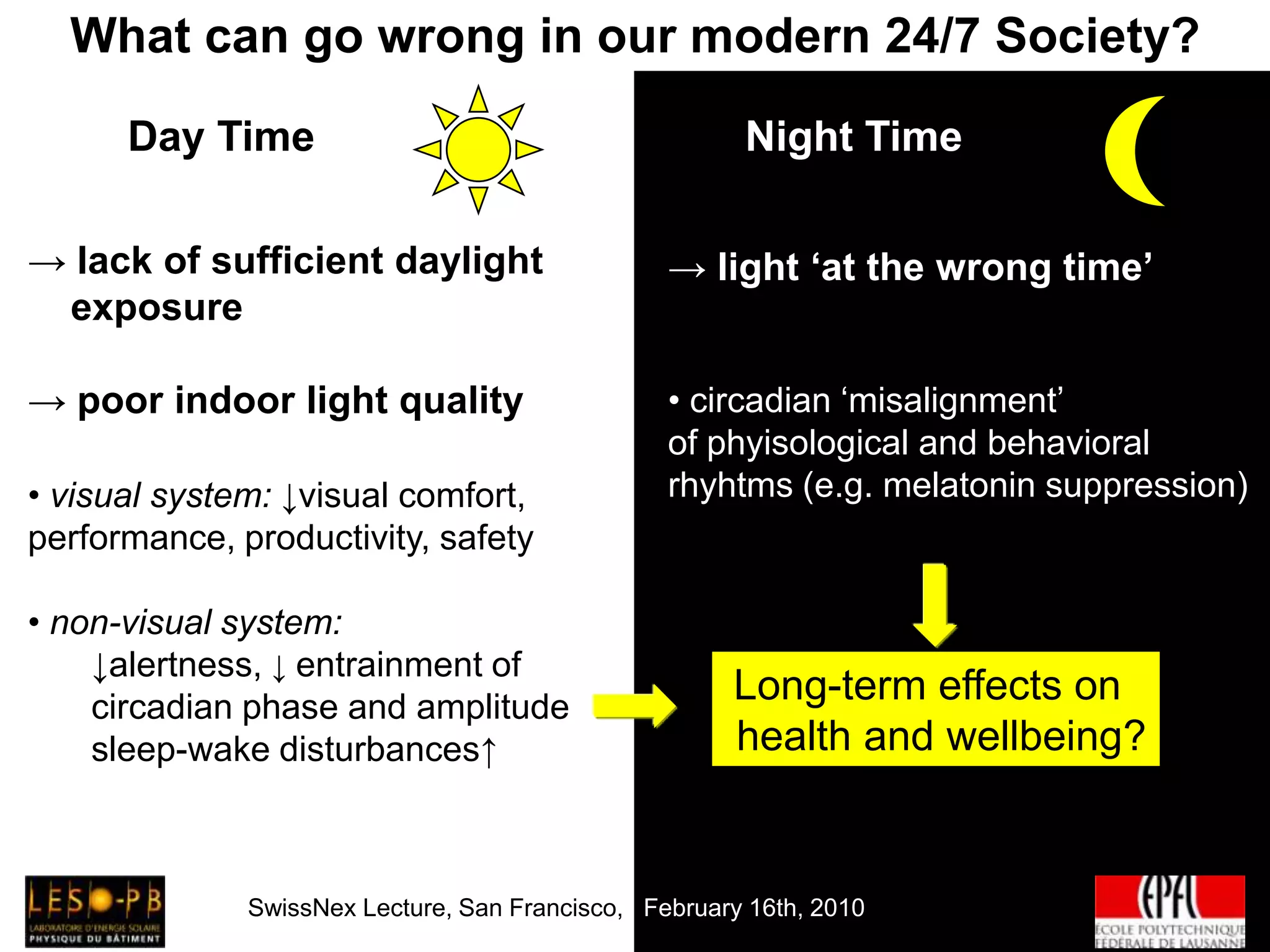
    Sensitivity of receptorsWhatcan go wrong in our modern 24/7 Society?Night Time-> light ‘at the wrong time’ circadian ‘misalignment’of phyisological and behavioral rhyhtms (e.g. melatonin suppression)Long-term effects on health and wellbeing?SwissNex Lecture, San Francisco,February 16th, 2010Day Time-> lack of sufficient daylight exposure-> poor indoor light qualityvisual system: ↓visual comfort, performance, productivity, safetynon-visual system:↓alertness, ↓ entrainment of circadian phase and amplitudesleep-wake disturbances↑
  • 58.
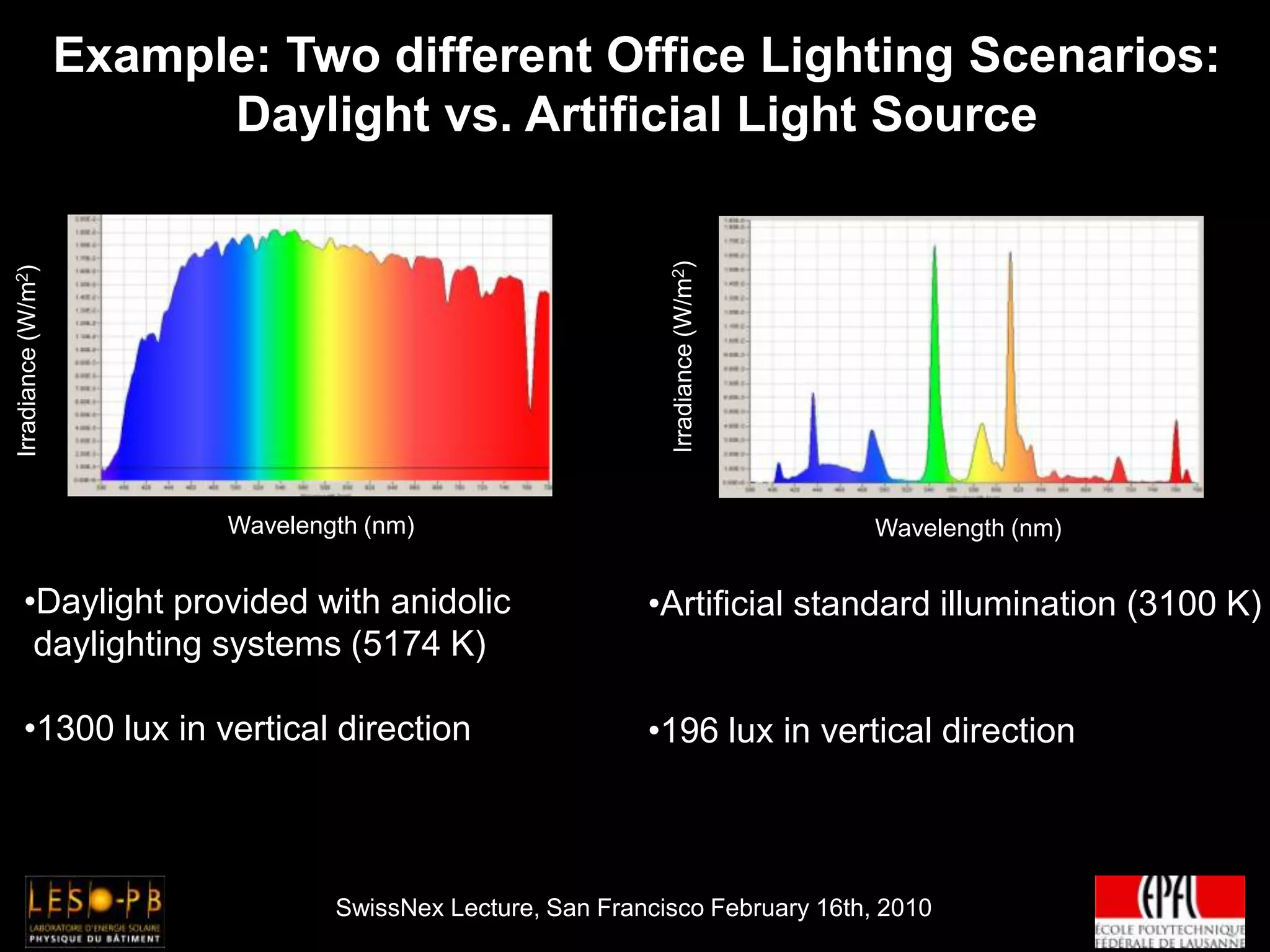
    Irradiance (W/m2)Wavelength (nm)Artificialstandard illumination (3100 K)
  • 59.
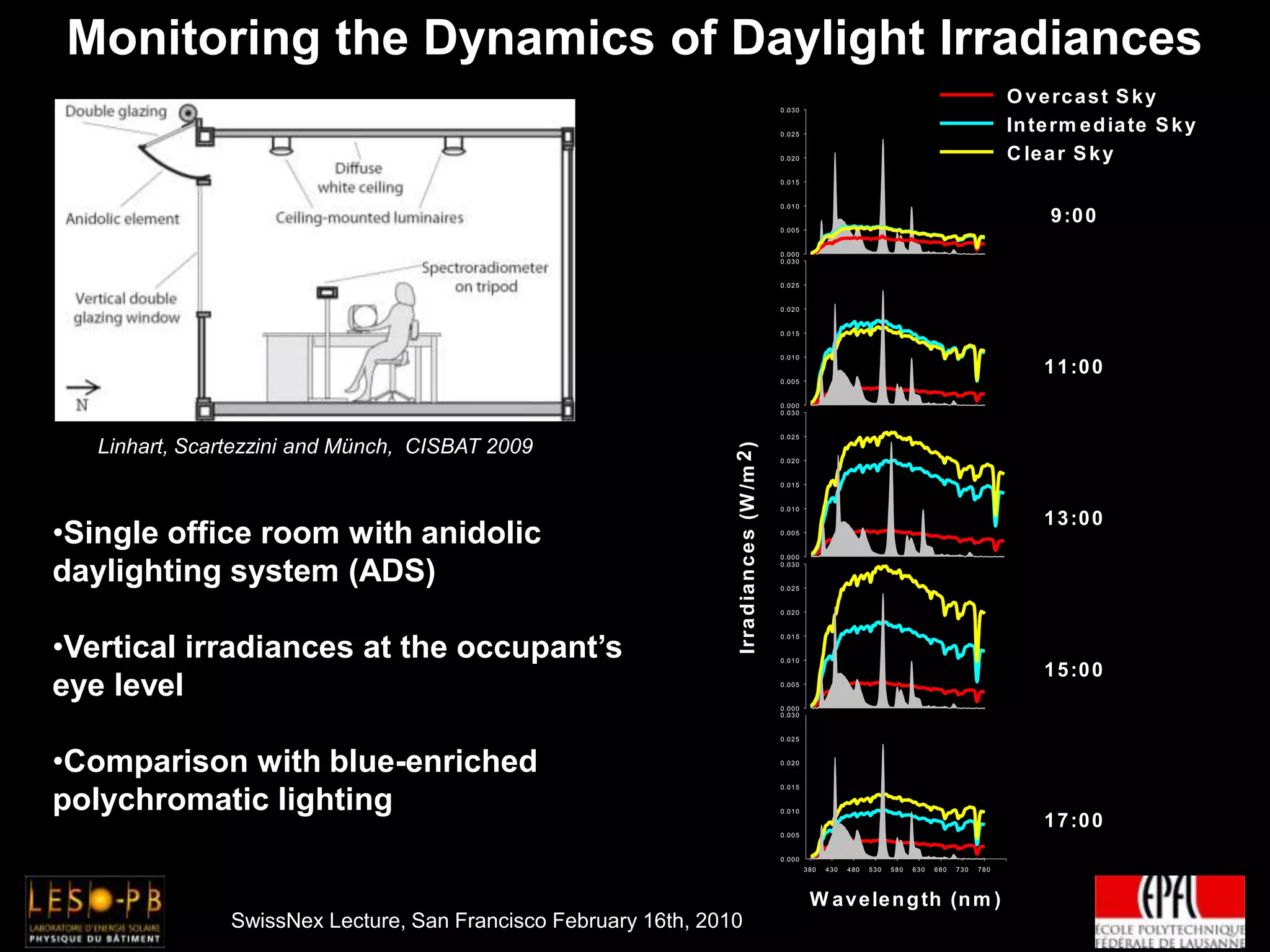
    196 lux invertical directionSwissNex Lecture, San Francisco February 16th, 2010Example: Two different Office Lighting Scenarios: Daylight vs. Artificial Light SourceIrradiance (W/m2)Wavelength (nm)Daylight provided with anidolic daylighting systems (5174 K)1300 lux in vertical direction Monitoring the Dynamics of Daylight IrradiancesLinhart, Scartezzini and Münch, CISBAT 2009Single office room with anidolic daylighting system (ADS)
  • 60.
    Vertical irradiances atthe occupant’s eye level
  • 61.
    Comparison with blue-enrichedpolychromatic lightingSwissNex Lecture, San Francisco February 16th, 2010
  • 62.
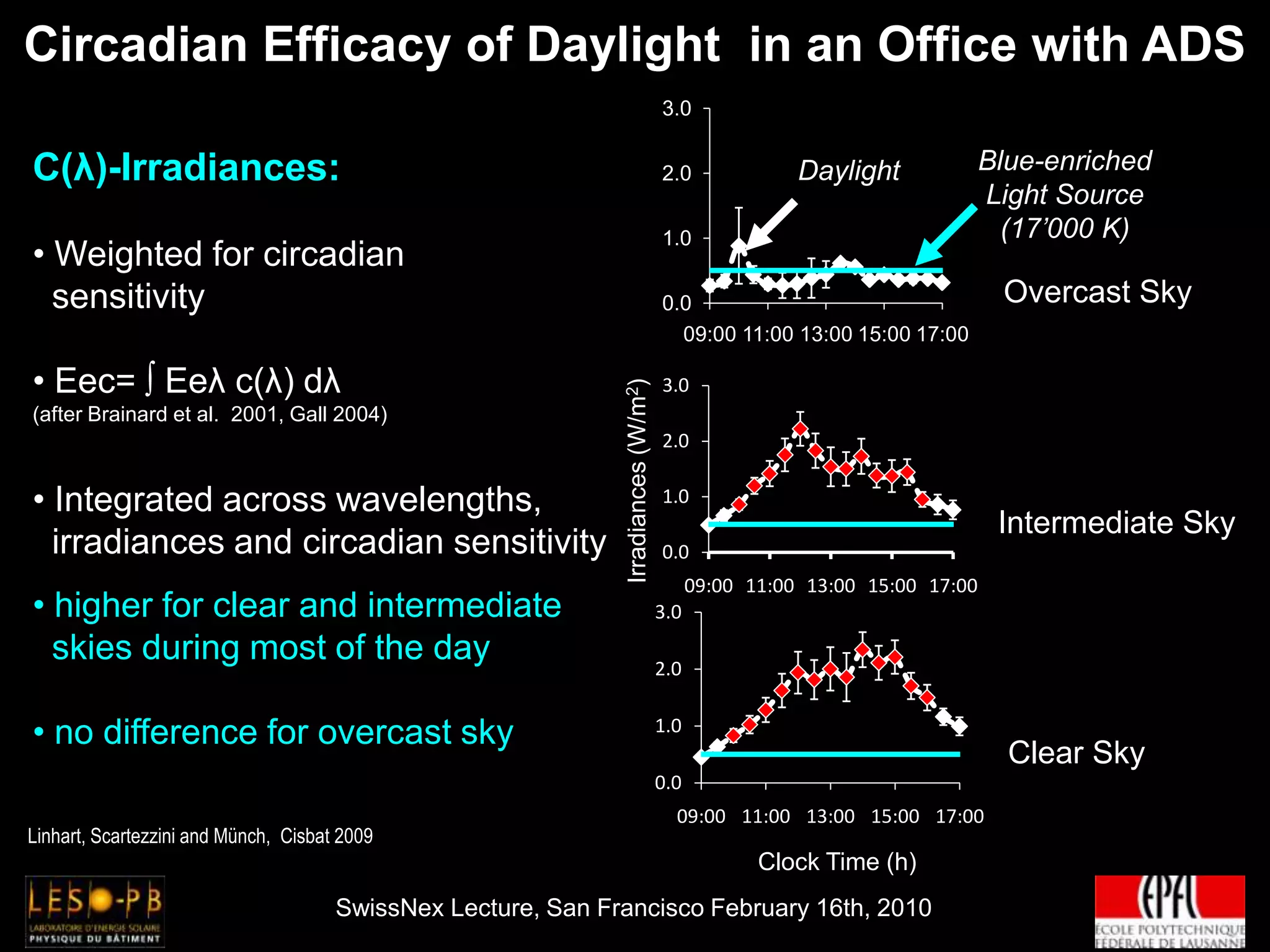
    DaylightBlue-enrichedLight Source(17’000 K)OvercastSkyIrradiances (W/m2)Intermediate SkyClear SkyClock Time (h)SwissNex Lecture, San Francisco February 16th, 2010Circadian Efficacy of Daylight in an Office with ADSC(λ)-Irradiances: Weighted for circadian sensitivity Eec= ∫ Eeλ c(λ) dλ (after Brainard et al. 2001, Gall 2004) Integrated across wavelengths, irradiances and circadian sensitivity higher for clear and intermediate skies during most of the day no difference for overcast skyLinhart, Scartezzini and Münch, Cisbat 2009
  • 63.
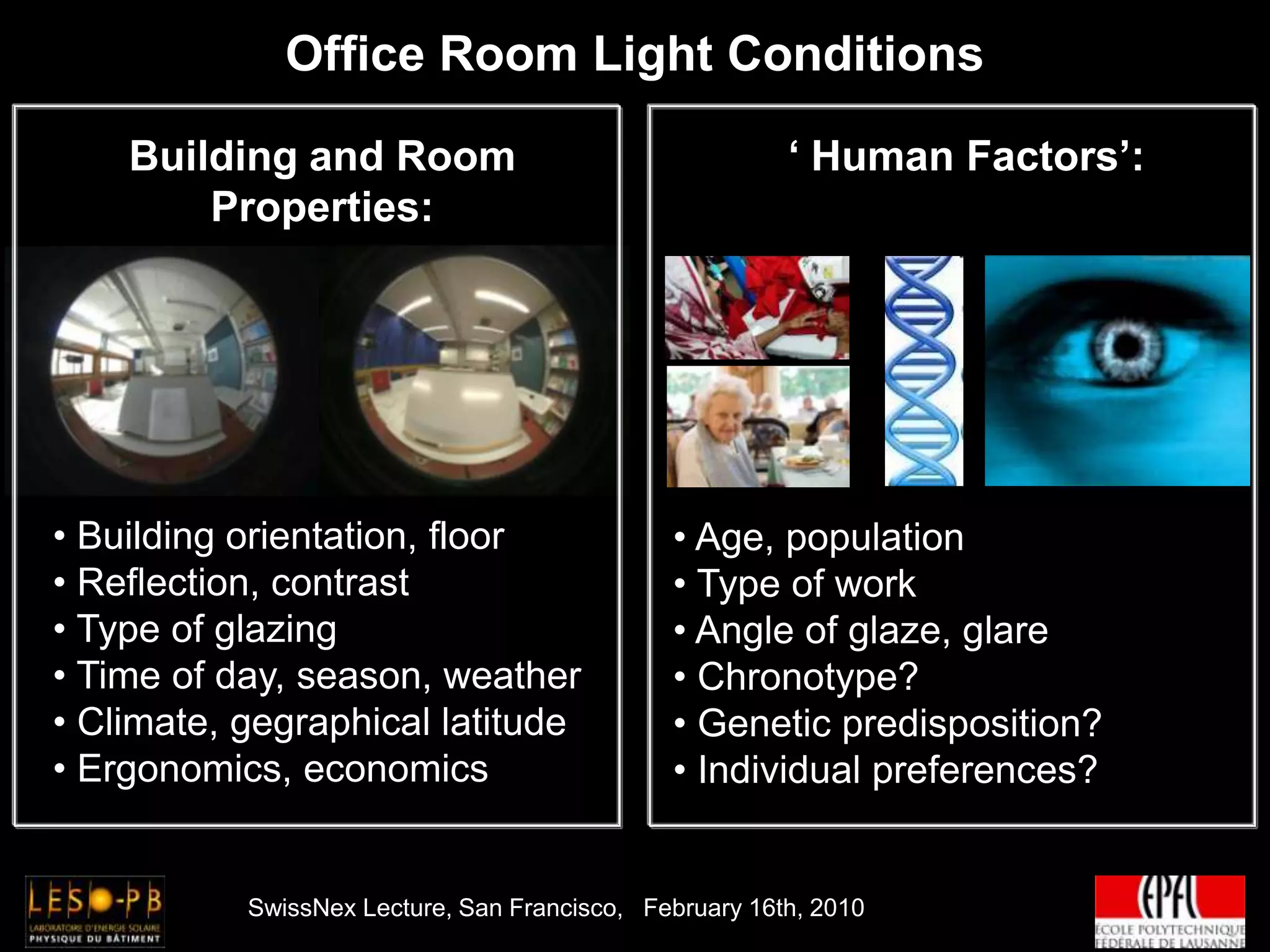
    Building and RoomProperties:‘ Human Factors’: Building orientation, floor
  • 64.
  • 65.
    Type ofglazing
  • 66.
    Time ofday, season, weather
  • 67.
  • 68.
  • 69.
  • 70.
  • 71.
    Angle ofglaze, glare
  • 72.
  • 73.
  • 74.
    Individual preferences?SwissNexLecture, San Francisco, February 16th, 2010Office Room Light Conditions
  • 75.
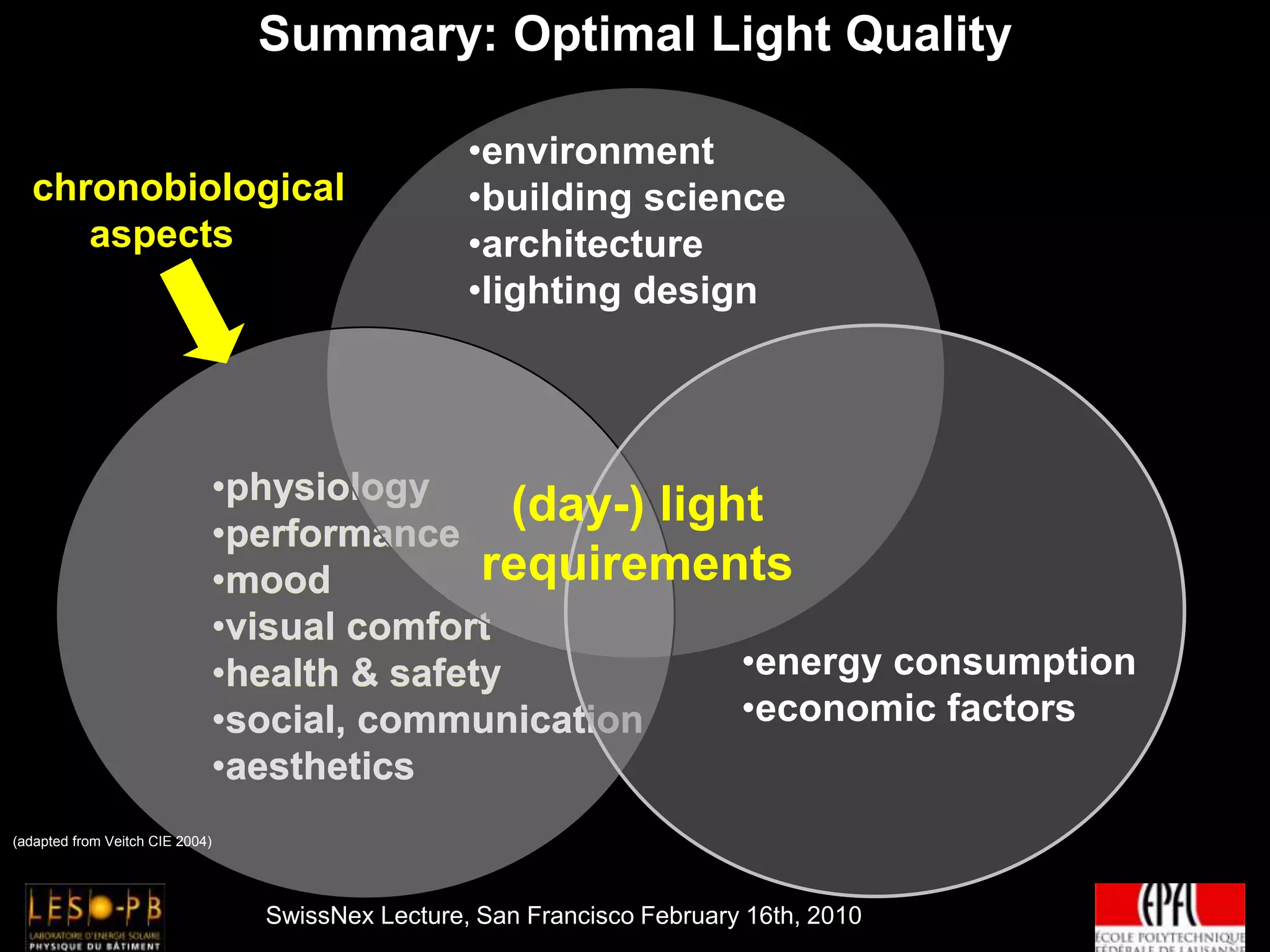
    Summary: Optimal LightQuality chronobiologicalaspectsSwissNex Lecture, San Francisco February 16th, 2010environment
  • 76.
  • 77.
  • 78.
  • 79.
  • 80.
  • 81.
  • 82.
  • 83.
  • 84.
  • 85.
  • 86.
  • 87.
  • 88.
  • 89.
  • 90.
  • 91.
  • 92.
  • 93.
  • 94.
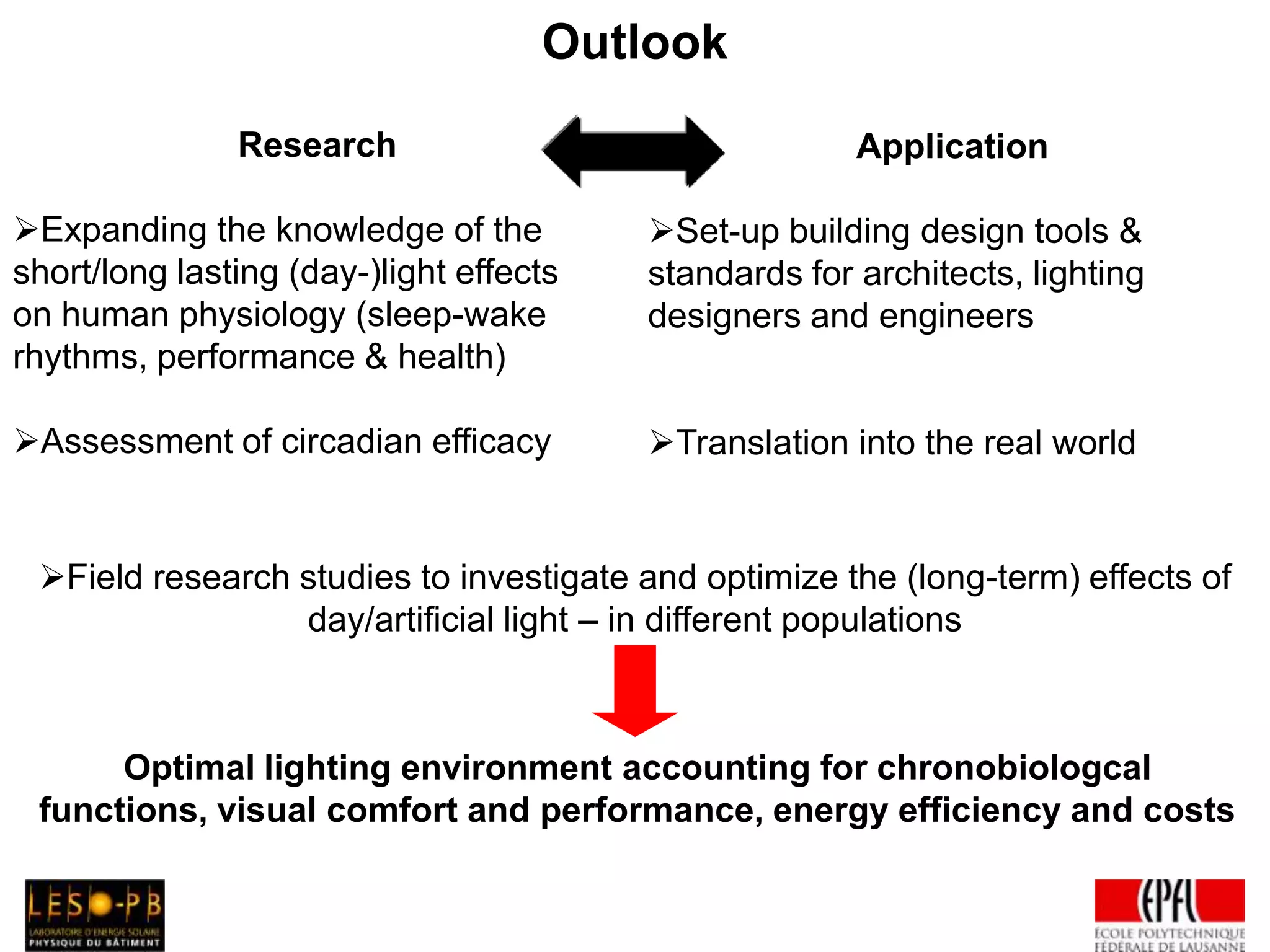
    ApplicationSet-up building designtools & standards for architects, lighting designers and engineers
  • 95.
    Translation into thereal worldOptimal lighting environment accounting for chronobiologcal functions, visual comfort and performance, energy efficiency and costsSwissNex Lecture, San Francisco February 16th, 2010OutlookResearchExpanding the knowledge of theshort/long lasting (day-)light effects on human physiology (sleep-wake rhythms, performance & health)Assessment of circadian efficacy
  • 96.
    Field research studiesto investigate and optimize the (long-term) effects of day/artificial light – in different populationsSwissNex Lecture, San Francisco February 16th, 2010AcknowledgementsTeam of the Solar Energy and Building Physics Laboratory, EPFLFriedrich LinhartPierre LoeschVELUX Foundation (Switzerland)Swiss Federal Institute of Technology, Lausanne
  • 97.
    SwissNex Lecture, SanFrancisco February 16th, 2010Thank you for your attention!