Gonioscopy
  Dr. N.suneel ,MS
        1st year
Dept of ophthalmology
Introduction
• Definition:

• Why gonioscopy is underutilized?
• How frequently we should do gonioscopy?

• Indications:
• Contraindications:
ANATOMY OF ANGLE OF ANTERIOR CHAMBER
• Structures from posterior to anterior
      anterior surface of iris
      ciliary band
      scleral spur
      trabecular meshwork
      schwalbe’s line
      posterior surface of
             cornea
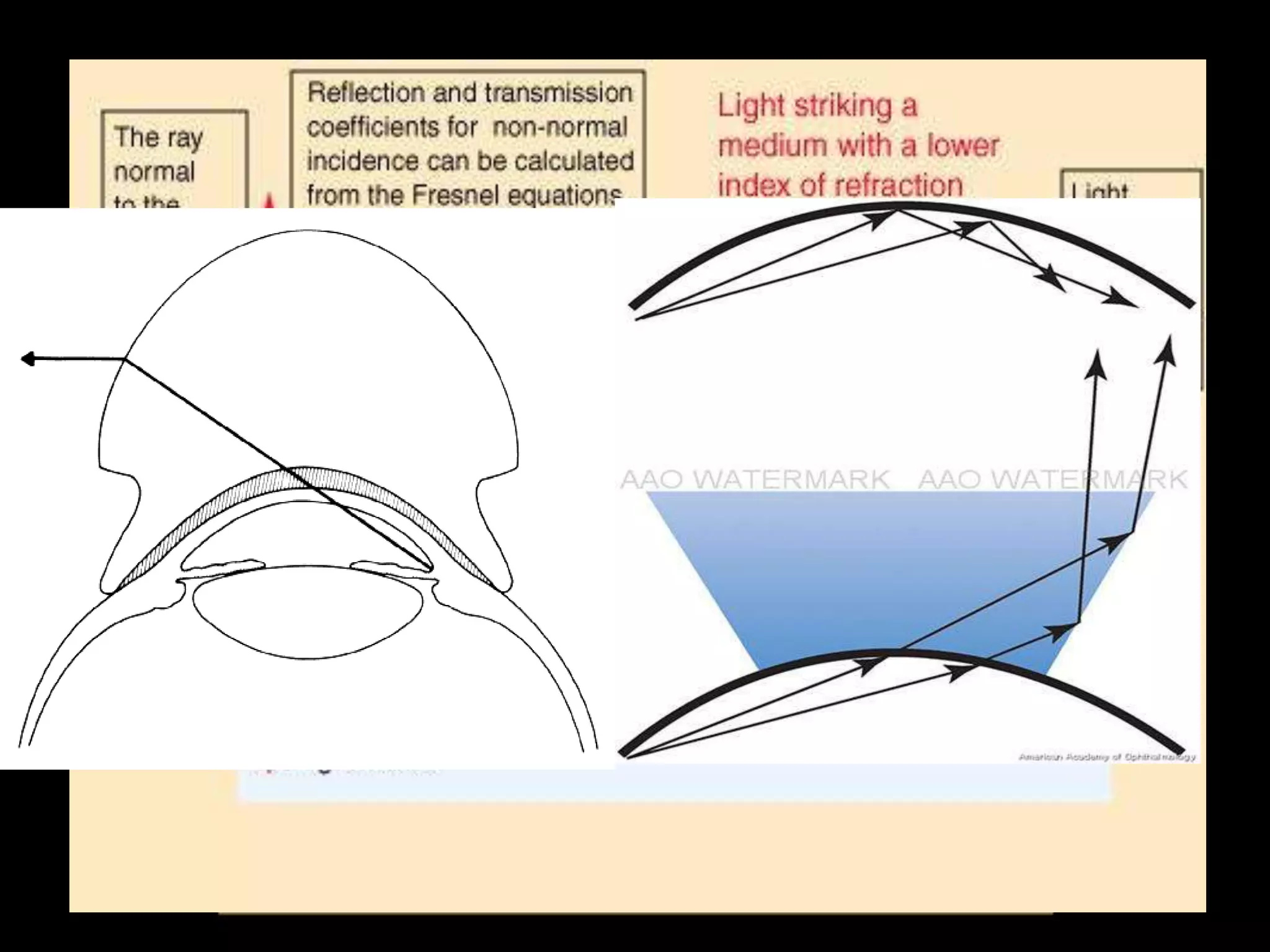
principle
•   Critical angle .
•   Total internal reflection .
•   Eliminates corneal-air interface
•   Direct and indirect gonioscopy
Direct gonioscopy
   Koeppe lens                 Barkan lens
   • Prototype diagnostic      • Prototype surgical lens
     lens


   Richard son - shaffer       Thorpe lens
   • Small koeppe lens         • Surgical and diagnostic lens
   • For use in children       • For operating room


   Layden                      Swan – jacob lens
   • For premature infants .   • Surgical goniolens for use in
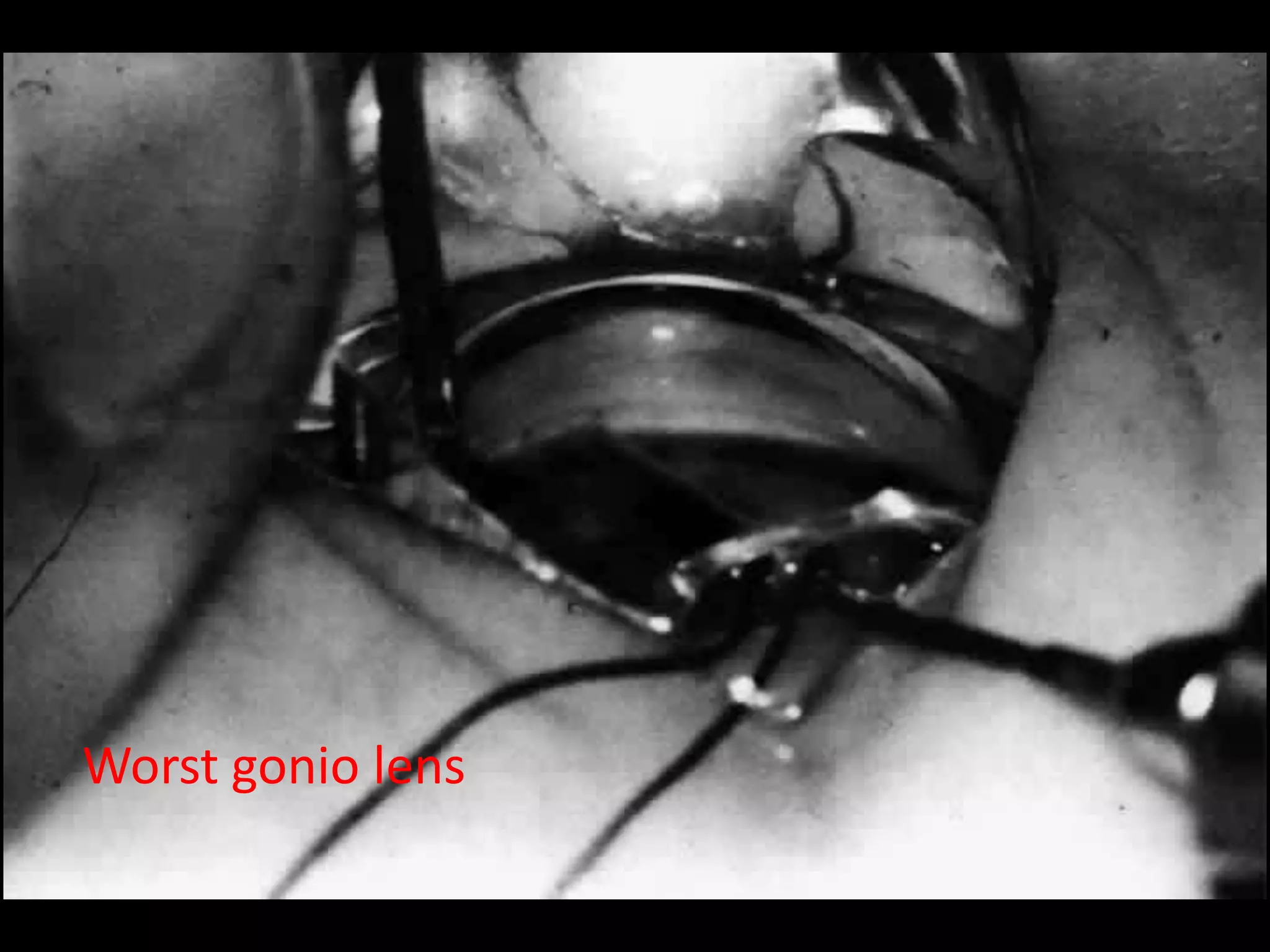
Worst gonio lens                 children.
Indirect gonioscopy


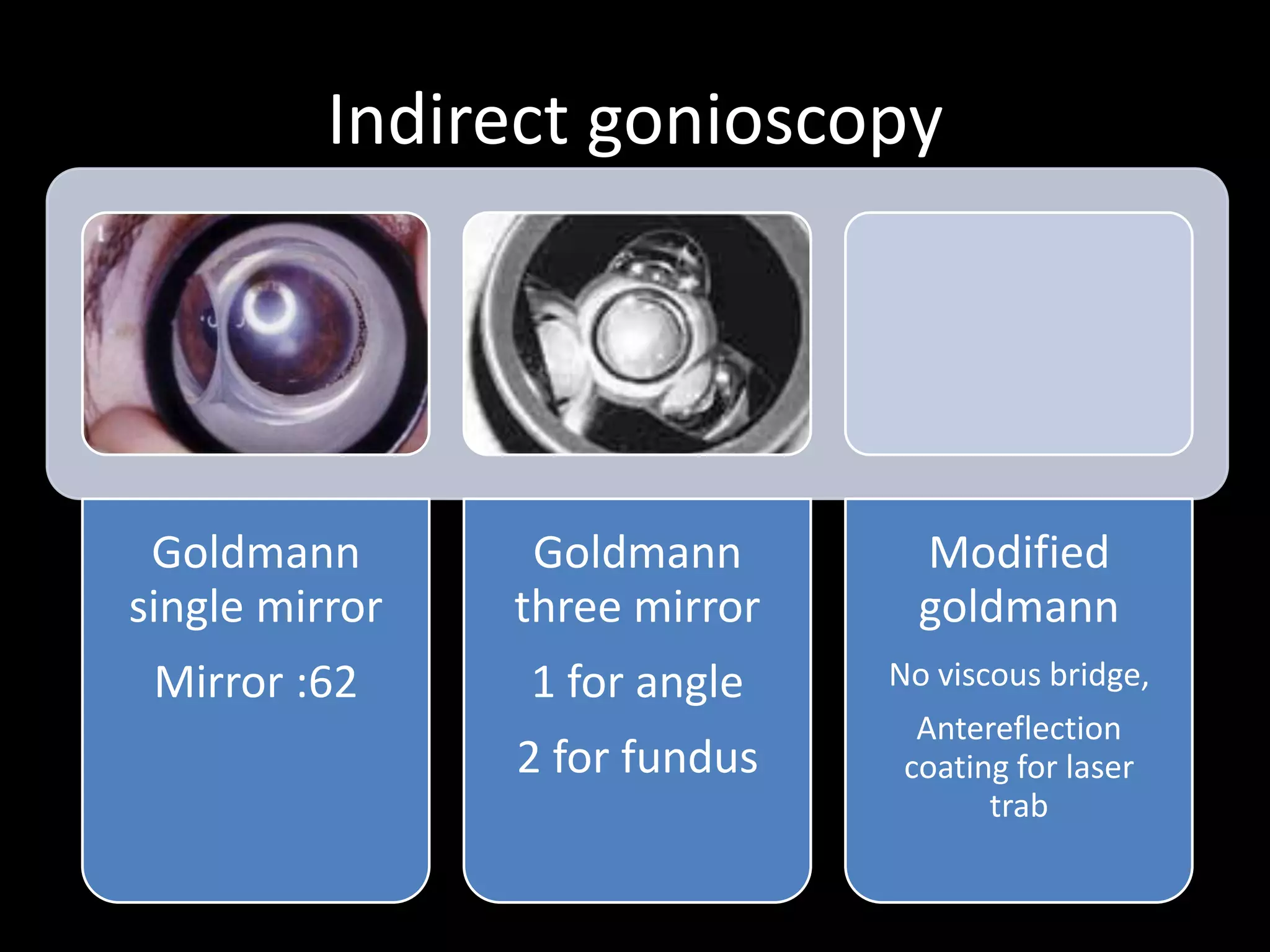
 Goldmann        Goldmann        Modified
single mirror   three mirror     goldmann
 Mirror :62     1 for angle    No viscous bridge,
                                 Antereflection
                2 for fundus    coating for laser
                                      trab
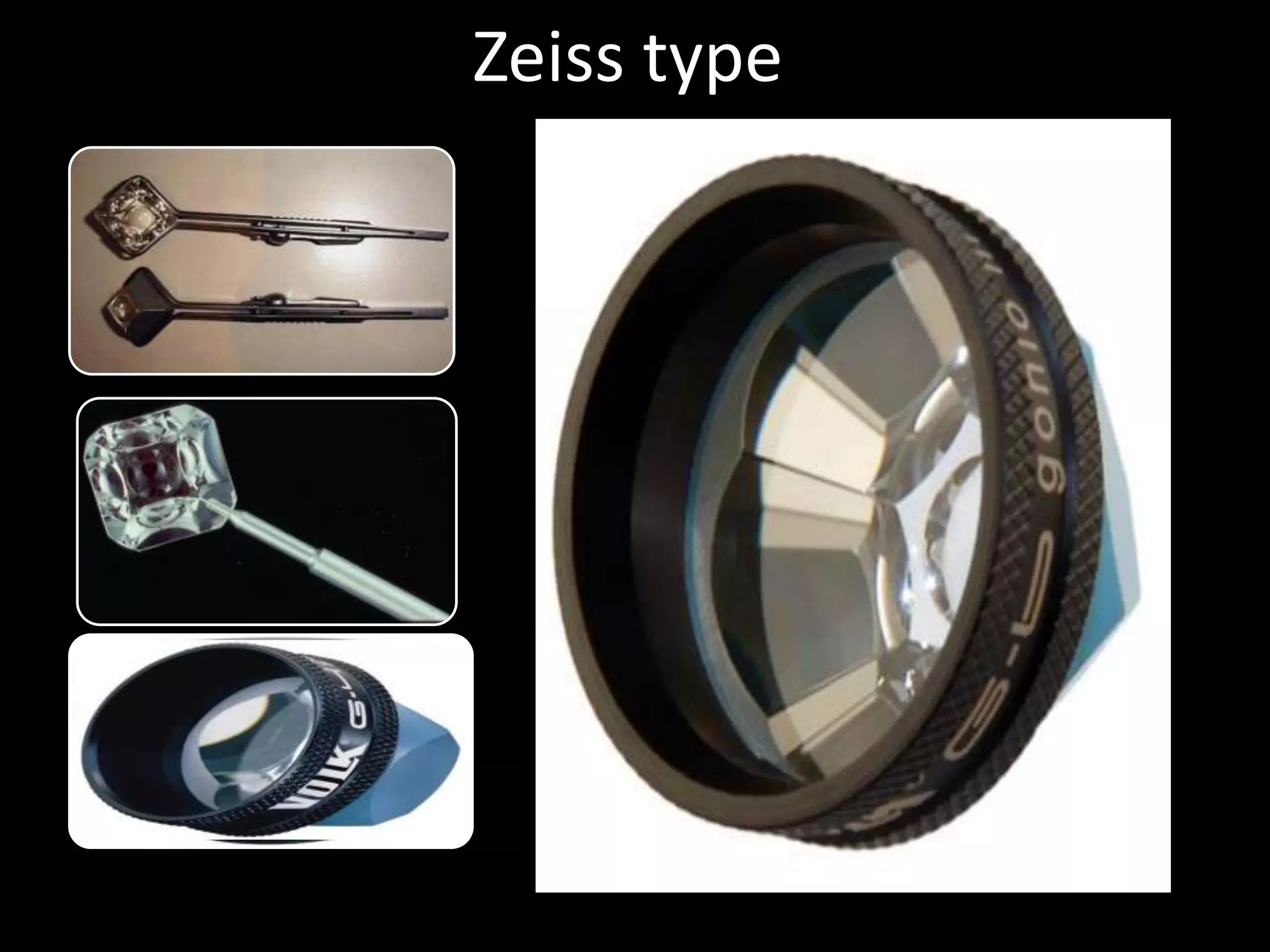
Zeiss type
      Zeiss four mirror
      • Mirror:64
      • Require unger/holder


      Posner four mirror
      • Modified zeiss with
        attached handle


       Sussman four mirror
       • Handheld zeiss type
         gonioprism
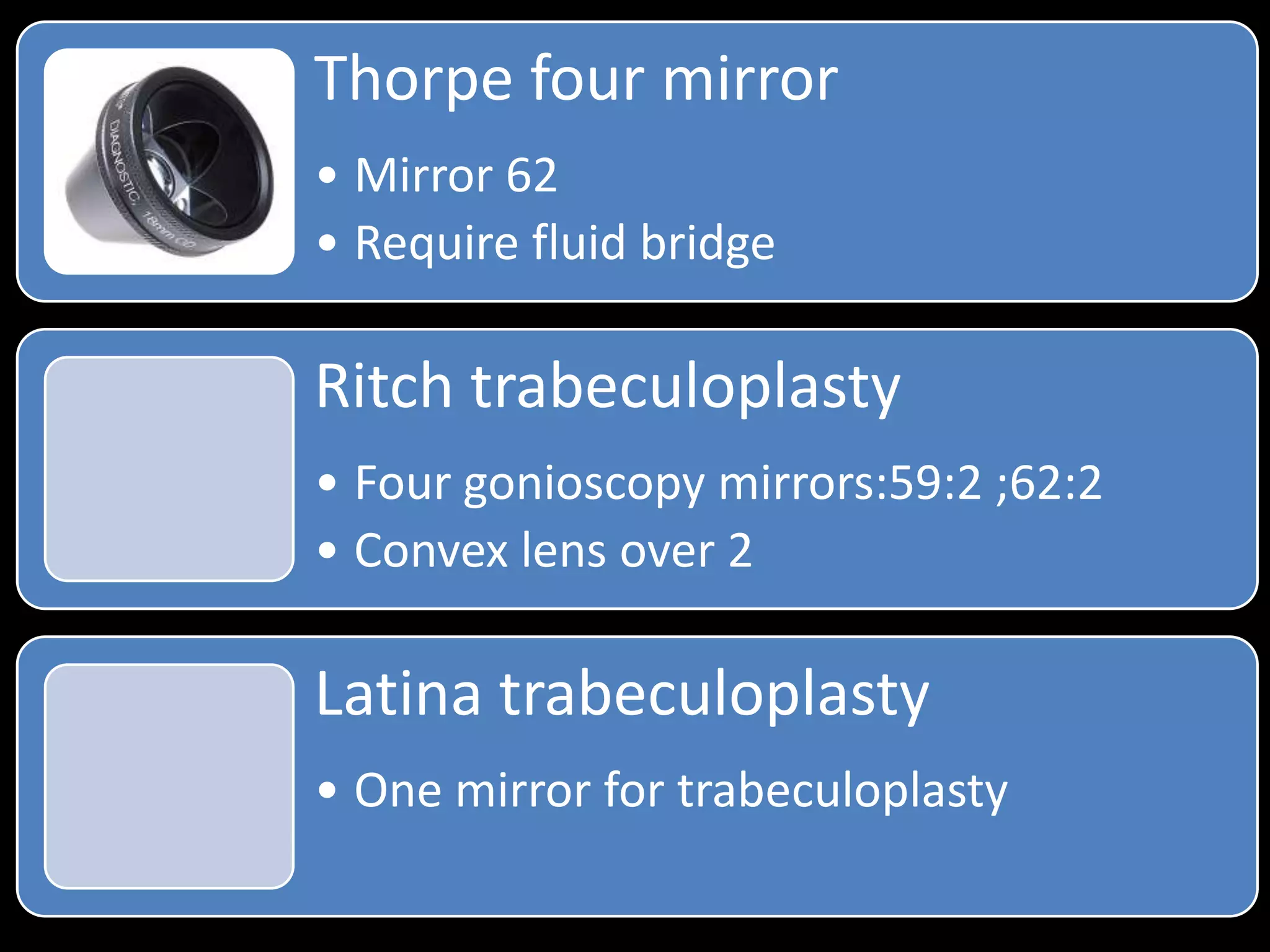
Thorpe four mirror
• Mirror 62
• Require fluid bridge

Ritch trabeculoplasty
• Four gonioscopy mirrors:59:2 ;62:2
• Convex lens over 2

Latina trabeculoplasty
• One mirror for trabeculoplasty
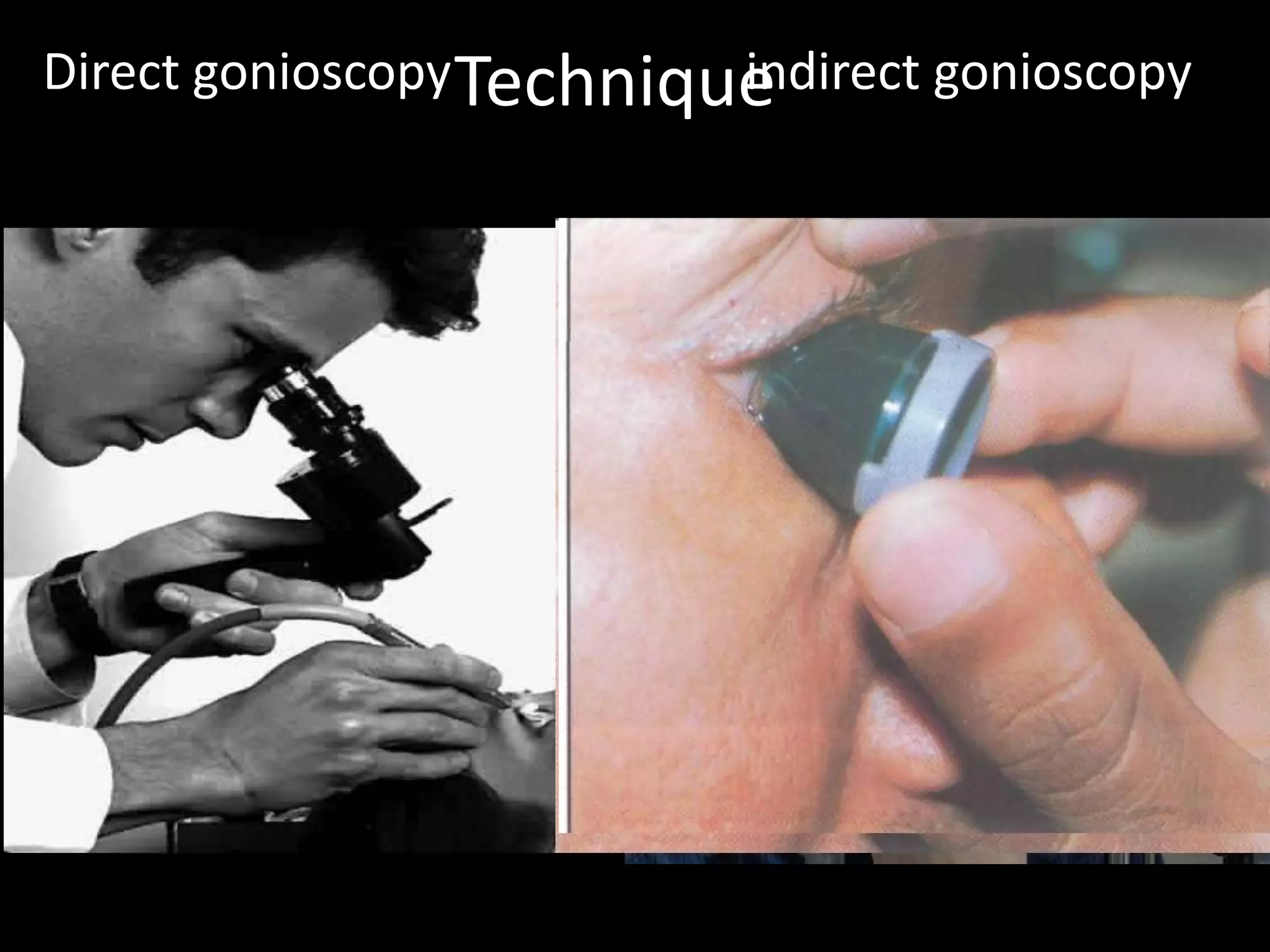
Direct gonioscopy Technique
                          indirect gonioscopy
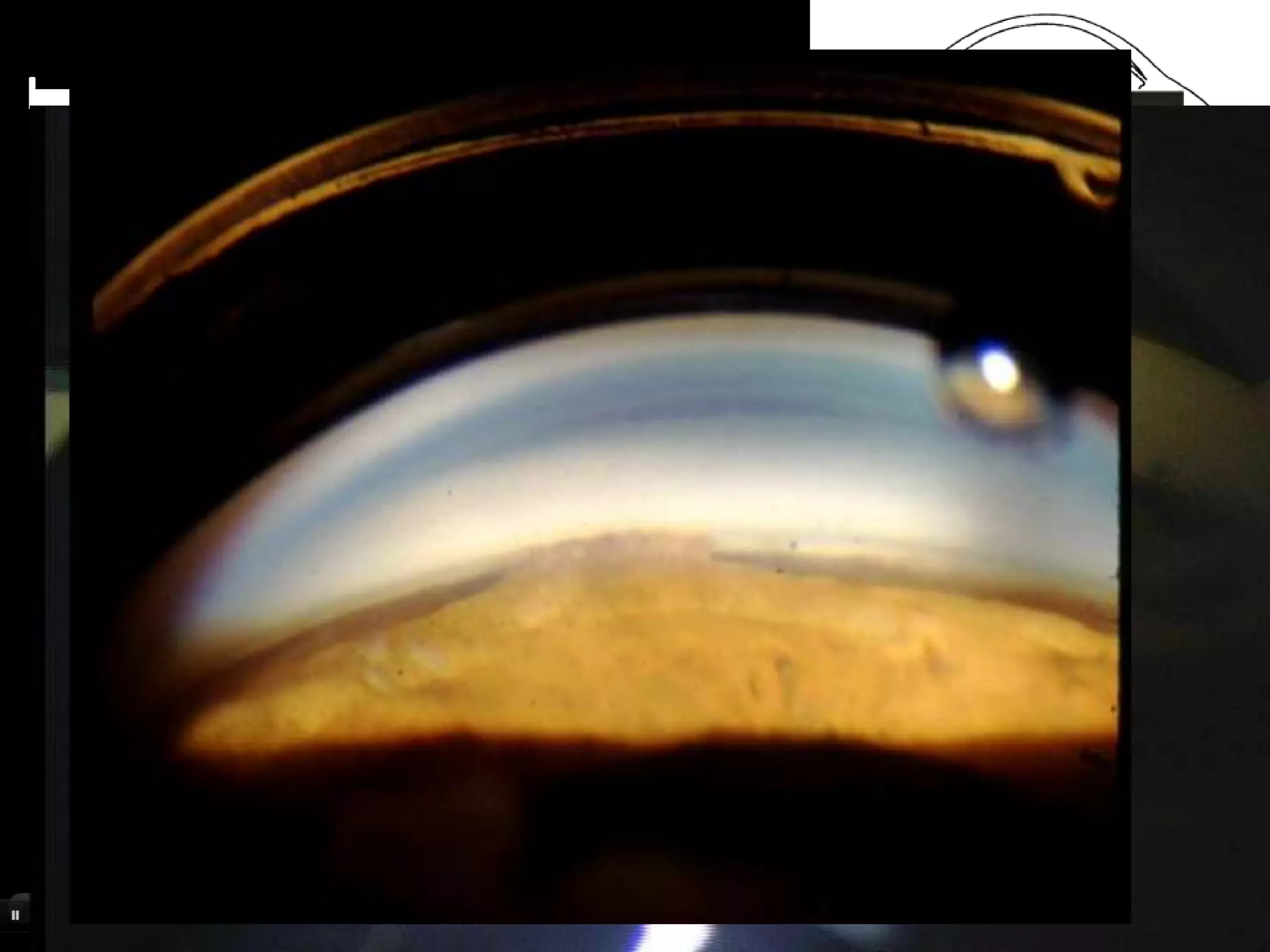
Indentation gonioscopy
 • By changing amount of
   pressure on cornea one
   can observe effect on
   angle width.
 • Appositional vs PAS .
 • Platue iris syndrom
 • Phacomorphic glaucoma
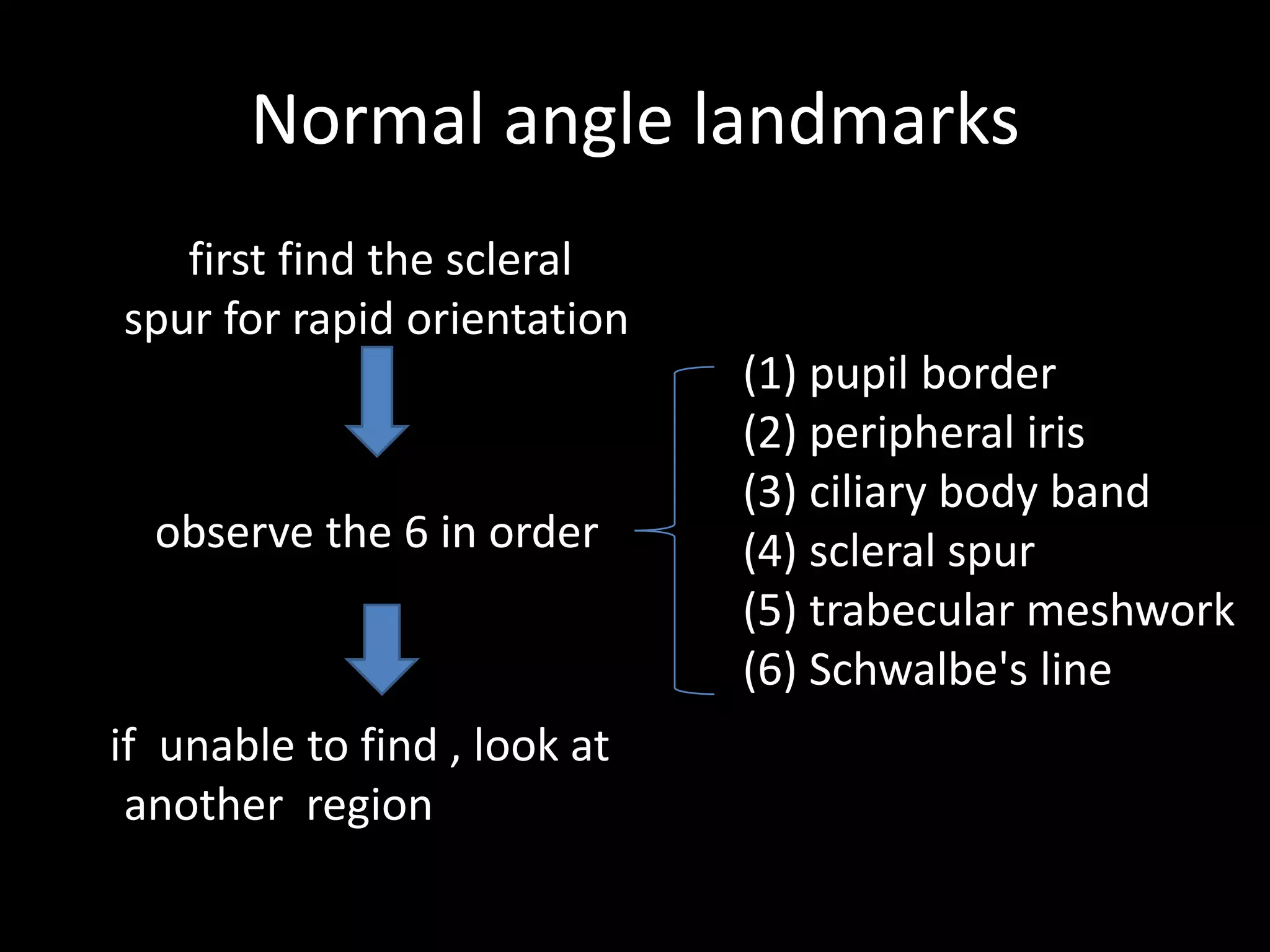
Normal angle landmarks
   first find the scleral
spur for rapid orientation
                              (1) pupil border
                              (2) peripheral iris
                              (3) ciliary body band
  observe the 6 in order      (4) scleral spur
                              (5) trabecular meshwork
                              (6) Schwalbe's line
if unable to find , look at
 another region
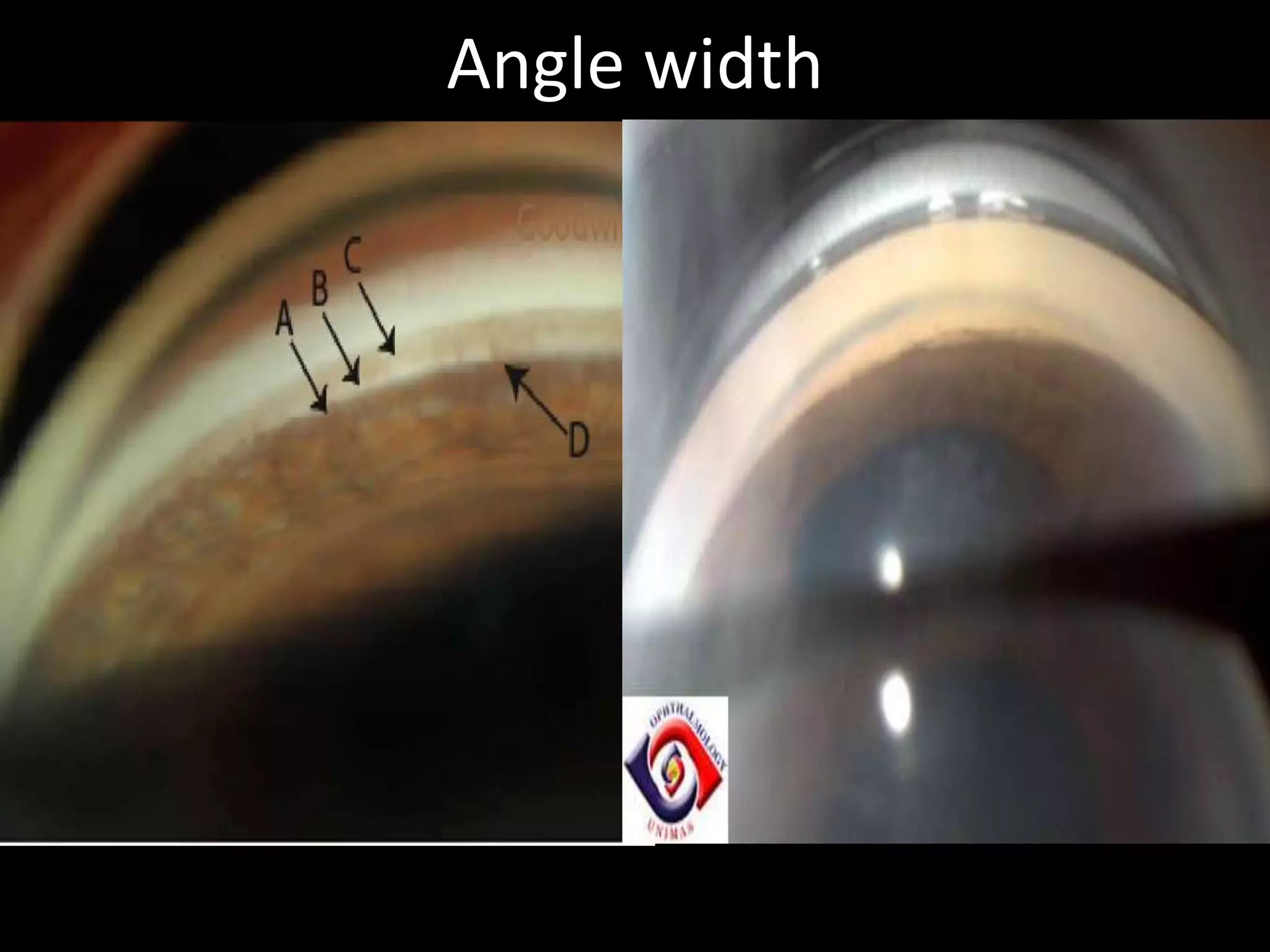
Angle width
• Estimated by examining the distance between
  schwalbe’s line and nearest part of iris .
• If angle between iris and TM is 20 to 45 deg :wide ,
                                      <20 deg       :narrow
• Angle :wide/open/narrow/closed :
  irregular narrowing : subacute angle closure glaucoma
                           dislocation of lens,cycts,
                         posterior adhesions plus pupillary block
  Irregular widening :traumatic recession ,
                      dislocation of lens,cyclodialysis
Pupil &iris
• looking at pupillary border also helpfull for
  orientation .
• Dandruff like flekens at pupillary margin :t/o PXF .
• Glaucoma flekens ,post synechiae can be seen in ante surface of lens.

                      contour

   iris               Site of insertion

                     Angulation b/w iris &cornea

  Neovascularization , hypoplasia , atrophy , polycoria .
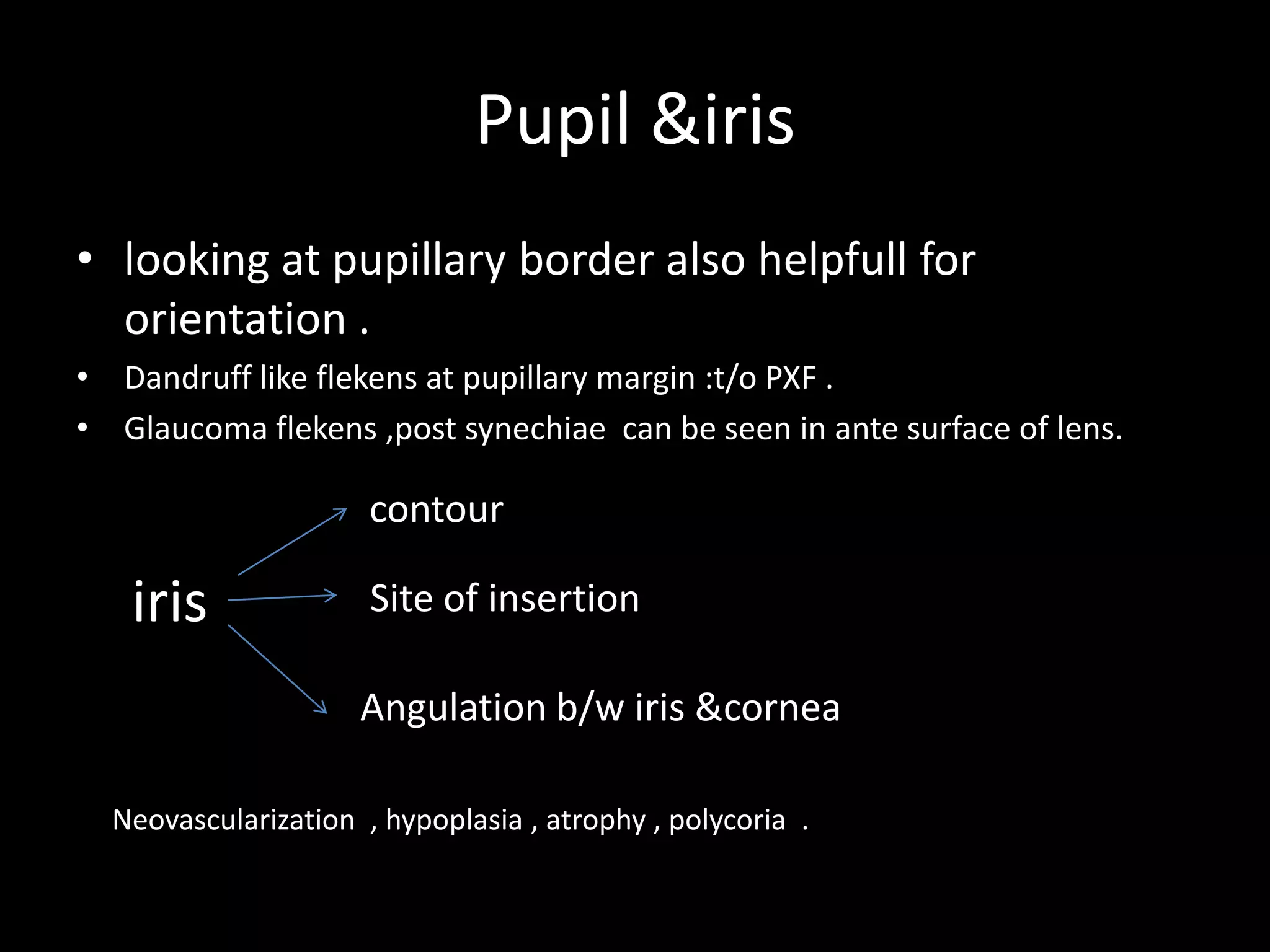
•   Slight convexity : normal ,physiological .
•   Excessive convexity:hyperopia , ACG .

•   Platue iris: ACG .

•   Flat iris : pigmentary glaucoma,
                myopia ,aphakia .

•   Concave iris :PDS, cyclitic membrane ,
                 PAS in aphakia .

•   Irregularity of contour : dislocation of lens
                             cyst or tumor
•   Segmental atrophy of iris : previous acute glaucoma ,
                                herpes zoster

•   Pigment spickling : EXF , pigmentary glaucoma,
                       malignant glaucoma,tum&cysts.

•   Pigment abnormalities: nevus ,heterocromatic cyclitis
                          glaucoma cyclitic crises
                          hemangioma ,neurofibroma ,siderosis.
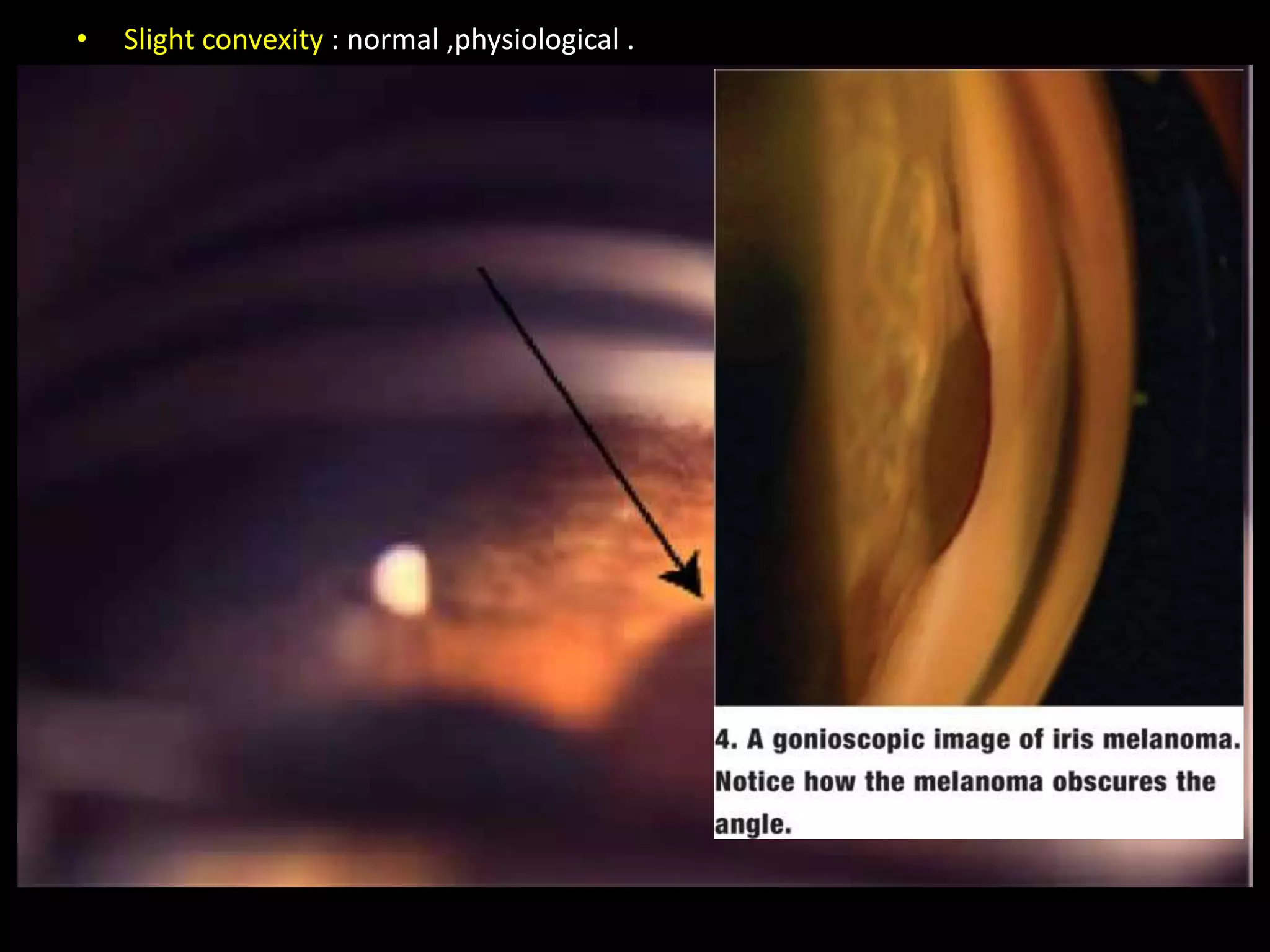
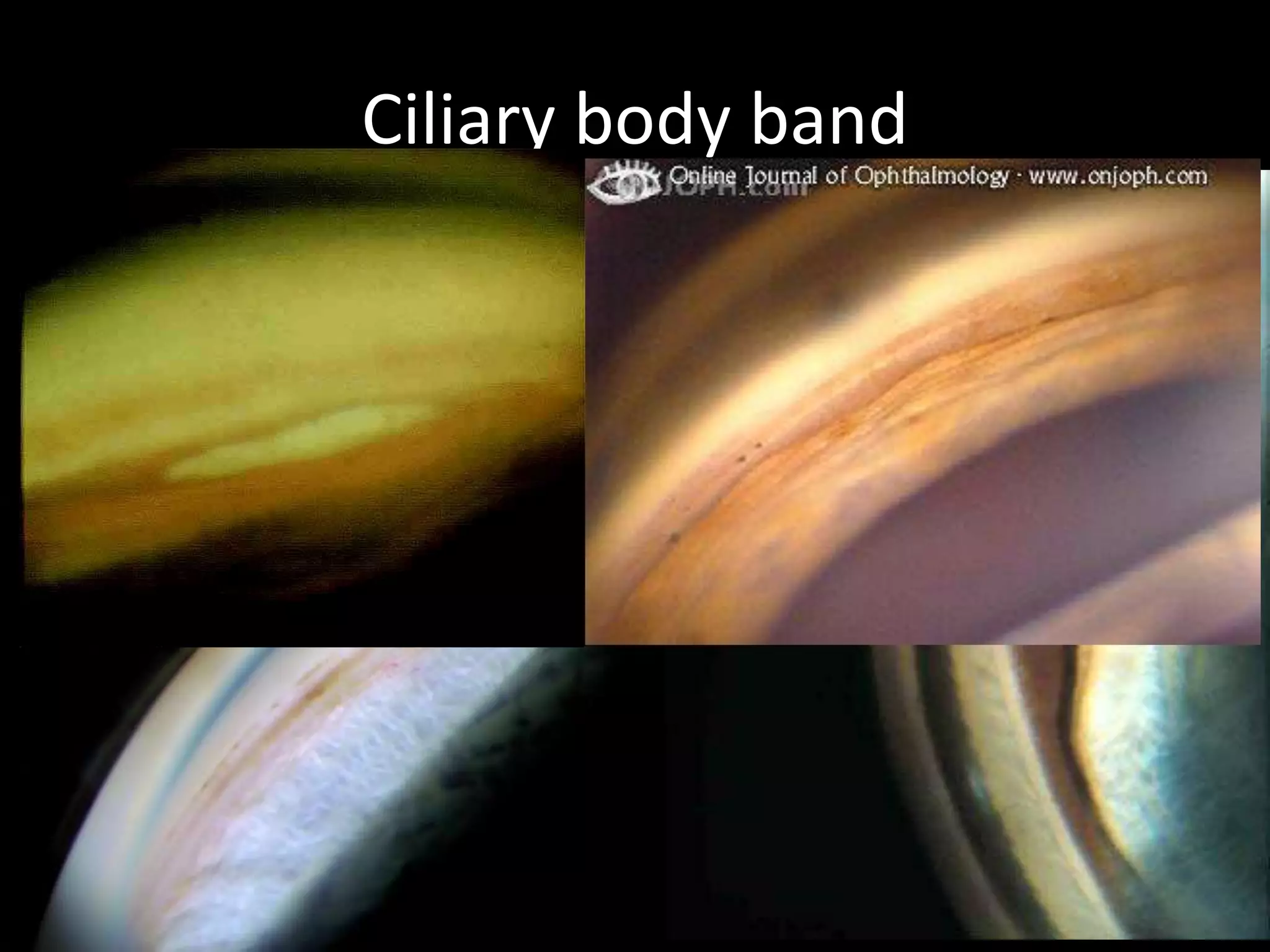
Ciliary body band
    Very light gray --------------------   N in white race
C
O
    Darker gray,traces of brown --         N in dark races
L   Darker, slate gray ----------------    melanoma.
O   Whitish, cobwebby -------------        tear into muscle
U
R
    Scleral white
    cleft behind the S spur----------      cyclodailysis


W   Narrower --------------hyperopics , PAS ,
I
D
    Unusually narrow--- congenital glaucoma
T   Wider -------------------myopics, tear into CB
H                            cyclodialysis
Scleral spur
• Grey white line of varying width,this white colour makes it
  most helpful landmark for rapid orientation .

   Spur all visible ------------------------open angle
   Spur hidden---------------------------uveal meshwork
                                             excessively narrow angle
                                            closed angle
                                            synechias
   Unusually prominent and white--torn uvealmeshwork,
                                            ciliary muscle torn,
                                            cyclodialysis
Uveal meshwork
• Proper identification avoid confusion with PAS and IP .

       Homogenous,                      Network of
       transperant                      gray/brown strands
       ,glittering                      of variable amount
       ,unpigmented


 •IP:long slender isolated strands that stands out away
 from uveal meshwork

 •Greater amount nasally .
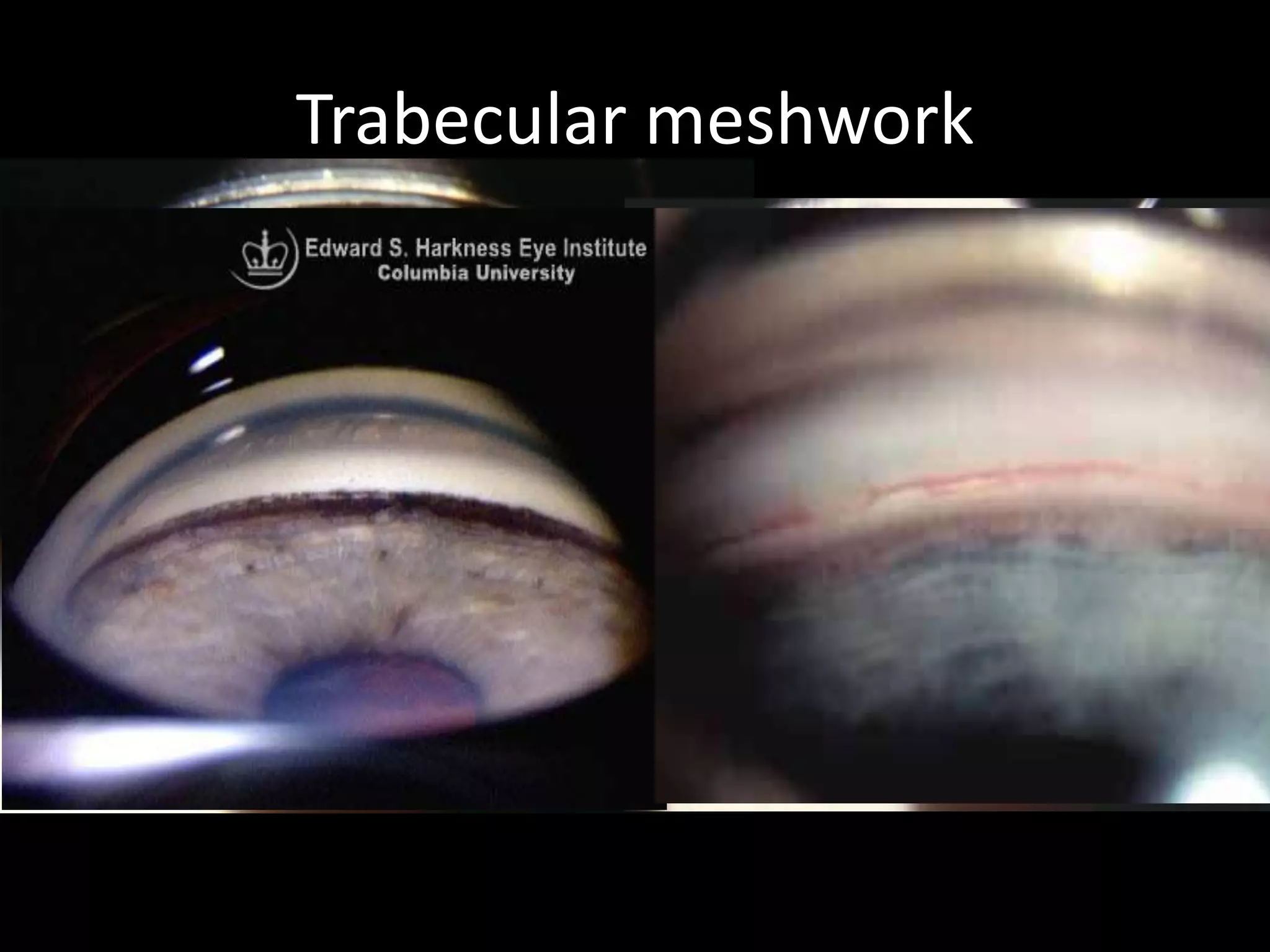
Trabecular meshwork
• Normal variable :covered by uveal meshwork
                      blood in schlemn canal
• Charecteristic : filteration area finely granular
  translucent with or without pigment.
• Abnormalities: execessive pigmentation
                       inflammatory exudates
                       blood vessels
                       synechias
                       loss of normal textures
                       traumatic rupture
Congenital abnormalities : posterior embryotoxon (reiger)
                           iridocorneal malformations
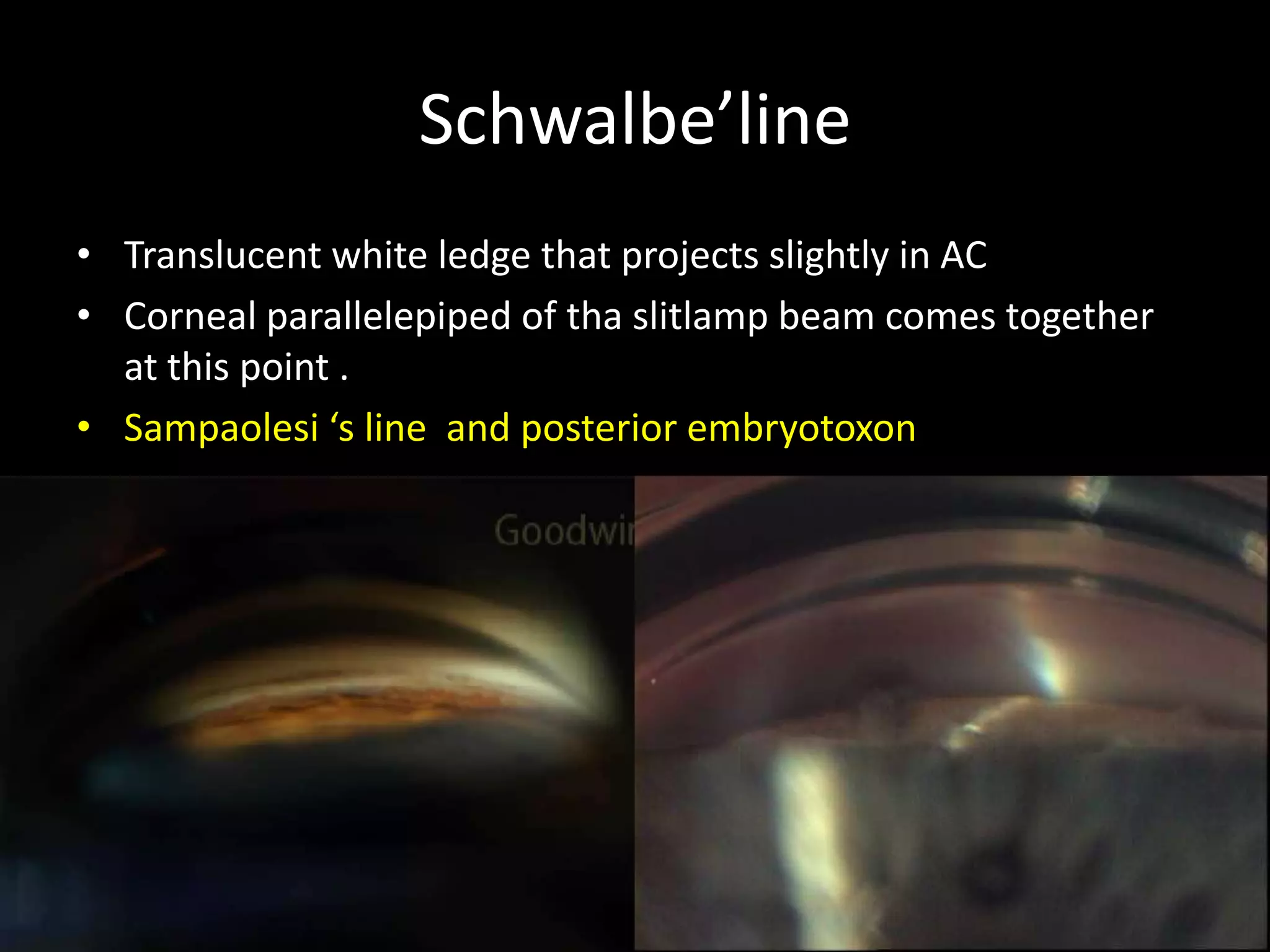
Schwalbe’line
• Translucent white ledge that projects slightly in AC
• Corneal parallelepiped of tha slitlamp beam comes together
  at this point .
• Sampaolesi ‘s line and posterior embryotoxon
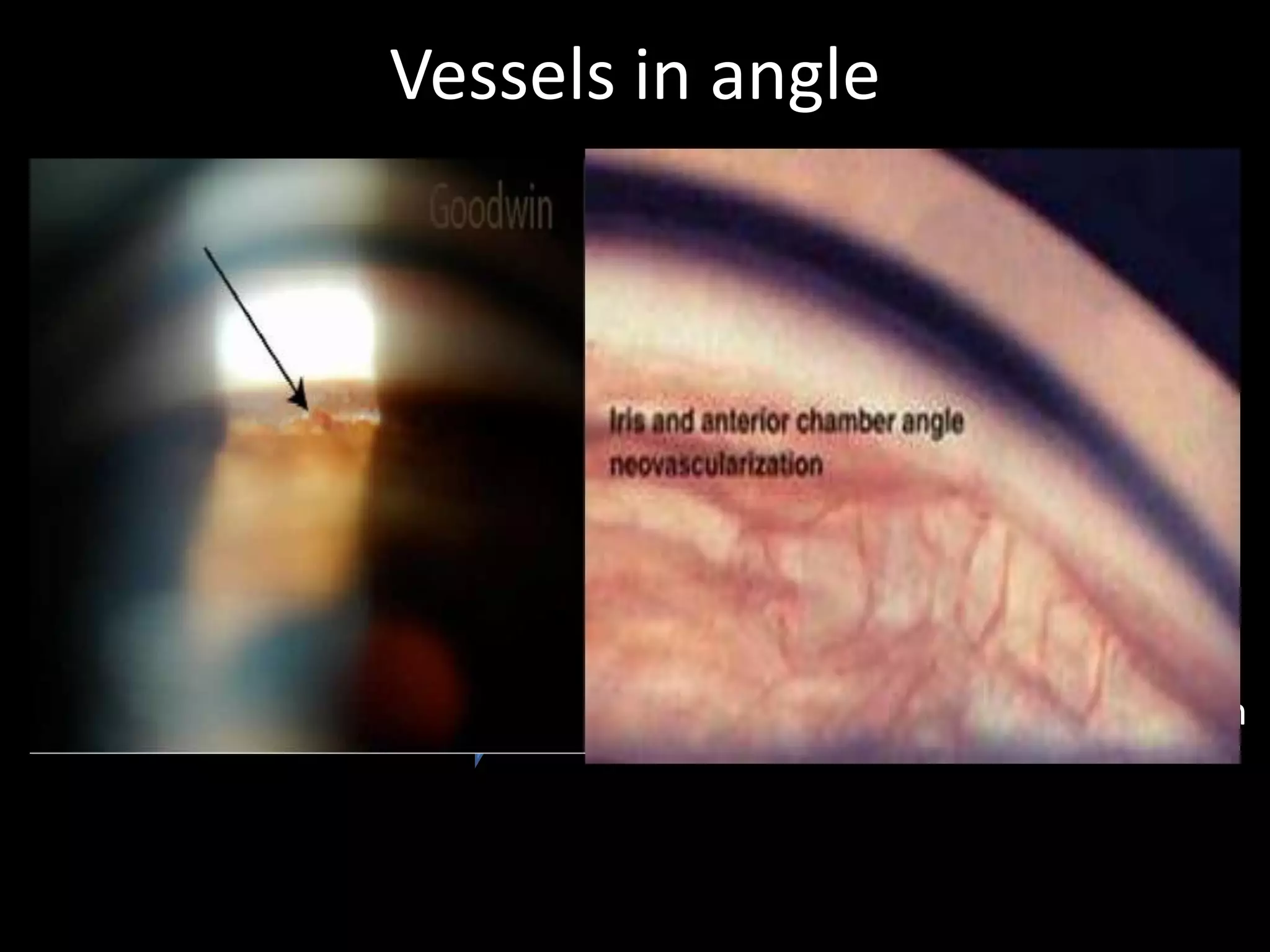
Vessels in angle
                       Radial vessels in iris
   Normal              Sea serpent type circumferrential vessel on CB
                       Short and strait vessels seen on CB

                           Erratic course,branch and arborised on
Abnormal vessels           to angle wall ,stands out as solid cords
                           , may pull the iris to TM


   Congenitally
                            Congenital glaucoma,axenfield’s syndrom
   abnormal vessels
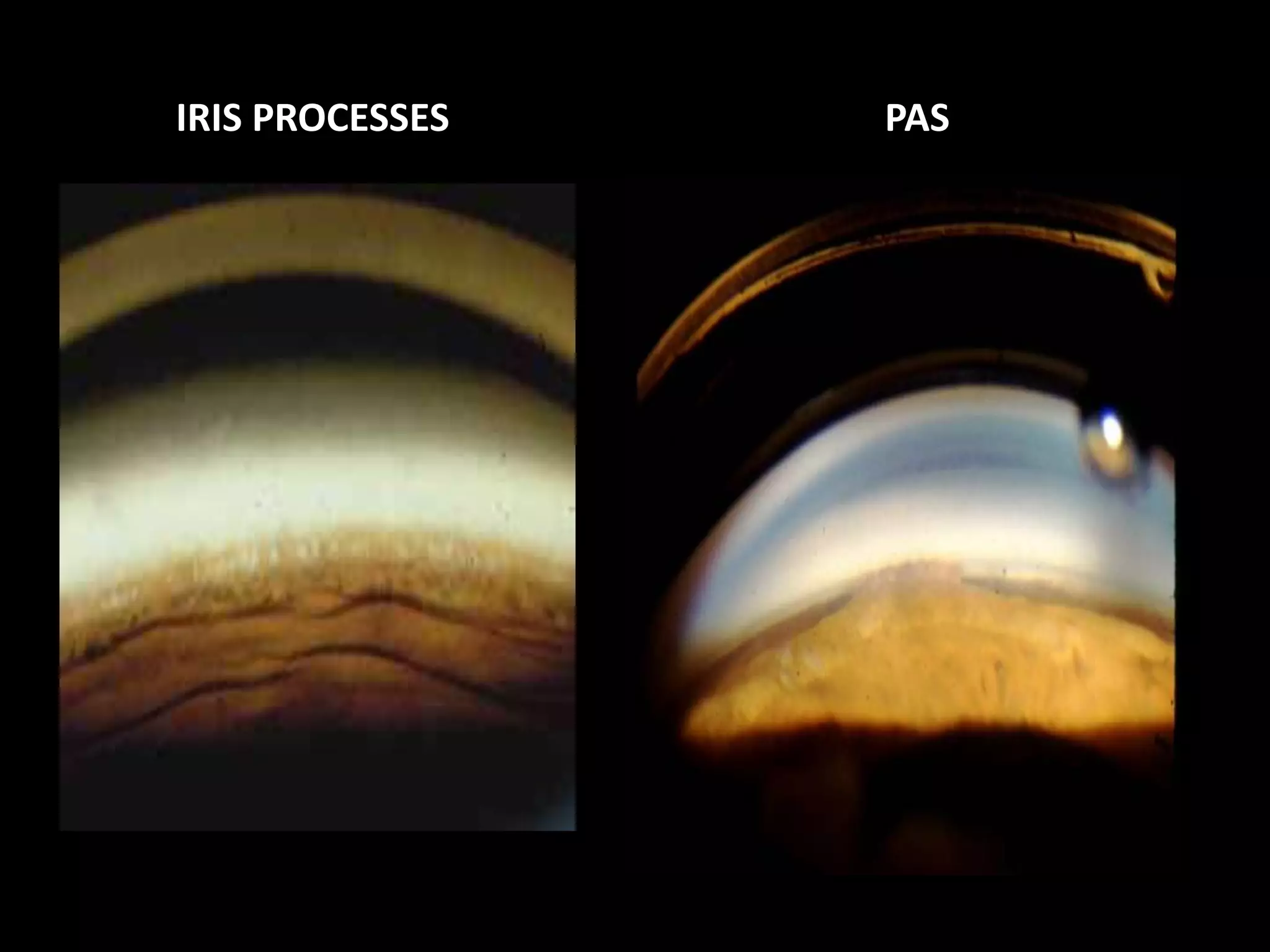
IRIS PROCESSES                          PAS

• Thread like fibers of uveal   • Adherence of iris to angle
  tissue                          structures
• Thin Network of strands,      • Solid and broad
  porus
• Structures behind seen        • Structures behind unseen
• Height : usually SS           • Height : varies
• Peripheral iris tissue wrap   • Peripheral iris tissue butts
  around angle recess             flat against TM
• Blood vessel -ve              • Blood vessel +/_
• Pigmentation - /+ ve          • Pigmentation +
•Should be differentiated from uveal meshwork
                                 •More on inferiorly and nasally.
                                 •Dens band whole circumference:EXF
                                                                    PDS,
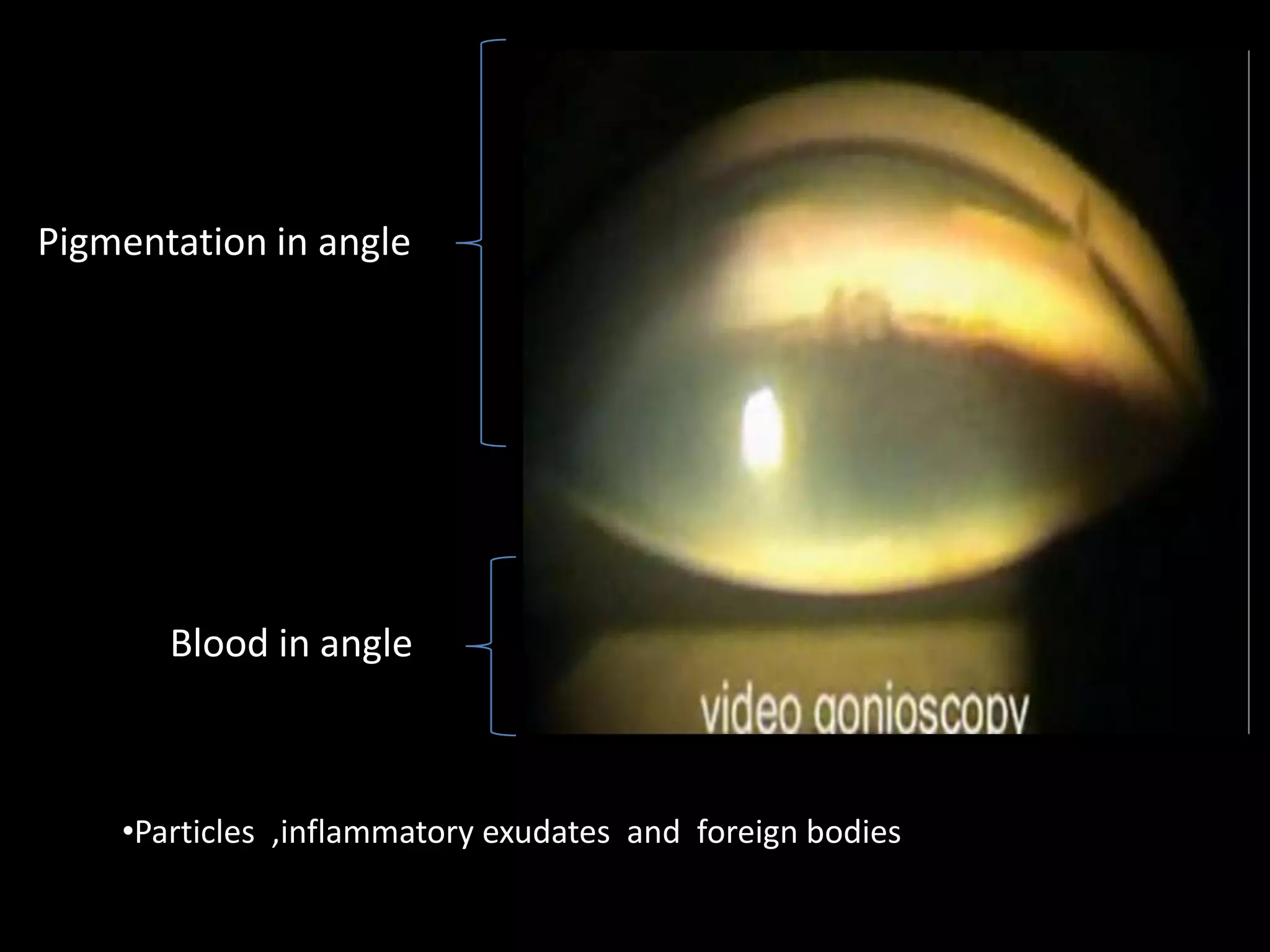
Pigmentation in angle                                               pig.glaucoma
                                 •Scattered ,lower parts:previous
                                                          SX,inflammation,
                                                          hyphema
                                 •Black fine ,coarse balls:old blood


                                 Fresh blood :bright red ,
       Blood in angle            old blood : black particals and balls
                                 Organised clot :synechial filling of angle


    •Particles ,inflammatory exudates and foreign bodies
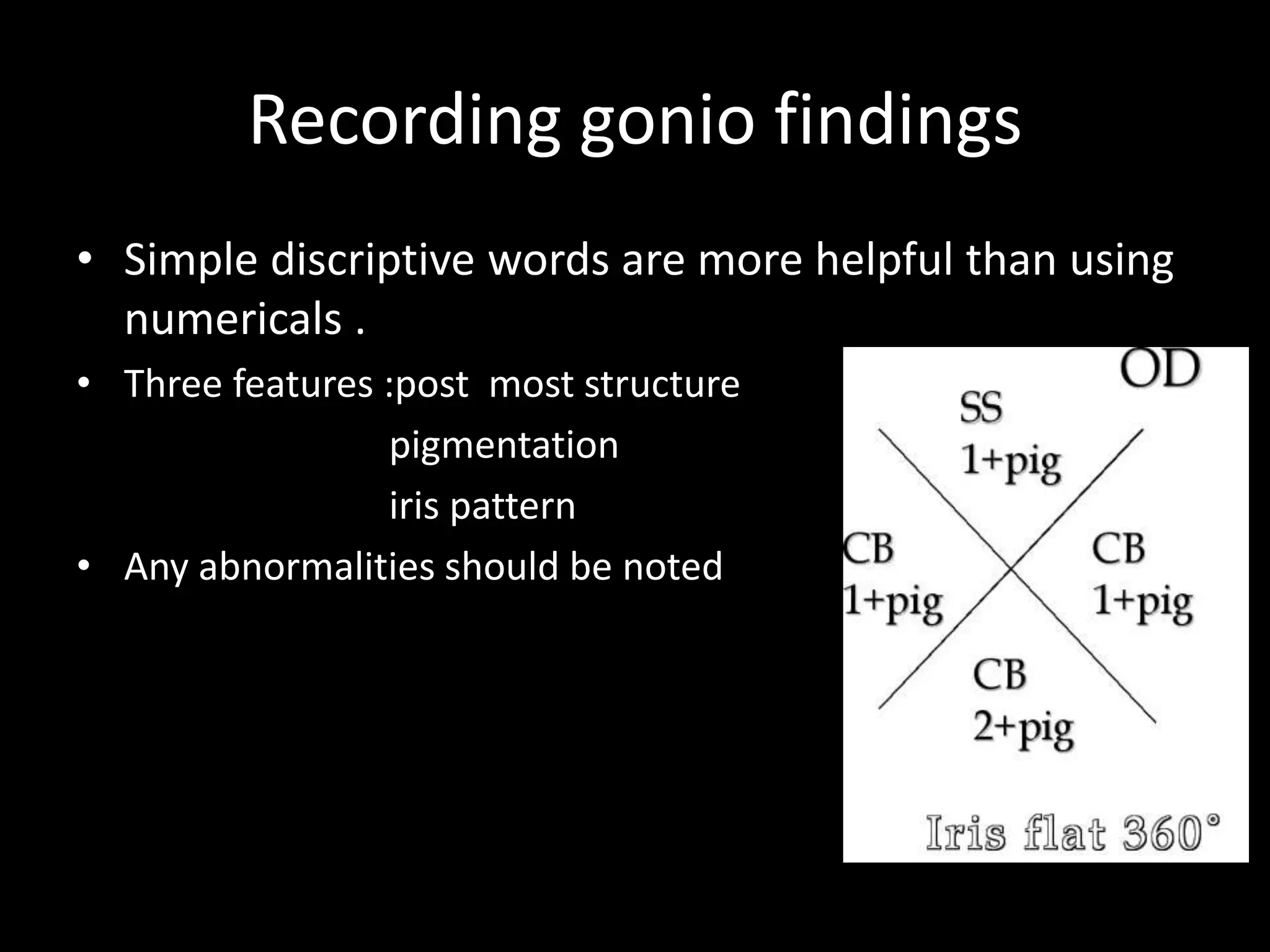
Recording gonio findings
• Simple discriptive words are more helpful than using
  numericals .
• Three features :post most structure
                 pigmentation
                 iris pattern
• Any abnormalities should be noted
Grading of chamber angle
Scheie grading         shaffer system spaeth system

• Scheie system: most posterior structure visible.

• Shaffer’s system : assess geometric angle width in 4 grades .
                      angle potential for occlusion.
• Spaeth system : three dimentional structure of angle -
   -level of iris insertion and peripheral iris configuration.
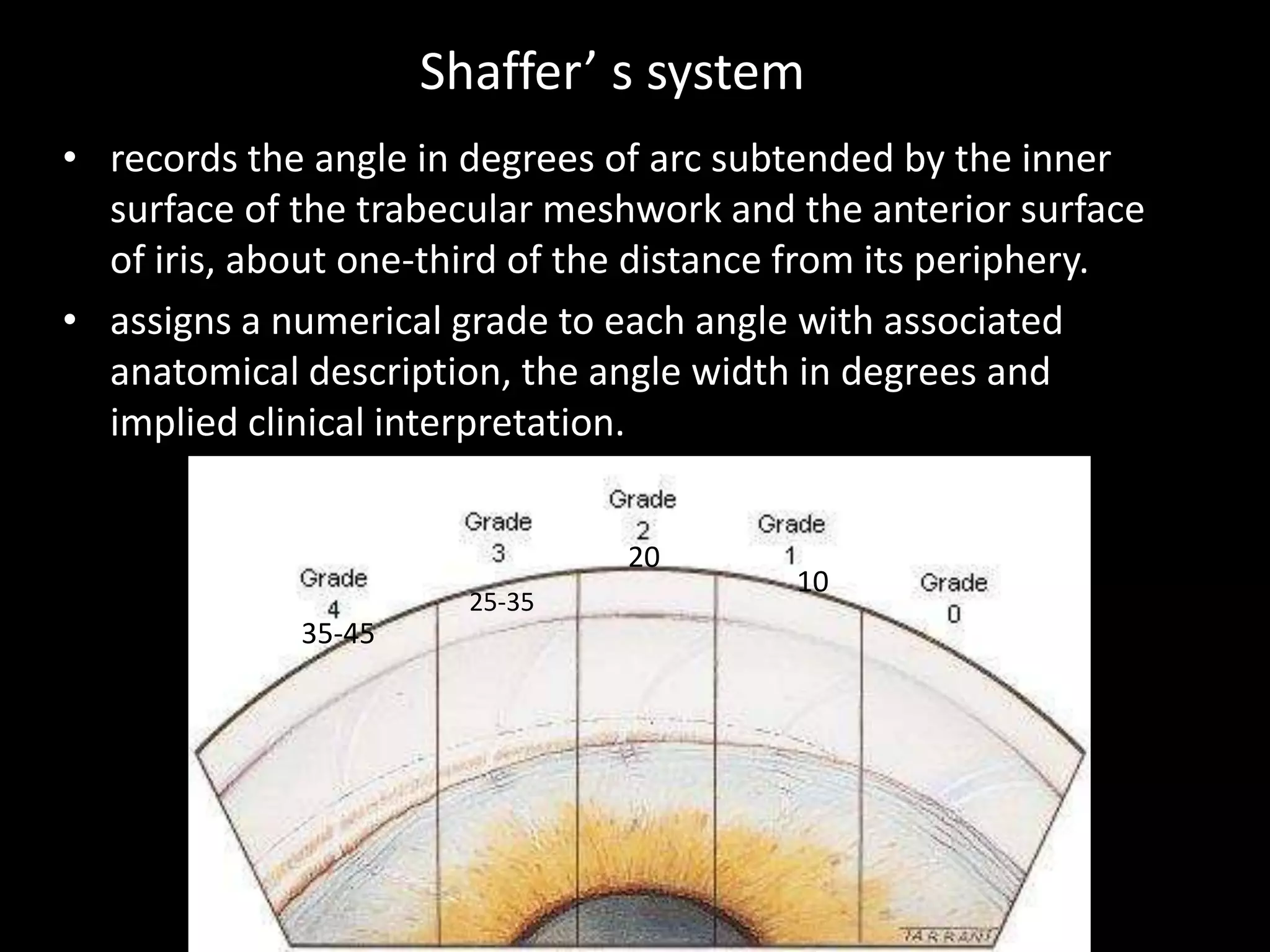
Shaffer’ s system
• records the angle in degrees of arc subtended by the inner
  surface of the trabecular meshwork and the anterior surface
  of iris, about one-third of the distance from its periphery.
• assigns a numerical grade to each angle with associated
  anatomical description, the angle width in degrees and
  implied clinical interpretation.


                                20
                                          10
                       25-35
             35-45
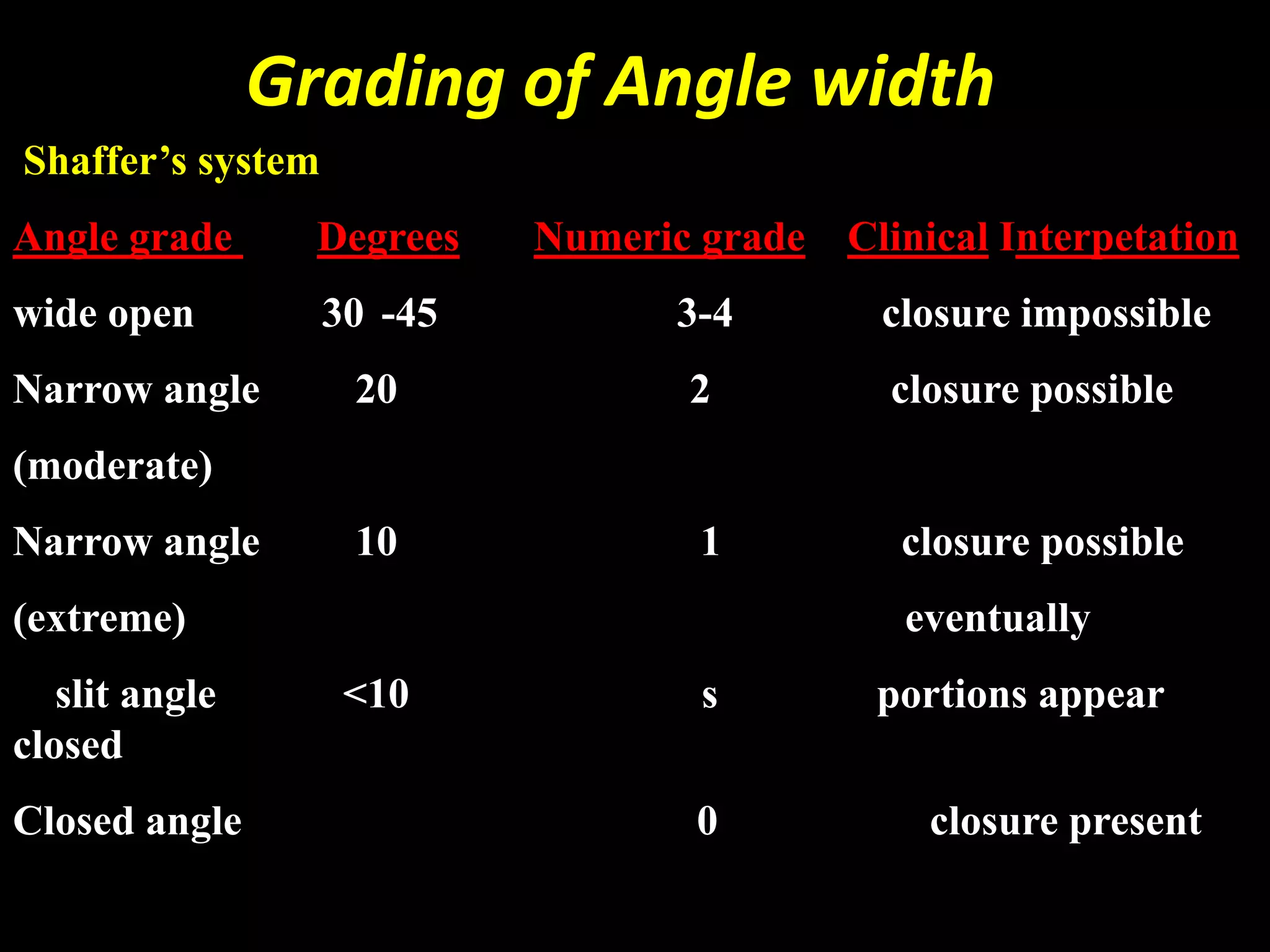
Grading of Angle width
Shaffer’s system
Angle grade       Degrees   Numeric grade Clinical Interpetation
wide open          30 -45          3-4       closure impossible
Narrow angle        20             2          closure possible
(moderate)
Narrow angle        10              1         closure possible
(extreme)                                     eventually
   slit angle       <10             s        portions appear
closed
Closed angle                        0           closure present
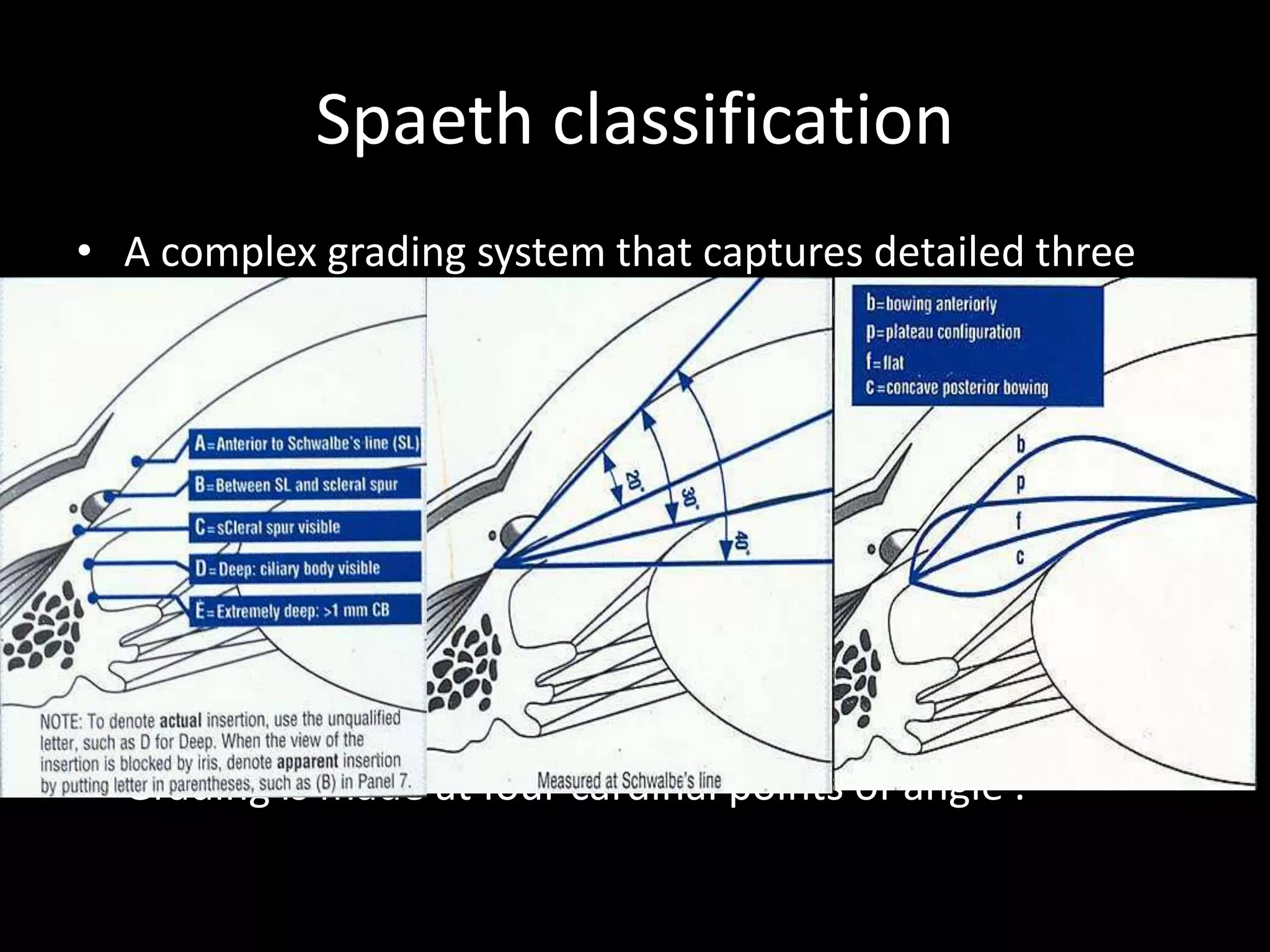
Spaeth classification
• A complex grading system that captures detailed three
  dimensional information in coded form .
• High correlation with UBM and biometric gonioscopy.
• Interobserver variability - minimal .
• Addresses : 1.site of iris insertion .
              2.angle width.
              3.config of peripheral iris.
              4.trabecular meshwork pigmentation.
              5.presence/absence of abnormalities.
• Grading is made at four cardinal points of angle .
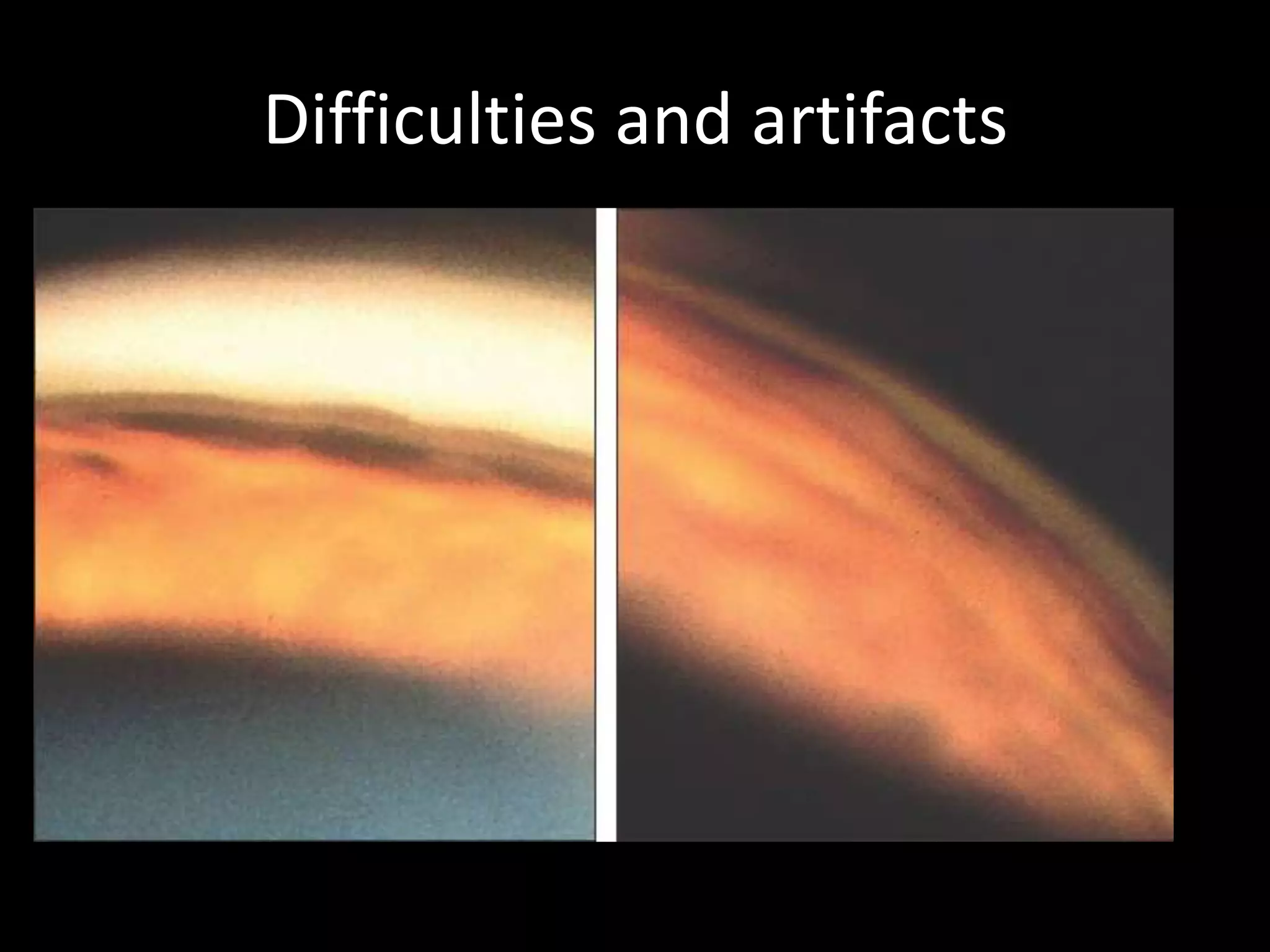
Difficulties and artifacts
• Koeppe lens --- narrow the angle
• Zeiss lens ----- widen the angle by indentation
• Ideal pressure of gonioscopy.
• Dimlight provacaton test:
• Coreal edema : lower IOP ,
                  oral/topicalhyperosmotics
                   epithelial debridment
• Cornea guttata : pebbled ,shagreen appearance
                    against white sclera,,
                    easier with gonio than slitlamp
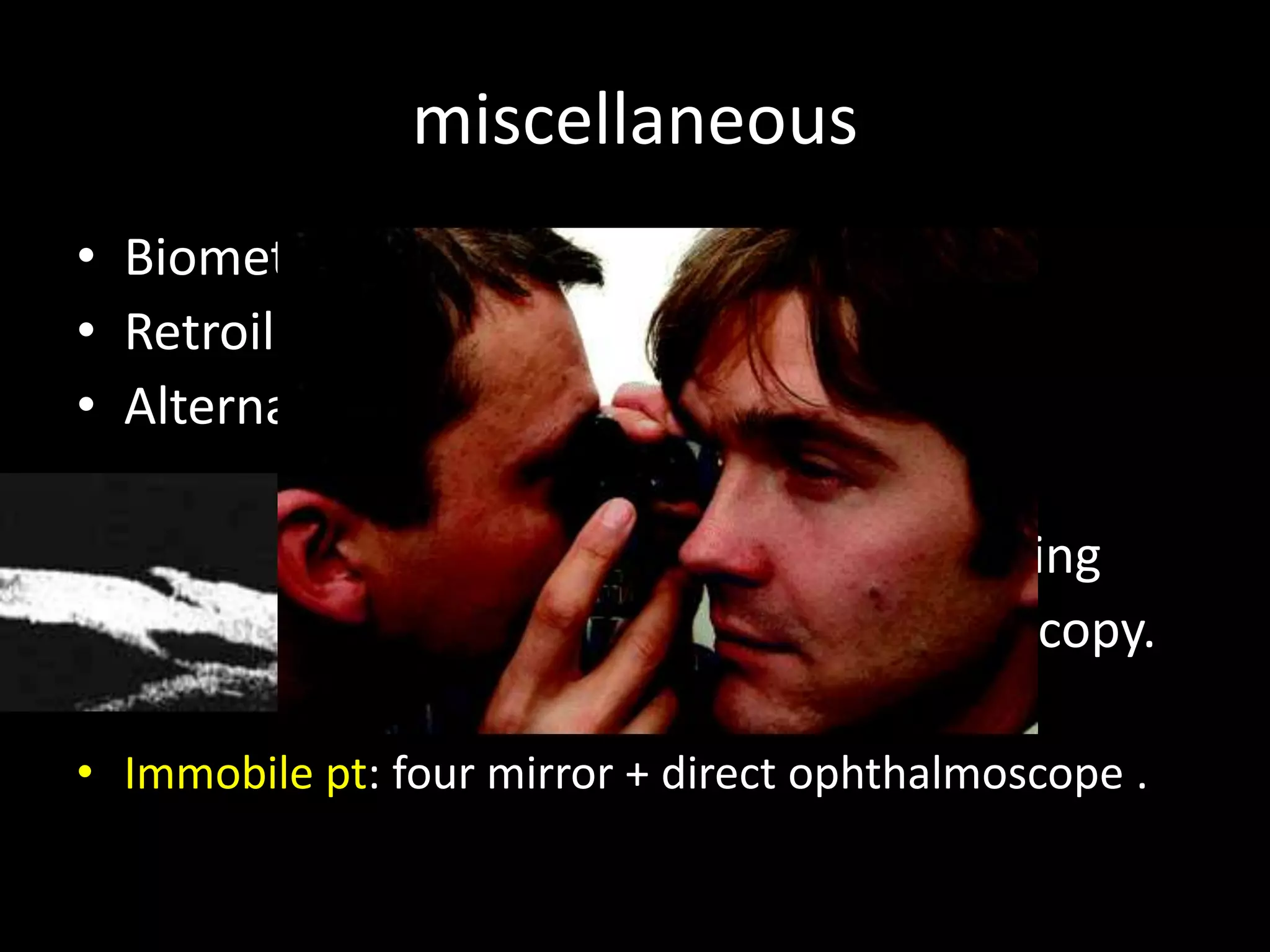
miscellaneous
• Biometric gonioscopy
• Retroillumination:
• Alternatives for angle assessment :
                         UBM
                         Scheimpflug imaging
                         ophthalmic endoscopy.

• Immobile pt: four mirror + direct ophthalmoscope .
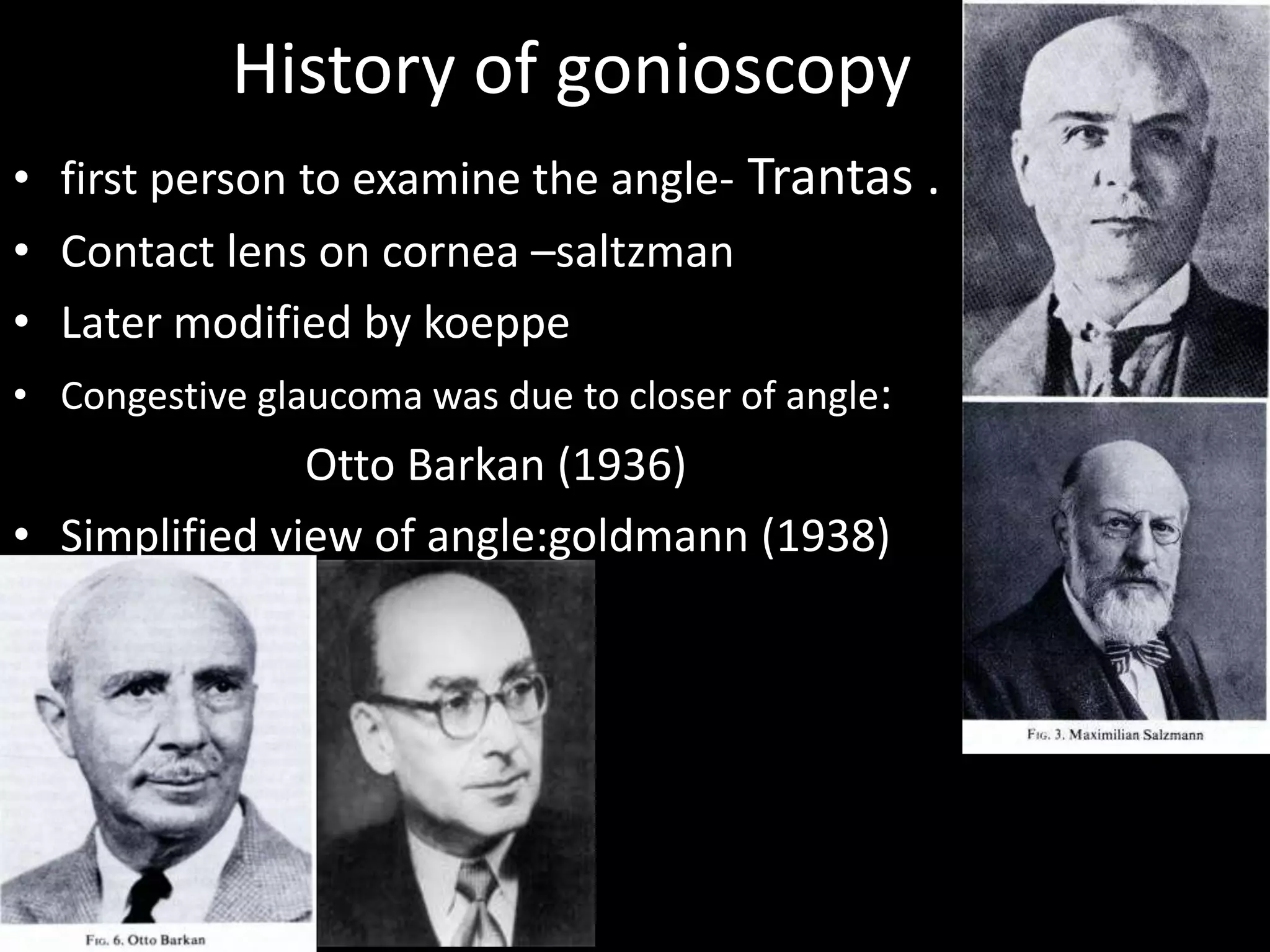
History of gonioscopy
• first person to examine the angle- Trantas .
• Contact lens on cornea –saltzman
• Later modified by koeppe
• Congestive glaucoma was due to closer of angle:
                Otto Barkan (1936)
• Simplified view of angle:goldmann (1938)
summary
• Essential tool in management of glaucoma.
• Routein gonioscopy can prevent cosiderable
  number of glaucoma associated blindness.
• Advent of handy goniolens
• know normal, variations in normal to find
  abnormals in angle easily.
THANQ

Gonioscopy

  • 1.
    Gonioscopy Dr.N.suneel ,MS 1st year Dept of ophthalmology
  • 2.
    Introduction • Definition: • Whygonioscopy is underutilized? • How frequently we should do gonioscopy? • Indications: • Contraindications:
  • 3.
    ANATOMY OF ANGLEOF ANTERIOR CHAMBER • Structures from posterior to anterior anterior surface of iris ciliary band scleral spur trabecular meshwork schwalbe’s line posterior surface of cornea
  • 4.
    principle • Critical angle . • Total internal reflection . • Eliminates corneal-air interface • Direct and indirect gonioscopy
  • 5.
    Direct gonioscopy Koeppe lens Barkan lens • Prototype diagnostic • Prototype surgical lens lens Richard son - shaffer Thorpe lens • Small koeppe lens • Surgical and diagnostic lens • For use in children • For operating room Layden Swan – jacob lens • For premature infants . • Surgical goniolens for use in Worst gonio lens children.
  • 6.
    Indirect gonioscopy Goldmann Goldmann Modified single mirror three mirror goldmann Mirror :62 1 for angle No viscous bridge, Antereflection 2 for fundus coating for laser trab
  • 7.
    Zeiss type Zeiss four mirror • Mirror:64 • Require unger/holder Posner four mirror • Modified zeiss with attached handle Sussman four mirror • Handheld zeiss type gonioprism
  • 8.
    Thorpe four mirror •Mirror 62 • Require fluid bridge Ritch trabeculoplasty • Four gonioscopy mirrors:59:2 ;62:2 • Convex lens over 2 Latina trabeculoplasty • One mirror for trabeculoplasty
  • 10.
    Direct gonioscopy Technique indirect gonioscopy
  • 11.
    Indentation gonioscopy •By changing amount of pressure on cornea one can observe effect on angle width. • Appositional vs PAS . • Platue iris syndrom • Phacomorphic glaucoma
  • 12.
    Normal angle landmarks first find the scleral spur for rapid orientation (1) pupil border (2) peripheral iris (3) ciliary body band observe the 6 in order (4) scleral spur (5) trabecular meshwork (6) Schwalbe's line if unable to find , look at another region
  • 13.
    Angle width • Estimatedby examining the distance between schwalbe’s line and nearest part of iris . • If angle between iris and TM is 20 to 45 deg :wide , <20 deg :narrow • Angle :wide/open/narrow/closed : irregular narrowing : subacute angle closure glaucoma dislocation of lens,cycts, posterior adhesions plus pupillary block Irregular widening :traumatic recession , dislocation of lens,cyclodialysis
  • 14.
    Pupil &iris • lookingat pupillary border also helpfull for orientation . • Dandruff like flekens at pupillary margin :t/o PXF . • Glaucoma flekens ,post synechiae can be seen in ante surface of lens. contour iris Site of insertion Angulation b/w iris &cornea Neovascularization , hypoplasia , atrophy , polycoria .
  • 15.
    Slight convexity : normal ,physiological . • Excessive convexity:hyperopia , ACG . • Platue iris: ACG . • Flat iris : pigmentary glaucoma, myopia ,aphakia . • Concave iris :PDS, cyclitic membrane , PAS in aphakia . • Irregularity of contour : dislocation of lens cyst or tumor • Segmental atrophy of iris : previous acute glaucoma , herpes zoster • Pigment spickling : EXF , pigmentary glaucoma, malignant glaucoma,tum&cysts. • Pigment abnormalities: nevus ,heterocromatic cyclitis glaucoma cyclitic crises hemangioma ,neurofibroma ,siderosis.
  • 16.
    Ciliary body band Very light gray -------------------- N in white race C O Darker gray,traces of brown -- N in dark races L Darker, slate gray ---------------- melanoma. O Whitish, cobwebby ------------- tear into muscle U R Scleral white cleft behind the S spur---------- cyclodailysis W Narrower --------------hyperopics , PAS , I D Unusually narrow--- congenital glaucoma T Wider -------------------myopics, tear into CB H cyclodialysis
  • 17.
    Scleral spur • Greywhite line of varying width,this white colour makes it most helpful landmark for rapid orientation . Spur all visible ------------------------open angle Spur hidden---------------------------uveal meshwork excessively narrow angle closed angle synechias Unusually prominent and white--torn uvealmeshwork, ciliary muscle torn, cyclodialysis
  • 18.
    Uveal meshwork • Properidentification avoid confusion with PAS and IP . Homogenous, Network of transperant gray/brown strands ,glittering of variable amount ,unpigmented •IP:long slender isolated strands that stands out away from uveal meshwork •Greater amount nasally .
  • 19.
    Trabecular meshwork • Normalvariable :covered by uveal meshwork blood in schlemn canal • Charecteristic : filteration area finely granular translucent with or without pigment. • Abnormalities: execessive pigmentation inflammatory exudates blood vessels synechias loss of normal textures traumatic rupture Congenital abnormalities : posterior embryotoxon (reiger) iridocorneal malformations
  • 20.
    Schwalbe’line • Translucent whiteledge that projects slightly in AC • Corneal parallelepiped of tha slitlamp beam comes together at this point . • Sampaolesi ‘s line and posterior embryotoxon
  • 21.
    Vessels in angle Radial vessels in iris Normal Sea serpent type circumferrential vessel on CB Short and strait vessels seen on CB Erratic course,branch and arborised on Abnormal vessels to angle wall ,stands out as solid cords , may pull the iris to TM Congenitally Congenital glaucoma,axenfield’s syndrom abnormal vessels
  • 22.
    IRIS PROCESSES PAS • Thread like fibers of uveal • Adherence of iris to angle tissue structures • Thin Network of strands, • Solid and broad porus • Structures behind seen • Structures behind unseen • Height : usually SS • Height : varies • Peripheral iris tissue wrap • Peripheral iris tissue butts around angle recess flat against TM • Blood vessel -ve • Blood vessel +/_ • Pigmentation - /+ ve • Pigmentation +
  • 23.
    •Should be differentiatedfrom uveal meshwork •More on inferiorly and nasally. •Dens band whole circumference:EXF PDS, Pigmentation in angle pig.glaucoma •Scattered ,lower parts:previous SX,inflammation, hyphema •Black fine ,coarse balls:old blood Fresh blood :bright red , Blood in angle old blood : black particals and balls Organised clot :synechial filling of angle •Particles ,inflammatory exudates and foreign bodies
  • 24.
    Recording gonio findings •Simple discriptive words are more helpful than using numericals . • Three features :post most structure pigmentation iris pattern • Any abnormalities should be noted
  • 25.
    Grading of chamberangle Scheie grading shaffer system spaeth system • Scheie system: most posterior structure visible. • Shaffer’s system : assess geometric angle width in 4 grades . angle potential for occlusion. • Spaeth system : three dimentional structure of angle - -level of iris insertion and peripheral iris configuration.
  • 26.
    Shaffer’ s system •records the angle in degrees of arc subtended by the inner surface of the trabecular meshwork and the anterior surface of iris, about one-third of the distance from its periphery. • assigns a numerical grade to each angle with associated anatomical description, the angle width in degrees and implied clinical interpretation. 20 10 25-35 35-45
  • 27.
    Grading of Anglewidth Shaffer’s system Angle grade Degrees Numeric grade Clinical Interpetation wide open 30 -45 3-4 closure impossible Narrow angle 20 2 closure possible (moderate) Narrow angle 10 1 closure possible (extreme) eventually slit angle <10 s portions appear closed Closed angle 0 closure present
  • 28.
    Spaeth classification • Acomplex grading system that captures detailed three dimensional information in coded form . • High correlation with UBM and biometric gonioscopy. • Interobserver variability - minimal . • Addresses : 1.site of iris insertion . 2.angle width. 3.config of peripheral iris. 4.trabecular meshwork pigmentation. 5.presence/absence of abnormalities. • Grading is made at four cardinal points of angle .
  • 29.
    Difficulties and artifacts •Koeppe lens --- narrow the angle • Zeiss lens ----- widen the angle by indentation • Ideal pressure of gonioscopy. • Dimlight provacaton test: • Coreal edema : lower IOP , oral/topicalhyperosmotics epithelial debridment • Cornea guttata : pebbled ,shagreen appearance against white sclera,, easier with gonio than slitlamp
  • 30.
    miscellaneous • Biometric gonioscopy •Retroillumination: • Alternatives for angle assessment : UBM Scheimpflug imaging ophthalmic endoscopy. • Immobile pt: four mirror + direct ophthalmoscope .
  • 31.
    History of gonioscopy •first person to examine the angle- Trantas . • Contact lens on cornea –saltzman • Later modified by koeppe • Congestive glaucoma was due to closer of angle: Otto Barkan (1936) • Simplified view of angle:goldmann (1938)
  • 32.
    summary • Essential toolin management of glaucoma. • Routein gonioscopy can prevent cosiderable number of glaucoma associated blindness. • Advent of handy goniolens • know normal, variations in normal to find abnormals in angle easily.
  • 33.