G322

 TV Drama and Representation

               and

Audience and Institutions: UK Film

           The Key Points
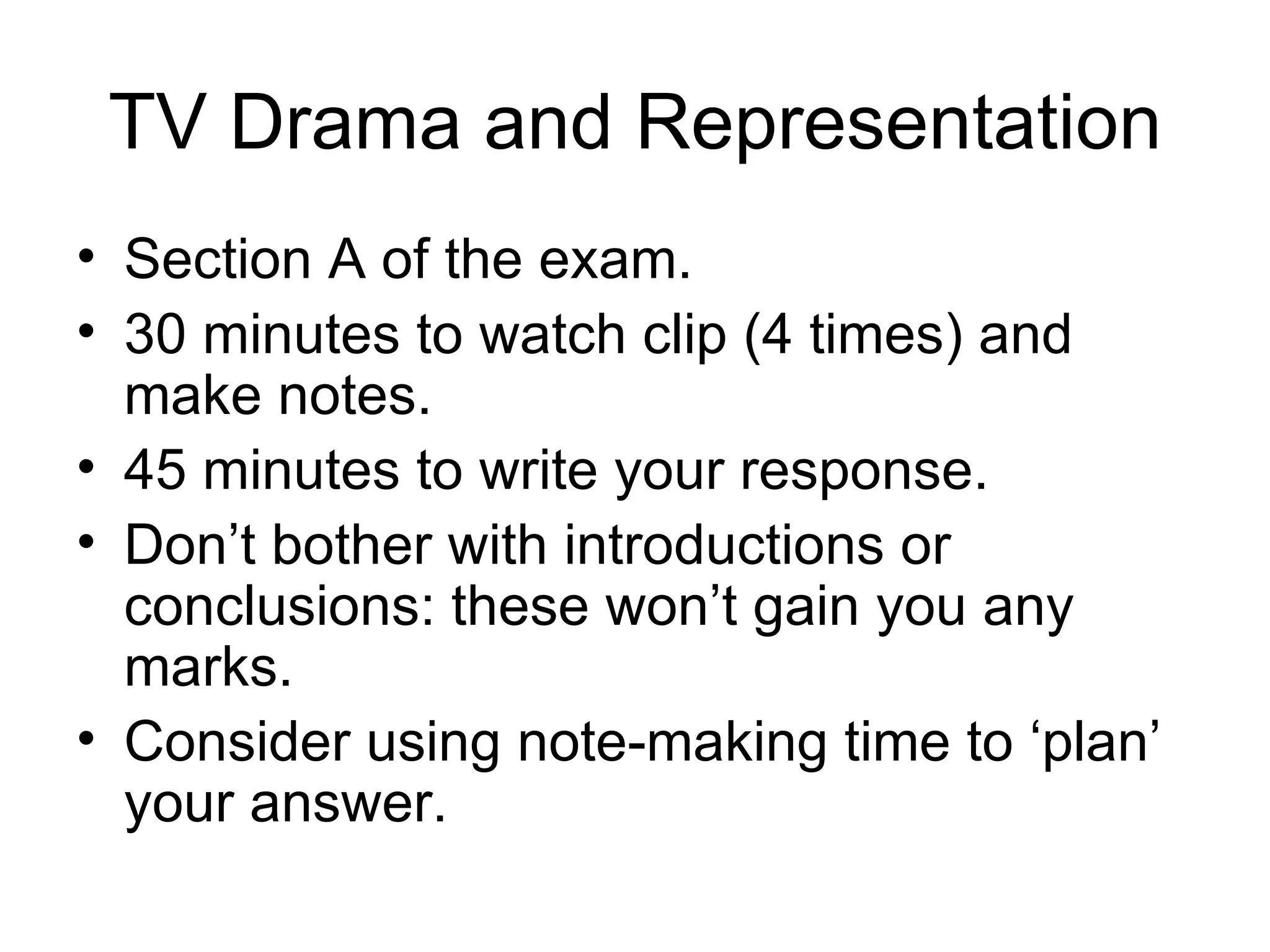
TV Drama and Representation
• Section A of the exam.
• 30 minutes to watch clip (4 times) and
  make notes.
• 45 minutes to write your response.
• Don’t bother with introductions or
  conclusions: these won’t gain you any
  marks.
• Consider using note-making time to ‘plan’
  your answer.
TV Drama and Representation
• You must comment on…

  –   Camera
  –   Sound
                          And how they link to…
  –   Mise-en-scene
  –   Editing

  – Representation

• Failure to discuss any of these areas will reduce
  your mark!
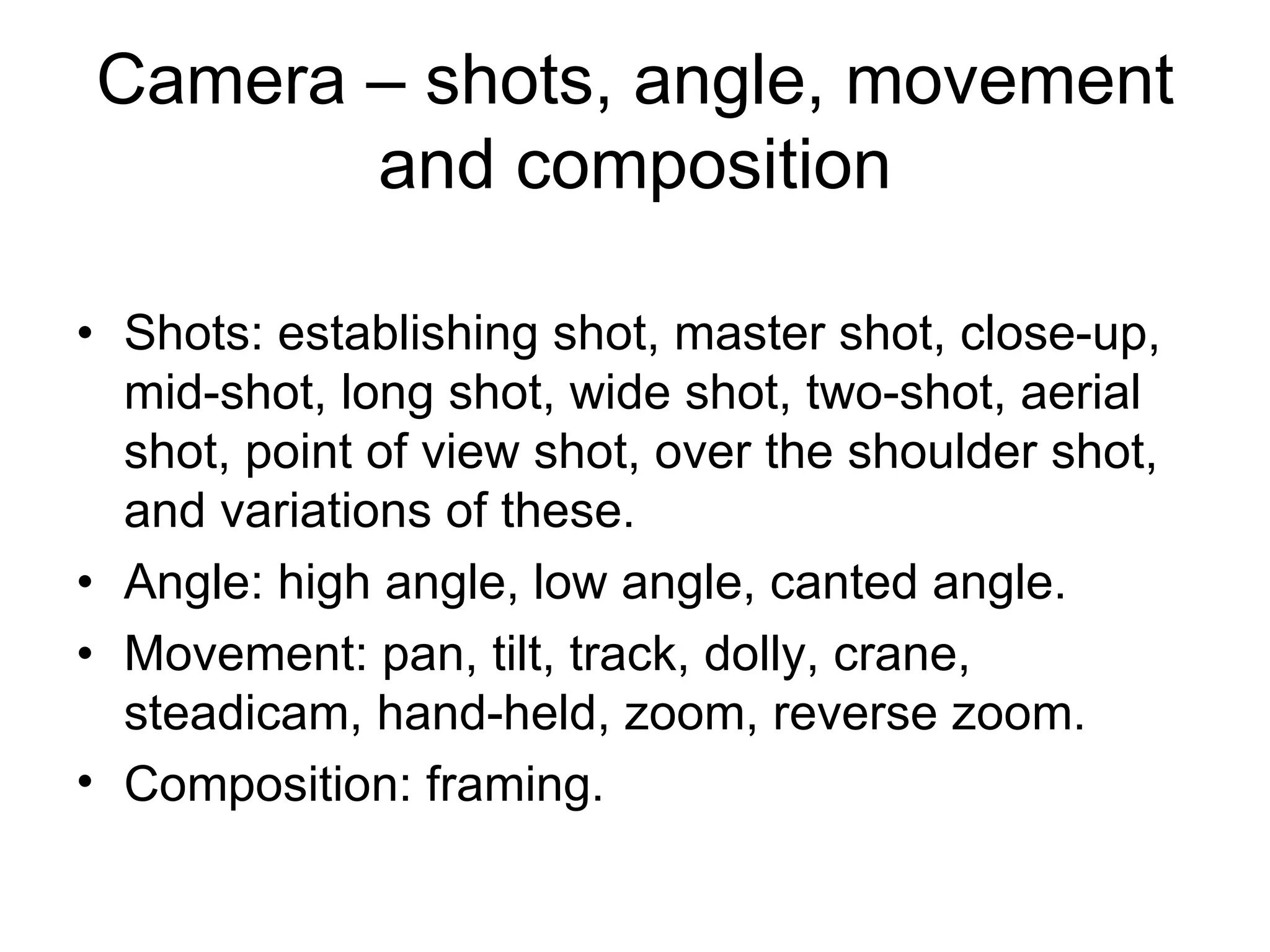
Camera – shots, angle, movement
       and composition

• Shots: establishing shot, master shot, close-up,
  mid-shot, long shot, wide shot, two-shot, aerial
  shot, point of view shot, over the shoulder shot,
  and variations of these.
• Angle: high angle, low angle, canted angle.
• Movement: pan, tilt, track, dolly, crane,
  steadicam, hand-held, zoom, reverse zoom.
• Composition: framing.
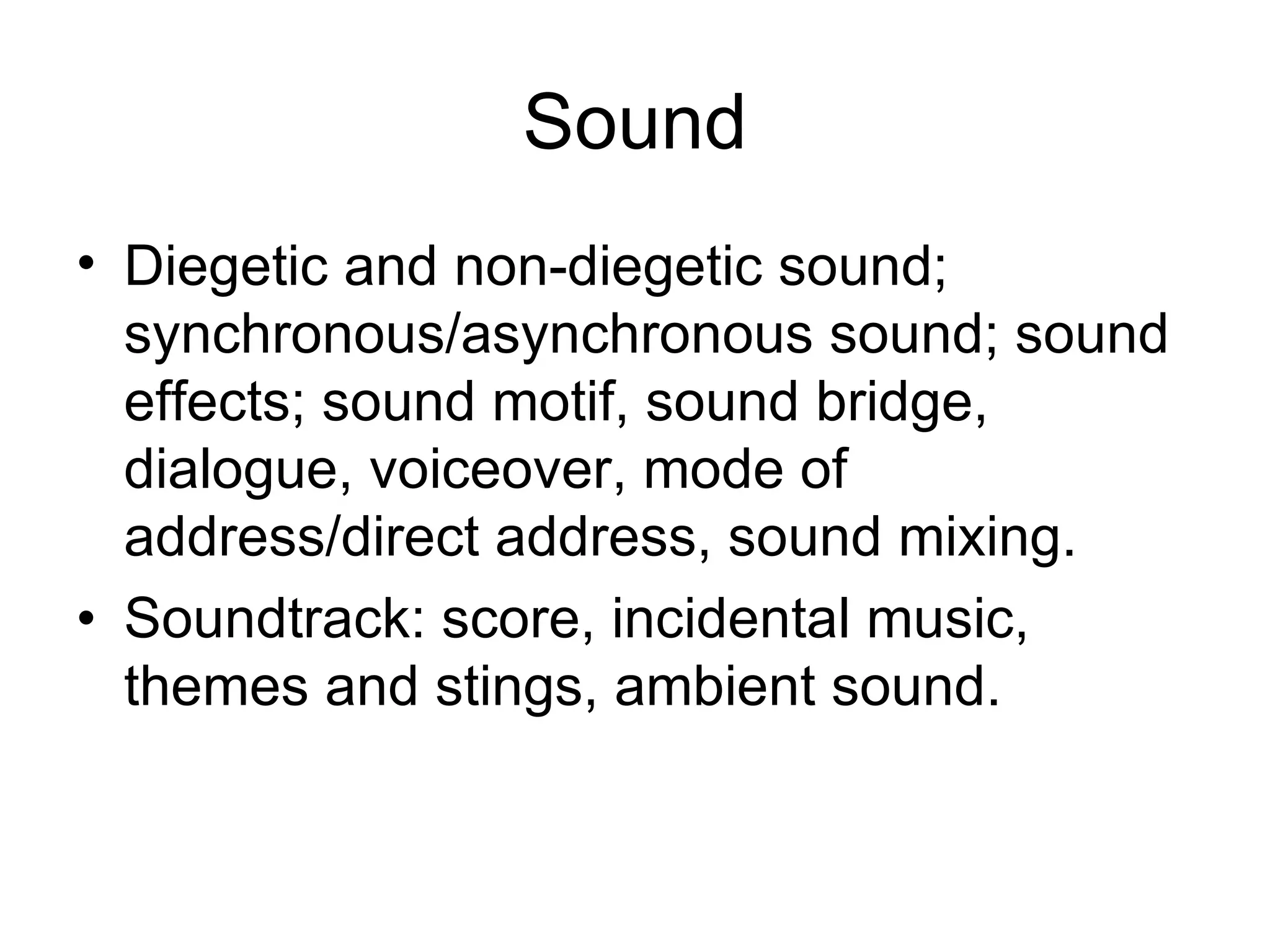
Sound
• Diegetic and non-diegetic sound;
  synchronous/asynchronous sound; sound
  effects; sound motif, sound bridge,
  dialogue, voiceover, mode of
  address/direct address, sound mixing.
• Soundtrack: score, incidental music,
  themes and stings, ambient sound.
Mise-en-scene


• Production design: location, studio, set
  design, costume and make-up, properties.
• Lighting; colour design.
Editing
• Cutting: shot/reverse shot, eyeline match,
  graphic match, action match, jump cut.
• Other transitions, dissolve, fade-in, fade-
  out, wipe, superimposition, long take,
  short take, slow motion, post-production,
  visual effects.
Representation
           “representations of individuals,
             groups, events or places…”

• Gender
• Age
• Ethnicity
• Sexuality
• Class and Status
• Physical ability/disability
• Regional identity
Keywords…
• All the terminology mentioned on the
  previous slides are keywords.
• Other you could mention include…
  – Realism – do the different techniques used
    work to make the piece realistic?
  – Verisimilitude – the construction of a
    believable world.
  – Stereotypes – how we expect people and
    places to be.
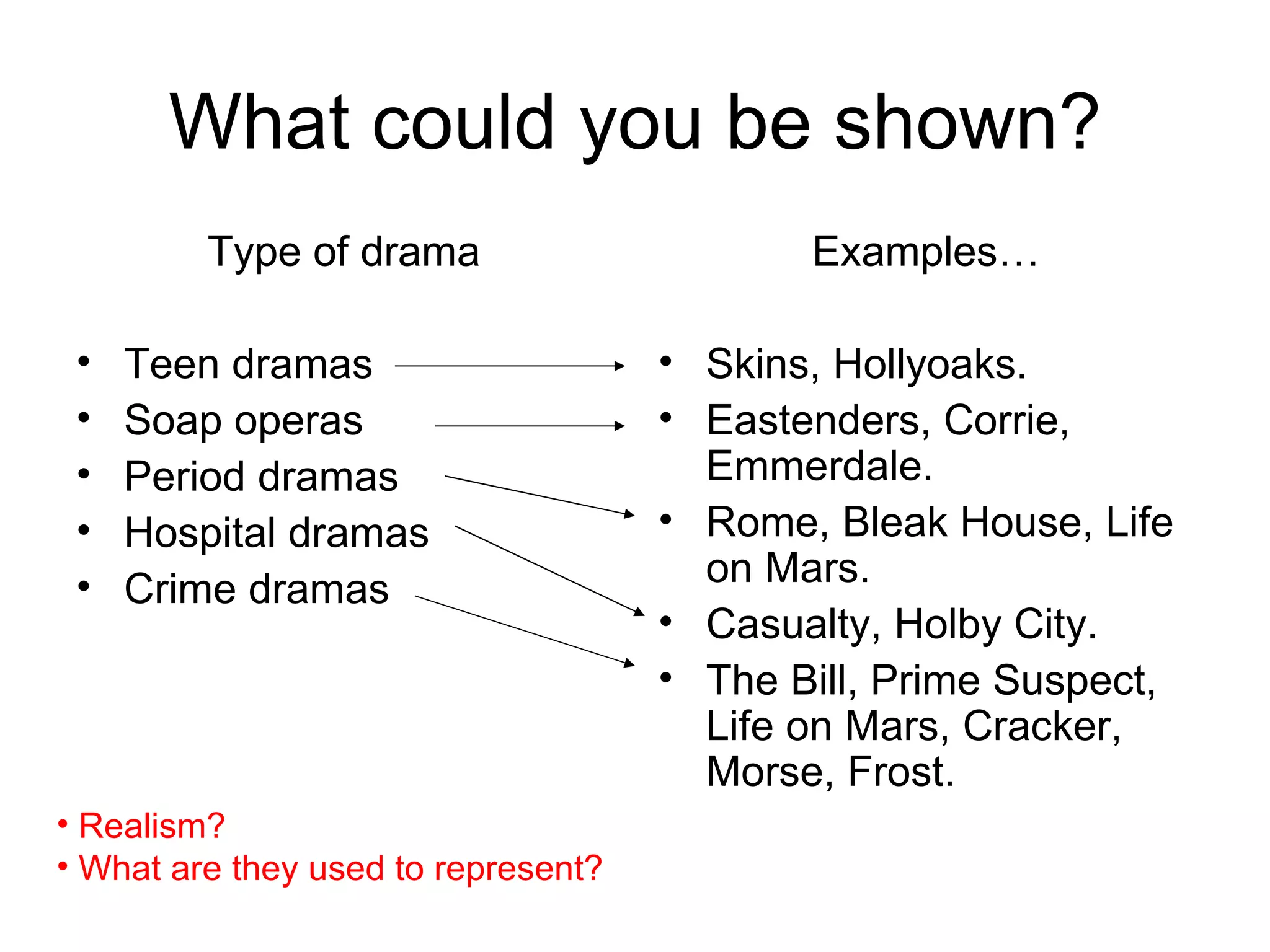
What could you be shown?
         Type of drama                      Examples…

 •   Teen dramas                     • Skins, Hollyoaks.
 •   Soap operas                     • Eastenders, Corrie,
 •   Period dramas                     Emmerdale.
 •   Hospital dramas                 • Rome, Bleak House, Life
 •                                     on Mars.
     Crime dramas
                                     • Casualty, Holby City.
                                     • The Bill, Prime Suspect,
                                       Life on Mars, Cracker,
                                       Morse, Frost.
• Realism?
• What are they used to represent?
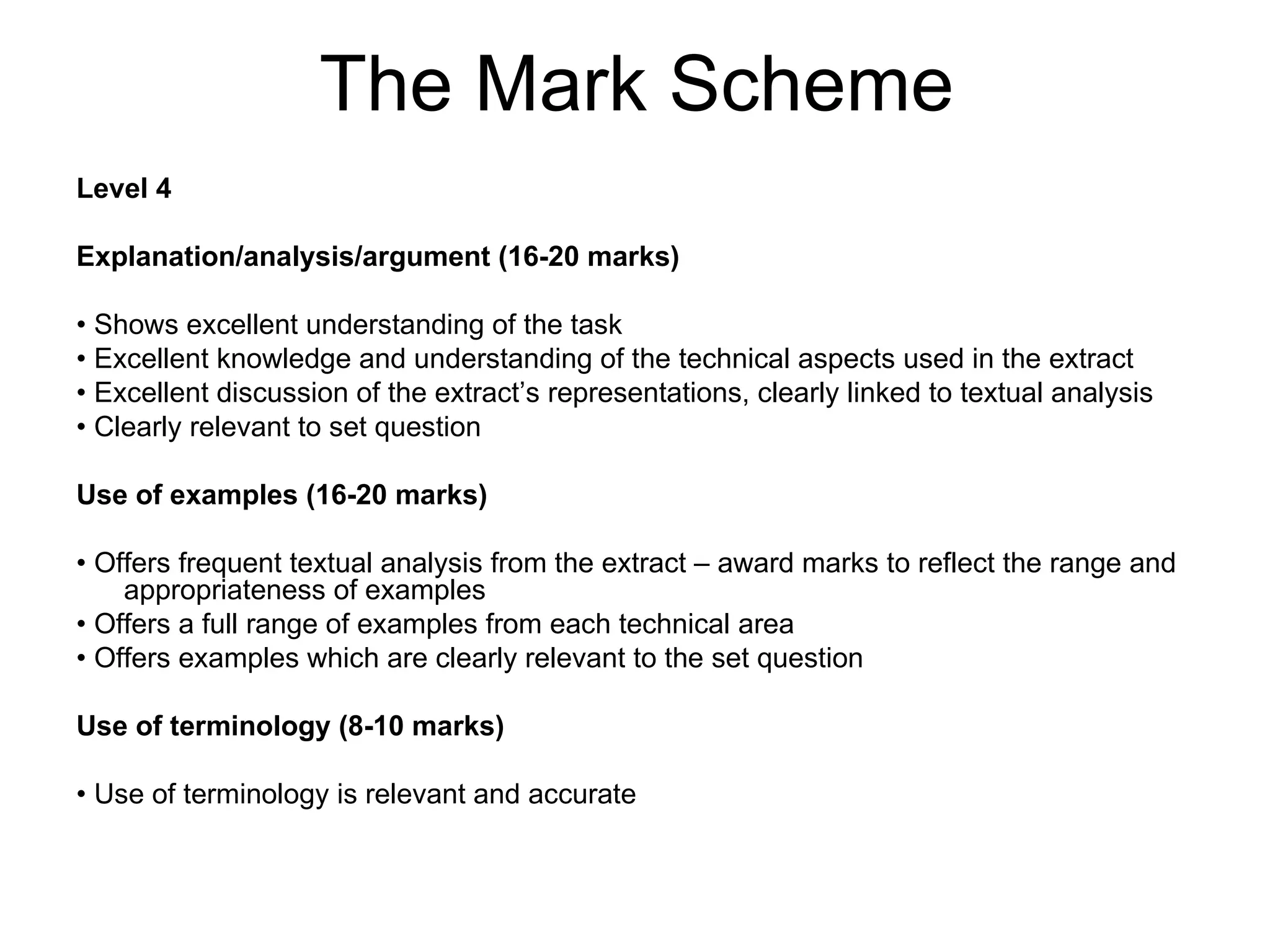
The Mark Scheme
Level 4

Explanation/analysis/argument (16-20 marks)

• Shows excellent understanding of the task
• Excellent knowledge and understanding of the technical aspects used in the extract
• Excellent discussion of the extract’s representations, clearly linked to textual analysis
• Clearly relevant to set question

Use of examples (16-20 marks)

• Offers frequent textual analysis from the extract – award marks to reflect the range and
    appropriateness of examples
• Offers a full range of examples from each technical area
• Offers examples which are clearly relevant to the set question

Use of terminology (8-10 marks)

• Use of terminology is relevant and accurate
Video Games
• Section B.
• 45 minutes to respond to 1 question.
• Question will ask you to discuss the
  processes of production, distribution and
  exhibition in Video Games.
• Your answer should make reference to
  specific examples from the case study we
  have studied.
The Case Study
Your answer can should contained detailed examples.

• You should refer to one main case study and use other
  examples to back yourself up.
Production / Distribution / Exhibition
  The question requires you to discuss these three
  areas…
• Production – Processes (publisher, developer,
  budgets and so forth) and decisions that take
  place when making a video game.
• Distribution – Advertising, marketing,
  merchandising and delivering the game.
• Exhibition – The different ways in which the
  audience can ‘consume’ game.
You should also make reference to…
Synergy
• In media economics, synergy is the promotion
  and sale of a product (and all its versions)
  throughout the various subsidiaries of a media
  conglomerate, e.g. films, soundtracks, books,
  Internet or action figures etc.

• Walt Disney pioneered synergistic marketing
  techniques in the 1930s by granting dozens of
  firms the right to use his Mickey Mouse
  character in products and ads, and continued to
  market Disney media through licensing
  arrangements.
Proliferation (through technology)
• Downloading – DLC, games.
• Social Networking Sites – marketing and
  buzz
• Accessibility – everywhere?
• Control – licences have to granted by the
  big three.
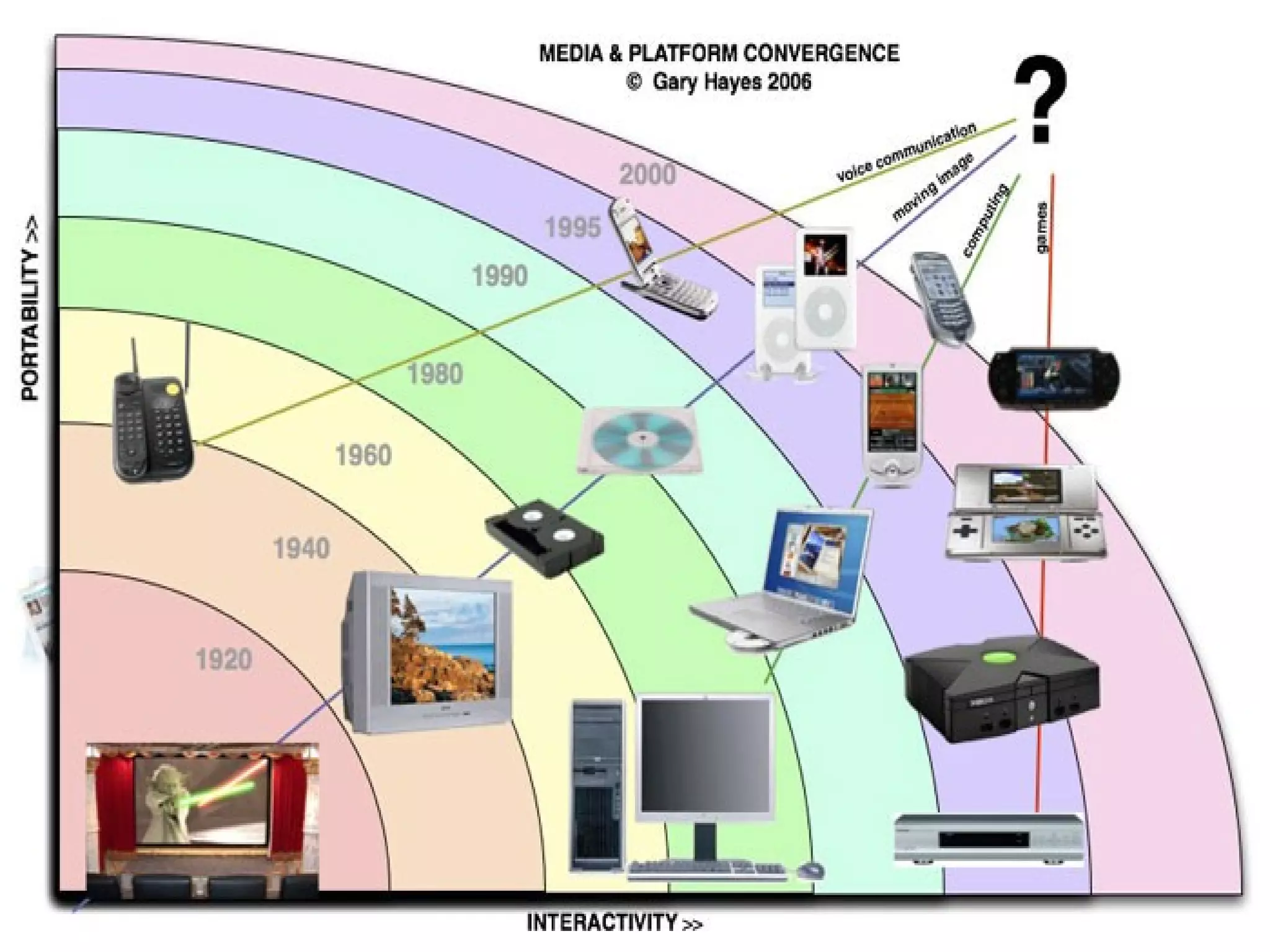
“The importance of technological convergence for
           institutions and audiences”

   What does convergence mean and why is it
                  important?

• When two or more technologies come together
  to create a new technology.

• Audiences: Everything in one product.

• Institutions: Audiences tied to one product.
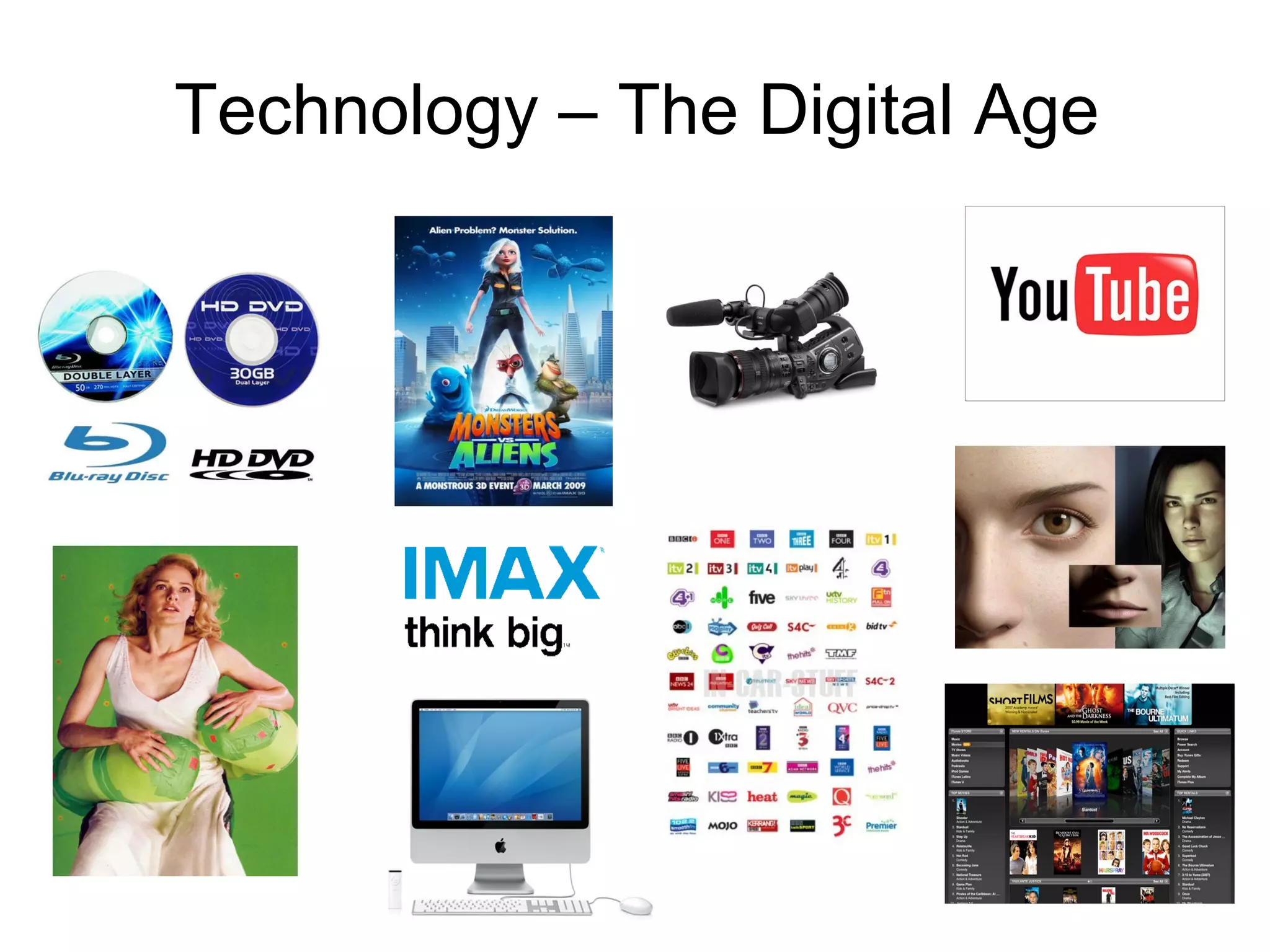
Technology – The Digital Age
Your Experiences


How do you consume games?
Us challenging them…
• Remember that YOU are a key part of the
  film industry.

• YOUR behaviour influences what they (the
  institutions) do.

• Be prepared to comment on the power of
  the audience!
The Question
• Discuss the issues raised by an institution’s
  need to target specific audiences within a media
  industry which you have studied.

Or maybe…

• What issues / decisions do institutions face
  when releasing their products?
• How do audiences influence institutional
  decisions?
The Mark Scheme
Level 4

Explanation/analysis/argument (16-20 marks)

• Shows excellent understanding of the task
• Excellent knowledge and understanding of institutional/audience practices – factual
    knowledge is relevant and accurate
• A clear and developed argument, substantiated by detailed reference to case study
    material
• Clearly relevant to set question

Use of examples (16-20 marks)

• Offers frequent evidence from case study material – award marks to reflect the range
    and appropriateness of examples
• Offers a full range of examples from case study and own experience
• Offers examples which are clearly relevant to the set question

Use of terminology (8-10 marks)

• Use of terminology is relevant and accurate
Revising
•   The blogs
•   The booklets and resources
•   The internet
•   Youtube

• And these…
    – http://blackpoolmedia.wordpress.com/category/representat
    – http://6thformnoodle.blogspot.com/search/label/Year%2012

G322 revision

  • 1.
    G322 TV Dramaand Representation and Audience and Institutions: UK Film The Key Points
  • 2.
    TV Drama andRepresentation • Section A of the exam. • 30 minutes to watch clip (4 times) and make notes. • 45 minutes to write your response. • Don’t bother with introductions or conclusions: these won’t gain you any marks. • Consider using note-making time to ‘plan’ your answer.
  • 3.
    TV Drama andRepresentation • You must comment on… – Camera – Sound And how they link to… – Mise-en-scene – Editing – Representation • Failure to discuss any of these areas will reduce your mark!
  • 4.
    Camera – shots,angle, movement and composition • Shots: establishing shot, master shot, close-up, mid-shot, long shot, wide shot, two-shot, aerial shot, point of view shot, over the shoulder shot, and variations of these. • Angle: high angle, low angle, canted angle. • Movement: pan, tilt, track, dolly, crane, steadicam, hand-held, zoom, reverse zoom. • Composition: framing.
  • 5.
    Sound • Diegetic andnon-diegetic sound; synchronous/asynchronous sound; sound effects; sound motif, sound bridge, dialogue, voiceover, mode of address/direct address, sound mixing. • Soundtrack: score, incidental music, themes and stings, ambient sound.
  • 6.
    Mise-en-scene • Production design:location, studio, set design, costume and make-up, properties. • Lighting; colour design.
  • 7.
    Editing • Cutting: shot/reverseshot, eyeline match, graphic match, action match, jump cut. • Other transitions, dissolve, fade-in, fade- out, wipe, superimposition, long take, short take, slow motion, post-production, visual effects.
  • 8.
    Representation “representations of individuals, groups, events or places…” • Gender • Age • Ethnicity • Sexuality • Class and Status • Physical ability/disability • Regional identity
  • 9.
    Keywords… • All theterminology mentioned on the previous slides are keywords. • Other you could mention include… – Realism – do the different techniques used work to make the piece realistic? – Verisimilitude – the construction of a believable world. – Stereotypes – how we expect people and places to be.
  • 10.
    What could yoube shown? Type of drama Examples… • Teen dramas • Skins, Hollyoaks. • Soap operas • Eastenders, Corrie, • Period dramas Emmerdale. • Hospital dramas • Rome, Bleak House, Life • on Mars. Crime dramas • Casualty, Holby City. • The Bill, Prime Suspect, Life on Mars, Cracker, Morse, Frost. • Realism? • What are they used to represent?
  • 11.
    The Mark Scheme Level4 Explanation/analysis/argument (16-20 marks) • Shows excellent understanding of the task • Excellent knowledge and understanding of the technical aspects used in the extract • Excellent discussion of the extract’s representations, clearly linked to textual analysis • Clearly relevant to set question Use of examples (16-20 marks) • Offers frequent textual analysis from the extract – award marks to reflect the range and appropriateness of examples • Offers a full range of examples from each technical area • Offers examples which are clearly relevant to the set question Use of terminology (8-10 marks) • Use of terminology is relevant and accurate
  • 12.
    Video Games • SectionB. • 45 minutes to respond to 1 question. • Question will ask you to discuss the processes of production, distribution and exhibition in Video Games. • Your answer should make reference to specific examples from the case study we have studied.
  • 13.
    The Case Study Youranswer can should contained detailed examples. • You should refer to one main case study and use other examples to back yourself up.
  • 14.
    Production / Distribution/ Exhibition The question requires you to discuss these three areas… • Production – Processes (publisher, developer, budgets and so forth) and decisions that take place when making a video game. • Distribution – Advertising, marketing, merchandising and delivering the game. • Exhibition – The different ways in which the audience can ‘consume’ game. You should also make reference to…
  • 15.
    Synergy • In mediaeconomics, synergy is the promotion and sale of a product (and all its versions) throughout the various subsidiaries of a media conglomerate, e.g. films, soundtracks, books, Internet or action figures etc. • Walt Disney pioneered synergistic marketing techniques in the 1930s by granting dozens of firms the right to use his Mickey Mouse character in products and ads, and continued to market Disney media through licensing arrangements.
  • 16.
    Proliferation (through technology) •Downloading – DLC, games. • Social Networking Sites – marketing and buzz • Accessibility – everywhere? • Control – licences have to granted by the big three.
  • 17.
    “The importance oftechnological convergence for institutions and audiences” What does convergence mean and why is it important? • When two or more technologies come together to create a new technology. • Audiences: Everything in one product. • Institutions: Audiences tied to one product.
  • 19.
    Technology – TheDigital Age
  • 20.
    Your Experiences How doyou consume games?
  • 21.
    Us challenging them… •Remember that YOU are a key part of the film industry. • YOUR behaviour influences what they (the institutions) do. • Be prepared to comment on the power of the audience!
  • 22.
    The Question • Discussthe issues raised by an institution’s need to target specific audiences within a media industry which you have studied. Or maybe… • What issues / decisions do institutions face when releasing their products? • How do audiences influence institutional decisions?
  • 23.
    The Mark Scheme Level4 Explanation/analysis/argument (16-20 marks) • Shows excellent understanding of the task • Excellent knowledge and understanding of institutional/audience practices – factual knowledge is relevant and accurate • A clear and developed argument, substantiated by detailed reference to case study material • Clearly relevant to set question Use of examples (16-20 marks) • Offers frequent evidence from case study material – award marks to reflect the range and appropriateness of examples • Offers a full range of examples from case study and own experience • Offers examples which are clearly relevant to the set question Use of terminology (8-10 marks) • Use of terminology is relevant and accurate
  • 24.
    Revising • The blogs • The booklets and resources • The internet • Youtube • And these… – http://blackpoolmedia.wordpress.com/category/representat – http://6thformnoodle.blogspot.com/search/label/Year%2012