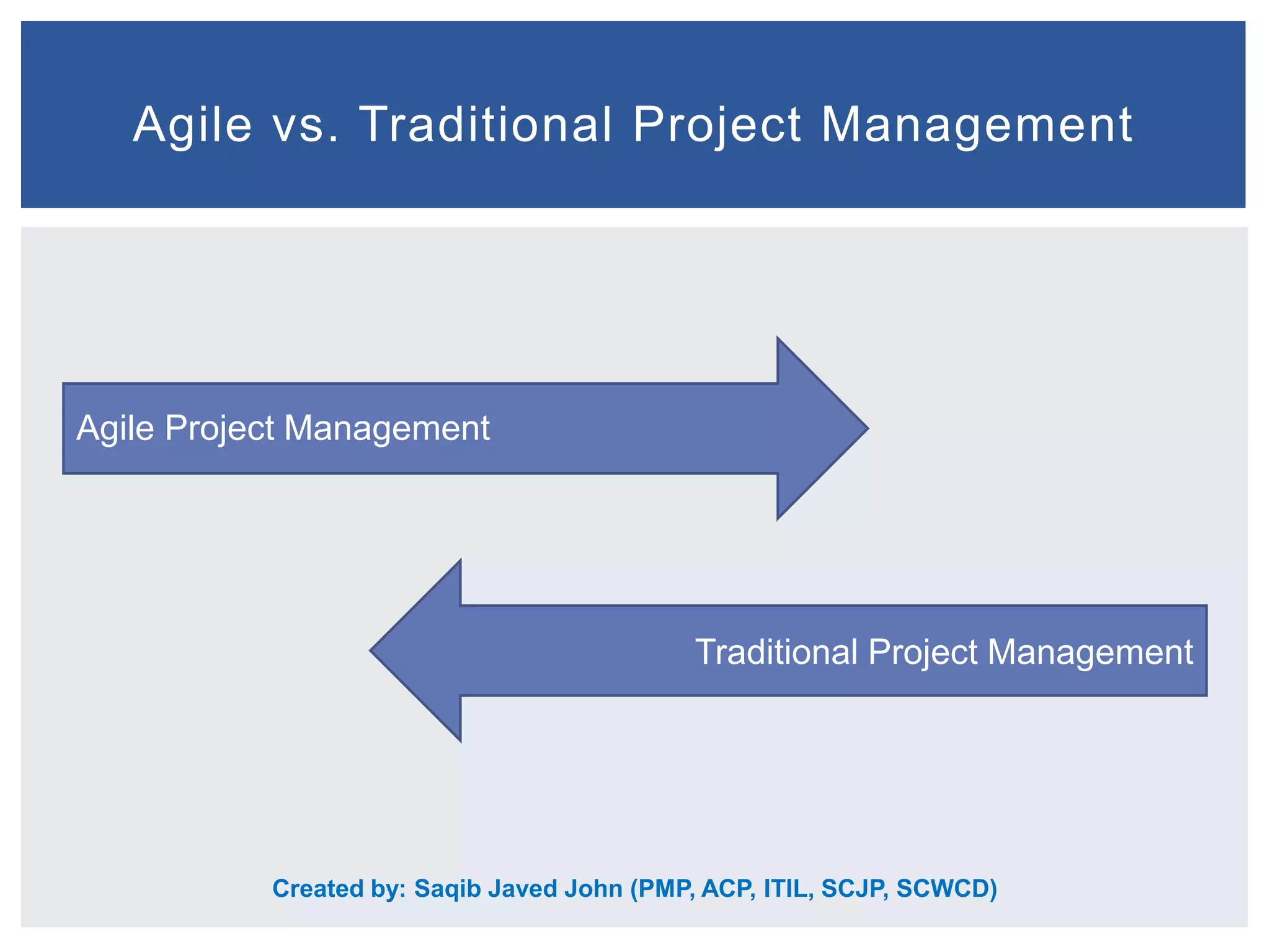
Agile vs. Traditional Project Management

Agile Project Management

Traditional Project Management

Created by: Saqib Javed John (PMP, ACP, ITIL, SCJP, SCWCD)
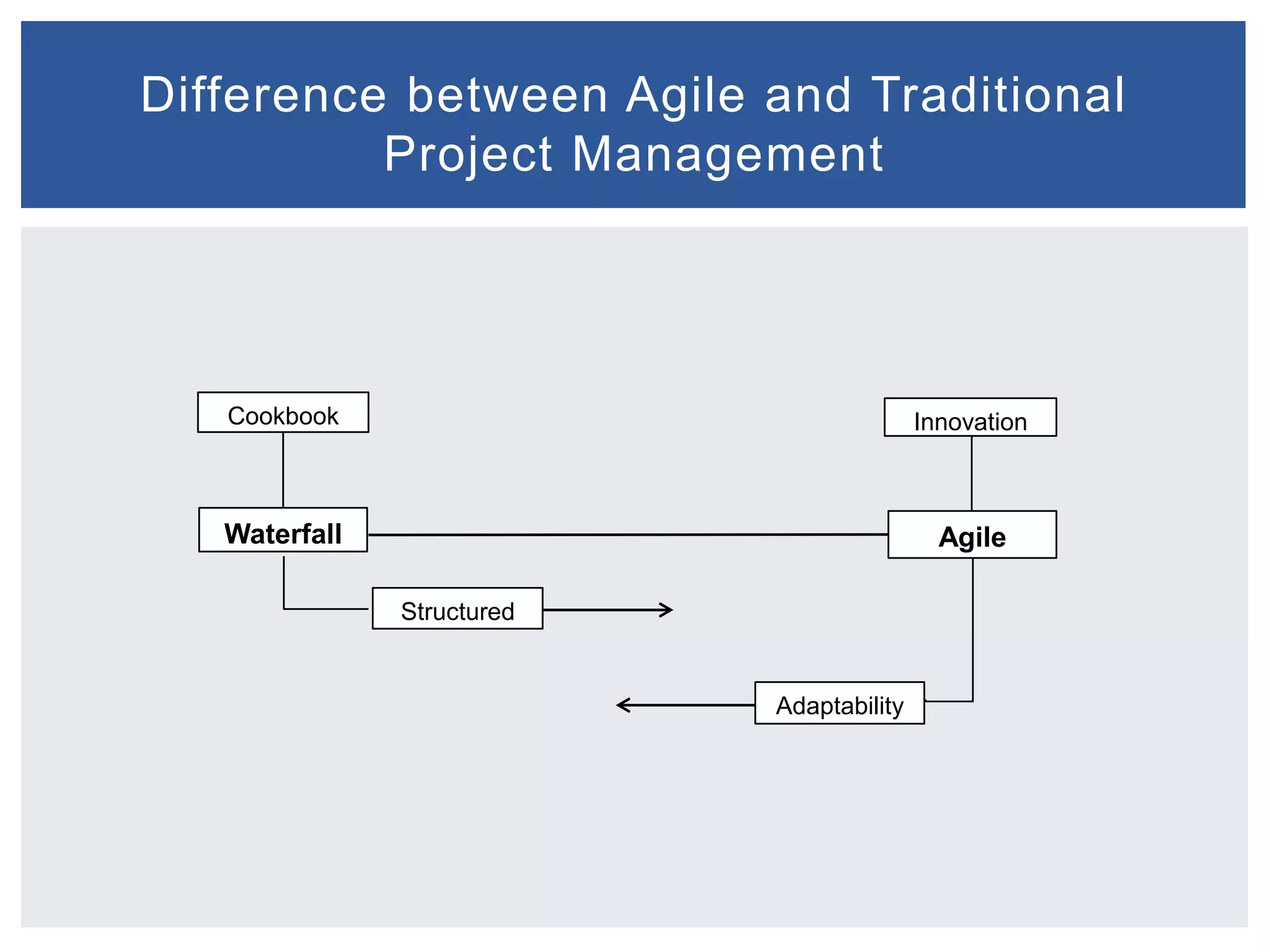
Difference between Agile and Traditional
Project Management

Cookbook

Innovation

Waterfall

Agile
Structured

Adaptability
Traditional Framework

Agile Framework

More Rigid and Directions coming Top Team may conduct dozens of
to Down
experiments to see which works best
More Commanding and Controlling
style of Leadership

Communication flowing freely
between all the team members

Spoon Feeding; Management tell
everyone “What to Do”

Self-Organizing; work is distributed
with consensus by the Team itself

Planning Centric and Plan Driven

Plan could be very fluid in Agile world
as Agile projects are more fluid then
waterfall projects

Document Oriented and Document
Driven

Cross functional, Self-Contained
and Agile is ultimately pragmatic

Resistant to Change

Agile Projects are welcoming to
change; true even changes are
introduced late in the project
Traditional Framework

Agile Framework

Customer get involved early in the
Customer involvement is the key here
processes but tended to keep at arm’s as more closely involved at the time of
length once the project begins
work being performed
Escalation to managers when problem When problems occur, team works
arise
together resolve them internally

Heavy upfront analysis and design

Daily stand-up meetings are held to
discuss work done yesterday, plan of
today and impediments if any

More serious about processes than
the product

Agile methods less focus on formal
and directive processes

Product is planned extensively and
then executed and tested

Work is delivered to client in small and
frequent releases to get rapid
feedback loops

Traditional models favors
“Anticipation”

Agile model favors “Adaption”
Traditional Framework

Agile Framework

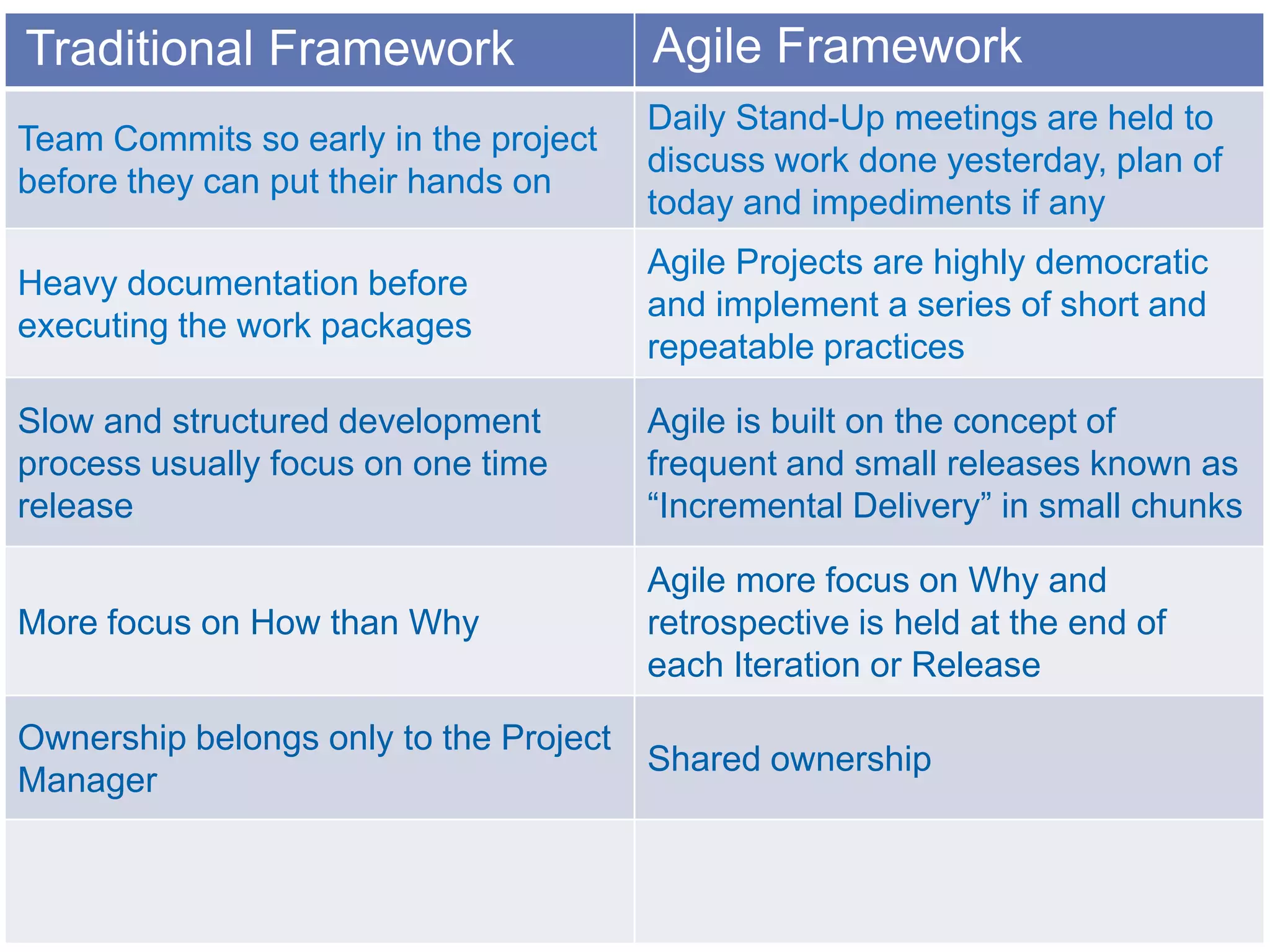
Team Commits so early in the project
before they can put their hands on

Daily Stand-Up meetings are held to
discuss work done yesterday, plan of
today and impediments if any

Heavy documentation before
executing the work packages

Agile Projects are highly democratic
and implement a series of short and
repeatable practices

Slow and structured development
process usually focus on one time
release

Agile is built on the concept of
frequent and small releases known as
“Incremental Delivery” in small chunks

More focus on How than Why

Agile more focus on Why and
retrospective is held at the end of
each Iteration or Release

Ownership belongs only to the Project
Manager

Shared ownership
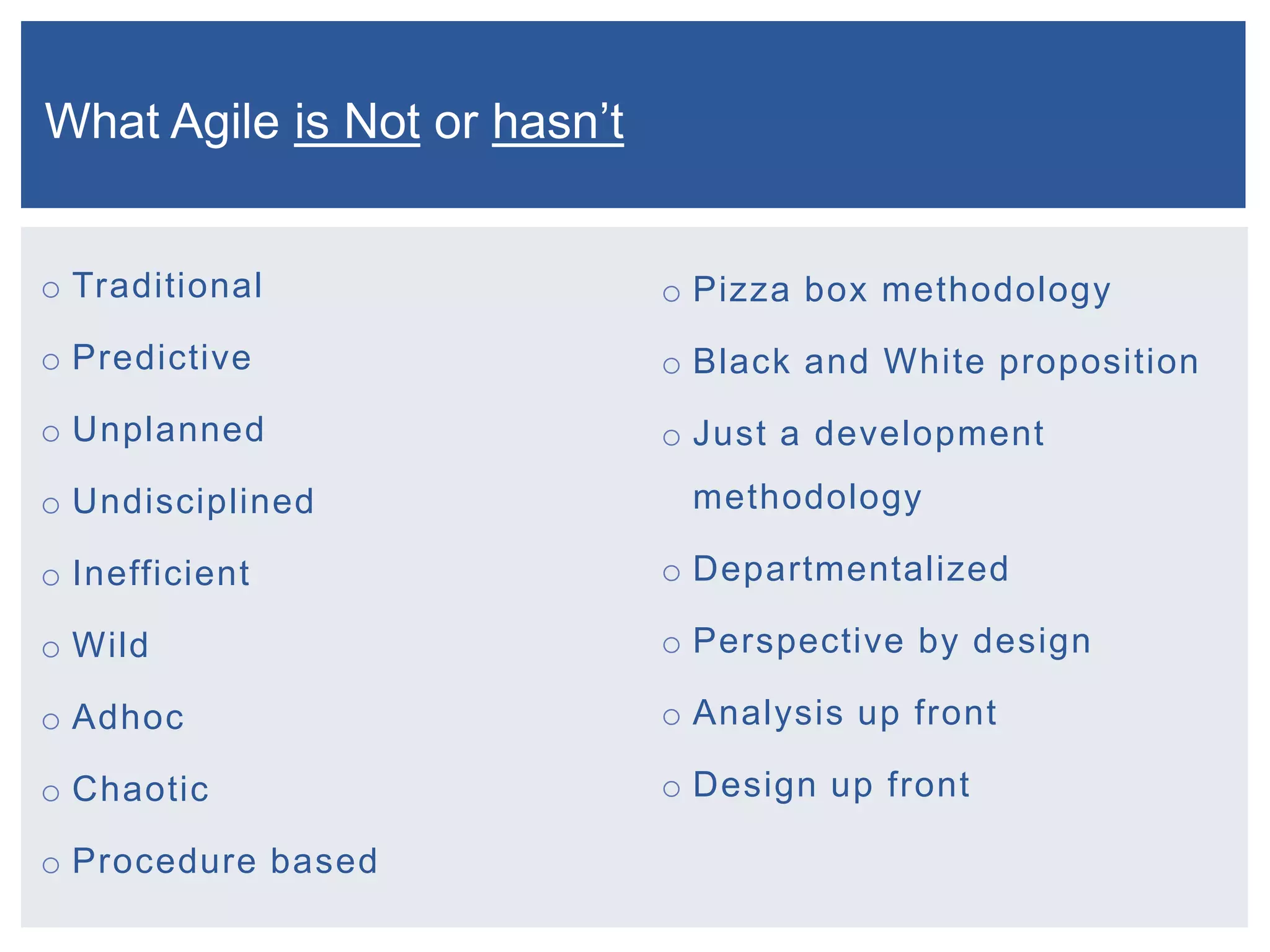
What Agile is Not or hasn’t
o Traditional

o Pizza box methodology

o Predictive

o Black and White proposition

o Unplanned

o Just a development

o Undisciplined

methodology

o Inefficient

o Departmentalized

o Wild

o Perspective by design

o Adhoc

o Analysis up front

o Chaotic

o Design up front

o Procedure based
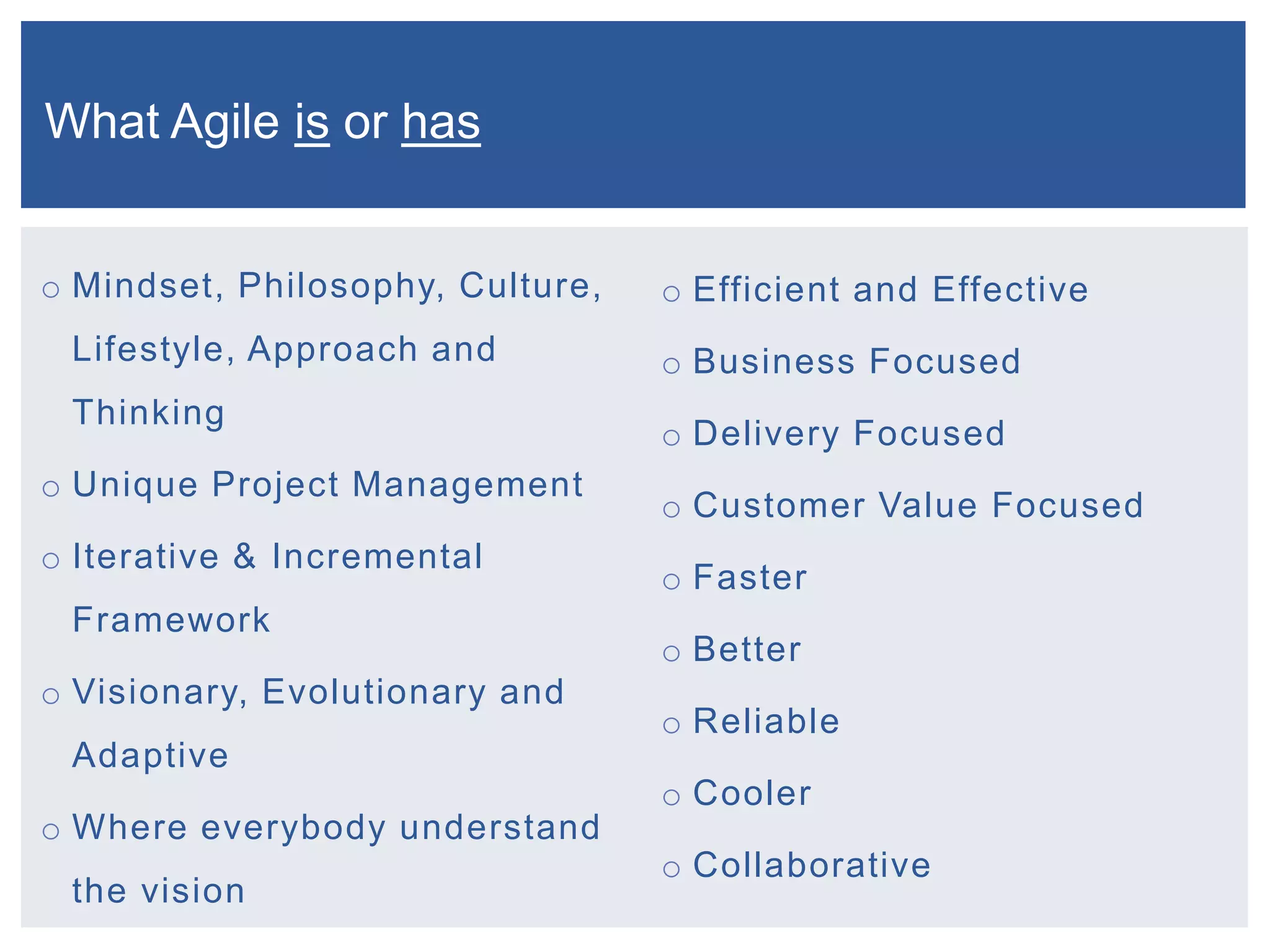
What Agile is or has
o Mindset, Philosophy, Culture,

o Efficient and Effective

Lifestyle, Approach and

o Business Focused

Thinking

o Delivery Focused

o Unique Project Management

o Iterative & Incremental
Framework
o Visionary, Evolutionary and

o Customer Value Focused

o Faster
o Better
o Reliable

Adaptive
o Where everybody understand
the vision

o Cooler
o Collaborative
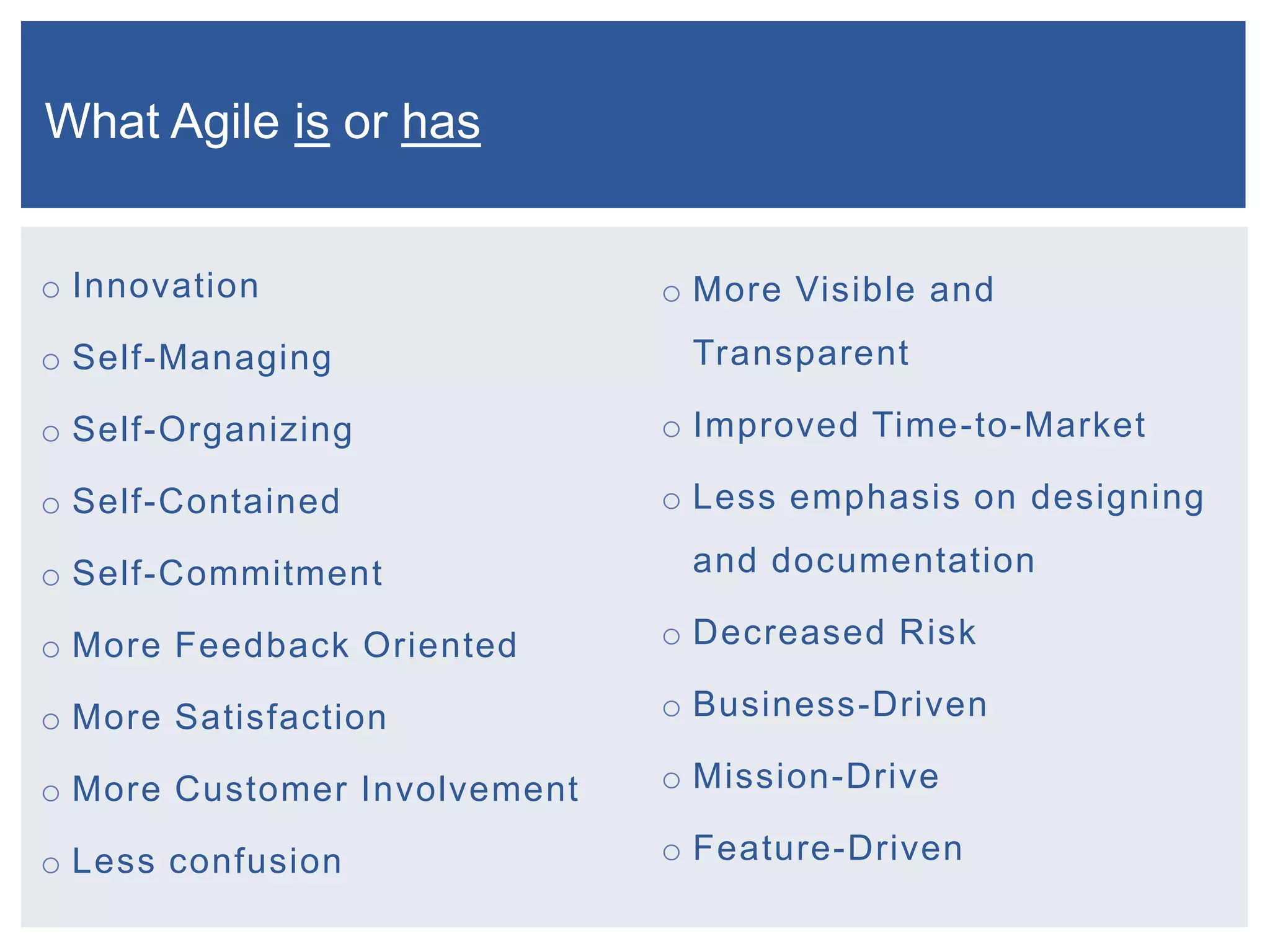
What Agile is or has
o Innovation

o Self-Managing

o More Visible and

Transparent

o Self-Organizing

o Improved Time-to-Market

o Self-Contained

o Less emphasis on designing

o Self-Commitment

and documentation

o More Feedback Oriented

o Decreased Risk

o More Satisfaction

o Business-Driven

o More Customer Involvement

o Mission-Drive

o Less confusion

o Feature-Driven
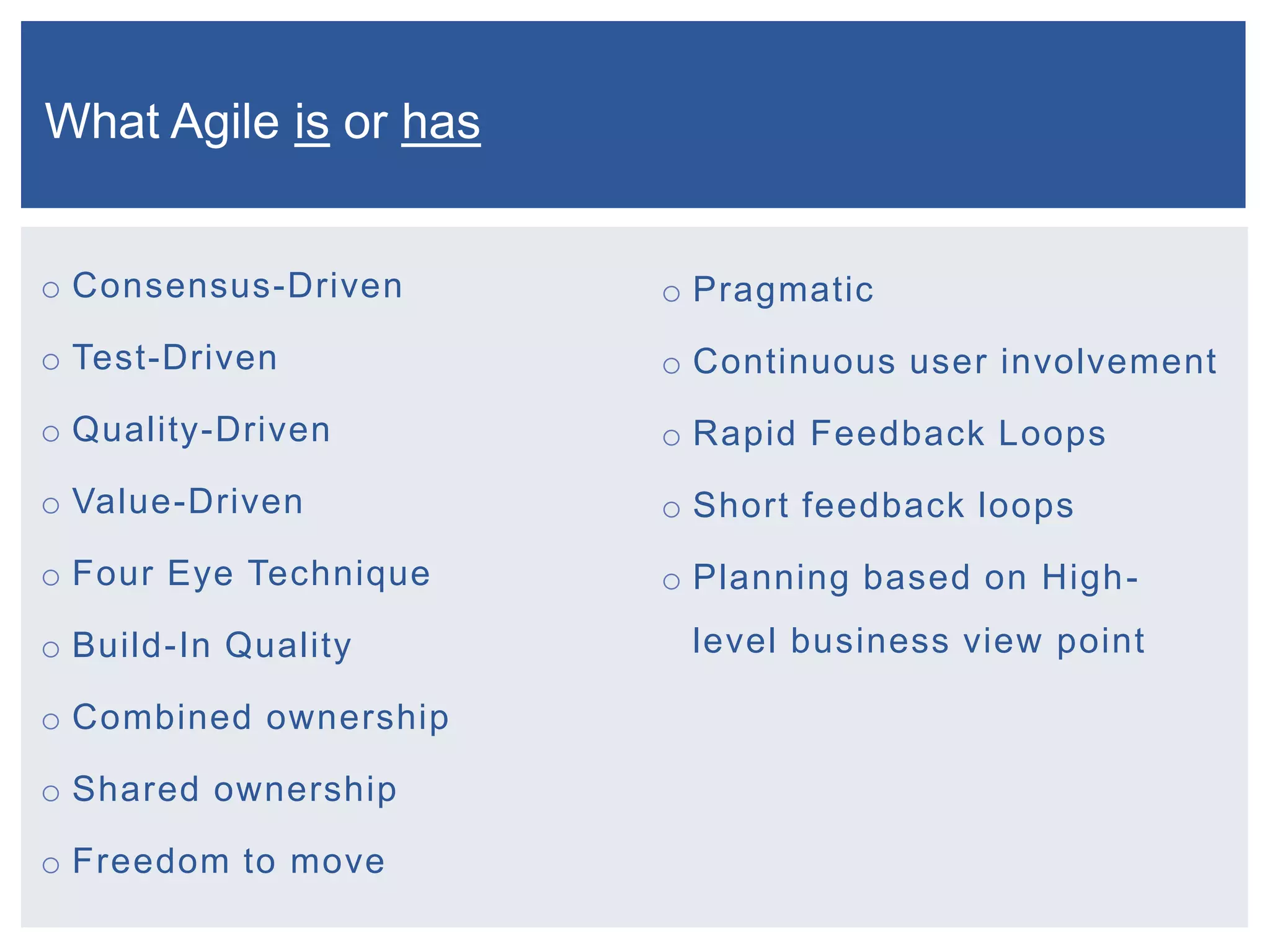
What Agile is or has
o Consensus-Driven

o Pragmatic

o Test-Driven

o Continuous user involvement

o Quality-Driven

o Rapid Feedback Loops

o Value-Driven

o Short feedback loops

o Four Eye Technique

o Planning based on High-

o Build-In Quality
o Combined ownership

o Shared ownership
o Freedom to move

level business view point
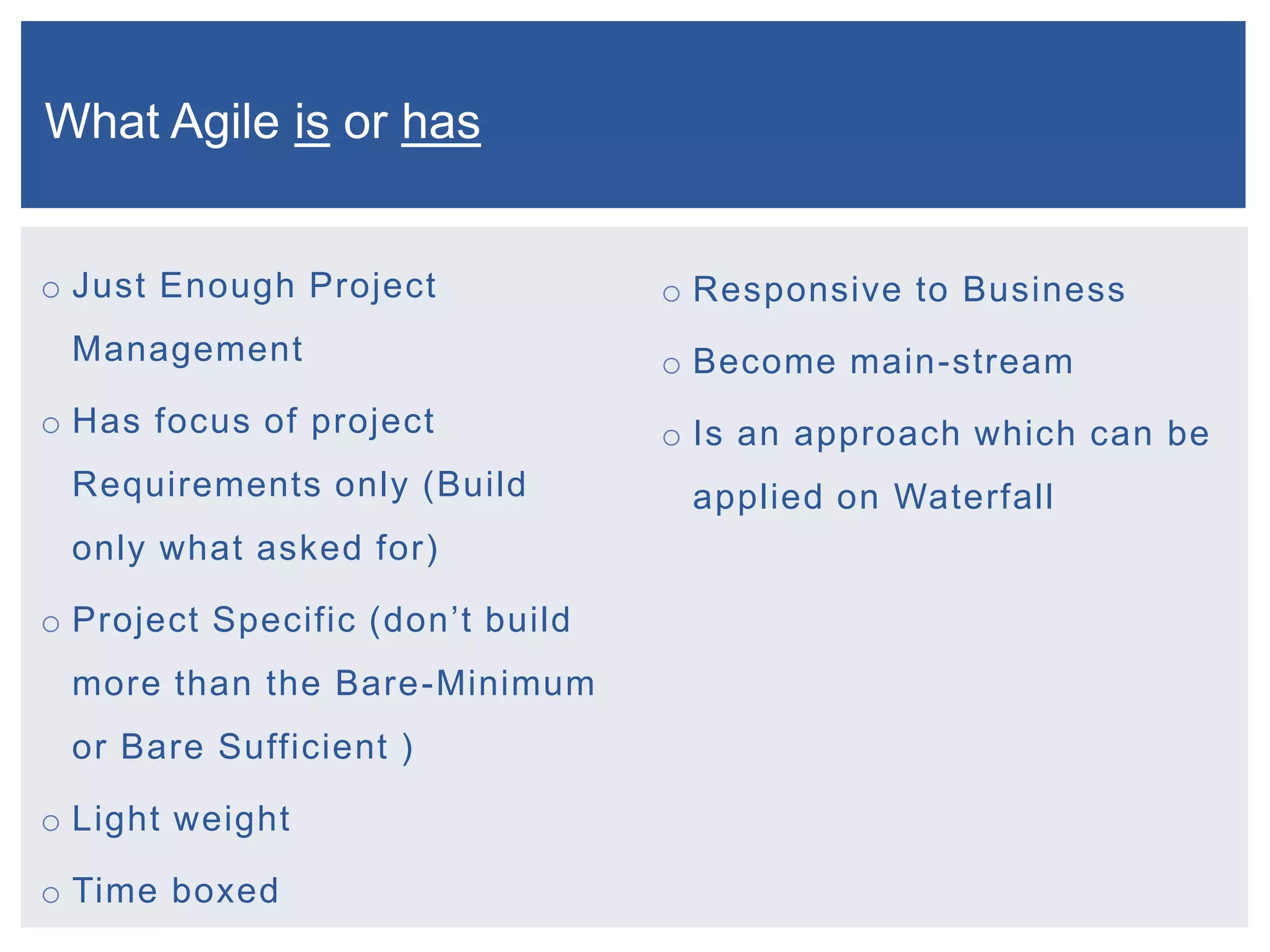
What Agile is or has
o Just Enough Project

Management
o Has focus of project
Requirements only (Build

only what asked for)
o Project Specific (don’t build
more than the Bare-Minimum
or Bare Sufficient )
o Light weight
o Time boxed

o Responsive to Business

o Become main-stream
o Is an approach which can be
applied on Waterfall
Thanks….
Created by:

Saqib Javed John
MSc CS, PMP, ACP, ITIL v3F, SCJP, SCWCD

Email: saqib.jav@gmail.com
Skype: saqibjohn76
LinkedIn: pk.linkedin.com/pub/saqib -javed -john/b/125/1b1

Agile vs Traditional Project Management

  • 1.
    Agile vs. TraditionalProject Management Agile Project Management Traditional Project Management Created by: Saqib Javed John (PMP, ACP, ITIL, SCJP, SCWCD)
  • 2.
    Difference between Agileand Traditional Project Management Cookbook Innovation Waterfall Agile Structured Adaptability
  • 3.
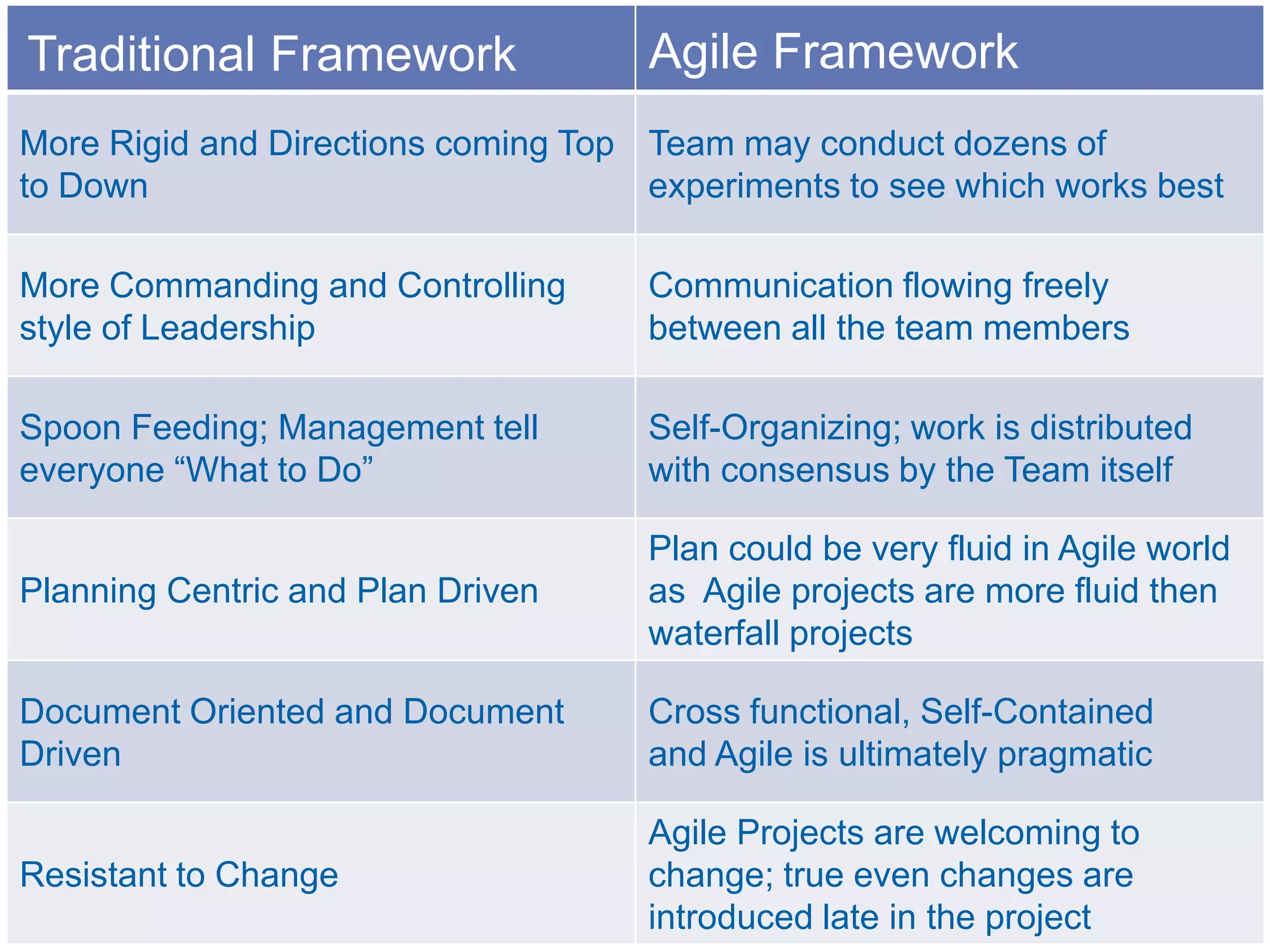
    Traditional Framework Agile Framework MoreRigid and Directions coming Top Team may conduct dozens of to Down experiments to see which works best More Commanding and Controlling style of Leadership Communication flowing freely between all the team members Spoon Feeding; Management tell everyone “What to Do” Self-Organizing; work is distributed with consensus by the Team itself Planning Centric and Plan Driven Plan could be very fluid in Agile world as Agile projects are more fluid then waterfall projects Document Oriented and Document Driven Cross functional, Self-Contained and Agile is ultimately pragmatic Resistant to Change Agile Projects are welcoming to change; true even changes are introduced late in the project
  • 4.
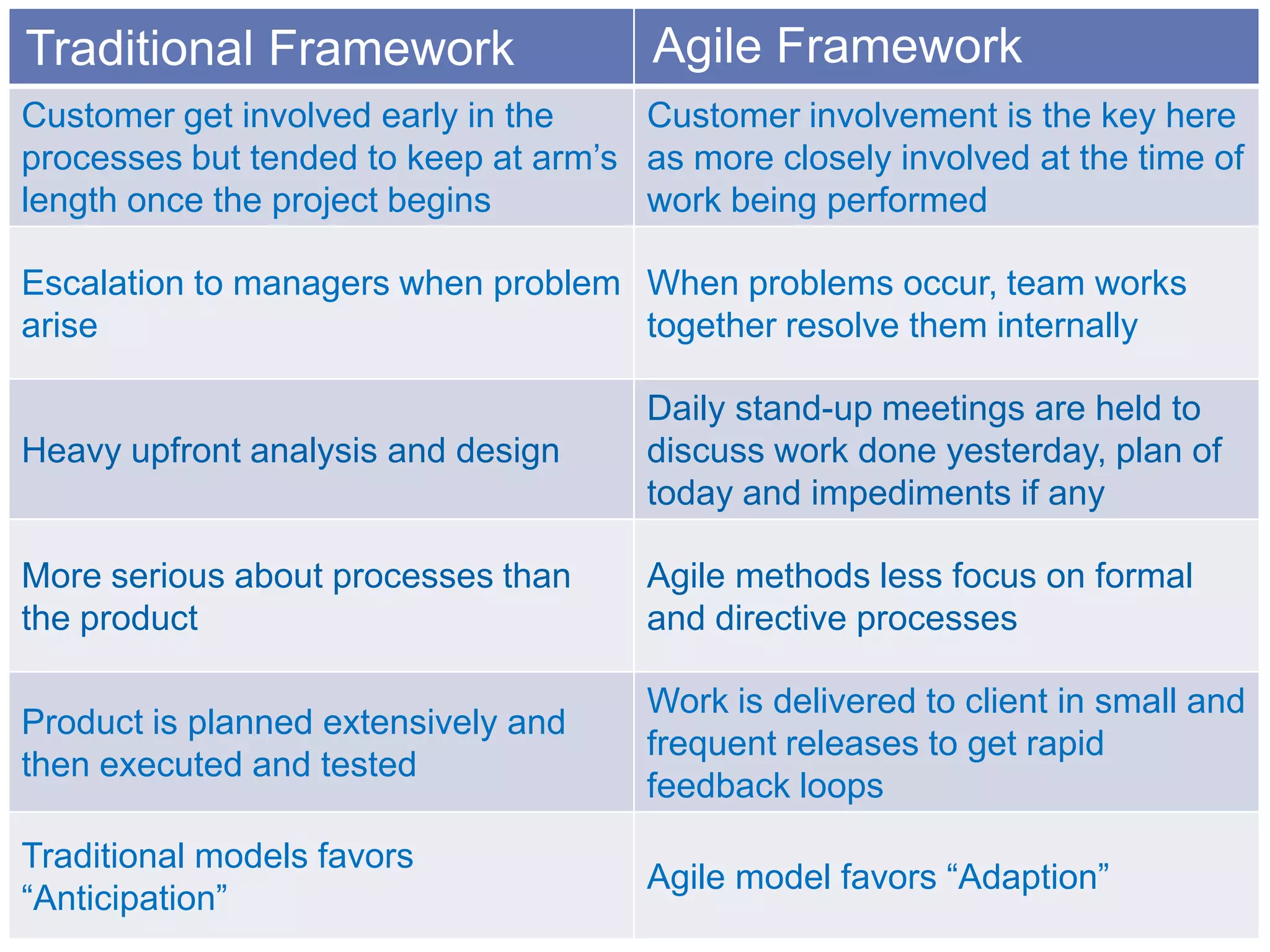
    Traditional Framework Agile Framework Customerget involved early in the Customer involvement is the key here processes but tended to keep at arm’s as more closely involved at the time of length once the project begins work being performed Escalation to managers when problem When problems occur, team works arise together resolve them internally Heavy upfront analysis and design Daily stand-up meetings are held to discuss work done yesterday, plan of today and impediments if any More serious about processes than the product Agile methods less focus on formal and directive processes Product is planned extensively and then executed and tested Work is delivered to client in small and frequent releases to get rapid feedback loops Traditional models favors “Anticipation” Agile model favors “Adaption”
  • 5.
    Traditional Framework Agile Framework TeamCommits so early in the project before they can put their hands on Daily Stand-Up meetings are held to discuss work done yesterday, plan of today and impediments if any Heavy documentation before executing the work packages Agile Projects are highly democratic and implement a series of short and repeatable practices Slow and structured development process usually focus on one time release Agile is built on the concept of frequent and small releases known as “Incremental Delivery” in small chunks More focus on How than Why Agile more focus on Why and retrospective is held at the end of each Iteration or Release Ownership belongs only to the Project Manager Shared ownership
  • 6.
    What Agile isNot or hasn’t o Traditional o Pizza box methodology o Predictive o Black and White proposition o Unplanned o Just a development o Undisciplined methodology o Inefficient o Departmentalized o Wild o Perspective by design o Adhoc o Analysis up front o Chaotic o Design up front o Procedure based
  • 7.
    What Agile isor has o Mindset, Philosophy, Culture, o Efficient and Effective Lifestyle, Approach and o Business Focused Thinking o Delivery Focused o Unique Project Management o Iterative & Incremental Framework o Visionary, Evolutionary and o Customer Value Focused o Faster o Better o Reliable Adaptive o Where everybody understand the vision o Cooler o Collaborative
  • 8.
    What Agile isor has o Innovation o Self-Managing o More Visible and Transparent o Self-Organizing o Improved Time-to-Market o Self-Contained o Less emphasis on designing o Self-Commitment and documentation o More Feedback Oriented o Decreased Risk o More Satisfaction o Business-Driven o More Customer Involvement o Mission-Drive o Less confusion o Feature-Driven
  • 9.
    What Agile isor has o Consensus-Driven o Pragmatic o Test-Driven o Continuous user involvement o Quality-Driven o Rapid Feedback Loops o Value-Driven o Short feedback loops o Four Eye Technique o Planning based on High- o Build-In Quality o Combined ownership o Shared ownership o Freedom to move level business view point
  • 10.
    What Agile isor has o Just Enough Project Management o Has focus of project Requirements only (Build only what asked for) o Project Specific (don’t build more than the Bare-Minimum or Bare Sufficient ) o Light weight o Time boxed o Responsive to Business o Become main-stream o Is an approach which can be applied on Waterfall
  • 11.
    Thanks…. Created by: Saqib JavedJohn MSc CS, PMP, ACP, ITIL v3F, SCJP, SCWCD Email: saqib.jav@gmail.com Skype: saqibjohn76 LinkedIn: pk.linkedin.com/pub/saqib -javed -john/b/125/1b1