Discover the Benefits of Agile
The Business Case for a New Way to Work
Deliver at the New Speed of Business
You’re operating in a world that’s global, responsive, customer-focused and
technology-driven. With software as the key driver of growth, innovation,
efficiency and productivity, how you deliver software says a lot about how
you’ll compete in this world.
“Embracing the rising strategic importance of software, and viewing its
development as a crucial competitive battlefield, are keys to success for an
ever-growing number of companies.”
Source: McKinsey1
A world written by software spells opportunities for those who capitalize on it and risks for those who
don’t. The companies that survive—and thrive—in this world will be agile companies: those able to quickly
and confidently respond to change, deliver value faster than the competition and build high-quality
products that customers really want.
Why Agile
The agile approach to developing software—and managing work in general—is your passport to success in
the application economy. Agile promises a range of benefits: faster time to market, increased productivity,
fewer defects, cost savings and better employee engagement.
•	Agile companies have been found to grow revenue 37 percent faster and generate 30 percent higher profits.2
•	The Project Management Institute found that highly agile organizations are 50 percent more likely to
successfully complete their strategic initiatives.3
•	A summary of research on project management methods found that agile approaches yielded 29 percent
better cost, 91 percent better schedule, 97 percent better productivity, 50 percent better quality, 400
percent better satisfaction and 470 percent better ROI than the least effective traditional methods.4
2 | DISCOVER THE BENEFITS OF AGILE ca.com
Agile methods help you to build and deliver products incrementally, to get value to customers quickly and
to keep development work aligned with business needs. Agile approaches emphasize these tenets:
•	Disciplined project management to minimize waste and deliver on schedule
•	Self-organizing, cross-functional, and collaborative teams
•	Customer satisfaction through delivery of software in short, frequent cycles
•	Frequent inspect-and-adapt sessions for continuous improvement
Here are some of the results you can expect to see when you adopt agile approaches:
Get to market faster
Anyone with a smartphone knows we’re living in an app economy: customers expect to see product
updates and improvements on a regular basis. When you get your releases out the door on an agile
cadence, you’ll not only deliver value to customers faster than your competition, you’ll get revenue in the
door sooner too.
Build high-quality products that customers value
Agile’s user-centric approach—which delivers value in short cycles so customer feedback can be integrated
into the development process—means you can align your strategy and development work around building
what customers want most. Agile approaches also integrate testing into the development process, which
improves quality and helps identify defects prior to release.
Reduce risk and eliminate waste
Traditional software development required long planning, design and development phases resulting in
infrequent, big-bang releases that risked delivering the wrong thing, too late. By delivering value to
customers more frequently and integrating their feedback, agile approaches help you respond more
effectively to the market reducing the risk of expensive market misses.
“We uncovered the performance costs of unstable teams … and are seeing
30–50 percent improvements in both cost and delivery duration compared
to similar waterfall projects.”
Source: Tata Communications5
Collaborate better
Self-organizing, cross-functional teams are the foundation of successful agile practices. These empowered
teams don’t just produce better products and services: they also produce more engaged employees.
According to the Corporate Executive Board (CEB), agile employees outperform so-called “hard workers” by
nearly 20 percent.6
3 | DISCOVER THE BENEFITS OF AGILE ca.com
Gain an edge on the future
A report from Accenture found that high-performing organizations are six times more likely than other
organizations to have adopted agile methodologies.7
And Computer Economics’ “IT Spending and
Staffing Benchmarks” study estimates that 83 percent of businesses plan to implement agile (up from
59 percent previously). In fact, “By 2018, the majority of software projects, as measured by the Gartner
CIO survey, will be agile-centric.”8
Agile Foundations
Agile approaches have been around for decades but were codified in 2001 with the Agile Manifesto,9
a
lightweight set of values for managing software development projects which include:
Individuals and interactions over processes and tools
Working software over comprehensive documentation
Customer collaboration over contract negotiation
Responding to change over following a plan
Agile is an umbrella term for a variety of work-management approaches that share common principles—
among them cross-functional collaboration, a focus on customer value, iterative and incremental delivery
(early and often), pulling quality forward, limiting work in progress (WiP) and continuous improvement.
Once considered a fad, agile has matured into a popular and respected set of development methods. In
fact, agile has expanded outside of software development and IT into sectors like banking, management
consulting, automotive manufacturing and healthcare. Companies are moving to agile methods because
the global marketplace demands they bring products that better reflect their customers’ needs to market
faster, Where the traditional “waterfall” approach—with its sequential phases and heavy investment in
large-scale, upfront design—lacks the flexibility to help organizations respond swiftly to changing markets,
agile approaches offer faster delivery, higher quality and an engaged development team that can deliver
on its commitments.
It’s about more than just software
Agile isn’t just a software development methodology. To deliver customer value faster, organizations need
to be agile in their organizational structure, processes, ceremonies and culture. What started as a
movement around software teams is now an enterprise-scale business approach, applied across teams in
distributed office locations—and it’s an operational model in which companies use their business agility
(agile execution, adaptive portfolio management and disciplined innovation) as a competitive advantage.
4 | DISCOVER THE BENEFITS OF AGILE ca.com
“Agile organizations lead the pack. If project leaders and executives work
together to build greater agility, they can solve problems, take smarter risks,
and deliver innovative products and solutions to market faster—all leading
to greater success.”
Source: Project Management Institute10
How agile is different
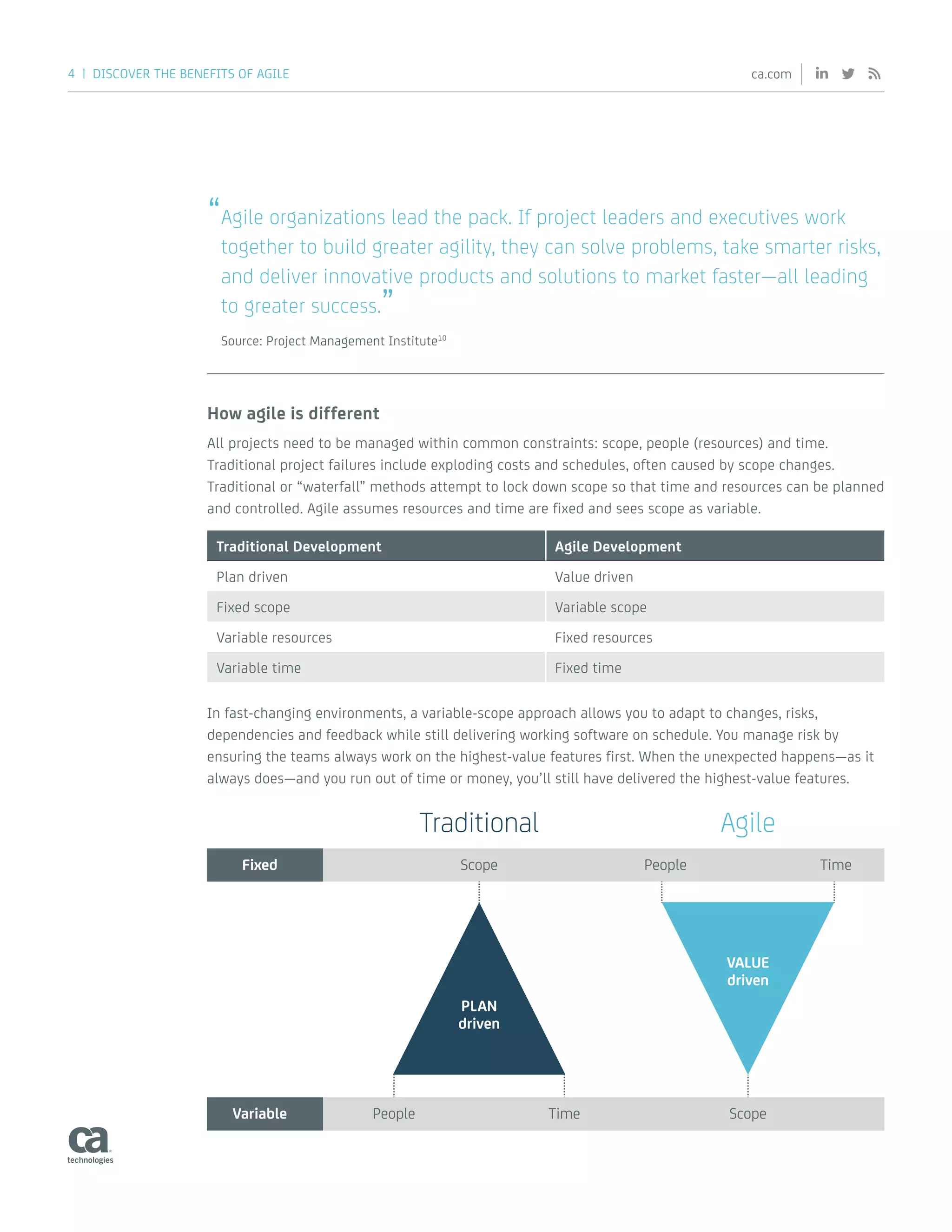
All projects need to be managed within common constraints: scope, people (resources) and time.
Traditional project failures include exploding costs and schedules, often caused by scope changes.
Traditional or “waterfall” methods attempt to lock down scope so that time and resources can be planned
and controlled. Agile assumes resources and time are fixed and sees scope as variable.
Traditional Development Agile Development
Plan driven Value driven
Fixed scope Variable scope
Variable resources Fixed resources
Variable time Fixed time
In fast-changing environments, a variable-scope approach allows you to adapt to changes, risks,
dependencies and feedback while still delivering working software on schedule. You manage risk by
ensuring the teams always work on the highest-value features first. When the unexpected happens—as it
always does—and you run out of time or money, you’ll still have delivered the highest-value features.
Traditional Agile
Fixed Scope People Time
Variable ScopePeople Time
PLAN
driven
VALUE
driven
5 | DISCOVER THE BENEFITS OF AGILE ca.com
Agile Methodologies
“Scrum” has become the most prevalent agile approach due to its simplicity and application to a wide
variety of work. “Lean” is borrowed from Japanese manufacturing approaches (think Toyota) and focuses
on eliminating waste while improving flow along an entire value stream. “Kanban,” which developed from
Lean manufacturing approaches, is quickly being adopted as useful method to facilitate flow, eliminate
waste, continuously improve and make the status of work progress more visible. “XP” (eXtreme
Programming) provides important guidance on the technical practices that enable rapid, incremental
development. Emerging flavors of agile—including test-driven development, behavior-driven development
and set-based engineering—address the specialized needs of the broad range of users now employing
agile approaches.
Scrum
Borrowed from the game of rugby, scrum is the name of a project management framework in which self-
organizing, cross-functional teams deliver shippable, working software in a set time period called a “sprint.”
In each sprint (typically between one week and one month and commonly two weeks), team members plan
the work they can commit to finishing in that timebox, build a backlog of features broken down into user
stories, gather for a daily “standup” (a fifteen-minute meeting in which they share daily progress and any
blocks), complete each story from idea to functional, production-level code, demo working software to
stakeholders to collect feedback and perform a retrospective, during which they review the sprint and
commit to improving process and product.
“Delivering high-quality end products quickly requires new ways of working,
including agile development, rapid release cycles, automated testing and
deployment and a ‘test and learn’ approach to changes.”
Source: McKinsey11
Agile roles
Agile teams (often known as the scrum team or delivery team) comprise the engine that powers agile’s
success. Research has shown that the optimal team size is seven, plus or minus two members, and that
stable teams (in which members aren’t frequently reassigned) produce the best results.12
ScrumMasters help the teams become high-performing. They facilitate team members’ relationships
with outside stakeholders, remove obstacles to progress and run efficient standups and other
collaborative meetings. ScrumMasters are servant leaders, rather than project managers. Instead of
command-and-control management tactics, they use collaboration and facilitation to help teams focus on
making and meeting commitments with quality and they clear the obstacles in the teams’ way.
6 | DISCOVER THE BENEFITS OF AGILE ca.com
Product owners own the vision of the product. They represent the needs of the user or customer by
deciding what work goes into the backlog, how it’s prioritized, how changes are integrated and when the
work is “done.” Product owners ensure teams understand the business value of their work.
Team members contribute to the team’s completion of its work by planning and finishing user stories. Team
members may be developers, testers, user experience researchers, engineering specialists, marketers or
other discipline-specific roles, but they work cross-functionally to build and deliver a product.
Manager roles (such as engineering director, IT director, portfolio manager, program manager, business
development manager and executive-level leaders) perform a range of important functions, especially for
those doing agile at scale. They provide budget and cost inputs, instill trust and transparency, manage
external stakeholders, coordinate multiple teams, facilitate career development, own issues or risks and
manage vendor contracts.
Agile at Scale
Scaling agile, especially in large, enterprise companies, isn’t just about adding more agile teams. Agile at
scale requires integrating agile principles into your organizational structure, company culture, process,
operations and strategic thinking. For the best results, you’ll scale horizontally (coordinating and aligning
teams of teams) and vertically (connecting development work to company strategy and portfolio
initiatives).
Agile approaches may seem simple, but scaling agile isn’t easy. It requires coordination, a willingness to
transform, lots of practice and commitment to the tenets of collaboration, visibility and continuous
improvement. However, scaling agile across your organization yields agility, flexibility and organizational
health. This is where you really see the promise of agile in delivering four times results in speed,
productivity, time to market and—ultimately—your bottom line.
If scrum and team-level agile help you establish cadence and synchronization, then agile at scale means
taking that cadence and synchronization to the next level. If you’re considering agile at scale, then
consider how you’d answer these questions:
•	How does work flow to your teams?
•	How far into the future do you plan?
•	Do you include people from outside IT or engineering in your planning?
•	What happens if the world changes after you plan?
7 | DISCOVER THE BENEFITS OF AGILE ca.com
Cadence
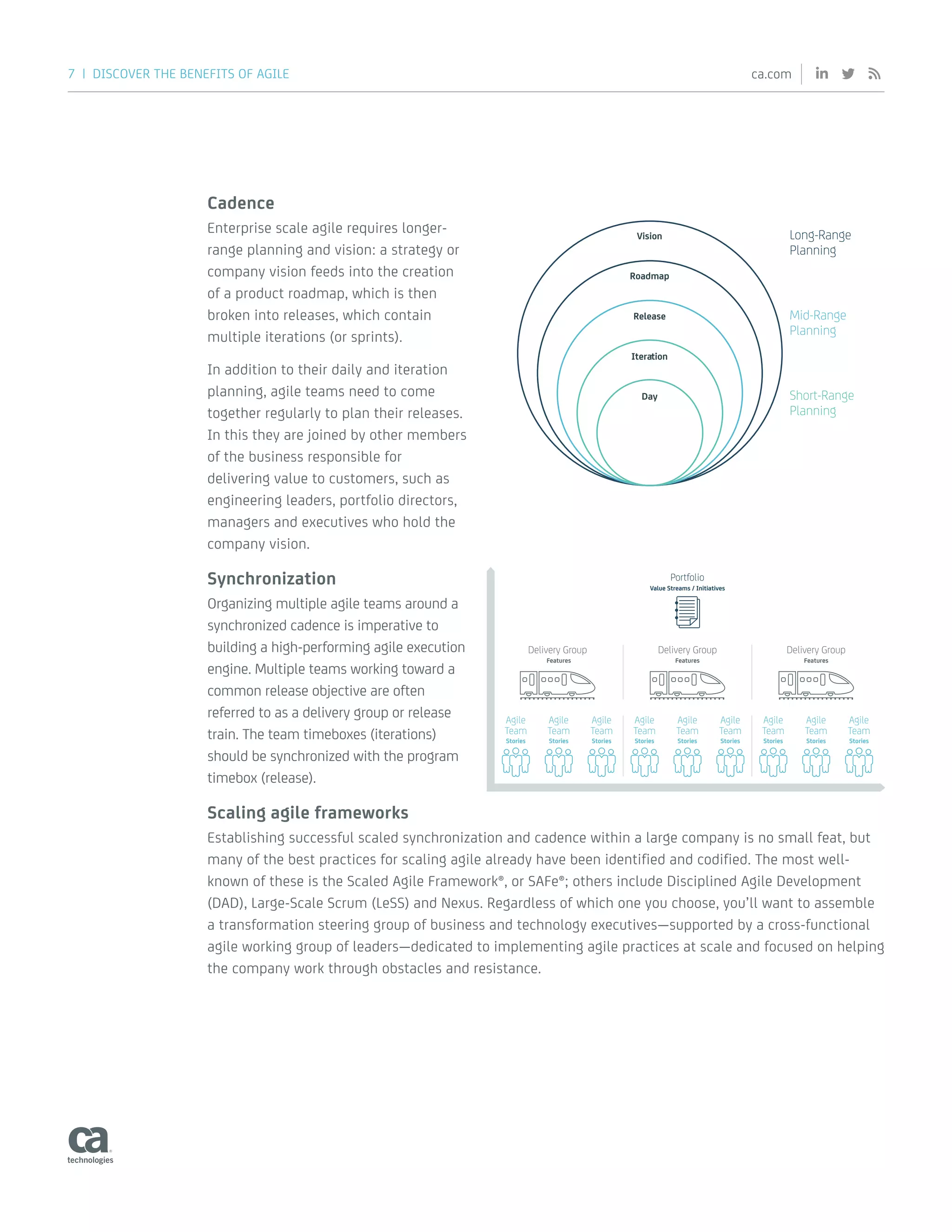
Enterprise scale agile requires longer-
range planning and vision: a strategy or
company vision feeds into the creation
of a product roadmap, which is then
broken into releases, which contain
multiple iterations (or sprints).
In addition to their daily and iteration
planning, agile teams need to come
together regularly to plan their releases.
In this they are joined by other members
of the business responsible for
delivering value to customers, such as
engineering leaders, portfolio directors,
managers and executives who hold the
company vision.
Synchronization
Organizing multiple agile teams around a
synchronized cadence is imperative to
building a high-performing agile execution
engine. Multiple teams working toward a
common release objective are often
referred to as a delivery group or release
train. The team timeboxes (iterations)
should be synchronized with the program
timebox (release).
Scaling agile frameworks
Establishing successful scaled synchronization and cadence within a large company is no small feat, but
many of the best practices for scaling agile already have been identified and codified. The most well-
known of these is the Scaled Agile Framework®, or SAFe®; others include Disciplined Agile Development
(DAD), Large-Scale Scrum (LeSS) and Nexus. Regardless of which one you choose, you’ll want to assemble
a transformation steering group of business and technology executives—supported by a cross-functional
agile working group of leaders—dedicated to implementing agile practices at scale and focused on helping
the company work through obstacles and resistance.
Vision Long-Range
Planning
Mid-Range
Planning
Short-Range
Planning
Roadmap
Release
Iteration
Day
Stories
Agile
Team
Stories
Agile
Team
Stories
Agile
Team
Stories
Agile
Team
Stories
Agile
Team
Stories
Agile
Team
Stories
Agile
Team
Stories
Agile
Team
Stories
Agile
Team
Value Streams / Initiatives
Features
Delivery Group
Portfolio
Features Features
Delivery Group Delivery Group
8 | DISCOVER THE BENEFITS OF AGILE ca.com
Release planning
Whereas sprint planning is done approximately every two weeks or at the start of each iteration, release
planning (also called program increment planning or big room planning) is done several times per year
(commonly every 10 to 12 weeks.) Release planning serves as a way to bring the company vision and
product roadmap into the same room with the people who will be executing on it. At an enterprise
company, release planning may involve several hundred people connected to a particular value stream,
working across two days, to identify risks, make adjustments and finalize a delivery plan.
This event typically has four key parts:
•	An executive sets the vision and context for the work to be done, so that those doing it understand the
business drivers for its importance.
•	During team breakouts, the delivery teams plan and prioritize their feature backlogs, slotting stories into
sprints, according to the work they believe they can commit to finishing within the release.
•	ScrumMasters, product owners and leaders help surface and resolve any needed adjustments, risks and
dependencies when the teams re-assemble.
•	Everyone involved votes on their commitment to the plan for the work to come.
Release planning represents a very different approach for many companies that traditionally perform
planning as an annual, management-only meeting, disconnected from those who will actually do the
work. Yet this planning ceremony is the crux of successful agile at scale—it directly maps your company’s
business strategy to your execution engine.
Some companies balk at the expense of assembling all these people together, many of whom may not
even work on the same continent and are taking time out from their day-to-day activities, to engage in
this event. Yet when these companies factor in the run rate for a development organization (not to
mention the risks of not doing such considered, mitigated planning), they find release planning to be an
investment that quickly pays for itself.
“By 2018 the transition to agile, DevOps and Web-scale IT practices will
become as disruptive to IT as the adoption of lean was to manufacturing
during the 1980s.”
Source: Gartner, Inc.13
9 | DISCOVER THE BENEFITS OF AGILE ca.com
Building an Agile Business
As the pace of change accelerates and disruption becomes the norm, the most successful companies are
differentiating themselves by sensing market opportunities and responding more quickly and confidently
than the competition. Organizational agility of this order requires architecting your whole business system
for speed, adaptation and opportunity. It means breaking down silos between departments and engaging
marketing, sales, finance, operations and the executive suite, so you can steer the entire company in the
right direction.
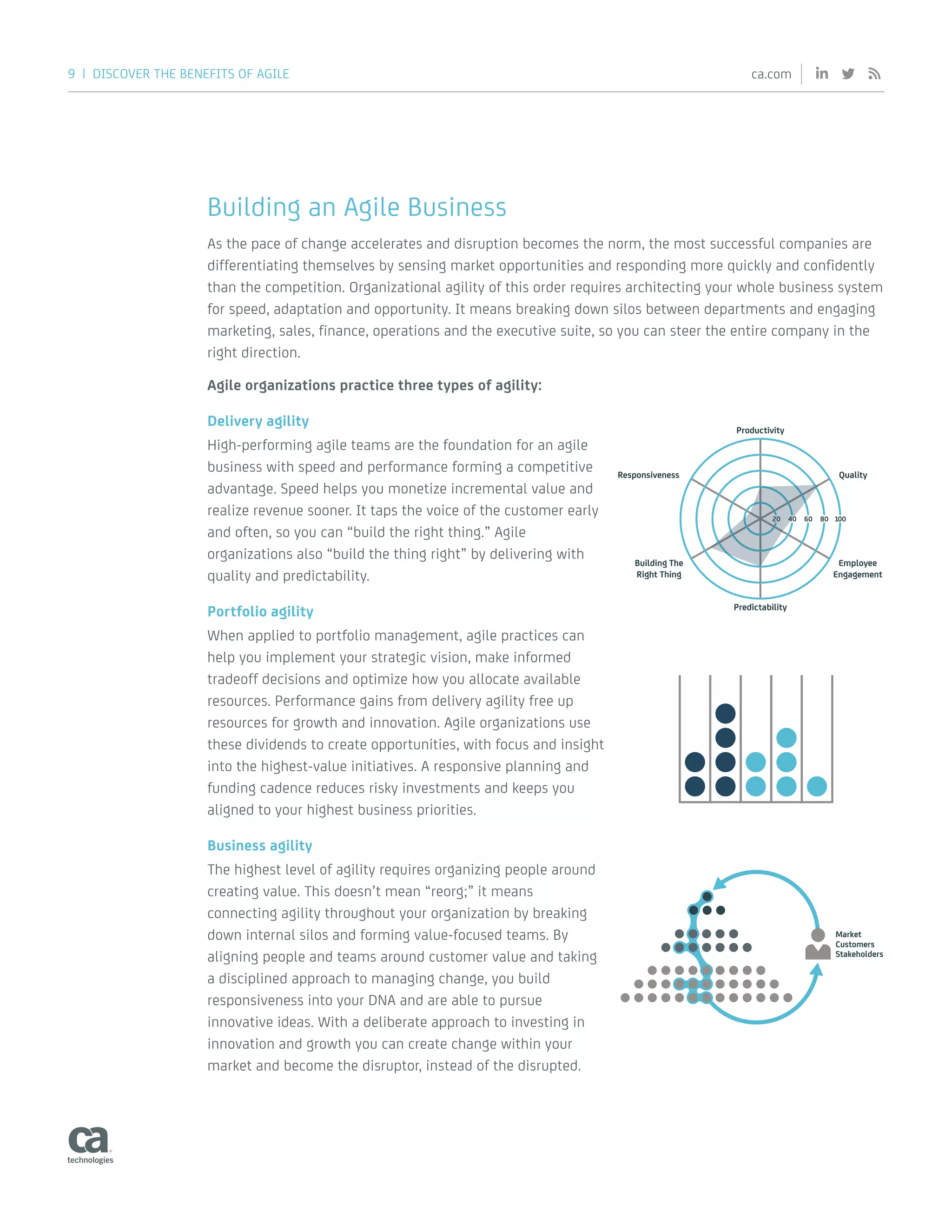
Agile organizations practice three types of agility:
Delivery agility
High-performing agile teams are the foundation for an agile
business with speed and performance forming a competitive
advantage. Speed helps you monetize incremental value and
realize revenue sooner. It taps the voice of the customer early
and often, so you can “build the right thing.” Agile
organizations also “build the thing right” by delivering with
quality and predictability.
Portfolio agility
When applied to portfolio management, agile practices can
help you implement your strategic vision, make informed
tradeoff decisions and optimize how you allocate available
resources. Performance gains from delivery agility free up
resources for growth and innovation. Agile organizations use
these dividends to create opportunities, with focus and insight
into the highest-value initiatives. A responsive planning and
funding cadence reduces risky investments and keeps you
aligned to your highest business priorities.
Business agility
The highest level of agility requires organizing people around
creating value. This doesn’t mean “reorg;” it means
connecting agility throughout your organization by breaking
down internal silos and forming value-focused teams. By
aligning people and teams around customer value and taking
a disciplined approach to managing change, you build
responsiveness into your DNA and are able to pursue
innovative ideas. With a deliberate approach to investing in
innovation and growth you can create change within your
market and become the disruptor, instead of the disrupted.
Productivity
Predictability
Quality
Employee
Engagement
Responsiveness
Building The
Right Thing
10080604020
Market
Customers
Stakeholders
10 | DISCOVER THE BENEFITS OF AGILE ca.com
Get Started with Agile
Does your company suffer from any of these symptoms?
•	Unrealistic plans
•	Frequent pivots
•	Customer dissatisfaction
•	Lack of commitment
•	Quality or technical debt issues
•	Risks that explode
•	Delayed delivery
•	Dependencies that block
•	Unstaffed priorities
•	Low developer morale
If so, then it might be time for you to consider a new way to work. Now is the time to get started
with agile.
“Employing a solid combination of knowledge, tools, and experience is what
allows organizations to leverage the principles of Agile in a way that
supports the needs of the business.”
Source: Pricewaterhouse Coopers14
Whether you’re just learning about agile or want to improve what you’re already doing, we can help.
Visit rallydev.com/discoveragile to take the next step.
11 | DISCOVER THE BENEFITS OF AGILE ca.com
Copyright © 2015 CA. All rights reserved. All trademarks, trade names, service marks
and logos referenced herein belong to their respective companies. CS200-151513
Connect with CA Technologies at ca.com
CA Technologies (NASDAQ: CA) creates software that fuels transformation for
companies and enables them to seize the opportunities of the application economy.
Software is at the heart of every business, in every industry. From planning to
development to management and security, CA is working with companies worldwide
to change the way we live, transact and communicate – across mobile, private
and public cloud, distributed and mainframe environments. Learn more at ca.com.
1 http://www.mckinsey.com/insights/high_tech_telecoms_internet/the_perils_of_ignoring_software_development
2 https://www.rallydev.com/resource/business-agility-survival-guide
3 http://www.pmi.org/~/media/PDF/Business-Solutions/PMI_Pulse_2014.ashx
4 http://www.davidfrico.com/rico08b.pdf
5 https://www.rallydev.com/resource/tata-communications-case-study
6 http://www.executiveboard.com/exbd-resources/pdf/executive-guidance/eg2013-annual-final.pdf
7 https://www.accenture.com/us-en/insight-digital-it-research
8 Gartner, Inc., “Predicts 2015: Application Development,” Mark Driver, Nathan Wilson, Jim Duggan, Ronni J. Colville, Jason Wong, Laurie F.
Wurster, Thomas E. Murphy, Yefim V. Natis, Magnus Revang, 19 November, 2014.
9 http://www.agilemanifesto.org/
10 Project Management Institute, http://www.pmi.org/~/media/PDF/Research/Organizational-Agility-In-Depth-Report.ashx
11 McKinsey, http://www.mckinsey.com/Insights/Business_Technology/Reinventing_IT_to_support_digitization
12 https://www.rallydev.com/resource/impact-agile-quantified-sdpi-whitepaper
13 Gartner, Inc., “Predicts 2015: Application Development,” Mark Driver, Nathan Wilson, Jim Duggan, Ronni J. Colville, Jason Wong, Laurie F.
Wurster, Thomas E. Murphy, Yefim V. Natis, Magnus Revang, 19 November, 2014.
14 https://www.pwc.com/en_US/us/insurance/publications/assets/pwc-using-agile-methodology.pdf

Discover the benefits of Agile - 2015

  • 1.
    Discover the Benefitsof Agile The Business Case for a New Way to Work Deliver at the New Speed of Business You’re operating in a world that’s global, responsive, customer-focused and technology-driven. With software as the key driver of growth, innovation, efficiency and productivity, how you deliver software says a lot about how you’ll compete in this world. “Embracing the rising strategic importance of software, and viewing its development as a crucial competitive battlefield, are keys to success for an ever-growing number of companies.” Source: McKinsey1 A world written by software spells opportunities for those who capitalize on it and risks for those who don’t. The companies that survive—and thrive—in this world will be agile companies: those able to quickly and confidently respond to change, deliver value faster than the competition and build high-quality products that customers really want. Why Agile The agile approach to developing software—and managing work in general—is your passport to success in the application economy. Agile promises a range of benefits: faster time to market, increased productivity, fewer defects, cost savings and better employee engagement. • Agile companies have been found to grow revenue 37 percent faster and generate 30 percent higher profits.2 • The Project Management Institute found that highly agile organizations are 50 percent more likely to successfully complete their strategic initiatives.3 • A summary of research on project management methods found that agile approaches yielded 29 percent better cost, 91 percent better schedule, 97 percent better productivity, 50 percent better quality, 400 percent better satisfaction and 470 percent better ROI than the least effective traditional methods.4
  • 2.
    2 | DISCOVERTHE BENEFITS OF AGILE ca.com Agile methods help you to build and deliver products incrementally, to get value to customers quickly and to keep development work aligned with business needs. Agile approaches emphasize these tenets: • Disciplined project management to minimize waste and deliver on schedule • Self-organizing, cross-functional, and collaborative teams • Customer satisfaction through delivery of software in short, frequent cycles • Frequent inspect-and-adapt sessions for continuous improvement Here are some of the results you can expect to see when you adopt agile approaches: Get to market faster Anyone with a smartphone knows we’re living in an app economy: customers expect to see product updates and improvements on a regular basis. When you get your releases out the door on an agile cadence, you’ll not only deliver value to customers faster than your competition, you’ll get revenue in the door sooner too. Build high-quality products that customers value Agile’s user-centric approach—which delivers value in short cycles so customer feedback can be integrated into the development process—means you can align your strategy and development work around building what customers want most. Agile approaches also integrate testing into the development process, which improves quality and helps identify defects prior to release. Reduce risk and eliminate waste Traditional software development required long planning, design and development phases resulting in infrequent, big-bang releases that risked delivering the wrong thing, too late. By delivering value to customers more frequently and integrating their feedback, agile approaches help you respond more effectively to the market reducing the risk of expensive market misses. “We uncovered the performance costs of unstable teams … and are seeing 30–50 percent improvements in both cost and delivery duration compared to similar waterfall projects.” Source: Tata Communications5 Collaborate better Self-organizing, cross-functional teams are the foundation of successful agile practices. These empowered teams don’t just produce better products and services: they also produce more engaged employees. According to the Corporate Executive Board (CEB), agile employees outperform so-called “hard workers” by nearly 20 percent.6
  • 3.
    3 | DISCOVERTHE BENEFITS OF AGILE ca.com Gain an edge on the future A report from Accenture found that high-performing organizations are six times more likely than other organizations to have adopted agile methodologies.7 And Computer Economics’ “IT Spending and Staffing Benchmarks” study estimates that 83 percent of businesses plan to implement agile (up from 59 percent previously). In fact, “By 2018, the majority of software projects, as measured by the Gartner CIO survey, will be agile-centric.”8 Agile Foundations Agile approaches have been around for decades but were codified in 2001 with the Agile Manifesto,9 a lightweight set of values for managing software development projects which include: Individuals and interactions over processes and tools Working software over comprehensive documentation Customer collaboration over contract negotiation Responding to change over following a plan Agile is an umbrella term for a variety of work-management approaches that share common principles— among them cross-functional collaboration, a focus on customer value, iterative and incremental delivery (early and often), pulling quality forward, limiting work in progress (WiP) and continuous improvement. Once considered a fad, agile has matured into a popular and respected set of development methods. In fact, agile has expanded outside of software development and IT into sectors like banking, management consulting, automotive manufacturing and healthcare. Companies are moving to agile methods because the global marketplace demands they bring products that better reflect their customers’ needs to market faster, Where the traditional “waterfall” approach—with its sequential phases and heavy investment in large-scale, upfront design—lacks the flexibility to help organizations respond swiftly to changing markets, agile approaches offer faster delivery, higher quality and an engaged development team that can deliver on its commitments. It’s about more than just software Agile isn’t just a software development methodology. To deliver customer value faster, organizations need to be agile in their organizational structure, processes, ceremonies and culture. What started as a movement around software teams is now an enterprise-scale business approach, applied across teams in distributed office locations—and it’s an operational model in which companies use their business agility (agile execution, adaptive portfolio management and disciplined innovation) as a competitive advantage.
  • 4.
    4 | DISCOVERTHE BENEFITS OF AGILE ca.com “Agile organizations lead the pack. If project leaders and executives work together to build greater agility, they can solve problems, take smarter risks, and deliver innovative products and solutions to market faster—all leading to greater success.” Source: Project Management Institute10 How agile is different All projects need to be managed within common constraints: scope, people (resources) and time. Traditional project failures include exploding costs and schedules, often caused by scope changes. Traditional or “waterfall” methods attempt to lock down scope so that time and resources can be planned and controlled. Agile assumes resources and time are fixed and sees scope as variable. Traditional Development Agile Development Plan driven Value driven Fixed scope Variable scope Variable resources Fixed resources Variable time Fixed time In fast-changing environments, a variable-scope approach allows you to adapt to changes, risks, dependencies and feedback while still delivering working software on schedule. You manage risk by ensuring the teams always work on the highest-value features first. When the unexpected happens—as it always does—and you run out of time or money, you’ll still have delivered the highest-value features. Traditional Agile Fixed Scope People Time Variable ScopePeople Time PLAN driven VALUE driven
  • 5.
    5 | DISCOVERTHE BENEFITS OF AGILE ca.com Agile Methodologies “Scrum” has become the most prevalent agile approach due to its simplicity and application to a wide variety of work. “Lean” is borrowed from Japanese manufacturing approaches (think Toyota) and focuses on eliminating waste while improving flow along an entire value stream. “Kanban,” which developed from Lean manufacturing approaches, is quickly being adopted as useful method to facilitate flow, eliminate waste, continuously improve and make the status of work progress more visible. “XP” (eXtreme Programming) provides important guidance on the technical practices that enable rapid, incremental development. Emerging flavors of agile—including test-driven development, behavior-driven development and set-based engineering—address the specialized needs of the broad range of users now employing agile approaches. Scrum Borrowed from the game of rugby, scrum is the name of a project management framework in which self- organizing, cross-functional teams deliver shippable, working software in a set time period called a “sprint.” In each sprint (typically between one week and one month and commonly two weeks), team members plan the work they can commit to finishing in that timebox, build a backlog of features broken down into user stories, gather for a daily “standup” (a fifteen-minute meeting in which they share daily progress and any blocks), complete each story from idea to functional, production-level code, demo working software to stakeholders to collect feedback and perform a retrospective, during which they review the sprint and commit to improving process and product. “Delivering high-quality end products quickly requires new ways of working, including agile development, rapid release cycles, automated testing and deployment and a ‘test and learn’ approach to changes.” Source: McKinsey11 Agile roles Agile teams (often known as the scrum team or delivery team) comprise the engine that powers agile’s success. Research has shown that the optimal team size is seven, plus or minus two members, and that stable teams (in which members aren’t frequently reassigned) produce the best results.12 ScrumMasters help the teams become high-performing. They facilitate team members’ relationships with outside stakeholders, remove obstacles to progress and run efficient standups and other collaborative meetings. ScrumMasters are servant leaders, rather than project managers. Instead of command-and-control management tactics, they use collaboration and facilitation to help teams focus on making and meeting commitments with quality and they clear the obstacles in the teams’ way.
  • 6.
    6 | DISCOVERTHE BENEFITS OF AGILE ca.com Product owners own the vision of the product. They represent the needs of the user or customer by deciding what work goes into the backlog, how it’s prioritized, how changes are integrated and when the work is “done.” Product owners ensure teams understand the business value of their work. Team members contribute to the team’s completion of its work by planning and finishing user stories. Team members may be developers, testers, user experience researchers, engineering specialists, marketers or other discipline-specific roles, but they work cross-functionally to build and deliver a product. Manager roles (such as engineering director, IT director, portfolio manager, program manager, business development manager and executive-level leaders) perform a range of important functions, especially for those doing agile at scale. They provide budget and cost inputs, instill trust and transparency, manage external stakeholders, coordinate multiple teams, facilitate career development, own issues or risks and manage vendor contracts. Agile at Scale Scaling agile, especially in large, enterprise companies, isn’t just about adding more agile teams. Agile at scale requires integrating agile principles into your organizational structure, company culture, process, operations and strategic thinking. For the best results, you’ll scale horizontally (coordinating and aligning teams of teams) and vertically (connecting development work to company strategy and portfolio initiatives). Agile approaches may seem simple, but scaling agile isn’t easy. It requires coordination, a willingness to transform, lots of practice and commitment to the tenets of collaboration, visibility and continuous improvement. However, scaling agile across your organization yields agility, flexibility and organizational health. This is where you really see the promise of agile in delivering four times results in speed, productivity, time to market and—ultimately—your bottom line. If scrum and team-level agile help you establish cadence and synchronization, then agile at scale means taking that cadence and synchronization to the next level. If you’re considering agile at scale, then consider how you’d answer these questions: • How does work flow to your teams? • How far into the future do you plan? • Do you include people from outside IT or engineering in your planning? • What happens if the world changes after you plan?
  • 7.
    7 | DISCOVERTHE BENEFITS OF AGILE ca.com Cadence Enterprise scale agile requires longer- range planning and vision: a strategy or company vision feeds into the creation of a product roadmap, which is then broken into releases, which contain multiple iterations (or sprints). In addition to their daily and iteration planning, agile teams need to come together regularly to plan their releases. In this they are joined by other members of the business responsible for delivering value to customers, such as engineering leaders, portfolio directors, managers and executives who hold the company vision. Synchronization Organizing multiple agile teams around a synchronized cadence is imperative to building a high-performing agile execution engine. Multiple teams working toward a common release objective are often referred to as a delivery group or release train. The team timeboxes (iterations) should be synchronized with the program timebox (release). Scaling agile frameworks Establishing successful scaled synchronization and cadence within a large company is no small feat, but many of the best practices for scaling agile already have been identified and codified. The most well- known of these is the Scaled Agile Framework®, or SAFe®; others include Disciplined Agile Development (DAD), Large-Scale Scrum (LeSS) and Nexus. Regardless of which one you choose, you’ll want to assemble a transformation steering group of business and technology executives—supported by a cross-functional agile working group of leaders—dedicated to implementing agile practices at scale and focused on helping the company work through obstacles and resistance. Vision Long-Range Planning Mid-Range Planning Short-Range Planning Roadmap Release Iteration Day Stories Agile Team Stories Agile Team Stories Agile Team Stories Agile Team Stories Agile Team Stories Agile Team Stories Agile Team Stories Agile Team Stories Agile Team Value Streams / Initiatives Features Delivery Group Portfolio Features Features Delivery Group Delivery Group
  • 8.
    8 | DISCOVERTHE BENEFITS OF AGILE ca.com Release planning Whereas sprint planning is done approximately every two weeks or at the start of each iteration, release planning (also called program increment planning or big room planning) is done several times per year (commonly every 10 to 12 weeks.) Release planning serves as a way to bring the company vision and product roadmap into the same room with the people who will be executing on it. At an enterprise company, release planning may involve several hundred people connected to a particular value stream, working across two days, to identify risks, make adjustments and finalize a delivery plan. This event typically has four key parts: • An executive sets the vision and context for the work to be done, so that those doing it understand the business drivers for its importance. • During team breakouts, the delivery teams plan and prioritize their feature backlogs, slotting stories into sprints, according to the work they believe they can commit to finishing within the release. • ScrumMasters, product owners and leaders help surface and resolve any needed adjustments, risks and dependencies when the teams re-assemble. • Everyone involved votes on their commitment to the plan for the work to come. Release planning represents a very different approach for many companies that traditionally perform planning as an annual, management-only meeting, disconnected from those who will actually do the work. Yet this planning ceremony is the crux of successful agile at scale—it directly maps your company’s business strategy to your execution engine. Some companies balk at the expense of assembling all these people together, many of whom may not even work on the same continent and are taking time out from their day-to-day activities, to engage in this event. Yet when these companies factor in the run rate for a development organization (not to mention the risks of not doing such considered, mitigated planning), they find release planning to be an investment that quickly pays for itself. “By 2018 the transition to agile, DevOps and Web-scale IT practices will become as disruptive to IT as the adoption of lean was to manufacturing during the 1980s.” Source: Gartner, Inc.13
  • 9.
    9 | DISCOVERTHE BENEFITS OF AGILE ca.com Building an Agile Business As the pace of change accelerates and disruption becomes the norm, the most successful companies are differentiating themselves by sensing market opportunities and responding more quickly and confidently than the competition. Organizational agility of this order requires architecting your whole business system for speed, adaptation and opportunity. It means breaking down silos between departments and engaging marketing, sales, finance, operations and the executive suite, so you can steer the entire company in the right direction. Agile organizations practice three types of agility: Delivery agility High-performing agile teams are the foundation for an agile business with speed and performance forming a competitive advantage. Speed helps you monetize incremental value and realize revenue sooner. It taps the voice of the customer early and often, so you can “build the right thing.” Agile organizations also “build the thing right” by delivering with quality and predictability. Portfolio agility When applied to portfolio management, agile practices can help you implement your strategic vision, make informed tradeoff decisions and optimize how you allocate available resources. Performance gains from delivery agility free up resources for growth and innovation. Agile organizations use these dividends to create opportunities, with focus and insight into the highest-value initiatives. A responsive planning and funding cadence reduces risky investments and keeps you aligned to your highest business priorities. Business agility The highest level of agility requires organizing people around creating value. This doesn’t mean “reorg;” it means connecting agility throughout your organization by breaking down internal silos and forming value-focused teams. By aligning people and teams around customer value and taking a disciplined approach to managing change, you build responsiveness into your DNA and are able to pursue innovative ideas. With a deliberate approach to investing in innovation and growth you can create change within your market and become the disruptor, instead of the disrupted. Productivity Predictability Quality Employee Engagement Responsiveness Building The Right Thing 10080604020 Market Customers Stakeholders
  • 10.
    10 | DISCOVERTHE BENEFITS OF AGILE ca.com Get Started with Agile Does your company suffer from any of these symptoms? • Unrealistic plans • Frequent pivots • Customer dissatisfaction • Lack of commitment • Quality or technical debt issues • Risks that explode • Delayed delivery • Dependencies that block • Unstaffed priorities • Low developer morale If so, then it might be time for you to consider a new way to work. Now is the time to get started with agile. “Employing a solid combination of knowledge, tools, and experience is what allows organizations to leverage the principles of Agile in a way that supports the needs of the business.” Source: Pricewaterhouse Coopers14 Whether you’re just learning about agile or want to improve what you’re already doing, we can help. Visit rallydev.com/discoveragile to take the next step.
  • 11.
    11 | DISCOVERTHE BENEFITS OF AGILE ca.com Copyright © 2015 CA. All rights reserved. All trademarks, trade names, service marks and logos referenced herein belong to their respective companies. CS200-151513 Connect with CA Technologies at ca.com CA Technologies (NASDAQ: CA) creates software that fuels transformation for companies and enables them to seize the opportunities of the application economy. Software is at the heart of every business, in every industry. From planning to development to management and security, CA is working with companies worldwide to change the way we live, transact and communicate – across mobile, private and public cloud, distributed and mainframe environments. Learn more at ca.com. 1 http://www.mckinsey.com/insights/high_tech_telecoms_internet/the_perils_of_ignoring_software_development 2 https://www.rallydev.com/resource/business-agility-survival-guide 3 http://www.pmi.org/~/media/PDF/Business-Solutions/PMI_Pulse_2014.ashx 4 http://www.davidfrico.com/rico08b.pdf 5 https://www.rallydev.com/resource/tata-communications-case-study 6 http://www.executiveboard.com/exbd-resources/pdf/executive-guidance/eg2013-annual-final.pdf 7 https://www.accenture.com/us-en/insight-digital-it-research 8 Gartner, Inc., “Predicts 2015: Application Development,” Mark Driver, Nathan Wilson, Jim Duggan, Ronni J. Colville, Jason Wong, Laurie F. Wurster, Thomas E. Murphy, Yefim V. Natis, Magnus Revang, 19 November, 2014. 9 http://www.agilemanifesto.org/ 10 Project Management Institute, http://www.pmi.org/~/media/PDF/Research/Organizational-Agility-In-Depth-Report.ashx 11 McKinsey, http://www.mckinsey.com/Insights/Business_Technology/Reinventing_IT_to_support_digitization 12 https://www.rallydev.com/resource/impact-agile-quantified-sdpi-whitepaper 13 Gartner, Inc., “Predicts 2015: Application Development,” Mark Driver, Nathan Wilson, Jim Duggan, Ronni J. Colville, Jason Wong, Laurie F. Wurster, Thomas E. Murphy, Yefim V. Natis, Magnus Revang, 19 November, 2014. 14 https://www.pwc.com/en_US/us/insurance/publications/assets/pwc-using-agile-methodology.pdf