Copyright Management for the LUISA Semantic Learning Content Management System Roberto García Universitat de Lleida, Spain Tomas Pariente ATOS Origin SAE, Spain www.luisa-project.eu LUISA is an European Comission FP6 funded  Specific Targeted Research Project
Table of Contents Introduction Motivation Related Work Proposal Copyright Model License Modelling Conclusions & Future Work
Introduction “ Web-spread” of e-Learning solutions requires  Interoperability Enabler: richer  semantics  than current metadata specifications for learning resources LUISA  (EU-IST-FP6):  reference semantic and service-oriented architecture for e-Learning Search, interchange and delivery of learning objects Face interoperability at different levels using Semantic Web  technologies
Motivation At the content copyright level: eLearning  DRM interoperability Main problem:  lack  of  structured  and  formal  ways to express the licensing terms of learning objects Sakai : predefined and simple copyright status sentences  “ Material is in public domain” or “I hold copyright” “ Use copyright below” + text box LOM : set of  attributes for stating learning object rights:  “ Cost”, “Copyright and Other Restrictions” and “Description”
Related Work Creative Commons: Focus on  open licensing  schemes e.g. Open Courseware Extension for  custom  licensing schemes (CCPlus), but  not  based on  formalised  license building blocks DRM Standards:  ISO/IEC MPEG-21 Rights Expression Language (REL) Open Digital Rights Language (ODRL)
Related Work DRM Standards issues [1]: Don’t scale well to  open environments  like the Web More appropriate for closed domains Cause  interoperability issues One of the main DRM end-users complains Rights language  limited expressivity  Difficult to accommodate copyright law Standardisation based on formal language grammar, no formal semantics [1] Electronic Frontier Foundation Report by Doctorow, 2005
Proposal Use the  Copyright Ontology  [1] in order to model e-Learning copyright licenses More  expressive  than XML approaches Facilitates  interoperability , works at the semantic level Based on a copyright law model, WIPO worldwide recommendations [2] Also based on  Semantic Web  technologies Copyright Ontology: provides the  building blocks  and restrictions to flexibly  model  LOs  licensing  terms [1]  Copyright Ontology,  http://rhizomik.net/ontologies/copyrightonto [2] World Intellectual Property Organisation,  http://www.wipo.int
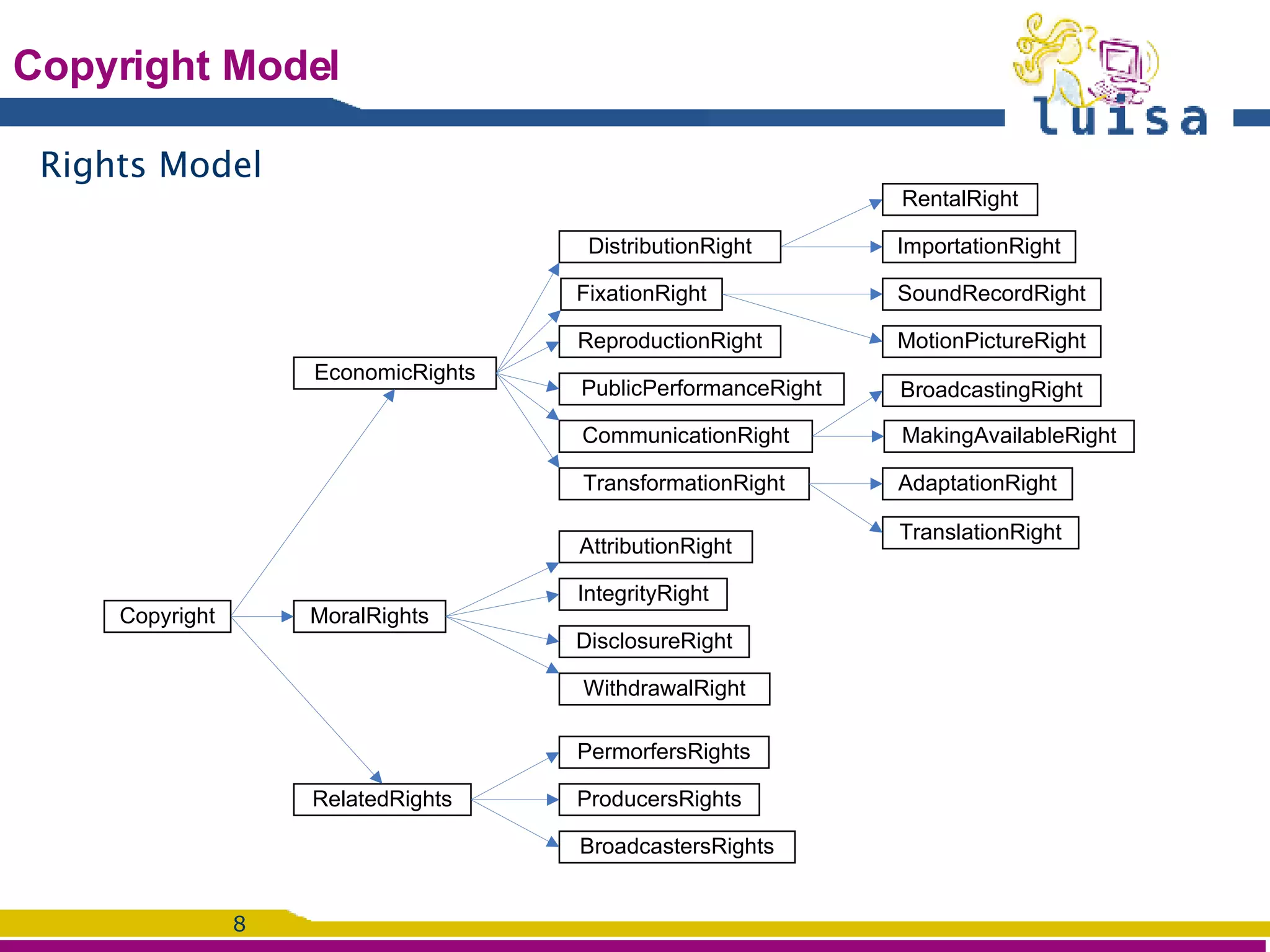
Copyright Model Rights Model
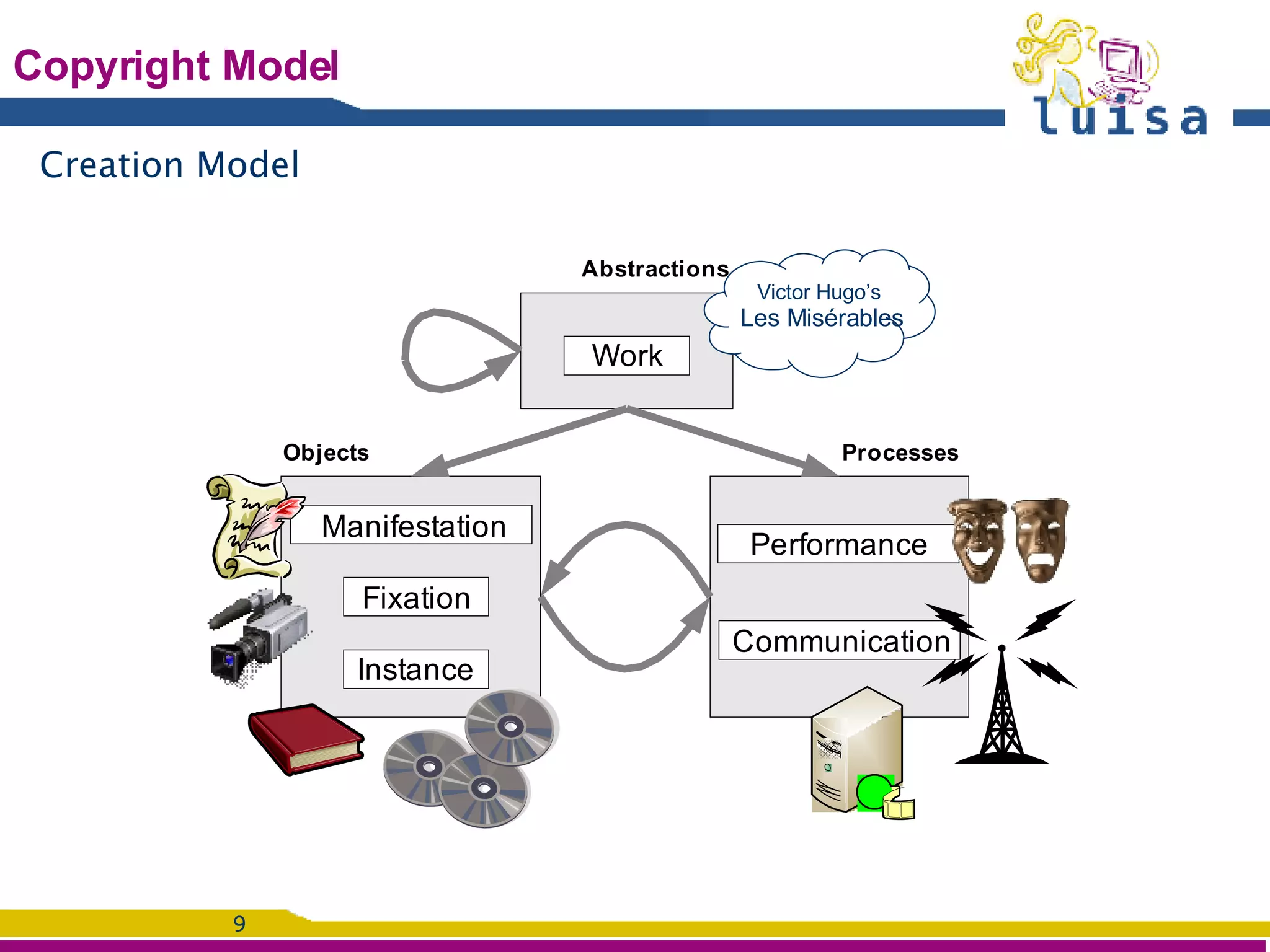
Copyright Model Victor Hugo’s  Les Misérables Creation Model
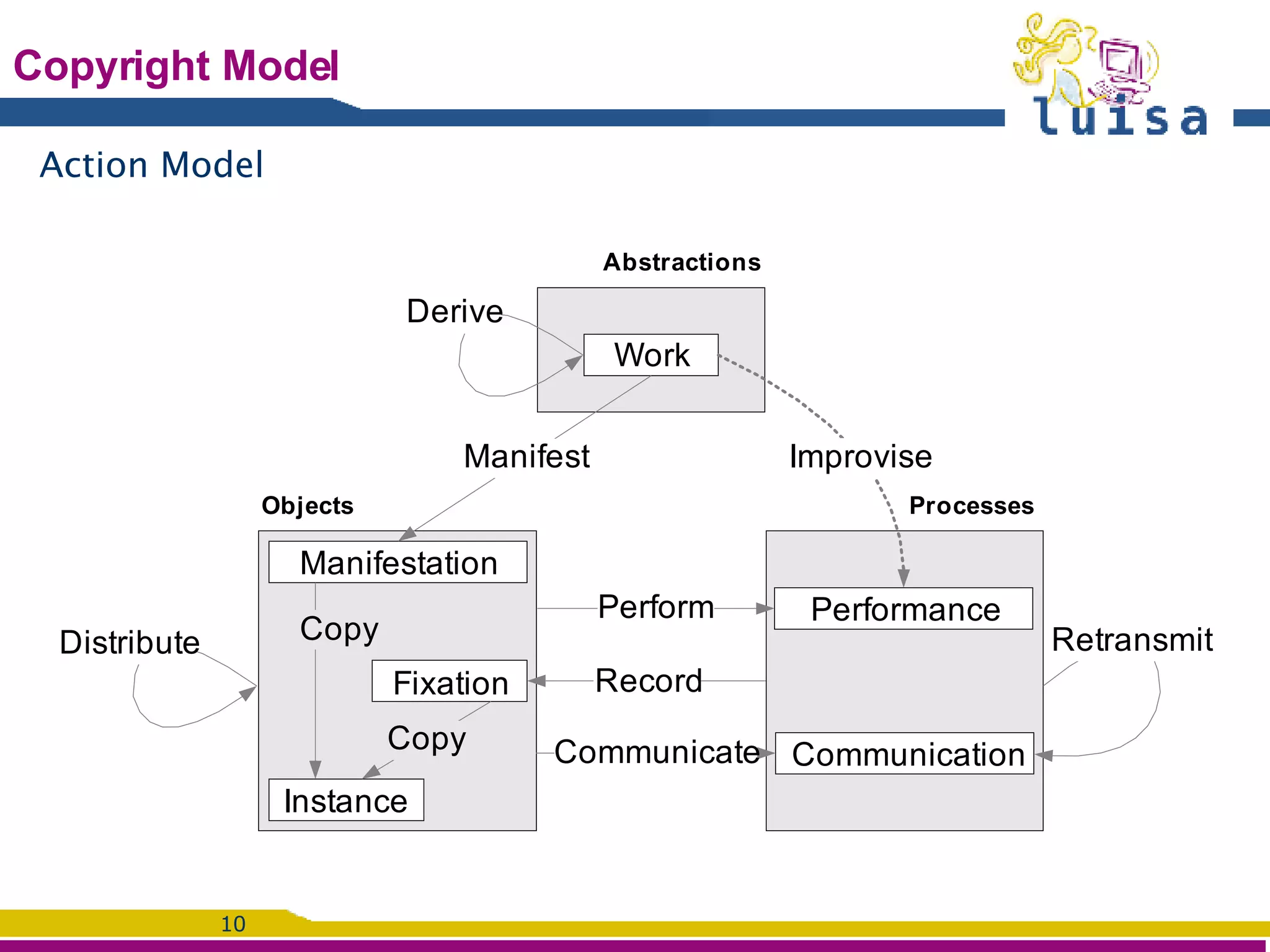
Copyright Model Action Model
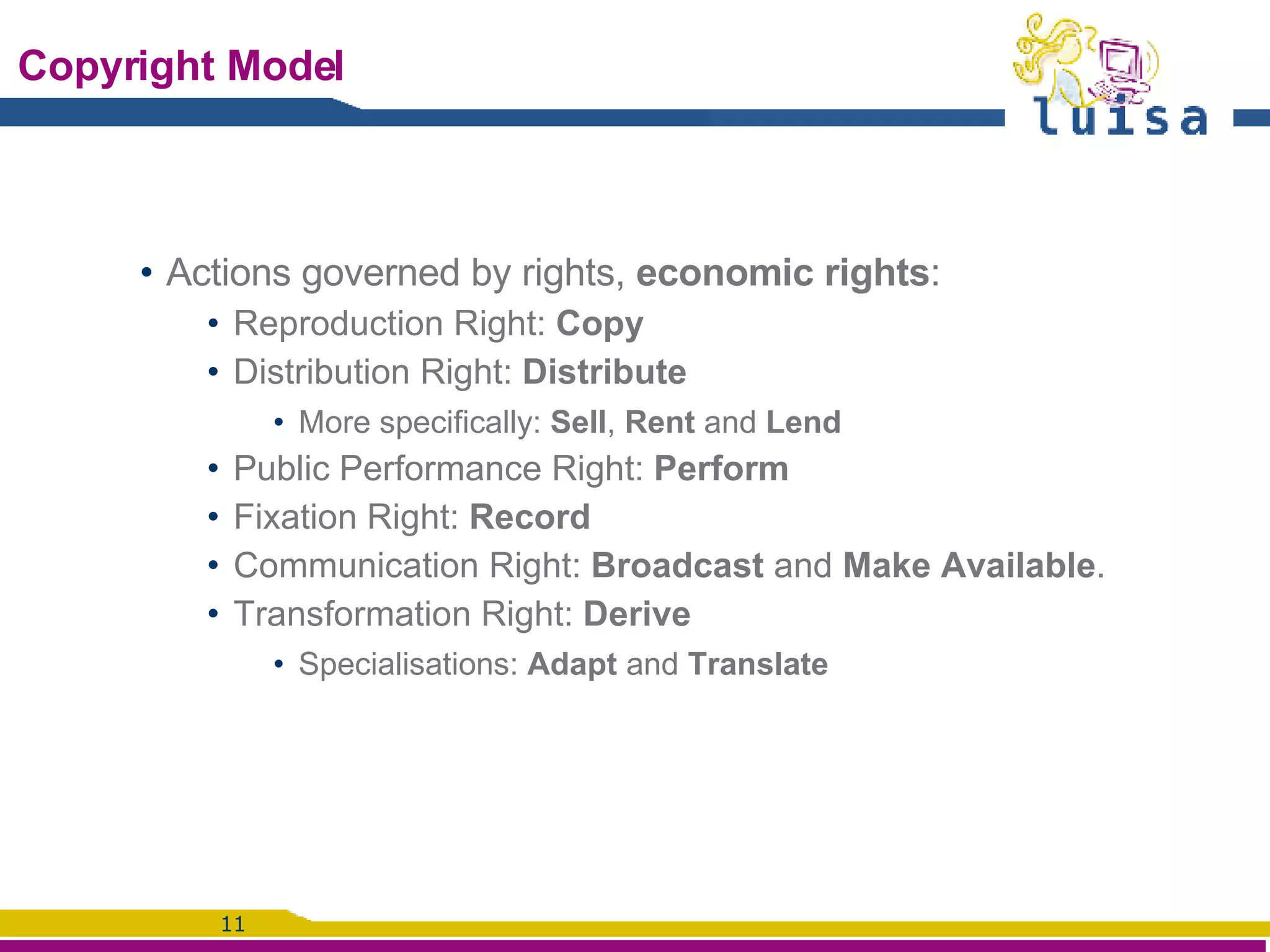
Copyright Model Actions governed by rights,  economic rights :  Reproduction Right:  Copy Distribution Right:  Distribute More specifically:  Sell ,  Rent  and  Lend Public Performance Right:  Perform Fixation Right:  Record Communication Right:  Broadcast  and  Make Available . Transformation Right:  Derive Specialisations:  Adapt  and  Translate
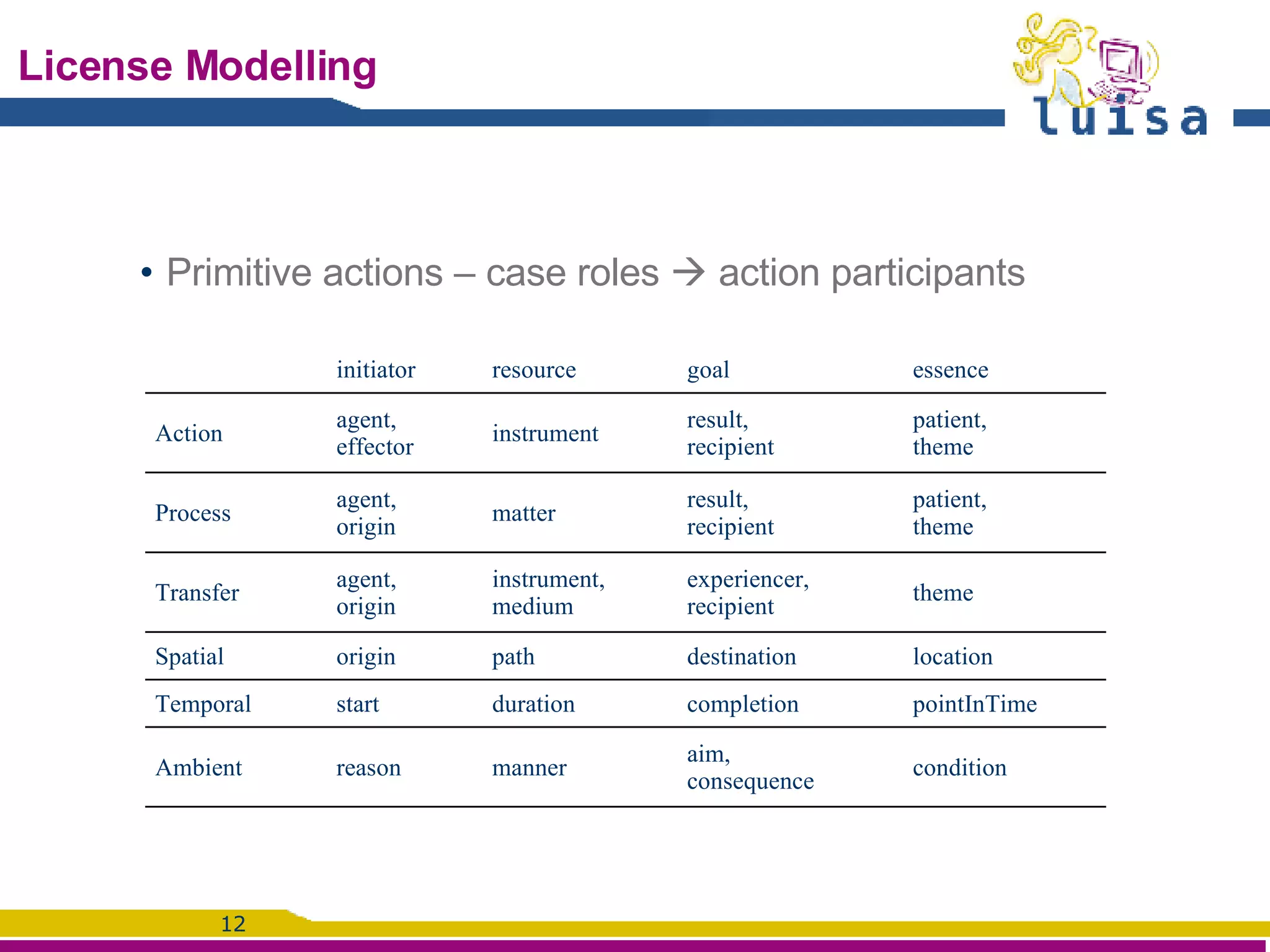
License Modelling Primitive actions – case roles    action participants initiator resource goal essence Action agent,  effector instrument  result,  recipient patient,  theme Process agent,  origin matter  result,  recipient patient,  theme Transfer agent,  origin instrument,  medium experiencer,  recipient theme Spatial origin path  destination  location Temporal start  duration completion pointInTime Ambient reason  manner aim,  consequence condition
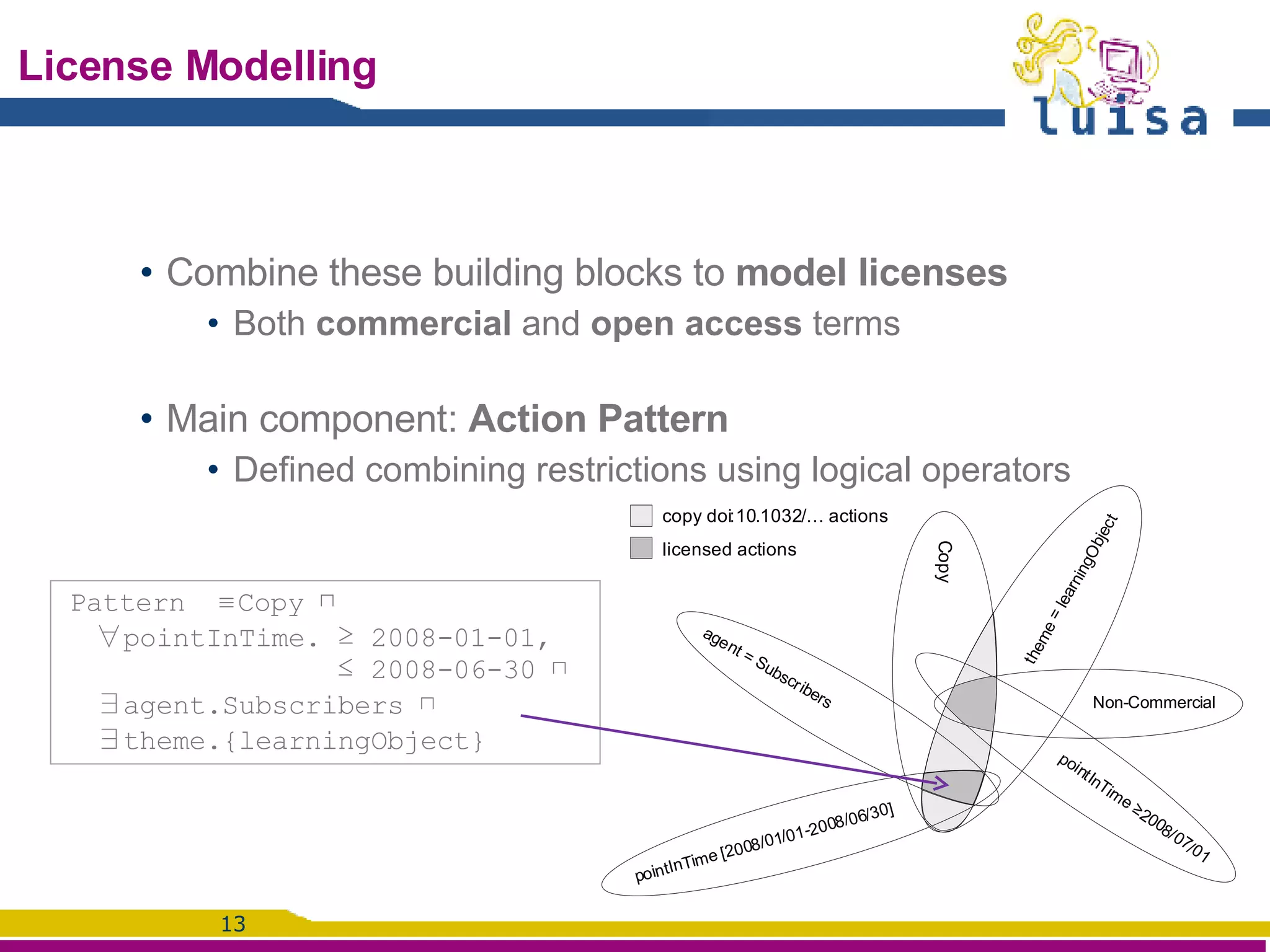
License Modelling Combine these building blocks to  model licenses Both  commercial  and  open access  terms Main component:  Action Pattern  Defined combining restrictions using logical operators   Pattern  ≡ Copy ⊓ ∀ pointInTime. ≥ 2008-01-01, ≤ 2008-06-30 ⊓ ∃ agent.Subscribers ⊓ ∃ theme.{learningObject}
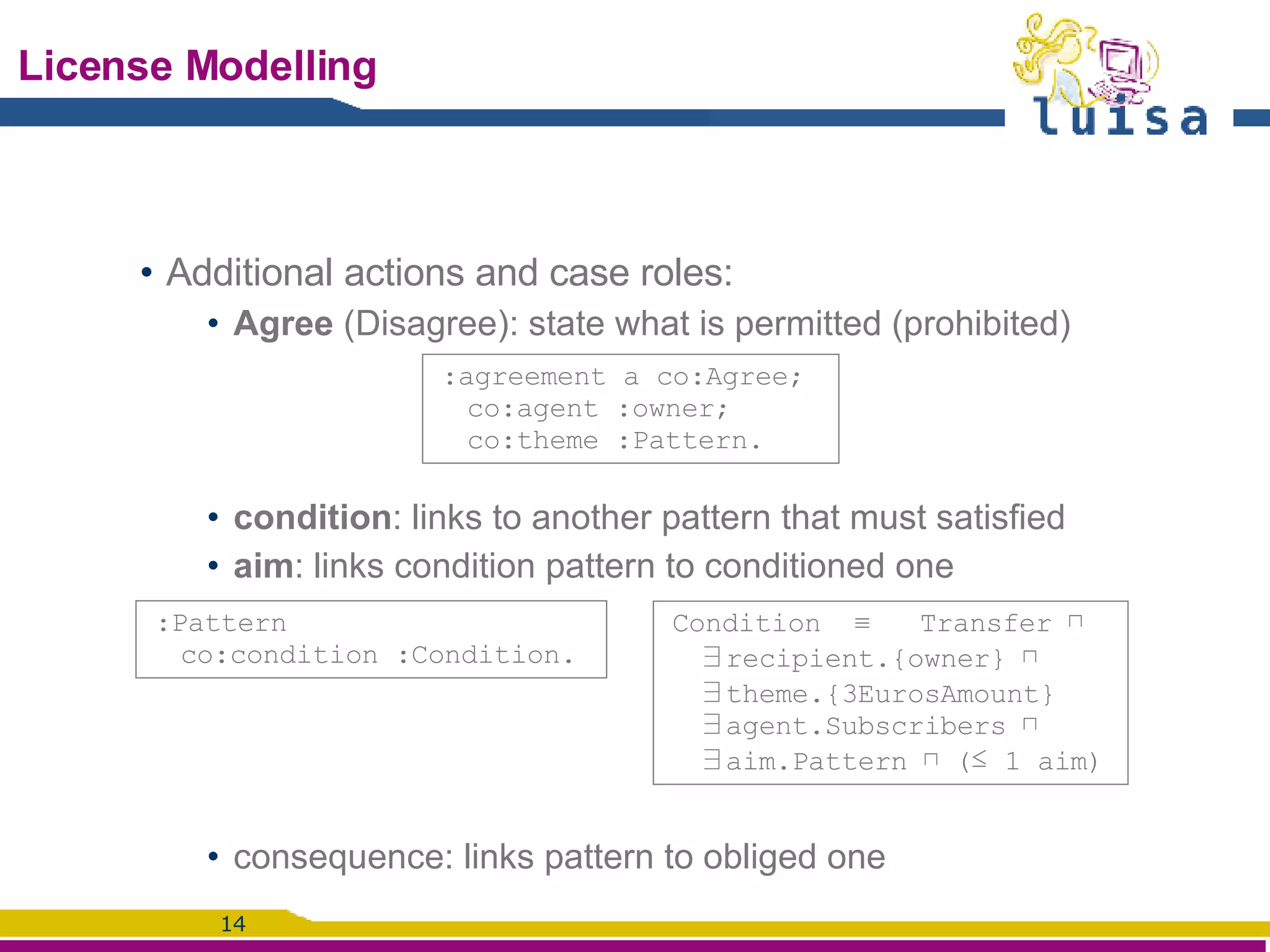
License Modelling Additional actions and case roles:  Agree  (Disagree): state what is permitted (prohibited) condition : links to another pattern that must satisfied aim : links condition pattern to conditioned one consequence: links pattern to obliged one :agreement a co:Agree; co:agent :owner;  co:theme :Pattern. Condition  ≡ Transfer ⊓ ∃ recipient.{owner} ⊓ ∃ theme.{3EurosAmount}  ∃agent.Subscribers ⊓ ∃ aim.Pattern ⊓ (≤ 1 aim) :Pattern co:condition :Condition.
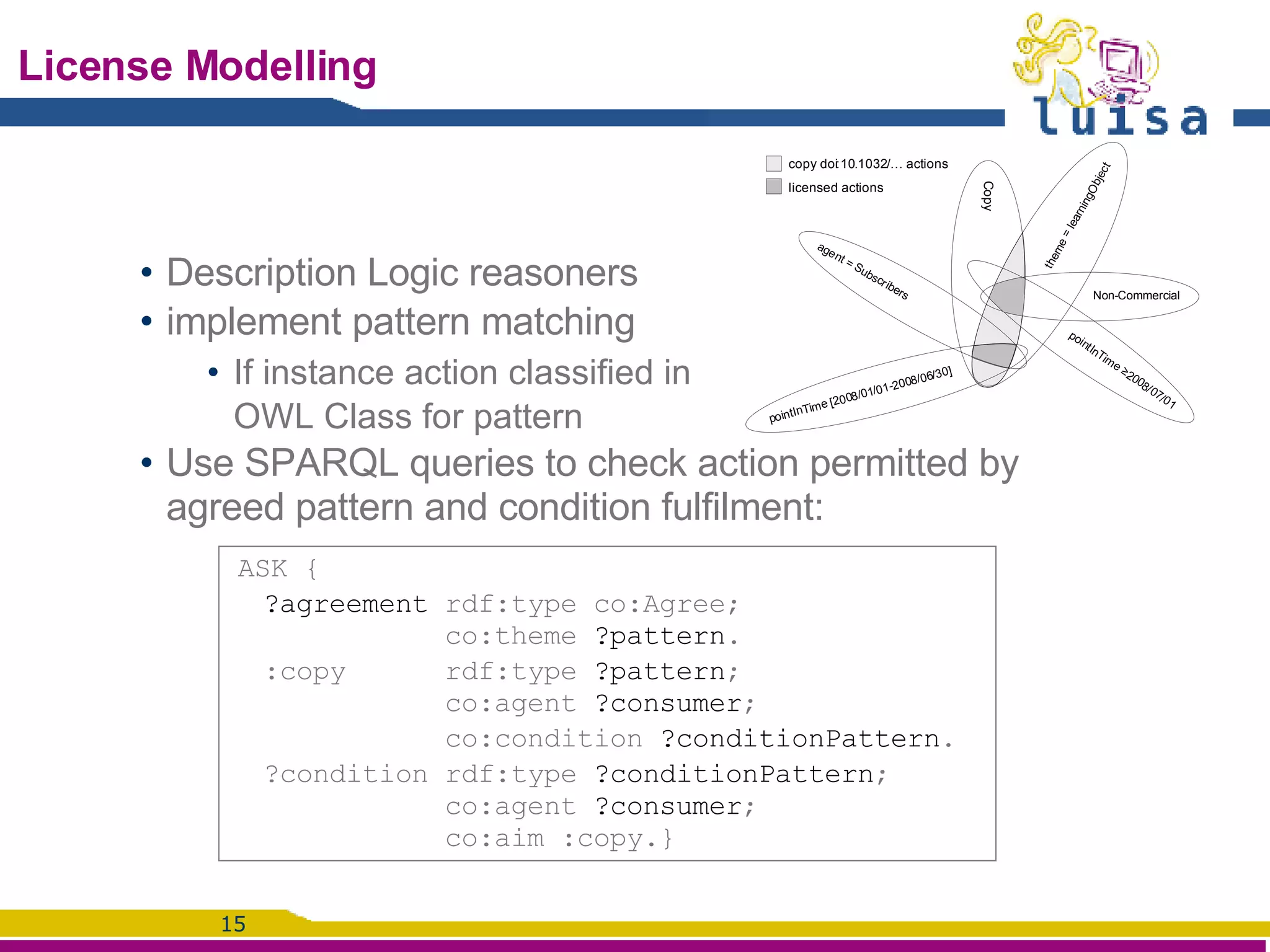
License Modelling Description Logic reasoners  implement pattern matching If instance action classified in  OWL Class for pattern Use SPARQL queries to check action permitted by agreed pattern and condition fulfilment: ASK { ?agreement  rdf:type co:Agree;   co:theme  ?pattern . :copy  rdf:type  ?pattern ;    co:agent  ?consumer ;    co:condition  ?conditionPattern . ?condition rdf:type  ?conditionPattern ;   co:agent  ?consumer ;   co:aim :copy.}
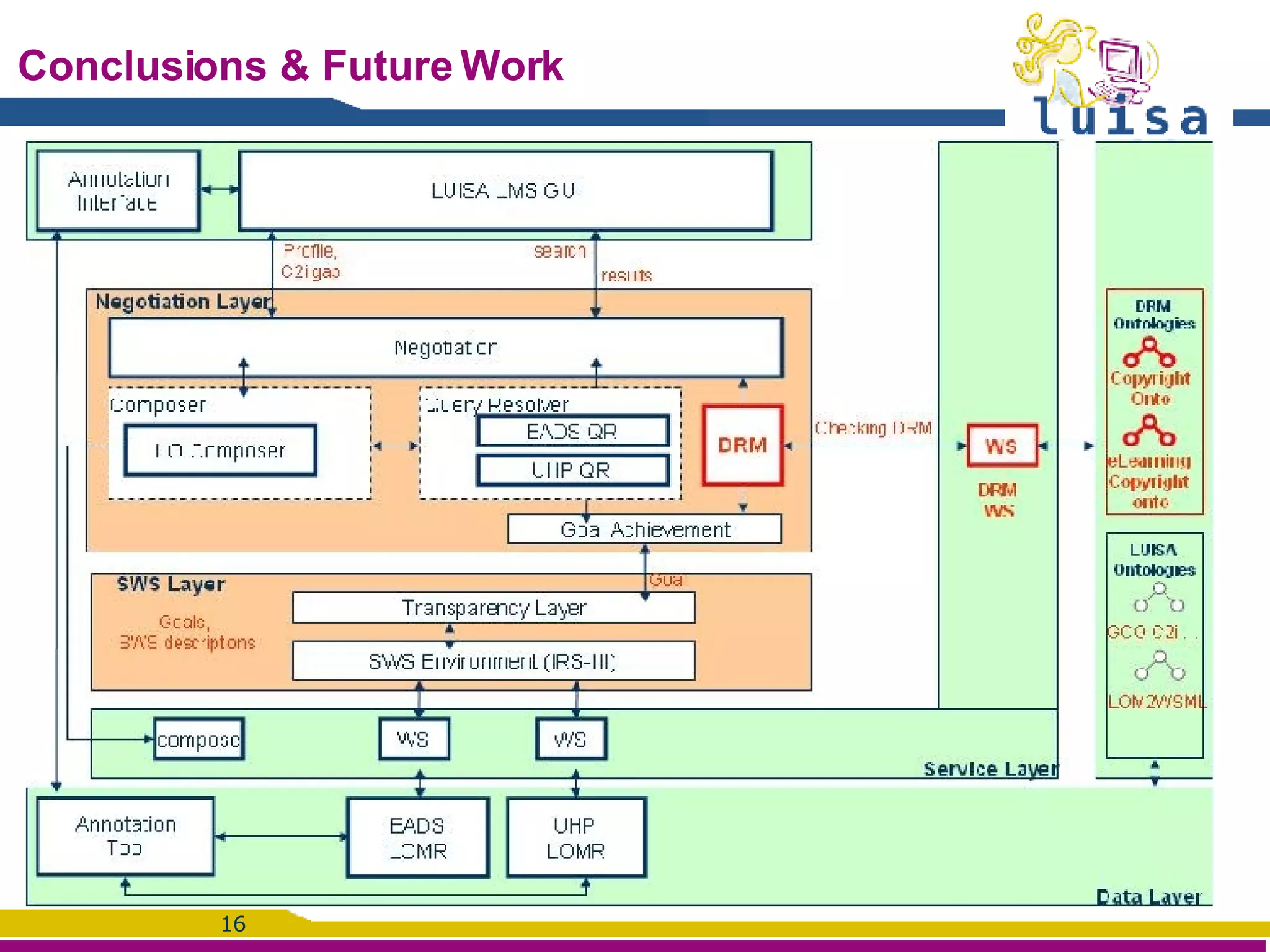
Conclusions & Future Work
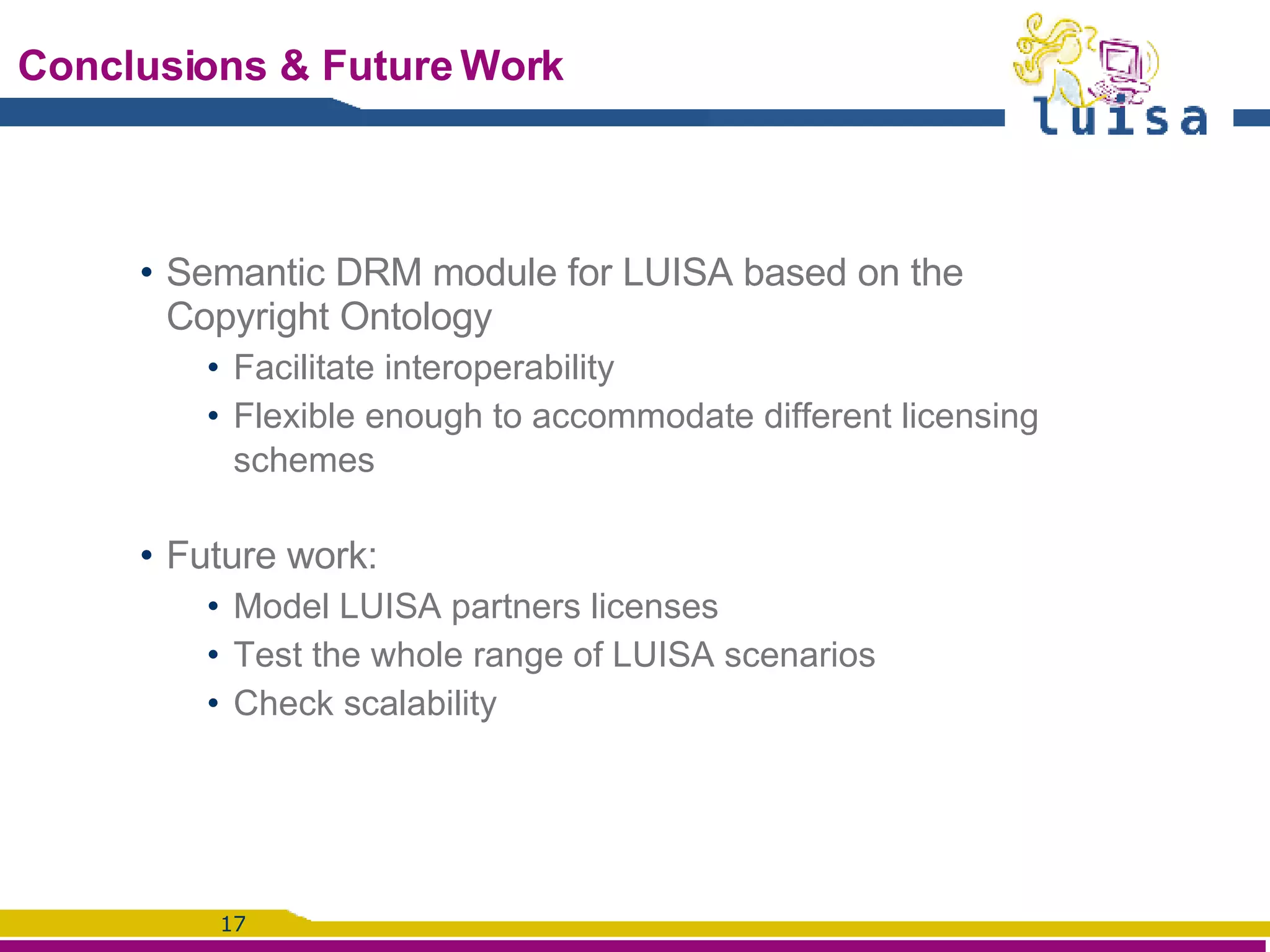
Conclusions & Future Work Semantic DRM module for LUISA based on the Copyright Ontology Facilitate interoperability Flexible enough to accommodate different licensing schemes Future work:  Model LUISA partners licenses Test the whole range of LUISA scenarios Check scalability

Copyright Management for the LUISA Semantic Learning Content Management System

  • 1.
    Copyright Management forthe LUISA Semantic Learning Content Management System Roberto García Universitat de Lleida, Spain Tomas Pariente ATOS Origin SAE, Spain www.luisa-project.eu LUISA is an European Comission FP6 funded Specific Targeted Research Project
  • 2.
    Table of ContentsIntroduction Motivation Related Work Proposal Copyright Model License Modelling Conclusions & Future Work
  • 3.
    Introduction “ Web-spread”of e-Learning solutions requires Interoperability Enabler: richer semantics than current metadata specifications for learning resources LUISA (EU-IST-FP6): reference semantic and service-oriented architecture for e-Learning Search, interchange and delivery of learning objects Face interoperability at different levels using Semantic Web technologies
  • 4.
    Motivation At thecontent copyright level: eLearning DRM interoperability Main problem: lack of structured and formal ways to express the licensing terms of learning objects Sakai : predefined and simple copyright status sentences “ Material is in public domain” or “I hold copyright” “ Use copyright below” + text box LOM : set of attributes for stating learning object rights: “ Cost”, “Copyright and Other Restrictions” and “Description”
  • 5.
    Related Work CreativeCommons: Focus on open licensing schemes e.g. Open Courseware Extension for custom licensing schemes (CCPlus), but not based on formalised license building blocks DRM Standards: ISO/IEC MPEG-21 Rights Expression Language (REL) Open Digital Rights Language (ODRL)
  • 6.
    Related Work DRMStandards issues [1]: Don’t scale well to open environments like the Web More appropriate for closed domains Cause interoperability issues One of the main DRM end-users complains Rights language limited expressivity Difficult to accommodate copyright law Standardisation based on formal language grammar, no formal semantics [1] Electronic Frontier Foundation Report by Doctorow, 2005
  • 7.
    Proposal Use the Copyright Ontology [1] in order to model e-Learning copyright licenses More expressive than XML approaches Facilitates interoperability , works at the semantic level Based on a copyright law model, WIPO worldwide recommendations [2] Also based on Semantic Web technologies Copyright Ontology: provides the building blocks and restrictions to flexibly model LOs licensing terms [1] Copyright Ontology, http://rhizomik.net/ontologies/copyrightonto [2] World Intellectual Property Organisation, http://www.wipo.int
  • 8.
  • 9.
    Copyright Model VictorHugo’s Les Misérables Creation Model
  • 10.
  • 11.
    Copyright Model Actionsgoverned by rights, economic rights : Reproduction Right: Copy Distribution Right: Distribute More specifically: Sell , Rent and Lend Public Performance Right: Perform Fixation Right: Record Communication Right: Broadcast and Make Available . Transformation Right: Derive Specialisations: Adapt and Translate
  • 12.
    License Modelling Primitiveactions – case roles  action participants initiator resource goal essence Action agent, effector instrument result, recipient patient, theme Process agent, origin matter result, recipient patient, theme Transfer agent, origin instrument, medium experiencer, recipient theme Spatial origin path destination location Temporal start duration completion pointInTime Ambient reason manner aim, consequence condition
  • 13.
    License Modelling Combinethese building blocks to model licenses Both commercial and open access terms Main component: Action Pattern Defined combining restrictions using logical operators Pattern ≡ Copy ⊓ ∀ pointInTime. ≥ 2008-01-01, ≤ 2008-06-30 ⊓ ∃ agent.Subscribers ⊓ ∃ theme.{learningObject}
  • 14.
    License Modelling Additionalactions and case roles: Agree (Disagree): state what is permitted (prohibited) condition : links to another pattern that must satisfied aim : links condition pattern to conditioned one consequence: links pattern to obliged one :agreement a co:Agree; co:agent :owner; co:theme :Pattern. Condition ≡ Transfer ⊓ ∃ recipient.{owner} ⊓ ∃ theme.{3EurosAmount} ∃agent.Subscribers ⊓ ∃ aim.Pattern ⊓ (≤ 1 aim) :Pattern co:condition :Condition.
  • 15.
    License Modelling DescriptionLogic reasoners implement pattern matching If instance action classified in OWL Class for pattern Use SPARQL queries to check action permitted by agreed pattern and condition fulfilment: ASK { ?agreement rdf:type co:Agree; co:theme ?pattern . :copy rdf:type ?pattern ; co:agent ?consumer ; co:condition ?conditionPattern . ?condition rdf:type ?conditionPattern ; co:agent ?consumer ; co:aim :copy.}
  • 16.
  • 17.
    Conclusions & FutureWork Semantic DRM module for LUISA based on the Copyright Ontology Facilitate interoperability Flexible enough to accommodate different licensing schemes Future work: Model LUISA partners licenses Test the whole range of LUISA scenarios Check scalability