EXPLORING VALUE SENSITIVE DESIGN
FOR BLOCKCHAIN DEVELOPMENT
Human-Computer Interaction and Data Integration Research Group
Computer Science and Engineering Department
Universitat de Lleida
PhD Roberto García
Associate Professor
PhD Rosa Gil
Associate Professor
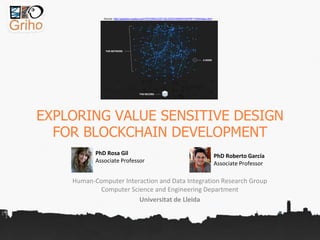
Source: http://graphics.reuters.com/TECHNOLOGY-BLOCKCHAIN/010070P11GN/index.html
Motivation
• Potential impact of blockchain technologies in society
• Consider human values during their design and
development
• Blockchain community own set of values favored by
the technology
• Explore how these values play among the diverse set
of stakeholders and the potential conflicts
• Define guidelines that make blockchains better
support human values
• Despite the initial bias these technologies might impose
Introduction
• Blockchains have their roots in Bitcoin
• After many attempts to create digital money, Nakamoto (2008) made a
revolutionary proposal that resulted in the first cryptocurrency
• Bitcoin is decentralized
• No need for central control keeping track of who owns every Bitcoin
• Based on distributed ledger
• All nodes participating in running the blockchain hold a copy of the ledger
with all the Bitcoin transactions to date
• They control no-one cheats, discouraged through a incentives system for
those behaving properly, e.g. mining rewards
Recommended:
http://graphics.reuters.com/TECHNOLOGY-BLOCKCHAIN/010070P11GN/index.html
Introduction
• Second generation blockchains, like Ethereum (Buterin, 2014)
• Distributed ledgers keep track of transactions and current
state of a shared computer
• Replicated and run in every blockchain node to guarantee that it
produces the same computations for everyone
• Application developers can program this shared
computer, smart contracts
• In the sense that it can be trusted that their code will execute as
programmed
• Example: escrow payment application that does not require a
trusted third party
Introduction
• Overall, potential to change the ways that people and
organizations trust each other
• By establishing a shared and tamper-proof registry of events
that aims to be decentralized and neutral
• Potential shift in control of money, law and government
• that those traditionally intermediating might perceive as a
menace
• Longer term, blockchain-based applications might evolve
into a new form of society where humans and machines
can autonomously interact
• For instance, self-driving cars that get paid and use the income
to pay their energy consumption or repairs
Objectives
• To date, blockchain core values have been:
autonomy, privacy and trust
• Assure that the use of blockchain technologies does not
go against other values
• Given the bias and enormous potential impact of
blockchain technologies, consider human values
throughout the design process of blockchains and
blockchain applications
• Explore Value Sensitive Design (VSD) as a way to ensure
that human values are taken into account
Approach
• Stakeholders analysis (literature review)
• Mainly direct and targeted. Pro-social?
• Non-targeted: malicious hackers, money laundering,…
• Analyze the benefits and harms for each group
• Map them to the corresponding values:
• human welfare, ownership and property, privacy, universal
usability, trust, autonomy, informed consent, accountability or
environmental sustainability (Friedman et al., 2013)
• Others? Wealth redistribution
• Detect value tensions  mitigation GUIDELINES
Benefits, Harms & Values
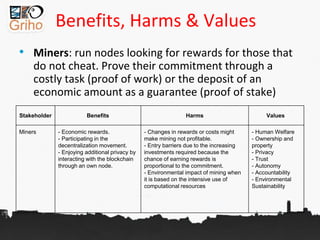
• Miners: run nodes looking for rewards for those that
do not cheat. Prove their commitment through a
costly task (proof of work) or the deposit of an
economic amount as a guarantee (proof of stake)
Stakeholder Benefits Harms Values
Miners - Economic rewards.
- Participating in the
decentralization movement.
- Enjoying additional privacy by
interacting with the blockchain
through an own node.
- Changes in rewards or costs might
make mining not profitable.
- Entry barriers due to the increasing
investments required because the
chance of earning rewards is
proportional to the commitment.
- Environmental impact of mining when
it is based on the intensive use of
computational resources
- Human Welfare
- Ownership and
property
- Privacy
- Trust
- Autonomy
- Accountability
- Environmental
Sustainability
Benefits, Harms & Values
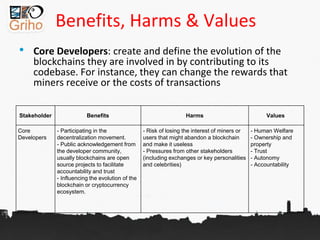
• Core Developers: create and define the evolution of the
blockchains they are involved in by contributing to its
codebase. For instance, they can change the rewards that
miners receive or the costs of transactions
Stakeholder Benefits Harms Values
Core
Developers
- Participating in the
decentralization movement.
- Public acknowledgement from
the developer community,
usually blockchains are open
source projects to facilitate
accountability and trust
- Influencing the evolution of the
blockchain or cryptocurrency
ecosystem.
- Risk of losing the interest of miners or
users that might abandon a blockchain
and make it useless
- Pressures from other stakeholders
(including exchanges or key personalities
and celebrities)
- Human Welfare
- Ownership and
property
- Trust
- Autonomy
- Accountability
Benefits, Harms & Values
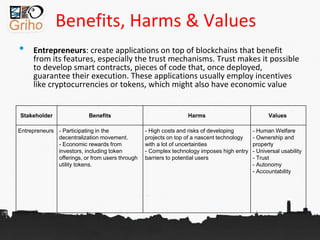
• Entrepreneurs: create applications on top of blockchains that benefit
from its features, especially the trust mechanisms. Trust makes it possible
to develop smart contracts, pieces of code that, once deployed,
guarantee their execution. These applications usually employ incentives
like cryptocurrencies or tokens, which might also have economic value
Stakeholder Benefits Harms Values
Entrepreneurs - Participating in the
decentralization movement.
- Economic rewards from
investors, including token
offerings, or from users through
utility tokens.
- High costs and risks of developing
projects on top of a nascent technology
with a lot of uncertainties
- Complex technology imposes high entry
barriers to potential users
- Human Welfare
- Ownership and
property
- Universal usability
- Trust
- Autonomy
- Accountability
Benefits, Harms & Values
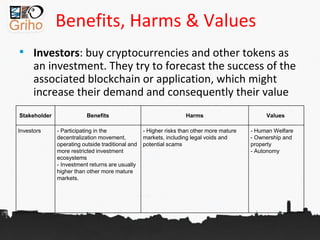
• Investors: buy cryptocurrencies and other tokens as
an investment. They try to forecast the success of the
associated blockchain or application, which might
increase their demand and consequently their value
Stakeholder Benefits Harms Values
Investors - Participating in the
decentralization movement,
operating outside traditional and
more restricted investment
ecosystems
- Investment returns are usually
higher than other more mature
markets.
- Higher risks than other more mature
markets, including legal voids and
potential scams
- Human Welfare
- Ownership and
property
- Autonomy
Benefits, Harms & Values
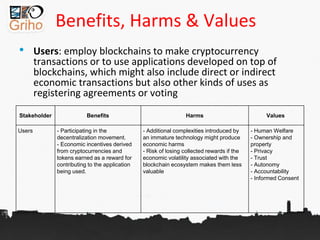
• Users: employ blockchains to make cryptocurrency
transactions or to use applications developed on top of
blockchains, which might also include direct or indirect
economic transactions but also other kinds of uses as
registering agreements or voting
Stakeholder Benefits Harms Values
Users - Participating in the
decentralization movement.
- Economic incentives derived
from cryptocurrencies and
tokens earned as a reward for
contributing to the application
being used.
- Additional complexities introduced by
an immature technology might produce
economic harms
- Risk of losing collected rewards if the
economic volatility associated with the
blockchain ecosystem makes them less
valuable
- Human Welfare
- Ownership and
property
- Privacy
- Trust
- Autonomy
- Accountability
- Informed Consent
Benefits, Harms & Values
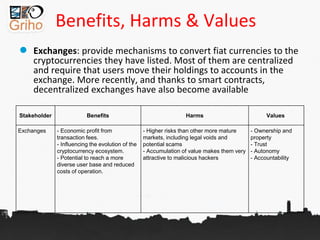
● Exchanges: provide mechanisms to convert fiat currencies to the
cryptocurrencies they have listed. Most of them are centralized
and require that users move their holdings to accounts in the
exchange. More recently, and thanks to smart contracts,
decentralized exchanges have also become available
Stakeholder Benefits Harms Values
Exchanges - Economic profit from
transaction fees.
- Influencing the evolution of the
cryptocurrency ecosystem.
- Potential to reach a more
diverse user base and reduced
costs of operation.
- Higher risks than other more mature
markets, including legal voids and
potential scams
- Accumulation of value makes them very
attractive to malicious hackers
- Ownership and
property
- Trust
- Autonomy
- Accountability
Benefits, Harms & Values
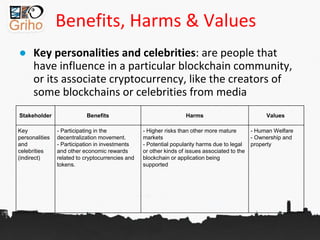
● Key personalities and celebrities: are people that
have influence in a particular blockchain community,
or its associate cryptocurrency, like the creators of
some blockchains or celebrities from media
Stakeholder Benefits Harms Values
Key
personalities
and
celebrities
(indirect)
- Participating in the
decentralization movement.
- Participation in investments
and other economic rewards
related to cryptocurrencies and
tokens.
- Higher risks than other more mature
markets
- Potential popularity harms due to legal
or other kinds of issues associated to the
blockchain or application being
supported
- Human Welfare
- Ownership and
property
Benefits, Harms & Values
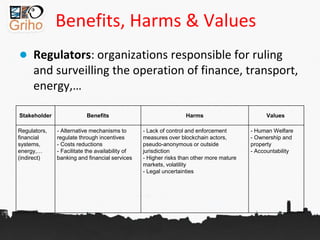
● Regulators: organizations responsible for ruling
and surveilling the operation of finance, transport,
energy,…
Stakeholder Benefits Harms Values
Regulators,
financial
systems,
energy,…
(indirect)
- Alternative mechanisms to
regulate through incentives
- Costs reductions
- Facilitate the availability of
banking and financial services
- Lack of control and enforcement
measures over blockchain actors,
pseudo-anonymous or outside
jurisdiction
- Higher risks than other more mature
markets, volatility
- Legal uncertainties
- Human Welfare
- Ownership and
property
- Accountability
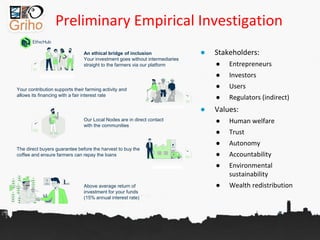
Preliminary Empirical Investigation
● Stakeholders:
● Entrepreneurs
● Investors
● Users
● Regulators (indirect)
● Values:
● Human welfare
● Trust
● Autonomy
● Accountability
● Environmental
sustainability
● Wealth redistribution
An ethical bridge of inclusion
Your investment goes without intermediaries
straight to the farmers via our platform
Your contribution supports their farming activity and
allows its financing with a fair interest rate
Our Local Nodes are in direct contact
with the communities
The direct buyers guarantee before the harvest to buy the
coffee and ensure farmers can repay the loans
Above average return of
investment for your funds
(15% annual interest rate)
Preliminary Conclusions
• The study highlights potential value tensions:
• accountability vs. privacy
• trust vs. environmental sustainability
• ownership vs. wealth redistribution
• …
• Trade-offs among competing values in the design,
implementation, and use of blockchain-based systems
• For instance, blockchain technologies due to their immutability imply
serious risks for privacy
• Issues are addressed during the whole blockchain application
design & development process
• For instance, improve user privacy by encrypting or hashing personal data
on chain  GUIDELINE
Future Work
• Additional empirical investigations that help clarify the
outcomes of different blockchains and applications
regarding the identified values
• Identify the whole set of value tensions and biases from
underlying blockchain technologies
• Generate a complete set of guidelines that make
blockchains and smart contracts better support human
values
Thank you for your attention
Questions?
Contact:
rosamaria.gil@udl.cat
roberto.garcia@udl.cat
The Interface adapts the
System to the User

ETHICOMP 2020: Exploring Value Sensitive Design for Blockchain Development

  • 1.
    EXPLORING VALUE SENSITIVEDESIGN FOR BLOCKCHAIN DEVELOPMENT Human-Computer Interaction and Data Integration Research Group Computer Science and Engineering Department Universitat de Lleida PhD Roberto García Associate Professor PhD Rosa Gil Associate Professor Source: http://graphics.reuters.com/TECHNOLOGY-BLOCKCHAIN/010070P11GN/index.html
  • 2.
    Motivation • Potential impactof blockchain technologies in society • Consider human values during their design and development • Blockchain community own set of values favored by the technology • Explore how these values play among the diverse set of stakeholders and the potential conflicts • Define guidelines that make blockchains better support human values • Despite the initial bias these technologies might impose
  • 3.
    Introduction • Blockchains havetheir roots in Bitcoin • After many attempts to create digital money, Nakamoto (2008) made a revolutionary proposal that resulted in the first cryptocurrency • Bitcoin is decentralized • No need for central control keeping track of who owns every Bitcoin • Based on distributed ledger • All nodes participating in running the blockchain hold a copy of the ledger with all the Bitcoin transactions to date • They control no-one cheats, discouraged through a incentives system for those behaving properly, e.g. mining rewards Recommended: http://graphics.reuters.com/TECHNOLOGY-BLOCKCHAIN/010070P11GN/index.html
  • 4.
    Introduction • Second generationblockchains, like Ethereum (Buterin, 2014) • Distributed ledgers keep track of transactions and current state of a shared computer • Replicated and run in every blockchain node to guarantee that it produces the same computations for everyone • Application developers can program this shared computer, smart contracts • In the sense that it can be trusted that their code will execute as programmed • Example: escrow payment application that does not require a trusted third party
  • 5.
    Introduction • Overall, potentialto change the ways that people and organizations trust each other • By establishing a shared and tamper-proof registry of events that aims to be decentralized and neutral • Potential shift in control of money, law and government • that those traditionally intermediating might perceive as a menace • Longer term, blockchain-based applications might evolve into a new form of society where humans and machines can autonomously interact • For instance, self-driving cars that get paid and use the income to pay their energy consumption or repairs
  • 6.
    Objectives • To date,blockchain core values have been: autonomy, privacy and trust • Assure that the use of blockchain technologies does not go against other values • Given the bias and enormous potential impact of blockchain technologies, consider human values throughout the design process of blockchains and blockchain applications • Explore Value Sensitive Design (VSD) as a way to ensure that human values are taken into account
  • 7.
    Approach • Stakeholders analysis(literature review) • Mainly direct and targeted. Pro-social? • Non-targeted: malicious hackers, money laundering,… • Analyze the benefits and harms for each group • Map them to the corresponding values: • human welfare, ownership and property, privacy, universal usability, trust, autonomy, informed consent, accountability or environmental sustainability (Friedman et al., 2013) • Others? Wealth redistribution • Detect value tensions  mitigation GUIDELINES
  • 8.
    Benefits, Harms &Values • Miners: run nodes looking for rewards for those that do not cheat. Prove their commitment through a costly task (proof of work) or the deposit of an economic amount as a guarantee (proof of stake) Stakeholder Benefits Harms Values Miners - Economic rewards. - Participating in the decentralization movement. - Enjoying additional privacy by interacting with the blockchain through an own node. - Changes in rewards or costs might make mining not profitable. - Entry barriers due to the increasing investments required because the chance of earning rewards is proportional to the commitment. - Environmental impact of mining when it is based on the intensive use of computational resources - Human Welfare - Ownership and property - Privacy - Trust - Autonomy - Accountability - Environmental Sustainability
  • 9.
    Benefits, Harms &Values • Core Developers: create and define the evolution of the blockchains they are involved in by contributing to its codebase. For instance, they can change the rewards that miners receive or the costs of transactions Stakeholder Benefits Harms Values Core Developers - Participating in the decentralization movement. - Public acknowledgement from the developer community, usually blockchains are open source projects to facilitate accountability and trust - Influencing the evolution of the blockchain or cryptocurrency ecosystem. - Risk of losing the interest of miners or users that might abandon a blockchain and make it useless - Pressures from other stakeholders (including exchanges or key personalities and celebrities) - Human Welfare - Ownership and property - Trust - Autonomy - Accountability
  • 10.
    Benefits, Harms &Values • Entrepreneurs: create applications on top of blockchains that benefit from its features, especially the trust mechanisms. Trust makes it possible to develop smart contracts, pieces of code that, once deployed, guarantee their execution. These applications usually employ incentives like cryptocurrencies or tokens, which might also have economic value Stakeholder Benefits Harms Values Entrepreneurs - Participating in the decentralization movement. - Economic rewards from investors, including token offerings, or from users through utility tokens. - High costs and risks of developing projects on top of a nascent technology with a lot of uncertainties - Complex technology imposes high entry barriers to potential users - Human Welfare - Ownership and property - Universal usability - Trust - Autonomy - Accountability
  • 11.
    Benefits, Harms &Values • Investors: buy cryptocurrencies and other tokens as an investment. They try to forecast the success of the associated blockchain or application, which might increase their demand and consequently their value Stakeholder Benefits Harms Values Investors - Participating in the decentralization movement, operating outside traditional and more restricted investment ecosystems - Investment returns are usually higher than other more mature markets. - Higher risks than other more mature markets, including legal voids and potential scams - Human Welfare - Ownership and property - Autonomy
  • 12.
    Benefits, Harms &Values • Users: employ blockchains to make cryptocurrency transactions or to use applications developed on top of blockchains, which might also include direct or indirect economic transactions but also other kinds of uses as registering agreements or voting Stakeholder Benefits Harms Values Users - Participating in the decentralization movement. - Economic incentives derived from cryptocurrencies and tokens earned as a reward for contributing to the application being used. - Additional complexities introduced by an immature technology might produce economic harms - Risk of losing collected rewards if the economic volatility associated with the blockchain ecosystem makes them less valuable - Human Welfare - Ownership and property - Privacy - Trust - Autonomy - Accountability - Informed Consent
  • 13.
    Benefits, Harms &Values ● Exchanges: provide mechanisms to convert fiat currencies to the cryptocurrencies they have listed. Most of them are centralized and require that users move their holdings to accounts in the exchange. More recently, and thanks to smart contracts, decentralized exchanges have also become available Stakeholder Benefits Harms Values Exchanges - Economic profit from transaction fees. - Influencing the evolution of the cryptocurrency ecosystem. - Potential to reach a more diverse user base and reduced costs of operation. - Higher risks than other more mature markets, including legal voids and potential scams - Accumulation of value makes them very attractive to malicious hackers - Ownership and property - Trust - Autonomy - Accountability
  • 14.
    Benefits, Harms &Values ● Key personalities and celebrities: are people that have influence in a particular blockchain community, or its associate cryptocurrency, like the creators of some blockchains or celebrities from media Stakeholder Benefits Harms Values Key personalities and celebrities (indirect) - Participating in the decentralization movement. - Participation in investments and other economic rewards related to cryptocurrencies and tokens. - Higher risks than other more mature markets - Potential popularity harms due to legal or other kinds of issues associated to the blockchain or application being supported - Human Welfare - Ownership and property
  • 15.
    Benefits, Harms &Values ● Regulators: organizations responsible for ruling and surveilling the operation of finance, transport, energy,… Stakeholder Benefits Harms Values Regulators, financial systems, energy,… (indirect) - Alternative mechanisms to regulate through incentives - Costs reductions - Facilitate the availability of banking and financial services - Lack of control and enforcement measures over blockchain actors, pseudo-anonymous or outside jurisdiction - Higher risks than other more mature markets, volatility - Legal uncertainties - Human Welfare - Ownership and property - Accountability
  • 16.
    Preliminary Empirical Investigation ●Stakeholders: ● Entrepreneurs ● Investors ● Users ● Regulators (indirect) ● Values: ● Human welfare ● Trust ● Autonomy ● Accountability ● Environmental sustainability ● Wealth redistribution An ethical bridge of inclusion Your investment goes without intermediaries straight to the farmers via our platform Your contribution supports their farming activity and allows its financing with a fair interest rate Our Local Nodes are in direct contact with the communities The direct buyers guarantee before the harvest to buy the coffee and ensure farmers can repay the loans Above average return of investment for your funds (15% annual interest rate)
  • 17.
    Preliminary Conclusions • Thestudy highlights potential value tensions: • accountability vs. privacy • trust vs. environmental sustainability • ownership vs. wealth redistribution • … • Trade-offs among competing values in the design, implementation, and use of blockchain-based systems • For instance, blockchain technologies due to their immutability imply serious risks for privacy • Issues are addressed during the whole blockchain application design & development process • For instance, improve user privacy by encrypting or hashing personal data on chain  GUIDELINE
  • 18.
    Future Work • Additionalempirical investigations that help clarify the outcomes of different blockchains and applications regarding the identified values • Identify the whole set of value tensions and biases from underlying blockchain technologies • Generate a complete set of guidelines that make blockchains and smart contracts better support human values
  • 19.
    Thank you foryour attention Questions? Contact: rosamaria.gil@udl.cat roberto.garcia@udl.cat The Interface adapts the System to the User