CURRICULUM, INSTRUCTION &
ASSESSMENT
SEPTEMBER 15, 2008
DR. DIANE KELLEY
Writing Measurable
Goals and Objectives
Goals of this Presentation
2
Appreciate the value of writing clear and
measurable behavioral objectives.
Re-evaluate objectives you have written and
work to enhance them.
Make additional efforts to enhance the
congruency of: Objectives, Individual
Professional Activities (PD, IPDPs)---Your
Own Action Items, and/or School &
Department Goals/Mission Statement.
Goals and Objectives
What are objectives?
Objectives are NOT goals. Goals are broad, objectives are
specific.
An objective is a “foreseen end that gives direction to an
activity” (John Dewey, 1977)
“An objective is an end toward which action is oriented, a
condition or state of being to be reached. It reflects how the
situation will be changed, improved or maintained. “ (Boyle)
An objective is a statement which specifies, in
measurable terms, the changes we expect in our
target audiences as a result of our programs.
3
Objectives
4
Definition
 A statement in specific and measurable terms that
describes what the learner will know or be able to do.
Example
 Students will be able to construct a five paragraph essay
that follows the guidelines of the Florida Writes rubric
within a 45-minute timed writing session in English class
and explain the components in their essay that warrant
the highest score.
Orienting Question
How do you tell a good objective
from a bad one?
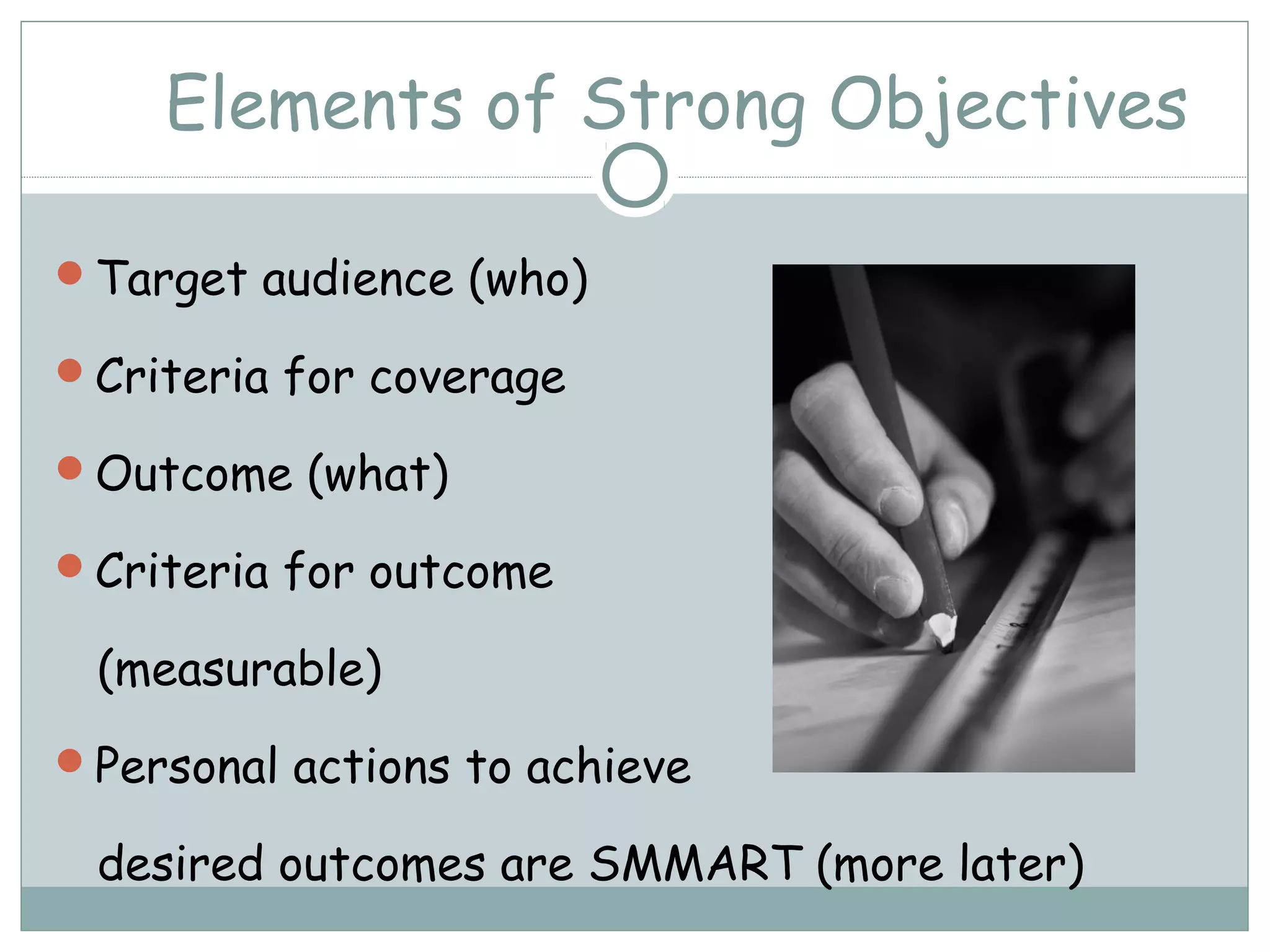
Elements of Strong Objectives
Target audience (who)
Criteria for coverage
Outcome (what)
Criteria for outcome
(measurable)
Personal actions to achieve
desired outcomes are SMMART (more later)
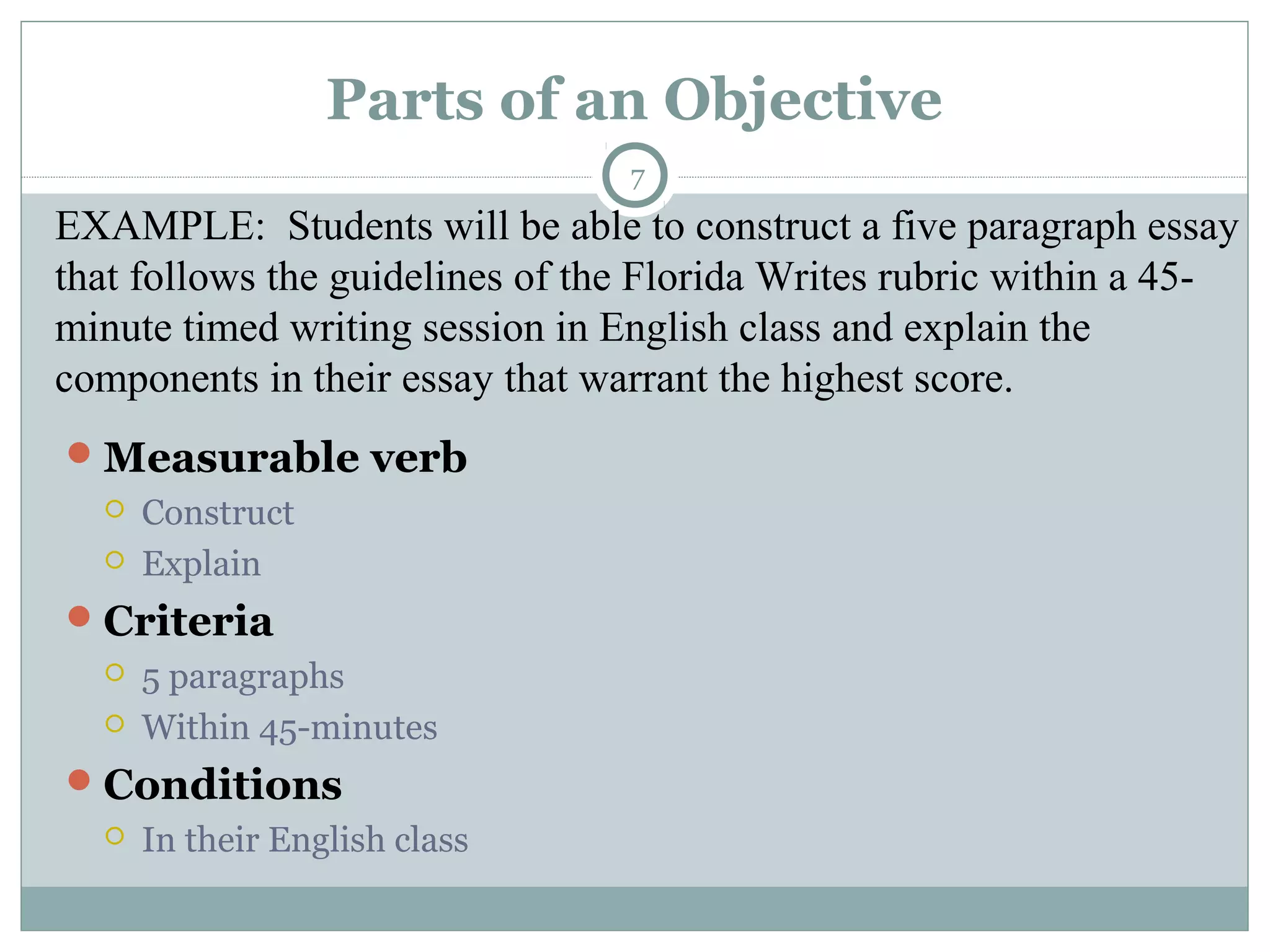
Parts of an Objective
7
Measurable verb
 Construct
 Explain
Criteria
 5 paragraphs
 Within 45-minutes
Conditions
 In their English class
EXAMPLE: Students will be able to construct a five paragraph essay
that follows the guidelines of the Florida Writes rubric within a 45-
minute timed writing session in English class and explain the
components in their essay that warrant the highest score.
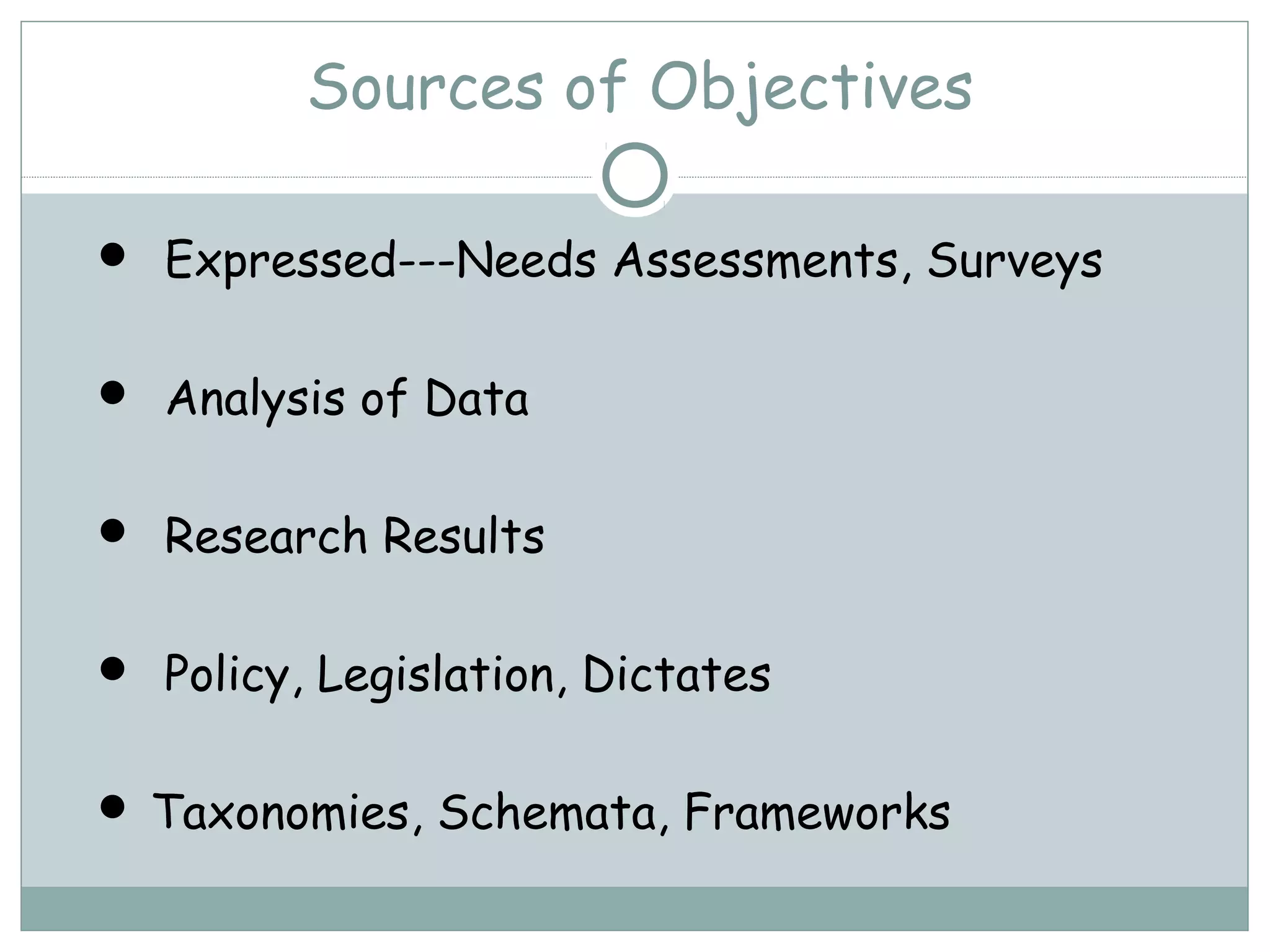
Sources of Objectives
 Expressed---Needs Assessments, Surveys
 Analysis of Data
 Research Results
 Policy, Legislation, Dictates
 Taxonomies, Schemata, Frameworks
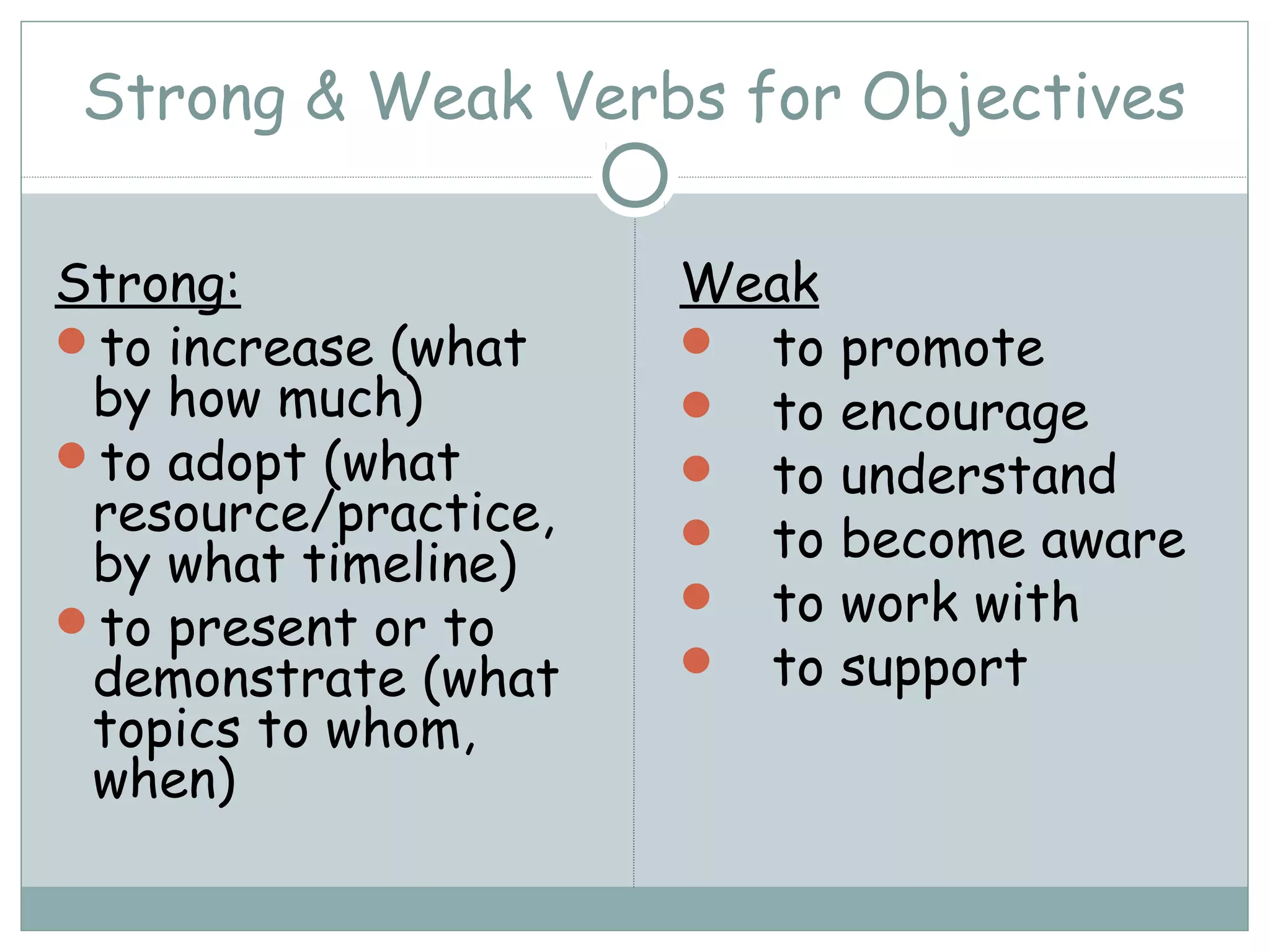
Strong & Weak Verbs for Objectives
Strong:
to increase (what
by how much)
to adopt (what
resource/practice,
by what timeline)
to present or to
demonstrate (what
topics to whom,
when)
Weak
 to promote
 to encourage
 to understand
 to become aware
 to work with
 to support
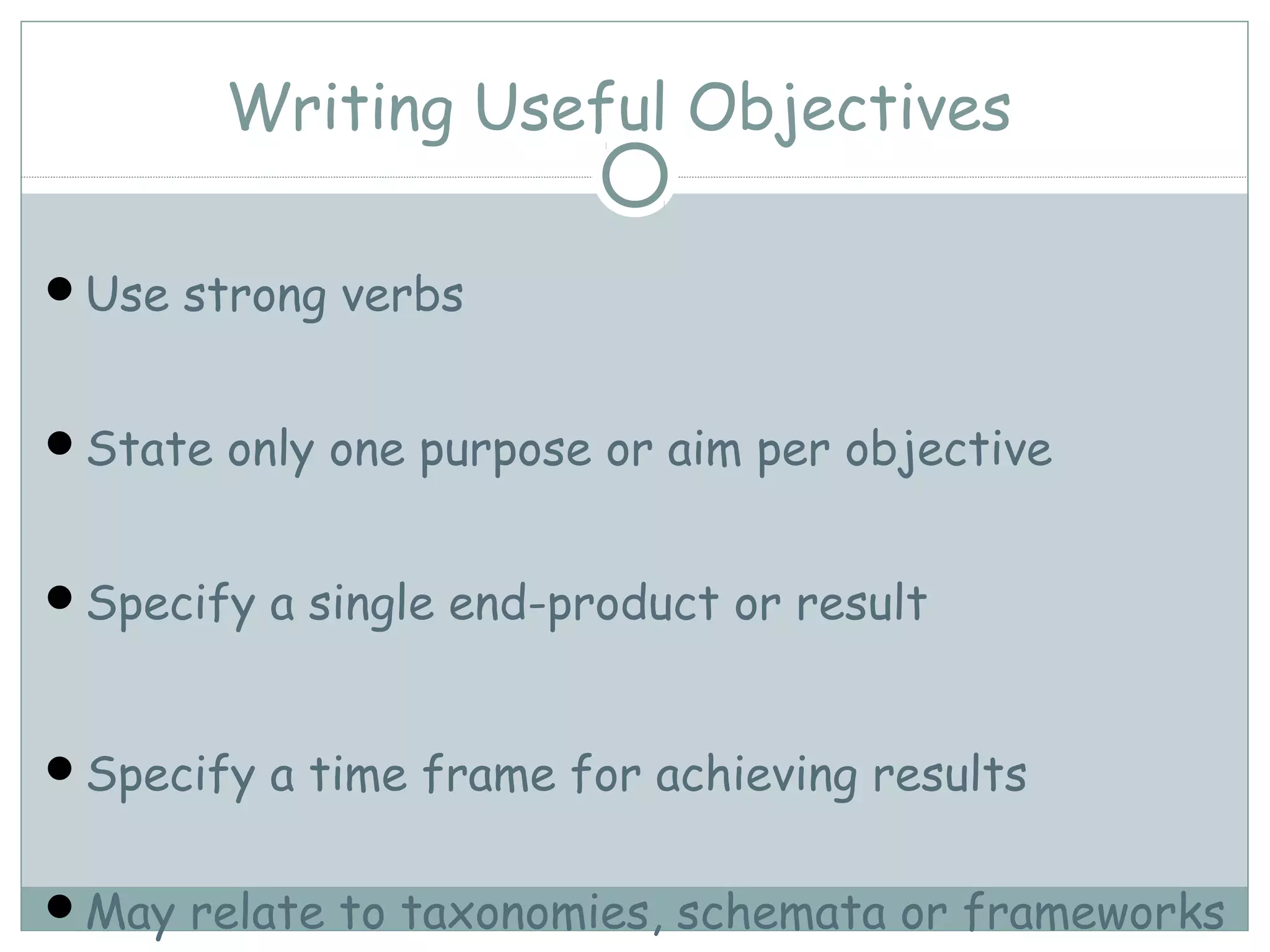
Writing Useful Objectives
Use strong verbs
State only one purpose or aim per objective
Specify a single end-product or result
Specify a time frame for achieving results
May relate to taxonomies, schemata or frameworks
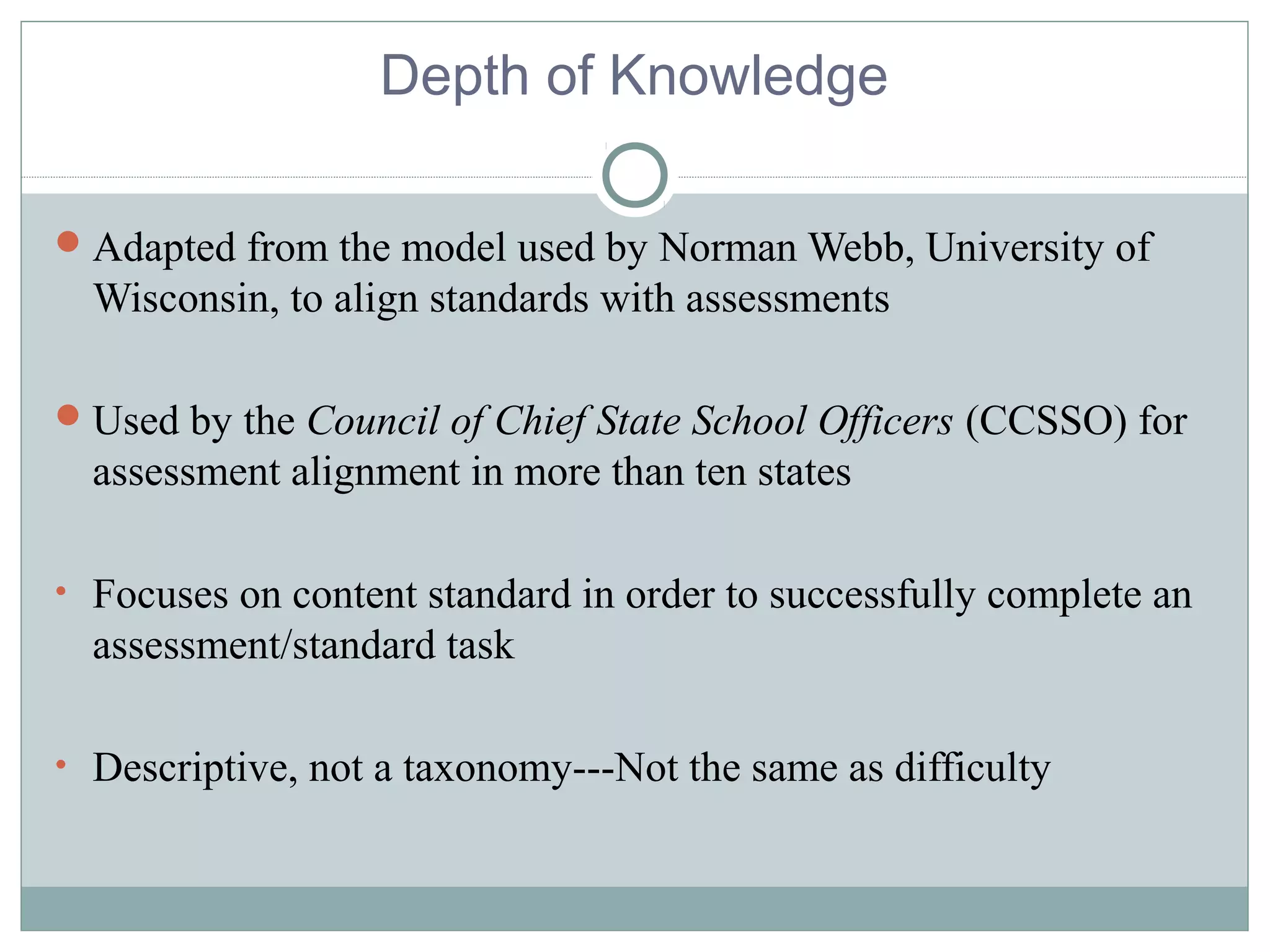
Depth of Knowledge
Adapted from the model used by Norman Webb, University of
Wisconsin, to align standards with assessments
Used by the Council of Chief State School Officers (CCSSO) for
assessment alignment in more than ten states
• Focuses on content standard in order to successfully complete an
assessment/standard task
• Descriptive, not a taxonomy---Not the same as difficulty
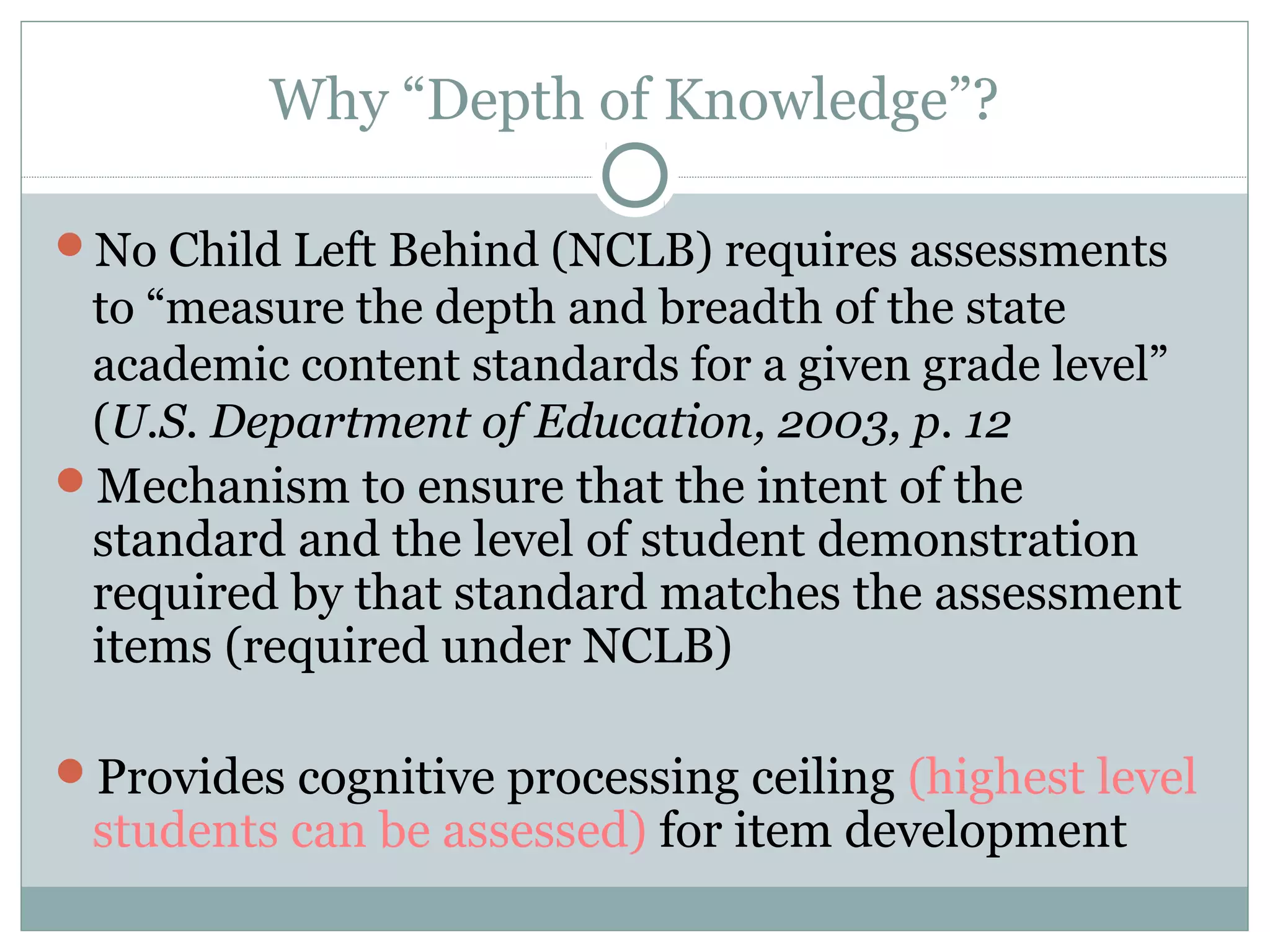
Why “Depth of Knowledge”?
No Child Left Behind (NCLB) requires assessments
to “measure the depth and breadth of the state
academic content standards for a given grade level”
(U.S. Department of Education, 2003, p. 12
Mechanism to ensure that the intent of the
standard and the level of student demonstration
required by that standard matches the assessment
items (required under NCLB)
Provides cognitive processing ceiling (highest level
students can be assessed) for item development
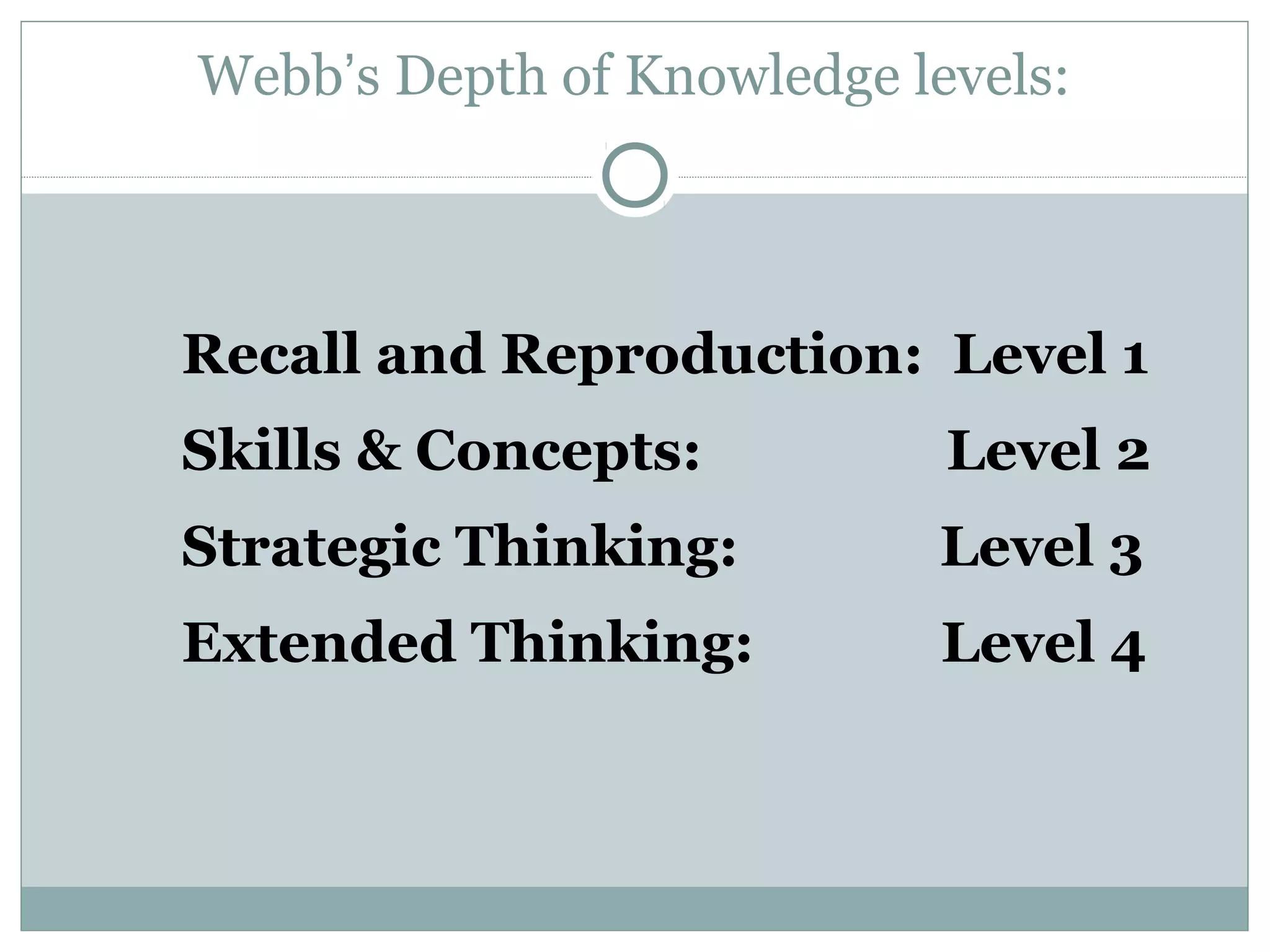
Webb’s Depth of Knowledge levels:
Recall and Reproduction: Level 1
Skills & Concepts: Level 2
Strategic Thinking: Level 3
Extended Thinking: Level 4
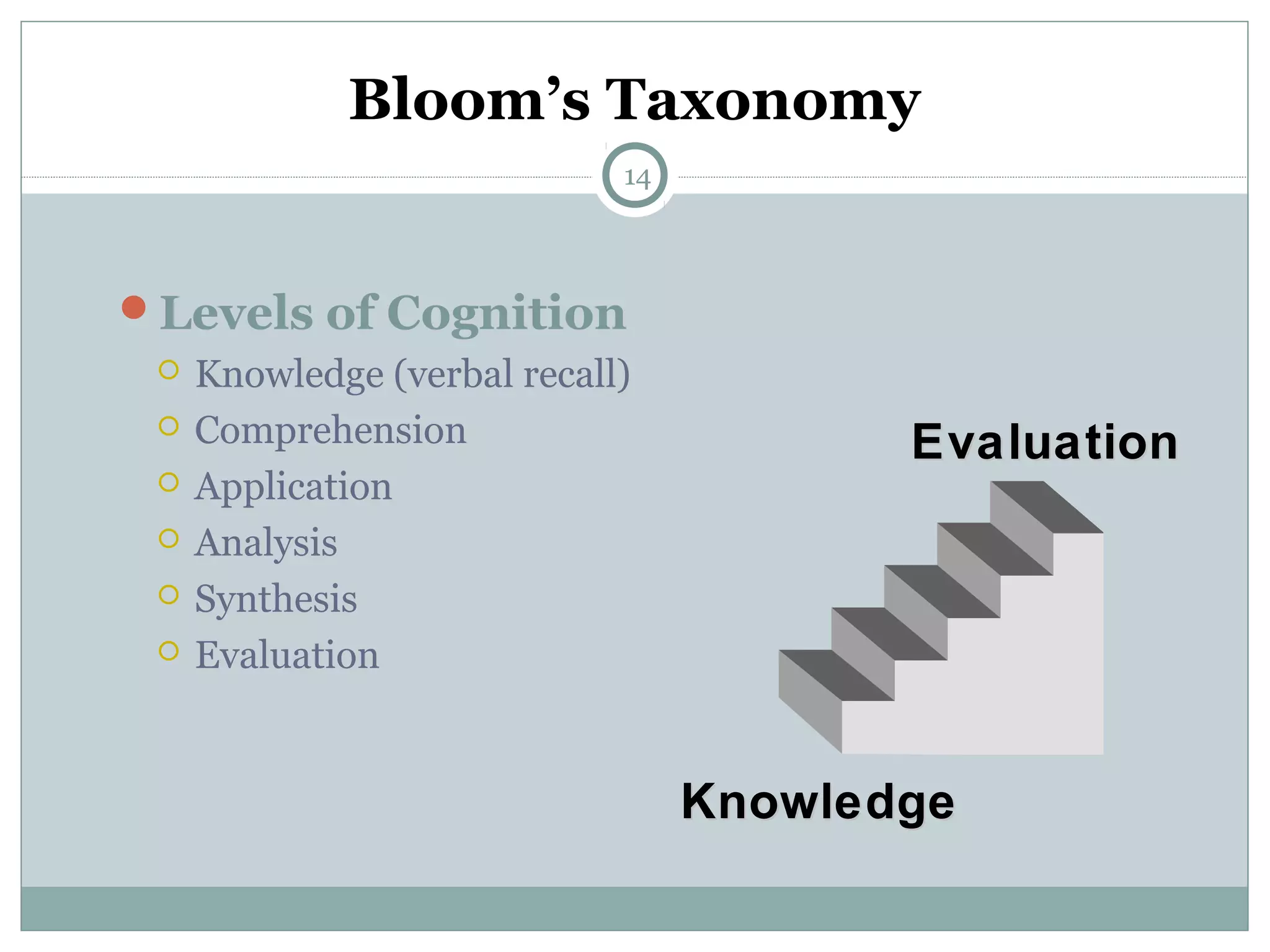
Bloom’s Taxonomy
14
Levels of Cognition
 Knowledge (verbal recall)
 Comprehension
 Application
 Analysis
 Synthesis
 Evaluation
KnowledgeKnowledge
EvaluationEvaluation
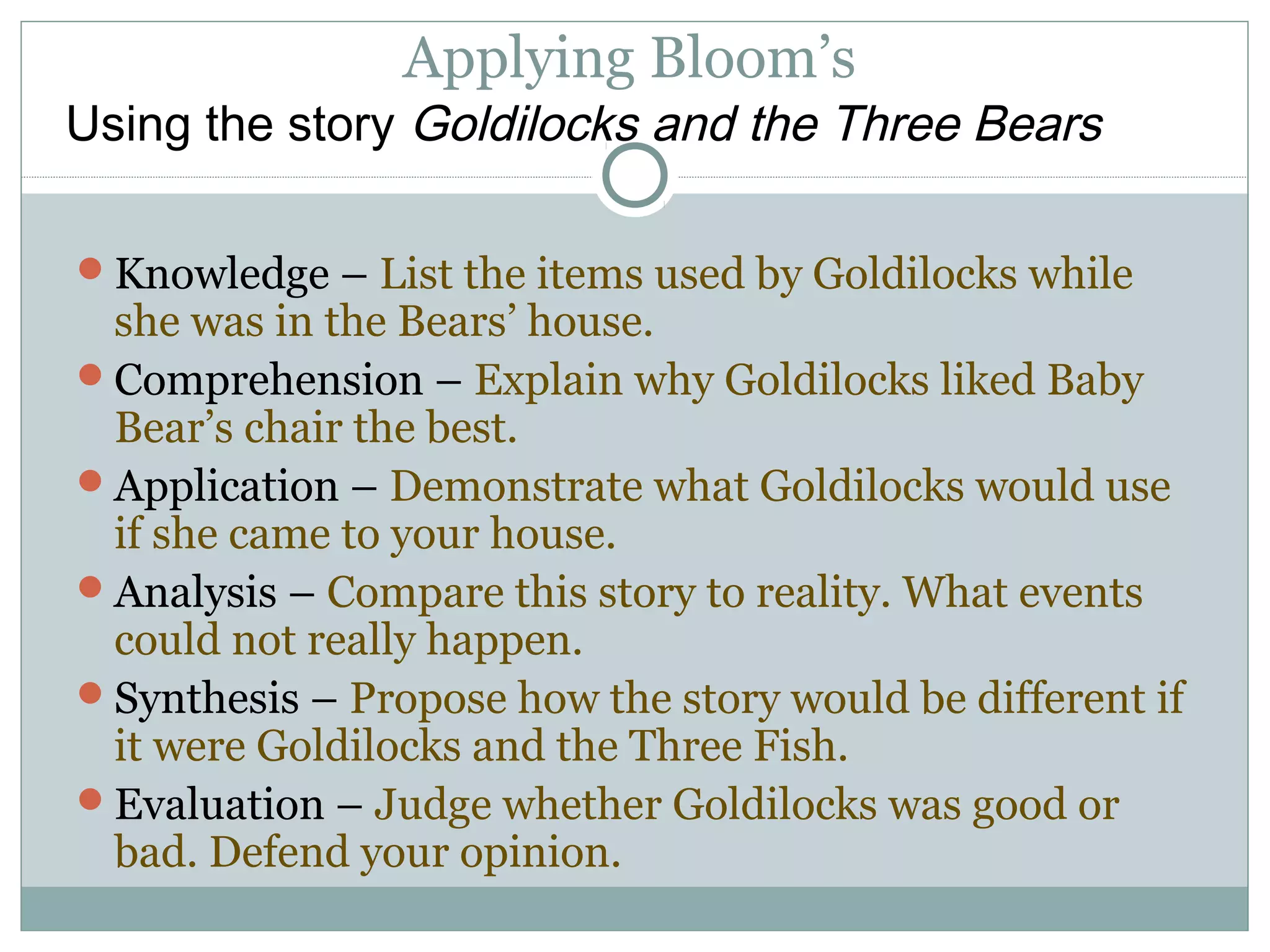
Applying Bloom’s
Knowledge – List the items used by Goldilocks while
she was in the Bears’ house.
Comprehension – Explain why Goldilocks liked Baby
Bear’s chair the best.
Application – Demonstrate what Goldilocks would use
if she came to your house.
Analysis – Compare this story to reality. What events
could not really happen.
Synthesis – Propose how the story would be different if
it were Goldilocks and the Three Fish.
Evaluation – Judge whether Goldilocks was good or
bad. Defend your opinion.
Using the story Goldilocks and the Three Bears
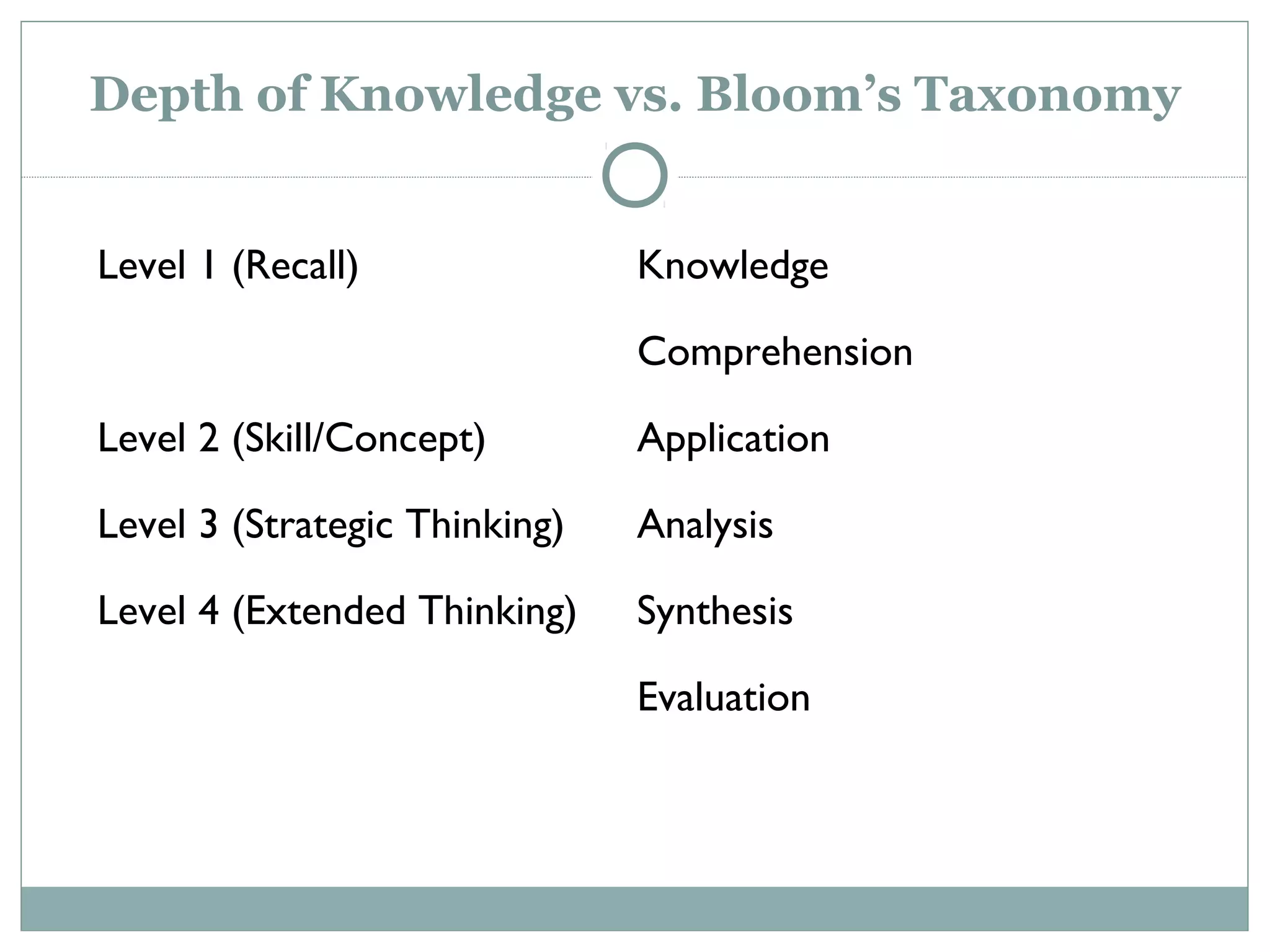
Depth of Knowledge vs. Bloom’s Taxonomy
Level 1 (Recall) Knowledge
Comprehension
Level 2 (Skill/Concept) Application
Level 3 (Strategic Thinking) Analysis
Level 4 (Extended Thinking) Synthesis
Evaluation
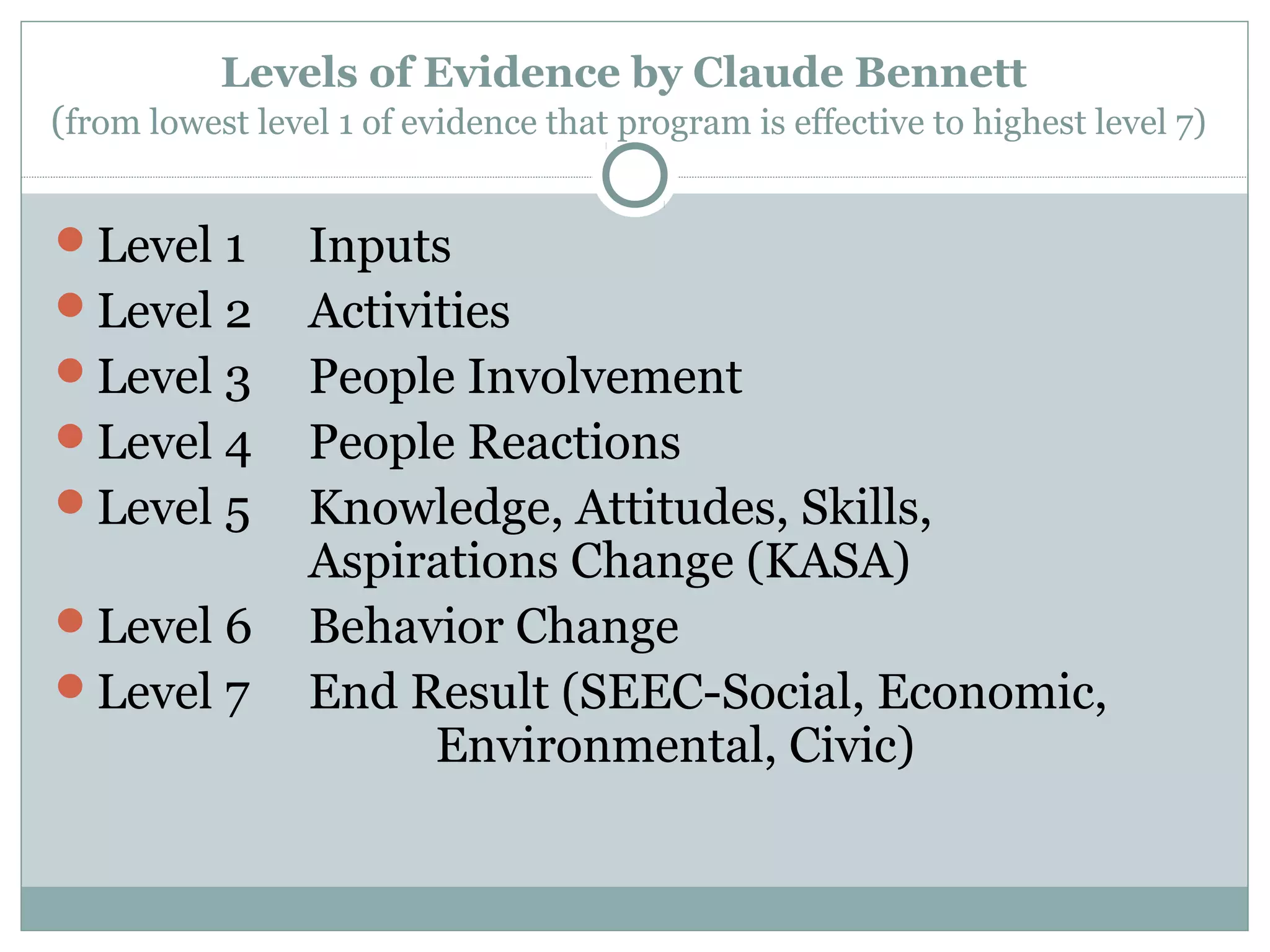
Levels of Evidence by Claude Bennett
(from lowest level 1 of evidence that program is effective to highest level 7)
Level 1 Inputs
Level 2 Activities
Level 3 People Involvement
Level 4 People Reactions
Level 5 Knowledge, Attitudes, Skills,
Aspirations Change (KASA)
Level 6 Behavior Change
Level 7 End Result (SEEC-Social, Economic,
Environmental, Civic)
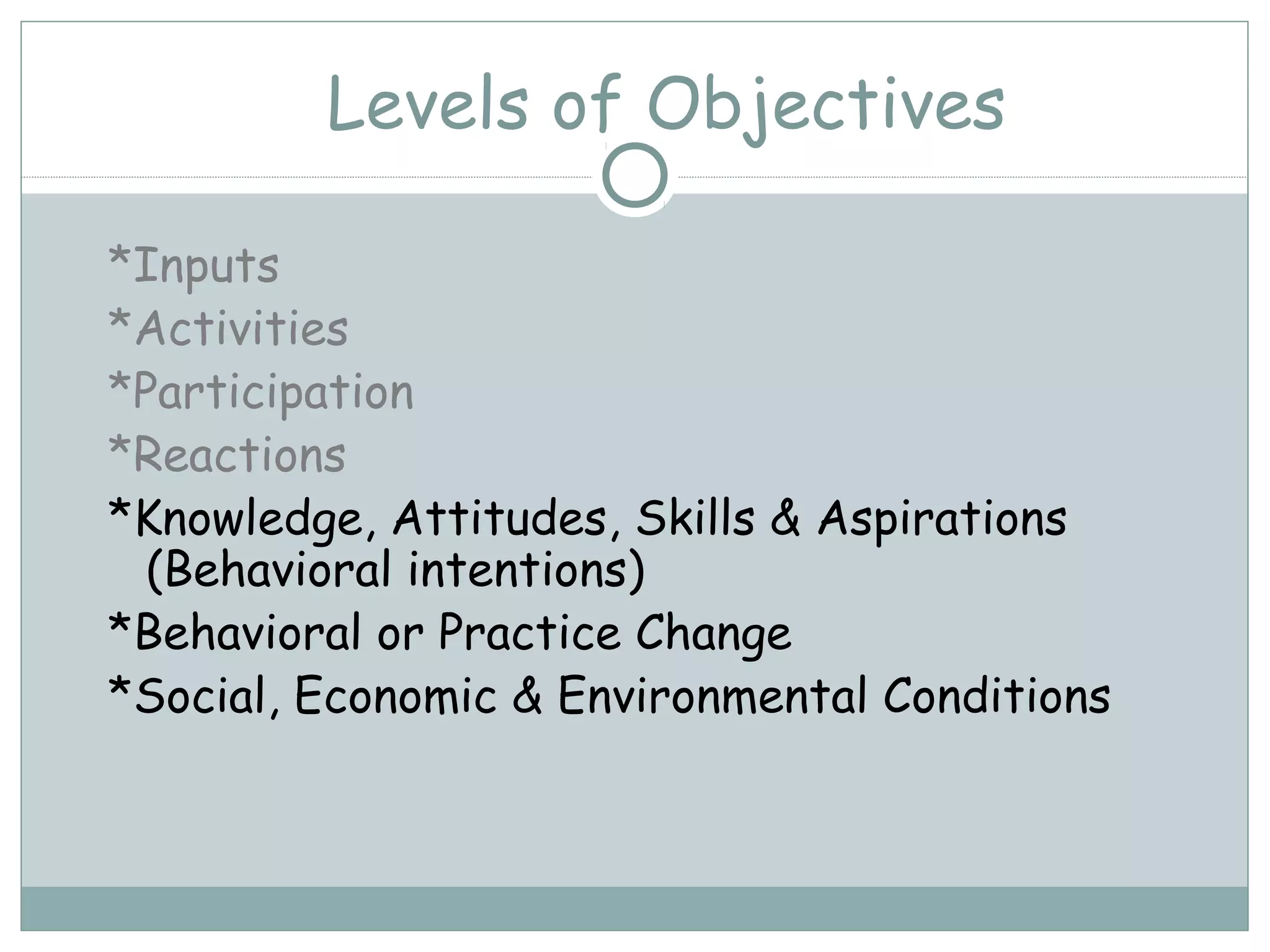
Levels of Objectives
*Inputs
*Activities
*Participation
*Reactions
*Knowledge, Attitudes, Skills & Aspirations
(Behavioral intentions)
*Behavioral or Practice Change
*Social, Economic & Environmental Conditions
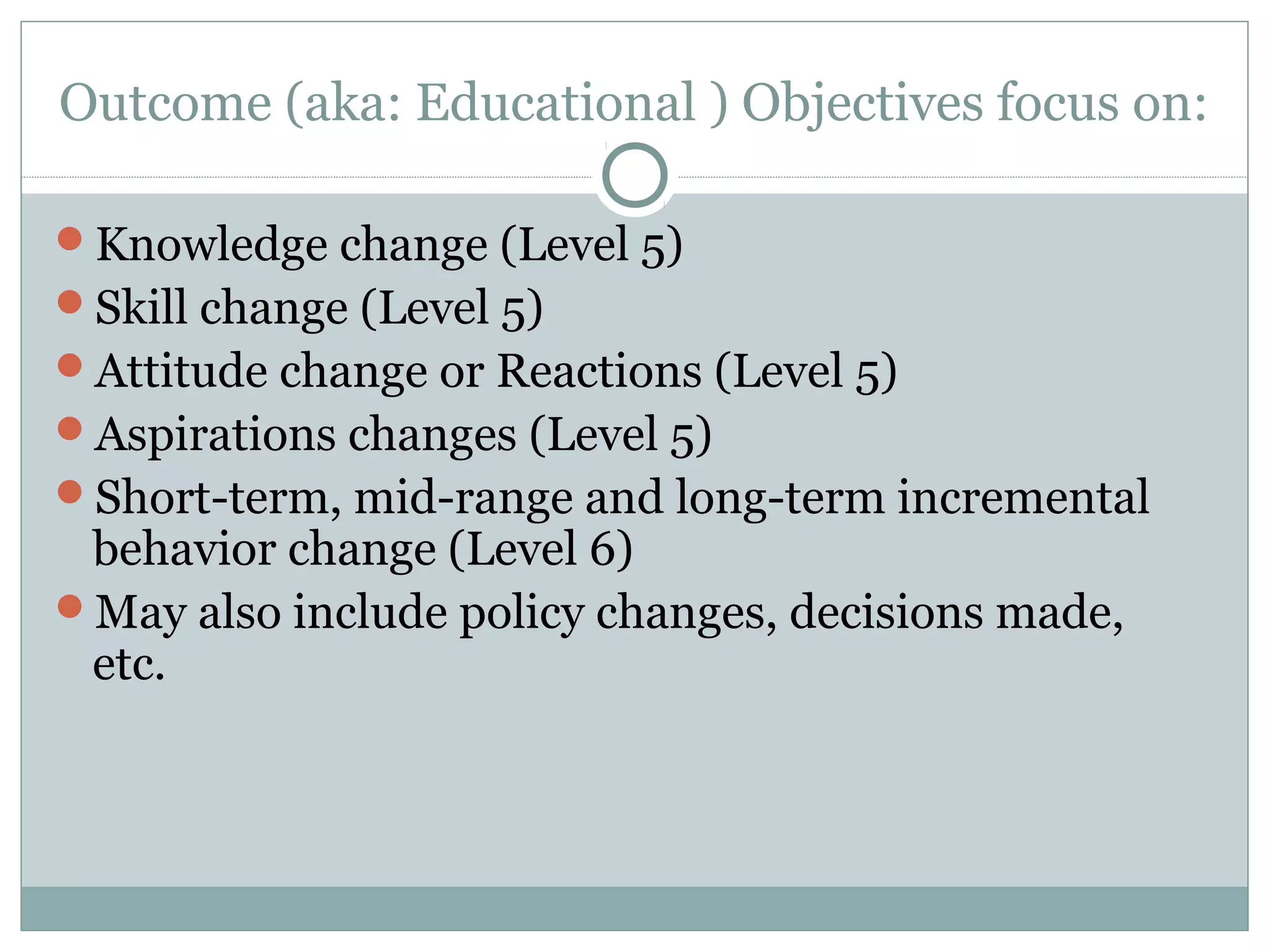
Outcome (aka: Educational ) Objectives focus on:
Knowledge change (Level 5)
Skill change (Level 5)
Attitude change or Reactions (Level 5)
Aspirations changes (Level 5)
Short-term, mid-range and long-term incremental
behavior change (Level 6)
May also include policy changes, decisions made,
etc.
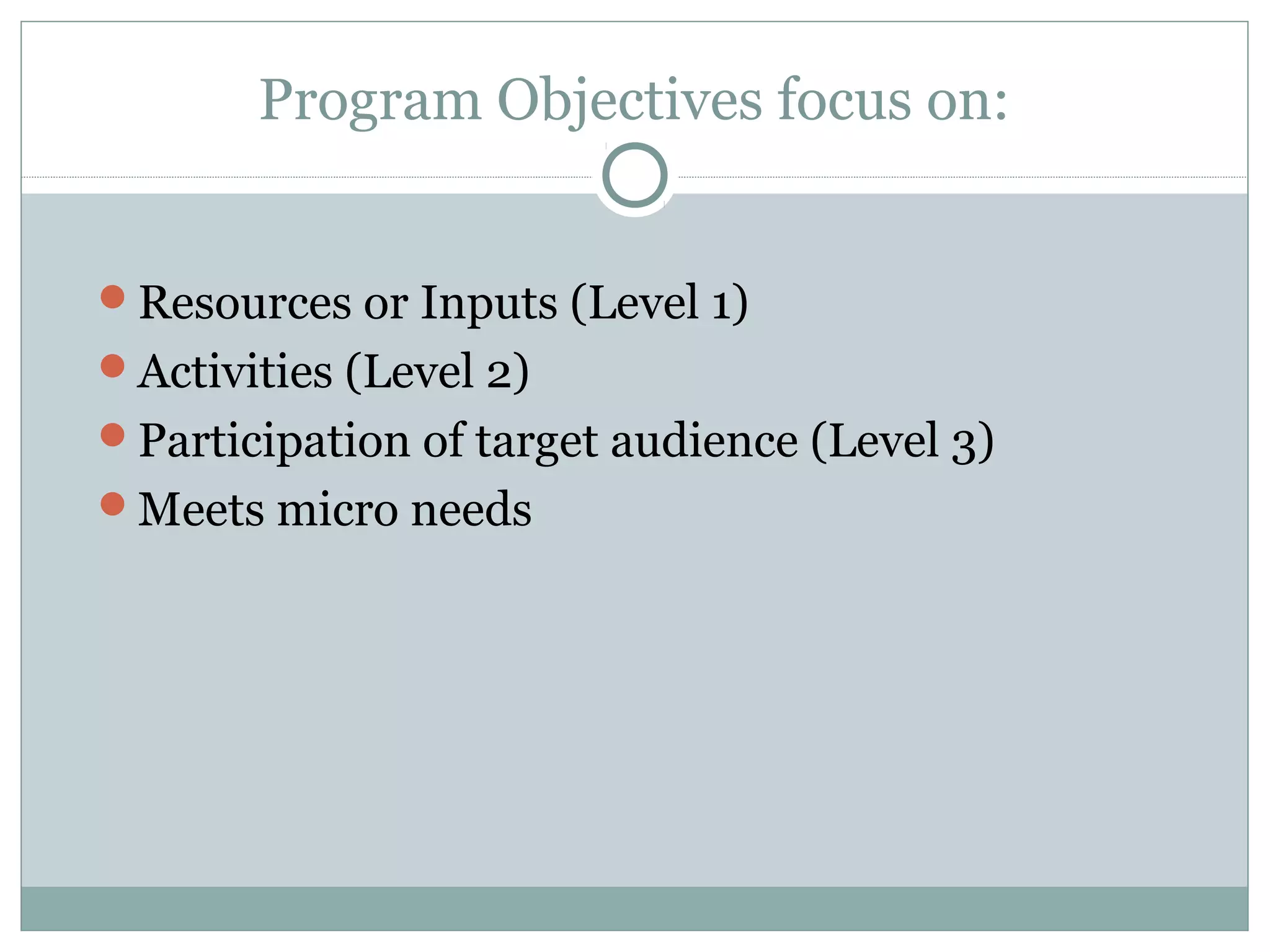
Program Objectives focus on:
Resources or Inputs (Level 1)
Activities (Level 2)
Participation of target audience (Level 3)
Meets micro needs
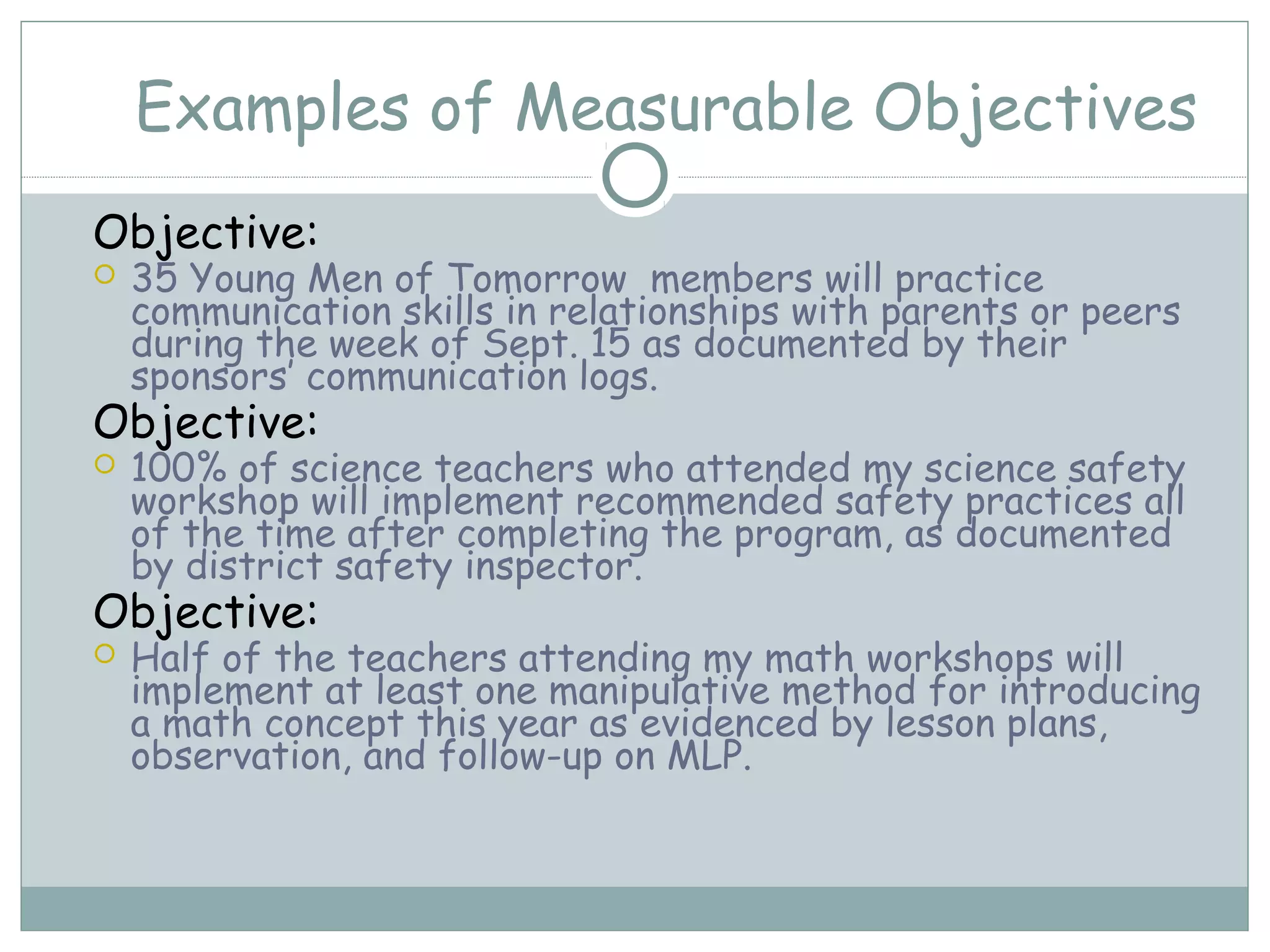
Examples of Measurable Objectives
Objective:
 35 Young Men of Tomorrow members will practice
communication skills in relationships with parents or peers
during the week of Sept. 15 as documented by their
sponsors’ communication logs.
Objective:
 100% of science teachers who attended my science safety
workshop will implement recommended safety practices all
of the time after completing the program, as documented
by district safety inspector.
Objective:
 Half of the teachers attending my math workshops will
implement at least one manipulative method for introducing
a math concept this year as evidenced by lesson plans,
observation, and follow-up on MLP.
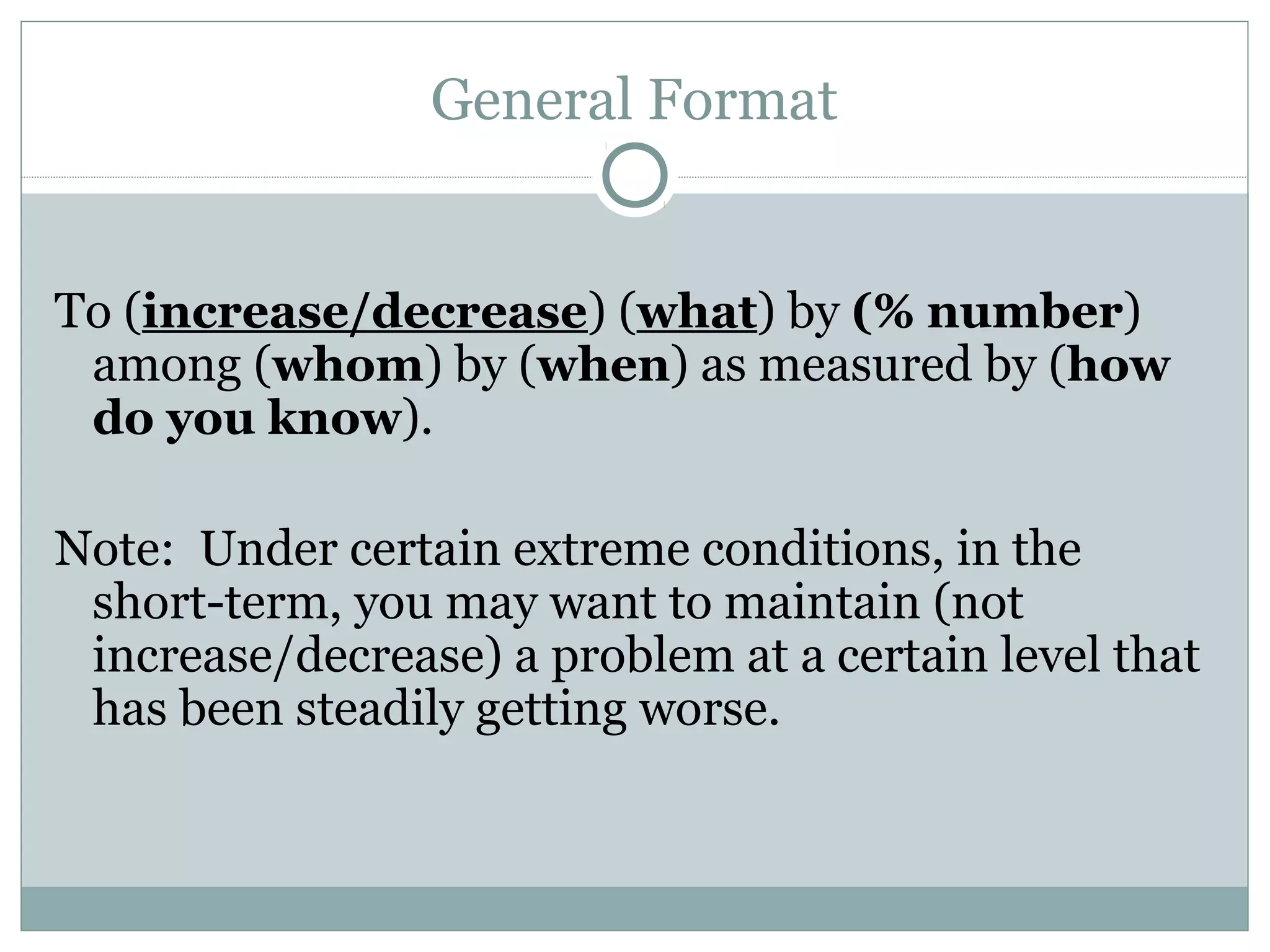
General Format
To (increase/decrease) (what) by (% number)
among (whom) by (when) as measured by (how
do you know).
Note: Under certain extreme conditions, in the
short-term, you may want to maintain (not
increase/decrease) a problem at a certain level that
has been steadily getting worse.
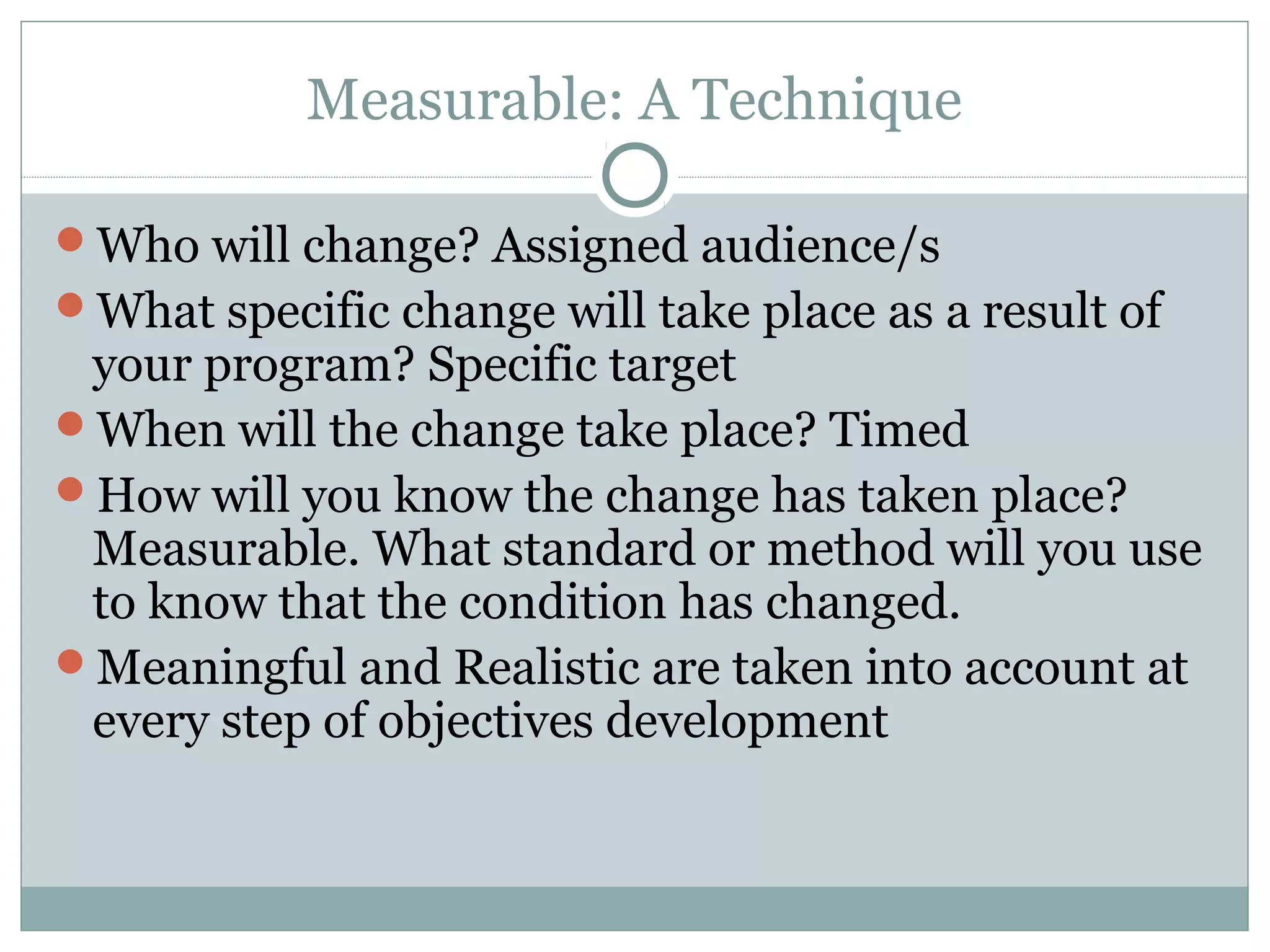
Measurable: A Technique
Who will change? Assigned audience/s
What specific change will take place as a result of
your program? Specific target
When will the change take place? Timed
How will you know the change has taken place?
Measurable. What standard or method will you use
to know that the condition has changed.
Meaningful and Realistic are taken into account at
every step of objectives development
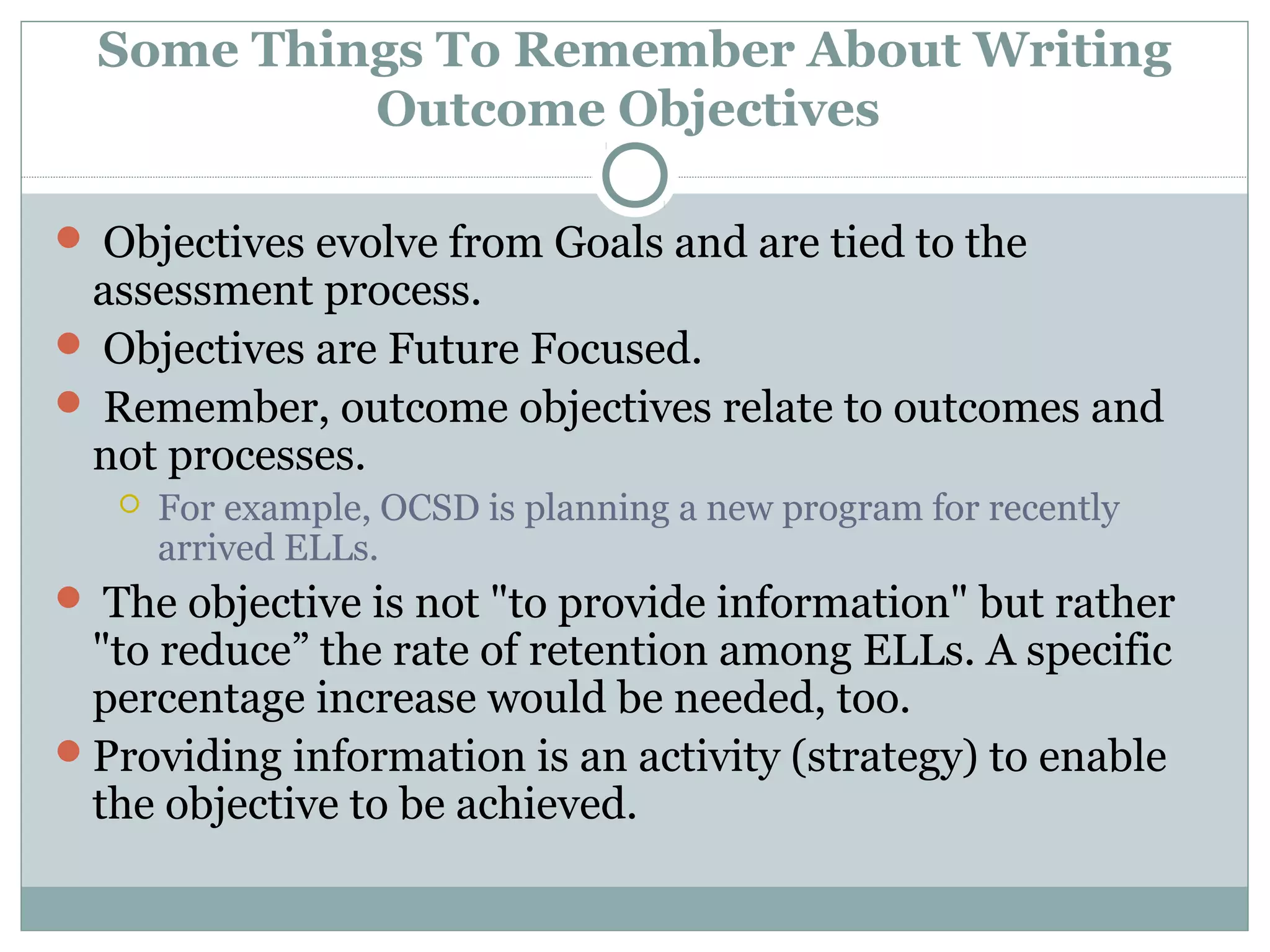
Some Things To Remember About Writing
Outcome Objectives
 Objectives evolve from Goals and are tied to the
assessment process.
 Objectives are Future Focused.
 Remember, outcome objectives relate to outcomes and
not processes.
 For example, OCSD is planning a new program for recently
arrived ELLs.
 The objective is not "to provide information" but rather
"to reduce” the rate of retention among ELLs. A specific
percentage increase would be needed, too.
Providing information is an activity (strategy) to enable
the objective to be achieved.
Common Errors in
Writing Goals and Objectives
Too specific to be meaningful
Too broad to be measurable
Too many to be manageable
Too few to be comprehensive
Too arbitrary to be relevant
Too boilerplate or “cookie-cutter”
to be individualized
Comparison
26
Goal
 Students will gain an appreciation and understanding of
the value of applying the Florida Writes rubric to their
own writing.
Objective
 Students will be able to construct a five paragraph essay
that follows the guidelines of the Florida Writes rubric
within a 45-minute timed writing session in their English
class and explain the components in their essay that
warrant the highest score.
Purposes of Objectives
Address the needs of
your target public
Provide direction to your
program or activity
Useful in selecting
learning experiences and
program methods
Communicate the
expected or predicted
results or changes to key
stakeholders
Forms the basis for the
evaluation if it is written
in measurable terms
Levels of Objectives
28
What is the level of this objective?
 Participants will be able to name the three parts of a
behavioral objective.
What is the level of this objective?
 Participants will be able to write a behavioral objective
that contains a measurable verb, condition, and
criteria.
Specificity and Level
29
Not So Specific:
 The learner will be able to: orally discuss the elements of
a story
More Specific:
 The learner will be able to: orally present a short story’s
parts in a logical sequence (Setting, Characters, Conflict,
Resolution), chronologically develop the elements,
summarize the actions of the protagonist and antagonist,
as well as highlight any details that may have been
influenced by the author’s background or experiences.
Good Objectives are SMMART
Specific- tells what change is going to occur. Has a
clear focus
Meaningful – relates to identified needs
Measurable- definite means to measure to see if
change occurred. Can observe it empirically
Assigned to a specific target audience
Realistic- can be accomplished
Timed- specific time to be achieved by
Measurable and Observable
Can look back and tell whether you achieved your
aim
Typically associated with quantifiable information,
but can be qualitative
Ex: Expected level of improvement in math for an
academic enrichment program as evidenced by pre
and post program math test scores
Using the SMMART Process
When writing goals and objectives, keep them
SMMART:
. Specific. Use specific rather than generalized
language:
 Clearly state the issue, the target group, the time and place of
the program.
 Poorly stated goal : The district’s Title I program will reduce the
number of ELLs retained.
 Clearer goal : As a strategy for reducing retention rates, ELLs
will participate in an intensive supplementary instructional
after-school program which will focus on supplementary
instruction on grade level benchmarks using effective ESOL
strategies.
Using the SMMART Process
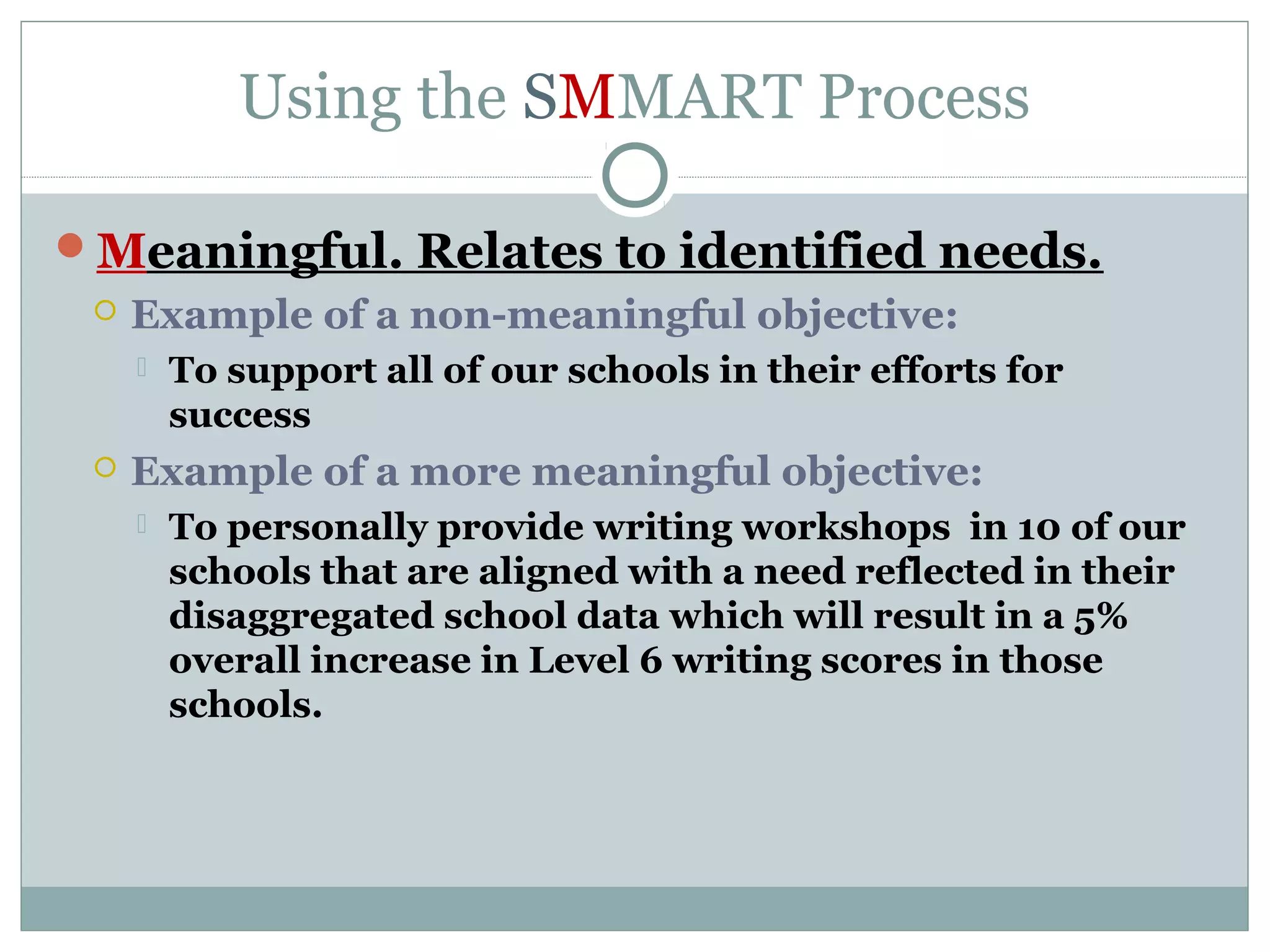
Meaningful. Relates to identified needs.
 Example of a non-meaningful objective:
 To support all of our schools in their efforts for
success
 Example of a more meaningful objective:
 To personally provide writing workshops in 10 of our
schools that are aligned with a need reflected in their
disaggregated school data which will result in a 5%
overall increase in Level 6 writing scores in those
schools.
Using the SMMART Process
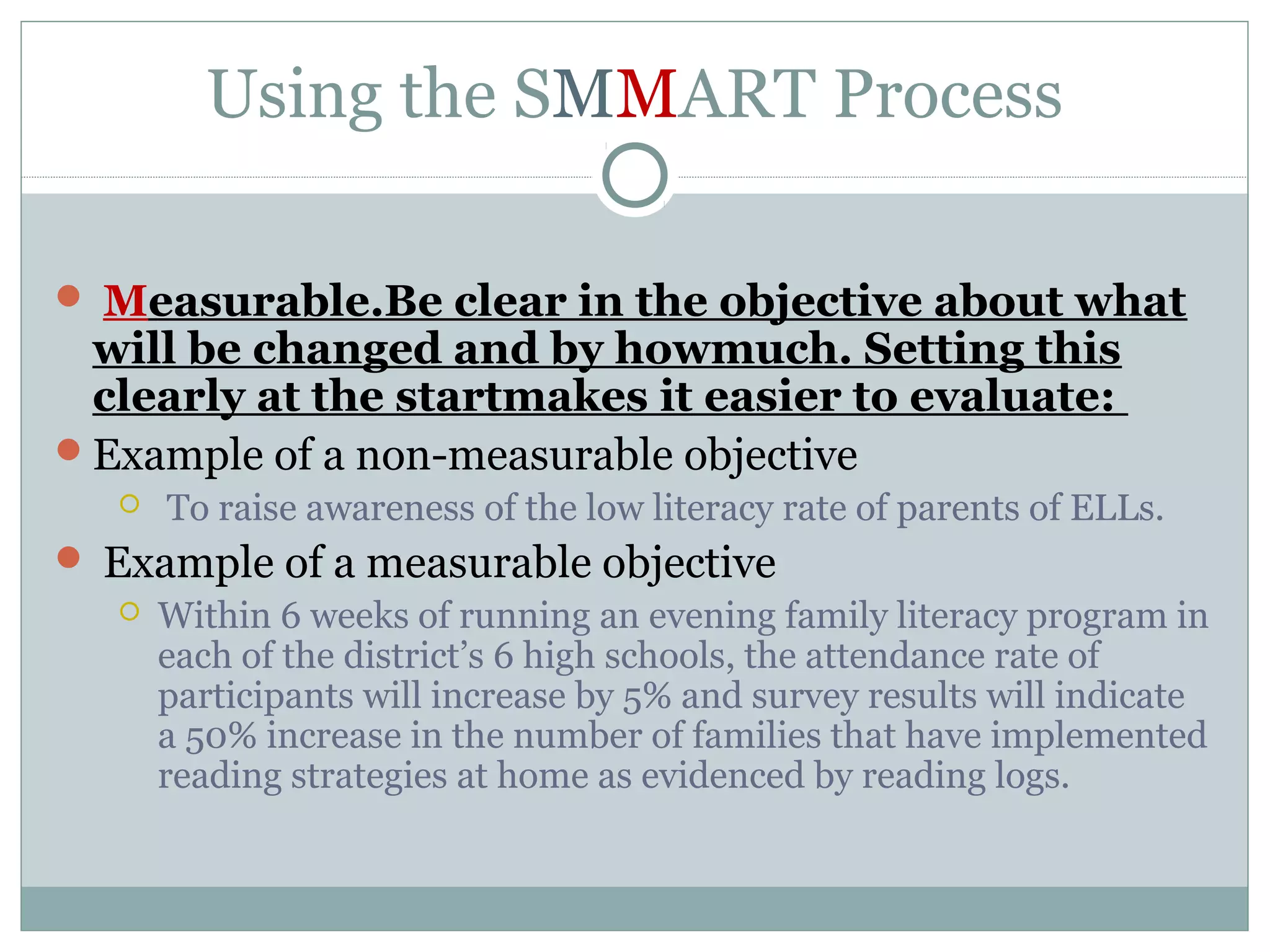
 Measurable.Be clear in the objective about what
will be changed and by howmuch. Setting this
clearly at the startmakes it easier to evaluate:
Example of a non-measurable objective
 To raise awareness of the low literacy rate of parents of ELLs.
 Example of a measurable objective
 Within 6 weeks of running an evening family literacy program in
each of the district’s 6 high schools, the attendance rate of
participants will increase by 5% and survey results will indicate
a 50% increase in the number of families that have implemented
reading strategies at home as evidenced by reading logs.
Using The SMMART Process
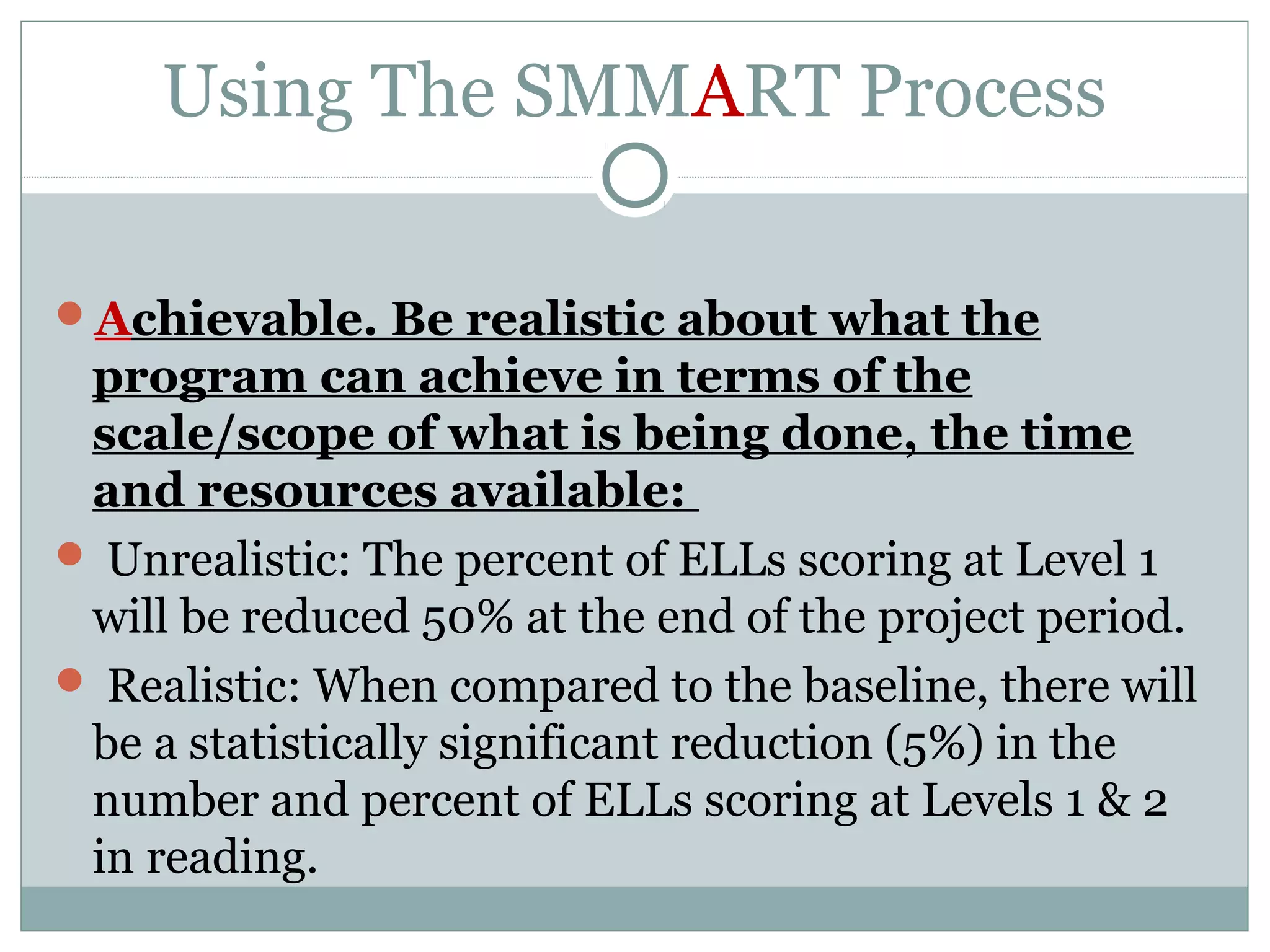
Achievable. Be realistic about what the
program can achieve in terms of the
scale/scope of what is being done, the time
and resources available:
 Unrealistic: The percent of ELLs scoring at Level 1
will be reduced 50% at the end of the project period.
 Realistic: When compared to the baseline, there will
be a statistically significant reduction (5%) in the
number and percent of ELLs scoring at Levels 1 & 2
in reading.
Using the SMMART Process
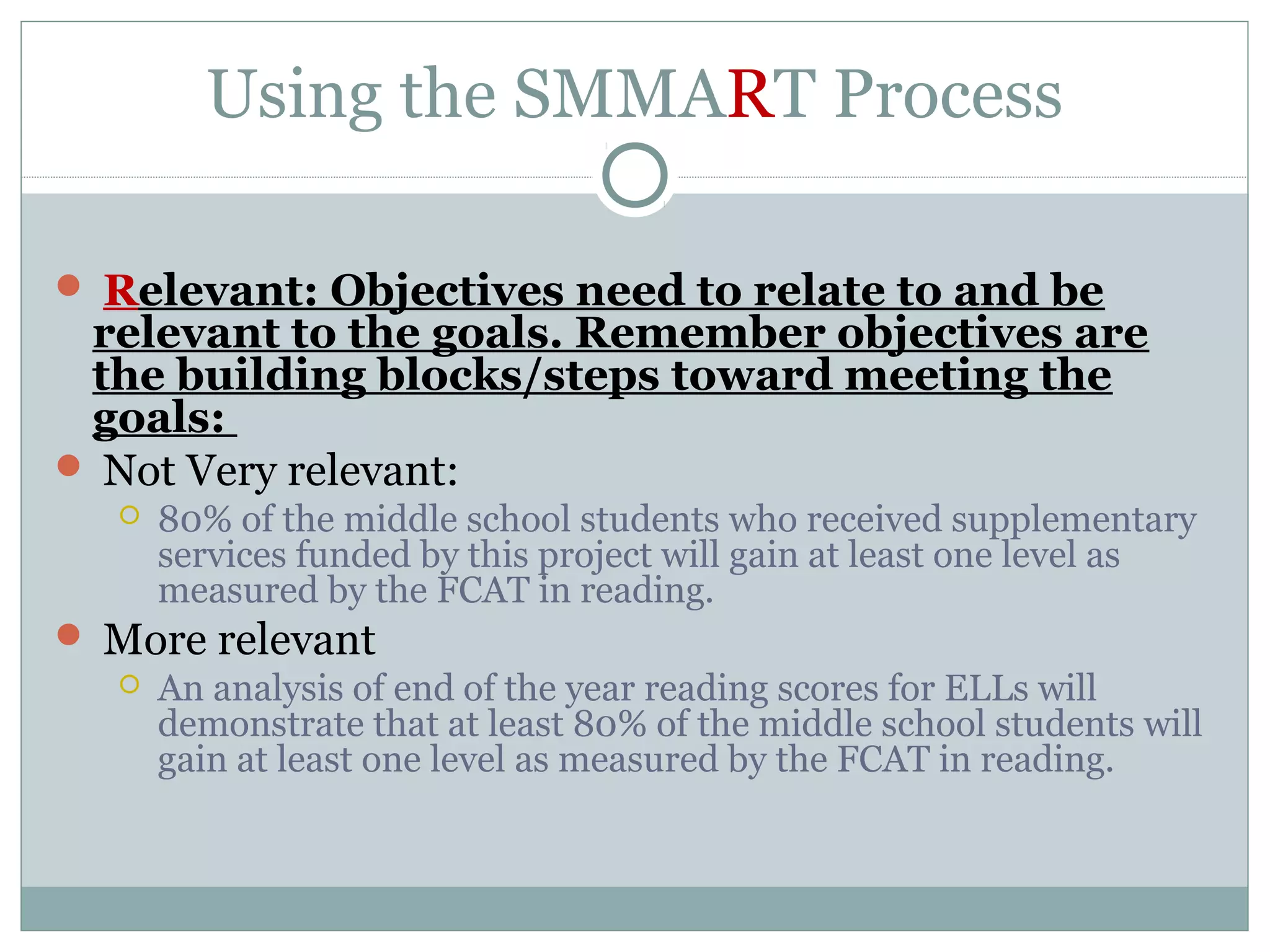
 Relevant: Objectives need to relate to and be
relevant to the goals. Remember objectives are
the building blocks/steps toward meeting the
goals:
 Not Very relevant:
 80% of the middle school students who received supplementary
services funded by this project will gain at least one level as
measured by the FCAT in reading.
 More relevant
 An analysis of end of the year reading scores for ELLs will
demonstrate that at least 80% of the middle school students will
gain at least one level as measured by the FCAT in reading.
Using the SMMART Process
Time Specific. Be clear in the objectives
about the timeframe in which the
program/activities, as well as expected
changes, will take place:
 At the conclusion of the program, there will be a 7%
(statistically significant) increase, when compared to
baseline data, in the proportion of ELLs who have
mastered listening, speaking, reading & writing in
English.
What is a Goal?
A Goal is a general statement of a desired state
toward which a program is directed.
see Rossi et al., 2004:98
Goals
39
Definition
 A statement that describes in broad terms what the
learner will do.
Example
 Students will gain an appreciation and understanding of
the value of applying the Florida Writes rubric to their
own writing.
Goal Writing
Good goal writing takes into account the
long-range vision and states it in short-range
measures.
Good goal writing is essentially the same
challenge regardless of the “form”.
Articulate measurable goals
Goals must be directly related to the student needs
as identified in the present level data.
Goals are positive statements of student or teacher
performance.
Goals must address reasonable, broader outcomes.
Goals provide the logical connection between
student needs and service implications.
Sample Goal  Objective  Strategy
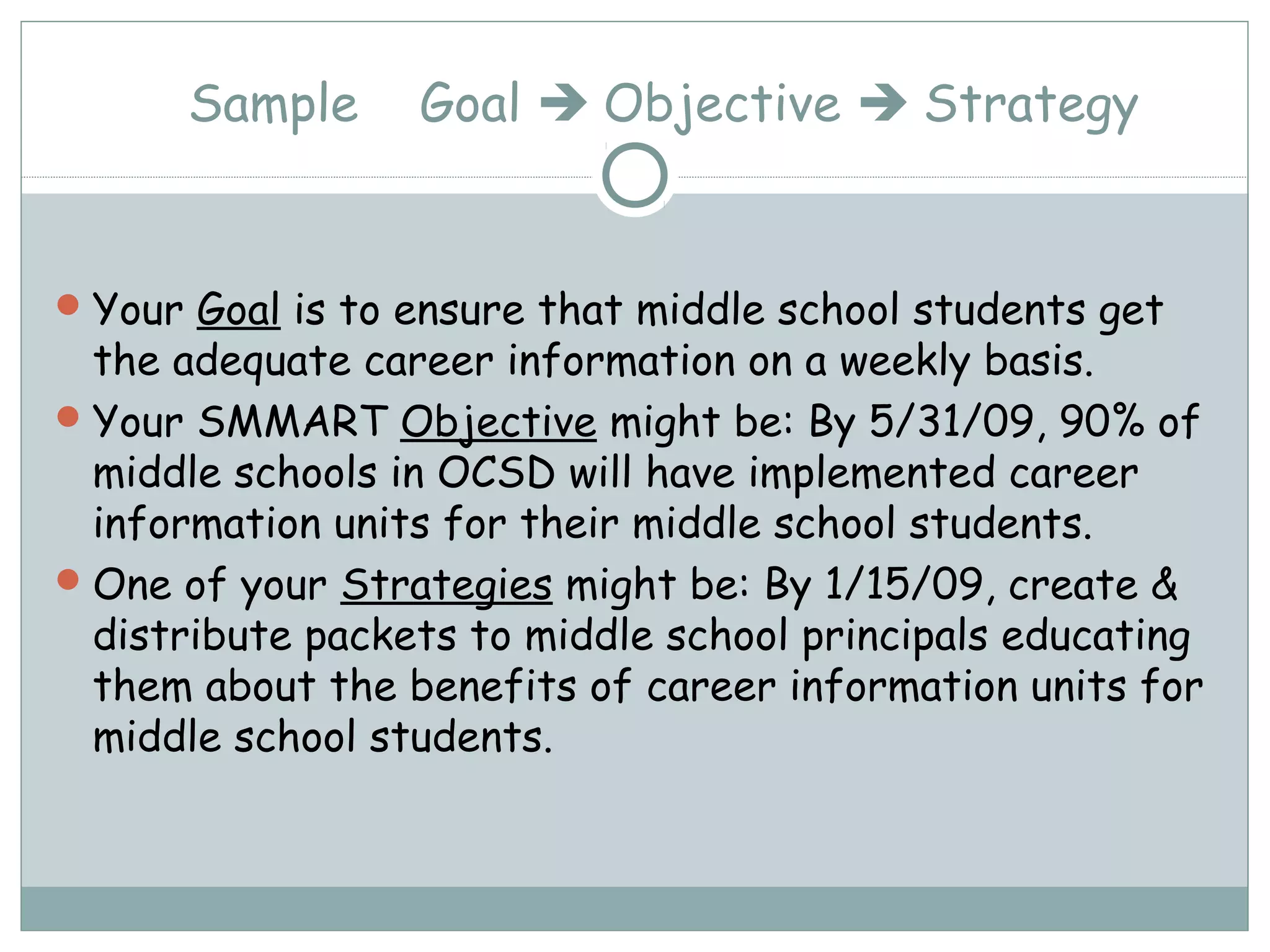
Your Goal is to ensure that middle school students get
the adequate career information on a weekly basis.
Your SMMART Objective might be: By 5/31/09, 90% of
middle schools in OCSD will have implemented career
information units for their middle school students.
One of your Strategies might be: By 1/15/09, create &
distribute packets to middle school principals educating
them about the benefits of career information units for
middle school students.
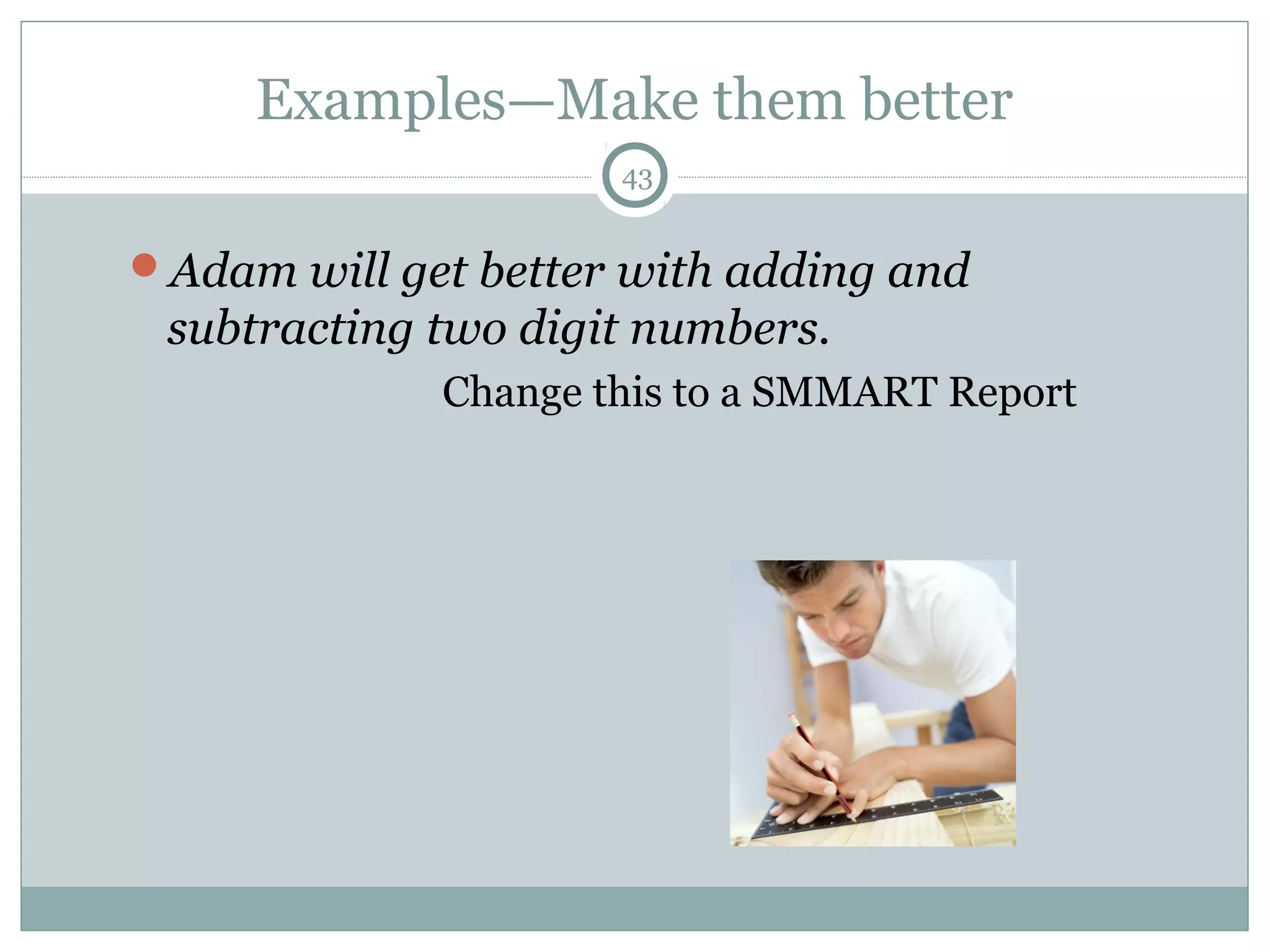
Examples—Make them better
43
Adam will get better with adding and
subtracting two digit numbers.
Change this to a SMMART Report
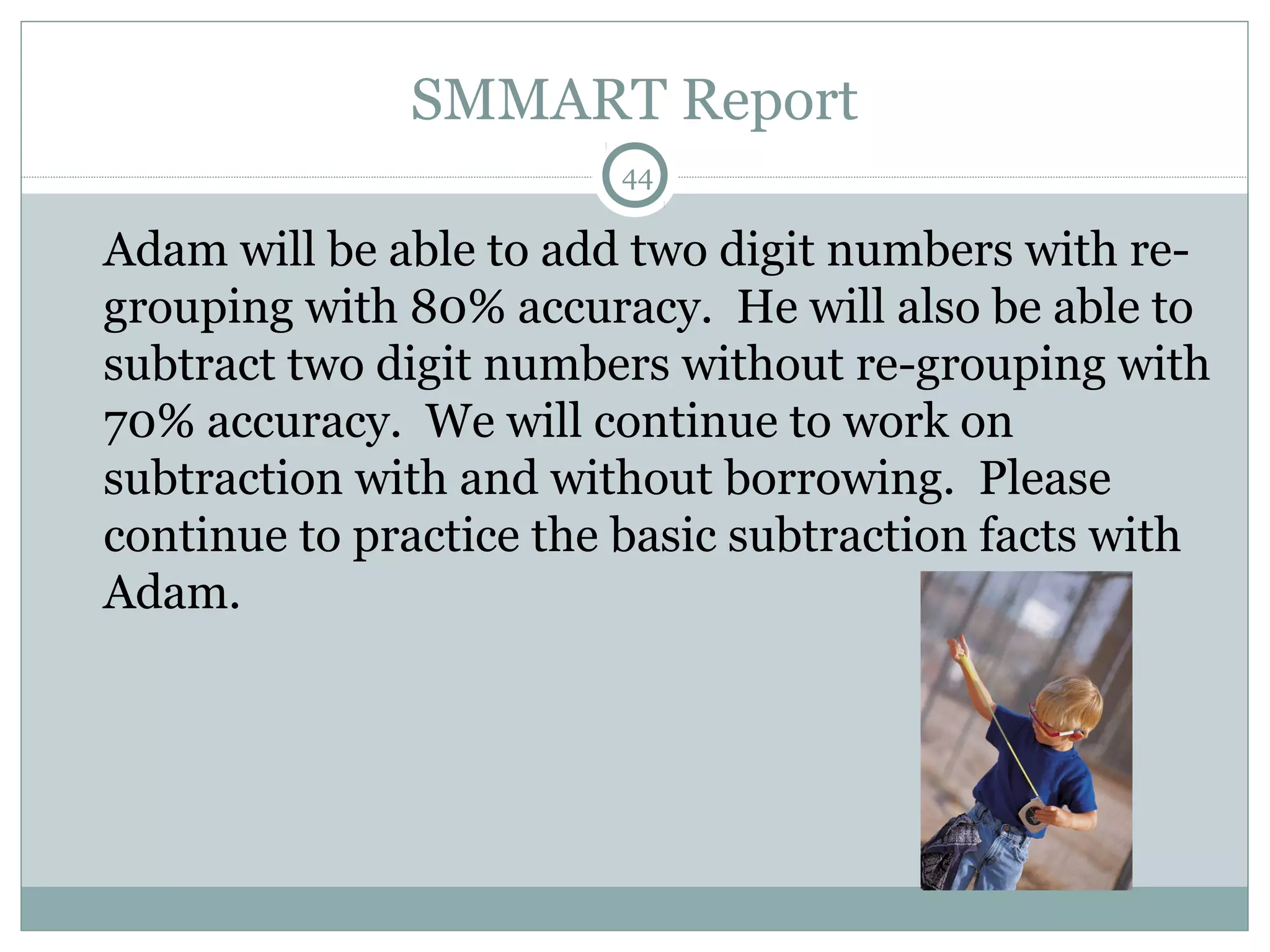
SMMART Report
44
Adam will be able to add two digit numbers with re-
grouping with 80% accuracy. He will also be able to
subtract two digit numbers without re-grouping with
70% accuracy. We will continue to work on
subtraction with and without borrowing. Please
continue to practice the basic subtraction facts with
Adam.
Some Things To Remember About Writing
Objectives
Objectives May be Long-term (Impact):
 Long-term but still realistic
 Based on expected achievements of program or actions
 Deals with determinants of proficiency that
can be measured (ex. level of understanding of math/science,
speaking, reading & writing)
 Deals with determinants of academic achievement that
can be measured (FCAT Levels)
 Do not happen immediately-measured after many months
 Dependent upon some action (strategies) personally undertaken
to improve student achievement
 SMMART!
References
Guion, Lisa A., Baugh, E. & Marcus, J.
(2006). Writing “SMMART” objectives. EDIS.
Florida Cooperative Extension Service, University
of Florida. Publication # FY824
Impact Statements, Michigan Agricultural
Experiment Station, available at
http://www.maes.msu.edu/intranet/Report_impact.h
Rockwell, K & Bennett, C (1995) Targeting
Outcomes of Programs, available at
http://citnews.unl.edu/TOP/english/index.htm

Writing measurable objectives

  • 1.
    CURRICULUM, INSTRUCTION & ASSESSMENT SEPTEMBER15, 2008 DR. DIANE KELLEY Writing Measurable Goals and Objectives
  • 2.
    Goals of thisPresentation 2 Appreciate the value of writing clear and measurable behavioral objectives. Re-evaluate objectives you have written and work to enhance them. Make additional efforts to enhance the congruency of: Objectives, Individual Professional Activities (PD, IPDPs)---Your Own Action Items, and/or School & Department Goals/Mission Statement.
  • 3.
    Goals and Objectives Whatare objectives? Objectives are NOT goals. Goals are broad, objectives are specific. An objective is a “foreseen end that gives direction to an activity” (John Dewey, 1977) “An objective is an end toward which action is oriented, a condition or state of being to be reached. It reflects how the situation will be changed, improved or maintained. “ (Boyle) An objective is a statement which specifies, in measurable terms, the changes we expect in our target audiences as a result of our programs. 3
  • 4.
    Objectives 4 Definition  A statementin specific and measurable terms that describes what the learner will know or be able to do. Example  Students will be able to construct a five paragraph essay that follows the guidelines of the Florida Writes rubric within a 45-minute timed writing session in English class and explain the components in their essay that warrant the highest score.
  • 5.
    Orienting Question How doyou tell a good objective from a bad one?
  • 6.
    Elements of StrongObjectives Target audience (who) Criteria for coverage Outcome (what) Criteria for outcome (measurable) Personal actions to achieve desired outcomes are SMMART (more later)
  • 7.
    Parts of anObjective 7 Measurable verb  Construct  Explain Criteria  5 paragraphs  Within 45-minutes Conditions  In their English class EXAMPLE: Students will be able to construct a five paragraph essay that follows the guidelines of the Florida Writes rubric within a 45- minute timed writing session in English class and explain the components in their essay that warrant the highest score.
  • 8.
    Sources of Objectives Expressed---Needs Assessments, Surveys  Analysis of Data  Research Results  Policy, Legislation, Dictates  Taxonomies, Schemata, Frameworks
  • 9.
    Strong & WeakVerbs for Objectives Strong: to increase (what by how much) to adopt (what resource/practice, by what timeline) to present or to demonstrate (what topics to whom, when) Weak  to promote  to encourage  to understand  to become aware  to work with  to support
  • 10.
    Writing Useful Objectives Usestrong verbs State only one purpose or aim per objective Specify a single end-product or result Specify a time frame for achieving results May relate to taxonomies, schemata or frameworks
  • 11.
    Depth of Knowledge Adaptedfrom the model used by Norman Webb, University of Wisconsin, to align standards with assessments Used by the Council of Chief State School Officers (CCSSO) for assessment alignment in more than ten states • Focuses on content standard in order to successfully complete an assessment/standard task • Descriptive, not a taxonomy---Not the same as difficulty
  • 12.
    Why “Depth ofKnowledge”? No Child Left Behind (NCLB) requires assessments to “measure the depth and breadth of the state academic content standards for a given grade level” (U.S. Department of Education, 2003, p. 12 Mechanism to ensure that the intent of the standard and the level of student demonstration required by that standard matches the assessment items (required under NCLB) Provides cognitive processing ceiling (highest level students can be assessed) for item development
  • 13.
    Webb’s Depth ofKnowledge levels: Recall and Reproduction: Level 1 Skills & Concepts: Level 2 Strategic Thinking: Level 3 Extended Thinking: Level 4
  • 14.
    Bloom’s Taxonomy 14 Levels ofCognition  Knowledge (verbal recall)  Comprehension  Application  Analysis  Synthesis  Evaluation KnowledgeKnowledge EvaluationEvaluation
  • 15.
    Applying Bloom’s Knowledge –List the items used by Goldilocks while she was in the Bears’ house. Comprehension – Explain why Goldilocks liked Baby Bear’s chair the best. Application – Demonstrate what Goldilocks would use if she came to your house. Analysis – Compare this story to reality. What events could not really happen. Synthesis – Propose how the story would be different if it were Goldilocks and the Three Fish. Evaluation – Judge whether Goldilocks was good or bad. Defend your opinion. Using the story Goldilocks and the Three Bears
  • 16.
    Depth of Knowledgevs. Bloom’s Taxonomy Level 1 (Recall) Knowledge Comprehension Level 2 (Skill/Concept) Application Level 3 (Strategic Thinking) Analysis Level 4 (Extended Thinking) Synthesis Evaluation
  • 17.
    Levels of Evidenceby Claude Bennett (from lowest level 1 of evidence that program is effective to highest level 7) Level 1 Inputs Level 2 Activities Level 3 People Involvement Level 4 People Reactions Level 5 Knowledge, Attitudes, Skills, Aspirations Change (KASA) Level 6 Behavior Change Level 7 End Result (SEEC-Social, Economic, Environmental, Civic)
  • 18.
    Levels of Objectives *Inputs *Activities *Participation *Reactions *Knowledge,Attitudes, Skills & Aspirations (Behavioral intentions) *Behavioral or Practice Change *Social, Economic & Environmental Conditions
  • 19.
    Outcome (aka: Educational) Objectives focus on: Knowledge change (Level 5) Skill change (Level 5) Attitude change or Reactions (Level 5) Aspirations changes (Level 5) Short-term, mid-range and long-term incremental behavior change (Level 6) May also include policy changes, decisions made, etc.
  • 20.
    Program Objectives focuson: Resources or Inputs (Level 1) Activities (Level 2) Participation of target audience (Level 3) Meets micro needs
  • 21.
    Examples of MeasurableObjectives Objective:  35 Young Men of Tomorrow members will practice communication skills in relationships with parents or peers during the week of Sept. 15 as documented by their sponsors’ communication logs. Objective:  100% of science teachers who attended my science safety workshop will implement recommended safety practices all of the time after completing the program, as documented by district safety inspector. Objective:  Half of the teachers attending my math workshops will implement at least one manipulative method for introducing a math concept this year as evidenced by lesson plans, observation, and follow-up on MLP.
  • 22.
    General Format To (increase/decrease)(what) by (% number) among (whom) by (when) as measured by (how do you know). Note: Under certain extreme conditions, in the short-term, you may want to maintain (not increase/decrease) a problem at a certain level that has been steadily getting worse.
  • 23.
    Measurable: A Technique Whowill change? Assigned audience/s What specific change will take place as a result of your program? Specific target When will the change take place? Timed How will you know the change has taken place? Measurable. What standard or method will you use to know that the condition has changed. Meaningful and Realistic are taken into account at every step of objectives development
  • 24.
    Some Things ToRemember About Writing Outcome Objectives  Objectives evolve from Goals and are tied to the assessment process.  Objectives are Future Focused.  Remember, outcome objectives relate to outcomes and not processes.  For example, OCSD is planning a new program for recently arrived ELLs.  The objective is not "to provide information" but rather "to reduce” the rate of retention among ELLs. A specific percentage increase would be needed, too. Providing information is an activity (strategy) to enable the objective to be achieved.
  • 25.
    Common Errors in WritingGoals and Objectives Too specific to be meaningful Too broad to be measurable Too many to be manageable Too few to be comprehensive Too arbitrary to be relevant Too boilerplate or “cookie-cutter” to be individualized
  • 26.
    Comparison 26 Goal  Students willgain an appreciation and understanding of the value of applying the Florida Writes rubric to their own writing. Objective  Students will be able to construct a five paragraph essay that follows the guidelines of the Florida Writes rubric within a 45-minute timed writing session in their English class and explain the components in their essay that warrant the highest score.
  • 27.
    Purposes of Objectives Addressthe needs of your target public Provide direction to your program or activity Useful in selecting learning experiences and program methods Communicate the expected or predicted results or changes to key stakeholders Forms the basis for the evaluation if it is written in measurable terms
  • 28.
    Levels of Objectives 28 Whatis the level of this objective?  Participants will be able to name the three parts of a behavioral objective. What is the level of this objective?  Participants will be able to write a behavioral objective that contains a measurable verb, condition, and criteria.
  • 29.
    Specificity and Level 29 NotSo Specific:  The learner will be able to: orally discuss the elements of a story More Specific:  The learner will be able to: orally present a short story’s parts in a logical sequence (Setting, Characters, Conflict, Resolution), chronologically develop the elements, summarize the actions of the protagonist and antagonist, as well as highlight any details that may have been influenced by the author’s background or experiences.
  • 30.
    Good Objectives areSMMART Specific- tells what change is going to occur. Has a clear focus Meaningful – relates to identified needs Measurable- definite means to measure to see if change occurred. Can observe it empirically Assigned to a specific target audience Realistic- can be accomplished Timed- specific time to be achieved by
  • 31.
    Measurable and Observable Canlook back and tell whether you achieved your aim Typically associated with quantifiable information, but can be qualitative Ex: Expected level of improvement in math for an academic enrichment program as evidenced by pre and post program math test scores
  • 32.
    Using the SMMARTProcess When writing goals and objectives, keep them SMMART: . Specific. Use specific rather than generalized language:  Clearly state the issue, the target group, the time and place of the program.  Poorly stated goal : The district’s Title I program will reduce the number of ELLs retained.  Clearer goal : As a strategy for reducing retention rates, ELLs will participate in an intensive supplementary instructional after-school program which will focus on supplementary instruction on grade level benchmarks using effective ESOL strategies.
  • 33.
    Using the SMMARTProcess Meaningful. Relates to identified needs.  Example of a non-meaningful objective:  To support all of our schools in their efforts for success  Example of a more meaningful objective:  To personally provide writing workshops in 10 of our schools that are aligned with a need reflected in their disaggregated school data which will result in a 5% overall increase in Level 6 writing scores in those schools.
  • 34.
    Using the SMMARTProcess  Measurable.Be clear in the objective about what will be changed and by howmuch. Setting this clearly at the startmakes it easier to evaluate: Example of a non-measurable objective  To raise awareness of the low literacy rate of parents of ELLs.  Example of a measurable objective  Within 6 weeks of running an evening family literacy program in each of the district’s 6 high schools, the attendance rate of participants will increase by 5% and survey results will indicate a 50% increase in the number of families that have implemented reading strategies at home as evidenced by reading logs.
  • 35.
    Using The SMMARTProcess Achievable. Be realistic about what the program can achieve in terms of the scale/scope of what is being done, the time and resources available:  Unrealistic: The percent of ELLs scoring at Level 1 will be reduced 50% at the end of the project period.  Realistic: When compared to the baseline, there will be a statistically significant reduction (5%) in the number and percent of ELLs scoring at Levels 1 & 2 in reading.
  • 36.
    Using the SMMARTProcess  Relevant: Objectives need to relate to and be relevant to the goals. Remember objectives are the building blocks/steps toward meeting the goals:  Not Very relevant:  80% of the middle school students who received supplementary services funded by this project will gain at least one level as measured by the FCAT in reading.  More relevant  An analysis of end of the year reading scores for ELLs will demonstrate that at least 80% of the middle school students will gain at least one level as measured by the FCAT in reading.
  • 37.
    Using the SMMARTProcess Time Specific. Be clear in the objectives about the timeframe in which the program/activities, as well as expected changes, will take place:  At the conclusion of the program, there will be a 7% (statistically significant) increase, when compared to baseline data, in the proportion of ELLs who have mastered listening, speaking, reading & writing in English.
  • 38.
    What is aGoal? A Goal is a general statement of a desired state toward which a program is directed. see Rossi et al., 2004:98
  • 39.
    Goals 39 Definition  A statementthat describes in broad terms what the learner will do. Example  Students will gain an appreciation and understanding of the value of applying the Florida Writes rubric to their own writing.
  • 40.
    Goal Writing Good goalwriting takes into account the long-range vision and states it in short-range measures. Good goal writing is essentially the same challenge regardless of the “form”.
  • 41.
    Articulate measurable goals Goalsmust be directly related to the student needs as identified in the present level data. Goals are positive statements of student or teacher performance. Goals must address reasonable, broader outcomes. Goals provide the logical connection between student needs and service implications.
  • 42.
    Sample Goal Objective  Strategy Your Goal is to ensure that middle school students get the adequate career information on a weekly basis. Your SMMART Objective might be: By 5/31/09, 90% of middle schools in OCSD will have implemented career information units for their middle school students. One of your Strategies might be: By 1/15/09, create & distribute packets to middle school principals educating them about the benefits of career information units for middle school students.
  • 43.
    Examples—Make them better 43 Adamwill get better with adding and subtracting two digit numbers. Change this to a SMMART Report
  • 44.
    SMMART Report 44 Adam willbe able to add two digit numbers with re- grouping with 80% accuracy. He will also be able to subtract two digit numbers without re-grouping with 70% accuracy. We will continue to work on subtraction with and without borrowing. Please continue to practice the basic subtraction facts with Adam.
  • 45.
    Some Things ToRemember About Writing Objectives Objectives May be Long-term (Impact):  Long-term but still realistic  Based on expected achievements of program or actions  Deals with determinants of proficiency that can be measured (ex. level of understanding of math/science, speaking, reading & writing)  Deals with determinants of academic achievement that can be measured (FCAT Levels)  Do not happen immediately-measured after many months  Dependent upon some action (strategies) personally undertaken to improve student achievement  SMMART!
  • 46.
    References Guion, Lisa A.,Baugh, E. & Marcus, J. (2006). Writing “SMMART” objectives. EDIS. Florida Cooperative Extension Service, University of Florida. Publication # FY824 Impact Statements, Michigan Agricultural Experiment Station, available at http://www.maes.msu.edu/intranet/Report_impact.h Rockwell, K & Bennett, C (1995) Targeting Outcomes of Programs, available at http://citnews.unl.edu/TOP/english/index.htm

Editor's Notes

  • #4 Point of slide is that goals and objectives are not the same.