Phonology:  The Sound   	      Patterns of Language By Richard Binkney, Ph.D.1
Phonology is the study of speech soundsPhoneme – the basic unit    of soundSemantics – the study of the    meaning of languageMorpheme – smallest unit    of sound to carry     meaning2
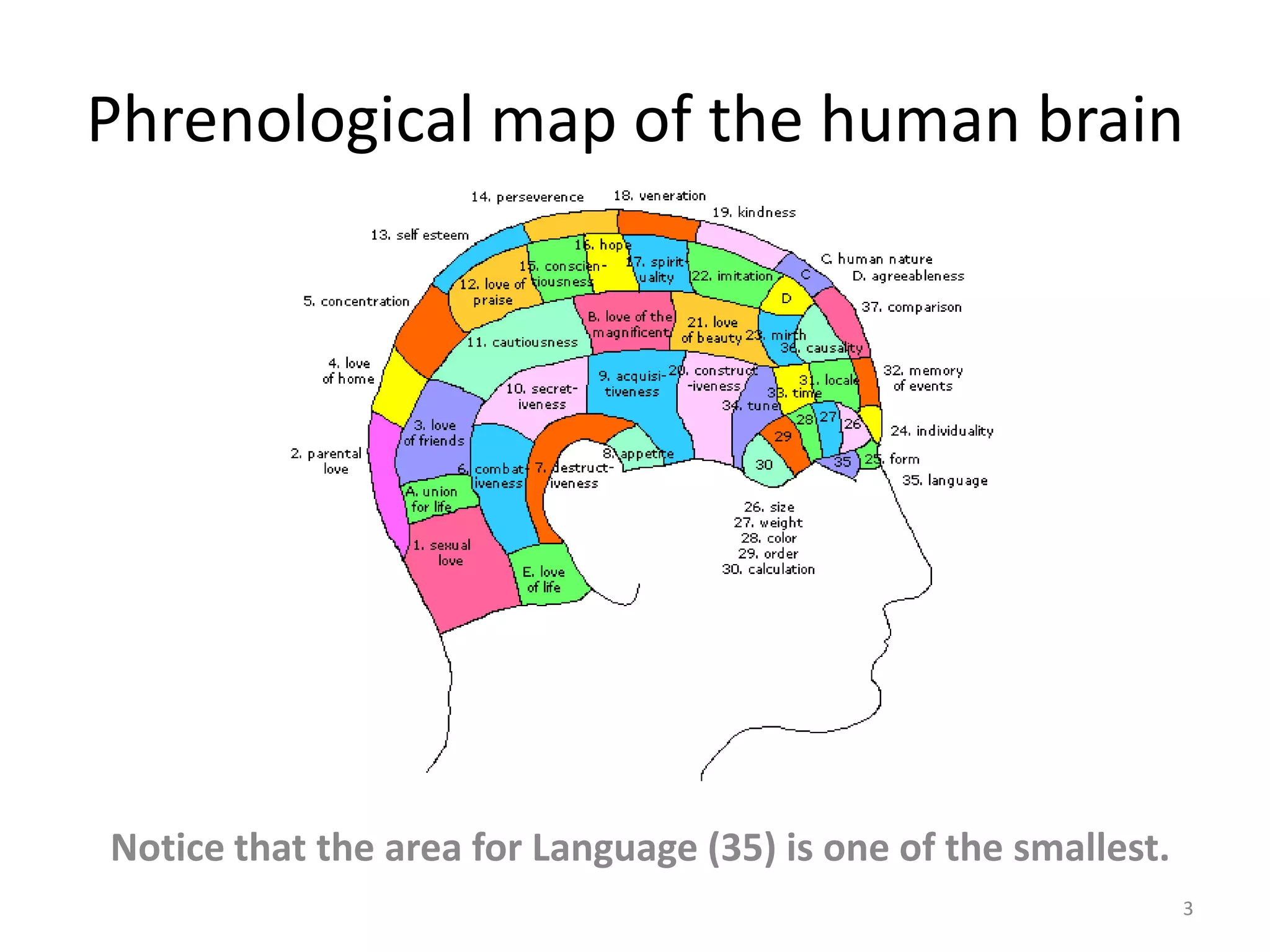
Phrenological map of the human brain3Notice that the area for Language (35) is one of the smallest.
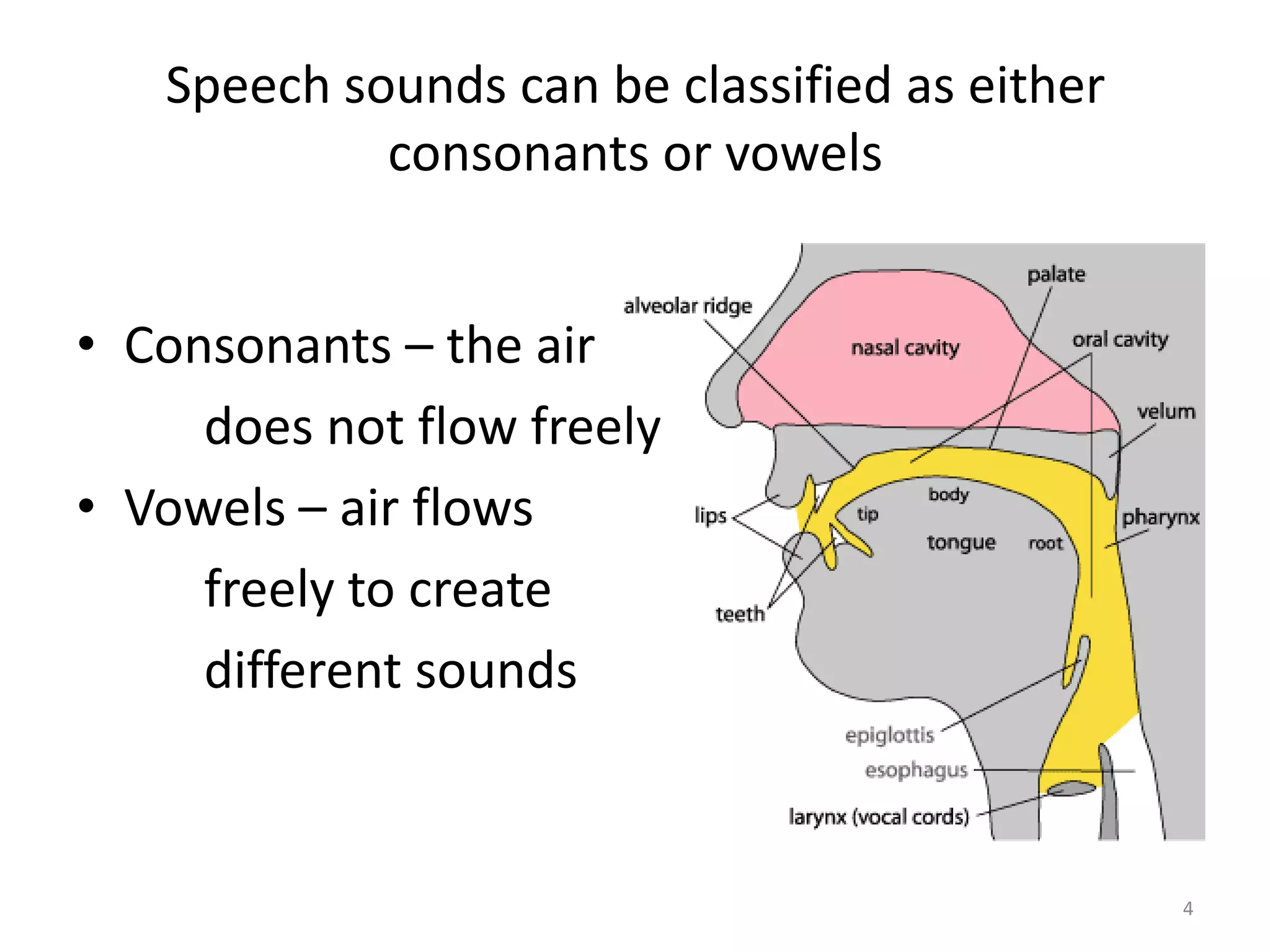
Speech sounds can be classified as either consonants or vowels Consonants – the air           does not flow freelyVowels – air flows          freely to create          different sounds4
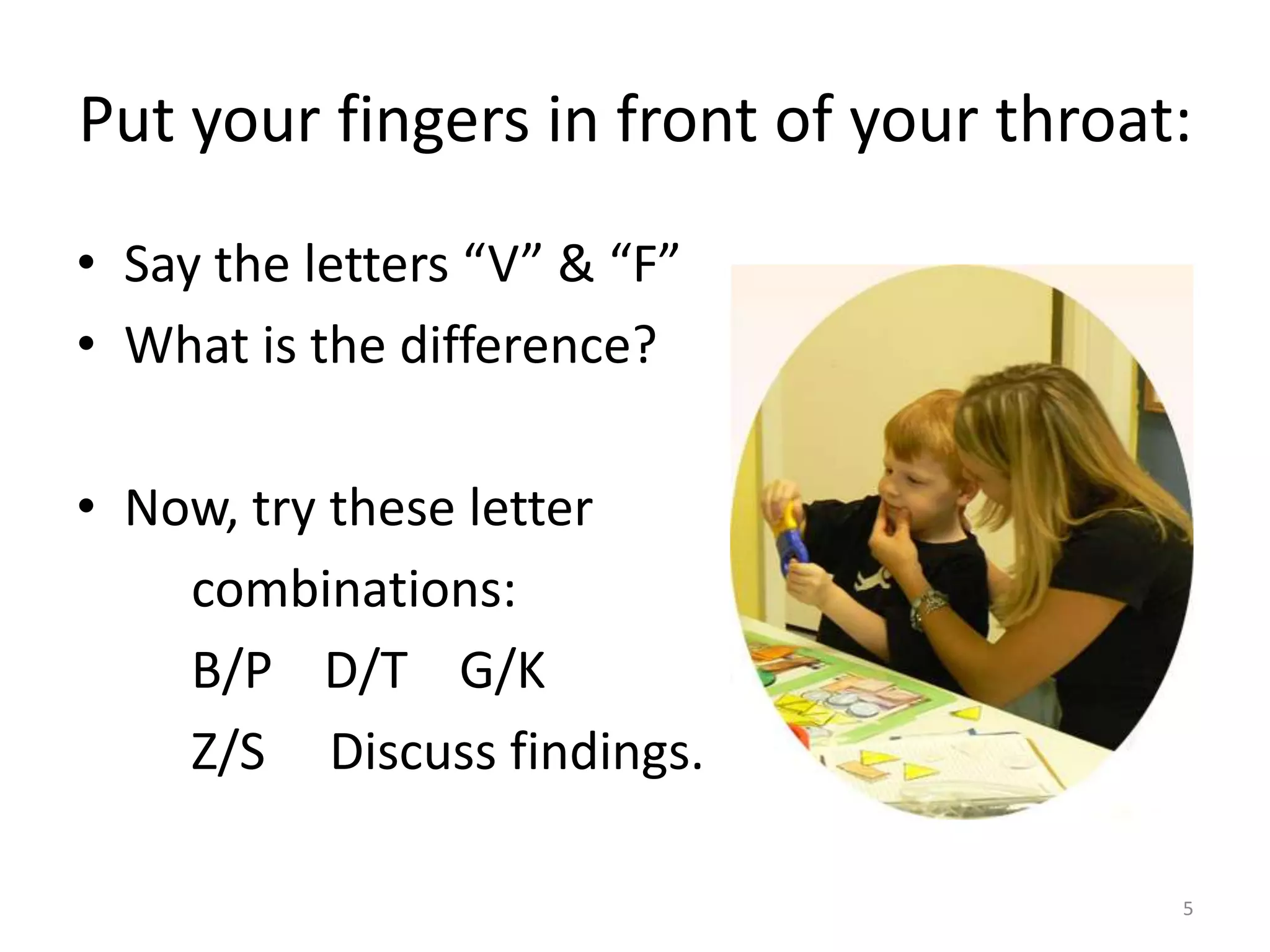
Put your fingers in front of your throat:Say the letters “V” & “F”What is the difference?Now, try these letter        combinations:         B/P    D/T    G/K         Z/S     Discuss findings.5
The Pronunciation of MorphemesPronounce the plural forms of:Child  –  Ox  –  Mouse  –  Criterion  –  SheepThe old spelling rule to add s or es is misleading. These are special plurals that have to be memorized early in the use of English.6
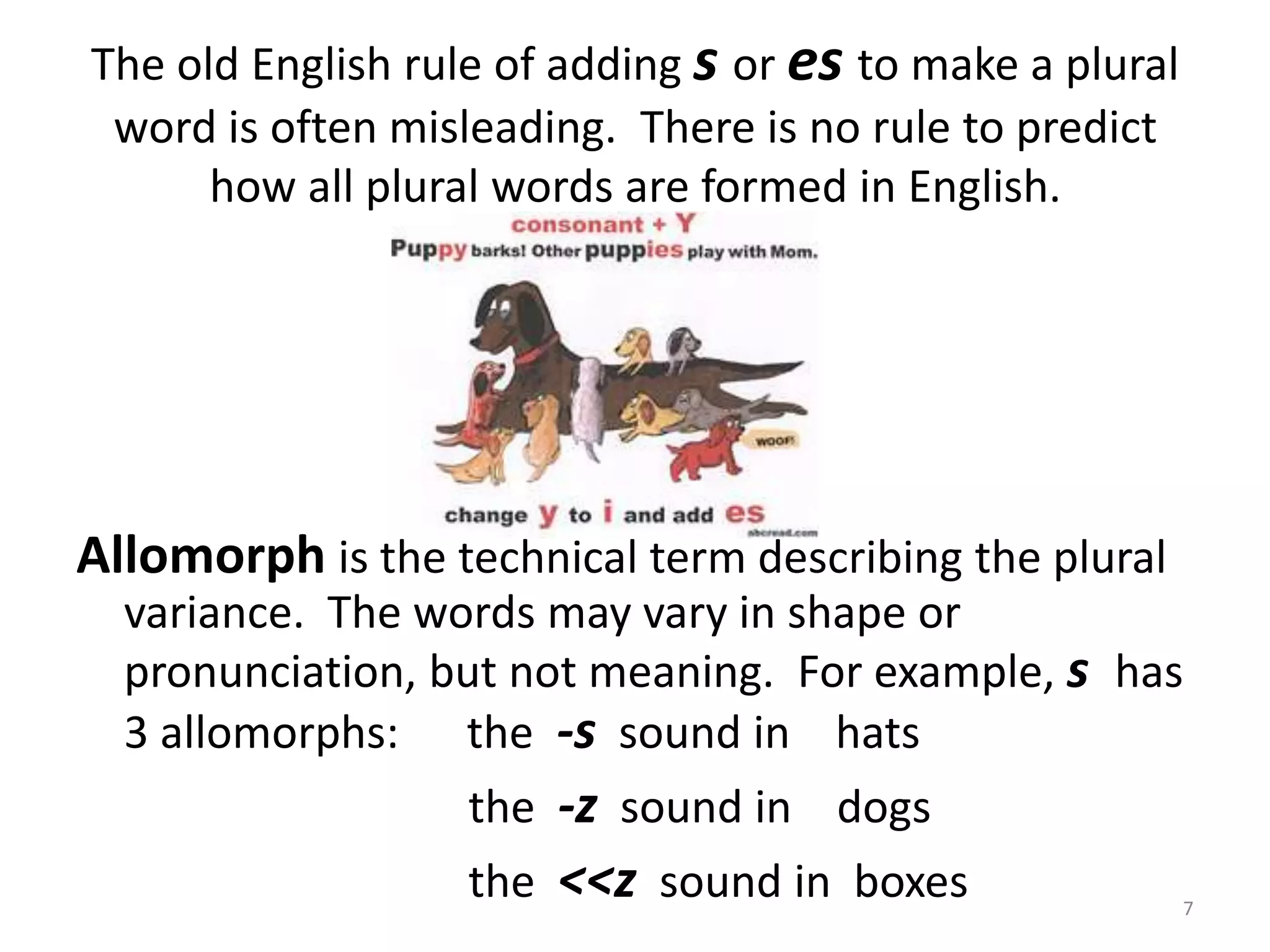
The old English rule of adding s or esto make a plural word is often misleading.  There is no rule to predict how all plural words are formed in English. Allomorph is the technical term describing the plural variance.  The words may vary in shape or pronunciation, but not meaning.  For example, s  has 3 allomorphs:      the  -s  sound in    hats			 the  -z  sound in    dogs			 the  <<z  sound in  boxes7
Phonemes are not physical sounds.  They are abstract mental representations of the phonological units of a language.The process of substituting one soundfor another word to see if it makesa difference is a good way to identifythe phonemes of a language.  Thesewords differ only in their vowel:beat    [bit]   [i]       boot   [but]  [u]bait     [bet]  [e]      boat   [bot]  [o]bite     [bajt] [aj]     bot     [bat]  [a]Can you think of any others?8
Minimal                                        Pairs…are two words with different meanings that are identical except for one sound segment that occurs in the same place in each word.  Say the following word pairs and determine in which sound segment the difference occurs: cab/cap  rot/lot   had/bad   pin/bin   zeal/seal9
The following Minimal Pairs showthat English  /p/  and  /b/  contrastin initial, medial , & final positions.Initial	    Medial           Finalpit/bit        rapid/rabid    cap/cabFind similar sets of minimal pairs forthe following consonant pairs:/k/ - /g/      /l/ - /r/      /s/ - /z/10
Morphophonemic Rulesdetermine the phonetic formof the plural morpheme andother morphemes.  Like plurals,some irregular past tenses conform to no particular rule and must be learned individually.For example:  	go / went		sing / sang			hit / hit		run / ran11
A Phoneme the basic form of a soundEach phoneme has associated with it one or moresounds, called Allophones, which represent the actual sound corresponding to the phoneme.For example, notice the differences as you pronounce:Aspiration allophone [p] in  pitWithout aspiration allophone  [p] in  spit12
Punctuation Marks : phonemes use / / marks – allophones/phones use [ ] marksPhonemically the words bead and bean are transcribed as    /bid/  and   /bin/Phonetically  the words aretranscribed to be pronouncedas    [bid]  and   [bin]13
Complimentary DistributionIs the relationship between two phonemetically similar segments.  The sound is modified by the		       environment.  Which variant occurs is determined by the immediate preceeding letter.		      For example:  the letter l has			      	      a complimentary distribution in the	                		      words glue and blue .  What othervariants do you find in these words?sat         vat					mill	    will					rack       rock14
            - Distinctive Features of Phonemes –Phonetics provides  the means to describe the phones (sounds) of language, showing how they are produced and how they vary.Phonology tells us how various sounds form patterns to create phonemes and their allophones.15
Phoneme Feature ValuesVoicing and/or Voicelessnessis the presence of a single feature.  This single feature may have two values: +  =  voicing   or  --  =  voicelessness.			Nasality presence or absence is			designated as  +  or  --  also.			Determine the values of:feel / veal    cap / cab                                                    m / b       16
         VoicingWhen verbs add -edto become past tense this ending becomes voiced if the preceding sound isvoiced as in “planned” or voiceless if the preceding sound is voiceless as in “jumped.”Since /t/ is not voiced and vowels are voiced, a /t/ between vowelsoften becomes voiced so that “latter” and “writer” are pronounced like “ladder” and “rider.”17
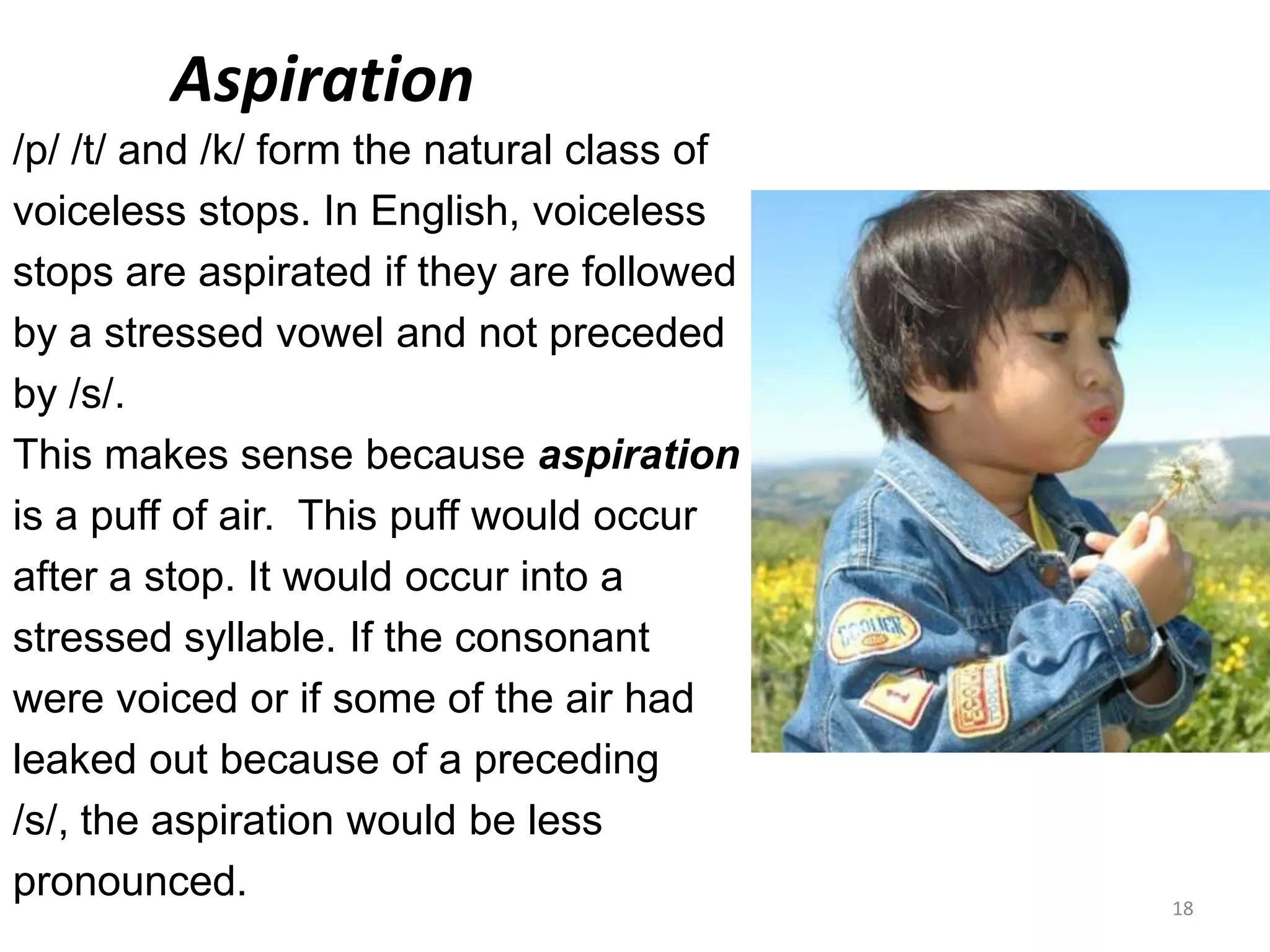
      Aspiration/p/ /t/ and /k/ form the natural class ofvoiceless stops. In English, voiceless stops are aspirated if they are followed by a stressed vowel and not preceded by /s/.This makes sense because aspirationis a puff of air.  This puff would occur after a stop. It would occur into a stressed syllable. If the consonant were voiced or if some of the air had leaked out because of a preceding/s/, the aspiration would be less pronounced.18
PalatizationWhen a word that ends with a 					/t/ is followed by a–ual, -ial, or -ion ending, the 					palatal vowel <y-> changes 						the /t/ sound into a /č/ 						sound.  Examples include:						  addict             addiction						  act                   actual or action						  part                 partial						  predict            prediction19
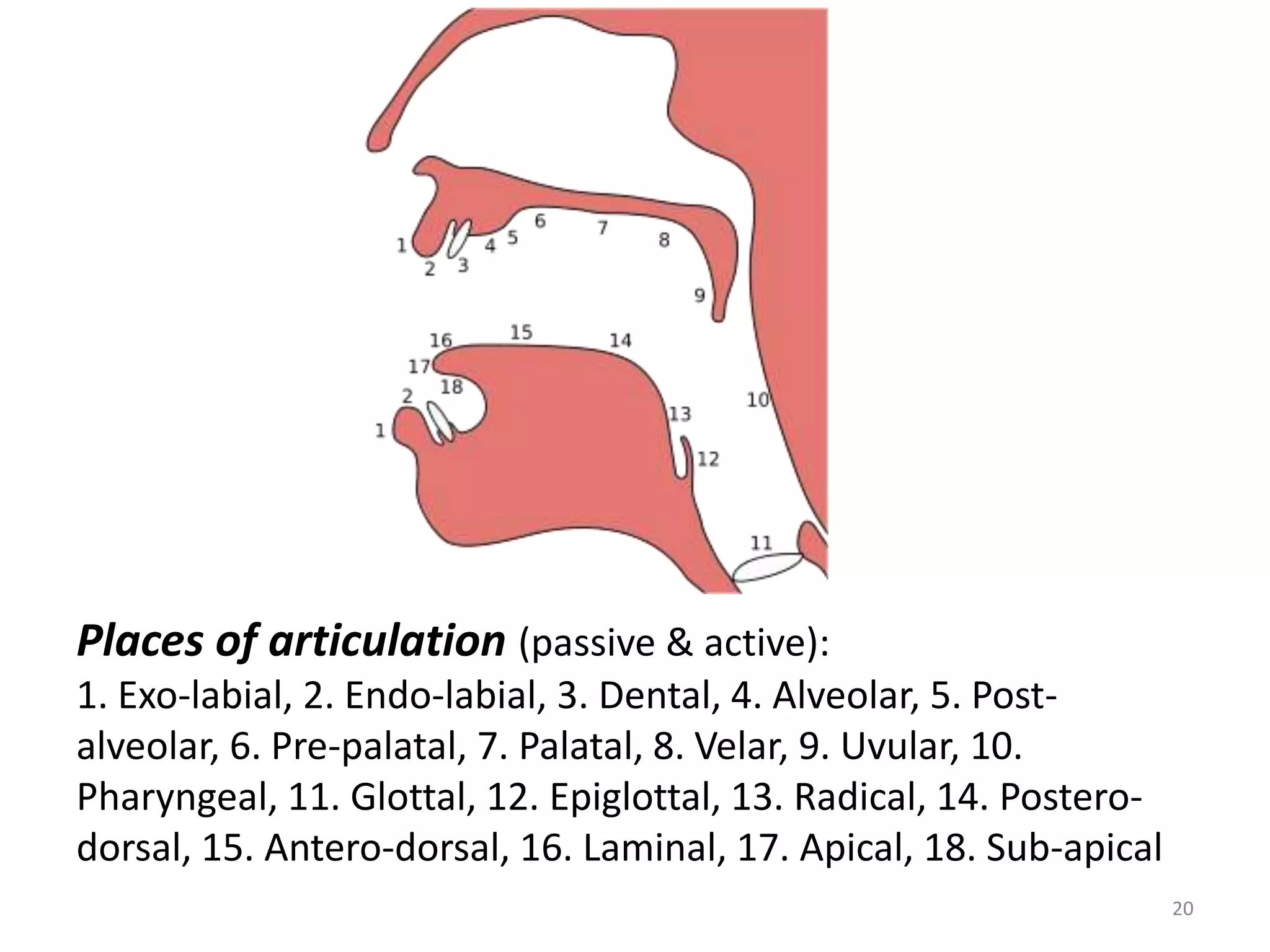
20Places of articulation (passive & active):1. Exo-labial, 2. Endo-labial, 3. Dental, 4. Alveolar, 5. Post-alveolar, 6. Pre-palatal, 7. Palatal, 8. Velar, 9. Uvular, 10. Pharyngeal, 11. Glottal, 12. Epiglottal, 13. Radical, 14. Postero-dorsal, 15. Antero-dorsal, 16. Laminal, 17. Apical, 18. Sub-apical
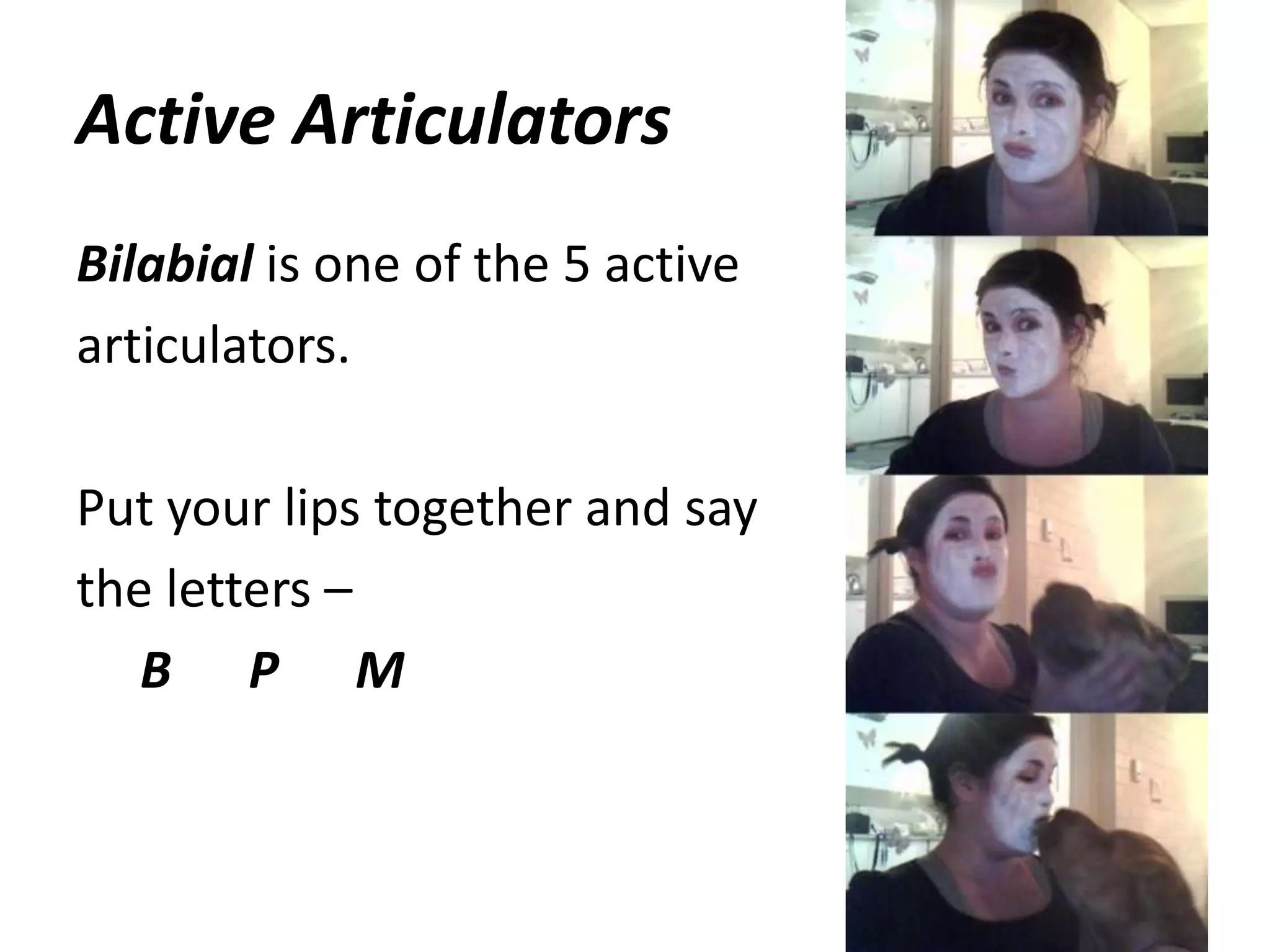
Active ArticulatorsBilabial is one of the 5 activearticulators.Put your lips together and saythe letters –B      P      M21
Active ArticulatesLabiodentalis anotherexample of an activearticulate.Put your lip to your teeth:Now say -      F      V22
Active Articulates The third example of an active articulate is     Interdental					Place your tongue on the					back of your incisors				      Say the letter     N23
Nasality is a nondistinctive feature for English vowels.  There is no way to predict that the difference between the words meat and beat.  You simply learn the words.On the other hand, the nasality feature value of the vowels in bean, mean, comb, and sing is predictable because they occur before nasal consonants.  When a feature value is predictable by rule for a sound, the feature is nondistinctive or redundant or predictable (the three terms are equivalent).  Thus, nasality is a redundant feature in English vowels, but a nonredundant feature for English consonants.24
Feature Values : NasalityNasality occurs with a lowering of the soft palate or velum so that air escapes both through the nose and the mouth.  The presence or absence of nasality is designated as[ +nasal ]  or  [ -nasal ]					   Determine nasality for:/m/    /p/                                              mother      patrol					    parrot        milk							   Can you think of any others?	25
Aspiration of voiceless stops illustrates the asymmetry of the phonological systems of different languages.Both aspirated and unaspirated voiceless stops occur in English and Thai, but they function differently.  Aspiration in English is not a distinctive feature because its presence or absence is predictable.  In Thai, it is not predictable.26
What is the difference between distinctive and phonemic?* The phonetic representation ofutterances shows what speakers know about the pronunciation of sounds.*The phonemic representation of utterances shows what speakers know about the patterning of sounds.*The words   pot/pat  spot/spat   have  identical phonemes (e.g.,  /p/ )27
In English, vowel length and consonant length are nonphonemic.       Prolonging a sound inEnglish will not producea different word.  In otherlanguages, long and shortvowels that are identical except for length are phonemic.In such languages, length is a nonpredictable distinctive feature.  28
Natural classes of sounds are those groups of sounds described by a small number of distinctive features.One example is where the [-- voiced], [--continuant], which describes /p/, t/, /k/.Any individual member of a natural class would 			     require more features in its 			     description than the class			      itself, so /p/ is not only[ -- voiced ], [--continuant]			      but also [ + labial].29
The Rules of Phonology     The relationship between the phonemic representations of   words and the phonetic   representations that reflect   the pronunciation of these words is rule-governed.          Although the specific rules of phonology differ from language to language, the kinds of rules, what they do, and the natural classes they refer to are the same throughout the world.30
     Assimilation Rulesrules make two or more neighboring     	segments more similar by making the segments share                 	some feature.	The vowel nasalization rule in English is an assimilation rule, because it involves taking the [+nasal] feature on the segment following the vowel and adding it to the vowel, making the value of [nasal] identical for the two segments.  Say the following words and discuss your findings:bone/bow    bean/bee    line/lie    hand/hat31
Dissimulation RulesDissimulation rules make sounds lessSimilar.  Sometimes it is easier to articulate dissimilar sounds:Say the “tongue twister:”The sixth sheik’s sixth sheep is sick.Now say,The fifth sheik’s fourth sheep is sick.Which is easier for you to say?  Why?32
EpenthesisEpenthesis is the addition of oneor more sounds to a word.Excrescense occurs if the soundadded is a consonant.Anaptyxis occurs if the sound added is a vowel.33
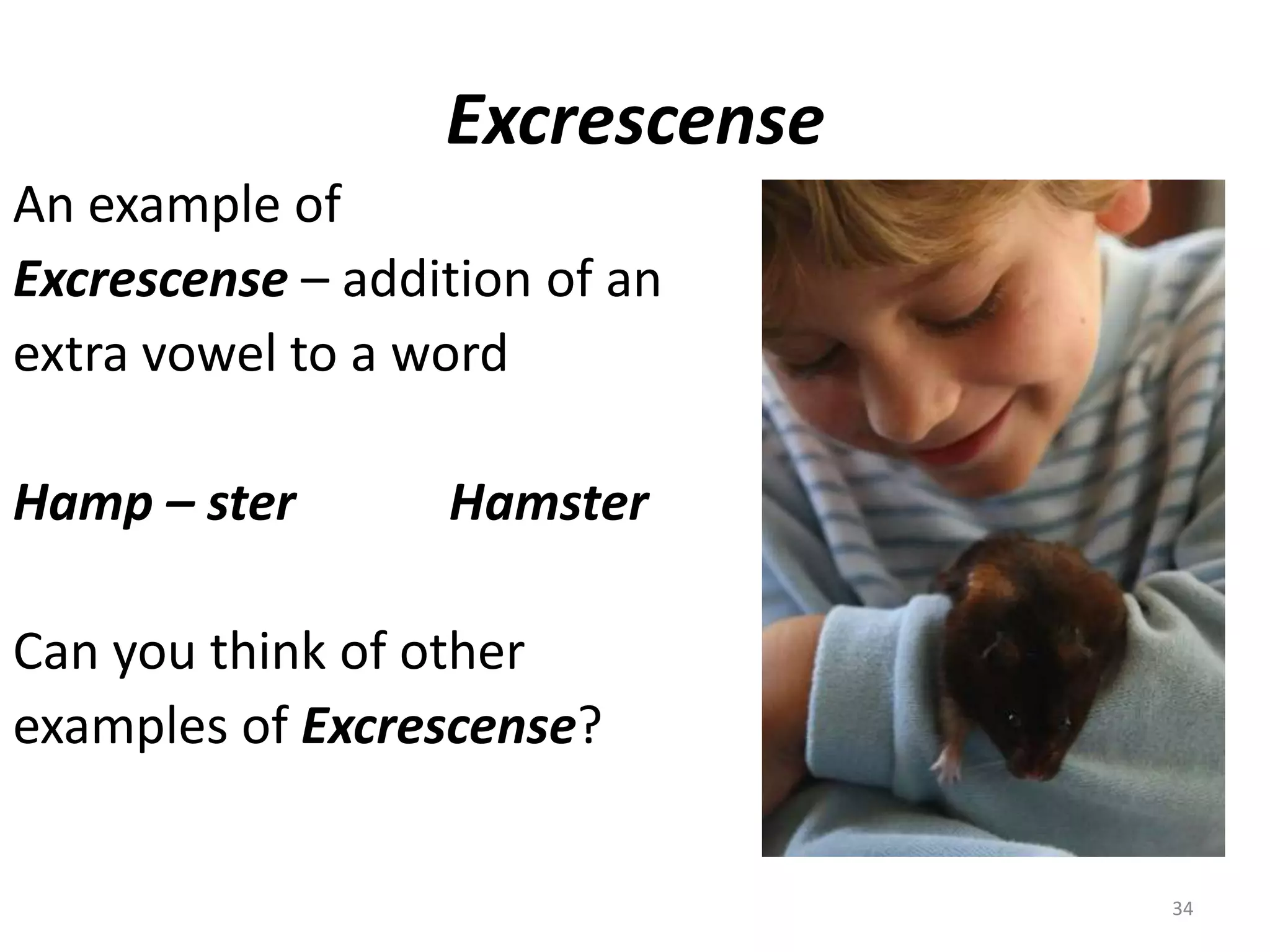
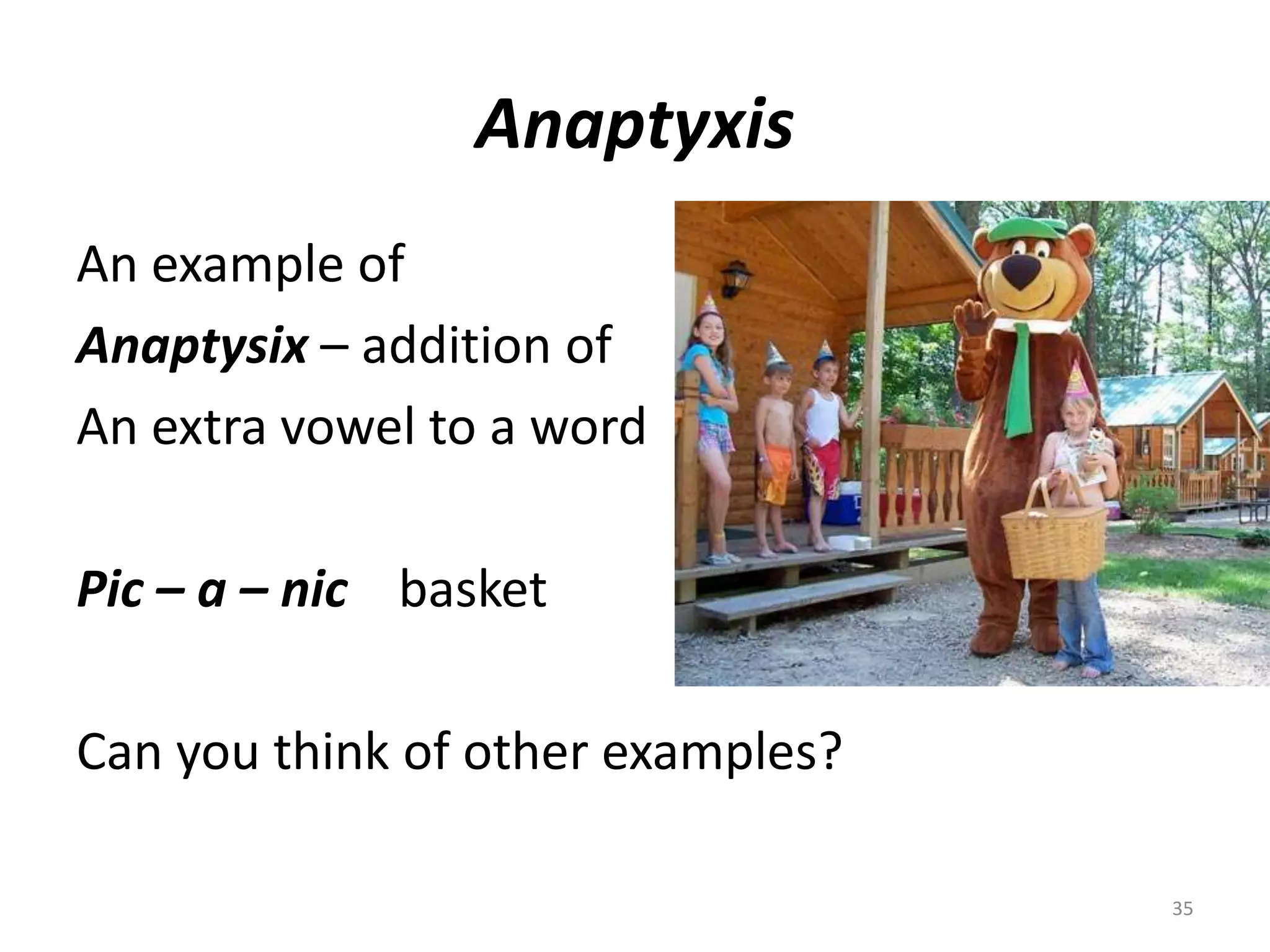
ExcrescenseAn example of Excrescense– addition of anextra vowel to a word Hamp – ster            HamsterCan you think of otherexamples of Excrescense?34
AnaptyxisAn example of Anaptysix – addition ofAn extra vowel to a wordPic – a – nicbasketCan you think of other examples?35
Epenthesis can also occur as a Poetic Device where the meter of a piece of literature requires extra syllables.  For example:  In “The Umbrella Man” movie/song the word adds a 4th syllable:         um – buh – rel – aCan you think of others?36
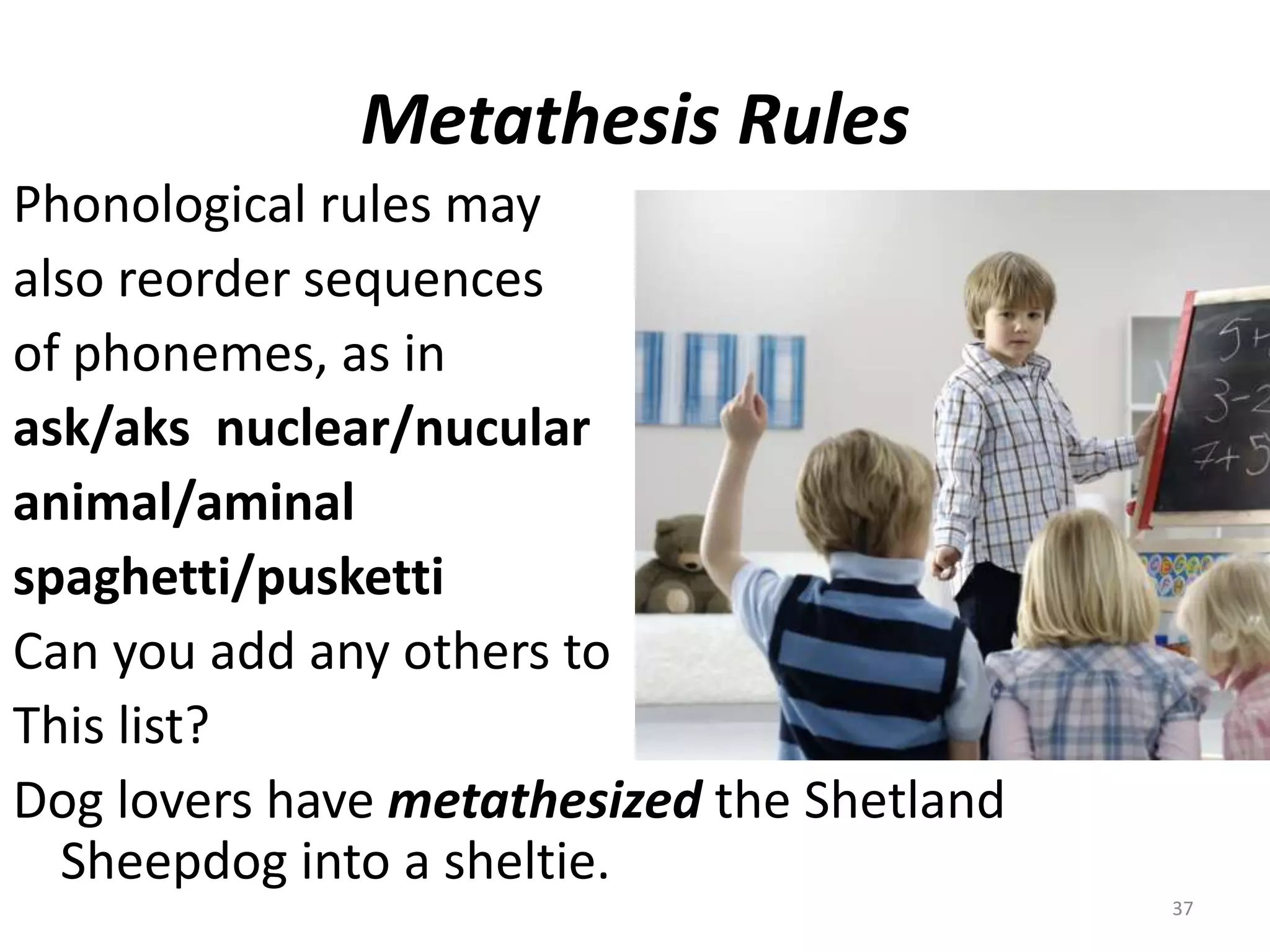
Metathesis RulesPhonological rules may also reorder sequences of phonemes, as inask/aks  nuclear/nucularanimal/aminalspaghetti/puskettiCan you add any others toThis list?Dog lovers have metathesized the Shetland Sheepdog into a sheltie.37
The more we look at languages, the more we realize that what appears at first to be irregular and unpredictable phonetic forms are actually rule-governed.We learn, or construct, these rules when we are acquiring the language as children.  The rules form an important part of the sound pattern that we acquire from birth.38
PhonologicalRulesThe function of thephonological rulesin a grammar is toprovide the phonetic information necessary for the pronunciation of utterances.                Input       Phonemic representation of wordsPhonological RulesOutputt    Phonetic representation of words									39
From One to Many – From Many to OneRarely is a single phoneme realizedas one and only one phone.  Consider the vowels in the following pairs of words: A -  compete      B - competition       medicinal          medicine       solid                    solidityIn column A, all underlined vowels are stressed with a variety of vowel phones; in column B, the underlined    vowels are pronounced as schwa.40
The Flap RuleFlap is a rapid movement of the tongue tip from a retracted vertical position to a horizontal position, during which the tongue brushes the alveolar ridge.When /t/ or /d/ occurs between a stressed and an unstressed vowel, they both become a “flap.”				The following words sound similar:auntie/Annie         metal/medal				 planter/planner    coating/coding                               futile/feudal          waiter/wader				  latter/ladder         matter/madder   Can you name any others?41
Neutralization Neutralization is a merger of a contrast in certain contexts or specified environmentSome examples of neutralizationBefore /g/ are:             bag             egg             Greg           keg             leg               pegCan you name any others?42
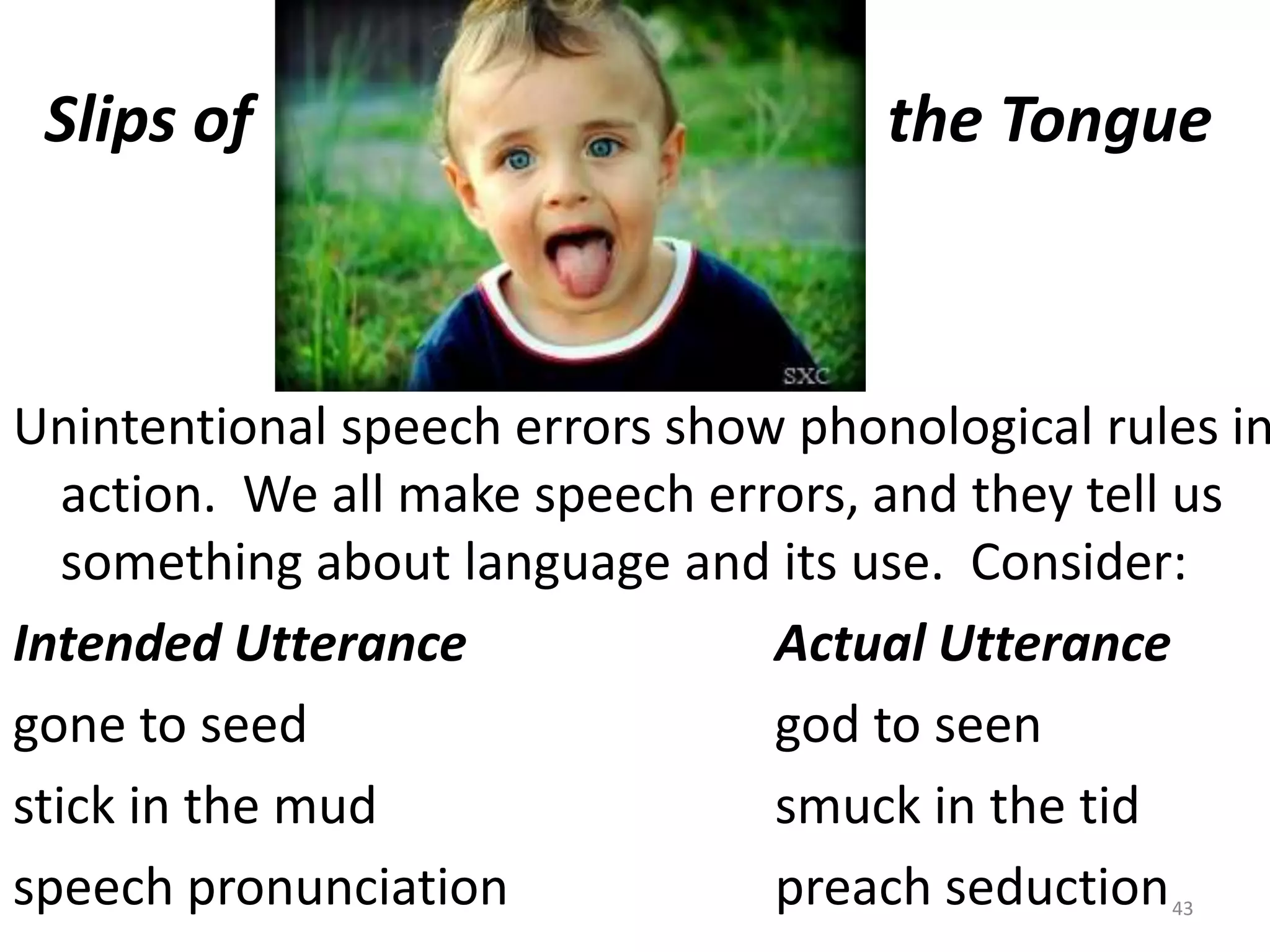
Slips of                                        the TongueUnintentional speech errors show phonological rules in action.  We all make speech errors, and they tell us something about language and its use.  Consider:Intended Utterance			Actual Utterancegone to seed				god to seenstick in the mud				smuck in the tidspeech pronunciation			preach seduction43
Word StressIn many languages, including English, one or more of the syllables in every content word is stressed.(the words to, the, of, a are functional/support words).  Astressed syllable, marked by an accute accent (‘) is more prominent in the following examples:Pervert      noun     as in     My neighbor is a pervert.Pervert      verb       as in     Don’t pervert the idea.  Can you think of other examples?44
Stress can be shown by placing a 1 over the primary stressed syllable, a 2 over the syllable with secondary stress, and leaving unstressed vowels unmarked.  Place the appropriate stress marks on these words?fundamental            introductory            secondaryStress is the property  of the syllable rather than a segment.  To produce a stressed syllable, you may change the pitch, make the syllable louder, or make it longer.  We often use all three of these phonetic means to stress a syllable.45
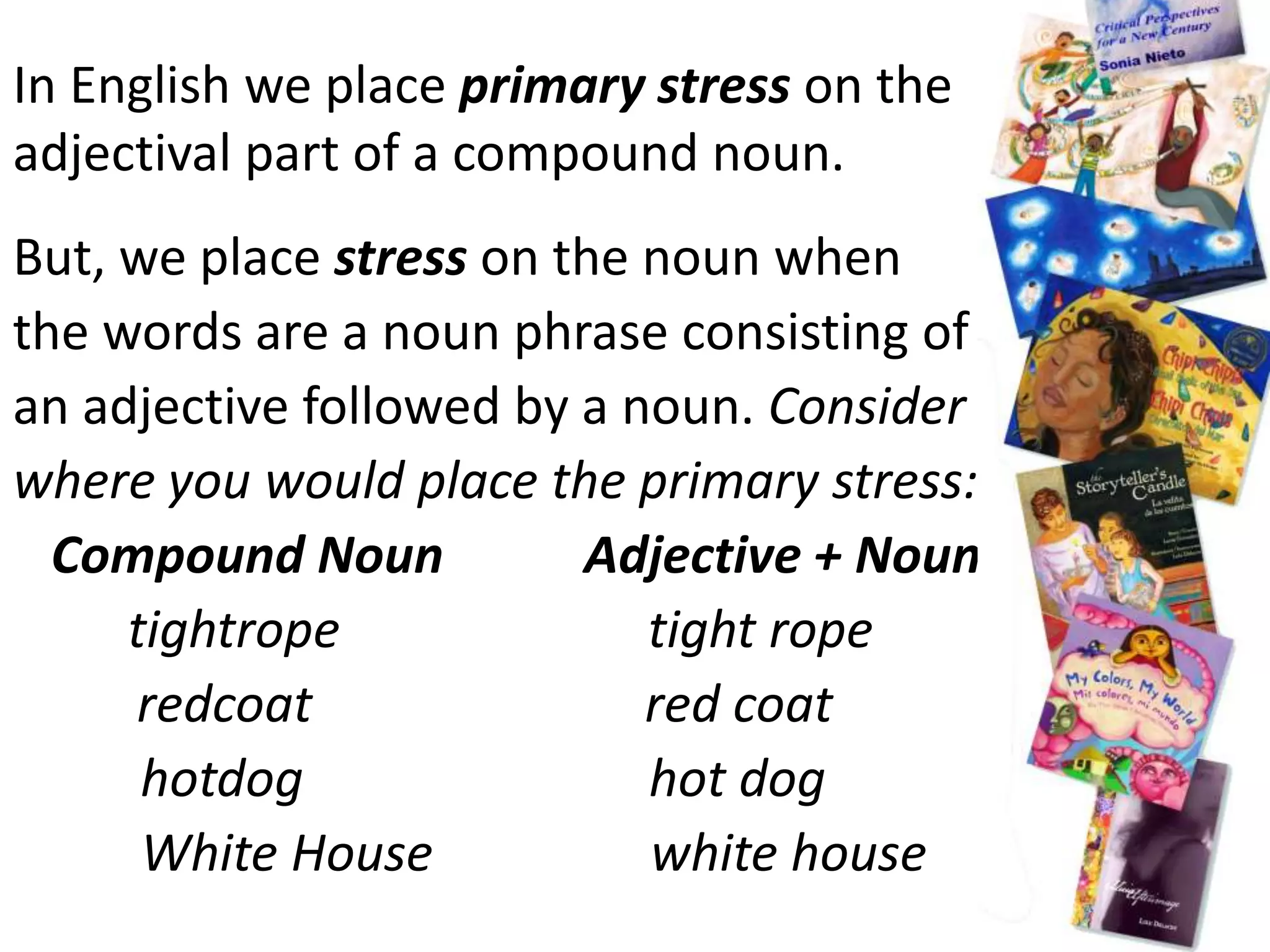
In English we place primary stress on the   adjectival part of a compound noun.But, we place stress on the noun whenthe words are a noun phrase consisting of an adjective followed by a noun. Considerwhere you would place the primary stress:Compound Noun           Adjective + Noun        tightrope			tight rope     redcoat                          red coat         hotdog                           hot dog         White House                 white house46
                       Pitch and IntonationPitch plays an important role in tone & intonation.Say:		John is going home.			What’s in the tea, honey?Falling pitch at the end indicates a statement.Pitch rising at the end may indicate a question.47
Phonolactic Constraints are language       		specific combinations of phonemes.In Japanese, the  /st/  consonant cluster     is not allowed – while it exists in EnglishIn English, the sounds  /kn/  and  /gn/     are not permitted at the beginning     of a new word – however, they do     exist in both German and Dutch48
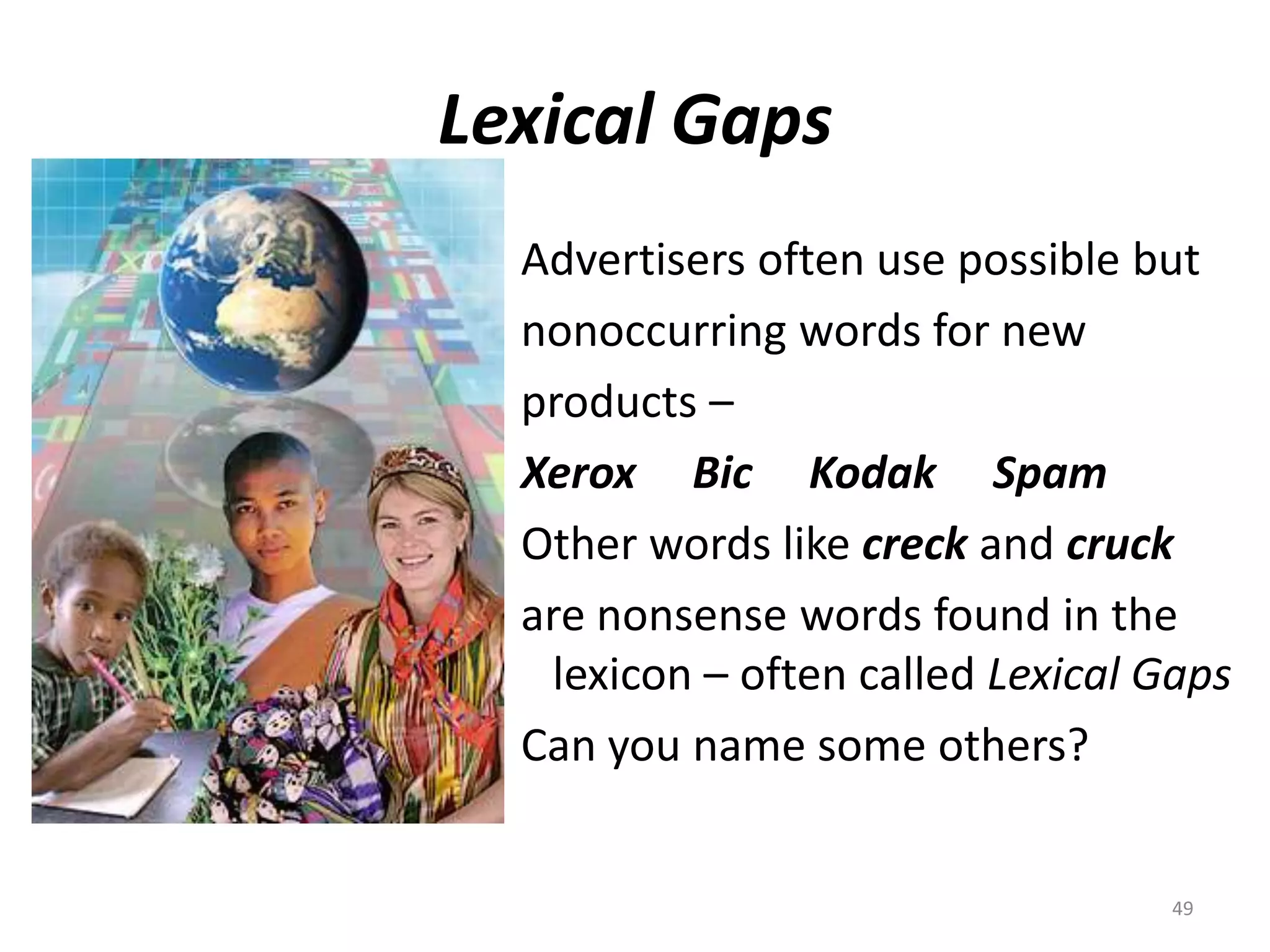
Lexical GapsAdvertisers often use possible butnonoccurring words for newproducts –Xerox     Bic     Kodak     SpamOther words like creck and cruckare nonsense words found in the lexicon – often called Lexical GapsCan you name some others?49
Why Do Phonological Rules Exist?Because languages have general principles that constrain possible sequences of sounds.The rules specify minimal modifications of theunderlying forms that bring them in line withthe surface constraints.Thus, we find different variants of a particularunderlying form depending on the phonologicalcontext.     One example is the English past-tense rule. Can you think of any others?50
Optimality TheoryThis proposal holds that a universal set of ranked constraints with  higher ranked constraints taking preference over lower ranked ones, exists with the entire system  governing the phonological rules. One example is the plural rule. Can you name any others?51
Phonological Analysis:  Discovering PhonemesPhonology shows that sounds canbe grouped into units/phonemesExample:  There is only one /p/phoneme in English – but thatphoneme has 2 sound variationsor allophones:/p/ aspirated as in pot/p/unaspirated as in soup    52
The phonological rules in a language show that the phonemic shape of words or phrases is not identical with their phonetic form.      The phonemes are not the actual      phonetic sounds, but are abstract      mental constructs that are realized      as sound by the operation of rules      described in this chapter.  No one       is taught these rules, yet everyone      knows them subconsciously.53
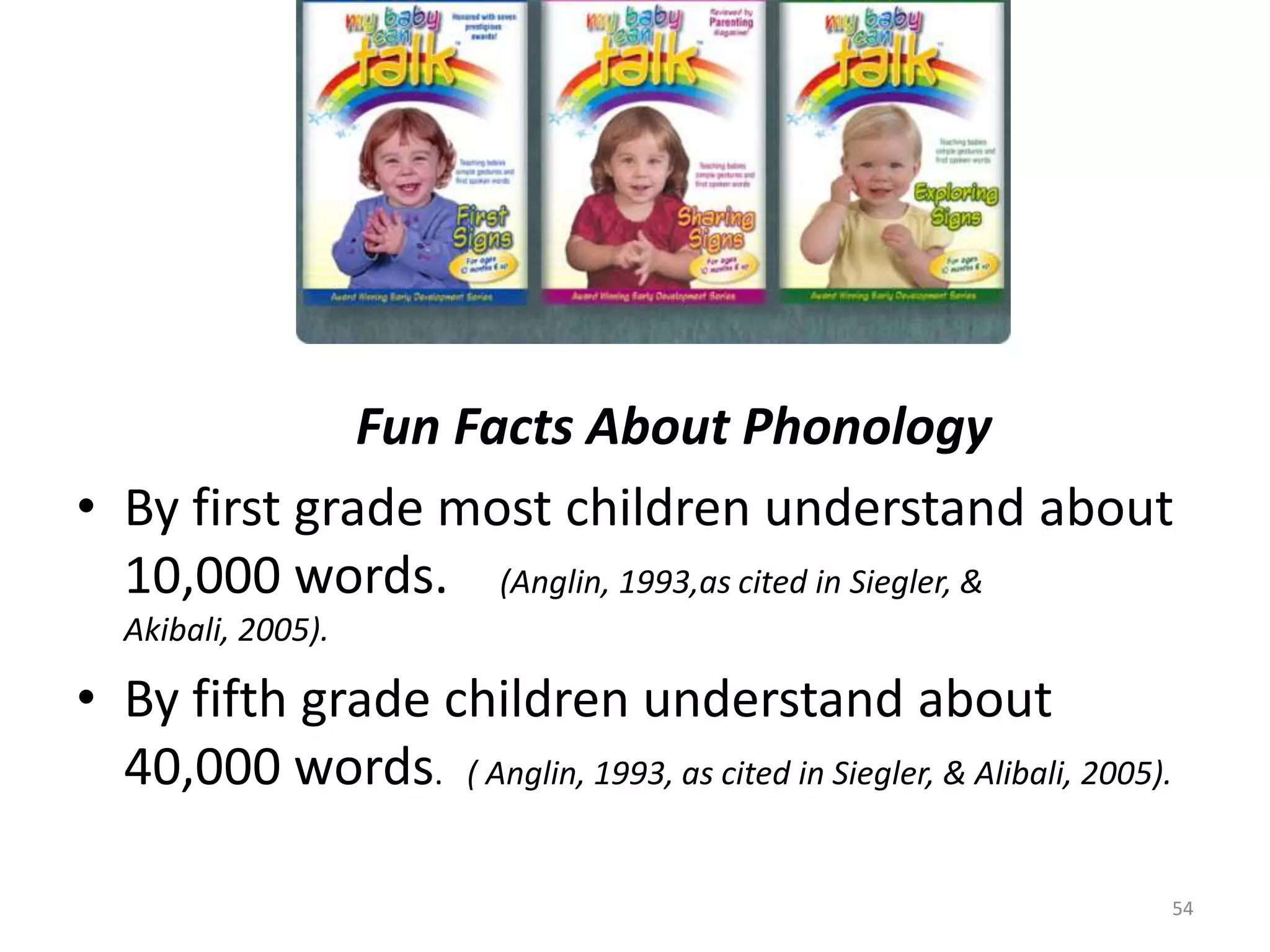
  Fun Facts About PhonologyBy first grade most children understand about 10,000 words.    (Anglin, 1993,as cited in Siegler, & Akibali, 2005). By fifth grade children understand about 40,000 words.   ( Anglin, 1993, as cited in Siegler, & Alibali, 2005).  54
55Parents and adults tend to shape word meaning in children before they shape grammar.(Baron, 1992; Brown, Cazden, & Bellus, 1969, as cited in Shaffer, et.al, 2002).
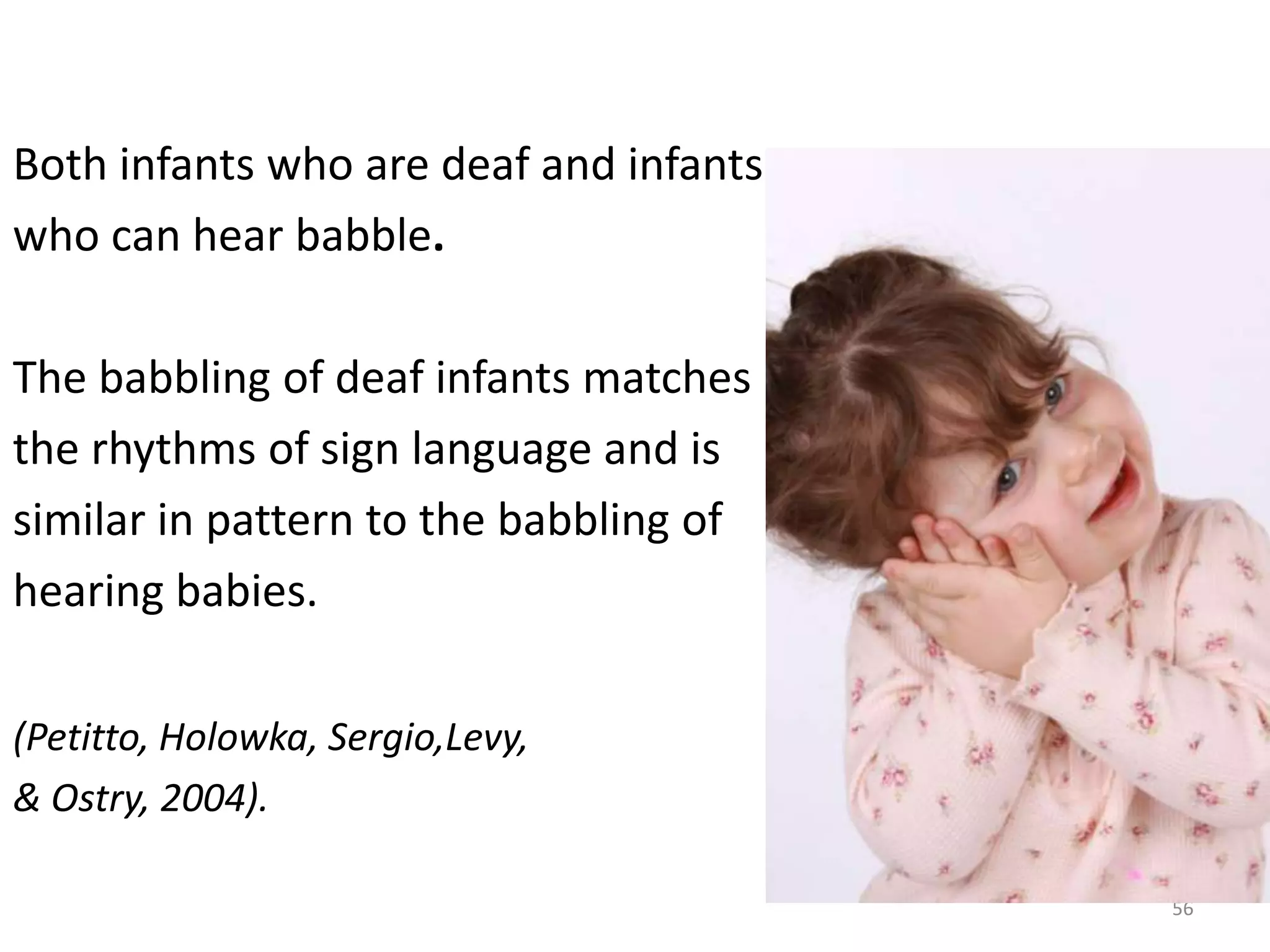
Both infants who are deaf and infants who can hear babble.The babbling of deaf infants matches the rhythms of sign language and is similar in pattern to the babbling of hearing babies. (Petitto, Holowka, Sergio,Levy,& Ostry, 2004). 56
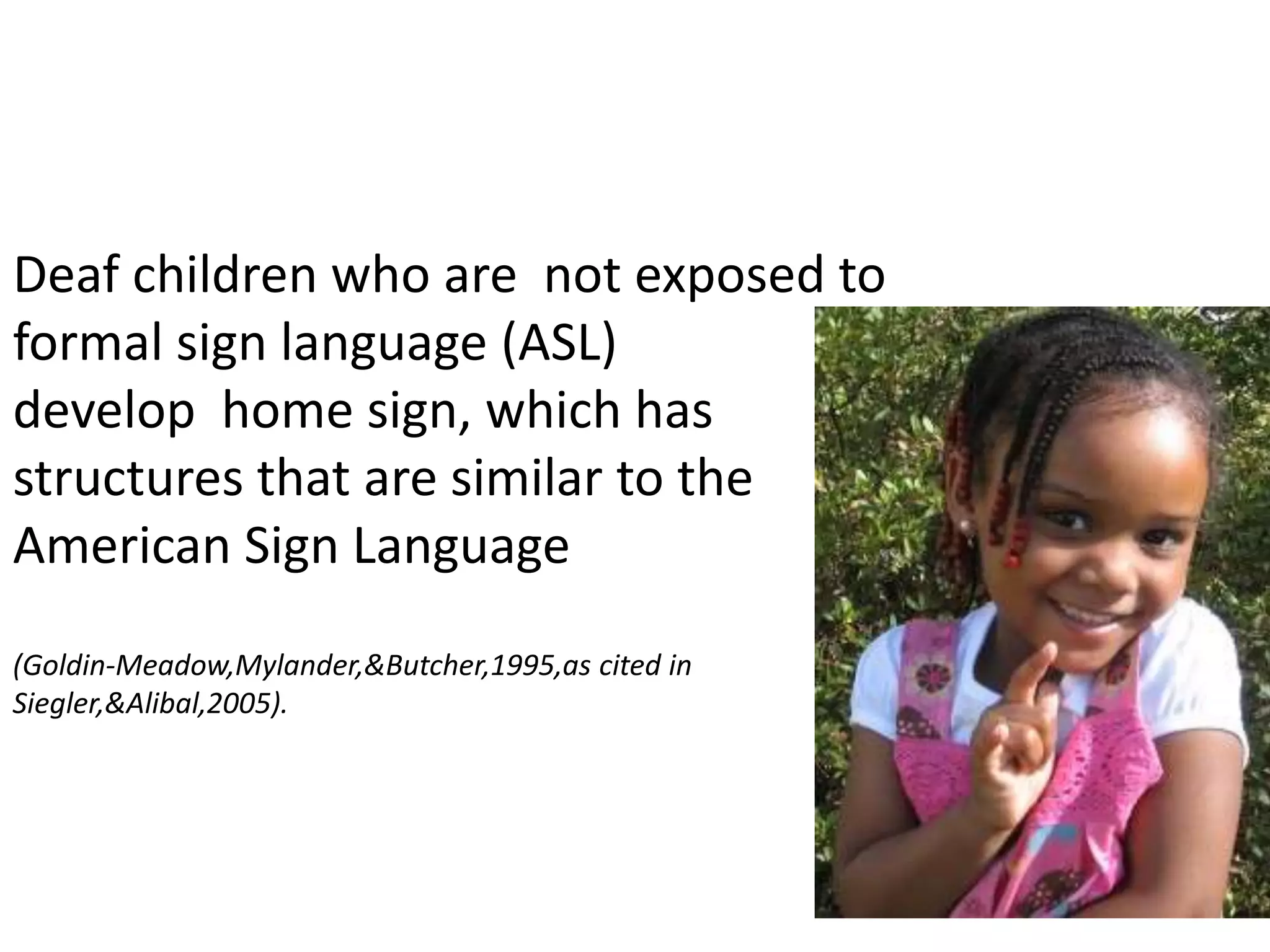
57Deaf children who are  not exposed to formal sign language (ASL) develop  home sign, which has structures that are similar to the American Sign Language (Goldin-Meadow,Mylander,&Butcher,1995,as cited in Siegler,&Alibal,2005).
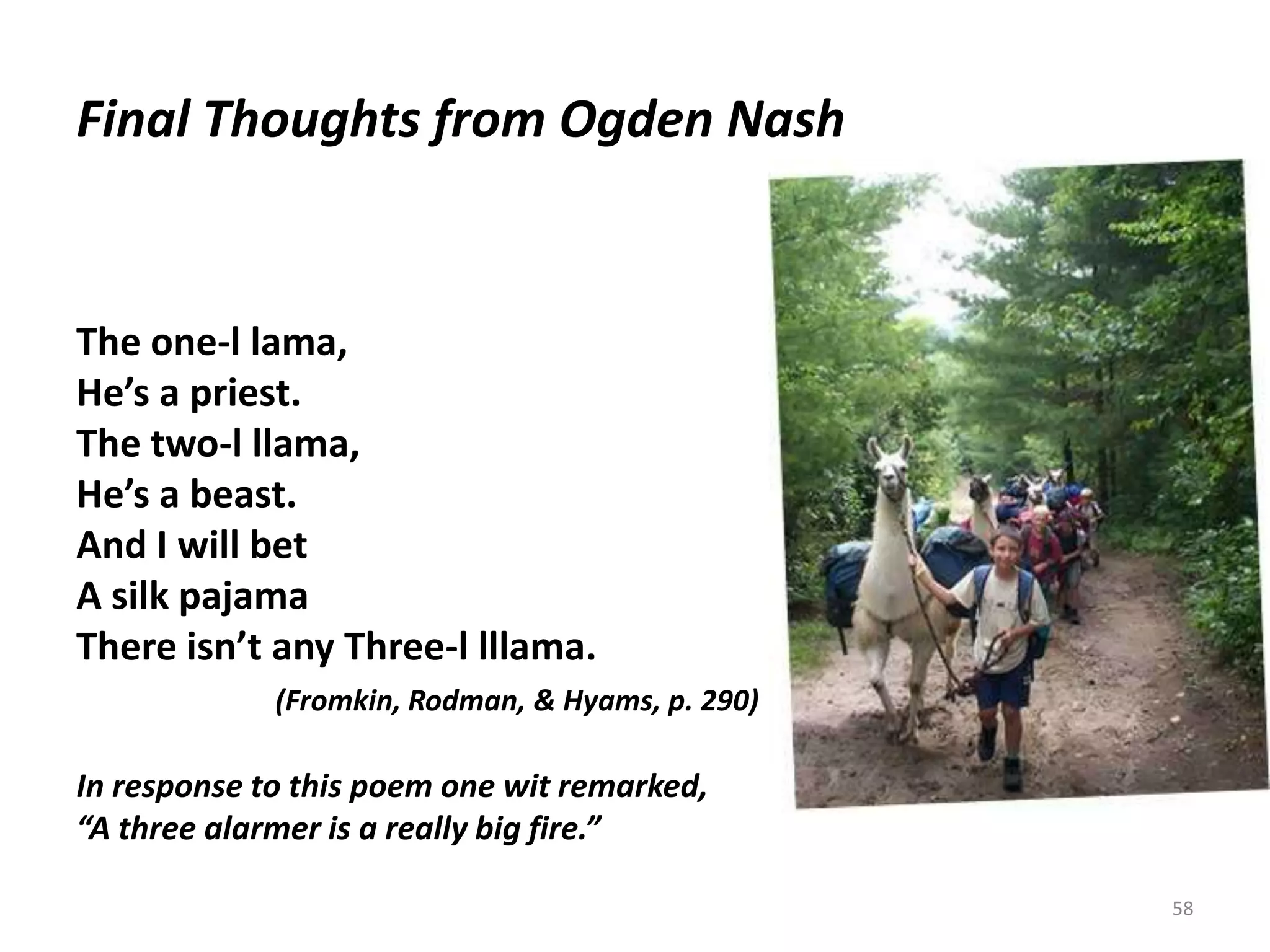
Final Thoughts from Ogden Nash58The one-l lama,He’s a priest.The two-l llama,He’s a beast.And I will betA silk pajamaThere isn’t any Three-l lllama.(Fromkin, Rodman, & Hyams, p. 290)In response to this poem one wit remarked, “A three alarmer is a really big fire.”
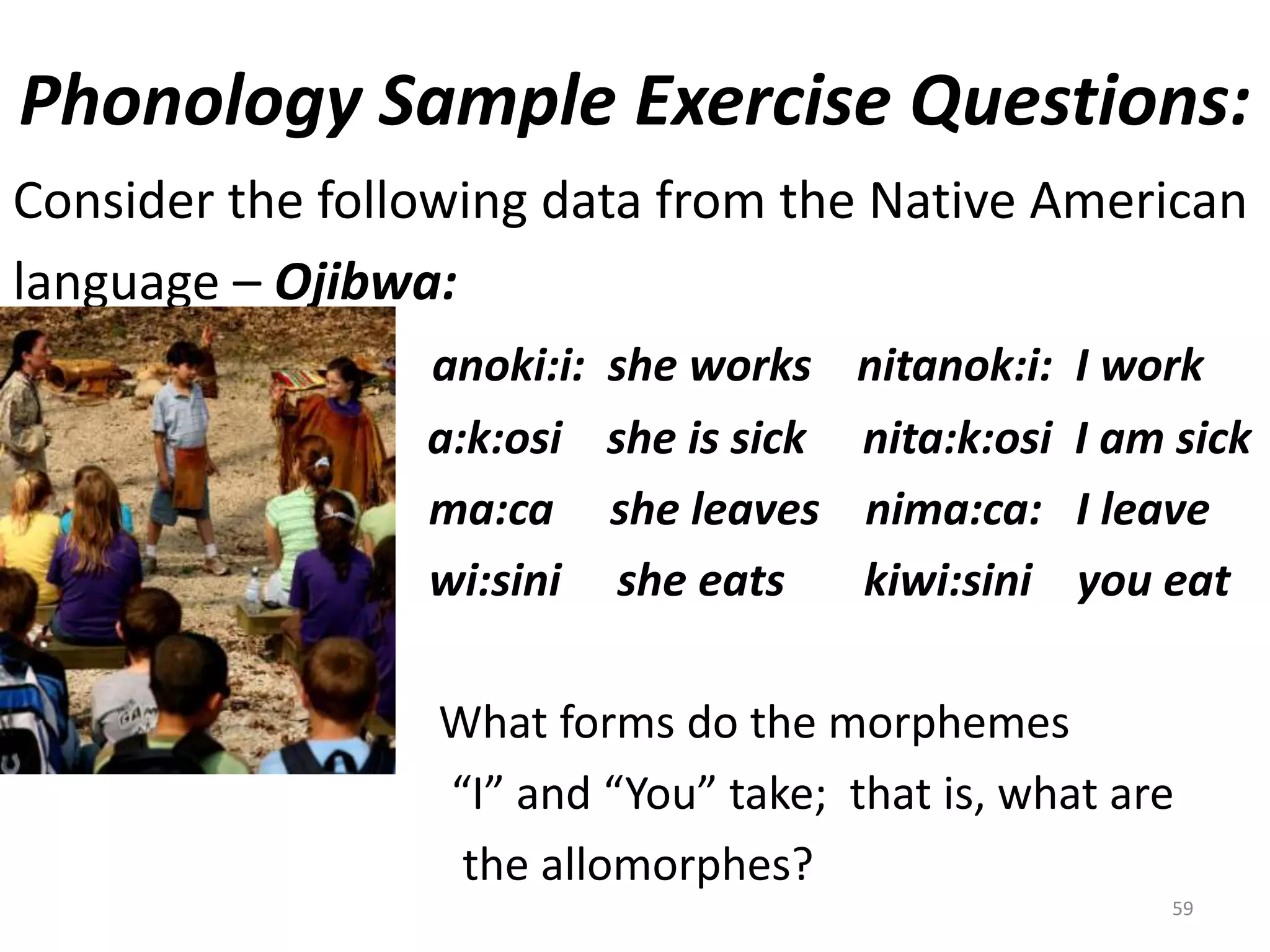
Phonology Sample Exercise Questions:Consider the following data from the Native Americanlanguage – Ojibwa:   anoki:i:  she works    nitanok:i:  I work				   a:k:osi    she is sick     nita:k:osi  I am sickma:ca     she leaves    nima:ca:   I leavewi:sini     she eats       kiwi:sini    you eat				    What forms do the morphemes                                       “I” and “You” take;  that is, what are                                        the allomorphes?59
Sample Exercise #2:  In African Maninka, the suffix –li has more than onepronunciation.  It is similarto the derivational suffix -ing(cook + ing = cooking).  Look at these Maninka words:bugo   “hit”           bugoli   “hitting”dila  “repair”        dilali     “repairing”dumu  “eat”          dumuni   “eating”gwen  “chase”      gwenni   “chasing”What are the 2 forms of the “ing” ending in Maninka?60
		ReferencesAll text materials and quotes from -- Fromkin, Victoria, Rodman, Robert, and Hyams, Nina.  An Introduction to Language, 8th ed.  Boston:  Thomson-Wadsworth, 2007.Google.Com (pictures and images)“Language Development – Fun Facts”Accessed 09/10/2009 http://languageDevelopment/tripod.com/id17.htmlNilsen, Don L. F.   Accessed 09/10/2009 	http://www.ssc.uwo.ca/anthropology					/faculteider/027/7PhonolUSEdition.pdf					  (slides  17 – 19)61
With Appreciation To –	Google Images	Dr. Sheila W. Binkney62

Phonology -- The Sound Patterns of Language Made Easy

  • 1.
    Phonology: TheSound Patterns of Language By Richard Binkney, Ph.D.1
  • 2.
    Phonology is thestudy of speech soundsPhoneme – the basic unit of soundSemantics – the study of the meaning of languageMorpheme – smallest unit of sound to carry meaning2
  • 3.
    Phrenological map ofthe human brain3Notice that the area for Language (35) is one of the smallest.
  • 4.
    Speech sounds canbe classified as either consonants or vowels Consonants – the air does not flow freelyVowels – air flows freely to create different sounds4
  • 5.
    Put your fingersin front of your throat:Say the letters “V” & “F”What is the difference?Now, try these letter combinations: B/P D/T G/K Z/S Discuss findings.5
  • 6.
    The Pronunciation ofMorphemesPronounce the plural forms of:Child – Ox – Mouse – Criterion – SheepThe old spelling rule to add s or es is misleading. These are special plurals that have to be memorized early in the use of English.6
  • 7.
    The old Englishrule of adding s or esto make a plural word is often misleading. There is no rule to predict how all plural words are formed in English. Allomorph is the technical term describing the plural variance. The words may vary in shape or pronunciation, but not meaning. For example, s has 3 allomorphs: the -s sound in hats the -z sound in dogs the <<z sound in boxes7
  • 8.
    Phonemes are notphysical sounds. They are abstract mental representations of the phonological units of a language.The process of substituting one soundfor another word to see if it makesa difference is a good way to identifythe phonemes of a language. Thesewords differ only in their vowel:beat [bit] [i] boot [but] [u]bait [bet] [e] boat [bot] [o]bite [bajt] [aj] bot [bat] [a]Can you think of any others?8
  • 9.
    Minimal Pairs…are two words with different meanings that are identical except for one sound segment that occurs in the same place in each word. Say the following word pairs and determine in which sound segment the difference occurs: cab/cap rot/lot had/bad pin/bin zeal/seal9
  • 10.
    The following MinimalPairs showthat English /p/ and /b/ contrastin initial, medial , & final positions.Initial Medial Finalpit/bit rapid/rabid cap/cabFind similar sets of minimal pairs forthe following consonant pairs:/k/ - /g/ /l/ - /r/ /s/ - /z/10
  • 11.
    Morphophonemic Rulesdetermine thephonetic formof the plural morpheme andother morphemes. Like plurals,some irregular past tenses conform to no particular rule and must be learned individually.For example: go / went sing / sang hit / hit run / ran11
  • 12.
    A Phoneme thebasic form of a soundEach phoneme has associated with it one or moresounds, called Allophones, which represent the actual sound corresponding to the phoneme.For example, notice the differences as you pronounce:Aspiration allophone [p] in pitWithout aspiration allophone [p] in spit12
  • 13.
    Punctuation Marks :phonemes use / / marks – allophones/phones use [ ] marksPhonemically the words bead and bean are transcribed as /bid/ and /bin/Phonetically the words aretranscribed to be pronouncedas [bid] and [bin]13
  • 14.
    Complimentary DistributionIs therelationship between two phonemetically similar segments. The sound is modified by the environment. Which variant occurs is determined by the immediate preceeding letter. For example: the letter l has a complimentary distribution in the words glue and blue . What othervariants do you find in these words?sat vat mill will rack rock14
  • 15.
    - Distinctive Features of Phonemes –Phonetics provides the means to describe the phones (sounds) of language, showing how they are produced and how they vary.Phonology tells us how various sounds form patterns to create phonemes and their allophones.15
  • 16.
    Phoneme Feature ValuesVoicingand/or Voicelessnessis the presence of a single feature. This single feature may have two values: + = voicing or -- = voicelessness. Nasality presence or absence is designated as + or -- also. Determine the values of:feel / veal cap / cab m / b 16
  • 17.
    VoicingWhen verbs add -edto become past tense this ending becomes voiced if the preceding sound isvoiced as in “planned” or voiceless if the preceding sound is voiceless as in “jumped.”Since /t/ is not voiced and vowels are voiced, a /t/ between vowelsoften becomes voiced so that “latter” and “writer” are pronounced like “ladder” and “rider.”17
  • 18.
    Aspiration/p/ /t/ and /k/ form the natural class ofvoiceless stops. In English, voiceless stops are aspirated if they are followed by a stressed vowel and not preceded by /s/.This makes sense because aspirationis a puff of air. This puff would occur after a stop. It would occur into a stressed syllable. If the consonant were voiced or if some of the air had leaked out because of a preceding/s/, the aspiration would be less pronounced.18
  • 19.
    PalatizationWhen a wordthat ends with a /t/ is followed by a–ual, -ial, or -ion ending, the palatal vowel <y-> changes the /t/ sound into a /č/ sound. Examples include: addict addiction act actual or action part partial predict prediction19
  • 20.
    20Places of articulation(passive & active):1. Exo-labial, 2. Endo-labial, 3. Dental, 4. Alveolar, 5. Post-alveolar, 6. Pre-palatal, 7. Palatal, 8. Velar, 9. Uvular, 10. Pharyngeal, 11. Glottal, 12. Epiglottal, 13. Radical, 14. Postero-dorsal, 15. Antero-dorsal, 16. Laminal, 17. Apical, 18. Sub-apical
  • 21.
    Active ArticulatorsBilabial isone of the 5 activearticulators.Put your lips together and saythe letters –B P M21
  • 22.
    Active ArticulatesLabiodentalis anotherexampleof an activearticulate.Put your lip to your teeth:Now say - F V22
  • 23.
    Active Articulates Thethird example of an active articulate is Interdental Place your tongue on the back of your incisors Say the letter N23
  • 24.
    Nasality is anondistinctive feature for English vowels. There is no way to predict that the difference between the words meat and beat. You simply learn the words.On the other hand, the nasality feature value of the vowels in bean, mean, comb, and sing is predictable because they occur before nasal consonants. When a feature value is predictable by rule for a sound, the feature is nondistinctive or redundant or predictable (the three terms are equivalent). Thus, nasality is a redundant feature in English vowels, but a nonredundant feature for English consonants.24
  • 25.
    Feature Values :NasalityNasality occurs with a lowering of the soft palate or velum so that air escapes both through the nose and the mouth. The presence or absence of nasality is designated as[ +nasal ] or [ -nasal ] Determine nasality for:/m/ /p/ mother patrol parrot milk Can you think of any others? 25
  • 26.
    Aspiration of voicelessstops illustrates the asymmetry of the phonological systems of different languages.Both aspirated and unaspirated voiceless stops occur in English and Thai, but they function differently. Aspiration in English is not a distinctive feature because its presence or absence is predictable. In Thai, it is not predictable.26
  • 27.
    What is thedifference between distinctive and phonemic?* The phonetic representation ofutterances shows what speakers know about the pronunciation of sounds.*The phonemic representation of utterances shows what speakers know about the patterning of sounds.*The words pot/pat spot/spat have identical phonemes (e.g., /p/ )27
  • 28.
    In English, vowellength and consonant length are nonphonemic. Prolonging a sound inEnglish will not producea different word. In otherlanguages, long and shortvowels that are identical except for length are phonemic.In such languages, length is a nonpredictable distinctive feature. 28
  • 29.
    Natural classes ofsounds are those groups of sounds described by a small number of distinctive features.One example is where the [-- voiced], [--continuant], which describes /p/, t/, /k/.Any individual member of a natural class would require more features in its description than the class itself, so /p/ is not only[ -- voiced ], [--continuant] but also [ + labial].29
  • 30.
    The Rules ofPhonology The relationship between the phonemic representations of words and the phonetic representations that reflect the pronunciation of these words is rule-governed. Although the specific rules of phonology differ from language to language, the kinds of rules, what they do, and the natural classes they refer to are the same throughout the world.30
  • 31.
    Assimilation Rulesrules make two or more neighboring segments more similar by making the segments share some feature. The vowel nasalization rule in English is an assimilation rule, because it involves taking the [+nasal] feature on the segment following the vowel and adding it to the vowel, making the value of [nasal] identical for the two segments. Say the following words and discuss your findings:bone/bow bean/bee line/lie hand/hat31
  • 32.
    Dissimulation RulesDissimulation rulesmake sounds lessSimilar. Sometimes it is easier to articulate dissimilar sounds:Say the “tongue twister:”The sixth sheik’s sixth sheep is sick.Now say,The fifth sheik’s fourth sheep is sick.Which is easier for you to say? Why?32
  • 33.
    EpenthesisEpenthesis is theaddition of oneor more sounds to a word.Excrescense occurs if the soundadded is a consonant.Anaptyxis occurs if the sound added is a vowel.33
  • 34.
    ExcrescenseAn example ofExcrescense– addition of anextra vowel to a word Hamp – ster HamsterCan you think of otherexamples of Excrescense?34
  • 35.
    AnaptyxisAn example ofAnaptysix – addition ofAn extra vowel to a wordPic – a – nicbasketCan you think of other examples?35
  • 36.
    Epenthesis can alsooccur as a Poetic Device where the meter of a piece of literature requires extra syllables. For example: In “The Umbrella Man” movie/song the word adds a 4th syllable: um – buh – rel – aCan you think of others?36
  • 37.
    Metathesis RulesPhonological rulesmay also reorder sequences of phonemes, as inask/aks nuclear/nucularanimal/aminalspaghetti/puskettiCan you add any others toThis list?Dog lovers have metathesized the Shetland Sheepdog into a sheltie.37
  • 38.
    The more welook at languages, the more we realize that what appears at first to be irregular and unpredictable phonetic forms are actually rule-governed.We learn, or construct, these rules when we are acquiring the language as children. The rules form an important part of the sound pattern that we acquire from birth.38
  • 39.
    PhonologicalRulesThe function ofthephonological rulesin a grammar is toprovide the phonetic information necessary for the pronunciation of utterances. Input Phonemic representation of wordsPhonological RulesOutputt Phonetic representation of words 39
  • 40.
    From One toMany – From Many to OneRarely is a single phoneme realizedas one and only one phone. Consider the vowels in the following pairs of words: A - compete B - competition medicinal medicine solid solidityIn column A, all underlined vowels are stressed with a variety of vowel phones; in column B, the underlined vowels are pronounced as schwa.40
  • 41.
    The Flap RuleFlapis a rapid movement of the tongue tip from a retracted vertical position to a horizontal position, during which the tongue brushes the alveolar ridge.When /t/ or /d/ occurs between a stressed and an unstressed vowel, they both become a “flap.” The following words sound similar:auntie/Annie metal/medal planter/planner coating/coding futile/feudal waiter/wader latter/ladder matter/madder Can you name any others?41
  • 42.
    Neutralization Neutralization isa merger of a contrast in certain contexts or specified environmentSome examples of neutralizationBefore /g/ are: bag egg Greg keg leg pegCan you name any others?42
  • 43.
    Slips of the TongueUnintentional speech errors show phonological rules in action. We all make speech errors, and they tell us something about language and its use. Consider:Intended Utterance Actual Utterancegone to seed god to seenstick in the mud smuck in the tidspeech pronunciation preach seduction43
  • 44.
    Word StressIn manylanguages, including English, one or more of the syllables in every content word is stressed.(the words to, the, of, a are functional/support words). Astressed syllable, marked by an accute accent (‘) is more prominent in the following examples:Pervert noun as in My neighbor is a pervert.Pervert verb as in Don’t pervert the idea. Can you think of other examples?44
  • 45.
    Stress can beshown by placing a 1 over the primary stressed syllable, a 2 over the syllable with secondary stress, and leaving unstressed vowels unmarked. Place the appropriate stress marks on these words?fundamental introductory secondaryStress is the property of the syllable rather than a segment. To produce a stressed syllable, you may change the pitch, make the syllable louder, or make it longer. We often use all three of these phonetic means to stress a syllable.45
  • 46.
    In English weplace primary stress on the adjectival part of a compound noun.But, we place stress on the noun whenthe words are a noun phrase consisting of an adjective followed by a noun. Considerwhere you would place the primary stress:Compound Noun Adjective + Noun tightrope tight rope redcoat red coat hotdog hot dog White House white house46
  • 47.
    Pitch and IntonationPitch plays an important role in tone & intonation.Say: John is going home. What’s in the tea, honey?Falling pitch at the end indicates a statement.Pitch rising at the end may indicate a question.47
  • 48.
    Phonolactic Constraints arelanguage specific combinations of phonemes.In Japanese, the /st/ consonant cluster is not allowed – while it exists in EnglishIn English, the sounds /kn/ and /gn/ are not permitted at the beginning of a new word – however, they do exist in both German and Dutch48
  • 49.
    Lexical GapsAdvertisers oftenuse possible butnonoccurring words for newproducts –Xerox Bic Kodak SpamOther words like creck and cruckare nonsense words found in the lexicon – often called Lexical GapsCan you name some others?49
  • 50.
    Why Do PhonologicalRules Exist?Because languages have general principles that constrain possible sequences of sounds.The rules specify minimal modifications of theunderlying forms that bring them in line withthe surface constraints.Thus, we find different variants of a particularunderlying form depending on the phonologicalcontext. One example is the English past-tense rule. Can you think of any others?50
  • 51.
    Optimality TheoryThis proposalholds that a universal set of ranked constraints with higher ranked constraints taking preference over lower ranked ones, exists with the entire system governing the phonological rules. One example is the plural rule. Can you name any others?51
  • 52.
    Phonological Analysis: Discovering PhonemesPhonology shows that sounds canbe grouped into units/phonemesExample: There is only one /p/phoneme in English – but thatphoneme has 2 sound variationsor allophones:/p/ aspirated as in pot/p/unaspirated as in soup 52
  • 53.
    The phonological rulesin a language show that the phonemic shape of words or phrases is not identical with their phonetic form. The phonemes are not the actual phonetic sounds, but are abstract mental constructs that are realized as sound by the operation of rules described in this chapter. No one is taught these rules, yet everyone knows them subconsciously.53
  • 54.
    FunFacts About PhonologyBy first grade most children understand about 10,000 words. (Anglin, 1993,as cited in Siegler, & Akibali, 2005). By fifth grade children understand about 40,000 words. ( Anglin, 1993, as cited in Siegler, & Alibali, 2005).  54
  • 55.
    55Parents and adultstend to shape word meaning in children before they shape grammar.(Baron, 1992; Brown, Cazden, & Bellus, 1969, as cited in Shaffer, et.al, 2002).
  • 56.
    Both infants whoare deaf and infants who can hear babble.The babbling of deaf infants matches the rhythms of sign language and is similar in pattern to the babbling of hearing babies. (Petitto, Holowka, Sergio,Levy,& Ostry, 2004). 56
  • 57.
    57Deaf children whoare  not exposed to formal sign language (ASL) develop  home sign, which has structures that are similar to the American Sign Language (Goldin-Meadow,Mylander,&Butcher,1995,as cited in Siegler,&Alibal,2005).
  • 58.
    Final Thoughts fromOgden Nash58The one-l lama,He’s a priest.The two-l llama,He’s a beast.And I will betA silk pajamaThere isn’t any Three-l lllama.(Fromkin, Rodman, & Hyams, p. 290)In response to this poem one wit remarked, “A three alarmer is a really big fire.”
  • 59.
    Phonology Sample ExerciseQuestions:Consider the following data from the Native Americanlanguage – Ojibwa: anoki:i: she works nitanok:i: I work a:k:osi she is sick nita:k:osi I am sickma:ca she leaves nima:ca: I leavewi:sini she eats kiwi:sini you eat What forms do the morphemes “I” and “You” take; that is, what are the allomorphes?59
  • 60.
    Sample Exercise #2: In African Maninka, the suffix –li has more than onepronunciation. It is similarto the derivational suffix -ing(cook + ing = cooking). Look at these Maninka words:bugo “hit” bugoli “hitting”dila “repair” dilali “repairing”dumu “eat” dumuni “eating”gwen “chase” gwenni “chasing”What are the 2 forms of the “ing” ending in Maninka?60
  • 61.
    ReferencesAll text materialsand quotes from -- Fromkin, Victoria, Rodman, Robert, and Hyams, Nina. An Introduction to Language, 8th ed. Boston: Thomson-Wadsworth, 2007.Google.Com (pictures and images)“Language Development – Fun Facts”Accessed 09/10/2009 http://languageDevelopment/tripod.com/id17.htmlNilsen, Don L. F. Accessed 09/10/2009 http://www.ssc.uwo.ca/anthropology /faculteider/027/7PhonolUSEdition.pdf (slides 17 – 19)61
  • 62.
    With Appreciation To– Google Images Dr. Sheila W. Binkney62