HR Solutions, Inc. and City University of Seattle Presents The Linkage Between Employee Engagement, Diversity & Satisfaction 71 st  NWHRA  Annual Conference and Trade Show Murat Philippe Principal Consultant October 2, 2009 Timothy Sprake HR Director
Workshop Learning Objectives Understand the importance and strategic impact of conducting an internal analysis of employee engagement that establishes the foundation for change to a culture where employees are genuinely engaged in the success of the organizations they support. Explore the different measurements of employee engagement and why these measures are more effective at achieving organizational success. Understand that an engagement survey is only one of the tools available that help organizations identify the need for change and improvement.  More importantly participants will understand that an organizations willingness and ability to actively pursue their current reality on multiple fronts and through multiple methods is the primary path to improvement and ultimately greatness.  Learn about the generational differences in workplace concerns that impact Employee Engagement levels.  (This will have be done by HR Solutions). Understand the importance of communications and taking action once survey results are available.  An awareness of the key principles of change management and their critical importance will be provided. Implement action plans to assure success of any change initiative and in particular one that impacts the organizations most important asset is its employees and their level of engagement.
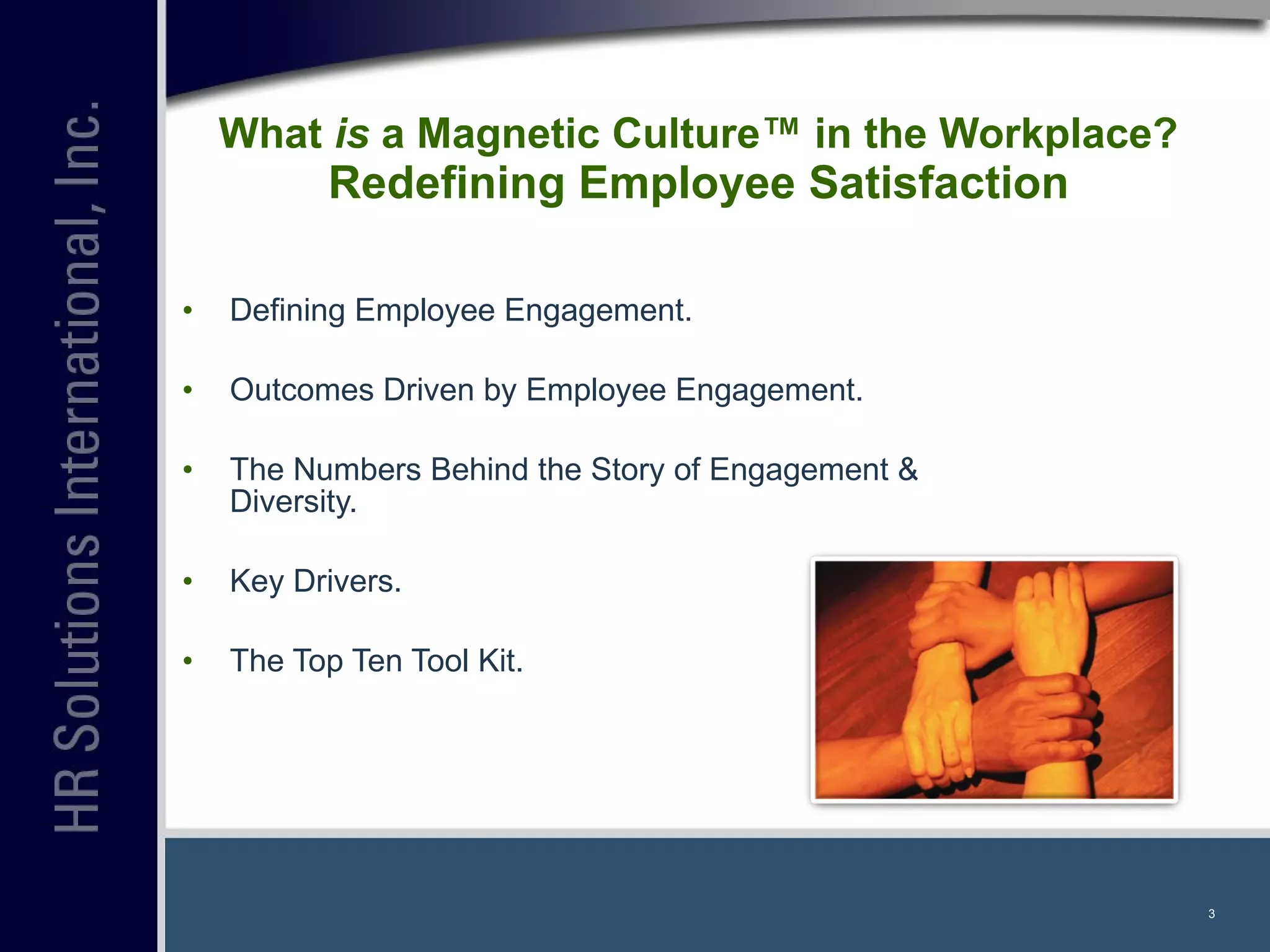
What  is  a Magnetic Culture™ in the Workplace? Redefining Employee Satisfaction Defining Employee Engagement. Outcomes Driven by Employee Engagement. The Numbers Behind the Story of Engagement & Diversity. Key Drivers. The Top Ten Tool Kit.
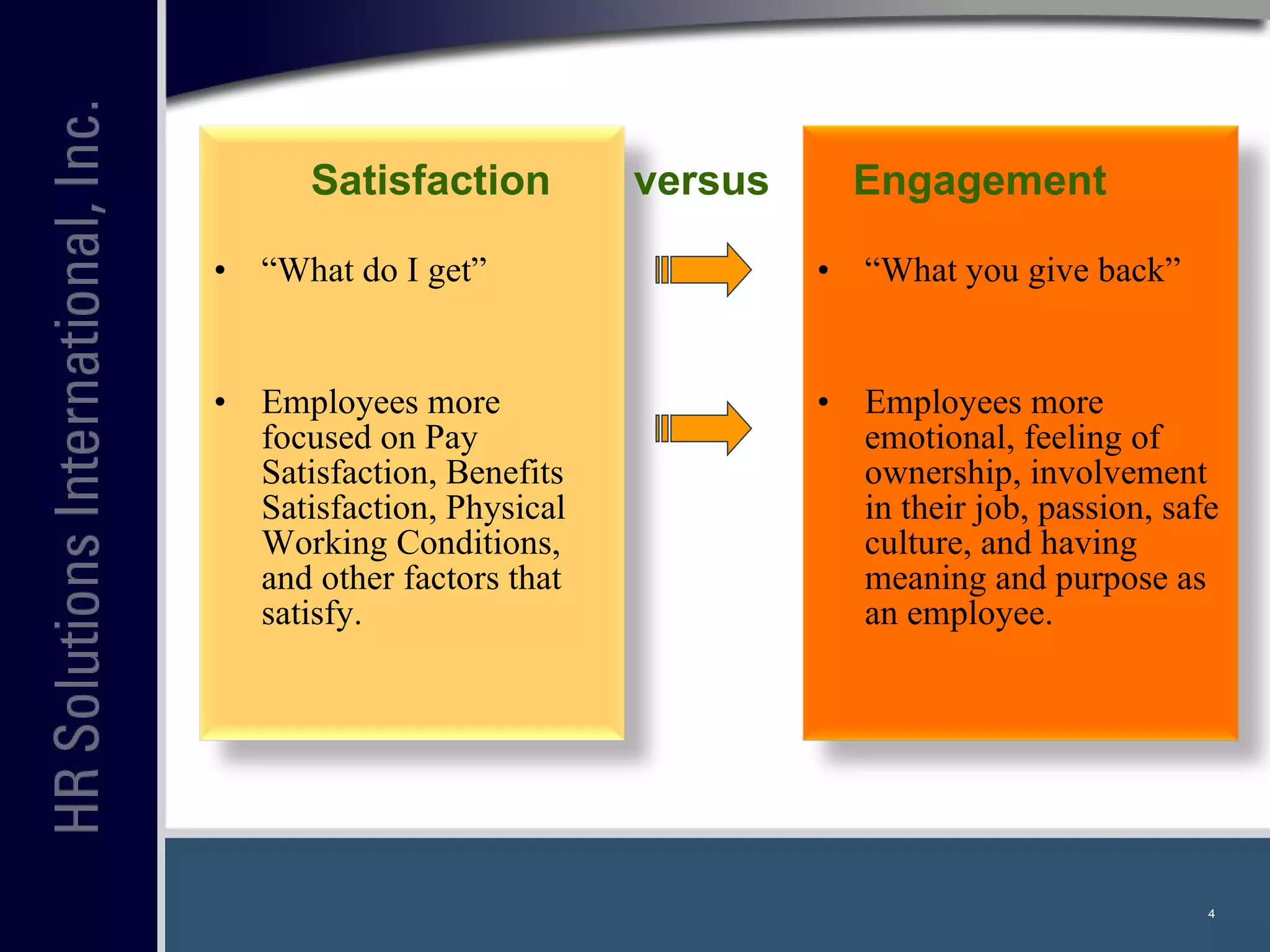
Satisfaction  versus  Engagement   “ What do I get” Employees more focused on Pay Satisfaction, Benefits Satisfaction, Physical Working Conditions, and other factors that satisfy.  “ What you give back” Employees more emotional, feeling of ownership, involvement in their job, passion, safe culture, and having meaning and purpose as an employee.
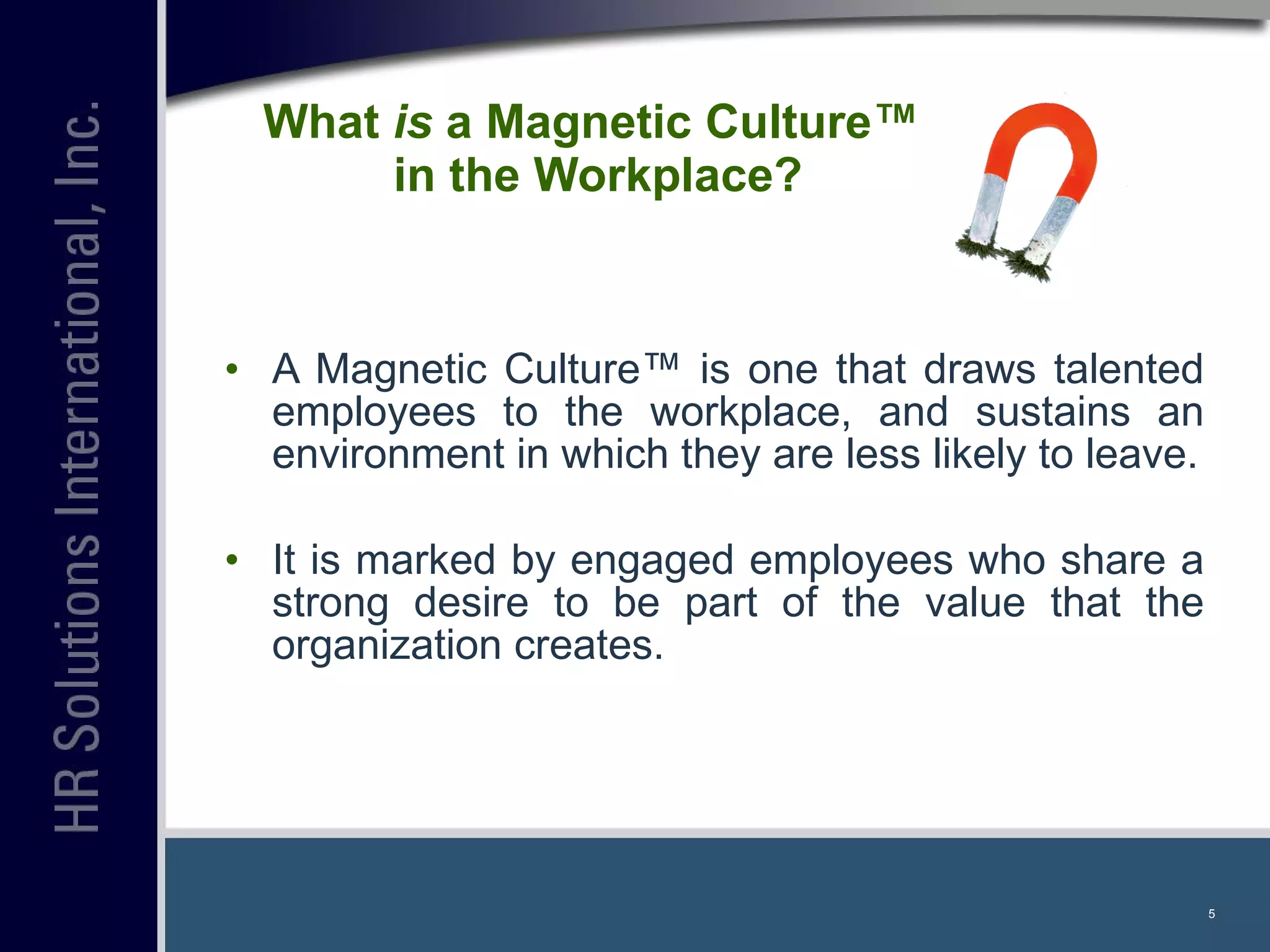
What  is  a Magnetic Culture™  in the Workplace? A Magnetic Culture™ is one that draws talented employees to the workplace, and sustains an environment in which they are less likely to leave. It is marked by engaged employees who share a strong desire to be part of the value that the organization creates.
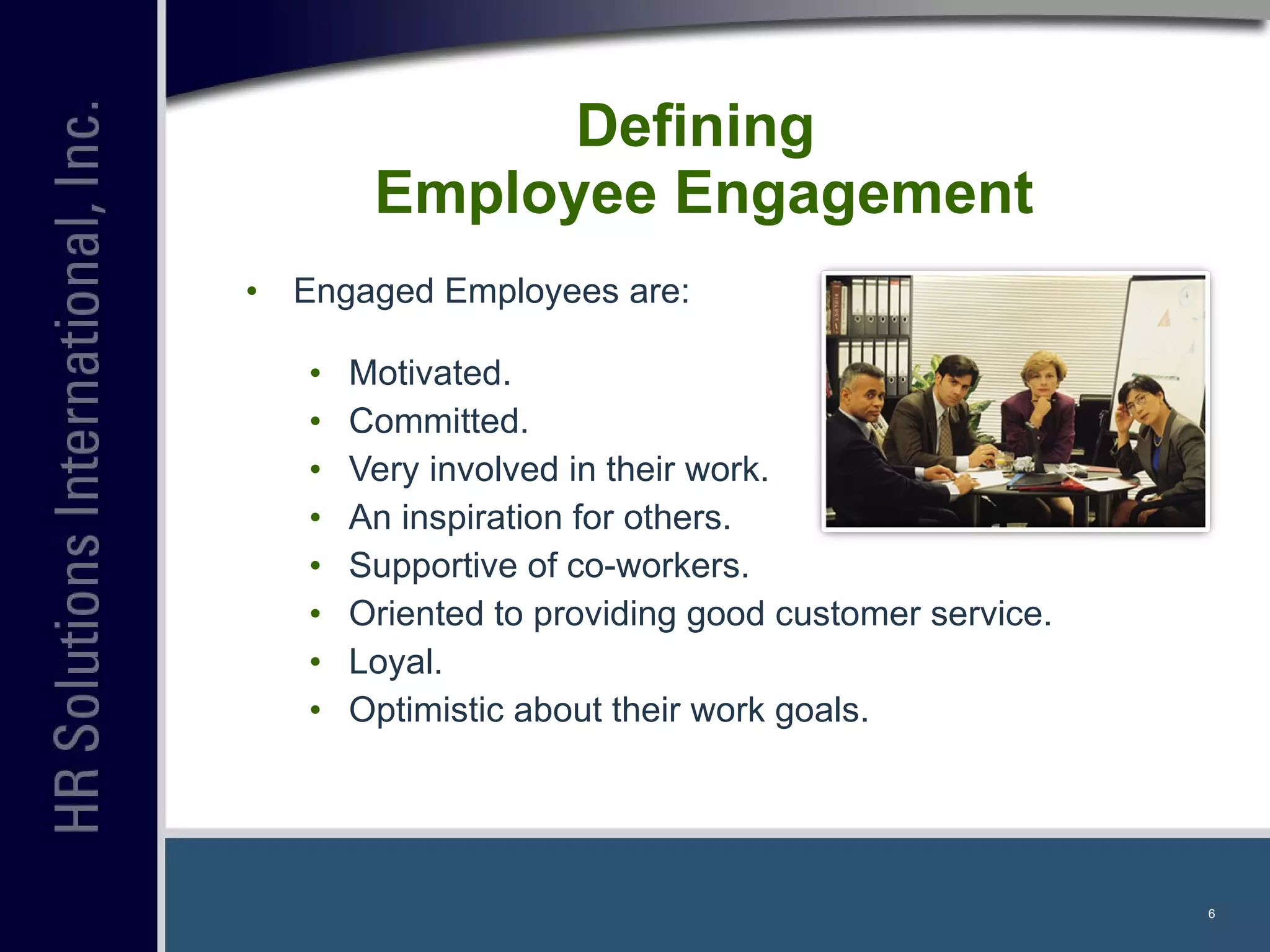
Defining  Employee Engagement Engaged Employees are: Motivated. Committed. Very involved in their work. An inspiration for others. Supportive of co-workers. Oriented to providing good customer service. Loyal. Optimistic about their work goals.
Outcomes Influenced By  Employee Engagement The following  business outcomes  result from successful implementation of Employee Engagement programs: Top Employer Ranking. Stellar Productivity and Financial Success.  Outstanding Performance from Employees. A Magnetic Culture™ is established at your organization.
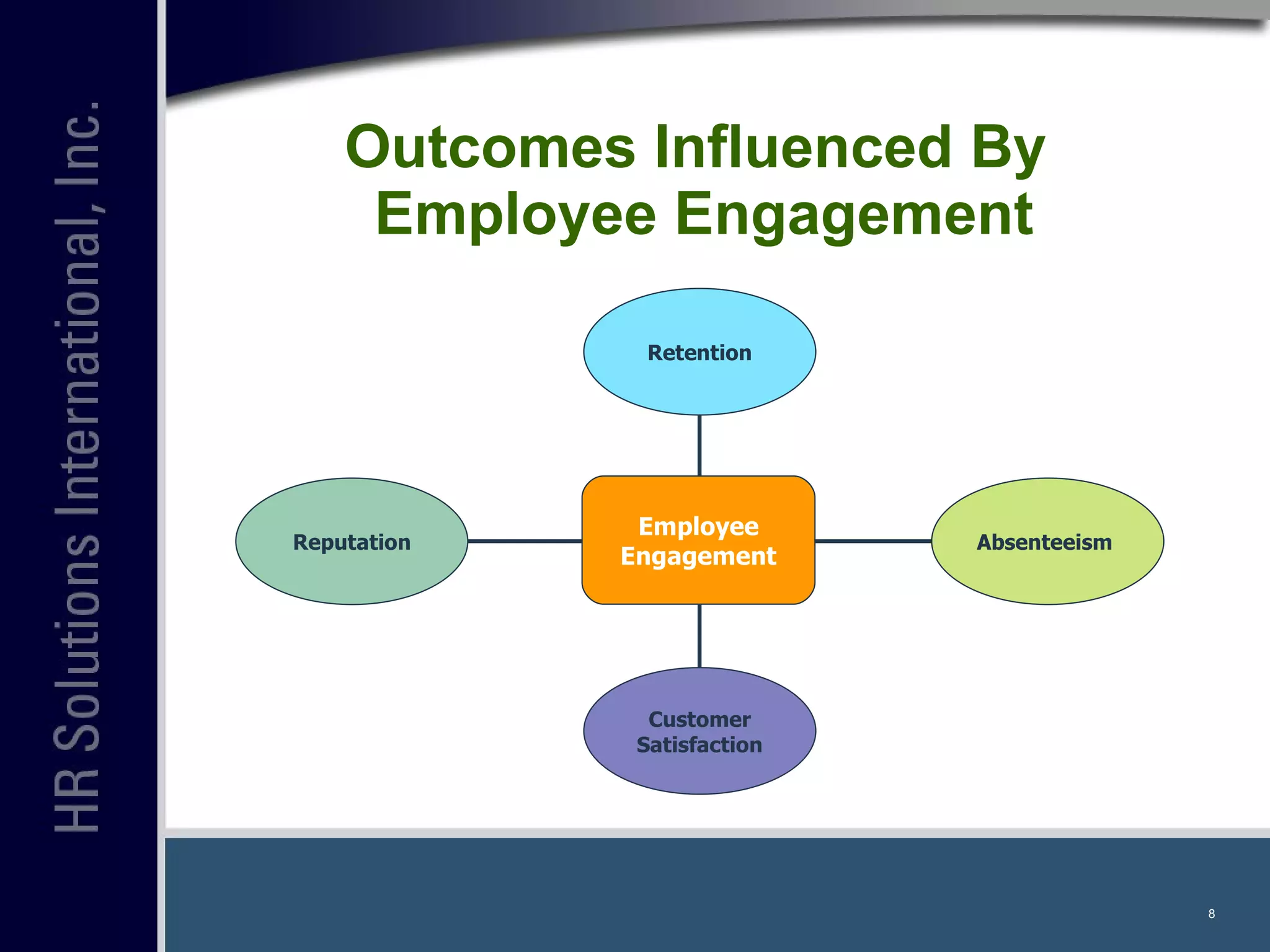
Outcomes Influenced By  Employee Engagement Reputation Customer Satisfaction Absenteeism   Retention Employee Engagement
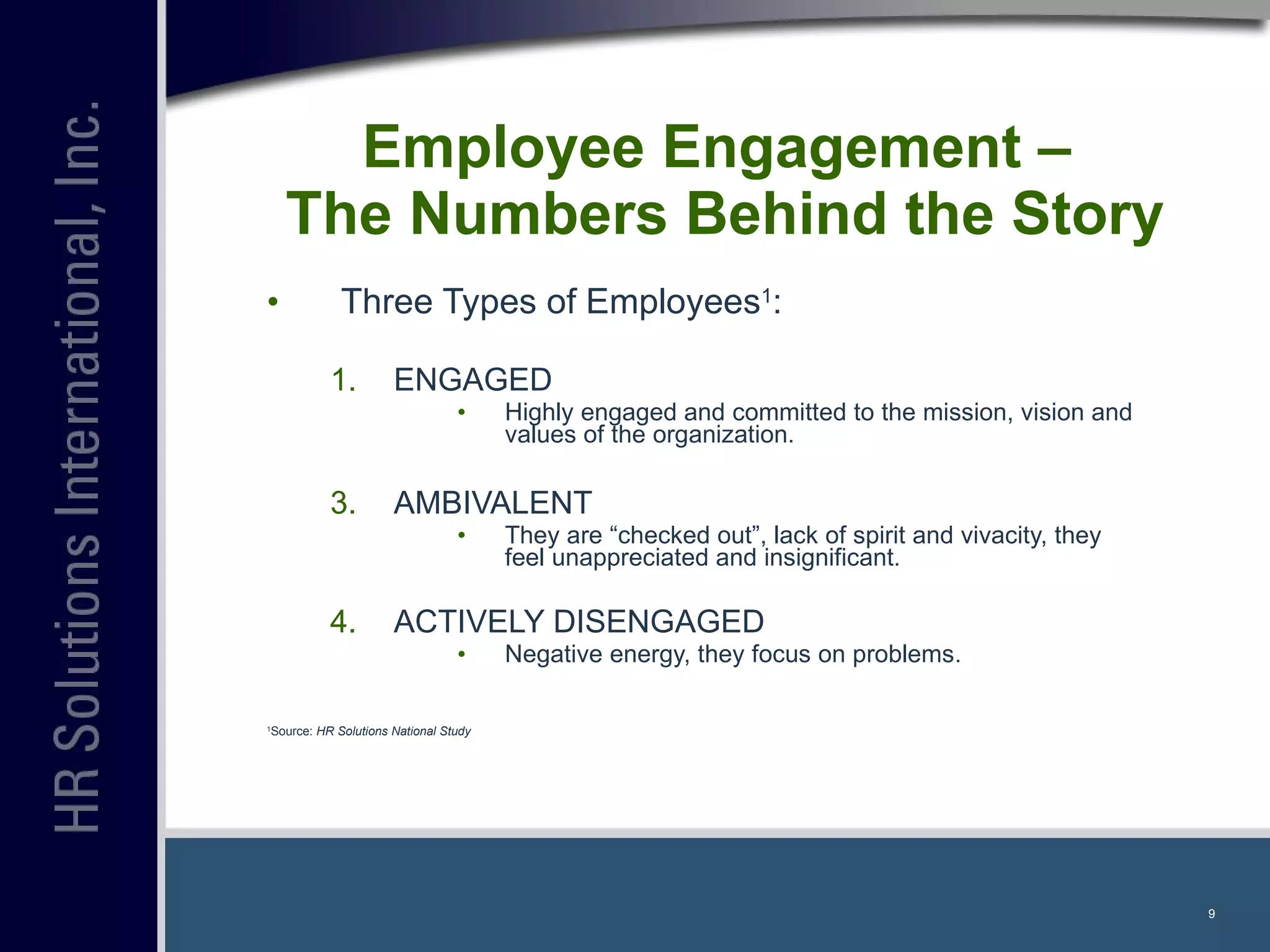
Employee Engagement –  The Numbers Behind the Story Three Types of Employees 1 : ENGAGED Highly engaged and committed to the mission, vision and values of the organization. AMBIVALENT They are “checked out”, lack of spirit and vivacity, they feel unappreciated and insignificant. ACTIVELY DISENGAGED Negative energy, they focus on problems. 1 Source:  HR Solutions National Study
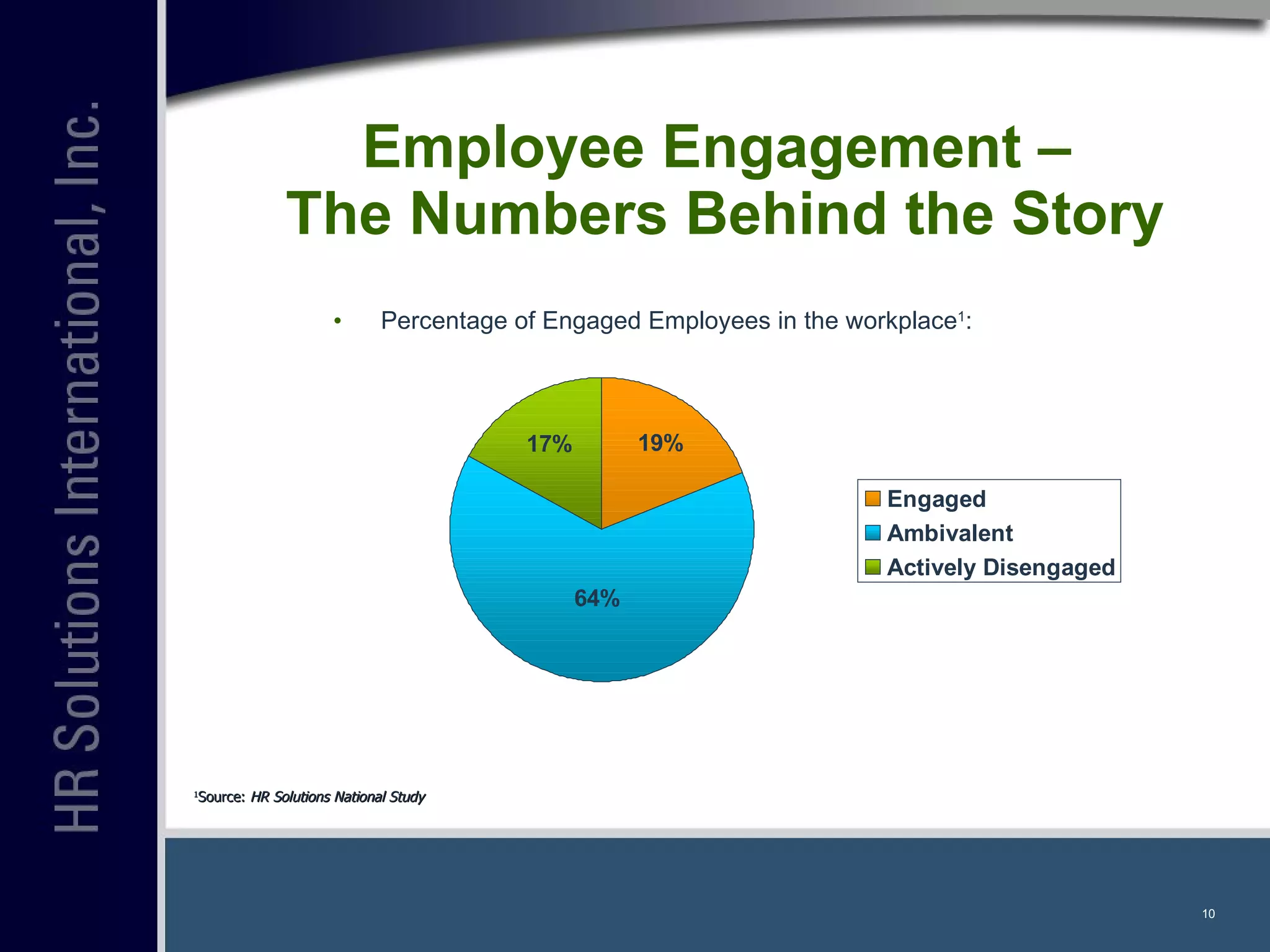
Employee Engagement –  The Numbers Behind the Story Percentage of Engaged Employees in the workplace 1 : 1 Source:  HR Solutions National Study
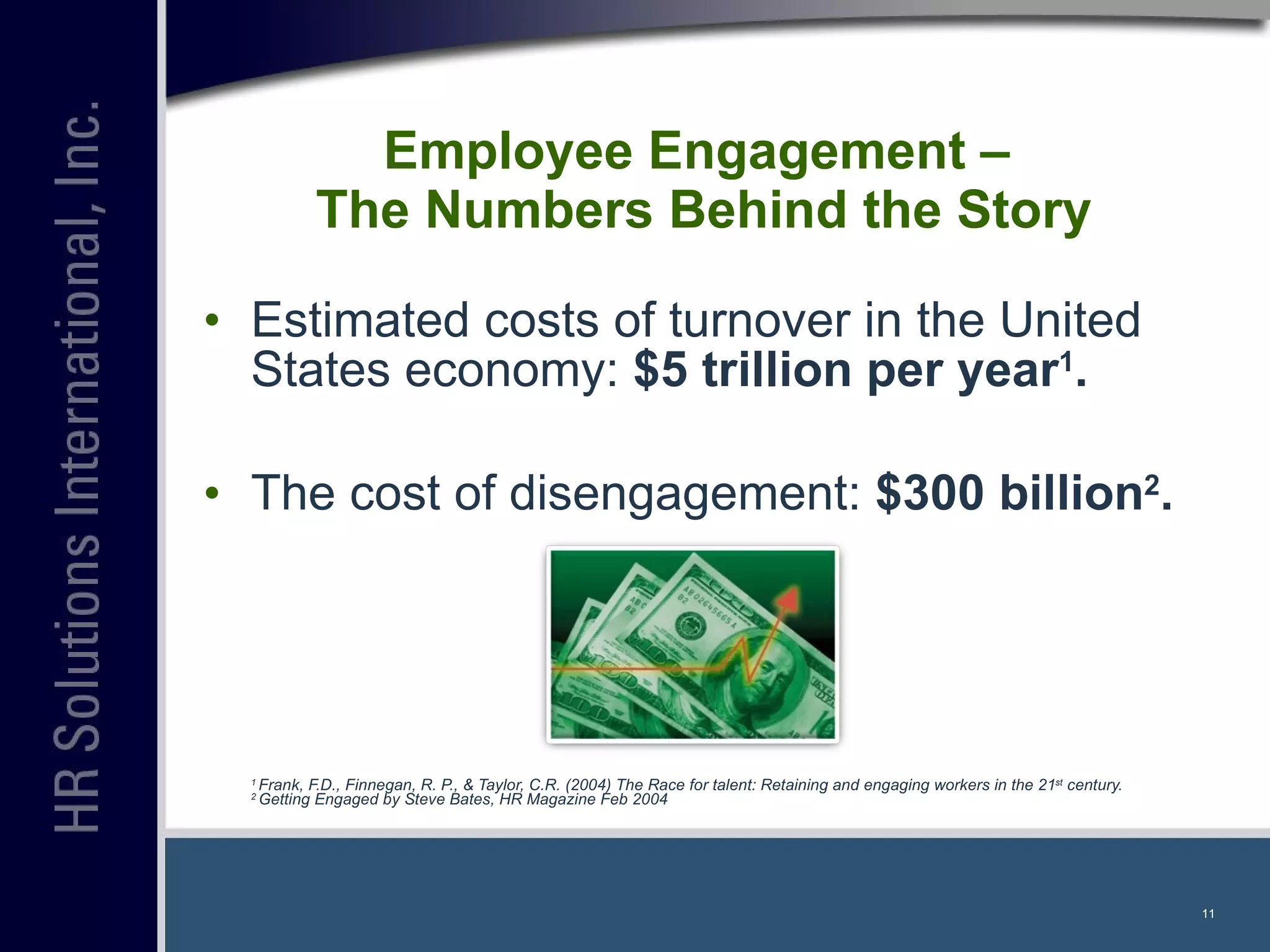
Estimated costs of turnover in the United States economy:  $5 trillion per year 1 . The cost of disengagement:  $300 billion 2 . 1  Frank, F.D., Finnegan, R. P., & Taylor, C.R. (2004) The Race for talent: Retaining and engaging workers in the 21 st  century.  2  Getting Engaged by Steve Bates, HR Magazine Feb 2004  Employee Engagement –  The Numbers Behind the Story
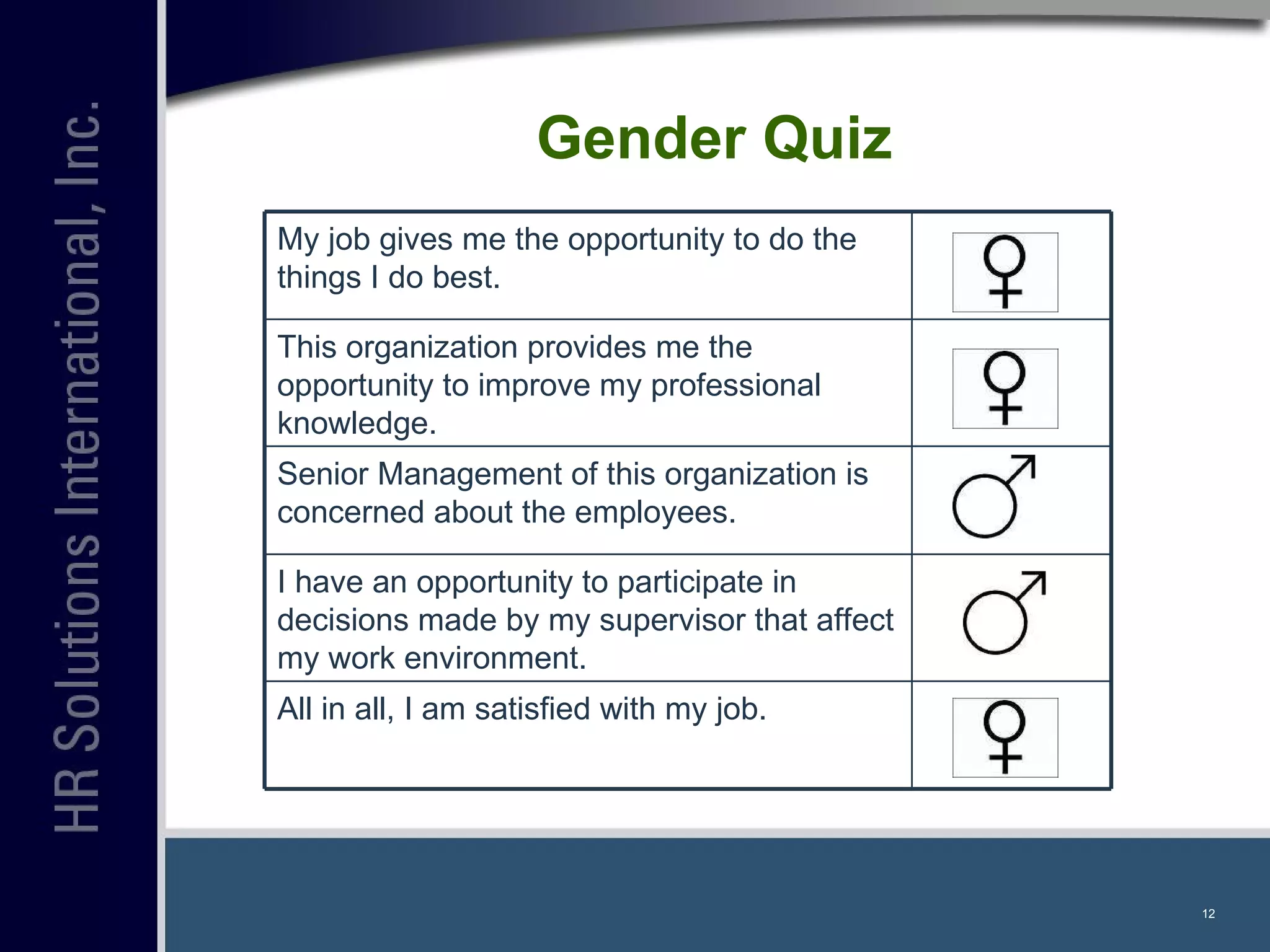
Gender Quiz My job gives me the opportunity to do the things I do best. This organization provides me the opportunity to improve my professional knowledge. Senior Management of this organization is concerned about the employees. I have an opportunity to participate in decisions made by my supervisor that affect my work environment. All in all, I am satisfied with my job.
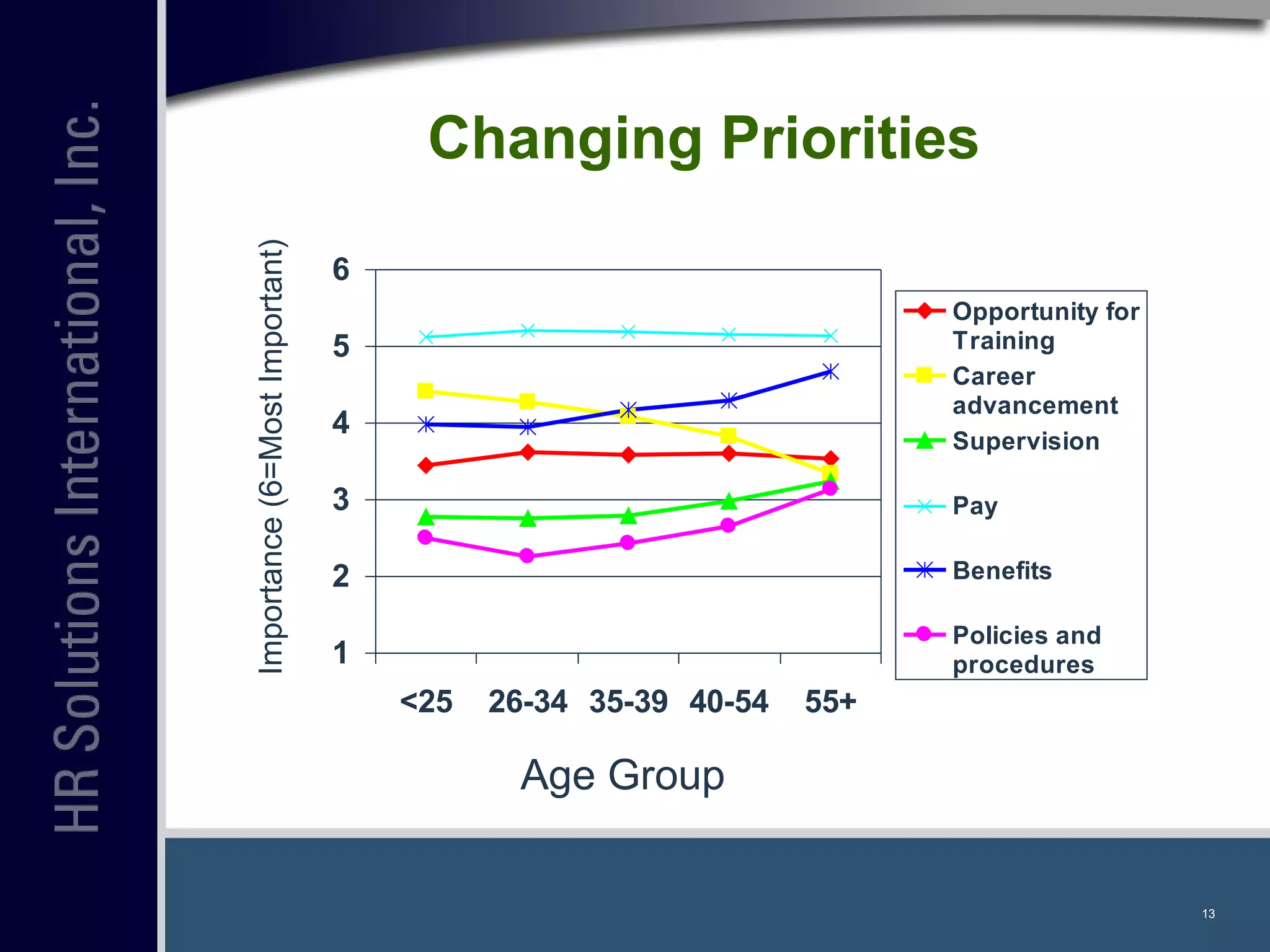
Changing Priorities Age Group Importance (6=Most Important)
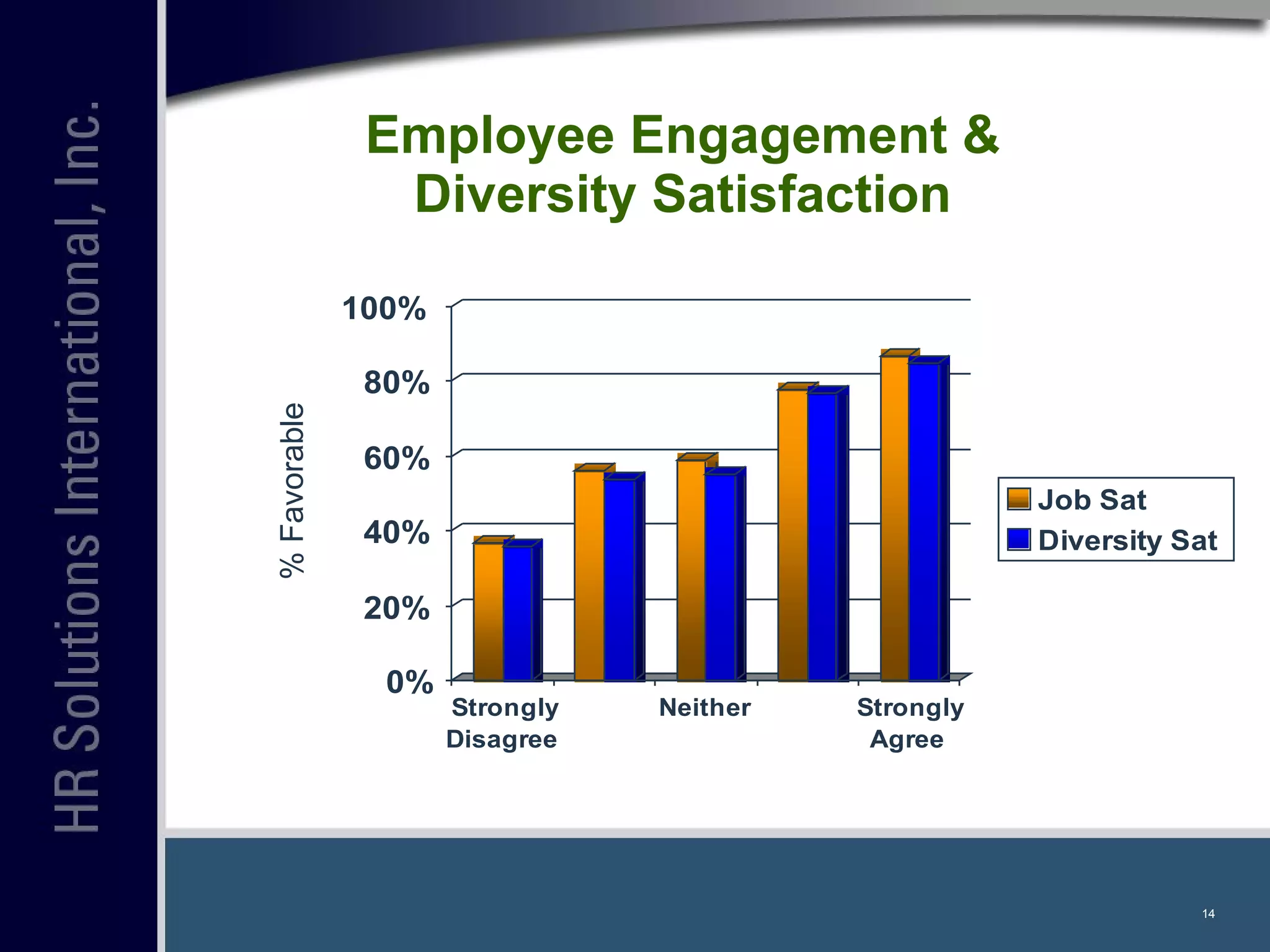
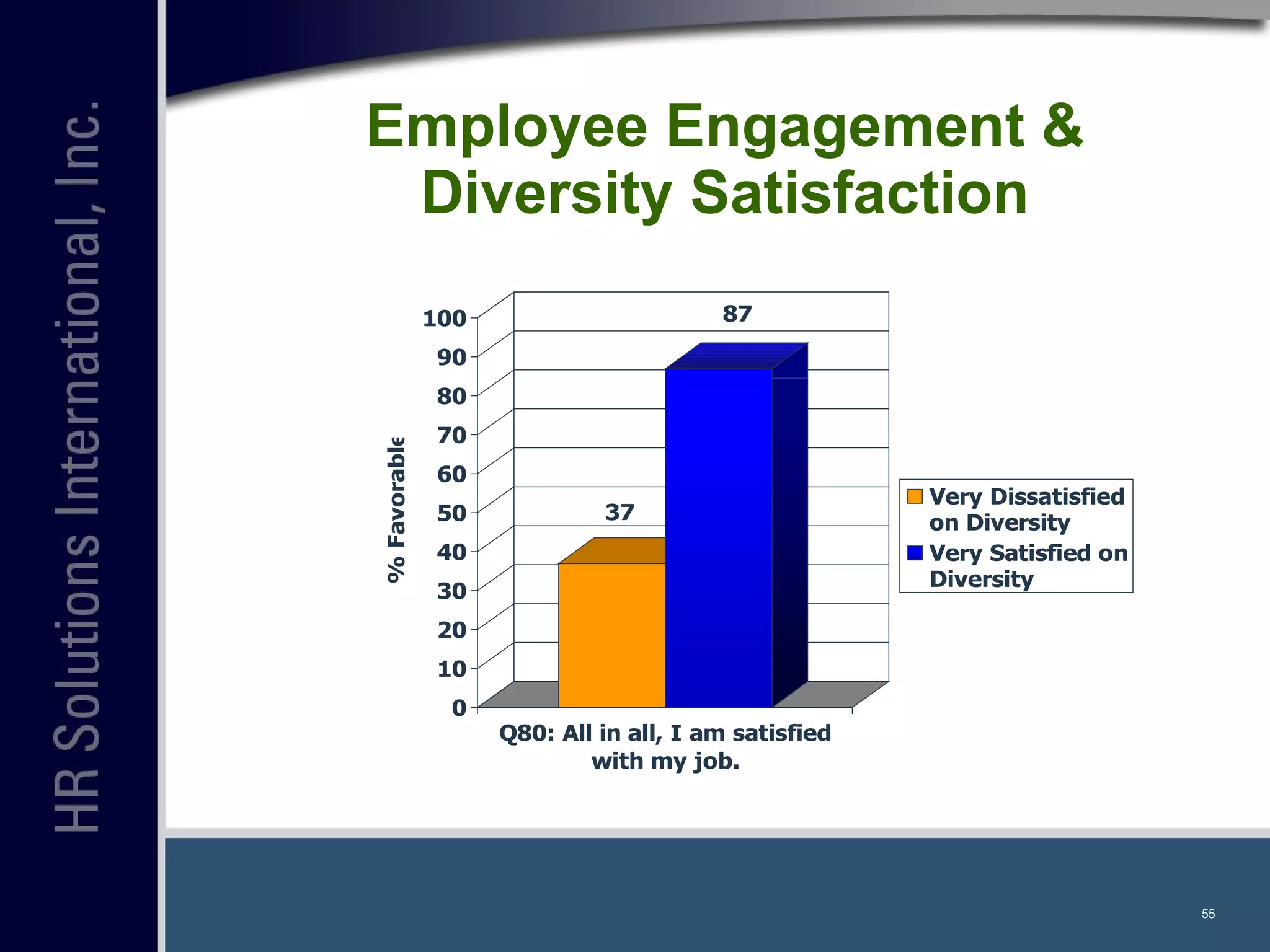
Employee Engagement & Diversity Satisfaction % Favorable
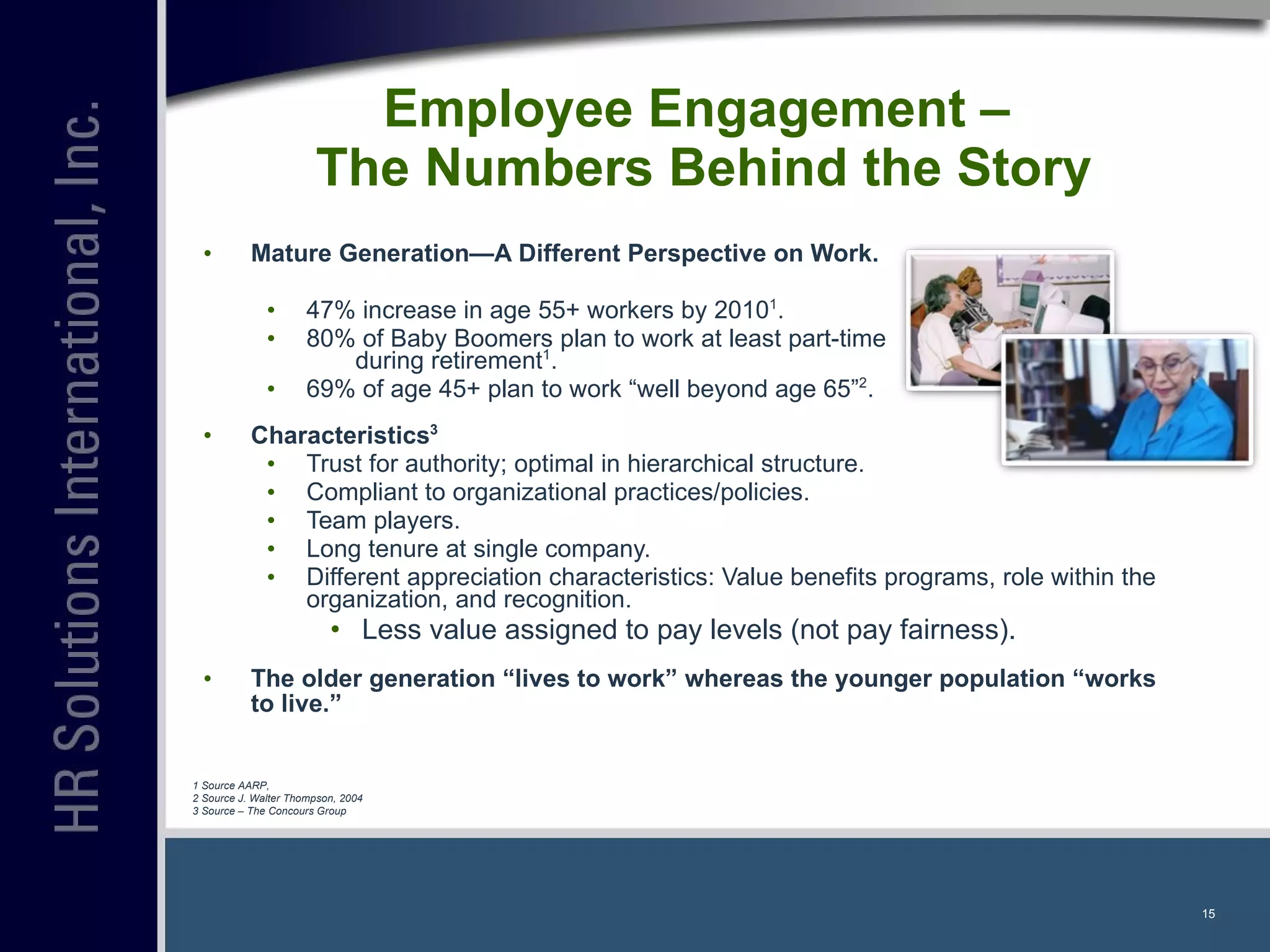
Employee Engagement –  The Numbers Behind the Story Mature Generation—A Different Perspective on Work. 47% increase in age 55+ workers by 2010 1 . 80% of Baby Boomers plan to work at least part-time  during retirement 1 . 69% of age 45+ plan to work “well beyond age 65” 2 . Characteristics 3 Trust for authority; optimal in hierarchical structure. Compliant to organizational practices/policies. Team players. Long tenure at single company. Different appreciation characteristics: Value benefits programs, role within the organization, and recognition. Less value assigned to pay levels (not pay fairness).  The older generation “lives to work” whereas the younger population “works to live.” 1 Source AARP, 2 Source J. Walter Thompson, 2004 3 Source – The Concours Group
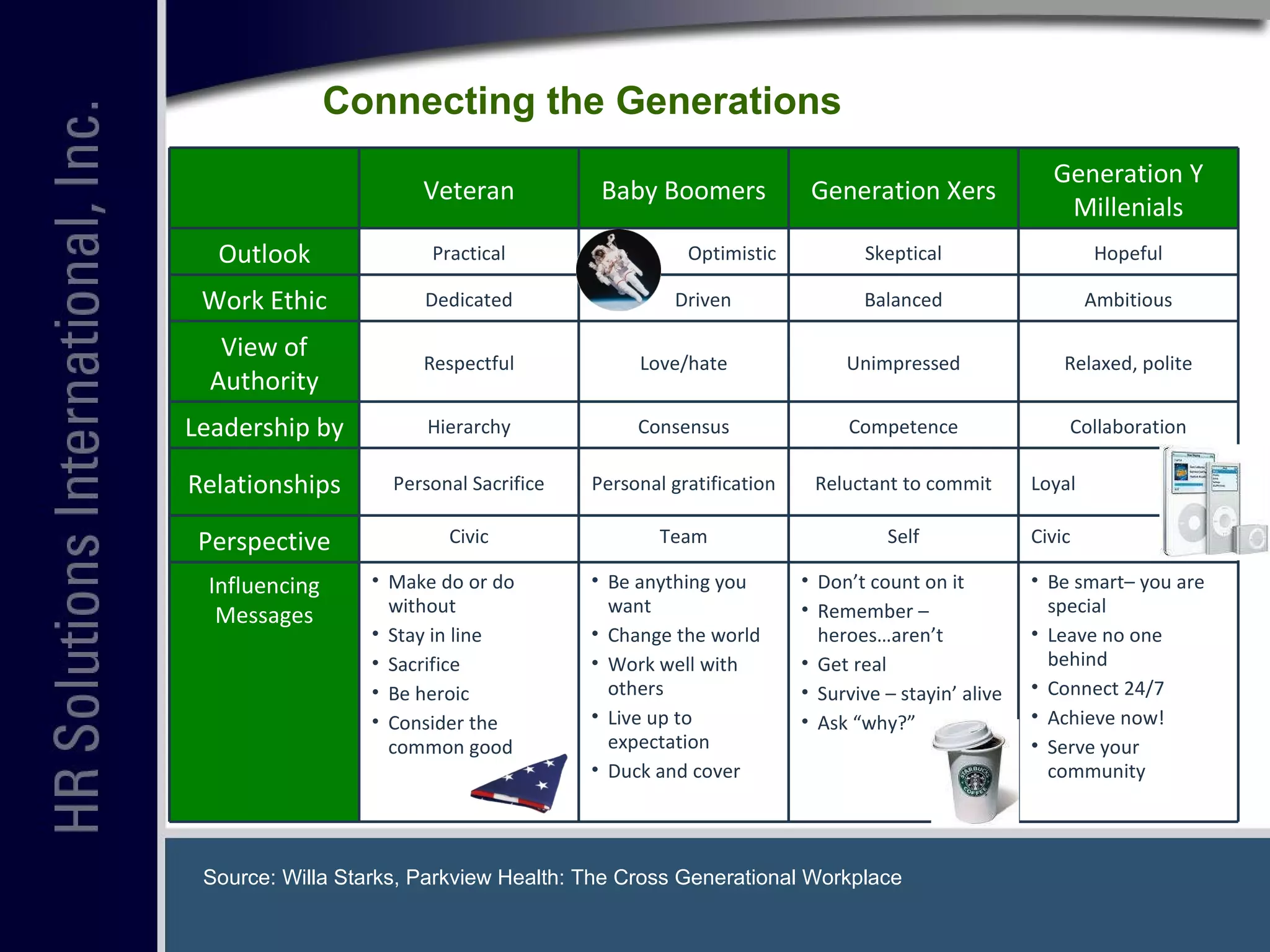
Connecting the Generations Source: Willa Starks, Parkview Health: The Cross Generational Workplace Veteran Baby Boomers Generation Xers Generation Y Millenials Outlook Practical Optimistic Skeptical Hopeful Work Ethic Dedicated Driven Balanced Ambitious View of Authority Respectful Love/hate Unimpressed Relaxed, polite Leadership by Hierarchy Consensus Competence Collaboration Relationships Personal Sacrifice Personal gratification Reluctant to commit Loyal Perspective Civic Team Self Civic Influencing Messages Make do or do without Stay in line Sacrifice Be heroic Consider the common good Be anything you want  Change the world Work well with others Live up to expectation Duck and cover  Don’t count on it Remember – heroes…aren’t Get real Survive – stayin’ alive Ask “why?” Be smart– you are special Leave no one behind Connect 24/7 Achieve now! Serve your community
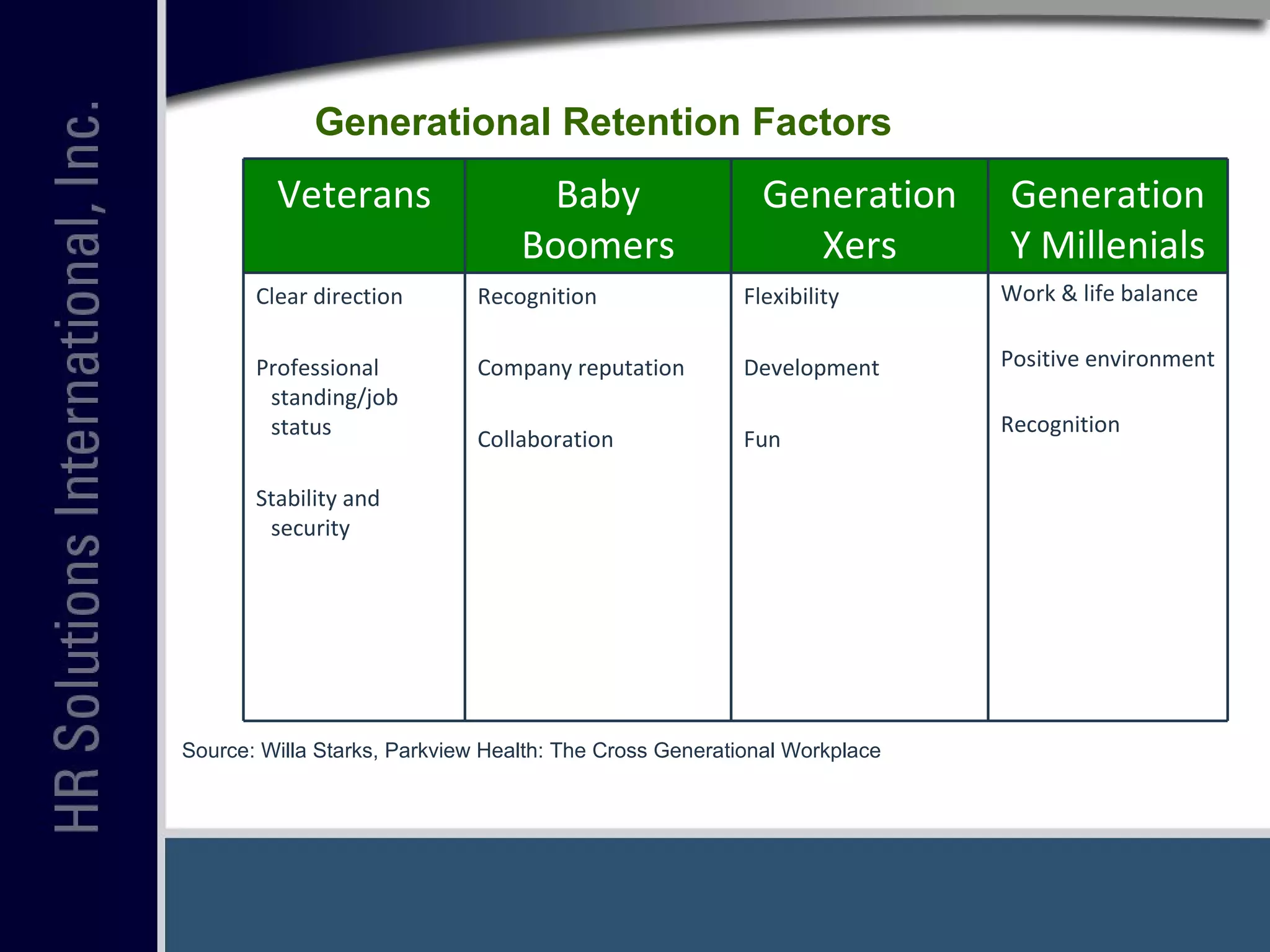
Generational Retention Factors Source: Willa Starks, Parkview Health: The Cross Generational Workplace Veterans Baby Boomers Generation Xers Generation Y Millenials Clear direction Professional standing/job status Stability and security Recognition Company reputation Collaboration Flexibility Development Fun Work & life balance Positive environment Recognition
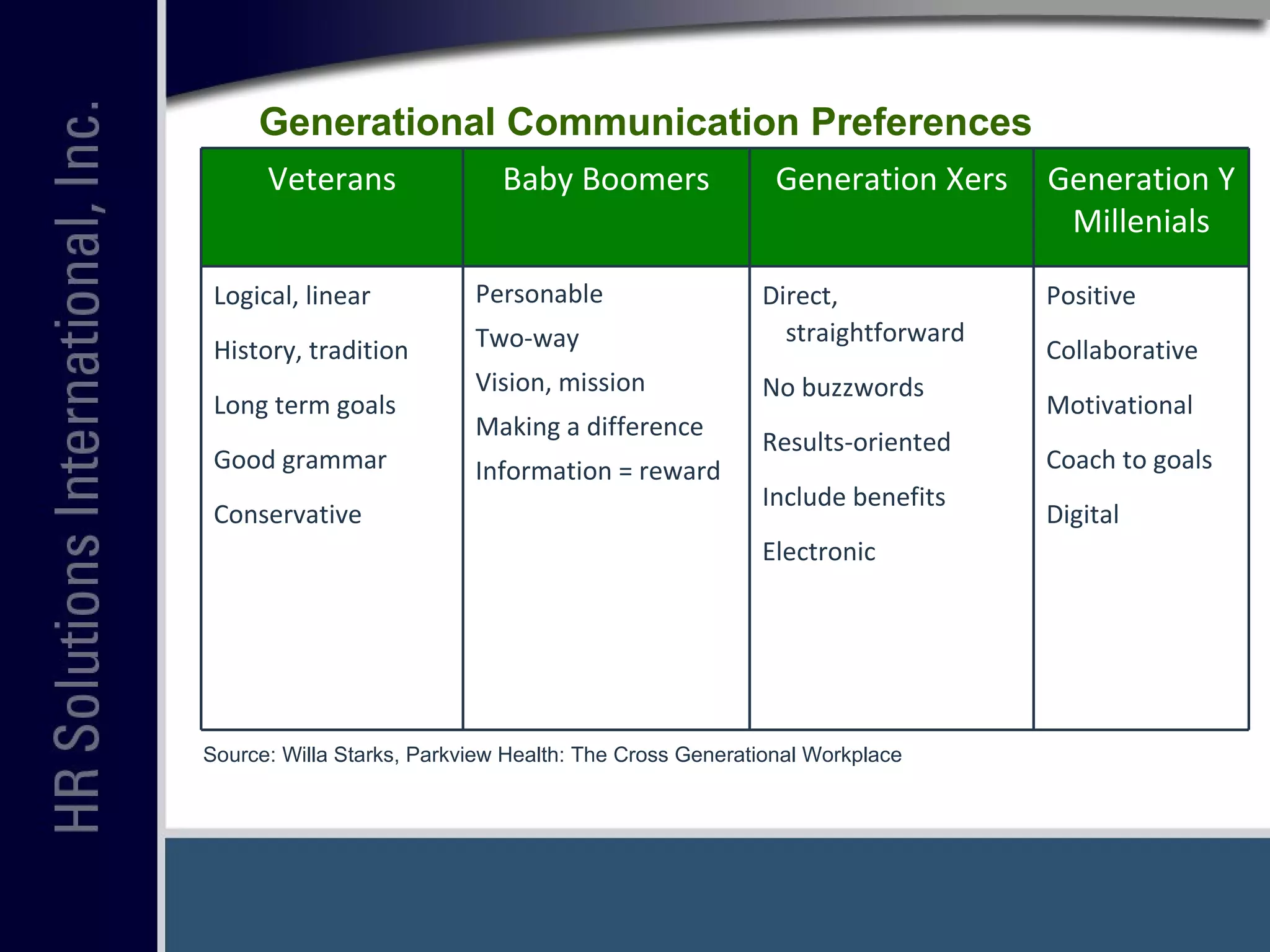
Generational Communication Preferences Source: Willa Starks, Parkview Health: The Cross Generational Workplace Veterans Baby Boomers Generation Xers Generation Y Millenials Logical, linear History, tradition Long term goals Good grammar Conservative  Personable Two-way Vision, mission Making a difference Information = reward Direct, straightforward  No buzzwords Results-oriented Include benefits Electronic Positive  Collaborative Motivational Coach to goals Digital
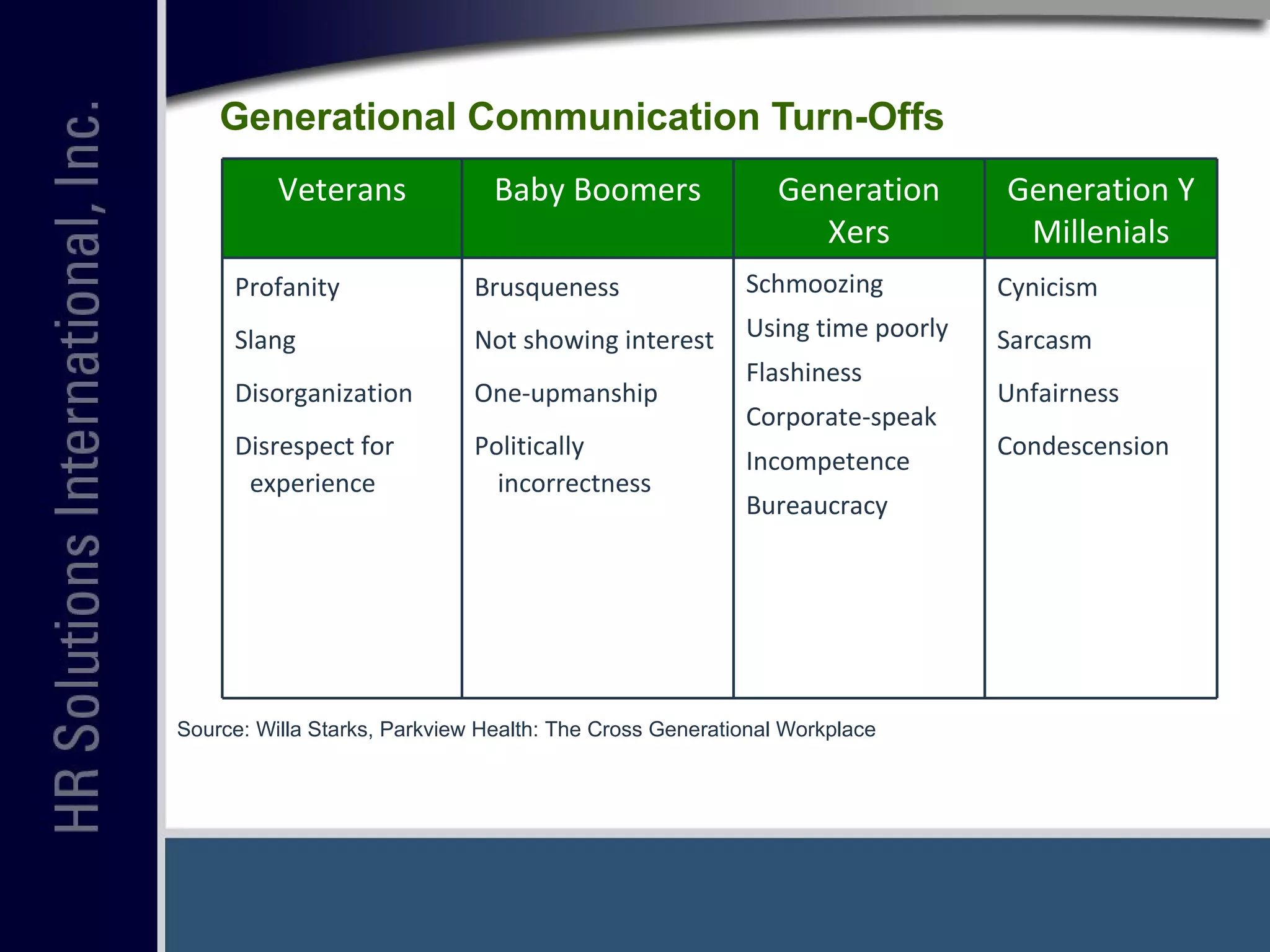
Generational Communication Turn-Offs Source: Willa Starks, Parkview Health: The Cross Generational Workplace Veterans Baby Boomers Generation Xers Generation Y Millenials Profanity Slang Disorganization Disrespect for experience Brusqueness Not showing interest One-upmanship Politically incorrectness Schmoozing Using time poorly  Flashiness Corporate-speak Incompetence Bureaucracy Cynicism Sarcasm Unfairness Condescension
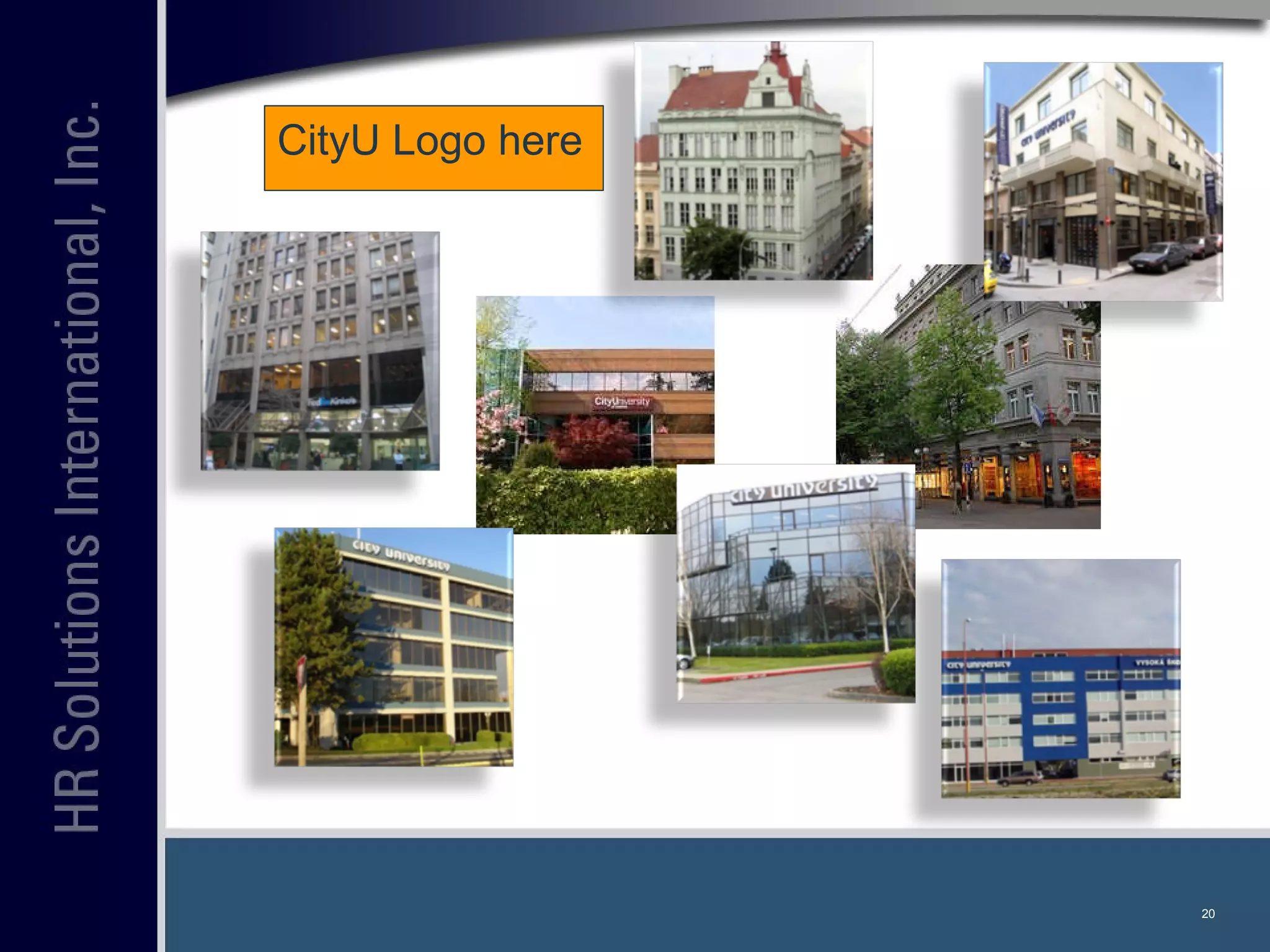
CityU Logo here
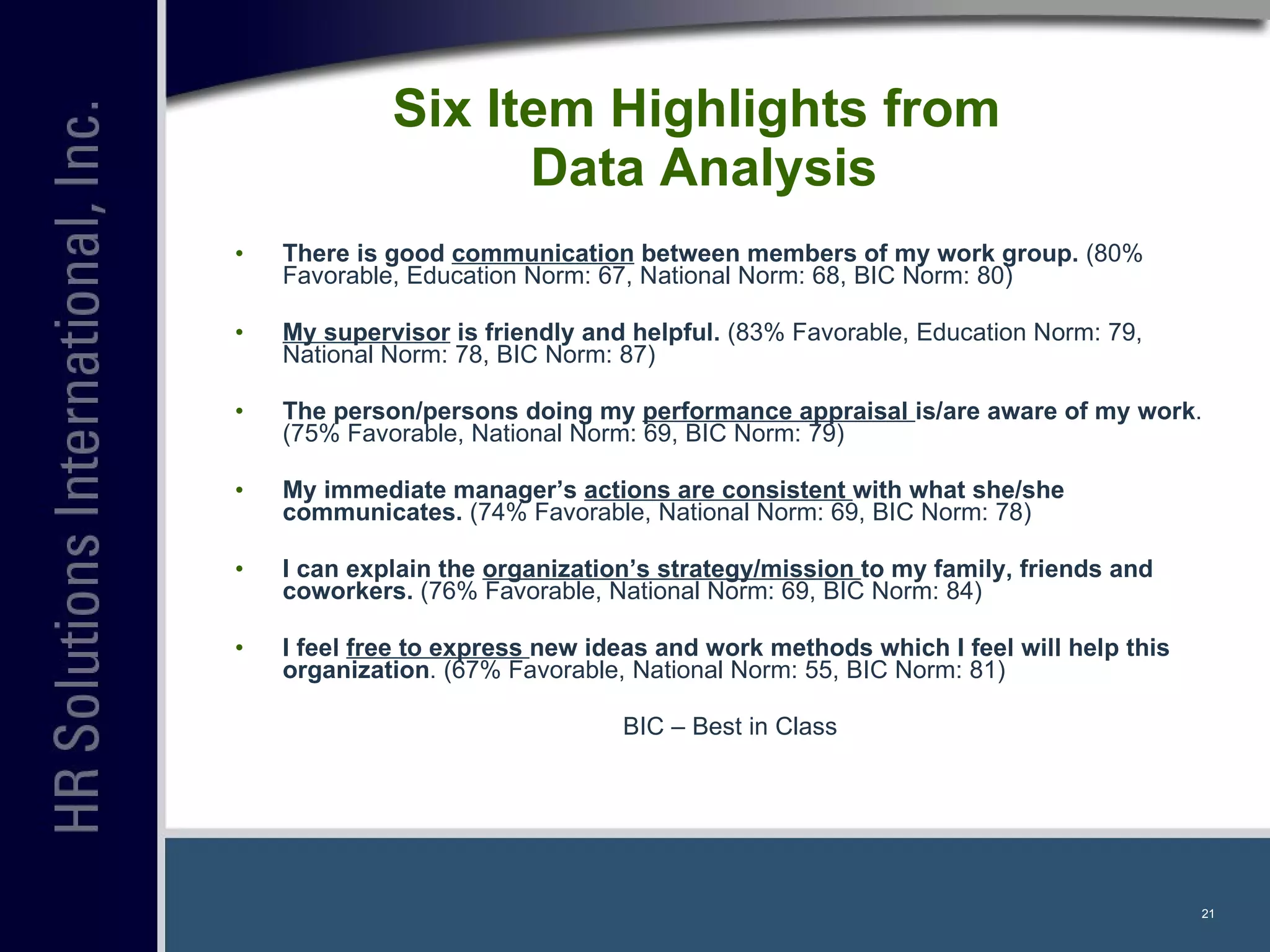
Six Item Highlights from  Data Analysis There is good  communication  between members of my work group.  (80% Favorable, Education Norm: 67, National Norm: 68, BIC Norm: 80) My supervisor  is friendly and helpful.  (83% Favorable, Education Norm: 79, National Norm: 78, BIC Norm: 87) The person/persons doing my  performance appraisal  is/are aware of my work . (75% Favorable, National Norm: 69, BIC Norm: 79) My immediate manager’s  actions are consistent  with what she/she communicates.  (74% Favorable, National Norm: 69, BIC Norm: 78) I can explain the  organization’s strategy/mission  to my family, friends and coworkers.  (76% Favorable, National Norm: 69, BIC Norm: 84) I feel  free to express  new ideas and work methods which I feel will help this organization . (67% Favorable, National Norm: 55, BIC Norm: 81) BIC – Best in Class
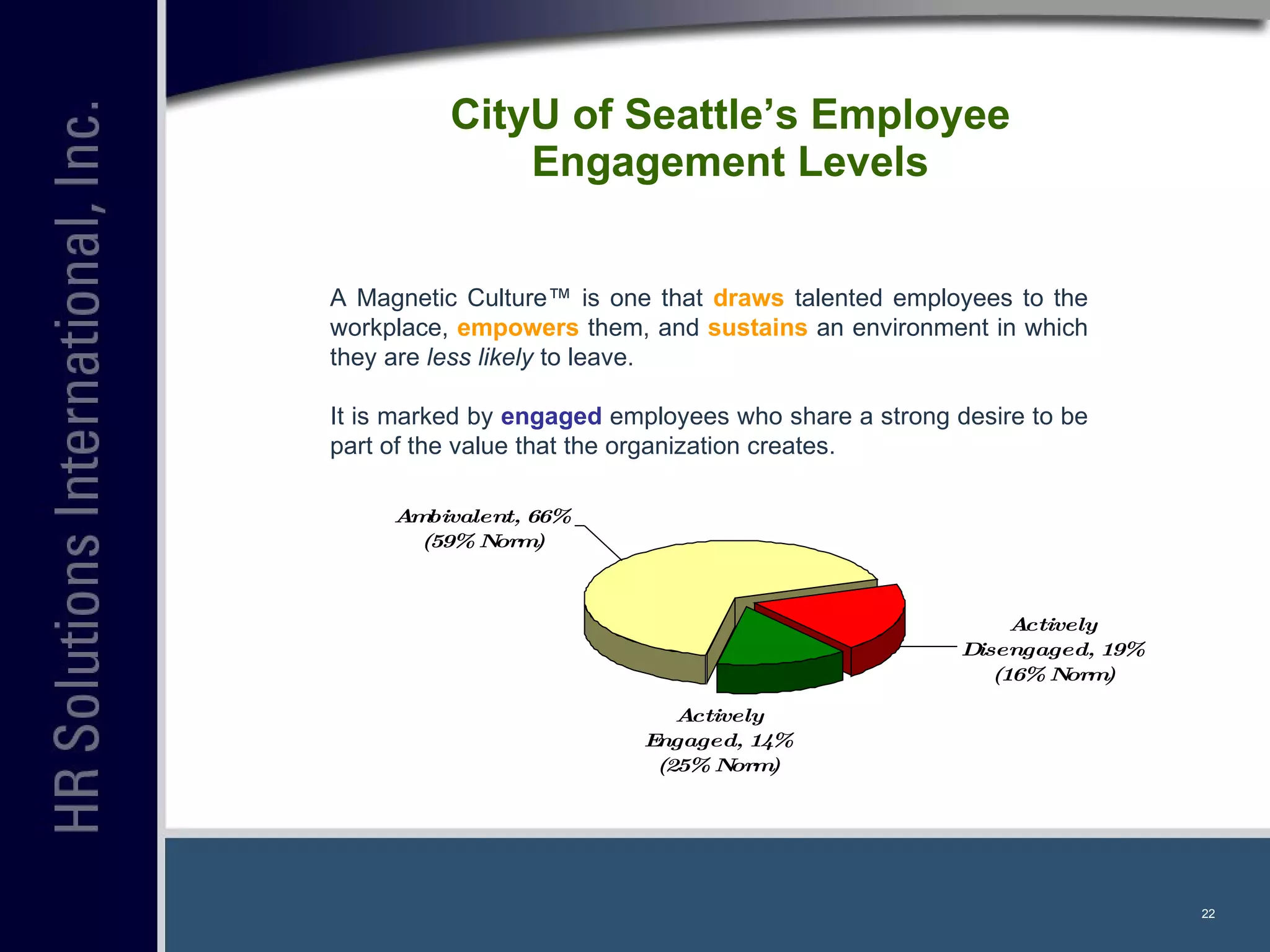
CityU of Seattle’s Employee Engagement Levels A Magnetic Culture™ is one that  draws  talented employees to the workplace,  empowers  them, and  sustains  an environment in which they are  less likely  to leave. It is marked by  engaged  employees who share a strong desire to be part of the value that the organization creates.
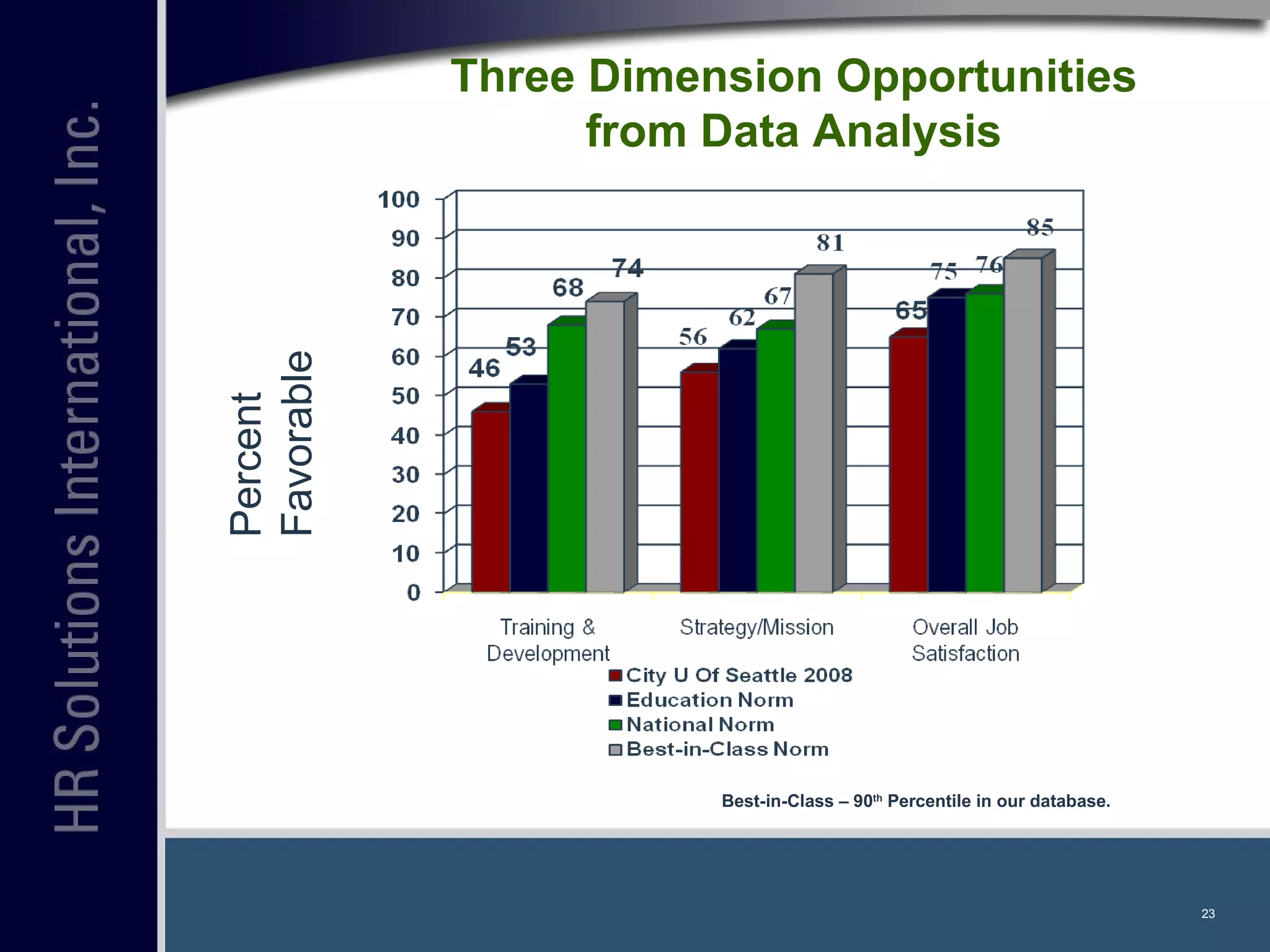
Percent Favorable Best-in-Class – 90 th  Percentile in our database. Three Dimension Opportunities from Data Analysis
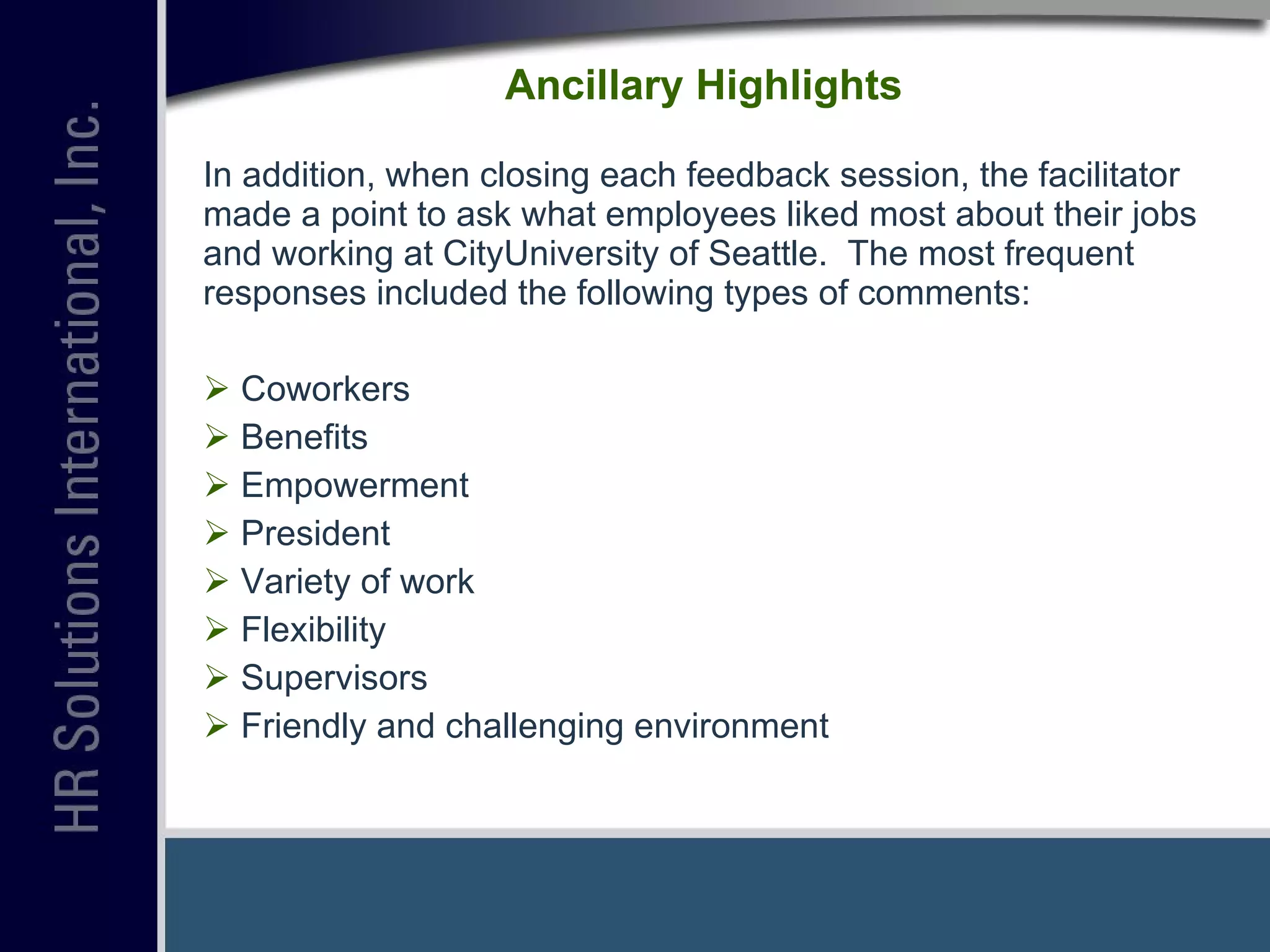
Ancillary Highlights In addition, when closing each feedback session, the facilitator made a point to ask what employees liked most about their jobs and working at CityUniversity of Seattle.  The most frequent responses included the following types of comments: Coworkers Benefits Empowerment President  Variety of work Flexibility Supervisors Friendly and challenging environment
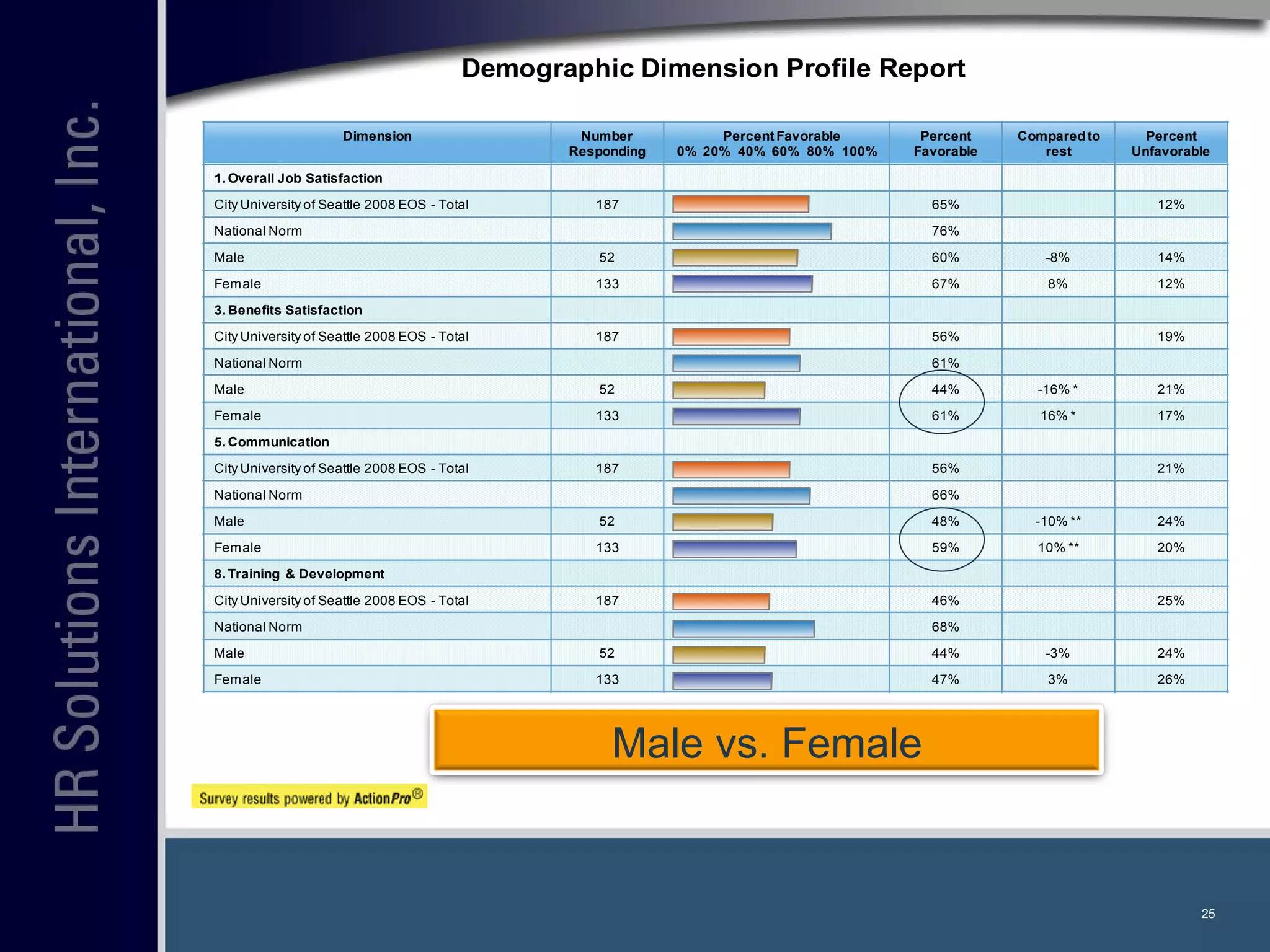
Male vs. Female
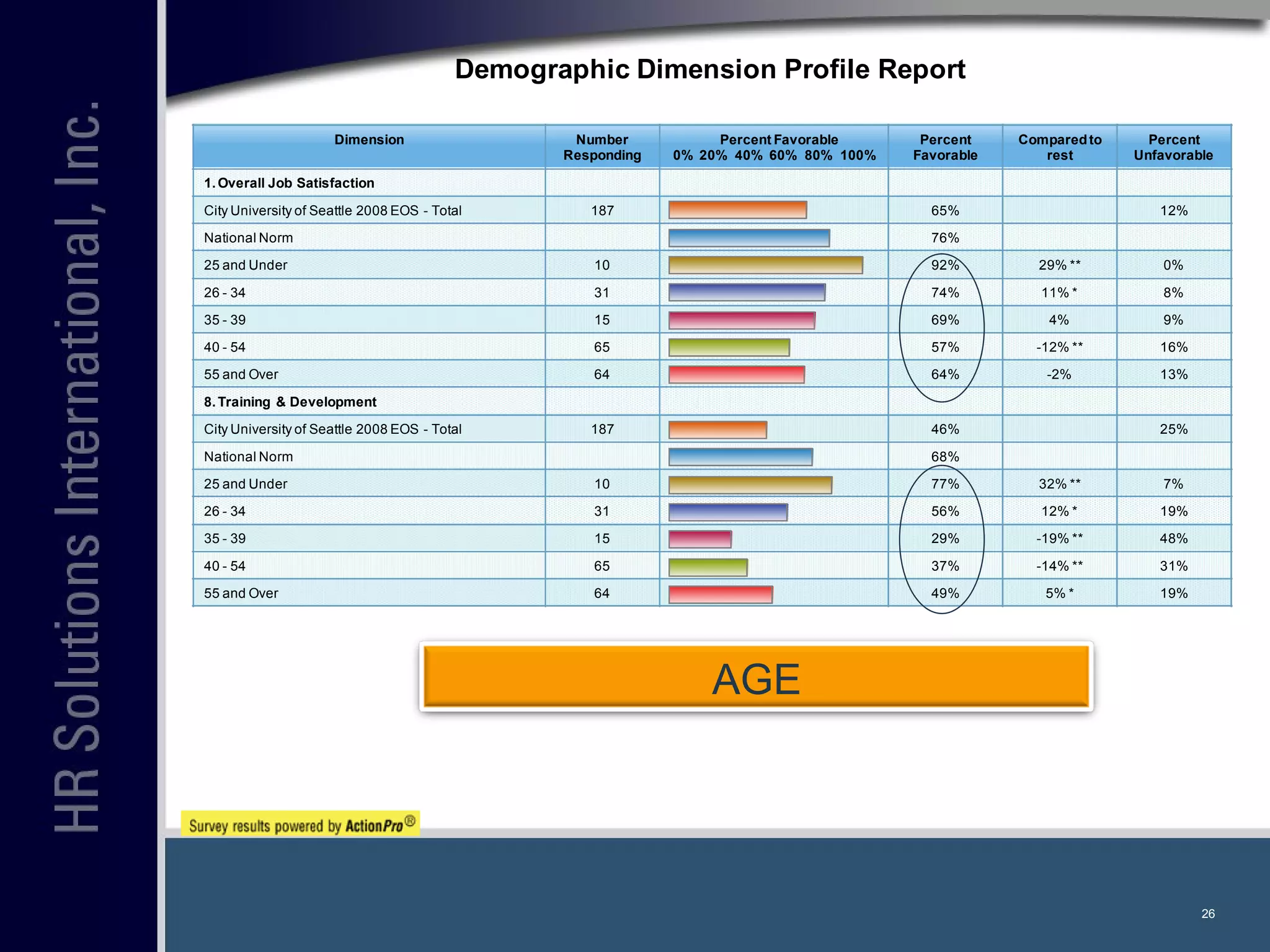
AGE
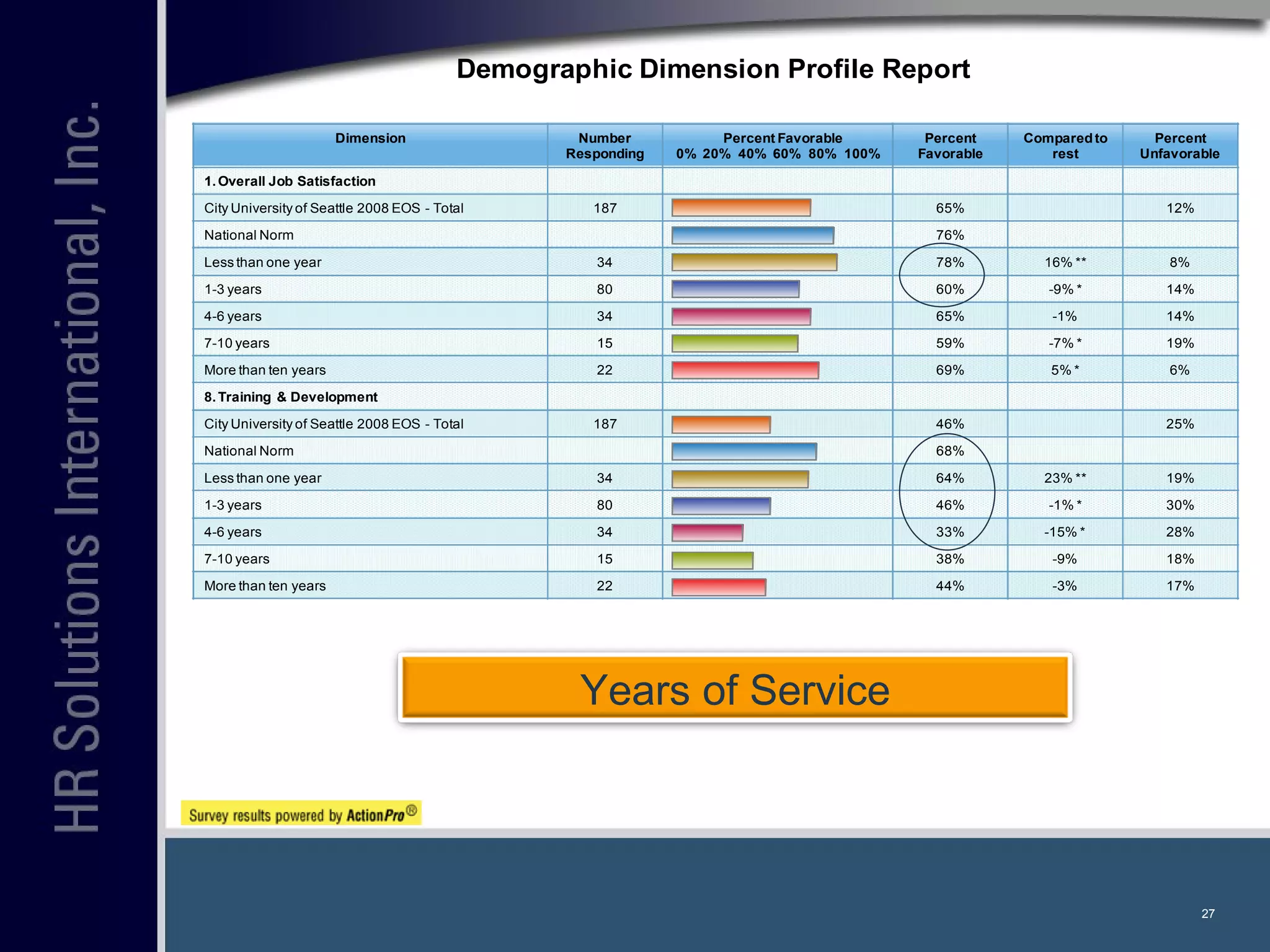
Years of Service
Training and Development  Feedback sessions included the following types of comments: “ There is no training or development.  Orientation to company is great.  You learn about the benefits.  The training is fine when you first come here.  There are people here that help you out.  Once you are trained that is it.  It is pretty much it.”  Nine agreed. “ I don’t feel organization is committed to Training & Development.  I got some in my own department; but there is no institutional commitment to it.”  [10 of 11 Managers agreed] Job-role specific department training IT Training,  Seminars, MS Excel training,  Phone etiquette/ transferring phone calls. SharePoint Leadership Development. How to hold people accountable. How to deal with underperformers.
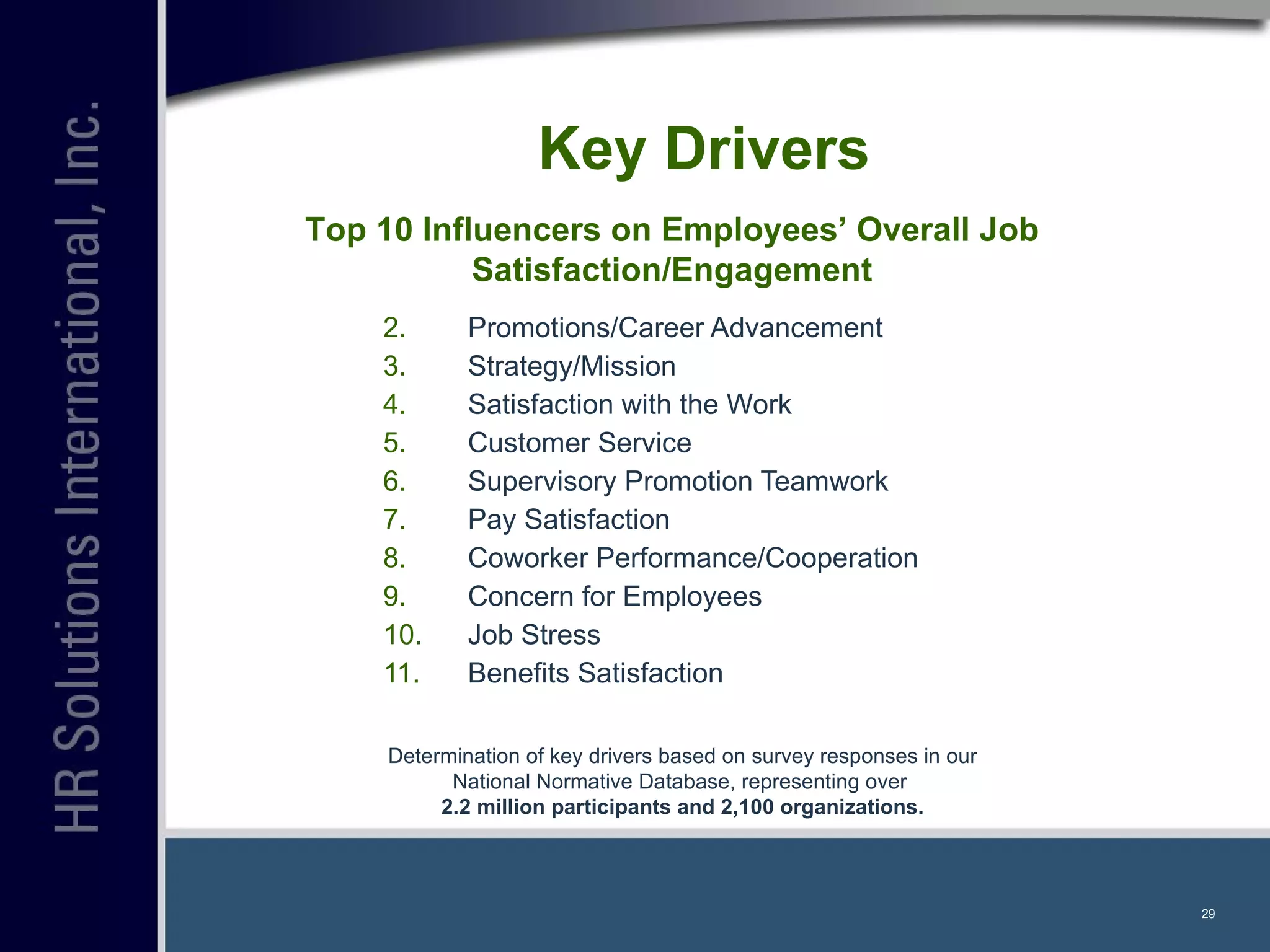
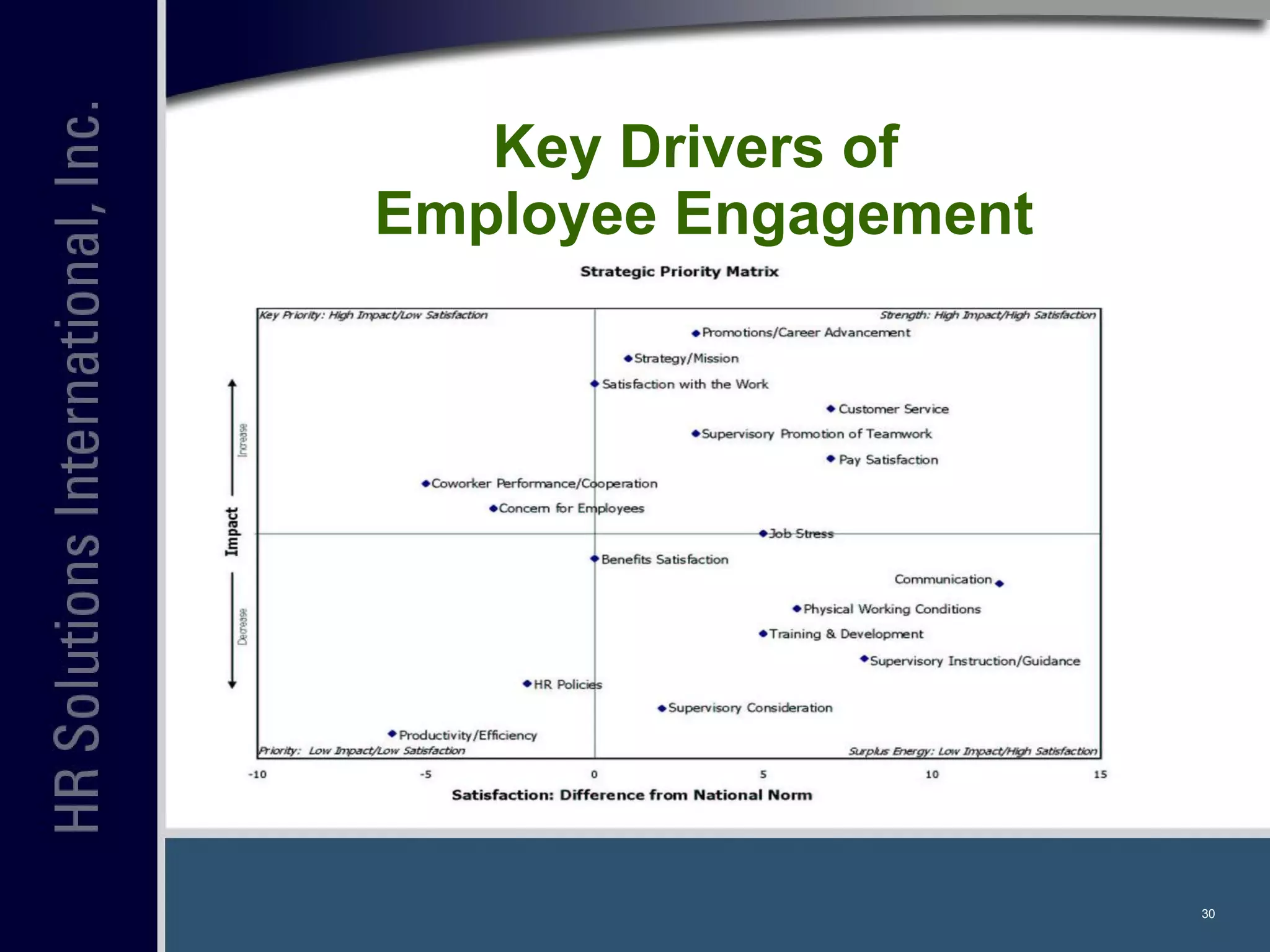
Key Drivers Promotions/Career Advancement Strategy/Mission Satisfaction with the Work Customer Service Supervisory Promotion Teamwork Pay Satisfaction Coworker Performance/Cooperation Concern for Employees Job Stress Benefits Satisfaction Top 10 Influencers on Employees’ Overall Job Satisfaction/Engagement Determination of key drivers based on survey responses in our National Normative Database, representing over  2.2 million participants and 2,100 organizations.
Key Drivers of  Employee Engagement
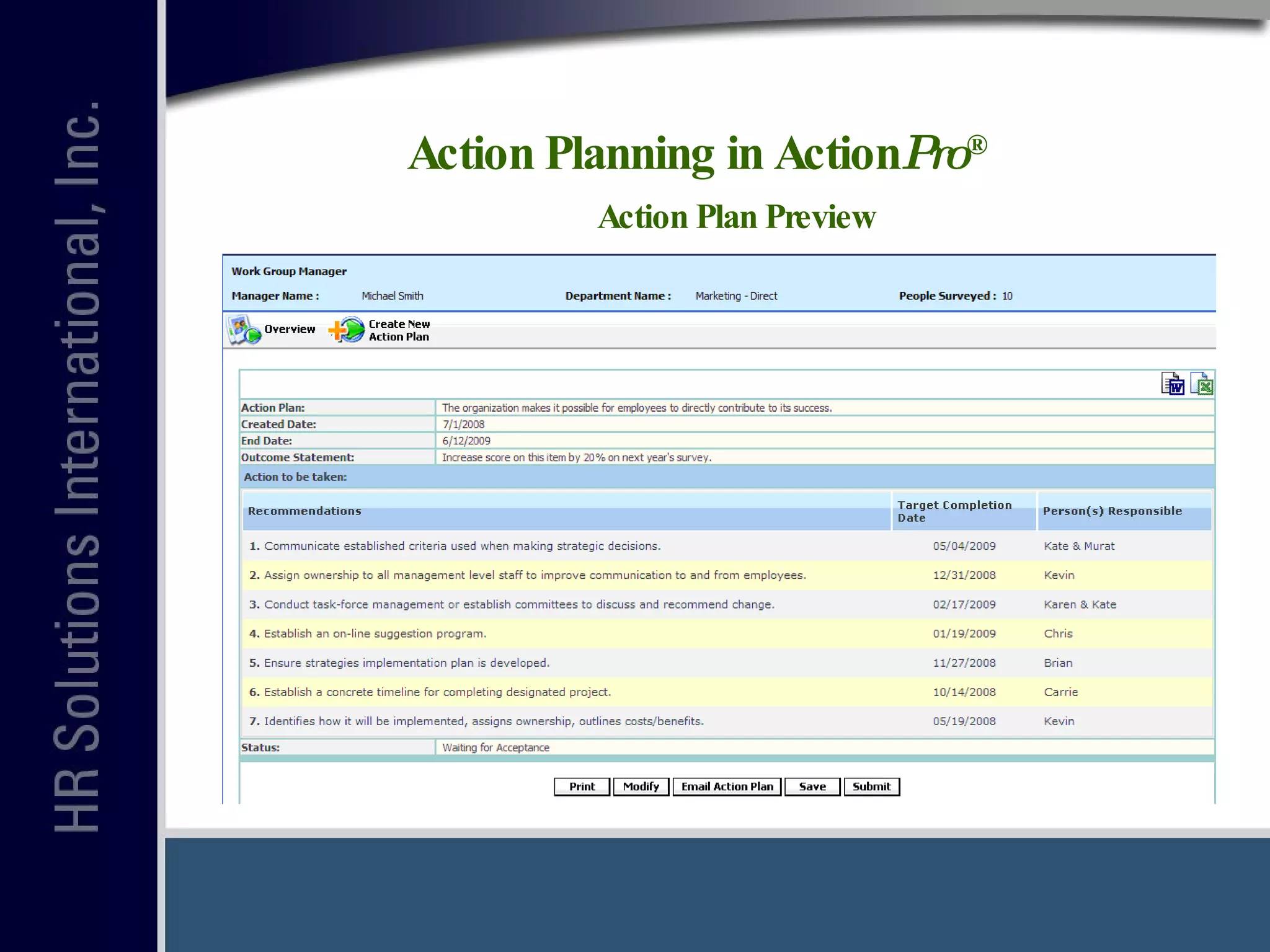
Action Planning in Action Pro ®   Action Plan Preview
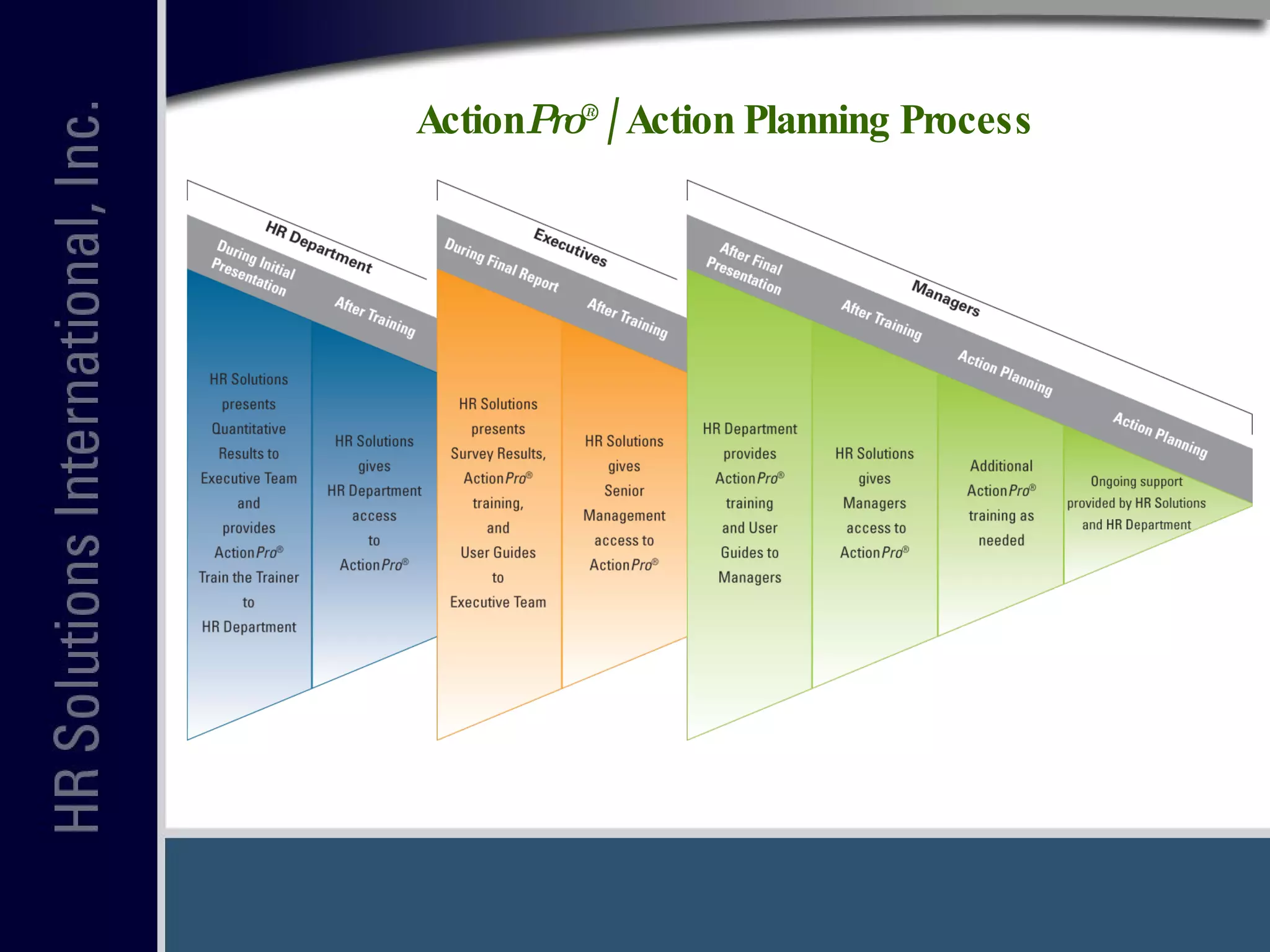
Action Pro ®  / Action Planning Process
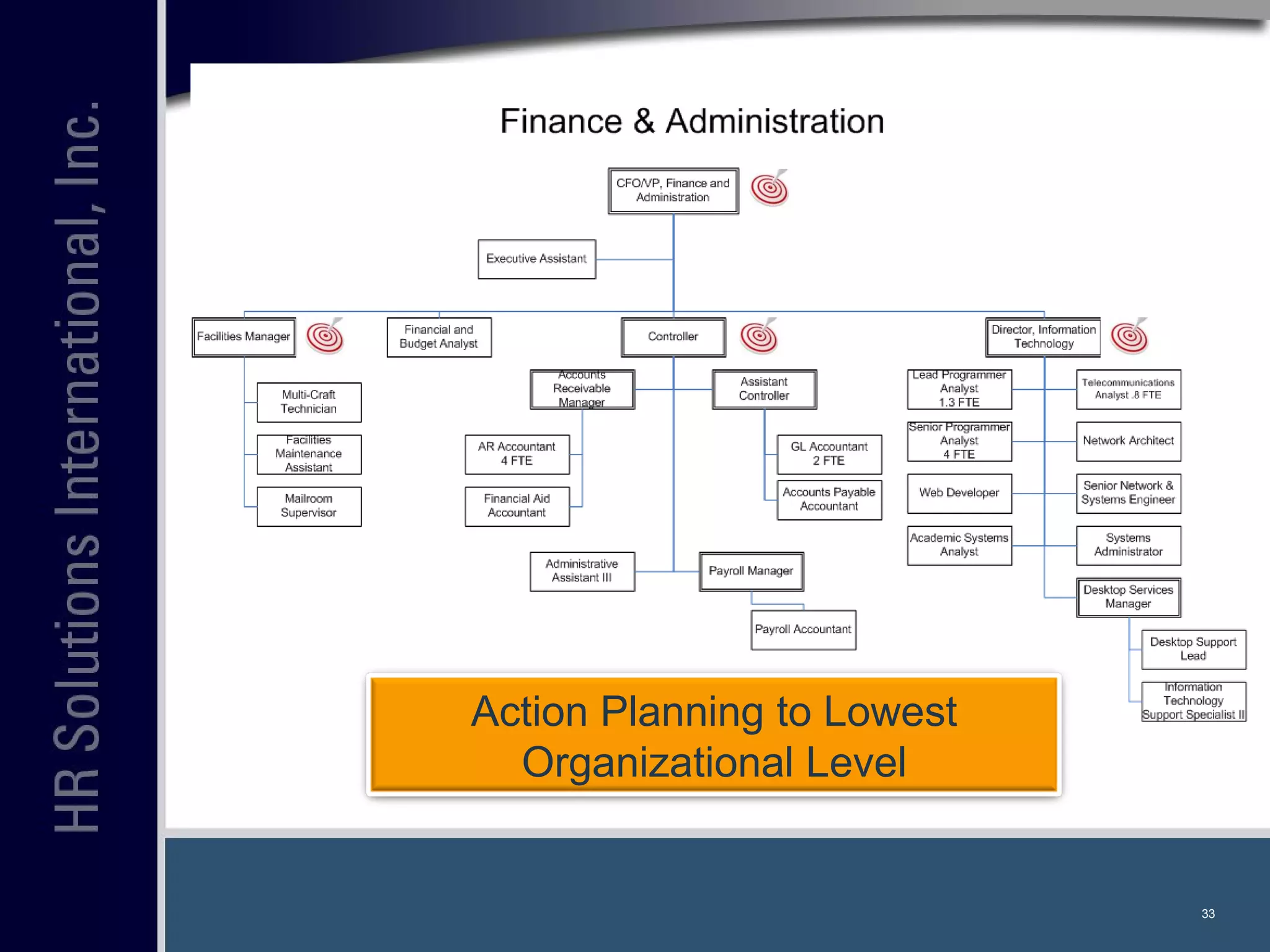
Action Planning to Lowest Organizational Level
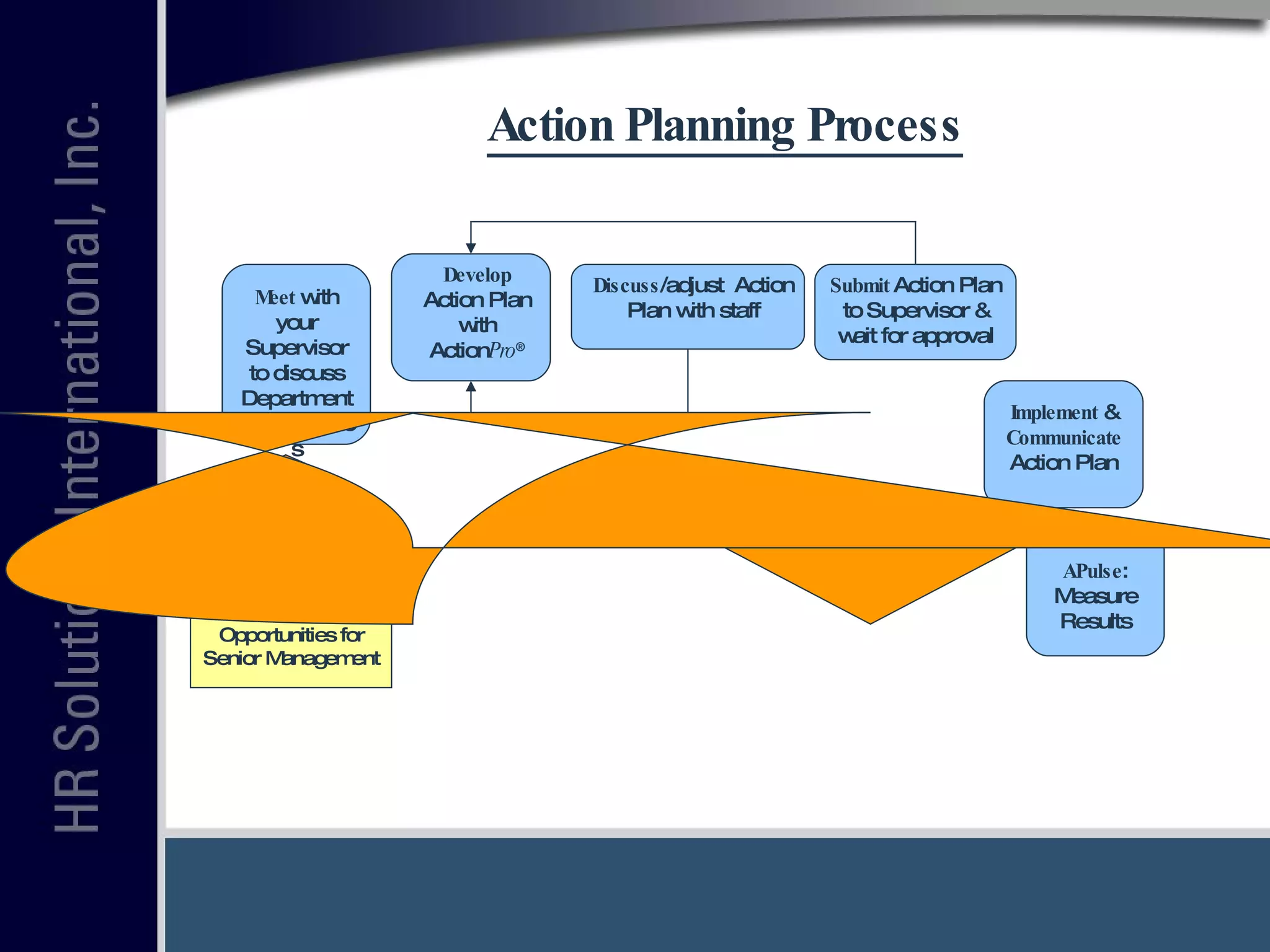
Submit  Action Plan to Supervisor & wait for approval Action Planning Process Meet  with your Supervisor to discuss Department Opportunities Global Opportunities for Senior Management Develop  Action Plan with Action Pro ® Implement  &  Communicate  Action Plan APulse : Measure Results Discuss /adjust  Action Plan with staff
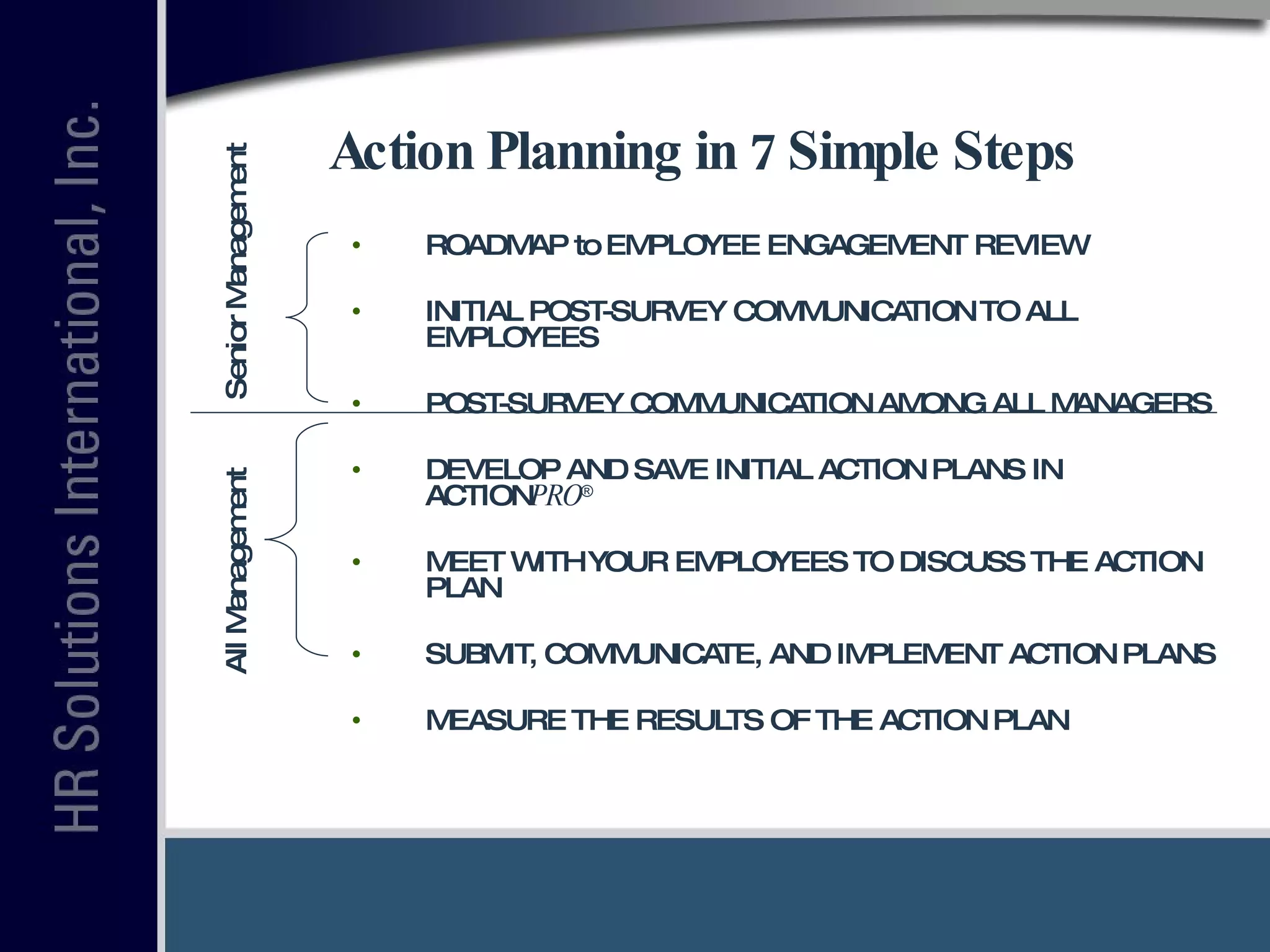
Action Planning in 7 Simple Steps ROADMAP to EMPLOYEE ENGAGEMENT REVIEW INITIAL POST-SURVEY COMMUNICATION TO ALL EMPLOYEES POST-SURVEY COMMUNICATION AMONG ALL MANAGERS DEVELOP AND SAVE INITIAL ACTION PLANS IN ACTION PRO ® MEET WITH YOUR EMPLOYEES TO DISCUSS THE ACTION PLAN SUBMIT, COMMUNICATE, AND IMPLEMENT ACTION PLANS  MEASURE THE RESULTS OF THE ACTION PLAN Senior Management All Management
THIS ONE’S FOR YOU RYAN!     Go ahead and delete!
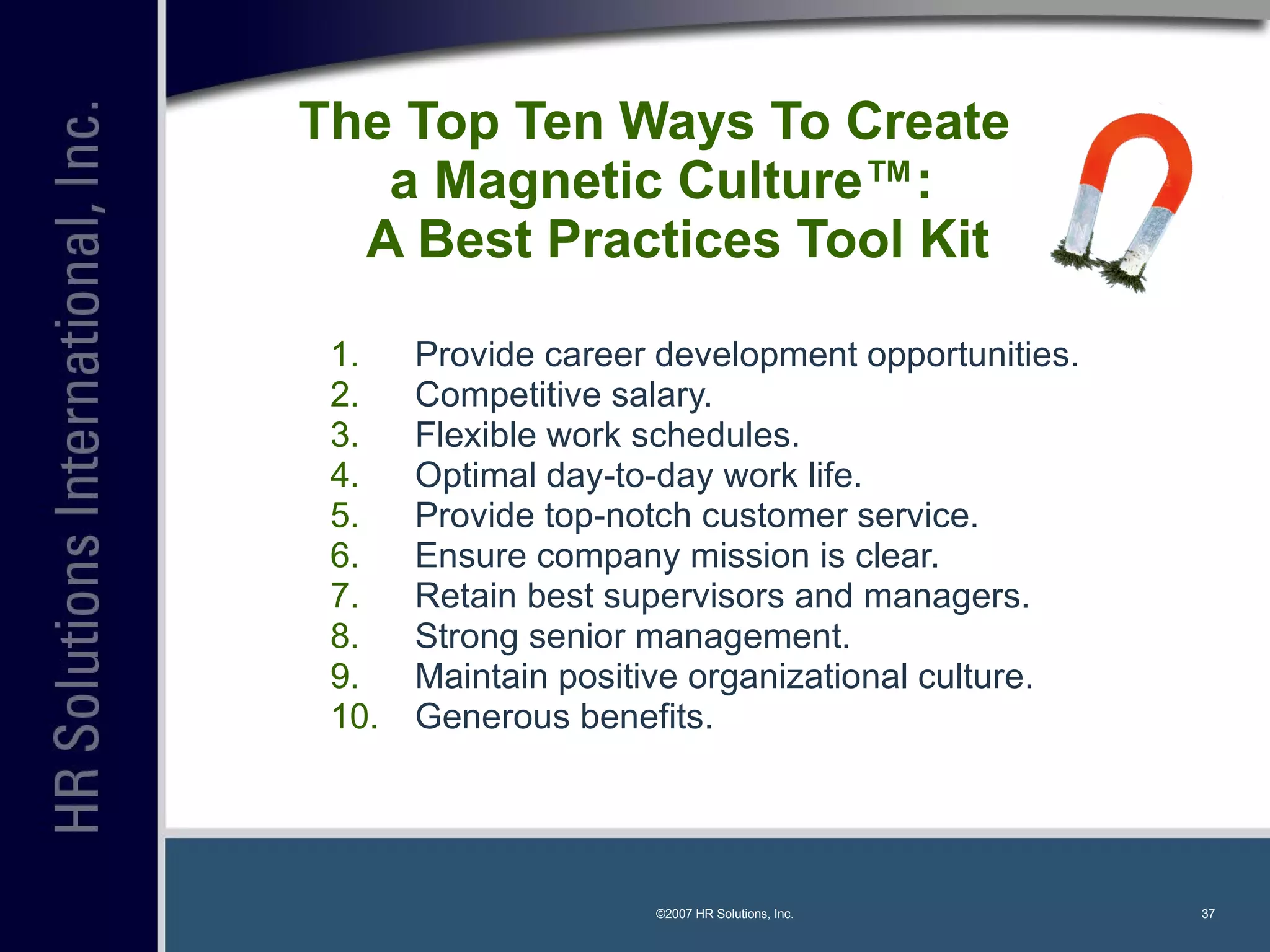
The Top Ten Ways To Create  a Magnetic Culture™:   A Best Practices Tool Kit Provide career development opportunities. Competitive salary. Flexible work schedules. Optimal day-to-day work life. Provide top-notch customer service. Ensure company mission is clear. Retain best supervisors and managers. Strong senior management. Maintain positive organizational culture. Generous benefits. ©2007 HR Solutions, Inc.
1. Career Development Opportunities. According to SHRM study*, this is the  single most important factor  to keep employees engaged. Career Planning Skill preparation Organizational political savvy. Coach with passion / Motivate employees. Ongoing educational opportunities. Mentors and Role Models. Magnetic Culture™  Best Practices Tool Kit * Source: SHRM 2006 US Job Retention Poll Findings
Magnetic Culture™  Best Practices Tool Kit 2. Competitive Salary. Better compensation elsewhere is the top reason employees chose to leave their jobs in 2006. 1 Ongoing assessment of comparable jobs/salaries is  crucial  to engagement. Learn from colleagues / competitors. Online pay comparison tools. ©2009HR Solutions, Inc. 1  2006 SHRM US Job Retention Poll Findings
Magnetic Culture™  Best Practices Tool Kit 3. Flexible Work Schedules. Alternate Arrival/Departure times. Compressed Work Week. Telecommuting. Redefine Retirement/Flexible Work Schedules - 76% of baby boomers want a gradual retirement.  (Source: Ceridian) More flextime and flexible work schedules. Part-time and job sharing. Consider shorter shifts. Working from home. Consulting (as a start). Temp work (as a start). Uniguard Insurance Group : Over 60% of its employees take part in flextime program.  Turnover decreased 5%; overtime decreased 5%.* Cubist Pharmaceuticals : Employee Opinion Survey administered by HR Solutions, Inc. in 2005. Employees responded 90% favorably to, “It is important to me that this organization consider and support flexible scheduling arrangements or flexible work options where possible.”  ©2007 HR Solutions, Inc. * Washington State University Cooperative Extension Program and the Commuter Challenge.  “Recent Case Studies.”  20 July 2006,  http://www.teleworkarizona.com/pdf/wficasestudy.pdf
4. Day-to-day work. Clear definition of employee role. Constant, relevant communication. Fairness at work. Adequate support. Variety of tasks. Easily obtainable information. Magnetic Culture™  Best Practices Tool Kit
5. Customer Service. Linkage of customer and employee satisfaction to management and employee compensation / bonuses. Norman Regional Hospital : Clear explanations to each patient of what they can expect: Estimated wait time. Where the patient will be going next. Who will take them there. What will happen once they arrive. 1 Successful Transfer of the Branding to the External Arena. Magnetic Culture™  Best Practice Tool Kit 1 Norman Regional Hospital, Creating a Magnetic Culture Customer Service Brochure 2006
6.  Clearly Communicated   Company Strategy / Mission. Host an Organizational Mission Workshop. Dispel misperceptions. Post mission statement clearly in high-traffic areas. Clear, concise, continuous communication. Employee Congress—multi-faceted communication. HR Solutions’ Best-in-Class Database: proven correlation between scores on Overall Job Satisfaction and Communication. Similar correlation with HR Solutions’ Most Improved Clients. Magnetic Culture™  Best Practices Tool Kit
Magnetic Culture™  Best Practices Tool Kit 7. Retain Best Supervisors / Managers. Accountability/Acceptance of responsibility. Imbed belief (Engagement & Diversity) at the manager level. Honesty/Trust. Timeliness of performance evaluation. Effectively communicate organizational strategy and mission. Appropriately handle conflicts. Care about employees. Clearly communicate expectations. Reduce communication gap between employees and managers.
Magnetic Culture™  Best Practices Tool Kit 7. Retain Best Supervisors / Managers (cont’d) Become educated on how to best maximize the value of mature workers Understand the generational differences in your workforce. De-bunk the myths. More seasoned workers cannot effectively use technology – inaccurate. Higher costs/more absences due to sickness and health problems – simply not true. Utilize their generational strengths to benefit the organization.
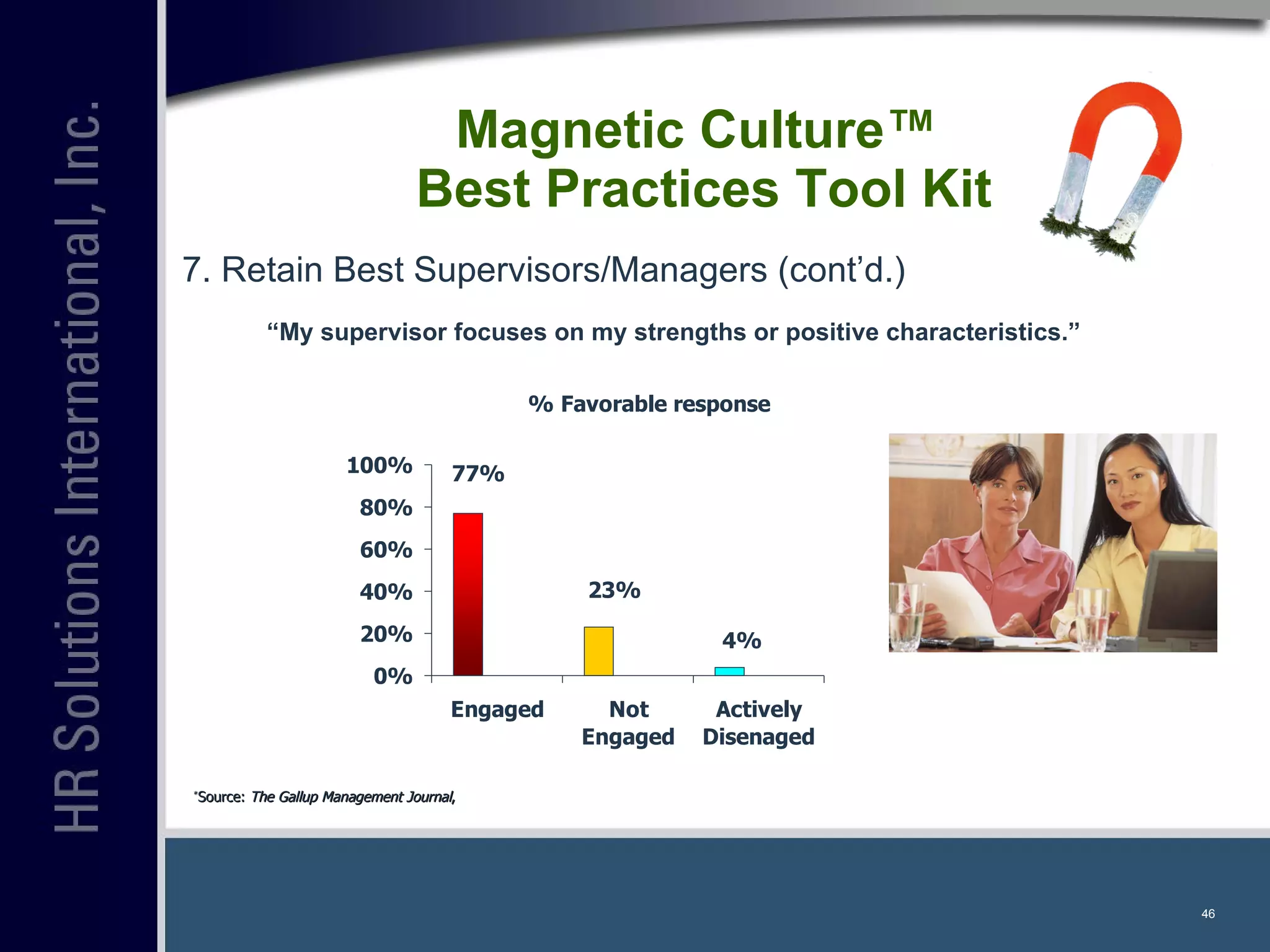
7. Retain Best Supervisors/Managers (cont’d.) “ My supervisor focuses on my strengths or positive characteristics.” Magnetic Culture™  Best Practices Tool Kit * Source:  The Gallup Management Journal ,
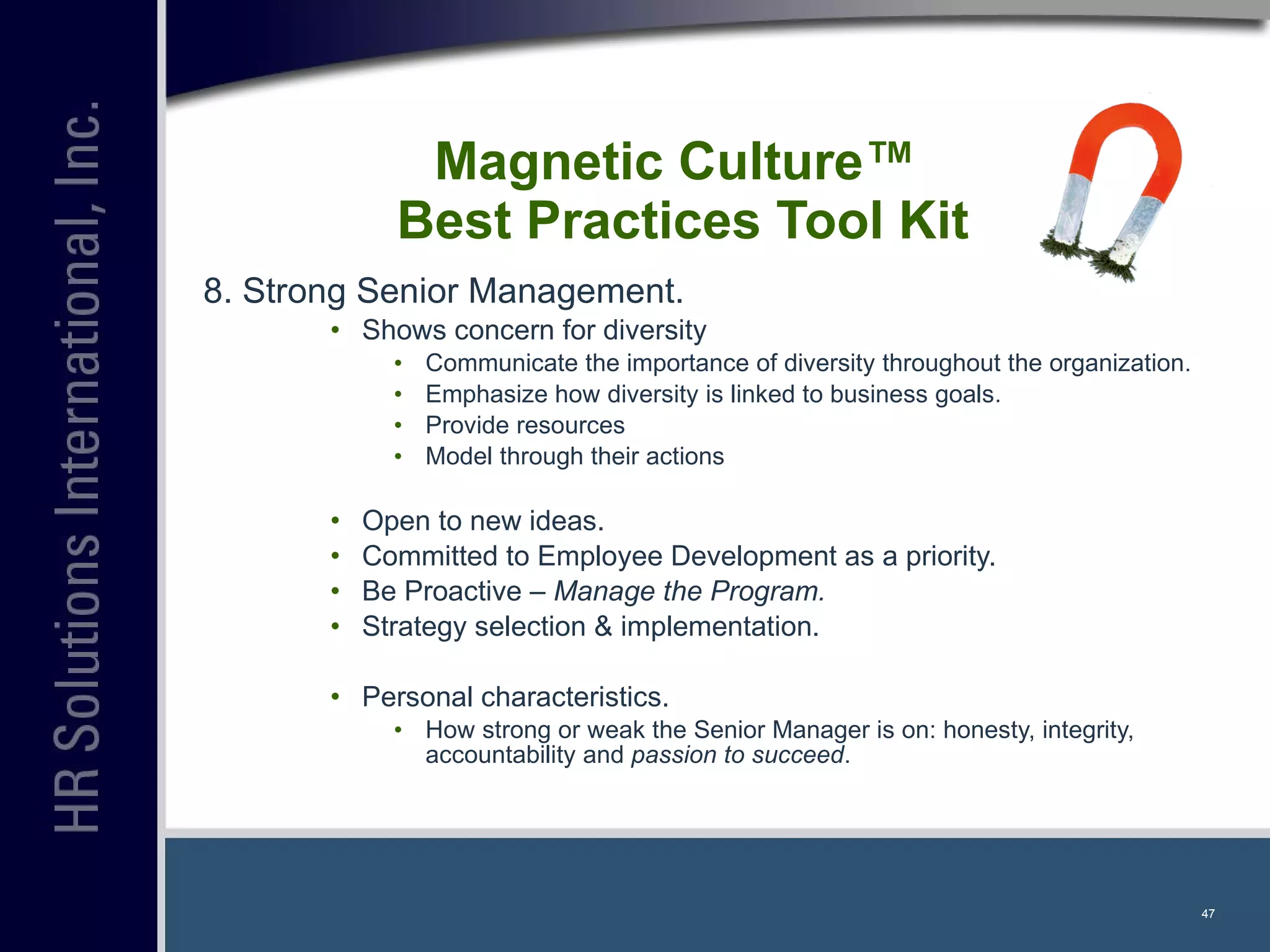
Magnetic Culture™  Best Practices Tool Kit 8. Strong Senior Management. Shows concern for diversity Communicate the importance of diversity throughout the organization. Emphasize how diversity is linked to business goals. Provide resources Model through their actions Open to new ideas. Committed to Employee Development as a priority. Be Proactive –  Manage the Program. Strategy selection & implementation. Personal characteristics. How strong or weak the Senior Manager is on: honesty, integrity, accountability and  passion to succeed .
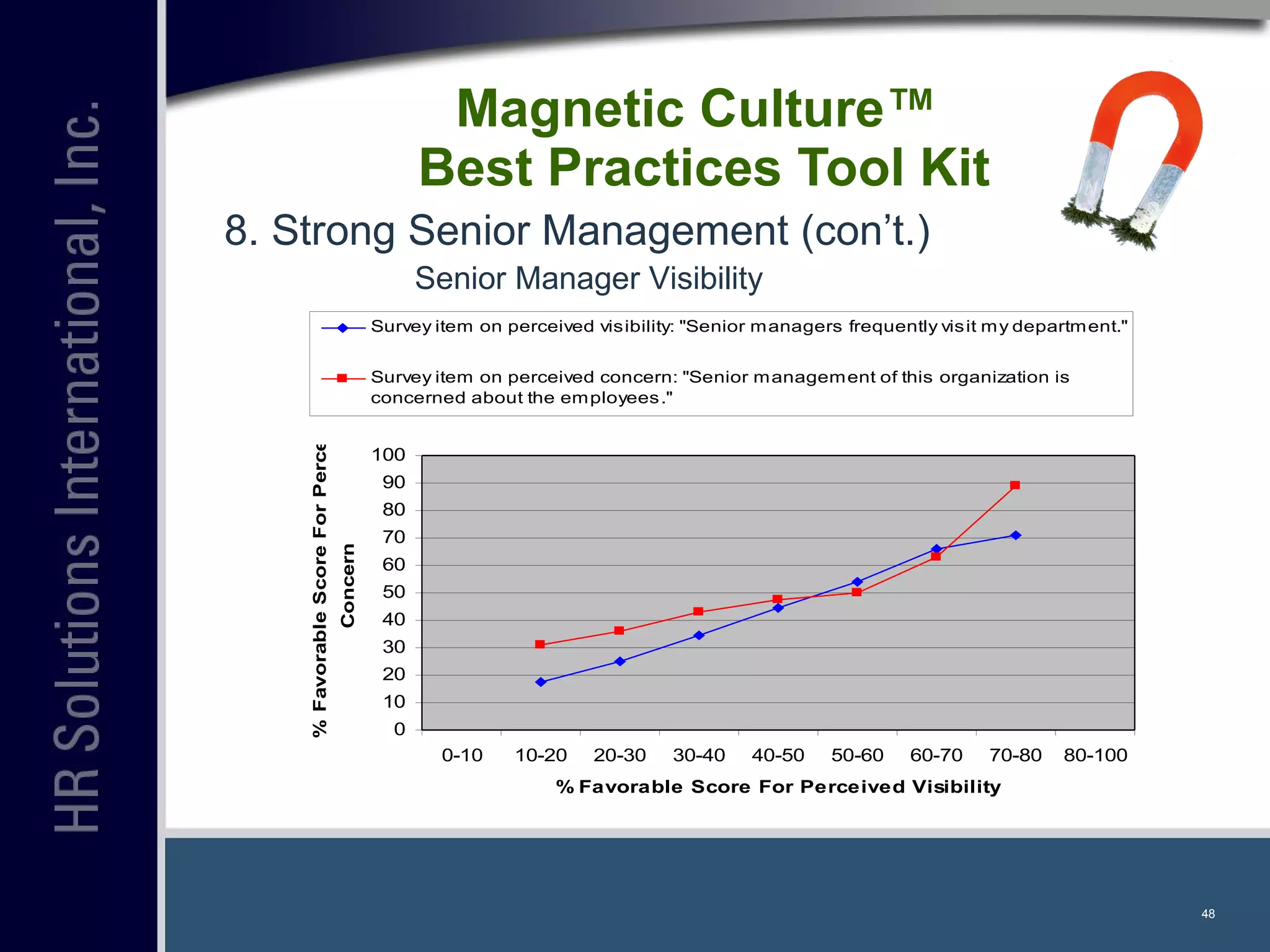
Magnetic Culture™  Best Practices Tool Kit 8. Strong Senior Management (con’t.) Senior Manager Visibility
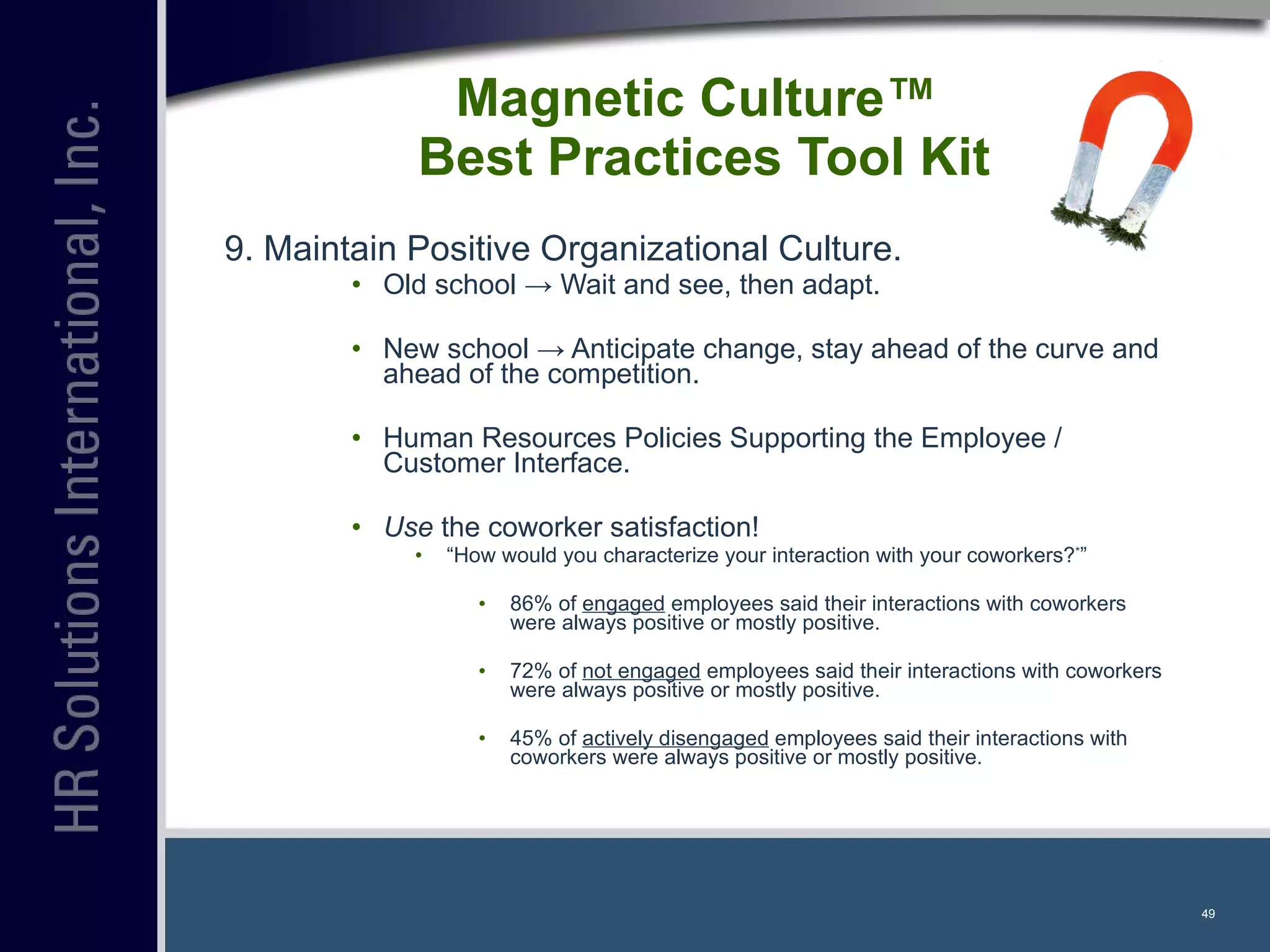
Magnetic Culture™  Best Practices Tool Kit 9. Maintain Positive Organizational Culture. Old school  -> Wait and see, then adapt. New school -> Anticipate change, stay ahead of the curve and ahead of the competition. Human Resources Policies Supporting the Employee / Customer Interface. Use  the coworker satisfaction! “ How would you characterize your interaction with your coworkers? * ” 86% of  engaged  employees said their interactions with coworkers were always positive or mostly positive. 72% of  not engaged  employees said their interactions with coworkers were always positive or mostly positive. 45% of  actively disengaged  employees said their interactions with coworkers were always positive or mostly positive.
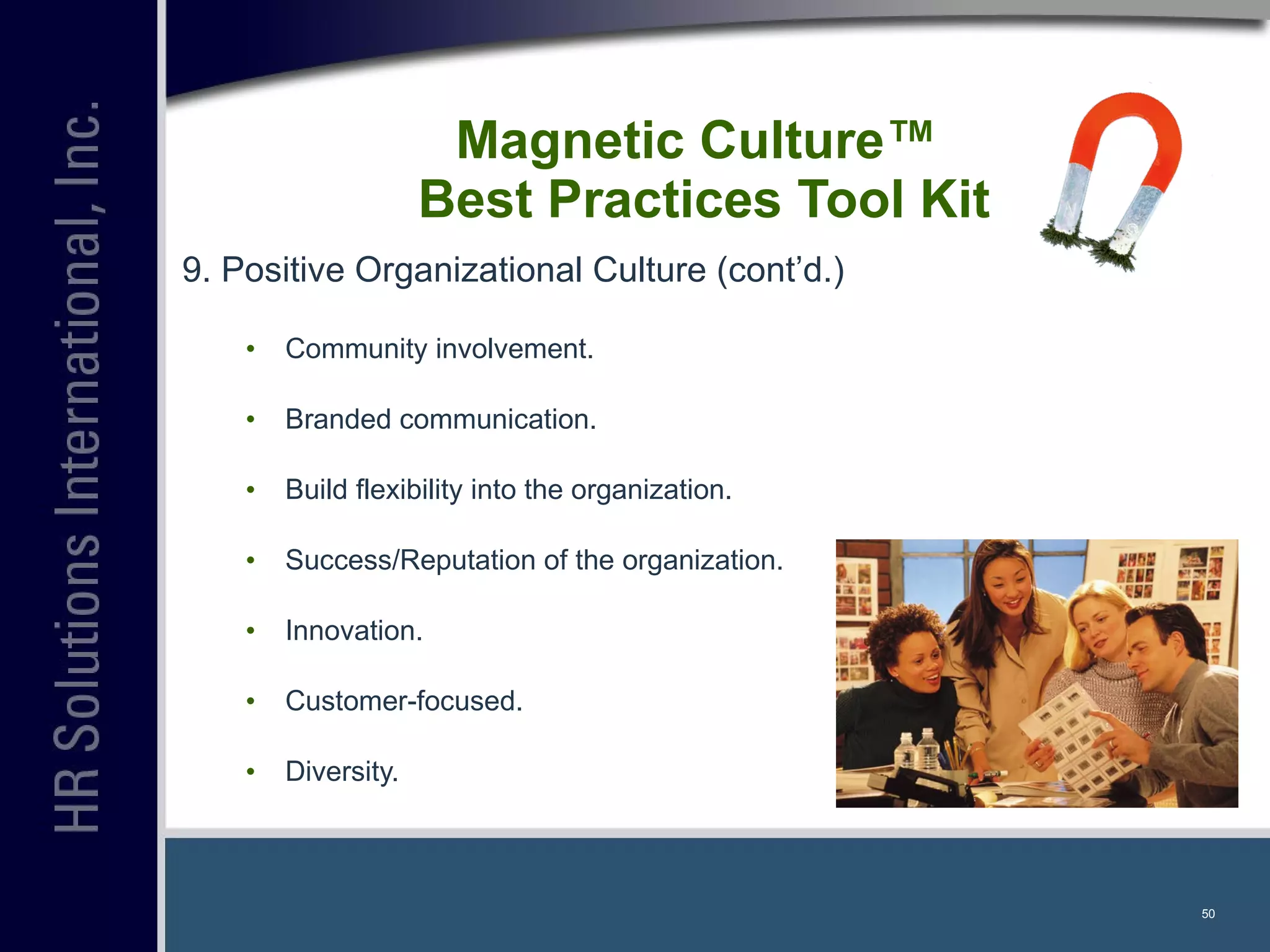
9. Positive Organizational Culture (cont’d.) Community involvement. Branded communication. Build flexibility into the organization. Success/Reputation of the organization. Innovation. Customer-focused. Diversity. Magnetic Culture™  Best Practices Tool Kit
10. Compensation Plans/Benefits Plans. Critically important tool to engagement, due to the fact that these are the most tangible job attributes. A ‘talent attractor’. Assurance of fair wage rates & rewards. Both internal & external equity. Strong impact on employees’ intent to stay versus discretionary effort. “ You can’t buy much effort.” Competitive salary for mature workers compared to younger workforce. Some organizations instituting “longevity adjustments.” Brand your benefits. Pay and rewards-related communication. Determine your goals in implementing an employee recognition program. Informal and Formal Recognition Programs. Magnetic Culture™  Best Practices Tool Kit
Key Retention Factors &  Best Practices Redesign Benefits Packages   Restructuring pension plans. Maintain full benefits for mature workers who switch to part-time. Health benefits packages to fit the age of the workers. Provide child and elder care benefits. “ Create the new labor source”; consider additional training to ease the transition to a new career for a mature worker.  Integrate diversity training with other types (e.g. employee orientation, team building, leadership, management development, performance evaluation, career development, and customer training) Consider rehiring former-employee retirees Restructure job content to deemphasize physical work and replace it with knowledge work, in order to tap into the strength and experience of mature workers.
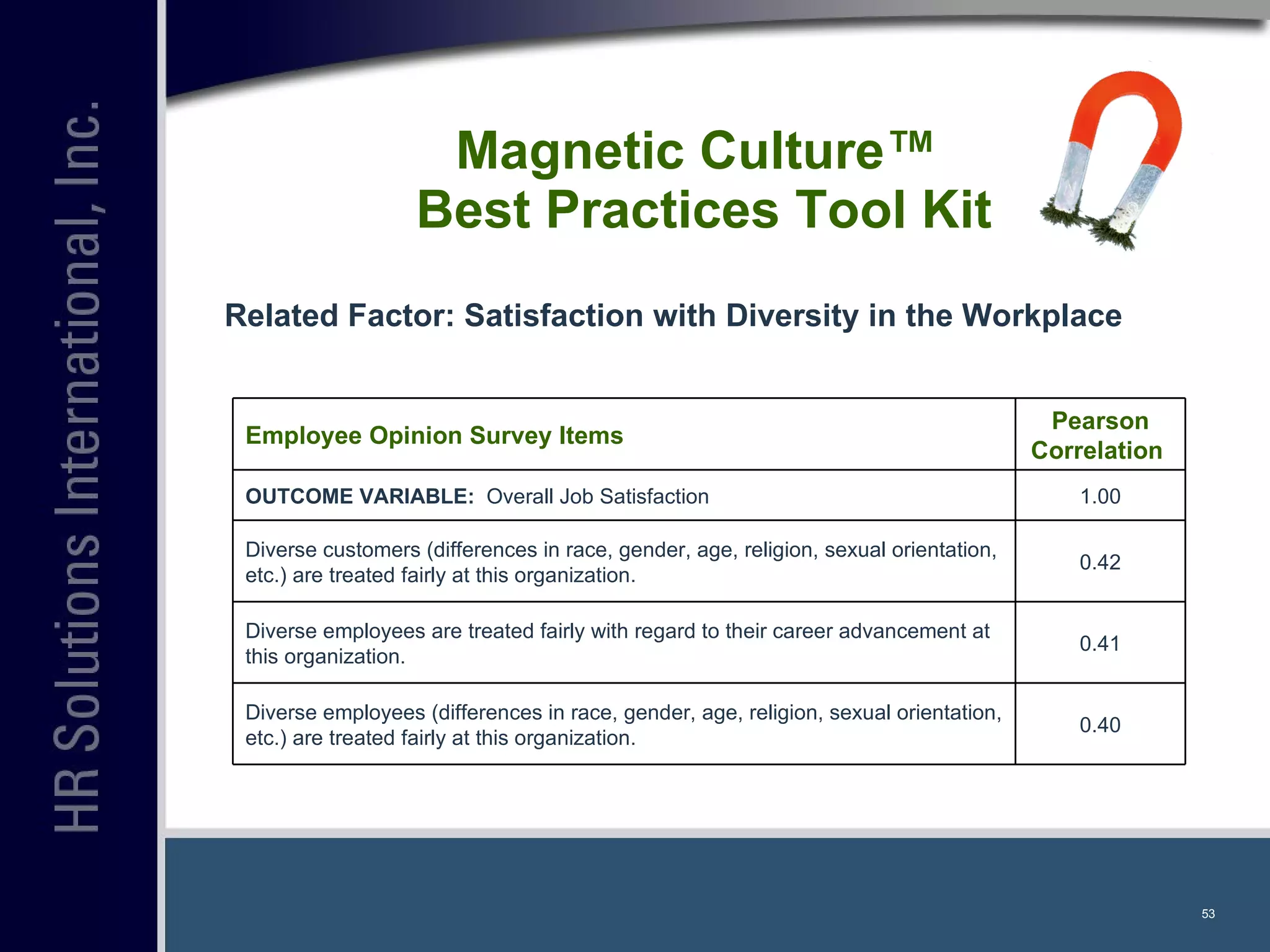
Related Factor: Satisfaction with Diversity in the Workplace Magnetic Culture™  Best Practices Tool Kit Employee Opinion Survey Items Pearson Correlation  OUTCOME VARIABLE:   Overall Job Satisfaction 1.00 Diverse customers (differences in race, gender, age, religion, sexual orientation, etc.) are treated fairly at this organization. 0.42 Diverse employees are treated fairly with regard to their career advancement at this organization. 0.41 Diverse employees (differences in race, gender, age, religion, sexual orientation, etc.) are treated fairly at this organization. 0.40
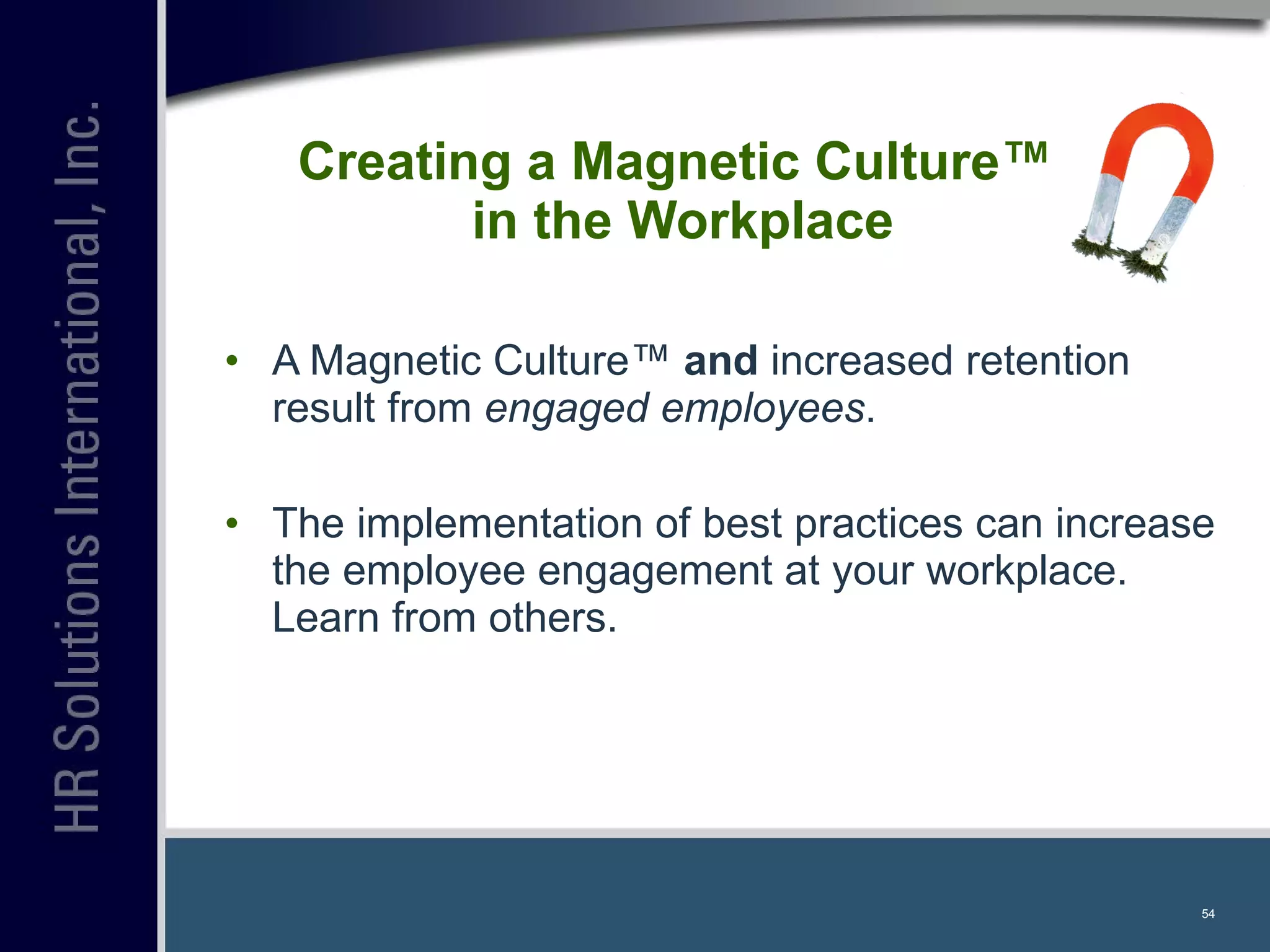
Creating a Magnetic Culture™  in the Workplace A Magnetic Culture™  and  increased retention result from  engaged employees . The implementation of best practices can increase the employee engagement at your workplace.  Learn from others.
Employee Engagement & Diversity Satisfaction
Creating a Magnetic Culture™  in the Workplace The kind of commitment I find among the best performers across virtually every field is a single-minded passion for what they do, an unwavering desire for excellence in the way they think and the way they work. Genuine confidence is what launches you out of bed in the morning, and through your day with a spring in your step. Jim Collins   Source:  Good to Great: Why Some Companies Make the Leap... and Others Don't , Page: 87
Questions / Comments  October 2, 2007 Thank You!

Managing a MultiGenerational Workforce

  • 1.
    HR Solutions, Inc.and City University of Seattle Presents The Linkage Between Employee Engagement, Diversity & Satisfaction 71 st NWHRA Annual Conference and Trade Show Murat Philippe Principal Consultant October 2, 2009 Timothy Sprake HR Director
  • 2.
    Workshop Learning ObjectivesUnderstand the importance and strategic impact of conducting an internal analysis of employee engagement that establishes the foundation for change to a culture where employees are genuinely engaged in the success of the organizations they support. Explore the different measurements of employee engagement and why these measures are more effective at achieving organizational success. Understand that an engagement survey is only one of the tools available that help organizations identify the need for change and improvement. More importantly participants will understand that an organizations willingness and ability to actively pursue their current reality on multiple fronts and through multiple methods is the primary path to improvement and ultimately greatness. Learn about the generational differences in workplace concerns that impact Employee Engagement levels. (This will have be done by HR Solutions). Understand the importance of communications and taking action once survey results are available. An awareness of the key principles of change management and their critical importance will be provided. Implement action plans to assure success of any change initiative and in particular one that impacts the organizations most important asset is its employees and their level of engagement.
  • 3.
    What is a Magnetic Culture™ in the Workplace? Redefining Employee Satisfaction Defining Employee Engagement. Outcomes Driven by Employee Engagement. The Numbers Behind the Story of Engagement & Diversity. Key Drivers. The Top Ten Tool Kit.
  • 4.
    Satisfaction versus Engagement “ What do I get” Employees more focused on Pay Satisfaction, Benefits Satisfaction, Physical Working Conditions, and other factors that satisfy. “ What you give back” Employees more emotional, feeling of ownership, involvement in their job, passion, safe culture, and having meaning and purpose as an employee.
  • 5.
    What is a Magnetic Culture™ in the Workplace? A Magnetic Culture™ is one that draws talented employees to the workplace, and sustains an environment in which they are less likely to leave. It is marked by engaged employees who share a strong desire to be part of the value that the organization creates.
  • 6.
    Defining EmployeeEngagement Engaged Employees are: Motivated. Committed. Very involved in their work. An inspiration for others. Supportive of co-workers. Oriented to providing good customer service. Loyal. Optimistic about their work goals.
  • 7.
    Outcomes Influenced By Employee Engagement The following business outcomes result from successful implementation of Employee Engagement programs: Top Employer Ranking. Stellar Productivity and Financial Success. Outstanding Performance from Employees. A Magnetic Culture™ is established at your organization.
  • 8.
    Outcomes Influenced By Employee Engagement Reputation Customer Satisfaction Absenteeism Retention Employee Engagement
  • 9.
    Employee Engagement – The Numbers Behind the Story Three Types of Employees 1 : ENGAGED Highly engaged and committed to the mission, vision and values of the organization. AMBIVALENT They are “checked out”, lack of spirit and vivacity, they feel unappreciated and insignificant. ACTIVELY DISENGAGED Negative energy, they focus on problems. 1 Source: HR Solutions National Study
  • 10.
    Employee Engagement – The Numbers Behind the Story Percentage of Engaged Employees in the workplace 1 : 1 Source: HR Solutions National Study
  • 11.
    Estimated costs ofturnover in the United States economy: $5 trillion per year 1 . The cost of disengagement: $300 billion 2 . 1 Frank, F.D., Finnegan, R. P., & Taylor, C.R. (2004) The Race for talent: Retaining and engaging workers in the 21 st century. 2 Getting Engaged by Steve Bates, HR Magazine Feb 2004 Employee Engagement – The Numbers Behind the Story
  • 12.
    Gender Quiz Myjob gives me the opportunity to do the things I do best. This organization provides me the opportunity to improve my professional knowledge. Senior Management of this organization is concerned about the employees. I have an opportunity to participate in decisions made by my supervisor that affect my work environment. All in all, I am satisfied with my job.
  • 13.
    Changing Priorities AgeGroup Importance (6=Most Important)
  • 14.
    Employee Engagement &Diversity Satisfaction % Favorable
  • 15.
    Employee Engagement – The Numbers Behind the Story Mature Generation—A Different Perspective on Work. 47% increase in age 55+ workers by 2010 1 . 80% of Baby Boomers plan to work at least part-time during retirement 1 . 69% of age 45+ plan to work “well beyond age 65” 2 . Characteristics 3 Trust for authority; optimal in hierarchical structure. Compliant to organizational practices/policies. Team players. Long tenure at single company. Different appreciation characteristics: Value benefits programs, role within the organization, and recognition. Less value assigned to pay levels (not pay fairness). The older generation “lives to work” whereas the younger population “works to live.” 1 Source AARP, 2 Source J. Walter Thompson, 2004 3 Source – The Concours Group
  • 16.
    Connecting the GenerationsSource: Willa Starks, Parkview Health: The Cross Generational Workplace Veteran Baby Boomers Generation Xers Generation Y Millenials Outlook Practical Optimistic Skeptical Hopeful Work Ethic Dedicated Driven Balanced Ambitious View of Authority Respectful Love/hate Unimpressed Relaxed, polite Leadership by Hierarchy Consensus Competence Collaboration Relationships Personal Sacrifice Personal gratification Reluctant to commit Loyal Perspective Civic Team Self Civic Influencing Messages Make do or do without Stay in line Sacrifice Be heroic Consider the common good Be anything you want Change the world Work well with others Live up to expectation Duck and cover Don’t count on it Remember – heroes…aren’t Get real Survive – stayin’ alive Ask “why?” Be smart– you are special Leave no one behind Connect 24/7 Achieve now! Serve your community
  • 17.
    Generational Retention FactorsSource: Willa Starks, Parkview Health: The Cross Generational Workplace Veterans Baby Boomers Generation Xers Generation Y Millenials Clear direction Professional standing/job status Stability and security Recognition Company reputation Collaboration Flexibility Development Fun Work & life balance Positive environment Recognition
  • 18.
    Generational Communication PreferencesSource: Willa Starks, Parkview Health: The Cross Generational Workplace Veterans Baby Boomers Generation Xers Generation Y Millenials Logical, linear History, tradition Long term goals Good grammar Conservative Personable Two-way Vision, mission Making a difference Information = reward Direct, straightforward No buzzwords Results-oriented Include benefits Electronic Positive Collaborative Motivational Coach to goals Digital
  • 19.
    Generational Communication Turn-OffsSource: Willa Starks, Parkview Health: The Cross Generational Workplace Veterans Baby Boomers Generation Xers Generation Y Millenials Profanity Slang Disorganization Disrespect for experience Brusqueness Not showing interest One-upmanship Politically incorrectness Schmoozing Using time poorly Flashiness Corporate-speak Incompetence Bureaucracy Cynicism Sarcasm Unfairness Condescension
  • 20.
  • 21.
    Six Item Highlightsfrom Data Analysis There is good communication between members of my work group. (80% Favorable, Education Norm: 67, National Norm: 68, BIC Norm: 80) My supervisor is friendly and helpful. (83% Favorable, Education Norm: 79, National Norm: 78, BIC Norm: 87) The person/persons doing my performance appraisal is/are aware of my work . (75% Favorable, National Norm: 69, BIC Norm: 79) My immediate manager’s actions are consistent with what she/she communicates. (74% Favorable, National Norm: 69, BIC Norm: 78) I can explain the organization’s strategy/mission to my family, friends and coworkers. (76% Favorable, National Norm: 69, BIC Norm: 84) I feel free to express new ideas and work methods which I feel will help this organization . (67% Favorable, National Norm: 55, BIC Norm: 81) BIC – Best in Class
  • 22.
    CityU of Seattle’sEmployee Engagement Levels A Magnetic Culture™ is one that draws talented employees to the workplace, empowers them, and sustains an environment in which they are less likely to leave. It is marked by engaged employees who share a strong desire to be part of the value that the organization creates.
  • 23.
    Percent Favorable Best-in-Class– 90 th Percentile in our database. Three Dimension Opportunities from Data Analysis
  • 24.
    Ancillary Highlights Inaddition, when closing each feedback session, the facilitator made a point to ask what employees liked most about their jobs and working at CityUniversity of Seattle. The most frequent responses included the following types of comments: Coworkers Benefits Empowerment President Variety of work Flexibility Supervisors Friendly and challenging environment
  • 25.
  • 26.
  • 27.
  • 28.
    Training and Development Feedback sessions included the following types of comments: “ There is no training or development. Orientation to company is great. You learn about the benefits. The training is fine when you first come here. There are people here that help you out. Once you are trained that is it. It is pretty much it.” Nine agreed. “ I don’t feel organization is committed to Training & Development. I got some in my own department; but there is no institutional commitment to it.” [10 of 11 Managers agreed] Job-role specific department training IT Training, Seminars, MS Excel training, Phone etiquette/ transferring phone calls. SharePoint Leadership Development. How to hold people accountable. How to deal with underperformers.
  • 29.
    Key Drivers Promotions/CareerAdvancement Strategy/Mission Satisfaction with the Work Customer Service Supervisory Promotion Teamwork Pay Satisfaction Coworker Performance/Cooperation Concern for Employees Job Stress Benefits Satisfaction Top 10 Influencers on Employees’ Overall Job Satisfaction/Engagement Determination of key drivers based on survey responses in our National Normative Database, representing over 2.2 million participants and 2,100 organizations.
  • 30.
    Key Drivers of Employee Engagement
  • 31.
    Action Planning inAction Pro ® Action Plan Preview
  • 32.
    Action Pro ® / Action Planning Process
  • 33.
    Action Planning toLowest Organizational Level
  • 34.
    Submit ActionPlan to Supervisor & wait for approval Action Planning Process Meet with your Supervisor to discuss Department Opportunities Global Opportunities for Senior Management Develop Action Plan with Action Pro ® Implement & Communicate Action Plan APulse : Measure Results Discuss /adjust Action Plan with staff
  • 35.
    Action Planning in7 Simple Steps ROADMAP to EMPLOYEE ENGAGEMENT REVIEW INITIAL POST-SURVEY COMMUNICATION TO ALL EMPLOYEES POST-SURVEY COMMUNICATION AMONG ALL MANAGERS DEVELOP AND SAVE INITIAL ACTION PLANS IN ACTION PRO ® MEET WITH YOUR EMPLOYEES TO DISCUSS THE ACTION PLAN SUBMIT, COMMUNICATE, AND IMPLEMENT ACTION PLANS MEASURE THE RESULTS OF THE ACTION PLAN Senior Management All Management
  • 36.
    THIS ONE’S FORYOU RYAN!  Go ahead and delete!
  • 37.
    The Top TenWays To Create a Magnetic Culture™: A Best Practices Tool Kit Provide career development opportunities. Competitive salary. Flexible work schedules. Optimal day-to-day work life. Provide top-notch customer service. Ensure company mission is clear. Retain best supervisors and managers. Strong senior management. Maintain positive organizational culture. Generous benefits. ©2007 HR Solutions, Inc.
  • 38.
    1. Career DevelopmentOpportunities. According to SHRM study*, this is the single most important factor to keep employees engaged. Career Planning Skill preparation Organizational political savvy. Coach with passion / Motivate employees. Ongoing educational opportunities. Mentors and Role Models. Magnetic Culture™ Best Practices Tool Kit * Source: SHRM 2006 US Job Retention Poll Findings
  • 39.
    Magnetic Culture™ Best Practices Tool Kit 2. Competitive Salary. Better compensation elsewhere is the top reason employees chose to leave their jobs in 2006. 1 Ongoing assessment of comparable jobs/salaries is crucial to engagement. Learn from colleagues / competitors. Online pay comparison tools. ©2009HR Solutions, Inc. 1 2006 SHRM US Job Retention Poll Findings
  • 40.
    Magnetic Culture™ Best Practices Tool Kit 3. Flexible Work Schedules. Alternate Arrival/Departure times. Compressed Work Week. Telecommuting. Redefine Retirement/Flexible Work Schedules - 76% of baby boomers want a gradual retirement. (Source: Ceridian) More flextime and flexible work schedules. Part-time and job sharing. Consider shorter shifts. Working from home. Consulting (as a start). Temp work (as a start). Uniguard Insurance Group : Over 60% of its employees take part in flextime program. Turnover decreased 5%; overtime decreased 5%.* Cubist Pharmaceuticals : Employee Opinion Survey administered by HR Solutions, Inc. in 2005. Employees responded 90% favorably to, “It is important to me that this organization consider and support flexible scheduling arrangements or flexible work options where possible.” ©2007 HR Solutions, Inc. * Washington State University Cooperative Extension Program and the Commuter Challenge. “Recent Case Studies.” 20 July 2006, http://www.teleworkarizona.com/pdf/wficasestudy.pdf
  • 41.
    4. Day-to-day work.Clear definition of employee role. Constant, relevant communication. Fairness at work. Adequate support. Variety of tasks. Easily obtainable information. Magnetic Culture™ Best Practices Tool Kit
  • 42.
    5. Customer Service.Linkage of customer and employee satisfaction to management and employee compensation / bonuses. Norman Regional Hospital : Clear explanations to each patient of what they can expect: Estimated wait time. Where the patient will be going next. Who will take them there. What will happen once they arrive. 1 Successful Transfer of the Branding to the External Arena. Magnetic Culture™ Best Practice Tool Kit 1 Norman Regional Hospital, Creating a Magnetic Culture Customer Service Brochure 2006
  • 43.
    6. ClearlyCommunicated Company Strategy / Mission. Host an Organizational Mission Workshop. Dispel misperceptions. Post mission statement clearly in high-traffic areas. Clear, concise, continuous communication. Employee Congress—multi-faceted communication. HR Solutions’ Best-in-Class Database: proven correlation between scores on Overall Job Satisfaction and Communication. Similar correlation with HR Solutions’ Most Improved Clients. Magnetic Culture™ Best Practices Tool Kit
  • 44.
    Magnetic Culture™ Best Practices Tool Kit 7. Retain Best Supervisors / Managers. Accountability/Acceptance of responsibility. Imbed belief (Engagement & Diversity) at the manager level. Honesty/Trust. Timeliness of performance evaluation. Effectively communicate organizational strategy and mission. Appropriately handle conflicts. Care about employees. Clearly communicate expectations. Reduce communication gap between employees and managers.
  • 45.
    Magnetic Culture™ Best Practices Tool Kit 7. Retain Best Supervisors / Managers (cont’d) Become educated on how to best maximize the value of mature workers Understand the generational differences in your workforce. De-bunk the myths. More seasoned workers cannot effectively use technology – inaccurate. Higher costs/more absences due to sickness and health problems – simply not true. Utilize their generational strengths to benefit the organization.
  • 46.
    7. Retain BestSupervisors/Managers (cont’d.) “ My supervisor focuses on my strengths or positive characteristics.” Magnetic Culture™ Best Practices Tool Kit * Source: The Gallup Management Journal ,
  • 47.
    Magnetic Culture™ Best Practices Tool Kit 8. Strong Senior Management. Shows concern for diversity Communicate the importance of diversity throughout the organization. Emphasize how diversity is linked to business goals. Provide resources Model through their actions Open to new ideas. Committed to Employee Development as a priority. Be Proactive – Manage the Program. Strategy selection & implementation. Personal characteristics. How strong or weak the Senior Manager is on: honesty, integrity, accountability and passion to succeed .
  • 48.
    Magnetic Culture™ Best Practices Tool Kit 8. Strong Senior Management (con’t.) Senior Manager Visibility
  • 49.
    Magnetic Culture™ Best Practices Tool Kit 9. Maintain Positive Organizational Culture. Old school -> Wait and see, then adapt. New school -> Anticipate change, stay ahead of the curve and ahead of the competition. Human Resources Policies Supporting the Employee / Customer Interface. Use the coworker satisfaction! “ How would you characterize your interaction with your coworkers? * ” 86% of engaged employees said their interactions with coworkers were always positive or mostly positive. 72% of not engaged employees said their interactions with coworkers were always positive or mostly positive. 45% of actively disengaged employees said their interactions with coworkers were always positive or mostly positive.
  • 50.
    9. Positive OrganizationalCulture (cont’d.) Community involvement. Branded communication. Build flexibility into the organization. Success/Reputation of the organization. Innovation. Customer-focused. Diversity. Magnetic Culture™ Best Practices Tool Kit
  • 51.
    10. Compensation Plans/BenefitsPlans. Critically important tool to engagement, due to the fact that these are the most tangible job attributes. A ‘talent attractor’. Assurance of fair wage rates & rewards. Both internal & external equity. Strong impact on employees’ intent to stay versus discretionary effort. “ You can’t buy much effort.” Competitive salary for mature workers compared to younger workforce. Some organizations instituting “longevity adjustments.” Brand your benefits. Pay and rewards-related communication. Determine your goals in implementing an employee recognition program. Informal and Formal Recognition Programs. Magnetic Culture™ Best Practices Tool Kit
  • 52.
    Key Retention Factors& Best Practices Redesign Benefits Packages Restructuring pension plans. Maintain full benefits for mature workers who switch to part-time. Health benefits packages to fit the age of the workers. Provide child and elder care benefits. “ Create the new labor source”; consider additional training to ease the transition to a new career for a mature worker. Integrate diversity training with other types (e.g. employee orientation, team building, leadership, management development, performance evaluation, career development, and customer training) Consider rehiring former-employee retirees Restructure job content to deemphasize physical work and replace it with knowledge work, in order to tap into the strength and experience of mature workers.
  • 53.
    Related Factor: Satisfactionwith Diversity in the Workplace Magnetic Culture™ Best Practices Tool Kit Employee Opinion Survey Items Pearson Correlation OUTCOME VARIABLE: Overall Job Satisfaction 1.00 Diverse customers (differences in race, gender, age, religion, sexual orientation, etc.) are treated fairly at this organization. 0.42 Diverse employees are treated fairly with regard to their career advancement at this organization. 0.41 Diverse employees (differences in race, gender, age, religion, sexual orientation, etc.) are treated fairly at this organization. 0.40
  • 54.
    Creating a MagneticCulture™ in the Workplace A Magnetic Culture™ and increased retention result from engaged employees . The implementation of best practices can increase the employee engagement at your workplace. Learn from others.
  • 55.
    Employee Engagement &Diversity Satisfaction
  • 56.
    Creating a MagneticCulture™ in the Workplace The kind of commitment I find among the best performers across virtually every field is a single-minded passion for what they do, an unwavering desire for excellence in the way they think and the way they work. Genuine confidence is what launches you out of bed in the morning, and through your day with a spring in your step. Jim Collins Source: Good to Great: Why Some Companies Make the Leap... and Others Don't , Page: 87
  • 57.
    Questions / Comments October 2, 2007 Thank You!

Editor's Notes

  • #15 “ Brushing off the importance of workplace diversity is a thing of the past; this study provides ground-breaking evidence that diversity satisfaction is a key component of employee satisfaction.” -Kevin Sheridan
  • #22 BIC = Best in Class