Boeing Leading the Way
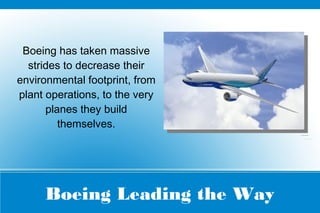
Boeing has taken massive
strides to decrease their
environmental footprint, from
plant operations, to the very
planes they build
themselves.
Plant Operations
Changes and improvements Boeing has made
to improve their overall environmental footprint
within their factories.
Plant Operations
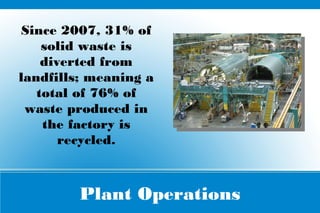
Since 2007, 31% of
solid waste is
diverted from
landfills; meaning a
total of 76% of
waste produced in
the factory is
recycled.
Plant Operations
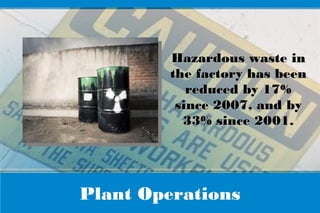
Hazardous waste inHazardous waste in
the factory has beenthe factory has been
reduced by 17%reduced by 17%
since 2007, and bysince 2007, and by
33% since 2001.33% since 2001.
Plant Operations
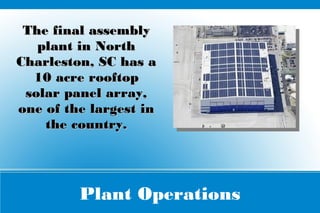
The final assemblyThe final assembly
plant in Northplant in North
Charleston, SC has aCharleston, SC has a
10 acre rooftop10 acre rooftop
solar panel array,solar panel array,
one of the largest inone of the largest in
the country.the country.
Plant Operations
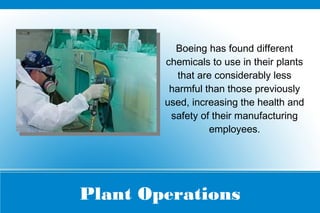
Boeing has found different
chemicals to use in their plants
that are considerably less
harmful than those previously
used, increasing the health and
safety of their manufacturing
employees.
Plant Operations
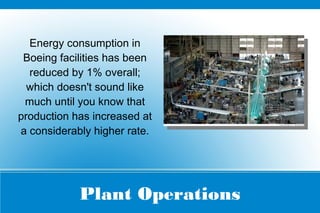
Energy consumption in
Boeing facilities has been
reduced by 1% overall;
which doesn't sound like
much until you know that
production has increased at
a considerably higher rate.
The Boeing Product
“At Boeing, we are focused on creating cleaner,
more efficient flight. Each new generation of
products we bring to the marketplace is quieter,
consumes less fuel and is better for the
environment.”
-Jim McNerney. President and CEO of Boeing
The Boeing Product
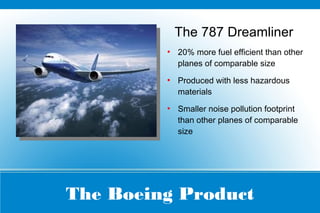
The 787 Dreamliner
●
20% more fuel efficient than other
planes of comparable size
●
Produced with less hazardous
materials
●
Smaller noise pollution footprint
than other planes of comparable
size
The Boeing Product
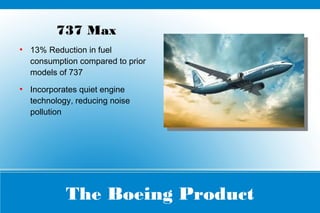
737 Max
●
13% Reduction in fuel
consumption compared to prior
models of 737
●
Incorporates quiet engine
technology, reducing noise
pollution
The Boeing Product
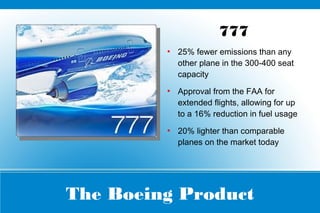
777
●
25% fewer emissions than any
other plane in the 300-400 seat
capacity
●
Approval from the FAA for
extended flights, allowing for up
to a 16% reduction in fuel usage
●
20% lighter than comparable
planes on the market today
The Boeing Product
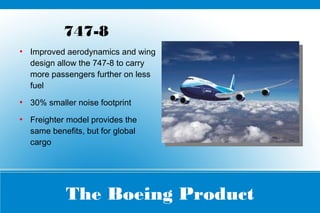
747-8
●
Improved aerodynamics and wing
design allow the 747-8 to carry
more passengers further on less
fuel
●
30% smaller noise footprint
●
Freighter model provides the
same benefits, but for global
cargo
The Boeing Product
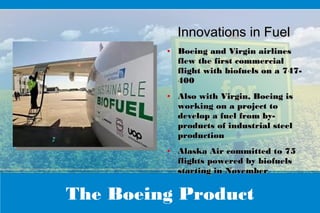
Innovations in FuelInnovations in Fuel
●
Boeing and Virgin airlinesBoeing and Virgin airlines
flew the first commercialflew the first commercial
flight with biofuels on a 747-flight with biofuels on a 747-
400400
●
Also with Virgin, Boeing isAlso with Virgin, Boeing is
working on a project toworking on a project to
develop a fuel from by-develop a fuel from by-
products of industrial steelproducts of industrial steel
productionproduction
●
Alaska Air committed to 75Alaska Air committed to 75
flights powered by biofuelsflights powered by biofuels
starting in Novemberstarting in November
Innovations for the Future
“The work that we have done to date
is the foundation for the extensive
efforts that lie ahead.”
-Jim McNerney, President and CEO of Boeing
Innovations for the Future
SpectroLab
Purchased by Boeing in 2000,
SpectroLab is the world's
leading manufacturer of solar
cells and panels, able to turn
40% of the sunlight captured
into electricity – better than any
other company.
Innovations for the Future
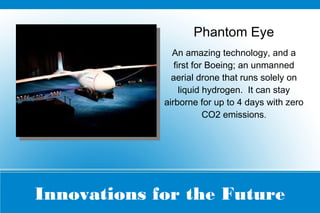
Phantom Eye
An amazing technology, and a
first for Boeing; an unmanned
aerial drone that runs solely on
liquid hydrogen. It can stay
airborne for up to 4 days with zero
CO2 emissions.
Innovations for the Future
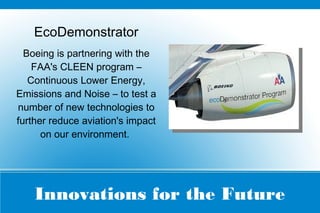
EcoDemonstrator
Boeing is partnering with the
FAA's CLEEN program –
Continuous Lower Energy,
Emissions and Noise – to test a
number of new technologies to
further reduce aviation's impact
on our environment.
Innovations for the Future
Boeing is leading the way toward an
environmentally sustainable aviation industry,
working in all areas to decrease their footprint
and increase efficiency. The future looks very
clean indeed thanks to the strides this company
has made, and continues to make every day.

Boeing Presentation

  • 1.
    Boeing Leading theWay Boeing has taken massive strides to decrease their environmental footprint, from plant operations, to the very planes they build themselves.
  • 2.
    Plant Operations Changes andimprovements Boeing has made to improve their overall environmental footprint within their factories.
  • 3.
    Plant Operations Since 2007,31% of solid waste is diverted from landfills; meaning a total of 76% of waste produced in the factory is recycled.
  • 4.
    Plant Operations Hazardous wasteinHazardous waste in the factory has beenthe factory has been reduced by 17%reduced by 17% since 2007, and bysince 2007, and by 33% since 2001.33% since 2001.
  • 5.
    Plant Operations The finalassemblyThe final assembly plant in Northplant in North Charleston, SC has aCharleston, SC has a 10 acre rooftop10 acre rooftop solar panel array,solar panel array, one of the largest inone of the largest in the country.the country.
  • 6.
    Plant Operations Boeing hasfound different chemicals to use in their plants that are considerably less harmful than those previously used, increasing the health and safety of their manufacturing employees.
  • 7.
    Plant Operations Energy consumptionin Boeing facilities has been reduced by 1% overall; which doesn't sound like much until you know that production has increased at a considerably higher rate.
  • 8.
    The Boeing Product “AtBoeing, we are focused on creating cleaner, more efficient flight. Each new generation of products we bring to the marketplace is quieter, consumes less fuel and is better for the environment.” -Jim McNerney. President and CEO of Boeing
  • 9.
    The Boeing Product The787 Dreamliner ● 20% more fuel efficient than other planes of comparable size ● Produced with less hazardous materials ● Smaller noise pollution footprint than other planes of comparable size
  • 10.
    The Boeing Product 737Max ● 13% Reduction in fuel consumption compared to prior models of 737 ● Incorporates quiet engine technology, reducing noise pollution
  • 11.
    The Boeing Product 777 ● 25%fewer emissions than any other plane in the 300-400 seat capacity ● Approval from the FAA for extended flights, allowing for up to a 16% reduction in fuel usage ● 20% lighter than comparable planes on the market today
  • 12.
    The Boeing Product 747-8 ● Improvedaerodynamics and wing design allow the 747-8 to carry more passengers further on less fuel ● 30% smaller noise footprint ● Freighter model provides the same benefits, but for global cargo
  • 13.
    The Boeing Product Innovationsin FuelInnovations in Fuel ● Boeing and Virgin airlinesBoeing and Virgin airlines flew the first commercialflew the first commercial flight with biofuels on a 747-flight with biofuels on a 747- 400400 ● Also with Virgin, Boeing isAlso with Virgin, Boeing is working on a project toworking on a project to develop a fuel from by-develop a fuel from by- products of industrial steelproducts of industrial steel productionproduction ● Alaska Air committed to 75Alaska Air committed to 75 flights powered by biofuelsflights powered by biofuels starting in Novemberstarting in November
  • 14.
    Innovations for theFuture “The work that we have done to date is the foundation for the extensive efforts that lie ahead.” -Jim McNerney, President and CEO of Boeing
  • 15.
    Innovations for theFuture SpectroLab Purchased by Boeing in 2000, SpectroLab is the world's leading manufacturer of solar cells and panels, able to turn 40% of the sunlight captured into electricity – better than any other company.
  • 16.
    Innovations for theFuture Phantom Eye An amazing technology, and a first for Boeing; an unmanned aerial drone that runs solely on liquid hydrogen. It can stay airborne for up to 4 days with zero CO2 emissions.
  • 17.
    Innovations for theFuture EcoDemonstrator Boeing is partnering with the FAA's CLEEN program – Continuous Lower Energy, Emissions and Noise – to test a number of new technologies to further reduce aviation's impact on our environment.
  • 18.
    Innovations for theFuture Boeing is leading the way toward an environmentally sustainable aviation industry, working in all areas to decrease their footprint and increase efficiency. The future looks very clean indeed thanks to the strides this company has made, and continues to make every day.