Project Management
(Secret: You are a project manager)
STUFF TO REMEMBER
         (HEY YOU! PAY ATTENTION!)


Scope, Timeline and Budget are critical to
understanding the structure of a project.

The 4D Model for project management is a
dependable way to structure a project.
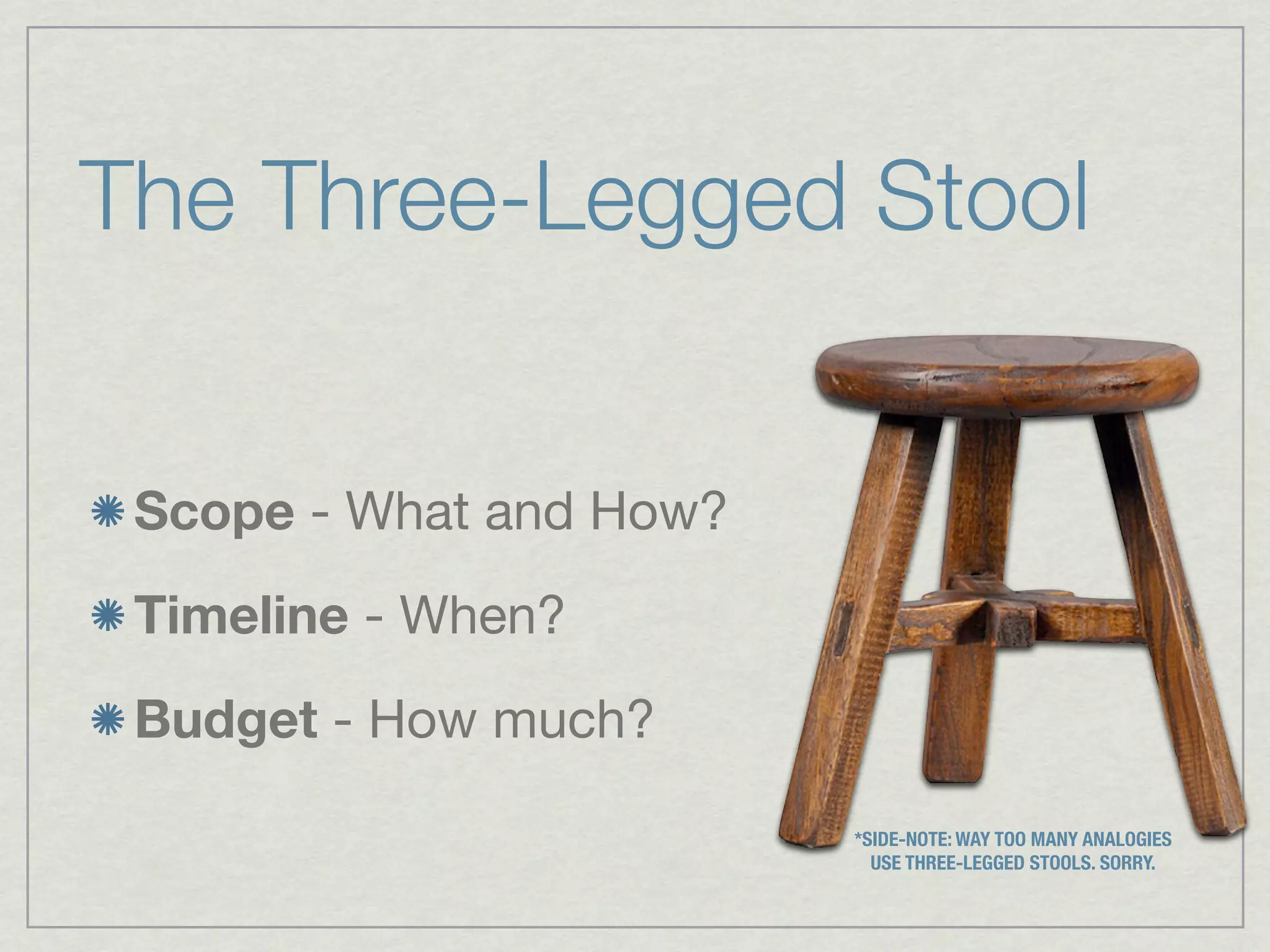
The Three-Legged Stool


 Scope - What and How?
 Timeline - When?
 Budget - How much?

                         *SIDE-NOTE: WAY TOO MANY ANALOGIES
                           USE THREE-LEGGED STOOLS. SORRY.
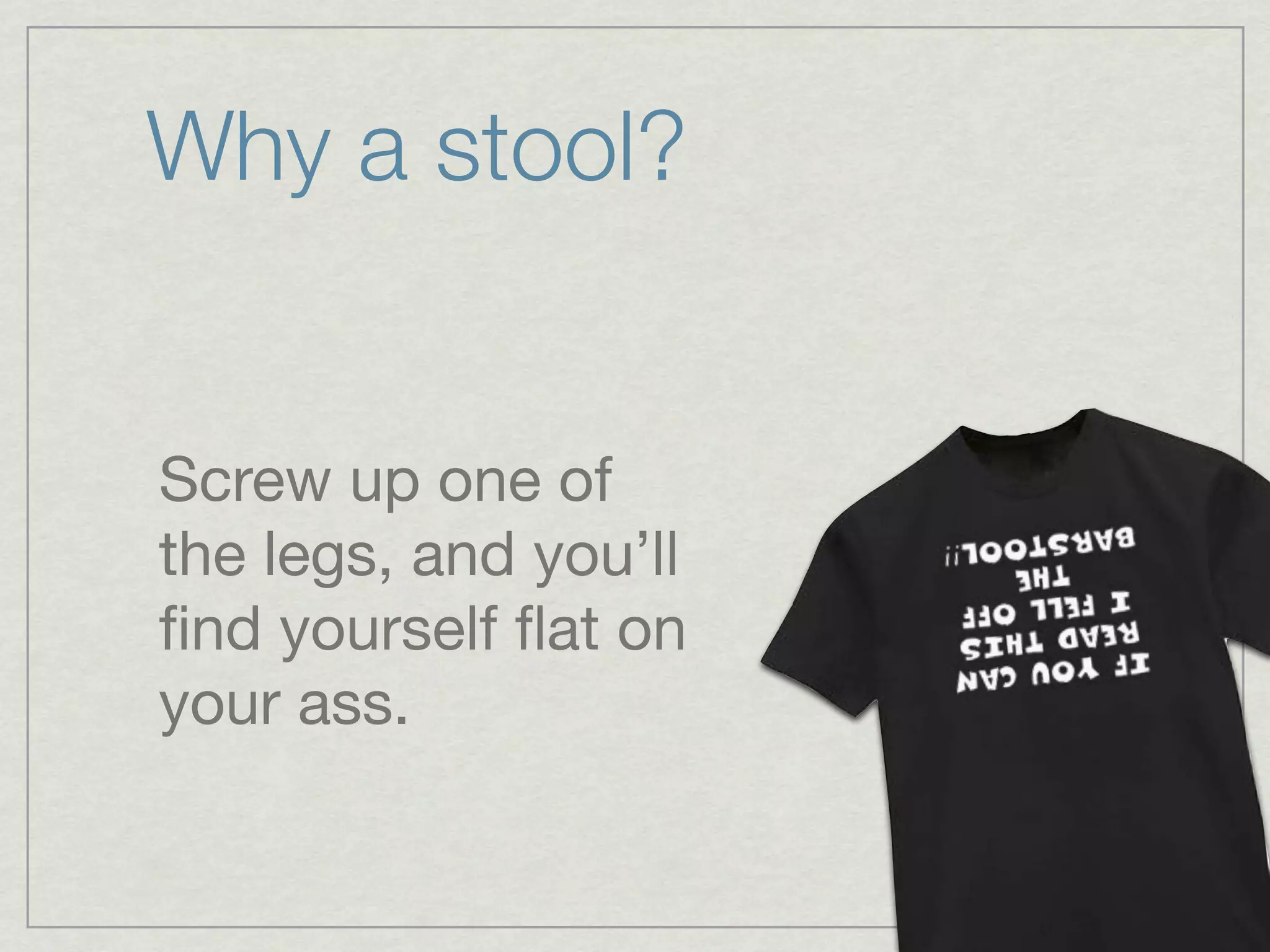
Why a stool?


Screw up one of
the legs, and you’ll
find yourself flat on
your ass.
Scope


Parameters / expectations

Criteria for success
                                  REAL MEN USE
                               COOLMINT LISTERINE®
Dividing line for priorities
Timeline
Good: Beginning
to deadline

Better:
Milestones with
deliverables

Best: Account for
outside factors,
have buffer
Budget
It can refer to $$

Everything has a “cost”

No budget is truly
unlimited
Status Updates
 Made Easy
What has changed?

Was there a corresponding
change to scope, timeline or
budget?

How can we fix what’s
busted?

What are our next steps?
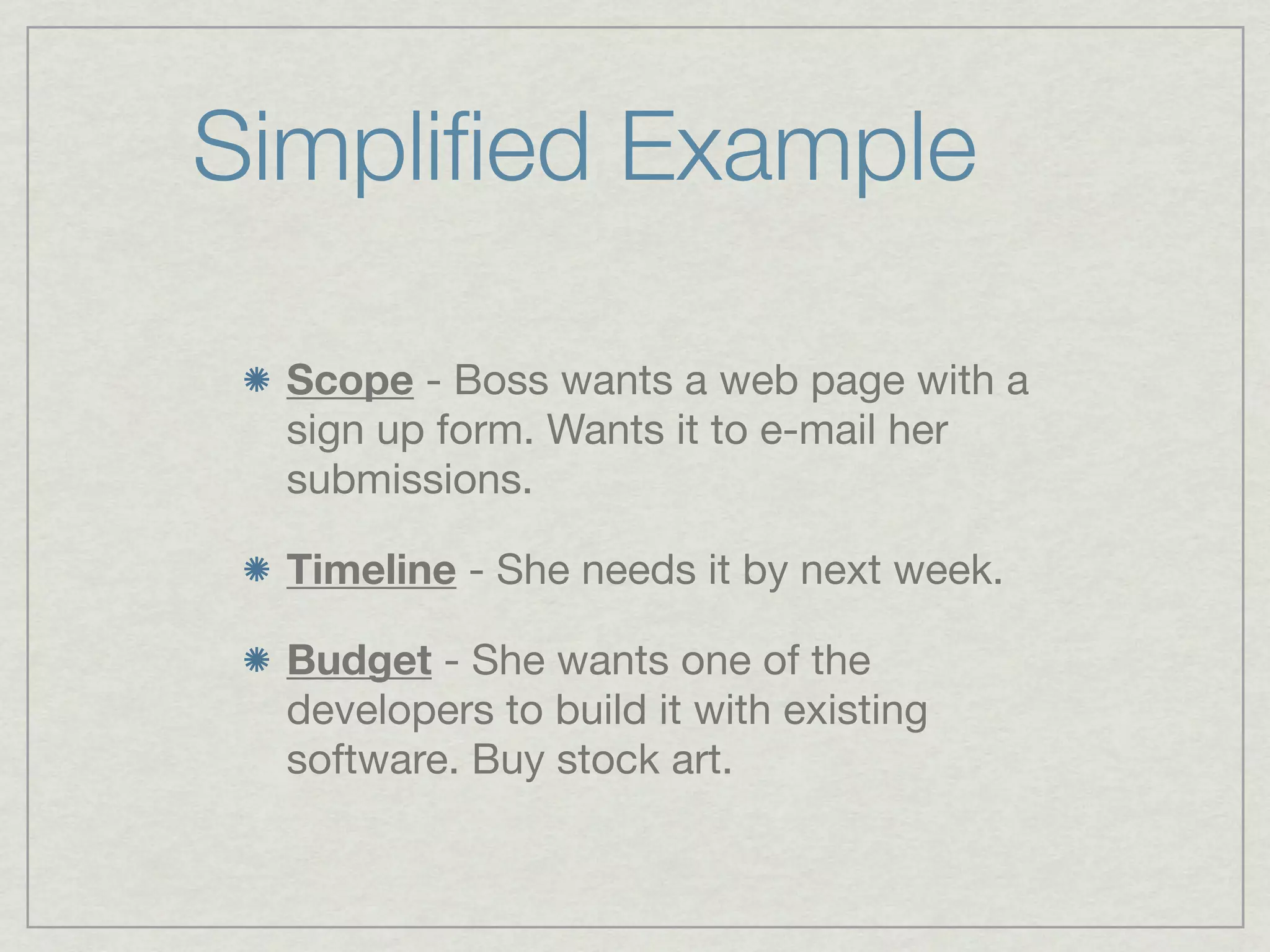
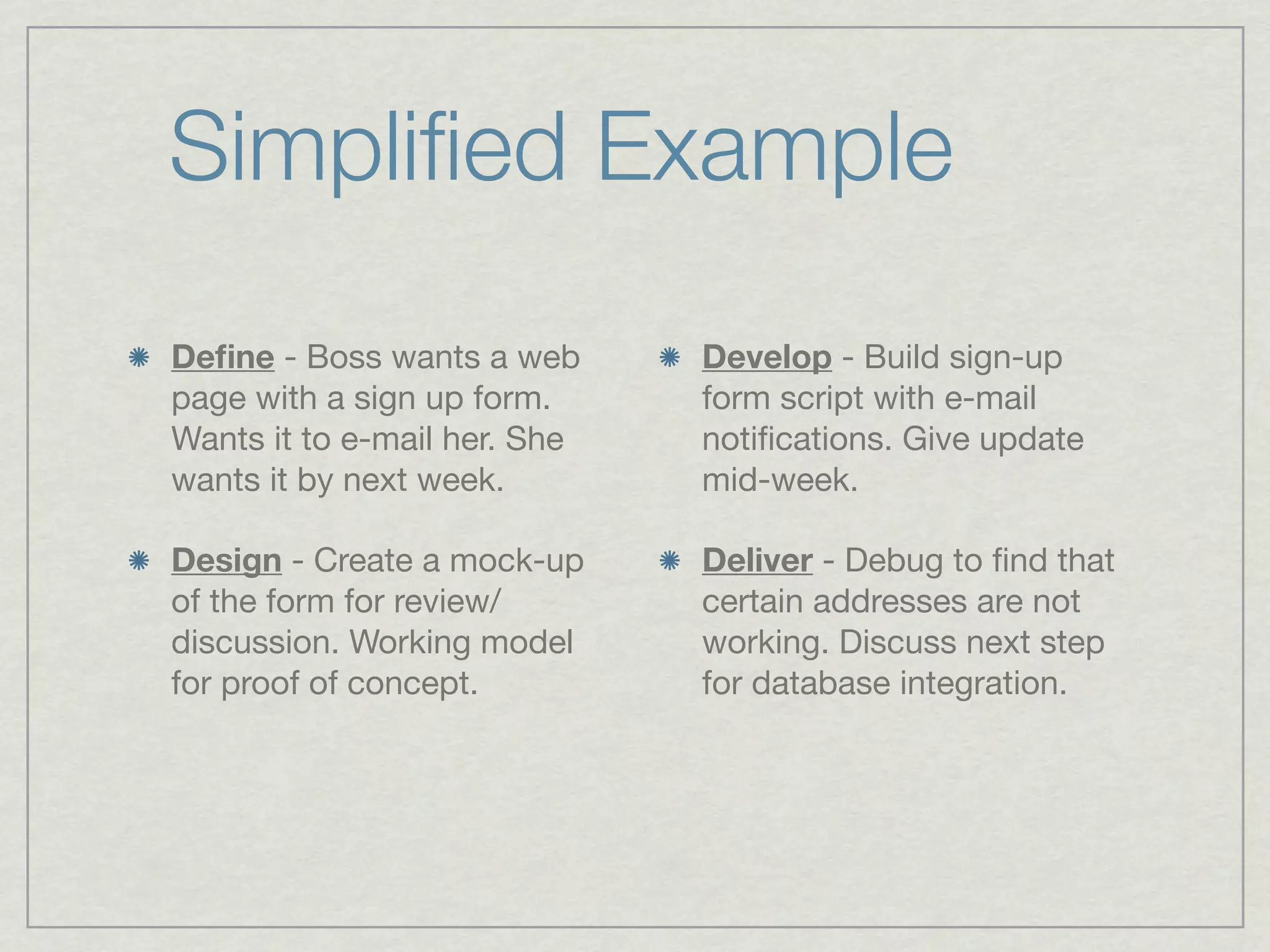
Simplified Example

  Scope - Boss wants a web page with a
  sign up form. Wants it to e-mail her
  submissions.

  Timeline - She needs it by next week.

  Budget - She wants one of the
  developers to build it with existing
  software. Buy stock art.
It’s not hard.


                 #TWSS
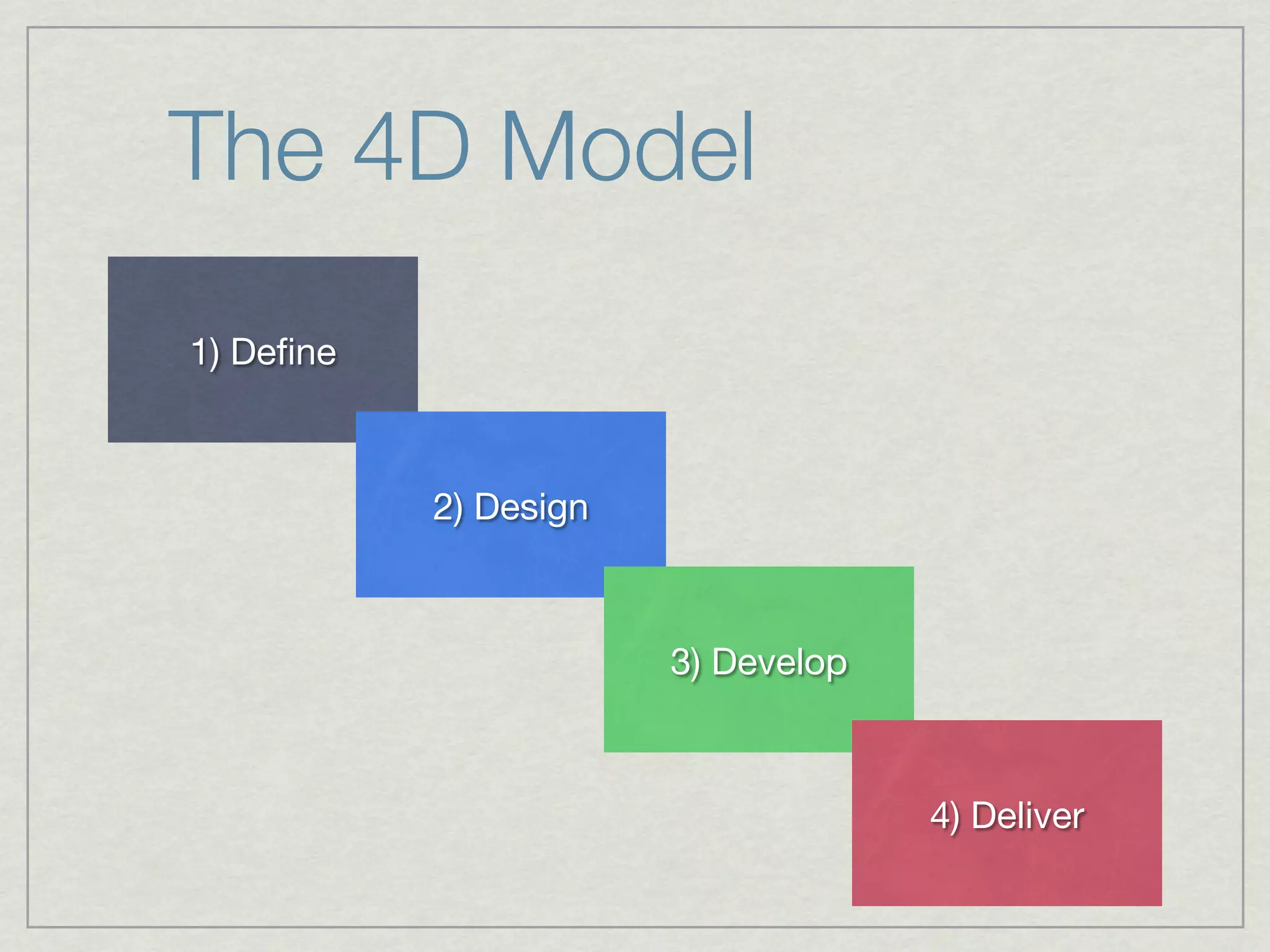
The 4D Model
1) Define


           2) Design


                       3) Develop


                                    4) Deliver
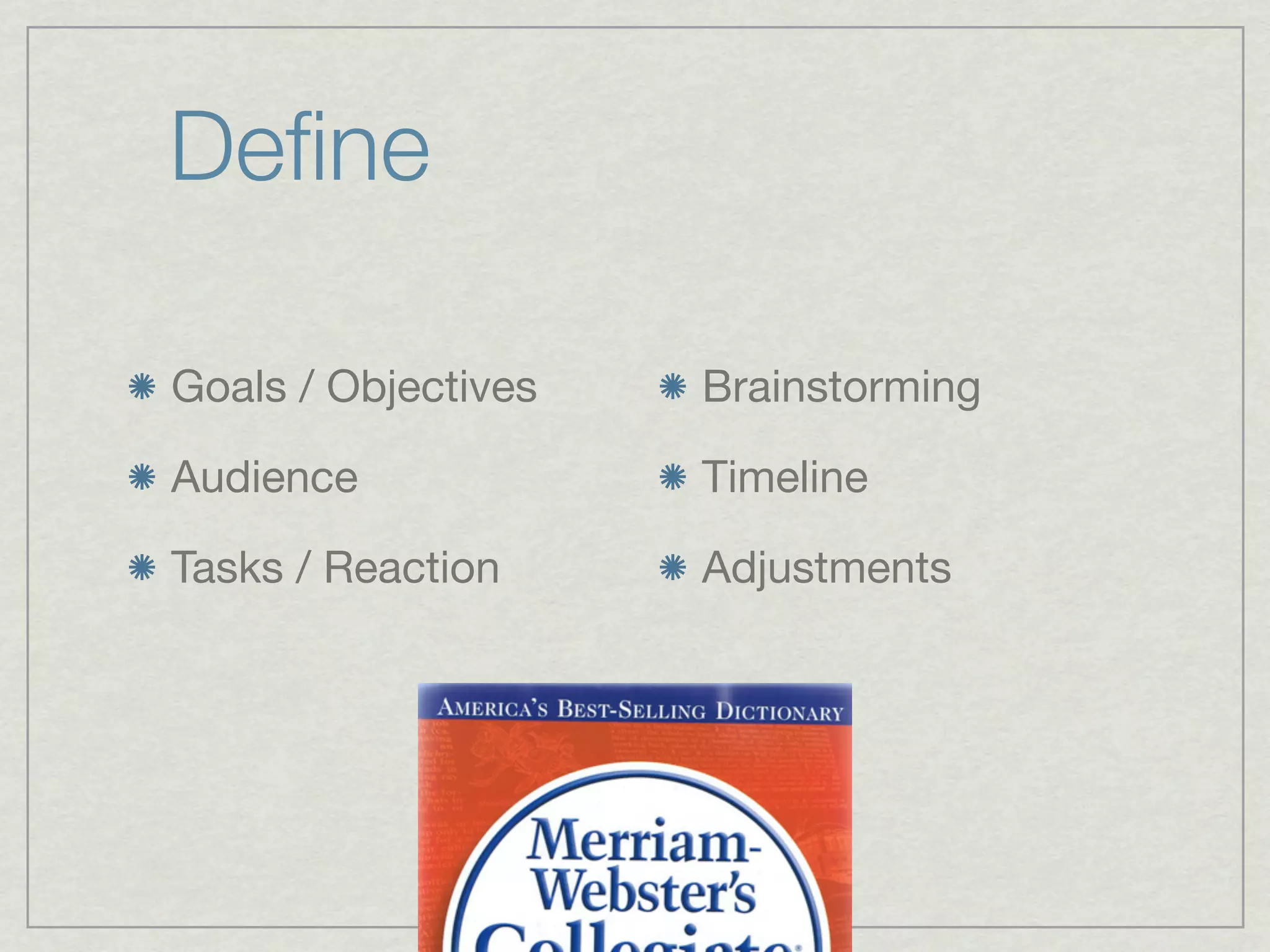
Define

Goals / Objectives   Brainstorming

Audience             Timeline

Tasks / Reaction     Adjustments
Design

User stories            Research

Prototypes / mock-ups   Adjustments
Develop

Implementation      M.V.P.

Identify blockers   Adjustments
Deliver

QA                 Field testing

Progress reports   Next steps
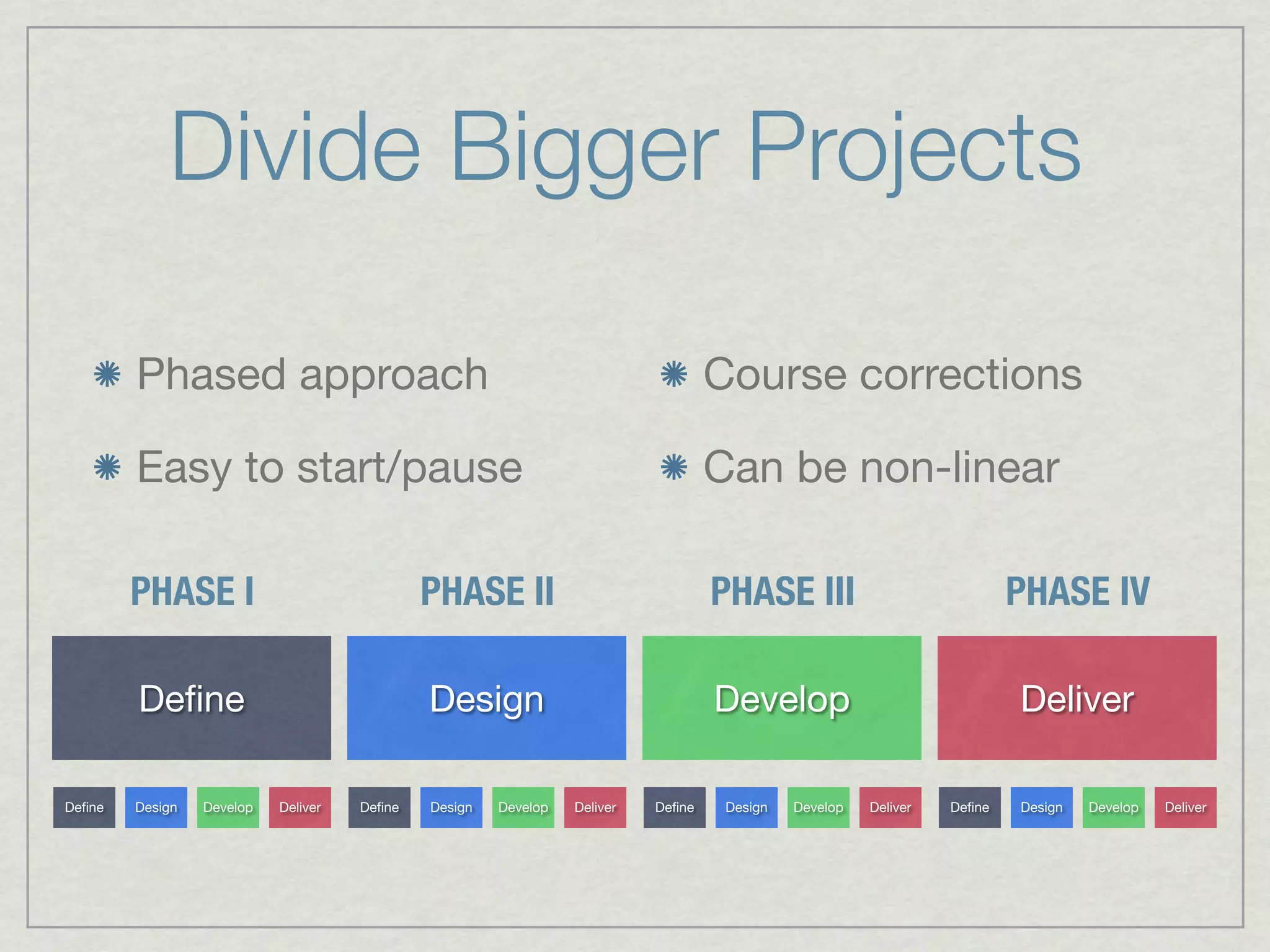
Divide Bigger Projects

        Phased approach                                                           Course corrections

        Easy to start/pause                                                       Can be non-linear

        PHASE I                              PHASE II                             PHASE III                             PHASE IV

        Define                                Design                               Develop                               Deliver

Define   Design   Develop   Deliver   Define   Design   Develop   Deliver   Define    Design   Develop   Deliver   Define   Design   Develop   Deliver
Simplified Example
Define - Boss wants a web      Develop - Build sign-up
page with a sign up form.     form script with e-mail
Wants it to e-mail her. She   notifications. Give update
wants it by next week.        mid-week.

Design - Create a mock-up     Deliver - Debug to find that
of the form for review/       certain addresses are not
discussion. Working model     working. Discuss next step
for proof of concept.         for database integration.
STUFF TO REMEMBER
                (THANK YOU!)


Scope, Timeline and Budget are critical to
understanding the structure of a project.

The 4D Model for project management is a
dependable way to structure a project.

Project Management (Secret: You are all project managers!)

  • 1.
    Project Management (Secret: Youare a project manager)
  • 2.
    STUFF TO REMEMBER (HEY YOU! PAY ATTENTION!) Scope, Timeline and Budget are critical to understanding the structure of a project. The 4D Model for project management is a dependable way to structure a project.
  • 3.
    The Three-Legged Stool Scope - What and How? Timeline - When? Budget - How much? *SIDE-NOTE: WAY TOO MANY ANALOGIES USE THREE-LEGGED STOOLS. SORRY.
  • 4.
    Why a stool? Screwup one of the legs, and you’ll find yourself flat on your ass.
  • 5.
    Scope Parameters / expectations Criteriafor success REAL MEN USE COOLMINT LISTERINE® Dividing line for priorities
  • 6.
    Timeline Good: Beginning to deadline Better: Milestoneswith deliverables Best: Account for outside factors, have buffer
  • 7.
    Budget It can referto $$ Everything has a “cost” No budget is truly unlimited
  • 8.
    Status Updates MadeEasy What has changed? Was there a corresponding change to scope, timeline or budget? How can we fix what’s busted? What are our next steps?
  • 9.
    Simplified Example Scope - Boss wants a web page with a sign up form. Wants it to e-mail her submissions. Timeline - She needs it by next week. Budget - She wants one of the developers to build it with existing software. Buy stock art.
  • 10.
  • 11.
    The 4D Model 1)Define 2) Design 3) Develop 4) Deliver
  • 12.
    Define Goals / Objectives Brainstorming Audience Timeline Tasks / Reaction Adjustments
  • 13.
    Design User stories Research Prototypes / mock-ups Adjustments
  • 14.
    Develop Implementation M.V.P. Identify blockers Adjustments
  • 15.
    Deliver QA Field testing Progress reports Next steps
  • 16.
    Divide Bigger Projects Phased approach Course corrections Easy to start/pause Can be non-linear PHASE I PHASE II PHASE III PHASE IV Define Design Develop Deliver Define Design Develop Deliver Define Design Develop Deliver Define Design Develop Deliver Define Design Develop Deliver
  • 17.
    Simplified Example Define -Boss wants a web Develop - Build sign-up page with a sign up form. form script with e-mail Wants it to e-mail her. She notifications. Give update wants it by next week. mid-week. Design - Create a mock-up Deliver - Debug to find that of the form for review/ certain addresses are not discussion. Working model working. Discuss next step for proof of concept. for database integration.
  • 18.
    STUFF TO REMEMBER (THANK YOU!) Scope, Timeline and Budget are critical to understanding the structure of a project. The 4D Model for project management is a dependable way to structure a project.

Editor's Notes

  • #2 \n
  • #3 * Scope, Timeline and Budget are critical to understanding the structure of a project\n* The 4D model for project management is a dependable way to structure your next project\n
  • #4 - Three legged stool\n- Scope - What you want to accomplish\n- Timeline - When you want to accomplish it\n- Budget - How much in resources are you going to devote to it\n
  • #5 \n
  • #6 - Scope defines the parameters for a project, and what criteria must be met to be successful.\n- Scope can also be viewed as a "line" on a list of priorities.\n
  • #7 - Timeline can refer to the overal lapse of time between start and finish\n- A better definition of timeline is a list of major milestones set on a calendar, with dependencies explained\n\n
  • #8 - Budget is not just the dollar amount you spend on a project\n- Budet also refers to the resources (both human and physical) that must be allocated to a particular project\n
  • #9 - The project's scope grew but the timeline didn't change: Late\n- The project's scope grew but the budget didn't change: Over-budget\n- The project's budget grew, timeline was shortened and scope remained the same: Could go over-budget anyway\n- The scope was reduced, the rest of the factors remained the same: On time, under budget!\n- An extra person was added to the team, all factors remained the same: Over-budget (if another project was affected)\n
  • #10 Just like a stool, adjustments need to be made in all areas.\n
  • #11 Enough of this theoretical stuff. How can we apply these ideas?\n\n
  • #12 \n\n
  • #13 Stated objectives of the project.\nIdentify the audience (personas) for which this project will be targeted.\nIdentify the tasks or reaction that you wish for each audience to have.\nShare ideas that are conceived without regard to scope, timeline or budget (you need valid brainstorming).\nA list of priorities to achieve the stated goals; line them up with which goal it meets.\nDetermine a proposed timeline for achieving the listed priorities (grouped into milestones).\nAdjustments to scope, timeline and budget.\n
  • #14 - User Stories ("As a __, I can __")\n- Prototypes / mock-ups of the end product (with functional descriptions)\n- Research citations on possible implementations\n- Adjustments to scope, timeline and budget\n
  • #15 - Implementation of ideas with regular feedback on progress\n- Identify blockers and escalate priority to clear them, prioritize next steps if work is completed ahead of schedule\n- Peer review when appropriate of work. Goal is to meet an MVP (minimally viable product) for each milestone\n- Adjustments to scope, timeline and budget\n
  • #16 Internal Quality Assurance (QA) and Testing.\nUpon each milestone, present progress and demonstrate which priorities were completed.\nField testing and outside review prior to release/launch.\nIdentifying next steps for project and appropriate feedback cycle for ongoing maintenance.\n
  • #17 This is a highly versatile concept that can be used to plan even the most complex projects\n
  • #18 \n
  • #19 So, what's the difference between what you're describing and agile?\n- There isn't. Agile simply means that you are biting off smaller chunks than planning an entire project at once. You still go through these same processes.\n- Agile removes the caps of overall scope, timeline and budget and instead allocates each for a "sprint"\n- A very high priority is put on being at a MVP (minimally viable product at the end of each sprint)\n- Requires a great deal more interaction with manager/production personnel\n- Greatly benefits product-based groups -- faster to market, focus is on progressive enhancement\n