Lecture summary on the same subject on a book written by Dr. Ed Morato of ACE at AGSB
“ Master yourself before you master others.” “ Conquer your fear and you conquer death.” Alexander the Great Knowing  yourself, Knowing your enemies 100 battles, 100 victories Sun Tzu
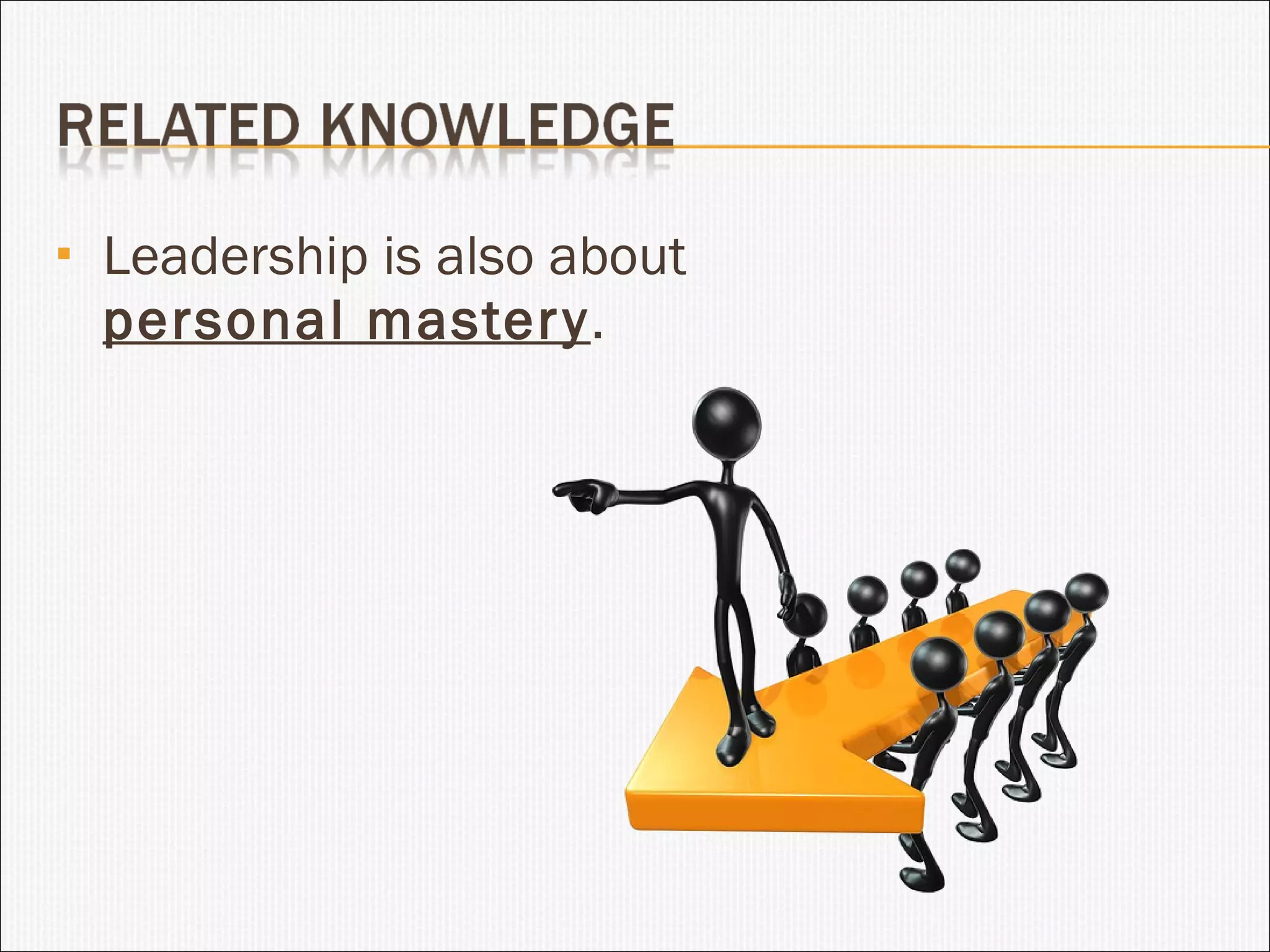
Leadership is also about  personal mastery .
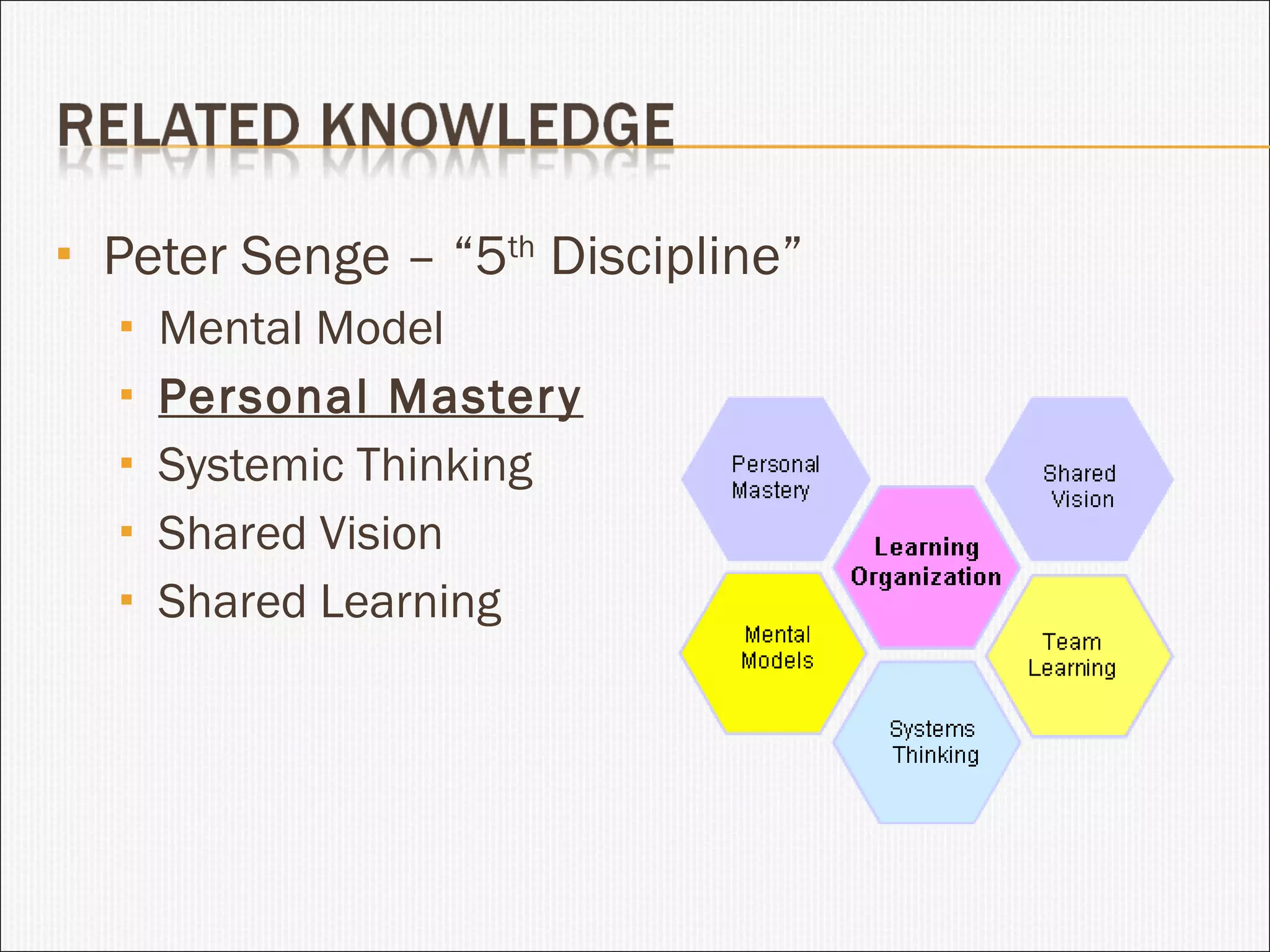
Peter Senge – “5 th  Discipline” Mental Model Personal Mastery Systemic Thinking Shared Vision Shared Learning
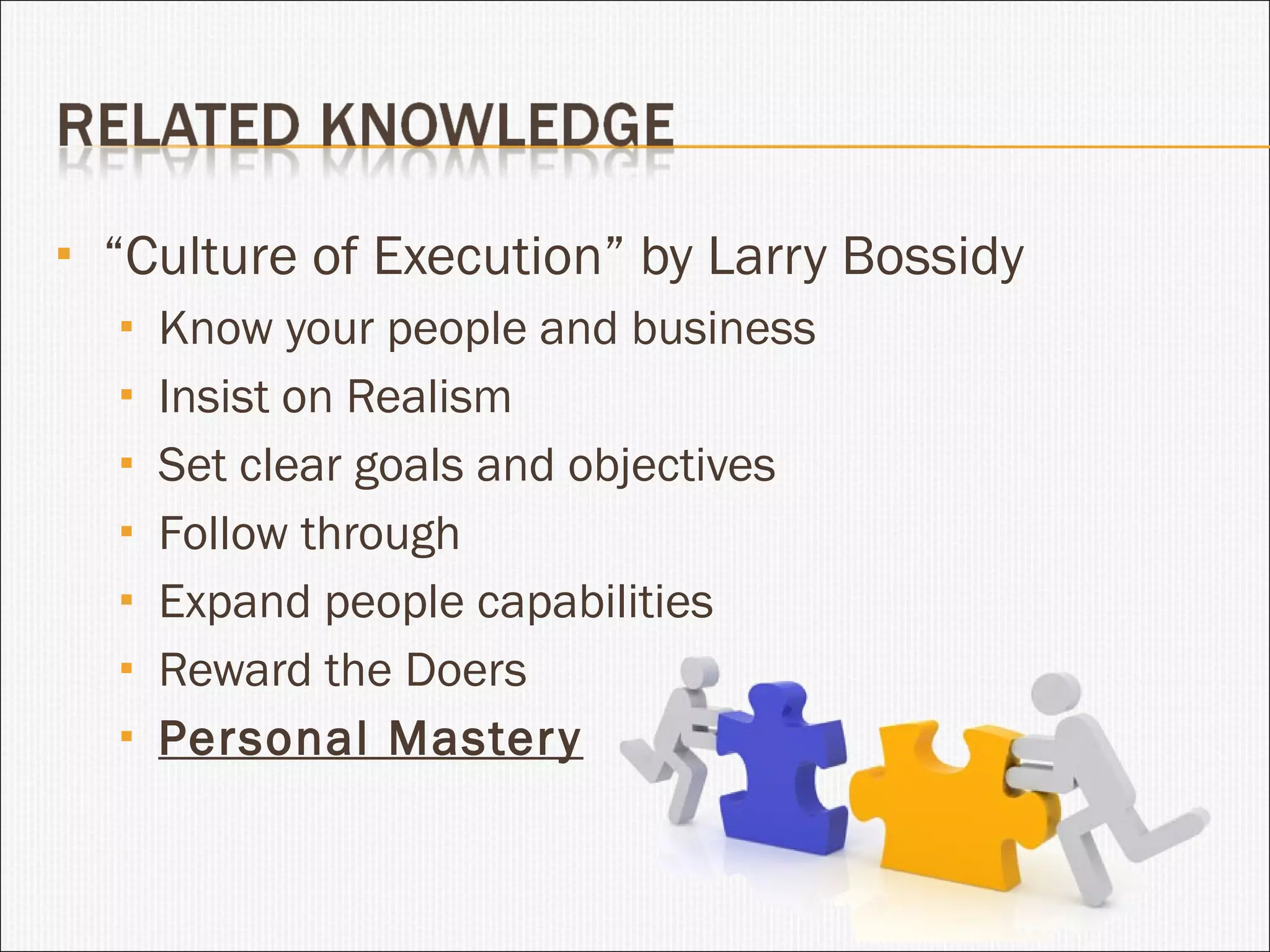
“ Culture of Execution” by Larry Bossidy Know your people and business Insist on Realism Set clear goals and objectives Follow through Expand people capabilities Reward the Doers Personal Mastery
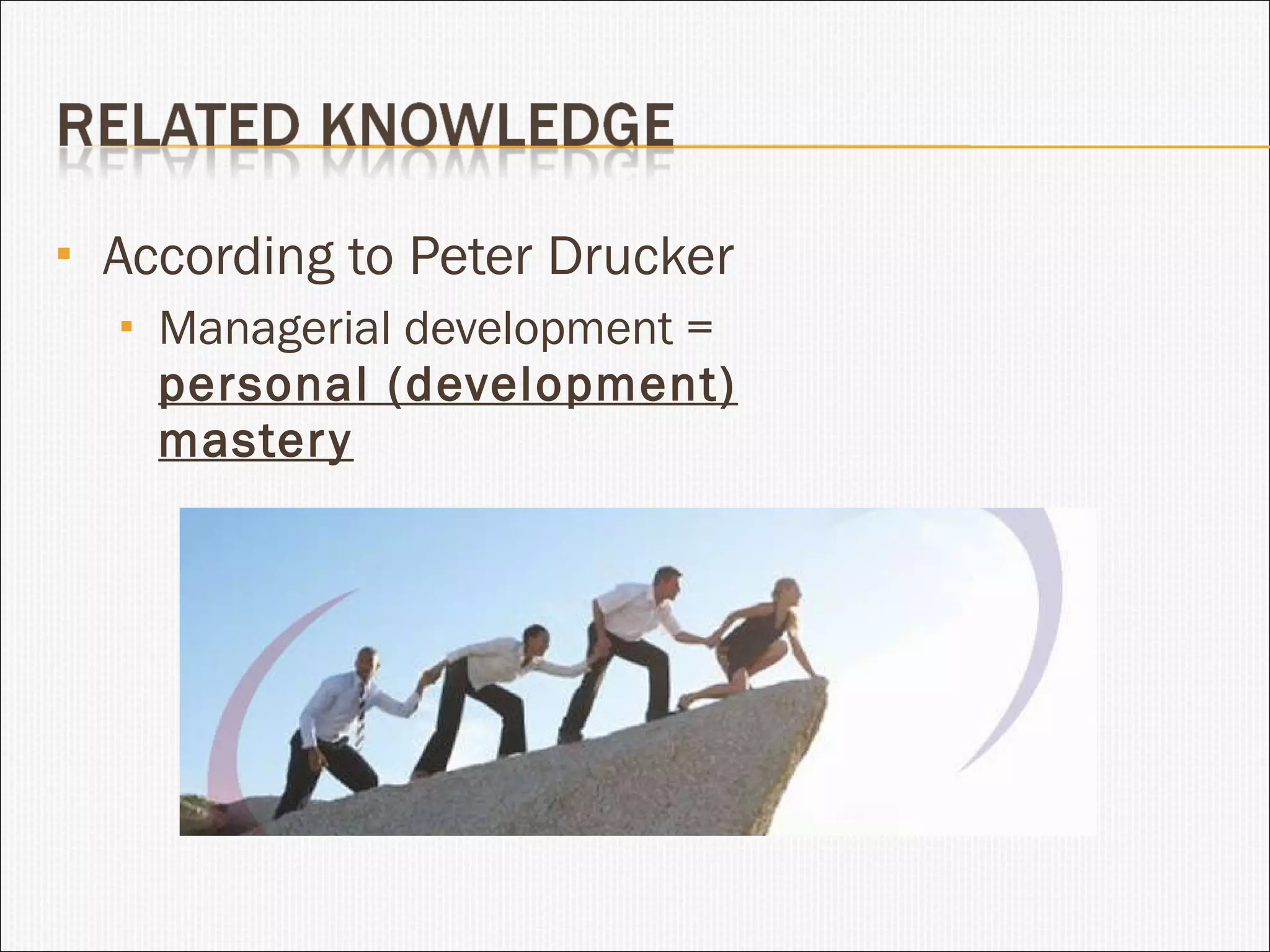
According to Peter Drucker Managerial development =  personal (development) mastery
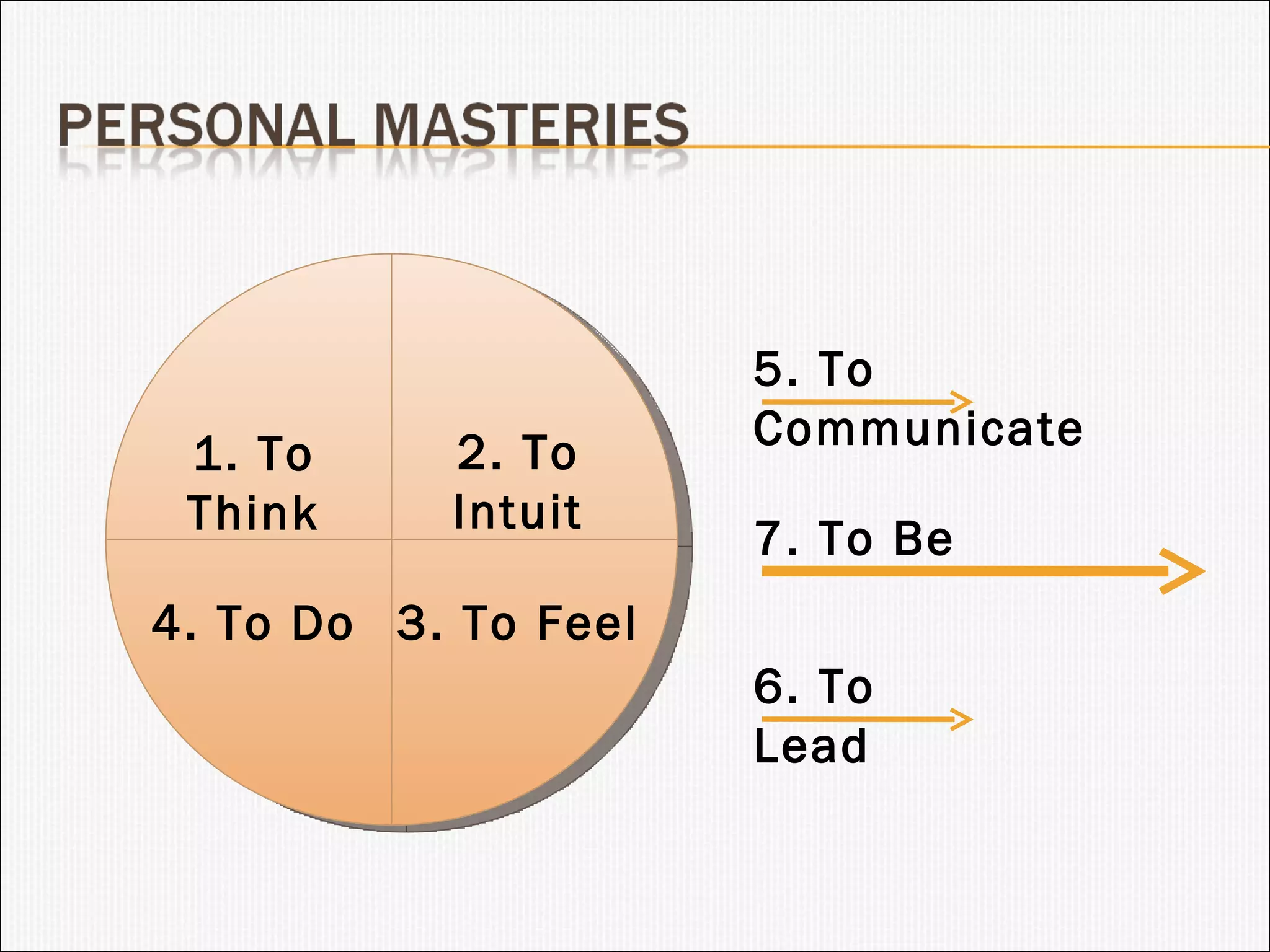
To Think To Intuit To Feel To Do To Communicate To Lead To Be
1. To Think 2. To Intuit 4. To Do 3. To Feel 5. To Communicate 7. To Be 6. To Lead
 
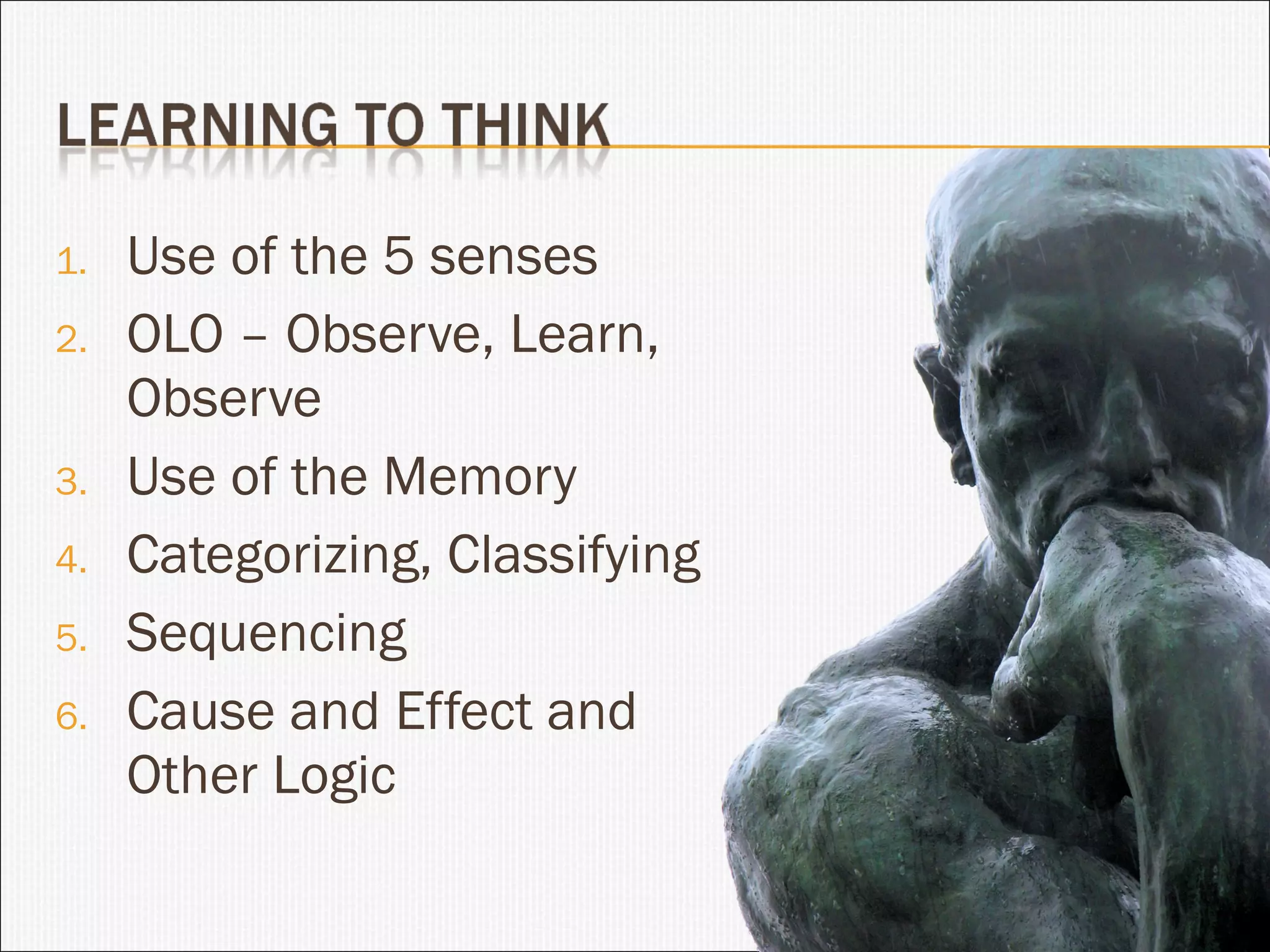
Use of the 5 senses OLO – Observe, Learn, Observe Use of the Memory Categorizing, Classifying Sequencing Cause and Effect and Other Logic
Syllogism and Inductive, Deductive Reasoning Critical Thinking (Converging, Reducing a thing to its essence) Creative Thinking (Expansive, Diverging, Finding multiple options) Systemic Thinking Integrative Thinking, Policy-making Associative Thinking (Use of Mind Maps)
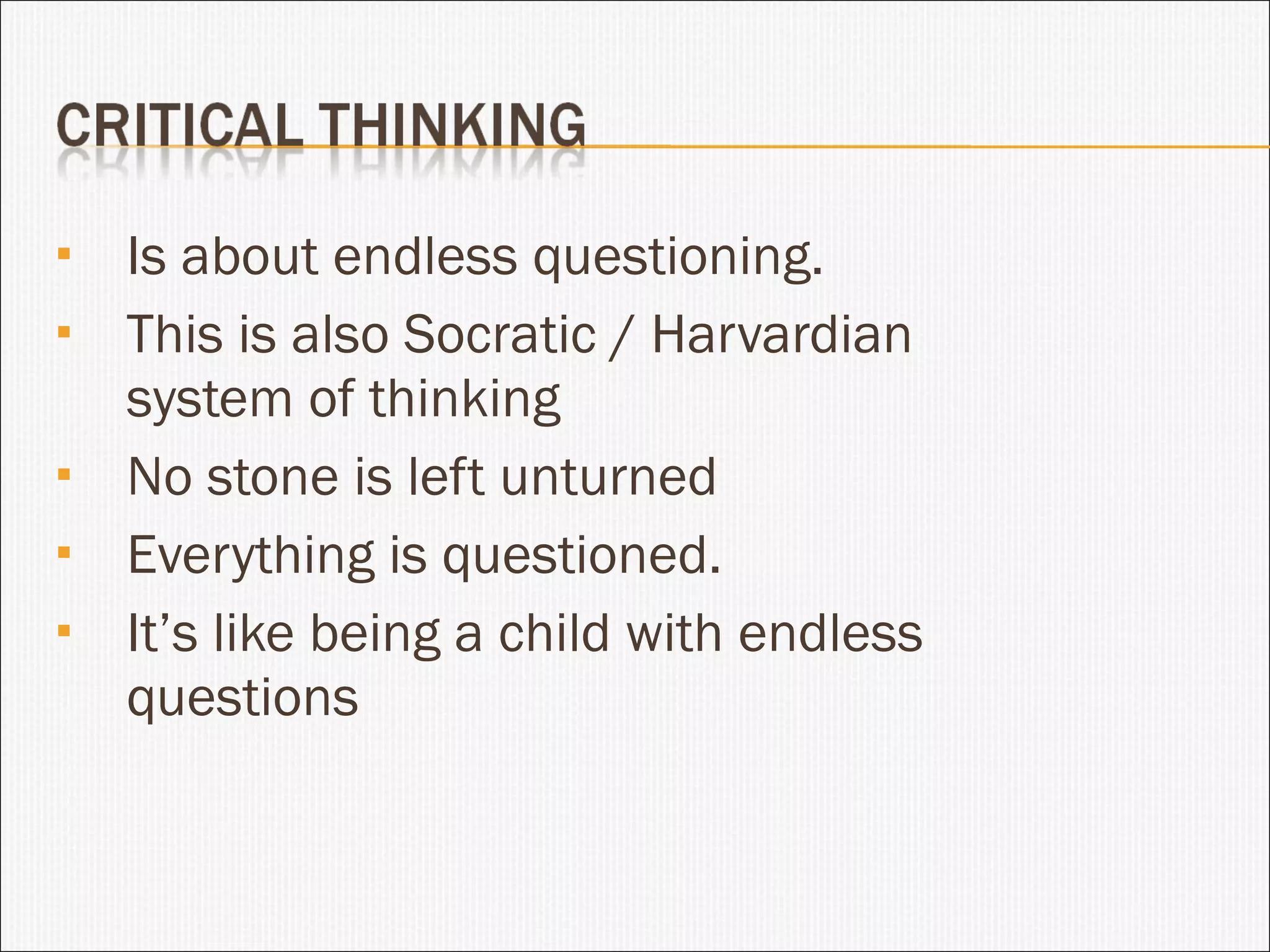
Is about endless questioning. This is also Socratic / Harvardian system of thinking No stone is left unturned Everything is questioned. It’s like being a child with endless questions
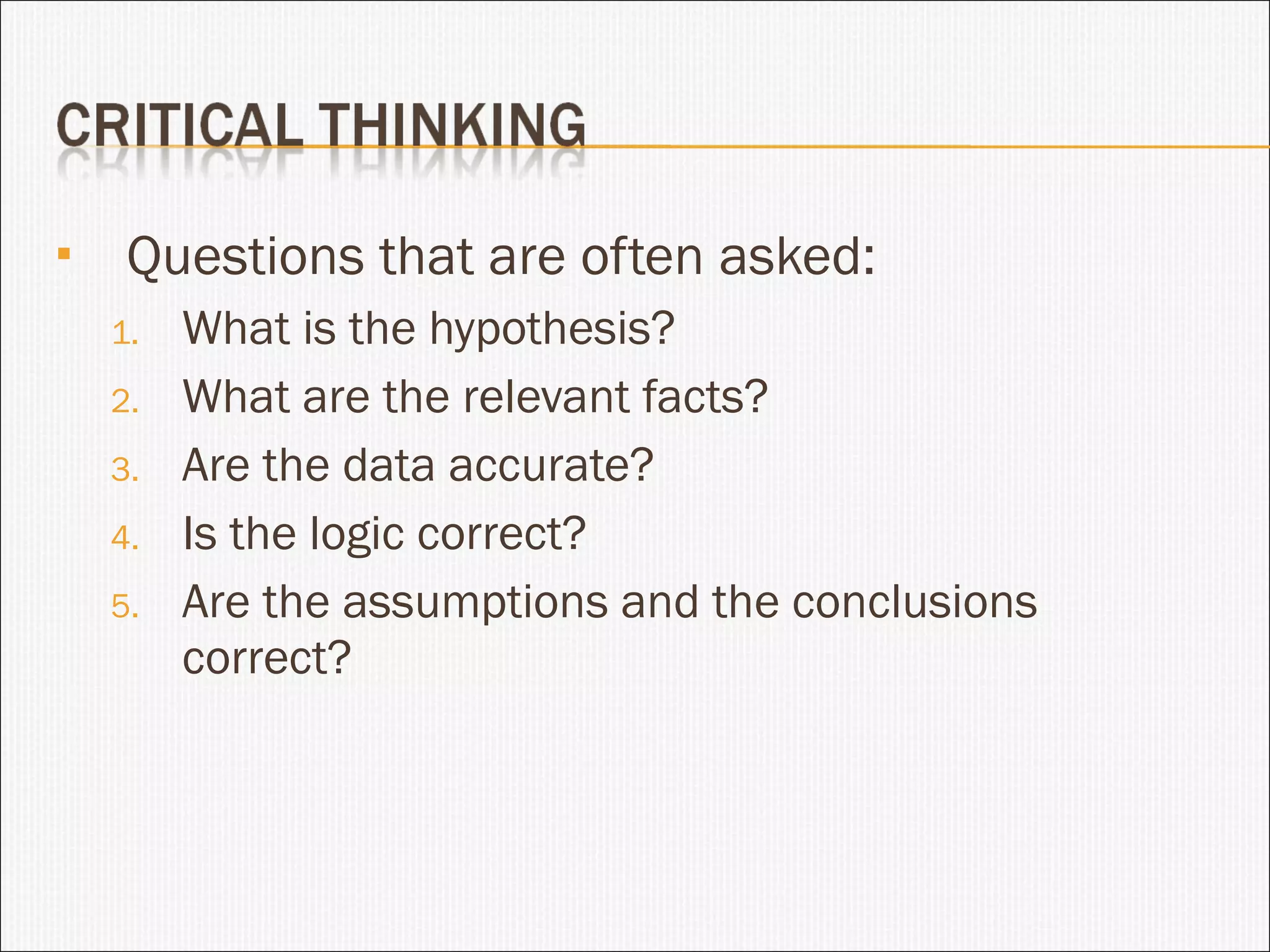
Questions that are often asked: What is the hypothesis? What are the relevant facts? Are the data accurate? Is the logic correct? Are the assumptions and the conclusions correct?
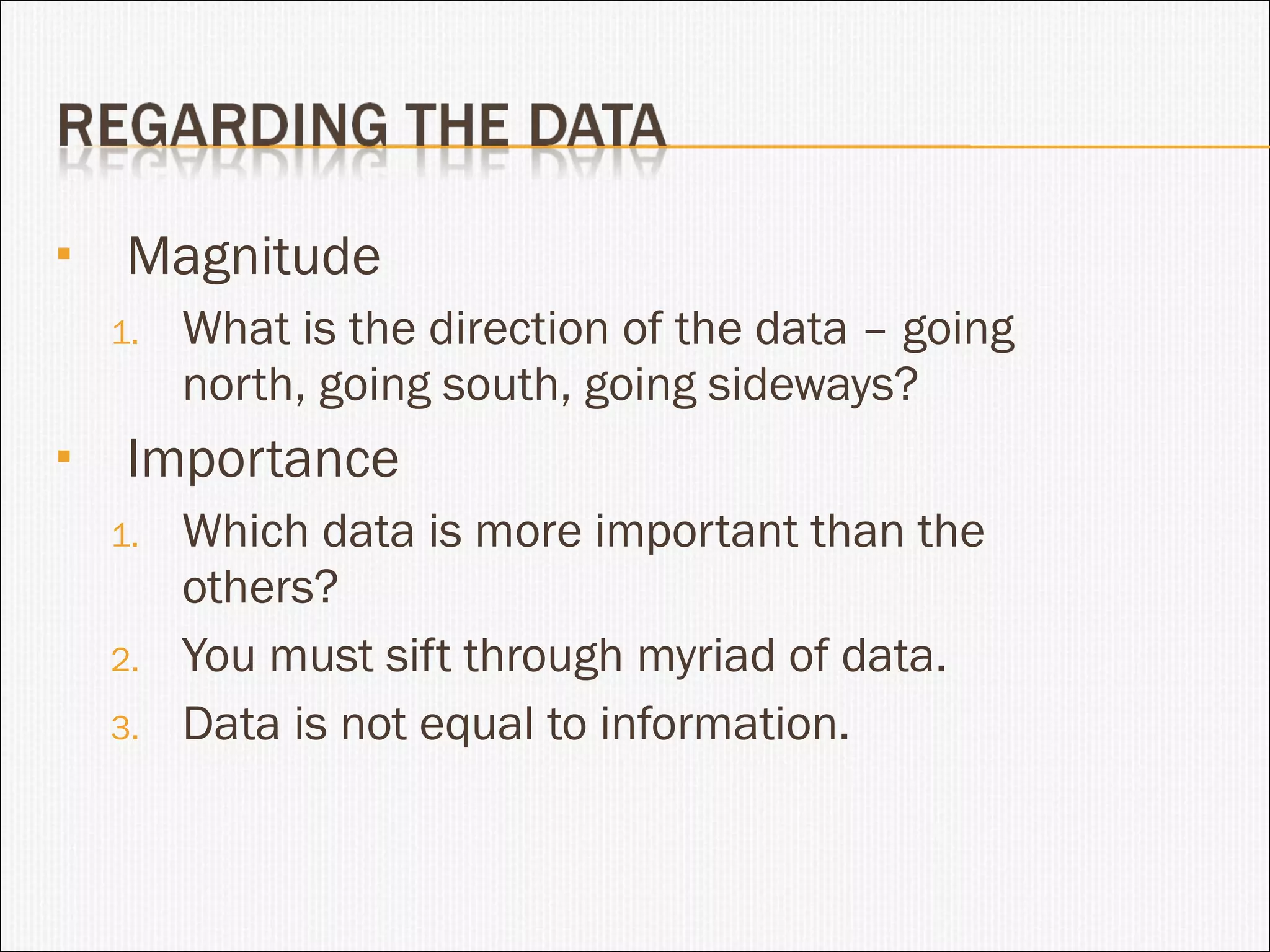
Magnitude What is the direction of the data – going north, going south, going sideways? Importance Which data is more important than the others? You must sift through myriad of data. Data is not equal to information.
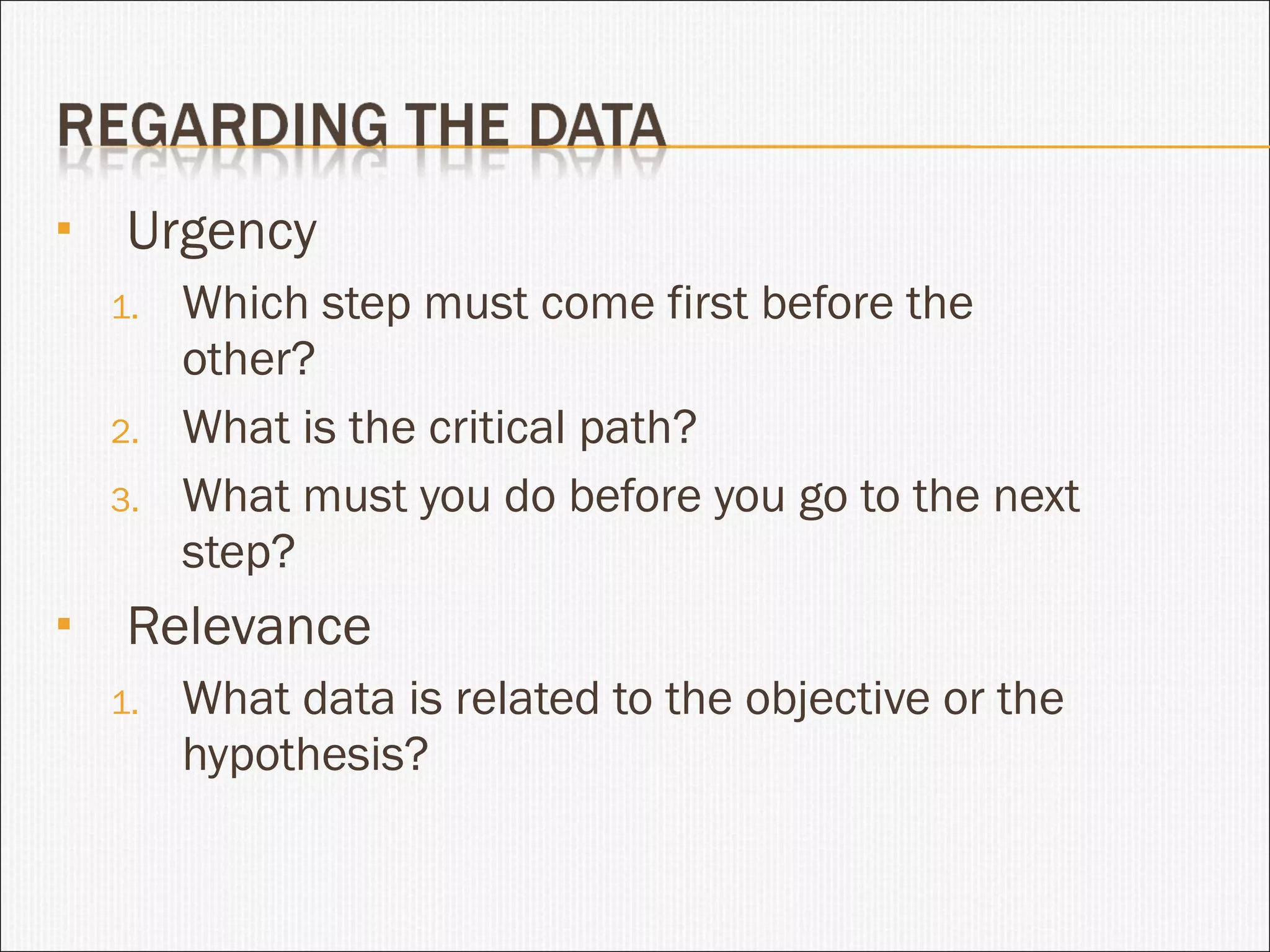
Urgency Which step must come first before the other? What is the critical path? What must you do before you go to the next step? Relevance What data is related to the objective or the hypothesis?
Doability Is the solution feasible? Is it practical? Will the cost of the solution exceed the benefits?  Will the solution benefit everyone concern? Will the solution create more problems than that was originally solved? PPA – Possible Problem Areas
 
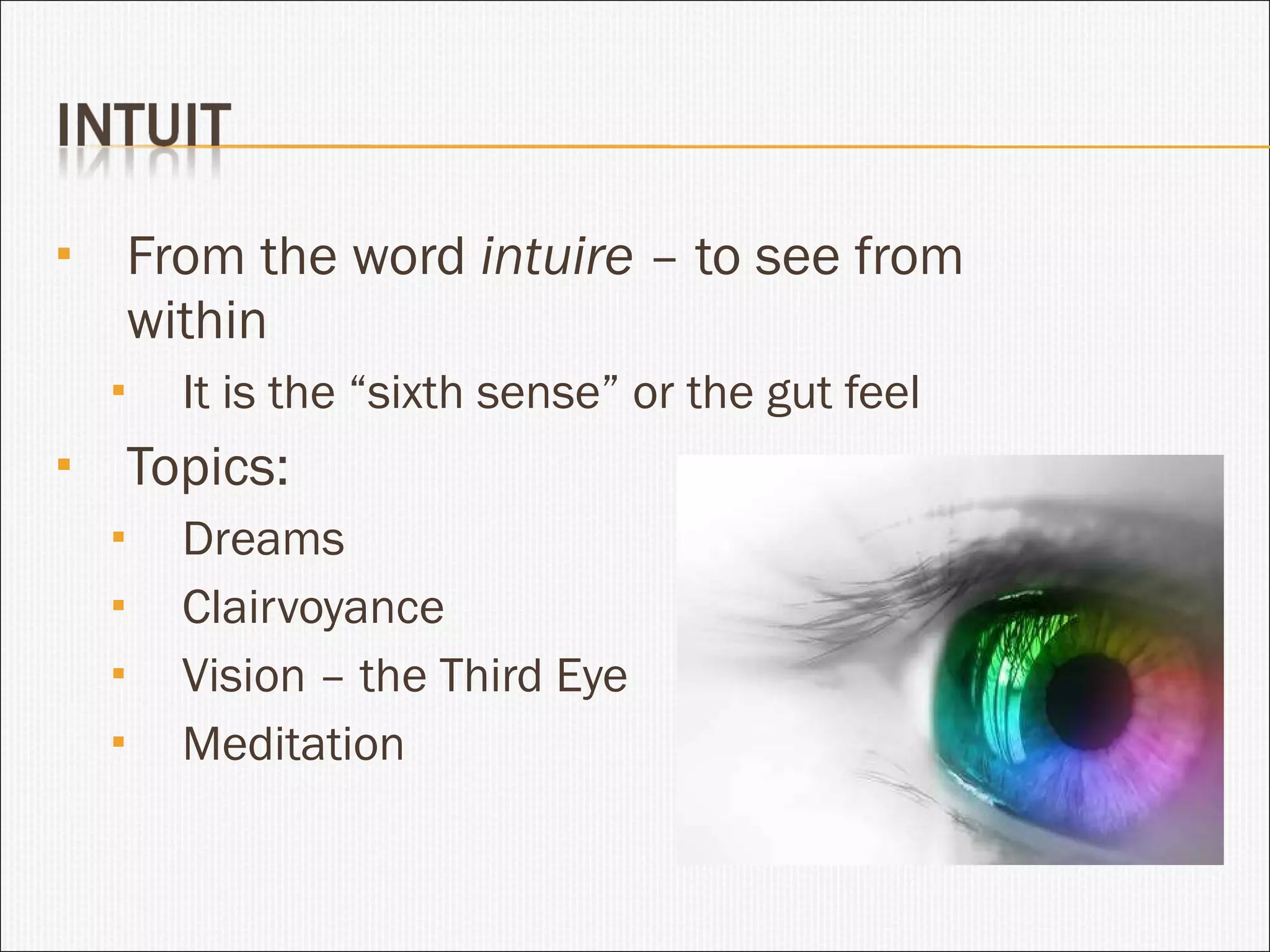
From the word  intuire  – to see from within It is the “sixth sense” or the gut feel Topics: Dreams Clairvoyance Vision – the Third Eye Meditation
 
“ Emotional Intelligence” by Daniel Goleman Emotional self-awareness Mastering adverse emotion (adversity quotient) Rage, shame, fear, grief, despair Empathy / Sympathy Emotional Maturity Secrets of Performers Source of Energy
 
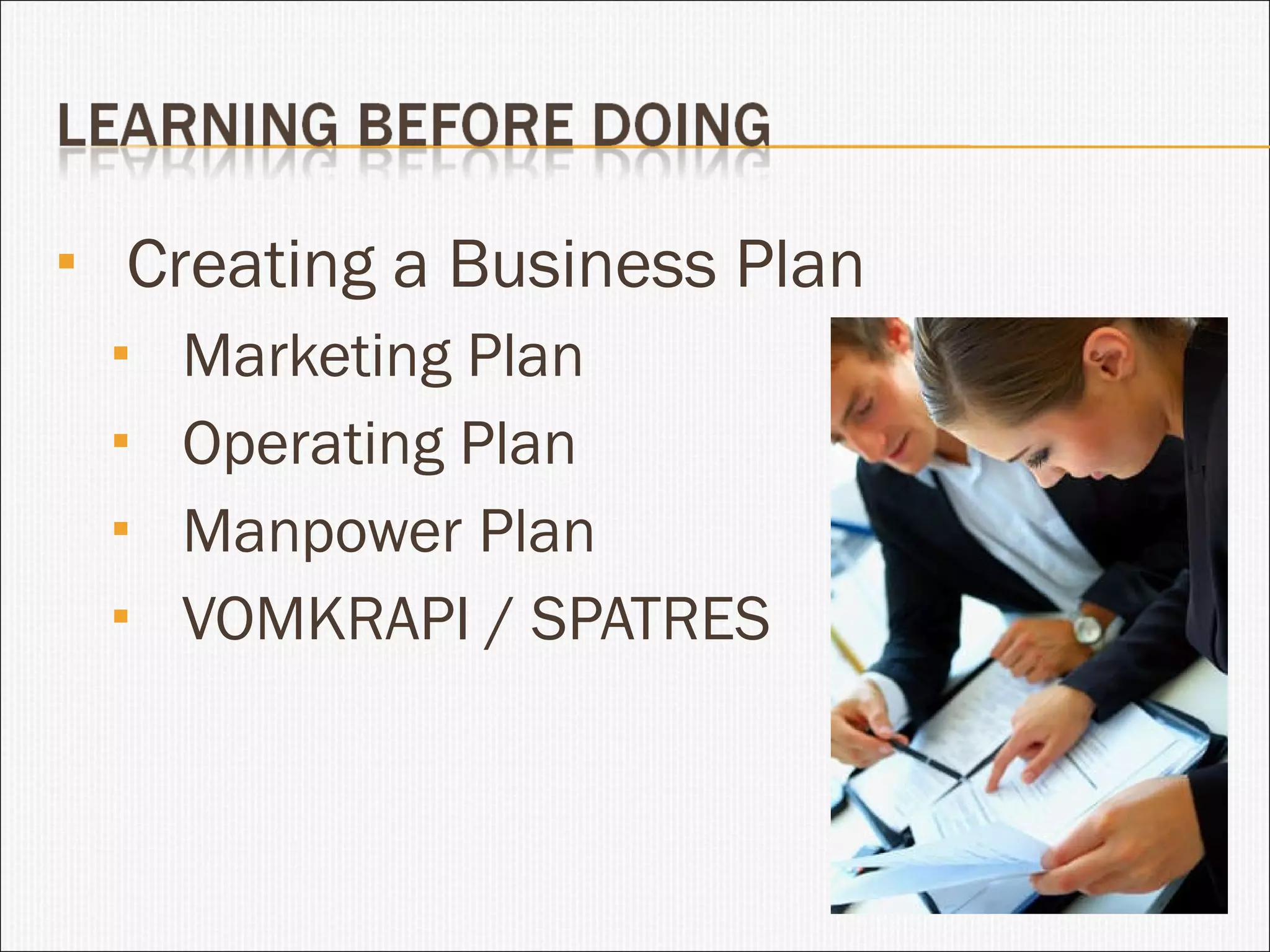
Creating a Business Plan Marketing Plan Operating Plan Manpower Plan VOMKRAPI / SPATRES
Problem solving Pareto Principle PERT-CPM Gantt Chart Decision Tree
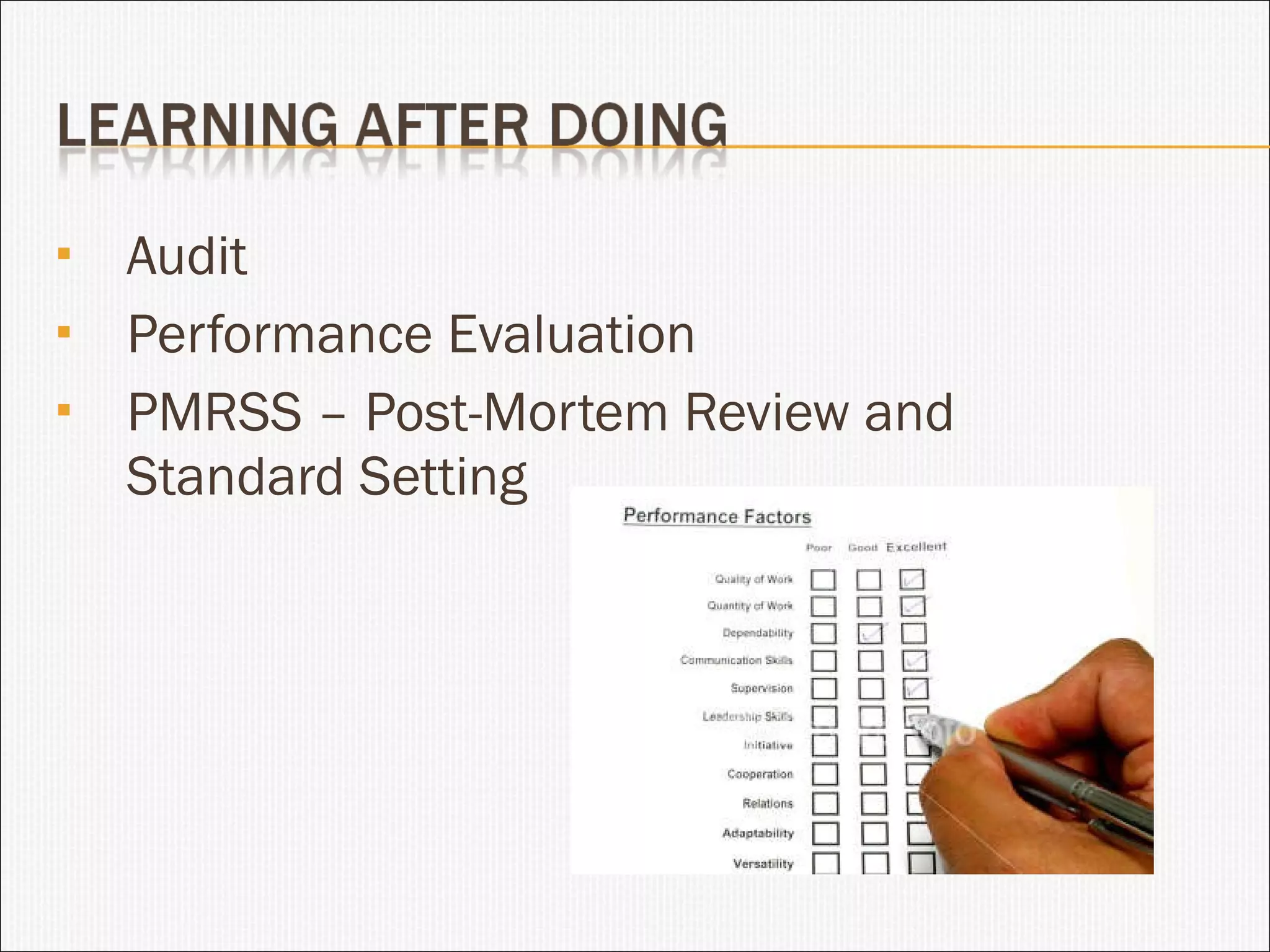
Audit Performance Evaluation PMRSS – Post-Mortem Review and Standard Setting
 
Only 25% of verbal communication is understood; the rest comes from body language Storing messages Messages must be classified as to source, date, department, projects Importance must be given to messages, memo, email, text that require action
Make great attention-getting opening statement Deliver a unique message Resonate with the audience Highlight major points at the conclusion Be sensitive to the audience
 
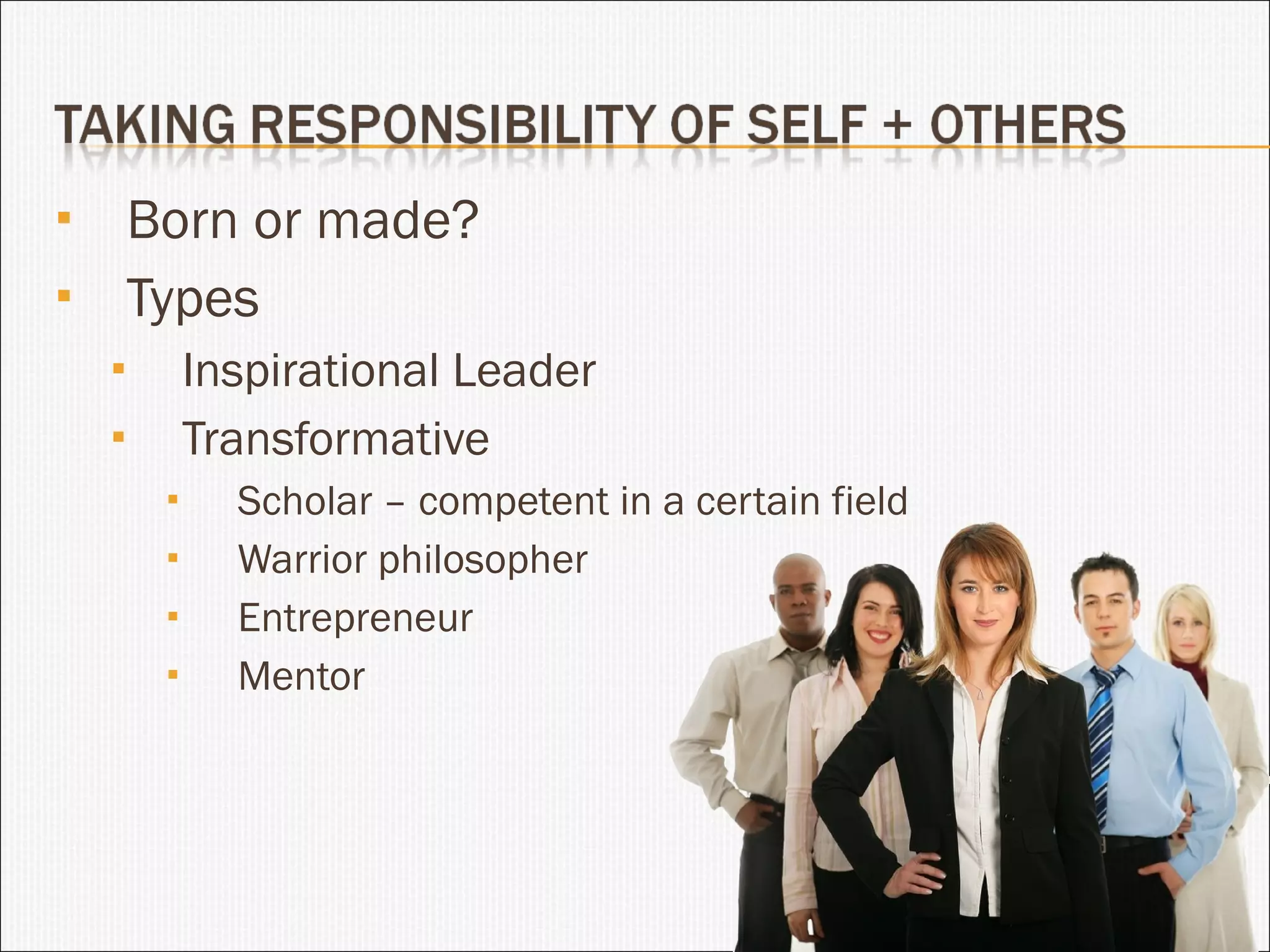
Born or made? Types Inspirational Leader Transformative Scholar – competent in a certain field Warrior philosopher Entrepreneur Mentor
Types  (cont’d) Adaptive Leader Spiritual Self-mastery (model for others) Selflessness Qualities of Successful Entrepreneurs High need for achievement Love of adventure Assertive
 
Wonderment – live curious; be a child again World view – “to a worm in a horseradish, the world is the horseradish”
Wisdom – the purpose of education is to replace an empty mind with an open one As we grow older, we tend to have deeply-ingrained mental models / templates that we keep on repeating The idea is to always have, and welcome, new templates
Will to Live Who am I? What is my mission, vision, in life? Low and high points in life. How did the low and high points make you more successful / less successful? End point in life How will you like to be remembered as a family man, professional, by your friends, relatives, and loved ones? What will you do to be remembered as such?
Will to Live “ Live as if it were always the last day of your life.”
Acknowledgement: The lecturer acknowledges the work of Dr. Ed Morato as the basis of this lecture.  The book of the same title, Personal Mastery book is available for sale. [email_address] Profjorgeentrep at tweeter Profjorge.entrep at agsb facebook

personal mastery

  • 1.
  • 2.
    Lecture summary onthe same subject on a book written by Dr. Ed Morato of ACE at AGSB
  • 3.
    “ Master yourselfbefore you master others.” “ Conquer your fear and you conquer death.” Alexander the Great Knowing yourself, Knowing your enemies 100 battles, 100 victories Sun Tzu
  • 4.
    Leadership is alsoabout personal mastery .
  • 5.
    Peter Senge –“5 th Discipline” Mental Model Personal Mastery Systemic Thinking Shared Vision Shared Learning
  • 6.
    “ Culture ofExecution” by Larry Bossidy Know your people and business Insist on Realism Set clear goals and objectives Follow through Expand people capabilities Reward the Doers Personal Mastery
  • 7.
    According to PeterDrucker Managerial development = personal (development) mastery
  • 8.
    To Think ToIntuit To Feel To Do To Communicate To Lead To Be
  • 9.
    1. To Think2. To Intuit 4. To Do 3. To Feel 5. To Communicate 7. To Be 6. To Lead
  • 10.
  • 11.
    Use of the5 senses OLO – Observe, Learn, Observe Use of the Memory Categorizing, Classifying Sequencing Cause and Effect and Other Logic
  • 12.
    Syllogism and Inductive,Deductive Reasoning Critical Thinking (Converging, Reducing a thing to its essence) Creative Thinking (Expansive, Diverging, Finding multiple options) Systemic Thinking Integrative Thinking, Policy-making Associative Thinking (Use of Mind Maps)
  • 13.
    Is about endlessquestioning. This is also Socratic / Harvardian system of thinking No stone is left unturned Everything is questioned. It’s like being a child with endless questions
  • 14.
    Questions that areoften asked: What is the hypothesis? What are the relevant facts? Are the data accurate? Is the logic correct? Are the assumptions and the conclusions correct?
  • 15.
    Magnitude What isthe direction of the data – going north, going south, going sideways? Importance Which data is more important than the others? You must sift through myriad of data. Data is not equal to information.
  • 16.
    Urgency Which stepmust come first before the other? What is the critical path? What must you do before you go to the next step? Relevance What data is related to the objective or the hypothesis?
  • 17.
    Doability Is thesolution feasible? Is it practical? Will the cost of the solution exceed the benefits? Will the solution benefit everyone concern? Will the solution create more problems than that was originally solved? PPA – Possible Problem Areas
  • 18.
  • 19.
    From the word intuire – to see from within It is the “sixth sense” or the gut feel Topics: Dreams Clairvoyance Vision – the Third Eye Meditation
  • 20.
  • 21.
    “ Emotional Intelligence”by Daniel Goleman Emotional self-awareness Mastering adverse emotion (adversity quotient) Rage, shame, fear, grief, despair Empathy / Sympathy Emotional Maturity Secrets of Performers Source of Energy
  • 22.
  • 23.
    Creating a BusinessPlan Marketing Plan Operating Plan Manpower Plan VOMKRAPI / SPATRES
  • 24.
    Problem solving ParetoPrinciple PERT-CPM Gantt Chart Decision Tree
  • 25.
    Audit Performance EvaluationPMRSS – Post-Mortem Review and Standard Setting
  • 26.
  • 27.
    Only 25% ofverbal communication is understood; the rest comes from body language Storing messages Messages must be classified as to source, date, department, projects Importance must be given to messages, memo, email, text that require action
  • 28.
    Make great attention-gettingopening statement Deliver a unique message Resonate with the audience Highlight major points at the conclusion Be sensitive to the audience
  • 29.
  • 30.
    Born or made?Types Inspirational Leader Transformative Scholar – competent in a certain field Warrior philosopher Entrepreneur Mentor
  • 31.
    Types (cont’d)Adaptive Leader Spiritual Self-mastery (model for others) Selflessness Qualities of Successful Entrepreneurs High need for achievement Love of adventure Assertive
  • 32.
  • 33.
    Wonderment – livecurious; be a child again World view – “to a worm in a horseradish, the world is the horseradish”
  • 34.
    Wisdom – thepurpose of education is to replace an empty mind with an open one As we grow older, we tend to have deeply-ingrained mental models / templates that we keep on repeating The idea is to always have, and welcome, new templates
  • 35.
    Will to LiveWho am I? What is my mission, vision, in life? Low and high points in life. How did the low and high points make you more successful / less successful? End point in life How will you like to be remembered as a family man, professional, by your friends, relatives, and loved ones? What will you do to be remembered as such?
  • 36.
    Will to Live“ Live as if it were always the last day of your life.”
  • 37.
    Acknowledgement: The lectureracknowledges the work of Dr. Ed Morato as the basis of this lecture. The book of the same title, Personal Mastery book is available for sale. [email_address] Profjorgeentrep at tweeter Profjorge.entrep at agsb facebook