RESEARCH
                  RESEARCH
                  REPORT
H A R V A R D B U S II N E S S R E V II E W
HARVARD BUS NESS REV EW


                  RESEARCH
                  RESEARCH
                  REPORT
H A R V A R D B U S II N E S S R E V II E W
HARVARD BUS NESS REV EW


                  RESEARCH
                  RESEARCH
                  REPORT
H A R V A R D B U S II N E S S R E V II E W
HARVARD BUS NESS REV EW


The Realities of Executive Coaching
January 2009


by Diane Coutu and Carol Kauffman
HBR Research Report | The Realities of Executive Coaching


                                                     ACKNOWLEDGEMENTS
                                                     The authors would like to thank Harvard Business Review’s Julia Kirby,
                                                     Editor, Special Issues; Katina Gallo Silberman, Director of Research, Harvard
  THE SuRvEy
                                                     Business Publishing; and HBR summer intern Annie Spokes.
  Methodology and Participants                           We also thank our research assistant, Sarah Wachter, for her invaluable
  The survey analysis presented here is              help. Special thanks are due to the Foundation of Coaching and the Coaching
  drawn from an online questionnaire                 and Positive Psychology Initiative at McLean Hospital for supporting
  developed by senior editors at Harvard
                                                     our work.
  Business Review and Carol Kaufmann. We
                                                         We could not have done this work without the HBR community of
  compiled a list of 245 potential participants
                                                     coaches. Most especially we thank the executive coaches Drs. Susan David,
  through our direct contacts in the coaching
  community, through references from
                                                     Sunny Stout Rostron, Henry Mardsen, John Stopford, and Ann Orton and
  senior executives, through HBR authors             the tutors from Meyler Campbell Ltd. Equal appreciation and thanks
  with expertise in coaching, and through            to executive coaches Drs. Mary Wayne Bush and Irene Stein from the
  organizations involved in the training of          Foundation of Coaching.
  executive coaches.                                     Finally, we thank the coaches who were the first to respond to our
                                                     survey and, as a result, opened a window for us to explore the realities of
  The 140 coaches who participated in                executive coaching: Graham Alexander, Susan Alvey, Susan Annunzio, Lynda
  the time allotted are all involved in the          Applegate, Camilla Arnold, Breck Arnzen, Mary Jo Asmus, Marian Baker,
  executive-coaching business. Sixty-six
                                                     Frank Ball, Janet E. Banks, Susan Battley, John Beeson, Jane Bermont,
  percent disclosed that coaching is their
                                                     Cherly Bertrand, Jeffery G.W. Bow, Richard E. Boyatzis, A. Drayton Boylston,
  primary source of income. Respondents
                                                     Catherine E. Braun, Daniel Burke, Vance Caesar, Alexander Caillet, Frank
  were divided equally into men and
  women. Participants hailed primarily
                                                     Cespedes, David Chinsky, Lourine A. Clark, Loren Comstock, Hugh Coppen,
  from the United States (71%) and the               Carol C. Courcy, Susan Cramm, Gillian Cribbs, Robert W. Cuddy, Kevin
  United Kingdom (18%). Respondents                  Cuthbert, Barbara D’Amico, Ben Dattner, Luc de Belloy de Saint Lienard,
  are highly experienced: 61% have been              Barry Demp, Patricia Hunt Dirlam, Steve Doucette, Karen Staib Duffy, Scott
  in the business for more than 10 years.            Eblin, Katherine Ebner, Brenda Broz Eddy, Keryl Egan, Joshua Ehrlich, Susan
  Approximately half have backgrounds                Ennis, Eddie Erlandson, Linda Feerick, Judith Firman, Vicki Foley, Candice
  in business, either as executives or               Frankovelgia, Alyssa M. Freas, Stew Friedman, John R. Fulkerson, Anna
  management consultants, and 20% have               Gallotti, Colin Gautrey, Alison Gill, I. Barry Goldberg, Vicky Gordon, Mark
  backgrounds in psychology. They are
                                                     Goulston, Vijay Govindarajan, Anthony Grant, Hannah Elizabeth Greenwood,
  nearly all independent; only 1% described
                                                     C. Michael Grissom, Rand J. Gruen, Laurence Hall, Ronald J. Hamara, Kate
  themselves as in-house corporate coaches.
                                                     Harper, Oonagh Harpur, Dominic John Houlder, Donny Huang, Harry Hutson,
  The web survey was conducted using
                                                     Susana Isaacson, Wendy Johnson, Kathi Joy, Leigh Kearney, Nancy M. Kline,
  Vovici EFM survey software. We reviewed            Mary Kralj, John Lazar, Joy Leach, Douglass Lind, Kate Ludeman, Michael
  the data and shared the findings with five         Maccoby, Julie Hayden Maloney, Michael Manwaring, Merry Marcus, Carlos
  commentators, who offered their own                E. Marin, Sarah Martin, Annie Martinez, Steve Melcher, Howard Morgan,
  expert analyses.                                   Meryl A. Moritz, Errica Moustaki, Garry A. Nelson, Stephen Newton, Peter F     .
                                                     Norlin, Julie K. Norris, Ann Orton, Eva J. Parsons, Eyal Pavell, Alice Perkins,
                                                     David B. Peterson, Marilyn Puder-York, Stacey Radin, Lloyd Raines, Gary
                                                     Ranker, Douglas A. Ready, Peter J. Reding, Gareth Rees, Barbara Roberts,
                                                     Philippe Rosinski, Basil Rouskas, Ruth Sack, Eugene Schnell, Tony Schwartz,
                                                     Anne Scoular, Jennifer Sellers, Sandy Simpson, Karlin Sloan, Dee Soder,
                                                     Lew Stern, Jon Stokes, Adrijana Strnad, Camilla Sugden, Kerry J. Sulkowicz,
TERMS AND CONDITIONS                                 Scott Taylor, Judith Tschirgi, Dave Ulrich, Ellen Van Oosten, Judith Vogel, Chris
Copyright 2008 by Harvard Business School            Wahl, Amy D. Webb, Luiz Fernandes Visconte, Paul David Walker, Randall P     .
Publishing Corporation. All rights reserved.         White, Larry Williamson, Robert Witherspoon, Isabel Witte, Linda Woolston,
Unauthorized reproduction or transmission of
any part of this publication in any form or by any
                                                     Joan O. Wright, and Rebecca Zucker.
means, mechanical or electronic, is prohibited.
The analyses and opinions presented in this
report are solely those of the authors.
Cover art: Joshua Gorchov


                                                                                            Harvard Business Review Research Report 2
HBR Research Report | The Realities of Executive Coaching


                                                The Realities of Executive Coaching
                                                By CAROL KAufMANN AND DIANE COuTu

Carol Kauffman is an executive                  Executive coaching is a confidential, individually-tailored engagement
coach and supervisor, psychologist,             designed to meet the needs both of the executive being coached and the
and assistant clinical professor and the        organization paying for the service. A coach meets behind closed doors
founding director of the Coaching & Positive    with an executive, and together they create personalized goals and explore
Psychology Initiative at Harvard Medical        specific ways to achieve them. But what exactly happens behind those closed
School in Boston. She is coeditor in chief      doors? Most of what we hear about coaching is anecdote and conjecture. To
of Coaching: An International Journal of        obtain a more complete understand of coaching, Harvard Business Review
Theory, Research & Practice                     created a 23-item survey sent out to 245 coaches, of whom 140 responded
(www.informaworld.com/coaching)                 during the allotted time period. A review of the key findings from the survey
and founder of the Harvard Coaching             will be offered to executives in the magazine’s January 2009 issue, in the
Conferences. She can be reached at              article “What Can Coaches Do for You?” by Diane Coutu and Carol Kauffman.
Carol_Kauffman@hms.harvard.edu.                 It will include additional analyses by five experts. This special report provides
                                                you with our findings.
Diane Coutu is a senior editor at HBR.
She was an affiliate scholar and                The Engagement
Julius Silberger Fellow at the Boston           As a group, you take on a wide variety of tasks (Q1), but most of your
Psychoanalytical Society and Institute and is   assignments fall into two categories: developing the capabilities of a high-
currently a 2008–2009 Fellow at the American    potential executive or facilitating a transition (Q2). That demonstrates that
Psychoanalytic Association. She can be          coaching today is less about fixing problem behaviors and more about
reached at dcoutu@harvardbusiness.org.          enhancing the performance of valued executives.
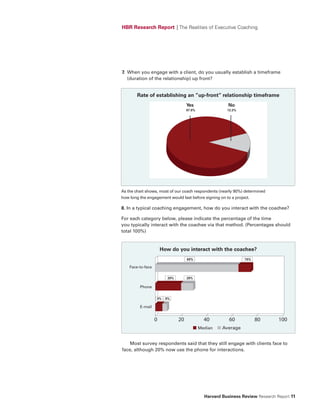
                                                    Most of you meet with executives face to face, although a healthy
                                                minority uses the telephone for primary contact (Q8). Compensation rates
                                                vary widely: from between $200 to $3,500, though most of you are clustered
                                                between $500 and $725 per hour (Q19). Nearly all of you set a specific
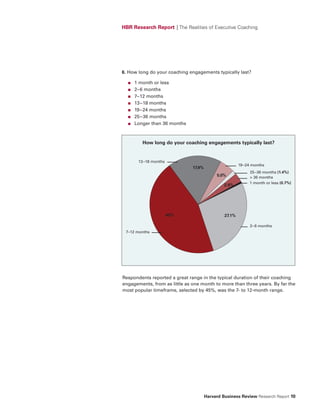
                                                duration for your engagements (Q7), usually from seven to 12 months.
                                                Only 10% of you report that your typical engagements last for less than two
                                                months or for more than 18 (Q6).
                                                    Unlike life coaching, executive coaching involves a third party—the
                                                company that employs the executive. Usually the company is represented by
                                                human resources or by the executive’s manager. You told us that more than
                                                half of your engagements are initiated by an organization that has decided to
                                                get a coach for one of its executives (Q4). Once the engagement has begun,
                                                however, the executive usually takes the driver’s seat. He or she decides
                                                whether the match feels correct and if the meetings are to proceed (Q5).
                                                    While the engagement focuses on the individual, the organization paying
                                                for the coaching service should know the value it receives for the investment.
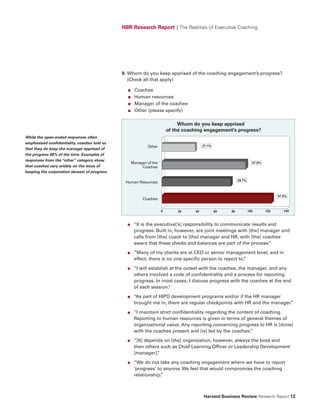
                                                Most of you (nearly 70%) keep the executive’s manager informed of progress,
                                                and 55% communicate with HR. This is usually done in conjunction with the
                                                executive. Expectations about disclosure are discussed up front (Q9). These
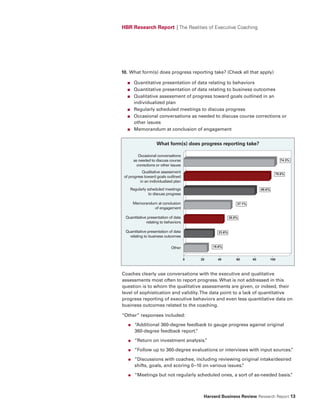
                                                progress reports are usually qualitative and occasional. Less than a third of
                                                you present quantitative data on changes in your coachee’s behaviors. Less
                                                than a quarter provide a quantitative assessment of the impact of those
                                                changes on business performance (Q10).


                                                                                       Harvard Business Review Research Report 3
HBR Research Report | The Realities of Executive Coaching


The Work
You delineated multiple benefits to coaching (Q22). Several of you said
simply: “It works!” More specifically, some of you noted that, as the 21st
century brings rapid change and massive amounts of information, coaching
helps executives manage business complexity. Others focused more
on leadership development, with many of you bemoaning a paucity of
developmental resources for high-level leaders. Coaching was also seen
as creating a unique and safe space for executives and as a replacement for
in-house mentors who used to perform the coaching function at a time
when executive turnover was slower and a culture of employment stability
was the norm.
     When we asked if your goals shifted over the course of an engagement,
all but a handful of you agreed (Q3). Although this fluidity can be problematic
if the engagement morphs to an area outside the coach’s area of expertise,
most of you felt that shifts were necessary to go “deeper” as the executive
developed a greater internal focus and increased self-awareness in the
context of a safe relationship. You also indicated that shifts occurred as part of
a natural evolution as goals were clarified and became more aligned with the
strengths and values of the executive.

The Methods
Of the myriad approaches to achieving organizational and personal change,
three stand out as the most common: engaging expert consultants, relying
on individual coaches, and working with therapist healers. You told us that
many clients seem to be confused about the features and benefits of each.
We asked what you, as coaches (and some of you are also consultants or
therapists), believe to be the most important similarities and difference
between these approaches, as well as the overlaps that exist (Q17, 18).
    All three approaches are founded on trust and confidentiality in the
professional relationship and require that practitioners keep their personal
agenda to a minimum. Coaching/consulting focuses more closely on the
organization by involving management in goal setting and assessing
change. It tries to improve the alignment between the executive and
the organizational value system. Coaching/therapy, by contrast, is more
concerned with facilitating individual behavioral change, building individual
capabilities, and exploring subjective experiences. The unique coaching
approach assumes an equal (versus expert) relationship between executive
and coach with the aim of helping the coachee to discover his or her own
path toward optimal performance in an organizational context.

The Key Success factors
Most of you attributed your success to your clients, the chemistry between
coach and executive, and the support of the organization rather than pointing
to yourselves as masterful professionals (Q20).
    You told us that executives who are willing to learn and evolve and who
can actively engage in the process, have the best results. Fewer than 10% of
your felt that executives needed to begin the process with clear goals or high
emotional intelligence. You nearly all agreed that executives with significant


                                        Harvard Business Review Research Report 4
HBR Research Report | The Realities of Executive Coaching


                                         character flaws or deep-seated behavioral problems are poor coaching
Tell us what you think of this report.   candidates. People suffering from deep resentment, severe narcissism,
Click here to give us your feedback.     ironclad beliefs, or a victim mentality are usually unwilling to look inwards
                                         and are therefore unlikely to benefit from coaching.
                                             An overwhelming majority of coaches attributed success to the quality
                                         of the relationship between coach and executive. Almost all of you agreed,
                                         however, that the support of the third party—the company—was also critical.
                                         Firms must be committed to the executive and his or her progress, and senior
                                         management needs to be invested in the engagement. A deep disconnect
                                         between the organization’s values and goals and those of the executives is
                                         also problematic (Q12). Coaching aims to align an executive’s values and
                                         vision; it doesn’t help people to contort themselves to a space in which they
                                         do not fit.
                                             We also asked for your opinions of what buyers of coaching services
                                         should take into account when choosing a coach. The two most common
                                         responses were that the coach should have prior experience coaching
                                         is a similar setting, and he or she should be able to clearly explain the
                                         methods employed and why (Q16). Given the perceived importance of clear
                                         methods, we looked at what tools you thought were most valuable. Most
                                         (86%) reported that interviewing skills were paramount. Seventy-seven
                                         percent cited the 360-degree feedback instrument. Next in importance were
                                         shadowing, peer support groups, cultural assessment, and psychometrics
                                         (39%–46% rated these tools as highly important) (Q14).

                                         The future
                                         Coaching exists to help executives find solutions, yet the field of coaching
                                         must solve a few problems itself. Most of you told us that coaching as a
                                         process is highly effective but that the field feels as if it is in “adolescence.
                                                                                                                         ”
                                         Many of you were concerned that a lack of entry barriers leaves the
                                         profession vulnerable to being discredited by charlatans. Many also felt that
                                         action was needed to winnow out bad or ineffective coaches. Some of you
                                         suggested that an emphasis on more rigor in practice and more research on
                                         effectiveness is needed.

                                         Our Conclusion
                                         Executive coaching does appear to be creating a space for itself in the
                                         corporate landscape, particularly with the shift toward coaching high
                                         performers. The open-ended responses often showed a surprising
                                         congruence, but sometimes lively disagreement, about where coaching
                                         needs to go from here. Although many individual coaches are skillful at
                                         helping individual companies and people, there is as yet no overarching
                                         definition, let alone organization, of the profession as a whole. Does
                                         executive coaching need such clarity to thrive? Ultimately, of course,
                                         organizations will decide.


                                                                                 Harvard Business Review Research Report 5
HBR Research Report | The Realities of Executive Coaching


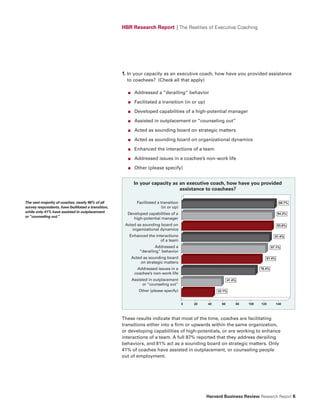
                                                     1. In your capacity as an executive coach, how have you provided assistance
                                                       to coachees? (Check all that apply)

                                                       ■    Addressed a “derailing” behavior

                                                       ■    Facilitated a transition (in or up)

                                                       ■    Developed capabilities of a high-potential manager

                                                       ■    Assisted in outplacement or “counseling out”

                                                       ■    Acted as sounding board on strategic matters

                                                       ■    Acted as sounding board on organizational dynamics

                                                       ■    Enhanced the interactions of a team

                                                       ■    Addressed issues in a coachee’s non-work life

                                                       ■    Other (please specify)


                                                            In your capacity as an executive coach, how have you provided
                                                                                assistance to coachees?

The vast majority of coaches, nearly 96% of all              Facilitated a transition                                                    95.7%
survey respondents, have facilitated a transition,                          (in or up)
while only 41% have assisted in outplacement           Developed capabilities of a                                                      94.3%
or “counseling out.”                                      high-potential manager
                                                      Acted as sounding board on                                                        93.6%
                                                         organizational dynamics
                                                        Enhanced the interactions                                                      91.4%
                                                                        of a team
                                                                        Addressed a                                                  87.1%
                                                               “derailing” behavior
                                                           Acted as sounding board                                              81.4%
                                                               on strategic matters
                                                             Addressed issues in a                                           76.4%
                                                            coachee’s non-work life
                                                           Assisted in outplacement                           41.4%
                                                                 or “counseling out”
                                                              Other (please specify)                   32.1%


                                                                                         0   20   40     60       80   100   120        140


                                                     These results indicate that most of the time, coaches are facilitating
                                                     transitions either into a firm or upwards within the same organization,
                                                     or developing capabilities of high-potentials, or are working to enhance
                                                     interactions of a team. A full 87% reported that they address derailing
                                                     behaviors, and 81% act as a sounding board on strategic matters. Only
                                                     41% of coaches have assisted in outplacement, or counseling people
                                                     out of employment.


                                                                                                  Harvard Business Review Research Report 6
HBR Research Report | The Realities of Executive Coaching


2. For which of these purposes are your services most frequently engaged?

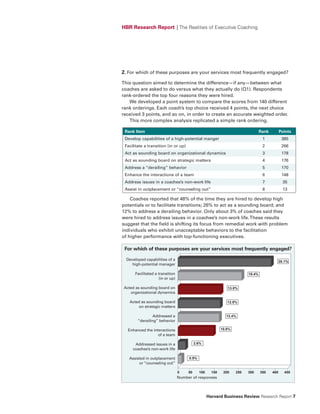
This question aimed to determine the difference—if any—between what
coaches are asked to do versus what they actually do (Q1). Respondents
rank-ordered the top four reasons they were hired.
   We developed a point system to compare the scores from 140 different
rank orderings. Each coach’s top choice received 4 points, the next choice
received 3 points, and so on, in order to create an accurate weighted order.
   This more complex analysis replicated a simple rank ordering.

 Rank Item                                                                        Rank         Points
 Develop capabilities of a high-potential manger                                   1            385
 Facilitate a transition (in or up)                                                2            266
 Act as sounding board on organizational dynamics                                  3            178
 Act as sounding board on strategic matters                                        4            176
 Address a “derailing” behavior                                                    5            170
 Enhance the interactions of a team                                                6            148
 Address issues in a coachee’s non-work life                                       7             35
 Assist in outplacement or “counseling out”                                        8             13

    Coaches reported that 48% of the time they are hired to develop high
potentials or to facilitate transitions; 26% to act as a sounding board; and
12% to address a derailing behavior. Only about 3% of coaches said they
were hired to address issues in a coachee’s non-work life. These results
suggest that the field is shifting its focus from remedial work with problem
individuals who exhibit unacceptable behaviors to the facilitation
of higher performance with top-functioning executives.

 for which of these purposes are your services most frequently engaged?

  Developed capabilities of a                                                                  28.1%
     high-potential manager

      Facilitated a transition                                            19.4%
                     (in or up)

 Acted as sounding board on                                    13.0%
    organizational dynamics

   Acted as sounding board                                     12.8%
       on strategic matters

                 Addressed a                                  12.4%
        “derailing” behavior

   Enhanced the interactions                                10.8%
                   of a team

      Addressed issues in a                 2.6%
     coachee’s non-work life

   Assisted in outplacement            0.9%
        or “counseling out”

                                  0    50     100     150    200    250   300     350    400      450
                                  Number of responses


                                                    Harvard Business Review Research Report 7
HBR Research Report | The Realities of Executive Coaching


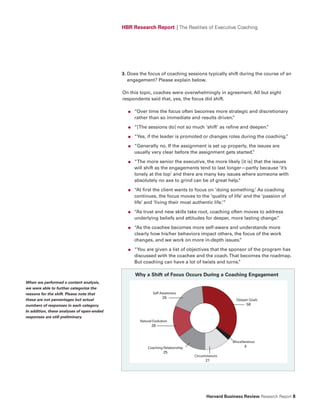
                                            3. Does the focus of coaching sessions typically shift during the course of an
                                               engagement? Please explain below.

                                            On this topic, coaches were overwhelmingly in agreement. All but eight
                                            respondents said that, yes, the focus did shift.

                                              ●   “Over time the focus often becomes more strategic and discretionary
                                                  rather than so immediate and results driven.
                                                                                             ”

                                              ●   “[The sessions do] not so much ‘shift’ as refine and deepen.
                                                                                                             ”

                                              ●   “Yes, if the leader is promoted or changes roles during the coaching.
                                                                                                                      ”

                                              ●   “Generally no. If the assignment is set up properly, the issues are
                                                  usually very clear before the assignment gets started. ”

                                              ●   “The more senior the executive, the more likely [it is] that the issues
                                                  will shift as the engagements tend to last longer—partly because ‘it’s
                                                  lonely at the top’ and there are many key issues where someone with
                                                  absolutely no axe to grind can be of great help.”

                                              ●   “At first the client wants to focus on ‘doing something.’ As coaching
                                                  continues, the focus moves to the ‘quality of life’ and the ‘passion of
                                                  life’ and ‘living their most authentic life.’”

                                              ●   “As trust and new skills take root, coaching often moves to address
                                                  underlying beliefs and attitudes for deeper, more lasting change.
                                                                                                                  ”

                                              ●   “As the coachee becomes more self-aware and understands more
                                                  clearly how his/her behaviors impact others, the focus of the work
                                                  changes, and we work on more in-depth issues.  ”

                                              ●   “You are given a list of objectives that the sponsor of the program has
                                                  discussed with the coachee and the coach. That becomes the roadmap.
                                                  But coaching can have a lot of twists and turns. ”

                                                  Why a Shift of focus Occurs During a Coaching Engagement
When we performed a content analysis,
we were able to further categorize the
reasons for the shift. Please note that                     Self Awareness
                                                                  29
these are not percentages but actual                                                                       Deeper Goals
numbers of responses in each category.                                                                          58
In addition, these analyses of open-ended
responses are still preliminary.
                                                    Natural Evolution
                                                           28


                                                                                                         Miscellaneous
                                                        Coaching Relationship                                    4
                                                                 25
                                                                                   Circumstances
                                                                                         21
                                                                        Note: responses do not add up to 140.


                                                                                          Harvard Business Review Research Report 8
HBR Research Report | The Realities of Executive Coaching


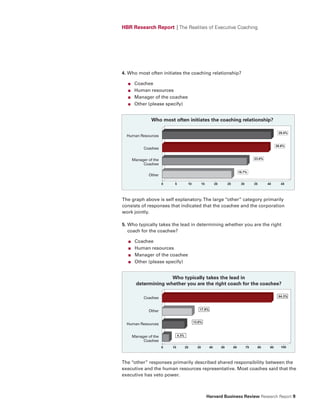
4. Who most often initiates the coaching relationship?

  ■    Coachee
  ■    Human resources
  ■    Manager of the coachee
  ■    Other (please specify)


                Who most often initiates the coaching relationship?

                                                                                                             29.5%
  Human Resources

                                                                                                            28.8%
            Coachee

      Manager of the                                                                          23.0%
           Coachee

                                                                                   18.7%
              Other

                       0    5           10          15         20        25         30        35      40      45


The graph above is self explanatory. The large “other” category primarily
consists of responses that indicated that the coachee and the corporation
work jointly.

5. Who typically takes the lead in determining whether you are the right
   coach for the coachee?

  ■    Coachee
  ■    Human resources
  ■    Manager of the coachee
  ■    Other (please specify)


                      Who typically takes the lead in
        determining whether you are the right coach for the coachee?

                                                                                                             64.3%
            Coachee

                                                17.9%
              Other

                                             13.6%
  Human Resources


      Manager of the            4.3%
           Coachee
                       0   10          20      30         40        50        60         70    80      90     100


The “other” responses primarily described shared responsibility between the
executive and the human resources representative. Most coaches said that the
executive has veto power.


                                                         Harvard Business Review Research Report 9
HBR Research Report | The Realities of Executive Coaching


6. How long do your coaching engagements typically last?

  ■   1 month or less
  ■   2–6 months
  ■   7–12 months
  ■   13–18 months
  ■   19–24 months
  ■   25–36 months
  ■   Longer than 36 months


         How long do your coaching engagements typically last?


       13–18 months
                                                        19–24 months
                               17.9%
                                                             25–36 months (1.4%)
                                            5.0%             > 36 months
                                                             1 month or less (0.7%)
                                                2.9%


                      45%                       27.1%

                                                             2–6 months
 7–12 months


Respondents reported a great range in the typical duration of their coaching
engagements, from as little as one month to more than three years. By far the
most popular timeframe, selected by 45%, was the 7- to 12-month range.


                                       Harvard Business Review Research Report 10
HBR Research Report | The Realities of Executive Coaching


7. When you engage with a client, do you usually establish a timeframe
   (duration of the relationship) up front?


        Rate of establishing an ”up-front” relationship timeframe
                                     Yes                  No
                                     87.8%               12.2%


As the chart shows, most of our coach respondents (nearly 90%) determined
how long the engagement would last before signing on to a project.

8. In a typical coaching engagement, how do you interact with the coachee?

For each category below, please indicate the percentage of the time
you typically interact with the coachee via that method. (Percentages should
total 100%)


                       How do you interact with the coachee?
                                     65%                         75%

    Face-to-face

                          20%        29%

         Phone

                   5%    8%

         E-mail


                   0            20             40         60           80        100
                                           ■ Median ■ Average


   Most survey respondents said that they still engage with clients face to
face, although 20% now use the phone for interactions.


                                               Harvard Business Review Research Report 11
HBR Research Report | The Realities of Executive Coaching


                                               9. Whom do you keep apprised of the coaching engagement’s progress?
                                                  (Check all that apply)

                                                 ■    Coachee
                                                 ■    Human resources
                                                 ■    Manager of the coachee
                                                 ■    Other (please specify)

                                                                               Whom do you keep apprised
                                                                          of the coaching engagement’s progress?
While the open-ended responses often
emphasized confidentiality, coaches told us
                                                             Other                        27.1%
that they do keep the manager apprised of
the progress 68% of the time. Examples of
responses from the “other” category show
                                                     Manager of the                                                   67.9%
that coaches vary widely on the issue of                  Coachee
keeping the corporation abreast of progress.

                                                                                                            55.7%
                                                Human Resources


                                                                                                                                    87.9%
                                                           Coachee


                                                                      0       20     40           60   80           100       120      140


                                                 ●    “It is the executive[’s] responsibility to communicate results and
                                                      progress. Built in, however, are joint meetings with [the] manager and
                                                      calls from [the] coach to [the] manager and HR, with [the] coachee
                                                      aware that these checks and balances are part of the process.  ”

                                                 ●    “Many of my clients are at CEO or senior management level, and in
                                                      effect, there is no one specific person to report to.
                                                                                                          ”

                                                 ●    “I will establish at the outset with the coachee, the manager, and any
                                                      others involved a code of confidentiality and a process for reporting
                                                      progress. In most cases, I discuss progress with the coachee at the end
                                                      of each session. ”

                                                 ●    “As part of HIPO development programs and/or if the HR manager
                                                      brought me in, there are regular checkpoints with HR and the manager.
                                                                                                                          ”

                                                 ●    “I maintain strict confidentiality regarding the content of coaching.
                                                      Reporting to human resources is given in terms of general themes of
                                                      organizational value. Any reporting concerning progress to HR is [done]
                                                      with the coachee present and [is] led by the coachee. ”

                                                 ●    “[It] depends on [the] organization, however, always the boss and
                                                      then others such as Chief Learning Officer or Leadership Development
                                                      [manager]. ”

                                                 ●    “We do not take any coaching engagement where we have to report
                                                      ‘progress’ to anyone. We feel that would compromise the coaching
                                                      relationship.”


                                                                                          Harvard Business Review Research Report 12
HBR Research Report | The Realities of Executive Coaching


10. What form(s) does progress reporting take? (Check all that apply)

   ■     Quantitative presentation of data relating to behaviors
   ■     Quantitative presentation of data relating to business outcomes
   ■     Qualitative assessment of progress toward goals outlined in an
         individualized plan
   ■     Regularly scheduled meetings to discuss progress
   ■     Occasional conversations as needed to discuss course corrections or
         other issues
   ■     Memorandum at conclusion of engagement


                      What form(s) does progress reporting take?

           Occasional conversations
        as needed to discuss course                                                        74.3%
          corrections or other issues
           Qualitative assessment                                                      70.0%
 of progress toward goals outlined
          in an individualized plan
       Regularly scheduled meetings                                          68.6%
                  to discuss progress

        Memorandum at conclusion                                37.1%
                 of engagement

  Quantitative presentation of data                         30.0%
              relating to behaviors

  Quantitative presentation of data                 23.6%
    relating to business outcomes

                               Other             18.6%


                                        0   20     40           60      80           100


Coaches clearly use conversations with the executive and qualitative
assessments most often to report progress. What is not addressed in this
question is to whom the qualitative assessments are given, or indeed, their
level of sophistication and validity. The data point to a lack of quantitative
progress reporting of executive behaviors and even less quantitative data on
business outcomes related to the coaching.

“Other” responses included:

   ●     “Additional 360-degree feedback to gauge progress against original
         360-degree feedback report.”

   ●     “Return on investment analysis.
                                       ”

   ●     “Follow up to 360-degree evaluations or interviews with input sources.
                                                                              ”

   ●     “Discussions with coachee, including reviewing original intake/desired
         shifts, goals, and scoring 0–10 on various issues.
                                                          ”

   ●     “Meetings but not regularly scheduled ones, a sort of as-needed basis.
                                                                              ”


                                             Harvard Business Review Research Report 13
HBR Research Report | The Realities of Executive Coaching


                                             11. What type(s) of challenge have you had most success in helping
                                                 coachees address?

                                             This question generated a wide range of responses. Many coaches mentioned
                                             helping executives become more strategic, navigate tricky political waters and
                                             transitions, and increase leadership skills. Key areas of growth of the executives
                                             include their realizing their impact on others, reducing derailing behaviors,
                                             increasing influence, and managing up or down more effectively.
                                             Responses included:
                                               ●   “Situations where the coachee develops a better understanding of the
                                                   dynamics and requirements of the situation and learns to adjust their
                                                   behavior in a manner that is still authentic and consistent with their values.
                                                                                                                                ”
                                               ●   “Eliminating fatal flaws seen as preventing the individual from being
                                                   promoted to the next level.  ”
                                               ●   “Those arising from clients going through transition. Typically the coaching
                                                   leads to clients gaining useful insights about how to both manage the
                                                   transition itself, and then how to operate effectively in the new domain. ”
                                               ●   “Helping high-performing executives acquire new insights, skills, and
                                                   capabilities quickly that improve their on-the-job effectiveness.”
                                               ●   “I have been successful at helping coachees to establish a vision for
                                                   their professional lives and a strategy for executing successfully on
                                                   current challenges.  ”

                                             12. What type(s) of challenge have you found difficult to help a coachee
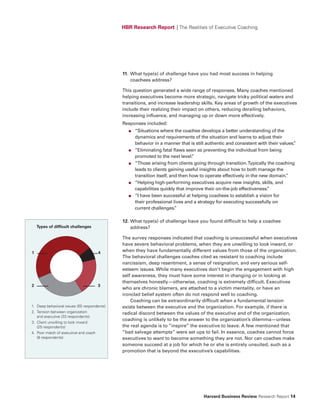
    Types of difficult challenges                address?

                                             The survey responses indicated that coaching is unsuccessful when executives
                                             have severe behavioral problems, when they are unwilling to look inward, or
1                                    4
                                             when they have fundamentally different values from those of the organization.
                                             The behavioral challenges coaches cited as resistant to coaching include
                                             narcissism, deep resentment, a sense of resignation, and very serious self-
                                             esteem issues. While many executives don’t begin the engagement with high
                                             self awareness, they must have some interest in changing or in looking at
                                             themselves honestly—otherwise, coaching is extremely difficult. Executives
2                                    3
                                             who are chronic blamers, are attached to a victim mentality, or have an
                                             ironclad belief system often do not respond well to coaching.
                                                 Coaching can be extraordinarily difficult when a fundamental tension
1. Deep behavioral issues (55 respondents)   exists between the executive and the organization. For example, if there is
2. Tension between organization              radical discord between the values of the executive and of the organization,
   and executive (33 respondents)
                                             coaching is unlikely to be the answer to the organization’s dilemma—unless
3. Client unwilling to look inward
   (25 respondents)                          the real agenda is to “inspire” the executive to leave. A few mentioned that
4. Poor match of executive and coach         “bad salvage attempts” were set ups to fail. In essence, coaches cannot force
   (8 respondents)                           executives to want to become something they are not. Nor can coaches make
                                             someone succeed at a job for which he or she is entirely unsuited, such as a
                                             promotion that is beyond the executive’s capabilities.


                                                                                    Harvard Business Review Research Report 14
HBR Research Report | The Realities of Executive Coaching


                                             Specific examples of challenges cited by survey participants include:
                                               ●   “If they do not agree with the need for change, the goal is impossible
                                                   to achieve.”
                                               ●   “Deep resentment and resignation: Coaching someone who is living
                                                   and working against their values or core beliefs. Most often the
                                                   conundrum is staying because the money or prestige is counter to their
                                                   personal vision. (This is especially difficult when someone has stayed
                                                   years, sacrificing the self for a company, and regrets not taking care of
                                                   health and family.)”
                                               ●   “Anything that fits in the category of the coachee trying to become
                                                   something they are not—for the sake of the job or the company.    ”
                                               ●   “Probably the most difficult challenge is with highly political
                                                   organizations—typically those with complex governance structures.
                                                   Such organizations often purposefully encourage internal competition.
                                                   When the culture rewards an attitude or behavior (either purposefully or
                                                   not), no amount of coaching will support an executive changing it.  ”
                                               ●   “We cannot coach intellectual capacity or address deeper psychological
                                                   wounds. (We will make referrals to deal with the latter.)”
                                               ●   “When [the] coachee is truly being railroaded by [his or her]
                                                   organization. ”

                                             13. Have you ever felt that a coachee had become overly dependent upon
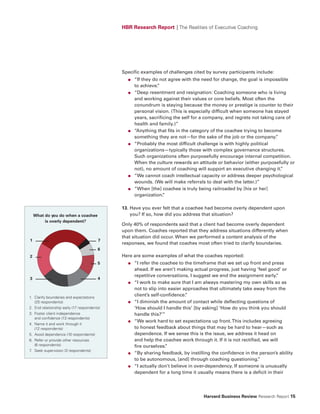
    What do you do when a coachee                you? If so, how did you address that situation?
         is overly dependent?
                                             Only 40% of respondents said that a client had become overly dependent
                                             upon them. Coaches reported that they address situations differently when
                                             that situation did occur. When we performed a content analysis of the
1                                       7
                                             responses, we found that coaches most often tried to clarify boundaries.
                                        6
2                                            Here are some examples of what the coaches reported:
                                        5      ●   “I refer the coachee to the timeframe that we set up front and press
                                                   ahead. If we aren’t making actual progress, just having ‘feel good’ or
                                                   repetitive conversations, I suggest we end the assignment early.   ”
3                                       4
                                               ●   “I work to make sure that I am always mastering my own skills so as
                                                   not to slip into easier approaches that ultimately take away from the
1. Clarify boundaries and expectations
                                                   client’s self-confidence.”
   (25 respondents)                            ●   “I diminish the amount of contact while deflecting questions of
2. End relationship early (17 respondents)         ‘How should I handle this’ [by asking] ‘How do you think you should
3. Foster client independence                      handle this?’”
   and confidence (13 respondents)
                                               ●   “We work hard to set expectations up front. This includes agreeing
4. Name it and work through it
   (12 respondents)                                to honest feedback about things that may be hard to hear—such as
5. Avoid dependence (10 respondents)               dependence. If we sense this is the issue, we address it head on
6. Refer or provide other resources                and help the coachee work through it. If it is not rectified, we will
   (6 respondents)                                 fire ourselves. ”
7 Seek supervision (3 respondents)
 .
                                               ●   “By sharing feedback, by instilling the confidence in the person’s ability
                                                   to be autonomous, [and] through coaching questioning.      ”
                                               ●   “I actually don’t believe in over-dependency. If someone is unusually
                                                   dependent for a long time it usually means there is a deficit in their


                                                                                   Harvard Business Review Research Report 15
HBR Research Report | The Realities of Executive Coaching


                                                       development which must be addressed. If the deficit is severe and
                                                       they are aware of it, I refer them for treatment. If it [is] simply a normal
                                                       dependency, which someone feels whilst learning new ways of being
                                                       and working, I accept that and gradually help them to develop the
                                                       robustness they need to stand alone.    ”
                                                   ●   “I always ensure that there is no dependence.  ”
                                                   ●   “When I see any evidence of possible dependency, I reflect back what
                                                       I am feeling, and we discuss where else this happens. We use this as
                                                       an opportunity for further learning to help build confidence in [the
                                                       coachee’s] own decisions.   ”
                                                   ●   “I would examine myself to see what I was doing to foster this
                                                       and correct it. [I would] encourage him/her to have the confidence
                                                       to stand alone. ”

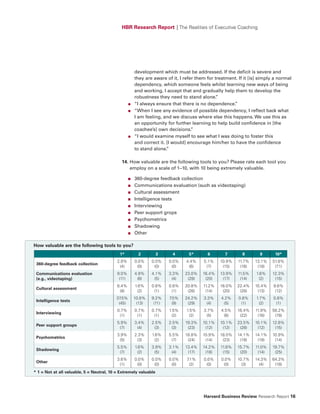
                                             14. How valuable are the following tools to you? Please rate each tool you
                                                 employ on a scale of 1–10, with 10 being extremely valuable.

                                                   ■   360-degree feedback collection
                                                   ■   Communications evaluation (such as videotaping)
                                                   ■   Cultural assessment
                                                   ■   Intelligence tests
                                                   ■   Interviewing
                                                   ■   Peer support grops
                                                   ■   Psychometrics
                                                   ■   Shadowing
                                                   ■   Other

How valuable are the following tools to you?
                                            1*           2        3      4       5*       6       7        8       9       10*
                                           2.9%        0.0%    0.0%    0.0%     4.4%    5.1%    10.9%    11.7%   13.1%    51.8%
 360-degree feedback collection
                                            (4)         (0)     (0)     (0)      (6)     (7)     (15)     (16)    (18)     (71)
 Communications evaluation                 9.0%        4.9%    4.1%    3.3%    23.0%    16.4%   13.9%    11.5%    1.6%    12.3%
 (e.g., videotaping)                        (11)        (6)     (5)     (4)     (28)     (20)    (17)     (14)      (2)    (15)
                                           6.4%        1.6%    0.8%    0.8%    20.8%    11.2%   16.0%   22.4%    10.4%    9.6%
 Cultural assessment
                                            (8)          (2)    (1)     (1)     (26)     (14)    (20)    (28)     (13)     (12)
                                          37.5%        10.8%   9.2%    7.5%    24.2%    3.3%     4.2%    0.8%     1.7%    0.8%
 Intelligence tests
                                           (45)         (13)    (11)     (9)    (29)     (4)      (5)     (1)       (2)    (1)
                                           0.7%        0.7%    0.7%    1.5%     1.5%    3.7%     4.5%   16.4%    11.9%    58.2%
 Interviewing
                                            (1)         (1)     (1)      (2)      (2)    (5)      (6)    (22)     (16)     (78)
                                           5.9%        3.4%    2.5%    2.5%    19.3%    10.1%   10.1%   23.5%    10.1%    12.6%
 Peer support groups
                                            (7)         (4)     (3)     (3)     (23)     (12)    (12)    (28)     (12)     (15)
                                           3.9%        2.3%    1.6%    5.5%    18.8%    10.9%   18.0%   14.1%    14.1%    10.9%
 Psychometrics
                                            (5)         (3)      (2)    (7)     (24)     (14)    (23)    (18)     (18)     (14)
                                           5.5%        1.6%    3.9%    3.1%    13.4%    14.2%   11.8%   15.7%    11.0%    19.7%
 Shadowing
                                            (7)          (2)    (5)     (4)     (17)     (18)    (15)    (20)     (14)     (25)
                                           3.6%        0.0%    0.0%    0.0%     7.1%    0.0%     0.0%   10.7%    14.3%    64.3%
 Other
                                            (1)         (0)     (0)     (0)       (2)    (0)      (0)     (3)      (4)     (18)
* 1 = Not at all valuable, 5 = Neutral, 10 = Extremely valuable


                                                                                        Harvard Business Review Research Report 16
HBR Research Report | The Realities of Executive Coaching


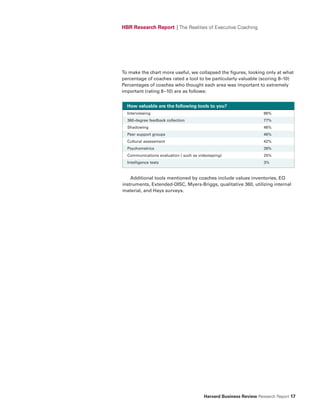
To make the chart more useful, we collapsed the figures, looking only at what
percentage of coaches rated a tool to be particularly valuable (scoring 8–10)
Percentages of coaches who thought each area was important to extremely
important (rating 8–10) are as follows:


  How valuable are the following tools to you?
  Interviewing                                                     86%
  360-degree feedback collection                                   77%
  Shadowing                                                        46%
  Peer support groups                                              46%
  Cultural assessment                                              42%
  Psychometrics                                                    39%
  Communications evaluation ( such as videotaping)                 25%
  Intelligence tests                                               3%


    Additional tools mentioned by coaches include values inventories, EQ
instruments, Extended-DISC, Myers-Briggs, qualitative 360, utilizing internal
material, and Hays surveys.


                                        Harvard Business Review Research Report 17
HBR Research Report | The Realities of Executive Coaching


15. What makes someone coachable? Please select and rank order the top
    three reasons from the list below.

   ■    Active engagement
   ■    Change readiness
   ■    Clear goals
   ■    Communication skills
   ■    Emotional intelligence
   ■    Ambition
   ■    Sense of psychological safety
   ■    Commitment to organization
   ■    Courage


                             What makes someone coachable?

                                                                                             31.6%
        Change readiness

                                                                                     28.0%
       Active engagement

                                                             9.1%
              Clear goals

                                                         8.3%
  Emotional inelligence

                                                       7.4%
                 Courage

              Sense of                                6.5%
   psychological safety

                                               4.3%
                 Humility

                                           3.6%
                Ambition

             Commitment            0.6%
           to organization
                                  0.5%
  Communication skills


                             0            50             100        150    200      250         300
                             Number of responses
                             (participants could choose more than one option)


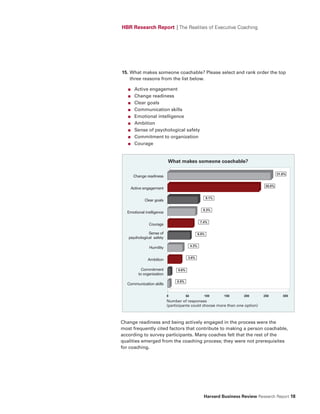
Change readiness and being actively engaged in the process were the
most frequently cited factors that contribute to making a person coachable,
according to survey participants. Many coaches felt that the rest of the
qualities emerged from the coaching process; they were not prerequisites
for coaching.


                                                         Harvard Business Review Research Report 18
HBR Research Report | The Realities of Executive Coaching


                                            16. In general, how much importance should buyers of coaching services
                                                attach to each of the following in their selections of coaches? Please
                                                rate each of the following using a scale of 1–10, with 10 being extremely
                                                important.

                                              ■     Certification in a proven coaching method
                                              ■     Experience coaching in similar setting
                                              ■     Experience working in similar setting
                                              ■     Clear methodology
                                              ■     Background in organizational development
                                              ■     Background in executive search
                                              ■     Experience as a psychological therapist
                                              ■     Experience as a coachee
                                              ■     Status as thought leader
                                              ■     Quality of client list
                                              ■     Ability to measure return on investment


              How much importance should buyers of coaching services attach to each of the following
                                        in their selections of coaches?
                                               1*        2      3       4      5*        6        7       8       9      10*
                                              16.8%    8.8%    3.6%    2.2%   24.1%     9.5%    6.6%    8.8%    8.8%    10.9%
Certification in a proven coaching method      (23)     (12)    (5)     (3)    (33)      (13)    (9)     (12)    (12)    (15)
                                              0.0%     0.7%    1.4%    0.7%   2.2%     15.9%    13.8%   24.6%   19.6%   21.0%
Experience coaching in similar setting         (0)      (1)      (2)    (1)    (3)      (22)     (19)    (34)    (27)    (29)
                                              6.0%     4.5%    6.7%    3.7%   23.1%    13.4%    15.7%   12.7%   5.2%    9.0%
Experience working in similar setting          (8)      (6)     (9)     (5)    (31)     (18)     (21)    (17)    (7)     (12)
                                              1.5%     0.0%    2.2%    3.0%   8.1%     17.0%    7.4%    18.5%   13.3%   28.9%
Clear methodology                               (2)     (0)     (3)     (4)    (11)     (23)     (10)    (25)    (18)    (39)
                                              8.1%     4.4%    7.4%    5.9%   16.2%    12.5%    10.3%   21.3%   7.4%    6.6%
Background in organizational development       (11)     (6)     (10)    (8)    (22)     (17)     (14)    (29)    (10)    (9)
                                              44.4%    10.5%   9.0%    5.3%   24.8%     3.8%    0.8%    0.0%    0.0%    1.5%
Background in executive search                 (59)     (14)    (12)    (7)    (33)      (5)     (1)     (0)     (0)      (2)
                                              27.2%    8.1%    9.6%    2.2%   24.3%     7.4%    8.1%    5.9%    2.9%    4.4%
Experience as psychological therapist          (37)     (11)    (13)    (3)    (33)      (10)    (11)    (8)     (4)     (6)
                                              6.6%     3.7%    4.4%    4.4%   16.9%    15.4%    11.8%   11.0%   8.1%    17.6%
Experience as a coachee                        (9)      (5)     (6)     (6)    (23)     (21)     (16)    (15)    (11)    (24)
                                              6.7%     4.5%    5.2%    2.2%   25.4%    14.9%    15.7%   14.2%   7.5%    3.7%
Status as thought leader in the field          (9)      (6)     (7)     (3)    (34)     (20)     (21)    (19)    (10)    (5)
                                              2.9%     2.2%    2.2%    0.7%   9.6%     11.8%    20.6%   23.5%   15.4%   11.0%
Quality of client list                         (4)      (3)     (3)     (1)    (13)     (16)     (28)    (32)    (21)    (15)
                                              2.9%     5.8%    5.8%    3.6%   16.1%    16.8%    16.8%   13.9%   9.5%    8.8%
Ability to measure return on investment        (4)      (8)     (8)     (5)    (22)     (23)     (23)    (19)    (13)    (12)
                                              3.9%     0.0%    0.0%    0.0%   3.9%      3.9%    3.9%    3.9%    11.8%   68.6%
Other                                          (2)      (0)     (0)     (0)    (2)       (2)     (2)     (2)      (6)    (35)

* 1 = Not at all important, 5 = Neutral, 10 = Extremely important


                                                                                      Harvard Business Review Research Report 19
HBR Research Report | The Realities of Executive Coaching


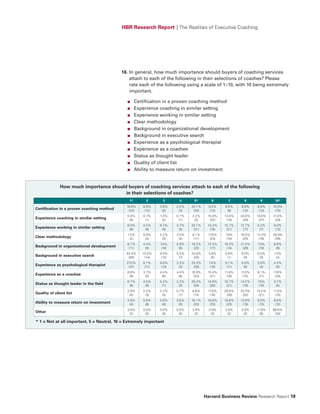
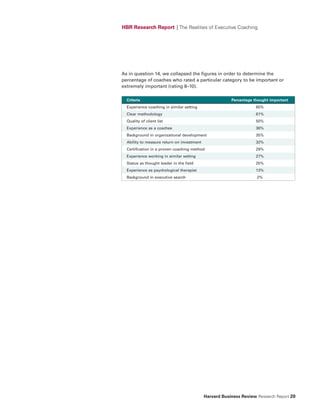
As in question 14, we collapsed the figures in order to determine the
percentage of coaches who rated a particular category to be important or
extremely important (rating 8–10).

  Criteria                                              Percentage thought important
  Experience coaching in similar setting                            65%
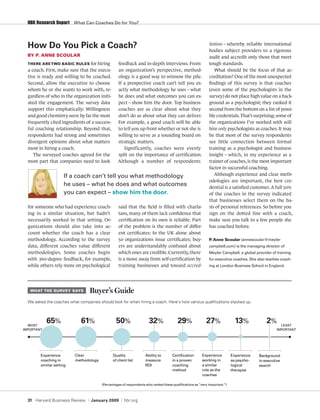
  Clear methodology                                                 61%
  Quality of client list                                            50%
  Experience as a coachee                                           36%
  Background in organizational development                          35%
  Ability to measure return on investment                           32%
  Certification in a proven coaching method                         29%
  Experience working in similar setting                             27%
  Status as thought leader in the field                             25%
  Experience as psychological therapist                             13%
  Background in executive search                                    2%


                                            Harvard Business Review Research Report 20
HBR Research Report | The Realities of Executive Coaching


17. What are the similarities and differences between coaching
    and consulting?

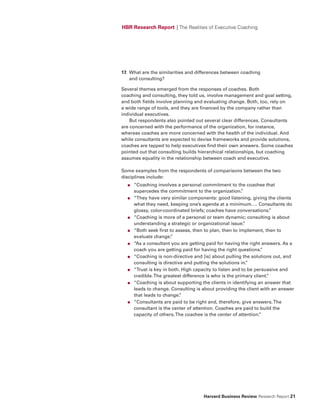
Several themes emerged from the responses of coaches. Both
coaching and consulting, they told us, involve management and goal setting,
and both fields involve planning and evaluating change. Both, too, rely on
a wide range of tools, and they are financed by the company rather than
individual executives.
    But respondents also pointed out several clear differences. Consultants
are concerned with the performance of the organization, for instance,
whereas coaches are more concerned with the health of the individual. And
while consultants are expected to devise frameworks and provide solutions,
coaches are tapped to help executives find their own answers. Some coaches
pointed out that consulting builds hierarchical relationships, but coaching
assumes equality in the relationship between coach and executive.

Some examples from the respondents of comparisons between the two
disciplines include:
  ●   “Coaching involves a personal commitment to the coachee that
      supercedes the commitment to the organization.     ”
  ●   “They have very similar components: good listening, giving the clients
      what they need, keeping one’s agenda at a minimum…. Consultants do
      glossy, color-coordinated briefs; coaches have conversations.   ”
  ●   “Coaching is more of a personal or team dynamic; consulting is about
      understanding a strategic or organizational issue.  ”
  ●   “Both seek first to assess, then to plan, then to implement, then to
      evaluate change.  ”
  ●   “As a consultant you are getting paid for having the right answers. As a
      coach you are getting paid for having the right questions.  ”
  ●   “Coaching is non-directive and [is] about pulling the solutions out, and
      consulting is directive and putting the solutions in.”
  ●   “Trust is key in both. High capacity to listen and to be persuasive and
      credible. The greatest difference is who is the primary client.
                                                                    ”
  ●   “Coaching is about supporting the clients in identifying an answer that
      leads to change. Consulting is about providing the client with an answer
      that leads to change. ”
  ●   “Consultants are paid to be right and, therefore, give answers. The
      consultant is the center of attention. Coaches are paid to build the
      capacity of others. The coachee is the center of attention.”


                                     Harvard Business Review Research Report 21
HBR Research Report | The Realities of Executive Coaching


                                                           18. What are the similarities and differences between coaching and therapy?

                                                           Coaches offered the following comparisons between the two disciplines:
                                                             ●   “Both happen in conversation; both are intimate relationships; both
                                                                 are outcome focused. Therapy includes an intentional focus on healing;
                                                                 coaching does not. Therapy presupposes a problem to be solved.
                                                                 Coaching presupposes mental health and has a more forward-looking
                                                                 focus on growth. While healing may occur as a result of coaching, it is
                                                                 not an intention.”
                                                             ●   “Executive coaching is based on achieving business results and is
                                                                 therefore focused on the client’s success in his role at work. The client’s
                                                                 past is irrelevant.
                                                                                   ”
                                                             ●   “Therapy often focuses on the past and looks at how past events have
                                                                 influenced the present. Coaching focuses on the future, visiting the
                                                                 past for perspective but creating action in the present to create new
                                                                 outcomes in the future.  ”
                                                             ●   “Therapy often begins with an assumption that the client (patient) is
                                                                 broken and needs fixing. At the very least, the therapist is focused on
                                                                 bringing the client to some level of normalcy. The coach sees his or her
                                                                 client as naturally creative, resourceful, and whole, and capable of self-
                                                                 discovery and purposeful action.  ”
                                                             ●   “Coaching focuses on solutions; therapy too often focuses on insights
                                                                 that lead to understanding, but little action.
                                                                                                              ”
                                                             ●   “Coaching and therapy should never [be] blurred. It is imperative that
                                                                 a coach knows when a person needs a therapist versus a coach, and
                                                                 [he or she] should have referral sources for clients that need that
                                                                 kind of help. ”
                                                             ●   “They both invite self reflection and self awareness and behavior
                                                                 change. They both create safe spaces for doing so.  ”

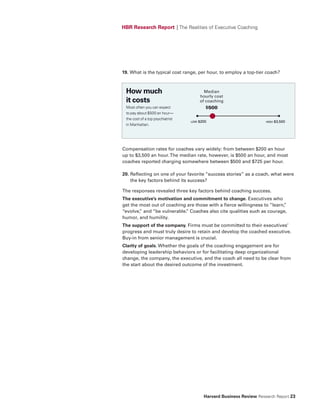
Comparison of the answers from questions 17 and 18
CONSuLTING                       Overlap                         COACHING                        Overlap                          THERAPy
Focuses on organizational        Advises individual leaders on   Focuses on the future           Paid to ask the right            Focuses on the past
performance                      business matters                                                questions
Paid to come up with             Involves management in goal     Works with healthy              Tackles difficult issues at      Diagnoses and treats
answers and frameworks           setting                         individuals                     work and home                    dysfunctionality
Provides expert advice on        Plans, evaluates, and           Helps executives to discover    Focuses on individual            Sets cure as the primary goal
business matters                 assesses change                 their own path                  behavioral change
Strives for objectivity          Uses broad array of tools       Fosters individual              Explores subjective              Paid for by the individual
                                                                 performance in a business       experience
                                                                 context
Provides quantitative analysis   Based on organizational         Advises individual leaders on   Tolerates failure                Based on medical ethics
of problems                      ethics                          business matters
Builds hierarchical              Paid for by the company         Assumes an equal                Builds individual capabilities   Confidentiality is protected
relationships                                                    relationship between the                                         by law
                                                                 executive and coach
Shared by Consultants, Coaches, and Therapists:
Rely heavily on trust-based relationships
Honor the confidentiality needs of the client
Keep their personal agenda at a minimum
Build on other disciplines


                                                                                                           Harvard Business Review Research Report 22
HBR Research Report | The Realities of Executive Coaching


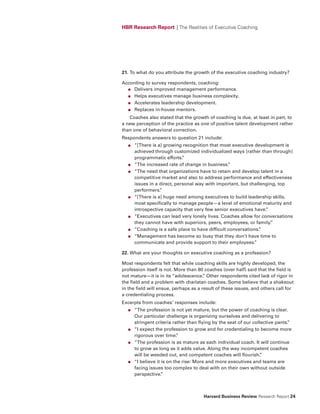
19. What is the typical cost range, per hour, to employ a top-tier coach?


 How much                                 Median
                                        hourly cost
 it costs                               of coaching
 Most often you can expect                 $500
 to pay about $500 an hour—
 the cost of a top psychiatrist
                                  low   $200                          high   $3,500
 in Manhattan.


Compensation rates for coaches vary widely: from between $200 an hour
up to $3,500 an hour. The median rate, however, is $500 an hour, and most
coaches reported charging somewhere between $500 and $725 per hour.

20. Reflecting on one of your favorite “success stories” as a coach, what were
    the key factors behind its success?

The responses revealed three key factors behind coaching success.
The executive’s motivation and commitment to change. Executives who
get the most out of coaching are those with a fierce willingness to “learn,
                                                                          ”
“evolve, and “be vulnerable. Coaches also cite qualities such as courage,
        ”                   ”
humor, and humility.
The support of the company. Firms must be committed to their executives’
progress and must truly desire to retain and develop the coached executive.
Buy-in from senior management is crucial.
Clarity of goals. Whether the goals of the coaching engagement are for
developing leadership behaviors or for facilitating deep organizational
change, the company, the executive, and the coach all need to be clear from
the start about the desired outcome of the investment.


                                          Harvard Business Review Research Report 23
HBR Research Report | The Realities of Executive Coaching


21. To what do you attribute the growth of the executive coaching industry?

According to survey respondents, coaching:
  ● Delivers improved management performance.

  ● Helps executives manage business complexity.

  ● Accelerates leadership development.

  ● Replaces in-house mentors.

   Coaches also stated that the growth of coaching is due, at least in part, to
a new perception of the practice as one of positive talent development rather
than one of behavioral correction.
Respondents answers to question 21 include:
  ●   “[There is a] growing recognition that most executive development is
      achieved through customized individualized ways [rather than through]
      programmatic efforts.  ”
  ●   “The increased rate of change in business.  ”
  ●   “The need that organizations have to retain and develop talent in a
      competitive market and also to address performance and effectiveness
      issues in a direct, personal way with important, but challenging, top
      performers. ”
  ●   “[There is a] huge need among executives to build leadership skills,
      most specifically to manage people—a level of emotional maturity and
      introspective capacity that very few senior executives have.”
  ●   “Executives can lead very lonely lives. Coaches allow for conversations
      they cannot have with superiors, peers, employees, or family. ”
  ●   “Coaching is a safe place to have difficult conversations.
                                                               ”
  ●   “Management has become so busy that they don’t have time to
      communicate and provide support to their employees.    ”

22. What are your thoughts on executive coaching as a profession?

Most respondents felt that while coaching skills are highly developed, the
profession itself is not. More than 80 coaches (over half) said that the field is
not mature—it is in its “adolescence. Other respondents cited lack of rigor in
                                       ”
the field and a problem with charlatan coaches. Some believe that a shakeout
in the field will ensue, perhaps as a result of these issues, and others call for
a credentialing process.
Excerpts from coaches’ responses include:
  ●   “The profession is not yet mature, but the power of coaching is clear.
      Our particular challenge is organizing ourselves and delivering to
      stringent criteria rather than flying by the seat of our collective pants.
                                                                               ”
  ●   “I expect the profession to grow and for credentialing to become more
      rigorous over time.  ”
  ●   “The profession is as mature as each individual coach. It will continue
      to grow as long as it adds value. Along the way incompetent coaches
      will be weeded out, and competent coaches will flourish.    ”
  ●   “I believe it is on the rise: More and more executives and teams are
      facing issues too complex to deal with on their own without outside
      perspective.  ”


                                      Harvard Business Review Research Report 24
HBR Research Report | The Realities of Executive Coaching


                                            ●   “It is still in its infancy and suffers from a lack of clear standards….
Carol Kauffman plans to continue                Buyer beware is the motto right now.       ”
researching the field of coaching. If       ●   “There are a lot of charlatans out there who give the profession a bad
you are interested in participating in
                                                name. I expect it will become more professionalized over time.      ”
further studies, please contact her at
                                            ●   “This is a business that needs a shakeout. More money is being made
Carol_Kauffman@hms.harvard.edu.
                                                in coach education than in coaching, and the lack of entry barriers (other
                                                than marketing) is a problem.     ”
                                            ●   “The industry is maturing. We will see more coaches coming from
                                                university graduate programs as it becomes more of a recognized
                                                profession.    ”
                                            ●   “It’s not mature yet. I worry that there are many people out there who
                                                believe because they’ve worked in business they can be a coach without
                                                any training.    ”

                                         23. Please provide us with any other insights you have about the realities of
                                             coaching that we have not yet addressed.

                                         Our open-ended question prompted a variety of responses:
                                            ●   “Corporations need to be trained how to identify excellence in a coach,
                                                just as they identify excellence in a business consultant. It might be very
                                                interesting for HBR to look at what makes a great executive coach.    ”
                                            ●   “Knowing what type of coaching best serves the immediate and
                                                long-term needs of clients is important. Like in medicine, sometimes a
                                                specialist is what is needed.”
                                            ●   “[There is a] need to standardize the professions without stifling it.”
                                            ●   “To be credible, coaching must codify its purpose, objective,
                                                methodologies, and ethics and generate credible research that
                                                measures real impact.   ”
                                            ●   “Coaching is particularly effective with mid-career women looking for a
                                                second wind or who are ready to play a bigger game.    ”
                                            ●   “I think your survey has missed the human dimension as a grounding
                                                philosophy for coaching. To the extent that leaders can embrace
                                                their own humanity, honor their imperfect-ness and embrace more
                                                wholeness, [we will] actually have more productive companies.     ”
                                            ●   “Organizational politics and procedures can restrict coaching’s potential
                                                as a key component of positive change.    ”
                                            ●   “The skilled worker is someone who can adapt styles/tools/processes
                                                to meet the needs of the coachee within the business context. It is
                                                important to remember that the client is the paying organization.   ”
                                            ●   “Few, if any, coach-training companies have a system whereby they
                                                only accredit the best coaches on their courses. [This practice] only
                                                increases the number of mediocre coaches in the market.     ”
                                            ●   “I think that the ROI aspect of the process needs to be addressed more
                                                fully. To do this, you need coaches skilled in assessment, statistics, and
                                                psychometrics.   ”

                                         These survey results shed new light on the current state of coaching practice.


                                                                                Harvard Business Review Research Report 25
HBR Research Report
                   by diane coutu and
                   carol kauffman


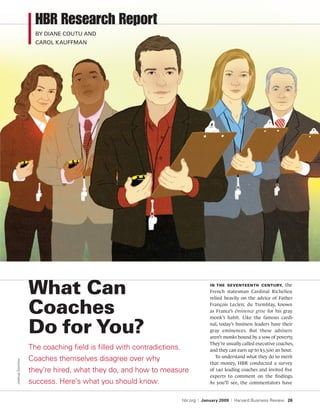
                 What can                                                             In the seventeenth century, the
                                                                                      French statesman Cardinal Richelieu
                                                                                      relied heavily on the advice of Father

                 coaches                                                              François Leclerc du Tremblay, known
                                                                                      as France’s éminence grise for his gray
                                                                                      monk’s habit. Like the famous cardi-

                 Do for you?                                                          nal, today’s business leaders have their
                                                                                      gray eminences. But these advisers
                                                                                      aren’t monks bound by a vow of poverty.
                                                                                      They’re usually called executive coaches,
                 The coaching field is filled with contradictions.                    and they can earn up to $3,500 an hour.
                                                                                         To understand what they do to merit
                 Coaches themselves disagree over why
Joshua Gorchov


                                                                                      that money, HBR conducted a survey
                 they’re hired, what they do, and how to measure                      of 140 leading coaches and invited five
                                                                                      experts to comment on the findings.
                 success. Here’s what you should know.                                As you’ll see, the commentators have


                                                                     hbr.org   |   January 2009   |   Harvard Business Review 26
HBR Research Report What can coaches do for you?


conflicting views about where the field               What the coaches say
is going – and ought to go – reflecting
the contradictions that surfaced among
the respondents. Commentators and
coaches alike felt that the bar needs to
be raised in various areas for the indus-             Did you know…
try to mature, but there was no consen-
sus on how that could be done. They
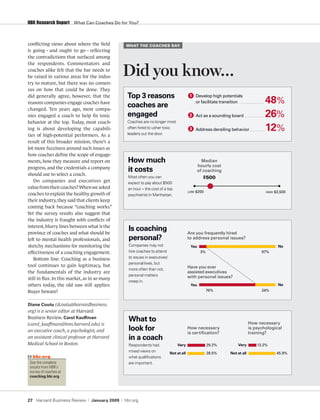
did generally agree, however, that the                 Top 3 reasons                             1 develop high potentials
reasons companies engage coaches have
                                                       coaches are
                                                                                                   or facilitate transition               48%
changed. Ten years ago, most compa-
nies engaged a coach to help fix toxic                 engaged                                   2 act as a sounding board                26%
behavior at the top. Today, most coach-                Coaches are no longer most
ing is about developing the capabili-                  often hired to usher toxic
                                                       leaders out the door.
                                                                                                 3 address derailing behavior             12%
ties of high-potential performers. As a
result of this broader mission, there’s a
lot more fuzziness around such issues as
how coaches define the scope of engage-
ments, how they measure and report on                  How much                                          median
                                                                                                       hourly cost
progress, and the credentials a company
                                                       it costs                                        of coaching
should use to select a coach.
                                                       Most often you can                                $500
   Do companies and executives get                     expect to pay about $500
value from their coaches? When we asked                an hour – the cost of a top
                                                                                                      $200                                       $3,500
coaches to explain the healthy growth of
                                                                                                low                                       high
                                                       psychiatrist in Manhattan.
their industry, they said that clients keep
coming back because “coaching works.”
Yet the survey results also suggest that
the industry is fraught with conflicts of
interest, blurry lines between what is the
province of coaches and what should be
                                                        Is coaching                             are you frequently hired
left to mental health professionals, and                personal?                               to address personal issues?
sketchy mechanisms for monitoring the                   Companies may not                        Yes                                               No
effectiveness of a coaching engagement.                 hire coaches to attend                          3%                              97%
   Bottom line: Coaching as a business                  to issues in executives’
                                                        personal lives, but
tool continues to gain legitimacy, but                                                          Have you ever
                                                        more often than not,
the fundamentals of the industry are                                                            assisted executives
                                                        personal matters                        with personal issues?
still in flux. In this market, as in so many
                                                        creep in.
others today, the old saw still applies:                                                         Yes                                               No
Buyer beware!                                                                                                76%                        24%


Diane Coutu (dcoutu@harvardbusiness.
org) is a senior editor at Harvard
Business Review. Carol Kauffman                         What to
(carol_kauffman@hms.harvard.edu) is                                                                                               How necessary
an executive coach, a psychologist, and                 look for                                How necessary
                                                                                                is certification?
                                                                                                                                  is psychological
                                                                                                                                  training?
an assistant clinical professor at Harvard              in a coach                                                                          No
Medical School in Boston.                               Respondents had                Very                  29.2%       Very         13.2% 45%
                                                        mixed views on             Not at all                28.5%   Not at all                   45.9%
  hbr.org                                               what qualifications
 See the complete                                       are important.
 results from HBR’s
   online tools
 survey of coaches at
 coaching.hbr.org.
  hbr.org


27 Harvard Business Review     |   January 2009   |   hbr.org
What the experts say


                                            The Coaching Industry: A Work in Progress
                                            by ram charan
                                            there’s no questIon     that future lead-         this direction, but most are still boutique
                                            ers will need constant coaching. As the           firms specializing in, for example, ad-
Who is                                      business environment becomes more                 ministering and interpreting 360-degree
                                            complex, they will increasingly turn to           evaluations. To get beyond this level, the
involved?                                   coaches for help in understanding how             industry badly needs a leader who can
Though they acknowledged
                                            to act. The kind of coaches I am talk-            define the profession and create a seri-
that confidentiality was central
to successful coaching,
                                            ing about will do more than influence             ous firm in the way that Marvin Bower
respondents said that in most
cases, they gave updates                                       the industry badly needs a leader who can
on coachees’ progress to
other stakeholders in the
                                                               define the profession, the way marvin bower
organization.                                                  did for management consulting.

                                            behaviors; they will be an essential part         did when he invented the modern pro-
Who typically initiates the                 of the leader’s learning process, provid-         fessional management consultancy in
coaching relationship?
                                            ing knowledge, opinions, and judgment             the form of McKinsey & Company.
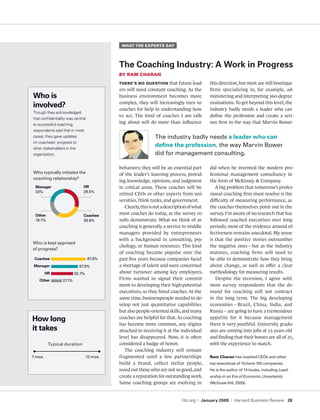
 Manager                      HR            in critical areas. These coaches will be             A big problem that tomorrow’s profes-
 23%                          29.5%
                                            retired CEOs or other experts from uni-           sional coaching firm must resolve is the
                                            versities, think tanks, and government.           difficulty of measuring performance, as
                                               Clearly, this is not a description of what     the coaches themselves point out in the
 Other                        Coachee
                                            most coaches do today, as the survey re-          survey. I’m aware of no research that has
 18.7%                        28.8%         sults demonstrate. What we think of as            followed coached executives over long
                                            coaching is generally a service to middle         periods; most of the evidence around ef-
                                            managers provided by entrepreneurs                fectiveness remains anecdotal. My sense
                                            with a background in consulting, psy-             is that the positive stories outnumber
Who is kept apprised
                                            chology, or human resources. This kind            the negative ones – but as the industry
of progress?
                                            of coaching became popular over the               matures, coaching firms will need to
 Coachee                           87.9%    past five years because companies faced           be able to demonstrate how they bring
 Manager                    67.9%           a shortage of talent and were concerned           about change, as well as offer a clear
         HR               55.7%             about turnover among key employees.               methodology for measuring results.
   Other          27.1%                     Firms wanted to signal their commit-                 Despite the recession, I agree with
                                            ment to developing their high-potential           most survey respondents that the de-
                                            executives, so they hired coaches. At the         mand for coaching will not contract
                                            same time, businesspeople needed to de-           in the long term. The big developing
                                            velop not just quantitative capabilities          economies – Brazil, China, India, and
                                            but also people-oriented skills, and many         Russia – are going to have a tremendous
How long                                    coaches are helpful for that. As coaching         appetite for it because management
                                            has become more common, any stigma                there is very youthful. University gradu-
it takes                                    attached to receiving it at the individual        ates are coming into jobs at 23 years old
                                            level has disappeared. Now, it is often           and finding that their bosses are all of 25,
          typical duration                  considered a badge of honor.                      with the experience to match.
                                               The coaching industry will remain
7 mos.                            12 mos.   fragmented until a few partnerships               ram charan has coached ceos and other
                                            build a brand, collect stellar people,            top executives of Fortune 100 companies.
                                            weed out those who are not so good, and           He is the author of 14 books, including Lead­
                                            create a reputation for outstanding work.         ership in an Era of Economic Uncertainty
                                            Some coaching groups are evolving in              (mcGraw-Hill, 2009).


                                                                             hbr.org   |   January 2009   |   Harvard Business Review 28
HBR Research Report What can coaches do for you?


                                                                                               Often companies have no idea what the
Does Your Coach Give You Value                                                                 coaches are really doing.
for Your Money?                                                                                   One reason seems to be that coaches
                                                                                               can be very lax in evaluating the impact
by DavID b. peterson
                                                                                               of their work and communicating results
Forty years ago, no one talked about           ance. It’s rare that companies hire busi-       to executives and stakeholders. While
executive coaching. Twenty years ago,          ness coaches to address non-work issues         70% of coaches surveyed said they pro-
coaching was mainly directed at talented       (only 3% of coaches said they were hired        vide qualitative assessment of progress,
but abrasive executives who were likely        primarily to attend to such matters), yet       fewer than one-third ever give feedback
to be fired if something didn’t change.        more than three-quarters of coaches             in the form of quantitative data on be-
Today, coaching is a popular and potent        report having gotten into personal ter-         haviors, and less than one-fourth provide
solution for ensuring top performance          ritory at some time. In part this reflects      any kind of quantitative data on business
                                                                                               outcomes of the coaching engagement.
                     fewer than one-fourth of the respondents                                  Even this may represent a somewhat
                                                                                               optimistic picture, given that this data
                     said they provide any kind of quantitative data
                                                                                               comes from the coaches themselves.
                     on business outcomes of the coaching.                                        While it can be difficult to draw ex-
                                                                                               plicit links between coaching interven-
from an organization’s most critical tal-      the extensive experience of the coaches         tion and an executive’s performance, it
ent. Almost half the coaches surveyed in       in this survey (only 10% had five years or      is certainly not difficult to obtain basic
this study reported that they are hired        less experience). It also underscores the       information about improvements in
primarily to work with executives on the       fact that for most executives, work and         that executive’s managerial behaviors.
positive side of coaching – developing         life issues cannot be kept entirely sepa-       Coaching is a time-intensive and expen-
high-potential talent and facilitating a       rate. This is particularly true of senior       sive engagement, and organizations that
transition in or up. Another 26% said          executives who spend grueling hours             hire coaches should insist on getting reg-
that they are most often called in to act      on the job and are often on the road            ular and formal progress reviews, even if
as a sounding board on organizational          and away from home. Many of them                they are only qualitative. Judging from
dynamics or strategic matters. Relatively      feel some strain on their personal lives.       this survey, companies won’t get them
few coaches said that organizations most       Not surprisingly, therefore, the more           unless they ask for them.
often hire them to address a derailing         coaches can tap into a leader’s motiva-
behavior.                                      tion to improve his or her home life, the       David b. peterson (david.peterson@
   The research also revealed an impor-        greater and more lasting the impact of          personneldecisions.com) is a senior vice
tant insight about what companies ask          the coaching is likely to be at work.           president at Personnel decisions international
coaches to do and what they actually              The problem is when organizations            in minneapolis and leads Pdi’s executive
end up doing. Consider work/life bal-          ask for one thing and get something else.       coaching practice.


 What the survey says               Ingredients of a successful coaching relationship
                                                                                                          Is there a
                                                                                                                 strong
         Is the executive                                  Does the executive                             commitment from
         highly motivated                                  have good chemistry                            top management to
         to change?                                        with the coach?                                developing the executive?


     yes                   no                             yes                no                       yes                     no
executives who         do not engage               the right match      do not engage             the firm must         do not engage a
get the most out       a coach to fix              is absolutely key    a coach on the            have a true           coach if the real
of coaching have       behavioral prob-            to the success       basis of reputation       desire to retain      agenda is to push
a fierce desire to     lems. blamers,              of a coaching        or experience             and develop           the executive
learn and grow.        victims, and                experience.          without making            the coached           out or to fix a
                       individuals with            Without it, the      sure that the fit is      executive.            systemic issue
                       iron-clad belief            trust required for   right.                                          beyond the control
                       systems don’t               optimal executive                                                    of the coached
                       change.                     performance will                                                     individual.
                                                   not develop.


29 Harvard Business Review      |   January 2009   |   hbr.org
but creative subordinates. All this takes
The Dangers of Dependence                                                                              more time – and money. Extending con-
on Coaches                                                                                             tracts is not necessarily unethical. Just
                                                                                                       be aware that your coach may be asking
by mIchael maccoby
                                                                                                       you to recontract for more than you bar-
all coaches recognIze             that they       to be a coach. What this means for you is            gained for or really need.
should be making you more competent               that before you hire a coach, you should                Two particular kinds of shift in fo-
and self-reliant. If the coaching rela-           ask him how he handles dependency in                 cus, though, are dangerous and should
tionship isn’t doing that, it’s very likely       relationships.                                       be avoided. One is when a behavioral-
that you’re becoming overly depen-                   A related finding of the survey de-               ist coach (my term for someone who
dent. Dependence isn’t always bad, of             serves special attention: Although al-               monitors your behavior) seduces you
course – friends relying on one another,          most 90% of the respondents reported                 into a form of psychotherapy without
for example, is a good thing. But we all          that they establish a time frame prior               making that explicit. For example, he
know people who can’t make a decision             to starting an engagement, all but eight             or she may say that you are now ready
without first talking to their psycho-            said that the focus of the assignment                to explore deeper issues that keep you
therapists, and some executives defer to          shifts from the original intent. There are           from realizing your full potential. The
their coaches in the same way. They have          no data in the survey about the mechan-              other is when personal coaches morph
conversations with the coach that they            ics of how those engagements shift, but              into business advisers. In these cases,
ought to be having with other executives
in the C-suite or with their teams.                                   coaches have an economic incentive
   The data in this survey show that
                                                                      to ignore the problem of dependency,
more than half of the respondents think
their clients do not become overly de-                                creating a potential conflict of interest.
pendent on them. In my view, that’s
unrealistic. Coaches have an economic             in my 35 years of working in the field, I            your coach becomes a kind of speaking
incentive to ignore the problem of de-            have observed that it’s typically a matter           partner – someone you can bounce stra-
pendency, creating a potential conflict           of coaches recontracting with executives.            tegic ideas off of. That can be just as dan-
of interest. It’s natural for them to want        Coaches who are essentially consultants              gerous because it’s a rare coach who has
to expand their business, but the best            may have a contract with you to work                 deep knowledge about your business.
coaches, like the best therapists, put            out strategy, for example, and then may
their clients’ interests first. Harry Levin-      offer to stay on to help with implemen-              michael maccoby is the president of
son, the father of coaching, worked with          tation. Or if you hire a coach to help you           the maccoby Group in Washington, dc, and
the top executives of his day. He said            be a better team player, she may suggest             is the author of Narcissistic Leaders: Who
that if a coach wasn’t aware of the de-           that you need additional work in man-                Succeeds and Who Fails (Harvard business
pendency dynamic, then he had no right            aging upward or working with difficult               School Press, 2007).


 What the survey says             Does the focus of coaching engagements shift?
All but eight of the 140 respondents said that over time their focus shifts from what they were originally hired to do.


    “Absolutely! It starts out with a                                            “Generally no. If the assignment
     business bias and inevitably mi-                                             is set up properly, the issues
     grates to ‘bigger issues’ such as                                            are usually very clear before the
     life purpose, work/life balance,                                             assignment gets started.”
     and becoming a better leader.”


                                                                                      hbr.org   |   January 2009   |   Harvard Business Review 30
HBR Research Report What can coaches do for you?


  How Do You Pick a Coach?                                                                                    itation – whereby reliable international
                                                                                                              bodies subject providers to a rigorous
  by p. anne scoular                                                                                          audit and accredit only those that meet
  there are tWo basIc rules for hiring             feedback and in-depth interviews. From                     tough standards.
  a coach. First, make sure that the execu-        an organization’s perspective, method-                        What should be the focus of that ac-
  tive is ready and willing to be coached.         ology is a good way to winnow the pile.                    creditation? One of the most unexpected
  Second, allow the executive to choose            If a prospective coach can’t tell you ex-                  findings of this survey is that coaches
  whom he or she wants to work with, re-           actly what methodology he uses – what                      (even some of the psychologists in the
  gardless of who in the organization initi-       he does and what outcomes you can ex-                      survey) do not place high value on a back-
  ated the engagement. The survey data             pect – show him the door. Top business                     ground as a psychologist; they ranked it
  support this emphatically: Willingness           coaches are as clear about what they                       second from the bottom on a list of possi-
  and good chemistry were by far the most          don’t do as about what they can deliver.                   ble credentials. That’s surprising; some of
  frequently cited ingredients of a success-       For example, a good coach will be able                     the organizations I’ve worked with will
  ful coaching relationship. Beyond that,          to tell you up front whether or not she is                 hire only psychologists as coaches. It may
  respondents had strong and sometimes             willing to serve as a sounding board on                    be that most of the survey respondents
  divergent opinions about what matters            strategic matters.                                         see little connection between formal
  most in hiring a coach.                             Significantly, coaches were evenly                      training as a psychologist and business
     The surveyed coaches agreed for the           split on the importance of certification.                  insight – which, in my experience as a
  most part that companies need to look            Although a number of respondents                           trainer of coaches, is the most important
                                                                                                              factor in successful coaching.
                     if a coach can’t tell you what methodology                                                  Although experience and clear meth-
                                                                                                              odologies are important, the best cre-
                     he uses – what he does and what outcomes                                                 dential is a satisfied customer. A full 50%
                     you can expect – show him the door.                                                      of the coaches in the survey indicated
                                                                                                              that businesses select them on the ba-
  for someone who had experience coach-            said that the field is filled with charla-                 sis of personal references. So before you
  ing in a similar situation, but hadn’t           tans, many of them lack confidence that                    sign on the dotted line with a coach,
  necessarily worked in that setting. Or-          certification on its own is reliable. Part                 make sure you talk to a few people she
  ganizations should also take into ac-            of the problem is the number of differ-                    has coached before.
  count whether the coach has a clear              ent certificates: In the UK alone about
  methodology. According to the survey             50 organizations issue certificates; buy-                  p anne scoular (annescoular@meyler
                                                                                                               .
  data, different coaches value different          ers are understandably confused about                      campbell.com) is the managing director of
  methodologies. Some coaches begin                which ones are credible. Currently, there                  meyler campbell, a global provider of training
  with 360-degree feedback, for example,           is a move away from self-certification by                  for executive coaches. She also teaches coach-
  while others rely more on psychological          training businesses and toward accred-                     ing at london business School in england.


   What the survey says              Buyer’s Guide
  We asked the coaches what companies should look for when hiring a coach. Here's how various qualifications stacked up.


  moSt
            65%               61%                 50%                  32%                29%               27%                13%            2%      leaSt
imPortant                                                                                                                                           imPortant


        experience        clear                 Quality              ability to       certification       experience         experience   background
        coaching in       methodology           of client list       measure          in a proven         working in         as psycho-   in executive
        similar setting                                              roi              coaching            a similar          logical      search
                                                                                      method              role as the        therapist
                                                                                                          coachee

                                         (Percentages of respondents who ranked these qualifications as “very important.”)


  31 Harvard Business Review     |   January 2009    |   hbr.org
Coach or Couch?                                                                                               ety. This raises important questions for
                                                                                                              companies hiring coaches – for instance,
by anthony m. grant                                                                                           whether a nonpsychologist coach can
coachIng DIFFers DramatIcally                          coaching those who have unrecognized                   ethically work with an executive who
from therapy. That’s according to the                  mental health problems can be coun-                    has an anxiety disorder.
majority of coaches in our survey, who                 terproductive and even dangerous. The                     Given that some executives will have
cite distinctions such as that coaching                vast majority of executives are unlikely               mental health problems, firms should
focuses on the future, whereas therapy                 to ask for treatment or therapy and                    require that coaches have some training
focuses on the past. Most respondents                  may even be unaware that they have                     in mental health issues – for example,
maintained that executive clients tend                 problems requiring it. That’s worrisome,               an understanding of when to refer cli-
                                                                                                              ents to professional therapists for help.
                   organizations should require that                                                          Indeed, businesses that do not demand
                                                                                                              such training in the coaches they hire
                   coaches have some training in mental
                                                                                                              are failing to meet their ethical obliga-
                   health issues.                                                                             tions to care for their executives.

to be mentally “healthy,” whereas ther-                because contrary to popular belief, it’s               anthony m. grant (anthonyg@psych.usyd.
apy clients have psychological problems.               not always easy to recognize depression                    edu.au) is the founder and director of the
In the respondents’ view, coaching does                or anxiety without proper training. An                     coaching Psychology unit at the university
not seek to treat psychological problems,              executive is far more likely to complain                   of Sydney in australia.
such as depression or anxiety.                         of difficulties related to time manage-
                                                                                                                   Reprint R0901H
   It’s true that coaching does not and                ment, interpersonal communication, or
                                                                                                                   To order, see page 119.
should not aim to cure mental health                   workplace disengagement than of anxi-
problems. However, the notion that
candidates for coaching are usually
                                                       the survey
mentally robust flies in the face of aca-                                                                     n   Respondents were divided equally into men
                                                       Methodology and Respondents
demic research. Studies conducted by                                                                              and women.
                                                       The analysis presented here is drawn from an
the University of Sydney, for example,                 online survey developed by senior editors at
                                                                                                              n   The coaches are primarily from the United
                                                                                                                  States (71%) and the United Kingdom (18%).
have found that between 25% and 50%                    Harvard Business Review and Carol Kauffman             n   66% of respondents disclosed that coaching
of those seeking coaching have clini-                  of Harvard Medical School. They compiled a                 is their primary source of income.
cally significant levels of anxiety, stress,           list of potential participants through their direct    n   The group is highly experienced: 61% have
                                                       contacts, referrals from senior executives and
or depression.                                                                                                    been in the business more than 10 years.
                                                       HBR authors, and executive-coaching training or-           50% of respondents come from the fields
   I’m not suggesting that most execu-
                                                                                                              n

                                                       ganizations. Nearly 200 survey invitations were            of business or consulting
tives who engage coaches have mental                   distributed by e-mail, and data were compiled          n   20% of respondents come from the field
health disorders. But some might, and                  from 140 respondents.                                      of psychology


 What the survey says               Coaching borrows from both consulting and therapy

                                                                        Coaching
             Consulting                                                                                                              Therapy

          Paid to come up with       advises individual              Focuses on the            Paid to ask the right              focuses on the past
          answers                    leaders on business                 future                questions
                                                                                                                                  diagnoses and treats
                                     matters
          focuses on organiza-                                                                 tackles difficult issues           dysfunctionality
          tional performance         involves manage-
                                                                   Fosters individual          at work and home
                                                                     performance in                                               based on medical
                                     ment in goal setting
          Strives for objectivity                                  a business context          focuses on individual              ethics
                                     based on organiza-                                        behavioral change
          Provides quantitative                                                                                                   Paid for by the
                                     tional ethics                  Helps executives
          analysis of problems                                                                 explores subjective                individual
                                     Paid for by the                 discover their            experience
                                     company                           own path


                                                                                             hbr.org   |   January 2009       |   Harvard Business Review 32