White Box Testing 
Len Schroath 
September 18, 2007
Agenda 
• White-box vs Black-box 
• Program Flow Controls 
• White-box Test Methods 
• Exercises 
• Complexity 
• Q&A
What is White-box Testing? 
• Looking at the internal structure of a program 
and deriving test cases based on the logic or 
control flow. 
• Test cases can be designed to reach every 
branch in the code and to exercise each 
condition 
• Typically done during unit testing 
• Also known as: 
– Structural Testing 
– Glass-Box Testing
What is Black-box Testing? 
• Looking at the program from an external 
point of view and deriving test cases 
based on the specification. 
• The only criteria upon which the program 
is judged is if it produces the correct 
output for a given input.
Why Do Both? 
Black-box 
• Impossible to write a test 
case for every possible 
set of inputs and outputs 
• Some of the code may 
not be reachable without 
extraordinary measures 
• Specifications are not 
always complete 
White-box 
• Does not address the 
question of whether or 
not the program matches 
the specification 
• Does not tell you if all of 
the functionality has been 
implemented 
• Does not discover 
missing program logic
Basic Program Flow Controls 
• IF 
• IF-Then-Else 
• FOR 
• While 
• Do-While 
• Case
IF Diagram
IF-THEN-ELSE Diagram
FOR or WHILE Diagram
DO-WHILE Diagram
CASE Diagram
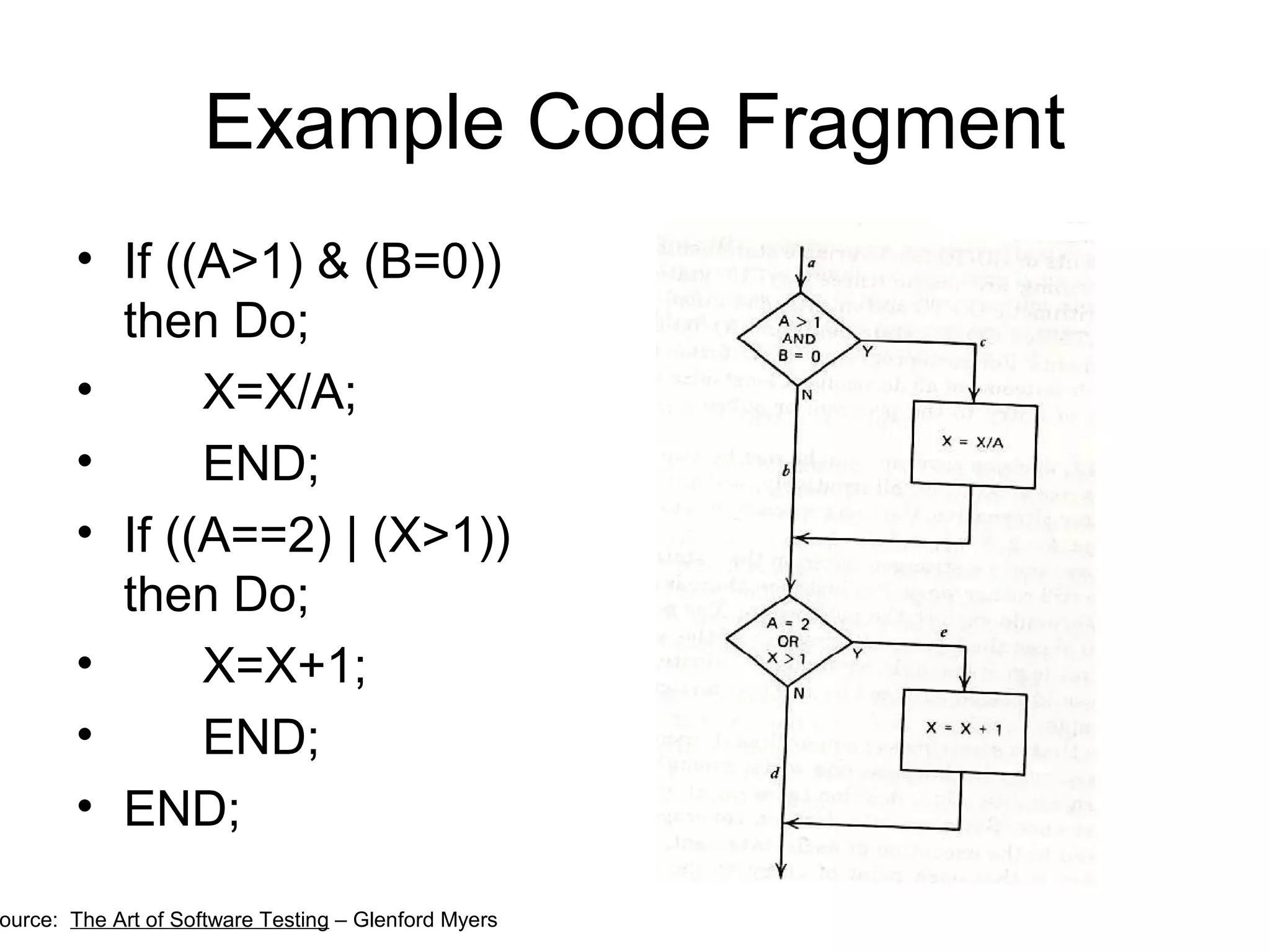
Example Code Fragment
Example Control Flow Graph 
Source: The Art of Software Testing – Glenford Myers
Exercise #1 
• int main (int argc, char *argv[]) 
• { 
• /* Process CTRL-C Interrupts */ 
• signal(SIGINT,catcher); 
• if (validate_command_line(argc)) return(1); 
• if (job_initialize(argv)) return(1); 
• processTestList(); /* Process all testCases in 
TestList */ 
• displayResults(); 
• fprintf(stdout,"Test Completen"); 
• job_termination(); 
• return(0); 
• } /* main */ Can you diagram 
this code?
Did You Get Something Like This?
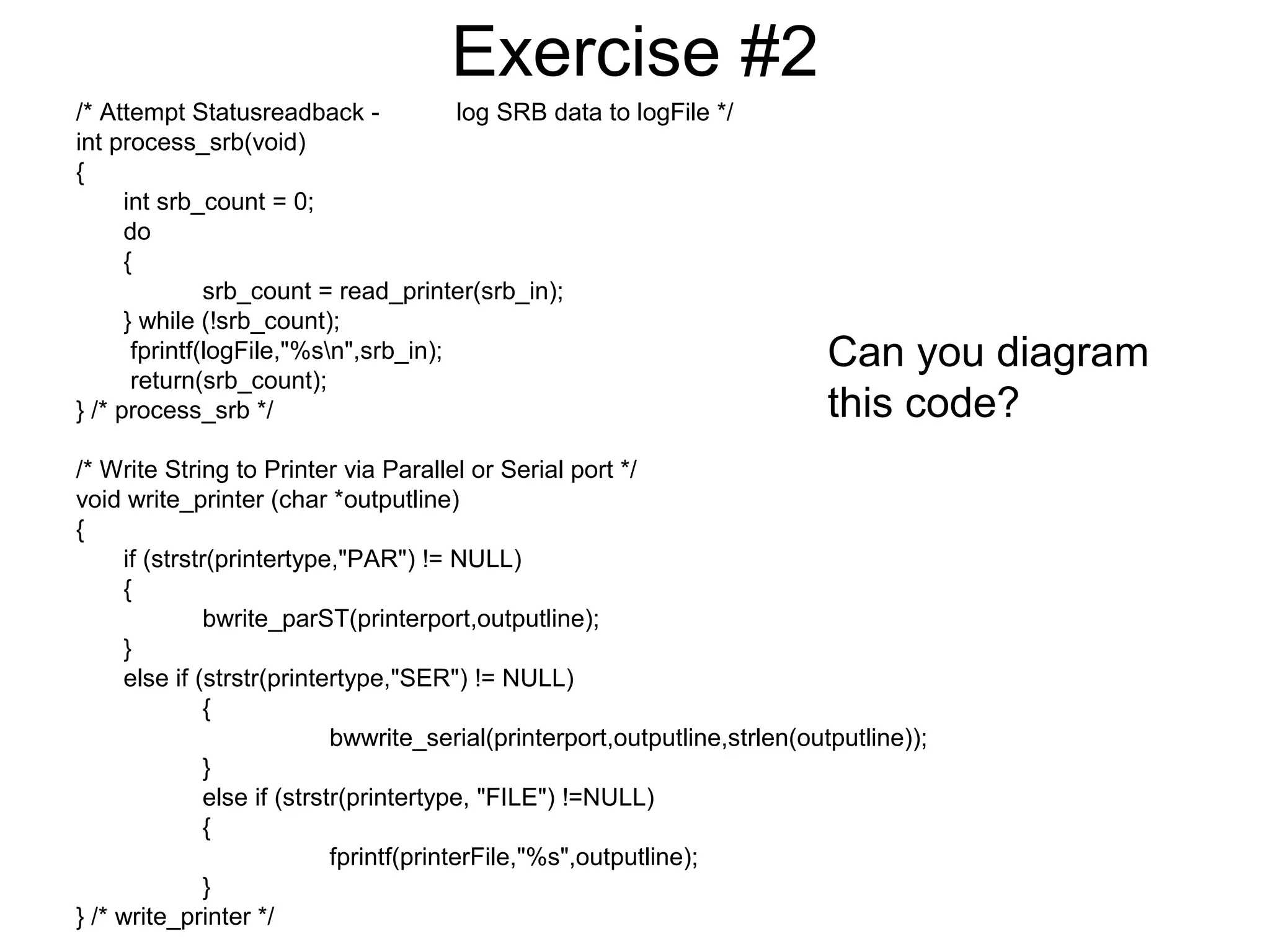
Exercise #2 
/* Attempt Statusreadback - log SRB data to logFile */ 
int process_srb(void) 
{ 
int srb_count = 0; 
do 
{ 
srb_count = read_printer(srb_in); 
} while (!srb_count); 
fprintf(logFile,"%sn",srb_in); 
return(srb_count); 
} /* process_srb */ 
/* Write String to Printer via Parallel or Serial port */ 
void write_printer (char *outputline) 
{ 
if (strstr(printertype,"PAR") != NULL) 
{ 
bwrite_parST(printerport,outputline); 
} 
else if (strstr(printertype,"SER") != NULL) 
{ 
bwwrite_serial(printerport,outputline,strlen(outputline)); 
} 
else if (strstr(printertype, "FILE") !=NULL) 
{ 
fprintf(printerFile,"%s",outputline); 
} 
} /* write_printer */ 
Can you diagram 
this code?
Did You Get Something Like This?
White-box Test Methods 
• Statement Coverage 
• Decision/Branch Coverage 
• Condition Coverage 
• Decision/Condition Coverage 
• Path Coverage
Example Code Fragment 
• If ((A>1) & (B=0)) 
then Do; 
• X=X/A; 
• END; 
• If ((A==2) | (X>1)) 
then Do; 
• X=X+1; 
• END; 
• END; 
Source: The Art of Software Testing – Glenford Myers
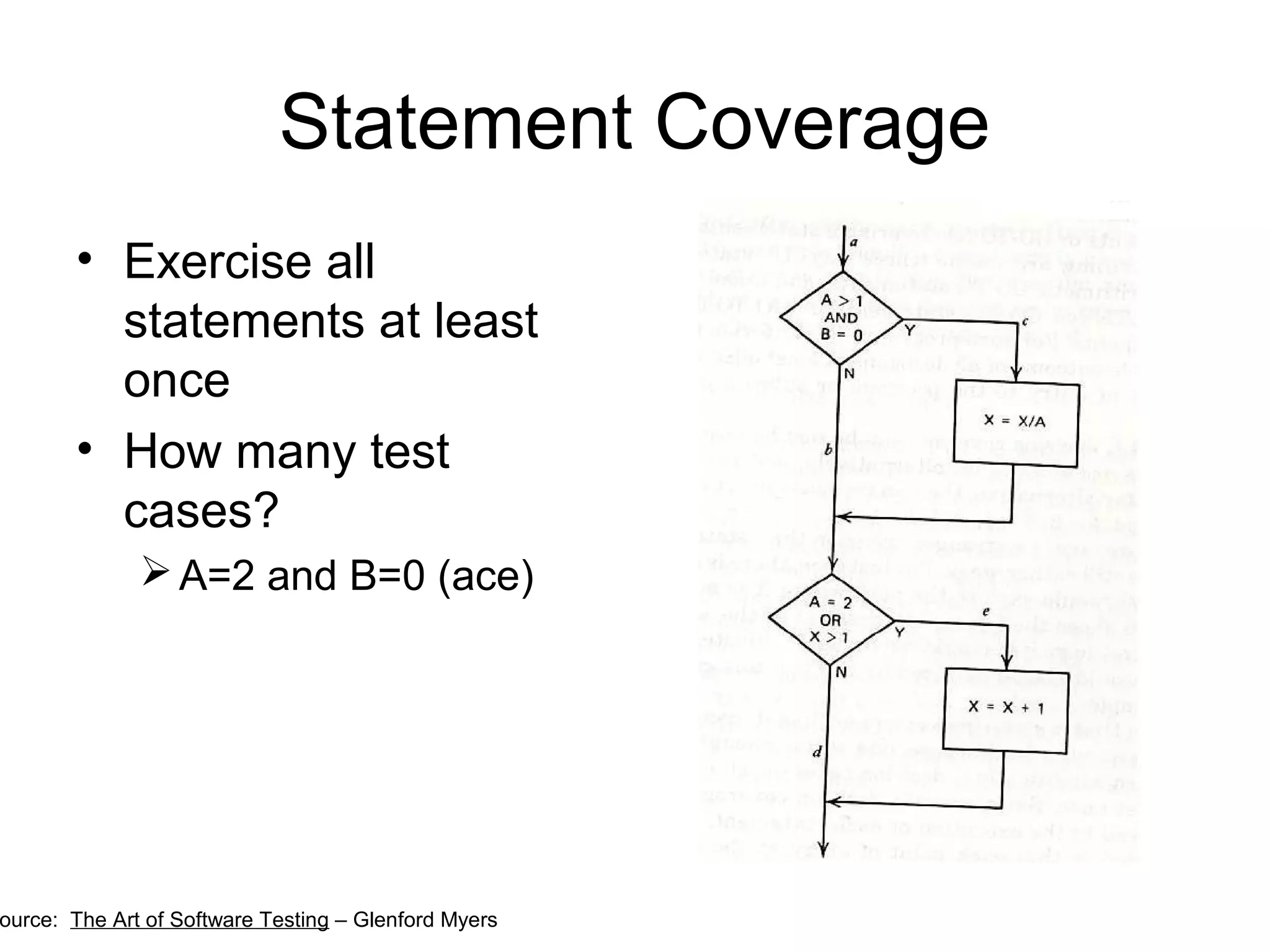
Statement Coverage 
• Exercise all 
statements at least 
once 
• How many test 
cases? 
A=2 and B=0 (ace) 
Source: The Art of Software Testing – Glenford Myers
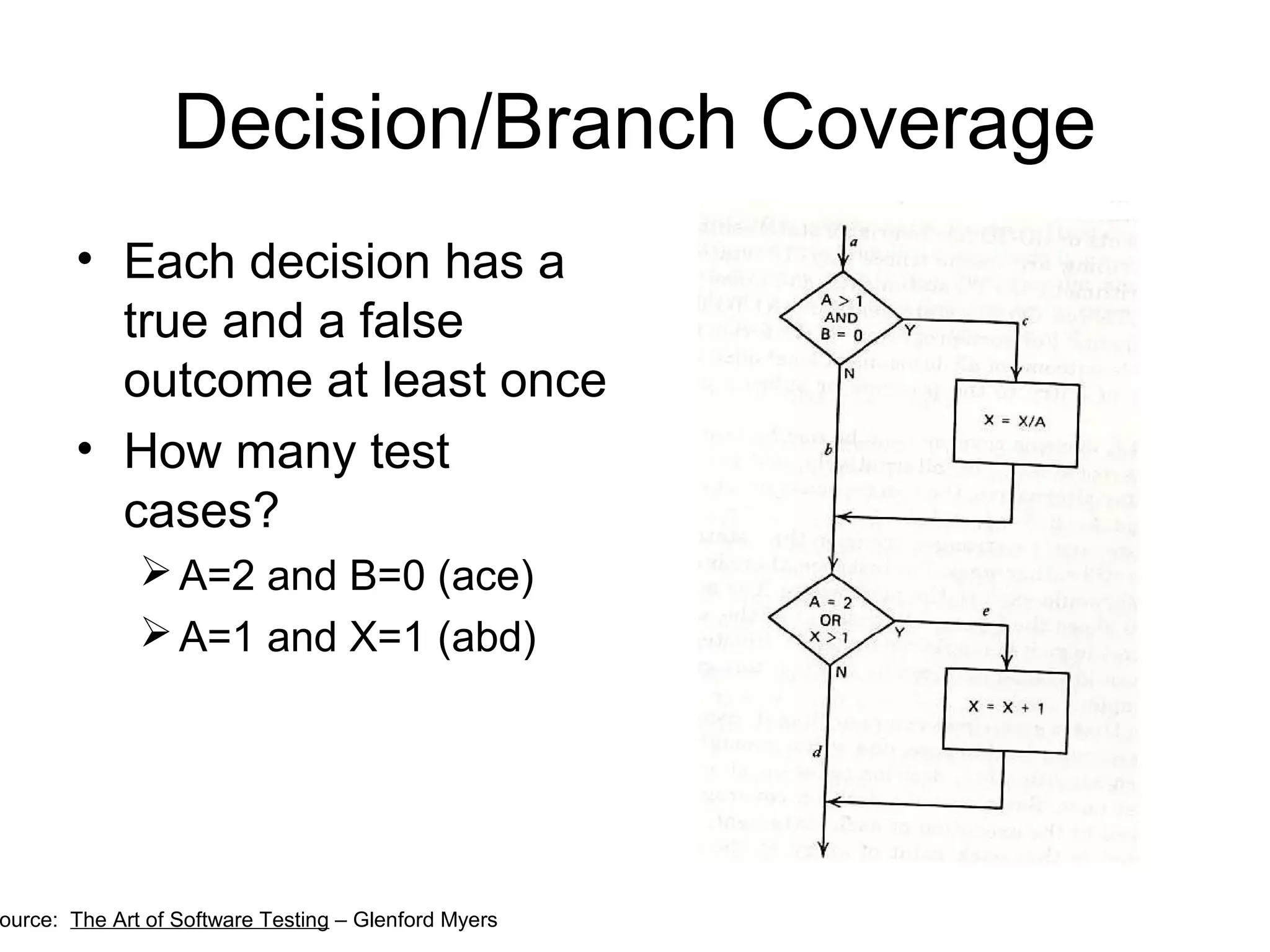
Decision/Branch Coverage 
• Each decision has a 
true and a false 
outcome at least once 
• How many test 
cases? 
A=2 and B=0 (ace) 
A=1 and X=1 (abd) 
Source: The Art of Software Testing – Glenford Myers
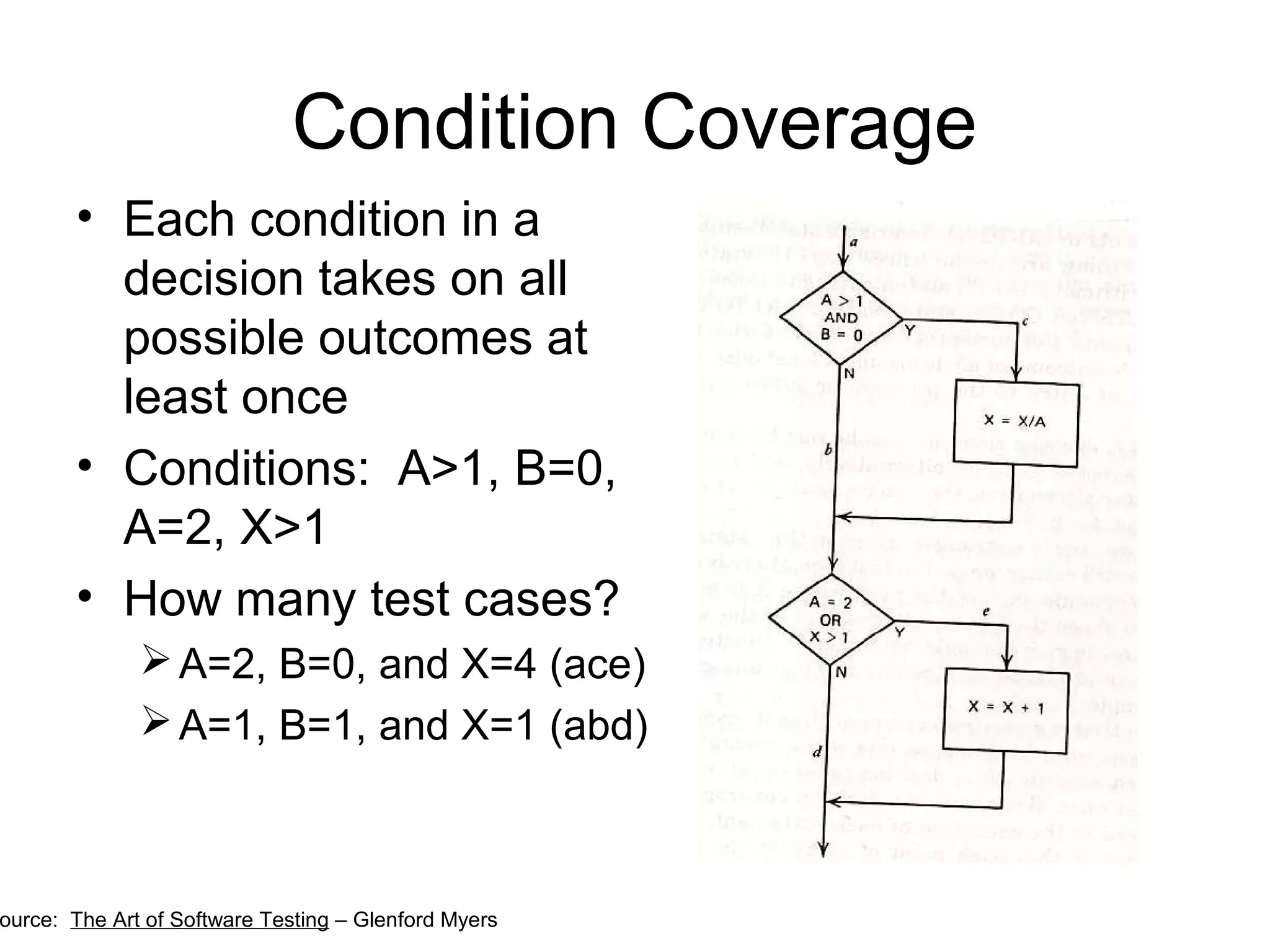
Condition Coverage 
• Each condition in a 
decision takes on all 
possible outcomes at 
least once 
• Conditions: A>1, B=0, 
A=2, X>1 
• How many test cases? 
A=2, B=0, and X=4 (ace) 
A=1, B=1, and X=1 (abd) 
Source: The Art of Software Testing – Glenford Myers
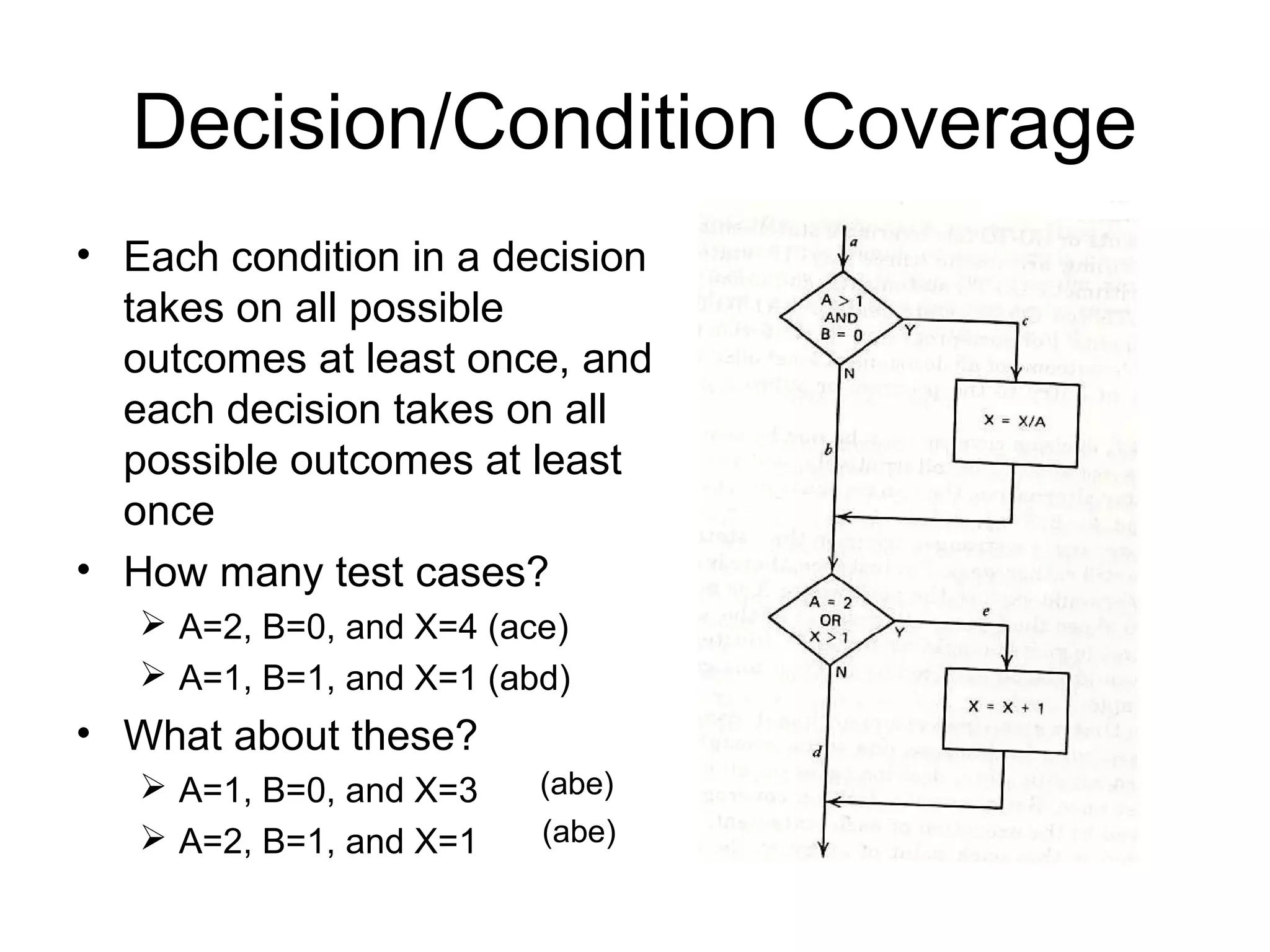
Decision/Condition Coverage 
• Each condition in a decision 
takes on all possible 
outcomes at least once, and 
each decision takes on all 
possible outcomes at least 
once 
• How many test cases? 
 A=2, B=0, and X=4 (ace) 
 A=1, B=1, and X=1 (abd) 
• What about these? 
 A=1, B=0, and X=3 
 A=2, B=1, and X=1 
(abe) 
(abe)
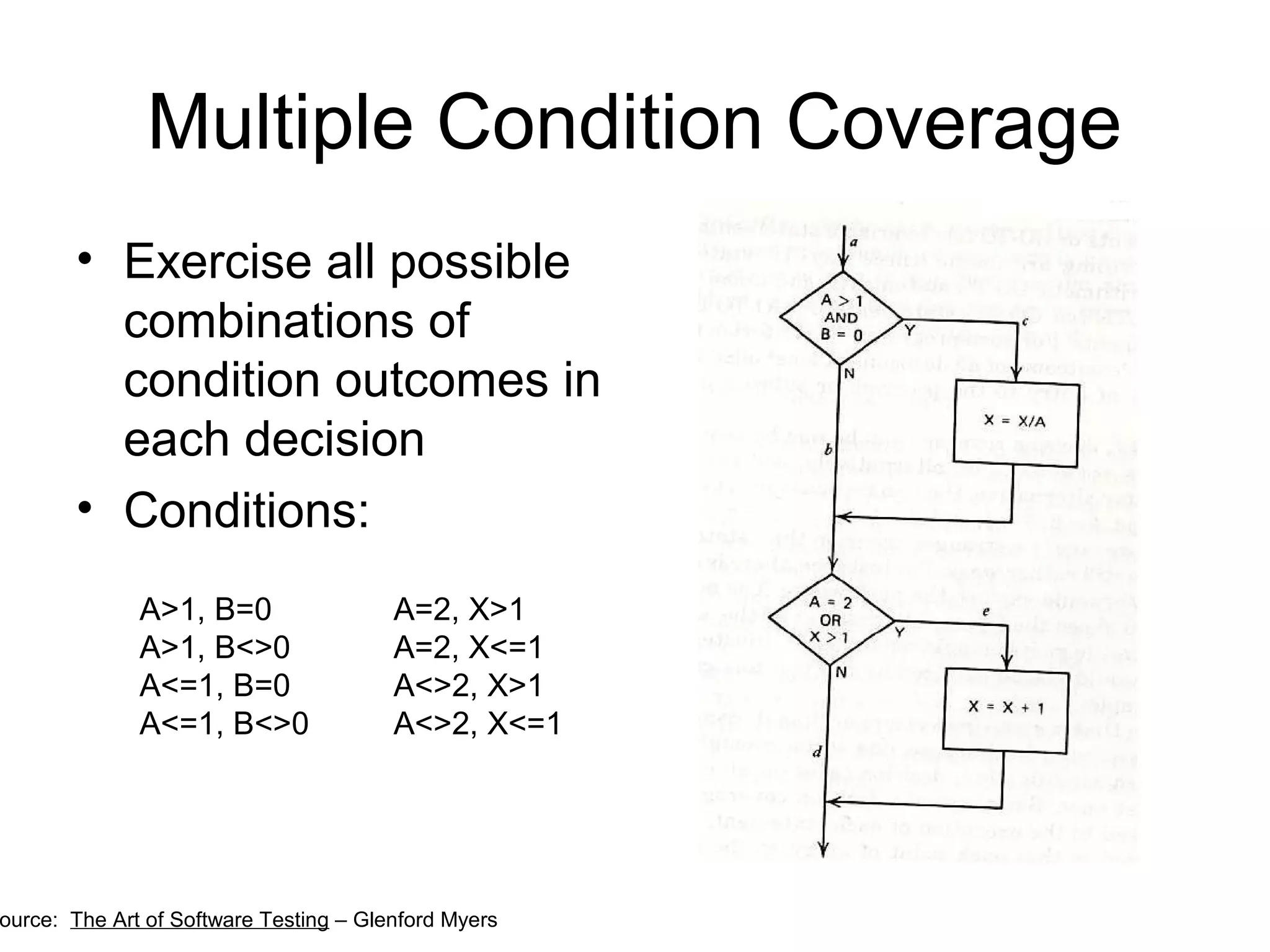
Multiple Condition Coverage 
• Exercise all possible 
combinations of 
condition outcomes in 
each decision 
• Conditions: 
A>1, B=0 
A>1, B<>0 
A<=1, B=0 
A<=1, B<>0 
A=2, X>1 
A=2, X<=1 
A<>2, X>1 
A<>2, X<=1 
Source: The Art of Software Testing – Glenford Myers
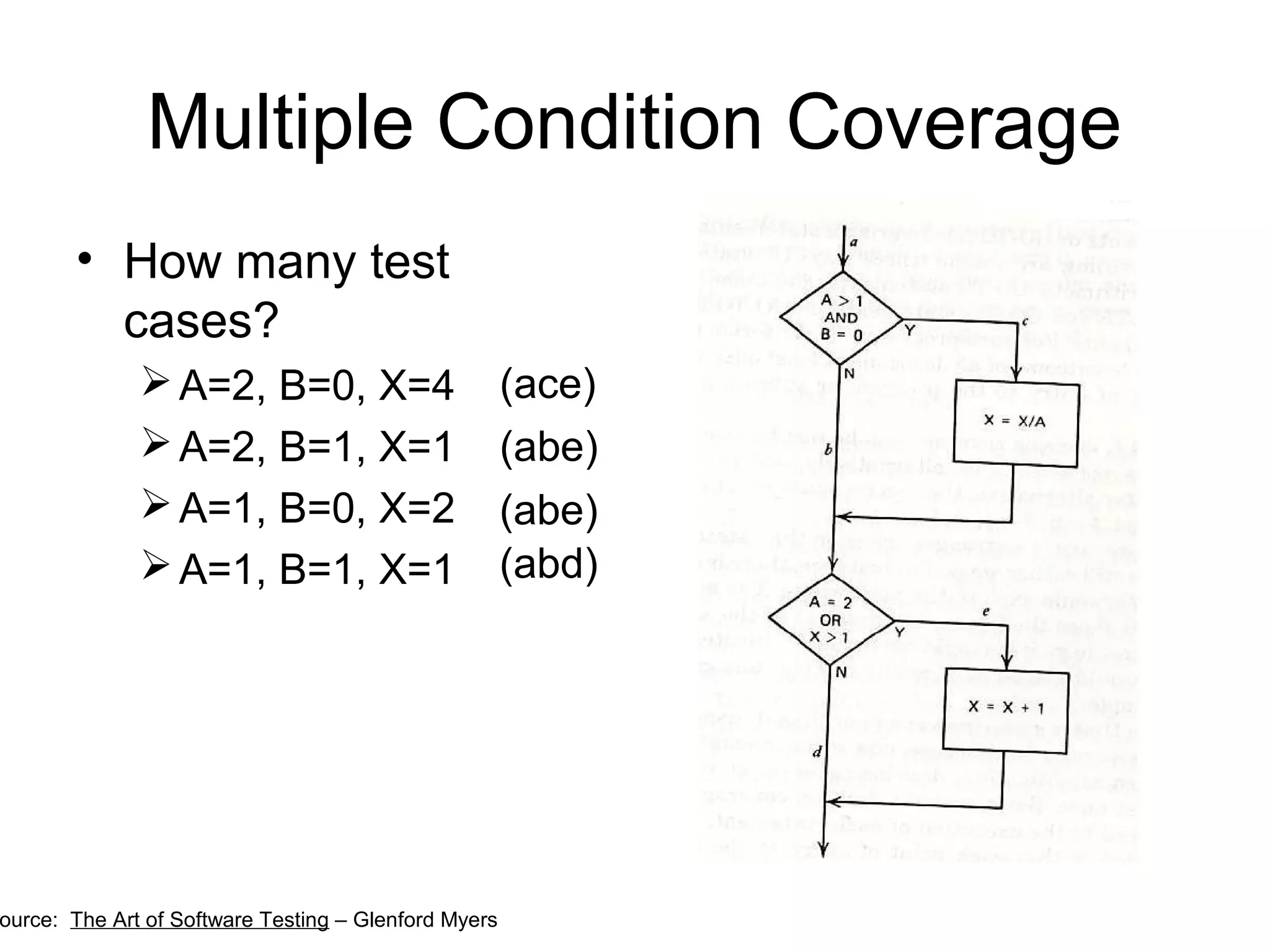
Multiple Condition Coverage 
• How many test 
cases? 
A=2, B=0, X=4 
A=2, B=1, X=1 
A=1, B=0, X=2 
A=1, B=1, X=1 
Source: The Art of Software Testing – Glenford Myers 
(ace) 
(abe) 
(abe) 
(abd)
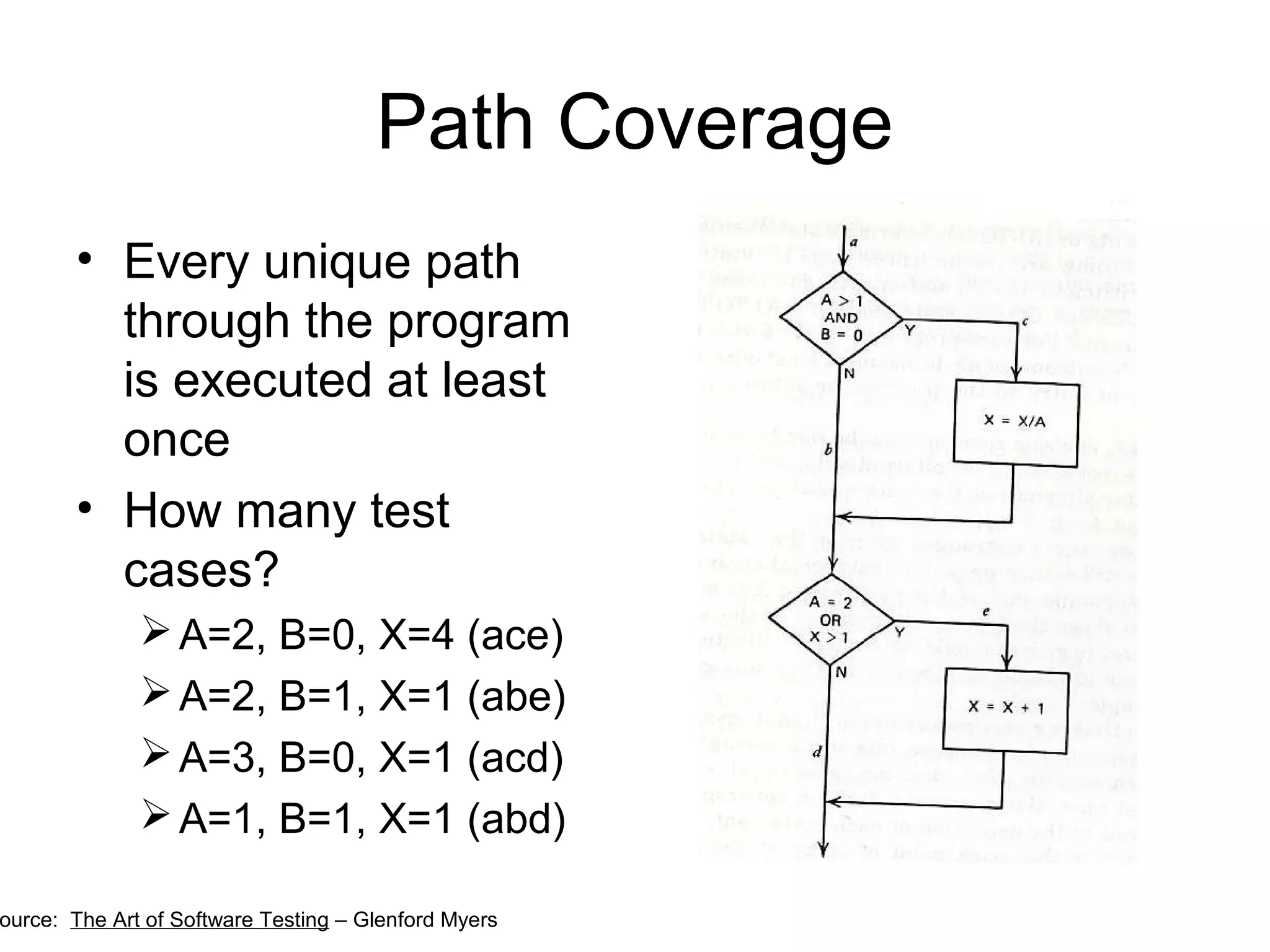
Path Coverage 
• Every unique path 
through the program 
is executed at least 
once 
• How many test 
cases? 
A=2, B=0, X=4 (ace) 
A=2, B=1, X=1 (abe) 
A=3, B=0, X=1 (acd) 
A=1, B=1, X=1 (abd) 
Source: The Art of Software Testing – Glenford Myers
McCabe’s Cyclomatic Complexity 
• Software metric 
• Developed by Tom McCabe (circa 1976) 
• Directly measures the number of linearly 
independent paths through a program’s 
source code, taking into account the 
various decision points 
• Independent of implementation language 
Source: Wikipedia
Calculating Complexity
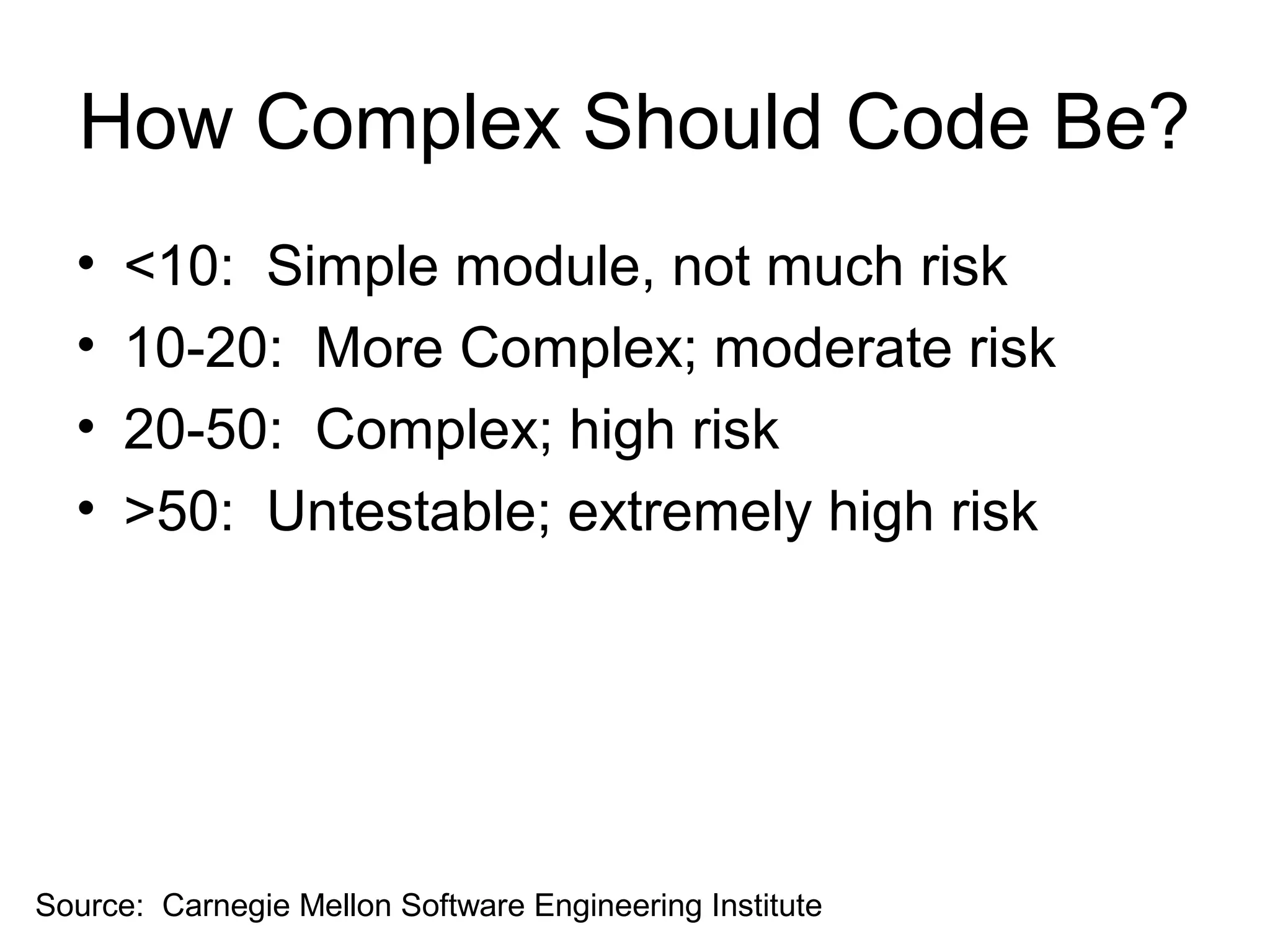
How Complex Should Code Be? 
• <10: Simple module, not much risk 
• 10-20: More Complex; moderate risk 
• 20-50: Complex; high risk 
• >50: Untestable; extremely high risk 
Source: Carnegie Mellon Software Engineering Institute
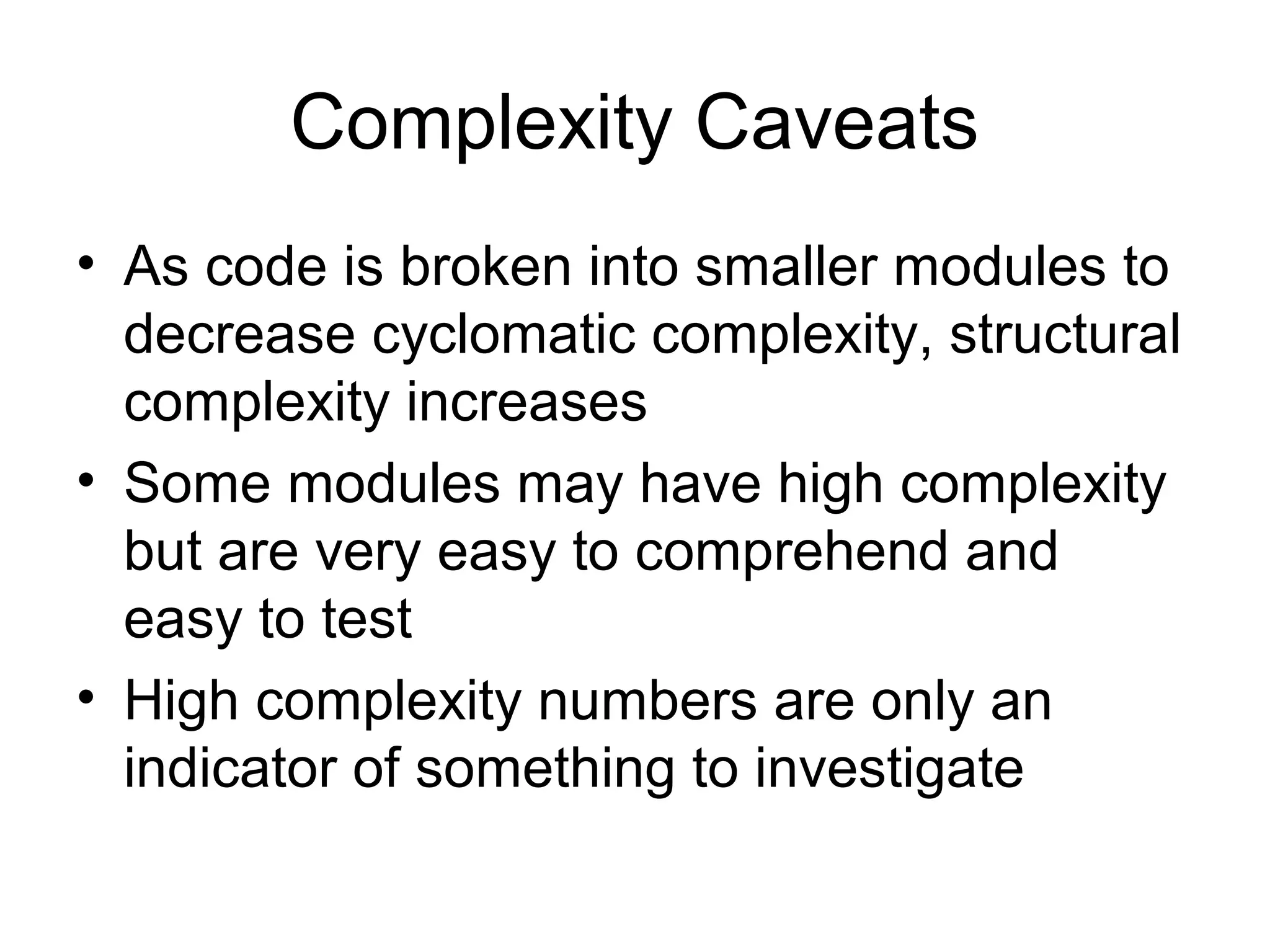
Complexity Caveats 
• As code is broken into smaller modules to 
decrease cyclomatic complexity, structural 
complexity increases 
• Some modules may have high complexity 
but are very easy to comprehend and 
easy to test 
• High complexity numbers are only an 
indicator of something to investigate
Questions?

White box testing-200709

  • 1.
    White Box Testing Len Schroath September 18, 2007
  • 2.
    Agenda • White-boxvs Black-box • Program Flow Controls • White-box Test Methods • Exercises • Complexity • Q&A
  • 3.
    What is White-boxTesting? • Looking at the internal structure of a program and deriving test cases based on the logic or control flow. • Test cases can be designed to reach every branch in the code and to exercise each condition • Typically done during unit testing • Also known as: – Structural Testing – Glass-Box Testing
  • 4.
    What is Black-boxTesting? • Looking at the program from an external point of view and deriving test cases based on the specification. • The only criteria upon which the program is judged is if it produces the correct output for a given input.
  • 5.
    Why Do Both? Black-box • Impossible to write a test case for every possible set of inputs and outputs • Some of the code may not be reachable without extraordinary measures • Specifications are not always complete White-box • Does not address the question of whether or not the program matches the specification • Does not tell you if all of the functionality has been implemented • Does not discover missing program logic
  • 6.
    Basic Program FlowControls • IF • IF-Then-Else • FOR • While • Do-While • Case
  • 7.
  • 8.
  • 9.
    FOR or WHILEDiagram
  • 10.
  • 11.
  • 12.
  • 13.
    Example Control FlowGraph Source: The Art of Software Testing – Glenford Myers
  • 14.
    Exercise #1 •int main (int argc, char *argv[]) • { • /* Process CTRL-C Interrupts */ • signal(SIGINT,catcher); • if (validate_command_line(argc)) return(1); • if (job_initialize(argv)) return(1); • processTestList(); /* Process all testCases in TestList */ • displayResults(); • fprintf(stdout,"Test Completen"); • job_termination(); • return(0); • } /* main */ Can you diagram this code?
  • 15.
    Did You GetSomething Like This?
  • 16.
    Exercise #2 /*Attempt Statusreadback - log SRB data to logFile */ int process_srb(void) { int srb_count = 0; do { srb_count = read_printer(srb_in); } while (!srb_count); fprintf(logFile,"%sn",srb_in); return(srb_count); } /* process_srb */ /* Write String to Printer via Parallel or Serial port */ void write_printer (char *outputline) { if (strstr(printertype,"PAR") != NULL) { bwrite_parST(printerport,outputline); } else if (strstr(printertype,"SER") != NULL) { bwwrite_serial(printerport,outputline,strlen(outputline)); } else if (strstr(printertype, "FILE") !=NULL) { fprintf(printerFile,"%s",outputline); } } /* write_printer */ Can you diagram this code?
  • 17.
    Did You GetSomething Like This?
  • 18.
    White-box Test Methods • Statement Coverage • Decision/Branch Coverage • Condition Coverage • Decision/Condition Coverage • Path Coverage
  • 19.
    Example Code Fragment • If ((A>1) & (B=0)) then Do; • X=X/A; • END; • If ((A==2) | (X>1)) then Do; • X=X+1; • END; • END; Source: The Art of Software Testing – Glenford Myers
  • 20.
    Statement Coverage •Exercise all statements at least once • How many test cases? A=2 and B=0 (ace) Source: The Art of Software Testing – Glenford Myers
  • 21.
    Decision/Branch Coverage •Each decision has a true and a false outcome at least once • How many test cases? A=2 and B=0 (ace) A=1 and X=1 (abd) Source: The Art of Software Testing – Glenford Myers
  • 22.
    Condition Coverage •Each condition in a decision takes on all possible outcomes at least once • Conditions: A>1, B=0, A=2, X>1 • How many test cases? A=2, B=0, and X=4 (ace) A=1, B=1, and X=1 (abd) Source: The Art of Software Testing – Glenford Myers
  • 23.
    Decision/Condition Coverage •Each condition in a decision takes on all possible outcomes at least once, and each decision takes on all possible outcomes at least once • How many test cases?  A=2, B=0, and X=4 (ace)  A=1, B=1, and X=1 (abd) • What about these?  A=1, B=0, and X=3  A=2, B=1, and X=1 (abe) (abe)
  • 24.
    Multiple Condition Coverage • Exercise all possible combinations of condition outcomes in each decision • Conditions: A>1, B=0 A>1, B<>0 A<=1, B=0 A<=1, B<>0 A=2, X>1 A=2, X<=1 A<>2, X>1 A<>2, X<=1 Source: The Art of Software Testing – Glenford Myers
  • 25.
    Multiple Condition Coverage • How many test cases? A=2, B=0, X=4 A=2, B=1, X=1 A=1, B=0, X=2 A=1, B=1, X=1 Source: The Art of Software Testing – Glenford Myers (ace) (abe) (abe) (abd)
  • 26.
    Path Coverage •Every unique path through the program is executed at least once • How many test cases? A=2, B=0, X=4 (ace) A=2, B=1, X=1 (abe) A=3, B=0, X=1 (acd) A=1, B=1, X=1 (abd) Source: The Art of Software Testing – Glenford Myers
  • 27.
    McCabe’s Cyclomatic Complexity • Software metric • Developed by Tom McCabe (circa 1976) • Directly measures the number of linearly independent paths through a program’s source code, taking into account the various decision points • Independent of implementation language Source: Wikipedia
  • 28.
  • 29.
  • 30.
    How Complex ShouldCode Be? • <10: Simple module, not much risk • 10-20: More Complex; moderate risk • 20-50: Complex; high risk • >50: Untestable; extremely high risk Source: Carnegie Mellon Software Engineering Institute
  • 31.
    Complexity Caveats •As code is broken into smaller modules to decrease cyclomatic complexity, structural complexity increases • Some modules may have high complexity but are very easy to comprehend and easy to test • High complexity numbers are only an indicator of something to investigate
  • 32.